Click here for the new Anchor Rising & Ocean State Current page

Open Thread: Ballot Question 1 , by Carroll Andrew Morse
Rhode Island History
1:30 PM, 10/24/10
Under Sgouros's Tapestry, by Justin Katz
Rhode Island History
9:40 AM, 08/ 7/10
Leadership Is Also About Timing, by Justin Katz
RI Governor '10
2:41 PM, 07/16/09
Plantation Fight: The Veiled Threats Begin, by Marc Comtois
Rhode Island Politics
12:00 PM, 07/ 6/09
Anti-'Plantations' Campaign Ramping Up, by Marc Comtois
History
10:00 AM, 07/ 2/09
The Mire We're In, by Justin Katz
Rhode Island History
7:33 PM, 03/17/08
Evolving Corruption, by Justin Katz
Rhode Island History
3:00 PM, 02/24/08
Reopening the Dorr, by Justin Katz
Rhode Island History
6:00 AM, 02/19/08
Anachronistic History: Ruth Simmons on George Washington, by Marc Comtois
History
6:00 AM, 08/22/07
A Firsthand Report on the President's Visit, by Carroll Andrew Morse
Rhode Island History
6:08 PM, 06/28/07
October 24, 2010

Open Thread: Ballot Question 1
The floor (aka the comments section) is open, for people who’d like to discuss why they will or will not be voting for or against the first question that will appear on the Nov. 2 Rhode Island ballot...
AMENDMENT TO THE CONSTITUTION OF THE STATE (CHANGING THE OFFICIAL NAME OF THE STATE)Voting yes will change the name of the state. Voting no will keep it as is.Approval of the amendment to the Title, Preamble and Section 3 of Article III of the Rhode Island Constitution set forth below will have the effect of changing the official name of the State from "State of Rhode Island and Providence Plantations" to "State of Rhode Island"
August 7, 2010

Under Sgouros's Tapestry
I recently managed to work my to-read pile of books down to Rhode Island 101, and I'll have more to say about it when I manage to work my to-write pile down that far. For the moment, though, it's relevant to note that the two commentary boxes offered in the "Economy" chapter are provided by two of the state's most active and extreme left-wingers, Josh Miller and Tom Sgouros. For his part, Sgouros takes the opportunity to push a "Top Five Myths About the Rhode Island Political Economy," the first of which is as follows:
1. Rhode Island's fiscal troubles stem from overindulgence towards unions and poor people. While personnel costs can't be ignored, the real culprit for our fiscal troubles is the 40-year building spree that suburbanized our state. Growing towns could finance services from the growth, which is fine, but only until the growth stops, which it has. Moreover, shrinking older cities saw their property tax bases decline, and when people fled Providence, Woonsocket, Westerly and even Newport, many of the suburbs they found were in another state.
The general response that I would make is that, while population is an inevitable occurance, it isn't exculpatory. It's a factor that public policy must manage, and indeed, the failure of the state's leadership to force adjustment among public sector workers and to address the role that welfare policies have played in affecting who migrates where are the key contributors to fiscal difficulties from a public-policy perspective.
But I bring up this first point of five that are eminently arguable because it relates to a response to Sgouros's recent op-ed that C. Kevin McCarthy submitted as a letter to the editor:
[Sgouros] trots out the tired old chestnut that the Blackstone Valley was a wealthy place in the 1950s based on its "taxable property per student in its schools."That is true only if pertinent details are willfully omitted. Taxable property per student ignores the many being educated by Bishop McVinney in the parochial-school system, at no cost to the taxpayer. Central Falls probably did have a high expenditure per "public"-school student in the 1950s.
When I was a student there in the 1960s, Notre Dame, Sacred Heart Academy, Holy Trinity and St. Matthew educated more children than the public schools. This pattern repeated itself all over the Blackstone Valley. There were some pockets of wealth in the North End of Woonsocket, in Oak Hill and Pinecrest in Pawtucket, and in rural areas of Lincoln and Cumberland, but the vast majority of Valleyites were middle class at best. Tom's misleading use of statistics won’t fool anyone who lived there.
The irony of Sgouros's general argument is that he blames government mismanagement for urban problems but concludes that the solution is more government management. The reason is that he wants to blame the government for the free movement of Americans out of cities so that he can push policies that will force them back — the better to manage and manipulate them.
In other words, he disagrees with the view that the government's job is to manage the society in which people actually want to live — adjusting its social and personnel policies accordingly — so that his friends in the unions and welfare industry can maintain the ground that they've claimed.
July 16, 2009
Leadership Is Also About Timing
Breaking new ground in Rhode Island's top political ranks, General Treasurer Frank T. Caprio has made public his daily calendars for the last 18 months, a move that not only shows how and with whom he has spent his time in office, but also the number of days he spent traveling outside Rhode Island on both state and political business.His daily schedules reflect a range of state, political and family commitments, from an "8:30 a.m. UN conference NYC," to a noon luncheon meeting described as "Lehman's/Capriccio" to "dinner with Gabriella & Frankie."
My impression of Rhode Island Treasurer Frank Caprio is that he's an unimpeachably honest guy, and he seems intent on running his campaign for governor in precisely the manner not only of an honest guy, but of an affable one: making up for the disadvantage of clean hands by keeping them in constant motion. During his ubiquitous appearances at state-level events of all sorts, Caprio is always the last to sit down — working the room, as they call it.
In that respect, he (or at least his image) is a welcome relief in a profession characterized by scheming and sleaze. The question is whether it makes him the man that Rhode Island needs in its top executive chair, just now, and his case has yet to be proven. He strikes me as the sort of leader a polity wants when it requires rest from the hard work of cleaning up government — after cleaning up the government. In those circumstances, the "right thing" has been clearly defined, and the society wants a chief who will apply it fairly and openly and recoil from immediate corruption.
Truthfulness is better than deception, of course, and straight laces better than knots. With Caprio, we can add in a better display of the correct impulses, compared with the erroneous ones of his likely competition. But that only makes him preferable — not adequate. What we need is not somebody who's affably honest, but somebody who's contentiously honest.
July 6, 2009

Plantation Fight: The Veiled Threats Begin
According to Senator Harold Metts, the people of Rhode Island had better drop their 'Plantations' or they'll be viewed as racists by the rest of the country. Metts, as reported by the Providence Business News, raised the specter of economic retribution should voters reject the removal of "Providence Plantations" from the official name of the state by likening the potential negative economic impact of keeping "Plantations" to that felt by Arizona when it held out against adopting the Martin Luther King Jr. holiday.
Metts, D-Providence, says he could see the same thing happening in Rhode Island, if voters reject the chance next year to shorten the state’s official name – the State of Rhode Island and Providence Plantations – dropping the “Providence Plantations,” which for many has become a controversial reference to slavery.And exactly why would there be so much news coverage? It's not going out on a limb to say that, up until now, 99% of the U.S. population (and probably 50% of Rhode Islanders!) had absolutely no idea about the "Providence Plantations" part of the name (much less that Rhode Island is even a state--I've been hearing about "Rhode Island, NY" for a long time). Until now, I think the reaction by most people when hearing about "Plantations" was the rhetorical "Huh." The irony is that Metts et al have set in motion a self-fulfilling prophecy thanks to this bit of "consciousness raising" about a heretofore unrealized problem.With all the national news coverage such a decision would receive, Metts said he wouldn’t be surprised if the state attracted fewer conventions and fewer tourists.
The most pragmatic argument against this issue is that there are other, more pressing matters that demand our legislators attention over a piece of feel-good legislation. But I also don't like the minimal gain that could be realized at the price of real history (not the naive misreading of it). URI historian Scott Malloy explained to the PBN the blinkered history being perpetrated:
The reference to Providence Plantation actually dates back to the founding of Rhode Island by Roger Williams when he settled in the area that is now Providence – after his banishment from the Massachusetts Bay Colony.It's a bit of historical quirkiness that lives on, nothing more. Like Molloy, I understand the motive behind the effort to remove "Plantations." I just don't agree. Further, I don't like the implication that opposing the removal of "Plantations" means anything other than a desire to maintain the traditional appellation of the place I live. It's really as simple as that.He called the settlement Providence Plantations in reference to the large amounts of acreage available for farming...Molloy said he could understand the minority community’s desire to remove the word “plantations” from the state’s name, particularly when considering Rhode Island was the “most notorious state in New England for the slave trade” in the 1700s.
But he added that “plantation” did not have its more contemporary connotation to slavery in the 1600s, when there were few if any slaves in Rhode Island. “It was a common usage in the British Empire,” he said.
“Some things ought to be righted, but this one doesn’t deserve it,” Molloy said.
July 2, 2009
Anti-'Plantations' Campaign Ramping Up
Still talking about 'Plantations':
Supporters of a plan that would give voters in next year’s general election the opportunity to strike the phrase “and Providence Plantations” from the state’s formal name, launched a public awareness and education campaign Wednesday....Backers say there is much work to be done if they are to persuade Rhode Island voters that the word “plantations” conjures up enough negative images of the state’s involvement in the slave trade to warrant a name change.Does a top-of-the front page placement signify anything about the ProJo's willingness to help persuade the public about the proposed State name change? I won't recount the history again. I suspect many, like Justin, while ambivalent about it don't buy the reasoning behind the proposal (the ProJo poll on the matter is running 8-1 against the name change). I also think the Phoenix's David Scharfenberg asks a good question: What happens if (when?) the ballot question fails?:“When I see that word ‘plantations,’ I start thinking about slavery. I start thinking about the injustices,” said Sen. Harold M. Metts, a Providence Democrat and a bill sponsor. “… It’s not about guilt. For me, it’s about healing.”
"The big issue is, what happens if it fails?" said Maureen Moakley, political science professor at the University of Rhode Island. "Where does it leave our notion of coming together and understanding? It could be divisive."The reaction from Rickman is unfortunate, to say the least. That the majority of Rhode Islanders voted for a black President trumps any such talk. If a majority of Rhode Islanders rejects the removal of 'Plantations' it won't be because they want to "insult the advocates of racial justice." It will because they recognize an exercise in political sophistry when they see it.There is no polling data on the issue. But there is reason for proponents to be concerned.
When Rhode Island settled on its official name in 1636, the word "plantation" did not have the connotation it would pick up some two centuries later — it referred, more benignly, to the farms on the state's mainland. And there are early indications that a tradition-bound state could resist calls to change a name that was not intended to invoke bondage....Fear of rejection is already percolating in the state's small black activist community. "I don't want the people of Rhode Island to insult the advocates of racial justice — and that's what a 'no' vote would be," said Ray Rickman, a consultant who once served as a state representative and deputy secretary of state.
March 17, 2008
The Mire We're In
If you haven't already read it, the final installment of Kenneth Payne's review of how Rhode Island reached its current state of political mire. One key thing to remember, as wrangling over budgets and state government action continues:
The General Assembly's powers are plenary and unlimited, except as those powers are restricted by the U.S. and the Rhode Island constitutions. As the historian and lawyer Patrick T. Conley put it in 1999, the executive and legislative branches are "neither separate nor equal."
Sometimes one gets the impression that the only reason dead voters let the Republicans win the governor's seat is to secure a scapegoat.
February 24, 2008
Evolving Corruption
Part 2 of Kenneth Payne's series on the evolution of political corruption in Rhode Island is worth a read (emphasis added):
The forms of government were familiar. For those in control, the system worked. The Yankee establishment held the reins of power.The State House was an expression of that power — political and economic. Rhode Island was urbanizing, industrializing and generating wealth. Cities were burgeoning with immigrants. Together Providence, Pawtucket, Central Falls, and Woonsocket held more than half of the people in Rhode Island. Yet in 1901, political power was consolidated and effectively placed beyond popular control. ...
Three sections at the end of Chapter 809 became infamous and merit a full reading. While their tone is matter of fact and lawyerly, their effect was a stark fixing of undemocratic power.
It might be interesting also to keep an eye on the Projo's advice columns for submissions by despairing readers of Payne's series.
February 19, 2008
Reopening the Dorr
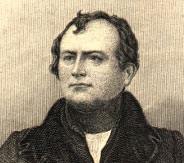 I'm disappointed to see that the Providence Journal is apparently not printing Kenneth Payne's series on Rhode Island's political history online. It's worth a look, if you've access to Sunday's paper. This paragraph, in particular, caught my attention:
Rhode Island government in 1900 was still colored by the dark shadows of the Dorr War, the brief, armed insurrection in 1842 that had sought to win greater fairness in the Rhode Island political system, including by extending manhood suffrage and by reapportioning the House of Representatives. After the Dorr War, Rhode Island electors approved a constitution that replaced the old Royal Charter of 1663. But the new "Law and Order" Constitution was not a liberal extension of political rights; it preserved the existing system of dominance by property-owning and native, mostly Protestant, men.
Being a non-native, I've had no reason to become acquainted with the biography of Thomas Dorr, but at first blush, it appears that we moderns would do well to resume his cause.
August 22, 2007
Anachronistic History: Ruth Simmons on George Washington
In a ProJo story about the annual reading of George Washington's Letter to the Touro Synagogue in Newport, Brown University President Ruth Simmons is quoted thusly:
She touched upon the moral contradictions underlying the noble desires of past leaders who were eager to uphold freedom, despite an indifference to the injustice of slavery.This is simplistic. Historians agree that Washington's views on slavery certainly evolved from his early manhood up until he freed many of his slaves in his last will. For Simmons to opine that he "fail[ed] to apprehend the corrosive evil of slavery and the immoral inequities that it was to create for generations of descendants" betrays a blindered view of history. The fact is, Washington was hardly indifferent and fully recognized the evils of slavery.“We all know that these lofty and compelling ideals were largely omitted from discourse when it came to Africans and Native Americans.… In failing to apprehend the corrosive evil of slavery and the immoral inequities that it was to create for generations of descendants, Washington compromised his legacy as a moral leader,” she said.
Continue reading " Anachronistic History: Ruth Simmons on George Washington"
June 28, 2007
A Firsthand Report on the President's Visit
Will Ricci, East Providence Republican City Committee Treasurer, National Federation of Republican Assemblies Regional Vice-President, and most importantly, frequent Anchor Rising commenter was able to attend today’s Presidential visit to the Naval War College in Newport. Will sends along his impressions, observations, and a photograph from the event...
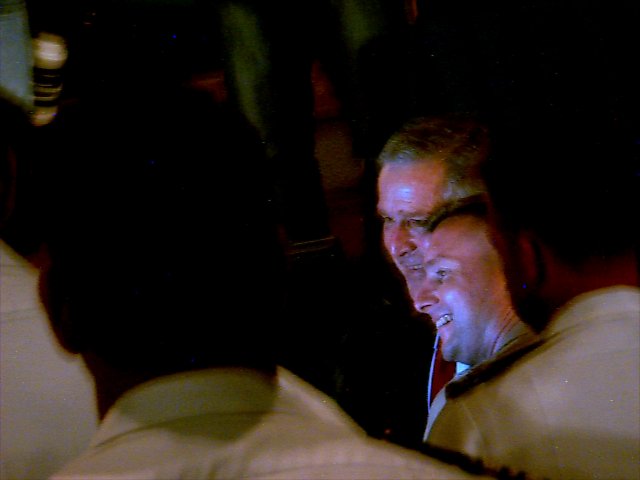
Will Ricci: I had the opportunity to attend the President's address at the Naval War College earlier today as a guest of the Governor, with a handful of other local Republicans. The audience was heavily populated with Navy officers, with a great many guests from other countries. I was seated less than 50 feet away (about ten rows) directly in front of the President's podium. The program began a little late at about 11:15 am.
There was a funny moment right at the beginning, when the unseen announcer said, “Please welcome the President… of the Naval War College, Rear Adm. Jacob Shuford”. Everyone broke out in laughter. The admiral made some brief remarks and then quickly introduced the President, who then appeared on stage with Gov. Carcieri to the sounds of Hail to the Chief. After a long standing ovation, everyone was seated. Gov. Carcieri then delivered some welcoming remarks behind the Presidential podium (he looked comfortable there), and then the President dove right into his speech.
The speech was heavily focused on terrorism, with an emphasis on what's going on in Iraq right now. Much of it had to do with sharing information that the mainstream media doesn't like to cover, such as that we're winning! I won't go heavily into the substance of the speech, as I assume the local media will cover that ad infinitum. The President showed some very interesting maps and diagrams on the monitors behind him demonstrating the progress that we've made, both before and during the surge. All I can tell you is that he had the audience at his full attention for the entire speech, which lasted about an hour, and that he covered a considerable amount of detail. He was not using a teleprompter, and used his notes only sparingly. It made me feel pretty good that he had such a clear understanding of what is at stake in Iraq and elsewhere. He didn't make any gaffes or other "Bushisms." He came off as human, genuine, and very engaged.
After the speech ended, I think he surprised everyone by asking the audience for questions. They weren't planted questions. He stayed for about another 15 minutes or so and answered all sorts of questions ranging from relations with Great Britain and Columbia, to ongoing diplomatic efforts with North Korea, and the use of naval forces around the world in the future. He made an effort to single out Venezuela and Cuba as places of interest in this hemisphere, and made a comment which I think the media might pick up on regarding Fidel Castro. I believe it started with "when the Lord calls Fidel ... away" (not home). It got a few approving nods.
PS As for protestors, unless they were hiding, there were virtually none. We saw ONE protestor at the main gate coming in, and I believe three outside when we left. It was paltry in any case.
May 31, 2007
UPDATE II: Obligatory Buddy Cianci Post
Following up on previous updates, no word yet on what Buddy had for lunch...
UPDATE I: Obligatory Buddy Cianci Post
Just an update to Andrew's Buddy Cianci Post.....Update complete.
April 2, 2007
Elaborating on MacKay's Immigration History
Scott MacKay's immigration piece in the Sunday ProJo was a good piece of historical writing. However, and inevitably, it will be used by some as proof for their arguments in the contemporary illegal immigrant debate. Namely that the U.S. has "historically" allowed all immigrants, whether illegal or not.
My first thought after reading the piece was that, while historically accurate, it doesn't necessarily reflect the situation that confronts us now. To be fair, though, this was only the first in a series (at least according to the ProJo), so I don't want to take MacKay to task when I don't know what else is forthcoming. However, I do suspect that there is an attempt to link the past with the present rather too directly--and some of MacKay's writing has the air of polemic rather than reporting.
Perhaps the issue that stirs the passions the most is that the primary difference between the immigrants of then and now is that the U.S. did not have the current social welfare apparatus in place. As such, the tax dollars of American citizens didn't go to support the immigrants of yesteryear. Instead, the immigrants worked hard for what they got. Were the conditions deplorable? Yes. Did they face racism and xenophobia? Yes. But to conflate then with now is simply not accurate.
MacKay writes about how French-Canadians were resistant to be assimilated into the U.S. culture and society. That is entirely true and I deal extensively with it below. He seems to be emphasizing this for the sake of invoking compassion for today's immigrants--and by doing so he conflates the legal/illegal distinction--but there is another way to look at it. Instead of using it as an excuse for today's immigrants, the difficulties encountered by the French Canadians as they attempted to cling to la survivance can also be used as an object lesson.
I don't think anyone will argue that chances are that the quicker an individual can acclimate to our culture and learn our language, the quicker he can succeed. That does not mean that Americans should denigrate or dismiss the various cultures of the immigrants--and we must keep in mind that there are waves of immigrants, which can obscure any acute progress in cultural education that is being made--but it does mean that we shouldn't let our compassion or forbearance be taken for granted. Today's immigrants should learn the "American way" as soon as possible and be encouraged to do so. That does not mean that they will be or should be somehow forced to forget their own culture.
Another point is that there was no such thing as "illegal immigration" until the U.S. passed laws saying so. MacKay deals with this, and although he certainly ascribes nefarious motives for the passage of the these laws, they were passed in reaction to a specific problem. Americans believed that too many people were coming in, too fast. Regardless of the ofttimes despicable reasoning behind the original passage of these laws, they are still the law and most Americans want to keep it that way.
By limiting immigration, the laws--if properly enforced--would actually reduce the current level of acrimony. They help to throttle back on the "incursion" of "the other" (to use a favorite academic term)--they make the waves smaller--and make it easier for those immigrants who enter the country legally to assimilate into the U.S. If these laws weren't so popular amongst Americans--including legal immigrants--then I don't think that some illegal immigration apologists would so consistently conflate the difference between illegal and legal immigration.
Overall, I find it interesting that much of this recounting of history is deemed pertinent because it apparently supports the argument that goes something like this: we've always had these immigration problems in the U.S. so why is it such a big deal now? What's missing from MacKay's accurate re-telling of history is any sense of learning from the lessons of the past. (Though, as I indicated, perhaps that will be present in the next story). Since when have progressives taken to premising their arguments upon the notion of "that's the way it's always been..." to argue for what it should be now? Usually they take what they know of history and try to identify a better way of dealing with the problems that were encountered. In this case, it seems like they're really just saying that everything is fine, let's move on.
In the extended portion of this post, I've tried to elaborate a bit on some of the unsaid implications in MacKay's piece by calling upon my own research into French-Canadian immigration during the post-Civil War era. To do this, I've excerpted liberally from a 4-part series on the topic that I've posted at Spinning Clio. (For important background--and full sources--see these posts on French-Canadian immigration before the Civil War and French-Canadian involvement in the Civil War, portions of which are included in this post).
Continue reading "Elaborating on MacKay's Immigration History"March 7, 2005

Rhode Island's Greatest Soldier
I had the opportunity to review a very fine book on Nathanael Greene for Sunday's edition of the NY Post. The review is here. Rhode Island must of course atone for Ambrose Burnside. Fortunately for Rhode Islanders, whenever anyone makes fun of Burnside, they can point out that, second only to Washington, Greene was the soldier most responsible for
American success in the War of Independence.

 About Community Crier

 About Engaged Citizen