Click here for the new Anchor Rising & Ocean State Current page

Spring into Summer Conference at Portsmouth Institute, by Justin Katz
Religion
8:15 AM, 04/15/13
If Spiritual Battles Gave Off Sparks, by Justin Katz
Religion
7:54 PM, 03/31/13
Fish on Fridays, by Carroll Andrew Morse
Religion
11:59 AM, 03/29/13
Re: Keep Christ in Christmas, but the Government Out, by Carroll Andrew Morse
Religion
12:15 PM, 11/30/12
The Messiah May Have Used the Word "Wife", by Justin Katz
History
2:07 PM, 09/29/12
Things We Read Today (15), Thursday, by Justin Katz
Civil Liberties
7:50 PM, 09/20/12
Rev. Rich Takes a Stand Against Small Children, by Justin Katz
Culture
10:14 AM, 09/ 1/12
Portsmouth Institute, Day 3: Rev. Nicanor Austriaco, "What Can Genomic Science Tell Us About Adam & Eve?", by Justin Katz
Science
6:54 AM, 07/11/12
Portsmouth Institute, Day 2, Session 4: Dr. Michael Ruse, "Making Room for Faith in an Age of Science", by Justin Katz
Religion
6:20 AM, 07/10/12
Portsmouth Institute, Day 2, Session 3: Kevin O'Brien as Dom Stanley Jaki, by Justin Katz
Religion
6:53 AM, 07/ 9/12
April 15, 2013

Spring into Summer Conference at Portsmouth Institute
With spring more or less undeniably having arrived, we're coming up on one of my favorite weekends of the year. This year, the Portsmouth Institute's annual conference is June 7-9, and the topic is "Catholicism and the American Experience," which is certainly timely, given that American bishops are actually beginning to near the short-list for Pope, with Boston's Cardinal Sean O'Malley's having just been appointed to a Vatican advisory board.
Had he won, I could actually have claimed to have met the Pope. O'Malley was the bishop in Fall River when I converted to Catholicism in that city. As it happens, another bishop of my acquaintance is speaking at this year's conference: Providence Bishop Thomas Tobin is on the speaker's list.
Other speakers of whom readers of a conservative Web site should take note are George Weigel and Roger Kimball. Although I'm not as familiar with his work, I suspect Peter Steinfels will offer somewhat of a different perspective, as a former editor of Commonweal and religion correspondent for the New York Times. And of course, the musical performances and excellent meals propel the entire experience to otherworldliness.
Long-time readers of Anchor Rising will have seen my reports from previous years' conferences, but for a reminder or a sampling of what the conferences are like, take a look at our archives:
- 2009: "The Catholic William F. Buckley, Jr."
- 2010: "Newman and the Intellectual Tradition"
- 2011: "The Catholic Shakespeare?"
- 2012: "Modern Science, Ancient Faith"
It's amazing to think that this will be the fifth of these conferences. It's even more amazing to think of all that's happened in the world since they began. I recommend attending for a number of reasons, but perhaps the most profound is the much-needed perspective that the intellectual content and spiritual experience lends to the seemingly rapid and perilous pace of modern life.
March 31, 2013
If Spiritual Battles Gave Off Sparks
It’s been a while since I’ve seen it, so I had intended to watch The Passion of the Christ on Good Friday. But life’s being what it is, these days, I couldn’t manage the 126 minutes required. And by the time Saturday rolled around, it felt more appropriate to turn attention toward the Resurrection, which took up only about the final minute of the film.
So, at the end of an exhausting Holy Week of sick children and the consequent sleepless nights, my wife and I turned toward more explicit entertainment, with Christian messages mainly in its metaphors. We watched the first installment of The Hobbit.
The interplay of the thoughts about the two movies brought to mind an impression I took away from the Portsmouth Institute conference on Cardinal Newman in 2010: We have a habit of insisting that the reality of God ought to make the world something different from what it is, and then we blame Him for not making the world what it is not.
Either God exists within the world as we experience it, or He does not. Waiting for crosses burning the sky merely postpones the decision to believe, and as demonic faces in the explosion on September 11, 2001, proved, if you haven’t already decided, it would be awfully difficult for a supernatural sign to be decisive on its own.
More specifically, though, during the various speeches and presentations of the 2010 conference, I remember having the sense that the speakers were fundamentally talking about the reality of spiritual battle. Somehow, it seems, the modern imagination has atrophied in its capacity to believe in that which it cannot see.
With all of our gadgets and the nigh-upon-disprovable reality of video’s special effects, we need the light show. If a priest's counsel of a severely distraught person involved bolts of energy and explosions, few would doubt. If the long process of liberating people from possession by evil ideas came as wizards’ battle of wills and the revivification of the healed victim came with instant physical change, none would question the reality of the evil and the good.
In all respects, the ailment and the fact of being healed might be equivalent, but we look to the visible battle as the mark of reality. So, since we don’t experience magic in the world in the same way that we can imagine it in a movie, it seems all too plausible that nothing else that we can’t visibly see in life exists, either.
Further, in fiction we have no trouble placing the material in partnership with the spiritual, or the magic. Inadequate as swords may be against trolls, they offer some protection from the mystical. A robotic bird can be one wonder of many in a quest of gods and monsters.
Yet, in life, when human ingenuity gives us tools to fight the forces of evil and corruption, as well as the harmful vicissitudes of the world, as we learn how to manipulate chemicals to affect physiology and psychology, we conclude somehow that all must be material. I’d suggest that bombs and bullets can subdue military enemies, but performing the spiritual feat of changing people’s minds might be more powerful, still. Antidepressants may ease the sensation that unseen and down-pulling hooks are buried deep in every follicle, but imparting meaning and hope to each others' lives can be liberating without the drugs.
In that regard, the quick presentation of the Resurrection in The Passion carried the message well. Materially, we see a naked man in a tomb with a hole in his hand, stepping forward to martial music.
If we know the Bible, we know that, having returned from death, Jesus' main action was to have some conversations. There is some mention of the special effects, as it were, in His final appearances, but the miracle exists mainly in His appearance — that He’s among us.
We’ve celebrated Easter, yet again, and life will go on as it has. As for light shows and magic, I’m increasingly convinced that the decision is not one of determining what it means that they do not happen, but of observing that they do.
March 29, 2013

Fish on Fridays
Nothing symbolizes the supposed arbitrariness of religion to those predisposed towards skepticism towards religious belief more than does the Catholic practice of eating fish on Fridays during the season of Lent. I’ll admit to having asked myself, especially on Good Friday, what connection there is between fish and the crucifixion of Jesus Christ. And then there is the philosophical paradox. If my soul is lost after I’ve eaten meat on a Lenten Friday, does that mean I’m free to commit worse sins without making my situation worse? But if the rule doesn’t really matter, then why follow it? And on and on and on and on…
Here’s what I do know. With the choice of fish options available to a 21st century American, eating fish on Fridays is about as small a “sacrifice” in a material sense as can be asked for. But honoring the rule does require me to make some conscious choices that run contrary to what the surrounding culture tells me are cool and sensible. And if I am unable to make this small sacrifice, because I find it too inconvenient, or because I’m afraid to explain myself to others who don’t share my belief or who might think that I’m being just plain silly, then on what basis can I believe myself to be capable of taking a stand in more serious situations, when the choices might be a little harder and the stakes a bit higher?
Slightly edited re-post of an April 6, 2007 original.
November 30, 2012
Re: Keep Christ in Christmas, but the Government Out
I don't believe it's fair to blame WPRO (630AM) talk show host John DePetro for "manufacturing" the controversy about the Rhode Island Christmas tree/holiday tree.
The blame rests squarely with Governor Lincoln Chafee, who is claiming the authority to rename a religious symbol because he is the head of the state. (Bill O'Reilly is wrong when he says Christmas trees are a secular symbol).
To Governor Chafee and some of his extreme-liberal fellow travelers, it's just plain obvious that "separation of church and state" means that government has inherent authority to rename religious symbols. To other Rhode Islanders, many Rhode Islanders, the possession of such a power by government officials isn't a slam dunk.
When Governor Chafee tries explaining why government should involve itself with renaming religious symbols, he generally isn't very convincing and, as a result, often prefers to take the discussion towards declaring that there shouldn't be so much opposition to his decision because publicly voiced dissent, he believes, could create chaos. Or maybe dissent, on this issue, in the Governor's mind, is chaos.
These, in the end, are the two sources of the continuing Rhode Island Christmas tree controversy: a Governor who asserts that his office as head of state comes with the power to rename religious symbols and said Governor's intolerance for dissent from that position. That much public questioning occurs about the wisdom of both these propositions is not just acceptable but healthy.
September 29, 2012
The Messiah May Have Used the Word "Wife"
Of one thing, we can be reasonably confident: Coverage of proof and arguments against that sliver of papyrus purporting to prove that Jesus had a wife will have a far smaller profile than the initial boom of proclamations that it had been discovered.
Not surprisingly, the Vatican has stated its opinion that the artifact is "counterfeit," but what I found most interesting about the article is that it's the first time I've seen a picture of it:
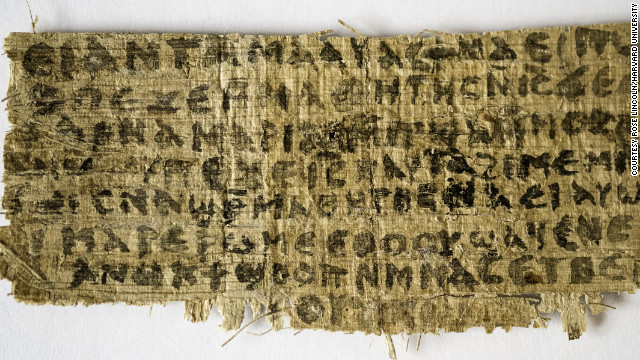
I'll confess, off the bat, that I'm not able to read ancient Coptic text, but unless it's a remarkably compact language, that's really not much context on which to come to any conclusions. The paragraph before could have made clear that it was a parable. The paragraph to follow might have been an explanation of the Church's view that it (the Church) is the "bride of Christ." Or the whole thing might be some piece of nefarious propaganda.
I don't know, one way or the other, but the credulity with which such items are passed around is telling, especially with regard to the news media and the stories that it deigns to amplify.
September 20, 2012
Things We Read Today (15), Thursday
Issuing bonds to harm the housing market; disavowing movies in Pakistan and tearing down banners in Cranston; the Constitution as ours to protect; the quick failure of QE3; and Catholic social teaching as the bridge for the conservative-libertarian divide.
September 1, 2012
Rev. Rich Takes a Stand Against Small Children
Back when the Episcopal/Anglican Church was finding itself fraught with international internal turmoil over the appointment of an openly and actively homosexual bishop in New Hampshire, Catholic writer and blogger Mark Shea predicted, as an aphorism, that the organization would gradually turn toward the promotion of homosexuality. I always considered that a plausible, but not inevitable, course of the future.
After crossing an intellectual line, human organizations have a tendency to correct for excess, to transform into something unrecognizable, or to fade into non-existence. Shea's prediction was of the second category, but either of the other two (or even other variations of the middle one) remain possible for the Episcopal Church.
Rev. Timothy Rich, a relatively new rector at St. Luke's Episcopal Church in East Greenwich gives some evidence that Shea's prediction has certainly not been negated. Previously, it's interesting to note, Rich worked very closely with the aforementioned homosexual bishop, Eugene Robinson, as an assistant and Canon in New Hampshire.
During a summer in which Boy Scouts of America affirmed its policy of excluding "open and avowed homosexuals," Rev. Rich determined to investigate whether his church had any connection with the group. It turned out that a local Cub Scout pack — mainly boys aged six to eleven — uses the church for meetings.
The fifty boys involved are a bit young for the policy to have much effect, and Cub Master Jeff Lehoullier indicates that Pack 4 would do nothing to actively enforce the rule, even if it applied to pre-adolescent children. And who's to say but that by the time these actual flesh-and-blood children nearest Rich's flock reach the age of Eagle Scout, the organization won't have changed its view?
But Rich has some modicum of power, and he feels he must use it to "take a stand" against a national organization with which the church under his authority has a very limited, indirect relationship. That his action might have an adverse effect on dozens of the community's children — and that, by his action, he appears to be the one propagandizing a culture-war position beyond their ken — is a secondary consideration.
If radical rectors are to force a change in Boy Scout policy from the outside, thousands and thousands of children will have to be thus harmed and made to feel dirty and excluded by adults who ostensibly hold offices of respect in their community. Rich insists that, when it comes to the individual boys, he "support[s] them and applaud[s] their efforts," but apparently, when more than one of them gather together, they must be cast out and scorned.
No doubt, he's flattered by the media attention (his humble claims notwithstanding), and no doubt many people whose opinions he values highly have figuratively and literally slapped him on the back. The rest of us ought to question the motives and assumptions behind the movement of which he's made East Greenwich a part.
ADDENDUM:
I realize that a good portion of readers don't find discussion of scripture all that persuasive, but some further thought on this matter led me to an observation that definitely merits mention.
While reading comments on the East Greenwich Patch article on this issue, a phrase from the Bible came to mind: "Let the children come to me."
It's from Matthew 19, and the expanded passage is worth consideration.
Just before the disciples attempt to prevent the children from approaching Jesus, He has been explaining that the Old Testament permission to divorce should not apply to His followers because, "from the beginning the Creator 'made them male and female'... For this reason a man shall leave his father and mother and be joined to his wife, and the two shall become one flesh."
The disciples object that the teaching is so hard that "it is better not to marry." And Jesus suggests that some are "incapable" of marriage. Some translations of the Bible have Jesus referring to such people as "eunuchs."
Again, I realize that not everybody assigns spiritual weight to the Bible, but I would think that a Christian preacher would be inclined to do so. And this passage has many layers of profundity, all ultimately reinforcing a traditional view of marriage. The man and woman become "one flesh," and then the children come forward. Nobody should attempt to "separate" what God has joined, meaning the husband and wife, and then the disciples attempt to separate the children from Jesus, who in Catholic theology is the bridegroom of the Church.
In some practices, Episcopal theology differs substantially from Catholic, but it seems to me Rector Rich should contemplate this passage deeply, as should the members of his church.
July 11, 2012
Portsmouth Institute, Day 3: Rev. Nicanor Austriaco, "What Can Genomic Science Tell Us About Adam & Eve?"
The Portsmouth Institute conference on "Modern Science, Ancient Faith" closed in spectacular fashion with Rev. Nicanor Austriaco, who teaches both biology and theology at Providence College. With the ease and humor of somebody used to speaking before college students, Austriaco explained what genomic science tells us about our ancestors and speculated about the timing and historical environment of the common ancestors whom the Bible calls Adam and Eve.
In brief, Austriaco said that, mathematically, one would have to have had between 1,000 and 2,000 mating pairs 50,000 to 70,000 years ago in order for everybody alive today to have common ancestors and yet to be as diverse as we are. That is, Adam and Eve were not the only human beings (or matable humanoids) alive at the time, but they did something to displease God (I would say something having to do with the choice of self-awareness and related knowledge) that made them distinct, and their ancestral lines blended with others as time went on.
(That would certainly ease quite a bit of the discomfort with which the modern is likely to read the first few generations described in the Bible.)
He elaborated that anatomically modern human beings date back about 100,000-150,000 years, but behaviorally modern humans go back only 50,000.
During the question and answer portion (which ran beyond what the schedule had initially allowed), Austriaco spoke about original sin and its application to all of nature, not just the children of Adam and Eve. He referred back to Aquinas, suggesting that before the Fall, "eagles were eagles and lions were lions," but they killed in a somehow "ordered way," meaning with the proper alignment of things... material to spirit, man to God.
It doesn't take much effort to connect this thread with the idea articulated by William Dembski about two forms of information: one internal to nature and one entailing some form of creativity and intentionality. The information inside an acorn that leads it to "build" a tree can be seen as ordered; access to the disordered information that a material creature such as a human being applies to the creation of which he's a part fits very well with the Old Testament's description of events.
From there, one can see the accomplishment of Christ as being the reintroduction of the proper perspective for use of human beings' capacity for knowledge, with the emphasis on that which is outside of nature, in the same way that God is outside of His creation. The cross is the symbol of this proper alignment of material life and spiritual existence.
But as the various speakers at the conference illustrated by their own talks, one needn't go quite this far in order to see that science and religion can coexist, even as they press against each other along the uneven border between regions of human thought.
July 10, 2012
Portsmouth Institute, Day 2, Session 4: Dr. Michael Ruse, "Making Room for Faith in an Age of Science"
With a joke about philosophers and theologians (he being the former), Michael Ruse used the dinner speech of day two of the Portsmouth Institute conference on "Modern Science, Ancient Faith" to take up the ostensibly neutral (mutually skeptical) approach to arbitrating between religion and science.
He referred to both approaches to knowledge as "symbolic" — presenting metaphors to explain reality. For its part, science long ago became wedded to the metaphor of the universe as a machine. The human brain, for instance, is "a computer made out of meat." (That made me wonder whether they could be seen as accessing a spiritual Internet.)
Ultimately, he suggested, if your area of interest is investigating the clockworks of the world, then you're "just not talking about" things like ultimate causes, morality, and the point of it all. Of course (I'd interject), a great many people who see science and religion as opposed and incompatible insist that it can and should dabble in such philosophy.
Because they see science as potentially providing "ultimate causes," and they "worship chance" as Kevin O'Brien put it, in the character of Dom. Stanley Jaki, they do claim access to moral discernment. That, for instance, has been the core cause of push-back against evolution in the classroom. As misplaced as they may be, those religious believers aren't imagining that evolution as presented has given the faith of materialism a way around the otherwise iron-fisted separation of church and state.
July 9, 2012
Portsmouth Institute, Day 2, Session 3: Kevin O'Brien as Dom Stanley Jaki
At each of the Portsmouth Institute's conferences (except the first, as I recall), Kevin O'Brien of Theater of the Word has had some sort of performance. Last year, being on Catholicism and Shakespeare, his troupe performed scenes from Shakespeare with accompanying commentary.
O'Brien's other two performances, however, were self-composed biographical lectures given in the character of some notable religious figure. This year, it was Dom. Stanley Jaki, a priest who wrote voluminously on science.
As a performance art collection of various writings by Dom. Jaki, the talk stood as a collection of insights toward the broad statement of a particular case. Two related quotations illustrate well: "Science is the quantitative study of things in motion," which can lead to the fallacy that "what cannot be measured exactly cannot be exactly."
July 7, 2012
Portsmouth Institute, Day 2, Session 2: Dr. William Dembski, "An Informative-Theoretic Proof of God's Existence"
From an entertainment standpoint, the most interesting aspect of Bill Dembski's talk at the Portsmouth Institute conference on "Modern Science, Ancient Faith" was the continuation of what is apparently a long-standing head-to-head with the previous speaker, Ken Miller. Dembski is a notable personage on the intelligent design side of the public debate, and at one point issued a throw-down for a sort of public trial pitting Miller's crew against his own.
Most interesting from an intellectual standpoint, though, was Dembski's step away from the heat of a politically charged issue to his substantive argument with respect to evolution. In an echo of Miller's suggestion that organisms collect information from their environment, Dembski pointed out that "natural selection is a non-random search." How, then, did nature find that process?
Think of a time when you've done some tedious project. Eventually you may have come up with a process, or series of steps, that was more efficient than that with which you began. That took observation and analysis.
Dembski divided processes into two types of information. There is the information inside an acorn that tells it how to make a tree, and there is the information that a shipwright brings to bear when following a blueprint. Both forms of information exist, but only one is interior to nature and available for natural processes.
He told the story of an artist hired to make a bust of Beethoven. The client was none too impressed when the artist arrived with a large, untouched stone and explained that every particle of the Beethoven bust was inside the stone. Therefore, he had delivered exactly what he had promised.
I'd go a step farther with the analogy. What's critical about the fable is not that the artist didn't have a point; modern art is full of such gimmicks. The point is that the particular client did not like the statement made and, indeed, considered it to be a lazy scam. It's not just the material information contained in the particles of a statue, and it's not just the intellectual information contained in an artist's sketch (or even his too clever argument about the bust).
Rather, what we seek in art is that which speaks on another plane of existence: communication. The client did not like the message that he felt the artist had communicated.
This clearly, is the reemergence of the running, unspoken theme of the conference. That which makes suffering out of mere pain and beauty out of mere material coincidence is communication and the conscious sense thereof. Slippery and prone to misinterpretation as it may be, it is as real as the subatomic particles in our atoms and indicates an abstract space outside of the material universe.
July 5, 2012
Portsmouth Institute, Day 2, Session 1: Dr. Kenneth Miller, "To Find God in All Things"
Brown University biology professor Ken Miller opened the second day of conferences at this year's Portsmouth Institute conference, "Modern Science, Ancient Faith." Readers may find his name familiar, inasmuch as he was a central figure when the teaching of evolution was big news a few years back. He also stood out, among the academics for evolution in that he remains a practicing Catholic and does not present evolution as counter-evidential to God.
As a professor and one who has spoken on the topic many times, Miller's presentation was very enjoyable, and he handily won over the audience. Of course, it was clear from the beginning of the conference, that the audience was far from creationist in its general viewpoint. It is descriptive, rather than derogatory, to say that one would expect such a view from educated Catholics.
That said, Miller still had the pique of the heated public debate days, as evident in his insistence that the decisions of a school district in Pennsylvania was nearly an existential battle over "the place of scientific inquiry itself." That may be true, if one believes that scientific inquiry ought to be the pole star of all society, without variation across the vast landscape of the United States, but conservatives (at least) ought to worry about the implications of dictating even that.
Surely, in the mix of considerations that society must integrate for the health and happiness of its members, other principles can be higher than scientific inquiry. That, one can't help but feel, explains some of the uneasiness even among evolutionist believers with the terms of the evolution versus intelligent design debate (and has a familiar feel, the day after Independence Day). Perhaps there are higher ideals that supersede the narrow debate about evolution, just as God supersedes the observable natural process itself.
Most significant, though, was Miller's tacit continuation of the theme that underlay the entire conference, manifesting in two points that he made. Describing the relatively rapid evolution of bacteria in the lab to be able to break down a pesticide, he explained that "living organisms harvest information from the environment." One could pivot on the point (and the experiment) to note that shaping the environment is precisely a tool for designing life, but it's the idea of information that leads toward new discussion, as opposed to returning to the battles of the past.
The second appearance of the theme arose when Miller highlighted fire rainbows as so beautiful as to constitute a religious experience, yet entirely explicable through the material processes. As with John Haught's reference to suffering, though there appear to be two types of information in play: one involving the instructions within nature about how material things must respond to their environment, and one involving a higher perspective of conscious subjectivity.
The former explains ice crystals' treatment of light and a living organisms reaction to painful sensations. The latter is what elevates pain to suffering and refraction to beauty.
July 4, 2012
Portsmouth Institute, Day 1, Session 3: Dr. John Haught, "Evolution and Faith: What Is the Problem?"
Georgetown University theology professor John Haught firmly established the theme of the Portsmouth Institute conference on "Modern Science, Ancient Faith" with his talk on the reconciliation of religion and science — even if he arguably did so without explicitly stating it.
Dr. Haught did so by taking up several of the philosophical objections to Christian theology, where it touches on the observable world. How, one question asks, could a good God have created a world with so much suffering?
Haught's entire presentation was in some ways an answer, but one of the key concepts that he offered was that life has a "narrative character"; it's a story, which is after all the "medium of meaning." He asked, rhetorically, "Would you try to make the world nice and safe?" Beginning a world with that requirement would sure produce a different outcome, but by many human measures (and probably most divine measures) it would be inferior.
Another rhetorical question that Haught poses inspired his most memorable image: If the point of the universe was intelligent life, why did it take so long? To illustrate argument, he showed a picture of 30 books of 450 pages each. Human life would appear on the very last page of the very last volume.
His answer was that the universe is in the process of becoming "something other than God in creation." We're experiencing that process..
One might also inquire of the rhetorical asker (somewhat whimsically) how long he could play in the sandbox of the universe, with full view of the tiniest particle and the largest galaxy, before interest demanded a new features, like life. But the idea at the next intellectual step after Haught's argument is much more satisfactory: As a Being in some sense beyond creation, God may be considered outside of time, as well as material. That being the case, creation was instantaneous from His perspective; we're just within it as it unfolds.
The idea of God — of spirit — beyond the material universe also provides answer to the argument about suffering, as would come into focus as the conference proceeded the next day.
ADDENDUM:
This paragraph, from a New York Times article about the official "discovery" of the Higgs boson, seems supremely relevant to the above:
Confirmation of the Higgs boson or something very like it would constitute a rendezvous with destiny for a generation of physicists who have believed in the boson for half a century without ever seeing it. And it reaffirms a grand view of a universe ruled by simple and elegant and symmetrical laws, but in which everything interesting in it, such as ourselves, is due to flaws or breaks in that symmetry.
July 3, 2012
Portsmouth Institute, Day 1, Session 2: Abbott James Wiseman, "A New Heaven and a New Earth"
Among the truly fascinating aspects of the entire 2012 Portsmouth Institute conference, "Modern Science, Ancient Faith," was the pervasive appearance of an underlying theme. That, in itself, is not surprising; the fact that nobody took its appearance as opportunity actually to state it is.
In retrospect, in the second lecture of the series, Brother Wiseman was most explicit on the point. His talk had much to do with the proper relationship of science and religion and the translation of revelation into terms consistent with the material world. Revelation, as he said, does not give exact knowledge of the world, present or future, but rather a sense of how things are and ought to be.
Of particular interest was the time that Wiseman spent on eschatology, or the religious expectation of the end of this world. In this regard, he spoke of past theologians who held that we could not separate the material and the spirit in our hope for "a state beyond decay and suffering." Indeed, and here's the hint of that which grew to be fascinating later, he spoke of the end days as a "conversion of energy into pure information."
It appears that the theologians were conspicuously reluctant to translate that vision into concrete predictions, but when combined with the notion — expressed by Wiseman and repeated throughout the weekend — that one must look beyond science for a full explanation of reality, it begins to transform into a workable model for ultimate questions.
July 2, 2012
Portsmouth Institute, Day 1, Session 1: Dom Paschal Scotti, "Galileo Revisited"
It was fitting that the the 2012 Portsmouth Institute conference, "Modern Science, Ancient Faith," held at the Portsmouth Abbey school, opened on the topic of Galileo.
Brother Scotti addressed the ways in which other factors brought about the Catholic Church's blunder with respect to Galileo. There were internal politics. Factional rifts between the Jesuits, who were more friendly to Galileo, and the Dominicans. Personality conflicts and ego-driven attacks, including on the part of the "academic superstar" scientist himself.
The bottom line, however, as Scotti told an audience member after the speech, is that the Church has actually done very well with respect to integrating science into its worldview and presentation. But when it got things wrong, with Galileo, it got them spectacularly wrong.
One particularly interesting point arose when an audience member asked whether our intelligence has arguably returned mankind to status as the center of the universe. Scotti replied that, in the old Ptolemaic view, Earth wasn't the pinnacle of the universe, but "the lowest place, the worst place," the place to which frailty sank.
May 14, 2012
Science and Religion Winding Through a Summer's Day
According to the Chinese calendar, 2012 is another year of the dragon. By the cyclical calendar of the United States, it's another year of the campaign, and early indications are that it will be a fierce one. No doubt, when the post-election chill deadens the flames this winter, we'll all be very relieved to see it over.
Already, we news consumers have been treated to institutionalized schoolyard taunts. Apparently, as a young father, Republican presidential candidate Mitt Romney built a shielded crate for his dog, to transport the pooch on top of the family car. President Barack Obama, for his part, dined on canine meat as a boy. We can be assured that these automotive and culinary anecdotes are a mere foretaste of the potluck fare to which we'll be treated as the months advance.
Whatever the personal aftertastes with which voters are left, few can doubt that ballots will be cast with larger matters in mind. The economy loiters in the neighborhood between stagnation and depression. As a matter of political philosophy, secular healthcare advocates mix shouts across the intersection of human rights with those espousing freedoms of conscience. Such are the substantive topics of our day.
Still, history may show even these battles to be the seasonal oscillations of a society too comfortable that existential questions have either been answered or are immaterial. Even as we have heated debates about whether elite law-school students ought to have to pay for their own contraception, the expanding capacity of science to do is making ever more immediate the discussion about whether to do.
It will, therefore, be a welcome diversion into weightier matters to attend the Portsmouth Institute's conference addressing "Modern Science/Ancient Faith" in the waning days of June. Every summer for the past three, the institute has hosted speakers and audiences on the campus of the Portsmouth Abbey School, but this is the first that centers around a topic rather than a personality.
As its first election-year event, too, the institute experience will contrast all the more with the rancor of daily life. While in the midst of such decisions as drive us haphazardly through each day, the notion that we can choose what air to breathe feels frivolous, and that is what a brief pause for intellectual pursuits is like. Away from the challenges of making a living is the space to consider subtle ideas with the gravity that they deserve.
The topic of the year illustrates the point very well. How we individually balance science and faith (consciously or implicitly) will affect how we choose to live. It is not irrelevant. It should not, moreover, be a mere marker of our philosophical tribe or political party.
Yet, that is what we tend to do. It is the Sciencers versus the Faithers, like warring gangs in dancing knife duels. Pick a side.
The other option is the passive version of the same tendency: dismissing the debate as an attempt to pit apples versus oranges when no overlap should be acknowledged. The error, here, is in failing to see that science and religion really do collide, at least in their practical application in the hands of human beings.
Despite its many innovations, science has not freed humanity from our inclination toward bias, in particular the bias for one's own will imposed upon another. Just as those who've abused people's natural religious impulses have sold their own personal interests as God's will, "the science shows" can be a key phrase in the demagogue's arsenal.
It is to the benefit of such would-be demagogues to place excessive emphasis on the "ancient" in "ancient faith." Thus, they give the impression that religion, particular religious doctrines, emerged once, long ago, in perfectly expressed fashion. In this view, if the Bible, for one, applies only obliquely to a modern situation, it must therefore be a fad of the past.
A faith frozen in its state millennia ago is juxtaposed with a fresh new science, full of modern comprehension of the world around us. It would be more true to suggest that what is ancient, in religion, is the framework around which we've ever since draped human experience, giving form to a reality that we are too limited in our vision to see.
The dragons winding their way through Chinese New Year parades have evolved in the materials used to create them. Their form remains largely the same, however.
Their import, well, that's another matter, as is the appropriate balance of technology and tradition — one that is well worth considering for an enjoyable few days in June, in the terms of science and religion.
April 6, 2012
Fish on Fridays
Nothing symbolizes the supposed arbitrariness of religion to those predisposed towards skepticism towards religious belief more than does the Catholic practice of eating fish on Fridays during the season of Lent. I’ll admit to having asked myself, especially on Good Friday, what connection there is between fish and the crucifixion of Jesus Christ. And then there is the philosophical paradox. If my soul is lost after I’ve eaten meat on a Lenten Friday, does that mean I’m free to commit worse sins without making my situation worse? But if the rule doesn’t really matter, then why follow it? And on and on and on and on…
Here’s what I do know. With the choice of fish options available to a 21st century American, eating fish on Fridays is about as small a “sacrifice” in a material sense as can be asked for. But honoring the rule does require me to make some conscious choices that run contrary to what the surrounding culture tells me are cool and sensible. And if I am unable to make this small sacrifice, because I find it too inconvenient, or because I’m afraid to explain myself to others who don’t share my belief or who might think that I’m being just plain silly, then on what basis can I believe myself to be capable of taking a stand in more serious situations, when the choices might be a little harder and the stakes a bit higher?
Slightly edited re-post of an April 6, 2007 original.
February 13, 2012

Rahe: Catholic Church Reaping What it Helped Sow
With the ongoing controversy between the Obama Administration and religious institutions--particularly the Catholic Church--as to whether the health care plans offered by the institutions should cover items they deem inconsistent with their religious tenets (ie; contraception, etc.), Paul Rahe writes that the support given to various progressive causes by the institution of the Catholic Church, in particular, has come back to bite them. He provides some history:
In the 1930s, the majority of the bishops, priests, and nuns sold their souls to the devil, and they did so with the best of intentions. In their concern for the suffering of those out of work and destitute, they wholeheartedly embraced the New Deal. They gloried in the fact that Franklin Delano Roosevelt made Frances Perkins – a devout Anglo-Catholic laywoman who belonged to the Episcopalian Church but retreated on occasion to a Catholic convent – Secretary of Labor and the first member of her sex to be awarded a cabinet post. And they welcomed Social Security – which was her handiwork. They did not stop to ponder whether public provision in this regard would subvert the moral principle that children are responsible for the well-being of their parents. They did not stop to consider whether this measure would reduce the incentives for procreation and nourish the temptation to think of sexual intercourse as an indoor sport. They did not stop to think.He also offers anecdotal evidence:In the process, the leaders of the American Catholic Church fell prey to a conceit that had long before ensnared a great many mainstream Protestants in the United States – the notion that public provision is somehow akin to charity – and so they fostered state paternalism and undermined what they professed to teach: that charity is an individual responsibility and that it is appropriate that the laity join together under the leadership of the Church to alleviate the suffering of the poor. In its place, they helped establish the Machiavellian principle that underpins modern liberalism – the notion that it is our Christian duty to confiscate other people’s money and redistribute it.
At every turn in American politics since that time, you will find the hierarchy assisting the Democratic Party and promoting the growth of the administrative entitlements state. At no point have its members evidenced any concern for sustaining limited government and protecting the rights of individuals. It did not cross the minds of these prelates that the liberty of conscience which they had grown to cherish is part of a larger package – that the paternalistic state, which recognizes no legitimate limits on its power and scope, that they had embraced would someday turn on the Church and seek to dictate whom it chose to teach its doctrines and how, more generally, it would conduct its affairs.
I would submit that the bishops, nuns, and priests now screaming bloody murder have gotten what they asked for. The weapon that Barack Obama has directed at the Church was fashioned to a considerable degree by Catholic churchmen. They welcomed Obamacare. They encouraged Senators and Congressmen who professed to be Catholics to vote for it. {Emphasis added.}
I was reared a Catholic, wandered out of the Church, and stumbled back in more than thirteen years ago. I have been a regular attendee at mass since that time. I travel a great deal and frequently find myself in a diocese not my own. In these years, I have heard sermons articulating the case against abortion thrice – once in Louisiana at a mass said by the retired Archbishop there; once at the cathedral in Tulsa, Oklahoma; and two weeks ago in our parish in Hillsdale, Michigan. The truth is that the priests in the United States are far more likely to push the “social justice” agenda of the Church from the pulpit than to instruct the faithful in the evils of abortion.Rahe goes into much greater depth than these snippets indicate and it's worth a read (whether you tend to agree or disagree).And there is more. I have not once in those years heard the argument against contraception articulated from the pulpit, and I have not once heard the argument for chastity articulated. In the face of the sexual revolution, the bishops priests, and nuns of the American Church have by and large fallen silent. In effect, they have abandoned the moral teaching of the Roman Catholic Church in order to articulate a defense of the administrative entitlements state and its progressive expansion.
February 10, 2012
Memo to Bishops: Don't Fall For It
The Washington Post has collected a spectrum of religious reactions to the Obama administration's "compromise" — apparently announced as such without first consulting with the parties implicitly involved in the negotiations (a sure sign that Obama is more concerned about appearing to compromise than actually doing so). Religious leaders and others concerned about religious liberty — in particular those concerned about our ability to work through cultural avenues distinct from government to help shape society — should pause in their deliberations about the specifics of this overture.
Note what position the President's games put us in: We're not arguing about the morality of contraception (including abortifacients). We're not even arguing about the legitimacy of the government's declaration that everybody should have access to them free of cost (at least free of immediate cost to them). We're merely arguing about who else must pay — who has to chip in for the pills that address pregnancy as an illness to be treated and against which to be inoculated.
One hopes that the administration's initial overreach was enough to awaken the bishops and others to the reality that a deal with the Devil is always, always conditional on his ability to force you to the next-least-moral space on the playing field.
January 25, 2012
The Cranston West Banner and State Inhibition of Religion
Folks who invoke ideas like the “the enduring legacy of Roger Williams” as a means for deciding contemporary policy issues such as Steve Ahlquist of the Humanists of Rhode Island, continue to be confused about what that legacy actually entails. A Saturday Projo op-ed by Mr. Ahlquist from which the above quoted phrase was taken, claims that…
…Williams worked to establish a government in Rhode Island that guaranteed [freedom of conscience and freedom of religion] by helping to draft a charter for the colony that was unique in the world because it contained no mention of God.This is not true, as Marc pointed out earlier this year. Rhode Island’s colonial charter, famous for its guarantee of freedom of conscience “in matters of religious concernments”, mentions God and the Gospels, in more than just a milquetoast fashion…
[T]hat true piety rightly grounded upon gospel principles, will give the best and greatest security to sovereignty…Surprisingly (to some) religious freedom and God can actually complement one another.They may win and invite the native Indians of the country to the knowledge and obedience of the only true God, and Saviour of mankind…
Roger Williams directly expressed his own thoughts on the duties "public magistrates" had with respect to a religion that they “believeth to be true” in “The Bloudy Tenent of Persecution” published in 1644. One such duty towards religion was…
Approbation and countenance, a reverent esteem and honorable testimony, according to Isa. 49, and Revel. 21, with a tender respect of truth, and the professors of it.The Bloudy Tenent also lists five “proper means” of civil government, the second of the five being…
The making, publishing, and establishing of wholesome civil laws, not only such as concern civil justice, but also the free passage of true religion; for outward civil peace ariseth and is maintained from them both.A blanket ban on mention of God in government-controlled spaces does not automatically align with “the free passage of true religion” that Williams thought was a legitimate concern of civil government, nor allow opportunities for the “reverent esteem and honorable testimony” for religion that he favored.
Now, despite ample room in Roger Williams' vision of church-state relations for hoisting a banner addressing Our Heavenly Father, Williams' views are not and should not be the only factor that decides the resolution of the issue today. However, Williams' belief that the civil government had a role in “the free passage of true religion” has propagated forward, formally at least, to become part of the test that the Supreme Court has created for determining the acceptability of religious displays on public property (the "Lemon test", named for the case of Lemon v. Kurtzman). The relevant prong is the second one …
First, the statute must have a secular legislative purpose; second, its principal or primary effect must be one that neither advances nor inhibits religion; finally, the statute must not foster "an excessive government entanglement with religion."Tests for government not advancing religion have been enforced through the court’s construction of a “reasonable observer” who possesses rabbit ears where mention of God or religion is involved. Concern for the no-inhibiting prong of the test has been considerably less vigilant.
* * *
Suppose that the Cranston West Banner was addressed to someone other than a Heavenly Father. Here’s one possibility…Mother Gaia,This might not pass the Lemon test – an anthropomorphic Mother Gaia might offend the courts’ tastes. On the other hand, the basic concept could probably be made acceptable by turning Mother Gaia into something a little more concrete...
Grant us each day the desire to do our best...
All-encompassing ecosystem of the earth,You also could come up with a version that skips the druidic sentiment and emphasizes collective humanity instead, something like Jean-Jacques Rousseau might write...
Grant us each day the desire to do our best...
Indestructible and infallible General Will of the community,…or that a Marxist might write…
Grant us each day the desire to do our best...
True consciousness of the proletariat,…and by pressing the Marxist envelope a little further, you could even get rid of people entirely, and ask for help only from the inanimate…
Grant us each day the desire to do our best...
Dialectic, impersonal and material forces of production,There’s certainly nothing spiritual in that last one that would trigger a Lemon Alert.
Grant us each day the desire to do our best...
But this list of what is versus what isn’t acceptable under the Lemon Test presents a problem. A wide definition of what “advances” religion per one part of the Lemon test has led to almost total neglect of the prohibition against "inhibiting" religion in another. A message displayed in a publicly-managed space asking for help from God in leading a better life is deemed unacceptable, while the same request in the same place made to the highest power that exists in the minds of Marxists, Romantics, naturalists, humanists, or shut-up-and-obey-the-statists would probably be OK. Religion has been inhibited by official state sanction -- officially deemed by the state to be somehow less worthy of free expression than other belief systems -- in a way that the Lemon test supposedly prevents.
Working from the state of the law and of society now, wherever the state bans the mention of God as an acceptable answer to the big questions, the state must also allow opportunities make clear that it is not allowed to take the position that God is less of an answer than other answers that are possible. This can be done at the present moment in the City of Cranston with a modification to the banner that respects the local history of the issue and the larger religious and philosophical questions involved, and that is consistent with the Lemon test and with the tradition of Roger Williams…
In 1963, David Bradley and the Cranston West community chose the imperative mood, to express a message they believed would help the members of the community live and grow together.In 2012, Judge Ronald Lagueux ruled that the state forbids mentioning to whom or to what the requests are addressed.
Judge Lagueux's ruling should not prevent anyone's lifelong consideration of all of the reasons why we aspire to be better on our next day than on our last,
nor imply that the state can decide the answer to this question for us.
*** ******** *******
Grant us each day the desire to do our best,
To grow mentally and morally as well as physically,
To be kind and helpful to our classmates and teachers,
To be honest with ourselves as well as with others,
Help us to be good sports and smile when we lose as well as when we win,
Teach us the value of true friendship,
Help us always to conduct ourselves so as to bring credit to Cranston
High School West.
****
January 17, 2012
The Cranston West Banner Can't be Required to Just Disappear
If the Cranston West banner has to be destroyed or removed, or if certain words have to be redacted from it, to comply with Judge Ronald Lagueux's Federal Court decision, there is no reason why a Soviet-style disappearance from history without explanation must occur, or that the public should not be informed that they are looking at a version 2 of the banner or at the space where the banner used to be.
If the minimum-modification option is pursued, various utilizations of the space on top or to the side of the banner are possible for displaying an explanation that would respect the history and original message of the banner, without violating any Supreme Court "endorsement of religion" tests.
Here's one proposal...
In 1963, David Bradley and the Cranston West community chose the imperative mood, to express a message they believed would help people live and grow together.In the meantime, a note should be added to the tarp covering the present banner saying "The Federal Government forbids you from seeing what is behind this covering".In 2012, Judge Ronald Lagueux ruled that the state forbids mentioning to whom or to what the requests are addressed.
Judge Lagueux's ruling should not prevent anyone's lifelong consideration of all of the reasons why we aspire to be better on our next day than on our last,
nor imply that the state can decide the answer to this question for us.
*** ******** *******
Grant us each day the desire to do our best,
To grow mentally and morally as well as physically,
To be kind and helpful to our classmates and teachers,
To be honest with ourselves as well as with others,
Help us to be good sports and smile when we lose as well as when we win,
Teach us the value of true friendship,
Help us always to conduct ourselves so as to bring credit to Cranston
High School West.
****
December 5, 2011
Yes, Reverend, What We Call It Matters
The annual battle over Christmas terminology isn't a sport for which I have much enthusiasm, the lines having been drawn and a general consensus reached. As a matter of governance, I think that local governments ought to be able to reflect the makeup of their communities, if that's what the folks who live there want, and that deliberately running from a religious reference is tantamount to unconstitutional expression of governmental religious preference. But this is ground that's been covered over and over.
It is telling that Governor Lincoln Chafee couldn't even muster a nod, as governor, to his ideological opponents and, acknowledging the General Assembly's action early in the year asking public officials to refer to such decorations as "Christmas trees," do so as a symbolic gesture of respect and concession. In Chafee, we find an ideologue who thinks sticking to his guns makes him a centrist.
More interesting, in my view, are the thoughts of Executive Minister of the Rhode Island State Council of Churches Rev. Don Anderson:
I would ask my fellow Christians, with all of the poverty, hunger and injustice that surround us, do we really believe that Jesus would have us spend all this time and energy around what we call a tree? I would suggest that if we truly want to honor the birth of Jesus, let us be found honoring and serving one another in recognition and thanksgiving for what God has done for us.
What Anderson elides is that Jesus' mission wasn't merely one of social work, but also of conversion. Recall the anointing at Bethany:
... a woman came up to him with an alabaster jar of costly perfumed oil, and poured it on his head while he was reclining at table. When the disciples saw this, they were indignant and said, "Why this waste? It could have been sold for much, and the money given to the poor."Since Jesus knew this, he said to them, "Why do you make trouble for the woman? She has done a good thing for me. The poor you will always have with you; but you will not always have me.
Immediately thereafter, in the book of Matthew, Judas agrees to betray Jesus — although whether in reaction to His dalliance in material pleasure or with the understanding that he is helping to fulfill Jesus' plan makes for an interesting theological debate. More relevant to the current controversy, however, is the simple fact of Jesus' statement that His bodily presence supersedes in importance the existence of material poverty.
Above everything, in the Christian interpretation, Jesus gave a face to God, as a model and guide. Throughout the Gospels, Jesus intermixes the admonition to do good for others as a way of doing good for Him with the command to spread His Word so that others will do the same. That is, why Christians have good will toward men is as important as that they do.
Happily, most people still understand (for the time being, at least) that a "holiday tree" is really a "Christmas tree," and related to a holiday celebrating the birth of the Messiah who taught these lessons, so little is lost by not naming the holiday at a tree lighting. (Of course, euphemism can be a species of dishonesty.) But Anderson's dismissal of the issue strikes me as a reckless exercise in political correctness that, if taken to the extreme that it often is, will ultimately undermine both the recognition of Christ and His explanation for the commandment to help others.
Ross Douthat expressed an applicable sentiment in a print National Review essay about the (mostly secular) pilgrimage movie, The Way:
In reality, religion — and more particularly, Catholicism — has everything to do with why The Way packs both an artistic and a metaphysical punch. Both the aesthetic and the spiritual realms thrive on specificity: on iconography that refers to something in particular, on moral frameworks that provide guidance for hard cases as well as general admonitions. Without these specifics, there would be no Santiago de Compostela, no Camino for the doubting modern pilgrims of The Way to walk, no sins to be forgiven, and no one to offer absolution.
After all, if the inspiration for decorating a tree is of no consequence, the inspiration for building magnificent churches must be as well, and so too the inspiration for making of our lives shrines to the God whom we are to see in the faces of our fellow men and women. Simply doing good deeds may be adequate for a generation or two, but eventually, people will forget the true names of the symbols and the explanation for their good behavior. God's voice will remain in us, calling through our consciences, but if that is enough, then why did He send his Son on Christmas Day only to be killed on Good Friday?
October 24, 2011
The Catholic Notion of a Global Authority
It comes around once a year in the missal for the Catholic Mass, and the lector, standing before his or her neighbors to read the holy words very often exudes a palpable discomfort:
Be subordinate to one another out of reverence for Christ.
Wives should be subordinate to their husbands as to the Lord.
For the husband is head of his wife just as Christ is head of the church, he himself the savior of the body.
As the church is subordinate to Christ, so wives should be subordinate to their husbands in everything.
Husbands, love your wives, even as Christ loved the church and handed himself over for her to sanctify her, cleansing her by the bath of water with the word, that he might present to himself the church in splendor, without spot or wrinkle or any such thing, that she might be holy and without blemish.
So [also] husbands should love their wives as their own bodies. He who loves his wife loves himself.
It's the second line in this passage from St. Paul's letter to the Ephesians that sticks in modern throats. Subordinate? I think not. What's missed is the balance between the calls to each spouse. The subordination requested is to a man who would do as Christ did and die a horrible death for those He loves. The dutiful husband and father is to be a savior to his family after the model of a crucified Christ. It's subordination to a man who is called to be subordinate right back. She realizes that she is part of him, and he realizes that she is him.
Something similar is at play in the typically unnuanced MSM characterization of the Vatican's new document, "Note on financial reform from the Pontifical Council for Justice and peace."
The Vatican called on Monday for the establishment of a "global public authority" and a "central world bank" to rule over financial institutions that have become outdated and often ineffective in dealing fairly with crises. The document from the Vatican's Justice and Peace department should please the "Occupy Wall Street" demonstrators and similar movements around the world who have protested against the economic downturn. "Towards Reforming the International Financial and Monetary Systems in the Context of a Global Public Authority," was at times very specific, calling, for example, for taxation measures on financial transactions. ... It condemned what it called "the idolatry of the market" as well as a "neo-liberal thinking" that it said looked exclusively at technical solutions to economic problems. "In fact, the crisis has revealed behaviours like selfishness, collective greed and hoarding of goods on a great scale," it said, adding that world economics needed an "ethic of solidarity" among rich and poor nations. ... It called for the establishment of "a supranational authority" with worldwide scope and "universal jurisdiction" to guide economic policies and decisions.
The Vatican didn't "call for the establishment" of such an authority in the sense that the world's leaders ought to get to work on it tomorrow. Rather, the document describes a long evolution toward an ideal. And as with St. Paul's characterization of marriage, the document isn't as one-sidedly anti-free-market as Philip Pullella's Reuters summary, above, suggests. It also acknowledges the risks of socialism and technocracy. Consider:
However, to interpret the current new social question lucidly, we must avoid the error — itself a product of neo-liberal thinking — that would consider all the problems that need tackling to be exclusively of a technical nature. In such a guise, they evade the needed discernment and ethical evaluation. In this context Benedict XVI's encyclical warns about the dangers of the technocracy ideology: that is, of making technology absolute, which "tends to prevent people from recognizing anything that cannot be explained in terms of matter alone" and minimizing the value of the choices made by the concrete human individual who works in the economic-financial system by reducing them to mere technical variables. Being closed to a "beyond" in the sense of something more than technology, not only makes it impossible to find adequate solutions to the problems, but it impoverishes the principal victims of the crisis more and more from the material standpoint.In the context of the complexity of the phenomena, the importance of the ethical and cultural factors cannot be overlooked or underestimated. In fact, the crisis has revealed behaviours like selfishness, collective greed and the hoarding of goods on a great scale. No one can be content with seeing man live like "a wolf to his fellow man", according to the concept expounded by Hobbes. No one can in conscience accept the development of some countries to the detriment of others. If no solutions are found to the various forms of injustice, the negative effects that will follow on the social, political and economic level will be destined to create a climate of growing hostility and even violence, and ultimately undermine the very foundations of democratic institutions, even the ones considered most solid.
Recognizing the primacy of being over having and of ethics over the economy, the world's peoples ought to adopt an ethic of solidarity as the animating core of their action. This implies abandoning all forms of petty selfishness and embracing the logic of the global common good which transcends merely contingent, particular interests. In a word, they ought to have a keen sense of belonging to the human family which means sharing the common dignity of all human beings: "Even prior to the logic of a fair exchange of goods and the forms of justice appropriate to it, there exists something which is due to man because he is man, by reason of his lofty dignity."
In 1991, after the failure of Marxist communism, Blessed John Paul II had already warned of the risk of an "idolatry of the market, an idolatry which ignores the existence of goods which by their nature are not and cannot be mere commodities." Today his warning needs to be heeded without delay and a road must be taken that is in greater harmony with the dignity and transcendent vocation of the person and the human family.
I will certainly not be the last to acknowledge that religious people are just as prone as anybody to muddled economic thinking, and those who hew their careers and behavior most closely to the premise that a higher authority has a claim on their lives are no less prone to err in their trust of human authority than those who believe human beings can control everything. But what this particular document is describing is a human development that brings the people of the world together toward common advancement with full respect of individual autonomy.
That objective is, or ought to be, not only consistent with, but inherent to any ethical approach to economic liberty. The libertarian ideal, in other words, shouldn't be "let me do whatever I want," but rather, "let me do good in the way that I think best." And the global authority here described is one that conveys feedback in a deeper manner than achieved by price systems. Otherwise, the Vatican is warning, a prosperous peace cannot continue.
To lash out at suggestions of global cooperation is to miss the opportunity presented by such statements as this, from the Vatican's document (emphasis added):
... It is a matter of an Authority with a global reach that cannot be imposed by force, coercion or violence, but should be the outcome of a free and shared agreement and a reflection of the permanent and historic needs of the world common good. It ought to arise from a process of progressive maturation of consciences and freedoms as well as the awareness of growing responsibilities. Consequently, reciprocal trust, autonomy and participation cannot be overlooked as if they were superfluous elements. ...As we read in Caritas in Veritate, "The governance of globalization must be marked by subsidiarity, articulated into several layers and involving different levels that can work together." Only in this way can the danger of a central Authority's bureaucratic isolation be avoided, which would otherwise risk being delegitimized by an excessive distance from the realities on which it is based and easily fall prey to paternalistic, technocratic or hegemonic temptations. ...
These measures ought to be conceived of as some of the first steps in view of a public Authority with universal jurisdiction; as a first stage in a longer effort by the global community to steer its institutions towards achieving the common good. Other stages will have to follow in which the dynamics familiar to us may become more marked, but they may also be accompanied by changes which would be useless to try to predict today.
Clearly, this is not a Cato Institute policy paper, but at the same time, it allows the room to suggest that the "changes" that we cannot predict include the development of social institutions outside of government — institutions of mutual consent and understanding, but consistent with free will and personal autonomy — that provide the necessary authority for consensual cooperation.
The error in the typical reaction to this sort of application of Catholic theology to the material world is to imagine that the Church has seen the future and it is the EU and UN writ large. Beneath the jargon of social justice writing is actually a call to re-imagine what global authority might look like, and it is a project that free-marketers ought to undertake with as much zeal as those who can think of nothing more original than the repackaged Marxism, which this very document describes as a failure.
June 21, 2011
Portsmouth Institute, "The Catholic Shakespeare?," Sunday, June 12
This year's Portsmouth Institute conference changed things up a bit by eliminating the one or two presentations from Thursday and lining up three for Sunday. It definitely made sense to better utilize the second weekend day, although the talks came in such rapid succession that a second viewing with time to ruminate is in order.
The speakers each took up a different play and offered some suggestion about their basis and meaning. First, Dr. Gerard Kilroy, of University College, London, assembled linguistic and thematic cues to suggest Romeo and Juliet as an allegory for believers and the Catholic Church, respectively:
The next speaker, Dennis Taylor, took a more historical approach in his review of Shakespeare's play The Tempest, tracing Catholic links to early efforts to explore the Americas. Apparently, some of the initial ventures in that effort carried with them the prospects of founding a refuge for English Catholics.
Closing out the day and the conference, Fr. David Beauregard took a religious and philosophical look at relationships, charity, and the development of virtue in The Tempest. (I apologize for the technical lapse in the middle of the speech.)
As always, I left the Portsmouth Abbey campus with a bit of melancholy that my annual taste of a more refined and intellectual life had come to a close. Was Shakespeare Catholic? Well, he was certainly sympathetic to Catholics' plight and had personal connections to people who were persecuted for their faith. Moreover, in the artist's quest for the profound, the tremendous religious turmoil of his day would have been a ready well.
With such venues and events as presented by the Portsmouth Institute, one can draw a sip and begin to see the deeper threads through the human experience, into our own day. Whatever the topic when next year comes around, it is always regenerative to find that the complications and labors of passing life are not all.
June 17, 2011
Portsmouth Institute, "The Catholic Shakespeare?," Saturday, June 11
The Saturday sessions of the Portsmouth Institute's conference, this year, began with Clare Asquith, speaking on "As You Like It and the Elizabethan Catholic Dilemma":
Mrs. Asquith's acute thesis is that Shakespeare wrote the play with a particular Catholic family in mind — indeed, perhaps under that family's patronage. Her broader suggestion is that the religious atmosphere of the time couldn't help but permeate the plays. For one thing, the various religious identity groups created character types who would have to appear in order for the play to seem authentic; for another, religious images were very useful for drawing characters and creating allegory.
One interesting example of the deep questions and interesting dynamics that were practically in the air for the plucking was the conflict between those who favored light and those who favored dark. The "Golden Bride," for example, could be seen as desirable because pure or otherwise because phony, thus creating a fabulous literary device that depended on perspective — say the distinction between Roman Catholics and Calvinists.
At any rate, there persisted, at the time, to be a sizable class of wealthy Catholics from whom Shakespeare could have derived patronage.
Next up was Dr. Glenn Arbery, of Assumption College, talking about "The Problem of Catholic Piety in the Henry VI Plays":
As you'll note from his accent, Dr. Arbery is a Southern man, and it's therefore not entirely surprising that he drew parallels between Shakespeare and William Faulkner, both of whom wrote at times of social adjustment, with all of the anxieties and changing orders that such times bring. When a society is thus shaking at its core, authors come to realize more deeply what its characteristics are — who its people are — and observe what it is being urged to become. There are good and bad in both, of course, just as there are positives and negatives in both the dark and the light (as Asquith put them), and part of what makes contemporary literature so rich is authors' inclination to highlight aspects of each, explicitly or inherently as a means of encouraging their societies to preserve or discard certain aspects.
Reading between the lines of Arbery's speech, one can discern inchoate buds of a distinction being made between what makes a good man and what makes a good leader (in the context of religion and monarchy). Secular democracy, though still a good distance off, was on its way — an excellent development, to be sure. But Shakespeare's history plays warn of the sorts of men and women who will strive to be the alternative to the "good man" who is not such a good king.
After Arbery's talk (and lunch) buses took us down the length of Aquidneck Island to Stanford White's Newport Casino Theater, which has not been entirely completed, yet, but which hosted the next presentation for the conference, scenes from Hamlet performed by
Theater of the Word Incorporated interspersed with analytical narration by Joseph Pearce:
The method of presentation was an excellent and entertaining method of explaining a thesis (although it was dark and so entertaining that I didn't take notes). And the theater itself was sufficiently compelling as to make me wish I had time to write plays again.
Back on the campus of the Portsmouth Abbey School, Saturday finished with a dinner talk by Father Peter Milward, whom I understand to have led the charge of research into the Catholic dimension of Shakespeare's plays.
Fr. Milward made among the most interesting points of the weekend when he noted that persecution of Catholics had gradually increased over the 1500s, climaxing during Shakespeare's time. Ever since, the Protestants have written the history, as it were, making Shakespeare seem to be a secular writer. Now, as Milward puts it, England "is not so much anti-Catholic as anti-Christian."
So it goes. See it as evolution or progressive devolution, a society that teases its profundity away from the underlying conclusion that made it profound in the first place will drift until its philosophy is hollow and its language unable to support the many layers of true depth.
June 14, 2011
Portsmouth Institute, "The Catholic Shakespeare?," Friday, June 10
As always, the Portsmouth Institute's annual conference was an edifying and relaxing taste of high intellectual pursuit, and one can only wish such events were more regularly available... and more broadly pursued by the general public.
Rt. Rev. Dom Aidan Bellenger, the Abbot of Downside, set the scene with the opening lecture on Friday afternoon. He described the religious upheaval during Shakespeare's time, during which "targeted attacks on tradition [cut] the culture adrift from its ancient moorings." Thus Shakespeare worked in an atmosphere of "creative tension of religious uncertainties."
Following Fr. Bellenger, Dr. John Cox, an English professor at Hope College, surveyed the use of prayer in Shakespeare. Specifically, Cox addressed the question of whether the prayers in Shakespeare's plays are notably Catholic, coming to the conclusion that they certainly show him to be knowledgeable of Christian practice and not unsympathetic, but that there was nothing strikingly Catholic about them. Overall, Shakespeare appears to have taken prayer seriously, and presented it as a sort of functional activity within a comprehensible moral framework, but he's dealing with characters (many unseemly), not with exegesis.
Later in the conference, I had occasion to mention to Dr. Cox my observation that prayer is very much like play writing in that the author is composing words to be spoken to convey some idea to an audience. He offered St. Augustine's Confessions as essentially a very long prayer, and I noted somebody's comments during Cox's Q&A session citing a character's use of the word "indulgence" when petitioning the audience for applause, as if the audience were a collection of saints available for appeal.
His reply was that some critics conclude that Shakespeare began to empty the language of profundity by using such words in light theatrical context and thus diminishing their utility for describing religious concepts. I wondered if that's led to a modern period in which the language provides the author no inherent profundity at all. But it also occurs to me that the double meaning of words is a very Catholic idea — not to say that Catholics invented the device, but that (as with Transubstantiation) the religious significance of words exists as a real, almost tangible thing however used.
After Dr. Cox's talk, however, deep thoughts were swept away for the time being with a specially collected orchestra's fantastic performances of Sir William Walton's Henry V Suite and Tchaikovsky's Romeo and Juliet Fantasy Overture, under the conducting of Troy Quinn:
Then, after a typically excellent Portsmouth Abbey meal, three students from the school offered the nightcap of some scenes from Romeo and Juliet:
June 10, 2011
UPDATED: Portsmouth Institute, 2011
This year's Portsmouth Institute conference takes up the topic of "The Catholic Shakespeare," and fittingly, this evening's musical interlude features music of a Shakespearean theme. Specifically, the orchestra will be playing Sir William Walton's Henry V Suite and Tchaikovsky's Romeo and Juliet Fantasy Overture. The performance begins at 6:15, so you've still got time to get to the Portsmouth Abbey campus if you're in the mood for a free concert.
Going into the weekend, I was curious about the manner in which the topic would be presented. The inaugural conference, two years ago, following pretty closely on his death, was mainly a forum for remembrances of William F. Buckley, Jr., with an emphasis on his religious faith. Last year, with the impending beatification of Cardinal John Henry Newman, the conference dealt with that tremendous figure and his effect on Catholic thought. This year's topic is a very specific question concerning a mainly cultural figure.
Of course, that figure is William Shakespeare, which makes the material of its own especial interest. So far Rt. Rev. Dom Aidan Bellenger described the cultural setting in which Shakespeare wrote, with specific reference to the destruction of Catholic monasteries. The second speaker, John Cox, gave a short survey of the use of prayer in Shakespeare's plays. Both talks were certainly edifying and left plenty of room for revelations of a broader cultural significance — which shouldn't have been surprising, after all, given the subject matter. Neither Shakespeare nor Catholicism are very narrow in their application.
Addendum 7:10 p.m.:
The music at these events is always excellent (thanks to music director Troy Quinn), but tonight's performance exceeded even my high expectations. I hope to have video up in the morning.
June 1, 2011
Who Is Michael Chippendale? An Elected Official.
Ed Fitzpatrick highlights the reasoning that state Representative Michael Chippendale (R, Foster) offered for voting in favor of the recently passed civil unions bill, and that reasoning seems to me to be incomplete. I'll note, first, that I come to much the same conclusion as Chippendale, although I favor civil unions that build a slate of rights and privileges from scratch, rather than with reference to marriage, which is what the legislation does:
15-3.1-6. Benefits, protections, and responsibilities. -- A party to a civil union lawfully entered into pursuant to this chapter shall have all the rights, benefits, protections, and responsibilities under law, whether derived from statutes, administrative rules, court decisions, the common law, or any other source of civil or criminal law as people joined together pursuant to chapter 15-3.
15-3 is the chapter that describes civil marriage, and as I've said before, if as a society we're going to create a relationship that confers marriage-like rights, we ought to be explicit about what rights ought to be included and why. Marriage, as traditionally understood, still has the distinction that, by their nature, a husband and wife can create children. In terms of state law, it's absurd for Fitzpatrick to call this legislation "a weak substitute for legalizing same-sex marriage," because there are no benefits to marriage that it leaves out. It may, from his standpoint, have been morally timid not to merge the institutions, but the only sense in which the law, itself, can be said to be "weak" is that it doesn't force religious people or organizations to eliminate their own understanding of marriage everywhere beyond the pulpit.
But back to Chippendale:
Chippendale noted he'd voted against the civil-unions bill in committee and that people quoted Scripture in testifying against the bill."But you know what?" he said. "At the end of the day, if my Lord Jesus Christ were here, he would say what he already has said: 'What you do to the least of my children you do to me.' And who in God's name am I to stand here and push a button that would injure one of my brothers and sisters? As a man of faith, I don't have that right."
Chippendale, a Catholic whose district extends to Foster, Glocester and Coventry, voted for the bill, saying, "I'm going to have a lot of people to answer to in my district. But I'm going to say to them: What you do to the least of God's children you do to him."
Who is Chippendale to push a vote button in the General Assembly? Well, he's an elected representative voting on an issue of public policy, and if a society cannot determine through representative democracy that one relationship is different from another in a key way that suggests different benefits, responsibilities, and codification in the law, then there really is no right to self governance.
What's particularly objectionable about Chippendale's reasoning is that it is about as close to theocracy as anybody is apt to get in our time and place. The tolerance of Catholic Christianity does not negate our rights to shape our society in a way that has proven to be the most effective at growing prosperity, decreasing poverty, increasing liberty, and maintaining peace. We'll all have different notions of what that requires, but to insist that setting some small space aside in our society and in the law for the particular human coupling that tends toward the creation of children is hardly injury to our brothers and sisters. Indeed, to the extent that doing otherwise further erodes the institution of marriage, right down to the underpinnings that any traditionalist reform would require, such actions truly do harm "the least of God's children"; they just aren't there in front of us holding protests and applying rhetorical pressure..
May 25, 2011
Ravitch Takes a Breath & Apologizes to Gist
The ProJo reports that that reformed education reformer Dianne Ravitch had apologized to RI Ed. Commish Deborah Gist for her actions following their recent meeting (which included a demand that Gist apologize to her). Ravitch issued the mea culpa on her blog after a visit to the Franciscan-founded Sienna College over the weekend. Apparently, the sense of community and the belief that we should treat others fairly impressed itself upon Ravitch.
I was indeed moved by my exposure to Siena. And when I came home, I reflected on a blog I wrote recently about my visit to Rhode Island. In that blog, I wrote harsh words about state Commissioner Deborah Gist. On reflection, I concluded that I had written in anger and that I was unkind. For that, I am deeply sorry.Credit goes to Ravitch for the re-set. My major criticism of her has been her stridency and her apparent unwillingness to believe in the sincerity of those with whom she disagrees. It's a trap that many of us fall into from time to time. Some of us live there. But being nice doesn't mean being any less passionate. It's important to realize that this came about because Ravitch had the opportunity to immerse herself in a community such as Sienna (or, say, a few days at a Portsmouth Institute event) that gave her time to reflect upon your outlook. It's a lesson to us all to take a breath every once in a while.Like every other human being, I have my frailties; I am far from perfect. I despair of the spirit of meanness that now permeates so much of our public discourse. One sees it on television, hears it on radio talk shows, reads it in comments on blogs, where some attack in personal terms using the cover of anonymity or even their own name, taking some sort of perverse pleasure in maligning or ridiculing others.
I don't want to be part of that spirit. Those of us who truly care about children and the future of our society should find ways to share our ideas, to discuss our differences amicably, and to model the behavior that we want the young to emulate. I want to advance the ideals and values that are so central to the Siena community: compassion, responsibility, integrity, empathy, and standing up against injustice. When Father Mullen presented me with my degree, he said that I am "now and forevermore a daughter of Siena." Although I am Jewish, not Catholic, I will strive to live up to that charge.
April 22, 2011
Fish on Fridays
Nothing symbolizes the supposed arbitrariness of religion to those predisposed towards skepticism towards religious belief more than does the Catholic practice of eating fish on Fridays during the season of Lent. I’ll admit to having asked myself, especially on Good Friday, what connection there is between fish and the crucifixion of Jesus Christ. And then there is the philosophical paradox. If my soul is lost after I’ve eaten meat on a Lenten Friday, does that mean I’m free to commit worse sins without making my situation worse? But if the rule doesn’t really matter, then why follow it? And on and on and on and on…
Here’s what I do know. With the choice of fish options available to a 21st century American, eating fish on Fridays is about as small a “sacrifice” in a material sense as can be asked for. But honoring the rule does require me to make some conscious choices that run contrary to what the surrounding culture tells me are cool and sensible. And if I am unable to make this small sacrifice, because I find it too inconvenient, or because I’m afraid to explain myself to others who don’t share my belief or who might think that I’m being just plain silly, then on what basis can I believe myself to be capable of taking a stand in more serious situations, when the choices might be a little harder and the stakes a bit higher?
Slightly edited re-post of an April 6, 2007 original.
March 16, 2011
The Prayer and the Regent
My patch column, this week, joins two topics related to education in Rhode Island:
The connection is indirect, to be sure, but the controversy over an old prayer banner in Cranston High School West brings to mind the Chafee administration - and not (only) because Rhode Island's new governor has me so worried that I think a school-system-wide prayer initiative might be beneficial.Rather, what connects the items, in my mind, is an aspect of newly confirmed Board of Regents Chairman George Caruolo's not-so-surprising hesitance to embrace the reforms that Commissioner of Education Deborah Gist has been pursuing with such zest.
March 11, 2011
Once Again Re: The Direction of Imposition
This started out as a comment to my previous post on the topic, but it began to feel more like a post in its own right.
As usual, our left-leaning readers have got me all wrong. I have absolutely no problem with any religion having an exclusive prayer posted in public schools, even with required recitation each morning provided there is no national policy that prevents the same for other religions. That is, let some community somewhere implement daily Muslim prayers, as long as there is no longer an ACLU veto on Christianity elsewhere.
If God blesses a minority-religion community with smarter, better adjusted, and more economically productive young adults as a result, perhaps the rest of the country would benefit from the example. (Go ahead and argue against that proposition without founding your argument in some article of faith.)
For my own community — that in which I pay taxes and am registered to vote — I would advocate for support (maybe even encouragement) of individual exploration and articulation of beliefs, with all given equivalent rights to public expression, and the added proviso that traditions already in place require the democratic process (not threats of lawsuits or judicial fiats) to change. If there's a banner, if there's a traditional appearance by the Easter Bunny, if there's an annual Hanukkah festival, then the entire community should agree to ending it.
As much as it pains me to use the "m" word with reference to my own stance, you don't get much more moderate than the above. Unfortunately, ideologues have succeeded in convincing a broad swath of people (especially in the Northeast) that their extremism is the default for all right-thinking people.
Re: The Direction of Imposition
I've been at a loss as to how to respond to the comments to my post this morning about the Cranston school prayer banner, because those who advocate for the removal of the banner are so extreme in their beliefs (even those who are typically reasonable and moderate in their approach) that they appear to lack any sense of proportion or capacity for compromise on this issue. Fortunately, Mangeek has phrased the position in a way that facilitates my response:
I'm an atheist dues-paying member of a conservative Christian church (figure that one out).It would be one thing if there was a prayer/religious group in the school that met weekly and put something like this up in their 'wall space', but it's not. When a school itself puts a banner up that starts with 'Heavenly Father', it's an overt endorsement of religion, and it gives people like me the willies.
I've also been omitting the (recent) McCarthyist addition of 'Under God' line from the pledge since I was twelve. When I was a scout leader, I made an effort to drop the 'God stuff' from our various daily oaths and sayings. I also allowed my scouts who weren't religious to stay back at the campsite during mandatory 'religious hours' at Yawgoog so we could engage in somber, silent reflection of the week's successes and failures.
Keep in mind, I'm in no way anti-religious, I'm anti-authoritarian, and putting 'heavenly father' banners up, adding 'God' to a pledge spoken at the opening of school, and mandating religious service attendance at camp all fall under the 'authoritarian' category for me.
You want religion in school? Fine, have it from students on the same terms that groups meet to discuss the environment or school governance, but keep it firmly separated from school administration.
By what conceivable measure is it possible to see the first of the following as more authoritarian than the second?
- A local school committee, with the apparent backing of a majority of town residents, keeping in place a banner that has been with the school since the very beginning, even though it hails from a time when it was acceptable to urge prayer in public
- A national advocacy organization (and certain commenters from Pawtucket, Providence, Arizona, and other places that are not the town in question) trying to use the expense of legal action as a means of bullying the district into taking the banner down on the grounds that a handful of residents do or might object to it
I'm especially confused about how Mangeek could choose the former as more authoritarian because he also believes it's authoritarian for a religiously founded private group (the Boy Scouts) to require prayers and attendance at some kind of religious service).
The Direction of Imposition with Cranston Prayer
The debate over a banner with a prayer in a Cranston public school — which the ACLU attempted to bully the district into moving with the threat of a lawsuit and which the school committee has voted to defend — makes very stark the contrast of the sides. On one side is the fact that public statements of religion were once part of the culture, and that this particular prayer is interwoven with the history of the school:
The students picked the school colors and the mascot and, following models from other schools in the district, a prayer and creed.Originally, Bradley said, the prayer banner and creed were stored in the school building. In 1962, Bradley said, students started reciting the prayer instead of "Our Father" as part of their morning exercises. And, in 1963, when the auditorium opened its doors, the prayer and creed were affixed to the walls of the auditorium as a gift from the first graduating class.
On the other side is the assertion by an aggressive minority that merely being in the presence of such a banner somehow forces them to do something against their religious nonbeliefs:
"This prayer endorses religion. It endorses a specific religion," said [sophomore Jessica] Ahlquist, who is an atheist. The prayer, she says, "is discriminating against us."For "a majority to say that you can take away a minority right, it's wrong," Ahlquist said. "It's also un-American."
There is no minority right being taken away. Students are not forced to recite the prayer. They are not forced to stand silent while others recite it. They are merely required to acknowledge that belief in God is a significant part of the school, city, state, nation, and civilization's heritage and, indeed, present culture and accept that they have no right to unilaterally erase its markers.
That's what really underlies the broader movement to strike religiosity from the public square: a claim to a special right to forbid the majority from acknowledging its shared faith, even to the degree that historical expressions thereof must be completely erased — wiped out. The zealotry of this movement is so strong that the ACLU will now harm real, present students in the Cranston district, as well as the employees and taxpayers of that community, by forcing the district to pay for a legal defense simply because the most local, discrete tier of government — where the inherent self-definition of democracy should be greatest — refuses to bow to a powerful national cult.
February 13, 2011
Make Sure One set of Rights doesn't trump Another
We hear a lot of the rights-based arguments being made in favor of same-sex marriage hereabouts, including the call to RI Founder Roger Williams and the "separation of church and state". The arguments for religious liberty have seemed muted in the coverage of the debate. In today's ProJo, Professor Robin Wilson (co-editor of the book Same-Sex Marriage and Religious Liberty: Emerging Conflicts) explains how RI's proposed gay marriage laws do a bad job of ensuring religious liberty, stating, "Every other state law authorizing same-sex marriage provides more protection..." He also explains that, to his mind, religious exemptions would go a long way towards a compromise solution:
Exemptions provide a middle way, respecting both the interests of same-sex couples and religious liberty. By avoiding a winner-takes-all outcome, exemptions turn down the temperature on a contentious issue.He gives examples of such exemptions contained in other same-sex marriage laws:Exemptions also serve the interests of same-sex marriage supporters by taking a powerful argument against same-sex marriage away from opponents.
• a religiously affiliated group that owns a reception hall limit its space to celebrating only traditional marriages when to do otherwise would violate their religious tenets, a basic protection provided by every same-sex marriage statute outside Rhode Island.In addition to such institutional safeguards, Wilson explains that protections for religious individuals--in the spirit of Roger Williams--should also be included:• a religiously affiliated adoption agency place children only with heterosexual married couples so long as they don’t receive government support, as Connecticut did.
• religiously affiliated fraternal organizations, such as the Knights of Columbus, limit insurance coverage to spouses in traditional marriages, as Connecticut and Vermont allow.
• a religiously affiliated organization extend spousal benefits only to individuals in marriages recognized by its faith, as New Hampshire, Connecticut, and Vermont have all done....
Without specific protections, religious organizations that step aside from celebrating same-sex marriages may be subject to private lawsuits under laws prohibiting discrimination on the basis of sexual orientation or marital status. And these organizations may face stiff penalties from the government.
As broad as the exemptions enacted elsewhere are, they leave out much-needed protections for individuals. Judges, justices of the peace, marriage-license clerks, and individuals in ordinary commerce — bakers, photographers, caterers — who prefer for religious reasons to step aside from same-sex marriages should be allowed to do so when no hardship will result to same-sex couples.I don't think that sincere religious opponents to same-sex marriage will be mollified by such pragmatic compromises, however. But politicians might.
February 5, 2011
Toward a More Optimistic Pessimism
I agree with R. R. Reno's assessment, presented in his review of The Uses of Pessimism: And the Danger of False Hope, by Roger Scruton (non-subscribers can try here):
Scruton observes that "the belief that human beings can either foresee the future or control it to their own advantage ought not to have survived an attentive reading of the Iliad, still less of the Old Testament." But hope springs eternal. The successes of modern science provide one explanation, for they encourage what Scruton calls "the careless pursuit of mastery." If we can control nuclear reactions, then why not the growth of cities or the education of children or the workings of a modern economy? We program computers, so it seems natural that we should treat social mores such as traditional forms of marriage and child rearing as silicon chips we can overwrite with new codes.
I disagree, however, with the underlying reasoning that appears to leave both reviewer and reviewed to that conclusion:
Without pessimism, we tend to become what Scruton calls "unscrupulous optimists," those who "believe that the difficulties and disorders of humankind can be overcome by some large-scale adjustment." Belief turns into action, and grand plans for social change demolish and destroy inherited ways of life to build such empires of hope as urban renewal, wars on poverty, and, of course, the mother of all hopes, the classless society. Modern societies are filled with witnesses to the failures of optimism, from the empty concrete plazas conceived by urban planners to the demoralized population of the former Soviet Union.
At a more basic level, I think this has it exactly backwards. The notion that "we have to do something" is more an expression of pessimism — as in, "without us, all is lost." Yes, an unjustified optimism may come into play with the assessment of success's probability, but that's hardly the defining characteristic of meddlers. One needn't argue too long with activists for peace, poverty-prevention, environmentalism, or myriad other causes to reach the admission that even if they are doomed to failure, the campaigns must be engaged, because otherwise there is no hope.
A healthier, wiser approach, I'd say, is to shift optimism from the likelihood of one's personal success to the assumption that reality has inherent purpose and a metaphysical intention for everything to work out in the end. There's only so much that we can hope to accomplish in the limited spheres of our own personal influence — which seems to be the pessimism that Scruton advises — but the targets of our worldly activism don't constitute the apogee of profundity.
February 3, 2011
The Godlessness of the Gaps
Philosophy Professor John Haldane adds his own commentary to the list addressing Stephen Hawking's lately released The Grand Design. If the subject catches your interest, you should certainly read the whole essay, but one point attracted my attention in particular:
[The authors] then go on to note, however, that "it is not only the peculiar characteristics of our solar system that seem oddly conducive to the development of human life but also the characteristics of our entire Universe, and that is much more difficult to explain." The forces of nature had to allow the production of carbon and other heavy elements, and allow them to exist stably; they had to facilitate the formation of stars and galaxies but also the periodic explosion of stars to distribute the elements needed for life more widely, permitting the formation of planets suitably composed for the evolution of life; and the strengths of the forces themselves and the masses of the fundamental particles on which they operate had to be of the correct orders of magnitude, and these lie within very small ranges. ...In short, and sparing the detail, ours is but one of an indefinite number of universes with different laws and forces, each universe being a spontaneous creation out of nothing: "Because there is a law such as gravity, the Universe [that is, ours] can and will create itself from nothing."
What's striking is that the philosophy that emerges from Hawking's work is almost a precise mirror image of the accusation of last resort for secularists belittling believers. They say that we are always seeking a "God of the gaps" — a divine force that explains the shrinking list of natural phenomena that mankind has yet to decipher. While protesting that such theology is hardly the most sophisticated available for debate (let alone universal), I'll concede that some folks do take that short cut.
But even so, what Hawking produces is an assumption of ever larger schemes of chaos and chance to explain all of that which appears ordered. That, ultimately, is no less a matter of faith, and it shares with the "gaps" religiosity the attribute of wholly missing the point: That we understand the method of the artist's craft does not disprove the artist, and we shouldn't allow it to suck the wonder right out of the work.
February 2, 2011
A Controlled Use for Weapons
Elbridge Colby has an interesting article in First Things (see here if you're not a subscriber) addressing the ability of nuclear weapons to fit within the just war tradition. One point worth emphasizing comes to mind upon reading his summation of the "nay" argument (with which he disagrees):
The argument proffered by the churchmen is as follows. For the use of force to be morally tolerable it must be discriminate - civilians may not be the object of direct, deliberate attack - and it must be proportionate to the evil confronted and the good achieved. In light of these premises, an empirical claim is made: that nuclear weapons, by their very nature, cannot be used in a discriminate and proportionate fashion and thus are illegitimate. As Archbishop O'Brien has argued, nuclear weapons "cannot ensure noncombatant immunity and the likely destruction and lingering radiation would violate the principle of proportionality."This judgment is grounded in an empirical assessment that escalation is highly probable in a nuclear exchange and therefore that the demands of proportionality cannot be satisfied. As Archbishop O'Brien puts it, "Even the limited use of so-called 'mininukes' would likely lower the barrier to future uses and could lead to indiscriminate and disproportionate harm. And there is the danger of escalation to nuclear exchanges of cataclysmic proportions." Nuclear weapons, in short, cannot be used discriminately and proportionately, both because of their inherent destructiveness and because their use is so likely to incur further, catastrophic damage. Therefore, because nuclear weapons cannot be used morally in warfare, they have no justifiable use and warrant elimination.
Specifically, Colby's topic is the "sharp change" from the Cold War acceptance that nuclear weapons were an unavoidable reality to "blunt statements insisting on the imperative of near-term nuclear disarmament." In that context, the largest point that the advocates for disarmament elide is that possession is not morally equivalent to use. If the act of possession of nuclear weapons assists actual peace, then the possibility of their deployment is not a trumping argument.
As Colby points out, it isn't implausible to suggest that the existence of nuclear weapons, and the utter horror with which they tinge the concept of war, have limited large-scale traditional war. To be sure, cataclysmic weapons merit tight control and constant warnings against their use, but it isn't at all clear that eliminating them totally is desirable — certainly not unilateral elimination.
The Scope of Religious Freedom
A recent article (apparently not online) in The Rhode Island Catholic summarized same-sex marriage legislation introduced to the General Assembly as follows:
Both Chafee and House Speaker Gordon Fox support allowing same-sex couples to marry. Last Thursday, Rep. Arthur Handy and Sen. Rhoda Perry filed bills that would recognize "civil marriage" between same gender individuals, but giving religious institutions the opportunity not to participate.
Having some history following this issue, I thought to take a look at the actual language that the local diocesan newspaper treats as containing religious exemptions. Here's the text of the relevant paragraphs of H5012:
Protection of freedom of religion in marriage. – (a) Consistent with the guarantees of freedom of religion set forth by both the First Amendment to the United States Constitution and Article I, Section 3 of the Rhode Island Constitution, each religious institution has exclusive control over its own religious doctrine, policy, and teachings regarding who may marry within their faith, and on what terms. No court or other state or local governmental body, entity, agency or commission shall compel, prevent, or interfere in any way with any religious institution's decisions about marriage eligibility within that particular faith's tradition.(b) Consistent with the guarantees of freedom of religion set forth by both the First Amendment to the United States Constitution and Article I, Section 3 of the Rhode Island Constitution, ordained clergy, ministers or elders as described and authorized in sections and 15-3-6 of the general laws to officiate at a civil marriage shall not be obligated or otherwise required by law to officiate at any particular civil marriage or religious rite of marriage.
The legislation also adds a paragraph distinguishing legally recognized marriages as civil marriages. Arguably, a hostile judge could find that language describing eligible "officials empowered to join persons in marriage" does not mean clergy have a right to perform civil marriage if they refuse to do so without regard to the gender of the spouses.
More importantly, the freedom-of-religion section of the bill is narrowly worded to protect "decisions about marriage eligibility within that particular faith's tradition." That includes the definition of marriage for activities related to the exercise of religion, but does not necessarily include the definition for activities related to employment within the religious organization or to receipt of services provided thereby. In other words, the fact that a church does not recognize same-sex marriage for the purposes of its religious rites does not mean that it will be permitted to do so when providing benefits to employees spouses or when determining what counts as marriage when distributing charitable services.
Religious faiths tend not to segment their religious activities apart from the way they live their lives in all capacities. That is, to believers charity is an expression of faith, as is one's interaction in the workplace. The government (and this particular legislation) does not share that broad view.
January 16, 2011
Grappling with Truth Isn't Easy
One of the more amorphous aspects of the Catholic Church that persuades me of the wisdom of its approach to conceptualizing life is that it eschews easy answers to thorny problems. (That doesn't mean, of course, that individual Catholics or even broad movements of them don't from time to time slip into human habits.) Bishop Tobin raised a case-in-point example of this quality in a September essay:
The gist of the letter [from the grandmother of a homosexual young man] is found in this paragraph: "Many men and women could not find themselves in love with a person of the same sex unless God made them that way. What is very serious is the attitude of disapproval and even violence that is often extended to gays. We are called to love everyone and not to be judgmental. When Church leaders speak out, it gives silent permission to others not to love gays."
Bishop Tobin cycles through a number of issues that create similar challenges for the reconciliation of the Church's call to love with its moral conclusions, returning to the topic at hand:
As I wrote to my correspondent, the fact that the Church has love and respect for homosexual persons does not mean that we can ignore the immorality of homosexual acts or the homosexual culture. Nor does our respect for homosexual persons mean that we should sit back silently while a highly-organized political movement seeks to hijack the institution of holy matrimony and change its definition as a union of man and woman — a definition that comes from God and has existed from the beginning of mankind.
That people with homosexual inclinations are human beings worthy of love and respect, that they experience their own intimate loves no less intensely than do heterosexuals, and even that their desires are natural do not negate the moral reasoning of the Church when it comes to their expression of their love — much less the longstanding and well developed theology that centers on the institution of marriage.
The easiest path is to grab onto any justification to allow people to do as they want to do, but what people want to do is not always (even often) the same as what they ought to do. If the "progressive" tendency is to cut loose tradition and moral gravity in order to accommodate the mores of the day, an equally facile mirror tendency is to cut loose the requirements for tolerance and compassion.
Neither approach fully accomplishes the goal toward which it is oriented. By letting love become license, the dogmatic liberal shirks the responsibility to guide and to be faithful stewards of the culture that has brought humanity so far. By letting responsibility become a yoke of rules without regard to the difficulties that they impose and rejection that they might imply, the dogmatic conservative fails to adequately apply the lessons of the culture that he strives to protect.
January 15, 2011
The Point of Separation
RI Bishop Thomas Tobin asks the key question:
Nor should the so-called "separation of church and state" be used as a weapon to silence the faith community, or restrict its robust participation in the debate of important public issues. I've found that whenever I've spoken out on public issues — e.g., abortion, gay marriage or immigration — some irritated souls, arguing the "separation of church and state" will insist that I'm out of line. In fact, religious leaders have every right, indeed the duty, to speak out on public issues. If we fail to do so, we're neglecting our role as teachers, preachers and prophets. And if we don't bring the spiritual dimension, the moral dimension to the discussion of these issues, who will?
The obvious answer is that they will — those who wish to push the notion of separation. What they tend to oppose, I'd suggest, is not the insertion of extralegal principles into the law, nor subjective judgments about morality. Such things are unavoidable and, in any case, their saturation of public discourse flows more regularly from secularists; they just change the terms to "rights" and "justice" and assert their interpretation of such concepts to be mere objectivity.
The objection of secularists is to foundations for government action that derive from other institutions and sources of authority than themselves, whether that means religion or, more generally, tradition. It is illegitimate, they argue, to look to a Supreme Being for guidance or the long history of mankind's consideration of His moral demands, because they wish to provide the guidance in His place.
January 8, 2011
The Predicament of Dementia
Father Tadeusz Pacholczyk notes an unfortunate, but natural, reaction to dementia. Relating the story of a woman who could only connect with her afflicted mother by singing hymns, with the lesson being that "there's always someone in there," Pacholczyk goes on to lament our tendency to behave as if that's not the case:
Sometimes we may view the situation more from our own vantage point, rather than the patient's. In a report on care for the elderly, physicians Bernard Lo and Laurie Dornbrand put it this way: "Family members and health professionals sometimes project their own feelings onto the patient. Life situations that would be intolerable to young healthy people may be [made] acceptable to older debilitated patients."[Steven] Sabat notes how this raises the prospect of reducing the patient to a kind of object:
The dementia sufferer is not treated as a person; that is, as one who is an autonomous center of life. Instead, he or she is treated in some respects as a lump of dead matter, to be measured, pushed around, manipulated, drained, filled, dumped, etc.
Two thoughts: First, it's possible to see a debilitating mental illness of late-life as a means of easing the process of death's separation. To the loved one, the circumstances of the patient appear intolerable — perhaps more so than death itself — but if treated properly, the sufferer may not have to see the circumstance as one of suffering. In that way, the gradual loss of a connection to reality makes the final separation bearable.
Second, the particular affliction of dementia relates intriguingly to a metaphysical interpretation that I've come to see as broadly explanatory. Basically, we are all instantiations of the idea of us in every circumstance in which it would be logical for us to appear, given the constraints of physics and history; that is, if it were logically possible for you to be a millionaire movie star at this moment in time, an instance of you exists in that very role.
Our individual awareness of continuous time (another way of saying "our souls") moves from one instance to the next with each passing moment, but according to the rules of reality. Your soul can't, in other words, instantly leap into the version of you that's a movie star, but you could take the steps — educational, social, economic — that lead you closer. This isn't just a linear progression in a unique, circumscribed reality; it's a transition of the very state of your being.
The experience of mental disorders, therefore, would be movement from one step to another with no logical coherence. To those of us living in a more ordered sequence of reality, that incoherence seems unreal.
So, it would be more correct, by this model, to say that the demented person is "over there," rather than "in there" (lateral, rather than buried) although it remains no less possible to draw them back, perhaps so strongly and sustainedly as to effect what appears to be a miracle overcoming of biological logic.
January 3, 2011
In the beginning was the Word
Scientists are speculating that gravity is actually a force caused as part of the universe's tendency toward entropy. Furthermore, the effect may have something to do with the way in which spacetime erases information on its march in that direction. The broader relevance of information is the interesting part:
Over recent years many results in quantum mechanics have pointed to the increasingly important role that information appears to play in the Universe.Some physicists are convinced that the properties of information do not come from the behaviour of information carriers such as photons and electrons but the other way round. They think that information itself is the ghostly bedrock on which our universe is built.
Gravity has always been a fly in this ointment. But the growing realisation that information plays a fundamental role here too, could open the way to the kind of unification between the quantum mechanics and relativity that physicists have dreamed of.
Metaphysics would seem to enter the unification, as well, leading through worldviews and religion. Think how easily the statement that "information carriers" come from information about them, rather than generating information, translates into a contradiction of the belief that human consciousness is a coincidental consequence of our biology.
December 22, 2010
A Possibility of New Precedent Affecting the Cranston West Banner
Would there be room in the public sphere -- specifically, within the the Cranston West High School cafeteria auditorium -- for a banner beginning with the words "Heavenly Father", if the most recent Establishment Clause precedent issued by the United States Supreme Court were to say that a relevant lower court decision was flawed, because...
The court’s decision continues a troubling development in our Establishment Clause cases -- the use of a “reasonable observer” who is increasingly hostile to religious symbols in the public sphere and who parses relevant context and history to find governmental endorsement of religion. Despite assurance from the Supreme Court that the Establishment Clause does not require us to “purge from the public sphere all that in any way partakes in the religious,” , the court’s “reasonable observer” seems intent on doing just that...According to this rationale, it is not obvious that the banner should be removed.In my view, the court’s application of the endorsement test is incorrect to the extent it: (1) effectively imposed a presumption of unconstitutionality on religious symbols in the public sphere; (2) employed a “reasonable observer” who ignored certain facts of the case and instead drew unsupported and quite odd conclusions; and (3) incorrectly focused on the religious nature of the crosses themselves, instead of the message they convey.
The passage above, however, is not a controlling Supreme Court precedent. It comes from the opening of a dissenting opinion issued this past Monday in the 10th Circuit case of American Atheists, Inc. v. Duncan, which considered the permissibility of roadside crosses placed as memorials by the Utah State Troopers association. Eugene Volokh, uberblogger and UCLA law professor with significant expertise in First Amendment issues, believes that there is a strong possibility that the US Supreme Court will take Atheists v. Duncan, and that at least five Justices lean towards an opinion in line with the dissent above. Volokh notes, for example, that in a recent Establishment Clause case, Justice Anthony Kennedy, a frequent swing vote on the Court, wrote that...
The goal of avoiding governmental endorsement does not require eradication of all religious symbols in the public realm.Now, there are significant differences between the Utah and Cranston cases that should not be discounted; in the Utah case the government is not directly putting up memorials, it is allowing another organization to put them in a public space, while in Cranston, the city government is directly responsible for choosing what is displayed. Still, since a lasting legal resolution in Cranston may not be possible until the disposition of Atheists v. Duncan is final, the prudent course of action with regards to the Cranston West banner may be to put off immediate further action, until the Supremes have their say on the Utah memorials.
December 16, 2010
Equivalence Beheaded
Whenever I express concerns about the odd and threatening behavior of such regimes as that currently ruling Iran, our comment sections become host to statements of blame-America relativism. No doubt, the same will prove true upon my posting this bit of news from the benighted region:
A Christan pastor in Iran has been sentenced to death for allegedly renouncing his Muslim religion and another faces a possible indictment on the same charge of apostasy, according to a prominent activist group working for human rights in Iran.Youcef Nadarkhani, a 32-year-old member of the Church of Iran ministry and pastor of an approximately 400-person congregation in the northern city of Rasht, faces death, according to the International Campaign for Human Rights in Iran.
Elsewhere in Iran, Christian pastor Behrouz Sadegh-Khanjani is up on charges of apostasy. In other Muslim nations, Christians are feeling the heat, as well.
Nadarkhani cleverly asserts that he's not an apostate because he rejected all religions until the age of 19. I'd wager that he shares my concerns about the sanity of those who implemented and enforce the laws that he's supposedly transgressed, and who are widely acknowledged to be working toward nuclear empowerment.
December 9, 2010
The Classical Nihilist
David Goldman captures something well in modern society, within the setting of Richard Wagner's operas:
Unlike Flaubert or Tolstoy, Wagner flatters his audience with the conceit that their libidinous impulses resonate with the Will of the World, and that their petty passions have the same cosmic significance as Isolde's or Kundry's.That was the debut of the culture of death. What made Wagner his century's most influential artist was not merely that he portrayed as inevitable and even desirable the fall of the old order but that through his music he turned the plunge into the abyss into an intimate, existential experience—a moment of unbounded bliss, a redemptive sacrifice that restores meaning to the alienated lives of the orphans of traditional society. On the ruins of the old religion of throne and altar he built a new religion of impulse: Brunnhilde becomes Siegfried's co-redemptrix in Wagner's heretical Christianity.
Music also provides an excellent context in which to discuss a fundamental problem with the attitude:
In other words, Wagner's aesthetic purpose is at war with his methods. Once we are conditioned to hear music as a succession of moments rather than as a journey to a goal, we lose the capacity for retrospective reinterpretation, for such reinterpretation presumes a set of expectations conditioned by classical form in the first place. Despite his dependence on classical methods, Wagner's new temporal aesthetic weakened the capacity of later musical audiences to hear classical music.
In other words, not only is the work internally incoherent, philosophically, but it spurs regression and squanders the blessings that cultural progress have secured.
November 28, 2010
A Strange Global Misunderstanding
There's something surreal about the continuing insistence that Pope Benedict has somehow changed Catholic teachings on condom use. This Christian Science Monitor article captures, pretty well, the error:
Secular Europe is a region that Pope Benedict views as critical to rebuilding Roman Catholicism. The pope's notice of acceptable condom use in some cases, such as by male prostitutes, may be a technically narrow shift; the pope also stated that "fixating on condoms is a trivialization of sexuality."But given the Vatican's more conservative direction under Benedict, this is being read as a shift from negative to positive language on matters related to sexual behavior — at a time when the public image of the church in Europe is badly damaged over priestly child abuse scandals in Ireland, Germany, and Belgium.
The only explanation for so many writers and editors' considering "acceptable condom use" as an appropriate paraphrase of Benedict's statement is that they lack the intellectual vocabulary to be more accurate. It's a bit like saying that it is acceptable to hit a bank clerk over the head rather than shoot her dead during a robbery. In the actual quotation, the Pope strove to articulate quite a different view.
Perhaps the most substantial underlying error is the focus on acts rather than spiritual frame of mind. Condom use by a male prostitute, in the Pope's example, is an indication that a glimmer of hope exists for moral reasoning, which may lead from the understanding that transmitting a deadly virus is immoral to the understanding that perpetuating a sinful lifestyle is immoral.
Prophylactics are more tragic than actively sinful. The sin comes in the context that make condom use the "lesser evil" — whether that means the practice of promiscuous sex that risks the spread of infectious disease or the deterioration of a married couple's circumstances to the point at which they can no longer be open to new life in their families.
However, the typical presentation of condoms in the secular arena is as devices that take away the danger (read: sin) of sex. Thus, in Benedict's words, "the sheer fixation on the condom implies a banalization of sexuality," which is the underlying problem perpetuating the AIDS crisis in Africa and some instances of the moral disintegration of the West.
November 14, 2010
Toward the Cave or Toward the Temple
Boston Globe columnist Jeff Jacoby marks the coming of aggressive-atheist season. (For some, of course, every season is aggressive atheist season.)
This year, the [American Humanist Association] is taking a more combative tone. It is spending $200,000 to "directly challenge biblical morality’" in advertisements appearing on network and cable TV, as well as in newspapers, magazines, and on public transit. The ads juxtapose violent or otherwise unpleasant passages from the Bible (or the Koran) with "humanist" quotations from prominent atheists.
As Jacoby suggests, this is more marketing pitch than statement of objective truth; it's easy to sort through thousands of years of text and cherry pick quotations. It certainly would not be difficult to juxtapose horrifying statements of twentieth century atheists with charitable and life-affirming quotations of their religious contemporaries. More interesting is Jacoby's response:
In our culture, even the most passionate atheist cannot help having been influenced by the Judeo-Christian worldview that shaped Western civilization. "We know that you can be good without God," Speckhardt tells CNN.He can be confident of that only because he lives in a society so steeped in Judeo-Christian values that he takes those values for granted. But a society bereft of that religious heritage is one not even Speckhardt would want to live in.
Related thoughts came to mind, this morning, in response to the Gospel reading in today's Catholic Mass. Here's Luke 21:7-19:
Then they asked him, "Teacher, when will this happen? And what sign will there be when all these things are about to happen?" He answered, "See that you not be deceived, for many will come in my name, saying, 'I am he,’ and 'The time has come.’ Do not follow them! When you hear of wars and insurrections, do not be terrified; for such things must happen first, but it will not immediately be the end." Then he said to them, "Nation will rise against nation, and kingdom against kingdom. There will be powerful earthquakes, famines, and plagues from place to place; and awesome sights and mighty signs will come from the sky."Before all this happens, however, they will seize and persecute you, they will hand you over to the synagogues and to prisons, and they will have you led before kings and governors because of my name. It will lead to your giving testimony. Remember, you are not to prepare your defense beforehand, for I myself shall give you a wisdom in speaking that all your adversaries will be powerless to resist or refute. You will even be handed over by parents, brothers, relatives, and friends, and they will put some of you to death. You will be hated by all because of my name, but not a hair on your head will be destroyed. By your perseverance you will secure your lives."
The homilist at my church focused on the danger of building a theology predominantly on the eschatological passages of scripture — which can lend an undue urgency to explicit shows of piety, conspicuously coinciding with the very specific beliefs of the person urging them. Another difficulty with Luke 21 that the priest did not take up, but that would have fit well with his teaching, is the fact that early followers of Jesus thought the events that He described were imminent.
With two millennia of retrospect, we can see that they clearly were not. But we can also see the difficulty that Jesus faced in answering the question that was posed to Him. He had just pointed out the superior contribution of an old widow who had given, from her poverty, to the temple treasury as compared with the larger funds donated by the rich. He then noted that the opulence of the temple was transitory: "the days will come when there will not be left a stone upon another stone." That is when His followers asked how they would know that the time had come.
What Jesus sets about explaining, it seems to me, is not the itinerary of the end of the world, but the fact that the world's end is written into the world's progress, with layers of abstraction and metaphysical notions for which our ancestors had had no preparation. "Many will come in my name," He says, urging His disciples not to follow them, even though "wars and insurrections," "earthquakes, famines, and plagues," and "awesome sights and mighty signs" will give weight and urgency to their exhortations. Looking at history, from our current perspective, such events seem too typically the way of the world to be a unique list of markers of armageddon. In that light, disciples of Christ should focus on the example — the testimony — that they set despite it all.
"Heaven and earth will pass away," but the immortal God — and our immortal souls — will not. And salvation will come not by throwing large sums into the coffers of a stone temple, but through faith and the behavior that faith begets.
Thus has the West become a society in which atheists can take for granted that morality requires no higher principle than that which cold reason can provide. And thus do we continue to have the opportunity to testify that the physical world is not self-contained and that morality that derives wholly therefrom will only lead us back toward the dank cave rather than the spiritual temple toward which we should be striving.
Toward Order
Further to this morning's post about cultural expectations for geniuses, I offer the suggestion that true revolutionaries aren't creating innovations, but discerning them in the patterns of the reality into which they've entered. Physicist Stephen Barr notes the corollary in science:
As we turn to the fundamental principles of physics, we discover that order does not really emerge from chaos, as we might naively assume; it always emerges from greater and more impressive order already present at a deeper level. It turns out that things are not more coarse or crude or unformed as one goes down into the foundations of the physical world but more subtle, sophisticated, and intricate the deeper one goes.
Barr uses the example of marbles in a box: When the box is tilted to one side, the marbles take a hexagonal pattern implied by their inherent shape. The order that we see in the packed marbles was, in a way of looking at it, part of the genius in the invention of the sphere. Such are the building blocks of all of reality.
Two responses are common from atheists or mere secularists to the species of notions of which Barr's is a member, that reality is, in fact, a divine thought: Either we happen to inhabit the one universe (of some unknowable number) in which these rules apply, thus de-necessitating God, or we happen to be privileging concepts of order and beauty that we prefer, given the universe that we inhabit. The first rejoinder doesn't actually address the argument; it merely pushes it to another level. After all, even if it took some number of universal false-starts to create our universe, the possibility of our universe must have existed within the initial concept of the multiverse.
To answer the second objection, I'll return to Barr:
Some might suspect that this beauty is in the eye of the beholder, or that scientists think their own theories beautiful simply out of vanity. But there is a remarkable fact that suggests otherwise. Again and again throughout history, what started as pure mathematics--ideas developed solely for the sake of their intrinsic interest and elegance--turned out later to be needed to express fundamental laws of physics.For example, complex numbers were invented and the theory of them deeply investigated by the early nineteenth century, a mathematical development that seemed to have no relevance to physical reality. Only in the 1920s was it discovered that complex numbers were needed to write the equations of quantum mechanics. Or, in another instance, when the mathematician William Rowan Hamilton invented quaternions in the mid-nineteenth century, they were regarded as an ingenious but totally useless construct. Hamilton himself held this view. When asked by an aristocratic lady whether quaternions were useful for anything, Hamilton joked, "Aye, madam, quaternions are very useful--for solving problems involving quaternions." And yet, many decades later, quaternions were put to use to describe properties of subatomic particles such as the spin of electrons as well as the relation between neutrons and protons. Or again, Riemannian geometry was developed long before it was found to be needed for Einstein's theory of gravity. And a branch of mathematics called the theory of Lie groups was developed before it was found to describe the gauge symmetries of the fundamental forces.
This is where this afternoon's topic ties in with this morning's: Pure mathematics are logic crystallized, and sometimes that logic leads to peculiar and seemingly irrelevant rooms, but those who discover those rooms needn't be nonconformist radicals. What's required for effective exploration of reality, in any field, is not a bumbling and callous rebellion, but a respect for the universe and human society as we find them, and what's required for a lasting and profound change in the physical and social order is not wholesale rejection of standards, but long-seeing comprehension of the paths that they naturally take.
November 10, 2010
Some Structure in a Chaotic World
It would be a mistake to make a splash of the quiet trickle of societal conversion, but it can be a source of hope to note this sort of thing:
A handful of Roman Catholic convents are contradicting the decades-long slide in the number of women choosing to devote their lives to the sisterhood. And at least two of them are doing it by sticking to tradition, including the wearing of habits. ...Sisters at St. Cecilia's and other thriving U.S. orders typically are younger, which makes them closer in age to potential newcomers. These orders also emphasize traditional practices, like wearing long, flowing black-and-white habits, and educating students.
There's no denying that religious life has become less mainstream of an option, over the past century, but it's a mistake for religious organizations to chase members into the brambles of a decaying culture. Those who wish truly to commit will do so, and maintaining the markers of difference will be, for them, an attraction, not a deterrent.
A plain statement of purpose and a resolute following of tradition create a powerful beacon, and it's left to those of us who believe to stop going along with the pop culture assessment that there's something peculiar about following it.
October 26, 2010
An Open Door for Evil
Even the most plain, factual description of Andrew Conley's murder of his kid brother is chillingly disturbing:
The teenager told police he choked his brother while they were wrestling until the boy passed out. He said he then dragged his brother into the kitchen, put on gloves and continued strangling him for at least 20 minutes.He then put wrapped the boy’s head in two plastic bags. A coroner testified that Conner may have still been alive for minutes or hours after that point, Humphrey noted, but the bags helped suffocate him, and Conley repeatedly banged the boy’s head on the ground before loading him in the trunk of his car to make sure he was dead.
He then went along with his day, compounding the horror with his casual behavior.
As a parent, especially, the violation of warm images of home and basic trust in familial bonds leaves only one word capable of describing the act: Evil. Questions of insanity and premeditation are tangled, because the monster had previously expressed admiration for a fictional television serial killer but found the experience surreal and felt outside himself and unable to stop. In that regard, the case puts the lie to insanity as an excuse for the inexcusable; the perpetrator must be considered insane by definition, and to consider that as mitigation is to negate our ability to deal appropriately with... again... evil.
Clearly, the killer was not well. Surely, the images and plots that gave form to his illness help to spread the blame to the parents who allowed them to infect their home, to the people and industry that produces them, and to the broad society that creates a market for destructive filth. If that society is to be substantively free, the slow, dispersed culmination of evil must be tolerated until it sharpens in the hands of a depraved person and a criminal act. But is that clinical assessment sufficient?
Columnist Ron Rosenbaum recently touched on similar thoughts for First Things. Writing about the West Cumbria killer dubbed "Psycho-Cabbie":
... one could see Derrick "simmering with rage and paranoia" and perhaps even the dread low self-esteem, too. But we are all simmering to some extent. And yet: Murdering his twin in cold blood and then driving over to his solicitor's house and shotgunning him in bed, too? Are these bad choices psychogenically determined, organically inevitable? Crimes just waiting to happen if we’d had a proper brain scan to warn us? Or are they evil? Can we utterly eliminate the fact that he had a choice, that he made a choice, and that it was an evil choice? Or do we just look at his brain scan posthumously for the real trigger? And what do we make of the nine further killings that morning, and of the dozen or so attempts that left several critically wounded? ...... [After his initial, pre-motivated murders] virtually every time he saw anyone—a person with whom he did not have any kind of psychogenic, emotional, legal relationship—he chose evil, more and further evil, until he totaled a dozen dead victims and then shot himself. He was in a world of utter freedom offered by the fact that he could not become any more morally or legally culpable than he already was. He was free to be as evil as he wanted to be. He could have shot himself after the first three, but he chose to blast open the faces of a dozen or so more, nine of them fatally.
The problem that Rosenbaum doesn't entirely resolve is that externalizing evil — whether as a series of biological or psychological triggers or as a demonic force — tends to complicate our sense of how to handle those who become its instruments. "If we are not free to choose evil," he concludes, "we are not free to refuse it," and the court psychologist might argue that, as a matter of law, society cannot fully punish those who were not free to resist the impulse toward their crimes.
At least with the notion of evil as a spiritual force, we can blame the perpetrator for "leaving the door open." With modern concepts of agency, even that degree of culpability is not as available. Who opened the door by which evil approached Indiana's fratricidal teen? And to the degree that evil takes the form of illness (psychological, biological, or both), blame seems less a matter of the active opening of a door than of the passive failure to close it.
Which is to say that all of the tools that have accrued to the modern intellect remain unable to address, and may in fact exacerbate our comprehension of, the evil to which our species has proven prone. Leave it thus: He who submits to evil must be punished for his acts in the body, even while redemption remains possible, spiritually. Those who cleared the path for evil should contemplate long and seriously their culpability. And the rest of us should make it our life's work to counter evil with good.
October 24, 2010
The Universal Nothing That Is Something
So, you might have come across the minor splash that physicist Stephen Hawking recently made by publishing a book that declares the concept of God unnecessary. Physicist Mike Flynn notes some need for specificity of terms, in such conversations:
... to say that a space-time manifold came from "nothing" is a stretch. The "no-universe state" is not nothing. It is a particular quantum state in "an intricate rule-governed system" and has "specific properties and potentialities defined by a system of mathematical laws." IOW, there is a whole pre-existing system of quantum physics from which it comes. And this is why Hawking can talk about physical laws before there is anything physical to obey them. See item 2, above. IOW, he has not conceived of Nothing. There is always Something pre-existing.Barr draws an analogy to the banking system budding off savings accounts. There is a difference between an account with no balance and no account at all. And even when there is no account, there is an "intricate rule-governed system" of banking laws that allows an account to come into existence. That isn't nothing.
Applying this clarification to the argument on the table, Flynn finds Hawking to be rephrasing the explanation for the origins of the universe offered at the beginning of the Gospel according to St. John. It's a very interesting dynamic of atheistic science that the farther it advances in search of non-religious causes, the closer it brings our understanding to God — if one just steps back from the equation and incorporates the fact of being.
October 15, 2010
Somehow It's Worse When It's Past, I Guess
Here's an interesting incident from an article about expanding restrictions on counter-Islamic blasphemy in and out of the Muslim world:
In Kabul in 2008, Ghaus Zalmai and Mushtaq Ahmad were each sentenced to 20 years in prison for publishing a Dari translation of the Koran (the translator was U.S. resident Qudratullah Bakhtiarinejad). The minister for the hajj and religious affairs pronounced the work "a conspiracy by international Zionism," and Sher Ali Zarifi, chair of an investigating commission on the translation, maintained that "the contents of this book show that its writers and editors are members of a religious pluralism movement in the West."
You know, I'm stilled called upon to answer for Catholic restrictions on translating the Bible centuries ago (which I understand to be much exaggerated, anyway). Somehow, I doubt that the same people who demand my statement of fealty to evolved religious norms similarly accost Muslims regarding the much more recent activities of their coreligionists.
October 14, 2010
From Allah's Lips to the King's Ear
Here's a fascinating dynamic, not only for the Muslim state, but the perspective that factions of the West might bring of it:
Now King Abdullah is moving to regain control over this abundance of fatwas. Under a royal decree issued in mid-August, only the official panel may issue the fatwas that answer every question of how pious Saudis should live their lives.The result: In recent weeks, websites and a satellite station where clerics answered questions have been shut down or have voluntarily stopped issuing fatwas. One preacher was publicly reprimanded for urging a boycott of a supermarket chain for employing female cashiers.
One wonders by what religious claims the king grants himself authority to restrict those to whom the domestic society has imparted the role of interpreting and explaining religion. As the West can testify, this is the road along which religion crumbles, when worldly habits and political constructs begin to be overtly superimposed on claims that are supposed to be supernatural.
Some observers see such an outcome as in line with the natural (even supernatural) order of things:
The question on the minds of some Saudis is whether any of this points the way to a more liberal code. Saad Sowayan, a Saudi historian and columnist, thinks it does. "The state wants to take the lead in shaping public opinion and this serves the issue of secularism and modernity," he said in an interview with The Associated Press.
That path, as the article goes on to explain, requires the king to stack the official religious council with increasingly tolerant clerics. But that would only undermine its claims to religious authority in favor of royal authority. In other words, the liberalization is entirely in the statist mode, rather than the classically liberal mode of freedom and balance between social institutions.
Of course, liberalizing Islam hasn't been the inclination of the ruling class of Saudi Arabia, and the official fatwas are among the most hard line.
September 18, 2010
While We're Condemning Threats
I'm sure it's just taking some time for transreligion councils to organize their press conferences over this story:
The Seattle cartoonist whose artwork sparked the controversial "Everybody Draw Muhammad Day!" has gone into hiding at the advice of the FBI after being targeted by a radical Muslim cleric, according to the newspaper that published her comics.Molly Norris has moved and changed her name, the Seattle Weekly said Wednesday, after U.S.-born Yemeni cleric Anwar al-Awlaki placed her on an execution hit list. Awlaki -- who has been linked to the botched Times Square bombing and cited as inspiration for the Fort Hood massacre and a plot by two New Jersey men to kill U.S. soldiers -- reportedly called Norris a "prime target" for assassination and that her "proper abode is hellfire."
Surely the threat to kill a specific person is as grave an insult to God and to all religions as the threat to burn a printed copy of scripture. I'll await the high-profile denouncing... and await... and await.
September 16, 2010
Unidirectional Interfaith Statements
It's often subtle — and I certainly don't mean to discourage interaction between leaders of different religions — but it does seem as if the statements of unity all follow a, well, a non-objective narrative. After an apparently religiously inspired multiple murder, an act of terrorism, to be blunt, this was the message of the an interfaith press conference in Rhode Island:
The meeting came as a quick response to the shootings at Fort Hood, which authorities have attributed to Maj. Nidal M. Hasan, 39, a Muslim psychiatrist on the Texas base.The Rev. Dr. Donald C. Anderson, executive minister of the Rhode Island State Council of Churches, said that the reason for this meeting was to stop placing blame on the entire Muslim community.
"It was our concern to step forward in a proactive way and make a statement about our unity together as people of faith and just let the Islamic community know that they are not standing alone," said Rev. Anderson. "It is our prayer that in response to this tragedy we will increase our efforts to live together in peace and understanding."
"Any reasonable conscious person," Imam Farid Ansari assured the media, "would know that these type of unconscionable acts was not something that has anything to do whatsoever with the religion of Islam."
Not quite a year later, a small-time Christian minister in Florida threatens to burn a Koran, and here's the message from the same folks in Rhode Island:
The Rev. Donald C. Anderson, executive minister of the Rhode Island State Council of Churches, said that even if the Rev. Terry Jones has cancelled the book burning, apparently on the understanding that proponents of a planned Islamic Center in New York will move the proposed facility farther away from ground zero, Mr. Anderson strongly believes that Rhode Island's religious leaders should proceed with an anti-bigotry news conference Friday."While I would celebrate [the cancellation] news, it does not sound to me that he's repented. To have even intended to burn the sacred book of another religion is wrong-headed," Mr. Anderson said.
Imam Ansari took the proverbial podium to opine that the First Amendment doesn't cover the burning of a Koran, because "you can't cry 'fire' in a crowded theater." The person burning the book, in other words, would be sparking an almost involuntary backlash from Muslims and would therefore be responsible for "endangering many lives."
"As Muslims, we would never dare think of burning the Bible. That would be unconscionable. It would be tantamount to burning Jesus Christ in effigy," he said, adding that the anti-Christian laws found in such places as Saudi Arabia are a "cultural thing" and have nothing to do with true Islam.
(One wonders whether Ansari accepts any financial or other support from within that culture.)
Why is it that acts of violence done in Islam's name require warnings against infidel backlash, while an act of offensive self-promotion threatened by a Christian requires unified condemnation? Perhaps the reportage omitted the statement, but I don't see any mention of warnings to those who've made it prudent for said Christian to carry a gun.
When Muslims are the perpetrators, the statement is, "We condemn, in advance, any backlash, and of course, when Muslims behave badly, it has nothing to do with Islam." When Christians are the prospective perpetrators, the statement is, "We condemn, in advance, this act and feel it must be made explicit that it is not a legitimate expression of our faith; any backlash would be understandable, and of course, when Muslims behave badly, it has nothing to do with Islam."
September 12, 2010
A Judgmental Pendulum
A mid-August column by Fr. John Kiley has been swinging in the background of my mind:
In spite of this legacy of warnings about the gravity of the end times, the prospect of final judgment and any thought of ultimate justice have almost disappeared from the modern Christian mind. Saturday afternoon lines at the confessional are a vague memory. Funeral liturgies have devolved into celebrations of life during which the deceased's flairs are praised, flaws are ignored and faith is immaterial. A good number of Catholics unashamedly deny the existence of hell, citing the seeming incompatibility of God's infinite mercy with eternal damnation. This contemporary indifference to the moral nature of the universe contrasts greatly with the liturgical, devotional and catechetical experience that most of our ancestors in the faith endured. Death, judgment, heaven and hell were very real prospects for most, perhaps all, previous generations of believers.
The accusations of Christian hypocrisy by William Lobdell that I addressed a couple of weeks ago are surely related:
... many people who call themselves Christian don't really believe, deep down, in the tenets of their faith. In other words, their actions reveal their true beliefs.
To the extent that Lobdell's observations are accurate, I wonder whether it mightn't be more correct to suggest, per Fr. Kiley, that Christians don't really believe, deep down, in the consequences of failing to follow tenets in which they actually do believe. Their faith still encompasses the Christian structure of reality, and they still believe that what the Church says to do is best to do, but it's the "or else" with which they have difficulty.
It can hardly be denied that our time and place, in history, are very challenging for those who would live a moral life without withdrawing from human society entirely. Not that anybody should prefer such an existence, but one suspects that adultery was somewhat less of a temptation in a frigid, heavy-clothes environment of rotting teeth, body odor, and disease and a very real risk of illegitimate childbirth with every sexual encounter than in our current times of easy contraception and cleanliness, in which the images of sex and mandate of indulged liberty are in every cultural message and small girls wear clothes marked "Boy Toy" and talk of fellatio while waiting for the grammar school bus.
We can hope that God's mercy will take into account the sinful poison with which the air of our particular context is laced, just as we can hope that He took into account the specific failings to which our ancestors were more prone. Still, as the pendulum swings from excessive strictness and imposition of rigid rules, enforced by human beings with their own faults and tendency to over-instruct, to the ill advised mandate that human beings should never express strong disapproval of any behavior except the expression of strong disapproval, we should, indeed, fear that we will not accurately identify the thread of Truth and follow that needle-threading line that divine mercy draws between impossible perfection and callous disregard for the order of the universe.
September 1, 2010
The Confusion of Success with the Meaning of Life
Some strains of Darwinian secularism are speckled throughout with signs of the mansions and vast estates of their most prominent promoters. Such appears to be the case with Matt Ridley's philosophy, as presented in George Gilder's review of his book The Rational Optimist: How Prosperity Evolves:
Reason, to Ridley's mind, impels us relentlessly forward and upward. Religion, on the other hand, he sees as a reactionary obstacle to growth, progress, and even morality. He cites, for example, the indignation of Israel's prophets Isaiah and Ezekiel, along with Homer, against the pride of the Phoenician traders as typical rants of reactionary traditionalists against the creators of wealth.Instead — echoing his previous books on the evolution of virtue and the superiority of sexual reproduction to reduplicative cloning — Ridley maintains that moral codes naturally evolve from the rise of catallaxy. Cultures that reach out to immigrants and new ideas gain cultural and genetic innovation. As wealth grows, population growth relents; women instead release their energies into the marketplace.
Reason does not have a self-contained direction; it is dependent on circumstances. To those not living on the proceeds of best-selling books, reason alone may very well lead to the conclusion that the world is cold, unfair, and irrational, and life utterly pointless. Religion, in such circumstances, can reorder the individual's sense of reason toward productive ends.
This is no linguistic nitpicking; it is a thematic problem with analyses such as Ridley's. Reason is what allows humankind to take evolution into its own hands in ways broad and discrete, but it requires a larger principle to give it direction. The reference to "immigration and new ideas" is a perfect example: Such intermingling is only fruitful where it provides new perspective on existing principles, and the application of human reason must begin with an assessment of what is worth preserving and what is dangerously attractive. It supposes too much correspondence between cultural evolution and biological evolution to assume a parallel process of "good decisions" through trial and error judged by rates of survival.
As I'm able, I'm reading a book titled The Art Instinct by Denis Dutton, in which the author strives to argue that art is both something more than, say, the weaving of bird nests and something growing out of human evolution. So thoroughly dedicated to the principle of genetic development as a human determinant is Dutton that, in one passage, he gives the impression that he believes that it took a genetic mutation for mankind to cease jumping from cliffs. Those disinclined to such behavior survived, while the other perished. But surely it wouldn't have taken too advanced a brain to notice a bloody lifeless pulp at the bottom of a high drop and to conclude that jumping would not be wise and, moreover, to warn others of that finding.
Such is the function of reason. Even so, a precondition of its application is the principle that it is better to live than to plummet to death. That brings us back to Gilder's review:
That a secular-feminist society, feeding on hedonic incentives, can ultimately sustain a functional national defense capable of standing up to the Vandals and Goths of the 21st century is yet to be proven, but the portents are unpromising. Europe is dismantling its military, while the U.S. increasingly regards its own chiefly as an arena for sex-role gaming.
Cultural innovations may benefit individuals for a period of time, but what is supposed to set human beings apart is our ability to foresee pitfalls and to step around them and to carry non-biological lessons from the past that tell us which paths are likely to be perilous. We do so through mechanisms of religion and tradition.
August 31, 2010
An Argument for a Burqa Ban
The Islamic practice of women's veiling, extending to the absurd and offensive burqa, presents difficult questions for the West. Who are we, we wonder, to trample other cultures voluntarily perpetuated? Worse yet is the question of whether a society can stop intolerance once it has granted itself permission to discriminate against that which it finds offensive.
Yet, journalist Claire Berlinski argues that veiling itself tends to be a metastasizing intolerance:
... the burqa must be banned. All forms of veiling must be, if not banned, strongly discouraged and stigmatized. The arguments against a ban are coherent and principled. They are also shallow and insufficient. They fail to take something crucial into account, and that thing is this: If Europe does not stand up now against veiling — and the conception of women and their place in society that it represents — within a generation there will be many cities in Europe where no unveiled woman will walk comfortably or safely. ...The debate in Europe now concerns primarily the burqa, not less restrictive forms of veiling, such as the headscarf. The sheer outrageousness of the burqa makes it an easy target, as does the political viability of justifying such a ban on security grounds, particularly in the era of suicide bombings, even if such a justification does not entirely stand up to scrutiny. But the burqa is simply the extreme point on the continuum of veiling, and all forced veiling is not only an abomination, but contagious: Unless it is stopped, the natural tendency of this practice is to spread, for veiling is a political symbol as well as a religious one, and that symbol is of a dynamic, totalitarian ideology that has set its sights on Europe and will not be content until every woman on the planet is humbled, submissive, silent, and enslaved.
To be sure, the United States is nowhere near such a point, but even here, the intellectual dynamic exposed by the questions has relevance. Neither the Constitution nor the principle of tolerance should be a suicide pact, and sometimes it may be the case that one side in a cultural battle will inevitably prevail and wipe out the very rules of competition that enables such thorough pluralism. There may be no rational reason for veiling to win over liberty, from an enlightened standpoint, but it is utterly predictable of human beings to behave irrationally and to rationalize.
Berlinski hits the core of the matter when she asserts that there is no such "thing as a neighborhood where the veil is the cultural norm and yet no judgment is passed upon women who do not wear it." In agreement with her subsequent assertion that "our culture's position on these questions is morally superior," one is inclined to suggest that we let those neighborhoods pass judgment, and dismiss them when they do so. Provided no violence transpires and the law does not ultimately flip from allowing the practice to imposing it, we can expect no legal shield against interpersonal judgment. And if the particular neighborhood in which the shifting attitudes is a concern, then we must individually fight the cultural fight.
The concern, ultimately, is that the West lacks the confidence to pass its own judgment when the rule isn't written into the law. There's a tendency — emanating from our "nation of laws" mentality — to feel as if anything not codified into law is too ambiguous to form so strong a personal or group opinion about that we impose compliance as a condition of our personal good will. The foundation of that self-doubting ideology is clear: it gains the upper hand in the intrawestern culture war if the law demarks legitimate judgment and values are banned from the "whereas" clauses of legislation.
The fatal flaw, however — the dangerous risk — is that the shallowness of a libertine society won't form the basis of adequate cultural confidence to defend against foreign principles that don't begin with the assumption of tolerance.
August 30, 2010
Self-Serving Accusations of Hypocrisy
I'm not sure what inspired the Providence Journal to transport this essay from one coast to another, but with the assumption that the objective was to begin debate, rather than conclude it, I thought it worth taking up. The argument of William Lobdell's broadside on religious Americans, initially published in the LA Times, is that folks are losing their faith because religious people are hypocrites:
How to explain the Grand Canyon-sized gap between principles outlined in the Gospels and the behavior of believers? Christians typically, and rather lamely, respond that shortcomings of the followers of Jesus are simply evidence of man’s inherent sinfulness.But if one adheres to the principle of Occam's razor — that the simplest explanation is the most likely — there is another, more unsettling conclusion: that many people who call themselves Christian don't really believe, deep down, in the tenets of their faith. In other words, their actions reveal their true beliefs.
As evidence that Christians don't behave as they believe appropriate, Lobdell cites broadly and generally research from the Barna Group, founded by evangelical pollster George Barna. This section of the essay functions by jumbling together demographics, eliding through terms that really must be differentiated in this context, and layering assumptions onto the findings. For example:
Barna has found that born-again Christians are more likely to divorce (an act strongly condemned by Jesus) than atheists and agnostics, and are more likely to be racist than other Americans.
Lobdell leaves unmentioned that born-again Christians are also more likely to be from demographic groups — economic and geographic — in which these traits and behaviors are more likely regardless of religion. Correlation, as the intellectuals like to tell people of faith, is not causation. More relevant, though, is Lobdell's failure to address the fact that born-agains, being typically Protestants, adhere to sects that find divorce to be acceptable. I happen to agree with him that one cannot legitimize divorce within a Christian context, but from that perspective, Protestants are wrong, not hypocritical. It certainly doesn't mean that applying looser doctrine to Christianity — as would be the reflexive response to accusations of hypocrisy — is any sort of solution.
I've written before about the pitfalls of Christianity Lite (see, for example, here, here, and here), and evidence can be found even in the Pew study that Lobdell, himself, cites (PDF). If the hypocrisy thesis is correct, one would expect more stringent religious groups to experience greater losses of members. Consider, however, that 14% of those raised Catholic became "unaffiliated," which includes no belief, but that the percentage of Anglicans/Episcopalians who made the same move was 20%.
For those not familiar with comparative Christianities, the Anglican/Episcopal Church is arguably the most Catholic of the Protestant sects, its main differentiation being a willingness to compromise with the mores of the time — with divorce, of course, and with married and female clergy, actively homosexual bishops, and all that. If hypocrisy is to blame for departures, the less demanding religion should have more success retaining its members, because adherents should be better able to follow the rules.
The next question is whether Christians move from stringent sects to lax sects before they exit the religion altogether. There's a conspicuously significant hole in Pew's data, here, inasmuch as the tables don't allow the reader to discern how many departing Catholics moved into the more conservative evangelical protestant sects versus the more liberal mainline sects. Of current Evangelicals, however, 11% were once Catholics, while the same percentage for mainline churches was 9%. Were the numbers presented from the perspective of the Catholic Church, they would probably be a lot more skewed, because the evangelical religions are larger.
In other words, even if we ignore the different strains within Catholicism, it appears to be the case that dissatisfied Catholics move toward more conservative expressions of faith.
It’s also problematic that the study has no qualification of "raised as." What percentage of those leaving the Church were only nominally "raised" within it? It strikes me as entirely plausible that the real dynamic is of people who are brought up with a merely cultural Christianity, as opposed to a church-going, religious Christianity, recoiling from attacks and accusations such as Lobdell's, rather than from actions of actual Christians whom they know. This supposition is especially reasonable in light of this finding from Barna:
Most of the people who have made these changes did so as a teenager or young adult. The study discovered that the median age at the time they changed faiths or significantly altered their faith perspective was 22.One-third of those who experienced a significant faith shift did so during their twenties and another one-third did so before age 20. In total, two-thirds of people who had a major faith change experienced that outcome before the age of 30 (68%). In fact, among respondents over 40, only 5% of them reported making a major shift in their religious affiliation after the age of 40.
The picture is of young adults — as susceptible to the mandates of pop culture as they are — giving up whatever religious practice they had as they move into the phase of life in which they must find motivation for their own activities. In many cases, no doubt, the "practice" that they abandon has mostly to do with religious sayings and trappings. It isn't hypocrisy that ushers them away, but laxity.
The most stunning aspect of Lobdell's essay, though, is the degree to which the definition of hypocrisy has been diluted beyond recognition. Apparently, difficulty following a regimen is hypocrisy, whether or not the individual is vocal about instructing others about how they should live. Indeed, it should be proven, for such accusations to be reasonable, that those who most strenuously speak the doctrine are also the most apt to fail, themselves, and that those around them are more likely to lose faith altogether. The attempt is not even made to prove such at thing.
The likes of Lobdell talk of "losing their religion" (a cliché incorporated into the title of his book) and seek to blame the religious. They appear mostly interested in justifying their own inability to live up to standards that they once espoused on the grounds that others can’t do it either. Their actions, and the actions that they so delight in highlighting in others, are driving their philosophy, while the thrust of religion ought to be in the other direction.
I suppose I can’t fault them for that, but it hardly justifies their presumption of being the most clear-thinking party. It also raises questions about the propriety of secularists' handing over poison and then complaining that it makes the faithful sick.
August 15, 2010
In Favor of a "Demanding" Religion
Undemanding religions decline. Such is the consequence of an argument that John Lamont — a professor of philosophy at the University of Notre Dame Australia — made in a recent article for the journal, First Things.
Religions with somewhat arduous rules dissuade "free riders" — those seeking the benefits of membership without cost. Additionally, traditions with visible activities that have no apparent justification other than faith help adherents to see fellow believers in the act of believing, thus reinforcing religious behavior.
Human nature, of course, has a strong strain of bargain hunting, and the structure of religious organizations is such that the people with the most authority to define dogma and policies — active laity and the ordained — have the highest amount of effort against which to negotiate. It's easy for this time consuming ritual or that strenuous restriction to seem a justifiable object of compromise.
For examples, seemingly inconsequential as well as profound and painful, one need only reflect on casual conversations among Catholics. Why must the Body species of the Eucharist be made of wheat? Isn't the proscription against meat on Fridays arbitrary? Wouldn't we solve much of our priest shortage (and assorted other difficulties) if we allowed the men who run our parishes to marry? Wouldn't we attract more adherents if we weren't so restrictive when it comes to modern facts of life like divorce and vocal about controversial issues, such as abortion? And what's so wrong with assisted suicide, anyway?
None of these questions are inappropriate, and the traditional answers are not necessarily forever and infallibly correct. The purpose of religion, after all, is to seek after Truth, not card-carrying members, and Truth is always subject to better understanding. But as a Church whittles away at the characteristics by which it is defined, it presents less evidence to the world that it has a unique, and uniquely relevant, perspective on something universal.
Eventually, its spiritual benefits do not promise much more reward than can be claimed with a sigh during sunset, membership in a social club, and an extra dollar at the checkout window when a fast-food chain offers an opportunity for drive-thru charity. More precisely, the cost of membership in an organized religion, however watered down it may at that point be, comes to outweigh whatever good-feeling it can facilitate above and beyond personal outlook.
Before you despair that religion might require arbitrary sacrifices of time and comfort purely for the purpose of creating characteristic costs of membership, a clarification and a reminder are in order. The clarification is that, correctly viewed, the costs are very often benefits, as well. This is true in the sense that learning to savor the Catholic Mass can produce deep joy and regular spiritual nourishment. It's also true in the sense that changing the family diet on Lenten Fridays makes possible a cornucopia of traditions.
The reminder is that arduous rules are only half of the calculation that makes a religion "demanding" enough to survive human nature and social pressure. The other half is the exhortation to visible participation, and that can be fully enjoyable. Church community dinners are not only a chance to stay out of the kitchen every now and then. After-Mass coffee and pastry gatherings are not just a source of free donuts.
Moreover, religiously themed events should not fall on the list of things that one could do if time weren't so tight and money weren't such an issue. If Newport's various music festivals were to slip away because of sparse attendance, the state would lose some feathers from its cap, and many Rhode Islanders would have fewer activities in which they intend to indulge... someday.
By contrast, similar events with Catholic themes enrich not just the local culture, but the Church, as well. The Portsmouth Institute's now annual conference on the campus of the Portsmouth Abbey School, for example, doesn't only increase understanding of Catholic subjects and offer a taste of that area of life in which religion, scholarship, art, and monasticism meet. It also makes a clear and public statement that those subjects are worth understanding and that area of life is worth tasting.
As the topic comes around into the light of voluntary, edifying, enjoyable activities, it becomes apparent that the "demanding" regimen of a religion isn't so much an imposition from authority figures as an effort that believers desire to make. For our faith to persist and to expand, its strength must be proven in the demands that we make of ourselves.
August 8, 2010
Word on the Page
It won't be to everyone's interests, but R.R. Reno's commentary on biblical exegesis is worth a read (see here if you don't subscribe to First Things). The difficulty, as Reno describes it, is the overlapping perspectives regarding the Bible as an historical document, as a work of literature, and as an explanation of divine Truth. For Jews and Christians those perspectives must also accord with doctrine as ostensibly derived from the Book.
The influence of metaphysics is as it should be. To try to read any text without drawing on an implied metaphysical horizon is like trying to walk without legs or see without eyes. With texts we hold dear, however, we become more anxious about the role of the implied metaphysical horizon. We don't just want to read Shakespeare in light of our assumptions about culture, history, and the human condition. There are profound truths in his plays, and we want these truths to influence our metaphysical horizon rather than simply be interpreted by it. We want to think about Macbeth or King Lear in a Shakespearean way.This disposition of interpretive submission and obedience becomes acute when a reader approaches the Bible as the word of God. The Bible provides the master code for reality, and therefore we want the metaphysical horizon we use to frame our more ambitious and large-scale interpretations of the Bible to be itself biblical in substance.
Even people who aren't very familiar with the Bible are comfortable raising internal contradictions as proof against its metaphysical coherence and contradictions between scripture and doctrine as evidence against believers' claims, but that's always seemed to me to be a prolongation of a debate that could be resolved in the first exchange. The unbelievers point out, rightly, that the Bible is not a clear and glowing handbook for proper living, and believers who maintain assertions of literal truth confirm, for them, the implausibility of religion's deeper claims.
But Reno's phrase "master code for reality" gets to the salient point, to my mind:
... we need hard questions—intellectually challenging and spiritually serious questions—and these theological exegesis provides. When we allow Church teaching and biblical proclamation to share in a common claim to truth, the obvious differences, the puzzling divergences, and the unexpected harmonies will naturally compel our minds and draw us into elaborate arguments that interweave theological and biblical analysis.
A code book for reality — if it is to remain applicable across ages and cultures — would arguably have to resemble literature in its obscurity, because the rules that human society must hear in different eras are different. Moreover, the Bible is not a rulebook for playing the game of life, to be memorized and put aside, but an actual, evolving player in it. The puzzles contained therein spur investigation and consideration, and only if we begin with faith in its deeper lessons will we pursue the possibility that its contradictions are not contradictions at all, but more like tightly packed metaphysical algorithms to be divined throughout the human story.
August 6, 2010
Pelosi's Word
Back in May, Speaker of the House Nancy Pelosi (D, CA) had this to say at a Catholic Community Conference:
They ask me all the time, 'What is your favorite this? What is your favorite that? What is your favorite that?' And one time, 'What is your favorite word?' And I said, 'My favorite word? That is really easy. My favorite word is the Word, is the Word. And that is everything. It says it all for us. And you know the biblical reference, you know the Gospel reference of the Word.And that Word is, we have to give voice to what that means in terms of public policy that would be in keeping with the values of the Word. The Word. Isn't it a beautiful word when you think of it? It just covers everything. The Word.
Fill it in with anything you want. But, of course, we know it means: 'The Word was made flesh and dwelt amongst us.' And that’s the great mystery of our faith. He will come again. He will come again. So, we have to make sure we’re prepared to answer in this life, or otherwise, as to how we have measured up.
To my ear, Pelosi's sermon has the ring of an unbeliever asked to say grace before a family meal (like Ben Stiller in Meet the Parents), and her apparent insincerity is surely what saved Ms. Pelosi from the wrath that Joseph Bottum correctly suggests that a Republican saying the very same thing would surely have incurred (subscription required):
What Speaker Pelosi was trying to say (in her incoherent manner) is that she wants to shape public policy in accordance with the gospels. (Strangely, her position on abortion remains militantly secular instead of consistent with her Church's teachings that affirm that unborn children are human beings and deserve legal protection.) We checked the websites for Americans United for the Separation of Church and State, the American Civil Liberties Union, People for the American Way, the Anti-Defamation League, the American Atheists, and the Secular Coalition for America. None of these groups, which pride themselves on upholding the separation of church and state, expressed any concerns about Pelosi's plan to create a "Word-based" public policy.
August 2, 2010
Whitewashing Over Faith
Robert George relates an anecdote about some literature at an American Constitution Society for Law and Policy conference. A pamphlet provided visitors with the Declaration of Independence, the Constitution, and the Gettysburg Address as reading material,.. only, the included version the Gettysburg Address omitted the phrase "under God."
At the time, staring at the text, I wondered whether it was an innocent, inadvertent error—a typo, perhaps. It seemed more likely, though, that here is the apex of the secularist ideology that has attained a status not unlike that of religious orthodoxy among liberal legal scholars and political activists. Nothing is sacred, as it were—not even the facts of American history, not even the words spoken by Abraham Lincoln at the most solemn ceremony of our nation’s history.
True, there are versions of the Address that lacked the reference to God, but the final version, as spoken, wasn't one of them, and at any rate, that counts merely as an excuse, in my view.
The story brought to mind the speech given by Cardinal Newman Society President Patrick Reilly at this year's Portsmouth Institute conference. Reviewing Newman's writings about higher education, Reilly noted that secular scholars who've edited or otherwise handled that work have actually omitted the Cardinal's emphasis on religion, in at least one case explaining that it was of mere anachronistic, historical significance — not relevant to the larger message at all, it would seem.
This raises the question: Can the secularists disappear God, in the fashion of Soviet airbrushing? I suspect not. More likely, they're creating the opportunity for backlash when their brightest students and other followers come to the inevitable "everything I know is wrong" moment at which the God-shaped hole pulls together threads that had previously drifted off into nothing.
July 31, 2010
Still Teaching While Catholic?
Commenter Brassband notes, in the comment section of my post on the University of Illinois' firing of a professor of Catholic thought for teaching Catholic thought, has been offered his job back (via American Papist):
The university released a statement today saying that Howell's appointment as an adjunct instructor in the Religion Department — teaching Religion 127, Introduction to Catholicism — will be continued for the fall.A review of whether Howell’s firing by the Religion Department violated his academic freedom is continuing, the university said.
In making the move, the university also announced it will now pay those teaching Catholic-related courses rather than have them paid by a church group.
That last point, though, is perhaps reason for concern:
... The prohibition against Dr. Howell's association with the Newman Center is another violation of his academic freedom and it is likewise a violation of his freedom of religion. How many other adjuncts or part time faculty are prevented from working for an organization associated with their faith as a condition of employment?The U of I appears to be making an economically untenable offer with the intent of voiding a 90+ year relationship with the Newman Center. I suspect that they are banking on the fact that since Dr. Howell cannot work for the Newman Center, which paid him a full professor's salary, he will not be able to afford to take the position. The U of I is offering him perhaps a little more than a quarter of his Newman Center salary.
From a distance, it sure does look like an anti-religious political maneuver.
July 28, 2010
Teaching While Catholic
There may be more to the story, but it appears that University of Illinois Adjunct Associate Professor of Religious Studies Kenneth Howell has lost his job for the offense of teaching Catholic thought as if it might be worth considering as something more than a curious human error.
Kenneth Howell was told after the spring semester ended that he would no longer be teaching in the UI's Department of Religion. The decision came after a student complained about a discussion of homosexuality in the class in which Howell taught that the Catholic Church believes homosexual acts are morally wrong. ...One of his lectures in the introductory class on Catholicism focuses on the application of natural law theory to a social issue. In early May, Howell wrote a lengthy e-mail to his students, in preparation for an exam, in which he discusses how the theory of utilitarianism and natural law theory would judge the morality of homosexual acts.
That 1,500-word email clearly stays on the explanatory side of the line from advocacy, getting into trouble mainly at the end, at which point, Howell makes the mistake of suggesting that Catholic teachings are not small-minded gobbledygook, but the rational conclusions of long consideration and must be responded to with the same:
Natural Moral Theory says that if we are to have healthy sexual lives, we must return to a connection between procreation and sex. Why? Because that is what is REAL. It is based on human sexual anatomy and physiology. Human sexuality is inherently unitive and procreative. If we encourage sexual relations that violate this basic meaning, we will end up denying something essential about our humanity, about our feminine and masculine nature.I know this doesn't answer all the questions in many of your minds. All I ask as your teacher is that you approach these questions as a thinking adult. That implies questioning what you have heard around you. Unless you have done extensive research into homosexuality and are cognizant of the history of moral thought, you are not ready to make judgments about moral truth in this matter. All I encourage is to make informed decisions. As a final note, a perceptive reader will have noticed that none of what I have said here or in class depends upon religion. Catholics don't arrive at their moral conclusions based on their religion. They do so based on a thorough understanding of natural reality.
This was too much for a student who had "a friend" in Professor Howell's class, who made it clear in his email to the head of the religion department, Robert McKim, copied to LGBT activists and a journalist, that he finds it offensive to be told that knowledge and learning should precede judgment:
Anyways, my friend informed me that things got especially provocative when discussing homosexuality. He sent me the following e-mail, which I believe you will agree is downright absurd once you read it.I am in no way a gay rights activist, but allowing this hate speech at a public university is entirely unacceptable. It sickens me to know that hard-working Illinoisans are funding the salary of a man who does nothing but try to indoctrinate students and perpetuate stereotypes. Once again, this is a public university and should thus have no religious affiliation. Teaching a student about the tenets of a religion is one thing. Declaring that homosexual acts violate the natural laws of man is another. The courses at this institution should be geared to contribute to the public discourse and promote independent thought; not limit one's worldview and ostracize people of a certain sexual orientation.
In actuality, Howell's position was funded by "the Institute of Catholic Thought, part of St. John's Catholic Newman Center on campus and the Catholic Diocese of Peoria," but even if that were not the case, Howell's firing — if based on this complaint, or even a string of such complaints — is evidence of a profound anti-intellectualism that conservatives believe pervades American higher education. Whether "homosexual acts violate the natural laws of man" is a matter of debate, and if it is the case that Catholic philosophy's centuries of development have arrived at such erroneous conclusions that undergraduate students who aren't even studying them can declare them "downright absurd," then that debate ought to be handily won.
Instead, "inclusivity" has trumped intellect:
In another e-mail, Ann Mester, associate dean for the College of Liberal Arts and Sciences, wrote that she believes "the e-mails sent by Dr. Howell violate university standards of inclusivity, which would then entitle us to have him discontinue his teaching arrangement with us."
A frightening phrase, that: "entitle us to have him discontinue his teaching arrangement with us." Beware your students, believing Christians. You may find yourself privileged to allow passive-voiced administrators to avoid uncomfortable ideas.
July 26, 2010
"Religious" Varieties, Ideology and the Man in the Mirror
Alexis Madrigal at the Atlantic has written a piece that uses the latest Apple iPhone problems as a jumping off point to examine the "religious experience" of being an Apple "fanboy." In short, there are 4 myths surrounding the Apple "mystique", according to Texas A&M's Heidi Campbell:
1. a creation myth highlighting the counter-cultural origin and emergence of the Apple Mac as a transformative moment;As Madrigal explains, these are myths in the Joseph Campbell vein "that helps people make sense of their relationship with the world." Madrigal wonders if "what happened during the [antenna failure] affair could undermine any of these key beliefs." Conclusion = nope.
2. a hero myth presenting the Mac and its founder Jobs as saving its users from the corporate domination of the PC world;
3. a satanic myth that presents Bill Gates as the enemy of Mac loyalists;
4. and, finally, a resurrection myth of Jobs returning to save the failing company...
Heidi Campbell, for one, doesn't think the company has much to worry about.Humor can point to some of these underlying "truths" held by the Apple fanboys:"This resurrection myth, and the belief in the infallibility of Mac technologies is going to keep people still invested," Thompson said.
Recalling the pricing and availability problems following the launch of the original iPhone, she concluded, "Antennagate will make waves for a little while, but if what happened to Apple around the launch of the original iPhone and all that rigmarole didn't shake people's faith, I don't think this will."
[A]s illustrated in this (hilarious) video that's garnered 5.5 million views on YouTube, it is hard to shake the faith of iPhone buyer that they are purchasing the world's best device.We'll believe in just about anything, won't we? So we "buy into an ideology," like a political one, or a movement, or a person or a company or its products. Once we've bought in, there are some very high hurdles that must be bounded over before we buy out. And, in many cases, it may not even be possible."What the hell entices you about the iPhone 4, if you don't mind me asking?" an imaginary store clerk says. "It is an iPhone," the cartoon customer response. "You do realize that doesn't mean anything. It's a brand," the clerk responds, but to no avail.
But that's just it: the iPhone does mean something, and it's the type of meaning that transcends rational optimizing about features and raw performance. "Apple weathered the storm because there is such brand loyalty through the religious narrative," Campbell maintained. "When you're buying into Mac, you're buying into an ideology. You're buying into a community."
That's why both political parties are always garner around 33% support. Or why, once people cast their vote for someone, they are willing to give the benefit of the doubt--often well-past the point that they elected official should continue to accrue such benefits--before changing our mind. It's why sports fans cheer for a team, feel betrayed, but come back on the bandwagon when the franchise is "resurrected" (guilty). It's why people can be let down by a company's product--like a stupid phone--but still sing hosannahs when things get fixed (kinda)--because they've wrapped their identity up in being an "Apple person" and it would be an ego, perhaps even id-, crushing experience to lose that.
I'm not sure if they are components of this ideological/religious explanation for brand loyalty (no matter the "product") or if they are distinct from it, but I think part of this loyalty can be ascribed to a couple, very human, tendencies--one having to do with the heart, and the other with the head. Once our hearts are given, we don't want to deal with being betrayed. No one wants a break-up! We also like to think we're intelligent people with good judgment: and when that judgment proves poor, we don't want to admit we were w-w-w-w-wrong.
That's why, I think, we so often witness people (including ourselves) who--once we're proponents of a way of thinking or a product--are unable to admit when "mistakes were made" or we misjudged something; or that we've simply changed our minds or were convinced otherwise. Instead, too many of the newly unconverted say we were lied to or there was some sort of conspiracy going on that we didn't know about.
We react kinda like a spurned lover and take self-righteous umbrage against our betrayers. Anything to keep the finger of culpability pointing away from us and our own judgment. Many of us are too fragile, I guess. But it's not our fault...
So When Will the ACLU Be Filing the Other Suit Necessary to Protect "Separation of Church and State" in Cranston?
The controversy surrounding the banner displayed at Cranston High School West which uses the words "Heavenly Father" and "Amen" has unintentionally revealed another issue concerning the principle of "separation of church and state" in the City of Cranston. As was reported by Maria Armental in the Projo, Cranston's School Committee maintains an official policy telling people where they should practice their religious observances; page 686 of the Cranston School Committee policy document says that...
The Cranston Public Schools reaffirms the basic American tradition of separation of church and state. Such a policy is the logical outcome of our pluralistic society. The proper setting for religious observance is the home and the place of worship.Declaring a limited set of places where religious observances are appropriate is pretty heavy-handed stuff to be coming from government, and if the display of a decorative banner can be considered movement towards the establishment of a government religion in violation of the First Amendment, then the adoption by the government of an official policy listing a limited number of sites where religious observance is deemed to be "proper" is an equally egregious violation of that same First Amendment's protection of the free-exercise of religion.
You might expect an organization concerned about "the separation of church and state" to object to a government statement defining proper places for religious observance, with the same urgency that has been shown in the objections to the banner. Instead, Steven Brown, head of the local chapter of the ACLU has approvingly cited the government-created statement of limits on where religious observance should occur as a part of the rationale for removing or altering the Cranston West banner. Based on the asymmetry of their approach, it certainly seems as if the local ACLU believes that maintaining stringent standards of "separation of church and state" is a priority in cases where such standards can be used to push religion out of public view, but that in other cases, separation of church and state is not so much of a priority, if even one at all.
July 25, 2010
Today's First Reading and an Early Revelation
Today's first reading for Roman Catholic Masses was the passage in which Abraham implores God to spare the city of Sodom for the sake of the innocents whom God might "sweep away... with the guilty." The typical reading of this passage — and the point most often emphasized during homilies — is that Abraham is daring to negotiate with God — and winning. The point often drawn from the scene is that prayer and intercessions can have an effect.
I can't recall the specifics, but I know that I've heard non-believers cite this interaction as evidence that the Bible can't be an accurate representation of the God whom believers profess it to describe, because an omniscient, omnipotent, benevolent God couldn't possibly bend to the requests of mere mortals. There's a capriciousness evident in a Supreme Being who would slaughter innocents with the guilty and then change His mind upon the request of a human being who is more charitable than Him.
Expanding the quotation, though, a few lines before those presented in the lectionary suggests a different interpretation:
The men set out from there and looked down toward Sodom; Abraham was walking with them, to see them on their way.The Lord reflected: "Shall I hide from Abraham what I am about to do, now that he is to become a great and populous nation, and all the nations of the earth are to find blessing in him? Indeed, I have singled him out that he may direct his sons and his posterity to keep the way of the Lord by doing what is right and just, so that the Lord may carry into effect for Abraham the promises he made about him."
With this interior dialogue included, the exchange between God and Abraham reads less as a negotiation than as a revelation, for Abraham, about the nature of God. It's clear that Abraham thinks he's presuming to debate with the Lord, but nothing in the responses is inconsistent with the interpretation that God is merely answering questions about His previous intentions (in the knowledge, of course, that there were no such innocents to be found).
Two points follow from this reading. First, what Abraham accomplished wasn't to persuade God of a higher morality, but to affirm for his descendants that such a morality coincided with their God — in keeping with God's stated intention of directing Abraham's "posterity to keep the way of the Lord by doing what is right and just." Had Abraham not explicitly pursued his line of questioning, the mercy of God would have been an open question after He'd destroyed Sodom.
Second, we can take Sodom as representing a promise, in this biblical story, that God will spare all of human society as long as there are those among us through whom He can work. Owing to free will, we can go well astray from our purpose and from the path of "what is right and just," but the existence of just a few points of human light are sufficient for the long, slow process of broad salvation.
After all, God did not destroy Jerusalem in the New Testament, and the process of salvation continues, these millennia later. We're living in Sodom, in other words, and we must strive to be those few innocents on whose behalf God will spare the city.
July 21, 2010
Winging a "Prayer"
The banner has been on display at Cranston West High School since 1958. On it is a simple, innocuous prayer.
Our Heavenly Father,It wasn't a problem until someone took offense--enter the ACLU:
Grant us each day the desire to do our best,
To grow mentally and morally as well as physically,
To be kind and helpful to our classmates and teachers,
To be honest with ourselves as well as with others,
Help us to be good sports and smile when we lose as well as when we win,
Teach us the value of true friendship,
Help us always to conduct ourselves so as to bring credit to Cranston High School West.
Amen.
Steven Brown, executive director of the local ACLU, said she “was extremely concerned and troubled … upon observing a display of a prayer on the wall.”....Brown said the banner violates the First Amendment and his letter asks the committee to remove it, along with anything similar that might be displayed in other Cranston schools.Familiar argument, heard it before. The hypersensitivity to this stuff is ridiculous, but, as Brown says, it's been pretty much "established" that this is a no-go (agree or not). So it looks like the Cranston School Committee is resigned to remove the banner because doing so would lighten the mantle of persecution imposed upon any non-believers forced to casually glance at the banner from time to time while attending a function in the auditorium--and it costs a lot less than a lawsuit. However, School Committee Chair Michael Traficante did offer some thoughts:“I understand that this prayer may have been posted in the auditorium for a long time,” said Brown. “However, the crucial protections of the Bill of Rights have been around even longer.”
Brown cited Supreme Court decisions upholding the separation of church and state and referred to the district’s policy which states that “The proper setting for religious observance is the home and the place of worship.”
School Committee Chairman Michael A. Traficante said he has been to the auditorium many times but has never noticed the prayer on the wall...Traficante said this is the first complaint that he’s aware of concerning the banner.Well, how about like this, Mr. Brown?“If it’s a violation of the First Amendment, we have no choice but to remove it,” he said, but suggested that the language could be changed.
“It doesn’t need to say Heavenly Father,” Traficante said.
To this, Brown chuckled.
“A prayer is a prayer,” he said. “I’m not quite sure how one changes the words of a prayer.”
We desire to do our best,That wasn't too hard.
To grow mentally and morally as well as physically,
To be kind and helpful to our classmates and teachers,
To be honest with ourselves as well as with others,
To be good sports and smile when we lose as well as when we win,
To learn the value of true friendship,
To always conduct ourselves so as to bring credit to Cranston High School West.
July 15, 2010
Time Traveling in Their Minds
Scientist priest Rev. Tadeusz Pacholczyk explains that a recent scientific achievement in the news was not so much the creation of life as a rebuilding of a fundamental component, citing a Princeton microbiologist:
"Every cell is a microcosm of life, and neither the Venter team nor anybody else has come close to recreating the cell from scratch. If anything, the new report underscores how dependent biologists remain on its encapsulated power. Bonnie L. Bassler, a microbiologist at Princeton, said, "They started with a known genome, a set of genes that nature had given us, and they had to put their genome into a live cell with all the complex goo and ingredients to make the thing go."
What's interesting about some responses, though, is the authors' eagerness to dispel that which one can assume they've already managed to disprove to their own satisfaction:
Nevertheless, a number of commentators have managed to miss the point. Bioethicist Art Caplan, writing on the Scientific American website, suggests that Venter's "synthetic cell" dispels the notion that life "is sacred, special, ineffable and beyond human understanding."Faye Flam muses in a similar vein in the Philadelphia Inquirer: "What's shocking about the new organism isn't that it breaches a boundary between inanimate matter and life, but that it shows that no such boundary exists. Life is chemistry." Her article gets even more outlandish when she suggests that chemicals "have the power to assemble themselves into organisms -- even complicated ones that can contemplate their own place in the universe..."
You know, I don't know that I've ever heard anybody claim that scientists could not possible learn to build cells from scratch. There are plenty of reasons to worry about the quest to do so — philosophically and practically — but the probability that it could be done is not seriously in dispute. No doubt, the likes of Caplan and Flam have long expected that day to come and have already drawn their conclusions about material and spiritual life.
It's an odd thing, that in acknowledging miracles and mysteries, religious people tend not to be concerned about mankind's peeks into the machine, while those who seek to make a religion of disbelief often seem desperate to declare the matter proven, even as they clearly believe that it already has been.
July 14, 2010
The Seamless Burka of Sharia
In the context of addressing the prior activities and positions of Supreme Court nominee Elena Kagan, Andrew McCarthy takes up the distinction between radical Islam and moderate Islam:
To hear progressives tell it, we can do nice, clean, friendly sharia, just like we do nice, clean, friendly Islam. "Lapidations," [or stonings,] they will tell you, are no different from jihadist suicide bombings: outmoded vestiges of a long-forgotten time. Except they're not. They are undeniably rooted in Islamic scripture, and they are happening today, with frequency, wherever sharia reigns. That is because the "moderate Islam" progressives like to banter about is a mirage in search of a cogent set of principles. There is no moderate Islam that can compete with the mainstream, sharia Islam. Thus the crimes and punishments, in all their ghoulishness, endure. ...Stonings are common in Saudi Arabia, where, as in Iran, sharia is the only law of the land. Beheadings are common, too. A vice patrol, the mutaween, monitors the population, especially the women, to ensure compliance with sharia standards of dress, prayer observance, and segregation of the sexes. Sanctions are draconian, as a 19-year-old woman learned in 2007, when she was sentenced to 200 lashes with a rattan cane after being gang-raped. Saudi Arabia's crown jewels, Mecca and Medina, are closed to non-Muslims; forget about building a church or synagogue in those cities — non-Muslims are deemed unfit to set foot on the ground. The slave trade was still officially carried on in the kingdom until 1961 and has been indulged unofficially ever since. Slavery, after all, is expressly endorsed by the Koran (see, e.g., Sura 47:4, 23:5-6, and 4:24) and was practiced by Mohammed himself. The Koran and the prophet’s legends are the prime sources of sharia.
It would go too far to say that moderate Islam does not exist. Inasmuch as there are moderate people who adjust the religion to their underlying beliefs, it must. But moderate Islam will have difficulty winning the day for much the same reason that churches that adhere to Christianity Lite are fading: Over the centuries, religions come up with extensive answers to people's common doubts and questions (a spiritual FAQ, if you will). But if those answers drift too far from scriptures and traditions, the religion loses its claim of authority. In countries that incorporate sharia into their laws (let alone outright theocracies), it isn't a real option to simply stop believing (at least to the degree of letting disbelief change behavior).
McCarthy goes on to describe the creeping sharia of sharia-compliant finance (SCF). The likes of Kagan (for whom SCF was an issue during her time at Harvard) choose to disassociate this sort of sharia from the beheading-and-stoning-women-for-the-crime-of-being-raped sort But the link cannot be severed, because not only are the guiding principles of one the same as of the other, but Islamic clerics are necessarily intimately involved. And while they, individually, may be moderate, there is no mechanism for keeping out those who are not.
July 2, 2010
Portsmouth Institute 2010 Table of Contents
With summer now fully underway, we return to ordinary life. Yet, moments and ideas drawn from the Portsmouth Institute's conference on "Newman and the Intellectual Tradition" linger, and one needn't but scoop away life's loose gravel to find the undercurrents that run through thought and living both. Something in the structure of Catholicism and in the emphases of its theology keeps intellectualism from drifting too far from experience. There is always that Man on the cross reminding us that belief must be lived and metaphysics must be applied.
Thanks once again to Jamie MacGuire both for organizing the event and for inviting Anchor Rising to participate and gather the speeches into online video so that the experience may be relived.
Friday, June 11:
Rev. George Rutler, "The Anglican Newman & Recent Developments"
Professor Paul Griffiths, "The Grammar of Assent"
Dr. Peter Kreeft, "The Dream of Gerontius"
Edward Elgar evening concert
Fr. Richard Duffield, "The Newman Cause"
Saturday, June 11:
Edward Short, "Newman and the Americans"
Patrick Reilly, "Newman and the Renewal of Catholic Identity in Higher Education"
Rev. Ian Ker, "Newman's (and Pope Benedict XVI's) Hermeneutic of Continuity"
June 28, 2010
Portsmouth Institute Conference on Newman: Rev. Ian Ker
The final lecture of the Portsmouth Institute's 2010 conference on "Newman and the Intellectual Tradition" was given by Oxford Theology Professor Rev. Ian Ker, on "Newman's (and Pope Benedict XVI's) Hermeneutic of Continuity." Introducing Rev. Ker was frequent Providence Journal contributor and Providence College Professor Fr. David Stokes.
(The remainder of Rev. Ker's speech is available in the extended entry of this post.)
As the title suggests, the conference closed pretty deeply into the specificities of its subject, Newman, and the Church in which he will soon be a saint, the Roman Catholic Church. One point, however, that is broadly relevant to contemporary discourse in the United States is that it was not a healthy turn of events for the Catholic Church to be established as a state religion. As Ker reports Newman's view: "Italy would be more religious were it necessary for religion to fight for its place."
Another supremely relevant point derives from Newman's observation that, in different times and places, monasteries became refuges for religious people when secular society became too oppressive. One application of that to the modern day might be that the Church must assert its presence more forcefully in education in order to extend that refuge beyond the proverbial monastery to the laity. How better could the Church model the signifying function of Christianity?
Continue reading "Portsmouth Institute Conference on Newman: Rev. Ian Ker"June 26, 2010
Portsmouth Institute Conference on Newman: Patrick Reilly
According to its Web site, the Cardinal Newman Society works to "renew and strengthen Catholic identity in Catholic higher education." To that end, the organization's president spoke on "Newman and the Renewal of Catholic Identity in Higher Education" at the Portsmouth Institute's 2010 conference, here introduced by Portsmouth Abbey Headmaster James DeVecchi:
(The remainder of Mr. Reilly's speech is available in the extended entry of this post.)
Reilly began with some statistics from a recent survey showing that students at Catholic universities still tend to drift toward the views of the secular political left on social issues (most prominently abortion and same-sex marriage), although as I recall, religious schools do mitigate the effect somewhat and also preserve the connection to the Church (among its adherents), presumably easing a future return to Catholic ethics. Still, Reilly's argument is sound that Catholic institutions of higher learning have some readjustment to do when it comes to the balance between their religious mission and their educational mission.
Notably, following on Newman's view of the university, Reilly emphasizes the environment. In Newman's conception, the experience of college life was as important as the subject matter, and Reilly points out that many Catholic colleges put aside the Catholicism of faculty and staff in order to improve standing and educational product. As I said, there is an appropriate balance to be struck, but if professors and other institutional leaders are to be advisers and role models, it's hardly reasonable to expect those who do not believe in the Church's teachings to model them.
Reilly suggests that the control of campus life has been reduced to an administrative function that separates the intellectual and moral formation of students from their college experience. In other words, he believes that Newman's view of such institutions as an opportunity for holistic life training has fallen out of fashion. I think he's incorrect, here. The actuality — and the actual complaint that those who share our worldview should make — is that the training has become adverse to Catholic principles, in favor of those of the secular left. There is no void; the gap has just been left to non-Catholic — even anti-Catholic — forces with an interest in college-age adults to fill.
On the matter of education, Reilly argues in line with Newman that universities cannot remove the existence of God from other topics and still present it as something possible. If believers' concept of God is true, then every intellectual pursuit is ultimately a subset of knowledge of the divine. Religion, in other words, cannot be made a secondary elective to fill out students' schedules in a subordinate way to "important" topics like science, math, and art, because the foundations of those subjects necessarily rest in existential questions, and they all continually run into ethical choices that they cannot answer by their own discipline.
This isn't to say that every professor should be required to incorporate religion into the teaching of their courses. Rather, the claim is that a university cannot present its offering as comprehensive education if it dismisses a central topic of existence as unworthy of required research and debate.
An interesting moment came when Professor Paul Griffiths, who remained throughout the conference after his own lecture, ran into some disagreement with Reilly over the degree of concern that active Catholics should have regarding the Catholicity of Catholic schools. The Duke professor suggested, by way of argument, that the Catholic segments of non-Catholic schools are often stronger and more faithful to the Church's teaching.
It's an exchange worth considering in greater detail, but my initial thought was that parents and students should have the option between public and Catholic institutions, but insofar as they desire a Catholic one, it should be fully as advertised. Reilly's premise, it seems to me, points in the direction of emphasizing Catholicity as a differentiation of Catholic universities rather than something to be de-emphasized.
In any case, it mightn't be a bad idea for the Cardinal Newman Society, or some other organization, to rate all Catholic programs in all colleges and universities with respect to their fidelity to Church teaching and the opportunities that they offer for participation in a Catholic campus culture.
Continue reading "Portsmouth Institute Conference on Newman: Patrick Reilly"
Portsmouth Institute Conference on Newman: Patrick Reilly
According to its Web site, the Cardinal Newman Society works to "renew and strengthen Catholic identity in Catholic higher education." To that end, the organization's president spoke on "Newman and the Renewal of Catholic Identity in Higher Education" at the Portsmouth Institute's 2010 conference, here introduced by Portsmouth Abbey Headmaster James DeVecchi:
(The remainder of Mr. Reilly's speech is available in the extended entry of this post.)
Reilly began with some statistics from a recent survey showing that students at Catholic universities still tend to drift toward the views of the secular political left on social issues (most prominently abortion and same-sex marriage), although as I recall, religious schools do mitigate the effect somewhat and also preserve the connection to the Church (among its adherents), presumably easing a future return to Catholic ethics. Still, Reilly's argument is sound that Catholic institutions of higher learning have some readjustment to do when it comes to the balance between their religious mission and their educational mission.
Notably, following on Newman's view of the university, Reilly emphasizes the environment. In Newman's conception, the experience of college life was as important as the subject matter, and Reilly points out that many Catholic colleges put aside the Catholicism of faculty and staff in order to improve standing and educational product. As I said, there is an appropriate balance to be struck, but if professors and other institutional leaders are to be advisers and role models, it's hardly reasonable to expect those who do not believe in the Church's teachings to model them.
Reilly suggests that the control of campus life has been reduced to an administrative function that separates the intellectual and moral formation of students from their college experience. In other words, he believes that Newman's view of such institutions as an opportunity for holistic life training has fallen out of fashion. I think he's incorrect, here. The actuality — and the actual complaint that those who share our worldview should make — is that the training has become adverse to Catholic principles, in favor of those of the secular left. There is no void; the gap has just been left to non-Catholic — even anti-Catholic — forces with an interest in college-age adults to fill.
On the matter of education, Reilly argues in line with Newman that universities cannot remove the existence of God from other topics and still present it as something possible. If believers' concept of God is true, then every intellectual pursuit is ultimately a subset of knowledge of the divine. Religion, in other words, cannot be made a secondary elective to fill out students' schedules in a subordinate way to "important" topics like science, math, and art, because the foundations of those subjects necessarily rest in existential questions, and they all continually run into ethical choices that they cannot answer by their own discipline.
This isn't to say that every professor should be required to incorporate religion into the teaching of their courses. Rather, the claim is that a university cannot present its offering as comprehensive education if it dismisses a central topic of existence as unworthy of required research and debate.
An interesting moment came when Professor Paul Griffiths, who remained throughout the conference after his own lecture, ran into some disagreement with Reilly over the degree of concern that active Catholics should have regarding the Catholicity of Catholic schools. The Duke professor suggested, by way of argument, that the Catholic segments of non-Catholic schools are often stronger and more faithful to the Church's teaching.
It's an exchange worth considering in greater detail, but my initial thought was that parents and students should have the option between public and Catholic institutions, but insofar as they desire a Catholic one, it should be fully as advertised. Reilly's premise, it seems to me, points in the direction of emphasizing Catholicity as a differentiation of Catholic universities rather than something to be de-emphasized.
In any case, it mightn't be a bad idea for the Cardinal Newman Society, or some other organization, to rate all Catholic programs in all colleges and universities with respect to their fidelity to Church teaching and the opportunities that they offer for participation in a Catholic campus culture.
Continue reading "Portsmouth Institute Conference on Newman: Patrick Reilly"June 25, 2010
Knowing the World
In a brief review of Alasdair MacIntyre's God, Philosophy, Universities: A Selective History of the Catholic Philosophical Tradition (try here without a subscription), Ryan Anderson makes a point that echoes in a Portsmouth Institute speech by Patrick Reilly that I'll be posting tomorrow:
Scholars once sought unified knowledge of all being, in pursuit of which philosophy and theology played central roles, tying together findings from the various disciplines. But the modern university has largely eliminated theology, relegated philosophy to one technical discipline among many, and abandoned the quest for integrated wisdom about the cosmos.
I look back on my academic days bemused that I was both agnostic on matters of religion and impressed by the way underlying concepts seemed to stretch across all subjects that I studied, from physics, to music, to literature, to sociology, and so on. Students can't possibly form a comprehensive understanding of reality — and the major questions that they must answer for themselves — without studying and understanding the thought about God and philosophy that has drawn Western Civilization toward its current position.
To be sure, one can learn all sorts of useful facts and processes simply studying discrete subjects without delving into the meaning of any of them, but then, college is merely a training facility, and frankly, it leaves most students only generally prepared for the work that they'll be doing. If we've decided that young adults oughtn't enter the workforce, into career-type gigs, until they're in their mid-twenties, we'd do better, I think, to graduate them with a stronger concept of the world in which they'll be acting.
Of course, that brings us back to the question of whether college is really necessary or helpful to all of those who incur debt to attend, and from a broad view of reality, I believe that it is not.
June 24, 2010
Portsmouth Institute Conference on Newman: Edward Short
The Saturday session of the Portsmouth Institute conference on Cardinal John Henry Newman began with a speech concerning Newman's view of American religion.
(The remainder of Mr. Short's speech is available in the extended entry of this post.)
As one finds with a great many authors of the past few centuries, Newman treated the United States as an analog and a metaphor — typically in a positive light. A theme that arises specifically with religion, though, is the effect of economic mobility.and opportunity.
As Short puts it, self-made men and women have made their own success, tackled their own trials, exerted their own effort, and in the process of gaining status have had no time to develop intellectual habits. They are religious, therefore: "not for love and fear, but for good sense."
During the question and answer period at the end of the lecture, the audience proved more interested in current trends and controversies in the United States than in Newman's view of our ancestors — his contemporaries. Indeed, a bit of a debate broke out about the appropriate reaction of Catholics to the spirit of the day.
For his part, I'd say that Short was perhaps the most optimistic commentator on American Catholicism's prospects that I've yet heard.
Continue reading "Portsmouth Institute Conference on Newman: Edward Short"June 20, 2010
A Perjurer Is Not Pure
J.H.H. Weiler makes a mighty effort, in First Things, to argue that both Jesus and the Jewish leaders whom He faced in His culture-defining trial were innocent, within the boundaries that God had set for each. The core of Weiler's argument derives from Deuteronomy 13:1-5, which foretells of a prophet who, acting on God's behalf, tests the people in an attempt to lead them astray. Writes Weiler:
... what if a prophet were to step outside the law and appeal to the authority on which that law is predicated? The people are told in Deuteronomy that they are not to add or subtract from the commandments of God. But surely a prophet, adding or subtracting with the authenticating authority of signs and wonders from God, can be followed?Not so, according to the text. The prophet may perform unmistakable signs and wonders that replicate the signs authenticating Moses as a prophet. But if that prophet were to insist on a breach with the Mosaic law, then he should be taken as a divine test — the real meaning of which is that the prophet is sent by God to test the love, loyalty, and fidelity of the people to God's revealed word to Moses at Sinai.
The problem with Weiler's proposition that Jesus authentically came to spread "an attractive and tantalizing message" and, as an joint act of God, to "put the Children of Israel to a new Abrahamic test" is that it necessarily makes a liar of Jesus. In Matthew 5, He asserts that he has not come "to abolish the law or the prophets," and that "not the smallest letter or the smallest part of a letter will pass from the law, until all things have taken place."
Since Weiler teaches his thesis as a course at New York University's School of Law, he might make the legalistic argument that Jesus, in fact, did not change the law for the Chosen People to whom it applied, but he thereby requires of the Messiah a tricky double-meaning in much of what He said that could not help but trip up His followers, even in the total absence of sin. He furthermore discounts efforts to convert Jews, which the closest disciples took up immediately upon imbibing the Holy Spirit.
No doubt, liberal theologians would find a tantalizing possibility in God's offering ethnically specific instructions. As we've explored before, however, liberal theologians succeed in nothing so efficiently as the evaporation of theology... and adherents.
Portsmouth Institute Conference on Newman: Fr. Richard Duffield
The after-dinner speech of the Portsmouth Institute's Friday, June 11, session centered around Cardinal John Henry Newman's residence, the Oratory of St. Philip Neri, in Birmingham, England, and efforts to collect and preserve his writings. With a video about the effort, Cardinal Newman Society President Patrick Reilly introduced the Oratory's current provost, Fr. Richard Duffield, who gave the lecture.
(The remainder of Fr. Duffield's speech is available in the extended entry of this post.)
I've quite a number of one-line quotations jotted in my notes, but they're much more profound in the context of Fr. Duffield's presentation. One that stands out, though, is his description of Cardinal Newman's "prophetic stand against 'compromises of the spirit of the age": "People don't like to have the consequences of their compromises pointed out to them."
Of more thematic significance, given the threads that I've been tracing throughout the Portsmouth Institute's conference, is Fr. Duffield's suggestion that the Oratory's project allows Newman scholars to conduct their research in harmony with the environment in which the Cardinal did his work. The conference itself presents a parallel, with its religious services and evening vespers on the grounds of a school-monastery.
Indeed, it further illustrates the cohesive whole of the Catholic tradition, in which it is possible to investigate the writings of a great intellect not only within the building that he inhabited, but very nearly within the lifestyle from which he drew his experience.
Continue reading "Portsmouth Institute Conference on Newman: Fr. Richard Duffield"June 17, 2010
Portsmouth Institute Conference on Newman: Dr. Kreeft
The third lecture of this year's Portsmouth Institute conference, on Newman and the Intellectual Tradition, was an overview of Cardinal John Henry Newman's famous poem, "The Dream of Gerontius," by Boston College Philosophy Professor Peter Kreeft, with Portsmouth Abbey Chaplin Dom Julian Stead introducing the speaker:
(The remainder of Dr. Kreeft's speech is available in the extended entry of this post.)
The poem — and the speech — is an artistic exploration of the notion of Purgatory. Indeed, during the Q&A of Prof. Paul Griffiths' presentation an audience member related the anecdote of having successfully used the poem to persuade a fellow Christian of Purgatory's reality. One thread of that topic that Dr. Kreeft drew out for consideration was the existence of demons, suggesting that (in general) there are two "recipes for failure" against an opponent: denying your enemy's existence and/or underestimating him, and overestimating him and thinking him insurmountable.
The second error set my thoughts in motion when Kreeft suggested that just the sight of demons is "real despair," drawing a distinction between them and cinematic monsters, however visually scary they may be. It is the stench of insurmountability. The fear isn't fright, but a feeling of ultimate hopelessness.
Here, we come again to an area in which it becomes difficult for believers and non-believers to communicate, because on spiritual matters, we inevitably use physical representations in describing immaterial things, and non-believers take their lack of tangible experience with corporeal beings as evidence that "immaterial" means "non-existent." It's difficult to conceive of volitive creatures not as monsters, but as abstract emotions like (say) depression. But we lose a dimension of reality, I think, a fruitful way of considering the world around us, when we systematize everything as mechanical and without intention.
Continue reading "Portsmouth Institute Conference on Newman: Dr. Kreeft"
Portsmouth Institute Conference on Newman: Dr. Kreeft
The third lecture of this year's Portsmouth Institute conference, on Newman and the Intellectual Tradition, was an overview of Cardinal John Henry Newman's famous poem, "The Dream of Gerontius," by Boston College Philosophy Professor Peter Kreeft, with Portsmouth Abbey Chaplin Dom Julian Stead introducing the speaker:
(The remainder of Dr. Kreeft's speech is available in the extended entry of this post.)
The poem — and the speech — is an artistic exploration of the notion of Purgatory. Indeed, during the Q&A of Prof. Paul Griffiths' presentation an audience member related the anecdote of having successfully used the poem to persuade a fellow Christian of Purgatory's reality. One thread of that topic that Dr. Kreeft drew out for consideration was the existence of demons, suggesting that (in general) there are two "recipes for failure" against an opponent: denying your enemy's existence and/or underestimating him, and overestimating him and thinking him insurmountable.
The second error set my thoughts in motion when Kreeft suggested that just the sight of demons is "real despair," drawing a distinction between them and cinematic monsters, however visually scary they may be. It is the stench of insurmountability. The fear isn't fright, but a feeling of ultimate hopelessness.
Here, we come again to an area in which it becomes difficult for believers and non-believers to communicate, because on spiritual matters, we inevitably use physical representations in describing immaterial things, and non-believers take their lack of tangible experience with corporeal beings as evidence that "immaterial" means "non-existent." It's difficult to conceive of volitive creatures not as monsters, but as abstract emotions like (say) depression. But we lose a dimension of reality, I think, a fruitful way of considering the world around us, when we systematize everything as mechanical and without intention.
Continue reading "Portsmouth Institute Conference on Newman: Dr. Kreeft"June 16, 2010
Portsmouth Institute Conference on Newman: Prof. Griffiths
The lecture on Cardinal John Henry Newman's Grammar of Assent, by Duke Divinity School Professor Paul Griffiths, reminded me what I miss about college. To think of such high and fundamental reasoning being a subject of everyday contemplation and discussion! (We strive for some small taste of that, on Anchor Rising, but it's just not the same when partaken during 15-minute coffee breaks on the construction site.)
Portsmouth Abbey teacher Dimitra Zelden gave a humorous introduction of the speaker:
(The remainder of Prof. Griffiths' speech is available in the extended entry of this post.)
Among the quotations that I jotted in my notebook (a neat imprinted one included in the Portsmouth Institute's registration package) is: "Credulity is the first principle of good cognitive functioning." Put differently, thought must be premised on belief in something. This belief — a general sense, really, of how the world functions — forms an "illative sense" that intellectual and even empirical argumentation cannot ultimately change.
At first stating, the conclusion seems bleak. Prof. Griffiths denied the possibility of ultimately convincing others of a proposition to which their illative sense will not allow them to assent, because the first belief necessary for a change of position — that the world can be such that a proposition to which we're opposed can be true — is not subject to rational dispute. "When we disagree fundamentally, argument is almost always useless."
In response to an audience question about whether argument therefore comes down to a resort to force, Griffiths offered the alternative strategies of "prayer and fasting" and the emphasis on (I'd term it) argument by aesthetics. Appeal to people's sense of beauty, of which truth is a natural component.
A number of directions for exploration present themselves. First, it seems to me that the end of argumentation's fruitful run brings us to the realm of politics, and that democracy's signal purpose is to redirect the impulse of sides to impose their views on those who disagree (which, objectively considered, circumstances will sometimes require) toward a non-violent process. Second, Griffiths' thesis (or Newman's, if the speaker was not adding his own extrapolation) risks eliding everything between intellectual argument and political or military force for those habituated to emphasize rationality.
It is critical to be aware that argument is really just one form of appeal. Debate appeals to logic. Beauty appeals to aesthetics. Violence appeals to survival instinct. Furthermore, there's no border between logic and aesthetics; it's more of a spectrum, with the upshot being a conclusion that Christians have understood even where they could not state it: To convince ultimately requires a change in illative sense, which must be accomplished through proof of action. That is to say charity, as well as an attractive relationship with the world, whether comfortable or challenging. Christ's indomitability — even as His material circumstances thrust Him toward the cross — stands as the stark model.
Continue reading "Portsmouth Institute Conference on Newman: Prof. Griffiths"June 15, 2010
Portsmouth Institute Conference on Newman: Fr. Rutler
As with last year, Rev. George Rutler — pastor of the Church of Our Savior in New York City and well-known author — gave the opening speech of the Portsmouth Institute's annual conference, although this year, his wasn't a lone Thursday speech, limiting his audience, but a fully attended Friday morning affirmation of anticipation.
Introducing Fr. Rutler, writer Edward Short made much of the shared Anglican beginnings of the speaker and the subject of this year's conference, Cardinal John Henry Newman. The recently deceased founder of First Things journal, Fr. Richard Neuhaus, also began as an Anglican, as I recall. It needn't be a slight against mainline Protestantism to note these high-profile conversions as evidence that the Roman Catholic Church excels in acknowledging and fostering the habits of intellectuals.
(The remainder of Fr. Rutler's speech is available in the extended entry of this post.)
Joining that observation with my initial musings at the conference's beginning — having to do with my religion's understanding that everything in human society, notably religious structure and wealth, can point toward a spiritual undercurrent in life — one can't help but marvel at the comprehensiveness — the catholicity — of the Church. Intellectual habits can also bore down to that flowing well of internal peace, although as with structure and wealth, it must be cultivated in right order.
The tragedy (although that may be too strong of a word) is that such blessings are difficult to convey to the young, and modern society certainly doesn't encourage the accumulation of wealth, for example, on the grounds that it helps to create an environment conducive to contemplative strolls. If that were more a point of emphasis, perhaps more young adults would follow other paths toward the same ends, whether intellectual, charitable, or religious life.
There's ever hope, though, I suppose. I think of Ryan Bilodeau, who had been an active and well connected young Republican activist in Rhode Island and is now well into the seminarian's procession toward the priesthood. In conversation, last year, he made clear that the possibility of an intellectual life, with the space for prayer and deep consideration, in proximity to the incomparable context and content of God, was an attractive part of such a life. Indeed, it is.
On a tangential shoot of this notion of an accessible current, running through and beneath society, I note that the moderator of Fr. Rutler's question and answer period, Vincent Millard, referenced the priest's staying at Millard's house in Little Compton, the town directly south from my home in Tiverton. Little Compton comes up, from time to time, with a surprising number of connections to national scenes — particularly with a conservative bent. Having gotten myself lost on the rural byways of the town a time or two, it's not difficult to see why successful people of various professions would take up residency there. Once again, though, I find I'm hovering on a fringe, in a neighborhood more properly seen as a suburb of urban and deteriorating Fall River, Massachusetts. (Where, I recall, Trappist monk and author Thomas Merton once mentioned staying.)
Continue reading "Portsmouth Institute Conference on Newman: Fr. Rutler"June 11, 2010
Portsmouth Institute Second Annual Conference, Newman and the Intellectual Tradition, Day One
It's hard to believe that it's been a full year since I attended and covered the first annual conference of the Portsmouth Institute of the Portsmouth Abbey School in (you guessed it) Portsmouth, Rhode Island.
I'll admit that, as much as I've looked forward to this event, the disruption of my habits and quotidian obligations creates an unavoidable drag. Little wonder that, in modern times, we gravitate toward convenient entertainments and consume materials for entertainment and edification in portionable bites. But the act of stepping away from daily life and the atmosphere in which content is consumed is as important as the content itself.
Which raises a theme on which I've touched, before, including with reference to last year's Portsmouth Institute conference: There's sort of subterranean stream that courses through life that one can tap by multiple means, and its sensation over the fingers and taste on the lips will differ depending on the point and method of access. Religious life is one route. Wealth can be (but is not necessarily) another. I suppose, to gelatinate the thought into a word, I'm referring to freedom, but not so much freedom of action, in the recognizably American sense, but freedom from the existential stresses of life. More familiar methods of relaxation offer but a fleeting shadow of the blessing that comes with an understanding, through faith, that, come what may, the trials of the day cannot touch the soul or, through wealth, that economic fluctuations cannot be so substantial as to leave one destitute.
As I type, between lectures that I'll describe subsequently, it occurs to me that the value of such locations as this campus to the general public is the representation of safety — the evidence of order protected from immediate deterioration (as distinct from immediate destruction, which our universe leaves as an inevitable possibility).
But here I'm trying to describe in real time a thought that will take years and multiple iterations to express and the second lecture is about to begin.
June 2, 2010
A Lament of Superficial Opposition
David Hart is, above all, disappointed at the recent wave of "New Atheists" — at their superficiality and intellectual laziness, at the way (in essence) they present themselves as petulant adolescents still impressed with the fact that God does not strike them dead when they turn mom's crucifix upside down. Hart mainly wishes for some sense of profundity, and all believers should be keenly aware that it is more difficult to grow in faith when the faithless don't rise to the challenge of initial responses.
Contrast the current debate with Nietzsche, about whom Hart writes:
Because he understood the nature of what had happened when Christianity entered history with the annunciation of the death of God on the cross, and the elevation of a Jewish peasant above all gods, Nietzsche understood also that the passing of Christian faith permits no return to pagan naivete, and he knew that this monstrous inversion of values created within us a conscience that the older order could never have incubated. He understood also that the death of God beyond us is the death of the human as such within us. If we are, after all, nothing but the fortuitous effects of physical causes, then the will is bound to no rational measure but itself, and who can imagine what sort of world will spring up from so unprecedented and so vertiginously uncertain a vision of reality?For Nietzsche, therefore, the future that lies before us must be decided, and decided between only two possible paths: a final nihilism, which aspires to nothing beyond the momentary consolations of material contentment, or some great feat of creative will, inspired by a new and truly worldly mythos powerful enough to replace the old and discredited mythos of the Christian revolution (for him, of course, this meant the myth of the Ubermensch).
Current atheists are right to shy from t Nietzschian project; the notion of an Ubermensch wrought a great deal of death and destruction in the last century. So, those who disclaim God based on their gut impressions of reality have little to offer beyond sniping as a means of ignoring the reality that, even if God were a created concept, He has served a purpose. Hart cites New Atheist A.C. Grayling as an example. The atheist points out, in his writings, that he prefers a painting of Aphrodite to those of a crucified Christ, and Hart responds:
Ignoring that leaden and almost perfectly ductile phrase "life-enhancing," I, too—red of blood and rude of health—would have to say I generally prefer the sight of nubile beauty to that of a murdered man's shattered corpse. The question of whether Grayling might be accused of a certain deficiency of tragic sense can be deferred here. But perhaps he would have done well, in choosing this comparison, to have reflected on the sheer strangeness, and the significance, of the historical and cultural changes that made it possible in the first place for the death of a common man at the hands of a duly appointed legal authority to become the captivating center of an entire civilization’s moral and aesthetic contemplations—and for the deaths of all common men and women perhaps to be invested thereby with a gravity that the ancient order would never have accorded them.
As a passing fancy, sex from the sea may be more compelling, but at some point lusting after a naked deity has to give way to the question of what the image indicates for humanity. One doesn't have to come to my conclusions, at that point, but the alternative is hardly life-enhancing if it eventually requires the suppression of our intellectual faculties.
May 17, 2010
Legal, but Gone
So, the Mojave Desert cross honoring American servicemen and -women has been stolen:
A cross erected on a remote Mojave Desert outcropping to honor American war dead has been stolen less than two weeks after the U.S. Supreme Court allowed it to remain standing while a legal battle continued over its presence on federal land.Versions of the memorial have been vandalized repeatedly in the last 75 years and the motive this time was not immediately known, but the theft was condemned Tuesday by veterans groups that support the cross and by civil libertarians that saw it as a violation of the constitutional separation of church and state.
Among the generic suspects mentioned by National Park Service spokeswoman Linda Slater are "metal scavengers." It seems like a long way to go for metal, unless there was gold beneath the white paint.
May 3, 2010
Mainly a Question of Power
My Rhode Island Catholic column for April takes up the interaction of Jesus and Pilate, with its lessons about power:
The striking thing, if Jesus told Pilate to label Him as he did, is that Caesar's representatives clearly had the power to kill the corporeal King of the Jews. Moreover, the fact that Jesus did not, after His resurrection, take Jerusalem by storm and expunge the Romans suggests that secular power over the material is not a force that Christians should deny.American writer H.L. Mencken once quipped that "the god in the sanctuary" was proven "a fraud" by "fellows who heaved dead cats into sanctuaries and then went roistering down the highways of the world." They faced no Earthly repercussions for their sacrilege, the thinking goes, so clearly, a god who promises to punish such behavior has no real power over them or does not exist.
Christians must own up to the individual and collective error of repeatedly reverting to a before-Christ understanding of God as a guarantor of eventual success in this world. To such lapses, those others who are skeptical, or even hostile, have replied, "Well look how much power we have over your God and His people --- to deny Him, to ensnare them in dependency and corruption, to crucify the Risen Lord again and again with disproof of His existence." On that particular cross, they inscribe "Faith, the Theory of Believers."
May 2, 2010
How the Accommodating Institution Declines
Apparently, in fields that debate such things, there's been an attempt to apply economic principles to explain the ebbs and flows of attendance in different churches. John Lamont does some difference splitting and paints a persuasive picture (subscription required). Because "the rewards of religion are supernatural and, therefore, unseen," the healthy religion, he explains, requires a different form of evidence, which is more visible where it is more distinctive:
Zeal and commitment are also necessary to lessen the "free rider" problem that plagues all voluntary groups — the problem of members who take the benefits of membership without contributing themselves. One can add to these considerations the fact that much of the appeal of religion comes from its providing moral principles with which to structure one's life. Such principles are far more effective when one sees that most of the people around one are following them. A community of people who, by and large, follow the principles of a morally demanding religion is far more effective moral educator than any amount of preaching — a factor that is especially important for parents. Thus, a church has to set high standards for membership in order to be attractive, and the churches that set high standards are the churches that will grow. Those with low standards will shrink because low standards reduce the rewards for religious commitment below the required cost in time and effort. This is why, as Finke and Stark assert, "the churching of America was accomplished by aggressive churches committed to vivid otherworldliness."
The problem arises with each incremental argument that this or that rule is arbitrary and may be discarded, often with the ultimately erroneous expectation that the church might be more attractive if its costs were lower. Lamont quotes from The Churching of America, 1776–2005: Winners and Losers in Our Religious Economy, by Roger Finke and Rodney Stark:
... other things being equal, people will always be in favor of a modest reduction in their costs. In this fashion, humans begin to bargain with their churches for lower tension and fewer sacrifices. They usually succeed, both because it is those with the most influence — the clergy and the leading laity — who most desire to lower the level of sacrifice and because each reduction seems so small and engenders widespread approval.
This perspective applies, to some degree, to cultural matters, as well. With marriage, for example, a great many people who formed their fundamental understanding of the institution long ago don't see why an easing of divorce, here, and the erasure of gender rules, there, ought to have any effect on their own marriages. As the rules ease, though, and boundaries of the institution become less clear, those who are not already formed in their perspectives have less reason to follow the well-trodden path.
The benefits to the individual spouse are, as with religion, supernatural, but they're also social and cultural. (Of course, the benefits to children born into stable marital homes are quite tangible.) If people don't draw the satisfaction of feeling a part of something greater, upon which participants agree — that is, if an institution merely provides a title for something that each participant defines for him or herself — the calculated rewards for forming relationships that are insoluble even when difficult or for devoting time and energy to religious practices even when disruptive become more and more difficult to reconcile.
May 1, 2010
Rethinking Paul
From college-level religious history courses to tracts on same-sex marriage, one hears of St. Paul as the strict counterpoint to Jesus' universal acceptance. I'd argue that the image of Jesus as the undemanding forgiver is fundamentally flawed, but Sarah Ruden — here, as summarized in a review of her book by John Wilson — puts Paul in his historical context to prove that Paul isn't the strict progenitor of strict, primitive dogma, either:
... consider the much-abused passage from I Corinthians 7, in which Paul talks about the marriage relationship. Is this the testament of a killjoy, a hater of women? Hardly. This misreading makes sense only if we assume (falsely) that "erotic, mutually fulfilling marriage was a ready option for Paul's followers, when actually he was calling them away from either the tyranny of traditional arranged unions or the cruelty of sexual exploitation, or (in the case of married men exploiting the double standard) both." Here and in many other passages, we find a forthright rejection of the "unmitigated chauvinistic attitudes Paul would have found in Greco-Roman households, both in his boyhood Tarsus and anywhere he would have traveled in the Roman Empire later."Paul created an honored place for celibacy as well as "putting brand-new limits on male desire" and "licensing female desire, which had been under a regime of zero tolerance" (women, you see, "were supposed to stop at nothing once they got started," but Paul regarded male and female desire as equal and reciprocal).
The popular hostile view of Paul, in other words, stands as an example of the modern tendency to judge all of the historical figures who stand along our gradual road toward the civilized present against their distance to our current height. Oddly, that tendency seems strongest among those who reject notions of absolute truth.
I say "odd" because if one believes in Truth, then it's perfectly natural for its revelation to occur incrementally over millennia, as human society figures it out, despite our limitations. Yet, if one disbelieves in Truth, there is no basis to judge historical figures in or out of context.
Of course, those in the latter group don't really disbelieve in objective standards. They just don't like the conclusions toward which the Truth that freed their culture from its primitive chains rightly points.
Separation Doesn't Mean That One Silences the Other
By way of follow-up on an issue that I've mentioned, before, the Supreme Court has ruled that a plain cross on public land in the middle of the desert does not constitute an establishment of religion:
By a 5-4 vote, the justices reversed lower courts in California that ordered the U.S. Park Service to remove an 8-foot-tall cross that has stood in various forms in the Mojave National Preserve since 1934 as a memorial to the soldiers of World War I. ...In the past, the high court, led by O'Connor, has said a city or state's display of a religious symbol was unconstitutional if it could seen as an official "endorsement" of a particular faith. In June 2005, a 5-4 majority cited this reason for striking down the display of the Ten Commandments in Kentucky courthouses.
But days later, O'Connor retired and was replaced by Alito. On Wednesday, he joined with Kennedy and Roberts. They agreed that if a religious display carries other meaning, it can be upheld. The cross "evokes far more than religion," said Kennedy, speaking for the divided court. He faulted the judges in California for having "concentrated solely on the religious aspects of the cross, divorced from its background and context." Justices Antonin Scalia and Clarence Thomas joined to form the majority. They said they would have gone further and ruled that the former park service official who sued had no legal standing to object to the cross.
April 24, 2010
The Reaction, Not the Rejection, Is the Thing
In their capacity as literature, the texts of the Bible aren't exclusively of religious concern. (That's hardly an original or incendiary suggestion.) So perhaps you'll find this reading of Cain and Abel — found in a review by Shalom Carmy of a book by Rabbi Lord Jonathan Sacks — worth a few moments of sunny Saturday contemplation:
... the rejection of Cain's offering is one of the most puzzling features of the story of the first murder. Classical exegetes, Jewish and Christian alike, have ingeniously found reason for God to discriminate between Cain's vegetables and Abel's fatted lamb, although their arguments seem to read more into the text than is manifestly there.As a result, many modern readers have realized that Cain's response to God's rejection matters more than the perfection of the sacrifice. I don't think anyone has expressed this better than Sacks. He looks at the offering as a gift. When a gift is rejected, there are two possible reactions: If you, the giver, ask what went wrong and try to do better, "you were genuinely trying to please the other person." If you become angry with the recipient, "it becomes retrospectively clear that your concern was not with the other but with yourself." This combines a profoundly satisfactory reading of the text with a powerful moral lesson.
Our culture tends so strongly toward a rejection of overt (as opposed to insinuated) authority and an embrace of self-centricism that it takes a moment to adjust to the frame of mind that the reading requires. We tend, that is, to find an initial inequity or unfair treatment largely to exculpate the reaction.
Was God's preference for Abel's gift arbitrary? Cain doesn't take the path toward finding out. He judges his gift by his own criteria and determines himself to have been wronged. As much as we may unite in lamenting his ultimate remedy, it'd be difficult to argue that we don't take a similar approach in such wide venues as personal interactions and social governance.
April 23, 2010
Bishop Tobin Won't Let Catholicism Just Be a Brand
As much as it's disappointing to see division among Catholic organizations, unity can't be the core principle of any group that actually believes in anything. That is to say that I think Bishop Thomas Tobin got this one right:
Following a statement issued by the U.S. Conference of Catholic Bishops expressing regret that health care reform came with the possibility of expanded abortion funding, Bishop Thomas J. Tobin sent a letter March 29 to Sister Carol Keehan, the president and CEO of the Catholic Health Organization, requesting that St. Joseph Health Care of Rhode Island be dropped from the organization's membership and expressing his disappointment that the CHA, under her leadership, publicly endorsed the legislation that was signed into law.Breaking with the position of the U.S. Bishops who support health care reform without federal funding for abortion, Sister Carol Keehan, a Daughter of Charity, said that "while not perfect, the reform law significantly expands coverage, especially to low-income and vulnerable populations, and is a tremendous step toward protecting human dignity and promoting the common good."
Just as Catholicism isn't only an ethnicity, it isn't only an organizational brand.
Handing Charitable Authority to the State
In a recent iteration of his editor's column for First Things, Joseph Bottum takes up the topic of the branches of religious organizations that reside at the edges of the organized church, itself, what he calls "limicole institutions":
As [Archbishop] Chaput notes, the first leverage typically used is financial. Public bureaucrats and lawmakers pressure Catholic agencies by threatening to withdraw funding or to revoke tax exemptions. And, as a result, Catholic Charities in many jurisdictions end up obliged, for both practical and legal reasons, to hire a majority non-Catholic staff.Of course, that issue is but one aspect of the larger issue of religious liberty. Over the next decade, this is where the battle of religious liberty will be most visibly fought—in the limicole institutions. And particularly in the Catholic ones, as the most visible and, in bulk, significant. Homosexual activity, contraception, and abortion will be the flashpoints. To quote, again, Archbishop Chaput, "Critics rarely dispute the Church's work fighting injustice, helping community development, or serving persons in need. But that's no longer enough. Now they demand that the Church must submit her identity and mission to the state's promotion of these newly alleged rights—despite the constant Catholic teaching that these behaviors are personal moral tragedies that can lead to deep social injustices."
As I've stated, before, there are two issues, here, the first being the obvious matter of religious liberty and the lines that protect it. The second issue, which is less remarked in this context, is the oppressively broad government that, frankly, many religious people have helped to bring about as they've sought to leverage civic authority as a means of social change and charitable action.
Once it became a matter of law that the government could enforce non-discrimination in employment, it became a matter of political maneuvering to define what constitutes discrimination. It should not surprise religious people that those who find their worldview misguided, even fundamentally offensive, would determine that their religious doctrine violate the law. Similarly, as the government has taken on the role of regulating and funding charitable services — a cause for which religious officials and laypeople continue to advocate — it has gained authority over those who provide such services as a religious mission.
People seem to believe that common sense and reasonable allowances will always be a factor in government action. It's a dubious proposition of itself, but religious citizens, especially, ought to appreciate the problem that their civic opposition believes that common sense and reasonable allowances are subjective, shifting concepts, conveniently tending toward their core beliefs, not ours.
April 21, 2010
Two Choices, Neither Science
Robert Chase restates a recurrent theme in a recent consideration of science fiction and religion:
... Starting with Fred Hoyle, himself the author of such science-fiction novels as The Black Cloud, scientists have realized the universe is exquisitely fine-tuned to produce life. If protons were just 0.2 percent more massive, they would be unstable and decay into simpler particles. If gravity were a bit stronger, stars would burn up before life had a chance to evolve. If the strong force, which binds nuclei together, were a touch more powerful, there would be no hydrogen and therefore no stars, no water, and no us. All these coincidences seem to indicate the presence of an Intelligent Designer.Hoyle certainly became convinced that they did. Moreover, a number of physicists have proposed that our universe is but one of a multitude, and with enough universes the odds tip in favor of having one with the right set of laws and constants to produce us. There is a long tradition of science-fiction stories dealing with alternate worlds and parallel dimensions—Keith Laumer's Worlds of the Imperium, for instance, and Roger Zelazny's Amber series—and it is likely that this sort of theorizing will spur the production of more. Yet the whole enterprise has an air of desperation about it. We are asked to believe in the existence of myriad universes for which we have no direct evidence and that must always be unobservable because the alternative, God, is emotionally disagreeable to the theorists. The multiverse may even be true, but until it can be shown to be a necessary result of established physical laws, or somehow submitted to proof, it will never be science.
As it happens, C.S. Lewis's Narnia series pulled the two themes, which Chase presents as opposing, together. As described in The Magician's Nephew, which followed The Lion, the Witch, and the Wardrobe in composition but preceded it in the plot, Narnia and Earth existed in different dimensions reachable through a sort of portal dimension. And yet, Lewis concluded the series with the affirmation of Christianity overarching all dimensions.
That's more or less my conclusion when it comes to reality. Rather than parallel dimensions, though, I believe that all possible moments exist as spaces on a cosmic game board, as it were, connected into a great mesh. The continuity that we perceive occurs as our souls move from one moment to the next according to certain rules defined more or less in accordance with our sanity. Within the infinite number of possible sequences, God defines the True path that tells the story of reality from start to finish.
And, yes, a science fiction-ish novel on this topic is among the dozens of story lines that I've stored away to write someday... perhaps in another life. Of course, in some other dimension, I've already written it.
April 18, 2010
Zealots Never Sleep
Think what you will of the outcome, it's astonishing — and not a little unsettling — that there are people who think it the most important use of their time and resources to battle the benign and vapid symbolism of a particular "national day of":
A federal judge in Wisconsin ruled the National Day of Prayer unconstitutional Thursday, saying the day amounts to a call for religious action.U.S. District Judge Barbara Crabb wrote that the government can no more enact laws supporting a day of prayer than it can encourage citizens to fast during Ramadan, attend a synagogue or practice magic. ...
Congress established the day in 1952 and in 1988 set the first Thursday in May as the day for presidents to issue proclamations asking Americans to pray. The Freedom From Religion Foundation, a Madison-based group of atheists and agnostics, filed a lawsuit against the federal government in 2008 arguing the day violated the separation of church and state.
Even casting my mind back to my own, sometimes obnoxious, atheism, I can't imagine the sort of zealotry that must spur people to organize in opposition to a generic call to prayer. Of course, organizational dynamics probably play some role — with the actual foundation soliciting limited funds from a broad number of people and then having to contrive action items to prove that it's worth the donation (which, one imagines, the donors see mainly as a thumb in the eye of us fundies).
April 17, 2010
A Dangerous Fine Line in Blending Public/Private Education
There are two factors — arguably in opposing ideological directions — in which this news should raise concerns:
A plan to create what could be the first U.S. public charter schools run by a Roman Catholic archdiocese is meeting resistance from those who worry about whether religious messages and icons will really stay out of the classrooms and hallways.Mayor Greg Ballard says the plan is an innovative way to keep schools open so they can fill the needs of families in the struggling areas surrounding the schools. Archdiocese officials saw an opportunity to keep the schools open despite a growing budget deficit.
Predictably, the national movement to cut churches out of the public square has pounced on the transformation of the schools, asserting doubts that the wicked religious folks will follow through on their vows to end religious classes and remove religious symbols and literature from the premises. With regard to their activism, I can only opine that such measures should not be a national issue, but a state-by-state issue.
But with regard to their preferred policy, I find myself in general agreement. What's the point of non-Catholic Catholic schools? The Church should be extremely wary of dabbling in waters in which secular tides prove again and again to suffocate the missions of organizations. Religious organizations should be resisting the trend to make them subcontractors to the Great Benevolent Charity and Bureaucracy that the government is becoming.
In the case of schools, they should be advocating for school choice and vouchers that allow students to use money allocated for their educations toward their preferred institutions — regardless of private, public, and religious status. That's how "separation of church and state" ought to function: with the separation being the individual citizen who operates in both spheres.
April 9, 2010
Growth Rather than Radical Reworking
The following passage, from an autobiographical essay by Fr. Richard Neuhaus, from 2002, caught my eye, because it strikes me as a generally applicable principle for organizational growth, as opposed to continual redefinition:
The Church's teaching lives forward; it is not reconstructed backward—whether from the fifth century or the sixteenth or the nineteenth or the twenty-first. But through all the changes of living forward, how do we know what is corruption and what is authentic development? Recall Cardinal Newman's reflection on the development of doctrine, a reflection that has been incorporated by magisterial teaching. He suggested seven marks of authentic development: authentic development preserves the Church's apostolic form; it reflects continuity of principles in testing the unknown by the known; it demonstrates the power to assimilate what is true, even in what is posited against it; it follows a logical sequence; it anticipates future developments; it conserves past developments; and, throughout, it claims and demonstrates the vigor of teaching authority. And thus it is, said St. Vincent of Lerins in the fifth century, that in authentic development of doctrine nothing presents itself in the Church's old age that was not latent in her youth. Such was the truth discovered by Augustine, a truth "ever ancient, ever new."
Basically, the idea is to define what is essential in both principle and structure and to measure all changes by that. In the case of the United States, for example, we could say that we have the Declaration of Independence for principle and the Constitution and other documents for structure. It will risk a wayward path to pursue the principles of the Declaration by subverting the structure of the Constitution, and vice versa.
Unfortunately, both for the Church and the nation, people love the idea of expediency. With healthcare, the motivation is to simply declare that all will have it. With our evolving sense of personal freedom, the flawed mandate is to simply grant it, structural considerations be damned. Neither is possible, because the idea behind our national founding and the Idea behind the Church's founding is a holistic kernel in which the forward-moving history was contained.
April 5, 2010
The Religion of Rhode Island's Public University
Last year, Notre Dame University was the center of national attention, because it had asked abortion-supporting President Obama to give the commencement address and was planning to give him an honorary degree. The problem was, of course, that Notre Dame is explicitly a Catholic organization, and while nobody objected to pro-choice speakers, in general, many thought the honor implicitly being granted to Obama inappropriate.
Approached from the perspective of that debate, controversy over a speaker at the University of Rhode Island really is remarkable:
University of Rhode Island President David M. Dooley's selection of a Christian minister to speak at his inauguration ceremony has triggered a campus-wide discussion about the separation of church and state, tolerance and free speech — precisely the principles Dooley says he hopes will define the URI community.But not everyone at the state university is comfortable with his decision.
Dooley invited Greg Boyd, a well-known minister from Minnesota, to deliver the keynote address at the April 8 inauguration, a choice that has sparked all sorts of discussions — online, informally and in campus meetings. Some students and faculty say they are concerned that Boyd's views on issues such as same sex-marriage and abortion — he opposes both — and his position as a religious leader make him an inappropriate representative at such a significant public university event.
Let's highlight, first, that this is not a commencement address, but an inauguration ceremony for the new university president and that, according to a profile published yesterday, the event is entirely funded with private money. Apart from such particulars, it can hardly be said that Boyd is a right-wing religious extremist:
Boyd said he no longer describes himself as an evangelical as the word "has gotten so wrapped up with so much that I'm against. Jesus does not want to enforce his morality on others. That's why he attracted prostitutes and tax collectors. Jesus has this encompassing embrace. His love for people outruns his desire to control them."
Inasmuch as President Obama, himself, has stated his opposition to same-sex marriage, and that the speech has no relevance to abortion, it's reasonable to infer that Boyd's being a public Christian was the factor that brought the red flags. And those flags leave a dark mark on the reputation of the university, as far as this alumnus can see.
There doesn't seem to have been any question, among the faculty, about whether it's appropriate of the institution to take the money of Christians, pro-lifers, or marital traditionalists, whether as taxpayers or students. Yet, any potential student with such affiliations who hears of the controversy will surely question whether he or she can expect acceptance.
It's one thing for Communication Studies and Women's Studies Professor Lynne Derbyshire to raise "concerns" about URI's even hinting that Boyd's views might be acceptable. One expects doctrinaire leftism from such quarters. But even Fisheries and Aquaculture Professor Michael Rice thought it fine to express his reservations about the Christian speaker in the Providence Journal. What field of study could the pro-life, pro-marriage, Christian student pursue at the state's largest public university without fearing the barely contained revulsion of his or her professors?
Note that reporter Jennifer Jordan was apparently unable to find a professor whose opinion comes closer to support of Boyd than Resource Economics Professor Stephen Swallow's statement that it's healthy for the university community to "have some speakers who make us uncomfortable" as an exercise in being "tolerant about other points of view." I knew Professor Swallow as an intern in his department, and he personally gave me some nudges and breaks that sent me in beneficial directions that I might not have otherwise pursued, and I know what he's saying, here. But what he can't help but make clear, as well, is that the state's research institution of higher learning has a particular point of view and that anybody who differs will make the faculty uncomfortable.
Once again, we learn that "open-mindedness" is really just another term for a particular ideology with its own restrictions on acceptable beliefs.
April 4, 2010
The Believing Modern
Given the day, and the surprising amount of interest displayed, 'round here, in conversation of religion's clash with modernity and postmodernity, current editor Joseph Bottum's first publication in First Things, back in 1994, merits some consideration:
We were all of us raised as moderns, however, and even as I write these words, my own modernness rises up to make me blush. To speak about doom and retribution, about the godless present age, is to sound distinctly premodern, distinctly dated, distinctly benighted and reactionary. It is to sound like the anti-humanistic enemy against whom modernity has campaigned for three hundred years. And I ought to blush, for I profit fully from the modern. I drive my car, keep iced tea in my refrigerator, get my vaccinations, use my computer, turn on my air conditioner in the summer heat. ...I choose the phrase "to hold knowledge" deliberately, for the massive scientific advance of modernity reveals how easy it is to discover facts, and modernity's collapse reveals how hard it is to hold knowledge. We have an apparatus for discovery unrivaled by the ages, yet every new fact means less than the previously discovered one, for we lack what turns facts to knowledge: the information of what the facts are for. ...
Three hundred years of this attack [on ancient faith] have created in believers an attitude both deeply defensive and deeply conservative. But the defensiveness springs from the attempt by believers to defend their belief against a "progressive" philosophy that is already rejected intellectually by nearly all cultural commentators, and, I suspect, despised intuitively by nearly all young people in America. Believers should not become entangled in the defense of modern times. This is the key—the postmodern attack on modernity is right: without God, essences are the will to power. Without God, every attempt to call something true or beautiful or good is actually an attempt to compel other people to agree.
It's an interesting point. The modern person of traditionalist faith agrees with the Enlightenment modernist that reality has a coherence, a narrative, but also agrees with the post-modernist that the removal of God from the plot leaves only the arbitrary intentions of power-hungry animals.
Given some of the topical matters that we've been discussing, such as drugs and sex, I'd been thinking how clear it is that secular leftists support freedoms that make the individual vulnerable, but revile freedoms that allow the individual to shore up his influence or to develop firm self-contained communities. The druggie must be free, for example, to numb his sense of reality with drugs, but the businessman must not be free to determine that druggies impede the efficiency of his company. Conveniently, we can observe, those who express their freedom in self-destructive ways require a third-party guarantor — the state — to whom they must allocate power.
I'd also been thinking that those who decry inequity of class as a call to arms invariably disclaim the existence of a God and a larger purpose — a larger personal existence — such that the have nots can only be bitter that they've drawn short straws for their measly few decades of life, while others live as kings and queens. There are essentially two ways to battle those circumstances: Again, allocate power to some champion (the state) that will take from the rich and give to the poor, or redefine meaning and the successful life in a way that the bullies and leeches cannot touch. Indeed, the stronger their assault, the greater the reward.
The sorts of people who seek power for themselves by stoking grievance in others cannot stick their strings into such a worldview, which makes it dangerous. And so it is. Those vested in the power of earthly days can only be threatened by the promise of resurrection and the strong confidence of immortal souls.
April 2, 2010
Fish on Fridays
Nothing symbolizes the supposed arbitrariness of religion to those predisposed towards skepticism towards religious belief more than does the Catholic practice of eating fish on Fridays during the season of Lent. I’ll admit to having asked myself, especially on Good Friday, what connection there is between fish and the crucifixion of Jesus Christ. And then there is the philosophical paradox. If my soul is lost after I’ve eaten meat on a Lenten Friday, does that mean I’m free to commit worse sins without making my situation worse? But if the rule doesn’t really matter, then why follow it? And on and on and on and on…
Here’s what I do know. With the choice of fish options available to a 21st century American, eating fish on Fridays is about as small a “sacrifice” in a material sense as can be asked for. But honoring the rule does require me to make some conscious choices that run contrary to what the surrounding culture tells me are cool and sensible. And if I am unable to make this small sacrifice, because I find it too inconvenient, or because I’m afraid to explain myself to others who don’t share my belief or who might think that I’m being just plain silly, then on what basis can I believe myself to be capable of taking a stand in more serious situations, when the choices might be a little harder and the stakes a bit higher?
Slightly edited re-post of an April 6, 2007 original.
The World Has a Story
Given comment section conversation, and the fact that it's Good Friday, a Robert Jensen piece from 1993 seems an appropriate item for contemplation:
... modernity has supposed we inhabit what I will call a "narratable world." Modernity has supposed that the world "out there" is such that stories can be told that are true to it. And modernity has supposed that the reason narratives can be true to the world is that the world somehow "has" its own true story, antecedent to, and enabling of, the stories we tell about ourselves in it. ...If there is little mystery about where the West got its faith in a narratable world, neither is there much mystery about how the West has lost this faith. The entire project of the Enlightenment was to maintain realist faith while declaring disallegiance from the God who was that faith's object. The story the Bible tells is asserted to be the story of God with His creatures; that is, it is both assumed and explicitly asserted that there is a true story about the universe because there is a universal novelist/historian. Modernity was defined by the attempt to live in a universal story without a universal storyteller.
Even before I ceased to call myself an atheist, I had a sense that secular Western society was trying to smuggle the fruits of religious tradition without the responsibilities. The practice is visible on an individual basis, too, in people who developed their sense of reality, and their basic comfort with life, within a religious context, but who decided that they (and their children) no longer needed to keep up with even the tepid demands of religion. The repercussions, it seems to me, take at least a generation to manifest, and I suspect the near future will bring either a return, among the young, to traditionalist faith or a rapid, astonishing deterioration of our society.
April 1, 2010
The Sun Exists Always Beyond the Clouds
Already, with the rains, the bushes had begun to bud, and by this morning, flowers were asserting themselves on the landscape. Now the sun is working its way from behind the clouds, and though we'll be a long time drying, the day will come, and the greenery will be all the more plentiful for the soaking.
The flooding probably cemented an especial feeling of relief at the dawn of spring that had already been likely, this year, given the economy. Emerging from the gloom won't be easy, and being under water with respect to employment and basements alike has most certainly been a burden too much for some. For them, recovery will mean dramatic change.
Which isn't necessarily the worst of outcomes. The point, though, is that if we want to, and if we strive to, we live in times during which recovering from adversity is almost always a reasonable expectation. That cultural reality brings to mind something Fr. John Kiley wrote for the latest Rhode Island Catholic:
Considering the threat that came from persecution and invasion, disease and division and reflecting on the coarseness of private life in previous centuries, it is little wonder that the promise of eternal life held greater attraction for ancient and medieval man than heaven does for modern generations. Previous eras knew they would face their maker through violence or disease much more quickly than modern man reckons.The promise of heaven provided much more relief for the oppressed and beleaguered believers of the past than for the comfortable and contented masses of the modern Western world. Terrorism, unemployment and social unrest are certainly major contemporary issues but they are not the threat that slaughter, starvation and scarcity were to our ancestors. Sadly, the consolation of heaven is much less compelling for a modern believer than celestial solace was for the weary generations of the past.
That sense of something more is still critical in life, because the clouds always return, and there are battles that must be won in the cold, wet, weary days that can only be won when they are not mistaken for existential crises for the eternal soul. Here, I recall a passage from the very first editorial published in First Things, back in 1990:
Religion best serves public life by relativizing the importance of public life, especially of public life understood as politics. Authentic religion keeps the political enterprise humble by reminding it that it is not the first thing. By directing us to the ultimate, religion defines the limits of the penultimate. By illumining our highest purpose all lesser purposes are brought under transcendent judgment. ...... Temporal tasks are best conducted in the light of eternal destiny. Religion points us to the last things, framing the final direction that informs our decisions about life, both personal and public. The chief service of religion, then, is to teach us that the first things are the last things.
The word to which all such discussion dissolves is: perspective. The problems of day-to-day life, even when they have the rarity of hundred-year storms, matter very little in the scope of forever, and when forever is something to anticipate joyfully, we can derive meaning and hope even from the stains that the flooding leaves behind.
March 22, 2010
Acknowledging One Ultimate Path
My column in the Rhode Island Catholic, this month, takes up the question of whether every religion can be equally valid:
This brand of ecumenism reduces religion to a ritualized variation on self-help psychology. Rather than standing as an attempt to understand the world as we find it, one's religious affiliation becomes a font of profundity for the metastasized relativism of our culture. It imprints the illusion of cosmic depth on something as superficial as "I, me, mine."Starting, instead, with the assertion that God has a particular nature, with implications for our behavior, we find that our moral compass sometimes directs our steps along difficult paths. In contrast, when individuals begin their contemplation of the universe with themselves, the powerful magnet of their own desires tends to pull that compass toward the paths that they wish to travel anyway.
March 18, 2010
Meant to Be Versus Is
Not unexpectedly, my column in last month's Rhode Island Catholic was my first to garner a letter to the editor of that paper. I'm not sure, though, that William Schecher, of Smithfield, understood what I was trying to say when he writes:
The whole purpose of unions is to join together for the common cause of protecting and advancing the welfare of all workers, whether they belong to a union or not. This begins with a local union, whose members’ freedoms and initiatives must come together in solidarity as one, in negotiating contracts either in the public or private sector, or on a local or national level.
That may, indeed, be "the whole purpose of unions" in an idealized ideological vision (or in literature that unions push on their members), but it is not the reality of their activity. Indeed, my argument was that it's not a likely outcome based on the incentives of their structure.
A union aggregates the power of its members for concentrated political and economic force. Union leaders often use their political capital in ways that have little to do with their members, and they must devote much of what's left to keep the workers under their umbrella feeling as if they benefit financially by their membership.
An Eroding Moral Code
Kevin Hassett expresses the interesting concern that a second wave of financial crisis may be in our future if homeowners (or, rather, home mortgagers) decide simply to walk away from houses on which they owe more than their worth. All losses would thereby transfer to banks' bottom lines, eliminating more of the future wealth that is currently flowing through the current economy.
The essay's worth reading on those grounds, alone, but here's an intriguing bit of evidence about the mechanics of morality:
And there was an interesting twist: Of the students who had the chance to cheat, half were asked beforehand to list ten books that they remembered reading in high school, while the rest were asked to write down as many of the Ten Commandments as they could remember.The results were stunning. On average, students in the control group answered 3.1 problems correctly. Students in the second group took the opportunity to cheat--under certain conditions: The ones who started by listing ten books from high school cheated, on average reporting that they had answered 4.1 problems correctly. The students who were asked to recall the Ten Commandments, by contrast, did not cheat, reporting on average 3.0 correct answers.
Apparently, thinking about the Ten Commandments put students in a moral frame of mind.
March 7, 2010
The Religion of the Irreligious
This essay by Alex Rose has loitered about my desk for better than a month, because I've been unable to decide whether it's worthy of response. One gets the strong impression that Mr. Rose's primary intention is to execute a faux-daring poke in the eye of an acceptably accosted group — traditionally religious people — to provoke a reaction and draw attention to himself. If that's the case, he's guilty of no more than ambition and a lack of imagination. Why the Providence Journal opinion page editors would step over the reams of local, national, and international material that they reject on a daily basis in order to contribute to the ignorance of their readers by offering them Rose's expression thereof is another question.
Whatever the answer, the fact that the piece of writing landed in my driveway on a winter Wednesday morning suggests that corrections that we might like to think unnecessary may, in fact, be required. Herewith, I'll run through the exercise expeditiously so that I can send Mr. Rose along with Tuesday's recycling. (Perhaps he'd appreciate that detail, inasmuch as recycling appears to be among his methods of writing.)
Indeed, the first clause [of the First Amendment], "[c]ongress shall make no law respecting an establishment of religion, or prohibiting the free exercise thereof," can be read as downright self-contradictory. For how are laws to protect religious institutions without explicitly honoring them?
Having twisted a word or two for laughs, myself, I can testify that it's possible to read just about anything as "self-contradictory." Usually, though, especially when handling the language of our well-educated forefathers, such a reading is evidence of misreading. In the case of the Bill of Rights, "establishment" is not meant as a synonym for "organization" — as in "a business establishment" — but as the act of establishing. Congress cannot establish a Church of the United States, which, absent the First Amendment, it could theoretically do without infringing the free exercise of other religions.
Rose's misreading is especially significant because he proffers it en route to suggesting precisely the sort of establishment of religion that a properly understood First Amendment would proscribe:
Let me be clear: I am in no way suggesting we impose any kind of legal sanctions that might threaten religious freedom. I do believe, however, that children have the right to be educated, that access to truth is as "inalienable" a birthright as the pursuit of happiness.If what they learn in Sunday school is flatly at odds with the scientific worldview — and often it is — they are bound to be confused.
What they come away with is a very inconsistent picture of reality, one in which ghosts and miracles exist alongside natural selection and photosynthesis. Maybe some grown-ups can find ways of squaring the circle without any problem, but kids cannot, and the rift creates air bubbles in their understanding of how the world works.
As somebody who finds the plausibility of miracles' coinciding with photosynthesis to be such a simple matter that children could readily understand it (even if adults like Rose stumble on the concept), I'd suggest that "how the world works" cannot be comprehensively answered without some non-falsifiable assumption. Whatever its mechanics, either the universe runs on cold chance or some sort of intention, and that particular "yes" or "no" makes all the difference.
Joseph Anesta, of Cranston, put it very well in a letter to the editor appearing the following Wednesday:
Ironically, Mr. Rose clearly does have a god, the most jealous, vengeful, angry deity of all. His god is the State, and "thou shall have no other."
Secular statists like Alex Rose may permit their fellow Americans to quietly believe whatever they like, but in their view, workers have no essential right to their own property and parents have no essential right to convey their beliefs to their children. The government, on the other hand, is supposed to be perfectly within its reasonable boundaries when it determines the nature of reality and educates its children accordingly.
The most telling evidence of Rose's fundamentalism is his apparent confidence that his fellow adherents are destined always to be the ones wielding the power of the state. That would be threat enough to liberty to justify fear, but the greater danger is the more strongly believing faction that would surely seize the precedent.
March 6, 2010
A Piling of Sin
Sandra Lavin, writing about coming to grips with having an abortion, makes an important point:
If I had to say why I had an abortion it would all begin with the decision to begin that illicit relationship and then all of the nets of sin that suffocate you without you even knowing it. One sin leads to another leads to another until you no longer even recognize yourself. Your conscience is deadened.
One can withdraw the religious terminology without losing the essential insight. Sin requires compounding sin, all mutually reinforcing each other. One could also say that error, self-deception, or whatever, does the same.
The consequence also translates into both religious and secular terms: The more one invests in a particular sin, error, or self-deception, the more difficult it becomes to reassess. In the case of abortion, the weight upon a woman's decision to kill her own child must be terrifying, giving her huge incentive to push doubts away. Similarly, those who've assisted or even generally supported the broad legality of abortion can't but see the possibility that they're wrong as the possibility of a monumental indictment.
March 5, 2010
The Bigger Government, the More Established Its Religion
An editorial in the Rhode Island Catholic points to another Catholic charity pushed out of business by redefinition of the ground out from under it:
Time and time again proponents of homosexual marriage have promised churches and religious institutions they have nothing to fear from their radical proposal to redefine marriage. Yet last week Catholic Charities of the Archdiocese of Washington announced that it is ending its foster care and public adoption program after the District of Columbia said the charity would be ineligible for service because of the new law recognizing homosexual "marriage." The D.C. City Council's law recognizing homosexual "marriage" required religious entities which serve the general public to provide services to homosexual couples, even if doing so violated their religious beliefs. Exemptions were allowed only for performing marriages or for those entities which do not serve the public.For 80 years Catholic Charities has provided high quality social services to the most vulnerable in our nation's capital. It seems surprising that the local D.C. government would want to put the Catholic Church out of the foster care business. Corporal works of mercy are no less important to the life of the church than its sacramental ministry. Forbidding the church to perform them is a serious blow to its religious liberty. Why would the government do that? Under the guise of equality and tolerance they seek to impose the radical homosexual agenda to redefine marriage and family life at all costs; even violating the religious freedom of the Catholic Church. Their commitment to equality is apparently so strong that they are willing to put Catholic Charities out of business because it won't promote an agenda that it views as morally wrong.
As we've noticed before, and with even more advanced evidence from Europe, the tendency is for government to define religious liberty ever more narrowly. The extreme would be a proclamation that one is permitted to believe however one wants, but not actually to pollute the public discourse with those beliefs by doing anything so secular and communal as speaking publicly.
Churches stop too soon in their assessments of such controversies, though. Sure, it's a violation of their liberties for the government to mandate that they treat marriages identically even when their constituent parts are substantially different. But right now, they're engaged in dueling civil rights claims, making it a political matter, not a principled one, who will win.
What the Catholic Church, especially, ought to be considering is that, were it not for pervasive government involvement in charitable endeavors, the threat to religious charities would be minimal. Yet, one often hears Catholic priests and other religious officials advocating for even more expansive government involvement in social welfare. Once government takes on the responsibility as a hub for good works, it will inevitably define how and to whom they must and can be provided, and once that definition is available to the political process, special interests, such as the homosexual movement, will seek to turn it toward their own ends.
March 3, 2010
Colleges Are Liberal Havens, Even When They're Catholic
It's interesting to see the political shifts of Catholic college students assessed on a scale of agreement with Catholic doctrine:
On pro-life issues, the results indicated a "mixed pattern," it said. A majority of Catholic students leave college disagreeing that abortion should be legal but they number fewer than those who entered with that opinion, it said. Overall 56 percent said they disagreed "strongly" or "somewhat" that "abortion should be legal." ...Like Catholic students at most public colleges, they moved toward agreeing with the church's position on the need to reduce the number of large and small weapons and its view that federal military spending should not be increased.
On the death penalty, 49 percent of Catholic students on Catholic campuses agreed "strongly" or "somewhat" with the church's opposition to the death penalty and were more likely than Catholic students at public colleges to agree with the church's social justice teaching on the need to reduce suffering in the world and "improve the human condition."
In brief, college moves kids to the left. Since the Church crosses the center line of Western politics, the students move toward the Church in some instances and away from it in others.
February 22, 2010
Toward More Christian Unions
My February column for The Rhode Island Catholic takes up the subject of the Church's support for labor unions:
Catholic theology enters the political mix with the holding that God works through the individual conscience. What organized labor does, in the ideal, is to combine the power of individuals to construct a stronger, more substantive assertion of human conscience. In the workplace, the purpose is to counterbalance the economic power of business leaders or the political power of government officials.The problem is that these sources of power are not parallel. A company gains influence by increasing the importance of its products and services to the market. The source of a business's power is therefore manipulable as a means to an end and constrained by regulation, competition, and employee morale. The source of a government's power is the entire society, and we rightly constrain its actions through civic structure. The parallel dynamic and constraints for unions are complicated by the doctrine that people — union members — must always be ends in themselves, with inviolable rights to pursue their own interests. And it's a much more comfortable (and remunerative) project to extort money from local communities than to fight foreign tyrannies on behalf of a distant workforce.
February 21, 2010
What's in a Name
We've had some discussion, around here, about the significance of structures and doctrines when comparing religions, and whether they bear on questions of value and correctness. A quotation from Paul Vitz that Fr. John Kiley includes in his latest Rhode Island Catholic column contributes to the argument that I've been making:
Paul Vitz, a distinguished writer (who has become more distinguished by becoming a Catholic) observes, "To begin with, it should be clear that when people change the name for God, they have changed their religion. If a small group began to refer to God as 'Zeus or Jupiter' we would know that something non-Christian was going on. To reject God the Father as a name is to deny the basic Christian creeds. It is to deny the language of baptism, and of course to deny the entire theology of the Trinity upon which Christianity and its theology have been constructed. But we can get even more specific. Jesus himself gave us the terminology for referring to God as Father. He expressed himself in this language often, clearly and with emphasis in the Gospels, and it is obvious that the notion of God as Father is a major new theological contribution of Jesus himself. This means that to deny the language of God as Father is to repudiate Jesus and his message."
We have a tendency to approach religion as a practical application of common sense when its role in society, and its necessary intellectual structure, necessarily go beyond the common. I've had arguments with family members over the obviousness of allowing substitute grain in the Eucharist for people who are allergic to wheat, and there are likely similar seemingly petty debates with which members of other sects and religions have experience. My point was that, although I couldn't see a reason to insist on wheat, there are other factors involved the rule, including elusive divine inspiration, and that there is a process and a structure for honing all of those factors into doctrine.
Cultural mechanisms have a longer memory than individuals, so in cultural and religious matters, it is advisable to respect that which we've received from our ancestors. An individual Christian may not recall all of the reasons that Vitz lists for retaining the language of God the Father, and may in the future, forget the reasons that he or she found its dilution to be desirable. Subsequent generations will not recall the deep debates that went into such a shift, and will therefore follow the logic of the language that they've inherited.
One can imagine future theologians observing that their religions prefer gender-free designations for God and that Jesus specifically used masculine language for Him and therefore conclude that Jesus wasn't speaking absolute Truth, but cultural biases that should be revised as necessary. (Actually, this argument may already be heard among liberal Christian sects.) With that conclusion, they'll turn to other rock-hard doctrines of their faith and adjust them as desired, until the relationship to Jesus' teachings is entirely aesthetic.
We've inherited a set of denotations and connotations for the word "father" that incorporates much more extensive a definition than we could hope to articulate. Within the culture, we just know what its key components are meant to be. Indeed, I'd suggest that Jesus' characterization of God as such was partly meant to ensure that we retained a particular notion of fatherhood, just as it was meant to ensure a particular notion of God's relationship with us.
February 18, 2010
A Cultural Turnaround Based on Experience
Here's an interesting result from a survey of U.S. Catholics done by the Center for Applied Research in the Apostolate at Georgetown University in Washington, appearing in an article in the Rhode Island Catholic, but not apparently online anywhere:
"The youngest Catholics ... look a lot more like the pre-Vatican II [than the] Vatican II or post-Vatican II cohorts," [social scientist Barbara Dafoe Whitehead] said. "Huge majorities - 80 percent or more - of these youngest Catholics believe that marriage is a lifelong commitment and that people don't take marriage seriously enough when divorce is readilly available."Many children of this generation have experienced divorce in their own families, and they are determined not to divorce themselves, Whitehead said.
Of course, one should also consider the possibility that increasing liberalism after Vatican II led to fewer Catholics of the sort who would disagree with this young generation and a concentration of traditionalists among those who are still religious (which could be a leaping point for further discussion about the effectiveness at liberalizing doctrine to be more amenable to shifts in cultural mores). Still, it's not difficult to imagine cultural backlash among a generation that's been on the receiving end of negative life-changing trends such as increases in divorce.
What would be the texting jargon for "'til death do us part"?
February 15, 2010
From Lite to Empty
Mary Eberstadt offers a good introduction to the observational thought that pick-and-choose religion — specifically within Christianity — is not sustainable:
Even so, it is the still longer run of Christian history whose outlines may now be most interesting and unexpected of all. Looking even further out to the horizon from our present moment—at a vista of centuries, rather than mere decades, ahead of us—we may well begin to wonder something else. That is, whether what we are witnessing now is not only the beginning of the end of the Anglican Communion but indeed the end of something even larger: the phenomenon of Christianity Lite itself.By this I mean the multifaceted institutional experiment, beginning but not ending with the Anglican Communion, of attempting to preserve Christianity while simultaneously jettisoning certain of its traditional teachings—specifically, those regarding sexual morality. Surveying the record to date of what has happened to the churches dedicated to this long-running modern religious experiment, a large historical question now appears: whether the various exercises in this specific kind of dissent from traditional teaching turn out to contain the seeds of their own destruction. The evidence—preliminary but already abundant—suggests that the answer is yes.
As I illustrated some time ago by tracing the cultural ratchet from contraception to cloning, initial compromises can undermine much broader swaths of belief than initially appears likely, even beyond the immediate genus of sin. Writes Eberstadt:
These examples are among many that could be cited to illustrate an important point: Even in the hands of its ablest defenders, Christianity Lite has proven time and again to be incapable of limiting itself to the rules about sex alone. Once traditional sexual morality is dispensed with in whole or in part, it is hard, apparently, to keep the rest of Church teaching off the chopping block. To switch metaphors, which came first, the egg of dissent over sex—or the chicken of dissent over other doctrinal issues? We do not need to know the answer to grasp the point: History shows that Christianity Lite cannot seem to have one without the other.
Unless religious thinking evolves over long periods of time, with changes of doctrine growing from tradition, it isn't possible to reshape discrete principles without deforming more fundamental considerations, such as authority. This, I'd suggest, is part of what gives the Catholic Church an especial fortitude against cultural tides: Radical change requires the Church to undermine so much of what makes it distinct among religions — the blend of scripture, tradition, and revelation; the authority of the hierarchy; the real presence of Christ in the Eucharist — that it faces natural controls, and eras of overreach may recede.
February 11, 2010
When Caesar Claims What Is Not His
Joseph Bottum notes a piece of legislation in the United Kingdom that looms as a logical subsequent step for liberal legal and cultural trends in the United States:
... the bill's most controversial provision would enjoin churches and other religious bodies from discriminating on the basis of gender or sexual orientation in the selection of personnel, save in cases where said personnel regularly spend more than half their time "leading worship services or explaining doctrine."According to Simon Caldwell in Britain's Catholic Herald, the Bishops' Conference of England and Wales has prepared a briefing to protest the measure. A senior Queen's Counsel has informed the bishops that the bill's pertinent clause will make it "unlawful to require a Catholic priest to be male, unmarried or not in a civil partnership, etc., since no priest would be able to demonstrate that their time was wholly or mainly spent either leading liturgy or promoting and explaining doctrine . . . the Bill fails to reflect the time priests spend in pastoral work, private prayer and study, administration, building maintenance, and so on."
The Christian Science Monitor has more information, or for an experience of the what-government-thinks-of-you sort, check out the "easy read" document (PDF) available on the U.K. government's official page for the bill.
The practice has already entered Western society, of course, but at a certain point religious leaders — if they truly believe what they preach — have to face the consequences for civil disobedience and proclaim that they have no intention of complying with unjust laws. Sure, the rabid secularists will smear with words like "bigotry," but let them then go out and proclaim a belief in religious liberty. Let them then attempt to justify the creeping sharia that's slowly permeating the West.
Let the politicians imagine, in short, the front-page pictures of men and women in religious clothes being taken away in handcuffs because they continued to believe what they've long professed. Such laws are either a bluff or a travesty. Are ostensibly democratic and freedom-loving governments going to begin shutting down churches for hiring according to their doctrine? Or will they satisfy themselves with pushing charitable arms out of communities, as Massachusetts pushed the Catholic Church out of adoption?
Either way, the broader society must be made to see this brand of "progress" for what it is. Whether that witness begets reconsideration really ought to be of secondary consideration to people who believe in the primacy of supernature.
February 10, 2010
The Difference a Pope Makes
In keeping with the theme of confidence as a prerequisite to true tolerance, Joseph Bottum explores the way in which the authority represented by the papacy gives the Roman Catholic Church a theological coherence that has preserved its voice in modern society:
For a long while, Americans thought Catholicism was an un-American form of religion, but in our current situation, Catholicism alone appears able to synthesize faith and reason long enough, broadly enough, and deeply enough to avoid sectarianism. John Courtney Murray, the American Jesuit who influenced the Second Vatican Council's decree on religious liberty, made essentially this argument, and the thirty years of debate over abortion has confirmed it. Catholic thought now defines the nonsecularist terms of American discourse—and does so, at its best, without threatening either the religious freedom or nonestablishment clauses of the First Amendment.
The Church's structure is among the decisive factors in my decision to become — and remain — Catholic. The hierarchy, properly understood with distinctions between the prudential and the divinely imparted, is in keeping with the way in which human nature requires community-level disagreements to be resolved and foundational beliefs to be maintained as our understanding of the world evolves.
If there is a capital-T Truth, then something like the Catholic Church is essential toward its pursuit, not the least because the institution gives us confidence to meet and address disagreements.
February 9, 2010
A Millennium of Separating
With the intention of zooming out a bit for some mid-afternoon reflection, I note Robert Louis Wilken's review of a book by Tom Holland and its striking proclamation:
That, at least, is the thesis of Tom Holland's new book, The Forge of Christendom, a provocative and elegantly written account of the end of the first millennium and the beginning of the second. [Pope Gregory VII] did not live to witness his ultimate victory. But "the cause for which he fought," writes Holland, a British historian and radio personality, "was destined to establish itself as perhaps the defining characteristic of Western civilization." That characteristic is the division of the world into Church and state, with these realms distinct from each other. In Holland's eyes, Gregory "stood as godfather to the future."
As the subsequent millennium completes its turn, the trend has become for the state to leverage that principle of separation to bind the Church. Where we'll be 1,000 years from now will have much to do with our resolution of the current conflict.
February 5, 2010
A Relationship with Knowledge
First, a line that's supremely relevant for those of us who've been beating our heads against a wall of political inertia, in Rhode Island:
In my experience, compulsively objective scientists are evenly matched, or even outmatched, by shamelessly subjective humanists. More than once I’ve been shocked by colleagues who seem unable to grasp that richly elaborated accounts of personal experiences do not refute claims about statistical tendencies.
That's from R.R. Reno's response to a book addressing our relationship with knowledge by Paul Griffiths:
The first half of Intellectual Appetite provides a metaphysical analysis (or, more accurately, the grammar of a metaphysical analysis—Griffiths operates as formally as possible to encompass a wide range of metaphysical options) that allows us to explain why, for a Christian, the basic move of "enclosure by sequestration" trains the mind to be false to reality. The world is not made up of tiny little bits of disconnected reality, all just waiting for our mental appropriation. Everything is saturated with the sustaining power of God’s creative will. Nothing merely exists, because everything comes into being and endures in the shimmering light of the divine gift of existence.
By the phrase "enclosure by sequestration" Reno means to indicate the human tendency to disassemble the components of reality for inspection. As a practical matter, this is how the limits of our own capacity for comprehension require us to proceed, but the danger is that we'll pick and choose those components that serve the reality that we prefer to conceive. If we were to stroll farther into the metaphysical weeds, I'd suggest that we do, in a real way, succeed in constructing our own realities, but that doing so does not make each variation equally valid. They can all be measured by their distance from and movement with respect to objective Truth.
In this view, nothing — no action or thought — is inactive, because what we believe the world to be manipulates reality as surely as what we do with our physical bodies. So, I disagree with Reno's interpretation, here:
In his Confessions, St. Augustine provides a particularly vivid account of the power of spectacles. He reports that his close friend Alypius, though possessing a good and cultured character, became addicted to the bloody, violent games that provided civic entertainment in the ancient world. At first, Alypius "held such spectacles in aversion," Augustine writes. One day, some friends persuaded him to go. Alypius steeled himself, closing his eyes to avoid participating in the barbarism. At the crucial moment, as the blood gushed and the crowd roared, "he was overcome by curiosity," and "he opened his eyes."But Augustine's account does not turn toward ownership, as the phenomenology preferred by Griffiths suggests. On the contrary, all the images Augustine uses point in the opposite direction: "He was struck in the soul by a wound graver than the gladiator, whose fall had caused the roar." "His eyes were riveted." He "was inebriated by bloodthirsty pleasure." He becomes addicted and captivated. It isn't that Alypius owns the spectacle. The spectacle owns Alypius.
It would be closer to the truth, I'd suggest, that however much he may enslave himself to his own fixations, the voyeur is actually pursuing a sense of ownership of the gladiator's final moments, as if for a collection of images that the spectator has accumulated. Moreover, the scene allows him to participate without immediate bodily risk — to benefit whether the gladiator survives or dies.
The viewing is not passive. It constructs the communal hand that forces the gladiator into a fight for his real life. It represents a movement toward a particular understanding of reality, one in which the senses are deadened to violence in a way that minimizes the travesty and in which the participant is not a person with a soul with which to communicate, but an object. Hence, the progression toward ever more gratuitous scenes and perhaps an increasing likelihood of acting them out.
January 25, 2010
Top Baseball Prospect Signed by God's Team
I heard about Grant Desme this morning on the radio. He's a pretty good baseball player.
The Athletics picked Desme in the second round of the 2007 amateur draft and he was starting to blossom. He was the only player in the entire minors with 30 home runs and 30 stolen bases last season.But he's picking another team:Desme batted .288 with 31 homers, 89 RBIs and 40 steals in 131 games at Class-A Kane County and high Class-A Stockton last year. He hit .315 with a league-leading 11 home runs and 27 RBIs in 27 games this fall in Arizona, a league filled with young talent.
Desme announced Friday that he was leaving baseball to enter the priesthood, walking away after a breakout season in which he became MVP of the Arizona Fall League.Good for him."I was doing well at ball. But I really had to get down to the bottom of things," the 23-year-old Desme said. "I wasn't at peace with where I was at."
A lifelong Catholic, Desme thought about becoming a priest for about a year and a half. He kept his path quiet within the sports world, and his plan to enter a seminary this summer startled the A's when he told them Thursday night.
General manager Billy Beane "was understanding and supportive," Desme said, but the decision "sort of knocked him off his horse." After the talk, Desme felt "a great amount of peace."
"I love the game, but I aspire to higher things," he said. "I know I have no regrets."
January 24, 2010
Learning to Be Good
A comment section recently brought out the topic of whether children are born with a moral sense and ended with BobN arguing as follows:
... Young minds are very plastic and amoral.As Reagan said, freedom is never more than one generation away from being lost.
Today's society is filled with examples of young people without moral compasses. From the gangs of Los Angeles (or Providence) to the children in madrassas preparing to become the suicide bombers of al Qaeda at the extreme, to the welfare queens and "baby mamas" and their no-strings impregnators who view welfare as a career, to business-school students who cheerfully admit to cheating to get ahead and think it is a normal part of business, to politicians who speak of democracy while plotting to seize tyrannical power, there are an awful lot of people who are not wired to see the truth.
Of course there are many counterexamples. In fact, the vast majority of people still understand right and wrong and act accordingly. And at the extreme of this end of the spectrum are the valiant patriots who volunteer to serve our country and literally fight for freedom and our way of life.
My own belief is that morality is just like everything else in that it is a process of development. We're all born with an innate sense of what is right — a conscience that seeks for God. Genetics set boundaries and probabilities for our behavior, but the rest develops over time based on experiences and cultural input. I once heard some celebrity suggest that pit bulls are a danger because they have such big hearts, and if people pervert their loyalty and desire to please, the dogs can become monsters. Just so with people: Our drive to do what is right can be perverted so dramatically that an impulse toward transcendence can be made to point toward that which is immoral.
As Archbishop George Niederauer writes:
How do we form and guide our consciences? While the Church teaches that each of us is called to judge and direct his or her own actions, it also teaches that, like any good judge, each conscience masters the law and listens to expert testimony about the law. This process is called the education and formation of conscience.
It is by following our inherent longing for Truth up the structure built of revelation and tradition — of history and cultural experience — that we achieve both moral goodness and independence.
January 20, 2010
Taking the Less Traveled Path
Folks who remember Ryan Bilodeau from his days as a prominent College Republican at the University of Rhode Island might not know that he's entered Our Lady of Providence Seminary. He tells his inspiring story in the current Rhode Island Cathotlic:
My journey to OLP, like that of my brother seminarians, is a unique one. My high school years were spent on the straight and narrow path, attending Mount Saint Charles Academy and dedicating my extracurricular time to the Catholic Youth Organization Center. This path began to diverge, however, with the advent of my involvement in politics while an undergrad student at The University of Rhode Island. With one foot in the classroom and the other working for campaigns, consulting firms and interest groups, the path on which I traveled brought me throughout Rhode Island and around the country, all the while away from God.Thankfully God’s fervent grace threw a fork in the road. It was at fancy cocktail parties at Bellevue Avenue mansions or conventions in Washington, D.C. hotels that I heard in the silence of my heart Christ asking me the same question He once asked two disciples: "What are you looking for?" Through prayer and with the help of the priests at OLP, I was able to answer that question in the form of an application to enter the seminary.
I've asked myself that question — What are you looking for? — at political events, and the answer most often turns out to be human interaction and the opportunity to represent God well in the world. I congratulate Ryan on heeding the call before he'd invested his soul in a business that allows only a very narrow path to righteousness.
January 18, 2010
Corrupted by Association
My Rhode Island Catholic column, this month, takes up the corrupting influence that associations and images can have on our thoughts:
We live in a society that's much too quick to dismiss the significance of simple associations, taking on faith that the images that splash across television screens and flood public spaces couldn't possibly lodge in the mind with any effect. But surely they do. A man upon meeting a woman will have different thoughts behind his eyes if she reminds him of a model whom he's seen in a provocative pose than if she resembles an actress known for a role as a loving wife or if he’s seen her likeness on a prayer card.One should hope that decorum and maturity will adjust mental images before they translate into behavior, and in this example, the woman will have the greatest effect on the man’s perception of her. Still, when vile associations pile upon each other, ever greater adjustments and contradictions will be necessary in order to dispel the collage that they create.
January 17, 2010
Don't Let Randomness Validate Chaos
The photograph of the two-year-old Haitian being handed into his mother's arms has got to be among the most amazing captures of human expression that I've ever seen. The ordeal from which the boy has just been rescued is still discernible in his face, but his focus on his mother mixes with, well, almost surprise, as if of relief that the calamity did not wholly recast reality. The permanent remains — air and light and mom.
Of course, among the first lost dreams of youth is that parents are not permanent, and we adults know that this particular boy's ordeal was only just beginning when the Belgian and Spanish rescuers pulled him from the wreckage. Still, there's something in Redjeson Hausteen Claude's eyes, in the photograph, that needn't ever become an impossibility and that, indeed, we ought to strive to preserve at all times, for ourselves and for our culture.
Such preservation begins by addressing the inclination to see the catastrophe as an example of cruel randomness. From my perspective, randomness is hardly applicable. We live in a volatile world — on a planet of stone, fire, and fluid — and during a time that offers tremendous opportunity for preparation. Haiti is an overpopulated and underdeveloped nation that is far from fit to withstand the inevitable shocks that its location makes inevitable. Its condition, in that respect, results from accumulated decisions of human beings the world 'round.
This is to blame neither the victims nor those who've victimized them, but to point out the aggregate manifestation of choices — of free will in a reality that is punctuated with hard stops that we lack the knowledge to predict. Take it one step farther: such free will could not exist if there were no real choices to make or consequences to them. That one person should suffer for others' decisions is certainly unfair, but it's an injustice of human origin, not (if I may finally introduce the unspoken) of divine making.
Acknowledging as much is critical because a sense of meaning and purpose — a sense of a caring parent with whom we will ultimately be united — repercusses in our behavior. Without it, human cruelty takes something of the absolution of natural disaster. A loss of the rightly ordered perspective ultimately results in the piling of travesty upon tragedy:
As we hear reports of gunfire overnight, FEMA reports deteriorating security conditions continue to rise with widespread looting and armed gangs brandishing firearms. There are also reports of unescorted aid workers being assaulted for supplies are rising The problem also is the supply chain. Right now I am looking at a massive amount of food and water here at the airport, but only the U.S. Military is doing anything.
It allows fear to overcome responsibility:
Earthquake victims, writhing in pain and grasping at life, watched doctors and nurses walk away from a field hospital Friday night after a Belgian medical team evacuated the area, saying it was concerned about security.The decision left CNN Chief Medical Correspondent Sanjay Gupta as the only doctor at the hospital to get the patients through the night. ...
CNN video from the scene Friday night shows the Belgian team packing up its supplies and leaving with an escort of blue-helmeted U.N. peacekeepers in marked trucks.
Perhaps we cannot confidently predict the decisions that we'll make under pressure of panic, and surely nobody is innocent of poor, even unjust, choices made at a distance of time and space and probability from their consequences. But the likelihood that we'll choose well increases, it seems to me, to the extent that we keep Redjeson Hausteen Claude's expression ever poised just beneath the skin.
ADDENDUM:
Wonderfully, there are no shortage of methods of donating toward the assistance of the people of Haiti. Here are two opportunities:
The Federal Church of the United States of America
By now, you're likely to have heard Martha Coakley's interpretation of the First Amendment's application to the matter of abortion. In conversation with radio talk host Ken Pittman, the Democrats' candidate for U.S. Senate spoke as follows:
Ken Pittman: Right, if you are a Catholic, and believe what the Pope teaches that any form of birth control is a sin. ah you don't want to do that.Martha Coakley: No we have a separation of church and state Ken, lets be clear.
Ken Pittman: In the emergency room you still have your religious freedom.
Martha Coakley: (...uh, eh...um..) The law says that people are allowed to have that. You can have religious freedom but you probably shouldn't work in the emergency room.
Kathryn Jean Lopez suggests that Coakley's view of more profound relevance:
Coakley betrays a prevalent tendency of the liberal mind: If we go by what she said to Pittman, Coakley believes that religious liberty is not something endowed by our Creator, but something the law allows, something the state can change depending on who is in power, or what's polling well. If she were his student, Richard W. Garnett of Notre Dame's law school has a few questions he would want to ask Coakley: Is religious freedom a concession by the State? Or is religious freedom really about the fact that government is limited in its scope and competence, and that some realms of life stand outside the circumscribed authority that a free people is willing to grant its government?
The problem may even go more deeply than the hypothetical options suggest. If the Party of Death has its way, the freedom to be true to your religion will translate into a right to select from a list of careers in which the government has determined your beliefs will not interfere with worldviews of which it approves. This, simply put, is a religious establishment by the federal government.
January 11, 2010
How the Economy Interacts with the Poor
As economic units is perhaps the last way in which clergy should consider human beings, but it's worth their while, on prudential matters, to take into account the ways in which economic principles affect charitable intentions. Unfortunately, in the quotation that Ed Fitzpatrick recently utilized, I fear Roman Catholic priest John Kiley has the mechanism reversed:
"When many of our fellow citizens are constrained by unemployment and illiteracy, and even by hunger and disease, the whole society suffers," said the Rev. John Kiley, ecumenical officer of the Roman Catholic Diocese of Providence. "Because of poverty, civilization's greatest resource, the human person, is prevented from sharing his intelligence, his gifts and his uniqueness with the world at large. Thus, mankind's social capital is depleted. Poverty makes poorer persons of us all. The elimination of poverty in Rhode Island over the next 10 years will improve the living standards of all citizens. Elevating the poor will actually enrich the prosperous."
An accurate assessment would find an organic give and take, but if the dominance tilts in one direction or the other, I'd say that it's more true that improving the economy will elevate the poor than the other way around. Prosperous people who increase their charitable giving — and, more generally, behavior — during hard times will certain reap rewards in many ways, but if the suggestion is for society to reallocate funds from the wealthy to the poor by means of government coercion, the economy will slip even farther, and the most vulnerable will wind up being harmed more profoundly and with an increasing number of fellows.
Dependency and the dilution of natural motivators for self improvement can also prevent the human person from growing and sharing. Nothing depletes social capital and human potential more surely than a government with its fingers in everybody's pockets, whether it's taking or giving.
January 8, 2010
An Obligation on the He Who Cannot Be Obliged
To some degree, the theological principle that Bruce Marshall describes here can be seen as a core division point of human ideology:
If God had remitted our sins by sheer forgiveness—sent them away or simply declared them nonexistent—then our sins indeed would be gone, and we no longer would be sinners. We would, however, be mere spectators to our own salvation: observers who simply noted this fact about ourselves, without any involvement of our hearts and wills. By treating our sins as a debt for which he will accept payment, God gives humanity a genuine share in its own salvation. As any child knows whose father has given him or her money to buy him a Christmas gift, there is joy in this that can come in no other way, even though—or, better, precisely because—we know well that we are simply giving back what we have freely received.
Theologically, I'd suggest that the salvific transaction is actually more profound than that. Undeserved blessings are arbitrary and may be removed arbitrarily. God's granting us an ability earn salvation conversely creates an obligation on Him to provide it — to reward.
Thinking of the myriad people, in modern society, who appear to believe that they are owed happiness and comfort, in material matters, and should face no strings along with spiritual beneficence, it's difficult to avoid the impression of a paradox: Many are eager to trade that which makes them human — the ability to judge the world and choose a path through it — for creature comforts, yet in so doing, they inflate their importance in the universe.
The image that comes to mind is of an impetuous child who understands that he or she is gong to receive a reward, anyway, and scorns and challenges his or her parents for imposing a chore — a game. The parents are giving the child an opportunity to place a binding claim on them, and the child is insisting that he or she already owns that claim, and more, as payment for deigning to exist.
January 6, 2010
In a Spiritual Dimension
One hears, from time to time, statements that suggest that advancements in neurological science will negate belief that the self is anything other than an illusion created by electrical and chemical processes. I've always thought such a view to be astonishingly wrong-headed and, in some cases, deliberately misleading.
Stephen Barr takes up the topic in a review of a book about the related science and religion:
It is no less reasonable to accept the existence of both mental and physical aspects of reality and to say that they do in fact affect each other in predictable ways that can be described, without having in hand or even supposing that there exists a “mechanism” for that interaction. Indeed, this is really all that neuroscience itself can do. For instance, it can tell us that a lower than normal concentration in the brain of a molecule called dopamine (a certain arrangement of eight carbons, eleven hydrogens, one nitrogen, and two oxygens) leads to the subjective experience of boredom or apathy. It can find that the electrical stimulation of a certain tiny region of the brain produces mental states ranging from mild amusement to hilarity. It can report, as Jeeves and Brown do, that “damage to a certain small area of the cortex serving vision (called ‘V4’) can strip color” from one’s visual experiences.But in none of these cases can it explain the connection between motions of material particles and mental experiences any better than Descartes was able to do. For neuroscience, in effect, the entire brain is just Descartes’ pineal gland writ large.
But there is one key difference. Neuroscientists, unlike Descartes, tend to see the action as one-way: Matter can affect mind but not the other way around. Some justify this by saying that any effect of mind on matter would violate the laws of physics. Nothing that is known about physics, however, compels that conclusion.
What's amazing? That the application of chemicals and electricity to an organism that runs on chemical and electrical reactions can elicit a physical and emotional response, or that some well-chosen squiggles on a piece of paper can do the same thing? The former merely offers a shortcut for something that we've always had the power to accomplish.
We would be foolish to dispute that there is some mechanical process for the entirety of an exchange of humor, for example. There's an economic reason, rooted in biological need to support one's self, for a comedian to make jokes. There's a culture and a society through which he knows what makes something funny. There are mental processes by which his brain coordinates that information, mechanical processes whereby his mouth enunciates its conclusions, economic processes that put him on a stage in front of cameras, electrical processes whereby the cameras function and send those signals to your television. And then there are biological processes that bring the light into your eyes and the information to your brain.
Even without minute detail about each step, we can trace the whole thing from beginning to end. That doesn't mean that there's nothing more. Much like the movement of electrons begets an electrical field and a magnetic field, the existence of those electrons does not make the field less real. Moreover, you can act on the field without any knowledge of the mechanical basis for it. Just so, we can acknowledge the mechanics of the self and still understand there to be a sort of spirit field.
The major risk of the scientific inclination is that the more efficiently we can manipulate processes — as we move from having to go through an elaborate system of getting a comedian to learn how to make jokes and practice his delivery and work through a major network and a whole industry of entertainment in order to spark the pleasing sensation of laughter to simply being able to offer a pill or a shock to the brain — we can manipulate much more significant and dangerous things than laughter. As we advance, it becomes imperative that we develop our appreciation for this spirit field, and yet, our tendency to give credence to such a dimension at all decreases.
This, indeed, may be the mechanics of the Eschaton. The theological end of the world may have something to do with the fact that, as we "play God," our appreciation for what God has done, our belief in God, decreases. There are two paths based on increasing knowledge: You can become more God like, more like Jesus (for the Christian), in your actions, or you can become more arrogant and prideful in what you can do to manipulate reality, more skeptical that there is a God. If a series of accidental process, and not an intention, brought us to this point in reality, then there's less reason to be concerned about the idea of messing with it.
The intelligent being who has mastered laughter has reason to believe that he can put that power to better use than arbitrary circumstances of nature. If, however, there is a God who has thought the whole thing through from beginning to end, we ought to have a greater respect for, and be more humble in our application of, our new powers.
An apocalyptic narrative appears in the assurance that, no matter how far our civilization goes, we can move closer to God as individuals. The more skeptical, secular, and anti-religious the world becomes, the more opportunities there are to behave in a Christ-like manner. Those who take seriously the promise that they are blessed when persecuted will have plenty of opportunities for that blessing, and those who distrust the promise will have plenty of evidence that conversion will mean persecution. In other words, the separation of humanity into binary categories of religious belief and irreligious belief, which sciences dealing with the nature of being accelerate, might, itself, be the process of the end times.
January 5, 2010
Prudential Differences from Pulpit to Pew
Whenever the issue of immigration comes up with some reference to religious groups, especially where Roman Catholic clergy are involved, somebody inevitably calls in to talk radio to declare that it's really just a scheme to increase the number of church-going Hispanics. The claim is more cynical than is merited, but to the extent that such considerations potentially play a subconscious role, Mark Krikorian points out another dynamic that should be considered:
The three Christian groups had remarkably similar views, with born-agains slightly more hawkish and Catholics slightly more dovish, as you'd expect; in any case, overwhelming majorities thought overall immigration was too high and preferred attrition over legalization as a way to deal with the current illegal population. While Jews were most permissive, again as expected, even there a plurality preferred attrition, and ten times more said immigration was too high as opposed to too low. These views are the opposite of the leadership of the various denominations, which uniformly, and with increasing stridency, support amnesty and increased immigration.
Given that the difference of opinion between religious leaders and followers spans denominations and even religions, the underlying cause seems more likely to be one of perspective than of self-interest:
Overwhelming majorities of all groups [of lay people] thought illegal immigration was caused by inadequate enforcement rather than by limits on legal immigration, and also that there are plenty of American workers to fill low-skilled jobs, if the wages and working conditions were improved, as opposed to needing to increase legal immigration.
Perhaps church leaders should adjust their prudential judgment in light of the experience of their flocks, who by the nature of their vocations, spend more time interacting with the economy. By advocating for increases in the nation's low-end workforce, as well as for social welfare and amnesty policies as incentive for crossing our border by any means possible, clergy are helping to suppress the economy's ability to improve working and living conditions for everybody.
Proof of the Existence of Government
Somehow, one is not surprised that this instance of governance has not sparked the shock and outrage that accompanied the decision of Swiss voters to ban minarets:
... the European Court of Human Rights in Strasbourg, France, has ruled that the government of Italy must remove crucifixes from public school classrooms throughout that country. According to the decision of the court, "The presence of the crucifix . . . could easily be interpreted by pupils of all ages as a religious sign." This, the court said, could be "disturbing for pupils who practiced other religions or were atheists."
Yes, public/private distinctions apply, but the question is one of governance. The Swiss have determined public scenery to be subject to public considerations of culture, and the Italians should be able to do the same with public classrooms. If a distant, largely unaccountable government in another country can decide such matters of local taste, then — whatever one's belief in God — there's no such thing as self-government.
January 4, 2010
In a Land of Waning Religion?
Ted Nesi has culled the local data from a national survey concerning American religion:
Rhode Island residents are among the least religious in the country, according to a new study by the Pew Research Center's Forum on Religion & Public Life in Washington.Just 44 percent of Rhode Island and Connecticut residents surveyed by Pew said that religion is "very important in their lives." The two states ranked No. 42 out of 46 in their share of deeply religious people. (The center surveyed 482 people in the two states, which were combined because of their small sample sizes.)
One could layer all sorts of caveats over this sort of data. In a state in which religion isn't an overt and explicit part of quotidian interactions, for example, it may be that a survey respondent has to be even more devout in order to declare the importance of religion and expressions of certainty in the existence of God.
That said, there's a reason public statements of religiosity feel like missionary work around here. One could suggest that New Englanders just like to treat their faith as a private matter, but by any standards &151; religious, sociological, psychological — cordoned faith is vulnerable faith, especially as new generations get the impression that nobody really believes anything.
December 31, 2009
The British Judiciary Defines the Jews
In the continuing series of stories that show Western (especially European) governments to believe it to be their right to define the boundaries of religious practice, David Goldman describes a case in which a British court found that an Orthodox Jewish school could not follow the practice of matrilineal descent in its admissions policies:
JFS is a state school, one among seven thousand religious schools funded by the British government, but the ruling in the case applies equally to private schools. Justice Munby, presiding in the first case, opened his ruling with these words: "The content of a religious faith and the nature of its beliefs, observances, and practices is, for a secular court, a matter of fact to be proved in the usual way by evidence." What was to be proved, in a practical matter, was whether the Jewish religion might be practiced in the United Kingdom.
Munby ultimately decided for the school, but having determined that a secular court could judge whether a religious organization's decision was factually in keeping with its stated beliefs, he opened the way for an appeals court to come to a different conclusion about whether the practices suggested by those beliefs are legal:
Even more redolent of Kafka was the subsequent contrary ruling of the appeals court, which overturned Munby's decision with the brief, bland assertion that Jewish religious law was racist, equating the Jewish doctrine of matrilineal descent with South African apartheid: "If it were otherwise, a person who honestly believed, as the Dutch Reformed Church of South Africa until recently believed, that God had made black people inferior and had destined them to live separately from whites, would be able to discriminate openly without breaking the law."
On first glance, the decision seems to be a consequence of the West's method of fighting racism through government, rather than cultural, structures, and that has surely been contributing to the sequentially falling barriers protecting individual and collective liberty, but even so, an additional intellectual barricade had to fall, in this case. The distinction now lost was that one cannot convert from being black, but one can convert to Orthodox Judaism. If one believes attendance of an Orthodox Jewish school to be of such merit as to pursue lawsuits for admission, one can follow the steps to become officially Jewish.
Not good enough, says updated British law. Personally, I think a group ought to be free to set policies for its community however it likes, and everybody else ought to be free to lampoon and shun it, but even an entry hatch of conversion is not sufficient inclusiveness for the soldiers of tolerance.
December 27, 2009
With a Combination of Powers, the Devil Smiles
We're all familiar with the concept of separating powers across government. Especially in the United States, the notion of checks and balances is woven throughout civic education. Too few in the modern era appreciate the importance of separating powers across society. Not for long will powerful people in business, religion, and government maintain mutual respect out of intellectual habit; such respect will only flow perpetually from the actuality of power. The businessman will respect the religious leader because the former's customers trust the judgment of latter. The politician will respect the businessman because the latter has economic clout.
Hopefully, we in the West are beginning to wake up to the fact the more we look to government to handle, the more power politicians will demand and the more authority they will assert. Thus, as an editorial explains in a recent Rhode Island Catholic, a government tasked with ensuring equality will interpret its authority in such a way as to draw parameters around tolerable religious beliefs and practices:
The bill, which claims to eliminate discrimination in the workplace, would regulate churches including the Catholic Church as employers. It would make it unlawful to require a Catholic priest to be male, unmarried or not in a civil marriage, since no priest would be able to clearly demonstrate that their time was wholly spent leading prayer, liturgy or worship and promoting and explaining doctrine. The Bishops of England and Wales have protested the bill and its immensely serious consequences for over two years. ...Catholic Bishops reject claims by the government that as long as priests spend 51 percent of their time leading worship and preaching the Gospel they would be spared any hostile legal action. They suggest that priestly ministry is so diverse and includes pastoral work, private prayer and study, administration and building maintenance that it would be impossible to guarantee that such a condition could be met. The rejection of the government’s claims includes the objection by Catholic Bishops that the government would now effectively define what work a priest must perform. Last month an amendment to protect the liberty of churches was rejected by the House of Commons and as a result the bill will likely become law next year.
News of strengthening allegiances across Christian denominations is clearly related:
"For religion, militant secularism is just as dangerous as militant atheism was. Both tend to exclude religion from the public and political sphere, relegating it to a ghetto, confining it to the area of private devotion," [Russian Orthodox Archbishop Hilarion wrote in an introduction to a book of speeches by Roman Catholic Pope Benedict XVI].The archbishop added that in modern Europe the "unwritten rules of political correctness" are increasingly applied to religious institutions, to the point that believers can no longer express their religious convictions publicly because it would be considered a violation of the rights of non-believers.
Archbishop Hilarion said Europe's political unification had brought with it the risk of a new pan-European "dictatorship" that would impose a single model of secular humanistic values on all European countries.
Religious leaders are not innocent in the modern movement to grant government authority to implement preferred social policies, so the first step in combating its overreaches will be admission of culpability and reconsideration of political philosophy. Even now, when it comes to economic and (sadly) environmental matters, the belief that government can simply dictate the enlightened practices is proving to have an insidious allure among the faithful.
It will not prove possible to imbue an all-powerful government with respect for the individual and communal rights granted by an all-powerful deity. To the extent that such a thing ever seemed possible, the impression relied entirely on secular leaders' respect for the power of individuals and communities in other social spheres. Where government sees opportunity to marginalize those checks on its power, it will.
December 26, 2009
Those Warm, Cuddly Atheists
I hadn't thought the link on Drudge worth clicking, because stories about holiday displays in state houses tend to be media-trumpeted examples of adults' immaturity, but procrastinating before bed, last night, I took a look at this sample out of Illinois and find the controversial signage to be surprising even within its genre:
The sign [posted by Freedom from Religion Foundation] reads: "At the time of the winter solstice, let reason prevail. There are no gods, no devils, no angels, no heaven or hell. There is only our natural world. Religion is just myth and superstition that hardens hearts and enslaves minds."
Obviously, the people of Illinois are free to handle their public buildings without reference to my opinion, but I'd suggest that the parties responsible for accepting this sign (there or in the handful of other states that did so) ought to face public pressure against their offices for their bad judgment. The content of the sign and the concept of its placement illustrates perfectly that atheists need no higher power but their own arrogance to start down paths that lead to oppression.
The very fact that the display is a sign — a statement of position — placed among religious symbols ambiguously related to doctrine (and usually highlighting a positive, accepting aspect of it) stands as evidence of the group's mentality and the public officials' bad judgment. Note, especially, that the attribution of the sign appears in a much smaller font than the message, giving the impression that it is the state's position in relation to religious displays nearby. Then there's the message itself, which constitutes a direct and explicit attack on fellow citizens.
As I've argued recently, the real problem, in these circumstances, is that this activity initiates at the federal level. Atheists should be free to be as obnoxious as they like, but states oughtn't feel as if the federal government requires them to ignore the obvious calls of common sense and good taste.
December 19, 2009
A Federalist Christmas
My monthly column in the current Rhode Island Catholic reviews the Commerce Clause, government spending, and the Fourteenth Amendment as contributors to trends that are transforming Christmas into a private affair:
The underlying assumption that an atheist should feel as at home as an orthodox Roman Catholic in any corner of the nation is at odds with the brilliant experiment that the Founders initiated. True civic freedom — truly representative government — must include the right to construct a community that reflects its members' unique values. Furthermore, a dynamic society requires that its citizens be able to escape from communities with uncongenial values to others that are substantively different, without disclaiming their national identity.Americans who want their towns to resemble a Norman Rockwell vision of the Christmas season have no right to threaten or disenfranchise the skeptics and gadflies in their midst. The gadflies, in turn, should have no recourse to the swamps of Washington, D.C., for a Grinch's veto.
A resident of any town, state, or nation should have recourse to due process should he or she feel that the government is not adequately representing him or her. Secularists wish to make their "due process" a quick run through the courts to align the government with their beliefs, while disallowing their religious neighbors any due process less dramatic than a constitutional amendment at the national level.
December 12, 2009
A Positive Unintended Consequence of Controversy
Mary Eberstadt notes that, leading up to the turn of the millennium, the taboo against pedophilia appeared to be next up on the list of cultural norms to undermine:
The phenomenon of pedophilia chic revealed the intensely troubling possibility that society, especially literate and enlightened society, was in the process of sanctioning certain exceptions to the taboo against sex with minors—particularly sex between men and boys. As a matter of criminal law, of course, girls are often and tragically the victims of older men. But pedophilia chic concerned not the rate of criminal conviction but rather the open public questioning of the taboo itself. What the record through the 1990s showed was that in the case of girls the taboo remained solid, and in the case of boys it did not. In other words, to take the example before us now, had Roman Polanski been arrested for the same crime a decade ago, in all likelihood we would have witnessed the same outcry that we did this fall.So now let us ask the more difficult question: Would Polanski in 2009 still have inadvertently united almost everyone in America against him if his victim had been a thirteen-year-old boy rather than a thirteen-year-old girl? The answer, perhaps surprisingly, is yes—and for interesting if unexpected reasons.
Winding through some indicators of that "pedophilia chic," Eberstadt concludes that the scandal in the American Catholic Church forced "literate and enlightened society" to reposition its opinion so as to permit moral outrage against cultural conservatives. It's an interesting suggestion, and it certainly doesn't conflict with experience with human nature.
One might also suggest similar reactions within the Church, itself. We can hope, for example, that church leaders will be wary of the judgments and suggestions of secular society such as informed organizational decisions in the late '60s and '70s. (The human frailty that begets the sorts of cover-ups that we witnessed in subsequent decades is probably beyond our ability to eliminate, although we can be more watchful.)
More broadly, it may be that the Church is in the process of reevaluating its relationship with and role in American society. One needn't enumerate the examples of public school teachers who've been found to have abused their positions with children and teenagers to suggest that representatives of Christ must hold themselves to a higher standard. And one needn't engage politicians in the dispute over their claims to define Catholicism as rightfully as bishops in order to discern that religion's role, and therefore its standards, must be of a different sort than those compiled and applied within secular spheres.
The challenge is to make the beneficial reactions to horrible actions outlast the damage that those actions did to the Church's standing.
December 7, 2009
Working for the State Absolves the Conscience
Among the arguments of those who've sided with Congressman Patrick Kennedy in his rejection of Catholic doctrine is the point that Kennedy works for the people and therefore must represent their wishes. My usual response is that an elected official is to balance and represent the interests of his constituents, and it is just not possible to be Roman Catholic and believe that the world's most liberal abortion laws are actually in society's interest. What interests me, for this post, though, is the implication that Kennedy's status as a "public servant" absolves him of supporting atrocities if they are supported by the people and their government.
There's something similar in creeping government action against the notion of conscience clauses. Consider this paragraph by Wesley Smith (emphasis added):
A recent article published by bioethicist Jacob Appel provides a glimpse of the emerging rationale behind the coming coercion. As the Montana Supreme Court pondered whether to affirm a trial judge's ruling creating a state constitutional right to assisted suicide, Appel opined that justices should not only validate the "right to die" but also, in effect, establish a physician's duty to kill, predicated on the medical monopoly possessed by licensed practitioners. "Much as the government has been willing to impose duties on radio stations (e.g., indecency codes, equal-time rules) that would be impermissible if applied to newspapers," Appel wrote, "Montana might reasonably consider requiring physicians, in return for the privilege of a medical license, to prescribe medication to the dying without regard to the patient's intent." Should the court not thus guarantee access to assisted suicide, it would be merely creating "a theoretical right to die that cannot be meaningfully exercised."
Thus did Massachusetts push Catholic Charities out of the adoption business. The presumption becomes that the practitioner does not work for him or her self, ultimately, but for the government. "The right to practice" is contingent upon one's wiilingness to do as the government dictates. Smith goes on:
Indeed, forcing medical professionals to participate in the taking of human life is already advancing into the justifiable stage. In Washington, a pharmacy chain refused to carry an abortifacient contraceptive that violated the religious views of its owners. A trial judge ruled that the owners were protected in making this decision by the First Amendment. But in Stormans Inc. v. Salecky, the Ninth Circuit Court of Appeals reversed the decision, ruling that a state regulation that all legal prescriptions be filled was enforceable against the company because it was a law of general applicability and did not target religion.In a decision that should chill the blood of everyone who believes in religious freedom, the court stated: "That the new rules prohibit all improper reasons for refusal to dispense medication . . . suggests that the purpose of the new rules was not to eliminate religious objections to delivery of lawful medicines but to eliminate all objections that do not ensure patient health, safety, and access to medication. Thus, the rules do not target practices because of their religious motivation." And since pharmacists are not among the medical professionals allowed by Washington"s law to refuse participation in assisted suicide, Stormans would also seem to compel dispensing lethal prescriptions for legally qualified patients even though the drugs are expressly intended to kill.
It's difficult to see how this principle would stop short of allowing government to dictate just about anything to religious citizens, provided legislators and judges can phrase the action in terms with the appearance of applying to everybody. A law that everybody must ingest some non-kosher substance, for example, could be made to apply to Jews on grounds of general applicability.
The common theme is that — partially in the name of religious freedom — the government takes upon itself the right to determine what a man or woman of good conscience should and shouldn't be expected (permitted) to do.
December 6, 2009
Freedom to Be a Community
With all of the local controversy over matters of church and state — made timely again, today, by Ed Fitzpatrick's column about Treasurer Frank Caprio's status as a pro-choice politician with experience as an unwed teenage father (more on which anon) — it's worth submitting into the discussion this excellent explanation from the religious side, culled from Richard Garnett's review of a book by David Novak:
Of particular interest to Novak is the debate over same-sex marriage and the increasing pressure on religious believers to censor their reservations about it, particularly in Canada, where Novak lives and teaches. He notes that this debate implicates religious liberty not because the legal recognition of same-sex unions is itself a burden on that liberty but because religious communities are increasingly being told that they may not make their case. To "deprive a religious community of the right to make moral claims," he contends, is both antireligious and undemocratic. What's more, he observes, religious freedom—the freedom to make moral claims from out of a religious tradition—is not only a claim on democratic society, it is a "gift for it as well."Perhaps the most striking and distinctive aspect of In Defense of Religious Liberty is Novak's consistent, almost dogged, insistence that religion is not private, personal, or individual. It is, necessarily, relational, communal, traditional, and public. "Faith," as he puts it, "is not so much a leap from the rational into the super-rational as it is one's acceptance of a communal narrative by including oneself within the narrating community." A legal regime that recognizes and protects a right to accept this narrative will also, necessarily, acknowledge the authority of that community to govern itself and those who have accepted it.
December 5, 2009
A Lived Philosophy
Apart from the whole review from which it comes — by Thomas Hibbs, of David Walsh — this paragraph offers a worthwhile point of reflection on a rainy Saturday afternoon:
The withering critique of propositional, systematic metaphysics has made possible the re-emergence of the priority of life to thought and of the practical to the theoretical. Transcendence reappears as the irreducibly mysterious horizon within which human thought occurs. The consequence, as Walsh provocatively puts it in this, his final book in a trilogy devoted to modern thought, is that the modern philosophical revolution has succeeded in bringing to light the source of the premodern tradition it opposed.
Based on Hibbs's summary, I'm not so sure that modern philosophy has "succeeded" except in the sense that traversing a dangerous, dead-ended path succeeds in proving that the main road was a better route to follow. The point is well taken, though, that we may be returning to a realization that life must be considered to be as it feels.
In philosophy and science, we've almost adopted a principle of the weird — astonished that the equations and logical series bring us to conclusions that appear impossible, if our sense of ourselves and our reality is legitimate. The lesson we take from such discoveries is too often that everything we know is wrong or illusory. To the contrary, the lesson should be that the disconnect from experienced reality is the illusion; we just have more work to do relating the findings to life as we live it.
November 30, 2009
Roundtable Redux
Anybody who missed my appearance on WRNI's Political Roundtable on Friday can find the audio here. There were two points that I didn't manage to work into the extremely rapid format:
- In response to Scott MacKay's suggestion that the Roman Catholic Church would find its pews empty were it to be as intransigent on every issue as it is on abortion (vis Patrick Kennedy), it ought to be pointed out that few issues are as stark and straightforward as abortion. On one level, there is no room for prudential judgment on the question of whether it's morally proper to deliberately kill children for any reason short of life-and-death. On another level, there isn't really much room to work prudential judgment around abortion. In healthcare, for example, additional funding for abortion will be used for that purpose, but the expanded coverage and "improvements" to the healthcare system that Kennedy (for example) cited as justifying compromise are wholly prospective — mostly suspect.
- Regarding Gordon Fox's day out at the ballpark with lobbyists, I would have liked to point out the effect of this whole frame of mind on the citizenry. Fox (to recap) sat in a $120 seat purchased by GTECH lobbyists at a Red Sox game and claims to have paid his way. Whatever the specifics of the case, if a carpenter like me were to be elected to office and err in judgment over a $100 sports ticket, the potential $10,000 fine would be devastating. Another problem with the oppressive effort to pluck all influence peddling from government is the adverse effect of making government a game that only people insulated from the risks can play. Shrinking government would be a better approach.
November 27, 2009
A Proper Progress
Father John Kiley steps forward to defend the Western period of exploration as a time when we "began to also hope in progress," not in religion alone. Indeed, Fr. Kiley credits the likes of Christopher Columbus and Leonardo de Vinci not just with their particular discoveries and innovations, but with the whole technological drive of our culture. There should, of course, be a restraint:
Pope Benedict correctly laments the fracture that occurred between hope in faith that marked the Middle Ages and hope in progress that distinguishes the modern era. Too much hope in human progress crowds out God in modern times just as exclusive hope in faith left little room for progress in the earlier era. Clearly, the two hopes are not incompatible. The God who made the spiritual world also fashioned the material world. Both heaven and earth are certainly worthy of investigation and exploration. Hope in progress alone sadly does lead to atom bombs and abortion procedures and corporate expansion. But progress enlightened by faith can fashion this world into a fuller reflection of the goodness and kindness of God himself.
Sadly, we are creatures of extremes. We seek a rule and insist that it must apply to everything and all. We tend to believe either that working with material reality is playing God or that any manipulation that gives the impression of benefiting us must be justified.
Guarding the State in the Church
The person who brought my attention to Senator Sheldon Whitehouse's scheduled appearance at Central Congregational Church, in Providence, this Sunday, suggested that the politician is likely to face a very friendly audience as he gives his national healthcare pitch. It's all too obvious to wonder what might be the reaction were a right-of-center politician giving a political presentation at a more conservative church, but it's curious the effect that the event's being held by a religious organization can have on political opponents.
My own religious observation would cause me to miss this particular gathering, anyway, but I have to admit a reluctance to crash an event on somebody else's holy ground, as it were. Even with explicit permission from the church's leaders, there would feel something surreptitious about attending as political opposition.
Others with challenging questions for the senator might not share my inhibitions.
November 25, 2009
A Teaching Moment
The Kennedy/Tobin flap has revealed the rank opportunism of those who, like the Kennedy's and so many other politicians, fall back on their Catholic heritage when it comes to getting votes from one segment (older Democrats who remember Jack) or excoriate the Church when it is advantageous to get them from another (pro-abortion, pro-gay marriage progressives). They've been allowed to have it both ways for so long--thanks to priests and bishops of the Church willing to turn the other way, no less--that they seem a little surprised that someone--Bishop Tobin--is finally calling them on the carpet.
In essence, the argument--both between the primaries and those who support them--has laid bare the fact that many Catholics don't abide by several of the Catholic Church's teachings. These Catholics, like Patrick Kennedy and the majority of Rhode Island Catholics (including myself), are basically cultural Catholics who have come to view Catholicism more as heritage than a religion with strict rules that should be followed.
For many of us, being Catholic is a fundamental part of our identity (much like being Jewish). It provides the form for our practice of religion, regardless of whether or not we abide by or believe the entirety of the catechism. We go to church as often as possible (or convenient) and strive to hit all of the milestones: baptism, first communion, confirmation and a Catholic wedding.
Yet, whether we Catholics like to admit it or not, there are rules and the church hierarchy--parish priests, bishops, cardinals, the pope--is charged with explaining and enforcing those rules. If we don't like the rules, then there are several other denominations that may be more in tune with both our personal beliefs and how we'd prefer to practice your faith. It is not up to the Church to change to fit us.
Recognizing that, there are many Catholics who, like myself, can't see being anything other than Catholic, especially when it comes to our religious expression. We were brought up in The Church: we know when to hit all of the cues and are used to the rhythm of the mass. The notion of becoming a mainline, much less an evangelical, Protestant strikes us as, well, almost cultish! Thus, has our faith transformed--by varying degrees--from being based on sincere belief practiced according to a dictated form and under prescribed rules into being an outward expression of our (religious) culture that is separate from our internal, personal beliefs. We think what we think, but still go through the motions.
So what if we disagree and ignore the Church's teachings on several--mostly procreational--matters. We don't necessarily buy into the idea that disagreement equals sin, you see. Well, mostly. Which is why the "hypocrisy" charge that is thrown out against the Church regarding priestly pedophilia too often seems to be an attempt to hide hypocrisies all our own. For, while I too believe that the church has failed grievously in the way they have handled the various sexual abuse controversies, it is pure sophistry to proclaim that its other moral teachings are rendered moot because of human failings in this area.
As Justin wrote, in so many words, we can't have our cake and eat it, too. Even if, up until now, that seemed to work pretty well. Whether one is inclined to side with the Bishop or Kennedy, the most important aspect of this episode is whether or not it has inspired all Catholics, full-fledged or cultural, to take a closer look at the true nature of their relationship with the Church.
Battle for the Catholic Brand
To some extent, I'm probably out of sync with the perceptions of the general public, on this one, but I find this sort of thing astonishing:
In a televised forum that was by turns casual and bitter, the two leading Democrats vying for US Senate were both heavily critical of the Catholic Church during a discussion of their own personal faith.US Representative Michael Capuano and Attorney General Martha Coakley both said Providence Bishop Thomas Tobin’s overreacted in his written request that US Representative Patrick Kennedy not take communion because of the Rhode Island Democrat’s stance on abortion. ...
"I consider myself a Catholic and I disagree with my church on several items," [Capuano said,] listing abortion, gay marriage, and the restrictions on women and married men from serving as priests. ...
"I also disagree with the institution and the role they played in hiding pedophile priests for years," [Coakley] said. "It seems to me a little bit ironic that a church that was willing to overlook the victimization of many, many children over several years is now turning around and saying to people who are good Christians, good Catholics, that, 'You can’t join this.'" ...
City Year co-founder Alan Khazei, who is also Catholic, said he does take communion even though he is pro-choice.
He initially said he would still choose to take communion, even if a bishop told him not to, but later said, "If my priest said I can’t take communion, then I wouldn’t be able to do it."
It's as if some Democrat politicians are choosing to go to political war with the Church over the Catholic brand, which really amounts to an atrocious show of ego and vanity. Look, it's a sad development whenever people leave the faith, but it compounds the disagreement with aggression to reject its teachings while insisting on the justification for keeping its benefits. Indeed, doing so illustrates precisely why accepting the Eucharist while out of communion with the Church layers sin on sin. And as far as relevance of the scandal to bishops' right to shepherd, one expects the Democrats would reject attempts to tar them with any and all evils of their party.
Two things are increasingly clear: The Democrat Party is moving in a direction that Roman Catholics simply cannot follow and remain Roman Catholics. The particular Democrats in the quotation above are not fit to lead the nation.
(via RIFuture)
November 24, 2009
The Banality of the Separation of Church and State "Argument", vis-à-vis Bishop Tobin and Congressman Kennedy
Four points, on the continuing discussion spurred by Congressman Patrick Kennedy's statement that a true pro-life position requires the Catholic Church to support a healthcare plan that includes public funding for abortions:
- Cribbing a large dose of Robert George's exposition on philosophy and theology (Backfill: By which I mean I'm doing some cribbing from Robert George, not that the Church is -- the Church relies on sources more like St. Augustine, St. Thomas Aquinas, etc.), the Catholic Church recognizes a distinction between its teachings which are rooted in natural law, i.e. those derived from the observation and rational consideration of God's creation, and those which are rooted in divine revelation. The Church should never advocate writing matters of divine revelation into secular law, but in matters of natural law, such as the right of all persons to the equal protection of man-made law, the Church has as much right to speak out as anyone. And as the only power possessed by the Church is the persuasive power to speak out -- a power that depends heavily on the clarity and consistency of the ideas being communicated -- the Church has not only the right, but the duty to oppose the spread and the codification into law of ideas that it believes to be contrary to natural law and to be potential sources of harm.
- We know now that contentious relationship between Bishop Thomas Tobin and Congressman Patrick Kennedy on life-issues dates back to at least 2007. We also know that Bishop Tobin had nothing to say in public about this dispute, until last month, after Congressman Kennedy stated that the Catholic Church's pro-life position required support for a healthcare plan that includes government-funded abortions. To this statement, Bishop Tobin was compelled to respond, to stop an earthly prince from using his power and position to spread a poorly-thought out and destructive idea: that denying the protection of law to innocent lives is not only acceptable, but can be required, when it furthers a certain political agenda. Allowed to spread unchallenged, this idea can have dire consequences for individuals and society.
- Congressman Kennedy obviously is not the first Catholic office holder to support abortion. In 1983, in a speech delivered at Notre Dame University, New York Governor Mario Cuomo offered what many consider to be the pinnacle of the "personally opposed but publicly in favor" position on abortion. Some of Cuomo's arguments are severely lacking, for example, where he argues that abortion should remain legal because it offers people the opportunity to do the right thing of their own free will. Of course if you were to suggest repealing other laws consistent with Catholic social teaching, for example minimum-wage laws, I doubt there would be much support from Cuomo-thinking liberals to be found on the basis of the opportunity it would provide for people to choose a course of action without interference from the state. And he never seriously addresses the issue of the duty of government officials to guarantee that all persons are treated with an equal right to life under the law.
But overall argument aside, Governor Cuomo was very clearly willing to state that the act of abortion was wrong…
For me, life or fetal life in the womb should be protected, even if five of nine Justices of the Supreme Court and my neighbor disagree with me. A fetus is different from an appendix or a set of tonsils. At the very least, even if the argument is made by some scientists or some theologians that in the early stages of fetal development we can't discern human life, the full potential of human life is indisputably there. That – to my less subtle mind – by itself should demand respect, caution, indeed…reverence.
Congressman Kennedy's stated position, whether he understands what he has said or not, tramples upon this idea. His statement that a true pro-life position requires supporting an expansion of the government's role in providing abortions is an argument that everyone must disregard whatever personal respect, caution and reverence for life they believe in to help to advance the agenda that he supports. Declaring that people should ignore their personal beliefs on serious moral issues, in support of a particular political agenda, is a long distance away from the position that Governor Cuomo's words were attempting to stake out. - Finally, since when does "separation of church and state" mean that religious figures can express public opinions on matters of their religion only when they agree with secular governing authorities?!?!
November 22, 2009
Diocesan Priests Ordered to Deny Communion? Congressman Kennedy Says Yes, Bishop Tobin Says No.
Bishop of Providence Thomas Tobin and Rhode Island First District Congressman Kennedy are offering two different versions of the latest consequences resulting from Congressman Kennedy's public statement that a true pro-life position requires the Catholic Church to support a healthcare plan that includes public funding for abortions (h/t commenter "Tim", who pointed to this Ray Henry AP story at Boston.com, which led back to the John E. Mulligan original in the Projo)…
Providence Bishop Thomas J. Tobin has forbidden Rep. Patrick J. Kennedy to receive the Roman Catholic sacrament of Holy Communion because of his advocacy of abortion rights, the Rhode Island Democrat said Friday.As Congressman Kennedy is the only source making public the details of what the Bishop obviously considers to be a personal conversation, there is a reasonable possibility that what Bishop said is not being relayed accurately, not because of intentional dishonesty, but because the original message was not fully understood.“The bishop instructed me not to take Communion and said that he has instructed the diocesan priests not to give me Communion,” Kennedy said in a telephone interview.
Kennedy said the bishop had explained the penalty by telling him “that I am not a good practicing Catholic because of the positions that I’ve taken as a public official,” particularly on abortion. He declined to say when or how Bishop Tobin told him not to take the sacrament. And he declined to say whether he has obeyed the bishop’s injunction.
Bishop Tobin, through a spokesman, declined to address the question of whether he had told Kennedy not to receive Communion. But the bishop’s office moved quickly to cast doubt on Kennedy’s related assertion about instructions to the priests of Rhode Island.
“Bishop Tobin has never addressed matters relative to public officials receiving Holy Communion with pastors of the diocese,” spokesman Michael K. Guilfoyle said in an e-mailed statement.
UPDATE:
According to a new AP story from Ray Henry, Bishop Tobin's expression of concern regarding Congressman Kennedy's public positions conflicting with Church teaching predate the October, 2009 CNS video which brought the disagreement into the public light...
The Roman Catholic bishop of Rhode Island said Sunday that he asked Rep. Patrick Kennedy in a 2007 letter to stop receiving Communion, the central sacrament of the church, because of the congressman's public stance on moral issues.Bishop Thomas Tobin divulged details of his confidential exchange with Kennedy after the Democratic lawmaker told The Providence Journal in a story published Sunday that Tobin had instructed him not to receive Communion. The two men have clashed repeatedly in the past few weeks over abortion.
Kennedy did not say where or how he received those instructions. He declined to say whether he has obeyed the bishop's request...
Tobin urged Kennedy not to receive communion in a February 2007 letter, a portion of which was released publicly by Tobin's office Sunday.
"In light of the Church's clear teaching, and your consistent actions, therefore, I believe it is inappropriate for you to be receiving Holy Communion and I now ask respectfully that you refrain from doing so," Tobin wrote.
Also About Refashioning America
A fair number of people who might be said to lean right — libertarians and moderates and such — would do well to consider a review of the current standing of Catholic charities by Archbishop Charles Chaput, of Denver:
When we look closely at Church-state conflicts in America, we see that they now often center on a group of behaviors—homosexual activity, contraception, abortion, and the like—that the state in recent years has redefined as essential and nonnegotiable rights. Critics rarely dispute the Church's work fighting injustice, helping community development, or serving persons in need. But that's no longer enough. Now they demand that the Church must submit her identity and mission to the state's promotion of these newly alleged rights—despite the constant Catholic teaching that these behaviors are personal moral tragedies that can lead to deep social injustices. ...In squeezing the Church and other mediating institutions out of the public square, government naturally assumes more power over the nation's economic and social life. Civil society becomes subordinated to the state. And the state then increasingly sees itself as the primary shared identity of its citizens. But this is utterly alien to—and in fact, an exact contradiction of—what America's founders intended.
Those who find their sympathies drawn to forced assertions of individual liberty have a tendency to miss the ways in which rules that allow for true plurality — even to the point of allowing individuals and organizations to discriminate in ways that we might not like — safeguard their own preferred freedoms. The reason big-government types like the notion that the government is the nation's "shared identity" is that, on that basis, they see a path toward reworking that identity with a direct application of their influence on the government.
It's a dangerously attractive notion to conceive of America's uniqueness as deriving from its non-ethnic unity. We are a nation of laws, to be sure, but that is only a positive, constructive innovation if the laws are not leveraged to define culture in the way that ethnicity traditionally has.
November 20, 2009
Deny Fathers (and Reality) at Your Peril
Fr. John Kiley makes an excellent point in an RI Catholic column that is, for some reason, not online:
And it is not just television that demeans men. Catholics would be surprised how often a priest goes to another parish to celebrate Mass only to find all the male pronouns penciled out of the Sacramentary and Lectionary. Some have taken the liberty of revising the Sign of the Cross with its explicit use of the male terms "Father" and "Son" into the gender neutral "in the name of the Creator, Redeemer and Sanctifier."Thus a warm relationship (father/son) is replaced by three anonymous functions. The recent novel "The Death of a Pope" narrates a discussion resulting in God being addressed as "Our Parent" rather than "Our Father." Mary Daley, a professor at Boston College no less, sees the fatherhood of God to be a mere extension of male domination. Man reads himself into God. Her book is chillingly entitled, "Beyond God the Father."
Our society has had (and will always have) work to do ironing prejudices and other markers of human error out of the culture, but attempting to expedite the process through the control of language is an attempt to recreate the world according to our own specifications. Jesus Himself used the "Father" construction frequently and deeply; it must have consequences to insist that the word choice was arbitrarily made within a context of patriarchal oppression.
November 18, 2009
Kennedy's Church of Personal Influence
One aspect of the controversy between Congressman Patrick Kennedy and Bishop Thomas Tobin with a broader application is Kennedy's misunderstanding of religion's place in life:
U.S. Rep. Patrick Kennedy said he was "not going to dignify with an answer" Roman Catholic Bishop Thomas J. Tobin's public comments that Kennedy could not be a good Catholic and still support abortion rights. Kennedy called those comments "unfortunate," and said, "I'm not going to engage [in] this anymore."
Clearly, Kennedy sees this as a political problem, and the bishop as a constituent whom he was willing to indulge if it would make the problem go away. (Doesn't this guy realize I'm a Kennedy?) Read the above in the context of the bishop's revelation, on Dan Yorke's show, that Kennedy had requested that their "private" meeting be held in a prominent public place during the lunch hour. As I suggested in a vlog back in September, fame and fortune distort one's perception of life, which can be especially detrimental on spiritual matters.
Wherever he believes the origin of the dispute to be, Kennedy should find it worrisome that he's run into this conflict with his Church and seek to resolve it, honestly and with openness and charity. Of course, one suspects that the irreducible requirement of any worldview, for him, is that women must be permitted to kill their children prior to birth, an irreducible division.
As Bishop Tobin implies in his letter to Kennedy, the congressman is effectively excommunicating himself:
Your letter also says that your faith "acknowledges the existence of an imperfect humanity." Absolutely true. But in confronting your rejection of the Church's teaching, we're not dealing just with "an imperfect humanity" — as we do when we wrestle with sins such as anger, pride, greed, impurity or dishonesty. We all struggle with those things, and often fail.Your rejection of the Church's teaching on abortion falls into a different category — it's a deliberate and obstinate act of the will; a conscious decision that you've re-affirmed on many occasions. Sorry, you can't chalk it up to an "imperfect humanity." Your position is unacceptable to the Church and scandalous to many of our members. It absolutely diminishes your communion with the Church.
Kennedy may be able to find an ordained priest to administer Roman Catholic sacraments for him, but his religion appears to be more of the church of the individual sort — in his case, the Church of Kennedy. However strong his faith might be, it isn't Catholicism, not just because he rejects and actively, publicly works against a core consequence of its belief system, but also because he rejects its structure and authority. That's a pretty definitional consideration in the Catholic Church.
Indeed, for a sense of what Congressman Kennedy is doing to the Church whose faith he professes to share, look to his supporters. In a post titled "Stick to your guns, Patrick Kennedy" (illustrating an intention to attack the religious institution with militant imagery), by Sean South, Matt Jerzyk provides this nice little nugget as an update:
... as America seeks to undermine the influence of clerics overseas on other nations and groups, people of conscience should condemn Tobin's inappropriate attacks on Kennedy -- especially considering the fact that we are - after all - in the land of Roger Williams.
For trying to ensure the faithful representation of its beliefs — worked out as a matter of international cooperation through millennia of developing religious thought — the Church faces comparisons to radical terrorist regimes. One cannot expect better from irreligious Progressives, I fear, but even Patrick Kennedy should recoil from such rhetoric and take it as evidence that he ought to reevaluate his understanding of faith's requirements.
November 17, 2009
Interfaith Community Aligns Against Laypeople
There can be no doubt that our society is better off with religious leaders who consistently urge against heated discord than who use their influence to rally factions against each other. I worry, though, that this level of disposition to unite with other religious leaders against impliedly barbaric masses comes at the cost of any influence at all:
The Rhode Island interfaith community united together to speak with one voice in its support of the local Muslim community throughout the aftermath of the shootings last Thursday at Fort Hood Army Base in Texas.Representatives of the Diocese of Providence, the Rhode Island State Council of Churches, the Community Relations Council of the Jewish Federation of Rhode Island, and members of different faith communities gathered at the Jewish Community Center, 401 Elmgrove Ave., on Friday, November 6 to extend their support.
Somebody who had somehow missed the news out of Fort Hood would think that there'd been a killing spree against Muslims down South. Indeed, when the next paragraph explains that "authorities have attributed" the shootings to a Muslim — with no mention of any victims, it's important to note — the narrative becomes downright confusing. Who was targeted? Against whom is this "one voice" of religious groups speaking?
The Rev. Dr. Donald C. Anderson, executive minister of the Rhode Island State Council of Churches, said that the reason for this meeting was to stop placing blame on the entire Muslim community.
Who's doing that? Sure, one could find columnists here and there who come close, and yes, there are some among the regular population (me included) who humbly note that the link between Islam and such attacks is, well, not nonexistent and who make the unavoidable observation that international terrorists have taken Islam as a unifying and motivational ideology.
It seems to me that it would be would be much more productive and more conducive to peace for religious leaders to conduct a frank and mutually respectful discourse about how Western society can absorb that reality and help peaceful Muslims to wrest their faith from the grip of the theological fascists whose influence the Fort Hood shooter proves to extend even to Americans. It's easier, to be sure, to condemn a purely hypothetical backlash against too-real violence in a parade of moral vanity, but it damages the credibility of those who participate and minimizes the significance of religion in society.
November 13, 2009
Death, Taxes, and the Impossibility of Separation
In an essay in the current issue of The RI Catholic, I attempt to link my conversion from nihilism to Catholicism with the impossibility of truly separating church and state by way of introducing my heretofore monthly column in the publication:
Faith-filled or faithless, no such existential philosophies can be sopped off the skin like bath water. They have consequences. They show on the faces that we present to the world.Moreover, they determine what sort of obligations we acknowledge. One hears often about a separation of church and state, but there can be no such thing. Even a culture that takes the impetuous stand that nobody has a right to impose restrictions will paradoxically find itself knocking down doors in search of hegemony, lest somebody, somewhere tells somebody else what to do. Even a government that preaches an individual autonomy to "define one's own concept of existence, of meaning, of the universe, and of the mystery of human life," as the Supreme Court put it when finding a Constitutional right to sodomy in Lawrence v. Texas, will collect taxes and allocate the dollars by its own mysterious process.
November 8, 2009
A Memory of Now
If you're of a mind to direct your thoughts away from the particulars of the day — shootings and bombs and recession and government expansion — David Goldman's essay on the use of rhythm and expectation to imbue a sense of the sacred into music is worth your time. There is a point, though, where our imaginative limitations strain the grand theories:
Augustine is not concerned with time in the abstract, but rather with the possibility of communication between God and humankind. "Lord, since eternity is yours, are you ignorant of what I say to you? Or do you see in time, what passes in time?" Aristotle's Prime Mover has no need to communicate with humans and, for that matter, no means of doing so. Aristotle's static time can have no interaction with the eternity of the biblical God—which means that if Aristotle’s description of time as a sequence of moments were adequate, we could not hope to commune with an eternal being.But Aristotle's theory, in Augustine's view, leads to absurdities. To consider durations in time, we must measure what is past, for the moment as such has no duration. Events that have passed no longer exist, leaving us in the paradoxical position of seeking to measure what does not exist. Augustine's solution is that memory of events, rather than the events themselves, is what we compare. "It is in you, my mind, that I measure times," he concludes. If the measurement of small intervals of time occurs in the mind, then what can we say about our perception of distant past and future? If our perception of past events depends on memory, then our thoughts about future events depend on expectation, and what links both is "
"consideration." For "the mind expects, it considers, it remembers; so that which it expects, through that which it considers, passes into that which it remembers."Expectation and memory, Augustine adds, determine our perception of distant past and future: "It is not then future time that is long, for as yet it is not: But a long future, is 'a long expectation of the future,' nor is it time past, which now is not, that is long; but a long past is 'a long memory of the past.'" This is the insight that allows Augustine to link perception of time to the remembrance of revelation and the expectation of redemption.
If one knows the rules that a particular piece of music is following, then the musical moment has a sort of intrinsic memory even apart from the past and future, telling the tale of what's been and what is yet to come. In life, this is especially true. Imagine that you could freeze everything else but you in time; you could pick somebody you don't know and inspect the incidentals of his or her life and learn quite a bit the individual's past and future. Layer into that an ability to measure momentary emotions, and differences in perception of the passage of time aren't really an obstacle to communication.
My point is this (I suppose): We communicate with each other and with God through our actions. Indeed, it's central to the Christian understanding of Jesus that God communicated with us in precisely that manner.
Of course, my remarks, here, are wholly tangential to Goldman's discussion of the intersection of philosophical and musical theory, which, dealing in two human conventions, can be complete of its own accord.
November 7, 2009
The Origin of Anti-Semitism
Perhaps it's peculiar, given my Jewish heritage, or perhaps it's entirely predictable, given my progression from atheism to Catholicism, but I'd never thought to explain anti-Semitism in the way that Meir Soloveichik describes here:
As Stanley Hauerwas notes, Berkovits fails to understand that "societies putatively founded on values of 'universal validity' cannot help but interpret the particularistic commitments of the Jewish people as morally retrogressive." In contrast, many Christians have come to appreciate, and even celebrate, God's special relationship with the Jewish people. Wyschogrod, in his description of God's election of Israel, notes that anti-Semitism is, at its core, a resistance to, and jealousy of, this election. "Instead of accepting Israel's election with humility," he writes, the nations of the world all too often "rail against it, mocking the God of the Jews, gleefully pointing out the shortcomings of the people he chose," for "Israel's presence is a constant reminder to them that they were not chosen but that this people was." At the same time, as Kendall Soulen notes in his excellent introduction to Wyschogrod's thought, for Wyschogrod, it is through God's love of Israel that we come to know his love for all the world—or, in Soulen's words, "God also desires to be Redeemer of the world as the One whose first love is the people of Israel." Thus Soulen cites Wyschogrod: "Because [God] said: 'I will bless those who bless you, and curse him that curses you; in you shall all the families of earth be blessed' (Gen. 12:3), he has tied his saving and redemptive concern for the welfare of all humankind to his love for the people of Israel."
It seems to me that this assumes that anti-Semites ultimately believe in the God of Israel, and although a significant number may believe while proclaiming not to do so (even, in some sense, believing that they do not believe in Him), I'm not so sure this is sufficiently broad as a core theory. I'd be more inclined to explain anti-Semitism as a rebellion against Western civilization's heritage (expanded to include the Middle East). The Jews are a direct reminder and descendants of our foundational culture, particularly of the moral components thereof that complicate sinful desires and corrupt intentions.
Western and Middle Eastern civilization don't feel the same way about, say, the Greeks, because not only was their contribution more academic in nature, but modern Greeks' connection to ancient Greece is by mutable geographic nationhood, whereas Jews' nationhood is intrinsically related to their being the direct inheritors of their — and our — tradition.
November 6, 2009
Absolutes Only Halt Debate When They Meet with Intransigence
I'm straining for a silver lining, to be sure, but Congressman Patrick Kennedy does offer the useful service, from time to time, of stating rhetoric that is sufficiently blunt to expose the error underneath. With reference to the fight he picked with the Catholic Church:
Kennedy also said that no group "is getting everything it wants" in the medical overhaul. The church "has every right to promote its position," he said, but if a group "seeks to impose absolutes on the debate, we are left standing idle instead of moving our nation forward."
That's only the case if those determining the course of the issue are intransigent in the face of the absolute. Every party to a negotiation has a bottom line that it will not cross; the process moves forward by determining the proximity to that line that other parties find tolerable.
This is even true of folks like me, whose bottom line is that the government should not be a significant force in the healthcare system. The way forward would be to figure out my determination of "significance" and explore alternate methods of achieving hoped-for ends. (That assumes, of course, that the hoped-for end isn't in actuality government ownership of the healthcare system, which is probably the case for more than a few healthcare "reform" advocates.)
A Biological Ghetto
In the June/July issue of First Things, Mary Eberstadt suggested commonality between pro-lifers and vegetarians that (she thinks) justifies closer affiliation. Think what you may about the thesis, on which I'm not sold, a subsequent letter from a gentleman named Gerald Lame brings us back to dualism:
So Eberstadt's "moral traditionalists" are really animist-vitalists. And the news these pro-lifers have not yet heard, trapped as many are in their scholastic ghetto, is that the scientific theory of vitalism was found in the twentieth century to be false. The entire science of molecular biology is a testament to this fact. It turns out that there is no life principle. Life is a set of properties belonging to a suitably organized physical organism. These properties are the same for humans and nonhumans, for animals and plants. What distinguishes us is not some mysterious entity called human life. It is the structures of our bodies, especially our brains, and what they do. So a person is not a life. Animism is false. The mere fact that an embryo is alive does not mean that the person who might later arise from it is in any sense present. Life is not a proper object of sympathy.
He provides insufficient evidence to confidently declare him guilty of the practice, but Lame appears to be of the sort who extrapolate from mechanical understanding inappropriate philosophical lessons. He relies on "personhood" as something outside of biology and "life" but doggedly stops short of the next step into mire. If "life is a set of properties belonging to a suitably organized physical organism," then one could define "personhood" as the combination of those properties with a genetically unique organism. Lame must inevitably fall back to the old argument about consciousness.
The pro-life argument, especially in a theological milieu, is that biological life and spiritual personhood are inextricably linked. Not unlike an aborigine believing that a photograph steals the soul, Lame implies that describing the biology negates the person. Accuse whomever he may of intellectual ghettoism, the track in which his argument lies is well traveled and fraught with moral pitfalls.
For example, in a previous paragraph, he describes the biological process of pain and notes that young fetuses are incapable of feeling it. But if opposition to killing a human organism is essentially a question of suffering, then inducing euphoria prior to ceasing the flow of impulses that animate a biological construct in the form of a human being would alleviate "moral intuitions" that even a person is "a proper object of sympathy."
November 4, 2009
No Price Tag Doesn't Mean No Price
Professor Stephen Mathis has come across my post responding to his op-ed, and he comments, in part:
I think the ultimate problem with devaluing people or their organs is problematic precisely because it makes them vulnerable to more powerful folks. But I do disagree that disallowing a price tag on organs makes them worthless: I think it simply makes them incommensurable with money, which marks off their special status as things that are unlike everyday commodities. The same goes for laws outlawing the selling of sex. Making it impossible to buy or sell sex doesn't make it worthless, rather it delineates it as something so special it shouldn't be open to the pressures of the market (that usually come from the powerful/rich).
I don't know Mr. Mathis's background, but I'd suggest the possibility that he's just never encountered a situation in which he's needed a sufficient amount of money that would justify the sale of a body part. I'll tell you the honest truth: I'd part with certain bodily properties if I could thereby erase my debt.
The economics are unavoidable: Every body part has an abstract value; that we disallow their sale just removes the motivation to assign a dollar amount to it. The same is true of sex, although the value is so much lower, and unlike organs, its sale doesn't deprive the seller of its use, so some people will always make the transaction, whatever the law says.
November 3, 2009
Error and Redundancy
Congressional United Church Pastor Eugene Dyszlewski took to the Projo letters section, on Sunday, to attack Roman Catholic Bishop Thomas Tobin for his criticism of supposedly Roman Catholic Congressman Patrick Kennedy, who had attacked the Catholic Bishops for continuing to oppose abortion funding within healthcare legislation. Writes Dyszlewski:
The congressman poses a legitimate question about how the Catholic Church could be against the biggest social-justice issue of our time. It remains to be seen what specific language in what bill raises the abortion concern. Federal law already includes a ban on abortion financing; demanding redundant legislative language in the bill under the threat of opposition seems oddly unnecessary.
It would be preferable if religious leaders were less prone to logical error and the promotion of misinformation. For illustration of the first count, imagine a "comprehensive healthcare bill" that would cover all those millions of uninsured Americans (or non-Americans, as the case may be), but that had a provision for the execution of Protestant ministers. Would it be inexplicable opposition to "the biggest social-justice issue of our time" to require the removal of that provision as a prerequisite for supporting the bill? The reverend is merely trading in deceptive political rhetoric.
On the second count, Dyszlewski is astonishingly strident about the redundancy of the language for which pro-lifers are calling. At best, it appears that the only real question is the mechanism by which federal dollars would flow to abortion providers. If Dyszlewski is referring to the Hyde Amendment, he's simply wrong. That annual appropriations rider applies only to the Health and Human Services appropriation, from which healthcare legislation would have distinct revenue. The upshot is that unique legislation does, in fact, require a targeted ban.
If Rev. Dyslewski believes that financing the killing of unborn children is a small price to pay for a bill that will ensure the erosion of our healthcare system, then it would be more honest of him to come out and say as much. In the meantime, I'd caution him against making common cause with the likes of Stephan Brigidi, of Bristol, who used the same space a couple of days previous to express his zealotry for banning religious leaders and their beliefs from the public square. "For far too long," writes Brigidi, "this interference has gone unchallenged, such as the reciting of rosaries and prayers under the State House rotunda to oppose certain legislation."
There's a reason the "right" to abortion rises up in tandem with an urge to restrict rights of religion and free speech, and religious folk would do well to contemplate it.
October 23, 2009
Congressman Kennedy Would Prefer Less Dissent from the Catholic Church on Abortion and Healthcare
CNS News has posted a video of an interview with Rhode Island First District Congressman Patrick Kennedy, where he says that the Catholic Church's opposition to including funding for abortion in healthcare reform plans "is an absolute red herring" that does nothing but "fan the flames of dissent and discord".
You have to start to wonder, is there any time ever that Congressman Kennedy believes that someone can reasonably dissent from his positions?
October 13, 2009
One Must Be Fit to Move Forward
The following is a sentiment that I seem to have been hearing in multiple contexts, recently, written in this case by George Cardinal Pell in a review of Peter Seewald's book on Pope Benedict (emphasis added):
... by his own account, the answers Seewald received "grabbed him by the scruff of the neck." He started to read the gospels regularly and to go to Mass. Belief became a burning issue for him and he was horrified by the possibility that his questions had no answers. He has now quietly returned to the Church, acknowledging that, by Catholic criteria, only a conservative can be progressive—which is to say, only someone who keeps the treasure of faith complete and intact is able to achieve progress.
In our overgrown labyrinth of a reality, one can only get so far lunging forward, naked and desperate for progress. One must be adequately dressed, with such maps and guidebooks as are available, and with implements for self-provision and defense. That, in a metaphor, is conservatism, and I'm obviously inclined to expect the principle to follow from my religion as well as my politics — even prior to my politics.
October 11, 2009
What Sort of World Authority?
Douglas Farrow takes up one of the more difficult questions for the right-wing Catholic: Pope Benedict's call for a "true world political authority" in his recent encyclical, Caritas in Veritate. Farrow doesn't fully assuage fear that the pope has erred in the direction of his European intellectual surroundings, but he does provide the context of Benedict's previous writings, which assure us that the pope does see the danger of secular governmental consolidation.
From the Christian perspective, we must begin with the assumption that the world will converge in some way, making the question how, not whether, to govern that interconnected society:
Globalization, Benedict insists, is something more than the inevitable consequence of technology. In fact, it tells us something about the way humanity is made. Globalization, in other words, is a consequence of divine design. It is no mere accident of history affording "unusual opportunities for greater prosperity," as John Paul II said. History, as Paul VI suggests, is the site of development, and development is the function of the human vocation, at once personal and corporate, to an end that lies beyond history. On the way to that end, something like globalization was bound to happen. Humanity has been called together by God in Christ, and it will come together. ...In Caritas in Veritate, Benedict speaks of globalization in much the same terms. "Globalization, a priori, is neither good nor bad. It will be what people make of it," he notes, quoting from John Paul II. "We should not be its victims, but rather its protagonists, acting in the light of reason, guided by charity and truth. Blind opposition would be a mistaken and prejudiced attitude, incapable of recognizing the positive aspects of the process, with the consequent risk of missing the chance to take advantage of its many opportunities for development."
The resolution to the problem, it seems to me, comes into view if we take a classically American view of government rather than the more European view that we fear Pope Benedict to be promoting. In practical terms, this means that, taking a global tier of government to be inevitable, the only tolerable version is after a democratic, federalist model with authority and power inversely proportional to the distance from the individual. The higher one goes, the less the governing body should actually be authorized to do.
In more substantive terms, and here I think it unquestionable that the pope agrees, taking the American view means beginning with the idea that human society is governed by more than just a political government. Our Constitution acknowledges and provides for the maintained health of other spheres of authority, such as religion, commerce, and media, and any higher level of government must do the same to a heightened degree.
Of course, with America herself drifting from those principles, the fear that a "world political authority" formed during these times would have oppressive, totalitarian tendencies is eminently reasonable. What's needed, in other words, is a cultural conversion before such secular mechanisms would be tolerable. As the head of the Church, Pope Benedict surely sees that, and his encyclical, as Farrow suggests, should be seen less as an instructional document for immediate advocacy than as a presentation of where the world is headed and what final destination Catholics should envision.
September 20, 2009
The Immortality That We Already Have
As we slide into autumn, with the sensations and associations that it brings, Michael Ledeen's musing on the relationship between the living and the dead in Naples seems more relevant now than it did in the summer edition of First Things. He makes some very interesting points, which resonate with greater strength as the trees promise (or threaten, depending on your perspective) to shed their leaves:
The great divide between Naples and the rest of Europe came in the second half of the nineteenth century, following the unification of Italy. For several hundred years, the continent had seen enormous religious and political wars, culminating in the Napoleonic war that came to an end at Waterloo in 1812. From then until the outbreak of the First World War, there was no continent-wide war. In that remarkably tranquil century, the Western attitude toward death underwent a striking evolution. Previously, death had been understood as altogether normal. In the nineteenth century, it came to be viewed as a violent intrusion into human affairs. The thought of leaving the world of the living became unbearable, and the requirement to remember the dead became a social imperative. ...It would require a greater understanding of the human spirit than we possess to explain why the passionate Western embrace of the dead emerged at the moment when, for the first time in hundreds of years, so few people were actually dying in combat or in violent epidemics of the sort that had ravaged Naples so many times. But the new vision of death—and the importance of the dead—undoubtedly had something to do with the rise of modern nationalism, which incorporated religious rituals into secular political ceremonies. As religion was driven out the front door of respectable thought, it crept back in through political cults of the sort that eventually destroyed the heirs of the Enlightenment in the mass movements of the twentieth century. The core beliefs of the Enlightenment were unable to satisfy human passions, and, the more vigorously the intellectual elite asserted that science and logic could explain everything and eventually solve all problems, the more passionately people believed in otherworldly forces. The dead insisted on intruding into the otherwise ordered universe of the scientists and the philosophes.
Especially insightful is the mention of nationalists' usurpation of some of the compelling attributes of religion. To some extent, one could argue that nationalists leverage fear of death as a means of control, even as they present national identity as the path toward a sort of immortality. It's only natural that people would therefore create a darker mythology around the deceased.
Perhaps we're seeing something similar, now, as medical scientists push back death's boundaries, winning battles in the fight against it. A people can only ponder even more distinctly what it means to lose the war against death when they've been told that it's feasible to win.
If humanity somehow manages to approach worldly immortality, I suspect that the dead will become a universally ugly breed. More frightening than any staggering-zombie movie can convey. I also suspect that fear of death will become an even more potent weapon against the timid.
The remedy and defense has not and will not change, however. As the song says, just remember that death is not the end. Presented with a choice of two versions of immortality, that spent with God is more enticing than that spent gripping the thin reeds of an attenuating version of life. At least in my book.
September 19, 2009
Left to Us in This Life
So there's been some controversy over Ted Kennedy's receipt of Catholic burial rights, with the participation of Cardinal Sean O'Malley, no less. I lean toward the other side, as described here by Catholic University School of Canon Law Dean Father Robert Kaslyn:
He compared the pastoral issue to the question of whether couples seeking a church marriage should be denied the sacrament if it's not clear that they are sufficiently faithful. In addressing the question, Father Kaslyn paraphrased Pope John Paul II, saying that "to judge the presence or absence of sufficient faith is almost impossible, and therefore the church should presuppose that if a couple is willing to go through the preparation process that is sufficient."
On the day of my marriage, I would have characterized myself as an atheist, and while I like to think that I'd have found my way to the true faith, when I later went looking for it, being already married in the Church certainly made the journey easier. Just so, our duty as believers is to do all that we can, in this life, to help others toward heavenly repose with the Father, and if the appropriate burial would facilitate that, then it is for us to put away our human pique and provide it.
That said, the presence of multiple priests and the local archbishop are unaccountable apart from the fame of the deceased, which fame is unalterably tainted with (most prominently) the stain of abortion. The Church was right to send the senator along in full hope of his ultimate salvation, but it was wrong of local clerics to make his funeral a matter of especial note based on his worldly prominence.
September 16, 2009
Principles Affirmed in Immigration
Upon death, I expect to confront, in some fashion, my countless errors of thought and of faith and to regret the actions to which they led me. On some issue, perhaps a habit, many of us will find it difficult to resist the urge to defend long-held beliefs even in the face of divine correction.
If it turns out, for example, that annual amnesties of illegal immigrants are a morally necessary practice, the task would be not to defend opposing beliefs — arguing that we better understood fairness in life than God — and to desire truly to understand why the option that seemed so wrong to us was, in fact, fair. I tremble to say it, but I'm wary of Bishop Tobin's confidence that our individual final judgment will hinge on our correctly identifying "the right side of the issue" of illegal immigration, and his implicit argument that "comprehensive immigration reform" is that side.
Granted, the bishop has strong scriptural support in Jesus' remonstration to welcome strangers as if they are He, and an Old Testament passage is a theologically weaker card to play, but I've been reading through Ezekiel, lately, and have been struck by God's tone when repeatedly instructing the prophet to warn the Israelites of their sins, here, for one example:
... anyone hearing but not heeding the warning of the trumpet and therefore slain by the sword that comes against him, shall be responsible for his own death. ...But if the watchman sees the sword coming and fails to blow the warning trumpet, so that the sword comes and takes anyone, I will hold the watchman responsible for that person's death, even though that person is taken because of his own sin.
The amnesty, or "path of legalization," that Bishop Tobin urges seems not only to be welcoming strangers, but also to be confirming them in their implicit beliefs about boundaries and rules. Attempting to steal one's way into Heaven, while not inevitably punishable by eternal damnation, seems likely to be a more painful path to salvation, ultimately, than taking the steps as laid out.
This is not to say that we should consider admission to the United States to be comparable to admission into Heaven, but that the mindsets by which we live as individuals should mirror our spiritual mindsets. And in this, the position that the entire conference of bishops takes, in America, strikes me as having the same essential problem as the grammatical phrase, "comprehensive immigration reform." The first word of that phrase, when not applied purely for its beguiling sparkle, typically means "addressing multiple facets of the problem," but it seems ever to fall short of allocating responsibility to all who have erred. As I've argued before, a comprehensive spiritual policy on illegal immigration must also correct the immigrants in their errors of thought.
I'd look to my religious leaders to convince me that the appropriate reaction to circumstances should not include an instruction to illegal immigrants to be happy in their penance of returning to their countries and taking a legal approach. Bishop Tobin acknowledges that it is wrong to ignore "the law in coming to our nation," but he immediately nullifies that law as superseded by the "law of love." How could such a higher law fail to hold them accountable, as sentient human beings capable of understanding consequences?
Illegal immigration is surely not the greatest of sins, and there are myriad mitigating factors, but the one-way nature advocacy on behalf of such immigrants is hardly comprehensive. They are requesting special dispensations, and I have yet to see their advocates admonish them that it is critically important that that they prove themselves, from the beginning, to be desirous of earning full citizenship (by, for one thing, learning the language of the country) and acknowledge fully and humbly that they have trespassed.
Instead, we are told to affirm the apparent lesson of the last amnesty, a couple of decades ago: that rules don't really mean anything for the brash, and a society's inclination to love and care for others will inevitably lead them to adjust the rules in your favor. For every essay urging fellow Americans toward leniency, shouldn't there be one addressing the responsibilities and moral mindsets of those who would be its beneficiaries? After all, as attractive as it may be for them to become legal residents of the United States, it is of infinitely greater importance that they become members of the community of Heaven.
September 13, 2009
Of Scapegoats and Apocalypse
It is unlikely that René Girard's essay "On War and Apocalypse" is of a sort that would appeal to many Anchor Rising readers — that would appeal to any given group, really, except perhaps theologians. But he does make an interesting point about sacrifice and the advancement of knowledge:
We cannot refasten the bindings because we now know that the scapegoats of sacrifice are innocent. Christ's Passion unveiled the sacrificial origin of humanity once and for all. It dismantled the sacred and revealed its violence. And yet, the Passion freed violence at the same time that it freed holiness. The modern form of the sacred is thus not a return to some archaic form. It is a sacred that has been satanized by the awareness we have of it, and it indicates, through its excesses, the imminence of the Second Coming. ...By accepting to be crucified, Christ brought to light what had been "hidden since the foundation of the world"—the foundation itself, the unanimous murder that appeared in broad daylight for the first time on the Cross. In order to function, archaic religions need to hide their founding murder, which was being repeated continually in ritual sacrifices, thereby protecting human societies from their own violence. By revealing the founding murder, Christianity destroyed the ignorance and superstition that are indispensable to such religions. It thus made possible an advance in knowledge that was until then unimaginable.
Freed of sacrificial constraints, the human mind invented science, technology, and all the best and worst of culture. Our civilization is the most creative and powerful ever known, but also the most fragile and threatened because it no longer has the safety rails of archaic religion. Without sacrifice in the broad sense, it could destroy itself if it does not take care, which clearly it is not doing.
Perhaps because he views his surroundings from the path of theological theory, Girard's narrative becomes, it seems to me, incoherent as he strives to fit it into a religious idea that appeals to him mainly on the grounds of its poetry. It's certainly interesting to suggest that the Passion revealed the strings behind sacrifices and scapegoats, but it erroneously follows a thread of religious thought that assumes that people ever actually thought their sacrifices were guilty.
Holocausts and other sacrificial offerings in ancient Judaism were to be "without flaw." Moreover, they were animals. The actual scapegoat in Leviticus wasn't thought to be guilty, explicitly not so, but was more a vessel for community confession. The priest was to whisper to it the transgressions of the people and then whisk them far away into the desert. Indeed, reading Girard one would expect the cliché to be that the community would pluck its sacrifices from its dregs.
It's no small point. In order to present Christ as destroying superstition, in this sense, one must discard the stronger narrative of His fulfilling intuition. The scapegoat carried the community's sins into the desert as an offering to Satan explicitly to take those sins away; the Israelites wandered through the desert, facing tribulations, on their way to the Holy Land; Jesus went into the desert to face the devil... and returned to where he'd been. Girard has the worthy intuition that Christianity "demystified" religion, but the revelation isn't that the scapegoat was innocent all along — we knew that. Rather, the revelation is that there is no mysterious elsewhere. No magic transformation in the desert. Only progress within the reality that we already know; the mystery is not an outlier, but underlying.
Girard goes on to speak of a "trend to extremes" building toward the apocalypse, but he doesn't actually describe such a trend. He describes the existence of extremes, but examples of piety and irreverence, purity and depravity — which are much more significant, in religious terms, than the existential extreme of nuclear weapons — have arguably been more pronounced in the past.
Again, there's a worthy intuition, here. The extreme danger of total annihilation realized in modern technology juxtaposes conspicuously with the extreme safety provided by faith, but utter destruction has always been conceivable. The difference, in the past, was that natural and supernatural forces would be the cause. Technology hasn't introduced the possibility of the result, but humanity as its source.
The "paradox," here, is that the more we come to understand God's nature by that which he created — that is, the broader our comprehension of creation — the greater our capacity to assume the powers of God. We're demystifying reality, in other words, and the crucial lesson of Christianity is that we do not thereby obviate religion, much less disprove God.
In Girard's construct, "history has meaning," and "its meaning is terrifying." History is meaningful, certainly, but its meaning just is. God is who is. The interpretation that Girard puts forward is that Christianity has "foreseen its own failure," but that can only be said to be so if one takes as the religion's objective to transport us somewhere unreal, somewhere beyond our humanity. The security of faith, which ought to keep us all from being terrified, come what may, derives from the realization that the whole great show — whether the drama is a personal battle with disease or a global struggle against nuclear holocaust — is not what matters, at all.
September 7, 2009
Exemptions Granted to Imply Supremacy
Cardinal George Pell, of Sydney, is entirely correct that "part of the logic in attacking the freedom of the church to serve others is to undermine the witness these services give to powerful Christian convictions." Providing, say, adoption services in Massachusetts is thus defined not as something done out of religious conviction, but a secular practice that a religiously founded organization opts to pursue.
A church-based charity is no different, in this view, than a company offering a service for profit or a non-profit corporation processing charity as a means of professional occupation for its employees. Even if a religious group is filling a void, it must abide by the state's rationale for providing the service, and if it refuses to do so, well then, either the service must be ended or the state must pick up the slack.
To the contrary, says Pell:
Believers should not be treated by government and the courts as a tolerated and divisive minority whose rights must always yield to the minority secular agenda, especially when religious people are overwhelmingly in the majority. The opportunity to contribute to community and public good is a right of all individuals and groups, including religious ones. The application of laws within democracies should facilitate the broadening of these opportunities, not their increasing constraintModern liberalism has strong totalitarian tendencies. Institutions and associations, it implies, exist only with the permission of the state and to exist lawfully, they must abide the dictates or norms of the state. Modern liberalism is remote indeed from traditional liberalism, which sees the individual and the family and the association as prior to the state, with the latter existing only to fulfill functions that the former require but which are beyond their means to provide.
Civic involvement has been redefined as secular behavior, with the effect being that religion is a permissible eccentricity to be practiced outside of public view. Thus secularists foment the impression that the religious impulse does not increase charity and moral goodness, but is an unnecessary burden that our ancestors unfortunately attached to a feeling of fellowship that human beings naturally feel.
And if they do not feel that way (or don't express their feelings in preferred way), well then, the government must correct them. Once again, we see that government-based "social justice" is a cure worse than the disease. Actually, it's not a cure at all; it's an opiate for control while the disease festers.
Truth Amidst Error
The question of papal infallibility has probably been on the minds of conservative Roman Catholics since the publication of Caritas in Veritate. Not surprisingly, the encyclical's controversial pararaph declaring an "urgent need of a true world political authority" has dominated coverage and conversation. Some on the right, perhaps having not had a chance to digest the entire document, have fallen back on the "challenges both sides" truism, which is certainly applicable, but not excusive of the Holy Father's call to develop the United Nations into the source of the "real teeth" required for "the family of nations."
Cardinal Henry Manning provides a framework for considering Catholics' obligation for agreement, here quoted in a First Things review by Edward Oakes of Mark Powell's book surveying papal infallibility from a Protestant perspective:
So, in the face of this contradiction between his maximalism [with regard to papal infallibility] and his dismay at the pope's ruling, he had no choice but to adopt Newman's more minimalist interpretation. "The Decree of Leo XIII was absolutely true, just, and useful," Manning said in painful embarrassment. "But in the abstract. The condition of Ireland is abnormal. The Decree contemplates facts which do not exist....Pontiffs have no infallibility in the world of facts, except only dogmatic. The [rent strike] is not a dogmatic fact, and it is one thing to declare that all legal agreements are binding, and another to say that all agreements in Ireland are legal." This was exactly Newman's view in his Letter to the Duke of Norfolk (1874): "But a pope is not infallible in his laws, nor in his commands, nor in his acts of state, nor in his administration, nor in his public policy. Let it be observed that the Vatican Council has left him just as it found him here."
As arose in yesterday's post related to literature, there are deep truths visible only in artificial constructs in which complications may be constrained. A novel draws out truth by defining the reality of the setting, characters, and plot in such a way as to bring it into focus; the Author of life, however, has defined reality with an eye toward evoking a truth that humanity must strain beyond its own reason to see. The pope, in the minimalist understanding, cannot run afoul of that truth, even as he remains fully human — which is to say, fully fallible — when it comes to the complications of circumstances. As Oakes quotes Cardinal Avery Dulles:
... when the Church, through its highest teaching office, defines a truth pertaining to revelation, divine providence, working through a multiplicity of channels, will preserve the Church from error. But it may well be necessary, as generations pass, to reinterpret the defined dogma in accordance with the presuppositions, thought categories, concerns, and vocabulary of a later age.
To my eye, frankly, Pope Benedict's controversial paragraph reads as if out of nowhere — as if it required further qualification in a round of editing that didn't happen. The encyclical may be seen as an exhortation to expand our sense of community across the entire globe, and the pope is manifestly wise when it comes to first principles and the requirement to acknowledge the complexity of human society. Consider (all quoted emphasis in original):
Integral human development presupposes the responsible freedom of the individual and of peoples: no structure can guarantee this development over and above human responsibility. The "types of messianism which give promises but create illusions" always build their case on a denial of the transcendent dimension of development, in the conviction that it lies entirely at their disposal. This false security becomes a weakness, because it involves reducing man to subservience, to a mere means for development, while the humility of those who accept a vocation is transformed into true autonomy, because it sets them free. Paul VI was in no doubt that obstacles and forms of conditioning hold up development, but he was also certain that "each one remains, whatever be these influences affecting him, the principal agent of his own success or failure."
In striving toward a truly just society, we must beware of making gods of men and be aware that God works through our individual consciences. Thus:
The significant new elements in the picture of the development of peoples today in many cases demand new solutions. These need to be found together, respecting the laws proper to each element and in the light of an integral vision of man, reflecting the different aspects of the human person, contemplated through a lens purified by charity. Remarkable convergences and possible solutions will then come to light, without any fundamental component of human life being obscured.
The moral internationalist necessarily walks a line between directing systems and leaving people free to reject direction. The precariousness of that line emerges in the subsequent paragraph, in which the pope insists that we "prioritize the goal of access to steady employment for everyone." The counterbalancing weight that we too easily neglect is that spiritual development requires that the individual be free to strive and fail. Promotion of a human guarantor of economic stability cannot but displace the divine guarantor of eternal salvation. Benedict goes on:
The principal new feature has been the explosion of worldwide interdependence, commonly known as globalization. Paul VI had partially foreseen it, but the ferocious pace at which it has evolved could not have been anticipated. Originating within economically developed countries, this process by its nature has spread to include all economies. It has been the principal driving force behind the emergence from underdevelopment of whole regions, and in itself it represents a great opportunity. Nevertheless, without the guidance of charity in truth, this global force could cause unprecedented damage and create new divisions within the human family. Hence charity and truth confront us with an altogether new and creative challenge, one that is certainly vast and complex. It is about broadening the scope of reason and making it capable of knowing and directing these powerful new forces, animating them within the perspective of that "civilization of love" whose seed God has planted in every people, in every culture.
Intrinsic to the vastness and complexity of this "creative challenge" is the reality that success cannot be achieved in a wholly deliberate fashion. It requires a trust in a sort of communal reason in which God can work through each individual — an ambiguity between the powers of different social aspects. In other words, political authority must be bounded by religious, economic, and cultural authorities. Lines between these aspects are artificial and, especially where they place them in hierarchical order, will inevitably be exploited. That is why political bodies, which by definition have recourse to police and military force, must be limited in scope and checked by other such bodies. One of global scope will not fail to implement global tyranny, no matter what abstract laws its founders put in place to restrain it.
In like fashion to the armies of would be social engineers that the West has generated, Pope Benedict appears to be drawn to the elevation of political forces to control economic powers. Such is the implied solution to this problem:
Owing to their growth in scale and the need for more and more capital, it is becoming increasingly rare for business enterprises to be in the hands of a stable director who feels responsible in the long term, not just the short term, for the life and the results of his company, and it is becoming increasingly rare for businesses to depend on a single territory. Moreover, the so-called outsourcing of production can weaken the company's sense of responsibility towards the stakeholders — namely the workers, the suppliers, the consumers, the natural environment and broader society — in favour of the shareholders, who are not tied to a specific geographical area and who therefore enjoy extraordinary mobility. Today's international capital market offers great freedom of action. Yet there is also increasing awareness of the need for greater social responsibility on the part of business. Even if the ethical considerations that currently inform debate on the social responsibility of the corporate world are not all acceptable from the perspective of the Church's social doctrine, there is nevertheless a growing conviction that business management cannot concern itself only with the interests of the proprietors, but must also assume responsibility for all the other stakeholders who contribute to the life of the business: the workers, the clients, the suppliers of various elements of production, the community of reference. In recent years a new cosmopolitan class of managers has emerged, who are often answerable only to the shareholders generally consisting of anonymous funds which de facto determine their remuneration.
It would be a fatal error to set political authority, with the gauze of democratic accountability, as essentially the manager of the managers. All such power must ultimately filter through human beings, and those whose offices are titularly governmental are no less prone to greed and corruption than those whose offices are corporate. Socialistic solutions accomplish only the joining of police power with economic power, whereas any workable plan that would preserve individual freedom would have to set these powers in productive conflict.
Business managers must be addressed as people, not forces or offices. They must be held answerable to all, in a social sense, not to a few in a governing regime that is answerable to all in a highly manipulable democratic process. We must not fool ourselves into promoting a moral government as the guarantor of moral businesses.
Just so, the appearance of a "new" project of developing a worldwide community does not negate humanity's fundamental inability to comprehend all forces on a global scale. The individual person cannot be trusted to comprehend and control the intricacies of even a small village, and joining us together in legislative brain trusts does not increase our capacity for articulation. Instead, we must rely on a spiritual form of intelligence that subverts individual intentions for the universal good and remain fully cognizant of the reality that human beings will always and everywhere face a powerful temptation to reverse that subversion.
Just as no bolt of divine truth strikes a pope upon his elevation making him a superhuman seer, no wave of global charity will whelm a global governing bureaucracy. Cardinal Dulles phrased it well that "divine providence, working through a multiplicity of channels, will preserve the Church from error" on matters that it is the Church's role to discern. Similarly, only divine providence, working through the even greater number of channels throughout human society, can preserve us from tyranny.
August 14, 2009
Circuits Demystify the Brain
Michael Hanlon does raise the ethical hurricane that spins at the end of the effort essentially to create a human brain with computer technology:
Well, a mind, however fleeting and however shorn of the inevitable complexities and nuances that come from being embedded in a body, is still a mind, a 'person'. We would effectively have created a 'brain in a vat'. Conscious, aware, capable of feeling, pain, desire. And probably terrified.And if it were modelled on a human brain, we would then have real ethical dilemmas. If our 'brain' - effectively just a piece of extremely impressive computer software - could be said to know it exists, then do we assign it rights?
Would turning it off constitute murder? Would performing experiments upon it constitute torture?
Note the quotation marks around "person." Putting aside questions to which we do not have answers, such as the inherent morality that we should expect from digital life, we can observe that the likely response of our culture is tilted by the very assumptions with which it will achieve the innovation. Earlier, Hanlon writes:
So what is it, in that three pounds of grey jelly, that gives rise to the feeling of conscious self-awareness, the thoughts and emotions, the agonies and ecstasies that comprise being a human being?This is a question that has troubled scientists and philosophers for centuries. The traditional answer was to assume that some sort of 'soul' pervades the brain, a mysterious 'ghost in the machine' which gives rise to the feeling of self and consciousness.
If this is the case, then computers, being machines not flesh and blood, will never think. We will never be able to build a robot that will feel pain or get angry, and the Blue Brain project will fail.
But very few scientists still subscribe to this traditional 'dualist' view - 'dualist' because it assumes 'mind' and 'matter' are two separate things.
Instead, most neuroscientists believe that our feelings of self-awareness, pain, love and so on are simply the result of the countless billions of electrical and chemical impulses that flit between its equally countless billions of neurons.
So if you build something that works exactly like a brain, consciousness, at least in theory, will follow.
The implication of this sort of non-dualism is that the self isn't real. Look at it this way: Hanlon misses the possibility that the simulation could tap into or generate a soul. Rather like the mystery of the Trinity, I suspect the relationship of mind to body is more subtle than the binary dualism/non-dualism phrasing allows, but the salient point is that, by relegating soul to the mysteries of the gray jelly, Hanlon implicitly accepts the conclusion that cyber-consciousness would disprove soul, and yet he still wishes to count the creation as a "person."
The problem is that, if there's no "ghost in the machine," conceptually, then there is only machine, and machines can be turned off without moral complication. At some point, a human society with pervasive familiarity with this sort of humanoid lifeform might learn to recoil at the notion that one can simply erase the hard drive, but in the interim, it would have internalized the principle that "personhood" is "simply the result of the countless billions of electrical and chemical impulses." The "simply" is out of place, there; whatever the mechanism, there's something substantial about the soul, and our inherent value hinges on its recognition.
August 9, 2009
WFB-Related Edification
For some Sunday reading, you indubitably would profit from a visit to the Portsmouth Institute's Web site, where the diligent administrators have been posting transcripts of the talks given by the various speakers. For anybody with an interest in a particular speaker, Mr. Buckley, Catholicism, or conservatism, the offerings amount to a literary collection.
My own "coverage" of the event, by the way, is here.
Contemporary for a Catholic or Catholic for a Contemporary?
It's not quite explicit, but one gets the impression that Deal Hudson, director of InsideCatholic.com, likes the short stories of my friend, Andrew McNabb, because they're gritty for a Catholic writer:
Every now and then the real thing comes along: a Catholic writer who writes well enough to satisfy literate readers who judge fiction by the canons of fiction, not theology. It's a bonus when that Catholic writer occasionally peoples his narratives with familiar characters -- like the sexually confused ex-seminarian or the young, excessively certain priest. You recognize him not by his profession of faith, or his attention to clergy and rituals, but by his well-crafted works of imagination infused with a sacramental intelligence. ...McNabb's stories juxtapose the pure and the impure, the violent and the tender, the body and the spirit -- yet there is nothing in them suggesting a Gnostic dualism. The unity of his stories is achieved by drawing our attention to a dogged mortality we would rather ignore. The Body of This is a sustained, poetic meditation on one character's message to her injured husband: "There you are, and here I am."
For most, it may be a distinction without difference that my own take is that Andrew is palpably Catholic for an artsy modernist. The difference is this: Those who revel in Catholics' willingness to walk the fine line of impropriety wish for challenges to authority, ultimately to God; those who emphasize the pull of piety even within circumstances far removed from religious life leave clues toward Truth for drifters. (A sample from Andrew's local reading emphasizes the point.)
I'm insufficiently familiar with Hudson's writing to know how thoroughly he's immersed in the mindset against which I'd advise, but he's facing the wrong direction when states that Andrew's stories draw "our attention to a dogged mortality we would rather ignore." Turning around, he'd see that our culture has thoroughly immersed itself in the dark thickness of mortality; what Andrew does is to draw our attention to the immortality of which we're deliberately made suspicious.
July 29, 2009
Wednesday Morning Pause for Perspective
By way of pausing in the middle of the workweek for a breath of fresh air, take a moment to ponder the thoughts of Christina Puchalski, professor of medicine and health sciences at George Washington University School of Medicine and executive director of the George Washington Institute for Spirituality and Health, in a short interview with Sally Quinn:
... I also think that there’s something about religious beliefs and spiritual beliefs, again, that helps people understand suffering, find meaning in suffering. It helps you position your illness, if you will, in an appropriate place. So that instead of the illness becoming the sole meaning and focus in your life, it becomes part of your life. You find meaning from it, you find the ability to reframe your situation and move on.Let's say you have an amputation, and you can no longer do the art that you've done. What a spiritual approach would do is to say, "What is your life really about? Is it really about the art, or is it about something else?" It really helps you find another way to express that creativity, so that you don't need your arm to do the art, you might be able to teach about art, or you might be able to do something else.
I've been increasingly impressed with the reality that faith makes ever situation win-win. Either one may enjoy the bounty of life, or one may learn from a challenge, which amounts to the same thing.
OK. Back to work.
July 19, 2009
A Culture of Asterisks
Stephen Kent makes a poignant point that extends well beyond the borders of Christianity:
The cross is the symbol of Christianity. The asterisk is the symbol of 21st Century conditional cultural Christianity. ...Marriages vows now seem to read
As long as you both shall live.*
*or until either party becomes bored, tired or attracted to another....
Disclaimers and exceptions proliferate, in these days, and it's a simple matter to find ourselves slipping into them even when unnecessary or unjustified.
July 12, 2009
Multiple Paths to Self-Destruction
On the whole, there's nothing in what Stephen Hawking is reported to have said at a recent lecture that is incompatible with theism broadly or Catholicism specifically. Human beings are part of nature, and our actions affect the course of the universe to some extent. Theologically, we are called to make of ourselves God's instruments (although I'd propose that the higher benefit comes spiritually, with the fact of our having done the act, rather than materially, in the task that we accomplish).
There is a certain danger lingering behind such thinking, and it's one that justifies admonishments against "playing God." Humankind has a way of backing into pits as it seeks to skirt obvious falls. Consider even just the last two paragraphs of the above-linked post:
But we are now entering a new phase, of what Hawking calls "self designed evolution," in which we will be able to change and improve our DNA. "At first," he continues "these changes will be confined to the repair of genetic defects, like cystic fibrosis, and muscular dystrophy. These are controlled by single genes, and so are fairly easy to identify, and correct. Other qualities, such as intelligence, are probably controlled by a large number of genes. It will be much more difficult to find them, and work out the relations between them. Nevertheless, I am sure that during the next century, people will discover how to modify both intelligence, and instincts like aggression."If the human race manages to redesign itself, to reduce or eliminate the risk of self-destruction, we will probably reach out to the stars and colonize other planets. But this will be done, Hawking believes, with intelligent machines based on mechanical and electronic components, rather than macromolecules, which could eventually replace DNA based life, just as DNA may have replaced an earlier form of life.
I'm inclined to assert that voluntary elimination of such traits as aggression is utterly impossible, even if it becomes technologically plausible. At some point, people who refuse to submit will have to be forced or pushed off the evolutionary cliff (by sterilization or incarceration), otherwise they'll return to rule their passive brethren. Then, there's the possibility that removing aggression will derail technological advancement or that humanity (or its post-human surrogates) will encounter something in the universe — another alien species, perhaps — that requires an aggressive reaction.
More basically, though, there's an ontological difficulty in the second paragraph of the block quote: We begin with the prospect of removing our capacity for self-destruction only to end with the creation of life forms that would replace us! Clearly, prior to any decisions about our self-directed evolution must come a conclusion — an unlikely consensus — about the source of value in the universe. Adherents to scientism assume that value, leaving it deliberately unstated, and to the extent that they are not entirely oblivious to the fact that they have done so, they rely upon a sort of intellectual conceit that they know better... or at least that the process of thinking to which they adhere necessarily points in the direction of Good.
Ultimately, their imposition of a preferred evolution of mankind will come down to raw power, and one way or another, those qualities of human nature with which many of us have discomfort will be written into our program for the rest of our part in the universe's history, if only because it is also written into nature.
(I spent a fair amount of time with my head in these clouds a half-decade ago, if anybody's interested in more.)
July 6, 2009
A Chilling Thought
I've yet to trace the history sufficiently to form a strong opinion about the Robert McNamara, although I do generally distasteful to snarl at the dead on the occasion of death. The remarkable chill, though, emanates from the comments to the post at that link, beginning with the following unobjectionable suggestion from Lee Rosten:
I suspect he will now face the real judge of his life's achievements and it will not be pretty.
To that, FritzieZivic retorts:
Nothing will happen to R.McN. He's dead. That's it. His dirty work is his legacy and that is the end of the story.Forget about at least that member of the 'Best and the Brightest' club getting his just desserts 'on the other side.'
With the final chill coming with Charles Drago's "near-total agreement" (emphasis in original):
What awaits McNamara, his masters, and their accessories on the "other side" is not our proper concern.God's work is our own -- right here, right now.
Think about that. Drago has made punishment on a par with eternal damnation a temporal project for humanity. What punishment couldn't be excused on those grounds, should the powerful deem one to be secularly evil?
It's nothing new to see the unholy alliance of such theists and atheists point in the direction of human beings as deserving of the responsibilities and powers rightly left to the Deity, but seeing it plied in the service of retribution is a frightening display that I hope has little currency in the population at large.
June 23, 2009
To the Final Notes
The performance of Fauré's Requiem, Op. 48 with which the Portsmouth Institute ended its conference on "The Catholic William F. Buckley, Jr." doubled as a celebration of the completed restoration of the Church of Saint Gregory the Great, in which the concert took place.
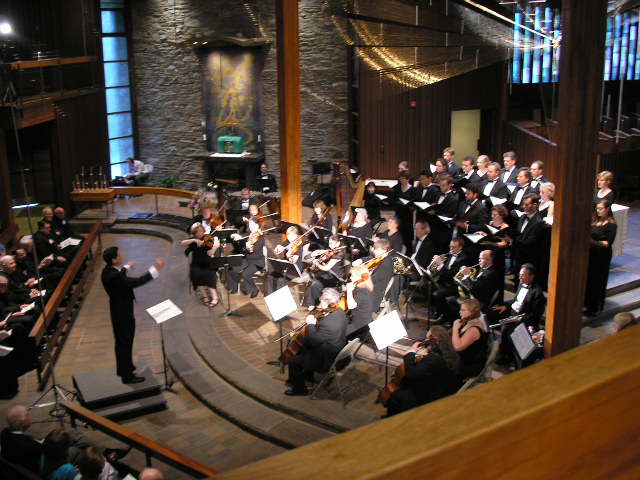
This particular requiem is among my favorite works in the classical canon — certainly among choral works — and the setting and temporal context made it a magnificently fitting culmination of my three-day glimpse of a life of the mind. The horns punching into the "Sanctus" finally pierced the gauze with which the necessities of daily life tend to wrap our spirits. Stream, download (3 min, 17 sec).
Holy, Holy, Holy
Lord God of Hosts
Heaven and earth are fully of thy glory
Hosana in the highest. Holy.
Thus struck, I scattered my nearly illegible scrawl as notes in the margins of my program:
Think of the divine order that brings together these people, each of whom believes his or her present task to be the most important thing to be doing at this time (ipso facto) — even extending the performance back to the piece's composer, adding in the engineering of the instruments over centuries, the honing of talents, the skill: all for the glorification of God and to request His mercy, His intercession in the cold workings of nature's machine. Even if the music were not created or presented for that purpose, I defy you to explain that it was randomness and pure human preferences that brought it to be.
I defy it because I shall not believe it and will think you tragically deprived of grace by Satan himself.
The performers needn't believe themselves to be doing otherwise than singing pretty music. Even Fauré — when it comes to it — could have had other intentions for all it matters. A librettist, try as he might, could not deprive the Maker of this sort of praise. Even constructing the archetype of all that is disgusting and base — destroying all marks of the beauty that is divine inspiration — the devil would by that very act prove an order and thereby point to the One whom he detests.
June 21, 2009
The Journalist Who Believed Catholic Christianity to Be True
Kathryn Jean Lopez, of National Review Online, began her speech — beginning day three of the Portsmouth Institute's conference on William F. Buckley, Jr. — by stating that she would not have described WFB as a "Catholic journalist," because both descriptors were so thoroughly integrated into his persona, and she seemed genuinely awed that he plainly and directly incorporated religious beliefs in his writing. Her first example was his handling of a question on Satan, which she asked us to imagine being posed on Hardball: Stream, download (1 min, 26 sec).
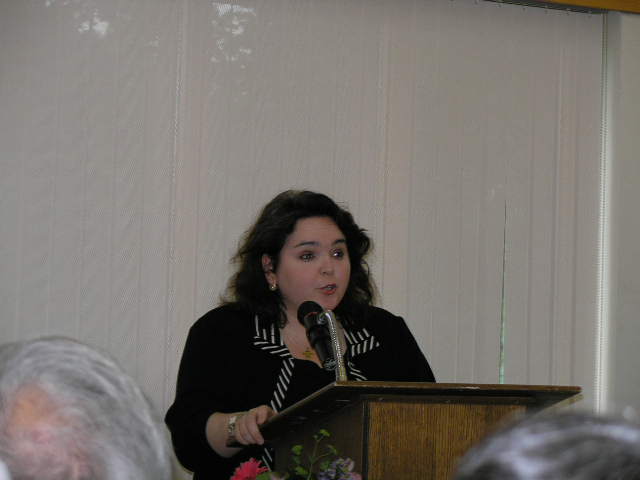
Lopez read, as well, an extended excerpt from a WFB column in the '90s decrying the taping of a murder suspect's Catholic confession to a priest as "the end of the line" to "fascism": Stream, download (3 min, 20 sec). The point came up again, during the Q&A, when an audience member asked the outcome of the controversy, and Kathryn promised to post the answer in the Corner on Monday. Of course, being a blogger, my Anchor Rising co-contributor Andrew Morse had googled the matter and let Ms. Lopez know that the district attorney had ended up apologizing. The case apparently became quite a row, with the defense ultimately seeking to use the tape (raising questions about whether the suspect had known to expect the recording) and the courts disallowing it, although not going quite as far as the local diocese requested and destroying the tape.
I've seen no indication, through quick online research, to indicate that Bill Buckley played a role beyond that typically inhabited by a columnist in that case, but as Lopez suggests, his death has left somewhat of a void where previously we all might have expected an additional, trusted, and authoritative opinion on matters of interest to those who explicitly undertake, share, or are incidentally interested in the contemporary Catholic mission. What, she wonders, would he have said of President Obama's rhetoric when speaking at the Notre Dame graduation? Stream, download (48 sec).
A couple of notable (or, rather, especially notable) segments came during Kathryn's Q&A. One is her response to conference organizer Jamie MacGuire's question about her experience with Buckley as a young NR employee in which she described something that came up repeatedly during the several days devoted to the man: his investment in human capital. Stream, download (4 min, 16 sec). She suggests that WFB's investment in and support for others extended even when they moved beyond the reach of his immediate projects, such as National Review, and sees the workings of his Christianity in that tendency. I see, as well, his larger project of building a movement of which NR was a central part; if the movement is the thing, one doesn't want to ghettoize the soldiers in a single publication, but to send them out into the world.
A second notable exchange began with New England Cable News Reporter Gregory Wayland's relation of his experience producing stories on the anniversary of Humanae Vitae (video) and embryonic stem cell research (video). On the first, he (and Kathryn) stated some surprise that it had been acknowledged as newsworthy. On the second, he expressed that he'd felt pressure to lessen the prominence of a scientist who researches and supports adult stem cell research. The question to Lopez was, in Wayland's words, how to deal with "the well-worn trough down which the waters of journalism flow lined by very definite assumptions which are the received wisdom of the journalistic community." Stream, download (3 min, 39 sec).
June 20, 2009
Correcting a Misimpression, and the Charitable Speaker
Between the Friday morning talks of Maggie Gallagher and Joseph Bottum, I was asked in the presence of a notable personage about my conversion to Catholicism. It took some time — well past the cessation of the conversation — for my mind to catch up to the realization that said personage's response indicated that I had inadequately characterized my emotions about the circumstances that brought me to the event in question.
My pithy summary was that, having had no experience with religious faith, I found myself within a year graduating from college, moving to a new apartment, pursuing employment, getting married, commuting for over an hour each way to and from work, and inhabiting a gray cubicle for the better part of every weekday, and I realized that something within my belief structure (more accurately, my non-belief structure) was not functional. The distinguished gentleman suggested that only the long commute and gray cubical were dispiriting aspects of the life that I'd described, and it still bothers me to think that he might not have understood how integral to my meaning precisely that actuality was.
What I'd meant to convey was that the rapid succession of these life-changing events seemed to have as their consequence a lack of success so profound that it couldn't even be called a failure. My great sprint through the final years of youthful development hadn't left me falling because unable to fly; rather, they'd placed me on a treadmill (the walls of which, I might add, were not only gray, but of such a design that it seemed as if a previous occupant had taken up the habit of checking off the days of his captivity). Furthermore, I had no basis to expect anything other than the continuation of that treadmill until my ultimate collapse into oblivious death.
Thence religious faith, which gave me a context by which to understand that, even if phony cloth partitions were to become the sum of life's setting, its real texture spread to spaces inherently unaffected by them.
Which brings me to the afternoon speech of New Criterion editor and publisher Roger Kimball.

Mr. Kimball gave an exquisite, if negative, description of the sign of peace moment in Roman Catholic Masses (stream, download) in which he lamented the disruption of "the mood appropriate to the celebration of the awful mystery of the Mass." The aesthetician does not like the moment, to say the least, but I'd propose that it makes a difference which threads are setting the mood.
My first trip to Mass as a might-be believer (rather than mere accompaniment for my wife) was made alone to an old urban church in Fall River that was, at the time, under construction, making it dark and close, with boards on windows and scaffolding constricting the pews. To this day, I remember how suffused was the service with the invocation of the quality that my days were desperately lacking: internal peace. And the moment at which that message's light managed its first wink into my psychological darkness came when the small boy behind me held out his hand and wished for it to do so (albeit with no great enthusiasm).
There may be something, here, of the distinction between those who've had faith and those who are approaching it. Kimball went on to describe the delight that Bill Buckley took in life (stream, download), and I can't imagine that he (or Mr. Buckley) would object to the observation that there are prerequisites to delight. Among them is that internal peace.
That is to say that one profits nothing from concentration at Mass if one's mind is a chaos of despair. A handshake can only be disruptive of prayer if a person's very thoughts are not a prior disruption. As one who knows neither man, and for many years knew not peace, I find Kimball's reference to Buckley's spiritual generosity significant (stream, download); how conducive to spiritual advancement it would be were one to find Mr. Kimball or Mr. Buckley among the randomly proximate churchgoers reaching out across the pew with a smile.
Speech after speech, this week, made the case that WFB was generous, indeed, with his smile, so it's odd that he would share Kimball's aversion to offering it during Sunday worship. Perhaps he needed that time for his own rejuvenation. I'll confess, however, that my newly Catholic eyes (relatively speaking) do not see the difficulty in reformulating that rejuvenation to the minor degree of affirming the importance of the church community as a constituent part of one's own, personal, and humble relationship with God.
Toward the end of his speech, Kimball spoke of time's internal complement (stream, download): taking away moments, while still providing the substrate on which achievement can grow. Just so with that non-traditional practice that he so loathes. Just so the presence of traditionalists among parishioners who don't know more than a garbled phrase or two of Latin.
Just so, as well, was it an act of spiritual generosity for Roger Kimball to offer his thoughts for our audience's consideration, facilitating the sort of discussion that — even if online, and even if without response — draws participants into the mechanics of the faith such that, by focus of the intellect, they almost do not notice that they have moved more deeply into belief.
June 17, 2009
Society Needs Religious Organizations That Transcend the Political
The Roman Catholic Church has been under veritable government attack in Connecticut, and its travails highlight the need for religious organizations, Catholic and otherwise, to be selective and to tread carefully with political activism:
The Roman Catholic Diocese of Bridgeport sued Connecticut officials in federal court Friday, after being told it needs to register as a lobbyist to hold rallies and use its Web site to oppose legislation.The move is the latest chapter in tensions between the Catholic Church and the state over issues including gay marriage, emergency contraception and giving parishioners more control over church finances.
As I've suggested before, the Church should undertake some institutional introspection and then strongly delineate its role in American society. Having done so, it should stand its ground, whatever tricks or overreaches government officials should attempt. That means proving itself not to be a lobbyist and providing concrete examples of its approach to society's challenges apart from government intervention; the more religious and other groups permit of (even foist on) government, the more those groups are going to become petitioners, rather than coequals.
The dangers of a strategy that is more accommodating of big government initiatives are visible in the Church's current legal battle in Connecticut:
The ethics office, the diocese says, is claiming the diocese acted as a lobbyist by taking part in a March 11 rally at the state Capitol against a church finances bill, which would have given church lay members more power over parish finances. The bill was actually withdrawn by Judiciary Committee leaders before the rally and officially killed a week after the protest.The diocese also says ethics officials are further claiming that the diocese acted as a lobbyist when it made statements on its Web site urging members to contact their state lawmakers to oppose the finances bill and another bill on same-sex marriage.
Consider the precedents. In one instance, a powerful apolitical organization under unconstitutional attack from its state government held a show of its influence. In the other instance, the Church communicated how its teachings would apply to its members activity as engaged citizens. It tightens the totalitarian clamp to permit the principle that an aggressive government can require registration of and the imposition of lobbying regulations on its targets as they defend themselves.
June 7, 2009
After a Difficult Violent Roundtable, Part 2
A second conversation in which sufficient articulation proved difficult on Friday night's all–Anchor Rising Violent Roundtable on the Matt Allen Show related to Matt's statement that the Catholic Church is in some respects an anti-American institution. Having such a strong statement catch one off guard doesn't make measured extemporaneous response an easy accomplishment, but upon reflection, I'd suggest that Matt is backing into a perilous political philosophy.
The Roman Catholic Church — any church, for that matter — should not be an "American" institution. The U.S.A. exists as an entity and as an idea; to the extent that an authentically American church were not redundant, it would be dangerous. A religion with policy conclusions in lock-step with the practice of the American idea would necessarily lend theological import to a quintessentially secular project. It would be a fundamental establishment of religion, marrying Church and State.
There is not only great value in, but essential need for cultural institutions completely separate from the reigning polity — with a source and structure of authority that is distinct from the nation's governmental strategy. Where members of the hierarchy are wrong in prudential matters, Catholics should discuss (even debate) the issues and argue for the Church's proper role, but all should realize that the Church's interests are not the same as the country's. Sometimes one will be wrong, or the human beings who guide it will step beyond their appropriate boundaries; sometimes the other will be the culprit; but that's reason to accept them as mutual ballast.
In an objective analysis, Matt's imputation of anti-Americanism on the part of the Church based on the public policies for which some of its representatives advocate is identical to the impulse of those within the hierarchy who wish overzealously to leverage the government's powers of taxation. Both sides judge and prescribe as if the two pillars of society ought to be more of a continuous support, in which the visibility of light is indicative of fatal cracks, not expected separation.
Let's not dilute anti-Americanism. I don't believe it is Matt's point of view that the Roman Catholic Church takes as its goal the downfall or diminution of the United States as a secular construct. The institutional Church has watched governments rise and fall throughout its history, and there are multiple bold lines between supporting policies that are arguably detrimental to the civic body and calling for the downfall of a Great Satan. An instructive distinction exists between President Ronald Reagan's characterization of the Soviet Union as an "evil empire" and Pope John Paul II's view of communism as "a medicine more dangerous than the disease itself" that became "a powerful threat and challenge to the entire world."
Both the United States of America and the Roman Catholic Church are centrally concerned with liberty. For one, it's liberty from oppression by people; for the other, it's liberty from oppression by sin and evil. Those concerned with either in particular should pay close attention to the other, but nobody should expect their requirements always to be the same, just as nobody should drive the two apart because one — accurately or erroneously — points in a different direction from time to time.
The project of post-Enlightenment conservatism (as we understand it today) is to layer balances and restraints against human nature, and theologically, the impulse to declare opposition amounts to a Church of Me, in which the individual pushes away a perspective that ought to be given credence. Here, the philosophical thread leads to a final point of contention on Friday night — namely, conservative wariness of populism — which I'll address after I've trimmed some hedges and made my way through the Sunday paper.
June 6, 2009
After a Difficult Violent Roundtable, Part 1
Last night's Violent Roundtable on the Matt Allen Show was the most difficult public appearance/talk show that I've done yet. Probably because Matt correctly assessed that an hour of harmony wouldn't have been very interesting, his questions touched on a number of weighty subjects on which expressing comprehensive thoughts on the spot is not easy.
For instance, take Matt's reference to Rep. John Loughlin's suggestion that the government get out of the marriage business, and permit everybody civil unions, because "marriage is a religious concept." That attempt at compromise (I'd call it a cop-out) is simply based on a false premise. Marriage is not a religious concept; it transcends religion, not only in the sense that all religions throughout history have recognized its opposite-sex nature, as I mentioned last night, but also in the sense that it resides at the intersection of multiple social strata: religion (yes), but also family, heritage, government, property, history, and so on, all of which find relevance in the biological fact of a man and a woman's ability to become one in the person of a child.
Religion's role in marriage is to lend the mysticism that makes the relationship profound, and therefore worthy of lifelong vows. Ancestry roots children in their society. Property gives motivation for productivity and economic prudence, particularly with a long-term view of generations. And government's role is to protect the community that it governs, in this context, by protecting the familial structure on which all of Western society's progress has been founded.
Consequently, government has even more objective, secular interest in encouraging stable marriages — that is, permanent unions between intimate men and women — than it does in encouraging the additional social good of consistent mutual care, which is ultimately what civil unions would recognize. Even the requirement of intimacy would be impossible for the government to require or assume, opening the door for civil unions between anybody and anybody (or anybodies).
For government to reduce all mutual care relationships to a level field, relying on religious groups to define their profundity, it would create a necessary equivalence between them. By declining to adhere to a consistent definition understood across the aforementioned strata, the government referee would be declaring the concept of marriage available for redefinition and throwing it to cultural forces that include not only religious organizations, but also pop-culture industries. If nothing else, the social noise would end the marital institution's utility.
Matt's suggestion — fantastic in principle — that we should refuse to acknowledge the government's authority as lexicographer skirts an assessment of what is actually happening. Drawn forward by well financed and highly motivated special interests and prodded by a complicit media industry, the government has been forcing a new definition of marriage into the culture. That being the case, following Matt's political philosophy would actually require the people to demand that the government explicitly affirm the definition of marriage under which their culture has operated throughout history until such time as it is understood by all to have changed.
In other words, the trajectory of the change currently involves the government's redefinition in order to manipulate the culture. Those playing defense on the traditionalist side are not the ones ceding authority to the political class, nor is there equivalence between our attempts to hold the government in place and the attempts of radicals to drag it into the cultural fight.
The initial question that sparked our discussion, on the radio, was whether the government should be granting heretofore marital rights and privileges piecemeal, one by one, to same-sex couples. The topic shifted a bit by the time it got to me, but my answer would have been that such an approach is precisely the appropriate one. Formed back when people actually believed that same-sex marriage was sufficiently inconceivable that a constitutional amendment was not necessary, my view has long been that the governments at various levels should affirm the traditional definition of marriage and do so in such a way as to enable state-level legislation easing the difficulties that those with other relationship types face. Require that legislation to define new relationships and their privileges without reference to marriage (i.e., no "all rights and privileges of marriage" language), thus requiring our society to come to consensus about the justification, purpose, and meaning of each change.
Cultural forces will vie to define the new unions, and it would be appropriate for those on the same-sex marriage side to refer to themselves as married, if they so choose, as well as to strive for the broader society's similar understanding of their relationships. Over time, the culture may come to see no significant difference between civil unions and marriage, or perhaps the distinctions between mutual-care relationships and procreative marriages will become more prominent. All the debate, however, and experimentation would be performed outside of the core institution of marriage and without the government's being used as a lever to roll the cultural boulder.
June 5, 2009
An Interesting Convergence of Issues
This story confounds categorization:
Eastern District of Michigan judge Lawrence P. Zatkoff handed down the decision, in a case involving an alleged violation of the constitutional separation of church and state. The issue is whether a government-owned company, AIG, can market sharia-compliant insurance products. (To be sharia-compliant, an investment vehicle must be created and structured in ways that do not violate Islamic law.) In a well-reasoned and cogently argued opinion, Judge Zatkoff refused to dismiss the case prior to factual discovery. ...The problem with all of this public largesse is that AIG sponsors, pays for, and aggressively markets sharia-compliant insurance products. The practice of sharia finance has created lucrative advisory positions for often radical imams, who get paid to guarantee the religious "purity" of sharia-compliant products. Such vehicles typically follow the Muslim principle of zakat and donate a slice of their profits to charity. Unfortunately, many of the charities receiving these funds have links to terrorism. Mr. Murray objects to his funds' being used to legitimate and promote sharia law, when that is the same law that calls for jihad. For that matter, sharia allows Saudis, Iranians, Sudanese, Somalis, Afghans, Taliban members, and other adherents to justify the following: the execution of apostates who decide to abandon the faith; the criminalizing of "Islamophobic blasphemy"; the punishment of petty crimes with amputations, floggings and stonings; and the repression of “non-believers” from practicing their respective religions freely and openly.
On one hand, a private business should be able to develop, operate, and market whatever products it likes (provided doing so does not directly support our nation's enemies). On the other hand, AIG is not alone, now, in being a not-so-private company, and the government ought not be in the position of financing the adherence to religious law. It's a precarious balance, and the conceit of mere mortals to maintain it is apt to become hamartia.
Herman Melville functions out of context here:
So, when on one side you hoist in Locke's head, you go over that way; but now, on the other side, hoist in Kant's and you come back again; but in very poor plight. Thus, some minds for ever keep trimming boat. Oh, ye foolish! Throw all these thunder-heads overboard, and then you will float light and right.
Starboard side, we carry the notion that the government should not interfere with freedoms of association and religion. Port side, we've now hung the principle that the government can become a controlling investor in industry. Express no surprise when when find the deck taking on water.
June 4, 2009
A Missed Opportunity for a Lesson in Charity... and Independence
Marc addressed the intention of the Roman Catholic Diocese of Providence to request that its pastors advocate during Mass on Sunday for maintenance of welfare payments. Dan Yorke expressed dismay, as well.
What I find most discouraging about the initiative is its indication that the Church is misassessing (or not adequately considering) the political tides. Religious organizations are facing increasingly pointed questions about the justification for social and political exemptions when it comes to the practical expression of their faith. The most prominent example has been Massachusetts's refusal to permit Catholic Charities to apply its religious beliefs to the practice of placing children in adoptive homes consisting of a mother and a father. With the swell of the same-sex marriage movement, those questions will become demands.
What the diocese and the Church must do is to define religious organizations' position in contrast with the state — delineating distinctions of priorities, appropriate approaches, and independent value. Preaching political activism from the pulpit in the service of maintained government spending and services does not take the wise path. It affirms the principles that will smother the vitality right out of America's religious institutions.
Observing budget-driven hardship among those who rely on government services and handouts, the Church should strive to pick up the slack, not to crack the whip. The homilies that Rhode Islanders hear this weekend should not focus on asking the Statehouse's little Caesars to wield the the power of their thumbless economic hands, but on asking parishioners to target charity toward people in need, to consider hiring from among the ranks of the unemployed, especially the long-unemployed. Rather than using its structure in the fashion of a political action committee, the hierarchy should mobilize an institutional brainstorming session to determine how the diocese's own programs and resources might be leveraged for the benefit of those whom the state can no longer afford to support financially.
Stepping in to do God's work when the government cannot (or should not) will reestablish religious organizations as an important institution apart from the political structure, deserving of maximum freedom to do what they do. By contrast, not only endorsing, but advocating for statist economic policies will inevitably compromise the Church's strength when it comes to resisting the social and cultural policies on which those who deify the state will insist.
June 2, 2009
Tuesday Morning Theology
Given the comments to my post about Monday's (apparently) politically founded murder, it would seem that my non-symbolic reference to an entity named Satan has caused some confusion about my view of human agency.
The existence of evil as a force in the universe does not absolve humanity of responsibility for acts committed in its service. Wicked acts are always a choice, else they are not wicked, but unfortunate — tragic. There's a subtlety along that line, to be sure, having to do with individual intention and awareness, but I'm speaking in broad categorical terms, here.
However, I maintain that we never relinquish our humanity — or our inherent value as human beings — on the basis of our acts. The precious soul still exists, clouded (even suffocating) amidst evil's corruption.
Abortionist George Tiller, like his murderer, like the murderer of the soldier in Arkansas performed evil acts. But they were not evil of themselves. Thus is it appropriate to say that somebody has been guided — or lured — by Satan without thereby implying that he or she sacrificed moral worth.
May 31, 2009
All in the Service of Evil
Only evil was served by the killing of abortionist George Tiller. Just as one can imagine the phrases by which Satan guided Tiller to see his barbarous work as righteous, one can imagine the whispers that brought the killer to Tiller's church — leading him perhaps to see as poetry a setting that should have resonated as blunt screams to stop.
Just so will the evil perpetuate itself. Some will find in this atrocity justification for restricting the rights of we who strenuously oppose abortion, and in the current political climate, they may achieve no small portion of their goals. In turn, frustration and complex feelings of persecution will escalate in opposition. Where will it stop? Well, where does it ever? Now, never, or somewhere in between.
With the simple, psychotic act of one man's murder, our society comes to another precipice, and when Americans inclined toward prayer have offered ours for Mr. Tiller and his family and have spared a word for the dementia-strangled soul of his murderer, we should turn our hopes toward a miracle of temperament. We should pray that from this horrible catalyst will emerge a fuller appreciation for the value of human life and for the civic structures and rights that enable us to resolve issues of cosmic consequence without violence.
May 29, 2009
The Back Door to Silence
Given the hour, perhaps this news excuses a cliché: first, they came for the Christians:
A local pastor and his wife claim they were interrogated by a San Diego County official, who then threatened them with escalating fines if they continued to hold Bible studies in their home, 10News reported.Attorney Dean Broyles of The Western Center For Law & Policy was shocked with what happened to the pastor and his wife.
Broyles said, "The county asked, 'Do you have a regular meeting in your home?' She said, 'Yes.' 'Do you say amen?' 'Yes.' 'Do you pray?' 'Yes.' 'Do you say praise the Lord?' 'Yes.'"
The county employee notified the couple that the small Bible study, with an average of 15 people attending, was in violation of County regulations, according to Broyles.
Broyles differentiates between these meetings and religious assemblies, and in so doing, he may be highlighting a path to oppression of which citizens should be aware:
"For churches and religious assemblies there's big parking concerns, there's environmental impact concerns when you have hundreds or thousands of people gathering. But this is a different situation, and we believe that the application of the religious assembly principles to this Bible study is certainly misplaced," said Broyles.
Obviously, large-group concerns apply regardless of the topic inspiring assemblage. A political rally, for example, could create parking problems and affect the environment just as well; translate this story to that context, and overly enthusiastic government administrators could effectively strangle grassroots opposition groups before they've begun.
(via Hit & Run)
April 12, 2009
Beginning Anew... and Continuing to Live
Some folks will groan at the movie's mention, but I rewatched The Passion of the Christ on Friday night, and many of the points that struck me when the movie was new are still valid, although their social and spiritual implications have long since been integrated more deeply into my thought.
This time around, the scene that resonated most strongly for me was the Easter scene at the end: The mere moments when the stone rolls from the tomb, the death shroud shimmers, and Jesus steps forward to triumphant music. From years of conversations, taking both sides on the question of Christ's divinity, I've found a number of people who disbelieve the Gospel story mainly on the grounds that history continues to unfold. If that event, directly affecting a small group of people in the outskirts of civilization, was so profound, why then must we continue to face down our demons? If Jesus defeated sin and death, why then do we continue to fall to both? How the ebbs and flows of Christians' prominence and fidelity?
These are mysteries beyond my reckoning, but it does occur to me that the lessons given through His life would have been little more than a summary of how people ought to have lived if His death and resurrection were meant to end the need for their application.
Another difficulty that we have, being human, is that most of our lives are spent in anticlimax. One might suffer through immense pain if bolstered with the knowledge that its outcome will be an improved life, and yet life tends just to go on. Improvement becomes stasis becomes tedium becomes difficulty, requiring further struggle. Our task is never done, at least until we die, and perhaps not even then.
Here's where the symbol of a phoenix falls short of the Christian image. The former repeats in an endless cycle. For the latter, each resurrection is but a stage of development. Jesus suffered, died, and rose, and observing the world as it's been these two thousand years, one might discern that we've continued to make Him suffer in an even deeper sense. But then, in an even deeper sense will He rise again, raising us with Him.
So it is Easter once more. Most of us return to work tomorrow. We'll continue to stumble through life, to err in our judgment, to fall short of the ideals that we uphold. Having not died and risen, we will continue in our foibles, although perhaps a bit less with each passing year.
If it's true, though, that our salvation comes in stages, each deeper and more profound than the last, then today's suffering will seem as nothing tomorrow, like lessons that we once found difficult but now see to have been basic building blocks that we should not have permitted to frustrate us. We should take that lesson forward, understanding that tomorrow's perspective will make our current problems mere recitation. Let the triumphant music play, and don't think it foolish to be inspired and uplifted by it, but understand that the music does not end when we step into the light. Neither does it become boring with repetition.
April 10, 2009
The Wound of a Burden
My observance of Good Friday is enhanced this year by virtue of the work that I performed yesterday afternoon: renailing old subfloor, with all the crouching and hammer swinging that entails, followed by the lugging of heavy plywood and medium-density fiberboard (MDF) up two racks of pipe staging and through a window just big enough to allow the sheets at an angle. For those who understand less than half of the previous sentence, the point is that I'm sore, particularly in my shoulders and my wrists.
Sometimes feeling some echo of an ache helps one to appreciate the pain and distraction of suffering.
On Wednesday night, I went to the Redwood Library in Newport for a book reading and signing for my friend Andrew McNabb, who was in the area promoting The Body of This, which I reviewed on Monday. In the audience were a couple of people who participated in the Third Thursday Writers Group at the Redwood, back before my writing took a political turn. None would meet my eye. When the library's executive director introduced Andrew, she described the group and suggested that it might be starting up again, if there's interest; for some reason, she omitted mention of the two literary reviews that I produced for the group and distributed for free around town.
It's possible that, over the past five years, my looks have changed dramatically enough (from editor to carpenter) that my fellow writers did not recognize me. It's also possible that the executive director has forgotten the books (which were not an official publication of the library) or that she doesn't wish to appear to be promising another such opportunity for writers. But the possibility that my ideological convictions and, moreover, visibility in declaring them have constructed an interpersonal burden that I must bear among those whom I once knew brought out, for me, the underlying profundity of one of the stories that Andrew read:
When we think of wounds — and of scars — we concentrate on the sharp pains in life, but the burdens that we must carry leave their marks, too. And if we recognize them for what they are, we can learn from them, perhaps even be glad of them.
(The Body of This is available on Aquinas & More as well as on Amazon.)
Fish On Fridays
Nothing symbolizes the supposed arbitrariness of religion to those predisposed towards skepticism towards religious belief than does the Catholic practice of eating fish on Fridays during the season of Lent. I’ll admit to having asked myself, especially on Good Friday, what connection there is between fish and the crucifixion of Jesus Christ. And then there is the philosophical paradox. If my soul is lost after I’ve eaten meat on a Lenten Friday, does that mean I’m free to commit worse sins without making my situation worse? But if the rule doesn’t really matter, then why follow it? And on and on and on and on…
Here’s what I do know. With the choice of fish options available to a 21st century American, eating fish on Fridays is about as small a “sacrifice” in a material sense as can be asked for. But honoring the rule does require me to make some conscious choices that run contrary to what the surrounding culture tells me are cool and sensible. And if I am unable to make this little tiny sacrifice, because I find it too inconvenient, or because I’m afraid to explain myself to others who don’t share my belief or who might think that I’m being just plain silly, then on what basis do I believe myself to be capable of taking a stand in more serious situations, when the choices might be a little harder and the stakes a little bit higher?
Slightly edited re-post of an April 6, 2007 original.
April 9, 2009
Ambassador as Change Agent
During my drive home, Dan Yorke was talking about rumors that Caroline Kennedy might be poised for appointment as President Obama's ambassador to the Vatican:
Former U.S. Ambassador to the Vatican Raymond L. Flynn is giving a thumbs down to Caroline Kennedy as a potential pick for his former diplomatic post, saying the pro-choice values of JFK's daughter would make the nod "a mistake." ...According to the Italian publication Panorama, Sen. John F. Kerry asked Obama to consider Caroline Kennedy for the Vatican ambassadorship. Neither Kerry’s office nor the White House would comment yesterday.
Dan's core point was that the Vatican isn't just another country, but an ethnic entity to which it is traditional to send an ambassador of the Roman Catholic faith, and being pro-life is critical to such a role. I'd suggest that the special status of the Vatican (in contrast to a nation) is only relevant in the sense that its public character is more starkly drawn than normal.
Sending Kennedy would be like sending an anti-Zionist Jew as ambassador to Israel. It would be like sending somebody whose beliefs run absolutely contrary to those of France or England or Brazil or wherever — somebody who stands in opposition to a core value of the foreign power. Such treatment is only suitable with hostile, or at least unfriendly, countries.
The only reason the United States would send an inimical ambassador is if it is more concerned with challenging a nation's policies and beliefs than with ensuring good relations.
April 8, 2009
Reason (and, Therefore, God) Affects Morality as an Action in Itself
Those who agree with the view, cited by David Brooks, that "moral thinking is more like aesthetics" should ponder whether they're missing a connection between this:
Socrates talked. The assumption behind his approach to philosophy, and the approaches of millions of people since, is that moral thinking is mostly a matter of reason and deliberation: Think through moral problems. Find a just principle. Apply it.
And this:
Moral judgments are like that. They are rapid intuitive decisions and involve the emotion-processing parts of the brain. Most of us make snap moral judgments about what feels fair or not, or what feels good or not. We start doing this when we are babies, before we have language. And even as adults, we often can’t explain to ourselves why something feels wrong.In other words, reasoning comes later and is often guided by the emotions that preceded it. Or as Jonathan Haidt of the University of Virginia memorably wrote, "The emotions are, in fact, in charge of the temple of morality, and ... moral reasoning is really just a servant masquerading as a high priest."
Mr. Haidt's metaphor may be memorable, but I wouldn't declare it accurate. Emotions are the materials that we must use in building our temple, but the structure we build according to blueprints described in a tradition of reason. Statements of principle well argued become actions in their own right. They affect the culture that we imbibe as our individual personalities and moral senses develop.
Think of the powerful people influenced by Socrates, those who've built on his logic and who've put its consequences into policies. Think of the cultural markers and influences — those that set the moral instinct that we attempt to guide through our own reason — that have developed over the millennia following Jesus Christ. For ourselves, we may tend to find emotions too strong for reason — its master, even — but that proves only that moral reasoning has a delayed effect as it works its way into our collective intuition.
I'd go one step further, although non-theists needn't follow. This process is indicative of the manner in which God acts in the world: through us. A moral person might find a profound responsibility in that.
April 6, 2009
The Body of This Transcends the Surreal
Something in the atmosphere of the Redwood Library — and Newport more broadly — taps into subconscious wells of historical and artistic instinct for the writer. The greats feel somehow near amidst the stacks, and conversation among literary fiddlers seems only slightly less grand than the exchanges that one imagines upon a Berkshire evening between the likes of Hawthorne and Melville. When I attended the library's Third Thursday Writers' Group sessions regularly, in the first half of this decade, we would sit around an old table and critique each other's work, and none should doubt that the aging portraits around the room made their own contributions, as well.
Chief among the evidence that we undertook no mere extracurricular task were the offerings of Andrew McNabb. Such were the power of his written voice and the allure of his tales and characters that the rest of us felt as if the purpose of a given meeting had hardly been fulfilled unless he'd produced something from his folder. Certainly, we felt a wisp of trepidation when we ventured to criticize it.
Well, if I have a criticism — now that Andrew has offered his work to the public in a book of stories and sketches titled The Body of This — it derives from my desire for continuation and reprise. In the years since life swept me from the practice of regular writers-group attendance, during which time Andrew has transplanted to Maine, my book reading has been mainly mechanics and action: physics (to edify), project management (to advance), Robert's Rules (for politics). Body of This felt like a return to intangible substance, not the least because that is the underlying sense of Andrew's writing.
What makes his style resonate beyond the vast body of surrealistically tinged modernism is his sensibility as an even-on-weekdays Catholic. The imagery and subject matter lead one to expect a certain secular cynicism — doubt, scorn — that intriguingly isn't there; his sketches are moments of faith as it's lived. The churning stickiness of simultaneously budding sexuality and spirituality in the altar boy of "Blemished" doesn't stand as a mockery of religious superficiality, as it would for the zealous materialist, but as an honest confession of human nature.
As readers should expect from a mature writer, this pervasive theme manifests even in Andrew's strategy for description. One sentence painting the setting of "Their Bodies, Their Selves" reads like a clue to the whole collection: "If you took the building just for what it was — one level, three rooms — and ignored the dunes and the puffins and the sea grass and the few small pine-treed islands just offshore you wouldn't have much." So is it for Andrew's vignettes, wherein the typical fantasist of the surreal might find hollow meaning in the foolish striving of hairless monkeys. So is it in life, which taken as a series of things to do and places to be doesn't leave us with much. If we look beyond the what, to the where and how and why, we find ourselves to possess an infinite canvas of full and rich life.
That is the origin of my sole complaint: One longs to see Andrew's well-drawn characters in multiple settings, even if scarcely related, throughout the book. Similarly, those of us who've been privileged to read the magnificent longer-form shorts by Mr. McNabb can only wonder at their absence.
Perhaps, though, this mild disappointment can blossom into hope that The Body of This is most directly an introductory work, presented on Andrew's first night in our circle — an initial taste of his self revelation over the years to come.
Andrew McNabb will be in the Rhode Island area this week, giving readings from his book.
April 2, 2009
The Sides Stay the Same on Abuse
The headline splash: "Catholic bishops warned in '50s on abusive priests." The story describes some correspondence from Rev. Gerald Fitzgerald, who founded the Servants of the Paraclete to assist clergy facing various personal difficulties with their vows, such as alcoholism, emotional issues, and (on the extreme end) abuse of children. In religious terms ("charity to the Mystical Body should take precedence over charity to the individual"), Fr. Fitzgerald suggested that abusers would not often change.
Why didn't the Church listen to this man, who was especially well positioned to speak from authority? Well:
By the 1960s, Fitzgerald was losing control over the direction of the religious order, and medical and psychological professionals began working at the center — a change he had resisted. Those experts said some abusers could return to ministry.
If the take-away from the story is that the Church should be wary of relying on secular professionals who aren't first and foremost concerned with the organization or its divine mission, then perhaps I'd agree. Unfortunately, too many people won't get much past the headline in their comprehension — even if they read up to the end.
March 18, 2009
What the Day Could Bring
I've been holding on to this column by Roman Catholic Bishop Thomas Tobin. Having come across no obvious hooks on which to hang it for a post, perhaps a cold-winded Wednesday afternoon is as good as any time for his helpful reminder:
Any given day might bring you surprises that will change your life completely – the death of a loved one, a diagnosis of a serious illness, the discovery that a spouse has been unfaithful, a kid getting hurt in a sporting event, a fire that damages your home, an unexpected layoff notice, a call from the bishop’s office – the list goes on and on. The ultimate surprise that could change your life, of course, is its termination. You could die today, or tomorrow.What are the lessons to be learned from the uncertainty of life? I can think of three. ...
The first is to not get too attached to the things of earth, since everything is transient, everything is passing. ...
The second lesson is to approach the world with humility, not to overestimate our personal importance in the grand scheme of things. ...
The third and final lesson is that we always have to be prepared for the final drama of life – our death.
Elsewhere in the column, Bishop Tobin makes clear that our days' surprises aren't always necessarily negative. All three lessons apply as much (if with slight difference) to surprise victories and blessings.
March 8, 2009
A Word for Perspective and Fortitude
Begging the indulgence of our non-Christian readers, I found working through today's newspaper to be such a discouraging exercise, following on weeks (months) of seeing, personally and societally, people's economic vulnerability viciously exploited, that the second reading at today's Mass had an especial poignancy for me, and I'd like to share it:
Brothers and sisters:
If God is for us, who can be against us?
He who did not spare his own Son
but handed him over for us all,
how will he not also give us everything else along with him?
Who will bring a charge against God's chosen ones?
It is God who acquits us, who will condemn?
Christ Jesus it is who died—or, rather, was raised—
who also is at the right hand of God,
who indeed intercedes for us.
"It is God who acquits us, who will condemn?" If God created all — is all — then how can we not trust His strength in our lives to overcome the negative strength of bosses and politicians?
Move forward. These hard times will pass, and we'll be judged, and judge ourselves, on the basis of how well we tended the longer threads of our lives.
February 13, 2009
While We're on the Nexus Between Religion and Politics...
Here's some Biblical inspiration specifically for Rhode Islanders (Proverbs 28:28)
When the wicked gain pre-eminence, other men hide;
but at their fall the just flourish.
I'd append the suggestion that the second clause goes the other way, as well: the flourishing of the just leads the wicked to fall.
So let's start flourishing!
February 6, 2009
A Tenuous Deal with the Devil
Generally speaking, the government ought to get out of the charity business, but if it's going to appropriate funds, there's no reason that it shouldn't be able to work together with religious groups toward shared ends. For one thing, their spiritual motivation often enables lower administrative costs. The danger — the deal with the devil — is that government tends to appropriate in the other direction, as well, making the receipt of its funds an increasingly dominant consideration. And when it begins making demands, the religious organizations ought to cordially turn away from the relationship.
One might justifiably be suspicious that, at bottom, the word "expand" has a double meaning for the current administration, indicating both an increase in the size of the program and in its demands of participants:
President Obama signed an executive order Thursday to create a revamped White House office for religion-based and neighborhood programs, expanding an initiative started by the Bush administration that provides government support — and financing — to religious and charitable organizations that deliver social services. ...In announcing the expansion of the religion office, Mr. Obama did not settle the biggest question: Can religious groups that receive federal money for social service programs hire only those who share their faith?
The Bush administration said yes. But many religious groups and others that are concerned about employment discrimination and protecting the separation of church and state had pushed hard for Mr. Obama to repeal the Bush policies.
Meanwhile, other religious groups were lobbying to preserve their right to use religion as a criterion in hiring. Some religious social service providers warned they might stop working with the government if they were forced to change policies.
Invidious discrimination should not mix with charity, but the practice of interfering with an organization that's interwoven with religious principles will tend to expand, with groups opposed to various religious tenets using the government's reach to constrict them. The impression that religious citizens should be wary of government expansion is fortified by other recent news:
Senator DeMint's [failed stimulus-package] amendment would have eliminated a provision that bans any university or college receiving funds to renovate buildings, from allowing "sectarian instruction" or "religious worship" within the facility. This would in effect bar use of campus buildings for groups like the Fellowship of Christian Athletes, Campus Crusade for Christ, Catholic Student Ministries, Hillel, and other religious organizations.
February 3, 2009
Stumbling Down the Logical Aisle
Ray Hodges' ruminations on the morality of same-sex marriage are reasonable and presented with an even temper. Just so must be the tone of any dialogue on controversial matters. Unfortunately, his argument is a wholly erroneous construct, collapsing under the weight of misapprehensions, categorical non sequiturs, and an a priori conclusion.
The flaws emerge right at the beginning, when Hodges notes that his "question about gay marriage is not why [he, as a Catholic,] should be concerned about legalizing an immoral activity." Of course, the sexual acts to which he refers are already legal. The dispute, in the civic sphere, is whether those sexual acts are sufficiently indistinguishable from those associated with traditional marriage to negate all legal methods of treating the latter as unique. By the end of his letter, having determined to his own satisfaction that homosexual behavior is not immoral, Hodges admits no additional considerations prior to the leap to marital equivalence.
To take up that further argument, however, would rush past the fact that Hodges errs in hinging his reasoning on the false synonymity of "natural" and "moral." Indeed, immorality — sinfulness — comes so naturally to humankind that, we Christians believe, God offered a law to His chosen people (who had a terrible record of obeying it, thereafter) and ultimately went to the length of sacrificing His own Son to free us from the inevitability of sin and death. Natural law, in the Catholic Catechism, is not related to the popular notion of appearing in nature, but to "the original moral sense which enables man to discern by reason the good and the evil, the truth and the lie."
Even in secular terms, one need only trace the effects of humanity's foibles on civilization to see that morality seems most often to be a denial of "natural" tendencies. Marriage, itself, is meant to regulate the natural urge, especially among men, to stray from the families whom heterosexual activities tend to create. It is a foundational institution in our civilization's progress away from raw nature.
Mr. Hodges is free to brush aside core teachings of his Church, such as the critical importance of tradition, but the rejection of a theological worldview does not constitute a case for the innovation of same-sex marriage. We all want to be compassionate, and most of us wish to increase the world's sum of happiness, but radically altering the meaning of marriage is not a path toward either end.
January 27, 2009
Caught in the Scientist's Perspective
Stanley Aronson writes reasonable, interesting columns for the Providence Journal, but I often get the impression of an underlying scientism. By that relatively new coinage, I mean the tendency — a system of belief, really — to treat scientific answers as complete grounds for defining one's life.
So, in context of an essay about doctors' evolving ability to diagnose, even to forecast, illness, Aronson writes:
Where there had been three populations in a tripartite world dominated by health, disease or disease-incipiency, there was now a fourth population, namely, those currently quite healthy and without any underlying latent disease but who are nonetheless destined by the nature of their genetic baggage to be at high risk for some awesome disease in the future.There are many who will bemoan: Has the time arrived when my physical destiny is inflexibly determined without my active participation? Have the domains of determinism and predestination, the specters that haunted theologians for centuries, finally emerged as an incontrovertible secular reality? Have I no choice in life but to be a pawn manipulated by my genes?
Personally, I don't believe that anything essential has changed in this regard. Human beings have always know that they would die. Using genetic information to give some sense of the when hardly represents an existential shift.
By standing in awe of science, however, those who tend toward Aronson's view lose sight of a critical principle underlying religion's answer to the question of destiny: Your lifespan and your health are not synonymous with your destiny. We are "manipulated by our genes" only if we waste our lives tracing their fatal calendar.
Yes, it is "an incontrovertible secular reality" that we will all die. What we do before (and after) that event is what defines us, and our destinies.
January 21, 2009
A Church of the Mind
Among the factors that drew me to the Roman Catholic Church is that it essentially rejects the construct that insists that faith and reason are opposing sources of knowledge. They're not; they blend and overlap and are ultimately inseparable. On those grounds, and with consideration of the times in which we live, Rev. Joseph Lennon, of Providence College, issues a call for the renewal of a Catholic intelligentsia:
Love of learning for its own sake, a conviction that reason will prevail, a consuming desire bordering on obsession to get to the root causes of things — these are keys unlocking the door to an understanding of the intellectual. Democritus declared he would rather discover a single demonstration than win the throne of Persia. Thomas Aquinas became so enraptured with ideas that he would often forget to eat and drink. Once Thomas' absorption in theological speculation grew so intense he felt no pain while having his injured leg cauterized. ...Catholics deem it sinful to revile or ignore reason, so intellectuals are warmly embraced by the Church. Thomas Aquinas exalted reason to a degree that seemed scandalous and sacrilegious to the reformers who came 300 years after him. One of the meanings of Logos in St. John's Gospel is Reason, and Logos is God. So, under penalty of blaspheming God, Catholics dare not be anti-reason and therefore anti-intellectual. ...
In defending supernatural revelation against heresy, the Church, at the same time defends natural reason and the primacy of the intellect over the will, the emotions, the instincts or any of the other faculties to which voluntarism always appeals.
The times do require a public voice tempered with the confident conviction that only the interlocking gears of faith and reason can instill.
January 8, 2009
R.I.P. Father Richard John Neuhaus
Founder of First Things and one of this country's preeminent theologians, Father Richard Jon Neuhaus has passed away. From the National Catholic Reporter.
From the early 1970s forward, Neuhaus was a key architect of two alliances with profound consequences for American politics, both of which overcame histories of mutual antagonism: one between conservative Catholics and Protestant Evangelicals, and the other between free market neo-conservatives and “faith and values” social conservatives.In 2005, Time magazine took the unusual step of including the Catholic Neuhaus on a list of America’s 25 most influential Evangelicals, noting that in a 2004 session with journalists from religious publications, President George W. Bush cited Neuhaus more often than any other living authority.
“Father Richard,” the president said then, “helps me articulate these [religious] things.”
To Catholic insiders, however, it was Neuhaus’ writing rather than his political activism that made him a celebrity. From the pages of First Things, the unapologetically high-brow journal he founded in 1990, Neuhaus kept up a steady stream of commentary on matters both sacred and secular.
In broad strokes, Neuhaus was an unabashed supporter of the papacies of John Paul II and Benedict XVI, and his commentary was prized in Rome. John Paul, for example, named Neuhaus as a delegate to the 1997 Synod for America. Yet he was no lapdog for ecclesiastical authority; he lamented the Vatican’s opposition to the Iraq war in 2003, and early in Benedict’s papacy Neuhaus voiced “palpable uneasiness” that the new pontiff was not clamping down on what Neuhaus saw as dissent from church teaching.
Over the years, even people who disagreed with Neuhaus’ politics or theology would devour his monthly essay in First Things, titled “The Public Square,” for sheer literary pleasure. His combination of epigrammatic formulae and occasionally biting satire often reminded fans of English-language Catholic luminaries of earlier eras, such as G.K. Chesterton or Cardinal John Henry Newman.
December 26, 2008
Christmastime in Baghdad
Being from an AP report, the headline is rapidly submerged in lest-you-think-this-is-good-news "context," but it's worth noting, nonetheless:
Iraq's Christians, a small minority in the overwhelmingly Muslim country, quietly celebrated Christmas on Thursday with a present from the government, which declared it an official holiday for the first time. ...In his homily on Thursday, Chaldean Cardinal Emmanuel III Delly praised the establishment of Christmas as an official holiday as a step toward easing tensions.
"I thank it too for making this day an official holiday where we pray to God to make us trust each other as brothers," he said at the Christmas Mass before several dozen worshippers in the small chapel of a Baghdad monastery.
A senior Shiite cleric, Ammar al-Hakim attended the event, flanked by bodyguards, in a gesture of cooperation with Christians.
"I thank the visitors here and ask them to share happiness and love with their brothers on Christmas. By this they will build a glorious Iraq," the cardinal said.
December 25, 2008
A Quiet Start, Barely Audible
My teens and early twenties were, in a word, turbulent — mired in self-destructive behavior and emotional flights. Typical. Oh so typical was my pushing the world away in order to create an explanation for my feeling of isolation. In my impatient mind, the world had promised me much and delivered little.
The fruits of this attitude, and of the atheism with which it tumbled, were borne as I sat by one of my apartment's two windows, on a day away from my gray office cubical, and heard nothing in response to my demands that God provide a decisive sign of His existence. Promises being what they were, surely He owed me a voice from the sky — something so miraculous as to be unreal and inspire doubts about my sanity were I to describe it to others (whom I had well prepped for such doubts). Yet I heard nothing.
On a Saturday shortly thereafter, I paced my apartment while my new wife was at work. I drove the streets. I found myself at a Catholic Mass in Fall River, the church dark, its windows covered during renovation. And there, amid the legs of scaffolding, I heard the phrase for which I longed: "Peace be with you." I don't remember specifics about the scriptural readings and homily, but my recollection is that they dealt, even more than usual, with the message of internal peace, and when I turned to shake hands with the child in the pew behind me, it was as if Jesus himself were looking through that boy's eyes as he spoke the compulsory greeting. Indeed He was.
Today we celebrate the birth of a child to little immediate fanfare. Three magi saw some signs, and a king arched his eyebrow. Some shepherds heard a herald — in a sense of the arrival of the apotheosis of their profession. It would be decades, however, until the significance of that child truly came to be felt, and centuries and millennia would pass with the slow growth of his message.
The difference between one's early twenties and early thirties — between one's first standard workyear and one's calculation that a decade and more of labor are light on the scale against the possibility of 2,500 workweeks remaining — is a better understanding of time, and of the ways in which seeds grow in life.
We've recently installed a gate across the front lawn from one of the houses on which my company is working, and it will be four or five years before the bushes that line the property are high enough to give it coherence. During that time, the gate will look unnecessary and awkward. It will wear and be repainted. Ultimately, however, it will make sense and fit its surroundings.
Life's promises, I propose, are always kept, although we are deceived in hearing what we want. Prayers are answered, but the response is often, by necessity, not as clear or as quick as we would like. In the noise of our philosophies and desires, Truth is often too soft to register.
Peace be with you, this Christmas Day, and may the child born of Mary in the manger help us all to understand that He does not merely whisper, but speaks in such long phrases as to require close listening.
December 4, 2008
Revelations of the Beatified
Rev. David Lewis Stokes's reflections upon the failed exhumation of Cardinal Newman is a rewarding read:
What really makes Newman our contemporary was his life-long sense that at the heart of modernity churns a moral vortex that promises to consume us all. Writing in 1875, Newman captured the century and a half to come:"To consider the world in its length and breadth, its various history, the many races of man, their starts, their fortunes, their mutual alienation, their conflicts; and then their ways, habits, governments, forms of worship; their enterprises, their aimless courses, their random achievements and acquirements, the impotent conclusion of long-standing facts, the tokens so faint and broken of a superintending design, the blind evolution of what turn out to be great powers or truths, the progress of things, as if from unreasoning elements, not towards final causes, the greatness and littleness of man, his far-reaching aims, his short duration, the curtain hung over his futurity, the disappointments of life, the defeat of good, the success of evil, physical pain, mental anguish, the prevalence and intensity of sin, the pervading idolatries, the corruptions, the dreary hopeless irreligion, that condition of the whole race—all this is a vision to dizzy and appall; and inflicts upon the mind the sense of a profound mystery, which is absolutely beyond human solution."
Newman always sensed that we live out our lives in spiritual exile, pretending all-the-while to be at home. And he came to see in most political wrangling a wrestling with smoke and fog, having little relevance to the "aboriginal calamity" that has marred the human soul. For Newman, here we have no abiding city. We belong elsewhere.
December 2, 2008
Why Should Their Moral Rights Be Trampled?
The Bush administration is entirely right to permit healthcare providers to refuse tasks that they find objectionable:
The outgoing Bush administration is planning to announce a broad new "right of conscience" rule permitting medical facilities, doctors, nurses, pharmacists and other healthcare workers to refuse to participate in any procedure they find morally objectionable, including abortion and possibly even artificial insemination and birth control. ...Health and Human Services Department officials said the rule would apply to "any entity" that receives federal funds. It estimated 584,000 entities could be covered, including 4,800 hospitals, 234,000 doctor's offices and 58,000 pharmacies.
If private organizations wish to require particular procedures to be done, that's within their purview, but the government's position should be in line with the rights and freedoms that it guarantees to its citizens.
December 1, 2008
Strangely Controversial
It's strange that this, from Rod Dreher's argument for the centrality of religious social conservatives to the Republican Party, should have the air of something controversial:
Times change. Today, the greatest threats to conservative interests come not from the Soviet Union or high taxes, but from too much individual freedom. Look around you: Americans have been poor stewards of our economic liberty, owing to cultural values that celebrate unfettered materialism. Our families and communities have fragmented, in part because we have embraced an ethic of extreme individualism. Climate change and a peak in oil production threaten our future because we have been irresponsible caretakers of the natural world and its resources. At best, the religious right stood ineffectively against these trends. At worst, we preached them, mistaking consumerism for conservatism.All political problems, traditional conservatism teaches, are ultimately religious problems because they result from disordered souls. In the era now dawning, Americans will learn again to live within limits — and together. Religious conservatives are philosophically positioned to lead the way, but we can't do it by pouring new wine into old skins.
The piece that modern sensibilities tend not to infer is the specification that the excess of individual freedom oughtn't be curbed by government fiat. Some people overreach, of course, but the mainline of social conservatism holds that it is government's role to foster a sociopolitical environment in which sociocultural institutions can function to rein in behavior in an atmosphere respectful of free will and compromise. Even with clear atrocities such as abortion, social conservatives tend to advocate for federalist solutions. There's a reason that they and libertarians have managed to hold their alliance for so long: there's a significant ideological, and personal, overlap.
Dreher goes on to make a point that's entirely in keeping with my general philosophy of political rhetoric:
We're going to have to learn to think and talk in terms — and not overtly religious ones — of building up civil society and its mediating institutions. David Cameron has revived the Conservative Party's fortunes in Great Britain by following this model. His is a heavily secular approach for his heavily secular nation. Fortunately, American religious conservatives have more of a cultural base to build on.
St. Paul insisted that we can know God by His creation, and it follows that moral ills ultimately manifest in social wounds that we all sense to be wrong. That is where dialogue must start, and it is where civil-sphere argumentation must stay; once the social point is made, those who've been converted that far will either find the rest of the way for themselves or they won't. Attempting to force a particular destination on them ensures the latter outcome.
November 18, 2008
The Primacy of Identity
The left's investment in identity politics has proven to reap rewards. In battling the concept that people should develop their senses of self in such a way as to deemphasize a relative superficiality like ethnicity, the planners and plotters and goers-along cleared the field for such results as this:
Political and sociological analysts in several interviews and teleconferences Nov. 5 pointed out that Obama's vote among Catholics reflected a 7-point increase over the Catholic vote for Kerry.The exit polls divided voters into "all Catholics" or white, non-Hispanic Catholics. In the latter group, the shift toward the Democratic candidate was less pronounced than among Catholics overall. Fifty-two percent of white Catholics supported McCain, and 47 percent voted for Obama. Majorities of white Catholics also voted for Bush in both his elections, by 56 percent in 2004 and 52 percent in 2000.
Approximately 40 percent of U.S. Catholics are Hispanic and another 3 percent are African-American. Asian and Pacific Islanders constitute about 4 percent.
Latinos nationwide voted for Obama by 67 percent to 31 percent for McCain. African-Americans voted for Obama by 95 percent to 4 percent. Asians supported Obama by 62 percent to 35 percent.
Without doubt, the inauguration of a black man represents a milestone in America, but there is potential, at least, for race to increase its prominence, as the now-more-powerful identity contingent wrings its investment for every drop of power.
November 17, 2008
Father Sirico: The Way Forward
With a H/T to Rossputin, here is Father Sirico of the Acton Institute offering his assessment of the current state of economic thinking:
...That when one divorces freedom from faith both freedom and faith suffer. Freedom becomes rudderless (because truth gives freedom its direction). It is left up for grabs to the most adept political thug with the flashiest new policy or program; freedom without a moral orientation has no guiding star. Likewise, without freedom and the ability to make moral, economic and social choices, people of faith have restricted practical impact. Theocracy is the destruction of human freedom in the name of God. Libertinism is the destruction of moral norms in the name of liberty. I say a plague on both their houses.All too many in recent years have at times fallen prey to a consumerist mentality, which is not merely the desire to live better, but the confused idea that only in having more can we be more. Rather than the Cartesian formulation, "cogito ergo sum" we have a new one: "consumo ergo sum."
How common it has become to live outside one’s means, whether it’s the huge flat screen TV we think we can’t do without or the newest automobile or the house larger than our income can afford. The old rallying cry, "Live free or die," has given way to "I’ll die if I can’t have it." Consumerism is wrong not because material things are wrong. No, the Creator pronounced his creation ‘good.’ Consumerism is wrong because it worships what is beneath us.
Then there are the imprudent risks assumed in piling up debt on mortgages with a hubris which assumed that values could only continue to rise at 10% or better per year.
To balance the heresy of consumerism, our culture has invented its opposite, environmentalism-as-holy-order. Here the virtue of thrift—a traditional, indeed, conservative virtue—is reconfigured as a ‘progressive’ or ‘liberal’ political demand. Thrift, that "handmaid of enterprise," was mothered by scarcity, a scarcity that unregulated pricing in a free market has, better than all economic systems in human history, served best to mitigate. What an obscenity, then, that the principle of thrift should be employed in the mouths of those who oppose this system of natural rationing and allocation, preferring instead top down systems of distribution that would bring poverty and misery to any nation that fully embraced them.
And what must be said about the mortgage originator who sold a loan knowing the customer could ill afford it? Who cared only for the bonus that loan would generate, knowing that the loan would be sold off to some other unknowing bank within days?
And then there is Wall Street. How often the greed and avarice of Wall Street has been skewered and denounced by the East Coast cognoscenti literati, creatures who would not recognize a moral principle if it bit them in their Aspen condos. Most often Wall Street, functioning as a surrogate for the free economy, is denounced for all the wrong reasons: for seeking and making a profit, as though running in the red was somehow a moral virtue and every attempt to be productive was greed. No, if we are going to offer a moral critique of Wall Street, let us not do it because free markets allocate and produce capital, without which people’s homes and savings evaporate, or to be more precise, never get created in the first place. Rather, let us offer a moral critique because all these previously private businesses are now waddling up to the governmental trough begging to be nationalized or subsidized and demanding their share of the dole. Isn’t it obvious that once we concede the principle of a bail-out for those "too big to fail," we invite a queue that will wrap around the globe?
But if tonight I appear to be a generous distributor of anathemas, let me now turn my attention to the institution which initiated, enabled, enhanced and will deepen and sustain this economic and moral hazard. I speak of that institution which has been doing this for the last several decades, and that is the Invasive State as opposed to a limited government. Tocqueville taught us long ago the lesson we are about to re-learn, namely that a society where the moral tie is weakened and where no one accepts responsibilities and consequences for their actions will quickly morph into an authoritarian, State-centered society.
The only society worthy of the human person is a society that embraces freedom and responsibility as its two indispensable pillars which is a society that understands that our individual good depends on our common good and vice versa. Let us reflect upon some crucial facts that are too often overlooked.
The institution of government—what many view as the first resort of charity—is the very thing that unleashed and encouraged those vices of greed and avarice and reckless use of money that got us into the current financial imbroglio. It did so by first placing a policy priority on a worthy goal, increased home ownership, but pursued it with a fanaticism that neglected other goods such as prudence, personal responsibility and rational risk assessment.
Moreover, its official banking centers enjoyed subsidies which distorted that most sensitive of price signals—the price of money—to delude both investors and consumers into believing that capital existed to support vast and extravagant consumerism when in fact no such capital and savings existed.
It’s an obvious point but one the mainstream media appears intent on missing: The financial crisis did not occur within a free market, a market permitted to work within its own indigenous mechanism of risk and reward, overseen by a juridical framework marked by clarity, consistency and right judgment. Quite the contrary. The crisis occurred within a market deluged and deluded by interventionism.
Today we find institution after institution "in the tank" for unrestrained government intervention. One is reminded of Italian philosopher Antonio Gramsci’s call for the left to begin a long march through the institutions of Western Civilization. The left, it seems, got the memo. How will we respond to this disheartening situation? Now is no time to retreat in disarray. Now is no time to stumble. There remains a remnant … a potent remnant who has not bowed the knee to big government. My call to you tonight is a transparent one: strengthen the soldiers of that remnant. In particular—strengthen that band of brothers gathered with you tonight, the Acton Institute.
Never in Acton’s nearly 20 year history has our message been more essential than right now. As an institution that cherishes the free and virtuous society, we are living through this thing with all of you, and we need your help to continue. Our history of integrity; the quality of our products and programs; the responsible tone with which we approach the questions at hand, all speak to the fact that this work is worthy of your investment. I humbly ask for it with the promise that we will use it well and prudently.
The fact of the matter is that too many of us have become much too comfortable and yielded to a perennial temptation, the temptation to take our liberty for granted. Those of you who have invested in the work of the Acton Institute over the years know—and especially those of you who have had a chance to see our latest media effort "The Birth of Freedom" know—we believe the time has come for a renewal of those principles that form the very foundation of civilization, the same principles that make prosperity possible and accessible to those on the margins.
Liberty is indeed, as Lord Acton said, "the delicate fruit of a mature civilization." As such it is in need of a nutritious soil in which to flourish. In this sense you and I are tillers of the soil, if you will.
Liberty is a delicate fruit. It is also an uncommon one. When one surveys human history it becomes evident how unusual, how precious is authentic liberty, as is the economic progress that is its result. These past few weeks are a vivid and sad testimony to this fact. As a delicate fruit, human liberty as well as economic stability must be tended to, lest it disintegrate. It requires constant attention, new appreciation and understanding, renewal, moral defense and integration into the whole fabric of society.
In a trenchant analysis of the free society, Friedrich Hayek once offered a sobering speculation:
"It may be that as free a society as we have known it carries in itself the forces of its own destruction, and that once freedom is achieved it is taken for granted and ceases to be valued…" and then he goes on to ask, "Does this mean that freedom is valued only when it is lost, that the world must everywhere go through a dark phase of socialist totalitarianism before the forces of freedom can gather strength anew?"
He answers, "It may be so, but I hope it need not be."
Hayek offers what I consider a partial remedy to this threat. He argues that "if we are to avoid such a development, we must be able to offer a new liberal program which appeals to the imagination. We must make the building of a free society once more an intellectual adventure, a deed of courage." (The Intellectuals and Socialism, F. A. Hayek).
He is right of course, but Hayek left something out: We must make the building of the free society once more a moral adventure – for its construction was morally inspired in the first place. It emerged from a vision of man as a creature with an inherent and transcendent destiny. This vision, this anthropology, inspired the institutions of Western Civilization: Universal human rights; the right to contract and private property; international institutions of charity; the university. All these formed because of the high view of human dignity we inherited from our Judaeo-Christian tradition.
Earlier, I gave you only the dark side of St. Jerome’s story. A brighter side emerged however, when St. Athanasius came on the scene and scattered the errors of Arianism, defeating its arguments and confounding its proponents. The rectitude of Athanasius’ ideas inspired the Christian faithful to rise up and affirm what they knew to be their tradition, their prayer, their birthright and their heritage.
As a priest, part of my calling is to defend that Tradition. As a child of America and the West, I have a second birthright to defend—the free and virtuous society. Please help us in the critical task of demonstrating why it is not merely the technical proficiency of markets that will enable us to surmount the economic crisis we face. Help us to continue our effort to convince people that economic and moral excellence is of a piece.
People will never surrender themselves for an abstract point of utility. But for a moral adventure? For a deed of moral courage on behalf of human liberty? For this, we will be able to summon a vast army.
October 26, 2008
On the Happiness of Conservatives
Something has seemed tellingly erroneous about liberals' declarations of conservatives' desperateness and their premature schadenfreude related to the presumed outcome of the election. Liberals misapprehend something very basic in the conservative philosophy, which, although it varies in form and degree across the right-wing spectrum, is partly definitive. Those perplexed by the partisan or ideological happiness gap are missing the same something:
This year, when things seem so rosy for Democrats, the joy gulch yawns wider than ever. The fraction of very happy Republicans has never been so much larger than the very happy Democrats.What's the Republicans' secret to feeling groovy?
"They have more money," Paul Taylor, director of the Pew Social & Demographic Trends project, writes in the new report. "They have more friends. They are more religious. They are healthier. They are more likely to be married. They like their communities better. They like their jobs more. They are more satisfied with their family life. They like the weather better." ...
Brooks says a lot hinges on the answer to this question: Do you believe that hard work and perseverance can overcome disadvantages? Conservatives are more likely to say yes.
Pew found that Democrats are more likely to say that success in life is mostly determined by outside forces. Republicans lean toward thinking that success is determined by one's own efforts.
The hypothesis: Those who think they can control their destinies are happier.
The notion of controlling one's destiny begins to go off the mark, because core to conservatism is a material realism. As Peter Robinson describes in a summary of an interview with Thomas Sowell:
He prefers an older way of looking at American politics--a much older way. In his classic 1987 work, A Conflict of Visions, Sowell identifies two competing worldviews, or visions, that have underlain the Western political tradition for centuries.Sowell calls one worldview the "constrained vision." It sees human nature as flawed or fallen, seeking to make the best of the possibilities that exist within that constraint. The competing worldview, which Sowell terms the "unconstrained vision," instead sees human nature as capable of continual improvement.
You can trace the constrained vision back to Aristotle; the unconstrained vision to Plato. But the neatest illustration of the two visions occurred during the great upheavals of the 18th century, the American and French revolutions.
The American Revolution embodied the constrained vision. "In the United States," Sowell says, "it was assumed from the outset that what you needed to do above all was minimize [the damage that could be done by] the flaws in human nature." The founders did so by composing a constitution of checks and balances. More than two centuries later, their work remains in place.
The French Revolution, by contrast, embodied the unconstrained vision. "In France," Sowell says, "the idea was that if you put the right people in charge--if you had a political Messiah--then problems would just go away." The result? The Terror, Napoleon and so many decades of instability that France finally sorted itself out only when Charles de Gaulle declared the Fifth Republic.
What role have the two visions played in the campaign? Sen. John McCain, who is trailing, has by and large embraced the constrained vision; Sen. Barack Obama, who is leading, the unconstrained vision. Asked if Obama represents the purest expression of the unconstrained vision since Franklin Roosevelt, Sowell, himself an African-American, replies: "No. Since the beginning of American politics. This man [Obama] has been a left ideologue for 20 years."
In the constrained vision, in contemporary politics, there's no such thing as perfectibility, so its implication for mood is to be happy anyway — to do our best. The unconstrained vision, ever chasing impossible structure insists that our work is not done, and it doesn't take much objectivity to see that our work can never be done. The Right sees the world's ebbs and flows and seeks meaning that isn't essentially linked to floods; the Left creates a narrative of progress, ever tangibly near, too often thwarted. One worldview casts setbacks as ultimately temporary and opponents as misguided; to the other, humanity is an ugly crowd that must be led, and saved by any means necessary from those who would repress it.
On a personal note, I can testify that I spent most of my adulthood thus far never long surpassing the positive threshold of any happiness index, and the idea that things beyond my personal control were precisely the things most in need of change has only recently receded. Now, I'd have to pause before telling a pollster whether I'm "very happy" or only "pretty happy." (I'd definitely be in the top group if I could manage to get my finances at least into break-even territory.) Oh, there are various forces that keep us all from achieving everything we desire, and sometimes they manifest in ugliness among our brethren, but our victory is not necessarily their defeat. Indeed, they cannot be defeated in a worldly sense, only ignored.
Not surprisingly, my improved mood in recent years has correlated most closely with my increasingly confident religiosity. My health has remained constant, and if anything, my sense of personal wealth has decreased. The foundation of true happiness may be a sense of progress and chance of success, and then contentment, but progress is never consistent, and success is never assured. What I find conservatism to provide is the promise that, when it comes to life's important answers, we are our ancestors' peers, not an improved iteration of them. What I find Christianity to provide is an understanding that progress needn't be toward worldly goals and a willingness to redefine the measurement of success.
October 21, 2008
The Power of Headlines and Scandal
So, if you were to see the headline "Priest compelled to reveal he's gay," what would you expect to see in the story? That the Church (or somebody) forced him to admit his orientation as a targeted effort laced with malice. But in actuality, the LA Times story to which the Providence Journal gave that title is about a Fresno priest who couldn't stand to be reminded of the Church's teaching on marriage and took his homily as an opportunity to contravene it:
With Proposition 8 on the November ballot, and his own bishop urging Central Valley priests to support its definition of traditional marriage, Farrow told congregants he felt obligated to break "a numbing silence" about church prejudice against homosexuals."How is marriage protected by intimidating gay and lesbian people into loveless and lonely lives?" he asked parishioners of the St. Paul Newman Center. "I am morally compelled to vote no on Proposition 8."
Not only that, but he was apparently compelled to notify the local media and do a television interview before Mass and then skip town after Mass. In other words, Farrow's was a premeditated action bringing scandal to his diocese.
The news stories mention Farrow's loss of position and salary, as well as possible defrockment, but it takes an egregious aversion to the nature and purpose of religious organizations not to see how declaring one's Church to be "an accomplice of injustice" provides a fine example of what Roman Catholics mean when they say that a person is not so much actively excommunicated as acknowledged as having excommunicated him or herself. It also provides a taste of the paradigm that will exist in American society if same-sex marriage were to become a part of the law.
In the meantime, Christians should pray for Mr. Farrow — that he overcomes whatever demons have been whispering in his ear and seeks reconciliation.
ADDENDUM:
It's also worth noting that the Providence Journal excised several paragraphs between these two:
"He ambushed us," Gallegos, 44, said while leaving the white concrete-block church with his wife and two children.Farrow's statements, they said, were not in accord with church teachings.
Non-Catholics might scoff at the presumption of a lay family's correcting a priest with decades of experience on a matter of church teachings. The "they" in the second paragraph, however, was actually "parish leaders," including the parish's Deacon, who read from the bishop's letter that sparked Farrow's action.
October 19, 2008
Changes in Responsibility and Import
In his two-part (one, two) revisitation of Humanae Vitae, Fr. John Kiley misses the mark in one instance. From part two:
[Contraception] destroys unitive intimacy by dividing the couple: the condom places all responsibility on the husband; the pill or diaphragm places all responsibility on the wife. By passing responsibility to one or the other, artificial birth control is blatant sexism, dividing a couple instead of drawing them together in mutual restraint.
As I suggested some years ago, when I traced the psychological progression from contraception to cloning, contraception actually places the responsibility on the birth control method itself. One or the other of the parents is responsible only when he or she fails to use the contraception (in which case there may be practical reasons to mitigate responsibility yet by blaming the nature of the contraception, as with the inconvenience and sensation-dulling qualities of condoms).
October 16, 2008
John Paul II
John Paul II was elected Pope 30 years ago today.
This posting contains links to many articles about him:
John Paul II, Requiescat in pacem
Two additional postings about Pope John Paul II:
Follow Me: John Paul II Roused Us From a Lethargic Faith
A Poignant Reflection on John Paul II
September 12, 2008
Until You Have Paid the Last Penny
Among the factors that most impress me as indicative of the accuracy of the Roman Catholic faith is the mutual leaven of those influences that we are to consider when assessing the world in which we live. The individual conscience is sacrosanct, personal revelation possible, and compassion paramount, yet absolute truth exists, and organizational process — necessarily slow moving and impeded by the flaws of humanity — are institutionalized for applying that truth to the shifting world.
Conscience, revelation, and compassion are quick — like us, things of the moment. Hierarchy is cumbersome. Rooting decisions in ancient texts and slowly evolving catechismal documents requires that the ideas of the past be reckoned.
So, when I look to my Church for guidance, I look to these two practical sides of the belief system it proclaims, and with the U.S. Conference of Catholic Bishops' following RI Bishop Thomas Tobin's lead, I see a surfeit of divine compassionate impulse and a dearth of divine staidness. I hear the call to forgive drowning out the warning not to teach others by our transgressions:
... if you bring your gift to the altar, and there recall that your brother has anything against you, leave your gift there at the altar, go first and be reconciled with your brother, and then come and offer your gift. Settle with your opponent quickly while on the way to court with him. Otherwise your opponent will hand you over to the judge, and the judge will hand you over to the guard, and you will be thrown into prison. Amen, I say to you, you will not be released until you have paid the last penny.
Granted, the context of this passage emphasizes personal example and the culpability of sinful thoughts, but the essential messages are that amends must be made, debts paid, and that ideas have consequences for ourselves and for those whom our decisions reach. What, then — proclaiming neither the primacy of immigration law nor the infallibility of our secular leaders — are we to make of Gustavo Cabrera?
Bishop Tobin's answer would clearly be that we would be wrong to tear the illegal immigrant from his family — that disrupting their lives so dramatically would be immoral. But that result follows from Cabrera's action, not ours, and taking his family as reason to waive the consequences, meaning deportation, is apt to make the establishment of a family a milestone in the passage of other illegal immigrants, just as the amnesty granted in 1986 has arguably contributed to the exponential increase in violation of our immigration law.
One can hardly fault Cabrera for his decisions. He took a risk when he left his tearful family in Guatemala twenty-five years ago, and acknowledging the opportunities that his children have been, are being, and will continue to be given, that risk paid off. No doubt his own parents understood that when they watched the fading taillights behind which their son lay. To remove the sense of risk, however, is to make a promise that Americans may quickly find catastrophically expensive.
The fact that Cabrera found it necessary to give his multipage story to the Providence Journal through an interpreter, even after a quarter century in this country, underscores his outlook on his venture. He has always known that his stay within foreign borders was likely to be temporary; now that he's been caught, that straightforward consequence must be borne out. Perhaps he and his fellow returning expatriates will take the lessons that they've learned about governance back to the country that spurred them to leave — that made the sundering of families an attractive option for them.
On our end, we must remember the importance of ideas and that our own actions can have far-reaching ramifications. It's a natural urge for a moral heart to forgive the Gustavo Cabreras in our midst; it's a small thing, too, to say, "let them stay." Indeed, we need bear them no malice, and we should wish them well, with the hope that they can help to uplift those societies to which they return. (What would be the effect of return only illegal immigrants who are of criminal bent?)
I daresay that the lesson is equally applicable to us. Surely, we do ourselves spiritual harm by reinforcing the notion that putting some length of time between our decisions and their foreseeable consequences, and making those who depend on us vulnerable to those consequences, ought to translate forgiveness into absolution.
August 22, 2008
The Reverend Pastor Keith Mlyniec: Immigration Exegesis
[In light of Bishop Thomas Tobin's call yesterday for ICE to halt "mass" arrests of illegal immigrants, Pastor Mlyniec's Engaged Citizen post of April has been moved to the top of the blog.]
Dear Governor Carcieri,
It seems the media has chosen to portray all the clergy in our state as standing together with one voice against your recent executive order. Hence, the April 03 Providence Journal’s opening line of their lead story, “In an extraordinary show of unity, leaders of Rhode Island’s religious community yesterday called on Governor Carcieri to reconsider…” I would like to take this opportunity to share with you that not all the clergy of Rhode Island are opposed to your executive order pertaining to illegal immigrants.
As a pastor in South County, I support your leadership decision to boldly deal with such a complex issue. While I am in full agreement with other clergy in the need to be concerned for the care, rights, and dignity of each human being residing in our great state, I do not see any legitimate biblical justification to stand opposed to you. In fact, it is my opinion that there is ample biblical evidence to support your decision.
I recently heard a bishop justify his position by quoting Jesus, “I was a stranger and you welcomed me.” Best that I can tell, your executive order is not aimed at strangers, but illegal immigrants. Jesus never said, “I broke your laws and you harbored me as a fugitive.” Yes, we are to love our neighbors, but we are also to uphold and obey the local laws of the land as taught by the Apostle Paul when he said, “Everyone must submit himself to the governing authorities (Romans 13:1).”
Next, I heard a rabbi quote from the Old Testament, “…for you were strangers in the land of Egypt.” What he didn’t mention was that the Israelites were officially invited to Egypt at the request of the Pharaoh, that they were publicly welcomed, and that they were given the best of the land (Genesis 47). They did not slip into Egypt under the cover of darkness and attempt to live there illegally. While I applaud the rabbi for his generous show of hospitality and concern for human rights, I must respectfully disagree with his biblical argument which implies that those who have intentionally chosen to break the laws of the land should be considered strangers and therefore taken in and treated as the native in the land (Leviticus 19:34). We must keep in mind that in those days, both the natives and strangers willingly obeyed the laws of the land (Ruth 1:16).
And of course, like many others, I then heard a reverend declare, “In God’s kingdom, there are no second-class citizens.” Now, I am a firm believer in the equality and rights of each and every human being. However, I must respectfully point out to the reverend, that the State of Rhode Island may indeed be the “Ocean State” but it is certainly not the kingdom of God on earth. I also call to his attention that there are two distinct divisions of people in our state, those who are here legally and those who are not. I do not deny that we should consider those who are here illegally as first-class people, friends and employees. However, as hard as this sounds, the reality is that they are not citizens of the United States of America and therefore there is no citizen “class” in which to put them.
I affirm and support the efforts of my well-intentioned and passionate clergy brothers as they take a stand to calm the fears and anxieties resulting from your executive order. I also commend them for standing to be shepherds and peacemakers for their flocks. They have encouraged all of us to display a greater love for our neighbors and their well-being. I will be in prayer during this wave of unrest and division that God would grant peace and understanding to all involved. As we dwell in a season of difficult days, may God continue to grant you humility, wisdom, and the strength to continue to make decisions filled with justice for all.
With great respect,
The Reverend Pastor Keith Mlyniec
West Kingston Baptist Church
August 10, 2008
Off on a Tangent
Work and other responsibilities have kept me away from the keyboard, of late, and my first production upon stealing a brief while for writing came in the form of some philosophical waxing. I've posted it over at Dust in the Light, if you're interested. I'll try to get to something more appropriately in the Anchor Rising line later this afternoon for those who are not.
July 20, 2008
Irrelevant by Association
It occurs to me, while reading through the comments to last week's post on religion and evolution, that a bit of common, subconscious legerdemain infects those making the secularist argument. By way of context, here is my lone statement of intentions with respect to my own voting intentions:
I'll vote every time for children to have at least the sense that such a reality is plausible, and I submit that a society that insists that children receive only the cold, hard lessons of the skeptics would be doomed.
That statement bears on my own community. Elsewhere, I hold that, down to the community level, regions ought to have a wide degree of latitude to shape the education that their children receive. Yes, the United States needs well educated scientists, but who am I, as an overeducated New England carpenter to judge for a town in rural Mississippi that the utility of scientific knowledge outweighs the utility of religious faith — even if we exclude spiritual well-being from the judgment. A person who believes that there is no child in the country who would not be better served by an accurate, if rudimentary, understanding of evolution than by an affirmation of some particular religious worldview is a prima facie zealot and, unless claiming to know every American child, ought to cede stronger authority to those closer to them.
Beyond those civic principles, my writing on this topic presents merely my own view of God, offered with the intention of honestly conveying the personal intellectual foundations on which I construct my specific policy suggestions and illustrating what I feel to be at stake. I'm not, in other words, presenting Bible passages to be included in public policy or in classroom instruction.
Unfortunately, discussion of religion has worn deep ruts into our society's intellectual habits. For example, the statement is commonly made (often with strains of condescension) that humanity has manifold understandings of God, creating a necessity to exclude Him from public discourse. It is inappropriate — the case in point argument goes — to mention God in the context of evolution because various religions have offered various competitive explanations for the development of the universe, which, being of a religious nature, are beyond our ability to judge.
This is a clear non sequitur — one directly related to a process whereby many people wrongly conclude that God does not exist. Having once labeled something as "religion," which requires some degree of faith, the person asserts the assumption that all such thinking must be wholly based on relativistic "myths" and therefore tainted by indecipherable criteria. One needn't possess much faculty for reason to spot the faith-based taint in such a conclusion: namely, the underlying belief that there is no God and, therefore, no more or less accurate understanding of Him.
Ported to discussion of public school curricula, it can seem as if the secularists are arguing that government schools cannot suggest the compatibility of God with evolution for the reason that some religions are clearly not compatible with it, thus triggering a violation of church/state separation. The consequence becomes that the lessons develop a decidedly atheistic tone, given the impression that no theology can account for the mechanical process. It becomes science versus religion because we lack the cultural confidence to stand our religious traditions beside our scientific accomplishments.
The only constitutionally reasonable way to address this sort of conundrum is to allow maximum freedom across the nation. As may be inferred from my willingness to make suggestions about societal doom, I'm of the opinion that a society that allows intellectual progress fully in a reciprocal relationship with theological development is most likely to prove successful in every way about which we should be concerned. Allow people to hone their local societies according to their beliefs and some will thrive while others languish, providing valuable lessons for our broader collective as we move forward.
July 13, 2008
The Light Burden
Apropos of our discussion of religion and evolution, a story from the Second Book of Kings comes to mind.
Naaman is a foreign military commander, valiant and respected, who has become inflicted with leprosy. A military campaign brings a captured Israelite girl into his house as a servant, and she suggests that he seek out the prophet Elisha. When the leper follows her advice and travels all the way to Elisha's door, the prophet doesn't even make an appearance — merely sending a message that the inflicted man should wash seven times in the Jordan River. Disappointed at the lack of import to the event, Naaman prepares to head for home; there are rivers in which to wash there, after all.
But his servants came up and reasoned with him. "My father," they said, "if the prophet had told you to do something extraordinary, would you not have done it? All the more now, since he said to you, 'Wash and be clean,' should you do as he said."So Naaman went down and plunged into the Jordan seven times at the word of the man of God. His flesh became again like the flesh of a little child, and he was clean.
The counsel that Naaman's servants offer is a repeating theme in the Bible, both Old and New Testaments: God is reality, and those who expect Him to express Himself more in the form of pagan mystics — behaving in ways strange and unfamiliar — are apt to be disappointed. Instead, He'll take an ordinary act, such as bathing in the Jordan, and by way of a prophet or, perchance, a messiah, invest it with divine proclamation and in that way express miracles.
Thus do we see the hand of God: not in that which oughtn't be, but in that which is. The showmanship is in the Truth, not in the deliberate oddity.
They are wrong who insist that God's direction of reality's progression must be bizarre and in contradiction to the natural order. It's nearly an absurdity; that which God does is the natural order. In the accounts of Elijah's and Elisha's miracles of sustenance, as in Jesus', there is no strange alchemy when they generate food. The prophets don't scatter sand in bowls, twirl it with their fingers, and pour out stew. They say, "pour the oil into all the vessels, and as each is filled, set it aside." They gather up the food and simply feed those in need. Indeed, it is among the temptations of the Devil for Jesus to "command that these stones become loaves of bread." God acts via what is, not what is not.
Therefore, Andrew's qualification when arguing on the side of science in the evolution/intelligent design debate makes all the difference: evolutionary processes "may appear from the perspective of mere mortals to be driven by random processes." This is the heart of all disagreement on this issue. By what authority does one even proclaim the appearance of randomness at the existential level? The fact that species A apparently developed attribute 471 in response to stimulus theta offers no information on the question of whether theta or A's thetal environment was random. It illustrates only that species may be influenced by their surroundings. Randomness — which we may, for this limited purpose, treat as synonymous with a lack of intention — is entirely a presumptuous human superimposition.
Yeah, a fly might have a longer proboscis if it had evolved in a different hemisphere, but it did not. Yeah, a capacity for rational thought may have led evolution down its path with another phylum, but it did not.
Yet, when advocates at the state level, or lower, seek to make this particular message available to school children — that, whatever the science finds, their parents aren't necessarily deluded in their beliefs — opposing advocates the nation over behave as if interrupting the science education of distant tweens for a philosophical qualification is equivalent to recrucifying Galileo. At the end of our grown-up arguments, we can often agree that "science ends here," but to insist that children receive such a message as part of their science education is treated as tantamount to the imposition of dogma.
In the irreducible element of the fight, John West is entirely correct: "If it really is a 'fact' that the evolution of life was an unplanned process of chance and necessity (as Neo-Darwinism asserts), then that fact has consequences for how we view life." Consider last week's doom-and-gloom reportage du jour:
Even folks in the Optimist Club are having a tough time toeing an upbeat line these days. Eighteen members of the volunteer organization's Gilbert, Ariz., chapter have gathered, a few days before this nation's 232nd birthday, to focus on the positive: Their book drive for schoolchildren and an Independence Day project to place American flags along the streets of one neighborhood. ...But then talk turns to the state of the Union, and the Optimists become decidedly bleak.
They use words such as "terrified," "disgusted" and "scary" to describe what one calls "this mess" we Americans find ourselves in. Then comes the list of problems constituting the mess: a protracted war, $4-a-gallon gas, soaring food prices, uncertainty about jobs, an erratic stock market, a tougher housing market, and so on and so forth.
It is necessary, for such leanings to be sensible, that the mess of the modern day be seen to constitute the aggregation of random circumstances. The "list of problems," in this view, didn't have to be the case, and the "uncertainty" is a consequence of faith in randomness. Contrast this with last week's Gospel reading in the Roman Catholic Church:
At that time Jesus exclaimed:
"I give praise to you, Father, Lord of heaven and earth,
for although you have hidden these things
from the wise and the learned
you have revealed them to little ones.
Yes, Father, such has been your gracious will.
All things have been handed over to me by my Father.
No one knows the Son except the Father,
and no one knows the Father except the Son
and anyone to whom the Son wishes to reveal him."
"Come to me, all you who labor and are burdened, and I will give you rest.
Take my yoke upon you and learn from me,
for I am meek and humble of heart;
and you will find rest for yourselves.
For my yoke is easy, and my burden light."
The "wise and learned" may not know it, but our yoke is easy and our burden light. The hand of God is obvious to those who will see, and His existence makes playthings of our anxieties and concerns. I'll vote every time for children to have at least the sense that such a reality is plausible, and I submit that a society that insists that children receive only the cold, hard lessons of the skeptics would be doomed. And that it would probably be a good thing, in the end.
July 10, 2008
Re: No Scientific Theory
Andrew's disagreement with John West, it seems to me, comes down to a single word: "directs." In essence, West presents two opposing possibilities:
- "God... intentionally directs the development of life toward a specific end."
- "God himself cannot know how evolution will turn out."
Andrew's hypothetical of God's experimenting with "multi-creation," picking "the one He likes best and [making] it permanent" would fit within possibility #1, with God's method of "directing" being, essentially, a series of model runs. I'd argue that such a possibility would have, in West's words, "consequences for how we view life" that are more similar to the tweaking God than the ball-rolling God, because the critical difference is the belief that God has a preference that may be understood (admittedly to a limited extent) by observing that which he has made, as St. Paul put it.
My own view is that all realities that could exist do exist in the only way that it makes sense to call "real." (In religious terms, one might say that God's imagination is reality.) What we experience as the linear progression of time is actually the movement of our souls across a playing field of options, and God acts mainly by drawing our souls toward a particular range of those possibilities.
Moving more than a clarification or two beyond that stage in the discussion requires many, many more paragraphs than I intend to pile on, here, but the salient point is that there remains an indication of "intelligent design." If there is a distinction worth making between West's statements and Andrew's, I wouldn't characterize it as one of West limiting God's rules, but one of Andrew limiting God's definition of "directing."
No Scientific Theory Can Place Limits on God
I can get out of my depth on philosophical topics rather quickly [Insert your own "And this is different from the other topics that you write about, how?" joke here], but I found John G. West's defense of the idea of "intelligent design" in his National Review Online article on the recently-passed Louisiana Science Education Act deeply unsatisfying…
If it really is a “fact” that the evolution of life was an unplanned process of chance and necessity (as Neo-Darwinism asserts), then that fact has consequences for how we view life. It does not lead necessarily to Richard Dawkins’s militant atheism, but it certainly makes less plausible the idea of a God who intentionally directs the development of life toward a specific end. In a Darwinian worldview, even God himself cannot know how evolution will turn out — which is why theistic evolutionist Kenneth Miller argues that human beings are a mere “happenstance” of evolutionary history, and that if evolution played over again it might produce thinking mollusks rather than us.West is mixing science and theology here in a way that just can't be done.
Consider this: An omnipotent God could evolve an infinite number of universes, from big-bang to big-crush (or big fade-to-black, depending upon if He's creating closed or open universes), an infinite number of times, all in a single instant. When the instant of multi-creation is done, maybe He picks the one He likes best and makes it permanent, or maybe he skips the whole process of making them all, and jumps right to the end He knows will be best -- He is God, He can know the outcome to everything before it has begun -- bringing us to where we are now. Indeed, to say that God has to plan a universe the same way we humans would plan a big project, with a set of linear, step-by-step milestones and checkpoints along the way, is to place some rather unimaginative, human limits on His power.
What we call "science" is the study of the observable and repeatable rules that God has set for the universe we live in. But the fact that the physical universe that we experience is limited by a set of natural laws and processes created by God doesn't imply that the Maker of the laws is limited in any way at all -- it just means that mortal minds can't fully fathom the ways of an omnipotent God.
June 25, 2008
Remember Those Old "Unclear on the Concept" Cartoons from The Far Side…
This is not from The Onion. According to a survey conducted by the very reputable Pew Forum on Religion and Public Life…
- 15% of atheists are fairly or absolutely certain that God exists.
- 29% of agnostics do not believe in God.
May 5, 2008
Pope Sees a Fragile but Inspirational America
Father Roger J. Landry of the Diocese of Fall River has some thoughts on the meaning of Pope Benedict's recent visit to the U.S. (h/t). In particular, he focuses on how the Pope called on our own founding traditions to reinvigorate us.
He came to speak to all Americans: to remind us who we are, what our particular cultural and political inheritance is, and inspire us to treasure, protect and advance it.Father Landry notes that the Pope, in a seeming echo of Edmund Burke, makes a critical distinction between the "positive concept of secularism" held--and handed down--by the American founders and the "negative European secularism flowing from the French revolution." The Pope believes America can serve as the “'fundamental model' for Europe," but that many Americans believe in the European model instead of that of their own heritage and they must be persuaded to re-think their position. Why?For Benedict, the greatest part of that inheritance is the way our constitution and culture has protected religious freedom. In an interview on the plane coming to our country, the Holy Father said that America’s founding fathers understood and applied a crucial paradox: that the best way to preserve religious freedom was to have a secular state.
If this corruption of the positive American secularism continues — whereby faith becomes a civic virtue rather than leads to moral virtues — then the entire American experiment in self-government is endangered. This is not an exclusively papal insight, but, as the Pope himself noted, the clear conclusion of Presidents Washington and Adams as well as Alexis de Tocqueville. The 265th pope quoted the first president, who in his farewell address said that “religion and morality represent indispensable supports of political prosperity,” and added, “Democracy can only flourish, as your founding fathers realized, when political leaders and those whom they represent are guided by truth and bring the wisdom born of firm moral principle to decisions affecting the life and future of the nation.”Veritas.
April 30, 2008
A Difference of Ballast
Yes, unless Ben Stein didn't simply neglect to enunciate a qualifier (such as the one that I've inserted in the following quotation) in which he actually believes, then he may, as Glenn Reynolds puts it, have "completely lost it":
When we just saw that man, I think it was Mr. Myers, talking about how great scientists were, I was thinking to myself the last time any of my relatives saw scientists telling them what to do they were telling them to go to the showers to get gassed ... that was horrifying beyond words, and that's where science — in my opinion, this is just an opinion — that's where science [as an ideological locus of meaning and moral guidance] leads you.
The added phrase would certainly be a legitimate response to biologist P.Z. Myers's explanation, in the clip that Stein was referencing, that it was scientific learning that led him away from religious faith, and his hope that science would become the "main course" to the religious "side dish." A more accurate culinary metaphor, from my point of view, would present religion as the set of beliefs and understanding of the world that sets the whys and hows of eating, while science helps one determine what to ingest toward those ends.
Automatically hearing or not hearing such important intellectual foundations as that which Stein conspicuously omitted lays, I believe, the central barrier of this particular dispute. Consider Reynolds:
The Holocaust was not a scientific endeavor, but had its roots in the Nazis' unscientific loathing of the Jews. The Nazis did try to dress up that loathing in scientific dress, but that was a propaganda move, not science. (Indeed, Nazi science, for the most part, was dreadful science, made up by people to suit their preexisting beliefs without actual resort to the scientific method.)
And (via him), Ed Morrissey:
Science does not lead to Dachau; ideology perverting science led to Dachau. The Holocaust occurred when raving anti-Semites and materialists latched onto scientific theory as a philosophy, making it into a rationalization for what they would have done regardless.
Reynolds elides the reality that the trappings of science make for effective propaganda, and Morrissey is too quick to treat science as a passive body of knowledge, as opposed to a mode of thought that can have an effect on the thinker. It is an error to suppose that science can define, explain, and qualify everything that is important in life — or even just important in intellectual inquiry — but the implications, when once that error has been made, do lend themselves to dangerous conclusions. The lack of an anchor against tides of explicability and direction facilitates rationalization of ghastly experimentation and application.
Something similar can be said in general of religion, of course, and science is among the anchors to prevent that particular drift. The danger of current polemics is that the distance between us will grow as we pick and choose which types of ballast we may permissibly jettison. And we do well to grant a benefit of the doubt to those of the other side when — in one-take broadcast conversation — they appear to have left some disclaimers unsaid.
April 20, 2008
"Whadya get when an ex-Nun and a liberal Brown Professor get an opportunity to grill a Catholic Priest about the Pope's visit to America?"
Channel 12's (and Fox Providence) Newsmakers program opened with a discussion of Pope Benedict's visit to America. Host Steve Aveson opened by asking Father Najim about the impact of Pope Benedict's visit. Father Najim explained that a Papal visit will help with explaining and encouraging Catholics, especially males, to enter the Catholic vocations and that, in general, it serves to energize the faithful. When asked to compare Pope Benedict to his beloved predecessor, Pope John Paul II, Fr. Najim talked about how the current Pope, when still a Cardinal, had a reputation as the Vatican's watchdog, but that has changed as he's had the opportunity to exhibit his pastoral side and that the priests love Pope Benedict.
Then the gloves came off. And we got the answer to the question, "Whadya get when an ex-Nun and a liberal Brown Professor get an opportunity to grill a Catholic Priest about the Pope's visit to America?"
Arlene Violet - You mentioned the Pope's reputation when he was Cardinal Ratzinger, the hard side, I guess they called him God's rottweiler, but certainly in that capacity he was one of the stonewallers really to stop settlements or not initiate settlements with the victims of sex abuse. Does he not have a credibility problem notwithstanding his comments about how terrible the scandal has been on kids that have been sexually assaulted when he was behind the stonewalling on this issue?Based on the lead in from Aveson and the topic that was initially explained, I don't think Father Najim quite expected the reception he received. He dealt with it well enough, though. I'm a Catholic (about 12 yearly masses above a "Christmas Catholic," I must confess), so I know the pain the Church has caused the victims. I certainly can't speak for them and I'm sure there are many applauding Violet and Lawless for their questions, and even perhaps their tone. But now that we know what we do--that the Pope met privately with victims of abuse and has publicly addressed the issue multiple times--I think the questions by Violet and Lawless have been exposed as the innately cynical, "gotcha" journalism that they were.Fr. Najim - I think the truth is that Pope Benedict has come out very strongly against the abuse cases in this country, the whole scandal. The first thing he addressed, even before getting off the plane, was how deeply ashamed he was of what's happened in the Catholic Church and deeply ashamed of the priests who have committed these crimes...
AV - But wouldn't it have been more real for him to have apologized for his position. I mean, while he was not in fact one of the people engaging in this horrific behavior, nonetheless he stonewalled on the settlements there so he should have said, "I'm sorry for stonewalling this."
Fr. N. - But Arlene, the Church has aggressively tackled these issues, probably more aggressively than most institutions would. We look at the Church coming forward to make sure that there are clear and strong policies in place to make sure that these kind of abuses never take place again. The Pope himself has encouraged bishops to make sure that these policies are in place to make sure that these abuses do not take place again. Pope John Paul II apologized to the Church, and remember, when a Pope speaks, he speaks for the Church. And so, Pope Benedict needs to continue to be able to move forward. I think this is what we need to do. I mean, the Pope has acknowledged these abuses, he's acknowledged the wrongdoing, at the same time we need to go forward. We need to move forward. He's come to this country as a messenger of hope and so I don't see the need that he has to personally apologize. We don't have all the information that Pope Benedict had coming across his desk, so I think we need to be careful that we don't make a judgment upon what he was seeing.
Jennifer Lawless - Wasn't discussing it on the plane, though, sort of a cheap political way to not to have to deal with it when he's actually traveling across the country.
Fr. N. - Well he is dealing with it...
JL - I mean he got ahead of it, he talked about it, he selected the question, he was able to deal with it completely on his terms. And, in a way, that makes it sort of inappropriate for journalists and other people along the trip to bring it up again. So I mean, isn't that kind of indicating that this is not something he's willing to address wholeheartedly?
Fr. N. - We have to be careful that we don't reduce the Papal visit to a negative. Pope Benedict didn't come to this country specifically for the scandal. Pope Benedict came to the United States of America as a messenger of hope as he himself said. To bring Christ's word of life. And I believe that in his visit he is bringing healing by his presence in this country. He comes to us as the spiritual father of a billion Catholics, 67 million in this country. He comes to us as our spiritual father...who by his very presence brings that healing. And so as far as being a cheap political trick, I don't think so. In fact, Jennifer, I thought he tackled it head on. That was my take on it, that, "Wow, even before he's getting off the plane, he's addressing this." And he is addressing it in his visit, too.
It didn't end there. In addition to the sex abuse scandal, Violet and Lawless grilled Fr. Najim over the Church's stance against the ordination of women as priests or against priests getting married. Simply put, I think it was an opportunity lost. Instead of taking the opportunity of the Pope's visit to indulge in a deeper exploration of what a Pope's visit actually can accomplish, or of the good things that the Church does, the Q&A was just another bash-the-antiquated -hypocritical -Catholic-religion session; one that we've all seen before.
So, all I'm saying, is that a Papal visit is about so much more than defending the mistakes, as Fr. Najim said. (But even then, it is clear that the Pope is trying to help heal the wounds). Unfortunately, there are a lot of people--especially those who love to point to hypocrisy if only to hide their own--who see political ax-grinding in everything. Mostly because they spend a lot of their own time at the whetstone.
April 12, 2008
What's the Point of Sound from an Evil Tree?
This passage from the latest Rhode Island Catholic column from the consistently insightful Fr. John A. Kiley is worth sharing:
Somewhere towards the end of the last century, Fear of God yielded to fear of alienation. Not a few prelates, priests and parents have been profoundly afraid to speak up lest they lose their audiences. Well, their audiences are already lost. And a broadminded church is not offering them any inducement to return. The fictional Cure de Torcy is correct. The church's main task is doctrine and discipline rather than self-esteem and self-affirmation. "Whoever believes in me will do the works that I do," insists Jesus in Sunday's Gospel. It is a dogmatic faith in Jesus that will lead to effective works toward one's neighbor.
March 23, 2008
The Meaning of Easter
Selections from last night's Easter Vigil mass:
- The Easter Vigil is the turning point of the Triduum, the Passover of the new covenant which marks Christ's passage from death to life. Easter is about redemption.
- God has secured the victory: Exodus 14:13-15 - And Moses said to the people, "Fear not, stand firm, and see the salvation of the Lord, which he will work for you today; for the Egyptians whom you see today, you shall never see again. The Lord will fight for you, and you have only to be still." The Lord said to Moses, "Why do you cry to me? Tell the people of Israel to go forward."
- Renewing an everlasting covenant: Isaiah 55:1-11 - Come, all you who are thirsty, come to the waters; and you who have no money, come, buy and eat! Come, buy wine and milk without money and without cost. Why spend money on what is not bread, and your labor on what does not satisfy? Listen, listen to me, and eat what is good, and your soul will delight in the richest of fare. Give ear and come to me; hear me, that your soul may live. I will make an everlasting covenant with you, my faithful love promised to David. See, I have made him a witness to the peoples, a leader and commander of the peoples. Surely you will summon nations you know not, and nations that do not know you will hasten to you, because of the Lord your God, the Holy One of Israel, for he has endowed you with splendor. Seek the Lord while he may be found; call on him while he is near. Let the wicked forsake his way and the evil man his thoughts. Let him turn to the Lord, and he will have mercy on him, and to our God, for he will freely pardon. For my thoughts are not your thoughts, neither are your ways my ways, declares the Lord. As the heavens are higher than the earth, so are my ways higher than your ways and my thoughts than your thoughts. As the rain and the snow come down from heaven, and do not return to it without watering the earth and making it bud and flourish, so that it yields seed for the sower and bread for the eater, so is my word that goes out from my mouth: It will not return to me empty, but will accomplish what I desire and achieve the purpose for which I sent it.
- The Lord will pour clean water over the people and give them a new heart: Ezekiel 36:24-28 - For I will take you from the nations, and gather you from all the countries, and bring you into your own land. I will sprinkle clean water upon you, and you shall be clean from all your uncleannesses, and from all your idols I will cleanse you. A new heart I will give you, and a new spirit I will put within you; and I will take out of your flesh the heart of stone and give you a heart of flesh. And I will put my spirit within you, and cause you to walk in my statutes and be careful to observe my ordinances. You shall dwell in the land which I gave to your fathers; and you shall be my people, and I will be your God.
- The Lord is risen: Matthew 28:1-8 - Now, after the sabbath, toward the dawn of the first day of the week, Mary Magdalene and the other Mary went to see the sepulchre. And behold, there was a great earthquake; for an angel of the Lord descended from heaven and came and rolled back the stone and sat upon it. His appearance was like lightning, and his raiment white as snow. And for fear of him the guards trembled and became like dead men. But the angel said to the women, "Do not be afraid; for I know that you seek Jesus who was crucified. He is not here; for he has risen, as he said. Come, see the place where he lay. Then go quickly and tell his disciples that he has risen from the dead, and behold, he is going before you to Galilee; there you will see him. Lo, I have told you." so they departed quickly from the tomb with fear and great joy, and ran to tell his disciples.
- From the priest's homily: With Easter, death has lost its sting. The tomb is powerless and empty.
And from The Anchoress:
...Depressed yet? Through ordinary lenses, things indeed look pretty bleak. But Easter is here, and through the lenses of hope, its early arrival seems perfectly timed.Those still digging out from snow and searching in vain for a sprig of crocus might be excused for thinking otherwise, and the relentless negatives confronting us through media do seem to accentuate the dark. But Easter helps shine light on the small positives all around us — things we might miss and step over, without its bright beams.
This week former Soviet leader Mikhail Sergeyevich Gorbachev visited the tomb of St. Francis of Assisi and, after kneeling in prayer for thirty minutes, confirmed that he is, in fact, a Christian. Somehow that admission had the effect, for many, of demonstrating the long-term reach of the hand of God, as their memories pieced together a few seemingly unrelated events, and found meaning: memories of an early 20th-centery happening in Fatima, Portugal, where the Mother of Christ instructed illiterate farm children to warn the world about "Russia's mistakes" and to pray for that nation. Memories of President Ronald Reagan suggesting that Gorbachev was a "closet Christian" and of the Soviet leader’s unprecedented engagement with Pope John Paul II, who had himself nearly been assassinated by then-communist Bulgaria. Memories of walls coming down, "overnight."
Memories take on a different cast in the long-term view.
And that is what Easter is — the long-term view — the answer to day-to-day bleakness. A review begins on the night before Easter, as Orthodox and Eucharistic churches chant out — through the eyes of faith — the whole history of the world; from creation to awareness, to covenant, to exile, to suppression, to oppression, to unthinkable incarnation and finally resurrection, salvation and sustenance, all woven together into a marvelous whole, and bound with the message, "I am with you always."
On Easter Sunday, upon the resurrection of Jesus, the Christ, death was cast aside as a mere moment in the "marvelous whole" of eternity, and there we learned that days of bleakness and shadow are overcome. A light may pierce darkness, but darkness may never pierce light, and so light is ever dominant, ever powerful. Christians believe Christ is that light, and that his love, his lessons, his sacrifice and his resurrection illuminate even our darkest corners with hope, and thus fullness of redemption, even from ourselves.
And with that mindset, we may be reassured and becalmed. If the daily news can seem all-too weighty and burdensome, if it leads us into anxiety and cynicism and engenders within us a strain of hopelessness — a sense that nothing ever changes — then on this day of all days we can take a minute to reflect on the long-view of things. Did an unhappy incident at one moment of our lives have a positive effect on us down the road? Did one lost opportunity lead us into something (or someone) we now love, but never would have encountered, had we gotten our then-heart’s desire? Can we look back on a terrible memory and realize that we lived through it and were made stronger for doing so?
The abiding message of Easter is actually contained not in the gospels but in the Revelation: "see, I make all things new." It is at Easter that we are most powerfully enjoined to remember that promise, and to reflect back on our lives and our histories, just long enough to perceive where we have come from, so that we may look forward with anticipation; with the awareness that nothing is static — that nothing we see today will be exactly the same tomorrow — and with heartfelt appreciation for the knowledge that as everything in our lives slowly evolves, there is a hand in it, a promise of Presence, all with a long-term mindset, and a view to eternity. Happy Easter.
A blessed Easter to all.
March 15, 2008
Historians Repeating Themselves
Sometimes historians skip a step or two by juxtaposing their own opinions on historical facts and then applying the "lesson" to the current day with little explanation. Such is the case with Champlain College Distinguished Scholar in History Willard Sterne Randal's musing on the history of religion in campaigns:
No presidential election since 1800 has taken place without an attempt to damage at least one candidate's reputation by innuendo, rumor or ridicule. Too often, the weapon of choice has been religion.No campaign has more brutally combined these tactics than when President John Adams, a New England Puritan, faced off against his vice president, Thomas Jefferson, a Deist. Jefferson's narrow victory left the country divided for decades. ...
Washington, Jefferson, Franklin and Madison all opposed tearing down the wall they painstakingly erected between church and state. Today, no American should have to worry about a candidate's religion, or that, if elected, a president would transform his private religious views into a public agenda.
Maybe it would be better to keep religion off the campaign trail, too.
One could descend into the argument over the founders' understanding of their supposed wall (citing, for starters, Ben Franklin's call for prayer at the Constitutional Convention), but for my purposes with this post, it is sufficient merely to offer my own opinion that candidates' religions should in all cases inform their public agendas whey they're elected — else their religion must be insincere.
This isn't to say that a president ought to impose theological principles on the country, but that religion encompasses a world view and a hierarchy of priorities. Indeed, promoting an absence of religion — particularly in the modern political context — is to promote just such a hierarchy.
Leveraging religion in campaigns can go too far, of course, as demagoguery or bigotry, but it is important to consider, for one immediate example, whether Barack Obama shares his pastor's anti-Americanism. For a more general example, as a pro-lifer, it makes a difference to me whether a candidate's stated positions in that area are founded in a long-term religious conviction or appear potentially to be political calculations.
March 1, 2008
Attacking the Church in the Name of Freedom
Wielding their new cost-free weapon, radicals continue to attack Christians in Canada:
Catholic Insight, a Canadian magazine known for its fidelity to Church teachings, has been targeted by the Canadian Human Rights Commission for publishing articles deemed offensive to homosexuals.The commission has been investigating the Toronto-based publication since homosexual activist Rob Wells, a member of the Gay, Lesbian and Transgendered Pride Center of Edmonton, filed a nine-point complaint last February with the government agency in which he accuses the magazine of promoting "extreme hatred and contempt" against homosexuals.
Apparently, there are no repercussions for filing frivolous complaints, and the burden of proof is on the defendant to prove his innocence. Welcome to the world of modern tolerance — intolerant of speech and increasingly anti-democratic:
The commission is investigating a similar case against the Christian Heritage Party, a political party co-founded by pro-life Catholics and Protestants. The complaint against the party was also initiated by Rob Wells.
January 20, 2008
On Gaia's Good Side
One hopes that most devout Christians — Catholics especially — have a wave of initial suspicion upon hearing such admonitions as "if we only care about heaven, then we've lost Jesus' sense of urgency about loving your neighbor. We're all kin, so my neighbor is also the polar bear and the bumblebee." It is wise, in such company as was to be found at the Rhode Island Interfaith Power and Light conference at Bishop Hendricken, last week, to resist the urge to run to one's Bible for contrary evidence. But...
I've thus far missed the passage wherein the disciples ask Jesus when they helped Him and He replies, "I was a polar bear, and you preserved my natural habitat." And I seem to recall His offering a statement about the comparative value of sparrows and people.
Oh, I'm fully persuaded that good stewardship of the natural world is among mankind's responsibilities, but embracing such bromides as "greening your congregation" and such fashionable solutions as those cute (mercury-containing) compact fluorescent bulbs feels a bit more like an answer to the call of Gaia, than of Yahweh:
The eco-conversion [keynote speaker and Episcopal priest Margaret Bullitt-Jonas] described, and encourages others to undergo, had three steps closely modeled on Christian theology.First is "Creation" — developing an awareness of and appreciation for God's creation. Then, "Crucifixion" — feeling grief and guilt for the things humans have done to creation. Ultimately, "Resurrection" — working for justice, healing and reconciliation. She encouraged those in the audience to take stock of the things that they do to harm the planet and the things they can do to help it. Even doing something small, she said, will make you "wake up in the morning and have a little more integrity." She commended those who attended for taking at least the first step in this journey. "We together are the future we need to be seeing more of."
Justice for the planet? The dodo as the recrucified Lord? Recycling as a measure of human integrity? Just compare the confusing contrivedness of that last quotation with the awe inspiring concision of the very name of God.
There's something related, in the religious quarters of the greening movement, to the topic of Fr. John Kiley's latest Quiet Corner column in the print edition of the Rhode Island Catholic:
The heightened appreciation of the sacred element in church life by younger priests and seminarians (as well as by some older priests) might be a justified reaction to the social worker mentality that many priests adopted in the 1960s, '70s and '80s. Priests, and religious, became agents of change rather than ministers of the Gospel. A role proper to the laity was assumed by the clergy. The transformation of the secular world became the preoccupation of many priests, while loss of faith in the supernatural grew apace among both clergy and laity. ...This assimilation of mainstream Catholic America into (let's be honest) mainstream Protestant America seems to call precisely for a renewed appreciation of everything that is uniquely Catholic: the parish priest as the embodiment of mediatorship within the Catholic community; the Eucharist as Christ's sacrifice renewed by the priest at the altar; the assurance of forgiveness offered through the priest's formal absolution; the word of authentic revelation and tradition preached daily from Catholic pulpits; the witness of celibacy as a firm affirmation of fulfillment in the next life; and, precisely as indicated by Pope Benedict in his recent encyclical on hope, a keen spiritual focus on heaven, eternity and the world-to-come.
We are called to look toward the Kingdom of God, which is not of this world. If the warmth of an incandescent bulb or, more to the point, the monetary and psychic resources not devoted to reduced carbon footprints can do more to lead us thereto than "eliminating disposable dishes," I say that we allow our churches to keep the hue that they naturally attain, whether by incense or energy-inefficient stained glass.
January 6, 2008
How Do They Not Believe...
Michael Novak counts the ways. It seems to me that he misses one category of atheists, or at least that he ought to have teased it out from the six that he lists: those who've made science and rationality (more correctly: rationalism) their god. He's got good advice for believers, though:
Recall that in your own truth there is always some error, and in the errors of your current opponents, some truth. Each believing Jew and Christian has solid religious grounds for being respectful of the truths uttered by others, and humble about the degree of knowledge each of them has so far attained. No one of us "has" the truth. All of us, with very limited minds indeed, are held accountable under its infinite light.
It always gives me a feeling of unreality when others take me as the raving, narrow-minded theist. (Perhaps I'm just the closest thing that they've managed to encounter in New England.) But it's always a mistake, in my view, to feel — much less assert — that one has the Truth. We manage no more than to suspect it, albeit sometimes very strongly.
December 24, 2007
Be Not Afraid
Accusations have been made — recently and in the past — that I hold the social views that I do out of fear and hate. "Why do you fear sex?" "Why do you hate homosexuals?" "Why are you afraid of progress?"
If not for the realization that these are clichés that have more to do with the speaker than with the object, I'd find such question perplexing, the personal experience of being myself having been what it's been. I was much more fearful back when I was an atheist with all of the proper opinions — pro-choice, fully tolerantTM, and so on.
To be sure, a large contributor to my unease was the underlying sense that there was something flawed in the opinions I felt obliged to have, and that the results were dangerous and harmful, not the least to those who were supposed to benefit by them. What if I was ostracized? What if agreeing with the wrong crowd diminished my potential for accomplishing those goals on which I'd set my sights? What if I one day proved to have been backwards and culpably incorrect?
With faith came courage.
With more to the world than material accomplishments, things that I knew to be wrong could be decried on their lack of merit. Our God became human, going so far as to allow His begotten Son, with whom He is one, to doubt Him, and for His lesson to humanity, He allowed us to torture and kill him for speaking the truth. Of what should we, then, be afraid, except perhaps cowardice and complacency?
Men and women of good will disagree about the specific requirements of religion, as a matter of worship, of intellect, and of action, but to suppose that those whose conclusions and consciences run contrary to the temper of the times speak against that fever out of fear is to misunderstand faith. It is, I would suggest, to misunderstand the significance of our celebrations this week: God's gifts to us are manifold, but justifications for courage and for hope rise high among them.
Christmas is a merry time, indeed.
December 19, 2007
Advocates for the Sheep
I've been finding something frustrating with local Christian leaders, of late.
Consider part of the Gospel reading from this past Sunday's Catholic Mass readings:
Jesus said to them in reply, "Go and tell John what you hear and see: the blind regain their sight, the lame walk, lepers are cleansed, the deaf hear, the dead are raised, and the poor have the good news proclaimed to them. And blessed is the one who takes no offense at me."
The lame walk, and the dead are raised, yet the poor do not "have their pockets filled." Instead, they receive the good news. A few chapters later, Jesus mentions the poor again:
Jesus said to him, "If you wish to be perfect, go, sell what you have and give to (the) poor, and you will have treasure in heaven. Then come, follow me."
Jesus doesn't tell the rich man to procure for the poor a "living wage." He doesn't mention ensuring adequate revenue flow through a charitable government. Instead, the young man "went away sad, for he had many possessions."
Our own Bishop Tobin offers related lessons:
We can get lost if we get wrapped up in materialism, secularism or hedonism, worshipping the false gods of this world instead of the one, true God.
The thing that frustrates me, with reference to the foregoing, is the all too common chastisement published as a recent editorial in the Rhode Island Catholic:
The Gospel this weekend reminds us that Jesus comes to us to bring sight to the blind, let the lame walk again, cleanse the lepers, bring hearing to the deaf, raise the dead and to proclaim the good news to the poor. The news is not good for thousands of Rhode Island poor families. They face devastating cuts in assistance and aid from state agencies. Many of them face the prospect of no health insurance coverage for themselves and their children.
"The news is not good"! But the News is good by definition — by faith. I realize the sentence was meant as a turn of phrase, but by such turns do we "get wrapped up in materialism." Through the echo of professional activists do we stumble into secularism. It is unfair — perhaps immoral — of Christian leaders, such as those who publish the Catholic, to leverage religious mandates when offering specific policy opinions without in tandem seeking to help the objects of the chastisements to make the difficult decisions:
These are disturbing financial times in our nation but especially in Rhode Island. There are no easy answers and no quick fixes to the huge deficit. However, we urge Governor Carcieri and the leadership of the General Assembly to remember that the state budget is more than a fiscal plan; it reflects our values as a people. Budget choices have clear moral and human dimensions. The poor and needy should not be forced to endure choices that force them to live without health care, affordable housing, and basic needs.
At whose door, then, would it be most moral to lay the budgetary shortfall? That of public employees? Unions? Taxpayers? High-paid non-profit executives? Is there no case for simultaneously improving our economic ecosystem and nudging the needy off the public lifeline into it?
There's a cowardice to solely declaring that the flow of resources to the poor must not be decreased. And it's a cowardice that allows the leeches and corrupt aristocrats to lay the responsibility on the next most vulnerable group: the regular, hard-working citizens. Oughtn't the Church be advocating for us, as well?
December 6, 2007
Romney Speech: The Public Square Cannot Be Naked
The Corner provides excerpts from Mitt Romney's speech today, which suggest it will focus on the broader strategic question of what role religion should play in the American public square instead of the granularity of Mormon theology:
There are some who may feel that religion is not a matter to be seriously considered in the context of the weighty threats that face us. If so, they are at odds with the nation's founders, for they, when our nation faced its greatest peril, sought the blessings of the Creator. And further, they discovered the essential connection between the survival of a free land and the protection of religious freedom. In John Adam's words: 'We have no government armed with power capable of contending with human passions unbridled by morality and religion... Our constitution was made for a moral and religious people.Freedom requires religion just as religion requires freedom. Freedom opens the windows of the soul so that man can discover his most profound beliefs and commune with God. Freedom and religion endure together, or perish alone…
When I place my hand on the Bible and take the oath of office, that oath becomes my highest promise to God. If I am fortunate to become your president, I will serve no one religion, no one group, no one cause, and no one interest. A President must serve only the common cause of the people of the United States…
There are some who would have a presidential candidate describe and explain his church's distinctive doctrines. To do so would enable the very religious test the founders prohibited in the constitution. No candidate should become the spokesman for his faith. For if he becomes President he will need the prayers of the people of all faiths…
It is important to recognize that while differences in theology exist between the churches in America, we share a common creed of moral convictions. And where the affairs of our nation are concerned, it's usually a sound rule to focus on the latter – on the great moral principles that urge us all on a common course. Whether it was the cause of abolition, or civil rights, or the right to life itself, no movement of conscience can succeed in America that cannot speak to the convictions of religious people.
We separate church and state affairs in this country, and for good reason. No religion should dictate to the state nor should the state interfere with the free practice of religion. But in recent years, the notion of the separation of church and state has been taken by some well beyond its original meaning. They seek to remove from the public domain any acknowledgment of God. Religion is seen as merely a private affair with no place in public life. It is as if they are intent on establishing a new religion in America – the religion of secularism. They are wrong.
The founders proscribed the establishment of a state religion, but they did not countenance the elimination of religion from the public square. We are a nation 'Under God' and in God, we do indeed trust.
We should acknowledge the Creator as did the founders – in ceremony and word. He should remain on our currency, in our pledge, in the teaching of our history, and during the holiday season, nativity scenes and menorahs should be welcome in our public places. Our greatness would not long endure without judges who respect the foundation of faith upon which our constitution rests. I will take care to separate the affairs of government from any religion, but I will not separate us from 'the God who gave us liberty…
These American values, this great moral heritage, is shared and lived in my religion as it is in yours. I was taught in my home to honor God and love my neighbor. I saw my father march with Martin Luther King. I saw my parents provide compassionate care to others, in personal ways to people nearby, and in just as consequential ways in leading national volunteer movements…
My faith is grounded on these truths. You can witness them in Ann and my marriage and in our family. We are a long way from perfect and we have surely stumbled along the way, but our aspirations, our values, are the self -same as those from the other faiths that stand upon this common foundation. And these convictions will indeed inform my presidency...
The diversity of our cultural expression, and the vibrancy of our religious dialogue, has kept America in the forefront of civilized nations even as others regard religious freedom as something to be destroyed.
In such a world, we can be deeply thankful that we live in a land where reason and religion are friends and allies in the cause of liberty, joined against the evils and dangers of the day. And you can be certain of this: Any believer in religious freedom, any person who has knelt in prayer to the Almighty, has a friend and ally in me. And so it is for hundreds of millions of our countrymen: we do not insist on a single strain of religion - rather, we welcome our nation's symphony of faith.
The Mormon tradition has some serious theological differences with Catholic and Protestant traditions. Yet, there are also theological differences which exist between Roman Catholicism and Protestant traditions, Catholicism and the Eastern Orthodox traditions, Pentecostal and main line Protestant traditions, Evangelical and main line Protestant traditions, Christianity and Judaism, as well as Orthodox, Conservative and Reformed traditions of Judaism. We can argue about theological particulars but I haven't found that to be interesting since college days when we debated all sorts of topics. And even then, those debates were often inconclusive or unproductive.
But the issue regarding what is the proper role of religion in the American public square - including how it informs the way we live together as a nation, a community, and a family - is a most important debate. That debate requires a certain moral seriousness, which can exist across differing religious traditions. It further requires us to take a serious look again at the principles of our Founding, which affirm that we are born with our rights which come from the Creator and "the laws of nature of and of nature's God," not the government. And, as the Founders stated, morality cannot be sustained without religious influence.
It is a debate which has not been conducted openly and honestly in recent times, as noted in the earlier Anchor Rising posts highlighted in the Extended Entry below.
If Romney's speech reignites a public debate on what should fill our public square, he has then made an important contribution to our civic discourse.
ADDENDUM:
The text of Romney's speech is here. The video is here.
Here are some of the subsequent commentaries -
Kathryn Jean Lopez
Mona Charen
Byron York
Byron York
Kate O'Beirne
Ramesh Ponnuru
Jonah Goldberg
Mark Levin
Captain's Quarter
South Carolina Republican Party leadership
Power Line
Examiner editorial
Lee Harris
Ed Cone
John Podhoretz
Fox News Special Report with Brit Hume
Evangelical leaders on Hannity & Colmes
Wall Street Journal
Boston Globe
Peggy Noonan
John Dickerson
Michael Gerson
Pat Buchanan
David Kuo
Rich Lowry
Charles Krauthammer
David Kusnet
Kathleen Parker
Jay Cost
E.J. Dionne
David Brooks
Dick Morris
Eleanor Clift
Liz Mair
Jonah Goldberg
Jason Lee Steorts
National Review editors
An NRO symposium
Kathryn Jean Lopez
Bill Bennett
David Frum
The Anchoress
Jimmy Akin
International Herald Tribune
Steve Chapman
Robert Robb
Terry Eastland
Richard John Neuhaus
Along with the American Founders, Romney strongly affirms the role of religion at the creation and through the history of this constitutional order...Continue reading "Romney Speech: The Public Square Cannot Be Naked"...Those familiar with the discussion of these questions might say that the entirety of Romney’s address is an exercise in "civil religion." That is closer to the truth of the matter. Civil religion is not another religion but is a mix of convictions about transcendent truths that are held in common and refracted through the particular religious traditions to which Americans adhere...
...His understanding that the naked public square is not neutral toward religion but is a project of the quasi-religion of secularism is entirely on target. His sharp contrast between America and a secularistic Europe, on the one hand, and jihadist fanaticism, on the other, is well stated.
It is too much to say, as he did, that Americans "share a common creed of moral convictions." It is not a creed, just as America is not a church, but there is an undeniably Judeo-Christian moral ambiance within which we engage and dispute how we ought to order our life together. And, however much we may argue over particulars, Mr. Romney is surely right in saying that "no movement of conscience can succeed in America that cannot speak to the convictions of religious people."...
...He was making a bid for the support of people who find themselves on one side of a culture war that they did not declare. If you wonder who did declare the war, you need go no further than the facing page of the Times on the same day, with its typically strident editorial attacking Mr. Romney and his argument about religion in American public life...
...I believe Mr. Romney has rendered a significant service in advancing the understanding of religion and public life in the American experiment...
October 29, 2007
The New Atheism
There have a flurry of books in recent months on atheism. Writing about them in The City Journal, Theodore Dalrymple - a non-believer himself - discusses What the New Atheists Don't See: To regret religion is to regret Western civilization:
...Lying not far beneath the surface of all the neo-atheist books is the kind of historiography that many of us adopted in our hormone-disturbed adolescence, furious at the discovery that our parents sometimes told lies and violated their own precepts and rules. It can be summed up in Christopher Hitchens’s drumbeat in God Is Not Great: "Religion spoils everything."What? The Saint Matthew Passion? The Cathedral of Chartres? The emblematic religious person in these books seems to be a Glasgow Airport bomber—a type unrepresentative of Muslims, let alone communicants of the poor old Church of England. It is surely not news, except to someone so ignorant that he probably wouldn’t be interested in these books in the first place, that religious conflict has often been murderous and that religious people have committed hideous atrocities. But so have secularists and atheists, and though they have had less time to prove their mettle in this area, they have proved it amply. If religious belief is not synonymous with good behavior, neither is absence of belief, to put it mildly.
In fact, one can write the history of anything as a chronicle of crime and folly. Science and technology spoil everything: without trains and IG Farben, no Auschwitz; without transistor radios and mass-produced machetes, no Rwandan genocide. First you decide what you hate, and then you gather evidence for its hatefulness. Since man is a fallen creature (I use the term metaphorically rather than in its religious sense), there is always much to find.
The thinness of the new atheism is evident in its approach to our civilization, which until recently was religious to its core. To regret religion is, in fact, to regret our civilization and its monuments, its achievements, and its legacy. And in my own view, the absence of religious faith, provided that such faith is not murderously intolerant, can have a deleterious effect upon human character and personality. If you empty the world of purpose, make it one of brute fact alone, you empty it (for many people, at any rate) of reasons for gratitude, and a sense of gratitude is necessary for both happiness and decency. For what can soon, and all too easily, replace gratitude is a sense of entitlement. Without gratitude, it is hard to appreciate, or be satisfied with, what you have: and life will become an existential shopping spree that no product satisfies...
Though eloquent, this appeal to moderation as the key to happiness is not original; but such moderation comes more naturally to the man who believes in something not merely higher than himself, but higher than mankind. After all, the greatest enjoyment of the usages of this world, even to excess, might seem rational when the usages of this world are all that there is...
Outside of Everywhere
Not being a connoisseur of biographies, I'm finding G. Wayne Miller's series on Roman Catholic Bishop of Providence Thomas Tobin more interesting than I expected. One result has been a new resolve to pay closer attention, and perhaps submit writing, to the diocesan newspaper, Rhode Island Catholic. That being the case, I'm not sure what to make of this:
The bishop would keep a close hand in the rebirth, but many of the details would fall to his communications director, Michael K. Guilfoyle, who had replaced the retiring William Halpin in late 2005. Guilfoyle was one of the bishop’s earliest appointments. He was a further sign of the importance Tobin placed on the media.Guilfoyle, 30 at the time, was a practicing Catholic, and he'd graduated from a Benedictine college, Saint Anselm, in Manchester, N.H. But he was no religious shill. He'd made his mark in the secular world, first as press secretary for U.S. Rep. Robert Weygand, then as director of communications for Weygand's successor, Rep. James Langevin. He was communications director for Sheldon Whitehouse's young senatorial campaign when the bishop hired him. Reporters respected Guilfoyle. Some could not understand why he had taken a position as spokesman for a bishop.
But Guilfoyle had tired of the political world, with its incessant demands on a man with a young family. He had never met Bishop Tobin, but when he did, after being recommended by a search committee, he liked the man. He liked the work of the Church and the opportunity to be "proactive," as he would later describe it, in sending a positive message after years of headlines detailing the horrors of the priest sex-abuse scandal.
"Whether it is promoting the important role Catholic schools play in educating our youth, or the work of the church to help the disadvantaged, among countless other good deeds and charitable works," Guilfoyle said when he was appointed, "the Diocese of Providence is a vibrant faith community that serves all of Rhode Island."
From Sheldon to the bishop. I note that Guilfoyle does not list the diocese's firm stand on Catholic cultural issues among the examples of its vibrancy.
Presumptuous though it may be, I have to admit some relief that he is not among the contacts for the paper.
Outside of Everywhere
Not being a connoisseur of biographies, I'm finding G. Wayne Miller's series on Roman Catholic Bishop of Providence Thomas Tobin more interesting than I expected. One result has been a new resolve to pay closer attention, and perhaps submit writing, to the diocesan newspaper, Rhode Island Catholic. That being the case, I'm not sure what to make of this:
The bishop would keep a close hand in the rebirth, but many of the details would fall to his communications director, Michael K. Guilfoyle, who had replaced the retiring William Halpin in late 2005. Guilfoyle was one of the bishop’s earliest appointments. He was a further sign of the importance Tobin placed on the media.Guilfoyle, 30 at the time, was a practicing Catholic, and he'd graduated from a Benedictine college, Saint Anselm, in Manchester, N.H. But he was no religious shill. He'd made his mark in the secular world, first as press secretary for U.S. Rep. Robert Weygand, then as director of communications for Weygand's successor, Rep. James Langevin. He was communications director for Sheldon Whitehouse's young senatorial campaign when the bishop hired him. Reporters respected Guilfoyle. Some could not understand why he had taken a position as spokesman for a bishop.
But Guilfoyle had tired of the political world, with its incessant demands on a man with a young family. He had never met Bishop Tobin, but when he did, after being recommended by a search committee, he liked the man. He liked the work of the Church and the opportunity to be "proactive," as he would later describe it, in sending a positive message after years of headlines detailing the horrors of the priest sex-abuse scandal.
"Whether it is promoting the important role Catholic schools play in educating our youth, or the work of the church to help the disadvantaged, among countless other good deeds and charitable works," Guilfoyle said when he was appointed, "the Diocese of Providence is a vibrant faith community that serves all of Rhode Island."
From Sheldon to the bishop. I note that Guilfoyle does not list the diocese's firm stand on Catholic cultural issues among the examples of its vibrancy.
Presumptuous though it may be, I have to admit some relief that he is not among the contacts for the paper.
October 18, 2007
The Mutable Soul
Jonah Goldberg has opened up the topic of ensoulment with respect to abortion, and an email that he published concerning the Christian view doesn't take its conclusions quite far enough to be entirely relevant to his broader stance on abortion:
What Christianity actually teaches is that man—and man alone—is a psychosomatic entity consisting of a body and a soul. Both together comprise the human person. Animals are pure body—even to the extent that they have intellect, they do not have immortal souls; angels on the other hand, are pure spirit, and thus have only tenuous links to the material world. Man alone participates in the entire "kosmos" created by God, who made all things visible and invisible (which formulation in the patristic mind implied material and immaterial). Man therefore has a unique place in God's plan as mediator of creation. The patristic understanding of the Second Coming, therefore, is not the obliteration of the material universe so that man can live an airy-fairy existence in some immaterial heaven (white robe and harp optional), but the restoration of this world to the state it had before the fall of Adam. To Christians, as to Jews, the resurrection of the dead means specifically the reuniting of the soul and the body in a restored humanity no longer subject to death and corruption.
A previous emailer had suggested that God "puts a body around our soul," but Christian doctrine is clear that each human is a created being, that only Jesus ("begotten, not made") is co-eternal backwards in history with God, and that God forms us in the womb. If that "us" is to be taken as including both body and soul, it follows that the soul is formed there, too, and no reason exists to suppose that our souls do not develop in a way similar to our bodies, with the main difference being that nature does not impose such a rigid trajectory on our spirits.
Upon conception, the progress of both facets of the unique human being begins, with the nascent soul definable mainly in terms of its volition to develop. At various stages in youth, the person becomes aware of existence, aware of his or her unique existence, and aware of his or her subordination to the rest of nature. These are milestones, not steps. Upon death — although I'll have to get back to you many decades hence (God willing) to speak with the confidence of experience — the trajectory can continue sharply toward God (Heaven), gradually toward Him (Purgatory), or gradually or sharply away from Him (Hell).
I offer my afterlife speculation only to present a full, if approximate, picture of the human being's existence in total, which is how the Christian believes God to see it. Because we've only hints and clues with respect to life after death, when Christians speak against morally illicit killing — whether the murder of adults or abortion — they tend to emphasize the insult to God and the deleterious effects on the killer. I submit that it strains a God-centered philosophy to suppose that there are distinctions to be made, on either of these counts, along the human lifespan. As for the effects on the killed, we would certainly like to believe that a person murdered in utero would instantly be saved, but it seems just as likely to me that he or she faces only a slow, purgatorial advancement toward Heaven.
Whatever the case, the point is that there is no such thing as "ensoulment," except inasmuch as it is synonymous with the creation of the individual (aka conception). This line of reasoning may ultimately leave us no less certain whether the preborn have souls, but it requires that the question be not whether they have received them yet, but whether souls actually exist. In most usages, "soul" is shorthand for "the thing that makes us each uniquely valuable," and if it is not real, then human life is devalued no matter its development.
September 17, 2007
Sunday's First Page, Above the Fold, Part III: Imagine There's No Heaven
The last item slipped onto the Sunday Providence Journal's front page above the fold is the most inexplicable. Taken from the Washington Post, about atheists in England, the relevance of the article's placement seems mainly to be that it allows the Projo to burnish its image among Rhode Island fellow travelers who accuse the paper of being "too conservative" by introducing them to "a thoughtful man with graying hair and clear blue eyes" who provides the story's lede:
In the United States and Europe, atheists react against a resurgence of Muslim and Christian extremism.
Flocking to "surprise bestsellers," such as a book written by rabid anti-religious atheist Richard Dawkins, such folks as Graham Wright see religion as a spectrum "from Muslim extremists blowing themselves up in God's name to Christians condemning gays, contraception and stem-cell research."
"There is a feeling that religion is being forced on an unwilling public, and now people are beginning to speak out against what they see as rising Islamic and Christian militancy," [Terry Sanderson, president of the National Secular Society of Britain] said.
As if in an effort to prove Wright's notion that religion has become "a negative influence in... the world," Sunday's Projo is peppered with stories highlighting the negative about religion and religious organizations, all plucked from non-Projo sources. There's the accelerating schism of the Anglican church over some branches handling of homosexuals on page A5. There's the story of elderly, disabled nuns who've lost their convent because the Archdiocese of Los Angeles has abuse settlements to pay on the front page of the Sunday Extra section. There's the non-commentary-page opinion piece claiming that "While American soldiers fight to establish a secular democracy abroad, many Americans want to create a Christian nation at home." And there's the story about the boys who are being driven out of a Utah polygamous sect to decrease the competition among males.
These are newsworthy items, all, but the unprompted collection of them into one paper with no clear local reason for interest suggests an extremism of the sort that Graham Wright voices when he says, "I truly loathe any sight or sound of religion."
August 22, 2007
Every Which Way but Truth
Perhaps for the sake of being clever, John Derbyshire ignores a thing that is very odd for a conservative writer to ignore. Granted, the related twofold goals of his review of Robert Spencer's book Religion of Peace? — Why Christianity Is and Islam Isn't give him a narrow context in which to work. It would be difficult, I'll concede, to argue both that Christianity and Islam are alike in their "magical thinking," which must necessarily make way for the advance of secularism among those with empirical inclinations, and that the "moral universalism" and "humane forbearance of the Prince of Peace" are the West's weaknesses (not secularism) against the Islamofascist threat, while still admitting that a great many of the strongest advocates against that ideology's encroachment count themselves as followers of said Prince.
Derbyshire manages to leave this consideration out of his piece through the tidy mechanism of a declaration that "Spencer can't have it both ways." That is, he can't insist that Christianity contributed much that Derbyshire agrees is good in Western society — "science and political progress" — without also having contributed to the unthinking (and suicidal) acceptance-ism that tends toward "impulses to hate [their own] culture and yield to its enemies." Through this mechanism, it becomes Derbyshire who gets to have it both ways. Toward his first goal:
To us pagans, it looks rather as though science only really got going when the power of faith had ebbed from its late-medieval high point; and then, it got going mainly in those north European nations that had embraced Protestantism after the Reformation. ...To people who eschew such [magical] thinking — people who prefer to ground their beliefs in the strict rules of evidence used in modern law and science — Mohammed’s flying through the air to Jerusalem on a white steed is no more preposterous than the doctrine of the Immaculate Conception; and so, God’s instructions to us through Mohammed are no more or less likely to make us better or worse than his instructions through Christ.
But toward his second:
It may even be that Robert Spencer suspects, at some level, that this sickness in the Western soul has its roots in Christianity, just like — according to him — every other aspect of our civilization.
Derbyshire may cloak his reference to the Christian "sickness" with a "may" and an "according to," but a fair reading of what follows suggests that it is, in fact, what he himself believes to be true. So, from his point of view, no, Christianity did not provide "the seed-bed from which modern science grew," but yes, it did conspire — two millennia into its lifespan — to make us cowards perhaps fated to a "religion of slaves."
A bit of common knowledge that Derbyshire gives not the merest consideration is that the “diversity” and open-borders movements are of secular and progressive origin, with their roots at least in part in relativism about such things as religion — the very relativism that he displays when he compares "preposterous" doctrines. The West's potentially fatal problem isn't that Christians believe that they must roll over for conflicting ideologies in the name of peace, but that secularism, both of itself and in the degree to which it has corrupted Christianity, has promoted the idea that it doesn't matter whether or not Christianity is true.
This is why — or one reason why — he errs in his suggestion that "even if it were true that the church midwifed science... following delivery of the newborn, the midwife's services are no longer required." The metaphor (although no doubt carefully chosen for this reason) wrongly excludes the possibility that the church has a crucial role to play in a scientifically educated society. Christianity produces "a civilizationally-suicidal view" only when blended with the notion that the religion itself doesn’t matter, whether the destruction comes at the hands of a more aggressive converting power or as a result of unfettered “advancement” plucked clean of inconvenient moral restrictions.
Derbyshire picks the anti-religion provocateur Christopher Hitchens as his example of a secularist whom he'd trust for "standing and fighting against jihadism" more than a Christian and the dhimmitic, retiring Dutch Roman Catholic Bishop Tiny Muskens as his example of why. Once again, the key is that which is ignored: these two men are notable mainly for their uniqueness within their categories. When the jihadis come a'callin', whom would you rather have on your side: Derb's conservative Christian peers or the world’s secular liberals? Obviously the former, because people with faith in their own beliefs will defend those beliefs, even if they scrutinize a doctrine of just war as they do so.
July 6, 2007
The Bishop of Rhode Island Suspends Seattle's Muslim Episcopalian Priest
According to a report from the Associated Press, Episcopalian Church procedures (a subject I know precisely nothing about) have placed the Right Reverend Geralyn Wolf, Bishop of the Episcopal Diocese of Rhode Island, at the center of the controversy concerning the “Muslim Episcopalian priest”…
An Episcopal priest who announced last month that she is also a practicing Muslim has been suspended from the priesthood for a year, according to a media report.The Rev. Ann Holmes Redding must take a year from her position at Seattle's St. Mark's Episcopal Cathedral and should "reflect on the doctrines of the Christian faith, her vocation as a priest, and what I see as the conflicts inherent in professing both Christianity and Islam," the Rt. Rev. Geralyn Wolf, bishop of the Diocese of Rhode Island, wrote in an e-mail to church leaders.
Redding, a priest for 23 years, was ordained by a former bishop of Rhode Island and remains subject to discipline by that diocese.
June 25, 2007
For Those in Need of Comparison
Michelle Malkin has republished photos of what actual non-separation of church and state looks like. Others have rightly emphasized the silence that this oppression inspires on the international stage, but given recent discussion around here, I'll make a tangential point:
Some Westerners apparently believe that allowing Christians to buck the secularist system within their own organizations or Christian leaders to explain how their religious beliefs apply to politics would unleash the demon evident in these images. I'd suggest that a look at the landscape as it truly is reveals that the evil actually inches forward with each new manacle placed upon the West's religious citizens. Heed George Will:
When the McCain-Feingold law empowered government to regulate the quantity, content and timing of political campaign speech about government, it was predictable that the right of free speech would increasingly be sacrificed to various social objectives that free speech supposedly impedes. And it was predictable that speech suppression would become an instrument of cultural combat, used to settle ideological scores and advance political agendas by silencing adversaries. ...Some African-American Christian women working for Oakland's government organized the Good News Employee Association (GNEA), which they announced with a flier describing their group as "a forum for people of Faith to express their views on the contemporary issues of the day. With respect for the Natural Family, Marriage and Family Values.''
The flier was distributed after other employees' groups, including those advocating gay rights, had advertised their political views and activities on the city's e-mail system and bulletin board. When the GNEA asked for equal opportunity to communicate by that system and that board, they were denied. Furthermore, the flier they posted was taken down and destroyed by city officials, who declared it "homophobic'' and disruptive.
The city government said the flier was "determined to promote harassment based on sexual orientation.'' The city warned that the flier and communications like it could result in disciplinary action "up to and including termination.''
A scrawled "Oppressor" on the hood cast over the bound Christian or traditionalist's head must not be allowed to draw attention away from the hand that holds the whip — not the least because that hand may find it snatched away from its delicate grip.
For Those in Need of Comparison
Michelle Malkin has republished photos of what actual non-separation of church and state looks like. Others have rightly emphasized the silence that this oppression inspires on the international stage, but given recent discussion around here, I'll make a tangential point:
Some Westerners apparently believe that allowing Christians to buck the secularist system within their own organizations or Christian leaders to explain how their religious beliefs apply to politics would unleash the demon evident in these images. I'd suggest that a look at the landscape as it truly is reveals that the evil actually inches forward with each new manacle placed upon the West's religious citizens. Heed George Will:
When the McCain-Feingold law empowered government to regulate the quantity, content and timing of political campaign speech about government, it was predictable that the right of free speech would increasingly be sacrificed to various social objectives that free speech supposedly impedes. And it was predictable that speech suppression would become an instrument of cultural combat, used to settle ideological scores and advance political agendas by silencing adversaries. ...Some African-American Christian women working for Oakland's government organized the Good News Employee Association (GNEA), which they announced with a flier describing their group as "a forum for people of Faith to express their views on the contemporary issues of the day. With respect for the Natural Family, Marriage and Family Values.''
The flier was distributed after other employees' groups, including those advocating gay rights, had advertised their political views and activities on the city's e-mail system and bulletin board. When the GNEA asked for equal opportunity to communicate by that system and that board, they were denied. Furthermore, the flier they posted was taken down and destroyed by city officials, who declared it "homophobic'' and disruptive.
The city government said the flier was "determined to promote harassment based on sexual orientation.'' The city warned that the flier and communications like it could result in disciplinary action "up to and including termination.''
A scrawled "Oppressor" on the hood cast over the bound Christian or traditionalist's head must not be allowed to draw attention away from the hand that holds the whip — not the least because that hand may find it snatched away from its delicate grip.
June 24, 2007
Religious Freedom, Except When Denied
Raising yet another sticky issue on the Sabbath, I note that Connecticut has decided that Roman Catholic hospitals may not behave as if the Roman Catholic faith is actually, you know, true:
Victim advocates cheered a recent bill requiring all Connecticut hospitals to offer emergency contraception to rape victims, but Roman Catholic leaders see it as the beginning of a new national assault on religious freedom.The bishops in this heavily Catholic but pro-choice state say the legislation, already signed into law by the Republican governor, could force Connecticut's four Catholic hospitals to perform what they consider chemical abortions.
Perhaps some charitable secularists will allow that Catholics might (kinda-sorta) take the women into account — paying some attention to their souls, as well as their health — but there's certainly a tendency to see the boundaries of religious freedom as ending where it might interfere with the reigning materialist worldview.
June 14, 2007
Separation of What and State?
I get the feeling that people (like Peter O'Connell of East Greenwich) who would get incensed at this paragraph, from a story about Philadelphia's declaring itself the City of Brotherly Love and fetal massacre:
Cardinal Justin Rigali, the spiritual leader of hundreds of thousands of Roman Catholics in the region, immediately responded with a rebuke urging "people of good will," as he put it, to reject the "divisive and erroneous label."
... would hardly blink at this one:
Planned Parenthood helped Councilwoman Blondell Reynolds Brown draft the resolution. Other council members pressed her to withdraw it, but she refused.
The report explains that the resolution has "no practical implications," but some government officials apparently believe that it is never pointless to proclaim fidelity to the Church of Choice and its gruesome sacrament.
May 25, 2007
Jurassic Eden
My first thought was that it's things like this that provide the "smarter-than-thee" rhetorical ammunition for the ideological opponents of conservatism.
Two prehistoric children play near a burbling waterfall, thoroughly at home in the natural world. Dinosaurs cavort nearby, their animatronic mechanisms turning them into alluring companions, their gaping mouths seeming not threatening, but almost welcoming, as an Apatosaurus munches on leaves a few yards away....I understand that it is a common rhetorical tactic to take an "extreme" example and portray it--whether overtly or not--as a normal characteristic of those with whom you disagree. In that sense, the Creation Museum is yet one more possible polemical dagger that can be aimed at the conservative heart. But that isn't such a big deal as is the degree to which such an entity will contribute to a lack of--or more generously, an improperly focused--scientific or philosophical sophistication amongst a goodly portion of religious Americans. If that seems condescending, I apologize. But if you aren't willing to accept that the earth is over 6,000 years old, then you'll find it hard getting people to take seriously whatever else you may believe, no matter how correct you are.For here at the $27 million Creation Museum...this pastoral scene is a glimpse of the world just after the expulsion from the Garden of Eden, in which dinosaurs are still apparently as herbivorous as humans, and all are enjoying a little calm in the days after the fall. {ed.-link to museum added.}
May 22, 2007
Imagining Conversations with God About Political Necessity...
Commenter Rhody gets to the heart of liberal/Democrat Catholics' rationalizations with respect to what their faith is supposed to encompass and what their politics are supposed to require:
When a Catholic is elected to public office, he or she is representing everyone in the district, not just Catholics (the crucial distinction JFK made). If a Catholic has trouble making that distinction, maybe he or she ought not to run for office.I believe Harry Reid makes the distinction, realizing that he is representing people other than Mormons, as does Congressman Ellison(IIRC) in Minnesota who represents constituents who don't share his Muslim faith. On the Republican side, Arlen Specter seems cognizant he represents gentiles.
Separation of church and state is a great advance the American government created by our founding fathers made over the British model. Does Carlin believe separation of church and state should go the way of dial-up? ...
I get a laugh out of the contrast to 40 years ago. When JFK ran, Republicans were afraid he'd tear down the separation of church and state. It seems it's conservatives who want to knock that separation down today, and enjoy seeing Bush and Rove use the Vatican as an ideological enforcement agent (the Catholic Church I grew up in was not obsessed with abortion and gays to the exclusion of other social justice issues).
Catholic Democratic candidates should not be intimidated by this argument. Neither should Rudy Guiliani.
I mean no slight to Rhody, with this, but his thoughts with respect to the separation of church and state resonate as evidence of liberals' inability to make critical distinctions in the face of ideological necessity. As I understand the record, the core objection that Kennedy faced — sifted and iced with an unhealthy dose of anti-Catholicism, to be sure — was that the hierarchical nature of his Church would, in essence, give the Pope a permanent office in the White House. That favorite understanding of hostile Protestants leaves out precisely the realm of religiously informed individual conscience and personal accountability that liberals now wish to characterize as contrary to the principle of separation.
Especially within a Church that considers its ecclesiastical structure to have been instituted by God and to be indispensable to an understanding of His will, politicians who claim that dire matters of conscience such as abortion must be handled in accordance with their constituents' wills, and not their own, are either:
- Misrepresenting their beliefs to their constituents
or:
- Compromising their beliefs and perpetuating utter evil for their own personal gain.
If you do not believe that which your Church emphatically teaches, then your professed religion is a lie. If you believe that your position requires that you suppress your internal revulsion at evil acts that are popular with your constituents, then I humbly suggest that your soul would have better odds with a whore's more honest labor.
May 21, 2007
"Can a Catholic Be a Democrat?"
Former RI Senate Majority Leader and CCRI Professor David Carlin (D, Newport) has written a new book, Can a Catholic Be A Democrat. Here's a summary:
When author David Carlin was a young man, it was scandalous for a good Catholic to be anything but a good Democrat. In the pews, pubs, and union halls of America's cities, millions of poor European immigrants and their children pledged allegiance to the Church of Rome and the party of FDR. All that changed in the 1960s, with the rise of a new kind of Democrat: wealthy, secular, ideological....So complete this transformation has been that we no longer speak of a natural alliance between Catholics and the Democratic Party. Indeed, Carlin here asks whether today it's even possible to be both a faithful Catholic and a Democratic true believer....On issues of human life, sex, faith, morality, suffering - and the public policies that stem from them - the modern, secularist Democratic Party has become the enemy of Catholicism; indeed, of all traditional religions. Carlin shatters the excuses that Catholic Democratic politicians employ in a vain attempt to reconcile their faith and their votes, and then, with what he calls the "political equivalent of a broken heart," he examines his own political conscience. As a faithful Catholic and a Democrat approaching his seventieth year, must he now leave the party he's called home since birth? David Carlin's arguments challenge all religious Democrats to ask themselves the same question.Here's a review.
April 8, 2007
The Significance of the Holiday
To all of our Christian readers, I wish a joyous Easter, full of reminders of the holiday's significance to us. No matter what happens in this world, in our society, we've better things ahead. In all our actions, there should always be that underlying confidence in salvation.
Which is why it is only with sadness for those without that confidence that I take a moment to note how perfectly Google's holiday logo for Easter represents the cultural landscape that a faction of Americans would like to foster. For those who don't follow that link today, let me summarize: despite holiday precedent, the search-engine company has done absolutely nothing. Easter is less worthy of note, in Googleland, than Mozart's birthday.
Consequently, I also take a moment to remind everybody that charity remains a goal — an obligation — even beyond Lent and to renew my suggestion to use the Yahoo!-based GoodSearch.com as an alternative to Google. GoodSearch's logo incorporates a halo regardless of the day.
April 6, 2007
Fish on Fridays
Nothing symbolizes the supposed arbitrariness of religion to those predisposed towards skepticism towards religious belief than does the Catholic practice of eating fish on Fridays during the season of Lent. I’ll admit to having asked myself, especially on Good Friday, what connection there is between fish and the crucifixion of Jesus Christ. And then there is the philosophical paradox. If my soul is lost after I’ve eaten meat on a Lenten Friday, does that mean I’m free to commit worse sins without making my situation worse? But if the rule doesn’t really matter, then why follow it? And on and on and on and on…
Here’s what I do know. With the choice of fish options available to a 21st century American, eating fish on Fridays is about as small a “sacrifice” in a material sense as can be asked for. But honoring the fasting rules does require me to make some conscious choices that run contrary to what the surrounding culture tells me is cool and sensible. And if I am unable to make this little tiny sacrifice, because I find it too inconvenient, or because I’m afraid to explain myself to others who don’t share my belief or who might think that I’m being just plain silly, then on what basis do I believe myself to be capable of taking a stand in more serious situations, when the choices might be a little harder and the stakes a little bit higher?
April 2, 2007
Secularists Versus Faith-Based Homeless Shelters
Am I alone in finding the attitude expressed towards the Providence Rescue Mission expressed by "some members of the Rhode Island Coalition for the Homeless" in Linda Borg's Saturday Projo article to be outrageous...
Last night, Sean Carew greeted his guests the way he always does, with a firm handshake and a warm smile.A corresponding report from WJAR-TV (NBC 10) suggests that it is not just the “foisting of religious views” that is of concern to the Coalition, but the fact that charities that provide relief to the homeless within a religious context exist at all…Carew is the executive director of the Providence Rescue Mission, which expanded its Cranston Street shelter and opened its doors to 40 more men yesterday. Although twice as many visitors were expected, only 15 men took advantage of the new wing for men. Perhaps, Carew says, the spring weather persuaded some to sleep outside, but he wonders if others were put off by the mission’s Christian affiliation. The non-denominational mission is supported by a network of area churches….
Some members of the Rhode Island Coalition for the Homeless are concerned that a faith-based mission will foist its religious views on people who have nowhere else to go, but Carew said the shelter does not push religion on anyone, although it does ask its guests to attend a short daily chapel service.
[Homeless advocates] question whether a faith-based shelter is the best place for homeless people who might come from diverse religious backgrounds.Faith based charities need to be homogenized, so that the homeless can feel like they have more choices? That doesn't make sense. Different options have to exist in order for a choice to be possible. I don't think that Mr. Ryczek is doing a very good job of expressing what it is that bothers him about faith-based homeless shelters."It's easy for us to assume that they will be grateful," said Jim Ryczek, executive director of the Rhode Island Coalition for the Homeless. "But homeless people have so many options taken away from them. Any choice that they can make that is solely their own is meaningful."
Sean Carew, the executive director of the Providence Rescue Mission, said all visitors will be treated well regardless of religious affiliation.
"We treat people like they are a guest," he said. "We have chapel at 5 p.m. and we ask that you attend. It's all about dignity. We don't ask what people believe in. We never ask if they are Christian. These folks have had a tough day. They need someone to give them a little affection, a handshake, a welcome. Most folks we work with are glad to go to chapel. They're glad to have someone to listen to them."
The shelter is a non-denominational Christian mission supported by 30 local churches.
For the sake of truth in advertising, the Coalition for the Homeless should consider changing its name to the Coalition for Imposing a Particular View of the Role of Religion in Society and Dictating to Faith-Based Charities How They Should Be Allowed to Carry Out Their Mission and Once Done With That, Getting Around to Helping the Homeless.
Secularists Versus Faith-Based Homeless Shelters
Am I alone in finding the attitude expressed towards the Providence Rescue Mission expressed by "some members of the Rhode Island Coalition for the Homeless" in Linda Borg's Saturday Projo article to be outrageous...
Last night, Sean Carew greeted his guests the way he always does, with a firm handshake and a warm smile.A corresponding report from WJAR-TV (NBC 10) suggests that it is not just the “foisting of religious views” that is of concern to the Coalition, but the fact that charities that provide relief to the homeless within a religious context exist at all…Carew is the executive director of the Providence Rescue Mission, which expanded its Cranston Street shelter and opened its doors to 40 more men yesterday. Although twice as many visitors were expected, only 15 men took advantage of the new wing for men. Perhaps, Carew says, the spring weather persuaded some to sleep outside, but he wonders if others were put off by the mission’s Christian affiliation. The non-denominational mission is supported by a network of area churches….
Some members of the Rhode Island Coalition for the Homeless are concerned that a faith-based mission will foist its religious views on people who have nowhere else to go, but Carew said the shelter does not push religion on anyone, although it does ask its guests to attend a short daily chapel service.
[Homeless advocates] question whether a faith-based shelter is the best place for homeless people who might come from diverse religious backgrounds.Faith based charities need to be homogenized, so that the homeless can feel like they have more choices? That doesn't make sense. Different options have to exist in order for a choice to be possible. I don't think that Mr. Ryczek is doing a very good job of expressing what it is that bothers him about faith-based homeless shelters."It's easy for us to assume that they will be grateful," said Jim Ryczek, executive director of the Rhode Island Coalition for the Homeless. "But homeless people have so many options taken away from them. Any choice that they can make that is solely their own is meaningful."
Sean Carew, the executive director of the Providence Rescue Mission, said all visitors will be treated well regardless of religious affiliation.
"We treat people like they are a guest," he said. "We have chapel at 5 p.m. and we ask that you attend. It's all about dignity. We don't ask what people believe in. We never ask if they are Christian. These folks have had a tough day. They need someone to give them a little affection, a handshake, a welcome. Most folks we work with are glad to go to chapel. They're glad to have someone to listen to them."
The shelter is a non-denominational Christian mission supported by 30 local churches.
For the sake of truth in advertising, the Coalition for the Homeless should consider changing its name to the Coalition for Imposing a Particular View of the Role of Religion in Society and Dictating to Faith-Based Charities How They Should Be Allowed to Carry Out Their Mission and Once Done With That, Getting Around to Helping the Homeless.
January 6, 2007
Seems to Me that Mrs. P Ought to Take Her Husband Aside and Explain to Him What a Fool He Is.
Via ("beautifully put") Andrew Stuttaford, from the Pub Philosopher (emphasis added):
Having a history degree, she also knows that the world could not have been made in 4004 BC and she has studied enough science to know that much of what is written in the Bible cannot possibly be true. ...We are drawn to religion by our feelings rather than our thoughts. The sense that, for all our clever inventions, there may still be things that humans will never know and the desire to hedge our bets just in case keeps many of us from declaring ourselves to be atheists.
With respect to the phrase I've italicized: has this guy no clue what God's capabilities are supposed to be? Has he no ability to see beyond his modernist filter?
With respect to the second quoted paragraph, I can only say, "uh, no." Mr. Philosopher has apparently not met any of those many converts (usually to Catholicism, to my experience) for whom religion is, above all, an intellectual exercise. (Personally, if I may confess it, here, it is more often my intellect that corrects my feelings toward religion.)
And as for the "hedging bets" thing, what sort of God does this fellow think us to believe in? Apparently one who rewards superficial fealty to Him, rather than frank openness — a strange preference for a God who is reputed to know our every thought.
But I suppose all may be forgiven when one's audience is mainly looking for folksy confirmation of its superiority.
November 28, 2006
Brown University Let's the Evangelicals Back In
After telling the Reformed University Fellowship that they wouldn't be allowed on campus just, well, "because," Brown University has had a change of heart. But they still haven't been forthcoming as to why the RUF was banned in the first place.
Yesterday, Ethan Wingfield, president of the Reformed University Fellowship, said he was pleased at the Brown administration's decision. "I think it is fantastic. It is an absolutely positive step. I'm glad we are back in contact and talking and working on a resolution."Kudos to the RUF for sticking it out. If they hadn't gone public, I think Brown would have been happy to have swept it under the rug. Of course, given this outcome, I now wonder whether it is the RUF or the University that was "possessed of a leadership culture of contempt and dishonesty."The campus religious group, which has about 100 members, is affiliated with Trinity Presbyterian Church, an evangelical congregation in Providence.
Restoration of the fellowship's status as a campus group means that its members can hold meetings on campus, advertise meetings and use campus space for speakers.
While Wingfield said he was pleased with the university's new tack, he said he is also disappointed because he believes the university wasn't specific about why the group was suspended in the first place.
"We still haven't been told why we were suspended," said Wingfield.
Leaders of the group say they were given different reasons for the action. At first they were told that Trinity Presbyterian, the local sponsor, had withdrawn support, which it had not, according to the Rev. David Sherwood, Trinity pastor.
Then they were told that it was because the group's former leader had been late in submitting the paperwork required to be established as a campus organization. The third reason given, according to fellowship leaders, was the most puzzling, they said. The Rev. Allen Callahan, Protestant chaplain, asserted they were "possessed of a leadership culture of contempt and dishonesty that has rendered all collegial relations with my office impossible."
...The Rev. Ms. Cooper Nelson has laid out four steps that the fellowship must take to be reinstated, including filing forms on time and communicating with "full transparency" to the Rev. Mr. Callahan.
Wingfield said the standards set by the Rev. Ms. Cooper Nelson are not onerous and are pretty much what is expected of other campus organizations which seek university sanction and use of university facilities. "All we want to do is be on campus," said Wingfield, who said the fellowship is looking forward to reinstatement, "as soon as we can get this resolved."
November 21, 2006
Brown University: Not a Bastion of Free Speech
Yesterday, I read in the ProJo about how Brown University had rather suspiciously banned an on-campus student evangelical group.
Leaders of the group say they were given different reasons for the action. At first, they were told it was because their local sponsor, Trinity Presbyterian Church, had withdrawn its support, which it hadn’t. Then they were told that it was because the group’s former leader had been two months late in September 2005 when he submitted the group’s application to be recognized as a campus organization. But the third reason is one that group leaders say is most baffling: the Rev. Allen Callahan, Protestant chaplain, asserted they were “possessed of a leadership culture of contempt and dishonesty that has rendered all collegial relations with my office impossible.”The F.I.R.E. organization has taken up the students' cause, but the group has yet to get a concrete explanation as to why it has been barred. Arlene Violette also had one of the students on her show yesterday (I didn't catch his name, but it may have been Wingfield) and he did state that the local chapter of the ACLU was helping the students.Student leaders said they still don’t know what he meant, and wrote a0 long letter to the chaplain’s office seeking elaboration. There’s been no response.
“We were disappointed that the university administration should treat us so lightly that they wouldn’t even acknowledge our letter,” said the fellowship’s president, Ethan Wingfield, a senior philosophy major. “We felt disrespected.”
Now I've discovered (via Instapundit and Judith Weiss) that Brown also cancelled a talk by Nonie Darwish last week. Darwish is an Egyptian who has gotten publicity for her willingness to talk (and she's written a book) about the radical Muslim culture in which she grew up. According to Adam Brodsky of the NY Post:
MUSLIMS are often accused of not speaking out sufficiently against terrorism. Nonie Darwish knows one reason why: Their fellow Muslims won't let them.Is there a pattern here? Brown did an admirable job of justified self-flagellation in their investigation into the role that the University played in slavery (though some dispute portions of it). Perhaps they should start a new investigation into why there is a pattern of silencing those whose views--on the face of it--seem to run counter to the on campus conventional wisdom.Darwish, who comes from Egypt and was born and raised a Muslim, was set to tell students at Brown University about the twisted hatred and radicalism she grew to despise in her own culture. A campus Jewish group, Hillel, had contacted her to speak there Thursday.
But the event was just called off.
Muslim students had complained that Darwish was "too controversial." They insisted she be denied a platform at Brown, and after contentious debate Hillel agreed.
Weird: No one had said boo about such Brown events as a patently anti-Israel "Palestinian Solidarity Week." But Hillel said her "offensive" statements about Islam "alarmed" the Muslim Student Association, and Hillel didn't want to upset its "beautiful relationship" with the Muslim community. Plus, Brown's women's center backed out of co-sponsoring the event, even though it shares Darwish's concerns about the treatment of women. Reportedly, part of the problem was that Darwish had no plans to condemn Israel for shooting Arab women used by terrorists as human shields, or for insufficiently protecting Israeli Arab wives from their husbands.
In plugging their ears to Darwish, Brown's Muslim students proved her very point: Muslims who attempt constructive self-criticism are quickly and soundly squelched - by other Muslims.
November 20, 2006
Conservatives Back Ideology with Cash
{N.B. Cross-posted at Spinning Clio--MAC}
Historian Ralph Luker points to a new book by Syracuse University professor Arthur C. Brooks called Who Really Cares: The Surprising Truth About Compassionate Conservatism. According to this story:
When it comes to helping the needy, Brooks writes: "For too long, liberals have been claiming they are the most virtuous members of American society. Although they usually give less to charity, they have nevertheless lambasted conservatives for their callousness in the face of social injustice."Brooks seems very reluctant to embrace his findings. I would bet it's because he isn't too keen on the idea of the political hammer it could become for social (religious) conservatives. I also think he'll get his wish of having other academics putting his findings through rigorous analysis! Finally, Ralph poses a good question: "do people on the left actually say: 'I gave at the IRS.'?"...The book's basic findings are that conservatives who practice religion, live in traditional nuclear families and reject the notion that the government should engage in income redistribution are the most generous Americans, by any measure.
Conversely, secular liberals who believe fervently in government entitlement programs give far less to charity. They want everyone's tax dollars to support charitable causes and are reluctant to write checks to those causes, even when governments don't provide them with enough money...
"These are not the sort of conclusions I ever thought I would reach when I started looking at charitable giving in graduate school, 10 years ago," he writes in the introduction. "I have to admit I probably would have hated what I have to say in this book."
Still, he says it forcefully, pointing out that liberals give less than conservatives in every way imaginable, including volunteer hours and donated blood.
...Harvey Mansfield, professor of government at Harvard University and 2004 recipient of the National Humanities Medal, does not know Brooks personally but has read the book.
"His main finding is quite startling, that the people who talk the most about caring actually fork over the least," he said. "But beyond this finding I thought his analysis was extremely good, especially for an economist. He thinks very well about the reason for this and reflects about politics and morals in a way most economists do their best to avoid."
November 15, 2006
A Paradox of Anti-Theocracy
A piece by Bernard F. Sullivan in Tuesday's Providence Journal brings to light an interesting paradox. On the one hand, it's difficult to fathom that a man with such apparent deficiency in categorical comprehension could have ever been a regional editor for a major newspaper. On the other, his expressed concept of government enables insight into the thought processes of some secularists: they don't necessarily have an especially restrictive view of "separation of church and state"; rather, they simply can't understand that church and state have distinct functions and different rules of operation. Consider:
There is perhaps no institution more authoritarian and autocratic than the Roman Catholic Church. Yet its leaders were willing to cozy up to pols in a desperate attempt to end gay marriages on a popular vote. Then, when the vote threatened to go against their canonical stance, as in the case of women priests, they scurried back to the mountain of magisterial intransigence and, hoping for a collective short memory on the part of the congregation, said church policies are not determined by popular vote.
So, if "archdiocesan officials" explain that "church policies are not determined by popular vote," they must behave as if state policies are not determined by popular vote, either, but rather accept the determination of the state's judicial hierarchy. If they insist on attempting to leverage democracy to shape government policy in accordance with their religious beliefs, then they must subject their religious beliefs to the democratic process. It isn't possible, in this civic model, for a religious organization to maintain that God's instructions are not available for popular revision, but that human laws are.
Curiously, Sullivan doesn't give any indication that he believes that those human laws ought to be determined through a democratic process when once the modern interpreters of old government texts have issued their ruling. Perhaps it isn't so much authoritarianism that bothers him as disagreement.
Given my suspicions, I won't bother addressing his crack that "maybe diocesan church leaders might get lathered up about street killings, poverty, violence, homelessness, child hunger and lack of adequate health care." The notion that people could sincerely believe that fortifying traditional marriage could be central to addressing all of those problems would surely be too much for him to bear, and perhaps to understand.
November 5, 2006
As if the Wrath of God Were a Real Phenomenon
It's always an edifying experience when I remember to check in with Paul Cella:
Now, it may be that some did predict divine vengeance [after the ostensible omission of God from the Constitution]. But divine vengeance, as it happens, is in fact a calamity somewhat mysterious in nature. I think even if I were a rugged atheist, with piety for empiricism and none for mystery, I might tread lightly on the subject of divine vengeance. Our dear freethinkers and rationalists, their imaginations narrowed into that shriveled state that only free-thought can accomplish, can only conceive of divine vengeance as something obvious and inexpressibly cartoonish — a frowning bearded man descending from the sky with fire and steel or something. It just does not occur to them that an Intelligence beyond the ways of man might manifest his terrible justice in ways dissimilar from the cartoons we make for children.
It's a rather simple observation, if one pauses to allow modern illusions to settle, that atheists and secular agnostics take as their first assumption that evidence of God's existence — at least a God resembling the Judeo-Christian version — would have to be of a sort that they already know not to exist. We must have locusts in a New England winter or pre-stuffed turkeys falling from the sky to count. Looking back, it is clear how evil in the compromises of the Constitution led to the Civil War and continuing racial strife, so historians might say, as scientists do with examinations in their own field: "God isn't necessary to our explanation."
With history, the response is especially clear: If God isn't necessary, why didn't we avoid His wrath?
October 23, 2006
One of the Reasons I've Determined to Bone Up on History
Discussions about history that occur within the context of modern ideological debates are difficult the keep under intellectual control. With such a vast body of knowledge, factoids can contradict each other. But it is gratifying to find that one's general sense of things is not without basis.
On the matter of the United States' Christian heritage, I recommend Christopher Levenick and Michael Novak's summary of some rebuttals and arguments on the "yes, Christian" side. I also found this tidbit, related by Matthew Franck, to be interesting, as well as relevant to some recent debate here on Anchor Rising:
...after the death of his son Philip in a duel, Hamilton’s devotion revived. As Forrest McDonald writes in his 1979 biography: “His youthful faith had never entirely departed him, and the overt atheism of the French Revolution had rekindled his sense of the importance of religion. Now, in the wake of Philip’s death, he became as devout as he had been as a protégé of the Reverend Hugh Knox. In the spring of 1802 he went so far as to propose the formation of a political party to be known as the Christian Constitutional Society.”
Cooperating with the Contemptuous
PROEM
I submitted my response to URI student Gabriel Lugo's hostile musings on American religion to the student paper of his school, The Good 5¢ Cigar, and Lugo (enlisting the help of a cowriter) replied a couple of weeks ago. Herewith, my further response.
Cigar readers will have to forgive me; as a humbled father of three who must work eighty-hour weeks to afford the king's ransom of a Rhode Island mortgage, I haven't the time that Gabriel Lugo has (much less he and a partner) to pore over research journals. Nonetheless, perhaps mere reason will suffice to make response.
I will take Mr. Lugo at his word that he has achieved hatelessness. (I, myself, cannot honestly claim to have managed such a state of grace, although I'm working on it.) Be that as it may, to the extent that Lugo is not hateful, he is certainly callous. He may have rationalized a moral imperative from humans' natural "propensity toward cooperation within a group," but his hostile language, mocking a majority of his fellow citizens (recall "the herd mentality" of those who believe in "invisible alpha males"), does not instill hope for that imperative's practice when it comes to cooperation between groups. Imagine the form of that same impulse in a person who has not conquered hate.
This is what I continue to find distressing: that Lugo fails to acknowledge the sheer diversity of the human race. If everybody would simply be and believe like me, he seems to suggest, then we could do without all those silly theistic faiths. But citing the mild behavior of members of the National Academy of Sciences is no proof at all, because not everybody can or will be made scientists. What is to be done with those who will not — or cannot — be "ingenious at improving [their] ethics"?
Nor does it "support the hypothesis that a religious society does not equate to a moral one" to note that the United Nations thinks "highly secular societies such as Norway and Sweden" are swell places to live. Apart from the inherent subjectivity of such lists, the populations of those nations are drastically less diverse, and their health, as Lugo describes it, may be transitory. According to the CIA World Factbook, in Sweden, there are more people over 64 than under 15; there are more people dying than being born. The country's meager population growth derives entirely from immigration, and some quick research from the Statistics Sweden government agency confirms that a sizable percentage of immigrants do not hail from "highly secular societies."
A similar, albeit less dramatic, analysis can be performed within the United States, with secular states and segments of society leaning toward the Scandinavian predicament. Moreover, intra-U.S. comparisons highlight a correlation that arguably precedes the one between religion and "dysfunction" on which Lugo relies: the correlations between religion and "dysfunction" separately with lower income. The question that Lugo and his cowriter (or at least their sources) suppress is whether religion improves lives within groups that are, for other reasons, more prone to dysfunction.
Discussion of these matters becomes quickly mired in fundamental differences of worldview, but the particular markers of dysfunction that Lugo notes, such as divorce, abortion, and the repercussions of sexual license, merit consideration of their source. Which segment of society has been pushing for liberalization in these areas? In contrast, which segment has been resisting the codification of libertinism in the law? In this respect, the correlations that Lugo cites may prove nothing more than that the detrimental consequences of secularization disproportionately affect those outside of the elite that initiates the changes.
Those elites may be inclined to scoff that religion correlates with poverty and ignorance, but such scoffing would elide an important realization: Among those who lack the capacity for or interest in an intellectual construction of beliefs, morality will necessarily be conveyed in religious terms — in terms of faith — even if those terms derive from a science book. How will Lugo's logicomorality compare with traditional religion when people inclined toward less considered behavior take it as their creed?
Moreover, how will its adherents address a world in which, despite the narrowly conclusive logic, fellow citizens say, "Fair enough, but we still want the Ten Commandments in the park and an opposite-sex definition of marriage"? We've evidence of the mechanism that they'll employ: forcing their beliefs through the courts, trampling what remains of democracy in our nation. And we've reason to fear that, if one as unhateful and considered as Mr. Lugo is inclined to lapse into hostile language, then there will be others inclined to lapse into hostilities of a more visceral sort.
Happily, as an intellectually inclined convert to Christianity, I believe theism to be internally rational (not to mention true) if only one has answered "yes" to the basic question of God's existence, for which either possible answer ultimately relies on faith. As I suggested in my previous letter, the relevant arguments are laid out plentifully in Western literature for those intellectuals able to leave aside their irrational biases sufficiently to read with a willingness to understand.
Mr. Lugo, in particular, might find it edifying to adopt a frame of mind that accepts that, as with civilization, so with religion. That "primitive people," as he fashions them, misunderstood and misapplied revelation means only that they represented a stage of development of, not the full expression of, religion. Their religion must be seen in context of what they would have been — and more importantly, would have become — without it. The fact that with religion they became us should minimize intellectuals' stigma against sharing a worldview with the less sophisticated of our day.
October 16, 2006
Celebrating Pope John Paul II
Pope John Paul II was elected Pope on this day in 1978.
This posting contains links to many articles about him:
John Paul II, Requiescat in pacem
Two additional postings about Pope John Paul II:
Follow Me: John Paul II Roused Us From a Lethargic Faith
A Poignant Reflection on John Paul II
October 12, 2006
Theocrats, Moral Relativism & The Myth of Religious Tolerance, Part VI: The Alleged Theocracy Threat - Valid or a Tool to Limit the Public Debate?
The previous posting in this series ended with these words:
A discussion about the meaning of "reason" becomes important as reason offers a tool to enable a pluralistic society to have substantive discourse about what belongs in our public square.
A previous posting entitled Respectful Competition: A Basic Requirement for a Healthy Democracy clarified the meaning of a vibrant discourse in our society:
A healthy democracy does not require blurring political differences. But it must find a way to express those differences forcefully without anathematizing people who hold different views.
As a first step toward discussing the meaning and significance of reason, this posting asks whether the current propensity for some to use the theocracy label in our public debate amounts to anathematizing religious people in an attempt to stifle one side of the debate in our public square.
Jonah Goldberg made these comments this week in Liberal Paranoia:
...Ross Douthat surveys the scare literature demonizing "Christianists," "theocons" and "Christocrats" - people who were under the impression that they were actually law-abiding, tax-paying, patriotic American citizens who happen to subscribe to the Christian faith. Little did they know they're actually all about rounding up infidels and torching the Constitution...
Ross Douhat is the associate editor at the Atlantic Monthly and he has written a book review entitled Theocracy, Theocracy, Theocracy which includes these arguments:
This is a paranoid moment in American politics...Perhaps the strangest of these strange stories, though, is the notion that twenty-first-century America is slouching toward theocracy. This is an old paranoia...
To understand what, precisely, the anti-theocrats think has gone so wrong, it’s necessary to understand what they mean by the term theocracy. This is no easy task...the clout of institutional religion is at low ebb in American politics...
...as National Review’s Ramesh Ponnuru put it, in an essay written amid the "values voter" hysteria of 2004:
It may be instructive to think about the wish list of Christian-conservative organizations involved in politics...Nearly every one of these policies—and all of the most conservative ones—would merely turn the clock back to the late 1950s. That may be a very bad idea, but the America of the 1950s was not a theocracy....But if you’re committed to the notion that religious conservatives represent an existential threat to democratic government, you need a broader definition of theocracy to convey your sense of impending doom...
All you need are politicians who invoke religion and apply Christian principles to public policy.
If that’s all it takes to make a theocracy, then these writers are correct: Contemporary America is run by theocrats. Of course, by that measure, so was the America of every previous era. The United States has always been at once a secular republic and a religious nation, reflexively libertarian and fiercely pious, and this tension has been working itself out in our politics for more than two hundred years...But there’s no way to give an account of American history without grappling with this tension...
Yet this is a history that the anti-theocrats seem determined to reject...
...this strict-separationist interpretation of world history frees the anti-theocrats from the messy business of actually arguing with their opponents...
A Christian is...allowed to mix religion and politics in support of sweeping social reforms— but only if those reforms are safely identified with the political Left, and with the interests of the Democratic party...
Sometimes it’s argued that what sets the contemporary Christian Right apart from previous iterations of politically active religion isn't its Christianity per se but its unwillingness to couch argument in terms that nonbelievers can accept—to use "public reason," in the Rawlsian phrase, to make a political case that doesn’t rely on Bible-thumping. As a prudential matter, the case for public reason makes a great deal of sense. But one searches American history in vain—from abolitionist polemics down to Martin Luther King’s Scripture-saturated speeches—for any evidence of this supposedly ironclad rule being rigorously applied, or applied at all.
And besides, religious conservatives do, frequently and loudly, make arguments for their positions on non-theological grounds...
What all these observers point out, and what the anti-theocrats ignore, is that the religious polarization of American politics runs in both directions. The Republican party has become more religious because the Democrats became self-consciously secular...
So the rise of the Religious Right, and the growing "religion gap"...aren’t new things in American history but a reaction to a new thing: to an old political party newly dependent on a bloc of voters who reject the role that religion has traditionally played in American political life. The hysteria over theocracy, in turn, represents an attempt to rewrite the history of the United States to suit these voters' prejudices, by setting a year zero somewhere around 1970 and casting everything that’s happened since as a battle between progress and atavism, reason and fundamentalism, the Enlightenment and the medieval dark.
The tragedy is that so many religious people have gone along with this revisionism...
There is no single Christian politics, and no movement can claim to have arrived at the perfect marriage of religious faith and political action. Christianity is too otherworldly for that, and the world too fallen. But this doesn't free believers from the obligation to strive in political affairs, as they strive in all things, to do what God would have them do. And the moments when God’s will is inscrutable, or glimpsed only through a glass, darkly, are the moments when good-faith arguments between believers ought to bear the greatest fruit...
In today's America, these arguments are constantly taking place...But they are increasingly drowned out by cries of "theocracy, theocracy, theocracy" and by a zeal, among ostensibly religious intellectuals, to read their fellow believers out of public life and sell their birthright for the blessing of the New York Times.
More excerpts from the article are contained in the Extended Entry below.
In another posting, Rediscovering Civility and Purpose in America's Public Discourse, a quote from T.S. Eliot defines the connection to and importance of religion in our public discussions:
As political philosophy derives its sanctions from ethics, and ethics from the truth of religion, it is only by returning to the eternal source of truth that we can hope for any social organization which will not, to its ultimate destruction, ignore some essential aspect of reality. The term "democracy"...does not contain enough positive content to stand alone against the forces that you dislike - it can easily be transformed by them. If you will not have God, you will pay your respects to Hitler and Stalin.
Reason, therefore, offers us - as members of a pluralistic society - the opportunity to discuss the connections between political philosophy, ethics and religion as we seek to better understand our American and Western Civilization heritages and apply their teachings to our habits as citizens of this great country.
Earlier postings in this series can be found here:
Part I: The Difference Between Religious Freedom and Religious Tolerance
Part II: Are We Hostile Toward or Encouraging Religious Belief?
Part III: Consequences of Excluding Religion from the Public Square
Part IV: Moral Recovery via Rediscovering the Meaning of Words
Part V: Recovering the Meaning and Implications of Religious Freedom
October 7, 2006
Amish Grace
Thanks to John Podhoretz and Peter Robinson on The Corner for the link to Rod Dreher's beautiful words entitled Amish faith shines, even in tragic darkness:
Is there any place on earth that more bespeaks peace, restfulness and sanctuary from the demons of modern life than a one-room Amish schoolhouse? That fact is no doubt why so many of us felt so defiled – there is no more precise word – by news of the mass murders that took place there this week. If you're not safe in an Amish schoolhouse ... And yet, as unspeakable as those killings were, they were not the most shocking news to come out of Lancaster County this week.No, that would be the revelation that the Amish community, which buried five of its little girls this week, is collecting money to help the widow and children of Charles Carl Roberts IV, the man who executed their own children before taking his own life. A serene Amish midwife told NBC News on Tuesday that this is normal for them. It's what Jesus would have them do.
"This is imitation of Christ at its most naked," journalist Tom Shachtman, who has chronicled Amish life, told The New York Times. "If anybody is going to turn the other cheek in our society, it's going to be the Amish. I don't want to denigrate anybody else who says they're imitating Christ, but the Amish walk the walk as much as they talk the talk."
I don't know about you, but that kind of faith is beyond comprehension. I'm the kind of guy who will curse under my breath at the jerk who cuts me off in traffic on the way home from church. And look at those humble farmers, putting Christians like me to shame.
It is not that the Amish are Anabaptist hobbits, living a pure pastoral life uncorrupted by the evils of modernity. So much of the coverage of the massacre has dwelled on the "innocence lost" aspect, but I doubt that the Amish would agree. They have their own sins and tragedies. Nobody who lives in a small town can live under the illusion that it is a haven from evil. To paraphrase gulag survivor Alexander Solzhenitsyn, the line between good and evil does not run along the boundaries of Lancaster County, but through every human heart.
What sets hearts apart is how they deal with sins and tragedies. In his suicide note, Mr. Roberts said one reason he did what he did was out of anger at God for the death of his infant daughter in 1997. Wouldn't any parent wonder why God allowed that to happen? Mr. Roberts held onto his hatred, purifying it under pressure until it exploded in an act of infamy. That's one way to deal with anger.
Another is the Amish way. If Mr. Roberts' rage at God over the death of his baby girl was in some sense understandable, how much more comprehensible would be the rage of those Amish mothers and fathers whose children perished by his hand? Had my child suffered and died that way, I cannot imagine what would have become of me, for all my pretenses of piety. And yet, the Amish do not rage. They do not return evil for evil. In fact, they embody peace and love beyond all human understanding.
In our time, religion makes the front pages usually in the ghastliest ways. In the name of God, the faithful fly planes into buildings, blow themselves up to murder the innocent, burn down rival houses of worship, insult and condemn and cry out to heaven for vengeance. The wicked Rev. Fred Phelps and his crazy brood of fundamentalist vipers even planned to protest at the Amish children's funeral, until Dallas-based radio talker Mike Gallagher, bless him, gave them an hour of his program if they would only let those poor people bury their dead in peace.
But sometimes, faith helps ordinary men and women do the humanly impossible: to forgive, to love, to heal and to redeem. It makes no sense. It is the most sensible thing in the world. The Amish have turned this occasion of spectacular evil into a bright witness to hope. Despite everything, a light shines in the darkness, and the darkness did not overcome it.
October 4, 2006
Theocrats, Moral Relativism & the Myth of Religious Tolerance, Part V: Recovering the Meaning and Implications of Religious Freedom
The previous posting in this series noted how moral relativism leads to words losing their meaning, thereby impoverishing the public discourse and making genuine consensus on important issues difficult, if not impossible. It also suggested that moral recovery was possible by calling for it with direct language.
As a first step toward eliminating that lack of meaning, the same posting identified four crucial questions and addressed the first question about whether moral truths exist and belong in the public square.
The second question noted that there is a lack of agreement on the meaning of religious freedom and reason.
It is impossible to have a reasoned public discourse over the proper role of religion in the public square if we do not share a common understanding about the meaning of religious freedom. The impact of no common ground means the public discourse often descends into an ahistorical mumbo-jumbo from secular left fundamentalists warning about the alleged threat from theocrats. The left's actions have the effect of stripping the public square of religious practices or habits as attempts are made to block religious or religion-inspired people and practices from playing any role whatsoever in the public square. These behaviors have created a backlash and new assertiveness from the religious right in recent times.
The purpose of this posting is to offer a broad definition of religious freedom, which can be found in the Extended Entry below, and reflect on some of its implications for all of us.
After reading the thoughts below on the meaning of religious freedom, several striking thoughts arise from the document:
First, it provides greater insight into the higher purpose that is at the heart of why religious freedom is so important: With the personal responsibility and free will that arise from the dignity of man is the moral obligation and sense of duty to pursue truth and abide by it as it becomes known. That provides a challenge to each of us: Do we accept as our personal duty, the obligation to pursue truth and abide by it as we achieve new understandings? (Note: Commitment to that course of action does not require a particular religious belief. It does require a dedication to being men and women of virtue.)
Second, there are profound implications that follow once that pursuit is engaged: Frequently our public discourse is an unpleasant mixture of some people questioning whether there is any truth at all while others are presenting beliefs as if they have already reached truth in its final form. It is these people - called fundamentalists of the left and right, respectively - who often dominate the public debate to our society's detriment. In contrast, the alternative view expressed below suggests the practice of religious freedom is a process with milestones achieved along the way - but not an end. That concept is completely ignored by secular left fundamentalists who prefer to rely on the use of scare tactics that equate any religious belief with religious fanaticism in order to achieve a near ban on religious expression in the public square. Yet an ongoing process also implies a lack of final closure in understanding truth, which should result in a greater spirit of humility accompanying the ongoing pursuit by religious people.
These conclusions lead us back to another point from the previous posting: The dominant struggle in our society today is over the meaning of freedom, in this case understanding the implications of religious freedom in our society. Once we have this freedom, how do we pursue truth and talk constructively to each other about it given that we live in a pluralistic society made up of people with differing religious beliefs?
Let's assume most people share a common goal of living together successfully and with meaning in a civil society. For that to happen, we have to be able to talk to each other, to have a substantive discourse. But it cannot be based upon the requirements that the existence of moral truths be denied, that religious beliefs be excluded from the public square, or that everyone be required to hold similar religious beliefs.
George Weigel put this issue in perspective when he wrote about Pope John Paul II:
Building the free society certainly involves getting the institutions right; beyond that, however, freedom's future depends on men and women of virtue, capable of knowing, and choosing, the genuinely good.That is why John Paul relentlessly preached genuine tolerance: not the tolerance of indifference, as if differences over the good didn't matter, but the real tolerance of differences engaged, explored, and debated within the bond of a profound respect for the humanity of the other...
John Paul II was teaching a crucial lesson about the future of freedom: Universal empathy comes through, not around, particular convictions...
It is in this context that a discussion about the meaning of "reason" becomes important as reason offers a tool to enable a pluralistic society to have substantive discourse about what belongs in our public square. That discussion of reason shall be the topic of the next posting in this series.
Earlier postings in this series can be found here:
Part I: The Difference Between Religious Freedom and Religious Tolerance
Part II: Are We Hostile Toward or Encouraging Religious Belief?
Part III: Consequences of Excluding Religion from the Public Square
Part IV: Moral Recovery via Rediscovering the Meaning of Words
October 3, 2006
When the Snakes Do the Talking
They sure teach the kids to string their thoughts together at the University of Rhode Island. Consider Gabriel Lugo's letter to the URI student paper, The Good 5¢ Cigar, apologizing for mistakenly "paint[ing] the author's person with the same irrational beliefs" as some fundamentalist Christians whom that other student had, in a limited way, defended. Writes Lugo:
In a world presided upon by the monopoly of evidence, rational thought and logical honesty, it is our duty to challenge these messengers of hatred, misinformation and intolerance. Let us not forget the power wielded by some of the fundamentalist religious groups in this nation. Belief in invisible alpha males, flying deities, talking snakes and magical apples of knowledge has a profound effect on political landscape of the United States of America. Forty-four percent of the electorate share the conviction that an omni-benevolent Superman will return to Earth in our lifetime and bring forth the Endtime. One need not be a prophet of doom to see the effects that this herd mentality will have on the only remaining Superpower.
Inadvertently, to be sure, Lugo has fleshed out in language the reason that many a rational and honest person is justified in fearing the palpable effects of disbelief in that venerable "omni-benevolent Superman" who presides over us all. He may not believe in "talking snakes and magical apples of knowledge," but Lugo's passive voice raises equally troubling questions: With what species of judgment and enforcement does his tripartite monopoly preside upon the world? How much tolerance is due those whom Mr. Lugo apparently hates?
I fear for Gabriel that he may, someday, depart from academia only to discover, among the variegated masses of his fellow citizens, that some exist who are respectable, even admirable, and intelligent, and yet who ascribe to the "herd mentality" that his pack has taught him to hunt. What will be his reaction when he finds that the easy prey abounding is not so simple a matter to devour and, worse, that the herd stubbornly insists that it has a right to shape its society and government?
The University of Rhode Island would offer such as Gabriel an incalculable service for his money by throwing in his path some selections from the vast library of Christian thought that are not so plainly dismissable. Whether a secular American university is still capable of challenging its students to such an unthinkable degree is another troubling question.
September 27, 2006
Equal Opportunity Offense, Selective Sensitivity
If you still need proof that the West is being frightened into applying inconsistent standards to free expression involving religion, depending upon what religion is involved, I don't think it can get any clearer than this report from Reuters...
Four cancelled performances of a Mozart opera have re-ignited an anxious and heated debate in Europe over free speech, self-censorship and Islam.Out of four severed heads -- three from living religons -- only one is singled out as an unacceptable display. Can there be a rational explanation, i.e. an explanation not based on power and fear, for this?By canning its production of "Idomeneo", fearful of security threats because of a scene that might offend Muslims, Berlin's Deutsche Oper provoked front-page headlines across the continent and found itself fending off charges of cowardice.
The controversy centred on a scene in which King Idomeneo is shown on stage with the severed heads of Buddha, Jesus, Mohammad and the sea god Poseidon.
September 24, 2006
Theocrats, Moral Relativism & the Myth of Religious Tolerance, Part IV: Moral Recovery via Rediscovering the Meaning of Words
The comments sections of
Part I: The Difference Between Religious Freedom and Religious Tolerance
Part II: Are We Hostile Toward or Encouraging Religious Belief?
Part III: Consequences of Excluding Religion from the Public Square
of this Theocrats, Moral Relativism & the Myth of Religious Tolerance series, plus Justin's Favoring the Non-Participatory posting, offer up many statements which present a largely incoherent vision for how our society will develop, share, and sustain a set of core values necessary for it to exist in a cohesive manner.
Distilled to their essence, the comments highlighted four major issues:
1. Do moral truths (discovered via either faith or reason) exist and belong in the public square - and how should they affect our public life?2. How do we define reason and religious freedom?
3. What does religious freedom - as defined in the 1st Amendment - mean and how has jurisprudence and societal practices changed our interpretation of religious freedom over the years?
4. What role and importance did the Founding Fathers assign to religion in our society and why?
This posting focuses on the first part of question #1 and subsequent postings in this series will address the remaining issues.
To provide a context before tackling question #1, here are some of the statements from the comments sections:
At no time do I want to interfere with your right or anyone else's right to practice [religion] as you choose...It is impossible for the state to speak on religion without giving the impression that one has been preferred. As you increase "liberty" for one, you decrease it for others. The Founders wanted balance for all...The Government does not have the right to allow one advocacy over another even if we can't figure out what the other is...We can never figure out what "all" advocacy is...Since the "all" universe cannot be determined, the only way to keep balance is the "no" universe...The Government cannot allow the advocacy of religion on public grounds because it limits the freedoms of others to express their religious views when they are not advocated. The non-advocated position has been de-established by the Government�How do you know with certainty that every religion has been asked to participate? You assume so because as a mainstream sect, you were. However, the guy who worships Kelly Clarkson as a demi-goddess was not...he was left out, his religion is valid, and therefore demeaned...Since everyone will not choose to participate...you cannot allow some belief system to obtain an advantage because they choose to participate. Therefore, no one gets to participate.
There are two striking features to these comments: First, they avoid any discussion of substantive issues such as freedom, justice, rights, and moral common sense. Instead, they devolve into ideas emphasizing how our government should restrict the freedom of citizens to express their beliefs in any public forum.
And when we equate the suggested religion of Kelly-Clarkson-as-a-demi-goddess with either the Jewish or Christian tradition, have not we just endorsed an unserious moral relativism which denies there are any moral truths discoverable by faith or reason? If there are no moral truths, have not then words like freedom and justice lost all meaning?
Reflections on Pope John Paul II's role in the demise of Communism - as highlighted in an article in the extended entry below - offers some guidance about where to begin:
Language, then, and the restoration of its relationship with reality were critical to the Communist collapse. This was no small feat since, for many in the West, words had lost their meaning. A recovery of meaning was essential before a real challenge could be presented...You cannot use "evil" as an adjective until you know it as a noun...the new struggle [today] is over the meaning of freedom...In Veritatis Splendor, the pope warned of "the risk of an alliance between democracy and ethical relativism, which would remove any sure moral reference point from political and social life, and on a deeper level make the acknowledgment of truth impossible." If truth is impossible, so are the "self-evident truths" upon which free government depends. Then, one can understand everything in terms of power and its manipulation...[John Paul II] raised the hope that moral recovery is possible by calling for it.
That loss of meaning means we - at least implicitly - deny the existence of moral truths and, by default, fail to address the societal consequences of the moral relativism now dominating the public square, as described by these words from Pope Benedict XVI:
No great, inspiring culture of the future can be built upon the moral principle of relativism. For at its bottom such a culture holds that nothing is better than anything else, and that all things are in themselves equally meaningless...The culture of relativism invites its own destruction...by its own internal incoherence...
Yet, acknowledging the existence of moral truths is part of both our American and Western Civilization heritages. As Lee Harris writes, our heritage is a rich one:
Christian Europe, after all, was a fusion of diverse elements: the Hebrew tradition, the experience of the early Christian community, the Roman genius for law, order, and hierarchy, the Germanic barbarians' love of freedom, among many others. In this cultural amalgam, Greek philosophy certain played a role. St. Clement argued that Greek philosophy had been given by God to mankind as a second source of truth, comparable to the Hebrew revelation. Benedict argues that the "inner rapprochement between Biblical faith and Greek philosophical inquiry was an event of decisive importance not only from the standpoint of the history of religions, but also from that of world history."
Our heritage not only acknowledges the existence of moral truths but argues that these truths can be discovered by either faith or reason - thereby confirming what has been true for centuries: This public conversation about the role of moral truths in the public square does not require everyone to hold identical religious beliefs. It does require us to be morally serious and to firmly place moral relativism in the dustbin of history.
Moral truths belong in the public square to avoid the societal consequences of moral relativism. Only with a belief in moral truths can words become meaningful again and enable us to begin a public conversation about principles such as freedom and - from there - to discuss proper ways to introduce their meaning back into the public square.
As a first step toward the recovery of meaning, let's next ask ourselves whether we truly understand the meaning of freedom - including religious freedom - and reason as we explore how best to live our American experiment in ordered liberty.
Continue reading "Theocrats, Moral Relativism & the Myth of Religious Tolerance, Part IV: Moral Recovery via Rediscovering the Meaning of Words"September 18, 2006
What Was the Pope Trying to Say?
Although the furor over Pope Benedict's University of Regensburg lecture has centered on a perceived insult to the prophet Mohammed, I believe that the remarks were directed at a more recent figure, Sayyid Qutb, an Egyptian writer active in the Muslim Brotherhood in the mid-20th century whose writings are widely read in the Islamic world today. Qutb's works have been a major influence on the modern philosophy of Islamic radicalism, including that of Ayatollah Ruhollah Khomeini of Iran. After Qutb was executed by the Egyptian government in 1966, his brother fled to Saudi Arabia, where he became a teacher of Osama Bin Laden.
It is doubtful that it is mere coincidence that both Pope Benedict's supposedly provocative lecture and many of Sayyid Qutb's writings concern the split between faith and reason embodied in Western philosophy. According to Luke Loboda's invaluable essay on Qutb's work, Qutb believed that Christianity, under the influence of Greek philosophy and Roman tradition, had created a separation between faith and reason that was unnatural, unspiritual, and ungodly. In the Christianized West, maintaining social order became a purely rational process separated from religious faith. The separation left individuals in a state of disharmony with God's creation, forced to deny the truth that faith and reason were inextricably linked.
In Qutb's view, God had provided man with a system for uniting faith and reason in his day-to-day life -- the system of Islamic law. Reason was acceptable when used for interpreting or implementing Islamic law, but not useful for discovering truths outside of its structure. Social orders claiming a rational basis and without relation to Islamic law and were especially unacceptable; Qutb viewed them as restrictions on and distractions from the precise instructions provided by God on how to exist harmoniously within the universe.
At the end of his Regensburg lecture, I believe that the Pope offers an olive branch to those sympathetic to Qutb's idea that reason and faith cannot be healthily separated from one another. The Pope asserts directly that the West has gone too far in separating faith and reason...
In the Western world, it is widely held that only positivistic reason and the forms of philosophy based on it are universally valid. Yet the world's profoundly religious cultures see this exclusion of the divine from the universality of reason as an attack on their most profound convictions....The West has long been endangered by this aversion to the questions which underlie its rationality, and can only suffer great harm thereby. The courage to engage the whole breadth of reason, and not the denial of its grandeur -- this is the program with which a theology grounded in Biblical faith enters into the debates of our time.But then the Pope makes his challenge, taking the position that harmonizing faith and reason does not imply the subordination of reason...
"Not to act reasonably (with logos) is contrary to the nature of God", said Manuel II, according to his Christian understanding of God. It is to this great logos, to this breadth of reason, that we invite our partners in the dialogue of cultures. To rediscover it constantly is the great task of the university.In other words, since God's nature is ultimately loving and reasonable, achieving harmony with God's creation requires humans to be loving and reasonable. Doing unto others as you would have them do unto you is equally as or more important than following any particular system of rules.
Qutb and the modern Islamists under his influence reject this view. They believe relations between individuals should be regulated first through Islamic law. Then they go further. Qutb advocates the destruction of any worldly institutions not based on Islamic law because the very existence of non-Islamic institutions places barriers between men and God. This is the basis of the modern Islamist conception of jihad. Qutb advocates waging offensive wars to destroy non-Islamic institutions until nothing but a social order based on Islamic law remains on the Earth. Quoting directly from Qutb's Jihad in the Cause of God...
Islam is not a "defensive movement" in the narrow sense which today is technically called "defensive war". This narrow meaning is ascribed to it by those who are under the pressure of circumstances and are defeated by the wily attacks of the orientalists who distort the concept of Islamic Jihaad. It was a movement to wipe out tyranny and to introduce true freedom to mankind, using resources according to the human situation, and it had definite stages, for each of which it utilized new methods.Qutb's definition of jihad is the basis upon which Islamists rest their claim that their violent acts are consistent with the Koranic sura that "there is no compulsion in religion". Technically speaking, they do not seek to force anyone to convert to Islam. They seek "only" to obliterate completely all non-Islamic institutions everywhere, thus creating a world where it is easier for people to choose Islam on their own (because there is nothing else to choose).
In the end, Pope Benedict never argues that Islam is inherently flawed or that radical Islam is an inevitable and natural outgrowth of "authentic" Islam. The Pope argues that anyone -- be they Islamic, Christian, Jewish, Hindu or whatever -- who subordinates their reason to comply with a set of rules or the decree of an individual leader risks acting contrary to God's nature. No matter what the letter of the law says, human beings should strive to embody God's loving and reasonable spirit in every action that they take. Though radical Islamists -- the Muslims who get most of the press these days -- find this position unworthy of consideration, Pope Benedict is inviting moderate Muslims to a dialogue on this subject.
September 14, 2006
Theocrats, Moral Relativism & the Myth of Religious Tolerance, Part III: Consequences of Excluding Religion From the Public Square
Part I in this series discussed how there is an important distinction between "tolerance" and "freedom." Justin, in a subsequent email to me, described it this way:
Tolerance asserts authority; freedom implies autonomy, perhaps even precedence.
Part II in this series noted how both the role of religion in the public square of our society has been steadily marginalized and Americans largely do not know their history well enough to understand how much has changed just in our lifetime.
This Part III posting describes some of the consequences when religion is excluded from the public square in America.
Richard John Neuhaus wrote these words in 1984:
Politics and religion are different enterprises...But they are constantly coupling and getting quite mixed up with one another. There is nothing new about this. What is relatively new is the naked public square. The naked public square is the result of political doctrine and practice that would exclude religion and religiously grounded values from the conduct of public business...When religion in any traditional or recognizable form is excluded from the public square, it does not mean that the public square is in fact naked...
The truly naked public square is at best a transitional phenomenon. It is a vacuum begging to be filled. When the democratically affirmed institutions that generate and transmit values are excluded, the vacuum will be filled by the agent left in control of the public square, the state. In this manner, a perverse notion of the disestablishment of religion leads to the establishment of the state as church...
Our problems, then, stem in large part from the philosophical and legal effort to isolate and exclude the religious dimension of culture...only the state can..."lay claim to compulsive authority."...of all the institutions in societies, only religion can invoke against the state a transcendent authority and have its invocation seconded by "the people" to whom a democratic state is presumably accountable. For the state to be secured from such challenge, religion must be redefined as a private, emphatically not public, phenomenon. In addition, because truly value-less existence is impossible for persons or societies, the state must displace religion as the generator and bearer of values...
[T]he notion of the secular state can become the prelude to totalitarianism. That is, once religion is reduced to nothing more than privatized conscience, the public square has only two actors in it - the state and the individual. Religion as a mediating structure...is no longer available as a countervailing force to the ambitions of the state...
If law and polity are divorced from moral judgment...all things are permitted and...all things will be done...When in our public life no legal prohibition can be articulated with the force of transcendent authority, then there are no rules rooted in ultimacies that can protect the poor, the powerless and the marginal...
Politics is an inescapably moral enterprise. Those who participate in it are...moral actors. The word "moral" here...means only that the questions engaged [in politics] are questions that have to do with what is right or wrong, good or evil. Whatever moral dignity politics may possess depends upon its being a process of contention and compromise among moral actors, not simply a process of accomodation among individuals in pursuit of their interests. The conflict in American public life today, then, is not a conflict between morality and secularism. It is a conflict of moralities in which one moral system calls itself secular and insists that the other do likewise as the price of admission to the public arena. That insistence is in fact a demand that the other side capitulate...
Therein lies the great debate and the great struggle in America and throughout Western Civilization.
Do we believe in reason and the ability to distinguish between right and wrong?Do we believe in and teach the uniqueness of our Western Civilization tradition?
Has the relativism of multiculturalism dumbed it all down to where there are no standards of excellence and no truth discoverable by some combination of reason and faith?
Or, as William Voegli said:
Justice, rights, moral common sense - either these are things we can have intelligent conversations about or they aren't...
September 10, 2006
Theocrats, Moral Relativism & the Myth of Religious Tolerance, Part II: Are We Hostile Toward or Encouraging Religious Belief?
In a comment to the Part I posting, Joe Mahn writes:
...From my simple perspective and I think in the context of the actual events of the time religious freedom meant that no State in the Union under the Constitution could force, by law, any citizen to participate in, confess, or otherwise practice any particular State sanctioned or preferred religion. It would also forbid the creation of a State religion with attendant threats of incarceration or imposition of any punishment upon said citizens.The objective of these freedoms was to allow citizens to believe what they wanted with no interference from the State as well as guarantee that States not mandate one religion, or sect within a religion, over another.
From that point going forward governments across the land, from municipal to federal, acknowledged God, His laws, and many other events and rituals of the Christian faith with little or no dissent. That all changed in the late 1940's when the US Supreme Court violated the Constitution by interfering in the rights of the sovereign states and prohibiting the free exercise of religion.
It's been all downhill from there....
Let's give a specific example of how much things have changed in our understanding of the relationship between the State and religion over the last 50 years: Supreme Court Justice William O. Douglas was know as a very liberal justice of the court. Yet, in Zorach v. Clauson, a 1952 case, he wrote for the Court with these words:
New York City has a program which permits its public schools to release students during the school day so that they may leave the school buildings and school grounds and go to religious centers for religious instruction or devotional exercises. A student is released on written request of his parents. Those not released stay in the classrooms. The churches make weekly reports to the schools, sending a list of children who have been released from public school but who have not reported for religious instruction...It takes obtuse reasoning to inject any issue of the "free exercise" of religion into the present case. No one is forced to go to the religious classroom, and no religious exercise or instruction is brought to the classrooms of the public schools. A student need not take religious instruction. He is left to his own desires as to the manner or time of his religious devotions, if any...
Moreover...we do not see how New York by this type of "released time" program has made a law respecting an establishment of religion within the meaning of the First Amendment...
And so far as interference with the "free exercise" of religion and an "establishment" of religion are concerned, the separation must be complete and unequivocal. The First Amendment within the scope of its coverage permits no exception; the prohibition is absolute. The First Amendment, however, does not say that, in every and all respects there shall be a separation of Church and State. Rather, it studiously defines the manner, the specific ways, in which there shall be no concert or union or dependency one on the other. That is the common sense of the matter. Otherwise the state and religion would be aliens to each other -- hostile, suspicious, and even unfriendly. Churches could not be required to pay even property taxes. Municipalities would not be permitted to render police or fire protection to religious groups. Policemen who helped parishioners into their places of worship would violate the Constitution. Prayers in our legislative halls; the appeals to the Almighty in the messages of the Chief Executive; the proclamations making Thanksgiving Day a holiday; "so help me God" in our courtroom oaths -- these and all other references to the Almighty that run through our laws, our public rituals, our ceremonies would be flouting the First Amendment. A fastidious atheist or agnostic could even object to the supplication with which the Court opens each session: "God save the United States and this Honorable Court."
We would have to press the concept of separation of Church and State to these extremes to condemn the present law on constitutional grounds. The nullification of this law would have wide and profound effects. A Catholic student applies to his teacher for permission to leave the school during hours on a Holy Day of Obligation to attend a mass. A Jewish student asks his teacher for permission to be excused for Yom Kippur. A Protestant wants the afternoon off for a family baptismal ceremony. In each case, the teacher requires parental consent in writing. In each case, the teacher, in order to make sure the student is not a truant, goes further and requires a report from the priest, the rabbi, or the minister. The teacher, in other words, cooperates in a religious program to the extent of making it possible for her students to participate in it. Whether she does it occasionally for a few students, regularly for one, or pursuant to a systematized program designed to further the religious needs of all the students does not alter the character of the act.
We are a religious people whose institutions presuppose a Supreme Being. We guarantee the freedom to worship as one chooses. We make room for as wide a variety of beliefs and creeds as the spiritual needs of man deem necessary. We sponsor an attitude on the part of government that shows no partiality to any one group and that lets each flourish according to the zeal of its adherents and the appeal of its dogma. When the state encourages religious instruction or cooperates with religious authorities by adjusting the schedule of public events to sectarian needs, it follows the best of our traditions. For it then respects the religious nature of our people and accommodates the public service to their spiritual needs. To hold that it may not would be to find in the Constitution a requirement that the government show a callous indifference to religious groups. That would be preferring those who believe in no religion over those who do believe. Government may not finance religious groups nor undertake religious instruction nor blend secular and sectarian education nor use secular institutions to force one or some religion on any person. But we find no constitutional requirement which makes it necessary for government to be hostile to religion and to throw its weight against efforts to widen the effective scope of religious influence...
But we cannot expand it to cover the present released time program unless separation of Church and State means that public institutions can make no adjustments of their schedules to accommodate the religious needs of the people. We cannot read into the Bill of Rights such a philosophy of hostility to religion.
How things change. Today, we hear examples of how a Christian student club cannot even meet after school on school property - while a gay & lesbian student club can. The issue for many of us is not the latter club's ability to meet. Rather, it is the exclusion of the former club's ability to meet.
Unfortunately, in yet another tribute to our lack of knowledge of American history, enough time has passed with these current practices being the norm so that most American's think it was never otherwise.
September 9, 2006
Theocrats, Moral Relativism & the Myth of Religious Tolerance, Part I: The Difference Between Religious Freedom & Religious Tolerance
Do we believe in reason and the ability to distinguish between right and wrong? Do we believe in and teach the uniqueness of our Western Civilization tradition? Or, has the relativism of multiculturalism dumbed it all down to where there are no standards of excellence or truth discoverable by some combination of reason or faith?
In Having it Both Ways on "Values", William Voegli writes:
...The more practical problem with the fact-value distinction is that no one, including those who espouse it, actually believes it. No one is really "value-neutral" with respect to his own values, or regards them as values, arbitrary preferences that one just happens to be saddled with...The problem with relativism is its insistence that all moral impulses are created equal - that there are no reasons to choose the standards of the wise and good over those of the deranged and cruel. A world organized according to that principle would be anarchic, uninhabitable. As Leo Strauss wrote, the attempt to "regard nihilism as a minor inconvenience" is untenable.
The problem with relativists is that they always dismiss other people's beliefs, but spare their own moral preferences from their doctrine's scoffing...
Justice, rights, moral common sense - either these are things we can have intelligent discussions about or they aren't...
In The Myth of Relgious Tolerance, Thomas Williams writes:
The vehement, sometimes acrimonious debates that accompanied the drafting of the Vatican II declaration on religious freedom, Dignitatis Humanae, yielded an exceptionally precise and carefully worded document. Noteworthy in the 5,700-word declaration is the absence of even a single reference to religious "tolerance" or "toleration."Continue reading "Theocrats, Moral Relativism & the Myth of Religious Tolerance, Part I: The Difference Between Religious Freedom & Religious Tolerance"The choice of religious "freedom" or "liberty" as the proper category for discussion and the exclusion of "tolerance" flies in the face of the societal trend to deal with church-state issues in terms of religious tolerance...
Why Tolerance Isn't Enough
Religion is a good to be embraced and defended - not an evil to be put up with. No one speaks of tolerating chocolate pudding or a spring walk in the park. By speaking of religious "tolerance," we make religion an unfortunate fact to be borne - like noisy neighbors and crowded buses - not a blessing to be celebrated.
Our modern ideas of religious tolerance sprang from the European Enlightenment. A central tenet of this movement was the notion of progress, understood as the overcoming of the ignorance of superstition and religion to usher in the age of reason and science...
Since religion was the primary cause of conflict and war, the argument went, peace could only be achieved through a lessening of people's passion for religion and commitment to specific doctrines...
The language of tolerance was first proposed to describe the attitude that confessional states, such as Anglican England and Catholic France, should adopt toward Christians of other persuasions (though no mention was made of tolerance for non-Christian faiths). The assumption was that the state had recognized a certain confession as "true" and put up with other practices and beliefs as a concession to those in error. This led, however, to the employment of tolerance language toward religion. The philosophes would downplay or even ridicule religion in the firm belief that it would soon disappear altogether. Thus, separation of church and state becomes separation of public life and religious belief. Religion was excluded from public conversation and relegated strictly to the intimacy of home and chapel. Religious tolerance is a myth, but a myth imposed by an anti-religious intellectual elite.
April 14, 2006

Pope Benedict XVI: Good Friday Reflections & More
On this Holy Day of Good Friday, when Christians commemorate the crucification of Jesus, Pope Benedict XVI offered these reflections on the Stations of the Cross. They are worth reading.
This newspaper article highlights some of the reflections.
Daniel Henninger of the Wall Street Journal adds his thoughts in a commentary entitled The Pope's Easter: Benedict XVI takes on the excesses of secularization and radical Islam:
If we still hold that the news reflects reality, we would be led to believe that Christians enter these final three days of Holy Week preoccupied with whether to credit the new Gospel of Judas that the hallowed National Geographic Society delivered unto the world this month, and whether to attend the imminent film version of "The Da Vinci Code," purporting that the Vatican has covered up Jesus' marriage to Mary Magdalene. My guess is that on this Easter Pope Benedict XVI, the new leader of the world's 1.2 billion Catholics, feels he has larger fish to fry than the marital status of Jesus...To a surprising extent, the pope's world is our world. His problems are the same problems that bedevil the political life of the United States: violence against the innocent under the cloak of Islam, the disdain of Old Europe, establishing an acceptable price for doing business with China, the pain of Africa's genocides and epidemics. These issues inhabit the public square, and inevitably through history the world's largest, centrally organized religion has faced onto that square.
Now comes a new kind of mosque. And this pope knows it.
Each January the pope delivers a formal address to the diplomatic corps attached to the Holy See. This year Benedict gave his first. Read the following and watch the religious wheat separated from the terrorist chaff:
"Attention has rightly been drawn to the danger of a clash of civilizations," said Benedict. "The danger is made more acute by organized terrorism, which has already spread over the whole planet. Its causes are many and complex, not least those to do with political ideology, combined with aberrant religious ideas. Terrorism does not hesitate to strike defenseless people, without discrimination, or to impose inhuman blackmail, causing panic among entire populations, in order to force political leaders to support the designs of the terrorists. No situation can justify such criminal activity, which covers the perpetrators with infamy, and it is all the more deplorable when it hides behind religion, thereby bringing the pure truth of God down to the level of the terrorists' own blindness and moral perversion."Moral perversion? We indeed have a pope, one, it appears, who won't pull his punches, and one who like the rest of us just now must contemplate the meaning of Flight 93's hijackers driving a passenger airliner to earth while chanting, "Allah is the greatest."
Any leader has to pick his fights, and my guess is that this pope will take his to the place he knows best--Europe. In the post-Soviet Europe that Pope John Paul II helped bring to life, there is already political tension between the more actively religious peoples of Eastern Europe--particularly Poland, Lithuania and Slovakia--and an assertively secular West. In February the European Union, the official arm of secular Europe, threw down the gauntlet; it effectively collapsed the government of Slovakia over a religious issue.
In 2003 the government of Slovakia signed a concordat with the Vatican to let doctors and health-care workers in Catholic hospitals decline to participate in abortions as a matter of conscience. This January the EU's Network of Independent Experts on Fundamental Rights (their real name, not an Orwellian satire) ruled Slovakia in violation of its EU "obligations." Translation: Tell those Catholic docs to do abortions or we will hammer you financially. The political tensions split Slovakia's government, and in February it fell.
We may assume the new pope noticed this re-invasion of Slovakia. George Weigel of Washington's Ethics and Public Policy Center, probably our most astute analyst of the papacy as a political actor (his biography of John Paul was a bestseller), has just written an absorbing book-length commentary on the new pope's probable direction called God's Choice. "Ratzinger has been thinking about Europe for 25 years," Mr. Weigel told me. "He needs to address the problem of a Europe in which consciences are being coerced by transnational institutions. This is the cash-out of what he means by the dictatorship of relativism. It's a real issue with real world consequences." Mr. Weigel notes Benedict will go to Cologne in September, and this could be the venue for a large, Europe-directed statement on the place of religion in contemporary society.
Don't write off the effort as quixotic. In 2004 then-Cardinal Ratzinger, one of the world's eminent theologians, made his case in a debate with the famous German philosopher Jürgen Habermas, himself a kind of secular saint. Habermas emerged from what turned into a dialogue with Ratzinger to cause a mini-sensation by suggesting that religious communities deserve respect for having "preserved intact something which has elsewhere been lost." There are signs, small as mustard seeds, of revival: In a paper last month for the American Enterprise Institute, Christopher Levenick drew attention to the renewed interest in monastic life inside Italy. In the past year some 550 women, most college-educated Italians, entered cloistered convents, according to Italy's Union of Mother Superiors.
If the pope's problems in Europe are mainly a struggle over the life of the soul, in foreign policy it is often a death struggle. Amid Denmark's prophet Muhammad cartoon debacle, Muslims in Maiduguri, Nigeria burned 11 churches and murdered 15 minority Christians. "For a Nigerian Catholic prelate," says Mr. Weigel, "the pope is a lifeline to the outside world." No one knows that better than the estimated eight million Catholics in China's persecuted underground church. Last month Benedict announced his desire to visit the mainland. The political hurdles are high. What should be the price of a papal visit? A Chinese claim to name his new bishops? Throwing over Taiwan's Catholics? It makes Google's political problems there look, well, young...
Here are some additional thoughts from the Pope earlier in Holy Week:
"Despite all the darkness in the world, evil does not have the last word," said Benedict XVI, frequently changing his prepared text off the cuff. "For our part, let’s commit ourselves to create a more just world with more courage." The pope then invited the faithful to participate in celebrations of the Triduum starting tomorrow. "These days are intended to re-ignite in us an urgent desire to follow and to serve Christ, mindful of the fact that he loved us to the point of giving up his life for us."
For further reflections:
Pope Benedict XVI: Proposing Faith as an Antidote to Relativism
Follow Me: John Paul II Roused Us From a Lethargic Faith
Pope Benedict XVI: "A Man With Great Humility & Gentlemanliness"
Teaching Our Children Well: Rediscovering Moral Principles & History
A Poignant Reflection on John Paul II
John Paul II, Requiescat in pacem
March 22, 2006
Confronting Afghanistan
The President needs to make sure he is in synch with the American people's fully justified negative reaction to the case of the Afghan man facing a death sentence for converting to Christianity or else he will face a loss of public confidence that will be bigger than what followed from the Dubai Ports World deal.
Fortunately, he seems to be aware of and concerned about the problem…
Bush said in a speech that a young democracy is growing in Afghanistan, but he's concerned about the case."We expect them to honor the universal principle of freedom," Bush said. "I'm troubled when I hear, deeply troubled when I hear, the fact that a person who converted away from Islam may be held to account. That's not the universal application of the values that I talked about.
January 31, 2006
Jack Reed’s Reservations about the Free Exercise of Religion and His Vote Against Samuel Alito
Senator Jack Reed has announced his opposition to confirming Judge Alito to the Supreme Court and voted to filibuster the nominee. According to a statement by Senator Reed, first amendment concerns play a prominent role in his opposition…
The first amendment protects Americans' religious liberties through two clauses that work in tandem: the free exercise clause and the establishment clause. I worry that if confirmed, Judge Alito would upset the careful balance the Founders sought in constructing the first amendment. In fact, Judge Alito seems to interpret the establishment clause as a rarely applicable part of the first amendment. He applies the free exercise clause on a much broader basis, often interpreting establishment clause cases as free exercise cases. He seems to see a plaintiff's complaint of establishment clause violations as attempts to block the free exercise of religion.In other words, Senator Reed opposes Judge Alito because he believes that Judge Alito believes too strongly in the free exercise of religion. An example of what this means comes from the Senator’s criticism of Judge Alito’s opinion in Child Evangelism Fellowship v. Stafford Township (2004).
CEF had requested permission to distribute materials in the Stafford schools, in the same way that other groups, including the Cub Scouts, the Ocean County Girl Scouts, the Long Beach Island Foundation of the Arts and Sciences, the Ocean County Library, Stafford Township Volunteer Fire Company #1, the Stafford Basketball Club, Pop Warner football, and the PTA, were allowed to distribute materials. However, the school administration denied CEF‘s request (and denied CEF’s request to participate in a back-to-school night) arguing that religious organizations do not have the same rights of free speech and public access enjoyed by non-religious organizations.
Judge Alito -- and the panel of third circuit Judges who heard the case -- disagreed. Alito wrote an opinion stating that Stafford could not treat CEF differently from other organizations simply because CEF was a religious organization.
Senator Reed stands by the position of the school district; strict government regulation of religious organizations, to the point of banning religious organizations from public access granted to non-religious organizations, is permissible in the public sphere. Reed, apparently, thinks that treating religious organizations as the equals of non-religious organizations would upset his "careful balance".
Is the contrary view -- that religious organizations should enjoy the same freedom of speech enjoyed by non-religious orginazations -- really a radical position that justifies a filibuster? Is Senator Reed really representing Rhode Island when he embraces discrimination based on religious beliefs?
January 17, 2006
Charles Kesler: Practical Atheists
Charles Kesler has written an editorial entitled Practical Atheists in the Winter 2005 edition of the Claremont Review of Books:
...Only in latter-day America could a benevolent "Merry Christmas" be twisted into a politically incorrect affront to polite norms, a sinister and unconstitutional threat to establish religion, or both.As a question of etiquette, the issue invites thought. To wish someone the joy of the holiday is not automatically to presume that he shares it. For example, it's not impolite to say "Happy St. Patrick's Day" to someone who isn't Irish...The important thing is that, in saying it, you wish him well; imagining yourself in his shoes is a gracious part of such friendliness.
But today's controversies have little to do with such delicate questions. They turn not on individual character and circumstances, nor on the mutual respect and civility possible between great religions, but on identity rights and a growing hostility to religion as such.
This season's dustup over "Happy Holidays" is thus a mild case of a more serious disorder. The cutting edge of aggressive secularism reveals itself in efforts to banish Biblical religion altogether from public life...In effect, the secularists demand that the tone of public life must be made to conform to atheistic standards. Everyone must be taught to behave as "practical atheists," in John Paul II's wonderful phrase. Even believers—especially believers—must learn to speak and act, outside the sanctuary of their churches and synagogues, as though God doesn't exist. Anything else would amount to persecution of non-believers.
In all these efforts, the Supreme Court by its egregious misinterpretations of the First Amendment's Establishment Clause has either fervently promoted religion's expulsion from the public square...The Court's present course was set in 1947, when it ruled, for the first time, that government may not "support any religious activities or institutions, whatever they may be called, or whatever form they may adopt to teach or practice religion." Before that, an "establishment of religion" had been understood narrowly, as the legislative designation of an official state church (or churches), with tax money dedicated to the support of its ministers, property, or both. The older understanding allowed for many kinds of government support of religion short of establishing it, and for a public square enriched by religion's free exercise.
There were disagreements over where to draw the lines. But then, unlike now, the disputes were over how, and to what extent, to accommodate religion and public life—not over whether to do so...
Why did the founders by and large support religion's prominent but mostly informal public role? In the first place, the free exercise of religion (or the rights of conscience) was a vital part of man's natural rights. With its roots in the Bible, religion had also an integral connection with morality. Self-government presumed a self-controlled or moral people, and religion helped to shape those mores. Moreover, religion and religious freedom helped to shape politics by supporting limited government. There was something divine in man, and an authority in heaven superior to human will, which put permanent limits on government's power.
Finally, religion dignified civil society by making it the home of man's highest purpose, to know and worship God. Yet civil society was also the site of man's lower but urgent purpose, economic exchange and moneymaking. The two were connected, so G. K. Chesterton observed, by such merry occasions as holy days...
This issue comes back directly to the issue of what moral legacies we will impart to our children, as was discussed in the posting Teaching Our Children Well: Rediscovering Moral Principles & History. Another posting, Religious Without Being Morally Serious Vs. Morally Serious Without Being Religious, shares James Taranto's views - as a self-described non-Christian and non-believer - on the pluralistic strength of the so-called Religious Right. An additional posting entitled Countering the Intolerance of Left-Wing Secular Fundamentalists provides additional thoughts from a Hugh Hewitt posting as well as a summary of many previous postings at Anchor Rising on the same subject.
December 29, 2005
Boldly Going Where Few Conservatives Have Gone Before…
…to the pages of the Providence Phoenix.
In response to Ian Donnis’ Phoenix article on Rhode Island’s young Democrats and young Republicans, Justin expressed some disappointment over how quickly young Republican leaders reject any association with a robust conservatism.
In a letter to the editor in this week’s Phoenix (scroll down to the 2nd letter on the page), I attempt to explain to Rhode Island’s Republicans why their “fiscally moderate, socially conservative” “fiscally conservative, socially moderate” message is not nearly as popular as they believe it to be.
UPDATE:
The fabulously named AuH20Republican suggests, correctly, that my last sentence above paints all RI Republicans with too broad a brush. I should have said that I am attempting to explain to Rhode Island’s Republican party establishment why their “fiscally conservative, socially moderate” message is not nearly as popular as they believe it to be.
UPDATE 2:
Or maybe AuH20Republican was pointing out an even stupider mistake on my part (see the strike-through above). I think I'm ready for the new year.
August 24, 2005
Teaching Our Children Well: Rediscovering Moral Principles & History
This posting continues a conversation begun with the previous posting entitled Religious Without Being Morally Serious Vs. Morally Serious Without Being Religious.
Rather than the canard of there being some remnant trying to establish a theocracy in America, I would suggest there is a different dynamic going on. The culture war led by the secular left fundamentalists has accomplished one thing among the religious right that has not happened as significantly in past years: It has united the religious right around certain core moral principles, even though sub-groups of the religious right still - and will always likely - disagree on specific theological positions.
This trend is a potentially profound development. One of the common weaknesses of highly religious people (of both the secular left and religious right) is that they can speak in strident ways that do not seek or place value on developing a broadly held consensus based on some underlying common ground. The idea now that Jews, Roman Catholics and Evangelical Protestants could come together in a reasonably unified position about major moral issues is a significant development.
Most importantly, as Pope Benedict XVI recently stated, none of these groups is being asked to give up their particular religious beliefs. And that means that these groups are learning to use language that identifies a shared core of moral principles but expresses that core in ways that appeal to others outside their specific religious tradition. That represents the true meaning of tolerance, as George Weigel wrote in describing the relevancy of Pope John Paul II's teachings:
That is why John Paul relentlessly preached genuine tolerance: not the tolerance of indifference, as if differences over the good didn't matter, but the real tolerance of differences engaged, explored, and debated within the bond of a profound respect for the humanity of the other. Many were puzzled that this Pope, so vigorous in defending the truths of Catholic faith, could become, over a quarter-century, the world's premier icon of religious freedom and inter-religious civility. But here, too, John Paul II was teaching a crucial lesson about the future of freedom: Universal empathy comes through, not around, particular convictions.
In a separate article, Weigel elaborated on the connection between moral truth and freedom:
...freedom detached from moral truth - the "freedom of indifference" that dominated the high culture of the triumphant West - [is] inevitably self-cannibalizing.Freedom untethered from truth is freedom's worst enemy. For if there is only your truth and my truth, and neither one of us recognizes a transcendent moral standard (call it "the truth") by which to adjudicate our differences, then the only way to settle the argument is for you to impose your power on me, or for me to impose my power on you.
Freedom untethered from truth leads to chaos; chaos leads to anarchy; and since human beings cannot tolerate anarchy, tyranny as the answer to the human imperative of order is just around the corner. The false humanism of the freedom of indifference leads first to freedom's decay, and then to freedom's demise...
It is the practice of genuine tolerance among the religious traditions that represents a profound development. It also begins to return us to principles articulated by our country's Founders, few of whom would be classified as religious fanatics but many of whom commented frequently on the importance of morality and religion in public life.
For example, John Adams offered these comments on the importance of morality & religion:
We have no government armed with the power capable of contending with human passions, unbridled by morality and true religion. Our Constitution is made only for a moral and religious people. It is wholly inadequate to the government of any other...Statesmen, my dear Sir, may plan and speculate for liberty, but it is religion and morality alone, which can establish the principles upon which freedom can securely stand. The only foundation of a free Constitution is pure virtue, and if this cannot be inspired into our People in a greater Measure than they have it now, they may change their rulers and the forms of government, but they will not obtain a lasting liberty.
George Washington made these famous comments in his Farewell Address:
Of all the dispositions and habits which lead to political prosperity, religion and morality are indispensable supports. In vain would that man claim the tribute of patriotism who should labor to subvert these great pillars of human happiness -- these firmest props of the duties of men and citizens. The mere politician, equally with the pious man, ought to respect and to cherish them. A volume could not trace all their connections with private and public felicity. Let it simply be asked, Where is the security for property, for reputation, for life, if the sense of religious obligation desert the oaths which are the instruments of investigation in courts of justice? And let us with caution indulge the supposition that morality can be maintained without religion. Whatever may be conceded to the influence of refined education on minds of peculiar structure, reason and experience both forbid us to expect that national morality can prevail in exclusion of religious principle.
Adam's and Washington's points are elaborated on further from additional sources in a July 4 posting entitled Happy Birthday, America! where the moral uniqueness of the American proposition is highlighted.
Why does this matter? Because there are long-term adverse consequences to the overt displays of contempt toward reasoned moral perspectives playing an important role in the public debate.
Reflect on what lessons we are teaching our children about moral seriousness when the quality of the public debate about important moral issues and their formal instruction on moral thought are shallow - or worse. Joseph Knippenberg comments on the importance of teaching students to think more deeply about such matters in a posting entitled To Nurture Greater Ethical Awareness, Students Need Practice in Moral Discernment:
Let me state this...in both secular and religious ways.The secular way of putting is that...philosophy is indeed necessary, not in order logically to derive moral principles, but rather to defend them against relativist and nihilist doubts. Aristotle himself works within a moral horizon, offering the most systematic possible account of gentlemanly virtue, but not deducing it from non-moral first principles. A latter-day Aristotelian can offer a defense of sound common sense against the inventions of theory.
From a religious point of view, the college and university experience can help students become more articulate and thoughtful defenders of their faith, open to the larger world, but not vulnerable and defenseless in the face of its challenges.
...the two things most needful for ethics in higher education are religion and philosophy...
Rather than the ridiculous argument that such training is all part of an attempt to turn America into a theocracy, some of us would posit that our children cannot grow into responsible adults without some appreciation for and understanding of universal moral principles, discoverable either through faith or reason or both.
There are equally serious long-term adverse consequences to the overt displays of contempt toward the importance of knowing history, including the Founding Principles of our American tradition.
And that leads naturally into how we teach history to our children, a subject discussed in a posting entitled We Are Paying Quite a Price for Our Historical Ignorance, which included these words:
Our schools teach history ideologically. They teach the message, not the truth...They are propaganda machines....Ignorance of history destroys our judgment...To forget your own history is (literally) to forget your identity. By teaching ideology instead of facts, our schools are erasing the nation's collective memory...There is an ongoing culture war between Americans who are ashamed of this nation's history and those who acknowledge with sorrow its many sins and are fiercely proud of it anyway...If you are proud of this country and don't want its identity to vanish, you must teach U.S. history to your children. They won't learn it in school. This nation's memory will go blank unless you act.
We have a moral obligation to teach our children well, to give them the tools necessary to live exemplary lives as free men and women. And that means equipping them with both knowledge of history and sufficient skills at moral discernment. Some of the secular left call such training a pathway toward theocracy. The rest of us call it historically-informed common sense.
August 23, 2005
Religious Without Being Morally Serious Vs. Morally Serious Without Being Religious
The Wall Street Journal's Best of the Web nails this story about Pat Robertson:
Since we've defended the "religious right," we suppose we'd better say a word about Pat Robertson's latest foolishness, as reported by the Associated Press:Religious broadcaster Pat Robertson called on Monday for the assassination of Venezuelan President Hugo Chavez, calling him a "terrific danger" to the United States. . . .
"You know, I don't know about this doctrine of assassination, but if he thinks we're trying to assassinate him, I think that we really ought to go ahead and do it," Robertson said. "It's a whole lot cheaper than starting a war . . . and I don't think any oil shipments will stop." . . .
"We have the ability to take him out, and I think the time has come that we exercise that ability," Robertson said.
"We don't need another $200 billion war to get rid of one, you know, strong-arm dictator," he continued. "It's a whole lot easier to have some of the covert operatives do the job and then get it over with."
We agree that Chavez is a menace, but give us a break. Religious conservatives argue (to take an example) that embryonic stem-cell research is wrong because the sanctity of nascent life is absolute and thus outweighs any possible benefits. But Robertson is willing to countenance assassination because it is "easier" and "cheaper" than other ways of bringing about a desired outcome? It goes to show that one can be religious without being morally serious.
Mr. Robertson is indeed lacking in moral seriousness. Shame on him for talking so loosely and inappropriately.
On the other hand, James Taranto's editorial referenced above and entitled Why I'm Rooting for the Religious Right: Secular liberals show open contempt for traditionalists is a morally serious communication and worthy of further highlighting:
I am not a Christian, or even a religious believer, and my opinions on social issues are decidedly middle-of-the-road. So why do I find myself rooting for the "religious right"? I suppose it is because I am put off by self-righteousness, closed-mindedness, and contempt for democracy and pluralism--all of which characterize the opposition to the religious right.One can disagree with religious conservatives on abortion, gay rights, school prayer, creationism and any number of other issues, and still recognize that they have good reason to feel disfranchised. This isn't the same as the oft-heard complaint of "anti-Christian bigotry," which is at best imprecise, since American Christians are all over the map politically. But those who hold traditionalist views have been shut out of the democratic process by a series of court decisions that, based on constitutional reasoning ranging from plausible to ludicrous, declared the preferred policies of the secular left the law of the land.
For the most part, the religious right has responded in good civic-minded fashion: by organizing, becoming politically active, and supporting like-minded candidates. This has required exquisite discipline and patience, since changing court-imposed policies entails first changing the courts, a process that can take decades...
In the past three elections, the religious right has helped to elect a conservative Republican president and a bigger, and increasingly conservative, Republican Senate majority. This should make it possible to move the courts in a conservative direction. But Senate Democrats, taking their cue from liberal interest groups, have responded by subverting the democratic process, using the filibuster to impose an unprecedented supermajority requirement on the confirmation of judges.
That's what prompted Christian conservatives to organize "Justice Sunday," last month's antifilibuster rally, at a church in Kentucky. After following long-established rules for at least a quarter-century, they can hardly be faulted for objecting when their opponents answer their success by effectively changing those rules.
This procedural high-handedness is of a piece with the arrogant attitude the secular left takes toward the religious right. Last week a Boston Globe columnist wrote that what he called "right-wing crackpots--excuse me, 'people of faith' " were promoting "knuckle-dragging judges." This contempt expresses itself in more refined ways as well, such as the idea that social conservatism is a form of "working class" false consciousness. Thomas Frank advanced this argument in last year's bestseller, "What's the Matter With Kansas?"
Liberal politicians have picked up the theme...
...It's not that [liberal Senator Feingold] sees the issues as unimportant, but that he does not respect the views of those who disagree. His views are thoughtful and enlightened; theirs are, as Mr. Frank describes them, a mindless "backlash."
This attitude is politically self-defeating, for voters know when politicians are insulting their intelligence...Many voters who aren't pro-life absolutists have misgivings about abortion on demand and about the death of Terri Schiavo. By refusing to acknowledge the possibility of thoughtful disagreement or ambivalence, Mr. Dean is giving these moderates an excellent reason to vote Republican.
Curiously, while secular liberals underestimate the intellectual seriousness of the religious right, they also overestimate its uniformity and ambition. The hysterical talk about an incipient "theocracy"--as if that is what America was before 1963, when the Supreme Court banned prayer in public schools--is either utterly cynical or staggeringly naive.
Last week an article in The Nation, a left-wing weekly, described the motley collection of religious figures who gathered for Justice Sunday. A black minister stood next to a preacher with a six-degrees-of-separation connection to the Ku Klux Klan. A Catholic shared the stage with a Baptist theologian who had described Roman Catholicism as "a false church."
These folks may not be your cup of tea, but this was a highly ecumenical group, united on some issues of morality and politics but deeply divided on matters of faith. The thought that they could ever agree enough to impose a theocracy is laughable.
And the religious right includes not only Christians of various stripes but also Orthodox Jews and even conservative Muslims. Far from the sectarian movement its foes portray, it is in truth a manifestation of the religious pluralism that makes America great. Therein lies its strength.
August 10, 2005
A Question to the Know-Nothings
One more thought on the Know-Nothing proposal to bar Catholics, by law, from hearing certain court cases. How, precisely, will a Catholic be identified for the purposes of this law?
At confirmation, will nominees be required to document their religious affiliation? And suppose a nominee refuses, citing some silly grounds like the 1st Amendment, or the Article VI ban on religious tests. Will the Congress then take it upon themselves to declare that the nominee belongs to a certain religion? Or will they just subpeona the nominee’s church, demanding to know if he or she is a member in good standing?
Or maybe, to be fair, we can just require all judges – heck, all Federal employees – to register their religion with the government.
Well, Massachusetts was the Center of the Know-Nothing Movement
In yesterday’s Boston Globe, modern day Know-Nothing Christopher D. Morris called for the Senate Judiciary Committee to draft “legislation calling for the automatic recusal of Catholic judges from cases citing Roe v. Wade as a precedent.” Apparently he is unfamiliar with Article VI of the U.S. Constitution which bans religious tests for holding public office.
But Morris goes beyond seeking a religious test. He gives his real game away with this sentence…
Asking the bishops to testify would be healthy. If they rescinded the threats made against Kerry, then Roberts would feel free to make his decision without the appearance of a conflict of interest…In other words, Morris wants to use the power of government to coerce religious leaders into changing how they lead their followers! Is this the 21st century meaning of "separation of church and state"?
August 3, 2005
To Stop Religious Terrorism, Permit Religious Politics
For my column — which will now be appearing every other Wednesday — I pondered the formation of London's homegrown Muslim terrorists: "Exploding Across Arm's-Length Tolerance." The bottom line is that the common thread that runs through the astute explanations — the root cause, if you will — is disengagement. And pushing religion, and the religious, away from politics and government will only exacerbate the problem.
June 26, 2005
Countering the Intolerance of Left-Wing Secular Fundamentalists
Hugh Hewitt has written an important article entitled Real Religious Intolerance. In the article, he provides a speech by American Roman Catholic Archbishop Chaput that is worthy of reading in full:
The Los Angeles Weekly's "The New Blacklist" is author Douglas Ireland's attempt to equate consumer boycotts of gay-themed entertainment sponsors with McCarthyism.Continue reading "Countering the Intolerance of Left-Wing Secular Fundamentalists"That's a stretch to begin with...
Ireland's piece is full of over-the-top rhetoric, including repeated use of the term "Christers," which many view as nakedly bigoted.
But Ireland is a proud radical atheist, as blogger-theologian Mark D. Roberts discovered as he began a lengthy assessment of Ireland's piece...the harshest language in his article didn't come from him, but from the associate dean of the University of Southern California's Annenberg School of Communication, Martin Kaplan. Kaplan, a long-time Democratic activist turned professor, called the trend among Christians refusing to buy products advertised on shows such as Will & Grace, ""theocratic oligopoly." Dean Kaplan continued: "The drumbeat of religious fascism has never been as troubling as it is now in this country."
Kaplan's absurdity would have lacked the context to make it other than the silly excess of a tenured Trojan had the Organization for Cooperation and Security in Europe not just held a conference in Cordoba Spain on the rise of anti-Semitism and other forms of religious intolerance in Europe...an American delegation attended...Among the delegation was Denver's Archbishop Charles Chaput. Archbishop Chaput's remarks deserve widespread distribution...
Because Dean Kaplan's bigotry and historical amnesia is not unique, we reprint the entire text of Bishop Chaput's remarks here:
For a few weeks two months ago, the City of Rome doubled in size. People from around Europe and the world came to the funeral of Pope John Paul II. Some 600,000 people viewed his coffin on the first day. More than 1.4 million paid their respects before his burial. That should remind us of two things.First, Europe remains obviously religious--not simply in its nominal and active believers, but also in its culture and assumptions about the dignity of the human person.
What we know as "Europe" was shaped, in vital ways, by the Christian faith. Judaism and Islam also clearly made important contributions to the European experience. But the founders of the European unity movement were all professed Christians. Their commitment to the great project of Europe's future came from their moral convictions, which in turn grew out of their religious identity and Christian heritage.
Second, John Paul II's appeal to people of every faith--and no faith--did not come simply from his personality but from his actions. His devotion to human freedom and his role in liberating Eastern Europe were rooted completely in his Catholic faith. In one sense, he embodied the greatness of Europe. And he did it by being a son of Europe's Christian imagination and history.
We know from the totalitarian regimes in Europe's recent past that a determined minority can persecute other minorities, and oppress even a majority of a nation's citizens. Discrimination and intolerance toward Christians and minority religious groups are rising in several areas of the world today. Europe, despite its heritage, is not immune. And unfortunately, other parts of the OSCE region show similar troubling signs.
Discrimination and intolerance take two forms: direct and indirect. Direct discrimination has the shape of legal restrictions, and often police harassment and legal barriers, designed to stamp out unauthorized or unpopular religious communities or to limit the legitimate exercise of their religious freedom. The intolerant behavior of some OSCE states continues to violate the basic human rights of belief and worship.
In several OSCE states, regimes discriminate against religious communities by creating structures of prejudicial treatment. High membership requirements prevent small congregations from obtaining legal status which, in contrast, is granted to other "traditional" religious communities. Lack of historical presence can block newer religious groups from qualifying for basic rights and privileges. Denial of legal standing has the very real consequence of either violating individual rights or stigmatizing entire groups. This is state-sponsored discrimination, and it violates OSCE commitments to promote religious freedom for all.
An equally dangerous trend now dominates other OSCE states, where public expressions of religious faith often seem to be ridiculed as fundamentalism. In the name of respecting all religions, a new form of secular intolerance is sometimes imposed. Out of fear of religious fundamentalism, a new kind of secular fundamentalism may be coerced on public institutions and political discourse.
At the same time, various media in the OSCE area now often allow symbols of Christian identity, Christian believers and their faith to be publicly abused. Programs like "How to cook a crucifix" and sacramental confessions recorded without the confessor's knowledge are deeply contemptuous of Catholic believers. This is unworthy of Europe's moral dignity and religious heritage. Furthermore, it stands in stark contrast to OSCE commitments to promote religious freedom.
Europe has given the whole world the seeds of democracy. Today's growing anti-religious and often anti-Christian spirit undermines that witness.
As with anti-Semitism, the OSCE must employ its practical commitments on combating discrimination to also fight discrimination and intolerance against Christians and members of other religious communities. Moreover, the OSCE must carefully monitor their implementation.
OSCE participating states must strive to protect Christian communities and other religious groups from discrimination and intolerance. The media should be encouraged to offer truly balanced coverage of religious faith. Educational systems should teach the value of faith in people's lives. The specific contribution given to public life by Christian communities and other religious groups should be remembered.
Democracy depends on people of conviction taking an active, visible part in public life; peacefully and respectfully, but vigorously. That includes Christians, Jews, Muslims and all religious believers, as well as non-believers. Public debate without a free and welcoming role for religious faith does not produce diversity or pluralism. It can easily do the opposite. It can create politics without morality, and public institutions without enduring ideals.
My hope is that OSCE participating states will do everything in their power to discourage all forms of religious intolerance - including any disrespect for Europe's own Christian roots."
May 28, 2005
A Poignant Reflection on John Paul II
In the May edition of Crisis Magazine, editor Brian Saint-Paul, offers this poignant reflection on the life of the late Pope John Paul II:
In the end, it was a beautiful death. Surrounded by those who knew and loved him, within earshot of the cheering thousands who came to be near his broken body, John Paul the Great passed into eternal life.With his prolonged suffering and dying, he offered a final homily - one that even the mainstream media could not ignore. It said this: Every human life has inherent dignity; every human life is precious; and even death should be embraced and experienced without shame.
How different that is from what our own culture tells us. We kill our young, starve our disabled, and hide away our elderly so we're not confronted with a forward glimpse of our own mortality. Our world fears death, as it distrusts those who do not. And so it's no wonder that the secular mind never really understood John Paul II.
We're told he was a great political warrior who overthrew Communism and urged peace in the world. That's true, as far as it goes. But he was no politician; he was no social worker or starry-eyed dreamer. Everything the pope did came out of his faith in Christ and his trust that love will always defeat death.
And this, for many, seems a contradiction. Indeed, much of John Paul II's life appears inconsistent to the secular West. He was a celibate priest who wrote much on the glories of marriage; he advocated religious freedom while "stifling debate" in his own Church; he was "progressive" on social issues and "conservative" on moral matters; a brilliant philosopher/writer/poet who tried to shut down intellectual inquiry.
Contradictions, the critics say. But therein lies the key to understanding this man, for the person of John Paul II is a kind of mirror for the rest of us. The way we see the Holy Father tells us far more about ourselves than it does about him. For this great and holy pope was remarkable not for his ability to balance opposing forces in his personality, but for his thoroughgoing consistency. He believed - as the Catholic Church has always taught - that all human life has dignity and that that dignity must be reflected in our relations with God, ourselves, and each other.
His writings, his theological positions, his political activism, all of it emerged from this fundamental belief. That so many of us find contradiction in him shows us how far we have fallen. Virtue looks like foolishness to the sinful man, and wisdom appears naive.
Not so with John Paul II. He recognized the cruelty of the human heart and the ravenous hunger of souls without God. But he knew the other side as well. In the wretchedness of the 20th century, he saw the beauty shining through, the remnants of a world created and deemed good. Humanity's fall has corrupted much, but despite our best efforts, we cannot erase God's fingerprints on us.
This is reality. This is what we would see if the glass were not so dark. John Paul II saw it, and that's why he traveled and spoke and wrote and prayed so very much. Through his eyes, he let us glimpse the world that exists just behind the veil. Many of us saw it too, if only for a moment. And what we beheld, what we beheld through him, was beautiful.
The May 2005 edition of Crisis contains many articles about the Pope.
For more reflections on Pope John Paul II, go here and here.
May 16, 2005
The Senate Judicial Filibuster: Power Politics & Religious Bigotry
A Wall Street Journal editorial entitled "How We Got Here: Why Republicans can't let the judicial filibuster succeed" states:
…On the eve of this brawl, it's worth recalling how we got here. Our own choice for what started the modern bitterness would be 1987 and the Robert Bork fight…the trashing of such a widely respected jurist marked that date as the one when nominations became political campaigns. During the Clinton years some GOP Senators returned the favor by delaying or blocking individual nominees. But even when Republicans had a Senate majority, there was nothing comparable to the demolitions of Mr. Bork or Clarence Thomas.The judicial filibuster of the last two years marks another political escalation…
The audacity of the Democrats' radicalism is illustrated by the breadth of their claims against the nominees. It isn't just one nominee they object to; it's 10, and counting. It isn't just abortion they're worried about but the entire range of constitutional law.
Priscilla Owen is said to be a judicial "activist" for a decision interpreting Texas's law regarding parental notification of teens seeking abortions. Janice Rogers Brown is "against" affirmative action and speaks bluntly in public. Brett Kavanaugh is portrayed as a radical for defending executive privilege. William Pryor is hit on the First Amendment. Richard Griffin is "anti-union" and "anti-worker." William Myers is "hostile" to the environment. Every one is labeled an "extremist" and unacceptable no matter their experience or their "well qualified" ABA rating.
This also marks a political escalation in reaching below the Supreme Court to the circuit courts of appeal…
They are going to such bitter lengths, we suspect, precisely because they view the courts as their last hold on federal power. As liberals lost their majority status over the past 30 years, they have turned increasingly to the courts to implement their political program. If Democrats succeed in blocking these nominees, they will feel vindicated in their view that judicial activism pays. They will also conclude that Senate obstructionism works, and so will dig in for more of it…
…Democrats who point to other judicial filibusters are deliberately confusing the distinction between a filibuster and a vote for "cloture," or to end debate…
This is at its core a political fight, and elections ought to mean something. Republicans have gained Senate seats in two consecutive elections in which judicial nominations were among the most important issues…
Robert Novak's latest editorial entitled "Judges' financial info sought" shows how the raw exercise of power politics behind the filibuster is escalating even further now:
On May 5, the U.S. Judicial Conference in Washington received a request from a Mike Rice of Oakland, Calif., for the financial disclosure records of U.S. Appeals Court Judge Edith Jones (5th Circuit) of Houston. A 20-year veteran on the bench, Jones is a perennial possibility for the U.S. Supreme Court. The demand for her personal records is part of a major intelligence raid preceding momentous confirmation fights in the Senate.Jones was not alone as a target, and Rice is not just a nosy citizen. He and Craig Varoga, a former aide to Senate Minority Leader Harry Reid, are partners in a California political consulting firm. Their May 5 petition requested financial information on 30 appellate judges in all but one of the country's judicial circuits, including nine widely mentioned Supreme Court possibilities. Varoga & Rice's client: NARAL Pro-Choice America.
Nobody can recall any previous mass request for such disclosures by federal judges. This intelligence raid is financed by the abortion lobby, but it looks to Republicans like a front for Reid and other senators who will consider President Bush's appointments for Supreme Court nominations...
While Rice bills himself as an "expert" on "state public-records laws," his special field has been negative research probing the background of political foes...
...But compiling financial profiles of judicial nominees plows new ground...
The abortion advocacy group surely was not asking the judges' views on abortion. Nancy Keenan, who has been NARAL's president some five months, told this column her organization is concerned about "out of touch theological activists" becoming judges. Why seek financial information from them? She said the disclosure information might help identify the "character" of judicial nominees...
To which this Power Line posting entitled "Anything goes if you're planning to attack believing Christians" notes:
...The statement of Nancy Keenan, NARAL's president, is also revealing. She told Novak that her organization is concerned about "out of touch theological activists" becoming judges. What does financial information have to do with this? Keenan says the disclosure information might help identify the "character" of judicial nominees. That's an interesting twist -- when caught with her pants down, Keenan reverts to a facially absurd "we're protecting the country from the God-fearing" defense. The left has journeyed very far, fairly fast...Remember how the Democrats blasted Senator Frist for suggesting that their opposition to President Bush's nominees had anything to do with religion? "Out of touch theological activists" are, I think, the same people as those who have "deeply held religious beliefs."
In addition, Stanley Kurtz has these comments in a posting entitled "It's What You Believe:"
When asked why her organization was going after these nominees, NARAL president Nancy Keenan said that her organization was concerned about "out of touch theological activists" becoming judges. Now that’s interesting. I thought opponents of the president’s nominees were only concerned about judicial philosophy, not religious belief. Do you suppose [the mainstream media] will now come down on Keenan for injecting religion into politics? Will [the mainstream media] now acknowledge that the president’s nominees are indeed being targeted because of their faith? Will pigs fly?
In a posting entitled "Hating Their Religion," Liberty Files offers these thoughts:
...Essentially, they are looking for the indicia of the serious practice of faith in order to use that as ammunition to slime them as an intolerant religious hack, their premise being that people of sincere faith cannot be effective judges because they will reflexively legislate the Bible.But NARAL is not concerned about fitness of judges anymore than it is concerned about the health of the mother after an abortion takes place. This plan is rooted in radical left's increasingly conspicuous anti-religious bigotry, and is an effort to portray people of faith as out of the mainstream nuts because they hold a set of unchanging beliefs and vocally object to the moral lawlessness of the left. Listen to their rhetoric and then replace the term "Christian" with "Jew", and the historical parallel will become clearer. NARAL's hope is that real faith, rather than being an admirable personal attribute, will become a skeleton in the closet, so that they can count on moral relativist activist judges and politicians who will maintain the abortion status quo and effectuate the social agenda of the left.
They accuse Christians of being hatemongers, but watch the behavior of these radicals carefully--they commit the very evils of which they accuse their opponents. They are discriminating based on religion. They behave as madmen. They don't argue facts, but only innuendo, prejudice and emotion, hoping that they can scare people into their viewpoint...
A JunkYardBlog posting entitled "An Admission" has this to say:
"Out of touch theological activists." That is a phrase that Andrew Sullivan is sure to love and support, but to the rest of us it can be explained in two words: religious bigotry. NARAL has admitted now that it is applying a religious test to the president's nominees, and NARAL is one of a handful of groups controlling the Democrats on the Senate Judiciary Committee. Therefore the Democrats are engaged in religious bigotry, and are conducting an unconstitutional religious test upon judicial nominees.Game, set, match. Now let's blow that non-filibuster filibuster out of the water.
Now, again, ask yourself who are really the theocrats threatening liberty in this equation?
For more on the judicial filibusters by Democratic Senators, go here and here.
For more on the fundamentalism of the secular left, go here, here, here, here, here, and here.
Debunking a Church/State Separatist Polemic
Over at Spinning Clio, I've written a longish piece ("Christianity as a 'Founding Religion' Disavowed: What DID the 1796 Treaty with Tripoli Say (and when did it say it)?" that investigates the historical interpretation of a rather obscure treaty that has been used to buttress the arguments of many secularists and others who seek to remove religion as a founding principle of the U.S. It is part of the History Carnival, a bi-monthly roundup of history blog posts. (This one is being hosted by Saint Nate, I'll be hosting one of the two next month, incidentally.) If so inclined, please take a look.
May 12, 2005
Religion and Civic Virtue
In the left-leaning Boston Review, Princeton professor Albert J. Raboteau, a Christian Orthodox, writes of the how religion inspired many social reform movements throughout America's history and that it continues to form the basis for our nation's civic virtue. I don't know (but can guess) Raboteau's political leanings, and I sense a bit of Christian Orthodox proselytizing, but that doesn't matter. What he says is important and I've excerpted some of it in the continuation of this post.
In short, Raboteau reminds that we cannot remove religion from our political society without repercussions, some of which have already occurred. He concludes with this observation about secularism
Secularism is not antireligious. It approves of religion by turning it into what Niebuhr called an “idol,” one among others suited to our self-gratification. Secularism, in this sense, robs the Church of its eschatological dimension. It is no longer the primary community for us, the source of our life and our joy, but one more activity in a busy week, competing with work, social life, and entertainment.Thus, it cannot be denied that the morals and virtues of a civilized nation are derived from religion. Many of us grew up in a time when it was OK for religion to be considered a valuable part of our national heritage. We, just as the Founders, believe that "civic virtue" is nothing if not supported by religion or faith. However, some have accepted the morality outlined by religion, but have rejected the need for it to be as integrated into our society as it was when they themselves developed intellectually, philosophically and politically.
They forget that the morality they have internalized was ultimately derived from someplace other than themselves or other men. They seem to believe that morality and virtue are somehow self-evident and that man and his government can adequately convey some set of widely-agreed upon values without having to call upon the religious and cultural tradition on which these values were originally based. Yet, it is arrogant to believe that we will be able to tell the next generation that virtues, variously defined (if at all), are "good" simply because "we say so" without providing the heritage and history, including religion, that informs our judgement. It will ring hollow. "After all," they may ask, "if these morals are so important, why is it that you ignored that which so obviously inspired and supported them?"
Continue reading "Religion and Civic Virtue"April 27, 2005
Providence College Students React to Pope Benedict XVI
While I (and others) have written of the bias on campus and the liberal tendencies therein, it also behooves us to point out examples where it is obvious that open debate is encouraged. Such an example is Providence College. (Full disclosure: I'm currently attending grad school at PC). One can correctly assume that a college founded by a Catholic order (the Dominicans) would probably be more conservative than other schools, but that is not always necessarily true. In my experience, the student body and professors at PC are generally good about allowing open debate and don't stray into non-related polemics during lectures. (And I have my antennae up). With all of that being said, here are some PC student reaction to the election of the new Pope. I think you'll find a diversity of opnion, which is exactly what should be ocurring on a college campus.
Continue reading "Providence College Students React to Pope Benedict XVI"April 26, 2005
Pope Benedict XVI: "A Man With Great Humility & Gentlemanliness"
The true quality of a man or woman living a visibly public life is often best judged by personal stories about private behaviors occurring outside the glare of the public spotlight. Suzanne Fields tells such a story about her Jewish son-in-law's interactions with Joseph Ratzinger before he became Pope Benedict XVI:
Continue reading "Pope Benedict XVI: "A Man With Great Humility & Gentlemanliness""
Separating the Establishment of a State Religion from the "Separation of Church and State"
When studying history, in particular an event, person or idea, it is necessary to keep in mind the context in which history occurred. The idea of a separation of church and state is one such topic that often gets divorced from the context in which the ideal was originally formulated and proclaimed by our Founding Fathers, particularly Thomas Jefferson.
In an essay on the 17th and 18th century religious "fad" known as deism (worth reading on its own), Avery Cardinal Dulles traces the history and tenets of deism and how it was embraced by the philosophers of the Enlightenment and many of the Founding Fathers, particularly Thomas Jefferson.
Continue reading "Separating the Establishment of a State Religion from the "Separation of Church and State""April 25, 2005
Follow Me: John Paul II Roused Us From a Lethargic Faith
Previous postings have paid tribute to the memory of Pope John Paul II and the promise of new Pope Benedict XVI.
On April 8, 2005, Cardinal Joseph Ratzinger gave the following important homily at Pope John Paul II's funeral mass in St. Peter's Square:
"Follow me." The Risen Lord says these words to Peter. They are his last words to this disciple, chosen to shepherd his flock. "Follow me" -- this lapidary saying of Christ can be taken as the key to understanding the message which comes to us from the life of our late beloved Pope John Paul II. Today we bury his remains in the earth as a seed of immortality -- our hearts are full of sadness, yet at the same time of joyful hope and profound gratitude.Continue reading "Follow Me: John Paul II Roused Us From a Lethargic Faith"
April 23, 2005
Discussing Justice, Rights & Moral Common Sense
Our country deserves a rigorous public debate about some serious and highly important issues raised in several recent postings entitled Pope Benedict XVI: Offering Faith as an Antidote to Relativism and Rediscovering Civility and Purpose in America's Public Discourse. This posting offers some additional perspectives on these issues.
Andrew Busch adds his thoughts:
There has been a great deal of discussion over the past three weeks about the implications for the Catholic Church of the death of Pope John Paul II and the selection of a new Pope, as Cardinal Ratzinger became Pope Benedict XVI...Continue reading "Discussing Justice, Rights & Moral Common Sense"First, for all of their public obsession with "diversity," "multiculturalism," and "tolerance," the liberals who populate (and indeed dominate) the mainstream media have little use for tolerance or diversity when it comes to cultural values...
The message was clear: Diversity is fine, as long as it does not interfere with imposing a moral (or perhaps amoral) conformity on the human race by badgering into submission any remaining resistance to the nihilism that now passes for sophistication in elite circles...
Second, the whole episode exposed the great moral dilemma of modern liberalism, the reason it seems unable to produce heroic figures. Liberals love heroic men, but they dislike it intensely when those men confidently possess a strong moral compass. That is to say, they want most of all to have men of conviction who nevertheless have no convictions...Diversity without disagreement, heroism without convictions. This is the jumble that remains of post-modernist liberalism in America, and for three weeks in April, it was on full public display.
April 20, 2005
Pope Benedict XVI: Proposing Faith as an Antidote to Relativism
With yesterday's election of Pope Benedict XVI, the hyperventilating of the liberal media has commenced as expected. The reactions tell an incomplete story, missing the broader and more significant issues threatening the civilized world.
Continue reading "Pope Benedict XVI: Proposing Faith as an Antidote to Relativism"April 3, 2005
John Paul II, Requiescat in pacem
The world lost yesterday someone whom I consider to be the greatest man of my lifetime, Pope John Paul II. George Weigel summed up the importance of this Pope well with these thoughts:
Pope John Paul II should also be remembered, however, as a man with a penetrating insight into the currents that flow beneath the surface of history, currents that in fact create history, often in surprising ways.Continue reading "John Paul II, Requiescat in pacem"In a 1968 letter to the French Jesuit theologian, Henri de Lubac, then-Cardinal Karol Wojtyla suggested that "a degradation, indeed a pulverization, of the fundamental uniqueness of each human person" was at the root of the 20th century's grim record: two World Wars, Auschwitz and the Gulag, a Cold War threatening global disaster, oceans of blood and mountains of corpses. How had a century begun with such high hopes for the human future produced mankind's greatest catastrophes? Because, Karol Wojtyla proposed, Western humanism had gone off the rails, collapsing into forms of self-absorption, and then self-doubt, so severe that men and women had begun to wonder whether there was any truth at all to be found in the world, or in themselves.
This profound crisis of culture, this crisis in the very idea of the human, had manifested itself in the serial crises that had marched across the surface of contemporary history, leaving carnage in their wake. But unlike some truly "conservative" critics of late modernity, Wojtyla's counter-proposal was not rollback: rather, it was a truer, nobler humanism, built on the foundation of the biblical conviction that God had made the human creature in His image and likeness, with intelligence and free will, a creature capable of knowing the good and freely choosing it. That, John Paul II insisted in a vast number of variations on one great theme, was the true measure of man--the human capacity, in cooperation with God's grace, for heroic virtue.
Here was an idea with consequences, and the Pope applied it to effect across a broad spectrum of issues.
One variant form of debased humanism was the notion that "history" is driven by the politics of willfulness (the Jacobin heresy) or by economics (the Marxist heresy). During his epic pilgrimage to Poland in June 1979, at a moment when "history" seemed frozen and Europe permanently divided into hostile camps, John Paul II demonstrated that "history" worked differently, because human beings aren't just the by-products of politics or economics. He gave back to his people their authentic history and culture--their identity; and in doing so, he gave them tools of resistance that communist truncheons could not reach. Fourteen months after teaching that great lesson in dignity, the Pope watched and guided the emergence of Solidarity. And then the entire world began to see the communist tide recede, like the slow retreat of a plague.
After the Cold War, when more than a few analysts and politicians were in a state of barely restrained euphoria, imagining a golden age of inevitable progress for the cause of political and economic freedom, John Paul II saw more deeply and clearly. He quickly decoded new threats to what he had called, in that 1968 letter to Father de Lubac, the "inviolable mystery of the human person," and so he spent much of the 1990s explaining that freedom untethered from moral truth risks self-destruction.
For if there is only your truth and my truth and neither one of us recognizes a transcendent moral standard (call it "the truth") by which to settle our differences, then either you will impose your power on me or I will impose my power on you; Nietszche, great, mad prophet of the 20th century, got at least that right. Freedom uncoupled from truth, John Paul taught, leads to chaos and thence to new forms of tyranny. For, in the face of chaos (or fear), raw power will inexorably replace persuasion, compromise, and agreement as the coin of the political realm. The false humanism of freedom misconstrued as "I did it my way" inevitably leads to freedom's decay, and then to freedom's self-cannibalization. This was not the soured warning of an antimodern scold; this was the sage counsel of a man who had given his life to freedom's cause from 1939 on.
Thus the key to the freedom project in the 21st century, John Paul urged, lay in the realm of culture: in vibrant public moral cultures capable of disciplining and directing the tremendous energies--economic, political, aesthetic, and, yes, sexual--set loose in free societies. A vibrant public moral culture is essential for democracy and the market, for only such a culture can inculcate and affirm the virtues necessary to make freedom work. Democracy and the free economy, he taught in his 1991 encyclical Centesimus Annus, are goods; but they are not machines that can cheerfully run by themselves. Building the free society certainly involves getting the institutions right; beyond that, however, freedom's future depends on men and women of virtue, capable of knowing, and choosing, the genuinely good.
That is why John Paul relentlessly preached genuine tolerance: not the tolerance of indifference, as if differences over the good didn't matter, but the real tolerance of differences engaged, explored, and debated within the bond of a profound respect for the humanity of the other. Many were puzzled that this Pope, so vigorous in defending the truths of Catholic faith, could become, over a quarter-century, the world's premier icon of religious freedom and inter-religious civility. But here, too, John Paul II was teaching a crucial lesson about the future of freedom: Universal empathy comes through, not around, particular convictions. There is no Rawlsian veil of ignorance behind which the world can withdraw, to subsequently emerge with decency in its pocket.
There is only history. But that history, the Pope believed, is the story of God's quest for man, and man then taking the same path as God. "History" is His-story. Believing that, Karol Józef Wojtyla, Pope John Paul II, changed history. The power of his belief empowered millions of others to do the same.
March 31, 2005
Rediscovering Civility and Purpose in America's Public Discourse
Hugh Hewitt writes:
The Terri Schiavo tragedy has been seized on by long-time critics of the "religious right" to launch attack after attack on the legitimacy of political action on the basis of religious belief. This attack has ignored the inconvenient participation in the debate--on the side of resuming water and nutrition for Terri Schiavo--of the spectacularly not-the-religious-rightness of Tom Harkin, Nat Hentoff, Jesse Jackson, and a coalition of disability advocacy groups.The attack has also been hysterical...
All of these charges--from the most incoherent to the most measured--arrive without definition as to what "the religious right" is, and without argument as to why the agenda of this ill-defined group is less legitimate than the pro-gay marriage, pro-cloning, pro-partial-birth abortion, pro-euthanasia agenda of other political actors...Every political conflict is a choice between competing moral codes...
...But a strain of thought is developing that the political objectives of people of faith have second-class status when compared to those of, say, religiously secular elites. Of course, not only would such a position have surprised all of the Founding Fathers, it would have shocked Lincoln and Reagan, too.
The speed with which issues that excite the passions of people of faith have arrived at the center of American politics is not surprising given the forced march that the courts have put those issues on. It was not the "religious right" that pushed gay marriage...ordered Terri Schiavo's feeding tube removed... forced the United States Supreme Court to repeatedly issue rulings on areas of law that would have been better left to legislatures.
These and other developments have indeed mobilized new activists across the country, many of who see a vast disparity between what they believe ought to be public policy and what is becoming that policy by judicial fiat. They have every right to participate in politics, and they can be expected to refuse to support elected officials who ignore their concerns.
Attempts to silence them, marginalize them, or to encourage others to do so are not arguments against their positions, but admissions that those positions represent majorities that cannot be refused a place at the law-making table.
Five important issues arise out of Hewitt's editorial and are the focus of this posting: (i) the under-discussed but domineering presence of liberal fundamentalism, a competing moral code in American society; (ii) how judicial activism destroys the fabric of our politics; (iii) the connection between religious values and the American Founding; (iv) the long-term consequences for America of a radically secular religion; and, (v) how we discover civility and purpose in America's public discourse.
Continue reading "Rediscovering Civility and Purpose in America's Public Discourse"March 28, 2005
Terri Schiavo and John 11:49-50
I do not usually write about religion, and almost never quote scripture. However, with Holy Week having just ended, I cannot help think about how little humanity seems to have changed over two millennia. This relevant verses are from the Gospel of John 11:49-50.
And one of them, named Caiaphas, being the high priest that same year, said unto them, Ye know nothing at all,Nor consider that it is expedient for us, that one man should die for the people, and that the whole nation perish not.
In the case of Terri Schiavo, we’ve changed it only slightly, to considering it expedient that one woman should die, so that the whole nation not perish, because it cannot survive if the wisdom of our courts is questioned.
Look, I do not want to overmake this point, but what makes us absolutely sure that we are any different from the mob back then? I am sure at the crucifixtion, some valid procedural arguments justifying why it was acceptable to put Jesus to death were advanced. Can we truly say that because we have followed our own rules, we have not succumbed to the temptation to put an innocent to death for our own convenience?
March 14, 2005
The Naked Public Square Revisited, Part IV
This posting builds on three previous ones about the Naked Public Square (I, II, III).
Greg Wallace, over at What Attitude Problem?, posted this story yesterday about yet another successful attempt to strip naked the public square. Read the story and follow the links.
This latest news story leads me back to a quote by Richard John Neuhaus found in the Part II posting:
When religion in any traditional or recognizable form is excluded from the public square, it does not mean that the public square is in fact naked...The truly naked public square is at best a transitional phenomenon. It is a vacuum begging to be filled. When the democratically affirmed institutions that generate and transmit values are excluded, the vacuum will be filled by the agent left in control of the public square, the state. In this manner, a perverse notion of the disestablishment of religion leads to the establishment of the state as church...
Is this really the legacy we want for America? Is this really the legacy we want to leave for our children?
February 22, 2005
George Washington and the Hebrew Congregation of Newport
On Washington's birthday, it is useful to remember why the founding of the United States, with its recognition of the equal natural rights of all, was such a boon to mankind. An emanation of the American Founding was religious freedom and tolerance. The folks at Powerline remind us of a particularly powerful example of the meaning of tolerance: the exhange of letters between President Washington and the Hebrew congregation of Newport. Most people are familiar with Washington's magnificent letter, but they should also read the congregation's letter :
Permit the children of the stock of Abraham to approach you with the most cordial affection and esteem for your person and merits ~~ and to join with our fellow citizens in welcoming you to NewPort.With pleasure we reflect on those days ~~ those days of difficulty, and danger, when the God of Israel, who delivered David from the peril of the sword, ~~ shielded Your head in the day of battle: ~~ and we rejoice to think, that the same Spirit, who rested in the Bosom of the greatly beloved Daniel enabling him to preside over the Provinces of the Babylonish Empire, rests and ever will rest, upon you, enabling you to discharge the arduous duties of Chief Magistrate in these States.
Deprived as we heretofore have been of the invaluable rights of free Citizens, we now with a deep sense of gratitude to the Almighty disposer of all events behold a Government, erected by the Majesty of the People ~~ a Government, which to bigotry gives no sanction, to persecution no assistance ~~ but generously affording to all Liberty of conscience, and immunities of Citizenship: ~~
deeming every one, of whatever Nation, tongue, or language equal parts of the great governmental Machine: ~~ This so ample and extensive Federal Union whose basis is Philanthropy, Mutual confidence and Public Virtue, we cannot but acknowledge to be the work of the Great God, who ruleth in the Armies of Heaven, and among the Inhabitants of the Earth, doing whatever seemeth him good.
For all these Blessings of civil and religious liberty which we enjoy under an equal benign administration, we desire to send up our thanks to the Ancient of Days, the great preserver of Men ~~beseeching him, that the Angel who conducted our forefathers through the wilderness into the promised Land, may graciously conduct you through all the difficulties and dangers of this mortal life: ~~ And, when, like Joshua full of days and full of honour, you are gathered to your Fathers, may you be admitted into the Heavenly Paradise to partake of the water of life, and the tree of immortality.
Done and Signed by order of the Hebrew Congregation in NewPort, Rhode Island August 17th 1790.
Moses Seixas, Warden
What If This Was Our Daughter or Sister or Wife? What If It Was "Only" A Stranger's Life?
My wife heard last night the sad and horrible news of the death of one of her dearest friend's daughter. We grieve for that wonderful family, whose kindness to others - including my wife - has never known any limits. Having been fortunate enough to be present at the birth of our three children, I cannot imagine anything more painful than having to bury one's child.
And that leads to a related story about Terri Schindler-Schiavo, which has been in and out of the news for a while now. Last week, however, a posting by Greg Wallace got my attention. Here is an excerpt:
She is not dying. She has no terminal illness. She is not in a coma. She is not on life-support equipment. She is not alone, but rather has loving parents and siblings ready to care for her for the rest of her life. She has not requested death.Yet a battle rages regarding whether Terri Schindler-Schiavo should be starved. She has sustained brain injuries and cannot speak or eat normally. Nevertheless, the only tube attached to her is a small, simple, painless feeding tube that provides her nourishment directly to her digestive system.
Her legal guardian is her husband, who already has another woman -- by whom he also has children. He wants Terri's feeding tube removed. Of course, he could simply allow her to be cared for by her parents and siblings, and get on with his life, but he refuses...
Some say that Terri's family should "let her go." But this is not a matter of "letting her go," because she isn't "going" anywhere. If, however, she is deprived of nourishment, then she would slowly die in the same way that any of us would slowly die if we were deprived of nourishment. It is called starvation.
What makes this an even more poignant human love story is the content of a written settlement offer made by Terri's family to her husband, Michael, on October 26, 2004. You can find the letter here. In that letter, her immediate family offers to:
Take Terri home and care for her at their own expense.Never to seek money from her husband, Michael, including from past malpractice awards. He would also be able to keep all assets from their married life.
Sign any legal documents allowing her husband to divorce her, should he desire that, while still allowing him to retain all rights to her estate upon her natural death in the future as if he was still married to her.
Allow Michael to retain visitation rights, if he so wished.
Forgo any and all future financial claims against Michael.
Michael has rejected their offer; the only acceptable outcome for him is to see Terri dead.
The love of this family for their daughter and sister is reinforced in postings here and here by fellow Rhode Islander, Chuck Nevola.
I would also encourage you to return to the family website for more on this case.
Going back to Greg's original posting and taking the issue to a more philosophical level:
If the courts permit that to happen, then why should that permission apply only in Terri's case? There would be no way to limit it to her case alone. Countless others would follow, and their deaths would be described as "letting them die" instead of "killing them." Where, indeed, does the state get the authority to starve people? Court decisions permitting this lack all authority, as Pope John Paul II teaches in "The Gospel of Life" (section 72). These decisions cannot be obeyed, because they are not binding on the conscience and are in fact acts of violence.
A horrible day is upon us: Michael Schiavo will have the legal right to begin starving Terri to death today.
This ghastly outcome should be neither the values nor the law of America. But it is now on the verge of becoming just that.
What would be our response if this was our daughter, our sister or our wife? Could our response be muted just because Terri Schindler-Schiavo is a "stranger" to all of us? Why should there be any difference?
Or, consider this: What if, by some awful twist of fate, one day you personally were in Terri's place and your family was stopped from saving your life, caring for you, and showing tender love for you? And what if everyone else was "too busy" to care?
I hope our society will find a greater respect for the preciousness of all human life - regardless of whether they are family, friends or someone we have never met. Let's begin by saving Terri Schindler-Schiavo's life.
February 5, 2005
Fanaticism, in Essence
People hold religious, social, or any other beliefs in varying degrees. Some treat them as relative, and whimsically; belief is a matter of perspective, so everybody's beliefs are equally true, including the changing beliefs of an individual over time. Such people are metastatically dangerous, in their way, but the more palpable threat comes from the opposite end of the spectrum: those for whom beliefs are to be so rigidly held that they cannot be questioned, even implicitly through the equal endowment of rights to speech and association.
That, in essence, is fanaticism. One can believe that Truth requires total abstinence or that Truth permits untrammeled indulgence without being a fanatic. In contrast, one can coat even moderation in fanaticism if the possibilities of both licentiousness and prudery are unspeakable.
There's a strong whiff such negation in the preemptive removal of a Ten Commandments monument from Roger Williams Park in Providence:
CITY LAWYERS confirmed last week that they began thinking about removing the monument, given to the city in 1963 by the Fraternal Order of Eagles, after getting a complaint from a local taxpayer, A. Gregory Frazier, a former lawyer who volunteers for the ACLU. ...Given the "politically sensitive" nature of the matter, [Deputy City Solicitor Adrienne G. Southgate] says, city lawyers were happy to find a solution that would avoid litigation and at the same time spare the city the expense of removing the monument itself.
Assistant solicitor Raymond Dettore... told Raymond Bonenfant, the secretary, that the monument would have to be removed, and the Eagles could have it back if they so wished. ... In August, Steven Brown, the ACLU's executive director, reminded the city that the monument was still there and needed to be moved. Feeling anxious about the delay, Southgate directed Bob McMahon, deputy parks superintendent, to cover the monument with a tarp.
However, city solicitor Joseph M. Fernandez says that when he mentioned the tarp to Mayor Cicilline during a briefing, Cicilline blocked Southgate's order, saying covering the Ten Commandments with a tarp didn't seem appropriate.
Fernandez said it was the first time the Ten Commandments display came up in their conversation, and doesn't know if the mayor knew about the plans for the monument before that day.
Perhaps it's the direct symbolism of the case — with the monument out in the open on a substantial expanse of public land. Or perhaps it's the way in which bare hints of lawsuits and a private group's "reminders" brought about the swift removal of a monument that was a fixture in the park for more than four decades, almost without the awareness of a single visible elected representative. But the episode makes absolutely clear the impossibility of compromise, or even of coexistence between ideologies.
Contrast the monument's purgation with this aspect of its history:
At first, the Eagles rejected the proposal [to send copies of the Ten Commandments to courthouses throughout the country], concerned that since there are three different versions of the commandments it might be seen as coercive or sectarian. But that changed when a group of Protestant, Jewish and Catholic laymen produced a version acceptable to all three groups.
The same general approach could accommodate other groups whose religions don't incorporate the Decalogue at all. It would be possible for public discussion to distill the relevant significance of the monument in the public square and, identifying echoes in the other traditions, develop a solution. When the fanatical ideology demands an absence of a particular form of expression on public land, however, no such compromise is possible — only denial and disparagement, as Stan Strain, from Modesto, California, illustrated to perfection in his letter to the editor of the Providence Journal:
I object to having religious writings and objects on public land. However, I would tolerate them if the government allowed another monument of equal size next to each one, stating that Jesus Christ is a mythical figure, and those who believe in imaginary gods and demons are suffering from a form of mental illness.
A healthy society will emphasize that which is shared, or at least comparable, between the cultures that it comprises. When the only permissible compromise is the erasure of all cultural heritage, the void that remains is a monument to fanaticism.
February 1, 2005
Pope John Paul II
News reports have arrived in the last hour or so that Pope John Paul II has been hospitalized.
Whether this is the time at which God calls his servant home or not, I found myself stopping this time upon hearing the news to ponder the enormous contribution he has made to the world and the cause of good over the last few decades, including:
His example of piety and devotion.The grace and forgiveness he showed after being shot.
His deep and influential writings on major religious, political, and economic issues that have influenced many of us and defied simplistic categorization.
The strength of his leadership in the fight against Soviet communism, especially in his Polish homeland.
His reaching out to people everywhere as he traveled around the world combined with his overt challenges to many societal practices.
The valiant fight against disease that has ravaged his own body in recent times.
I doubt there will be another pope like this one for many, many years and the world is a better place due to his service.
Horrible wrongs have occurred in the American Church in recent years. In contrast to those misdeeds, Pope John Paul II's life provides all of us with a role model of devotion to God. I believe we would be better off both individually and as a Church in the future if we paid greater attention to the example he set before us.
God bless you, Holy Father.
January 17, 2005
No Gods Before the Lord Your God
Matthew Jerzyk of Providence has a particularly restrictive view of the appropriate content of public monuments:
We have hundreds of places in our city for monuments of the Ten Commandments; they are called churches. Our public spaces, however, should be reserved to memorialize our common faith in government. For example, if any city official wants to use my tax dollars to erect monuments, I would suggest that he or she start with a monument to the U.S. Constitution.
Our common faith in government? God forbid!
December 22, 2004
Cross in Bennington
Given current jurisprudence, this is surely the prudent action:
BENNINGTON -- Officials at the Vermont Veterans Home were ordered to take down a red, white and blue lighted cross Wednesday after trustees decided it is illegal at a state-owned facility. ...Employees had put the large cross, strung with patriotic colored lights, atop a gazebo to honor local Vermont Guard troops who left last month for a tour of duty in the Middle East.
But think of how far we've slipped that this seems so obvious. From "Congress shall make no law respecting an establishment of religion," we've arrived at a society in which a state-operated home for veterans can't follow long American tradition and use a cross "in respect for those who have fallen and those who in the future may fall fighting for the freedoms whose costs are so dear," as Commandant Earle Hollings II put it.
The invocation of "fighting for freedom" raises perhaps the most offensive aspect of these little debacles:
Hollings said he received a phone message from an irate woman who was disturbed by the home's display of a religious symbol. Someone also sent a letter to the state, he said.
Irate? One imagines this woman believing that she — in keeping with the American Civil Liberties Union's rhetoric about itself — is "fighting for our freedoms." (Many who share her radical secularism would also dispute that our troops are doing so.) The veterans fought foreign forces that would have liked to overwhelm and subjugate our nation and its people; the "separation" purists fight the veterans and the military to snuff out the merest whiff of a religion that a majority of those citizens share.
What often gets lost even in the opening arguments of the debate about church and state is that "this is a Christian nation" is primarily a cultural assertion. Generally, arguments orbit the law — what the Founders intended to constitute through their documents. But the law that those documents created left the nation's religious culture unmolested, even to the degree of allowing laws and public symbolism to be formed from religious clay.
The underlying dispute in modern times is how our government ought to behave with respect to religion and its symbols, and the victorious view will inescapably affect our culture through the law. One view is clearly the established traditional approach, and the other is revolutionary. One side believes that God, being real, is properly not eschewed from public dealings; the other side believes this to be an antiquated assertion. There is no "separation" at this depth of difference.
The question that must be asked before delving into the minutia of legislation and litigation is what sort of a culture we want. Do we want a culture in which our symbolism is not disqualified from public display for the reason that a majority of citizens attribute religious significance to it? That encourages those who don't hold the religious beliefs to seek common ground and not hesitate to articulate the shared theme's manifestation in their own beliefs? Or do we want a culture in which individuals feel irateness to be justified when any group labeled "public" displays such symbols?
In a letter to the Bennington Banner responding to the cross's removal, Darrin Smith wonders whether "a complaint should be sent to the Arlington National Cemetery too." The sad conclusion to which one must come, based on the secularists' rhetoric and its heat, is that they would surely make such complaints if it were politically feasible to do so. In the name of tolerance and freedom, Christian imagery mustn't be tolerated when deriving from a public source, and the people of our Christian nation mustn't be free to draw from their faith for public purposes.
So where does that leave us?
Trustees said a more appropriate symbol would be a lighted pole or five-point star as is emblazoned on Army vehicles.
I'm partial to the pole idea. If we must erase a symbol (generically speaking) of suffering, sacrifice, and redemption, it would only be appropriate to replace it with a stiff erection that most aptly symbolizes the manner in which a whining minority feigns neutrality to stick it to an accommodating majority.
(via Michelle Malkin)
One Solitary Life
My family enjoyed the annual Radio City Music Hall's Christmas Spectacular show this week for the third year in a row - this time in Boston.
They always end the show with a live nativity scene and a slightly modified version of the attached story, which I thought was worth sharing in its modified form as we approach Christmas Day:
Nearly two thousand years ago in an obscure village, a child was born of a peasant woman. He grew up in another village where He worked as a carpenter until he was thirty. Then for three years He became an itinerant preacher.This Man never went to college or seminary. He never wrote a book. He never held a public office. He never had a family nor owned a home. He never put His foot inside a big city nor traveled even 200 miles from His birthplace. And though he never did any of the things that usually accompany greatness, throngs of people followed Him. He had no credentials but Himself.
While He was still young, the tide of public opinion turned against Him. His followers ran away. He was turned over to his enemies and went through the mockery of a trial. He was sentenced to death on a cross between two thieves. While He was dying, His executioners gambled for the only piece of property He had on earth--the simple coat He had worn. His body was laid in a borrowed grave provided by a compassionate friend...
Nineteen centuries have come and gone and today...Jesus is the central figure of the human race. On our calendars His birth divides history in two eras...
This one Man's life has furnished the theme for more songs, books, poems and paintings than any other person or event in history. Thousands of colleges, hospitals, orphanages and other institutions have been founded in honor of [Him]...
All the armies that ever marched, all the navies that ever sailed, all the governments that ever sat, all the kings that ever reigned have not changed the course of history as much as this One Solitary Life.
Whether we believe in Him or not, it is worth reflecting during this holiday season on how it is possible to bring about positive change in our world without achieving success by conventional definitions.
Reflecting on that brought me back to two of my favorite quotes.
The first is from Henry David Thoreau, who said:
If a man loses pace with his companions, perhaps it is because he hears a different drummer. Let him step to the music in which he hears, however measured, or far away.
The second is from Micah 6:8 in the Old Testament, which says:
He has shown thee, O man, what is good, and what the Lord doeth require of thee, but to do justly, love mercy, and walk humbly with thy God.
Happy holidays to you and yours.
December 21, 2004
The Naked Public Square Revisited, Part III
After pulling together the two previous postings of The Naked Public Square Revisited, Parts I & II, I returned home this weekend to find the December 27 issue of National Review with its cover article entitled "Secularism & Its Discontents." In the article, Ramesh Ponnuru offers some further insights into the debate about the public square.
Ponnuru reiterates how inappropriate name-calling has become the norm:
...most liberals, including religious ones, do find Christian conservatism dangerous in a way that makes it similar in principle, if not in virulence, to the Taliban...The idea that Christian conservatives and Islamofascists can be reasonably or fairly compared in this fashion is such a common-place that people who propound it often do not seem to think that they are saying anything provocative...
Putting things into perspective, Ponnuru notes:
My point...is to note that introducing nearly every one of these policies [of the religious Right] would merely turn the clock back to the late 1950's. That may be a very bad idea, but the America of the 1950's was not a theocracy.America at the time of its Founding was, by contemporary standards, including contemporary conservative standards, shockingly illiberal...
At the same time, Ponnuru offers the following appropriate suggestion to religious conservatives:
To the extent that religious conservatives are jumping from policy disagreements to accusations of bigotry against some persons - and this does happen - they ought to stop. And while there is no constitutional requirement that people make political arguments in terms that can be understood by fellow citizens with different religious views, it is a reasonable request.
He then turns his attention to how liberals often twist the relationship between faith and reason in this debate:
The way liberals typically deploy the distinction between faith and reason in public-policy argument could also stand some interrogation. There are good reasons to think that it involves real unfairness to religious conservatives, or at least to their views.Liberals tend to assume, without reflection, that the rational view of an issue is the one that most non-religious people take. The idea that a religious tradition could strengthen people's reason - could help them reach rationally sound conclusions they might not otherwise reach - rarely occurs to them...liberalism's general tendency is to identify reason with irreligion.
When you have read the likes of Thomas Aquinas and St. Augustine, it is hard not to find this reaction just plain annoying - not to mention just plain ignorant.
Ponnuru states the core problem in a way complementary to how Neuhaus did in the previous posting:
Liberalism's hymns to reason always end up truncating reason. They are pleas for open debate designed to rule things out of debate...Let us imagine a conservative who says that abortion should be illegal because it kills human beings. His liberal friend responds that this sort of theological talk is inadmissable in a democracy because it violates the rules of open debate. We can see that this liberal has misrepresented his friend's views and shut down the discussion - all in the name of reasoned argument. Yet that conversation happens all the time in our politics, and somehow we don't see it.If I'm right about liberalism's instinctive reflexes, then contemporary liberalism has forfeited the creed's ancient claim to promote civil peace...But if liberal secularism amounts to the unwitting imposition of the views of an irreligious minority on a religious majority, then it hardly seems likely to foster social harmony. Nor has it.
Finally, Ponnuru offers a sobering thought on what this all means during a time when Americans face a dedicated and evil external foe:
Liberalism's confusions about church and state matter more now that we are in a war with actual theocrats, murderous ones. It is one thing to fight a war for religious freedom, pluralism, and modernity. It is another to fight a war for those things as liberals understand them...
December 20, 2004
Institutions Under Siege
Having read "Hendricken administrator arrested on indecent solicitation charge" in the Providence Journal, I think I'd have written the headline somewhat differently. This sounds most newsworthy as a success story. The relevant information comes in paragraphs seven through ten of the fourteen-paragraph piece:
Sheldon had been placed on paid administrative leave from the school last month because of allegations of a "breach of professional conduct," Brother Thomas R. Leto, school president, said at that time.The action was taken, Brother Leto said then, after he had been made aware that Sheldon may have taken some inappropriate actions on the Internet.
Brother Leto said that he and the school principal were directed to a Web site, where they saw Sheldon's picture. They decided to immediately place him on leave.
School officials then contacted the Diocese of Providence, who referred the matter to the state police. Bishop Hendricken High School, an all-male Catholic school run by the Christian Brothers, is affiliated with the diocese.
Look, on a human level, people who incline a certain way will be drawn toward environments that stoke their inclinations. On a spiritual level, evil will be relentless in its attempted infiltration of that which points toward the divine. The important question, on either level, is whether the institution manages to stop potential threats before they manifest.
We must be wary of the opposing tendency, however, which is to trample over justice and charity toward those whom we suspect in our rush to be safe. In this instance, it looks as if the balance was properly struck.
December 18, 2004
The Naked Public Square Revisited, Part II
This posting is the second part of a discussion that began with an earlier posting and is related to two previous postings about liberal fundamentalism and the American Founding.
Richard John Neuhaus wrote a book entitled The Naked Public Square: Religion & Democracy in America. First published in 1984, it addressed societal trends and the philosophical issues underlying the religion/democracy debate in America. Here are some excerpts where he describes the problem:
Politics and religion are different enterprises...But they are constantly coupling and getting quite mixed up with one another. There is nothing new about this. What is relatively new is the naked public square. The naked public square is the result of political doctrine and practice that would exclude religion and religiously grounded values from the conduct of public business...When religion in any traditional or recognizable form is excluded from the public square, it does not mean that the public square is in fact naked...
The truly naked public square is at best a transitional phenomenon. It is a vacuum begging to be filled. When the democratically affirmed institutions that generate and transmit values are excluded, the vacuum will be filled by the agent left in control of the public square, the state. In this manner, a perverse notion of the disestablishment of religion leads to the establishment of the state as church...
Our problems, then, stem in large part from the philosophical and legal effort to isolate and exclude the religious dimension of culture...only the state can..."lay claim to compulsive authority."...of all the institutions in societies, only religion can invoke against the state a transcendent authority and have its invocation seconded by "the people" to whom a democratic state is presumably accountable. For the state to be secured from such challenge, religion must be redefined as a private, emphatically not public, phenomenon. In addition, because truly value-less existence is impossible for persons or societies, the state must displace religion as the generator and bearer of values...
[T]he notion of the secular state can become the prelude to totalitarianism. That is, once religion is reduced to nothing more than privatized conscience, the public square has only two actors in it - the state and the individual. Religion as a mediating structure...is no longer available as a countervailing force to the ambitions of the state...
If law and polity are divorced from moral judgment...all things are permitted and...all things will be done...When in our public life no legal prohibition can be articulated with the force of transcendent authority, then there are no rules rooted in ultimacies that can protect the poor, the powerless and the marginal...
Politics is an inescapably moral enterprise. Those who participate in it are...moral actors. The word "moral" here...means only that the questions engaged [in politics] are questions that have to do with what is right or wrong, good or evil. Whatever moral dignity politics may possess depends upon its being a process of contention and compromise among moral actors, not simply a process of accomodation among individuals in pursuit of their interests. The conflict in American public life today, then, is not a conflict between morality and secularism. It is a conflict of moralities in which one moral system calls itself secular and insists that the other do likewise as the price of admission to the public arena. That insistence is in fact a demand that the other side capitulate...
The founding fathers of the American experiment declared certain truths to be self-evident and moved on from that premise. It is a measure of our decline into what may be the new dark ages that today we are compelled to produce evidence for the self-evident.
It is sobering to consider how rapid the decline in America has been, happening during our lifetime. For example, contrast today's status quo with this 1952 opinion by William O. Douglas who, as a not particularly religious man, wrote the following in a U.S. Supreme Court case entitled Zorach v. Clauson:
We are a religious people whose institutions presuppose a Supreme Being. We guarantee the freedom to worship as one chooses. We make room for a variety of beliefs and creeds as the spiritual needs of man deem necessary. We sponsor an attitude on the part of government that shows no partiality to any one group and lets each flourish according to the zeal of its adherents and the appeal of its dogma. When the state encourages religious instruction or cooperates with religious authorities by adjusting the schedule of public events to sectarian needs, it follows in the best of our traditions. For it then respects the religious nature of our people and accomodates the public service to their spiritual needs. To hold that it may not would be to find in the Constitution a requirement that the government show a callous indifference to religious groups. That would be preferring those who believe in no religion over those who do believe.
Finally, here are some additional thoughts from Neuhaus where he offers some guidance on how to understand and fix the problem:
One enters the public square, then, not as an anonymous citizen but as a person shaped by "other sources" that are neither defined by nor subservient to the public square. The public square is not a secular and morally sterilized space but a space for conversation, contention, and compromise among moral actors...compromise is an exercise of moral responsibility by persons who accept responsibility for sustaining the exercise that is called democracy...One enters the democratic arena, then, as a moral actor. This must be insisted upon against those who view compromise as the antithesis of moral behavior. It must also be insisted upon against those who claim that moral judgment must be set aside before entering the public square...In this [latter] view, the assertion that a moral claim is an intrusion...an "imposition" upon a presumably value-free process. Morally serious people, however, cannot divide themselves so neatly...We do not have here an instance of moral judgment versus value-free secular reason. We have rather an instance of moralities in conflict. The notion of moralities in conflict is utterly essential to remedying the problems posed by the naked public square. Those who want to bring religiously based value to bear in public discourse have an obligation to "translate" those values into terms that are as accessible as possible to those who do not share the same religious grounding. They also have the obligation, however, to expose the myth of value-neutrality...
Neuhaus is now a Roman Catholic priest, a man known for publicly stating his deeply held religious beliefs. Yet, it is instructive to note how, through the use of reason that reaches out to all Americans, he carefully describes the issues we face here. In that way, he is being true to the principles of our Founding.
Americans who believe in liberty and self-government need to take responsibility for changing the course of our country's debate on this important issue. We need to approach this issue with greater clarity.
As we prepare for another new year, it is a worthy endeavor to contemplate how each of us can make our own individual contribution in 2005 to helping the land we love.
The Naked Public Square Revisited, Part II
This posting is the second part of a discussion that began with an earlier posting and is related to two previous postings about liberal fundamentalism and the American Founding.
Richard John Neuhaus wrote a book entitled The Naked Public Square: Religion & Democracy in America. First published in 1984, it addressed societal trends and the philosophical issues underlying the religion/democracy debate in America. Here are some excerpts where he describes the problem:
Politics and religion are different enterprises...But they are constantly coupling and getting quite mixed up with one another. There is nothing new about this. What is relatively new is the naked public square. The naked public square is the result of political doctrine and practice that would exclude religion and religiously grounded values from the conduct of public business...When religion in any traditional or recognizable form is excluded from the public square, it does not mean that the public square is in fact naked...
The truly naked public square is at best a transitional phenomenon. It is a vacuum begging to be filled. When the democratically affirmed institutions that generate and transmit values are excluded, the vacuum will be filled by the agent left in control of the public square, the state. In this manner, a perverse notion of the disestablishment of religion leads to the establishment of the state as church...
Our problems, then, stem in large part from the philosophical and legal effort to isolate and exclude the religious dimension of culture...only the state can..."lay claim to compulsive authority."...of all the institutions in societies, only religion can invoke against the state a transcendent authority and have its invocation seconded by "the people" to whom a democratic state is presumably accountable. For the state to be secured from such challenge, religion must be redefined as a private, emphatically not public, phenomenon. In addition, because truly value-less existence is impossible for persons or societies, the state must displace religion as the generator and bearer of values...
[T]he notion of the secular state can become the prelude to totalitarianism. That is, once religion is reduced to nothing more than privatized conscience, the public square has only two actors in it - the state and the individual. Religion as a mediating structure...is no longer available as a countervailing force to the ambitions of the state...
If law and polity are divorced from moral judgment...all things are permitted and...all things will be done...When in our public life no legal prohibition can be articulated with the force of transcendent authority, then there are no rules rooted in ultimacies that can protect the poor, the powerless and the marginal...
Politics is an inescapably moral enterprise. Those who participate in it are...moral actors. The word "moral" here...means only that the questions engaged [in politics] are questions that have to do with what is right or wrong, good or evil. Whatever moral dignity politics may possess depends upon its being a process of contention and compromise among moral actors, not simply a process of accomodation among individuals in pursuit of their interests. The conflict in American public life today, then, is not a conflict between morality and secularism. It is a conflict of moralities in which one moral system calls itself secular and insists that the other do likewise as the price of admission to the public arena. That insistence is in fact a demand that the other side capitulate...
The founding fathers of the American experiment declared certain truths to be self-evident and moved on from that premise. It is a measure of our decline into what may be the new dark ages that today we are compelled to produce evidence for the self-evident.
It is sobering to consider how rapid the decline in America has been, happening during our lifetime. For example, contrast today's status quo with this 1952 opinion by William O. Douglas who, as a not particularly religious man, wrote the following in a U.S. Supreme Court case entitled Zorach v. Clauson:
We are a religious people whose institutions presuppose a Supreme Being. We guarantee the freedom to worship as one chooses. We make room for a variety of beliefs and creeds as the spiritual needs of man deem necessary. We sponsor an attitude on the part of government that shows no partiality to any one group and lets each flourish according to the zeal of its adherents and the appeal of its dogma. When the state encourages religious instruction or cooperates with religious authorities by adjusting the schedule of public events to sectarian needs, it follows in the best of our traditions. For it then respects the religious nature of our people and accomodates the public service to their spiritual needs. To hold that it may not would be to find in the Constitution a requirement that the government show a callous indifference to religious groups. That would be preferring those who believe in no religion over those who do believe.
Finally, here are some additional thoughts from Neuhaus where he offers some guidance on how to understand and fix the problem:
One enters the public square, then, not as an anonymous citizen but as a person shaped by "other sources" that are neither defined by nor subservient to the public square. The public square is not a secular and morally sterilized space but a space for conversation, contention, and compromise among moral actors...compromise is an exercise of moral responsibility by persons who accept responsibility for sustaining the exercise that is called democracy...One enters the democratic arena, then, as a moral actor. This must be insisted upon against those who view compromise as the antithesis of moral behavior. It must also be insisted upon against those who claim that moral judgment must be set aside before entering the public square...In this [latter] view, the assertion that a moral claim is an intrusion...an "imposition" upon a presumably value-free process. Morally serious people, however, cannot divide themselves so neatly...We do not have here an instance of moral judgment versus value-free secular reason. We have rather an instance of moralities in conflict. The notion of moralities in conflict is utterly essential to remedying the problems posed by the naked public square. Those who want to bring religiously based value to bear in public discourse have an obligation to "translate" those values into terms that are as accessible as possible to those who do not share the same religious grounding. They also have the obligation, however, to expose the myth of value-neutrality...
Neuhaus is now a Roman Catholic priest, a man known for publicly stating his deeply held religious beliefs. Yet, it is instructive to note how, through the use of reason that reaches out to all Americans, he carefully describes the issues we face here. In that way, he is being true to the principles of our Founding.
Americans who believe in liberty and self-government need to take responsibility for changing the course of our country's debate on this important issue. We need to approach this issue with greater clarity.
As we prepare for another new year, it is a worthy endeavor to contemplate how each of us can make our own individual contribution in 2005 to helping the land we love.
December 17, 2004
The Naked Public Square Revisited, Part I
This Christmas holiday season has reignited the public debate about the proper roles for church and state.
Why are so many Americans upset about what is going on? Consider the following:
Christmas has been sanitized in schools and public squares, in malls and parades..."Those who think that the censoring of Christmas is a blue-state phenomenon need to consider what happened today in the Wichita [Kansas] Eagle," said William Donahue of the New York-based Catholic League for Religious and Civil Rights.
The Kansas newspaper ran a correction, he said, for mistakenly referring to a "Christmas Tree" rather than a "Community Tree" at the Wichita Winterfest celebration.
"It's time practicing Christians demanded to know from these speech-code fascists precisely who it is they think they are protecting [by] dropping the dreaded 'C-word'," Mr. Donahue said yesterday...
"People are tired of efforts to sanitize religious expression. This policy against even instrumental Christmas music in schools violates common sense and is neither necessary nor constitutional," Mr. Scott [of the Alliance Defense Fund] added...
Denver, for example, refused to allow a Christian church float in the city's holiday parade, because "direct religious themes" were not allowed. Homosexual American Indians, Chinese lion dancers and German folk dancers, however, were welcome...
School districts in Florida and New Jersey have banned Christmas carols altogether, and an "all-inclusive" holiday song program at a Chicago-area elementary school included Jewish and Jamaican songs, but no Christmas carols.
Meanwhile, a Kirkland, Wash., high-school principal nixed a production of "A Christmas Carol" because of Tiny Tim's prayer, "God bless us everyone," while neighboring libraries banned Christmas trees...
"Our Founding Fathers didn't intend to take religion out of the state. They took state out of religion," [said] Jim Finnegan.
We have seen similar issues arise in Cranston.
Unfortunately, however, the problem is much deeper and not limited to the Christmas season. As an article entitled "Declaration of Independence Banned" noted:
In the city of Cupertino, California, a fifth grade public school teacher at Stevens Creek School, Stephen Williams, has been prohibited by the principal from distributing the Declaration of Independence among other documents from the American Founding. Why? Because they mention God.
Things have truly gotten out of hand when American children are forbidden from reading our own Declaration of Independence. And, it shows how far certain people will go to enforce the new religion of secular intolerance. (See the Liberal Fundamentalism, Revisited posting for additional perspective on this intolerance.)
The same author continued:
Carried to its logical conclusion, the position staked out by modern courts would prevent not only any mention of God in the classroom, but would render teaching the natural rights principles of constitutional government unconstitutional......there is a concerted effort to drive God out of our schools and out of our public square...to remove constitutional limitations on government power, and, at the same time, replace moral, free, self-sufficient citizens with needy, subservient citizens dependent on government. Removing God from the American mind advances both goals.
Understanding that sound government and a free, moral society rest upon a belief in the "laws of nature and of nature's God," California passed a law in 1997 requiring public schools to teach the Declaration of Independence and other documents from the Founding period...
As my friend, John Eastman, said in the same article:
"Unfortunately, our courts have abandoned the original meaning of the religion clauses of the First Amendment, and what we are witnessing today is the logical consequence of a half-century of misguided jurisprudence."
This view of the world has serious implications for the American principle of self-government. Here are some further thoughts from an article entitled "Belief in God Underlies Self Government":
America's founders devised the world's most excellent constitution, but they never imagined that their handiwork would survive without the proper understanding of its foundations and purposes.The ultimate cause of our political order, and the reason for its existence, is set forth with surpassing eloquence in the Declaration's Preamble:
"We hold these truths to be self evident-that all men are created equal; that they are endowed by their Creator with certain inalienable rights; that among these are the rights to life, liberty and the pursuit of happiness. That to secure these rights, governments are instituted among men, deriving their just powers from the consent of the governed."This is the most revolutionary political doctrine in the history of the world...
But the radical nature of the Declaration consists not only in its revolutionary character but in its reliance on the authority of a divine Creator. The Declaration teaches that the authority of the people is prior to government, but that the rights of the people are the gift of God. Neither man nor government is the author of liberty. That honor belongs only to God...
It is true that America's founders were scrupulously neutral between the numerous religious sects that existed in their time. But it is not true that they were hostile to the God worshipped by all of them...
What is especially sinister about the relentless campaign to remove all public references to God is that it calls the nation's foundations needlessly into question. If there is no God, then there is no human freedom and there is no government by consent of the governed...
Thomas Jefferson wrote in his Notes on the State of Virginia,
"[C]an the liberties of a nation be thought secure when we have removed their only firm basis, a conviction in the minds of the people that these liberties are the gift of God?"
I will post shortly some excerpts from a powerful book which directly tackles this important issue of religion and democracy in America.
The Naked Public Square Revisited, Part I
This Christmas holiday season has reignited the public debate about the proper roles for church and state.
Why are so many Americans upset about what is going on? Consider the following:
Christmas has been sanitized in schools and public squares, in malls and parades..."Those who think that the censoring of Christmas is a blue-state phenomenon need to consider what happened today in the Wichita [Kansas] Eagle," said William Donahue of the New York-based Catholic League for Religious and Civil Rights.
The Kansas newspaper ran a correction, he said, for mistakenly referring to a "Christmas Tree" rather than a "Community Tree" at the Wichita Winterfest celebration.
"It's time practicing Christians demanded to know from these speech-code fascists precisely who it is they think they are protecting [by] dropping the dreaded 'C-word'," Mr. Donahue said yesterday...
"People are tired of efforts to sanitize religious expression. This policy against even instrumental Christmas music in schools violates common sense and is neither necessary nor constitutional," Mr. Scott [of the Alliance Defense Fund] added...
Denver, for example, refused to allow a Christian church float in the city's holiday parade, because "direct religious themes" were not allowed. Homosexual American Indians, Chinese lion dancers and German folk dancers, however, were welcome...
School districts in Florida and New Jersey have banned Christmas carols altogether, and an "all-inclusive" holiday song program at a Chicago-area elementary school included Jewish and Jamaican songs, but no Christmas carols.
Meanwhile, a Kirkland, Wash., high-school principal nixed a production of "A Christmas Carol" because of Tiny Tim's prayer, "God bless us everyone," while neighboring libraries banned Christmas trees...
"Our Founding Fathers didn't intend to take religion out of the state. They took state out of religion," [said] Jim Finnegan.
We have seen similar issues arise in Cranston.
Unfortunately, however, the problem is much deeper and not limited to the Christmas season. As an article entitled "Declaration of Independence Banned" noted:
In the city of Cupertino, California, a fifth grade public school teacher at Stevens Creek School, Stephen Williams, has been prohibited by the principal from distributing the Declaration of Independence among other documents from the American Founding. Why? Because they mention God.
Things have truly gotten out of hand when American children are forbidden from reading our own Declaration of Independence. And, it shows how far certain people will go to enforce the new religion of secular intolerance. (See the Liberal Fundamentalism, Revisited posting for additional perspective on this intolerance.)
The same author continued:
Carried to its logical conclusion, the position staked out by modern courts would prevent not only any mention of God in the classroom, but would render teaching the natural rights principles of constitutional government unconstitutional......there is a concerted effort to drive God out of our schools and out of our public square...to remove constitutional limitations on government power, and, at the same time, replace moral, free, self-sufficient citizens with needy, subservient citizens dependent on government. Removing God from the American mind advances both goals.
Understanding that sound government and a free, moral society rest upon a belief in the "laws of nature and of nature's God," California passed a law in 1997 requiring public schools to teach the Declaration of Independence and other documents from the Founding period...
As my friend, John Eastman, said in the same article:
"Unfortunately, our courts have abandoned the original meaning of the religion clauses of the First Amendment, and what we are witnessing today is the logical consequence of a half-century of misguided jurisprudence."
This view of the world has serious implications for the American principle of self-government. Here are some further thoughts from an article entitled "Belief in God Underlies Self Government":
America's founders devised the world's most excellent constitution, but they never imagined that their handiwork would survive without the proper understanding of its foundations and purposes…The ultimate cause of our political order, and the reason for its existence, is set forth with surpassing eloquence in the Declaration's Preamble:
"We hold these truths to be self evident-that all men are created equal; that they are endowed by their Creator with certain inalienable rights; that among these are the rights to life, liberty and the pursuit of happiness. That to secure these rights, governments are instituted among men, deriving their just powers from the consent of the governed."This is the most revolutionary political doctrine in the history of the world...
But the radical nature of the Declaration consists not only in its revolutionary character but in its reliance on the authority of a divine Creator. The Declaration teaches that the authority of the people is prior to government, but that the rights of the people are the gift of God. Neither man nor government is the author of liberty. That honor belongs only to God...
It is true that America's founders were scrupulously neutral between the numerous religious sects that existed in their time. But it is not true that they were hostile to the God worshipped by all of them...
What is especially sinister about the relentless campaign to remove all public references to God is that it calls the nation's foundations needlessly into question. If there is no God, then there is no human freedom and there is no government by consent of the governed...
Thomas Jefferson wrote in his Notes on the State of Virginia,
"[C]an the liberties of a nation be thought secure when we have removed their only firm basis, a conviction in the minds of the people that these liberties are the gift of God?"
I will post shortly some excerpts from a powerful book which directly tackles this important issue of religion and democracy in America.
December 3, 2004
Science (and Religion) Beyond Evolution
I chuckled when I read Tom LeBlanc's letter in the Projo (which Marc mentions in the previous post). The idea that the Theory of Evolution can accord with religious faith in God is only "groundbreaking" from the perspective of scientists. If the Judeo-Christian conception of God is more or less correct, then it must be the case that any science discovered to be true will accord with His existence.
This discussion brings to mind a series of six long essays that I wrote in response to physicist Frank Tipler's The Physics of Immortality. (Here's part one of the series.) The concepts are abstract, and the writing is rough. And I sometimes wasn't sufficiently clear when I was speculating about "if this, then that" and when I was saying "certainly this," but that's mostly because I was rushing to throw the ideas into words before discontinuing my online Just Thinking column.
Not surprisingly, given that I'm a Catholic Christian convert, the underlying idea is that even the most out-there of scientific ideas, to the extent that they are truly compatible with the world in which we live, are compatible with God, generally, and Christian revelation, specifically. I don't think the topic necessarily accords with the specific mission of Anchor Rising, but it's certainly one to which I intend to return when circumstances allow.
ADDENDUM:
I should note that the topic that I don't think accords with the mission of Anchor Rising is the tracing of religion into out-there science — not the level of discussion in which Marc has engaged. That's clearly apropos to our goals, here.
Science and Religion
Yesterday brought a letter to the editors of the ProJo from Tom LeBlanc, a former student of Miller's, who wrote that the story neglected to mention Miller's Finding Darwin's God, a work, according to LeBlanc, that
demonstrates how belief in God is not necessarily contrary to belief in evolutionary theory. This is indeed a quite groundbreaking notion, contrary to the partisanship typical of most evolutionary debates, in which "creationism" and evolution are passionately presented as diametrically opposed.Indeed, it seems that Miller believes that evolution and creation go hand-and-hand and are not mutually exclusive concepts. Science and Religion both offer creation theories, after all, and in that acknowledged common ground Miller seeks to sow the seeds of compatibility.
The conflict between these two versions of our history is real, and I do not doubt for a second that it needs to be addressed. What I do not believe is that the conflict is unresolvable....As more than one scientist has said, the truly remarkable thing about the world is that it actually does make sense. The parts fit, the molecules interact, the darn thing works. To people of faith, what evolution says is that nature is complete. God fashioned a material world in which truly free, truly independent beings could evolve. [source (Scientific American review of the book)]Miller takes atheistic evolutionists to task for too-cavalierly disregarding religious theories and he criticizes creationists (more specifically, instantaneous creationists) for attempting to raise reasonable doubt towards evolutionary theory instead of offering a theory of their own. Miller himself seems to follow a third way, often called either developmental creation or theistic evolution.
As a Catholic, Miller is following in the footsteps of other Catholic scientists who recognized that science and religion are not necessarily antagonistic. For example, with regards to just creation theory, Catholic sholars have long believed that a literal interpretation of Genesis is not required as proof of belief in God. Augustine (and others) believed that each of the seven days of creation as outlined in Genesis were not necessarily defined by the same 24 hour period as was contemporarily understood. In his The Literal Interpretation of Genesis [A.D. 408], Augustine observed that
Seven days by our reckoning, after the model of the days of creation, make up a week. By the passage of such weeks time rolls on, and in these weeks one day is constituted by the course of the sun from its rising to its setting; but we must bear in mind that these days indeed recall the days of creation, but without in any way being really similar to them" (Literal Interpretation of Genesis, 4:27).This echoed the earlier and more succinct ruminations of Cyprian, who stated in his Treatises [A.D. 250] that, "The first seven days in the divine arrangement contain seven thousand years" (Treatises 11:11 ). Though Cyprian's estimate was off, the writings of both he and Augustine have shown that religious men were perfectly willing to grant that a literal interpretation of the Bible was not necessary to be religious. ( Overall, the Catholic Church has some well-reasoned postions on this subject and a good, short summary is here).
Historically, religion and reason have often been at loggerheads, but some of the most important progress in human understanding (philosophy) has been made by religious scholars (Augustine, Thomas Aquinas, Copernicus and Johnathan Edwards, to name a few). In our Red/Blue, religious/secular world, we who consider ourselves conservative, on the Red/Religious side if you will, should take care not to negatively conflate rabid secularism with accepted scientific theory. I understand the motivation behind the biology textbook stickers. In a world where God is constantly under assault, some see an opportunity to bring God into our schools via the side door. The goal is admirable, however placing a "parental warning" on textbooks is a misquided method. These stickers imply to our school children that a sort of scientific conspiracy exists and that the real "truth" of science and nature is unknowable. Ironically, such implications of scientific uncertainty lead to the same a sort of relativism often derided by religious conservatives when applied in the moral realm. Just as it is disengenuous to state that there are no universally accepted moral codes, it is likewise to imply that scientific truth is also unattainable, or at least highly speculative.
As I've detailed, there are various evolutional theories, and God has a place in them. Simply because atheistic proponents discount the possibility that God has any place in their specific theory of evolution does not mean that all evolution theories have no place for God. Similarly, simply because some creationists believe that God created the world in six, 24 hour days does not mean that all religious people discount the fossil record or Darwin's observations. I would guess that for most people the truth lay somewhere in between the two extremes. Religion and Science do not have to be assigned opposite poles from which mutually exclusive belief systems are derived. Let's not let political ideology cloud our reason, or our faith.
November 24, 2004
Thanksgiving and Separation of Church and State
'Congress shall make no law respecting an establishment of religion or prohibiting the free exercise thereof.' This guarantee has been widely, almost willfully, misunderstood in recent years, and interpreted as meaning that the federal government is forbidden by the Constitution to countenance or subsidize even indirectly the practice of religion. That would have astonished and angered the Founding Fathers. What the guarantee means is that Congress may not set up a state religion on the lines of the Church of England, ‘as by law established.’ It was an anti-establishment clause. The second half of the guarantee means that Congress may not interfere with the practice of any religion, and it could be argued that recent interpretations of the First Amendment run directly contrary to the plain and obvious meaning of this guarantee, and that for a court to forbid people to hold prayers in public schools is a flagrant breach of the Constitution. In effect, the First Amendment forbade Congress to favor one church, or religious sect, over another. It certainly did not inhibit Congress from identifying itself with the religious impulse as such or from authorizing religious practices where all could agree on their desirability. The House of Representatives passed the First Amendment on September 24, 1789. The next day it passed, by a two-to-one majority, a resolution calling for a day of national prayer and thanksgiving [emphasis mine].To be sure, many of the founders were not what we today would consider conventional Christians (rather, they were deists), but most recognized the importance of organized religion in society. (For more on the deism of the Founders, refer to p.141-44 of Johnson's History).
It is worth pausing a second to look at the details of this gesture, which may be regarded as the House’s opinion of how the First Amendment should be understood. The resolution reads: ‘We acknowledge with grateful hearts the many signal favors of Almighty God, especially by affording them an opportunity peacefully to establish a constitutional government for their safety and happiness.’ President Washington was then asked to designate the day of prayer and thanksgiving, thus inaugurating a public holiday, Thanksgiving, which Americans still universally enjoy. He replied: ‘It is the duty of all nations to acknowledge the providence of 144 Almighty God, to obey His will, to be grateful for His mercy, to implore His protection and favor ... That great and glorious Being who is the beneficent author of all the good that was, that is, or that ever will be, that we may then unite in rendering unto Him our sincere and humble thanks for His kind care and protection of the people.’
There were, to be sure, powerful non- or even anti-religious forces at work among Americans at this time, as a result of the teachings of Hume, Voltaire, Rousseau, and, above all, Tom Paine. Paine did not see himself as anti-religious, needless to say. He professed his faith in ‘One god and no more.’ This was ‘the religion of humanity.’ The doctrine he formulated in The Age of Reason (1794-5) was ‘My country is the world and my religion is to do good.” This work was widely read at the time, in many of the colleges, alongside Jefferson’s translation of Volney’s skeptical Ruines ou Meditations sur les revolutions des empires (1791), and similar works by Elihu Palmer, John Fitch, John Fellows, and Ethan Allen. The Age of Reason was even read by some farmers, artisans, and shopkeepers, as well as students. As one Massachusetts lawyer observed, it was ‘highly thought of by many who knew neither what the age they lived in, nor reason, was.’ With characteristic hyperbole and venom, John Adams wrote of Paine: ‘I do not know whether any man in the world has had more influence on its inhabitants or affairs for the last thirty years than Tom Paine. There can be no severer satire on the age. For such a mongrel between pig and puppy, begotten by a wild boar on a bitch wolf, never before in any age of the world was suffered by the poltroonery of mankind, to run through such a career of mischief. Call it then The Age of Paine.’
As it happened, by the time Adams wrote this (1805), Paine’s day was done. His ‘age’ had been the 1780s and the early 1790s. Then the reaction set in. When Paine returned to America in 1802 after his disastrous experiences in Revolutionary France, he noticed the difference. The religious tide was returning fast. People found him an irritating, repetitive figure from the past, a bore. Even Jefferson, once his friend, now president, gave him the brush-off. And Jefferson, as president, gave his final gloss on the First Amendment to a Presbyterian clergyman, who asked him why, unlike Washington and Adams (and later Madison), he did not issue a Thanksgiving proclamation. Religion, said Jefferson, was a matter for the states: ‘I consider the government of the United States as interdicted from intermeddling with religious institutions, their doctrines, disciplines, or exercises. This results from the provision that no law shall be made respecting the establishment of religion, or the free exercise thereof, but also from that which reserves to the states the powers not delegated to the United States. Certainly no power over religious discipline has been delegated to the general government. It must thus rest with the states as far as it can be in any human authority.’ The wall of separation between church and state, then, if it existed at all, was not between government and the public, but between the federal government and the states. And the states, after the First Amendment, continued to make religious provision when they thought fit, as they always had done. [Paul Johnson, A History of the American People, p. 144-45]
With that, I wish you all a Happy Thanksgiving. (I may be around some time this weekend, but I have a tour of southern New England scheduled, so free time, much less blogging time, will be at a premium).
ADDENDUM: I'd also recommend Ken Masugi's piece, which touches on the same theme and points to the Thanksgiving Proclamations of Presidents George Washington and Abraham Lincoln.

 About Community Crier