Click here for the new Anchor Rising & Ocean State Current page

Schools Closed Tomorrow -- Seriously?, by Patrick Laverty
Rhode Island Culture
4:30 PM, 09/10/12
Things We Read
Rhode Island Politics
7:38 PM, 09/ 9/12
Hal Meyer: Revisiting My Former Home from the Outside, by Justin Katz
Rhode Island Culture
7:21 AM, 03/13/12
About the Cranston Banner, by Marc Comtois
Rhode Island Culture
9:00 AM, 02/17/12
Connections: Cranston Prayer Banner->Teacher Pay->Failing Catholic Schools, by Marc Comtois
Education
11:00 AM, 01/12/12
'Gansett as the Sun Rises on Adulthood and Sets on Rhode Island, by Justin Katz
Rhode Island Culture
5:40 PM, 01/ 1/12
The Birthplace of Dumb Apathy, by Justin Katz
Rhode Island Culture
9:45 AM, 08/ 2/11
Coach Cooley: A Role Worth Modeling, by Marc Comtois
Sports
4:00 PM, 05/29/11
Bewildered Leaders and a Bewitched Population, by Justin Katz
Rhode Island Culture
1:40 PM, 04/13/11
If Not for the People, RI Would Have Fewer People, by Justin Katz
Race
5:51 AM, 03/25/11
September 10, 2012

Schools Closed Tomorrow -- Seriously?
Maybe this is more of a venting post but why in the world are the schools closed tomorrow? Simply because it's an election day? Because some schools get used as polling places? I still don't get it. The middle school I attended was used as a polling location, more specifically the cafeteria. Rather than canceling school, we were encouraged to bring lunch from home and eat in our classrooms that day. The cafeteria was still available to purchase lunch, but instead of going there, they'd deliver boxed lunches, to be eaten in the classroom. That doesn't work anymore?
Now I'm not one of those parents who sees the school system as free child care and gets irate every time the school closes for any reason. I'm fortunate and those situations don't affect me the same way as they do for others. But this just seems like a terrible reason to close the schools.
My current town's school system started the year the Wednesday before Labor Day, and I was thrilled. I think this is a very smart move. Some in my town disagree and think school should never start before Labor Day. The way I see it, this is the time of the year when everyone is interested and engaged, not in mid to late June when everyone's tired, and the days are warming up. I'd rather they start in late-August and get out in early June than push it back. We'll get more quality educational days that way. Taking a day off for the elections just pushes the final day closer to the summer. It just feels like it can't be that easy for the teachers and the students to really get any good momentum going into the start of the year when these sorts of things happen, taking a day off so soon. And for what? The polls are open until 8 pm, so all the school staff will be able to vote. I just don't get it. We should be making every possible effort to keep the kids in school not looking for an excuse to take a day off. We should be prioritizing education over convenience of polling centers.
September 9, 2012

Things We Read Today This Weekend, 6
First, scroll down and read Monique's postings on Rep. Spencer Dickinson. Then...
The topics of hope and hopelessness pervaded this weekend's readings, from absurd labor rules in schools, to the likely outcome of Make It Happen, to Spencer Dickinson's insider view, and then to Sandra Fluke.
March 13, 2012
Hal Meyer: Revisiting My Former Home from the Outside
Post Falls, ID (Ocean State Current) - Following Jennifer Hushion's explanation of why her family is considering leaving Rhode Island, former Portsmouth resident Hal Meyer reflects on why he left and the change he has experienced.
Not long ago, my wife and I moved out of Rhode Island. We relocated to North Idaho, also known as the Idaho Panhandle. It's been almost five years, and there has been plenty of time to reflect on the change. My only regret is not moving sooner.Before we left Rhode Island, life seemed hard. The heavy hand of government seemed everywhere, and often I had the feeling of being a slave to the cabal of insiders who run the state. The contrast between Idaho and Rhode Island couldn't be any starker. Everything seems cheaper, cleaner, faster, and better managed out here.
February 17, 2012

About the Cranston Banner
Regarding the Cranston banner, well, it's pretty much all been said, so I won't divert too much time into it. Suffice to say, it's obvious that the decision to pursue an appeal was heavily affected by the current fiscal crisis in the City of Cranston. Would they have gone ahead if Cranston had more money? Possibly, but not a guarantee. The popular will certainly seemed to be there and even if took some dragging and cajoling I think the political will would have followed.
Yet, instead, fiscal trouble provided a convenient excuse (and a real one) to get the brouhaha off the School Committee's table. Most politician's aren't looking for a fight, but this is especially true on school committees, where the go-along-to-get-along attitude is evident in the legacy of school contract "negotiations" that we're dealing with across the state. No, it's better for all to "get past" this unpleasantness and move on. The only question that remains: in the aftermath, will those on the School Committee who voted against pursuing the matter further feel it at the ballot box in November? I have doubts.
January 12, 2012
Connections: Cranston Prayer Banner->Teacher Pay->Failing Catholic Schools
Back when TLC actually put on programs that reflected their actual name (The Learning Channel) instead of just reality crap, there once was a show called Connections, hosted by a balding English dude with glasses named James Burke. I loved that show. In it, Burke would link seemingly unrelated items through history. (Like getting from sugar to atomic weapons). This morning, I felt like I went down a similar path as the Cranston school prayer banner led me to Rhode Island's attempts to equalize teacher pay in the late 1960's and how that ultimate failure played a part in the decline of Catholic schools in the state. Interested? Read on.
It started when I read the judge's decision on the Cranston school prayer banner. In it, he bases much of his reasoning for removing the banner on the Supreme Court's ruling in Lemon vs. Kurtzman, which established a three part test for determining the establishment of religion. From Judge Lageux's finding (p.28):
According to the Lemon v. Kurtzman analysis, a governmental practice, or legislative act, must satisfy three tests in order to survive an Establishment Clause challenge. It must: “(1) reflect a clearly secular purpose; (2) have a primary effect that neither advances nor inhibits religion; and (3) it must avoid excessive government entanglement with religion.”While Judge Legeux provides other "tests", he relies greatly on Lemon (and, interestingly, puts great weight on the Cranston public's reaction--from fellow students, to School Committee Members, to Mayor Fung--to Ahlquist's request to remove the banner. In essence, her instigation resulted in a reaction that, according to the judge, confirmed her fears. But I digress).
What I then discovered is that Lemon actually dealt with a Rhode Island statute--originally challenged under DiCenso vs. Robinson--as well as the Pennsylvania Lemon vs. Kurtzman. Both had to do with sending public funds to private schools. In the case of Rhode Island (from the Supreme Court ruling, emphasis mine):
The Rhode Island Salary Supplement Act was enacted in 1969. It rests on the legislative finding that the quality of education available in nonpublic elementary schools has been jeopardized by the rapidly rising salaries needed to attract competent and dedicated teachers. The Act authorizes state officials to supplement the salaries of teachers of secular subjects in nonpublic elementary schools by paying directly to a teacher an amount not in excess of 15% of his current annual salary. As supplemented, however, a nonpublic school teacher's salary cannot exceed the maximum paid to teachers in the State's public schools, and the recipient must be certified by the state board of education in substantially the same manner as public school teachers.The "appellees" (ie; plaintiffs) were Rhode Island taxpayers who "brought this suit to have the Rhode Island Salary Supplement Act declared unconstitutional and its operation enjoined on the ground that it violates the Establishment and Free Exercise Clauses of the First Amendment." In this case, the Rhode Island taxpayers won as the court ruled that such public/religions "entanglements" were unconstitutional. (The court also didn't like the idea that the necessary government auditing required in the statute relied upon the State examining the books of many a private, parochial school or church).In order to be eligible for the Rhode Island salary supplement, the recipient must teach in a nonpublic school at which the average per-pupil expenditure on secular education is less than the average in the State's public schools during a specified period....The Act also requires that teachers eligible for salary supplements must teach only those subjects that are offered in the State's public schools. They must use "only teaching materials which are used in the public schools." Finally, any teacher applying for a salary supplement must first agree in writing "not to teach a course in religion for so long as or during such time as he or she receives any salary supplements" under the Act.
So what have we got? In the late '60s, public school teachers were having success in collectively bargaining higher salaries and private (ie; Catholic) schools in Rhode Island were experiencing a lay teacher shortage. As summarized by the appellate court that dealt with the DiCenso case:
The Salary Supplement Act [includes] specific legislative findings: that non-public elementary schools enroll 45,000 students, or 25 per cent of Rhode Island's elementary school children; that because of the numbers enrolled, these schools are vital to Rhode Island's educational effort; and that the rising cost of teachers' salaries makes it increasingly difficult for these schools to maintain their traditional quality....The financial crisis in these schools stems from the rapidly changing composition of their faculties. As recently as ten years ago, the Archdiocese of Providence relied almost exclusively on nuns to staff its school system. Lay teachers filled only 4 or 5 per cent of the system's 1200 teaching positions. By 1969, lay teachers constituted one third of the teaching force....Each shift from a teaching sister to a lay teacher represents a threefold increase in salary expense (i. e., a shift from approximately $1800 to $5500 at present levels). Moreover, the increasing salary levels in public schools make the task of recruiting lay teachers annually more expensive.Ultimately, because of its unconstitutionality, this attempted remedy failed and many Catholic schools--School Choice 1.0, if you will--were impacted and, ultimately, closed....A comparison of past and predicted salary levels [shows]...[i]n 1968-1969, a starting lay salary in the parochial schools was $5000 a year. In 1969-1970 the diocesan school system offered $6000, hoping that 15 per cent of this amount, or $900, would be paid by the state under the Supplement Act. In the meantime, however, the standard beginning salary for public elementary school teachers in Providence and elsewhere has increased from $6000 to $7000.
ADDENDUM: There is a case study written by Patrick Conley and Fernando Cunha that is out there, but I couldn't get my hands on it (for free--I'm not payin' for it!).
* NOTE: To be sure, there still remain parochial schools in Rhode Island, but they no longer educate the 25% of Rhode Island students they once did. Affordability isn't the only reason for the decline in number; the fading importance of religion in our culture is also a factor. Incidentally, my kids go to public schools.
January 1, 2012
'Gansett as the Sun Rises on Adulthood and Sets on Rhode Island
A little while back, an editor of a new online magazine, 7STOPS, sent me a link to an essay therein by Adrian Shirk, Providence-resident writer. The piece interweaves the history of Narragansett beer with the sense of rootlessness accompanying college graduation, these days, and the stasis of the state.
While looking for an apartment, I met a landlord who owned half the real estate around Holden Street in Smith Hill. In 1980 he'd moved into the second floor of an old carriage house while studying architecture at RISD and several years later bought the building. "I thought, just give me ten years, and this neighborhood will be booming." So he went forth, purchasing and renovating many of the beautiful, fin-de-siecle governor's homes that took up most of this bucolic road bordering the interstate. Come the early-90s, there still wasn't much interest. "Give me another ten years, I thought." But the early 00s came and went, and here he is today, with a slew of pristine properties, reliable tenants, but none of the enormous shifts he'd watched happen in Boston, New York, and even Baltimore took place. He's beginning to imagine it might always be this way.
That pretty well captures the allure of Rhode Island — that intangible promise that everybody refers to as "quality of life," even as they battle just to make ends meet. Any year, any decade, the world will see what the entranced resident sees and the state will blossom. Eventually, we conclude, as Shirk's landlord does, that the world does see it; most people just calculate their interests before arrival and note that the visibles aren't worth the costs in opportunity and freedom. Nothing will change until that does.
Perhaps that sentiment explains why I'm so intrigued by a word choice, upon Shirk's arrival in the city, that strikes me as most likely a misfire of the thesaurus:
There were no street signs, grids, and almost no passers-by to ask directions, leaving me hot and agitated and wondering how such an apocryphal city could have been so poorly planned.
There is no reason that something apocryphal ought to be conspicuously well planned; indeed, one would expect apocrypha to tend toward the other direction. But it's apt, nonetheless. Providence is a city, and Rhode Island a state, that doesn't have the import that it appears to have. None can deny that they're of significant historical origin, as can also be said of non-canonical biblical texts, but whether the're infused with the spirit of life progressing toward a better future — guided along by the unseen hand of Deeper Meaning — is a matter of perennial doubt.
August 2, 2011
The Birthplace of Dumb Apathy
With the pension crisis on hold until a special legislative session, apart from a typical Rhode Island study group (or special interest group, as the case more accurately is), with Central Falls entering bankruptcy, and with the fully-mobile-yet-somehow-disabled John Sauro emerging once again as a symbol (this time of the lack of consequences for a particular class of people in the state), this Jim Bush cartoon from March continues to be accurate:
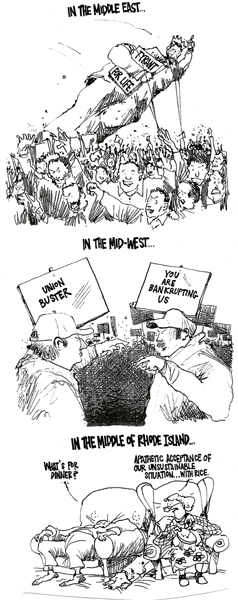
While searching for that strip, I was thrilled to spot something that didn't used to be the case, I don't believe: Jim has a large number of his editorial cartoons up on his personal Web page.
May 29, 2011
Coach Cooley: A Role Worth Modeling
That Providence College basketball has turned to a native son to turnaround it's troubled program is not new news, but Kevin McNamara's piece in today's ProJo about new PC basketball coach Ed Cooley is one worth reading. He had a tough family life but was lucky to know a family that helped him out. Above all else, though, was his focus and drive.
To ease his mother’s burden, Cooley lived with the Searights off and on from the time he was 10 years old. He says he “never remembers not having a job. I was sweeping the sidewalk in front of Popular Market at Broad and Warrington when I was 9 years old. I helped at the Laundromat next door, too.”He moved onto college and worked his way into the coaching ranks. Now, back in Providence, he's ready to accept the responsibility of turning around the the basketball program. And people are looking to Cooley to do more:By the time he enrolled at Central in 1984, Cooley was a budding hoop star. His mother had left Elma Street and moved into the Wiggins Village housing project, just around the corner from Central. Eddie moved back in with his mother, brother Timothy and two younger sisters, Margaret and Gloria.
In school, he credits an English teacher, Paula Milano, with steering him to the Upward Bound program at Rhode Island College. In his junior and senior years, he went to RIC for five hours every Saturday for classes and spent six weeks over two summers living on campus.
“Eddie was always focused on his education,” said Mariam Boyajian, the director of Upward Bound. “He was this big basketball player and his friends were all about being cool and the street but he handled all of it well. He found out that if he could do it here with us, he could do it in college.”
Cooley turns left onto Prairie Avenue, looks out over a wide expanse of playgrounds and says, “All this was projects. It was a tough spot. Roger Williams projects.” Up on the right sits Roger Williams Middle School, now one of the lowest-performing schools in the state.To be sure, in the short term, Cooley is focused on his program. Yet, I think it's safe to assume that Cooley will continue to be more to his hometown than just "Coach."As he tries to sneak past a group of kids waiting for a bus, the lone adult in the pack waves down his truck, “Cooley, I’ve been trying to get you!” He asks what’s up and she says, “You need to come in and talk some sense into these kids. They all show up to school with a ball under their arms and no books.”
April 13, 2011
Bewildered Leaders and a Bewitched Population
Calling Lincoln Chafee our "bewildered governor" and joking about the national search no doubt conducted before Senate Majority Leader Dominick Ruggerio hired the 25-year-old son of his union pal for a $90k job, Ed Achorn puts his finger on the chilling reality:
Until voters hold accountable these leaders — and the legislators who put them in power — they simply will not care if the masses suffer while those with connections gorge at the trough. If you vote those representatives and senators out of office for going along with these raises — or, at least, offer a credible threat that you will do so — you might find these leaders rethinking the question of whom they actually serve.
A few people still hold out hope that such a thing could happen, in Rhode Island, but I can't say I'm among them. The system is simply locked up by people invested in the corruption, which is a polite way of saying that they're bought off. I'd argue that the great majority of them would actually be better off under a fairer, less corrupt government, but few would listen.
In a state where people say that everybody knows everybody, too many folks think knowing somebody should actually be of legitimate value.
March 25, 2011
If Not for the People, RI Would Have Fewer People
Perhaps it's a function of idealism, but the continual penchant for racism in our country wearies me. By racism, I mean the division of people into racial groups and inclination to treat them as separate communities:
Without the 39,835 additional residents who identified themselves as Hispanic, Rhode Island would have lost 35,587 people from 2000 to 2010. That would have joined the Ocean State with Michigan, the only state to lose population in the 2010 census. As it was, Rhode Island ranked 49th in population growth, gaining 4,248, or 0.4 percent. ...Hispanics officially became the majority population in Central Falls, while Providence grew closer to that status. If separated, Providence's Hispanic population of 67,835 alone would be the fifth-largest city in the state.
And so on. The thing is: they are not separated. The population did not decrease by 35,587. What is it we should determine to do differently based on this information? Should it become an outrage that Central Falls doesn't have a majority Hispanic government? Or, from the other side, should we treat "Hispanic" as a synonym for "immigrant" and panic at the loss of native-born Americans from our state?
The detriment arises from the mixture of these perspectives, such that assumptions are made about a group and then notions of how society should be arranged are imposed under those assumptions. The insinuation is that Hispanics have unique needs and points of view, and if those qualities aren't reflected in the political order, then some sort of under-representation must be to blame.
Personally, I find this bit of Census news to be more relevant, and definitely distressing:
In 2000, 247,822 children lived in Rhode Island, according to the Census Bureau. That was 23.6 percent of the state's population of 1,048,319.By 2010, the number of children had dropped 23,866 to 223,956, or 21.3 percent of the state's slightly larger population of 1,052,567.
Unless one wishes to suggest that we were in the midst of a baby boom in 2000, the decrease in children is an indication of a waning society. Of course, it isn't necessary to turn to demographic statistics to discern that about Rhode Island.
January 16, 2011
Stuck in the Comic Book
If you didn't read it when it was published on the 2nd (yes, I'm still behind), take a look at Tyler Hayden's op-ed musing on getting stuck in Rhode Island:
Eight years later and I'm still here, I'm still cold and sometimes I still think I'm stuck. I keep expecting I'll get used to it, but surprisingly, my first impression still rings true. Some people simply aren't meant for certain locations. Like a fish out of water, I flip-flop around looking ridiculous and awkward. I am Kermit the Frog lost in the ghettos of Gotham. I've given up trying to "fit-in." ...Tough guys, meatheads, whatever you want to call them. Machismo reigns supreme throughout Rhode Island. Intimidation is the weapon of choice. There are jerks everywhere but Rhode Islanders are just really good at it.
There's so much to love about Rhode Island that it's hard to resist the call to change what's not so good — with improvement requiring nothing so much as convincing Rhode Islanders to get out of their own way. As I've said before, sometimes I think the full motto of the state is: "Hope... you're going to need it."
August 22, 2010
A Craft for Our Region
Something about Jeff Soderbergh's work, as recently explained by the Providence Journal's Channing Gray. seems very well suited to this region, and Rhode Island in particular:
Jeff Soderbergh has been called the poster child for recycling. He tracks down old windows, heating grates, corbels and doors — architectural elements with a provenance — and turns them into curious sculptures and elegant pieces of furniture.His materials come from all over the world, and his pieces have ended up in museums and private collections. Soderbergh has made a bed from a Gothic church window from Dublin, chairs from a 1902 baby grand, and a coffee table from a soapstone lab counter that came from a Newport middle school.
Often, in the course of remodeling old houses in Newport, I've found myself throwing out items that just felt as if they ought to be saved — even if only a single board of old wood. We can't help but come into contact with history and heritage, around here, and in a sense, Soderbergh's craft condenses that broader aesthetic into a single piece of furniture of art.
Of course, I can't help but find it a cheap characterization to equate such activity with recycling. It's more a matter of preservation — of finding what is of value in the old to a new application in the present, whether directly related or not.
Some will mutter "here he goes again," but it seems to me an ultimately conservative impulse (especially when one turns around and markets the craft for capitalistic purposes).
July 26, 2010
Those with Time to Wait
Money's somehow ever a factor in Rhode Island. Perhaps the tourist-attracting conspicuity of Newport mansions emphasizes the distinction between those with and those without (and the various gradations between). Perhaps the geography and historical, unplanned New England layout of the roads uniquely places working-class neighborhoods so near to the vistas that draw wealth. Perhaps the long life of the local architecture has led wealthy families to break up their land or subdivide their houses for apartments in proximity to others able to keep their estates whole.
Or it could be the discrepancy between those who can afford to tolerate the mess of the state's operations. After all, crumbling infrastructure has a sort of quaintness, and poorly run and business-unfriendly government only imposes a sort of premium, from the perspective of residents with the wealth to absorb the cost. Only those striving to improve their circumstances need suffer from the absence of opportunity.
It must be said, however, that money shapes the community in ways that can't help but be accessible to all. Unique (sometimes overwrought) architecture and the maintenance of the open spaces of bought-up land help to define an area. The specialty shops with crafts and arts that only the wealthy can buy may still be treated as free-entry museums. And then there's the interesting eccentricity that seems more refined among the rich. I think, here, of a statue that the distracted driver might spot on Rhode Island Ave., in Newport, while on the way to work.

Even if life leaves too little time or cash for more overt pastimes, only a slight turn of the head or turn of the wheel will lead to tastes of repose and feasts for the imagination — albeit with the pangs of longing for the time to linger and the observation that she's waiting for someone to come from within, not to pass by, without.
July 12, 2010
Small Reasons to Stay and Fight
I know of several people who've taken Tiverton's recent financial town meeting as evidence that it's time to pull up stakes and leave or, if they'd already intended to flee, to redouble their efforts. Much was made of claims that the presentation of the school department's budget left the town liable for funding amounting to a maximum of a 22% tax increase, but really, a seven percent increase in the current economy is affront enough.
The town's tax levy has doubled in the past decade. The Town Council was satisfied with "zero impact" contracts with its employees, without pursuing actual savings. The teachers' union clearly is not intending concessions, and the School Committee is unable to extract them. (Truth be told, none but one on the School Committee have any real desire to achieve concessions.) Moreover, the combined forces of public officials, the unions, a compliant local media, and a largely apathetic public that is therefore susceptible to well-rehearsed maneuvers from the other groups leave substantive change unlikely.
So, once again, I find my town to be a microcosm of the state. Schools and infrastructure will continue to underperform and deteriorate, while expense goes up, and the people who must be rallied to stop the process decrease in number year after year. Rhode Island has been at the national forefront in population loss for years, and those who are leaving are those who would back necessary reforms were they adequately presented and initiated.
This is to suggest that those of us who've been pointing to the problems that must be resolved have been remiss in neglecting to incorporate into our polemics reasons that people should stay and fight. It would be unreasonable to expect positive messaging from the RIGOP or any of the good government groups — much less, from Anchor Rising — to counterbalance a family's calculation that the opportunity cost of hanging in there (in here) overwhelms the benefits of Rhode Island life. But those benefits do exist, and it affects the fundamental message of reformers if they do not often mention them.
Why do you want reform? Out of principle, or because there's something worth saving? If wholly the former, then people on the fence might fear that principle will trample quality of life — as guardians of the status quo have been anxious to claim that any change of operations will do.
Such have been my thoughts as I've taken alternate routes home from work, recently. The contrast is stark between the suburban stop-and-go of West Main Rd. in Middletown and the largely empty back roads that flow past beaches and high-end waterfront manses and farms — at the cost, ultimately, of mere minutes of travel time. It would be a travesty to mar such views as this:

If there's a threat to these constituent parts of Rhode Island's character — in this case, "hanging rock" in the Norman Bird Sanctuary across the street from the Middletown beaches — it lies along the path of inadequate reform. The choice is not between total change and minimal change; it is between incompatible qualities of the state as it exists. Preservation requires a healthy economy and residents with the resources of time and money to take care of and enjoy all that the state has to offer.
July 6, 2010
July 5th Observances From Bristol
The family and I braved the crowds and the heat and took in the Bristol 4th (sic 5th) of July Parade. We arrived early (7:30-ish), staked our claim near the beginning of the route and hung out. Some observations:
1) As far as politicians, the earliest bird was AG candidate Joe Fernandez (D). General Treasurer candidate Gina Raimondo (D) really hit our portion of the parade route hard and somewhat overshadowed AG Candidate Christopher Little (M) who was also walking around at the same time. There were a few campaigners for Loughlin (R), Cicilline (D) and Bill Lynch (D) (all running for RI Congressional D-1), but none of the candidates personally glad-handed my section of the crowd. Bob Healey (Cool Moose) did come through later on during the parade though. (And incidentally, despite the Johnny-come-lately GOPers, Healey still has my vote with his end-the LtGov plan). It seemed like Caprio (D) had the most signage and workers.
2) Some time during the 3rd Division of the parade, things slowed down drastically. With the heat and the crowds, many people gave up and started walking the parade route in reverse to get out of dodge. It made for some annoyances as bands had to squeeze thru a constricted route. Not sure what the hold-up was for (though I suspect it was over-long reviewing stand performances). It also shows that our no-attention span culture can't handle much stoppage without moving on. Kinda sad.
3) The bands were all pretty good, but I really liked the Baltimore Marching Revels for their style and the joi-de-vivre they displayed. I also noticed that several bands were from Minnesota. Was there a special hookup with the Land of 10,000 Lakes this year?
4) I took note of the reaction to the separate Tea Party float and RIILE/other groups float. Both floats were sailing ship replicas (for obvious reasons) and more than one member of the crowd cheered the latter while exclaiming "Go Tea Party" or the like. In general, the reception to both was boisterously positive. However, I've gotta say that having people on a float screaming about "taking back our state" and "throw them all out" during a family-type parade (yes, even if it is one celebrating our Independence) seemed a little too intense and out of place. I'm not sure if any converts were won over by the antagonistic (no matter how justified) approach.
5) There was applause for all of the military personnel, past and present (and a few future). Wasn't as robust as I'd expected though. And it seems like time is finally catching up to the Greatest Generation--not a lot of them left. As I've noticed in recent years, the Vietnam Vets continue to get the biggest response.
6) As a history guy, I like the re-enactor groups. From the muskets to the fife-and-drums and all that. But at the risk of ticking off the wrong people....I don't get the pirate thing.
June 24, 2010
Change, We Fear Change
People hear what they want to. Or maybe what they expect to, based on their preconceptions. This was proven again to me recently. I had quickly skimmed the ProJo story about Education Commissioner Deborah Gist's visit to the John J. Moran Medium Security Facility to meet the inmates receiving their GEDs. Later, I heard through the grapevine that teachers were upset because Gist had told the inmates that they were there because "a teacher failed you", to which the response was, "What about their parents or themselves." I found it weird that Gist had said such a thing, so I went back and read the story. Here's what was reported:
"For many of you, part of the circumstances that you find yourself in is because the K-12 education system failed you," she said. "And I take that responsibility very seriously."Part of the circumstances that you find yourself in is because the K-12 education system failed you.While it's understandable that teachers would (obviously!) identify themselves as being part of the "K-12 education system", it's pretty clear to me that Gist is talking about a systemic failure, not that of teachers, per se. She certainly didn't say what I heard: that "inmates were there because a teacher failed them." She even took responsibility for the "system" and hoped to learn from the inmates."The fact that you are here means you have made mistakes along the way and you have had difficulties," Gist said. "But the fact that you are here means you are lifting yourself above those circumstances. We've all made mistakes. You've decided to better your education. You've made a very important decision."
She said she plans to return to the ACI, to spend time with the inmates and their teachers.
"I want to learn from you...so we can prevent younger students from experiencing some of the same challenges you faced," she said. "We want to get it right the first time."
I've heard several teachers are trying to give her the benefit of the doubt. Yet, for a variety of reasons, they seem to have their "ready-to-be-offended" radar up where Gist is concerned. The Central Falls issue rubbed them the wrong way; they think Rhode Island is just a career way-stop for her; some aren't impressed with her resume. And this anecdote reveals a sincere belief among teachers--call it paranoia?--that they know what Gist "is really trying to say" and it isn't something they want to hear.
Its no great mystery why this happens. It's a very human tendency to distrust anyone who comes in with the clear intent of shaking up the way things are done. Then you add in an inherent wariness towards the "executive class"--a sort of iconoclastic populism--that permeates our society. We see it regularly when the virtually powerless RI Governor is blamed for everything wrong or when folks claim we could save a lot of money by cutting items in the School Administration while they ignore that real savings really can only be made be cutting payroll/personnel. It's easier to blame one person (or a few) and seek to "change" (get rid of) that entity than to go through the pain of real change. Shooting the messenger and all that.
June 22, 2010
Not Working, Not Helping?
A report on volunteer rates in the United States and in Rhode Island seems to make contradictory points:
Volunteering in Rhode Island hit a six-year low last year, as more people looked for work or worried about making ends meet.The state ranked 42nd out of 50 states and Washington, D.C., in volunteer rates, according to a report released Tuesday by the government-run Corporation for National and Community Service. ...
"There's plenty of evidence that shows that when people are unemployed and they have to focus on their livelihoods, they are less likely to volunteer," said Bernie Beaudreau, executive director of Serve Rhode Island. "If you're not secure" about your job or the future, "you focus on changing that."
On the other hand:
Despite a tough economy, the number of American helpers increased by nearly 1.6 million to 63.4 million — the biggest increase in volunteers in a single year since 2003, the report says.Americans spent 100 million more hours helping their neighbors and others.
Clearly, Rhode Island's economy and unemployment are at the head of the pack of failure, in the nation, and there's surely correlation with this finding about volunteerism. My gut tells me, though, that both facts are effects of something larger. Our intrusive government, for example, is premised on the local belief that government is meant to take care of problems. Why should people volunteer when they donate by way of their taxes, and why should they work to expand the economy when those donations are obligatory and confiscatory?
June 3, 2010
RI has 2 of 7 "Junkiest Cities"
Oy.Think Greece and Spain are drowning in debt? Look a little closer to home. Seven U.S. cities recently had their municipal bonds downgraded below investment grade. Their debt is now junk, considered more worthless than that of the so-called PIIGS.
"America's short-term budget crises, long-term growth perspectives and needs for austerity are similar [to Greece]," said Matt Fabian, managing director at Concord, Mass.-based consulting firm Municipal Market Advisors.
Last quarter, Moody's Investor Services declared the debt issued by Harrisburg, Penn., and Woonsocket, R.I., to be junk, or below-investment grade. Meanwhile, Fitch Ratings currently has four other cities in the basement -- Detroit and Pontiac, Mich.; Harvey, Ill.; and Littlefield, Texas -- while Standard and Poor's has one -- Central Falls, R.I.
These seven cities are struggling under the weight of the recession. Residents are unemployed, and without a job, they can't pay their property taxes, which are the foundation of local budgets. And cities' operating expenses continue to soar; pension and debt payments don't go away. And as their credit gets worse, the cost of borrowing for municipal projects -- such as sewer plants and roads -- just gets more expensive.
"The fiscal stress is severe in cities around the country, and it's likely to stick around for at least a couple of more years," said Chris Hoene, director of policy and research at the National League of Cities.2 of 7 from little Rhody? Ignomious distinction to say the least and reflective of deep cultural and political problems that we're all familiar with.
May 18, 2010

John Biszko: Rhode Island's It for Me II
Sailboats on whitecaps turn and toss
Each mayor — his own tomato sauce
Taxes so high yet our bridges fall
Here! Getchya Pawsox tikitz!
Come one. Come all.
E'er true flies the elegant seagull
O'er the playground of the illegal
The foghorn wanes its comforting blast
Come join our burgeoning entitlement class.
In 1772 the Gaspee we did seize
Could I get a glazed crullah with that please?
Majestic pastures, vineyards, 'ahh Pro Patria'
A futile search for a socialist utopia.
The proud golden anchor and 13 stahz
On sleeves of riot police outside Providence bahz
Regal waves and cliffs fit for a post cahd
Save us wind turbines! But not in my back yahd!
RI, RI, RI's it for me.
Estate tax is fertile soil for my family tree
For her 2 months of summer, my golly, I'll be boating
It's easy to catch fish when they're already floating.
Come over. It's great. But no need to hurry.
We vote Dem every time. No change. No worry.
Someone owns a gun?! Good Lord, what to do?!
I'm sorry I said Lord. Did it offend you?
On these shores we hold forth a lively experiment
Alternative lifestyles. Blind progressive sentiment.
That a flourishing civil state may stand.
Have you tried Dunkin's new clam coffee?
It's not at all bland!
May 17, 2010
Two Perspectives on Root Causes
The two perspectives on what constitutes the root causes of poverty and, therefore, how to resolve them, emerged when the six gubernatorial candidates met with the Rhode Island Interfaith Coalition. On one side:
Republican John Robitaille, Governor Carcieri's former communications director, said the large number of single-parent families in poor communities is a key factor contributing to childhood poverty. He said the state needs to streamline access to its social service programs and adopt "targeted and measurable" ways to deal with the root causes of poverty, he said.
And on the other:
Rabbi Alan Flam, a senior fellow at Brown University's Swearer Center for Public Service, urged attendees to do more than write checks and organize food drives.While such charitable acts are helpful, they don't address the roots of poverty — or the ways to end it. Solutions require action in town halls and at the State House, he said. "We must act with a resolve and a belief that we can be a catalyst for change."
One can fairly infer that Robitaille would decrease government incentives for the behavior that constitutes the root causes, while Flam, in attempting to leverage the government as his "catalyst for change," would increase them. It's an old debate, but I'd suggest that if we perpetuate the sense that the indigent have a civil right to government solutions, we'll perpetuate the adolescent dependency that is primary among the roots.
We do have a moral obligation to assist those who need help, but that assistance must be seen as voluntary charity on our part, not as something that is owed to the recipients.
May 14, 2010
The Sickness is Deep
The anecdotes provided by John DePetro in this piece are, unfortunately, entirely predictable:
Callers from North Providence were calling in to my show on WPRO regarding the FBI arresting three members from the council. Some of the comments:
* "It wasn't taxpayer money they took."
* "25 grand ain't a lot of money. It ain't like they was greedy."
* "They come from nice families."
* "Everyone in Rhode Island has their hands in the cookie jar."
* "The real bad guy is the rat who went to the FBI".
April 18, 2010
History Unexplored and Quality of Life
It's been a running theme — of accelerating urgency on an individual basis — whether Rhode Island's vaunted "quality of life" justifies the cost of building a life, here. My view is that high culture, wonderful scenery, history, and so on don't amount to much for families that must work so hard simply to survive that they can't take in the sights.
A recent article in the Life section of the Sakonnet Times brought the question to mind:
We walk or drive by remnants of our storied local history every day without giving it a second thought. Some — like the hitching posts along Bristol's High Street and elsewhere — are "hidden" in plain view, while others are more camouflaged.
The article goes on to list a number of sites and artifacts in the East Bay, and if you're like me, perhaps you'll add the search for such things to a list already including various performances, museums, festivals, activities, and readings that you'd pursue if you could just get past the next mortgage with a little money and time to spare. Personally, I'm doubly affected by the desire to incorporate the rich local settings and traditions into stories and essays.
Oh, well. It's beginning to seem, as the song goes, that "someday never comes." The question remaining for Rhode Islanders is whether it's worth fighting for reasonable governance and a thriving economy that would allow folks other than tourists, the rich, and public sector workers to enjoy what Rhode Island has to offer, or whether it'd be better to find a location that would balance what one wishes to do with what one can afford to do.
March 19, 2010
Public Spenders' Soft-Spot for Nonsense
The "arts community" has drawn pretty tight ideological lines around itself, but there are those of us with pretensions to art, in some medium or other, with a different understanding of the world. As such a one, I think Governor Carcieri was wrong to give in and cancel his plans "to eliminate a program that has produced millions of dollars for high-profile, and sometimes controversial, public art installations across Rhode Island."
That's millions of dollars that have been tacked onto public construction projects as a requirement. Projects like a courthouse sound system playing chirping birds.
Now that the governor has caved, subsidy supporters are targeting his plan to cut the $700,000 of state arts funding from the budget. According to Lt. Gov. Liz Roberts, the "arts economy in Rhode Island" employs 12,000, which means that cutting public funding would cost them each, on average, about $60 per year.
I do agree with the value of having artistic and cultural displays in public spaces, but the following quotation strikes me as missing an important point:
"Public art is a very special thing ... What would the world be like if we removed all of these from our environment? It'd basically be like visiting East Germany prior to the Berlin Wall coming down," Rhode Island School of Design President John Maeda told supporters during an afternoon State House ceremony. "It'd be a place without feeling, without emotion, without hope."
I'd be surprised if the state couldn't find artists willing to donate their work for public viewing free of charge or donors willing to pay for art in the public square. If artists are driven, and the local society is desirous, the sharing will manifest.
March 9, 2010
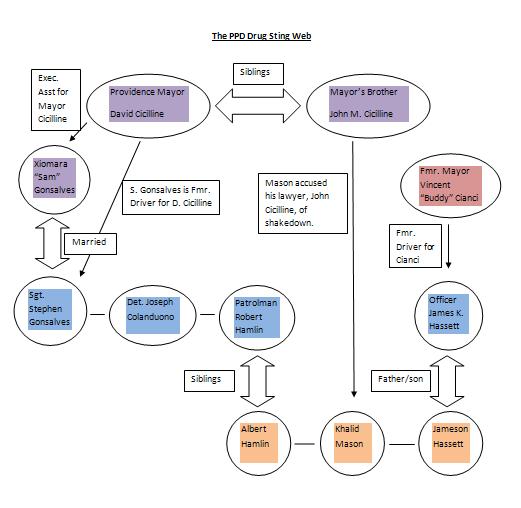
Connecting the Dots: The PPD Drug Ring
It's been a few days since the main players were divulged, so--based on information gathered in various stories--here is an attempt to show the links between the known players in the Providence PD drug ring and others. These links aren't to be inferred as an accusation against those not charged, but they are interesting in that they show how the saying in Rhode Island that "everyone knows everyone" is indeed the case.
February 16, 2010
The Not-Well New England State
Perhaps Rhode Island's problem is it's size. I mean, looking at the map that accompanies the results to Gallup's poll concerning Americans' well-being, one can hardly tell that we're in the "lower range" category. I mean, the bottom half of New England is "midrange," and Vermont, New Hampshire, and Maine made the "higher range" category so it looks like the region's doing pretty well. You can hardly see the little bile-colored spot amidst the region's green hue.
And yet, there we are, in company with the Deep South.
Gallup-Healthways Well-Being Index 2009 state-level data encompass more than 350,000 interviews conducted among national adults aged 18 older across all 50 states. Gallup and Healthways started tracking state-level well-being in 2008. The Well-Being Index score for the nation and for each state is an average of six sub-indexes, which individually examine life evaluation, emotional health, work environment, physical health, healthy behaviors, and access to basic necessities.
February 15, 2010
RI's Rut Is Intellectual as Well as Economic
In a general sense, the front-page, top-of-the-fold story in the Sunday Providence Journal isn't really news at all. Rhode Island led the region in job losses, over the last decade, and its 3.85% drop compared with a national average of 2.2%. The message to readers: get used to the pain.
Of particular concern is that the economic brain trust of the state, mostly academic economists, are offering advice that is both too sweeping and too targeted. Bryant professor Raymond Fogarty laments that "we didn't put enough money into business development," but also (rightly) notes that our "regulatory system is out of control." As we're hearing in the vague proposals that legislators have been floating, money isn't going to come without more government strings. URI professor Edward Mazze asserts (correctly) that government doesn't create jobs, but goes on to say that government should pursue a particular type of economy — the much-cited "knowledge economy" — by (naturally) investing more money in Mazze's employer.
Then, there's this common argument:
[Economic Development Corp. Director Keith] Stokes said Rhode Islanders need to realize the state is part of a regional economy, and people can move seamlessly across state borders. That means Rhode Island's workforce training and tax structure need to be competitive with neighboring states. Unless the state has a trained workforce, Stokes said, even areas of relative success for Rhode Island in the past decade — life science, defense, finance — don't benefit the state as much as they could.
Education is a long-term matter. Even a complete turnaround, today, would take years to change the general workforce and years more to attract businesses to employ it. With teachers' unions that would rather risk their members' jobs and tie up districts in court than allow their members to agree to additional support for students, it will take years of draining battle just to begin to implement a turnaround. And then, if the state doesn't have jobs on offer, the newly competent young adults will simply cross those seamless borders.
In the short-term, who cares if Rhode Island runs that scenario in reverse — attracting well-educated employees from other states? Over time, they'll move here, invest in the state, and help (or force) its natives to figure out how to change things for the better.
As I've noted before, I don't have a fancy title, and I certainly don't receive my paycheck from the public sector, but the answer seems simple, to me: Cut taxes. Eliminate mandates. Erase regulations. No targeted sectors or industries. No additional strings. Just a major overhaul and a big sign at the border that reads, "Open for Business."
January 19, 2010
What Consolidators Are Missing
I suppose this Projo editorial opposing the newly legislated board for statewide health insurance benefits for teachers is better late than never, but the editors continue to keep two and two from being joined:
Obviously, Rhode Island can do much better than rushing through a new system whereby a panel of special interests reward themselves at the taxpayers' expense. The approach adopted is, in essence, a new and costly mandate on local communities, with less, rather than more, local input into spending decisions that affect the bottom line.
That will always be the case, once the messy reality of human self-interest is introduced to the shiny machinations of planners. Better policies on a case-by-case basis may delay the deterioration as power and money are consolidated, but they will never prevent it.
More importantly, though, we all should have learned by now that there are other aspects of Rhode Island's government that must be fixed prior to consolidation. Handing a mandate to consolidate to the ruling class that has brought Rhode Island to its knees is like buying a home-owner's insurance policy from the thief who just broke in and stole all of your belongings.
A Fortieth Municipality
At a time when common wisdom is marching straight toward a cliff labeled "consolidation" (at the bottom of which are sharp rocks of incumbency, special interests, and political corruption), I'm encouraged to see that the independent spirit lives on in some corners of the state:
Started in early December by Prescott Avenue resident and Riverside native William J. Hurley, a group officially titled the "Coalition to Secede The Riverside from East Providence" has expanded over the last five weeks to include more than 100 members. While many have joked in the past that Riverside should become it's own town, Mr. Hurley and his peers say they want to see the idea come to fruition.
Of course, Riverside residents should be made aware of the huge additional cost of going it alone, but if they're comfortable bearing it, then the desire for more local control is a healthy one. One East Providence city councilman puts his finger on the most prominent benefit (emphasis added):
City councilman Bruce DiTraglia, whose ward is contained entirely to Riverside, said the idea definitely has its advantages."I would like it," he said. "I would think it would be a lot cozier and a lot more personal. I think you could get a lot more people involved. I think it's a good idea."
When the playing field to change policies is smaller, more people will think it worth their time. As gravity pushes control out to state and national governments, more and more people conclude that the possibility of change is so remote as to make civic engagement fruitless. Moreover, as the pain of errors in governance spreads more broadly, it takes a higher degree of incompetence to teach the electorate the lessons that it needs to learn.
January 15, 2010
How a Ruling Class Is Maintained
Ed Achorn makes a familiar observation when he writes:
Ocean State politicians have long supported a two-tiered society in which there is a privileged class of public employees — about one in six workers in Rhode Island two years ago, probably a higher percentage today — and an underprivileged class of private-sector drones.
We should remember, though, that the dynamic isn't entirely of two groups buying each other's support. It's more of an incestuous cabal. Look no farther than newly elected RI Representative Mary Duffy Messier (D, Pawtucket), who leaped directly onto our Legislative Stooge list:
But Messier was among the 47 House members who successfully voted to override Carcieri's veto [of the bill mandating teacher health insurance].[Rhode Island Association of School Committees Executive Director Tim] Duffy said his sister, who recently retired as a Cumberland school teacher with a $46,536 annual state pension, "has always been a strong union advocate."
Duffy Messier is 57. The average per capita personal income in Rhode Island is $37,523. Sometimes political victory is a matter of who has the time to make noise and join legislative bodies that pass harmful laws. And sometimes, I wonder whether we should stop complaining when public-sector workers who retire at a young age have their retirement largess sent to their new homes out of state.
January 4, 2010
In a Land of Waning Religion?
Ted Nesi has culled the local data from a national survey concerning American religion:
Rhode Island residents are among the least religious in the country, according to a new study by the Pew Research Center's Forum on Religion & Public Life in Washington.Just 44 percent of Rhode Island and Connecticut residents surveyed by Pew said that religion is "very important in their lives." The two states ranked No. 42 out of 46 in their share of deeply religious people. (The center surveyed 482 people in the two states, which were combined because of their small sample sizes.)
One could layer all sorts of caveats over this sort of data. In a state in which religion isn't an overt and explicit part of quotidian interactions, for example, it may be that a survey respondent has to be even more devout in order to declare the importance of religion and expressions of certainty in the existence of God.
That said, there's a reason public statements of religiosity feel like missionary work around here. One could suggest that New Englanders just like to treat their faith as a private matter, but by any standards &151; religious, sociological, psychological — cordoned faith is vulnerable faith, especially as new generations get the impression that nobody really believes anything.
December 17, 2009
Abstract Consolidation Polls Well in RI, but....
According to the new Brown U. poll:
However, as pollster Victor Profughi (he didn't do the Brown poll--ed.) stated on the John DePetro Show this AM, how many would approve of consolidation when it is their school/police/fire department being streamlined? It sounds good in the abstract, but how will the neighbors feel when the fire station across the street gets consolidated with another a couple miles away? Or two half-filled neighborhood schools get split up and the kids spread around to 4 or 5 schools? That's what real consolidation means--and it's done all the time in the rest of the country--but I'm not so sure Rhode Islanders are ready to embrace that kind of change when it happens on their doorstep.
Gov. Carcieri has proposed a high-powered commission to study the feasibility of consolidating or regionalizing public services, like education, public safety, and other municipal services. The argument is that there is too much duplication of services among the state’s 39 municipalities. Do you agree or disagree the following services should be consolidated?Q32. School Administration? Agree 64.3%; Disagree 25.3%; DK/NA 10.4%
Q33. Police? Agree 51.1%; Disagree 37.8%; DK/NA 11.1%
Q34. Fire? Agree 54.8%; Disagree 34.6%; DK/NA 10.6%
Q35. Public Works? Agree 69.2%; Disagree 20.8%; DK/NA 10.0
Q36. All Services? Agree 53.0%; Disagree 33.7%; DK/NA 13.3
October 31, 2009
Are We Right or Should We Be Left?
Concise and clear as it is, Matt Jerzyk's Providence Monthly piece (PDF) brings into relief an inconsistency in the narrative of the local left:
Conservatives are quick to blame the majority Democratic General Assembly for most of Rhode Island's ills, but that's not fair or accurate. First, many of the so-called Democrats in the General Assembly are DINOs (Democrats in Name Only). These DINOs support tax breaks for the rich, oppose women's rights and gay rights and gang up on immigrants and the poor. In other words, they would be Republicans if they could win an election under that party banner.
And yet, with reference to Republicans' dislike of Linc Chafee:
Of course, the irony of this tale is that Republicans historically maintained a power base in New England because of their social liberalism, not in spite of it. The fringe elements of the GOP who are casting out the moderate Republicans might as well be conducting a circular firing squad.
So, Democrats win in Rhode Island as conservatives, but Republicans don't win because they're not liberal? The inconsistency, here, needn't be Matt's; it could originate with voters. Personally, I'd dispute the notion that a decisive number of RI Democrats are very conservative, and I'd point out that conservative Republicans are decisive within their party. We have as much right not to vote for liberal (read, "moderate") Republicans as liberals have not to vote for conservative ones — point being that the question of whether conservative Republicans can win is open, even dubious, given our two-term governor, but it's more clear that liberal Republicans can not win, given the current electorate. There's no objective reason that conservatives must be the ones to compromise their values.
Whoever's inconsistency it is, Matt's reference to it does highlight that "Rhode Island's ills" aren't a result of those vague liberal shibboleths about "women's rights and gay rights" and affinity for "immigrants and the poor." Leftists are free to lament the state of social affairs, but it's difficult to link any of those issues to our economic stagnation from a left-wing perspective. (We on the right would argue that policies pertaining to immigrants and the poor are certainly contributors from ours.)
Frankly, the left/right divide is less useful, in assessing our state's frightening direction, than is the special interest/taxpayer battle, and it doesn't take much imagination to understand why those special interests would like the electorate to keep their eye on political distractions rather than concentrate on political reform.
October 28, 2009
A Fantasy of Practicality
Comments Joe Bernstein to a post on prostitution:
If everyone can just stop the morality arguments for two minutes, and think of the practical results,something should be apparent.I like less wasteful government spending. I think most people on this blog would agree.
Incarcerating women who engage in off-street prostitution is very expensive.It takes prison space that could be better used for dangerous individuals.The state will,in many cases,be put on the hook financially to support the children of incarcerated women.
If you're conservative,this doesn't make a lot of sense for a "crime" that is non violent in nature, and please spare me the crap about spreading STD's. STD's are mainly spread by ordinary people being careless.Most prostitutes who aren't servicing drive up traffic on the street take precautions.
This is very similar to the ridiculous mandatory minimum sentences for drug offenses.The prison is jammed with long term inmates who don't pose a great danger to the general public.Drug dealer one never made a living for a minute without hordes of willing customers.If anyone here could've spent the nine years in narcotics enforcement that I did,they'd likely reach the same conclusion.
Meanwhile,sexual predators including pedophiles,manage to get released in too little time.THOSE are the people I'm willing to see my tax dollars spent on to keep locked down until they're too old to function.
I'm not here on earth to preach to anyone else about what sin they commit by engaging in a behavior that is looked down upon by a lot of people.I'm way too burdened by my own shortcomings for that.
My attitude is that the government should spend money and time on tracking down and neutralizing those people who commit violent offenses and serious property crime.
By the way,my previous comments on drug offenders related to people on the lower end of the spectrum.Major traffickers are indeed dangerous to society,prticularly when they resort to frequent violence to achieve their ends.
The first thing to note is that the post to which Joe appended his comment did not make a moral argument, but a practical one — namely, that Rhode Island's approval of prostitution on practical grounds will not create a firewall at our border making the business fundamentally different here than it is everywhere else. There's a tendency in modern discourse to disregard the practical points of those who also promote morality, as if the former must be post facto scampering to layer an illusion of a considered opinion. The paradoxical effect can be the assumption that the immoral must be practical.
Whatever the case, because he did not address it, my argument applies as well to Joe's comment: Making prostitution explicitly legal in Rhode Island will not cleanse the sex industry of its objectionable — and publicly expensive — elements. Rather, it will make Rhode Island a hub, a home base, for an industry that is illicit everywhere else and therefore habitually corrupt. A business that is built on bribes and political corruption in every other state will not resemble a mom and pop grocer just because it exists five minutes from a border between legality and illegality.
Moreover, sexual license at this degree, and of this degree of uniqueness, tends to lump together. People with sexual dysfunctions — especially in the extreme, like sexual predators — will have a natural affinity for a state in which prostitution is legal. Especially when another of that state's iniquitous "loopholes" allows them to remain anonymous for longer than they should be able. It's no mere coincidence, I'd suggest, that Rhode Island happens to be home to both policies.
Perhaps we should coin the term "fallacy of practicality" — or perhaps "fantasy" would be better. The notion that the sorts of people who are willing to engage in child sexual slavery will find Rhode Island's acceptance of prostitution to be a hindrance rather than a boon is ludicrous. Our state, for example, was not included in a federal sting that is rescuing children from such a condition because slavery is legal, here. If anything, plucking an illegal version of an activity from the midst of a legal industry will require more extensive investigation.
That's not to mention the additional costs that our being a beacon for the nation's seedier elements will entail. Some of the costs will be in direct public safety, some in social spending, and then there will be the intangible cost to families and their children. Frankly, for all families' willingness to endure the slings and arrows of Rhode Island's misfortunes, the sex industry's setting up shop in Little Rhody could be the final message that our little coastal playground for the rich and the corrupt is not intended to be a family friendly location. As the economy improves everywhere else but here, the growth of the sex trade in the state will certainly be added to my "why we should leave" list.
Prostitution can be made illegal without requiring that all women caught selling their bodies be thrown in prison. Unfortunately, the people who might put pressure on forthcoming legislation to mitigate that aspect are so enamored of the idea that they could take a principled stand despite moral reservations that they're requiring the decision to be legal versus illegal. Rhode Islanders who are practical, moral, or both should support the "illegal" option and then advocate for compassion and thrift in the application of the law.
October 26, 2009
Rhode Island as Prostitution Satellite
You may have noticed that "a compromise bill" has emerged on the prostitution issue that may actually have a shot at passage, this week. In response, A largely anonymous Web site (with the exception of Marc Doughty), Citizens Against Criminalization, has gone live (notably named in parallel fashion to Donna Hughes's Citizens Against Trafficking).
Look, I'm not without sympathy for the libertarian argument, on this one, honestly, but I don't believe the sale of sex to be a right. That is, a state is within bounds to make such financial transactions illegal, and I support doing so for cultural reasons, but even more so for the image and society that Rhode Island will build by explicitly accepting the whore trade. Since illegality is the case pretty much from sea to shining sea, across the United States, this argument, from the anti-criminalization site's FAQ is pretty much negated:
Q. What about organized crime? I heard that these places are run by the mafia. A. Surely one would come to this conclusion if one visited other parts of the country. Luckily, because sex work is not illegal in Rhode Island, nobody needs to be 'paid off' in order to carry on business below the radar of the authorities. Organized crime has no place and no purpose when business is carried out legally, as it is in Rhode Island. Investigations into Rhode Island's spas by law enforcement have showed no evidence of corruption.
Rhode Island simply won't become a beacon of a "clean" sex industry simply because within its very narrow borders the transactions can be conducted openly. We will become the Prostitution State, and the social implications of that status will be defined by the illegality of prostitution everywhere else. "Legitimate" businesses aren't going to isolate themselves from the criminal enterprises elsewhere (even if they set up some degree of technical insulation).
September 30, 2009
Rhode Island and Self Definition
Ed Achorn makes an interesting juxtaposition of the ACORN-hidden-camera affair and Rhode Island's inability, thus far, to pass legislation making prostitution illegal. Whatever one thinks of his arguments on the matter, disputants should consider that leaving prostitution legal won't just be another quirky Rhode Island thing. It'll set us apart among our fellow states; the word "prostitution" is always among the top search items bringing people to Anchor Rising, usually as in "prostitution legal in Rhode Island." Once the legality of prostitution is no longer a "loophole," but an acknowledged and deliberate component of the law, the sex trade will explode in prominence.
I simply don't believe that enough people want us to be The Prostitution State to justify this issue's dragging on as it has.
September 25, 2009
Donnis on Prostitution
Ian Donnis has a radio story on WRNI addressing the prostitution issue in Rhode Island. It remains curious to me that those who advocate for the legality of prostitution on the grounds that it doesn't help the women to be thrown in jail aren't more vociferous about turning penalties onto the pimps and johns. They all admit that the vast majority of women involved in prostitution are so occupied out of destitution and addiction, and the lifestyle does nothing to move them away from that form of subservience.
September 17, 2009
Oh Happy Commerce, or, "I felt like I was forcing myself on a 40+ year old fat sex slave"
"Where the hell else is a middle aged man gonna hook up with a young sexy hot sex slave in real life? Like the old saying goes, we want a ***** [whore] in the bedroom but a lady in the kitchen. Just don't expect you gf [girlfriend] to be as whory as the real whores. You'll be disappointed. Even though we have plenty of sex, I still crave that AMP [Asian Spa] experience just for the fun of it, and I doubt if I'll ever get over it. So beware what you're getting into, it can be very addicting."
Thus do the patrons of Rhode Island's prostitution industry speak of their experience, as related by Melanie Shapiro in a Citizens Against Trafficking review of johns' online commentary (PDF). Note that the misogyny extends even to personal relationships.
Advocates for legalized prostitution like to present the image of a clean-cut client looking for a little release by turning to a fully self-aware young woman using the occupation as a stepping stone to build a better life. That's a fantasy. The objectification of the prostitute and the corruption of the culture is the reality.
September 8, 2009
Why We Stay
While Justin and Monique kept things flowing over the long weekend, I took some time with my family and my folks (down from New Hampshire) to take in some Ocean State sights. Well, mostly. First, I had some soccer duties to attend to on Saturday morning--hey, it was uniform day!
We went to Waterfire on Saturday night. It was a perfect Rhode Island night. Not too hot or humid, just the hint of a fresh breeze in the air. The normal lighting ceremony was accentuated by torch-lighting for those who would be accompanying the various opera singers who would be "spot singing" throughout the evening. The usual tourists were around as were quite a few college kids. (I wonder how many "regular Rhode Islanders" attend Waterfire?) My daughters liked it all--they always do!--and made sure we saw the Lady and the Gargoyles so that they could get their fortune. Add in some Del's and it was a perfect night for all.
On Sunday, we continued our tradition of attending Newport's Last Day of Summer party at Easton's (1st) Beach. In addition to the great food and carousel--and beautiful beach--there was a waterslide and some other activities for the kids, including a sand castle contest, sidewalk chalk contest, pie-eating contest...you get the picture. The kids had a blast (no sand castle prize this year, but last year they got a 2nd in the Kids Division and a 3rd for "Best use of only beach materials" for their volcano "erupting" with red seaweed). The day was punctuated by a stroll on the cliff walk. Again, another great one.
My point? This was truly a "Chamber of Commerce" weekend here in Rhode Island. And that's one of the reasons we love it here. Of all of the New England states, Rhody is truly unique with its relatively temperate climate, protected Narragansett Bay and, as Dan Yorke would say, the water. Throw in its proximity to Boston and New York and all of the history...just a great spot.
Over the years, I've often read or heard people who protect the political and economic status quo counter those of us looking for change with, "Well, if it's so bad, why don't you just leave." This past weekend was a good example of why we stay. But it's only part of it. Since taking a job down here, my wife and I have had two beautiful daughters who have grown up here. We are active in the community and school and have made many dear friends. We've put down roots--this is home, even if we weren't born here. We've invested ourselves and our time in this place. We want to make it better for the future and do what we can. Is it quixotic? Perhaps. But we think it's a challenge worth taking and we owe it to our kids to keep at it.
ADDENDUM: To that end....my parents have E-Z Pass in New Hampshire and used it to get across the Newport Bridge. My Dad noted that one of the benefits of E-Z Pass is that you're supposed to be able to, you know, pass easily through the toll both and continue on your way. Not in Rhode Island, though. Even the E-Z Pass lanes on the Newport Bridge have a gate that comes down and stops you until the pass is read. With the tolls going up as of today, that might be something worth addressing.
August 6, 2009
A Fireside Chat with Dan
Alright, there wasn't really a fire, but since we're talking radio, I like to imagine that there was one. Dan Yorke and I had that sort of conversation, yesterday, on 630AM/99.7FM WPRO. Those who missed it or who would like to revisit something (for kind or scurrilous reasons) can stream the whole segment (about an hour, without commercials) by clicking here, or listen to portions:
- On Anchor Rising, my writing habits and schedule, and blogging specifics (traffic, money, etc.): stream, download (5 min, 49 sec)
- On our blogging mission (or obsession) and the effect that AR and blogs in general are having: stream, download (3 min, 46 sec)
- On profiting (or not) from online writing: stream, download (4 min, 03 sec)
- A call from Mike and discussion of "excellence" in Rhode Island and the effects of local participation, with Tiverton Citizens for Change as an example: stream, download (12 min, 45 sec)
- On Dan's opinion that RI reformers need a "big win" and my belief that we focus on smaller victories: stream, download (2 min, 52 sec)
- On hopelessness and a magic wand policy change in Rhode Island (public sector union busting) and the problem of regionalization: stream, download (6 min, 48 sec)
- On what to do about unions: stream, download (2 min, 18 sec)
- On the coalition of problems in RI and whether all are addressable by the same principle (dispersing power and building from the community up, as well as a tangent about binding arbitration: stream, download (6 min, 2 sec)
- On the Republican Party in Rhode Island and awareness of reform groups: stream, download (4 min, 7 sec)
- On prescriptions for Rhode Island and the lack of leaders: stream, download (6 min, 34 sec)
- A call from Robert and discussion of Republicans and the Tea Party as a political party: stream, download (3 min, 14 sec)
- On the Moderate Party: stream, download (2 min, 9 sec)
- A call from John and discussion of Steve Laffey's plan: stream, download (1 min, 42 sec)
July 28, 2009

Speaker Murphy's Best of Rhode Island
House Speaker William Murphy, filling in today 10-21 for Buddy Cianci on WPRO, will not be taking calls, at least for the first couple of hours. Instead, he has indicated a desire to focus on some of the good things in and about Rhode Island.
Here, then, is the running list. Let me know if I miss an item referenced by the Speaker. First up, the
Pawtucket Red Sox
Speaker Murphy's in studio guest for this hour is President of that organization, Mike Tamburo. Professional player agent Jeremy Kapstein has called in to praise both the Paw Sox organization and Rhode Island as a big baseball state; he has, however, declined to share any inside info on any potential major league trades.
ADDENDUM
URI Graduate School of Oceanography
Speaker Murphy's telephonic guest is famed Oceanographer Dr. Robert Ballard, Professor at the URI School of Oceanography.
ADDENDUM
And hour three, with guests Leader Fox, Secretary Mollis and A.G. Lynch, was mainly devoted to positive legislation, pending and proposed, before the General Assembly.
July 13, 2009
If We're Going to Change Something, We Should Make Our Motto "Hope: You're Going to Need It!"
Alright. Let's go ahead and argue about the study that found even more lists on which to put Rhode Island at the wrong end, such as neurosicness and disagreeableness:
Led by scientist Peter J. Rentfrow of the University of Cambridge, England, the researchers ranked the states and the District of Columbia in each of the five dimensions of personality (the so-called Big Five) that psychologists commonly use to describe individual humans: Openness, Conscientiousness, Extraversion, Agreeableness and Neuroticism.Rhode Island ranked poorly on all.
The state was judged 40th on extraversion, characterized by positive emotions and the desire to seek the company of others; a near-bottom 48th on conscientiousness, which involves self-discipline and organized planning; and a middling 28th on openness, an appreciation for adventure and imagination. The state was ranked 45th on agreeableness (a tendency toward cooperation and compassion), 6th from the bottom, but was number 2 on the one negative trait, neuroticism (a type of emotional instability).
I'm not sure I buy the analysis that the trait was handed down by cantankerous founders, although it strikes me as reasonable to believe that other historical and geographical factors are the primary cause that binds those founders with the modern day attitude. The state is a few turns off the direct path from New York City to Boston by land and is dominated by a natural harbor; such qualities probably affect the sorts of people who settled (and continue to settle) here.
Whatever the cause, I've heard the same commentary from too many transplants to discount the accuracy of the general impression. Just as friends who've spent extended periods in other parts of the country have commented about the weight and smell of the air when they first disembarked from the airplane, Midwesterners and Southerners who've found themselves in Rhode Island will sometimes mention, in unguarded moments, the few extra points that Rhode Islanders deserve on the meanness scale.
One of the guys from the Rhode Show (which doesn't make it easy to find the hosts' names) argues that it's more an Eastern Seaboard thing — from Washington to Boston — than a Rhode Island thing, although the maps in the study itself suggest that the state's region is only partly exculpatory (PDF). It's telling that the host proceeded to defend — quite neurotically — the region's disagreeableness as mostly indicative of honesty.
For my part, I'd add my impressions to those of the above mentioned fly-over staters, and I'm from New Jersey. (The relative scores of that state and Rhode Island seem pretty accurate, to me.) I'd also point out that honesty only comes across as mean when one is inclined to think mean thoughts, although I'll concede that it's a coastal quality to voice the intellectual conceit that those who behave more politely are merely pretending.
Some mitigation must be acknowledged — for the sake of fairness — in the fact that a state's long decline will inevitably have an effect on the attitude of its population. With that, though, we face an impossible chicken and egg.
July 2, 2009
Anti-'Plantations' Campaign Ramping Up
Still talking about 'Plantations':
Supporters of a plan that would give voters in next year’s general election the opportunity to strike the phrase “and Providence Plantations” from the state’s formal name, launched a public awareness and education campaign Wednesday....Backers say there is much work to be done if they are to persuade Rhode Island voters that the word “plantations” conjures up enough negative images of the state’s involvement in the slave trade to warrant a name change.Does a top-of-the front page placement signify anything about the ProJo's willingness to help persuade the public about the proposed State name change? I won't recount the history again. I suspect many, like Justin, while ambivalent about it don't buy the reasoning behind the proposal (the ProJo poll on the matter is running 8-1 against the name change). I also think the Phoenix's David Scharfenberg asks a good question: What happens if (when?) the ballot question fails?:“When I see that word ‘plantations,’ I start thinking about slavery. I start thinking about the injustices,” said Sen. Harold M. Metts, a Providence Democrat and a bill sponsor. “… It’s not about guilt. For me, it’s about healing.”
"The big issue is, what happens if it fails?" said Maureen Moakley, political science professor at the University of Rhode Island. "Where does it leave our notion of coming together and understanding? It could be divisive."The reaction from Rickman is unfortunate, to say the least. That the majority of Rhode Islanders voted for a black President trumps any such talk. If a majority of Rhode Islanders rejects the removal of 'Plantations' it won't be because they want to "insult the advocates of racial justice." It will because they recognize an exercise in political sophistry when they see it.There is no polling data on the issue. But there is reason for proponents to be concerned.
When Rhode Island settled on its official name in 1636, the word "plantation" did not have the connotation it would pick up some two centuries later — it referred, more benignly, to the farms on the state's mainland. And there are early indications that a tradition-bound state could resist calls to change a name that was not intended to invoke bondage....Fear of rejection is already percolating in the state's small black activist community. "I don't want the people of Rhode Island to insult the advocates of racial justice — and that's what a 'no' vote would be," said Ray Rickman, a consultant who once served as a state representative and deputy secretary of state.
June 29, 2009
Who's Working the Plantation, Now?
Being neither a native nor a linguistic pro forma traditionalist, I'm in the "who cares" camp when it comes to the excision of the word "plantations" in the official full name of Rhode Island and Providence Plantations. The change would affirm a detrimental and immature impulse that's pervasive in modern society and should, itself, be excised, but ailments are so prevalent in the culture that one must sometimes let the disease eat a bit of loose flesh so as to better address the causes.
As if my metaphor had peculiar accuracy, however, the agreement-fest in the RI House over putting the question of the offending word on the ballot exposed a pair of ugly lesions that ought to concern Rhode Islanders a great deal:
State Rep. Doug Gablinske, D-Bristol, said that when he spoke out in March in favor of the bill, and said he was not proud of his community's involvement in the slave trade hundreds of years ago, he got more flack from his constituents than he has on any other issue.But he said he believes it's much easier for white men and women to "enjoy this country's bounty" and people should try walking "in the shoes of a black man." He said he was backing Almeida. ...
The word plantation is hurtful to his 83-year-old father, [Rep. Joseph] Almeida[, D- Providence] said. He's watching now, he said. And why, he asked, are Gablinske's constituents so upset over his support of the bill? "That should tell you something."
Here we have one "representative" — Gablinske — making the casually paternalistic declaration that he will not represent his constituents on a matter that drew more passion from them than any other (or so he professes). That spurt of moral superiority served to lob a softball to another "representative" — Almeida — to slur the people of Bristol as racists because, for whatever reason, they like the name of the state just the way it is.
Not fully indentured, as yet, the people of RI&PP will have the final say on the matter, and I'd wager that they'll vote the change down. As I said, it won't bother me in the least to be proven wrong, on that, but if the vote goes the way I expect, I'll smile at the implicit rebuke of our State House masters.
June 25, 2009
The Image of a Bad Place
University of Rhode Island Women's Studies Professor Donna Hughes is pessimistic about the likelihood that Rhode Island will decline to correct its permission of prostitution:
AFTER MY EXPERIENCE at the Senate Judiciary Committee last Thursday, I believe Rhode Island is headed for a human rights disaster and nationwide political embarrassment. It is becoming apparent that the Senate is not going to pass a much-needed prostitution bill. Rhode Island will continue to have an expanding number of spa-brothels, prostitution of minors in clubs, and no law that will enable the police to stop it. ...The end of the General Assembly session is near. From my observation, I believe the Senate is going to let another year go by without a prostitution law. This will be a tragedy for victims caught in the sex industry, a black eye for Rhode Island’s reputation, and a victory for the pimps.
Between those two paragraphs — the first and the last of the article — Professor Hughes describes the (ahem) colorful atmosphere of the Judiciary hearing as well as some of the political circumstances of the times. The scene blends with various other news items in the state to evoke a common image in American movies and books of the Place Gone Wrong. I'm thinking of Pottersville, from It's a Wondeful Life, and (for those of my generation) Biff Tannen's remake of Hill Valley in Back to the Future 2 — the archetype of a place governed by the wrong people, succumbing to the wrong impulses, bereft of goodness and soul.
Matching up the particulars of that cliché, it's difficult not to find Rhode Island to be well on its way. Prostitution. Gambling. General corruption.
You know, maybe it just needs to be said in order to give others permission to believe it: Sometimes that which has been known to be bad is, indeed, bad.
June 4, 2009
AR's Optimism That It Doesn't Have to Be This Way
Andrew presented the question, in studio with Matt Allen last night, about whether Rhode Islanders believe that their state must always be at the wrong end of every list (especially those that are economic in nature). Stream by clicking here, or download it.
May 17, 2009
Neighborhood Associations
The sun shone throughout the morning on Saturday, and it cast a timeless spring-in-the-city atmosphere across the neighborhood of Brown University where I was modifying a new door — manufactured with modern materials and recent engineering — to fit a very old opening.
A carpenter can do just about anything with an old door. When the rails and stiles are four or more inches of solid wood, all manner of liberties may be taken with blade and sandpaper. If one trims too much, or if rot requires repairs, new wood may be fit in place, glued, and made to blend as if the old-growth tree felled, cut, planed, and shaped by hand one hundred years ago were destined to be joined with the new-growth one largely processed by machine in recent months.
A hollow-core Masonite door is much less expensive, but the carpenter has less freedom. It consists of two sheets of pressed fibers shaped and textured to look like a paneled door and then adhered to a wood frame approximately an inch and a quarter deep; cut beyond that allowance, and the hollowness gapes dark and flimsy. The floors of century-old houses often dip and bulge to noticeable degree within the swing of a door, and depending on the material layered on the floor and the height of the opening, the installer may have no choice but surgery — cutting into the hollow parts of the door and then gluing a block between the sheets.
Thus was I employed by the street as the collegiate panoply strolled by: parents and preppies and dark-eye-shadowed lads, lovely young ladies ruined with tattoos from wrist to neck, lovelier ladies in spring dresses, professors in their conscientiously gaudy or anachronistic outfits, and men and women both with the manifest beauty of open eyes and a ready smile for strangers. The young children are the best, though; they watch intently, craning their necks as parents pull them along the sidewalk, because saws and hammers are interesting. The solid, sure things in life — doors, floors, roofs, and walls — are the province of the carpenter, and there's something of a mysterious meddling to our tasks.
And there's a thread across history to our practice, which I saw in the practices of others after I'd finished my work, cleaned up the more conspicuous evidence of my presence, and eaten my lunch and rumbled out of the neighborhood in my van (which now stalls at selected intersections). Along the way, peddlers stood by their tables, selling knickknacks. A man with white socks sat leaning against a bank wall playing guitar. A painter chipped away at an old iron fence, while his partner faced the other direction, leaning against a lamppost. People in their roles ever do as they do.
The old buildings have long stood on that steep hill, and their windows have reflected parades of human variety — in dress, in manner, and in occupation. The roads have experienced the evolution of vehicles. (How did horses and carriages ever manage such steep inclines?) And the neighborhood has held its character in an unspoken message from one generation to the next.
Waiting for the change of a traffic signal, brake pressed hard against the forty-five-degree pitch, I pushed a small piece of plastic into my ear and sent my voice across the state, leaving a digital message that I'd begun the journey home, and I wondered how fast I would have to drive to catch the last rays of springtime light on my own block. As they tend to do, clouds were drifting in from the west.
May 11, 2009
Myopia Versus the Long View in Rhode Island
Self-described newcomer to local politics, Brian Gough, has a letter on the Sakonnet Times Web site criticizing reformers' efforts. Individuals' understanding of the appropriate actions of elected representatives, particularly those in leadership roles, may vary, and differences of opinion aren't necessarily worth the expenditure of much heat. But Mr. Gough's snap assessment of the sides makes an egregious error:
The level of passion behind the actions taken at this meeting was apparent. I am a realist, and quickly did the math. I realize the impact of a small group's efforts to push their agenda is minimal in the short term but the impact on our long term financial viability is extreme. They are selling us out for a short-term reduction in our taxes, and willing to risk our long-term values (home value, bond viability, etc.) Based on this, I must question whether I am a short- or long-term resident of this town. The answer is easy, I am here for the long term, and based on this, I will focus my energy on what will help all of us for the long term.
Members of Tiverton Citizens for Change, as the most local representatives of our broader movement, take a very long view of the actions and the changes necessary to renew our town, our state, and our nation. Those who think we see each cut in terms of its immediate affect on our tax bills miss the point and are likely to stop following the thread before they've come to the real structural problems that we're trying to address.
April 23, 2009
A Typical RI Solution for "Solving" a Nursing "Shortage"
Our state is in dire financial trouble based on structural deficits, is on the wrong end of just about every state-by-state comparative list, and is losing its "productive class" by the thousands every year, but the matter of concern for a special legislative commission is, in the words of its Co-chairman Sen. James Doyle (D., Pawtucket):
Even if there are nurses without jobs now, the shortage of nurses, Doyle said, "is going to be a serious issue some day."
Some day. Okay. Let's take that as a plausible reason for at least strategizing methods of increasing the state's supply of nurses. What are some of the problems that must be addressed? Well, there's a reluctance to work more comfortable shifts and in more prestigious locations:
But many graduates want to work only the day shift in a hospital or don't want the less-prestigious nursing-home and home health-care jobs.
Meanwhile, employers are wary of investing in the training of young new hires:
In the hospitals where there are jobs, officials don't want to hire new graduates because they can be expensive to train and there is a fear that, once trained, they will leave to take another job, said commission Co-chair Lynne M. Dunphy, of the University of Rhode Island's College of Nursing.
Perhaps Ms. Dunphy's profession partially explains why the commission contrived such a peculiar means of addressing these specific problems:
A special legislative commission formally unveiled its proposal to give educators in the state's nursing schools an annual $3,500 tax credit, an attempt to keep them teaching so they can make a dent in what the panel said is a looming shortage of nurses in the state.
So, if there's a problem in the nursing profession life cycle, it has to do with matching candidates with difficult-to-fill positions; there's no indication that nursing schools are suffering a lack of students for whose educations they are unable to find teachers; and a legislative commission co-chaired by a nursing educator thinks shaving another "half-million dollars" out of the annual budget to benefit this extremely select class of citizens is the solution.
Yup. That's Rhode Island for ya.
April 20, 2009
What's Keeping the Prostitution Loophole Open?
We've been remarking on the seemingly unconscionable inability of our General Assembly to close the indoor prostitution loophole (here, here, here) for a while now. The ProJo has editorialized about it and offered a fine investigative piece about it.
As I wrote in 2007, "Rep. Joanne M. Giannini...has done yeoman's work in presenting a comprehensive package of legislation that seeks to address all of the past issues that opponents have had." She's still submitting the bills (here and here) and still debating the vocal opposition. Opponents believe that closing the loophole will end up further victimizing the victims (prostitutes) because they fear the working girls will disproportionately bear the brunt of any enforcement. This is the argument that Senate Majority Leader Paiva-Weed has used in the past. But the truth of the matter is that the focus on human-trafficking, while related to prostitution, is simply the most socially acceptable ground to stand on for those who want to leave the loophole open. Rep. Giannini has taken steps to strengthen the penalties against human-traffickers and essentially exempt those compelled into the sex trade. Still, there is opposition.
Dan Yorke believes that the General Assembly leadership refuses to close the loophole for more personal reasons. In a nutshell, put some political leaders, their lifestyles and Allens Avenue all together and you'll see that they don't want to end the much-discussed heterosexual prostitution because it would bring an end to homosexual prostitution, too.
I don't know whether it's any, all or a combination of the above that is keeping the loophole open, but it's about time to close it. 48 other states and most of Nevada (heh) have a point.
March 15, 2009
A State of Unfreedom
I intend to spend a little more time perusing the report titled Freedom in the 50 States: An Index of Personal and Economic Freedom (PDF), put out by the George Mason University Mercatus Center, but Rhode Island's predictable rankings, among the 50 states, are notable without extensive commentary:
- Fiscal policy: 41
- Regulatory policy: 48
- Economic freedom: 42
- Personal freedom: 47
- Overall freedom: 48
Overall, only New Jersey and New York are less free than Rhode Island. And regarding overall freedom, it's not surprising that the scatter plot on page 21 shows a precipitous drop when the percentage of the vote going to the Democrat nominee for president (in 2004) exceeds 50%.
December 5, 2008
Rhode Island to Hard-Working Taxpayers: You're Not Wanted
So I took a 14% reduction in my hourly pay rate this week. My other option was to quit and look for another job (without the benefit of a few months of unemployment insurance). Desperate times are here.
Meanwhile, the Sakonnet Times did run Richard Joslin's diatribe against the Tiverton taxpayers group with which I'm involved. The Providence Journal has also given Tom Sgouros's "Quit yer moanin'" rhetorical dreidle a bigger spin through the population, with Opinion Page Editor Bob Whitcomb offering Sgouros kudos for his "fact-filled and very thoughtful commentaries" (in general).
Then comes the broad list of possible new tax-the-people solutions for avoiding the necessity of paying for Rhode Island's transportation infrastructure out of the revenue pool that really ought to supply it. I'll tell you right now that just about any one of these options — except the higher gasoline tax, which won't affect me, except indirectly via higher costs passed on to customers — may be the final straw for my family.
It's possible they'll hit me with to-and-fro tolls just to get to work each day, and noises are that we're not talking the 35¢ that has been unchanged on New Jersey's Garden State Parkway for as long as I can remember. My wife could conceivably encounter four tolls, as she drops off the children at her mother's house three miles away and then heads to work in a part of Rhode Island more readily accessible via 195. Families in Portsmouth and Middletown could end up hitting six tolls on an evening trip to Providence. And then there are the other taxes and per-mile fees, no matter where one drives.
Of the half-dozen or so jobs that Monster.com emails to me each day that somewhat match my criteria (although rarely sufficiently), not a single one has been in Rhode Island for quite some time. And if I were to find another job in the state, chances are slim that I wouldn't have to deduct heavy transportation costs from my earnings. The question, therefore, is this: Do the state's leaders really intend to further weigh the "get out of here" side of the decision scale for the slice of the population that has been streaming out of the state in the thousands every year?
November 3, 2008
Rhode Island's Adolescent Society
Just so's we've all got the same impression of the culture of our state, let's review:
In Rhode Island, nobody is willing to close a loophole in the law that makes prostitution legal.
In Rhode Island, the judiciary just ruled that legislators who take bribes for votes are immune to prosecution on ethical grounds.
And now, in Rhode Island, it is age discrimination for a bar owner to prevent patrons under the legal drinking age from entering his or her establishment:
Puerini just thought he was being socially responsible — preventing those under 21 from sneaking drinks in his bar when drunken driving and underage drinking were growing issues in Rhode Island.But the state's Commission for Human Rights determined last month that Puerini broke the law in 2005 when an employee at POP, his bar, asked a 19-year-old, who had satdown to order dinner with his parents and some family friends, to leave the premises.
While Puerini faces no fines, the commission is requiring him to run a "prominent" notice in area newspapers stating that he and the business he has since sold violated the state's age-discrimination laws.
"The dangerous thing is it's now public that it's illegal to keep 18-year-olds out of a bar," Puerini says. "It's opened up a can of worms for many bar owners. Anybody with a bar does it. You're not going to get in if you don't have an ID.
Mind you that I believe the legal drinking age ought to be 18, but the idea that bars, far from being encouraged to block underage kids at the door, are legally prevented from doing so is contrary to common sense and to the assumption of liberty on which our nation was founded. The aggressive mother whose self-importance drove her to make her son into an underage martyr is deserving of opprobrium:
Robynne Alber, familiar with liquor licenses from her days working in the City Clerk's office, disagreed and called the police to confirm the license had no such requirement. Some tense discussions took place between her and the bartender and then on the phone between Alber and Puerini. Puerini then directed the bartender to ask the entire party to leave because, according to his testimony, "she was being loud and making people uncomfortable."The Albers left. But they did not give up. They later filed two complaints, one accusing POP of age discrimination and another alleging that POP kicked out Robynne Alber for defending her son's rights.
It is entirely unsurprising that Mrs. Alber has experience as a city hall employee. I suppose we should be grateful that she isn't a state legislator.
July 28, 2008
Eileen Slocum Passes Away
ProJo's 7 to 7 reports that "Grande Dame" of the RIGOP Eileen Slocum has passed away:
Eileen Slocum, grande dame of Newport society and a nationally known Republican Party advocate and fundraiser, died yesterday at Newport Hospital, according to her son. She was 92.R.I.P.Slocum, who hosted fundraisers in her Bellevue Avenue mansion and opened her gardens, designed by Frederick Law Olmstead, to the public, was a doyenne of both Newport social life and the National Republican Party.
"I think she was a great supporter of Rhode Island," her son, Jerry Slocum said. "And a great promoter of Rhode Island."
Slocum worked for the GOP on many different levels, from presiding over the Newport Women's Republican Club to being the the party's national committeewoman until her resignation earlier this summer.
She regularly attended the Republican National Convention.
And even in her 93rd year, he said, "she had been planning earlier this year ... looking forward to going to Minnesota."
July 23, 2008

Re: Signs of the Apocalypse
Daniel Barbarisi has a story in today's Projo on the strip clubs vs. the Puerto Rican Cultural Festival. Apparently, there's much more to this story; it is but a single battle in Providence's larger waterfront development war…
The waterfront flare-up between developer Patrick T. Conley and businesses on Allens Avenue is starting to burn out of control and has now drawn the businesses and the strip clubs on the avenue into a fight that threatens to cancel the Puerto Rican Cultural Festival planned for this weekend.Also, the cultural festival organizers have circulated a second press release (which still doesn't mention the broader context), containing several quotes from Charles Tapalian where he says he never had any intention to stop the 2008 festival from occurring…Conley and the waterfront businesses, known as the Working Waterfront Alliance, have been battling for years over the future of the industrial strip.
In 2006, Conley opened Providence Piers, a mill housing artists’ studios, function space, and an art gallery, in between Sprague Energy and Promet Marine Services, a shipyard. He wants to see the zoning changed in the area to allow for more than just industrial use. He had originally proposed condominiums, but appears to have altered that proposal to suggest that some sort of commercial use might be more appropriate.
In the interim, Conley has been holding carnivals, concerts and festivals at a vacant lot at his Providence Piers site since last summer, although they are prohibited by the area’s zoning....
At a Zoning Board hearing last night on whether Conley should get his variances, the festival’s timing shone a light on the fact that the site is not zoned properly. And when festival organizers went to get their permits Monday, they were shocked to discover that there was serious opposition to the event, and learned that they would have to wait for their permits and liquor license until Conley’s zoning variance was dealt with.
Among the opponents at a liquor license hearing Monday were lawyer David Tapalian, who acts as the agent for the Allens Avenue adult business Cheaters, which is owned by his father, Charles. Also in opposition were representatives of some of the Allens Avenue industrial businesses, such as Promet, Sprague, and Narragansett Improvement Company, an asphalt manufacturer.
“I was not trying to stop the festival.” “My feeling is that the Puerto Rican community has worked too hard to get this event together for the city to just pull the plug on them,” Tapalian went on. “I am on record at the previous hearing and have said that they SHOULD have the festival, particularly due to this late date. What I don’t want to see is anyone believing that we should allow a ‘carte blanche’ license for events at Providence Piers in the future without proper zoning and due to the potentially dangerous cyanide contamination.””I can understand that in the sudden shock of the city taking this to a hearing that they misunderstood my intentions, but honestly I think the festival should go forward. I’ll be there tonight and I will make it known again that I believe the festival should go on,” he said.
July 22, 2008
Signs of the Apocalypse, or There Are Some Things a Strip Club Just Won't Put Up With
From Anchor Rising's newly opened Bizarro-world bureau: Owners of Providence strip-clubs are worried that nearby cultural events will drag their neighborhood down.
Organizers of the Puerto Rican Cultural Festival scheduled for this weekend at Providence Piers are circulating a press-release claiming that a lawyer representing an Allens Avenue strip-club has formally objected to the festival, because of risks to public safety…
Opponents of the festival were represented by David C. Tapalian, son of H. Charles Tapalian who owns or controls neighboring sex oriented businesses like Cheaters and others through corporations like Spur Track Properties, a limited partnership that does not list any officers. David C. Tapalian is on record as the registered agent.The "merits" of the objection will be decided at a hearing scheduled for this evening.Tapalian alleged that public safety was their main concern, and shot-gunned objections ranging from dust as an environmental health issue and concern to insufficient Police and then blocked fire hydrants and parking. As each concern was addressed in turn, opponents moved on to the next, finally settling on limited parking as their prime concern.
May 1, 2008
Indicative of Obviousness
Times are so dark — and the general thrust of the solution so obvious — that special interests and other general-revenue soakers can't even escape to the Lifebeat section for relief. Credit goes to Rita Lussier for using her influence for the cause of sanity:
Not to alarm you, but this situation is a ticking time bomb. My fear is that if we can't get the numbers to add up, the problem is going to stay unresolved and while you and I are out sailing or playing tennis or watching the Red Sox or whatever sweet distractions of summer might capture our attention, our legislators might to be tempted to take THE EASY WAY OUT so that they too can go off and sail and play tennis and watch the Red Sox. ...Keep in mind that part of the problem here is that everybody else besides us is organized. The lobbyists are organized. The social welfare groups are organized. The unions are extremely organized. We, on the other hand, are not, mainly because we're so busy working to pay for all of this.
Well, I say it's time to get involved, time to say good job so far, now stay the course. And this is coming from someone who has never written to or called her representative. This taxpayer is speaking up:
DO THE RIGHT THING FOR OUR FUTURE. CUT SPENDING.
February 20, 2008
5 Years
A couple weeks ago I mentioned that Phoenix Rising: A Benefit for The Station Nightclub Fire Victims was happening on February 25th. I'd be remiss if I didn't mention it again on this, the fifth anniversary of the tragedy (and here).
God bless the victims and their families.
January 31, 2008
Providence is #10 (Most Miserable City)
So sayeth Forbes:
Misery is defined as a state of great unhappiness and emotional distress. The economic indicator most often used to measure misery is the Misery Index. The index, created by economist Arthur Okun, adds the unemployment rate to the inflation rate. It has been in the narrow 7-to-9 range for most of the past decade, but was over 20 during the late 1970s.Here is the top Ten:There also exists a Misery Score, which is the sum of corporate, personal, employer and sales taxes in different countries. France took the top spot (or perhaps bottom is more appropriate) with a score of 166.8, thanks to a top rate of 51% on personal incomes and 45% for employer Social Security.
But aren't there other things that cause Americans misery? Of course. So we decided to expand on the Misery Index and the Misery Score to create our very own Forbes Misery Measure. We're sticking with unemployment and personal tax rates, but we are adding four more factors that can make people miserable: commute times, weather, crime and that toxic waste dump in your backyard.
We looked at only the 150 largest metropolitan areas, which meant a minimum population of 371,000. We ranked the cities on the six criteria above and added their ranks together to establish what we call the Misery Measure. The data used in the rankings came from Portland, Ore., researcher Bert Sperling, who last year published the second edition of Cities Ranked & Rated along with Peter Sander. Economic research firm Economy.com, which is owned by Moody's, also supplied some data.
- Detroit, MI
- Stockton, CA
- Flint, MI
- New York, NY
- Philadelphia, PA
- Chicago, IL
- Los Angeles, CA
- Modesto, CA
- Charlotte, NC
- Providence, RI
Perception is reality, folks. Here's what they say about Providence:
No. 10
Providence, R.I.Rank
Commute times 69
Income tax rates 149
Superfund sites 111
Unemployment 121
Violent crimes 51
Weather 110Misery Measure 611
Only New York City fares worst than Providence when it comes to income tax rates. The top rate for all of Rhode Island is 9.9%. Residents are fleeing the area, with a net migration of 20,000 out of the area over the past four years.
January 29, 2008
Station Fire Survivor Concert: Phoenix Rising
On February 20th, 2003 I started blogging. The next day, February 21, 2003, the Station Night Club Fire (<= link to original story) occurred and I blogged about it throughout the day.

Now it's five years later and the survivors still need our help. There will be a benefit concert on February 25 to help them out. Artists are from across the spectrum (including metal, rock and country) are scheduled to perform. Keep it in mind.
Continue reading "Station Fire Survivor Concert: Phoenix Rising"January 17, 2008
Is There More to this Providence Fruit Building Thing?
As an admitted antiquarian, I've never met an old building I didn't think should be preserved and re-used. But that's just me and I recognize that--beauty being in the eye of beholder--not everyone thinks that the Providence Fruit and Produce Company Warehouse (more here) was worth preserving, restoring or reconfiguring. OK, fine. But what troubled me about the events leading up to the demolition of the building was the manifest failure of the government--state and City of Providence--to get their acts together. In particular, how the state's incompetence ended up in lost revenue:
The state bought the building from Amtrak for $14.1 million and evicted the remaining businesses. It held the property for six years while it debated what to do with it — either knock it down or sell it — and the property deteriorated, becoming a haven for the homeless and a draw for graffiti artists.So the state wanted to preserve the building, but did nothing to ensure compliance. Well, almost nothing:After lobbying by local preservationists, the state decided to put the building up for sale in the spring of 2004, with the condition that the original structure be incorporated into any new design.
The state’s request for proposals included a draft preservation easement that prevents the developer from knocking the building down for any reason — even in an emergency situation, only localized repairs are allowed without permission from state historic preservation officials.
But that preservation easement was never included in either the purchase agreement or the final property transfer last February....
Carpionato responded to the request with a $4.5-million bid, and on July 8, 2004, proposed a Quincy Market-style development featuring dozens of small shops. The state agreed in principle to the design, and consented to sell the building to Carpionato for $10 million less than the $14.1-million price it had paid to Amtrak seven years before. The reason, state officials said, was that half of the property had been sliced off to allow for the offramp construction. The other reason was that forcing the buyer to re-use the old building clearly reduced the value of the property....
A section of the deal requires the developer to set aside $250,000 to be paid if Carpionato breaches the agreement, Moses wrote. But that is the extent of Carpionato’s liability, he argued, and beyond that, the state does not have legal recourse; nothing prevents Carpionato from destroying the building if the situation changes for regulatory reasons — like issuance of a demolition permit.I'm unsure if the $250,000 will be paid--but it's a small price to pay, anyway.
I'm not particularly impressed with the way that Carpianato has gone about this and my impression is that this was their gameplan (h/t) all along. But the whole way this went down has me wondering if this isn't a case of the State being incompetent....maybe someone on the State side of things had a reason to leave out the previously agreed upon guarantees and conditions in the final purchase agreement. I don't know. But the mystery of why they were left out remains.
So, to summarize, I'm not debating the aesthetics of whether to demolish or save. I am questioning the flow of events that led to the outcome. The property was sold under a certain set of pretenses that supposedly guaranteed preservation of the original structure in some form. As a result of these assumptions, the property was sold for cheaper than market value because preservation is more expensive than ripping it down. In other words, the property could have probably fetched more money if these supposed qualifications weren't in place to begin with. That would have meant more money to the State (ie; taxpayers), including no historic tax credit, incidentally. The end result is that the developer got the best of both world; a cheaper, "preservation price" for the property and then the eventual go-ahead to demolish and develop at a more "economical" price.
So, I wonder if a game was being played from the start to keep the price down based on a pretense of preservation that would ultimately prove unenforceable because the legal language guaranteeing preservation was mysteriously left out of the final deal.
January 6, 2008
Having Found the Last Bastion
On my way to the jobsite, the other day, I stopped at CVS because it's the only store in which I've found my preferred brand of pencil and, because it caught my eye in passing, I picked up a copy of the latest Rhode Island Monthly. It occurred to me, as somebody trying to keep up with happenings in our state, that I ought to subscribe to the magazine. Reading through the January edition, however, led me to reconsider.
The rag looks well positioned to be the last bastion of received the-sky-ain't-falling wisdom. One need go no farther than Ellen Liberman's article on page 29 (page 11, if one subtracts full-page advertisements) (emphasis added):
In 1729, Jonathan Swift suggested that the Irish could alleviate their poverty by selling their babies to the wealthy British to be eaten. A well-nourished one-year-old, he suggested, would make "wholesome food, whether stewed, roasted, baked or boiled; and I make no doubt that it will equally serve in a fricassee or a ragout." A Modest Proposal: For Preventing The Children of Poor People in Ireland From Being A Burden to Their Parents or Country, and For Making Them Beneficial to The Public is now a classic work of political satire.Pureeing poor children into the plat du jour seems to be the only measure policymakers missed in their zeal to slash spending. In the last two years, Rhode Island, once a national model for the care of its most vulnerable children, took significant steps backwards.
In what sort of a setting — and to what audience — can it be straight-facedly stated that the General Assembly "slashed spending"?
I'll note, here, that I've had a soft spot for Ms. Liberman ever since she presented me as a Rhode Island Diogenes back in November '06, and I enjoyed our conversation for that interview. I'd also note that her piece was not the sole stimulus for my impression of the magazine. The latest cover story, by Sarah Francis, "The Rhode Island Red Awards: The dumbest, weirdest, and most outrageous moments of the year," continues the tone. Governor Carcieri and his executive branch are clearly cast as the central source of ineptitude and waste in the state, even to such detail as the following:
Rhode Islanders spent nearly $2,000 a month to pay the rent on a lobbyist's D.C. office that stood empty for almost two years. Carcieri spokesman Jeff Neal defended the $50,000 expense saying, "The governor believes we should maintain that office because if we ever gave up the lease we would never get it back."
No mention is made of the General Assembly's $70 million gift to Chief Justice Frank Williams. In fact, no mention is made of the legislature at all, except for its "law allowing seventeen-year-olds to be tried as adults." In fact, I didn't see a single legislator mentioned by name anywhere in the magazine, outside of the socialite section.
Little wonder Ms. Liberman believes her readers would find it newsworthy that the "state's child welfare community" predict as "future consequences" of cuts to their bread and butter "increased homelessness among young adults, mental illness, child abuse and crime." If Ms. Liberman wishes to present another side, I'll gladly speak with her again to offer the personal testimony that a failure to transform RI government will likely lead to increased homelessness (am I still a "young adult"?), mental illness (as some readers of Anchor Rising might wish to testify, as well), and crime. I'd also present Ellen with my own application for a statue:
"We have requested that the administration sit down to craft a thoughtful plan to make FIP a better workforce plan," says Kate Brewster of the Poverty Institute at Rhode Island College. "That request was denied. We hope their solution is not to make the program more challenging for families who desperately need it."It is sad to those who walk through this great state when they see the malls, the street and triple-deckers crowded with poor women followed by three, four or six children, all in outfits from Ocean State Job Lot and draining our budget with their unceasing demand for healthcare, child care and court translators.
I think that everyone can agree that this prodigious number of children is, in the present deplorable state of Rhode Island, a big problem; and, therefore, whoever could find out a fair, cheap and easy method of making these children sound, useful members of the state would deserve a public statue in his honor.
My plan for Rhode Island is to listen very carefully to the solutions that Kate and the Brewsterites propose... and do the opposite. Increase the cost in effort of free-ride programs. Encourage personal responsibility, and foster real consequences for intransigence. The phrase "social stigma" comes to mind. In tandem, decrease the disincentives to be productive citizens, which would require removing some of the stigma flung at successful businesses and individuals.
Liberman jokingly suggests that we tax children and put them to work; that would be less abusive than the dark futures of dependence and stagnation to which Rhode Island currently leads them, and to which the General Assembly seems inclined to drag the rest of us. Perhaps a subscription to Rhode Island Monthly can be justified purely as a window into the minds of the last demographic likely to come to this realization.
In the meantime, perhaps we at Anchor Rising ought to come up with our own "dumbest, weirdest, most outrageous moments of the year." I'd start, but just the thought of sorting so many previous posts gives me a headache.
December 28, 2007
(Most) "Experts" Agree that Population Loss is Bad
In today's ProJo story on the RI population loss (mentioned here and here yesterday), the Governor, policy experts and academics agree that a shrinking population isn't a good thing for the economy. Some quotes from the article:
Lardaro also explained that the RI's tax structure is "punitive" and it is ”discouraging highly paid, highly skilled workers from moving here, and high-tech companies from expanding here." Especially when our neighbors are more amenable.
But, despite all of this, YKW (you-know-who) doesn't see a problem:
Kate Brewster, executive director of the Poverty Institute...disputes that the state is unfriendly to business or that it is losing college-educated professionals.And none of that is related to the state's economy? Sorry, taking a page from the class warfare playbook doesn't work this time around. As the experts point out, the demographic being lost are the young and middle-class (or potential m-c), not the rich. But guess who employs them? And they aren't going to move here so long as the perception is that RI is business-unfriendly and a tax hell.“From 1997 to 2004, the number of Rhode Islanders reporting incomes over $200,000 rose by 87 percent, a faster rate than in neighboring Connecticut and Massachusetts,” Brewster said. “Detailed IRS data show no evidence of the rich fleeing Rhode Island.”
Brewster also said that because Rhode Island offers tax cuts and deductions to the wealthy, the actual percentage of income tax they pay is closer to 5.7 percent. “So there’s no reason to think that high taxes are driving the wealthy out,” she said.
Brewster blamed high housing costs and the lack of new construction, as well as slowing job creation, for the loss in population.
By the way--and just an aside--why ask Brewster's opinion on this in the first place, ProJo? Aren't there other academics who may offer an alternative view instead of a lobbyist who derives her living from advocating for an expanded, tax-funded, social welfare state? Her reaction to any news that may even remotely result in a cut of social services is predictable. Time to shake up the tree a little and rotate in a couple new sources for reaction.
December 27, 2007
Rhode Island Leads the Nation...in Population Loss
Tipped off by 7 to 7, I went over to the U.S. Census Bureau web site, which has just released population estimates up to July 2007 (raw data here). From the AP summary:
Rhode Island is losing residents at a faster clip than any other state in the nation.Here are some more details . First is a list of raw population numbers and rankings from 2006 to 2007; it is broken out by the U.S. as a whole as well as four geographic regions and RI itself (I apologize for the table lines not being completely drawn and other truncation. Thanks to "chalkdust" for giving a heads up on some oversights on my part. The perils of hasty post compilation!):New population estimates being released today by the Census Bureau show that in the year ending July 1, the state's population declined by four-tenths of percent. Rhode Island lost just over 3,800 people to end up with an estimated 1.058 million residents.
According to the Census figures, the only other state to lose population was Michigan, which saw a decline of three-tenths of a point.
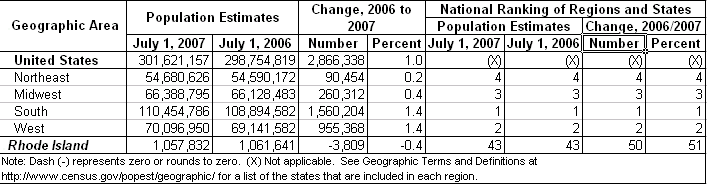
Note that over the past year (as usual) the Northeast is the slowest growing region and Rhode Island is at the very bottom of all states. Here's another table showing the raw numbers:
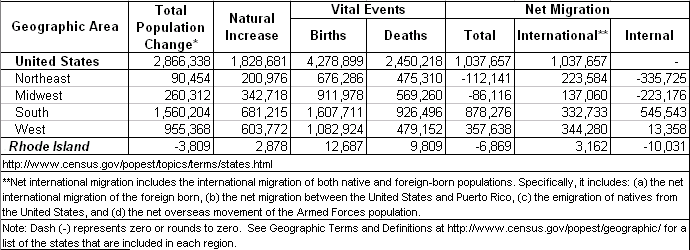
And another table that summarizes rates per 1,000 people:
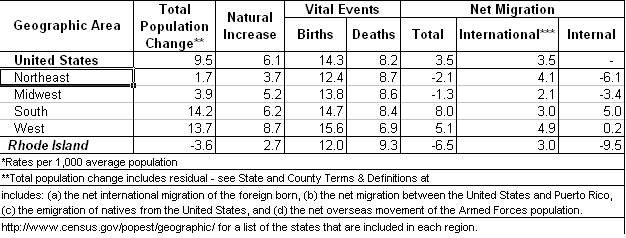
Finally, here is a graph of the net internal migration for Rhode Island up until 2006.
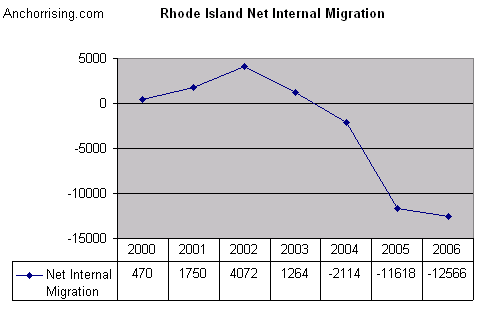
Starting in 2004, but really picking up speed in 2005 and 2006, our state has been hemorrhaging people. Time to shrink government too, huh?
December 23, 2007
Let Them Eat Taxes
I've devoted part of my mind — as I've worked throughout this pre-Christmas weekend — to an attempt to decipher the anagram that must surely lie behind the name Henry Rosemont Jr. He's one of the three academics with whom li'l' ol' carpenter Katz shared the Providence Journal's editorial pages on Friday, and I've found it difficult to believe that a real person would write such a thing as his love letter to "Little Rhody":
You know, of course, that you are being deserted by some people who believe that you have become too rich for their blood, and ignored by many respectable businesspeople for the same reason. Others complain of your seemingly wanton ways, especially with respect to exchanging money or other goods for your favors. All of this must rightfully cause you anguish. But do not despair, because many people love you dearly, not least those of us who have only come into your embrace recently. ...... In brief, what our property taxes paid for [in Maryland] was a sheriff’s department and a school system staffed with heavily overworked and underpaid teachers. ...
... In Lexington[, Massachusetts], the property taxes on an equivalent home there are more than double what we pay in Newport. If anything, our taxes are not high enough. ...
Although there are problems in some schools, you pay those to whom you entrust the young very well, with the lowest student-teacher ratio of any other state except Vermont. You acknowledge the bravery and dedication of your firefighters by paying them more than their peers anywhere else in the country, and compensate the police well, too. Perhaps most significant, the manifold services you provide to the old, the sick and the needy rank you ninth in the U.S.; clearly you understand that aiding victims is far more humane and efficient than blaming them for their plight. And you do all of this without taxing necessities of life — food, clothing, shoes, reading material — unlike almost all other states.
It's like reading a suicidal man's love letter to a poison. Rather, it's like reading a wine-drinker's love letter to the poisoned water that those beneath him are having to drink. How sheltered this man's life must be to see the world in which he lives so poorly.
Here's a thought: If the professoriat so loves taxes, let's have all future deficits funded by taxes on universities. In this case, I might actually support the notion of using taxes to create disincentive: To cover their higher costs, the schools would surely raise prices and decrease aid, which would provide the further service of keeping vulnerable young adults beyond the reach of likes of Mr. Rosemont, who realize that workers, taxpayers, and businesses are leaving the state but still declare that "taxes are not high enough."
Oughtn't academics be particularly concerned with discovering that which they are failing to see, rather than issuing flowery paeans to government and social systems that are in the process of proving themselves to be unsustainable failures?
December 22, 2007
The Book of Rhode Island
Mike Squatrito is in the local news regarding the just-published sequel in his Overlords series. You'll note, if you browse his site, that the second book's cover is a significant upgrade from the first, for which Mike can thank Anchor Rising's sometime brush-for-hire Colby Cook.
Mike also goes to my church, as it happens. He works for the same company as my brother in law. And he graduated from URI (albeit some time before I did).
And thus does Rhode Island wrap its tendrils around those who live here. (Now, that might be the basis for an interesting fantasy novel... or would it be horror?)
December 20, 2007
Whoda Thunk? A Double-dipping Union Hack
Providence Fire Union president Paul Doughty has not come to work for much of the last three years, staffing what Chief George Farrell said appeared to be a no-show position in the department’s training division instead of working a fire truck.Perhaps the most illustrative aspect of the whole story is the "that's the way it's always been done" attitude of both Doughty and past union president Stephen Day. Guess what guys, business as usual ain't gonna cut it this time.At the same time, Doughty was making extra cash working overtime shifts to fill the vacancy created when he left his job on a special hazards truck, according to a Journal analysis of department records; Farrell said that amounted to double-billing the city.
Doughty asserts that he has done nothing wrong: he acknowledges that he did not come to work for almost three years, but said he had been authorized to work full-time on union business by Farrell’s predecessor as chief, David Costa. He said that previous union presidents — including Farrell — have been allowed to do union business full-time. The union contract allows the president to take time off for union business, but it does not specify how much.You got that right, Chief. And it confirms all of the worst suspicions the public has.***
Doughty said that he was not double-billing by working overtime shifts. Once he was assigned to the Division of Training, he said, it was irrelevant where he served previously.“I know it doesn’t sound good, but no matter where I go, because of the way minimum manning is structured, either they’re paying me or they’re paying someone else,” he said. “But at the end of the day, it’s not my spot … for 17 years it’s been my spot, but for those three years or whatever, it wasn’t my spot.”
***
All agree that Doughty’s predecessor as union president, David Peters, worked on a truck at least 20 hours weekly. Peters served the union between Farrell and Doughty, from 2002 to 2004.But Stephen T. Day, fire union president from 1988 to 1996, said that he was allowed to work on union business full-time, and that he, too, worked overtime shifts on his former truck.
Day said that past practice proves that Doughty’s actions are proper.
“This is a smokescreen issue, this is retaliation for Paul Doughty speaking up to defend his members,” Day said.
To Farrell, that’s ridiculous. He said that had The Journal not started asking questions, he would have handled this internally — to have it come out in public just makes his department look bad.
December 18, 2007
Warwick's Honesty Tax
It's certainly a laudable act to seek to return $762 dollars found on the ground by an ATM. Few, indeed, would fault a man for predicting the rightful owner to be unlocatable and pocketing the money. Even fewer, I'd say, would find it blameworthy to keep the money if the authorities wouldn't hand over even a portion should the owner not be tracked down, as Anthony Saccoccia discovered to be the case in Warwick:
He tried to return the money to the Greenwood Credit Union, on Post Road, which was closed. Then he checked a neighboring business, also closed.So he took the money home and called the police. "We picked it up, brought it in and tagged it as evidence," said police Lt. Thomas Hannon.
The police will follow up with the credit union to try to figure out how the money got there, and to whom it belongs. They will seek to examine surveillance video and will ask the credit union to review withdrawal records, Hannon said.
Under the law, the money will go into an interest-earning account for six months, he said. If the police cannot locate the rightful owner in that time, the cash will be transferred to the general fund that pays for city services, he said.
Odd that the person to whom the money actually belonged would likely be more generous toward Mr. Saccoccia than the municipal government. Who'd have thought that the honesty tax would be 100%?
ADDENDUM:
According to Jon of Rhode Island Law Journal, Mr. Saccoccia has a right to that money if it's not claimed. His 90-day clock to claim the money begins when the owner's 90 days are up.
You may all proceed with your good-samaritanism.
November 28, 2007
Arguing from Opposite Sides of the Dollar
As an early-grave-working father of three children, whom my wife and I deliberately brought into the world at a relatively young age ourselves (by modern standards), with nowhere near the income nor savings that an accountant might require to balance out the cost of progeny, I find myself strangely split in my agreement with both parties of the following exchange from the Dan Yorke show:
URI Feinstein hunger center director Kathleen Gorman: How is a woman going to go to work making a minimum wage job or a low wage job if she doesn't have some help with child care?Dan Yorke: Why did that woman have a child in the first place, not to be able to afford it on her own?
Gorman: You think only wealthy people should have children? That's crazy!
Yorke: Yes! Now we're getting somewhere! Only people who can afford it should do it. That's the core philosophy! Only people who can afford it should do it. We got there. Do you agree?
Gorman: Absolutely not. If all people waited until they had enough money to support their children, there would be no children in the world.
I suspect, however, that my agreement with Ms. Gorman might be superficial: The emphasis on money and affordability, it seems to me, allows a spin (or else a delusive elision) by which practitioners in the welfare industry steal more agreement than they actually deserve.
I don't believe that only "wealthy people" should have children, and I suspect that Yorke does not either. Moreover, the notion of having enough money requires clarification: Have my wife and I come up with the resources to keep our children healthy and well nourished? Obviously. Do we currently have any feasible plan for paying for the grander expenses of the future, such as college? Nope.
Life requires a bit of playing by ear. (And I'd note that Yorke and my shared Church requires us to believe that God is ultimately calling the tune.) Indeed, it would be a mistake to leave out the possibility that having children can play a crucial role in fostering responsibility in the parent — a point of principle that applies regardless of socioeconomic standing. The irreducible notes in the melody are not income and savings, but openness, intentionality, and a willingness to sacrifice.
If it's all about the money, then the Gormans of the world can create the easy illusion that single parents who persist in having children ought to be seen as in familiar circumstances to anybody who ever had to take a night job to cover the cost of braces. That's clearly how this Gorman framed her rejoinder, and I worry that a too-resounding "Yes!" from Yorke may strike populist chords that need not resonate beyond the gimme choir.
November 12, 2007
Jon Scott on the Dedication of the WWII Memorial
Over at his brand new blog Jon Scott 2008, Jon Scott has a firsthand report on the dedication of Rhode Island's new World War II memorial, offering his cheers for the members of the general public -- and of course the veterans -- who attended, but jeers for the politicians who habitually attempt to hog the spotlight at events like these…
The Ocean State dedicated the long overdue World War II Memorial today following a short parade, which began at the State House and ended at the Memorial site on South Main Street. It was a beautiful day to honor those who have served our nation with both valor and dedication and, though I have never served (or, perhaps, because I’ve never served), I thought it an obligation to attend the ceremony.Many Rhode Islanders know the story of how funding has been lagging behind for a memorial to those who gave their lives in the second “war to end all wars” but lack of support for the project was not on the minds of those in attendance. The crowd was large, very much behind our troops, and appreciative of the vets who were there. The energy in the park and the stunning monument made me proud to be a Rhode Islander. I wish that I could say the same of the dedication ceremony itself.
I found myself reflecting on my belief that, had I been elected to Congress in 2006, I would not have joined the politicians on the rostrum. There is nothing partisan about my statement. Republicans and Democrats seemed equally eager to take the microphone and pander to the crowd of veterans and supporters. They were all equally mistaken that this was a day about them. I understand that this is the way that things are done. I understand that it is “the way we’ve always done it”, but enough is enough.
Had I been a sitting Congressman, I would have given up my seat behind the podium to someone who served during World War II and, instead of speaking to the folks in the crowd, I would have listened.
October 31, 2007
Creatures of a Rhode Island Halloween: What Lies Beneath Broad Street?
In the novella The Case of Charles Dexter Ward, H.P. Lovecraft tells the story of Doctor Marinus Willet's 1928 exploration of an underground crypt near the city of Providence…
Since the existence of some vast crypt beneath the bungalow seemed virtually beyond dispute, some effort must be made to find it. Willett and Mr. Ward, conscious of the sceptical attitude of the alienists, resolved during their final conference to undertake a joint secret exploration of unparalleled thoroughness; and agreed to meet at the bungalow on the following morning with valises and with certain tools and accessories suited to architectural search and underground exploration.Inside of the crypt, Dr. Willet discovers something terribly alive…
The explorer trembled, unwilling even to imagine what noxious thing might be lurking in that abyss, but in a moment mustered up the courage to peer over the rough-hewn brink; lying at full length and holding the torch downward at arm's length to see what might lie below. For a second he could distinguish nothing but the slimy, moss-grown brick walls sinking illimitably into that half-tangible miasma of murk and foulness and anguished frenzy; and then he saw that something dark was leaping clumsily and frantically up and down at the bottom of the narrow shaft, which must have been from twenty to twenty-five feet below the stone floor where he lay. The torch shook in his hand, but he looked again to see what manner of living creature might be immured there in the darkness of that unnatural well....Lovecraft identifies the location of the crypt and the bungalow above it (which belonged to the Charles Dexter Ward of the story's title) quite specifically…But Marinus Bicknell Willett was sorry that he looked again; for surgeon and veteran of the dissecting-room though he was, he has not been the same since….He screamed and screamed and screamed in a voice whose falsetto panic no acquaintance of his would ever have recognised; and though he could not rise to his feet he crawled and rolled desperately away from the damp pavement where dozens of Tartarean wells poured forth their exhausted whining and yelping to answer his own insane cries. He tore his hands on the rough, loose stones, and many times bruised his head against the frequent pillars, but still he kept on. Then at last he slowly came to himself in the utter blackness and stench, and stopped his ears against the droning wail into which the burst of yelping had subsided. He was drenched with perspiration and without means of producing a light; stricken and unnerved in the abysmal blackness and horror, and crushed with a memory he never could efface. Beneath him dozens of those things still lived, and from one of those shafts the cover was removed. He knew that what he had seen could never climb up the slippery walls, yet shuddered at the thought that some obscure foot-hold might exist.
What the thing was, he would never tell. It was like some of the carvings on the hellish altar, but it was alive.
Not long after his mother's departure, Charles Ward began negotiating for the Pawtuxet bungalow. It was a squalid little wooden edifice with a concrete garage, perched high on the sparsely settled bank of the river slightly above Rhodes, but for some odd reason the youth would have nothing else.Be careful at the next event you attend at Rhodes-on-the-Pawtuxet; it would be wise not to wander down the wrong staircase.
Creatures of a Rhode Island Halloween: What Lies Beneath Broad Street?
In the novella The Case of Charles Dexter Ward, H.P. Lovecraft tells the story of Doctor Marinus Willet's 1928 exploration of an underground crypt near the city of Providence…
Since the existence of some vast crypt beneath the bungalow seemed virtually beyond dispute, some effort must be made to find it. Willett and Mr. Ward, conscious of the sceptical attitude of the alienists, resolved during their final conference to undertake a joint secret exploration of unparalleled thoroughness; and agreed to meet at the bungalow on the following morning with valises and with certain tools and accessories suited to architectural search and underground exploration.Inside of the crypt, Dr. Willet discovers something terribly alive…
The explorer trembled, unwilling even to imagine what noxious thing might be lurking in that abyss, but in a moment mustered up the courage to peer over the rough-hewn brink; lying at full length and holding the torch downward at arm's length to see what might lie below. For a second he could distinguish nothing but the slimy, moss-grown brick walls sinking illimitably into that half-tangible miasma of murk and foulness and anguished frenzy; and then he saw that something dark was leaping clumsily and frantically up and down at the bottom of the narrow shaft, which must have been from twenty to twenty-five feet below the stone floor where he lay. The torch shook in his hand, but he looked again to see what manner of living creature might be immured there in the darkness of that unnatural well....Lovecraft identifies the location of the crypt and the bungalow above it (which belonged to the Charles Dexter Ward of the story's title) quite specifically…But Marinus Bicknell Willett was sorry that he looked again; for surgeon and veteran of the dissecting-room though he was, he has not been the same since….He screamed and screamed and screamed in a voice whose falsetto panic no acquaintance of his would ever have recognised; and though he could not rise to his feet he crawled and rolled desperately away from the damp pavement where dozens of Tartarean wells poured forth their exhausted whining and yelping to answer his own insane cries. He tore his hands on the rough, loose stones, and many times bruised his head against the frequent pillars, but still he kept on. Then at last he slowly came to himself in the utter blackness and stench, and stopped his ears against the droning wail into which the burst of yelping had subsided. He was drenched with perspiration and without means of producing a light; stricken and unnerved in the abysmal blackness and horror, and crushed with a memory he never could efface. Beneath him dozens of those things still lived, and from one of those shafts the cover was removed. He knew that what he had seen could never climb up the slippery walls, yet shuddered at the thought that some obscure foot-hold might exist.
What the thing was, he would never tell. It was like some of the carvings on the hellish altar, but it was alive.
Not long after his mother's departure, Charles Ward began negotiating for the Pawtuxet bungalow. It was a squalid little wooden edifice with a concrete garage, perched high on the sparsely settled bank of the river slightly above Rhodes, but for some odd reason the youth would have nothing else.Be careful at the next event you attend at Rhodes-on-the-Pawtuxet; it would be wise not to wander down the wrong staircase.
Creatures of a Rhode Island Halloween: The Ghost Ship Palatine
Trick-or-treaters in the vicinity of Rhode Island's southern coasts may also want to watch the ocean very carefully, in their case, for signs of a ghost ship said to haunt Block Island. A source no less credible than the New York Times reported on this legend in its edition of November 20, 1899…
During the month of November, a majority of [Block Islanders], or at least those who are descended from the ancient settlers of the community, look for the appearance of the Palatine, the phantom ship....The wife of one of the hotel owners on the island insists that the Palatine spectre was seen by fifty persons in 1880. And there are others who will declare that it makes its annual appearance, and that usually it foretells the death of an inhabitant of the sea-girt isle. The apparition makes its appearance on the edge of the night, when the conditions are best suited to a supernatural visitation. The ship appears in a cloud, with every sail set and drawing full. Her head is pointed toward Newport, when of a sudden the vessel's course is altered and she heads straight for the breakers. She strikes the cruel rocks, recedes, and sinks in the darkening water, while her shrouds and sails are all aglow with the fire that breaks out from the hull.Would it be a cliche to say that the legend of the Palatine may demonstrate how man may be the most dangerous creature of all? John Greenleaf Whittier's "The Wreck of the Palatine", published in 1867 and part of the background of the Times story, tells of a sailing ship lured to disaster by the devious residents of Block Island…
Into the teeth of death she spedAn August 15, 1885 report from the Times relays a detailed version of this legend in prosaic form.
(May God forgive the hands that fed
The false lights over the rocky Head!)O men and brothers! what sights were there!
White upturned faces, hands stretched in prayer!
Where waves had pity, could ye not spare?Down swooped the wreckers, like birds of prey
Tearing the heart of the ship away,
And the dead had never a word to say.And then, with ghastly shimmer and shine
Over the rocks and the seething brine,
They burned the wreck of the Palatine.
Rhode Island folklorist Michael Bell, however, tells an alternate narrative, supported by records made at the time of a confirmed 18th century shipwreck, but hidden from historians until the 1920s…
A deposition taken from the ship's crew shortly after the incident (but not rediscovered until 1925), recounts that the mate (and acting captain) refused to allow the passengers to go ashore, presumably because he was more concerned with tackling than people. During the voyage, "a fever and flux", possibly caused by bad water, had decimated the passengers. The master and some of the crew had died as well. At the insistence of the Block Islanders, the captain finally relented and the ship was abandoned. When her cable was cut, she drifted free and broke up on the rocks.The second version of the incident referred to by Bell, of course, was the version immortalized by Whittier.Within a hundred years, two major versions of this incident had entered oral tradition. One shows the people of Block Island to be kind-hearted souls who saved the shipwrecked passengers and nursed them back to health in their own homes after the cruel captain and crew deliberately ran the ship ashore to conceal their plunder and mistreatment of the passengers.
As early as the late 1870s (after Whittier's poem but before the original records were rediscovered), a gentleman named Samuel Livermore investigating the original incident concluded that there was no evidence that the residents of Block Island had intentionally wrecked the Palatine -- but that accounts of the appearance of a burning ghost ship were credible!
Finally, the 1899 Times story concludes on this ghostly note...
In connection with the ship Palatine, an interesting story is told of a dancing mortar, which once belonged to that ill-fated ship. It is a common mortar, and was used to grind corn. It now rests in the Rhode Island Historical Society's rooms in Providence. The old mortar rested in an old house on Block Island for many years. About the time the Palatine was due to make her appearance, the mortar would hop from its resting place to the floor and the skip and whirl to the brownstone hearth, where it would dance in rhythmic time. Warming up, it would leap back and forth from the floor to the ceiling of the room, beating an unearthly tattoo on the hardwood planks. The peculiar action is authenticated by reputable people who have investigated the occurence.
Creatures of a Rhode Island Halloween: The Sakonnet Sea Monster
Trick-or-treaters of the East Bay should be forewarned about getting too near the shore, lest they come face-to-face with the Sakonnet Sea Monster. The August 1, 2002 edition of the Fall River Herald News describes a recent encounter…
A fun-filled day of swimming and fishing for one local group of friends and family turned into a nightmare that most only witness in the movies.Fall River residents Dennis Vasconcellos, Rachel Carney, Joey Mailloux, Tracy Roberts, a young child and another woman were at Teddy's Beach in the Island Park section of Portsmouth Tuesday afternoon when things got a little scary.
Half the group was fishing, while the other half were either swimming or playing in the sand. But what seemed to be the perfect summer afternoon got turned upside down the moment Vasconcellos heard his fiancé, Carney, scream.
Carney was screaming for help, yelling that something was after her. An unknown ominous sea creature seemed to be toying with Carney, who was swimming beyond the "Danger" sign posted at the quiet beach.
The sea creature -- described as being about 15-feet long, with four-inch teeth, greenish-black skin and a white belly -- was swimming around Carney and popping its head out of the water to expose its teeth and hiss in a manner that could not soon be forgotten, Carney said.
"I was deep out in the water and kept hearing this hissing sound. Then I saw its head come up showing me its big teeth," Carney said. "It kept rolling while it was swimming and knocking into my feet. I just froze."
In the meantime, Vasconcellos said he swam out to her aide and just grabbed her from the backside and told her "don't look back"…
Creatures of a Rhode Island Halloween: The Sakonnet Sea Monster
Trick-or-treaters of the East Bay should be forewarned about getting too near the shore, lest they come face-to-face with the Sakonnet Sea Monster. The August 1, 2002 edition of the Fall River Herald News describes a recent encounter…
A fun-filled day of swimming and fishing for one local group of friends and family turned into a nightmare that most only witness in the movies.Fall River residents Dennis Vasconcellos, Rachel Carney, Joey Mailloux, Tracy Roberts, a young child and another woman were at Teddy's Beach in the Island Park section of Portsmouth Tuesday afternoon when things got a little scary.
Half the group was fishing, while the other half were either swimming or playing in the sand. But what seemed to be the perfect summer afternoon got turned upside down the moment Vasconcellos heard his fiancé, Carney, scream.
Carney was screaming for help, yelling that something was after her. An unknown ominous sea creature seemed to be toying with Carney, who was swimming beyond the "Danger" sign posted at the quiet beach.
The sea creature -- described as being about 15-feet long, with four-inch teeth, greenish-black skin and a white belly -- was swimming around Carney and popping its head out of the water to expose its teeth and hiss in a manner that could not soon be forgotten, Carney said.
"I was deep out in the water and kept hearing this hissing sound. Then I saw its head come up showing me its big teeth," Carney said. "It kept rolling while it was swimming and knocking into my feet. I just froze."
In the meantime, Vasconcellos said he swam out to her aide and just grabbed her from the backside and told her "don't look back"…
Creatures of a Rhode Island Halloween: Prologue
Last year, Anchor Rising assisted local trick-or-treaters by preparing them for some of the more unusual creatures they may encounter on Halloween night in Rhode Island.
There was Bigfoot, once observed in the woods of Charlestown…
Beside the tall fractured stump stood what looked like a large white (yellow white) ape. It was maybe 6 to 7 feet tall, its hair was long, face flat, long massive arms, its head appeared to be without any neck, its chest was broad.There was a "Block Ness Monster", i.e. Block Island's version of the Loch Ness Monster, whose remains have washed ashore from time to time…My mother and I froze momentarily (5 seconds, maybe 10) and the figure remained still, staring at us...
They actually saw it from the shore: a blur of whiteness underneath the waves just beyond the break. The two waded back into the surf and, to their astonishment, found the coiled skeletal remains of an indeterminate undersea creature....And there was the ghost who appeared in West Greenwich to tell people that she was not a vampire…"If you imagine the fish intact, it was a very large fish", [said oceanographer Jeremy Collie]. This echoes what he said when initially surveying the remains on Friday: "There was much more of this fish -- it was a monster. Well, maybe I shouldn't say that."
His wife [returned to Nellie Vaughn's gravesite] several months later where she happened to encounter a young, dark-haired woman who claimed to be a member of a local historical society. When their conversation shifted to discussion of Nellie Vaughn, the young woman became agitated and started repeating, "Nellie is not a vampire."These entities and apparitions may still be out there. And this year, we add three more to watch out for...Shaken, the Coventry woman turned to leave and when she looked back to ensure the disturbed woman was not following her, she found the cemetery empty.
Creatures of a Rhode Island Halloween: Prologue
Last year, Anchor Rising assisted local trick-or-treaters by preparing them for some of the more unusual creatures they may encounter on Halloween night in Rhode Island.
There was Bigfoot, once observed in the woods of Charlestown…
Beside the tall fractured stump stood what looked like a large white (yellow white) ape. It was maybe 6 to 7 feet tall, its hair was long, face flat, long massive arms, its head appeared to be without any neck, its chest was broad.There was a "Block Ness Monster", i.e. Block Island's version of the Loch Ness Monster, whose remains have washed ashore from time to time…My mother and I froze momentarily (5 seconds, maybe 10) and the figure remained still, staring at us...
They actually saw it from the shore: a blur of whiteness underneath the waves just beyond the break. The two waded back into the surf and, to their astonishment, found the coiled skeletal remains of an indeterminate undersea creature....And there was the ghost who appeared in West Greenwich to tell people that she was not a vampire…"If you imagine the fish intact, it was a very large fish", [said oceanographer Jeremy Collie]. This echoes what he said when initially surveying the remains on Friday: "There was much more of this fish -- it was a monster. Well, maybe I shouldn't say that."
His wife [returned to Nellie Vaughn's gravesite] several months later where she happened to encounter a young, dark-haired woman who claimed to be a member of a local historical society. When their conversation shifted to discussion of Nellie Vaughn, the young woman became agitated and started repeating, "Nellie is not a vampire."These entities and apparitions may still be out there. And this year, we add three more to watch out for...Shaken, the Coventry woman turned to leave and when she looked back to ensure the disturbed woman was not following her, she found the cemetery empty.
October 24, 2007
A State in Which You Have to Be an Insider Just to Get Where You're Going
I grew up a fifteen minute drive from the George Washington Bridge into New York City. I lived in Pittsburgh for a year. And I'm a wanderer. That is to say that I've been lost in some of the most confusing areas that the (expanded) East Coast has to offer, but tonight I discovered a specimen of poor street planning so spectacular that the city of East Providence ought to market it as a tourist attraction: where Broadway and Taunton and Waterman all jumble together in an explicable collection of diverging one-ways, replete with weird forks, sporadic signage, and highway-style exits onto normal roads, not to mention the quick dip into a tunnel that seems to have no purpose but to create an overpass to label with a memorial plaque.
So help me, the experience gifted me with a new empathy, as I could not help but think to myself, "No wonder Rhode Islanders act the way they do!" No road nor forest path has ever so thoroughly succeeded in disorienting me and corrupting my sense of direction.
As with everything in Rhode Island, what needs to be done is crystal clear to anybody with an ounce of objectivity, but the thorough reworking of contorted infrastructure would require the displacement of too many established interests. And those who've learned the winds and turns — whether not realizing how much they impair their lives or benefiting from others inability to find their way — develop a perverted pride in their toughness for simply surviving.
If we're to change a thing, I suppose, we've got begin with each neighborhood, each block, convincing, collaborating, building a critical mass of interest in a better road.
October 17, 2007
Just in Case You're Finding the Day's News Too Cheery
Here are two additional rankings across which I've recently come:
- Rhode Island is one of six states that spends more money from the State Children's Health Insurance Program (SCHIP) on adults than on children
- But perhaps that's because the states ranks 44th (that's bad) on the Milken Institute's Chronic Disease Index.
How many horrifying rankings, do you suppose, will it take before Rhode Islanders' apathy breaks?
Just in Case You're Finding the Day's News Too Cheery
Here are two additional rankings across which I've recently come:
- Rhode Island is one of six states that spends more money from the State Children's Health Insurance Program (SCHIP) on adults than on children
- But perhaps that's because the states ranks 44th (that's bad) on the Milken Institute's Chronic Disease Index.
How many horrifying rankings, do you suppose, will it take before Rhode Islanders' apathy breaks?
October 15, 2007
Stunned by the Ray of Light in the Shadows
Rhode Island, where the unbidden friendliness of a stranger is front page news:
... neither motorists nor pedestrians could ignore the man in the pale blue shirt and bright white sneakers yesterday morning standing between the Providence Biltmore and The Westin Providence hotels.Why, he wasn't asking for a thing; their befuddled faces finally began to register with the slimmest of smiles.
He was offering something.
"Good morning!" exclaimed Thad Davis to everyone around him. ...
"I had heard that people in Maine were friendly but real quiet with a dry sense of humor and that people from Boston, well I went to school with a couple kids from Boston and I think there's a certain arrogance with people from Boston."
Davis had heard little about those from the littlest state, but during his walk Thursday through downtown and Providence Place mall he came away thinking Rhode Islanders were, well, kind of glum.
"I wouldn't say they’re friendly but they're civil."
I'd have used "dour," rather than "glum," but the sad thing is that Rhode Island's treatment of outsiders deteriorates the longer they intend on staying. At least it seems that way sometimes.
October 1, 2007
$300,000,000 OBO
Mark Patinkin's hypothetical auction summary for Rhode Island (as in auctioning off the state) had me laughing out loud yesterday:
Founded 371 years ago by a difficult cast of characters expelled from neighboring states, it was the first of 13 colonies to renounce the crown. It later became the last to ratify the Constitution. This is not inconsistent, as Rhode Islanders do not like to be told what to do. The state was once famously described by writer H.P. Lovecraft as “That universal haven of the odd, the free and the dissenting.”Unlike the pantywaists in Boston who merely tossed tea in their harbor to protest taxation, Rhode Islanders once burnt down an entire British tax ship. Oddly, now that locals are in control of the state treasury, Rhode Island may be the most heavily taxed state anywhere.
Hopes for saner tax policy rest with the General Assembly, an evenly balanced body that is 85-percent Democratic. The Democrats, however, are independent thinkers who guarantee they will only vote what “they” feel is right. In this case, the word “they” means “unions.”
The upside for the high bidder is that unlike other states, which are increasingly crowded, studies predict that 74 percent of the local population will soon move to Florida (otherwise known as Flahridder) because it has no income tax.
Yup. It's a state of "friendly people," too, as he explains.
August 22, 2007
Anachronistic History: Ruth Simmons on George Washington
In a ProJo story about the annual reading of George Washington's Letter to the Touro Synagogue in Newport, Brown University President Ruth Simmons is quoted thusly:
She touched upon the moral contradictions underlying the noble desires of past leaders who were eager to uphold freedom, despite an indifference to the injustice of slavery.This is simplistic. Historians agree that Washington's views on slavery certainly evolved from his early manhood up until he freed many of his slaves in his last will. For Simmons to opine that he "fail[ed] to apprehend the corrosive evil of slavery and the immoral inequities that it was to create for generations of descendants" betrays a blindered view of history. The fact is, Washington was hardly indifferent and fully recognized the evils of slavery.“We all know that these lofty and compelling ideals were largely omitted from discourse when it came to Africans and Native Americans.… In failing to apprehend the corrosive evil of slavery and the immoral inequities that it was to create for generations of descendants, Washington compromised his legacy as a moral leader,” she said.
Continue reading " Anachronistic History: Ruth Simmons on George Washington"
August 16, 2007
RE: Who's Making Way for Buddy? Nobody
According to 7to7, who got this from WPRO Station Manager Paul Giammarco:
Program Director Paul Giammarco said the details of the station's line-up of talk show hosts will be announced later. Giammarco said that the station's four existing hosts, St.Pierre, John DePetro, Rush Limbaugh and Dan Yorke, will all remain at the station.My hunch is that Buddy will team with long-time pal St. Pierre in the mornings. If that's the case, such a move would also help lessen the tension between Cianci and DePetro during any "cross-over"."Ron, John, Rush and Dan are important members of our station's line-up," he said. "Each provides the public with their unique perspectives on local, regional and national issues, and the forum for the public to engage, be entertained and be informed."
"Right now," Giammarco said, "everyone is going to be here."
Who's Making Way for Buddy?
On the radio with the man himself, Ron St. Pierre just announced that Buddy Cianci will be joining WPRO. They didn't mention whom he'll be replacing, though; I imagine they're leaving it to the host to tell his own audience.
It may or may not be related, but I caught Dan Yorke making an odd off-hand comment yesterday afternoon that he thought it might be time to start fresh somewhere else. Could he be being pushed aside, or is he maybe discouraged at the changing face of the station? Rhode Island might just be wearing him out. Or maybe the two on-air moments are completely unrelated, and Buddy will slide in elsewhere on the schedule.
Who's Making Way for Buddy?
On the radio with the man himself, Ron St. Pierre just announced that Buddy Cianci will be joining WPRO. They didn't mention whom he'll be replacing, though; I imagine they're leaving it to the host to tell his own audience.
It may or may not be related, but I caught Dan Yorke making an odd off-hand comment yesterday afternoon that he thought it might be time to start fresh somewhere else. Could he be being pushed aside, or is he maybe discouraged at the changing face of the station? Rhode Island might just be wearing him out. Or maybe the two on-air moments are completely unrelated, and Buddy will slide in elsewhere on the schedule.
July 26, 2007
One of the Ways Rhode Island Gets Ya
Mark Patinkin's recent piece, "18 Things To See In R.I. Before You Die," highlights one of the ways in which a small place like Rhode Island can grab you: When people talk about places (or events) around the state, you're likely to have something to add to the conversation.
For example, the second thing on Patinkin's list is "the draggers at Point Judith." Not only do I recognize some of the boats that he mentions as among those that I once unloaded, but I actually devoted a chapter of my novel to describing the dockworker experience, which includes some mild griping about tourists looking at us as if we were an exhibit.
Further down the list, Patinkin mentions Gooseberry Beach on Ocean Drive in Newport. As it happens, from the vantage point of my current jobsite, I've observed telling differences between those who gather on Gooseberry and those who gather at its (private) neighbor, Hazard Beach. The Gooseberry crowd spreads out, while across the divide, the private-beach–goers huddle closely together, many under large umbrellas. Perhaps a future chapter in an as yet unwritten (and as yet unwritable) novel will make a symbol of that, plumbing the forces that push the latter into such a tight group.
I've found Rhode Island to be rife with natural settings on which an author may draw, and I think there's a corollary for non-writers. A sense of the place and a sense of being part of a place. Never underestimate the draw of shared experiences, or of places that make them likely.
June 27, 2007
I Don’t Suppose We Can Blame This On a Lack of Local Ownership
From an unsigned editorial in today’s Projo…
It is time to consider consolidating many more town and city services regionally. To that end, it might be time to revive Rhode Island’s four counties — Providence, Kent, Bristol and Washington (aka South County) to provide local services.Um, what happened to Newport County?
May 25, 2007
The List that Surprises No One Who Lives Here
Just a reminder to those driving off to Memorial Day vacations this weekend; Rhode Islanders have made their annual appearance in the bottom 5 on GMAC Insurance’s list of worst drivers in the United States. From New York Newsday…
The results of a recent driver survey released Thursday by GMAC Insurance seems to indicate they are - the average score by New Yorkers taking the written driver's license test was 71. The failure rate was 36 percent.Alas, we know in our hearts that it’s true.New Jersey, Washington, D.C., Massachusetts and Rhode Island joined New York in the bottom five…
The survey gauges driver knowledge by using actual questions from Department of Motor Vehicle exams.
May 8, 2007
Farewell, Rocky Point
As the last remnants of the Rocky Point Amusement Park are demolished and removed, one wonders if it would have survived longer had it maintained a look more like this:

Now, there will be a discussion over how much to develop and how much to devote to open space. Time marches on.
April 11, 2007
RI House Looks to Mandate Single-Mother Fertility Program
There are probably more than a couple reasons why this is just not a good idea:
Require health-insurance policies to cover infertility treatment regardless of a woman’s marital status. State law requires that insurers cover 80 percent of the cost of such treatments, with no limit on the total treatment cost. But they are currently required to offer that coverage only to married women.Un-PC as it may be, can we agree that enabling anyone to have a child out of wedlock--for the sake of some ill-conceived notion of equality or fairness--is wrong-headed? Even setting aside the "culture war" aspects, why is it in the interest of the State to mandate such a thing?
Keeping Abstinence in Rhode Island
Via Dave Talan's email-based RI Republican newsletter comes this worthy appeal:
I'm writing on behalf of Heritage of Rhode Island. Heritage is a Warwick-based non-profit that is concluding the execution of a three-year Federal abstinence education grant. During this time, Heritage has reached across the State with the message that abstinence outside of marriage is the healthiest choice an adolescent can make. Additionally, Heritage has worked with parents, teachers and faith community and civic leaders, equipping them with the skills and resources necessary to help their children avoid risky behaviors.Heritage is in the process of reapplying for an abstinence education grant, and is seeking letters of support. Of particular help would be letters from educators, faith community and civic leaders who would be interested in bringing Heritage's programming into their community. Letters are needed within the next two weeks.
Heritage is the only agency in Rhode Island fulfilling this component of the President's domestic agenda - any support you could provide would be greatly appreciated.
For more information about Heritage of Rhode Island, you can visit their website at www.HeritageRI.org, or call the office at 401.921.2993 and ask for Executive Director, Chris Plante. An updated site should be going live very soon!
Thanks for considering this request,
Jeremy Brodeur
Heritage of Rhode Island
Member, Board of Directors
JIBrodeur@hotmail.com
April 5, 2007
Re: Banning Brothels
Objections to closing the loophole that allows closed-door prostitution in Rhode Island leave me thinking that those who make them are either on the take or not very... let's say... considered in their understanding. If the goal is to emphasizing the capture pimps, madames, or what have you, then it ought to be streetwalking that is legal. Closed doors require infrastructure, as does organized solicitation — marketing as opposed to peddling.
Somehow it seems to be missed that, in order to arrest those who are facilitating the sale of sex, the sale of sex has to be illegal. On another note, it ought not be missed that the ACLU is both anti-abstinence and pro-prostitution. What a healthy group to have so prominently represented in our community!
Banning Brothels has Opponents?
Despite the fact that prostitution can occur behind closed doors in Rhode Island, prostitution actually is illegal in the state. AG Lynch and many others have long sought to close that loophole. But, somehow, for some reason, they continue to meet with opposition. Rep. Joanne M. Giannini, D-Cranston has done yeoman's work in presenting a comprehensive package of legislation that seeks to address all of the past issues that opponents have had. In addition to offering new legislation dealing with prostitution, solicitation and the closed door loophole, she's offered two bills concerned with human sex trafficking involuntary servitude and a separate one dealing with sex trafficking of a minor. Yet, those testifying against the bill meant to close the loophole were either unaware or chose to ignore the portions of Rep. Giannini's comprehensive package.
The majority of the witnesses blasted the bill.The same can be said for her co-legislators in the past.Opponents included Nancy Green, a concerned Providence resident.
“I feel like it is very easy to arrest [prostitutes] and toss them in jail,” she said to the small group of legislators gathered around a long table inside a cramped committee room. “I want to see us go after people at the top.”
Green’s concerns were echoed by a young social worker, a policy analyst, and the head of the Rhode Island affiliate of the American Civil Liberties Union. They all said that the bill would unfairly target the prostitutes, who opponents say are often forced into prostitution.
...Giannini was visibly upset when she addressed the committee after her bill was repeatedly criticized.
“My intent was never to punish the women with this bill,” she said. “I’ve added the pimps and the people who own the buildings … and the Johns. When was the last time you saw a John in the paper?”
Shaking her head incredulously after her testimony, Giannini dismissed the opponents as those who would rather see prostitution legalized.
“They’ve had two years to come up with a solution,” she said of her peers in the Assembly. “The solution they’ve come up with is ‘Do nothing.’ ”
In an interview earlier in the day, Senate Majority Leader M. Teresa Paiva Weed said she hasn’t seen Giannini’s latest proposal, but that she has serious concerns about past efforts to close the prostitution loophole.Apparently, Sen. Paiva-Weed was unaware that Giannini has dealt with those concerns already, but that's still no excuse for not taking action on this in the past. Talk about making the perfect the enemy of the good. Finally, it also appears as if time is running out on all of the bills as the deadline is April 12, according to the ProJo report (Steve Peoples). Majority Leader Fox is a co-sponsor on some of the legislation, but when asked if it was a priority, he could only offer that platitude that, “It’s a priority like any other bill.”“The concern I’ve always had has been that by focusing on the women on this issue, we are only focusing on half the problem,” she said. “I’d rather see better enforcement of the laws that are on the books.”
Gee, it sure hasn't been in the past.
April 2, 2007
Elaborating on MacKay's Immigration History
Scott MacKay's immigration piece in the Sunday ProJo was a good piece of historical writing. However, and inevitably, it will be used by some as proof for their arguments in the contemporary illegal immigrant debate. Namely that the U.S. has "historically" allowed all immigrants, whether illegal or not.
My first thought after reading the piece was that, while historically accurate, it doesn't necessarily reflect the situation that confronts us now. To be fair, though, this was only the first in a series (at least according to the ProJo), so I don't want to take MacKay to task when I don't know what else is forthcoming. However, I do suspect that there is an attempt to link the past with the present rather too directly--and some of MacKay's writing has the air of polemic rather than reporting.
Perhaps the issue that stirs the passions the most is that the primary difference between the immigrants of then and now is that the U.S. did not have the current social welfare apparatus in place. As such, the tax dollars of American citizens didn't go to support the immigrants of yesteryear. Instead, the immigrants worked hard for what they got. Were the conditions deplorable? Yes. Did they face racism and xenophobia? Yes. But to conflate then with now is simply not accurate.
MacKay writes about how French-Canadians were resistant to be assimilated into the U.S. culture and society. That is entirely true and I deal extensively with it below. He seems to be emphasizing this for the sake of invoking compassion for today's immigrants--and by doing so he conflates the legal/illegal distinction--but there is another way to look at it. Instead of using it as an excuse for today's immigrants, the difficulties encountered by the French Canadians as they attempted to cling to la survivance can also be used as an object lesson.
I don't think anyone will argue that chances are that the quicker an individual can acclimate to our culture and learn our language, the quicker he can succeed. That does not mean that Americans should denigrate or dismiss the various cultures of the immigrants--and we must keep in mind that there are waves of immigrants, which can obscure any acute progress in cultural education that is being made--but it does mean that we shouldn't let our compassion or forbearance be taken for granted. Today's immigrants should learn the "American way" as soon as possible and be encouraged to do so. That does not mean that they will be or should be somehow forced to forget their own culture.
Another point is that there was no such thing as "illegal immigration" until the U.S. passed laws saying so. MacKay deals with this, and although he certainly ascribes nefarious motives for the passage of the these laws, they were passed in reaction to a specific problem. Americans believed that too many people were coming in, too fast. Regardless of the ofttimes despicable reasoning behind the original passage of these laws, they are still the law and most Americans want to keep it that way.
By limiting immigration, the laws--if properly enforced--would actually reduce the current level of acrimony. They help to throttle back on the "incursion" of "the other" (to use a favorite academic term)--they make the waves smaller--and make it easier for those immigrants who enter the country legally to assimilate into the U.S. If these laws weren't so popular amongst Americans--including legal immigrants--then I don't think that some illegal immigration apologists would so consistently conflate the difference between illegal and legal immigration.
Overall, I find it interesting that much of this recounting of history is deemed pertinent because it apparently supports the argument that goes something like this: we've always had these immigration problems in the U.S. so why is it such a big deal now? What's missing from MacKay's accurate re-telling of history is any sense of learning from the lessons of the past. (Though, as I indicated, perhaps that will be present in the next story). Since when have progressives taken to premising their arguments upon the notion of "that's the way it's always been..." to argue for what it should be now? Usually they take what they know of history and try to identify a better way of dealing with the problems that were encountered. In this case, it seems like they're really just saying that everything is fine, let's move on.
In the extended portion of this post, I've tried to elaborate a bit on some of the unsaid implications in MacKay's piece by calling upon my own research into French-Canadian immigration during the post-Civil War era. To do this, I've excerpted liberally from a 4-part series on the topic that I've posted at Spinning Clio. (For important background--and full sources--see these posts on French-Canadian immigration before the Civil War and French-Canadian involvement in the Civil War, portions of which are included in this post).
Continue reading "Elaborating on MacKay's Immigration History"March 17, 2007
Immigration Debate To Heat up Locally
It should make for riveting television when WPRO-AM talk-show host Dan Yorke and blogger-political activist Matt Jerzyk square off on immigration on 10 News Conference at 6:30 AM this Sunday. (A few disclosures: I'm a weekly guest on Yorke's show, and Jerzyk is an occasional Phoenix contributor.)Should be interesting. One point though: I don't think many conservatives are blaming just liberals--President Bush has certainly gotten his fair share of criticism. Any conservative criticism of the actions of the Massachusetts Congressional delegation in the aftermath of the recent New Bedford raid is because they seem more concerned about playing up the plight of exploited illegal immigrants over an entirely legal (if somewhat mishandled) raid. As the ProJo editorializes, the law enforcement officers were simply doing there job--upholding the law. None of this means that conservatives are letting the President off the hook for his predisposition to amnesty.Jerzyk and Yorke have been engaged in a tiff since Jerzyk made a recent post responding to some of Yorke's assertions about the New Bedford immigration bust.
Considering how George W. Bush is in his second term, you have to laugh when conservatives blame liberals for shortcomings in the nation's immigration policy. That said, both immigrant advocates and immigration critics seem united in their belief that the staus quo leaves a lot to be desired. Since immigrants have long made for convenient scapegoats, the hard part is stimulating a dialogue that promotes light, rather than just heat (if not outright misinformation).
March 14, 2007
Airport Expansion: Impacting Real People and Real Communities
I've taken a bit of flack, including a charge that I've lost credibility on economic development issues, over my last post discussing the impact of the T.F. Greene airport expansion proposals (more on it here, here). In it, I took ProJo columnist Ed Achorn to task because I thought that (to quote from a follow-up comment of my own) his "comment implied that this was only a mere runway expansion and that a bureaucracy or insiders or whatever were holding it up. In truth, it's real people who value their quality of life. If they lose the argument, well, so be it. But for Achorn to so cavalierly dismiss them rankled me."
According to some expansion proponents, it's apparently either all or nothing. Your either for economic development or your against it. It's all black and white, you see. And if all you see when looking at airport expansion is dollar signs being put into the state's economy, I would imagine that it is black and white. Especially if you or your community is not affected.
The most aggressive of the proposals put forward so far seem to be too hard on the City of Warwick. {Update: thanks for the map, Andrew. Here are maps of the actual proposals--MAC}. Others, while less detrimental to the city, may not result in sufficient economic growth to justify a smaller expansion. What if the best course is to stand pat? These are the questions that I and many other Warwick residents want to have answered before a decision is made.
While it may be an economic boon to the State, the City of Warwick isn't so lucky. Losing 200-350 homes worth of property taxes (that the State isn't obligated to compensate) while at the same time picking up a net gain in infrastructure costs (water and sewer, trash collection, roads, etc) doesn't bode well for the pocketbooks of those who choose to reside in Warwick. There are also aesthetic changes that will occur, like increased pollution, the loss of wetlands, noise, extension of fenced-off airport property. I know, not very "conservative" of me to bring up some of this stuff, is it? Apparently, it's not very "progressive" of me either.
Look, I know the arguments. The airport has been there forever, so people who live or move to Warwick should have known that expansion was a possibility. They should have known that the State was thinking about planting LAX in the middle of an 80,000 person suburb. If it is really so bad, then current Warwick residents could just move. Besides, the State will pay them good money for their homes and they'll move elsewhere and everything will be fine. They should just get over it and move on. That about sums it up, right?
I guess that, for some people, it is easy to simply pick up and leave a community in which they've either lived their whole lives or have put down roots and made new friends and joined community organizations. Perhaps this is because no one worries about maintaining a "community" anymore. Not really. Pat of this may be because fewer people join community organizations or associations for the sake of making things better. The result is that fewer people have a real stake in the community in which they reside.
Thus, we can all just live in our McMansions and not talk to our neighbors (unless we need something), so one house is as good as any other and one neighbor is just as nondescript as another. As for the kids, well, they can make new friends in a new school--they're all the same. But for some people, it's a lot harder to just write off all of that time and money they've spent trying to help and better their community. And if that is what ultimately happens, there's a good chance that they will move on to the next city or town, but newly jaded and less likely to lend a hand. In today's throw-away society, I fear that we're also throwing away the already dying sense of community, too.
Despite the apparent conventional wisdom, conservatives--me included--don't necessarily privilege economic concerns over less measurable, and thus more aesthetic, factors, such as the quality of life in a community. Perhaps I'm falling prey to a predisposition that romanticizes the idea of a community. Yet, if so, it is rooted in my own experience. A real community is built on personal relationships, of groups of people joining together to make their neighborhoods--and the city or town as a whole--a better place for their families. That includes supporting such things as economic development, which can help to ease the tax burden on families, which, in turn, will allow them to devote more time (and money) to their families and communities. Yet, the by-products of economic development can also have a negative impact.
I support airport expansion, but only if it is done with forethought and with the goal of achieving the best cost/benefit ratio (and that means more than just dollars) possible. To bring up very real concerns about the burden that a particular community will bear so that the State as a whole may benefit--to ensure that any negative impact is either acceptable or manageable--is both fundamentally conservative and economically smart. The discussion going on now in Warwick is over where, exactly, is the point at which the economic benefits of economic development begin to be outweighed by the negative impact that will be felt by the city. As this discussion continues, it's not too much to ask that Warwick residents receive at least a little forbearance from their fellow Rhode Islanders. After all, it is they who are being asked to sacrifice a portion of their community--both property and personal relationships--so that the rest of the State can become more prosperous.
February 26, 2007
Unions and Progressives: They May Agree to Vote Democrat, But Not on Much Else
Some local political analysts predict that the alliance between the unions and the do-gooder liberalism that dominates Rhode Island cannot last forever, because the interests of the two factions don't converge. Tom Coyne put it very succinctly describing last year’s General Assembly session on the (sadly dormant) Rhode Island Policy Analysis Website…
The labor – liberal Democratic coalition that controls the General Assembly now faces an agonizing choice: The Rhode Island economy is in such tough shape that we can keep paying social welfare checks or public employee pension checks, but not both. Their old game is over.In today’s Projo, Scott Mayerowitz adds another angle, reporting on how the divergence of interests extends beyond money…
Thousands of Rhode Islanders who qualify for food stamps don’t sign up for the program, and some advocates say the state isn’t doing enough to encourage them to enroll....Is it unreasonable to ask unionized public employees to be flexible and occasionally take the public good into consideration in return for the big pension checks they've been promised?Many eligible Rhode Islanders don’t think they qualify, think the application process is too cumbersome or simply can’t make it to state offices to enroll because the hours conflict with their jobs....
[Acting Director Gary Alexander] said the Department of Human Services has wanted to experiment with evening hours but that the state has yet to reach an agreement with the unions to allow different work hours.
February 12, 2007
"And now, who has won?"
With the intention of making reservations, I GoodSearched my way to Trinity Brewhouse's Web site, last night, but what I found there gave me reservations. I can only assert that I'm wary of slipping into the role of easily offended Catholic Christian, and my literary and artistic background gives me wide latitude to excuse, on grounds of merit, that which might otherwise be offensive.
But still, there's a boundary at which I must acknowledge that, if I truly believe what I profess to believe, then such casual mockery of Christian ideas and symbolism cannot be casually shrugged off as clever marketing. Even before I was a Christian, as an intellectual, I would have insisted that ideas matter — that attitude toward others' beliefs matters — and so I sought to pursue the capitalist's protest of bringing my business elsewhere.
My inclination to do no more than quietly shift plans was a function of my charitable interpretation that the pub's management had merely gone too far with a name that, as a corporate release states, "came directly from their proximity to the nationally renowned Trinity Repertory Company located next door," which derived its own name from the United Methodist Church in which it began performances. But I put quietude aside when serendipity brought the following Catholic League news release to my emailbox:
Catholic League president Bill Donohue commented today on an event that is sure to rile most Catholics:“Roger Limoges, who works for the notoriously anti-Catholic front group Catholics for a Free Choice, will be speaking this evening at Trinity Brewhouse in Providence, Rhode Island. The event is billed as a party that ‘welcomes Catholics to a free choice celebration marking the 34th anniversary of Roe v. Wade.’ It is strange enough that only Catholics are invited to this event, but what is most disturbing is the fact that the owner of the pub, Joshua Miller, is a state senator. On the Trinity website is a picture of the Last Supper with various American celebrities substituting for Christ and the apostles.
“Anyone who would throw a party celebrating the right to kill babies is bad enough, but when Catholics are invited to attend an event that features a speaker from an anti-Catholic organization, a line of decency has been crossed. That a sitting state senator would host such a party is even sicker.
No doubt many who live in Cranston — the city formerly governed by Mayor Stephen Laffey, conservatives' great hope to unseat the liberal Republican Linc Chafee — and Warwick were unaware that they had voted for this Sweeney Todd of the Providence dining scene. No doubt many others — and many of the establishment's patrons — just don't care.
Be that as it may, I make this public service announcement: Thanks to Senator Miller, the Providence Trinity moniker is no longer a parochial example of Christianity's quiet role in contemporary New England, but rather, it is another instance of mockery thereof in the service of the Church of the Left.
February 7, 2007
DePetro and Yorke: Can they be Happy Together?
When I read that WPRO had dropped morning host Dave Barber, my first thought was that they must have hired someone new. The only question was: who? Too early for Buddy...Arlene? Now we know, as reported by both the ProJo and Phoenix, former WRKO and WHJJ host John DePetro has joined the WPRO fold. The move makes sense insofar as WPRO probably wants to strengthen its claim as the region's top local talk station, especially since WHJJ has gone a different way. Of course, the big question is: How is this going to play with Dan Yorke? As most political addicts know, they don't exactly have a history of getting along.
UPDATE: For the record, Yorke mentioned on his show (around 3:55 PM) that his official reaction to the DePetro hiring was "No Comment."
February 5, 2007
By the Way
I'd just about given up on it, but I thank the Providence Journal for publishing my letter regarding false adolescent-pregnancy research findings. For a more detailed version, see here.
Ocean State as Rubber Room
You know I'm in a state of hopeless nonchalance when I use the word "alas," but: Alas, I must admit that Robert Haiken of Warwick has put his finger on it:
The problem is no longer with the legislature. It is with the voters who keep sending the same people back to the legislature. We are reminded of that old definition of insanity — keep doing the same thing over and over and expect a different result.Nothing will ever change.
Behind the scenes, we here at Anchor Rising indulge in deep conversations about the underlying causes of "Rhodapathy." I'm a little reluctant to admit that the obvious seems always to resurface:
- Too many people feel personally connected, whether:
- They really are, or
- They merely know a guy who knows a guy whose daughter plays soccer with their nieces.
- Too many people are on the take, whether:
- They are receiving ludicrous benefits through the state's union culture, or
- They are receiving ludicrous payouts as part of the state's welfare programs.
- Too many people are ideologically bound to the status quo, whether
- They have to vote Democrat as a matter of psychotic compulsion, or
- They have to keep the statehouse pure blue because they dislike George Bush.
- Too many people can't muster the interest to change things, whether
- They're working so hard just to keep afloat that they can't spare the effort, or
- They're trapped in our peculiar fatalism that takes pride in accepting that this is just the way things are, here.
But I thank Mr. Haiken for his reminder that we can't just insist that a corrupt system change itself. We have to boot the folks who make it corrupt.
January 22, 2007
Re: Observation of an RI Naif (and One from an RI Architecture Columnist)
In a post from last week, Justin offered up this piece of (literally) homespun wisdom…
During a telephone conversation with my Jersey Boy father last night, he said (paraphrasing), "Rhode Island is essentially a playground for the rich, and the rich don't need a middle class." The point being, I suppose, that circumstances in this state will have to go beyond intolerable — beyond the point at which any rational citizenry would insist on change — before change will even be conceivable.David Brussat offered an interesting counterpoint in his Projo column from last Thursday…The frightening thing is that the few native Rhode Islanders with whom I was able to share the commentary today replied, "Sounds about right."
RUMOR HAS IT that Arnold Schwarzenegger has bought two Westin condos for his daughters starting at Brown next fall.It’s anecdotal at this point, but the fact that Da Governator is interested in buying a Westin condo is a reliable sign that some of Providence's new high-profile housing units exist within the realm of the “rich”. If we accept that, then Brussat's column is an argument that making cities into livable places requires upper and middle classes that work together...
The Westin expansion, the Masonic Temple hotel and the Waterplace condos cruise toward completion, promising almost 300 new apartments and almost 500 new hotel rooms downtown….Could the difference in outlooks towards class dynamics be as simple as the difference between urban and seaside life (I don’t think most people would think of Providence as part of “the playground for the rich” aspect of Rhode Island), or is a more complex explanation needed?The year-round residents…set the tone of a place at night — and it’s the environment after dark that makes or breaks the vitality of a downtown. For all the good publicity reaped by Providence’s downtown “renaissance” over the past decade, its streets during the evening hours are still dead on most nights — albeit not as dead as in 1997.
Indeed, many nice new shops have opened and more are coming soon. But too many of these places close too early to help enliven downtown. Their window displays may be attractive, but a shop that closes at 6 or 7 not only adds little to the life of the street when needed most, but thwarts some another entrepreneur who might put the space to better use.
Re: Observation of an RI Naif (and One from an RI Architecture Columnist)
In a post from last week, Justin offered up this piece of (literally) homespun wisdom…
During a telephone conversation with my Jersey Boy father last night, he said (paraphrasing), "Rhode Island is essentially a playground for the rich, and the rich don't need a middle class." The point being, I suppose, that circumstances in this state will have to go beyond intolerable — beyond the point at which any rational citizenry would insist on change — before change will even be conceivable.David Brussat offered an interesting counterpoint in his Projo column from last Thursday…The frightening thing is that the few native Rhode Islanders with whom I was able to share the commentary today replied, "Sounds about right."
RUMOR HAS IT that Arnold Schwarzenegger has bought two Westin condos for his daughters starting at Brown next fall.It’s anecdotal at this point, but the fact that Da Governator is interested in buying a Westin condo is a reliable sign that some of Providence's new high-profile housing units exist within the realm of the “rich”. If we accept that, then Brussat's column is an argument that making cities into livable places requires upper and middle classes that work together...
The Westin expansion, the Masonic Temple hotel and the Waterplace condos cruise toward completion, promising almost 300 new apartments and almost 500 new hotel rooms downtown….Could the difference in outlooks towards class dynamics be as simple as the difference between urban and seaside life (I don’t think most people would think of Providence as part of “the playground for the rich” aspect of Rhode Island), or is a more complex explanation needed?The year-round residents…set the tone of a place at night — and it’s the environment after dark that makes or breaks the vitality of a downtown. For all the good publicity reaped by Providence’s downtown “renaissance” over the past decade, its streets during the evening hours are still dead on most nights — albeit not as dead as in 1997.
Indeed, many nice new shops have opened and more are coming soon. But too many of these places close too early to help enliven downtown. Their window displays may be attractive, but a shop that closes at 6 or 7 not only adds little to the life of the street when needed most, but thwarts some another entrepreneur who might put the space to better use.
January 15, 2007
Observation of an RI Naif
I don't know whether it was something that he'd recently read or a memory sparked by something that I said, but during a telephone conversation with my Jersey Boy father last night, he said (paraphrasing), "Rhode Island is essentially a playground for the rich, and the rich don't need a middle class." The point being, I suppose, that circumstances in this state will have to go beyond intolerable — beyond the point at which any rational citizenry would insist on change — before change will even be conceivable.
The frightening thing is that the few native Rhode Islanders with whom I was able to share the commentary today replied, "Sounds about right."
Not surprisingly, the context for my father's explication was my continued interest in staying in this state. My reply, when whittled down to its essence, was that I find a certain attraction to contributing to the thorn, the buzz, the hiss, the whiff of truth that this playground comes at an unacceptable cost.
January 3, 2007
Rhode Island Isn't Big on Reinvention
So Rhode Island is hemoraging its young and ambitious citizens. That's not really news, but its mention gives us an excuse to consider our state in broad terms.
Any state-sized entity will have a broad middle for which life simply goes on — with more or less difficulty — whatever the trends along the all-important margins. But as a general proposition, it strikes me as characteristic of Rhode Island to enable policies that drive out the young and the entrepreneurial, while attracting those who will surely be state-dependent (i.e., welfare recipients, in one form or another). As a matter of simple logic, then, it follows that the movers and shakers who remain will be those who've found a way to capitalize on the ill health of the state, whether directly or indirectly. That would seem likely to result in a self-reinforcing downward spiral.
According to University of Rhode Island economist Leonard Lardaro:
With our budget deficits, the fact that our population is declining and the fact that we know our tax and cost structure is not competitive, Rhode Island needs to reinvent itself. This is not the time for piecemeal answers.
So what do you think? How about we "conserve" huge swaths of land, dictate a $10 per hour minimum wage and non-discrimination rental status for felons, layer regulations (as opposed to, say, consumer choices) on healthcare by government fiat, and finance our legislators' progressive education? Okay, fine. You drive a hard bargain, but we'll keep allowing public-sector employees (such as teachers) to unionize.
If that's not a formula for success, then I'm not a native Rhode Islander...
November 17, 2006
Where Have We Heard This Before? Patrick Lynch Says It's All Judge Darigan's Fault...
According to Edward Fitzpatrick in today's Projo, Rhode Island Attorney General Patrick Lynch continues his pattern of asserting that the rules that apply to everyone else don't apply to him. We've had the Attorney General assert that it's alright for him to take campaign contributions from a defendant that he is in negotiations with and to file incomplete campaign finance reports. Now, the AG is claiming his office should be exempt from Rhode Island's Access to Public Record's Act...
Facing a deadline in an access-to-public-records request, Attorney General Patrick C. Lynch yesterday released none of the evidence gathered as part of the Station nightclub investigation.Instead, the attorney general's office sent The Journal a letter saying it could not release certain information and records because of privacy concerns and because of orders issued previously by Superior Court Judge Francis J. Darigan Jr....
Earlier in the day, a Superior Court judge rejected a petition from the attorney general that sought guidance on what material must be made public. Lawyers met in chambers with Judge O. Rogeriee Thompson, who concluded Lynch's petition did not follow the procedure laid out in state law regarding access to public records, according to the attorney general's office and a lawyer representing The Journal....
[Spokesman for the Attorney General Michael Healey] said, "Nothing about this case has been routine and basically what we were trying to convey to Judge Thompson in chambers this morning was: This is an exceptional case, so please consider giving us an exemption."
October 31, 2006
Creatures of a Rhode Island Halloween III
The Coventry Courier tells the story of a woman laid to rest in West Greenwich in 1889, later mistakenly identified as a vampire...
The last and perhaps most widely known case of alleged vampirism in Rhode Island history is that of Mercy Lena Brown, buried at the Chestnut Hill Cemetery in Exeter....Fortunately for the sake of accuracy, there are reports that the deceased has returned to correct the record...On Jan. 17, 1892 Mercy, like so many others throughout early New England history, succumbed to consumption, or pulmonary tuberculosis- a devastating and highly contagious disease widely misunderstood by rural townspeople at that time....
Two years prior on May 31, 1889 a young West Greenwich woman named Nellie L. Vaughn also died at the young age of 19, a victim of pneumonia.
Unlike Mercy, however, stories casting Nellie as a vampire did not surface until 78 years after her death.
In 1967 a Coventry High School teacher told students the tale of a young woman who, after her death in the late 1800s at the age of 19, was accused of being a vampire. The teacher divulged little more information other than to say the woman was buried in an old cemetery off Route 102.
Accepting the story as an invitation, the youths set off to find her.
The Chestnut Hill Baptist Church is located off Route 102 in Exeter. And while their teacher was undoubtedly speaking of the cemetery behind that church, of Mercy Brown's resting place, the teens found another old cemetery off 102.
It was a cemetery that sits oddly out of place, guarded by a different white church and an aging stone wall.
Stepping within that wall and onto those sacred grounds they found something else. It was a gravestone that read, "Nellie L. Vaughn; Daughter of George B. and Ellen; Died in her 19th year, May 1889." And at the bottom of her headstone was inscribed, "I am waiting and watching for you."
The youths had found their vampire.
In 1993 a Coventry woman and her husband doing gravestone rubbings in the historical cemetery there, #WG002, heard a woman's voice repeating, "I am perfectly pleasant. I am perfectly pleasant."The husband said he left the cemetery, never to return, with unexplainable scratches on his face.
His wife, however, did go back several months later where she happened to encounter a young, dark-haired woman who claimed to be a member of a local historical society. When their conversation shifted to discussion of Nellie Vaughn, the young woman became agitated and started repeating, "Nellie is not a vampire."
Shaken, the Coventry woman turned to leave and when she looked back to ensure the disturbed woman was not following her, she found the cemetery empty.
Creatures of a Rhode Island Halloween II
(With the help of some creative editing) here is the true story from the July 3, 2004 edition of the Block Island Times of the most recent sighting of a mythical sea creature that may live in the briny deep off of Block Island sound...
URI Oceanographer: "It was a monster"On Thursday, June 24, Callum Crawford and Rob Fell braved the chilly ocean near Grace's Cove on an early-morning spearfishing expedition to secure a few striped bass for the dinner table....
They actually saw it from the shore: a blur of whiteness underneath the waves just beyond the break. The two waded back into the surf and, to their astonishment, found the coiled skeletal remains of an indeterminate undersea creature.
When unrolled, the remaining spinal column and skull reached a length of 18 feet....
In 1996, almost eight years ago to the day, local commercial fishermen Gary Hall and Jay Pinney pulled a similar looking and smelling thing to the surface. It became known as the Block Ness Monster and, after much fanfare, was lost to history in a mysterious carcass-napping....
Jay Pinney devoted much time and effort in determining the origin of the original Block Ness Monster, and was never satisfied with its identification as a basking shark. Pinney saw photographs of dead basking sharks that, to his eye, just didn't look like what he and Hall netted that day. "None of them had a beak that long or flat," he said. "Everyone had an opinion and no one was wrong"....
A team of scientists arrived on the 11:45 a.m. ferry Friday, June 25, and made for the 18-foot creature that by this time had been laid out on the stretch of beach between the ferry dock and the Old Harbor Bike Shop.
The group was led by oceanographers Jeremy Collie, Ph.D., and William Macy III, Ph.D....
But as of press time, we don't know with certainty what Crawford and Fell found in Graces Cove last Thursday.
Prof. Collie said on Tuesday that "If you imagine the fish intact, it was a very large fish." This echoes what he said when initially surveying the remains on Friday: "There was much more of this fish -- it was a monster. Well, maybe I shouldn't say that."
Creatures of a Rhode Island Halloween
One warning to the trick-or-treaters of South County tonight.
Recorded in the Bigfoot Field Researchers' Organization database has been a Class-A sighting from Charlestown of the creature known as Bigfoot...
It had been raining earlier with thunder and lightning mixed in. Now it was just raining. We were rounding a corner on one of the roads that paralleled the Indian Cedar Swamp and as we started downward, we noticed the road was obstructed by a large blown down oak tree, the tree had green leaves (this makes me think it was summer or the early fall) on it so it had recently come down, we guessed maybe in the storm earlier(possibly lightning).The road was very narrow and the brush along the side of the road made it difficult to back the car around to turn around. The rain was falling but not heavy, the wipers were on, the headlights on the car were on as well.
As my mother turned the front end of the car the lights cast on the left side of the road where the tree had been broken off from its stump. We were maybe 1 1/2 car lengths from the stump. Beside the tall fractured stump stood what looked like a large white(yellow white) ape. It was maybe 6 to 7 feet tall, its hair was long, face flat, long massive arms, its head appeared to be without any neck, its chest was broad.
My mother and I froze momentarily (5 seconds, maybe 10) and the figure remained still, staring at us...
October 19, 2006
The Word About Rhode Island Is Out, All Over North America
As I was putting together the previous item on Beacon Mutual, I stumbled across a book titled The Politics of Automobile Insurance Reform: Ideas, Institutions, and Public Policy in North America by Edward Lascher. I'm not sure if its table of contents should make Rhode Islanders laugh or make us cry...
- Introduction: Why We Should Care about the Politics of Automobile Insurance Reform
- Explaining Policy Choices: Pressure versus Ideas
- The Profiteering Story and the Pogo Story
- Reform Enacted: Pennsylvania
- Reform Stymied: Rhode Island
- Different Reform Regimes: Ontario
- The Parliamentary System Difference
- Conclusion: Learning from Automobile Insurance Reform
October 16, 2006
The Projo is Missing the Point on the Darigan Decision
The unsigned editorial in Sunday's Projo concerning Judge Francis Darigan's role in the Derderian/Station fire plea deal shows no cognizance about what the general public finds disquieting about it...
Under our system, defendants have a right to plea-bargain before a trial with prosecutors, a judge has the power to approve or reject such deals, and to impose sentences, and the public has no right to a full-blown trial. That system generally works reasonably well to protect the innocent and secure justice.The editorial board's implication is that the Attorney General negotiated a deal with the defense which Judge Darigan then approved. But if the 3 sides involved (prosecution, defense and judge) all agreed that this is what happened, there would be no controversy surrounding the Judge's role.
The controversy exists because there is no agreement on a common version of events. The Attorney General insists that Judge Darigan accepted a plea and imposed sentences while negotiations were still ongoing between prosecution and defense, the defense says the final sentences were taken directly from a proposal made by the AG's office and Judge Darigan has suggested that both the Attorney General and defense asked him to end the process and impose sentences.
So, depending on whose version of events the Projo editorial board had in mind when they wrote their editorial, they are either saying that a) they don't see an accountability problem when a life-tenure judge overrules the prosecutorial judgment of an elected law enforcement official and negotiates a plea on his own or that b) they don't believe the Attorney General's description of events, and they do believe that Judge Darigan acted only after the AG gave some form of consent to the deal.
October 13, 2006
Spending Priorities in Rhode Island
An unsigned editorial in today's Projo (drawing on a Rhode Island Public Expenditures Council study) repeats the kinds of numbers Rhode Islanders are all too familiar with...
- "Rhode Island spends significantly more per person on government than the national average ($7,077 vs. $6,493, in 2004, the most recent numbers available)".
- "Should Rhode Island be content with poorly performing public schools when it is one of America's leaders (eighth per capita) in spending on elementary and secondary education?"
- "Should the Ocean State...be satisfied to rank a lowly 42nd in per-capita spending on parks and recreation?"
- "According to 2004 statistics, the Ocean State spent $150 per capita in cash assistance for welfare recipients -- third highest in America -- compared with the $71 national average. Meanwhile, it ranked fourth in Medicaid vendor spending."
- "Similarly, Rhode Island spent more on fire protection -- $206 per capita -- than any other state. The national average was less than half that, $97.
- "Rhode Island ranked 46th in per-capita highway spending. (To some extent that may reflect the state's 50th rank in size.)"
- "The state also ranked 46th in per-capita spending on public higher education."
October 6, 2006
How Cox Cable Can Defend Its Monopoly, Rhode Island-Style
Timothy C. Barmann of the Projo has been reporting that Verizon is trying to enter the Rhode Island cable TV market. This is from yesterday's paper...
Verizon Communications has cleared a significant hurdle in its plans to offer cable television service in Rhode Island by reaching an agreement with the state that lifts the requirement that Verizon build its own public-access studios, as other cable providers must do....Here's the strategy I think Cox should follow to fend off the Verizon threat. Cox should propose amending the state constitution so that the rights to operate a cable TV company in Rhode Island are limited to one and only one comapny, a company that must be based in Atlanta, Georgia.Cox Communications, which has the most to lose by Verizon's entry in the cable business, did not raise any objections to the waiver agreement.
This strategy makes as much sense as amending the state constitution to allow the state to grant the right to operate one and only one destination casino that must be located in West Warwick, RI.
October 3, 2006
Random Thoughts
I haven't posted much lately, mostly because of real world "busy-ness" with work and family. One result of all of this activity is that ideas and thoughts flitter across the mind only to leave again, half-resolved. However, the benefit of a blog is that these things don't have to remain that way. So, if you'll indulge me, here are a few random thoughts.
The GOP is walking a fine line in the whole Foley affair. If you run along the moral high ground, the fall is farther and faster. By this point, I've come to expect the worse from any Congressional majority. The GOP has blown many opportunities to implement an overall, conservative program of government. They have offered a few scraps here and there, but only when pushed (Border fence, PorkBusters). Instead, it seems as if keeping power for its own sake has become more important to the GOP leadership. Now, that's a very cynical view....especially because....what exactly do Democrats offer for an alternative? Elect them because they want the power so that they can, well...what exactly? Have the power themselves?
By the way, Patrick Kennedy should really refrain from commenting on the moral failure of anyone, shouldn't he? For that matter, Democrats lecturing anyone on covering up the pecidillo's of politicians should check the mirror. Sheesh.
It's almost election time and Bob Woodward has a new book out. Whoda thunk?
On principle, I'm opposed to gambling for mostly moral reasons and good ol' fashioned Yankee thriftiness. I've also said (ad naseum) that the biggest addicts to casino gambling are the legislators who get addicted to the revenue generated by it. Thus, I hope that if we deny the General Assembly revenue, they won't find new ways to spend it. Therefore, maybe I'm on the wrong side of this casino issue. If it is true that the state will lose revenue if a new casino is approved, wouldn't that mean that the legislature would have less money at their discretion (especially with slippage)? If that's the case, shouldn't I support the casino in the belief that the legislature will "starve"? In an ideal world, probably. But if there's one thing we can count on, the General Assembly will never hesitate to raise "revenue" via increased taxation.
And there's also no doubt that very few of us will experience "property tax relief" thanks to a casino. Somehow, I don't think the General Assembly will allow such a "trickle down affect" to occur.
I don't think anyone, other than possibly the Derderian's, is happy with the outcome of the Station non-trial. What a complete tragedy.
A couple lighter notes:
If you've ever worked in one, you'll appreciate The Office. I wonder what Joseph Campbell would say about some of those archetypes? (By the way, Dwight makes the show, for me).
Why did people ever put linoleum (or carpets) over hard wood floors? A quest for modernity, I suppose....but now I've gotta pay for the more aesthetically pleasing "hardwoods throughout the house" look with both $ and sore muscles.
No Red Sox in October: kinda weird. And I don't think it's going to get better next year.
October 2, 2006
Did Judge Darigan Short-Circuit the Derderian Trials on His Own, or Did the Defense And the Attorney General Ask Him To?
Up until Friday, the quasi-official narrative of the disposition of the Derderian trial was that all sides wanted a plea deal, but could not agree on a sentence. Becoming frustrated with an impasse in the negotiations (and perhaps with some confusion within the Attorney General's office), Judge Francis Darigan directly negotiated a sentence with the defendants, over the objection of the Attorney General, in return for a nolo contendre plea.
However, in his formal sentencing statement on Friday, despite taking "full and total responsibility for the acceptance of these pleas and for the sentences which will be imposed on the Defendants", Judge Darigan described a process different from the quasi-official line. Here is the relevant part of Judge Darigan's statement (via The Dan Yorke Show's document archive)...
This Court was well aware that all parties desired to conclude these cases without a trial. As the structure of theses (sic) cases and the issues for the trial became clearer and more crystallized, the Court began to share this opinion.In legal parlance, "the parties" usually refers to both sides, the prosecution and the defense. If that is the meaning here, something different from a judge taking it upon himself to negotiate with the defense in order to resolve a case is being described. Instead, we have both sides -- Attorney General and Defense -- asking Judge Darigan to step in and end the case.As the date for the trial approached, the Defendants clearly indicated to the Court and the Attorney General's Office that they wished to change their pleas.
It was at this time that the parties asked the Court if it would accept a change in the pleas and impose sentences to which the State, if it wished, could object.
There is the qualifier -- Judge Darigan says that the State retained a right to "object" even after they asked him to impose a sentence. Does that mean that when the Attorney General's office asked Judge Darigan to impose a sentence, they thought they were retaining the right not to accept a deal (but if they were worried that they would not like the Judge's decision, why ask the Judge to step in in the first place?) or does retaining the right to "object" simply mean that the AG's office remained free to express displeasure with the sentences imposed by the Judge (but why does the AG's office need the permission of the Judge to express their opinion after a case has been decided?).
Despite Judge Darigan's attempt to lay out the provenance of this ruling in detail, it is still unclear whether he believed he was acting in concert with both parties or in concert with just the defense at the time he decided on a sentence.
The Station Fire Prosecution: Blaming the Foam Manufacturer for the Station Fire Was a Desperation Defense
On his WPRO-AM website, Dan Yorke has posted the state's sentencing recommendation in the Derderian brothers case. The sentencing memo casts serious doubt on whether defense efforts to shift the blame to the foam-manufacturer were at all credible. The prosecution investigated this issue thoroughly and would have made the case that no evidence supported the claim that fire-retardant foam had been ordered, but a different product was shipped...
When the Defendants bought the Station, they bought both the assets and the liabilities of the business. One of the nightclub's liabilities was its eroding good will in the residential neighborhood that abutted its location on Cowesett Avenue. For years, neighbors had complained to the authorities about the way the club had been run, including, but not limited to, the amount of noise that emanated from the club....The memo suggests that Michael Derderian received the harsher of the two sentences because he was the one who made the actual decision to purchase the foam.The Defendants visited the closest and most vocal neighbor shortly after purchasing The Station. In an effort to ease the neighbor's concerns and complaints, the Defendants offered to buy him an air conditioner so that, even when it was warm, he could keep his windows closed, thereby reducing the amount of noise that he actually heard from The Station. The neighbor declined the offer.
During the same visit, which took place on the deck of the neighbor's house, the neighbor casually informed the Defendants that he worked for a company that sold polyurethane foam. At the time, the neighbor was involved almost exclusively in the sale of such foam for use as packing material to protect products during shipping. The neighbor nevertheless offered his thoughts about sound deadening options, including the fact that foam had sound deadening qualities.
Documents show that soon after the visit to the neighbor?s house, Michael Derderian purchased the highly flammable polyurethane foam that line the south and west walls of The Station from the foam company for which the neighbor worked. The investigation of the fire revealed, and the trial evidence would have shown, that no person from or on behalf of the company from which Michael Derderian bought the foam every made any representations to Michael Derderian about the flammability of the foam. Indeed, the evidence shows that neither the neighbor nor any other person at the foam company with whom Michael Derderian may have dealt ever told him that the foam was fire retardant. Sadly, and conversely, it is equally true that none of these individuals ever advised Michael Derderian that the foam was not fire retardant.
Most significantly, as it relates to the counts on which the Defendants are about to be sentenced, Jeffrey and Michael Derderian never asked for objective proof that the foam that they bought and installed was flame resistant or otherwise satisfied the Rhode Island Fire safety Code...
September 29, 2006
Judge Darigan and the Station Fire Victim Impact Statements
I wasn't intending to post anything on the Station fire victims' impact statements, but I feel the continuing judicial over-reaching by Judge Francis Darigan that now extends to today's proceedings requires comment. According to the Projo's 7-to-7 blog, Judge Darigan has told the victims that they cannot use their impact statements to comment on the legal process that has brought them to this point...
Jay McLaughlin, related to Sandy and Michael Hoogasian, said he felt a sense of "pain caused by disrespect, apathy, betrayal, all of which have victimized us over and over again."Judge Darigan is out of line here. If he didn't want people to discuss the sentences in their statements, he shouldn't have decided on sentences before the statements were given. There are limits to how much reality judges can demand that people ignore.McLaughlin, who is married to Michael Hoogasian's sister Paula, then criticized the sentence and Judge Francis Darigan called a recess. Darigan has told fire victims family members and friends to restrict their comments to memories of their loved ones and the effect their death has had on them.
Darigan told the people in the courtroom that he understands their frustration, but that the hearing isn't an opportunity for a diatribe against the proceeding.
He later allowed McLaughlin to return and continue.Again, members of the audience applaued when McLaughlin finished. Darigan asked them to refrain.
In our system of government, judges are insulated from popular accountability. This is for a sound purpose, to give them the freedom they need to make decisions that are unpopular with the public but legally correct. But the protection of judges from popular passions was never intended to protect the type of action Judge Darigan took in accelerating the resolution of the Derderian brothers' case. The Judge was not making a decision that was legally necessary when he inserted himself directly into sentence negotiations and accepted a plea deal over the formal objection of the Attorney General.
This doesn't mean that Judge Darigan's decision was wrong, but it does make inappropriate his use of his judicial position to hide from and even stifle questions and criticism about his role in what happened. Had there been a trial, victims would have been allowed to comment in their impact statements on things said during the proceedings. Since Judge Darigan has gone far beyond adjudicating questions of law and made himself a substantive part of the resolution of this case, statements regarding his actions should be considered fair game.
If the final stage of a court proceeding isn't the appropriate forum for crime victims to discuss how the courts have failed or served them, then where is that place?
UPDATE:
Prior to formally announcing the sentence, Judge Darigan is outlining in detail how the Derderian plea deal came about; he certainly can't be accused of hiding from describing his role in the disposition of the case at this moment. Why this information couldn't have been made public at the same time that the plea deal was announced is unclear. People may have had more confidence in the system if it had been.
September 28, 2006
The Station Plea and the Responsibility for the Foam that Shouldn't Have Been There
It appears that much the Derderian brothers legal defense in a Station Fire trial would have focused on who was most responsible for the presence of flammable sound-proof foam in the building. The defense, according to Mark Arsenault et. al. in Sunday's Projo, was going to argue that the Derderians believed they had installed fireproof foam, but had been defrauded by a foam company that sent a different product than was ordered and actively concealed that fact. Furthermore, according to the defense, the Derderians were never alerted to the problem despite multiple-fire inspections...
"We hung the foam in the nightclub but there are so many extenuating circumstances that we would have brought out," [Kathleen Hagerty] said. The [Derderian brothers], she said, had ordered "sound foam," which in any place of public assembly must be fire-retardant.We have no idea how strong that defense would have been. On the one hand, Attorney General Patrick Lynch hasn't indicted anyone from the foam company, indicating he doesn't believe that the case against them is strong. On the other hand, the lenient sentence accepted by Judge Darigan could be an indication that he believed that shifting the blame to the foam-company (or to Larocque) would have been effective."But instead of getting the sound foam they'd ordered," said Hagerty, "they got packing foam and were never told that they weren't getting the sound foam they had ordered."
Foam is sold with a material data warning safety sheet, Hagerty said, but that information was never given to the Derderians by the salesman from American Foam.
"And we would have presented testimony from employees of American Foam who would have told the jury that they were under orders from the owner not to supply that sheet unless the buyer specifically asked for it," Hagerty said. "But the manufacturer of the foam had sent a letter to the distributors encouraging them to give the safety sheet to the end-user."
Hagerty also said that the defense would have presented evidence that [West Warwick Fire Inspector Denis Larocque] had inspected The Station six times after the foam was installed but never cited the Derderians for having flammable foam in their club.
Whatever the answer, when there is such a discrepancy between the prosecution's and the defense's version of events, shouldn't the judge wait to see the case presented at trial before deciding on a sentence?
September 22, 2006
Re 2: Judge Decided on Station Fire Plea Deal
1. According to Roger Williams University Law Professor David Zlotnick, as reported by Kate Bramson on the Projo's 7-to-7 blog, a greater degree of secrecy is allowed in Rhode Island courts than is allowed in Federal courts...
A law professor at Roger Williams University says the controversy swirling around the Derderians' plea agreement highlights the downside of negotiating deals in secret....We appear to have yet another case of Rhode Island's weird civic culture concentrating power in the wrong places. The rules in Rhode Island seem to make judges into semi-prosecutors, who can help negotiate plea deals and make sentencing decisions before a complete case has been presented at trial.It can be an efficient way to bring cases to closure. But there�s a downside, and Rhode Island is witnessing that right now, Zlotnick said today.
"Now the danger is: People are saying, 'I didn't say that,' 'I didn't mean that'", he said.
"That's the downside of allowing an informal system with judge participation. The downside is that sometimes people disagree about what happened in chambers and there's no court reporter in chambers and we don't know what happened."That wouldn't have happened if this were a federal court case, Zlotnick said, because federal judges are not permitted to engage in plea-bargaining in closed chambers.
This is not an appropriate role for a judge. A judge is supposed to apply the law impartially before and during a trial phase, without taking a position on what punishment defendants "should" get for crimes that have been committed. Judges are only human; if they are allowed to directly participate in plea negotiations, it is unavoidable that they will become emotionally invested in seeing certain outcomes brought about. That may be a large part of what has happened here.
Rhode Island rules concerning judges and plea negotiations should be changed to more closely resemble the Federal rules in this area.
2. As Dave Kane has discussed (noted by Marc), the families and friends of the fire victims live with the Station tragedy every day, no matter what the legal process says or does. It's doubtful that the day or two of extra secrecy that Judge Francis Darigan wanted would have changed much. But deciding on a sentence for the Derderians, before the victims have had the chance to present their side, has reinforced a tragic sense of powerlessness and become a real source of further harm.
3. It is still unclear why Kathleen Hagerty, defense lawyer for Michael Derderian, is insisting that who offered the deal be publically acknowledged, to the point of making unusually detailed revelations about plea negotiations (the handwritten note, the phone message from Assistant AG William Ferland).
Given the circumstances, the Derderians got an outcome very favorable to them. Why does making public the way in which the deal came about matter to their lawyers?
September 21, 2006
Re: Judge Decided on Station Fire Plea Deal
There are at least four problems with Judge Francis Darigan's statement regarding the Derderian pleas in the Station Fire case that Marc posted on earlier this afternoon.
Judge Decided on Station Fire Plea Deal
Earlier, I asked "who made the decision?" to accept a plea deal in the Station Fire court case. We now have our answer:
Superior Court Associate Justice Francis J. Darigan said this afternoon that he decided to accept a plea in The Station nightclub fire case to spare victims' families and the state the trauma of criminal trials.This should put to rest the rumors that AG Lynch wanted the case to go away. Now the only question is: What was the motivation for someone in his office to leak this to the press? What purpose did it serve? Did they think that leaking it would help the AG get ahead of the story and enable him to put a positive spin on it while disavowing his acquiesence to any deal? If so, it backfired. Most of the armchair analysis I heard today was based on the assumption--supported by the Derdarians' lawyer--that the AGs office proffered the deal. By being the first out of the gate, the AG's office ended up giving the impression that they were engaging in damage control. That was a mistake. It has also somewhat diverted attention from the fact that the Derdarian's lawyer has a few questions to answer, though I suspect the questions are now being asked of her motivation for apparently lying about the source of the plea deal. Unless, of course, she didn't know the judge had made the decision and assumed that the deal was based on earlier discussions between the AGs office and herself. We'll have to wait to find out.Darigan also acknowledged that he approved the terms of the deal with club co-owners Michael and Jeffrey Derderian over the objection of the state Attorney General's Office.
The Derderian brothers each have agreed to plead no contest to 100 involuntary manslaughter charges, effectively ending the criminal prosecution against them. The charges represented the 100 who died in the Feb. 20, 2003, blaze, the worst in the state's history.
In exchange for their pleas, Darigan has agreed to a sentence of no jail time for Jeffrey Derderian and four years to serve in prison for Michael Derderian.
The news of the deal, which has not yet been accepted in court, came in a letter to victims' families released yesterday by Attorney General Patrick C. Lynch.
In a followup address to reporters this afternoon at the Kent County Courthouse, Darigan said a trial would "serve to further traumatize and victimize" not only the families of the victims but the entire state.
Darigan addressed the reporters for 25 minutes, reading from a letter he said he sent last night to families of the victims and also reading from a statement.
He also criticized the Attorney General's Office for what he called leaking news of the agreement to the press yesterday, calling it unethical.
In the letter Darigan sent to the victims’ families, he spoke about the sentences for the brothers.
“The difference in the sentences between the two defendants reflects their respective involvement with regard to the purchase and installation of the foam in question,” Darigan wrote. “It is my belief for the reasons stated above that the sentences I will impose are reasonably appropriate in light of all of the facts and circumstances as I understand them.”
The fire at the club started after the band Great White's pyrotechnics ignited foam used as soundproofing around the stage.
Darigan then read from a prepared statement, in which he criticized the way the plea agreement became public.
“The premature leak of the attorney general’s letter to the media by an anonymous source was unethical, reprehensible, devoid of any consideration for the victims of this tragedy and totally abrogated an agreement reached after weeks of discussion between the parties in this case,” he said. “This court sincerely regrets – beyond the court’s ability to articulate – the shock, anger, disbelief and sense of betrayal some of the families must feel because of the despicable action taken by the anonymous source within the Attorney General’s Office.”
Darigan said he would like the media to focus less on the back-and-forth between the Attorney General’s Office and the court and more on the merits of the plea agreement.
Lost in all of this is what I believe to be what most of the victims families feel about the judge "sparing them" a long trial. As Dave Kane, who lost a son in the fire said on the Dave Barber show this morning, he has to live with this ordeal every day, whether or not the trial is going on. As such, he isn't being spared anything.
Station Fire Plea Deal: Who Made the Decision?
One of the very first blog posts I ever wrote was in reaction to the Station Night Club fire. Now the ProJo and other outlets are reporting that the Derderian's have agreed to a plea deal and that there will be no trial. The one big question is: Who offered the deal?
Continue reading "Station Fire Plea Deal: Who Made the Decision?"August 30, 2006
A Study Where it’s Good that Rhode Island is at the Bottom
Continuing the day-of-lists theme that seems to have developed, according to a study by the Trust for America’s Health, Rhode Island is the 48th most obese state in the nation (but still only second best in New England [h/t 7-to-7])...
- Massachusetts 17.9% (49th)
- Rhode Island 18.6% (48th)
- Connecticut 18.9% (47th)
- Vermont 19.1% (45th)
- New Hampshire 19.9% (43rd)
- Maine 21.3% (32nd)
Whatever the answer, I think the obvious way to celebrate Rhode Island's excellent rating in the obesity study is with a piece of “The Giving Cake” served by Gregg’s Restaurants. Part of the purchase price of every slice of Giving Cake is donated to Hasbro Children’s Hospital.
August 20, 2006
What's Going On in Rhode Island
On a quiet East Side street yesterday morning, police dug bullet slugs from the vinyl siding on a house and the fender of a nearby car. A teenager walked by with a bloody bandage on his elbow. And mothers complained about the stupidity of young people shooting each other for no good reason.The night before, five people were shot as they sat in front of 94 Pleasant St., waiting to go to a club. Witnesses said they heard 15 shots. ...
"It's an East Side-South Side thing and they're fighting over nothing," said Denise Taylor, who lives on Pleasant Street. She said she has a 17-year-old son who has been shot once and shot at several times.
"I can't take him to the mall because he'll get jumped," she said.
Most of the massage parlors in Rhode Island are operating in office buildings in the capital city -- some just blocks from City Hall -- but the mayor says the state's weak law on prostitution hampers the police in shutting down the brothels. ...A quirk in current state law makes prostitution legal in Rhode Island, as long as it takes place indoors. Only the streetwalkers, their pimps, and the customers flagging them down from vehicles can be charged. ...
Last year, legislators rejected an attempt to strengthen the prostitution law, saying it would punish women who may be working as prostitutes against their will.
At the last session of the General Assembly, two bills that targeted human-trafficking also died.
I don't know what to say, except maybe this: Hey, yeah, let's throw a casino into the mix. That'll help.
August 3, 2006
Cranston’s Ward 2 Goes Online
Say hello to ward2.org, the latest entry into the Rhode Island blogosphere. Ward2.org is a blog based in the city of Cranston's second ward.
Elizabeth Seal has a short article in this week’s Cranston Herald about ward2.org and its principal founder (and Cranston City Council candidate and, most importantly, Anchor Rising reader), Mark Lucas...
As people start using the site, Lucas said his hope is that it becomes something of a throwback to the days of sitting on front porches and shooting the breeze. As people get busier, he said, neighborhoods get more disconnected. By creating a virtual “porch” of sorts, people can participate from wherever they are and stay informed and involved.
July 31, 2006
Karl Rove Offers Hope...or not?
At first, being of a cynical mind this morning, I wondered if Karl Rove (via Dale Light) had ever been to Rhode Island when I read his recent statements at the George Washington University Graduate School of Political Management. But upon further consideration, I think he truly hit on one truism, which I've highlighted:
"There are some in politics who hold that voters are dumb, ill informed and easily misled, that voters can be manipulated by a clever ad or a smart line," said Rove, who is credited with President Bush's victories in the 2000 and 2004 elections. "I've seen this cynicism over the years from political professionals and journalists. American people are not policy wonks, but they have great instincts and try to do the right thing."I'd offer that here in RI that interest in local politics is also proportional to how much the average RI thinks they can make a real difference. In other words: Not Much.Rove said it is "wrong to underestimate the intelligence of the American voter, but easy to overestimate their interest. Much tugs at their attention."
At this point, RI citizens have--for the most part--simply gotten used to putting their "attention" elsewhere than politics. Wrong or not, they seem to think that, for the most part, their everyday lives aren't affected that much by the actions of the General Assembly or local school committees and town councils. The irony, of course, is that this attitude of "They're all the same" is just about as self-perpetuating as it gets.
I guess the task for those of us who want to change the political climate in this state is to get the attention of the average Rhode Islander. Calling them ignorant certainly won't endear them to our cause, after all, and it also happens to be a cop-out. It takes hard work to change minds. The obvious fly in this ointment is that maybe, just maybe, the status quo here in Rhode Island is exactly what the average Rhode Islander wants....and if that's the case, maybe we're all just Ocean State versions of Don Quixote. But perhaps people are only satisfied with the status quo because that's all they know.
July 19, 2006
A Reason to Shop at Cardi's
From a Jessica Selby article in today’s Kent County Times…
Nick, Ron and Pete Cardi were one among 1,500 company owners across the nation to be nominated for the Secretary of Defense's Freedom Award, the highest award for employer support of the National Guard and Reserve...."There are 1,500 applicants for this award nation-wide," said Major General Robert T. Bray, the commanding general of the Rhode Island National Guard and the adjutant general of Rhode Island. "It takes six months to process and, in the end, only 15 awards are presented. This is quite an honor for Cardi's - a well deserved honor."
Cardi's Furniture was nominated by Hope resident Sgt. Gerald A. Pincins, of the 119th Military Police Company, Rhode Island National Guard. Pincins works for the Cardi's Furniture warehouse…
During the last eight years, while employed at Cardi's, Pincins has been deployed twice - the first time to the Balkans in 2000 and most recently to Iraq for Operation Iraqi Freedom....
The Cardi brothers, who continued to pay Pincins's health and dental benefits, contributed to his 401K and equalized his pay while he was deployed to what it would have been while he was with the company, modestly said that they thought nothing of what they did.
"He is there putting himself in harm's way protecting our country," Nick Cardi said. "When you think about what they do for us, at Cardi's we think what we do is small."
July 13, 2006
Supreme Court Won't Review Casino Amendment
The Rhode Island Supreme Court declined to review the proposed Casino Amendment as requested by Governor Carcieri and AG Lynch. Carcieri and Lynch were obviously disappointed:
Governor Carcieri and Attorney General Patrick Lynch released a joint statement this afternoon, saying they were disappointed that the court had declined to offer an opinion...Meanwhile, Narragansett Chief Sachem Matthew Thomas wasn't content to be just content. Obviously emboldened by the decision, he decided to throw down the gauntlet against casino opponents.The court's decision leaves "a constitutional cloud over the casino referendum."
"An advisory opinion from the Supreme Court would have conclusively laid to rest any question about the constitutionality of the casino proposal," they said in the joint statement. "It would have provided the clarity necessary for the voters to make a fully informed decision. And it would have prevented the chaos that the Supreme Court had earlier predicted would ensue if Rhode Islanders were asked to vote on an unconstitutional casino proposal."
Carcieri...told reporters it "doesn't change the basics, that this is just, as far as I'm concerned, and I think a lot of people out there agree with me, a terrible way to put a casino in place in our state. To put in our constitution a no-bid deal for one operator, for Harrah's -- by the way, this is not the Narragansetts, this is Harrah's -- is just terrible. I can't think of anything more outrageous."
Thomas said the casino deal will bring the tribe “benefits and opportunities we have only dreamed of,” millions of dollars that will help the Narragansetts relieve poverty and improve healthcare.To my knowledge, most opponents of either a Casino in general or this particular Amendment don't wish any ill will toward the tribe. By directly associating the "project" the "tribal casino" the "supporters" and the tribe's "partner" so closely with the Narragansett Indian tribe, Chief Thomas is deliberately trying to stack the debate such that he can portray all casino opponents as "really" being anti-Native American racists.Thomas also said he would not allow casino detractors to attack the credibility or integrity of the tribe.
“I want to put our opponents on notice,” he said. “Attacks on this project, attacks on our effort to establish a tribal casino, attacks on our supporters or our partner will be considered a direct attack on the Narragansett Indian tribe.”
I don't think people like to be told that because they disagree with the Narragansett's over a casino that they are closet racists and deserve to be attacked. In fact, I'd say most people think that the State should do more to help the Narragansett's, but they just don't think that a Casino is the best way to go about it. Unfortunately for the Narragansett Tribe, the Chief's beligerence probably undermined some of that goodwill. Thus, flush with this procedural victory, Chief Thomas' hubristic declaration may end up being the tactical error that will eventually lose him his Casino war.
April 7, 2006
Blogging RI
Ben Leubsdorf interviewed me for an article about Rhode Island blogs that appeared in yesterday's Brown Daily Herald. The resulting piece makes for interesting reading, although I probably didn't express my idealism about blogs as well as I might have. I did, however, try to stress that Anchor Rising is not mine alone, nor can I take total credit for its genesis. Sometimes, though, the restrictions on such pieces ween out the credit spreading.
December 13, 2005
Senator Chafee Gets $ for Alternative Schools
NB: I changed the original title of this post to reflect that Sen. Chafee has garnered funds for more than just the Narragansett school.
It's tempting to classify a lot of Federal spending as "pork," and we at Anchor Rising have certainly done our part to call it like it is. However, not all Federal money is "pork" and small amounts--strategically placed--can do much good. In my opinion, an example of this is the $50,000 that Senator Chafee helped to garner for the Nuweetooun School.
The Nuweetooun School is a private, nonprofit school in Exeter serving about 40 students from kindergarten through eighth grade.Here is more on the impetus for founding the school and on the theory of "cultured learning" and the curriculum that is taught. Some may cast a cynical eye on this approach, but the Narragansetts are to be applauded for taking the initiative in starting a school that suits the needs of their people.It's the first school created and administered by the Narragansetts since Europeans settled Rhode Island. Senator Lincoln Chafee is expected to visit the school this morning to announce 50-thousand dollars in funding to help develop curriculum, purchase supplies and pay operating expenses.
The money is from the U.S. Department of Education. The Nuweetooun School's core curriculum is Native American culture and history, with a focus on experimental learning.
UPDATE: Commenter John B. has alerted me to the fact that Sen. Chafee has also obtained $150,000 in funding for Sophia Academy, which is a " nondenominational, private, non-profit gender-specific middle school for girls, grades 5-8, from low-income families in Providence, Rhode Island." We have written a lot about how important school choice is for the future of both Rhode Island students and the state itself. These programs are worthy of support and Sen. Chafee should be commended for helping them. I would add, however, that Senator Chafee has been opposed to "school choice" (vouchers) in the past. This begs the question: if such private enterprises are advantageous for the groups--Native Americans and "low-income girls"--that they were targeted to help, why aren't similar entities that seek to appeal to the broader public likewise not worthy of such support?
November 30, 2005
Re: Rhode Island's Retrograde Fiscal Culture
Andrew puts his post about Rhode Island's fiscal position relative to its neighbors in the "Rhode Island Economy" category, but the issue is at least as political and cultural as it is economic. Over years of patchwork research, I've found that Rhode Island always tops Massachusetts in all the wrong ways. It takes bad or questionable policies, or policies that require moderation, and goes a bit further with them.
- The process for becoming a master tradesman, for example, is longer and more arduous, providing incentive to conduct such business in other states.
- As I recall from personal experience, teacher certification is just a bit more difficult to maintain and the inducement for those already in the club is a bit stronger, providing incentive (if not a requirement) for the young and innovative to ply that trade out of state.
- The welfare net is somewhat more generous (and tolerant of delinquency), providing incentive for the non-productive to move here.
Throw in the prominence of such "passing through" industries as tourism and higher education (which, I've a feeling, generate "residents" with minimal personal investment in the state), and you've got a state heading in all the wrong directions at once.
November 9, 2005
The Encyclopedia of New England
OpinionJournal has a short review of a reference book titled the Encyclopedia of New England…
The book draws on the efforts of some 1,000 contributors and, spooled out over 1,564 pages, touches on a nearly boundless range of topics, from the textile mills of the Industrial Revolution to the Internet boom of the information age; from clamming to aquaculture; from Ralph Waldo Emerson to Robert Frost; from the Harvard-Yale game to the Boston Red Sox. The tidy entries are accessible to the general reader and end with suggested readings for further study.The review caught my eye mainly because of this one sentence that I think is a bit over-the-top…
The "Encyclopedia" also rightly emphasizes New England's complicated and often ambivalent place in the nation. It is a region both distinctly apart from America and yet a part of it just the same.I'd like to hear what other New Englanders think of this idea. Do you feel like you’re living in a place “distinctly apart from America and yet a part of it just the same”? And do Rhode Islanders, in particular, feel a sense of belonging to a larger New England?
September 29, 2005
A Disaster Preparation Template
Peggy Noonan has an excellent article over at OpinionJournal, ostensibly about the government’s role in disaster response, but really about the government’s role in everything. Keep Noonan’s article in mind when reading anything about government disaster programs, like Wednesday’s Projo article on the state of hurricane preparation in Rhode Island.
Noonan points out a weakness intrinsic to any government program: Individuals in government get so caught up in the fact they have authority, they seek to apply that authority, whether it makes the situation better or not…
No one took responsibility, but there was plenty of authority. People in authority sent the lost to the Superdome and the Convention Center. People in authority blocked the bridges out of town. People in authority tried to confiscate guns after the looting was over.I would extend Noonan’s argument to disaster preparation. The most effective way for government to prepare for a disaster is not for government to compel people to behave in a certain way. It is to most efficiently deliver the means and information that people need to help themselves.
This principle leads to a three part disaster management template…
1. Who and where are the people who cannot help themselves in an emergency? Do we have the resources and are we ready to get them out of harm’s way?
2. What mistakes are citizens preparing for a disaster likely to make? How do we deliver the information and resources that will help people preempt as many of their own errors as possible?
3. What good options are people preparing for a disaster likely to overlook? How do we deliver information about disaster response options that people are not likely to see on their own?
January 31, 2005
Finishing the Line
In his commentary in the Providence Journal, which Don mentions in the previous post, Rhode Island College student Bill Felkner does the single most important thing for government reform:
Let's draw a straight line: The school teaches the "perspective"; graduates get jobs at the state Department of Human Services and the Poverty Institute; the DHS testifies (using Poverty Institute "research") to the State House on how well programs are doing. How can we blame politicians for developing ineffective programs when they are guided by biased testimony?
He doesn't draw the line far enough, though, to illustrate that it is actually a loop. Note Felkner's explanation of the approach to welfare that his school advocates and that the Rhode Island government follows:
Welfare programs are employment- or education-focused, further defined by "strict" or "lenient" requirements. Rhode Island has a "lenient, education-focused" model, and the proposed legislation advocates greater leniency.
In summary, not only are educators populating the state bureaucracy with ideologues, not only are educators helping to develop policies and put the shine on those already instituted, but the policies that these educators advocate are focused on increasing the customer base for — yup — educators. Consider the emblematic story of Providence's April Brophy, told in the Providence Journal last June. Ms. Brophy and her husband divorced, then he became disabled, so her child support payments were miniscule. State assistance helped, but it wasn't enough, until:
BROPHY'S BOSS wanted her to start working Saturdays. But Brophy had no one to care for her youngest child, Bobby, then in kindergarten. When the situation could not be resolved, Brophy quit, and entered an eight-month case-management program at Rhode Island College."It ignited my passion for social justice," Brophy said.
There Brophy learned that as kind as her social worker had been, she had neglected to tell Brophy that there were dozens of training and education programs open to her, part of her welfare benefits. The social worker had mentioned only two: RIC's case-management program and a certified nursing-assistant program. ... Brophy received her certificate in case management in May 2003 and tried to get a job in the field. ...
A few months later, she landed her current job: organizing for Rhode Island Parents for Progress, an advocacy group for low-income working families. ...
She says she has regained her sense of self-confidence. She hopes to go back to school to earn an associate's or bachelor's degree in social work. She now earns $11 an hour -- the highest salary she has ever received.
Described from a business point of view, Ms. Brophy is an ideal customer of the education industry. Not only did she complete the circuit between educators and government funds in her own case, but she is now employed to find other such human conductors. Seen in this light, the "perspective school" that Felkner now attends has a clear conflict of interest in its dealings with state policy, and the corruption is manifest along the entire loop, including the corruption of the ideals of higher education.
As I highlighted in response to the Projo's piece on Brophy, one can in good faith and with charitable intentions put forward solutions that align with one of two worldviews. Corruption aside, Rhode Island's more common worldview believes that people's particular difficulties must be addressed in the most expedient way possible: giving to them what the government has collected from others. The worldview that I favor puts the responsibility for people's lives in their own hands, believing that human nature creates a marketplace that incorporates every aspect of society, from economics to familial culture to religion, and that people ought to be allowed — empowered, in modern Marxist jargon — to seek their own balance.
As a nuclear family, the Brophys were doing just fine on $35,000 per year. According to Rhode Island College's Poverty Institute, a family of four needs $48,000 in combined income and handouts to get by. Unless we break this cycle whereby interest groups set policies that siphon tax dollars in their own direction while creating incentives for people to make unhealthy decisions, our state will eventually find itself attempting to subsidize everybody with revenue from nobody, and our culture will only generate more messes to mop up with public green.
January 28, 2005
Grab for the Goods, or Stand for the Good?
Heading back from the post office, where I'd hoped to find waiting any of a handful of checks that I desperately need, I heard a caller to the Dan Yorke show who's in a position with which I've some personal experience. The guy had just incurred $25,000 of debt so that his wife could acquire her teaching certification, and now she's "paying her dues" as a substitute, waiting to get fully into the system. His emotional dilemma (although he sounded as if he'd made up his mind) was between his understanding that Rhode Island needs deep reform and his personal proximity to one of the state's gushing arteries of wealth. Take the reasonable side... or get his wife "in there" first?
Well, odds are he's going to have a long time to think about it, and I'm not referring to the slow rate of reform. The deal that teachers have in Rhode Island is so good and, frankly, the job can (as opposed to should) be done with such ease, when it's become habitual, that job seekers far outnumber open positions. Oh, one hears predictions — and has for years — of a mass retirement/teacher shortage, but one also observes those many teachers hanging in there years beyond expectations.
During my wife's experience subbing in Rhode Island, there were some among her peers who'd been waiting for nearly a decade for their "dues" to be paid. I suppose after that amount of time one becomes used to the telephone calls before dawn dictating the location of the day, and certainly by that time, the family has had to find a way to make up for the pitiful pay and cover the further costs in time and money to maintain the certification over the years. What's awfully difficult to get used to, however, is the lottery of politics and nepotism, whereby one never knows whether a school system will fill openings from the sub pool, from the teachers' and/or principal's buddy lists, or from out of state.
The more time I spend scrambling to stay above water at the submerging end of Rhode Island — and I've been getting my shoulders wet for six years now — the more I appreciate how thorough of a governmental and cultural change is necessary. Look around, and you'll discover deep problems that leave very little reason for optimism just about everywhere.
Take the trades. Noticing how much better my brothers-in-law have done with trades than I have with my degree, finding the opportunities for which my education prepares me to be scarce, and thinking it a healthy day-job balance to my various opinion and artistic endeavors, I've been looking to get into the apprentice process as either an electrician or a plumber. Financial circumstances, however, preclude my taking classes beforehand, so the only viable option is to take a job completely green.
In the past couple of weeks, I've called over a hundred companies, and meeting with some of each trade, I've found one response to be overwhelmingly common: Demand is so great that a journeyman will have absolutely no trouble finding work, and "experienced" apprentices will have little. But for the same reason, tradesmen are loath to slow themselves down training somebody new, and those willing to make the investment quickly reach their maximum. By Rhode Island law, you see, they can only have one apprentice per licensed tradesman.
Suppose I'm an entrepreneurial type who notices that nobody seems to be able to find a plumber for anything short of an emergency. To respond to that opportunity, I'd have to be an apprentice for at least four years, working an average of 2,000 hours per year and taking relevant classes for 144 hours per year before I could take the test to become a journeyman, paying various fees along the way. Then I'd have to work for a master plumber for another year before I could take the test to become a master myself. Finally able to start my own business, I could then hire one single apprentice to begin the process over again.
That may or may not seem reasonable; a bachelor's degree generally takes four years, after all, and that may qualify the graduate for nothing more than an entry-level job. But two factors must be taken into account. The first is that the starting point and necessary education for the work that most college grads do are largely determined by the market. If a region has an extremely high demand for a particular service, college mightn't even be necessary.
The second is more relevant to Rhode Island's comparative environment. In Massachusetts, the apprentice requirement for plumbers is three years and only 100 hours of schooling during each one, with one more year and another 100 hours of classes before taking the master's examination. From the individual's perspective, that's not a huge difference. But from the marketplace's perspective, it is.
Starting everybody green, and assuming everybody passes the tests immediately, after 12 years, Rhode Island's system will have turned one master plumber into four masters and four journeymen, able to take eight apprentices. The Massachusetts system? Double in every category. Not only will twice the customers receive service, but twice the unemployed people can step onto the career path. Moreover, the gap ripples outward into the economy in innumerable forms — from the cost of home renovations to the rates of pay for less-skilled jobs.
If you're still reading this lengthy venting session, you're probably wondering... well, you're probably wondering why. What are the takeaway points? The first is that these little instances of additional security for people who are already established permeate Rhode Island society, and they represent a tremendous drag on the state as it moves toward the future; this is unjust to those starting out in the state, and it doesn't bode well for quality of life trends for anybody. The second is that the willingness — the drive — to change must be so thorough as to encompass areas that most people not vested in the status quo don't give any thought.
As I said, there is not much room for optimism.
December 31, 2004
A New England Ideology
The “Upper North” dialect zone identified by students of American speech patterns is almost identical to the blue-state zone on the Electoral College map: New England, the Great Lakes states, and the Pacific Northwest. This is “Greater New England” -- the regions settled by New Englanders and their descendants from the 17th to the 19th centuries.Additionally, Lind notes the theory of historian Wilbur Zelinsky, who "observed that 'the activities of a few hundred, or even a few score, initial colonizers can mean much more for the cultural geography of a place than the contributions of tens of thousands of new immigrants a few generations later.'” Hence, New England settlers, often the first in a region, basically formed the foundation for the politics of those regions. As such, traditional New England ideals, such as reformism, intellectual elitism and anti-militarism took root and are still present. Lind acknowledges that this Greater New England will remain the core of the Democrat party for some time. But he also offers that so long as the Greater New England ideology continues to be the identity to which the Democrat party is associated, political success will continue to elude them.
The culture of this vast expanse emanated from two areas of early settlement by English Puritans in the 17th century: the Massachusetts Bay Colony and the Connecticut River Valley. From here, the “Yankees” spread to all of New England and upstate New York. In the 19th century, settlers from these areas colonized the Great Lakes region and the upper Midwest. In Indiana, Illinois, and Ohio, the Yankee settlers encountered southerners migrating northward; the resulting political diversity of those states has made several of them “swing” states for generations.
From the upper Midwest, some pioneers of Yankee stock migrated to the Pacific Northwest. New Englanders were so important in the fur trade in the Oregon Territory that the local Indians described all whites as “Bostons.” In the 1840s, Yankee settlers colonized the Willamette Valley in northwest Oregon. A variant of New England culture left its imprint on the politics, folkways, and dialects of northern California, Oregon, Washington, and Idaho. On the West Coast, as in parts of the Midwest, the Yankee settlers were joined by Scandinavian and German immigrants with similar values.
November 24, 2004
Thanksgiving and Separation of Church and State
'Congress shall make no law respecting an establishment of religion or prohibiting the free exercise thereof.' This guarantee has been widely, almost willfully, misunderstood in recent years, and interpreted as meaning that the federal government is forbidden by the Constitution to countenance or subsidize even indirectly the practice of religion. That would have astonished and angered the Founding Fathers. What the guarantee means is that Congress may not set up a state religion on the lines of the Church of England, ‘as by law established.’ It was an anti-establishment clause. The second half of the guarantee means that Congress may not interfere with the practice of any religion, and it could be argued that recent interpretations of the First Amendment run directly contrary to the plain and obvious meaning of this guarantee, and that for a court to forbid people to hold prayers in public schools is a flagrant breach of the Constitution. In effect, the First Amendment forbade Congress to favor one church, or religious sect, over another. It certainly did not inhibit Congress from identifying itself with the religious impulse as such or from authorizing religious practices where all could agree on their desirability. The House of Representatives passed the First Amendment on September 24, 1789. The next day it passed, by a two-to-one majority, a resolution calling for a day of national prayer and thanksgiving [emphasis mine].To be sure, many of the founders were not what we today would consider conventional Christians (rather, they were deists), but most recognized the importance of organized religion in society. (For more on the deism of the Founders, refer to p.141-44 of Johnson's History).
It is worth pausing a second to look at the details of this gesture, which may be regarded as the House’s opinion of how the First Amendment should be understood. The resolution reads: ‘We acknowledge with grateful hearts the many signal favors of Almighty God, especially by affording them an opportunity peacefully to establish a constitutional government for their safety and happiness.’ President Washington was then asked to designate the day of prayer and thanksgiving, thus inaugurating a public holiday, Thanksgiving, which Americans still universally enjoy. He replied: ‘It is the duty of all nations to acknowledge the providence of 144 Almighty God, to obey His will, to be grateful for His mercy, to implore His protection and favor ... That great and glorious Being who is the beneficent author of all the good that was, that is, or that ever will be, that we may then unite in rendering unto Him our sincere and humble thanks for His kind care and protection of the people.’
There were, to be sure, powerful non- or even anti-religious forces at work among Americans at this time, as a result of the teachings of Hume, Voltaire, Rousseau, and, above all, Tom Paine. Paine did not see himself as anti-religious, needless to say. He professed his faith in ‘One god and no more.’ This was ‘the religion of humanity.’ The doctrine he formulated in The Age of Reason (1794-5) was ‘My country is the world and my religion is to do good.” This work was widely read at the time, in many of the colleges, alongside Jefferson’s translation of Volney’s skeptical Ruines ou Meditations sur les revolutions des empires (1791), and similar works by Elihu Palmer, John Fitch, John Fellows, and Ethan Allen. The Age of Reason was even read by some farmers, artisans, and shopkeepers, as well as students. As one Massachusetts lawyer observed, it was ‘highly thought of by many who knew neither what the age they lived in, nor reason, was.’ With characteristic hyperbole and venom, John Adams wrote of Paine: ‘I do not know whether any man in the world has had more influence on its inhabitants or affairs for the last thirty years than Tom Paine. There can be no severer satire on the age. For such a mongrel between pig and puppy, begotten by a wild boar on a bitch wolf, never before in any age of the world was suffered by the poltroonery of mankind, to run through such a career of mischief. Call it then The Age of Paine.’
As it happened, by the time Adams wrote this (1805), Paine’s day was done. His ‘age’ had been the 1780s and the early 1790s. Then the reaction set in. When Paine returned to America in 1802 after his disastrous experiences in Revolutionary France, he noticed the difference. The religious tide was returning fast. People found him an irritating, repetitive figure from the past, a bore. Even Jefferson, once his friend, now president, gave him the brush-off. And Jefferson, as president, gave his final gloss on the First Amendment to a Presbyterian clergyman, who asked him why, unlike Washington and Adams (and later Madison), he did not issue a Thanksgiving proclamation. Religion, said Jefferson, was a matter for the states: ‘I consider the government of the United States as interdicted from intermeddling with religious institutions, their doctrines, disciplines, or exercises. This results from the provision that no law shall be made respecting the establishment of religion, or the free exercise thereof, but also from that which reserves to the states the powers not delegated to the United States. Certainly no power over religious discipline has been delegated to the general government. It must thus rest with the states as far as it can be in any human authority.’ The wall of separation between church and state, then, if it existed at all, was not between government and the public, but between the federal government and the states. And the states, after the First Amendment, continued to make religious provision when they thought fit, as they always had done. [Paul Johnson, A History of the American People, p. 144-45]
With that, I wish you all a Happy Thanksgiving. (I may be around some time this weekend, but I have a tour of southern New England scheduled, so free time, much less blogging time, will be at a premium).
ADDENDUM: I'd also recommend Ken Masugi's piece, which touches on the same theme and points to the Thanksgiving Proclamations of Presidents George Washington and Abraham Lincoln.
November 10, 2004
A Charitable Interpretation
Michelle Malkin color-coded a by-state generosity index to reflect the election outcomes. Wading through the eighteen blue states — not one of which broke the top twenty-five — I found a silver lining for Rhode Island: at least we beat Massachusetts and New Hampshire.
Putting aside methodological questions, what could account for RI's poor showing? One... umm... charitable possibility is that we're so over-taxed that we've little left to give. Adding a layer of culpability to the guess, perhaps Rhode Islanders have a gave-at-the-town-hall attitude.

 About Community Crier