Click here for the new Anchor Rising & Ocean State Current page

March Employment in Rhode Island: How Worlds Diverge, by Justin Katz
Economy
8:30 AM, 04/20/13
Notebook Entry: "Secretary of Commerce vs. RICWFA paradox", by Carroll Andrew Morse
Basic Government Functions
9:15 AM, 04/ 5/13
Minimum Wage Workers and the Threat of Increases, by Justin Katz
Economy
2:50 PM, 04/ 3/13
The Three Ts Are Proving to Be About Ruling Class Insulation, by Justin Katz
Economy
9:02 AM, 03/21/13
Rhode Island Changed Last-Place Unemployment Partners in January, by Justin Katz
Economy
10:07 AM, 03/20/13
A Revision in Time Saves 1600, by Justin Katz
Economy
8:57 AM, 03/11/13
02/20/13 - Economic Development Presentation, State House, by Justin Katz
Economy
1:50 PM, 02/20/13
Things We Read Today (46), Weekend, by Justin Katz
Political Thought
7:57 AM, 01/14/13
Concluding a Strange Season for Employment Data, by Justin Katz
Economy
1:43 PM, 01/ 4/13
November Employment: Rhode Island's Peculiar Growth Abates, by Justin Katz
Rhode Island Economy
7:39 AM, 12/27/12
April 20, 2013

March Employment in Rhode Island: How Worlds Diverge
Watching the employment statistics, as presented by the federal Bureau of Labor Statistics (BLS) from month to month, offers an interesting perspective on how people can develop different understandings of objective reality.
Tracing the unemployment rate, one might think Rhode Island is undergoing a strong recovery. In January 2010, it was 11.9%, and for years the state was among the worst three, periodically claiming the lead spot. This past March, though, the rate was 9.1%, which puts five other states in a worse position.
But viewing the statistics in terms of employment, not unemployment, changes the picture entirely.
April 5, 2013

Notebook Entry: "Secretary of Commerce vs. RICWFA paradox"
A brief exposition of an entry put down in an actual dead-tree notebook, referring to a news-subject worth watching, at a time where there is certainly no shortage of subjects vying for public attention...
Secretary of Commerce vs. RICWFA paradox -- A group of Rhode Island leaders led by General Treasurer Gina Raimondo announced a plan in late March to help Rhode Island municipalities secure low-interest loans for infrastructure projects through the quasi-public Rhode Island Clean Water Finance Agency. At about the same time, the Rhode Island Public Expenditures Council pitched to the House Finance Committee its plan to move a chunk of the the quasi-public Economic Development Corporation's function to a Secretary of Commerce position situated inside of the Governor's office. This seems, at least on the surface, to have things a bit backwards, with a quasi-public organization assuming a significant role in providing a public good, i.e. maintenance of roads and bridges, while the government-proper devotes more energies to "economic development", most of which ultimately must happen outside of government.
According to WPRI.com's Ted Nesi, "the treasurer's office estimated communities could save $1 million on every $10 million in loans thanks to the lower rates they'd get by borrowing through the AAA-rated [RICWFA]", but the ability of a city or town to pay off debt doesn't change because it takes a new route to get a loan, and adding a new middleman isn't a guaranteed method for lowering the cost of something. It is fair to ask if there's a more fundamental issue with RI cities and towns paying more than they need to for lending, if someone else will be assuming risk of default in RICWFA routed loans, or if there's some other cost to this plan that's not immediately obvious.
(Bumped upwards, from an original April 4 posting date)
April 3, 2013
Minimum Wage Workers and the Threat of Increases
A quick update study from the RI Center for Freedom & Prosperity finds that legislative proposals at the state level to increase the minimum wage to $8.25 per hour would cost workers in the state 432 jobs, measured against last year's $7.40 per hour rate.
Even worse would be the proposal suggested by U.S. Congressmen Jim Langevin and David Cicilline to increase the national minimum to $10.10. That would cost 3,466 Rhode Islanders their jobs.
In a press conference this morning, replayed in large part by Dan Yorke on 630 WPRO, the Congressmen presented the image of struggling families working full time in minimum wage jobs just to subsist. That is simply not the profile of this group of people.
March 21, 2013
The Three Ts Are Proving to Be About Ruling Class Insulation
What are Governor Lincoln Chafee's three Ts of economic development, again? Is it talent, technocrats, and tolerance? Or is it technology, tolerance, and twee ideological fashion? It can be so difficult to keep these gimmicky strategies straight.
This particular strategy is also turning out to be difficult to make work. In fact, it may just be a description of a handful of cities that chance made "hip," rather than a workable, replicable strategy for turning around any given city. Indeed — as should probably be expected when we give broad authority to powerful people to plan the society in which everybody will live — it appears that pursuing a "creative class" strategy tends to produce the sorts of communities that serve powerful people and the cool folks with whom they like to hang out.
March 20, 2013
Rhode Island Changed Last-Place Unemployment Partners in January
The message making the rounds on Rhode Island's January employment numbers is that it represented a slight, if mixed, improvement, because the unemployment rate fell to 9.8%, the lowest it's been since early 2009. A large reason for that fact, however, is that a methodological revision by the U.S. Bureau of Labor Statistics made more people disappear from the Rhode Island labor force than it did from the employment rolls.
Now, the January numbers show another large drop in the labor force, nearly 1,400 people, thus "improving" the unemployment rate, even though actual employment fell for the first time since September 2011. The reason is that only 681 fewer people reported being employed. That's quite a different picture from Rhode Island's new partner in last place for unemployment, California. The latter has continued to add employment, but people entering and/or returning to the labor force have kept its unemployment rate from going down.
March 11, 2013
A Revision in Time Saves 1600
In George Orwell's 1984, the protagonist, Winston, begins to notice the import of the revisions that he makes to news and history as an employee of the Ministry of Truth. No fact is so set in stone that it can't be made to look better through revisions of the past.
In the real world, nationally, as well as locally here in Rhode Island, the newspapers have been touting the lower unemployment rates. Somehow the massive revision of the numbers and change of the methodology have gone sparsely mentioned.
February 20, 2013
02/20/13 - Economic Development Presentation, State House
Another economic development study presentation at the State House, liveblogged.
January 14, 2013
Things We Read Today (46), Weekend
Perspective from on high; the empathetic view from my soap box; cover-up as economic development; what happens when that which can't go on forever doesn't.
January 4, 2013
Concluding a Strange Season for Employment Data
An unanticipated (unprecedented) leap in employment just prior to this year's presidential election brought the Current Population Survey (CPS) data from the Bureau of Labor Statistics (BLS) an unusually high degree of technical scrutiny. As I've been noting, the seasonally adjusted and unadjusted results have been a bit peculiar. With data from December now available, the BLS concluded the year by changing five years' worth of seasonal adjustments and announcing changes that will make subsequent years "not directly comparable" to anything that came before.
For the final month of the year, the "headline" unemployment number, which is the percentage of people in the labor force who say they are actively seeking work, held at 7.8%. Two frequently highlighted considerations are that, one, certain demographic groups are way above that percentage and, two, the rate would be significantly higher if the American labor force hadn't slowed its pace. If the labor force of the last five years had continued to grow at the rate of the prior five years, the unemployment rate would be 8.6%.
But it's the difference of seasonal adjustment that illustrates the peculiarity of this year.
December 27, 2012
November Employment: Rhode Island's Peculiar Growth Abates
After two months of unexpectedly strong employment growth, Rhode Island's surge abated. Unemployment held at 10.4%, leaving the state at second worst in the nation, with Nevada rapidly making up the distance, and the number 3 California finally slipping below 10%.
According to survey data released by the U.S. Bureau of Labor Statistics, the pace at which increasing numbers of Rhode Islanders say that they are working fell to about a third of what it had been for September and October, to 1,501. Meanwhile the labor force increased by 1,411.
December 17, 2012
Things We Read Today (42), Weekend
The lesson of current events and history; what the 2nd Amendment means; what that means for change; government control and healthcare insecurity; government control and economic stagnation; a couple positive notes.
December 12, 2012
Things We Read Today (41), Wednesday
Two narratives on the economy; a health exchange story the media is missing; government as pretend leader; powerful teachers' unions (plus Ted Nesi's Rolodex)
State Comparisons: Right to Work and Beyond
A stunningly biased article by AP writer Jeff Karoub on the front page of today's Providence Journal likely captures the attitude of most in the Rhode Island media on the issue of right-to-work legislation, as enacted into law in Michigan, yesterday:
The GOP-dominated House ignored Democrats’ pleas to delay the final passage and instead approved two bills with the same ruthless efficiency that the Senate showed last week. One measure dealt with private-sector workers, the other with government employees. Republican Gov. Rick Snyder signed them both within hours, calling them “pro-worker and pro-Michigan.”
Yes, that plea-ignoring, ruthless GOP. Not mentioned in the article, in the paper, or in any mainstream RI media that I've seen was reportage of a unionist mob tearing down a large tent set up by Americans for Prosperity, while bystanders plead with them to stop because people were inside, and physically attacking a conservative commentator, after a Democrat legislator promised that "there will be blood."
The Projo's reporters are a unionized subset of the AFL-CIO, after all.
December 9, 2012
Things We Read Today (40), Weekend
What subsidizes green?; what the unions want the pension law to say; First Family Holiday Fame; America, the Special.
December 8, 2012
Mortgaging the Economy
Marc Comtois highlights another fascinating glimpse into the reasoning behind policy ideas that he and I agree are, well, in error. I'm speaking of this paragraph from Slate's Matthew Yglesias:
... I'm especially enthusiastic about the mortgage part. Suppose homeowners in expensive coastal cities couldn't deduct their mortgage interest, what would happen? Well, what would happen is that prices would fall. But nothing more dramatic than that. All the deduction does is encourage further bidding up of the price. In a normal market, that bidding up of the price might lead to additional construction. But the main reason those blue metro areas have such expensive houses is that zoning doesn't allow demand to be matched with supply. No matter how expensive Georgetown or Harvard Square or Park Avenue gets they're not demolishing the existing structures and replacing them with much larger ones. So you'd get some extra tax revenue this way with no real change in the amount of underlying economic activity.
Look, I've been known to make statements about the effects of policies that are arguably over-confident, but at this level of detail, human behavior has a definite x-factor of which policymakers (and policy-propounders) should beware.
December 7, 2012
The Philosophy of Noose Tightening
Providence Journal opinion columnist M.J. Anderson offers a fascinatingly candid look at the thought processes of those whose preference for expressing concern for people is through government programs, and at how it ultimately makes a cheap trinket of freedom.
The bulk of her column describes the terrible dynamic of ObamaCare that is leading employers to shift their emphasis toward part-time workers so as to avoid the choice that the federal government has given them: pay for expensive health plans or pay a penalty. ObamaCare sets a threshold of 50 employees working 30 hours or more per week before the mandate kicks in. As with minimum-wage laws, the rest is basic math and economic incentive.
Folks who share my philosophical view of the world look at this situation and see an argument against ObamaCare.
December 3, 2012
Open Thread: The Rhode Island Economic Development Corporation
Philip Marcelo of the Projo reported last week that...
Governor Chafee said on Friday that he is not considering major changes to the state Economic Development Corporation, despite a state-commissioned report calling for a major overhaul of the embattled agency, which came under fire for its handling of the 38 Studios debacle.I know every other state has some sort of economic development body (RIPEC provided a summary of them, at the end of its report on the RI EDC issued earlier this year), but what exactly is it that an "economic development agency" is supposed to achieve?
The question isn't whether government should be involved with economic development; one way or another it will be. As Justin pointed out earlier this year, during his Ocean State Current coverage of a non-profit/business community get-together, there is a strong perception from people who are trying to do economic stuff that the major way in which government is frequently involved in the current RI economy is as something that needs to be worked around. This leads to a first question: can an economic development agency make any difference with a government as broken as Rhode Island's is?
The other question is more fundamental: Even under as reasonable as can be hoped for conditions of good government, what exactly is it that a mission-specific economic development agency can do (whether as a quasi-public agency or as a regular government department) to bring about more improvement in the Rhode Island economy that directing the same level of "resources" (i.e., moolah) to more fundamental functions of government cannot?
Ted Nesi, in his Saturday morning post for WPRI-TV (CBS 12), recalled that the RI Department of Economic Development, the forerunner to the current Economic Development Corporation, was only created in 1974. The state got by without one for several centuries. Could it do so -- could it even be advantageous to do so -- again?
November 29, 2012
Things We Read Today (37), Thursday
Changing unions' privatization strategy; the government spending ratchet; the government spending racket; and the trap of dependency.
November 28, 2012
Things We Read Today (36), Wednesday
Threats to the economy (cliffs and debts); RI lagging again (yawn); dependors and dependees; Social Security a problem; and a civil right to the war zone frat party.
November 27, 2012
Things We Read Today (35), Tuesday
Healthcare and what you get for free; making a living trying to fix the dying (state); the dictator prescription; and unhealthily sexist (female) teachers.
The Unmentionable Solution to the Fiscal Cliff
Watch public policy even for a short while and the trick becomes evident. Whether we're talking my hometown of Tiverton, Rhode Island, (population 15,780) or the federal government, the maneuver is to claim increasing amounts of power and make sure that's the one thing not on the table when something has to give.
Thus, we get massive government interwoven like a terrible tumor around the vital organs of our economy. When the predictable illness follows, the two operations suggested, as if in opposition, are cuts on the spending side and increases on the revenue side.
Either, we're told, is apt to drive the patient into shock. The government can take money out of the economy through taxes, or it can stop putting money into the economy via cuts. That's not much of a choice.
November 26, 2012
Things We Read Today (34), Monday
Political theory (watching where you're going); bonds added to the pool of bubbles; safe regions in a pool with dangerous; government as the most dangerous bubble.
November 23, 2012

Free Market Argument for Copyright Reform
There was a bit of a controversy earlier this week when a policy brief from the Republican Study Committee was released advocating for major copyright reform with regards to intellectual property--and then it was "unreleased". The reasoning given was the the report was actually not properly vetted, whereas the belief amongst many was that lobbyists--such as the Motion Picture Association of America and the Recording Industry Association of America--got to the GOP.
As Lisa Shuchman reports, Rep. Darrell Issa, who was a strong opponent of SOPA, is regarded as someone with both the pull and desire to get something done on this front.
“The bad news for the movie studios and record companies is that the discussion about how to make copyright law make sense in a digital age has already started in Washington, and it will continue, with our without them,” Gigi Sohn, an attorney and president and co-founder of the public policy non-profit Public Knowledge, wrote in her blog.So, while it's not "official", here is the brief in full. And, to give you some flavor, here is the conclusion, which argues for reform based on free-market principles.:Indeed, Public Knowledge and others advocating for change to the copyright system have at least one ally in Congress. Rep. Darell Issa, who sits on the Judiciary Committee and its Intellectual Property, Competition and the Internet Subcommittee, wrote on his Twitter account Monday that the report was a “very interesting copyright reform proposal” and "It's time to start this copyright reform conversation."
The Congressman, who emerged as a leader on issues related to Internet rights earlier this year when he opposed the Stop Online Piracy Act (SOPA), has already said he plans to make digital rights a priority in the new Congress.
To be clear, there is a legitimate purpose to copyright (and for that matter patents). Copyright ensures that there is sufficient incentive for content producers to develop content, but there is a steep cost to our unusually long copyright period that Congress has now created. Our Founding Fathers wrote the Constitution with explicit instructions on this matter for a limited copyright – not an indefinite monopoly. We must strike this careful Goldilocks-like balance for the consumer and other businesses versus the content producers.There is much more free-market based reasoning within the brief. As they say, read the whole thing (it's only 9 pages!).It is difficult to argue that the life of the author plus 70 years is an appropriate copyright term for this purpose – what possible new incentive was given to the content producer for content protection for a term of life plus 70 years vs. a term of life plus 50 years? Where we have reached a point of such diminishing returns we must be especially aware of the known and predictable impact upon the greater market that these policies have held, and we are left to wonder on the impact that we will never know until we restore a constitutional copyright system.
Current copyright law does not merely distort some markets – rather it destroys entire markets.
November 21, 2012
To Starve or Gorge the Beast?
"[W]e've got to reduce spending before we can reduce taxes. Well, if you've got a kid that's extravagant, you can lecture him all you want to about his extravagance. Or you can cut his allowance and achieve the same end much quicker. But Government has never reduced. Government does not tax to get the money it needs. Government always needs the money it gets." ~ Ronald Reagan
Hence was born the idea of "starve the beast," a conservative core belief if ever there was one. But is it true? As explained in a recent column by Andrew Ferguson, economist (and libertarian) William Niskanen didn't think so.
Beginning in 2002, Niskanen published a series of papers and op-eds about tax cuts and spending increases that turned conventional conservative wisdom on its head....If we wanted a smaller government, he said, we would have to raise taxes....Niskanen, looking over 25 years of budget data, noticed something about STB ["Starve The Beast" ~ ed.]: It didn’t work. In fact, attempts to starve the beast by tax cuts seemed to lead to increased federal spending.That last--the ability of government to write checks on credit--was overlooked by STB advocates.Niskanen looked at both spending and taxes as a percentage of GDP. On average, he found, if federal revenues declined by 1 percent, federal spending increased by 0.15 percent. When revenues rose, on the other hand, relative spending decreased. A further study in 2009 by another Cato economist, Michael New, came to the same conclusion after the gluttonous administration of George W. Bush. Under Bush and his mostly Republican Congress, new benefits like subsidized Medicare drugs and increased federal education spending followed on the heels of large tax cuts.
Niskanen’s explanation for the failure of STB was straightforward, a conjecture based on standard economics: When you cut the price of something, demand for it will increase. Lowering taxes without lowering benefits meant that taxpayers were getting the benefits at a discount. The government made up the true cost with borrowed dollars that future taxpayers would have to repay. There was a big difference, Niskanen said, between a kid on an allowance and the federal government: The government has a credit card with no debt limit. {emphasis added}
[E]arly advocates of STB had counted on something that never materialized. They had assumed that as the debt piled up to finance annual budget deficits caused by free-flowing benefits, public outrage would force politicians to restrain spending without raising taxes. Yet we’ve had the deficits and the borrowing, in amounts that would have left Friedman and Reagan agog; what’s been missing is the outrage.People aren't outraged because they don't feel the immediate pain of increasing government because the money for government expansion is either borrowed or paid for by increasingly fewer individuals. So around 50% of the population feels no pain (they don't pay income taxes) while a majority of the rest pays relatively minimal amounts. And a lot of that pain is left to future generations. This aligns with Niskanen's reasoning for why higher tax rates lead to lower spending:
“Demand by current voters for federal spending,” he explained, “declines with the amount of this spending that is financed by current taxes.” When you make them pay for government benefits out of their own pockets, in other words, voters will want fewer of them. The journalist Jonathan Rauch put Niskanen’s point more pithily: “Voters will not shrink Big Government until they feel the pinch of its true cost.”Yet, as I mentioned, not everyone shares the tax burden evenly in our progressive income tax system. So, perhaps a flat tax would prove or disprove Niskanen's theory, but it's doubtful that will happen any time soon.
Ferguson's article brought some critiques of Niskanen's ideas. Noah Glyn offers up another reason for why government spending decreases when tax revenue increases:
[It's] the business cycle. As the economy grows, people earn more so they pay more in taxes; conversely, when the economy enters a recession, government revenue plummets. During recessions, however, the public relies on increased government spending, in the form of Medicaid, food stamps, and other transfer payments. (This can go the other way, too: Some state and local governments have used economic growth to justify increasing promises to government employees’ pension plans, but those costs typically come much further down the line.)This is buttressed by Ramesh Ponnuru's important, technical point and "thought experiment":
Let’s say we still had the Clinton-era tax rates and a (smaller but still quite large) long-term debt problem. Wouldn’t we be debating an increase in tax rates to a higher level than we are now? That seems to me pretty likely. The baseline from which we’re negotiating would be higher, perceptions of what’s tolerable would be higher, expectations of tax rates would be higher. On the Niskanen theory there would be a countervailing effect: In the interim the tax cuts caused spending to be higher and thus moved the spending baseline higher. But Niskanen didn’t find that a dollar of tax cuts were associated with a dollar of spending increases; he found that a 1 percent reduction in revenue over GDP was associated with a 0.15 percent increase in spending over GDP. So the countervailing effect would be smaller.Jonah Goldberg adds:
I always liked Niskanen’s argument, even if I didn’t quite find it persuasive. One thing that always bugged me about it which, to my surprise, Ferguson doesn’t mention, is the implicit assumption that Americans behave like rational economic actors with regard to what they get from government....The American species of homo economicus has been paying hundreds of billions to get rid of poverty for decades, what do we have to show for it? Poverty rate in 1975: 26 percent. Poverty rate in 2010: 26 percent. What a great return on the investment. Federal spending on education? Ahem...For reasons, good and bad, voters don’t treat tax dollars the way they do their own dollars. They don’t demand quality. They don’t demand accountability. They don’t push for efficiency. Many people think the government should spend money as if it comes from someplace other than the wallets of citizens and that what we get for it should be graded on some spiritual, emotional, philanthropic or metaphysical curve. How we spend for X so often seems to matter more than how much X is actually delivered.Yet, as Patrick Brennan argues, re-stating Niskanen's implicit premise, the missing demand for government quality is because so many have so little stake in the game.
People might be a lot more likely to start caring about where their tax dollars go (whether the ends are efficient and whether the money comes back to them) when those taxes are really substantial, broad-based, and they actually have to pay them.Brennan also compares U.S. expectations for government services to that of Europeans:
If you live in a society where, as Jonah pointed out Arthur Brooks has argued, the state is considered the main conduit for meeting societal needs and caring for the poor and vulnerable, you’ll care more about how well government works and whether it can care competently for you, and that’s a cultural matter. But it’s also important to homo economicus, because Leviathan has taken most of his paycheck, and he now has to hope, and should ensure, that government will provide for society at large, the poor and vulnerable, and even him at times, and do so as efficiently and competently as possible.Regarding the last, many conservatives (well, at least me) believe that a smaller government is one that is easier to make workable!There are obviously other explanations for these differences: Charlie Cooke has lamented to me on many an occasion that in Britain, the conversation about almost all government policies ends up being debates over efficacy of programs, not whether the programs should exist in the first place. Leaving aside the financial constraints Britain and elsewhere are now experiencing, if you don’t have a constitution with enumerated federal powers, a truly conservative and independently minded political movement, etc., you’re going to spend more time on making government work, not on making it smaller, and that’s for other reasons than I’ve just proposed.*
==========================
* Brennan expounded on the point later in the post: "It’s difficult to assess my thesis inasmuch as big government and the cultures that give rise to it have other negative effects on efficiency, so it’s possible citizens subject to a huge government and a regressive tax code get a more efficient government than they would if they didn’t have higher expectations than free-riding Americans, but still not a very efficient one. It’s been suggested, in fact, that it’s highly efficient yet regressive taxation (like light capital taxation, competitive corporate-tax rates, consumption taxes, etc.) that’s allowed places such as France and Scandinavia to have functional economies despite the burdens of absurdly large governments; perhaps it’s also the relative efficiency and usefulness of their government spending programs, and not just their tax system, that’s allowed them to manage as well. Thus again, economic preferences force the hand of citizens and politicians in a completely government-dominated society but not in one like America."
November 19, 2012
Inefficiency in Economic Development: Money Looking for Makers
Readers of Philip Marcelo's article, in today's Providence Journal, about restoration of the historic-structure tax credit program in Rhode Island should see some warning signs indicative of a broader flaw in government economic development:
... the national recession and a 2008 moratorium on the tax-credit program brought such projects to a near halt.Dozens stalled or never got off the ground, leaving around $150 million in credits –– which can be redeemed to offset business and personal income taxes — still pending final approval. ...
Millions of dollars more in credits also could become available, if developers do not meet a May 2013 deadline to show some progress on their projects. (A project must be fully completed and its expenses reviewed before state officials approve issuing credits.)
November 2, 2012
Strange Days for Employment Data
Today's "employment situation" release from the U.S. Bureau of Labor Statistics (BLS) presents what might be termed a mixed-but-still-tepid picture best summarized with this quotation:
Employment growth has averaged 157,000 per month thus far in 2012, about the same as the average monthly gain of 153,000 in 2011.
That's not much of an improvement, and it's not nearly enough to speak of anything like a healthy growth rate.
But a reasonable analysis, teasing out as much election-season politics as it is possible to do, has to admit the peculiarity of the report.
October 29, 2012
During Hurricane Sandy, Rhode Island Vendors Should Watch Their Prices
With the declaration of emergency for Rhode Island, Hurricane Sandy becomes the first instance in which a new law, passed by the Rhode Island General Assembly and signed by the governor this spring, goes into effect. H7409 (also S2606) outlaws price gouging during an emergency. In the heat of the experience, the adrenaline of survival pushes the consequences of public policy even farther out of the public consciousness than its usual peripheral place. Still, as we hunker down — with school canceled and government offices closed well in advance of the looming weather — interest in the storm creates an opportunity for education and debate.
October 25, 2012

Forced Disclosure of Criminal Background: A Novel Explanation for Rhode Island's High Unemployment Rate
... proffered in today's Providence Journal by the challenger in the House District Four race.
Asked about his own solutions, [Mark] Binder linked Rhode Island’s high unemployment, in part, to the large number of people who can’t get work because they are required to disclose their criminal histories on job applications. Binder told his audience at Laurelmead that he heard this story often in talking to unemployed people in the Camp Street area of Providence and believes the state should make it “so these guys don’t have to check that box” on an employment application.
It could only be good for the government reform effort in the state to have a Democrat Speaker toppled. In this case, that would involve a victory by Mark Binder. That does not, however, obviate the necessity to ask the almost painfully obvious question here: how does Mr. Binder's theory explain the situation of the vast majority of the unemployed in the state who, you know, lack a criminal background?
October 22, 2012
An Unexplected Surge in Employment
The national political scene saw quite a stir, the first week of October, when the Bureau of Labor Statistics (BLS) reported a huge jump in employment and corresponding drop in the unemployment rate. As I noted at the time, a large percentage of the increase was attributable to people who are involuntarily working part time, rather than full time.
More curious, though, is that August-to-September is not typically a time for large increases. The September-to-October month is the one that brings a boost in hiring. That fact is usually obscured by the seasonal adjustment by which the BLS smooths the month-to-month results in order to highlight actual trends, but the not-seasonally-adjusted chart at the above link tells the tale.
This factor appears to be in play in the state data, too, especially in Rhode Island. In nine of the last twelve years, employment has dropped in September, before seasonal adjustment. And September has never increased by the 5,229 people reported in this year's results.
October 18, 2012
Rhode Island Economy Booming! Or Not.
According to a press release from the RI Department of Labor and Training — the last to report this data before the election — Rhode Island's unemployment rate dropped to 10.5% in September, its lowest level since April 2009. The change was on the strength of the state's " largest monthly increase of employed RI residents since the Bureau of Labor Statistics implemented the current methodology in 1976."
Did it feel as if Rhode Island's economy took off at an historic rate, last month?
October 15, 2012
Deregulation Isn't the Problem; Bailouts Are
Travis Rowley takes on the talking point that the "Bush tax cuts" and the deregulatory impulse are what (say it with me) got us in this mess in the first place. The core of the argument goes to those government-sponsored enterprises (GSEs) that backed mortgages for lower-income families:
Whenever Democrats cite “the failed policies of the past” in order to refer to Republican promises to loosen up government guidelines placed on private enterprise, they are purposely confusing plans to deregulate the marketplace with the lack of oversight on Fannie Mae and Freddie Mac – government-sponsored agencies (GSEs) that prominent Democrats sought to protect from Republican reforms.As early as 2001 the Bush administration was warning that the size of Fannie Mae and Freddie Mac was a “potential problem” that could “cause strong repercussions in financial markets.” And Congressman Ron Paul (R) spoke of an existing real-estate bubble, and predicted that it “will burst, as all bubbles do.”
Put differently, it wasn't the deregulation that caused the problem; it was the promise of bailouts if things went wrong. As I've pointed out in various parts, Fannie and Freddie became an alternative to government debt for a safe investment at a time when the stock market was creating more prospective money than even existed in the gross domestic product (GDP). ...
October 13, 2012
Government Debt and the Danger of Historical Growth
In today's Saturday column,Ted Nesi voices reasoning that is only possible in a society that's become hubristicly accustomed to economic growth as an inevitability:
If bond investors are offering Rhode Island the lowest interest rates in its history, shouldn't the state be borrowing more money right now? Gina Raimondo has hinted she’s thinking that way, and there are plenty of infrastructure projects that need to be done soon. Some people are opposed to any and all state borrowing, and that's fine – but if you're someone who acknowledges Rhode Island taxpayers will be borrowing money at some point over, say, the coming decade, shouldn't as much of it be borrowed as possible now, while interest rates are at historic lows and 10% of the state's workers are idle?
This is akin to the approach of a college student who lives beyond his means on credit, expecting the sort of paycheck that he's been told to expect ...
October 12, 2012
Things We Read Today (25), Friday
Observing the VP debate from within; flight from a failing region; surprising beneficiaries of a government bailout; a fable.
October 5, 2012
Employment: October Surprise or October Miracle?
A lot of people who watch policy and politics relatively closely were very surprised, this morning, to hear that the unemployment rate had fallen to its lowest level during the Obama presidency — a level last seen in January 2009. As James Pethokoukis notes, of the seasonally adjusted 873,000 jump in employment from August to September, 582,000 were people who want to work full-time but had their hours cut or were unable to find full-time work, involuntary part time, as they're called.
Given the sheer size of the jump in employment, though, some cynical folks on the political right are finding it to be a bit suspicious. In their view, the move would be in keeping with the Obama administration's request to defense contractors not to notify employees before the election of possible layoffs and promise to cover the cost if they are sued for it.
Obama's Economic Claims Debunked
John Merline at Investor's Business Daily put together the below chart to help explain the economic myths being told by the President (read the whole thing).

October 2, 2012
Things We Read Today (22), Tuesday
Economic development options, from all-government to government-dominated; the heartless-to-caring axis in politics; Southern New Englanders' "independence"; solidarity between Romney and his garbage man; the media coup d'etat.
October 1, 2012

Feeling Good On Monday Morning
I think back to the old Southwest Airlines commercial (see it) advertising the all the great things about Philadelphia, including the cabbie proclaiming "Well there's a lot, a lot of culture here" and then all the other people in the commercial just proclaiming the greatness of the cheesesteak. Sometimes, I feel like people here in RI do the same when talking about why Rhode Island is a great state. We have the beaches, we have umm, Boston and New York are nearby. Oh, there's the restaurants, and of course we have Del's slushy lemonade. There you go, case closed, I've made my case for why Rhode Island is such a great place, why we're all here and why everyone else should consider coming here.
Just in case we needed the other view point in one concise web site, we now have that. The state's Republican Party launched RIRankedLast.com. Some of the things to enjoy with your morning Cheerios can include the state's rankings in various surveys like our dismal unemployment statistics, cost for education and a comparison to its effectiveness, our infamous business climate, and one for all the people who have sought fit to keep the Democrats in one-party rule for pretty much their whole lifetime: RI is the 7th worst state to retire in. How's that one grab you? You've been voting Democrat for the last 40-45 years or so, you're finally getting ready to retire and the fruit of your labor is non-existent. Abysmal. About the only thing you can do is start scouring the internet for your new home in the Carolinas or Florida, like everyone else. You helped create this environment and when it isn't working out for you, you flee, leaving it for the rest of us to try to clean up. It's like using the toilet and neglecting to flush.
Anyway, crude allusion aside, the web site has other information like links to all the recently convicted politicians we've been able to enjoy as well as lists of alternatives to consider next month.
It's sad that such a site is necessary and maybe even this isn't enough to get the message across to people but hopefully it'll at least get some people thinking about whether it really is true that "Yeah, the Assembly is a bunch of scumbags, but I like my guy. My guy is good!" We'll see in about another 37 days.
September 30, 2012
Things We Read Today (21), Weekend
Bob Plain's petit four of class warfare; CA's bid for more pension fund dollars; a martial metaphor for regionalization; a downturn for the never-recovered; Coulter v. View mention of RI.
September 27, 2012
RIPEC's EDC Report Another Indication of the Question Not Asked
Yesterday, the Rhode Island Public Expenditure Council (RIPEC), a venerable Rhode Island policy "voice and catalyst" founded in 1932, released a report analyzing the structure of the state's quasi-public Economic Development Corporation (EDC) and suggesting a reorganization. Governor Lincoln Chafee requested the report in May, following the scandalous collapse of 38 Studios, which had been the major basket in which the EDC had placed $75 million in bond-sale eggs.
Fortunately, Chafee Spokeswoman Christine Hunsinger confirms, for the Ocean State Current, that the state did not pay for the report. That's fortunate because — despite its 62 pages of text and 73 pages of organizational charts, definitions, and other appendices — the document does little to justify any particular new economic development structure and nothing to answer the more fundamental questions about the state's worst-in-the-nation employment situation.
September 23, 2012
Things We Read Today (17), Weekend
Returning RI to its natural state; RI as a playground for the rich; the gimmick of QE; the gimmick of digital records; killing coal/economy; when "Mostly False" means true.
September 21, 2012
Things We Read Today (16), Friday
The narrative of the candidates; death panels and pension boards; the endgame of government debt; an enemies list.
August Employment Data for Rhode Island and the Nation
Once again, the headline is that Rhode Island's unemployment rate fell another tenth of a percent, to 10.7%. And at least it's true, this month, that employment went up instead of down. (The past few drops in the unemployment rate were a result of people giving up their job searches, so they weren't counted in the statistics.)
But people continued to leave the state's labor force, and the employment increase wasn't exactly dramatic, giving the impression that our decline hasn't turned around, but has edged toward stagnation.
September 20, 2012
Things We Read Today (15), Thursday
Issuing bonds to harm the housing market; disavowing movies in Pakistan and tearing down banners in Cranston; the Constitution as ours to protect; the quick failure of QE3; and Catholic social teaching as the bridge for the conservative-libertarian divide.
September 19, 2012
Things We Read Today (14), Wednesday
Why freedom demands father-daughter dances; the U.S., less free; PolitiFact gets a Half Fair rating for its Doherty correction; and the mainstream media cashes in some of its few remaining credibility chips for the presidential incumbent.
September 18, 2012
Things We Read Today (13), Tuesday
Days off from retirement in Cranston; the conspiracy of low interest rates; sympathy with the Satanic Verses; the gas mandate; and the weaponized media.
September 17, 2012
Things We Read Today (12), Monday
Chafee shows his bond cards, Chicago exposes a metric discord, Rhode Island misses the skills-gap/business-cost lesson, QE3 misses the inflation nebula, and college majors miss the mark.
September 14, 2012
Things We Read Today (11), Friday
Being right about district 1 messaging; PolitiFact prepares for the election; what's a charter; being right about quantitative easing, First Amendment; and Bob Dylan says what he means.
September 13, 2012
Things We Read Today (10), Thursday
Madness overseas and at home, lunacy in the Fed, the disconcerting growth of government, and the performance art of public-sector negotiations.
September 11, 2012
Things We Read Today, 8
Today: September 11, global change, evolution, economics, 17th amendment, gold standard, and a boughten electorate... all to a purpose.
September 10, 2012
Things We Read Today, 7
Today it's debt and gambling, from bonds to pensions to entitlements, with consideration of regionalization, ObamaCare, and campaign finance.
September 7, 2012
I'll Ask Again: Better Off?
What is 4:1? The ratio of people who stopped looking for jobs as compared to those who found one in August.

– Nonfarm payrolls increased by only 96,000 in August, the Labor Department said, versus expectations of 125,000 jobs or more. The manufacturing sector, much touted by the president in his convention speech, lost 15,000 jobs.– Since the starts of the year, job growth has averaged 139,000 per month vs. an average monthly gain of 153,000 in 2011.
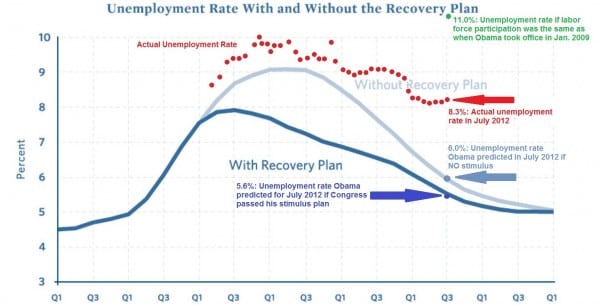
– As the chart at the top shows, the unemployment rate remains far above the rate predicted by Team Obama is Congress passed the stimulus. (This is the Romer-Bernstein chart.)
– While the unemployment rate dropped to 8.1% from 8.3% in July, it was due to a big drop in the labor force participation rate (the share of Americans with a job or looking for one). If fewer Americans hadn’t given up looking for work, the unemployment rate would have risen.
– Reuters notes that participation rate is now at its lowest level since September 1981.
– If the labor force participation rate was the same as when Obama took office in January 2009, the unemployment rate would be 11.2%.
– If the participation rate had just stayed the same as last month, the unemployment rate would be 8.4%.
– The Labor Department also said that 41,000 fewer jobs were created in June and July than previously reported. The change in total nonfarm payroll employment for June was revised from 64,000 to 45,000, and the change for July was revised from 163,000 to 141,000.
– The broader U-6 unemployment rate, which includes part-timer workers who want full-time work, is at 14.7%.
September 6, 2012
Things We Read Today, 4
Today, I touch briefly (for me) on long-term vs. short-term recovery, who's better off, RI's long spiral (and potential for quick resurgence), and the significance of different ballot types in Cicilline-Loughlin.
Government Surplus Wasn't the Problem; It's the How That Matters
In his daily flurry of tweets, WPRI reporter Ted Nesi linked to an interesting article by Joe Weisenthal in Business Insider. Weisenthal's conclusion is that the government surpluses of President Bill Clinton's second term were, themselves, the cause of the late '00s' economic bust:
The bottom line is that the signature achievement of the Clinton years (the surplus) turns out to have been a deep negative. For this drag on GDP was being counterbalanced by low household savings, high household debt, and the real revving up of the Fannie and Freddie debt boom that had a major hand in fueling the boom that ultimately led to the downfall of the economy. ...So while Clinton will be remembered nostalgically tonight, for both the performance of the economy and his government finances, they shouldn't be remembered fondly.
As if for authority, Weisenthal prints a PNG image of an economic formula (in a special formula font, even), but then he and his economist sources proceed to assert causation where there was only a temporary correlation in the parts of the equation during the Clinton era.
September 5, 2012
Things We Read Today, 3
Today's short takes address misleading labeling at the DNC, misleading fact-checking, fading national competitiveness, and the September 10 mentality.
September 3, 2012
Things We Read Today, 1
One thing I've learned, in years of blogging, is to be wary of proclaiming new regular features. Yet, I've been finding myself at the end of each day with a browserful of tabs of content on which I'm inclined to comment.
So, as interest and time allow, I'll publish quick-hit posts containing commentary that is somewhere between a tweet and a full-on blog post.
Leaning Against the Privileged Place of Investments
Readers shouldn't be surprised to hear that I'm largely in agreement with Peter Ferrara's "Obama's Accelerating Downward Spiral for America," but he happens to voice one bit of center-right common wisdom with which I have growing disagreement:
There is no secret or magic as to how to turn around these declining incomes. Increased investment in business expansion and start ups increases demand for labor, which drives up wages. That investment buys new tools and capital equipment for workers, making them more productive, which provides the cash flow to increase wages.Increasing investment results from reducing the tax rates on investment, which enables investors to keep a higher percentage of what they produce, increasing incentives for investment.
My resistance to this suggestion — notwithstanding Ferrara's positioning of it as a statement of the obvious — has three sides.
September 2, 2012
Against Incentivizing Cooperative Strategic Workarounds with Comprehensive Market-Driven Measurables
At the risk of repeating myself, I have to opine that one of Rhode Island's core economic challenges is the frequency of sentences like this:
To position Rhode Island to compete successfully for jobs and investments, a new public/private economic-development partnership should be designed to implement an integrated economic-development strategy that focuses on business retention and expansion, cultivates new business startups, supports a culture of innovation and entrepreneurship, develops market-driven workforce solutions to help grow the middle class, creates a robust research capability to help make better investment and policy decisions, develops a comprehensive manufacturing strategy, aligns state capital programs with economic-development strategies, develops best-in-class business information and knowledge exchanges, provides the highest level of customer service, builds on its regional economic-development assets and actively manages Rhode Island’s image and reputation in the marketplace.
Admittedly, I've been known to write a Melvillian paragraph from time to time, but I always try (at least) to make my endless sentences go somewhere. At a minimum, there should be some humor in there, or a rest-stop of wordplay to persuade the reader that it's worthwhile traveling on — perhaps rereading with justified suspicion that something worth catching might have been missed. But that's 109 words, a full four inches of Saturday Providence Journal column space, of the sort of technocratic jargon that leaves working self-starters rightly convinced that the underlying message is: "You're not included."
(Yes, I measured.)
August 31, 2012
All of Us Are the Job Generators
Although with regret, I have to opine that former East Providence city councilman Robert Cusack misses the target in his op-ed, yesterday, suggesting a way for Rhode Island to rejuvenate its sputtering economy:
We need to identify a job generator, make the changes needed to attract those jobs and then promote Rhode Island to execute the strategy. Which job generator? The initiative that brought Fidelity to the state has worked. Financial services remains a good candidate. Now we hear of bio-science in a new “Knowledge District.” Other ideas have been put forward that capitalize on our strengths. Whichever one or two job generators we target, that decision for once should be data-driven and fully vetted, and not a hipshot. Our future as a state is at stake.
The frame of mind that presents a policy prescription of what "we" (ultimately having to mean the government) need to do is fundamentally built around a trap in logic. Government officials — elected, appointed, or bureaucratic — have no competence in predicting the future bends of the marketplace. Just as the stock market is ultimately a gamble, wagering the state's economic well-being on the probability that the companies that happen to be in Rhode Island will happen to compete well in an industry that happens to take off is a high-stakes bet at best.
August 29, 2012
The Risk of Investment Promises May Be Unhedgeable
Early in the summer, Rhode Island General Treasurer Gina Raimondo announced that the state had invested $900 million of its pension assets in hedge funds. The decision was actually made in the middle of last year, in response to an asset liability study, treasury spokeswoman Joy Fox tells the Current. At that point, the treasurer began accumulating resources in cash to transition it into the new strategy.
August 23, 2012
Umm... Who (and What Policies) Got Us into This Mess?
I've had the extreme good fortune to shift careers to one that allows me time to create and stare at charts. (Sadly, yes, that's a literal description of some of my afternoons, as well as my feelings about those afternoons.) So it's with an especially strong "What!?" that I watched this video, via Ann Althouse, via Glenn Reynolds:
To save time for those who don't want to watch a political ad, the important point is that former President Bill Clinton argues for a second term for President Obama on the grounds that Republicans want to return to an era of deregulation — which, he claims, is "what got us into trouble in the first place." This, he contrasts with the Obama's plan, which "only works if there's a strong middle class." "That's what happened when I was president."
Let me first say that deregulation did play a role in our current predicament, but it wasn't deregulation alone. It was deregulation with a de facto government backing when risky ventures went wrong.
August 18, 2012
What Happens In A Good Economy
It's not that often where I can find an article on CNN.com that has much relevance to Rhode Island, but this one caught my eye. It just shows what a little ingenuity and work can do when you actually have a thriving economy.
Out in North Dakota where the unemployment rate currently sits at 3% due to a new oil boom, a high school student was able to identify a need. Due to the nature of the work and the places that people are living, showers can be hard to come by. Even to the point where people wait hours for a shower at a truck stop. This teen then hatched a plan to purchase an 18-wheeler trailer, retrofit it with shower rooms and an office, and purchase a separate water tank. He offers the service for a fee to the workers.
Sure, I get the point that North Dakota might have gotten lucky with the oil boom. That's like hitting the lottery. But at the same time, the state has been smart enough to simply get out of the way and let the business and entrepreneurs thrive. Business begets business. When you let the market thrive, other businesses will piggyback on top of it and when people perceive a need, they'll work to fill that need.
The other thing that struck me in the article was the kid's attitude with regard to work and money.
Jensen said that while his parents would always be there to assist if he really needed it, the burden of tuition rests squarely on him. He is determined to balance his passion for music with the reality of life."you gotta find something that does." Wow. If you fail at something, keep working to find something else that you can be successful at. That is about as opposite from the "what's in it for me" and the "where's my handouts" attitude that seems so prevalent here in Rhode Island.
"Music is what I absolutely love doing, but for anything in life, if it doesn't pay the bills you gotta find something that does," he said.
North Dakota is about 1800 miles from Rhode Island but judging by the differences in the states, North Dakota might as well be Mars.
August 17, 2012
Other States Need Much More Misery Before RI Has Company
The unemployment rate for Rhode Island fell by one tenth of a percent to 10.8%, but total employment dropped by 80 people. That's not even a "mixed picture," though. The only reason the unemployment rate moved in a seemingly positive direction is that 471 more Rhode Islanders just gave up looking for work.
So if the unemployment rate is a positive sign, then the state's motto might as well be "We hope people leave faster than they lose their jobs."
About the best that can be said for the Ocean State is that every other state in the union lost more employment than it did, except Utah, which saw a slight gain. That context is illustrated very well in an update to my chart showing labor force (employed plus looking for work) and employment for Rhode Island, Massachusetts, and Connecticut as a percentage of each state's January 2007 labor force.
August 11, 2012
Barro's Welfare Error
Via Ted Nesi comes a Bloomberg column by Josh Barro. It's one of those commentaries in which it isn't quite clear whether the author is offering pure political advice or expressing his opinion, so I'll assume the latter. In that context, here are Barro's thoughts on the balance of the economy and government:
If you concede that the purpose of a business is to provide well-paying jobs and solid benefits, then you cannot defend private equity. Private equity defenders must stand up for the idea that firms do not have a social obligation to retain and pay their employees; their function is to produce products and profits and getting them to do so more efficiently is good for consumers and for the economy as a whole.… [Therefore, it's a] straightforward neoliberal proposition: The government should provide a robust safety net so that employers can be left free to hire, fire, open and close at will. A dynamic private sector is important, but it needs a substantial welfare state to support the people who fall through its cracks.
Barro's is an interesting argument, but its greatest asset is how clearly it brings into focus something that people across the country are beginning to sense, especially on the right: The model of big finance and big business operating to supply wealth, with a robust welfare state picking up the pieces shed in the name of efficiency, is an excellent example of the ways in which the money-shuffling sector is distorting the country's economy and government deleteriously in its own favor.
Barro introduces an error with his most fundamental premise that there is such a thing as one single "purpose of a business." The purpose of a business is whatever the people involved in it want it to be. If they value profit above all else, they'll follow Barro's reasoning; if they value a sense of community, they'll operate differently.
Indeed, the infinite variety of priorities is a large part of what makes people go into one industry or another — or one line of work or another.
August 6, 2012
Recoveries: The Difference the Debt Makes (Not to Mention the Government's Focus)
Earlier today, Glenn Reynolds linked to an American Enterprise Institute post by James Pethokoukis, drawing on charts from economist John Taylor showing that the United States economy hasn't been returning toward where it would have been without the crash, and that this is unusual for prior downturns.

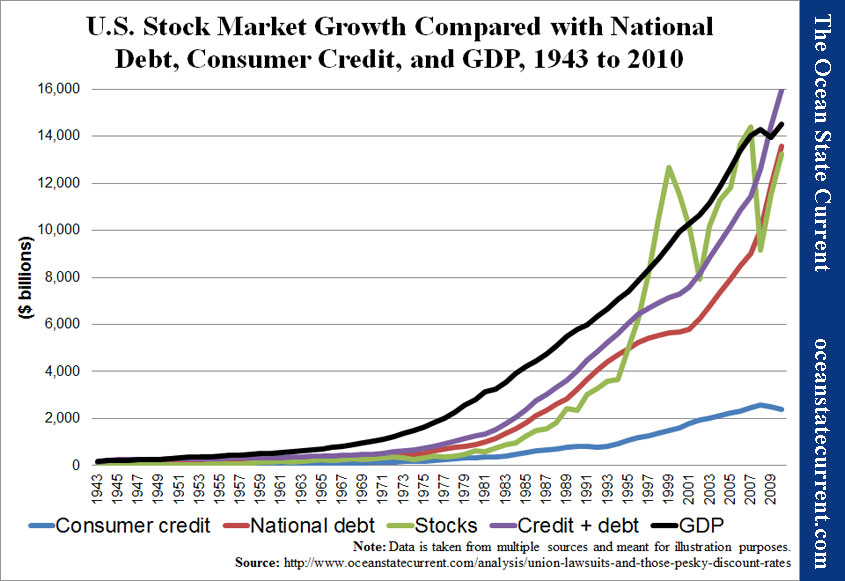
The reasons, I think, can be inferred from this chart, which I created with a view toward answering the question of whether it's reasonable to continue expecting 7-8% returns on pension fund investments:
August 3, 2012
One Graph Says it All
Hm. So what this says is we'd have been better off without the stimulus?
Well, at least we're in our 3rd "recovery summer", 'cause one just wasn't enough!
ADDENDUM: Woops, almost forgot. It's Bush's fault.
August 1, 2012
Hopkins Center Milton Party (and Thoughts on the Fuel of Capitalism)
The Stephen Hopkins Center for Civil Rights' panel discussion on the event of Milton Friedman's hundredth birthday offset "liberaltarian" Brown professor John Tomasi with June Speakman, a Roger Williams professor more inclined to agree with the prefix of the coinage. The panel would have benefited from the inclusion of an unabridged conservative who agreed with its root.
The most interesting idea placed on the Nick-a-Nees table was Tomasi's hypothesis that free markets can correspond with social justice if we think of the latter concept "in new ways." The people who developed social justice, he says, just "happened to be all from the left."
A conservative panelist might have suggested that there's no "happened to be" about it — that the very concept was designed to supplant the competing idea of charity and free association. Justice is the province of the police and the justice system, and "social justice" inherently suggests that those who hold the political levers can judge and impose their view of a just society on others against their will.
Watch video of the event and continue reading on the Ocean State Current...
July 27, 2012
The Context of the President's Context
It's intriguing to observe the telescoping nature of the "context" to which folks are referring when discussing President Obama's infamous Friday the 13th Roanoake speech. The damning two sentences continue to be:
If you’ve got a business -- you didn’t build that. Somebody else made that happen.
The inferred meaning is that somebody else should get credit for the business that you built. The president's defenders introduce the entire paragraph and the next, arguing that the context shows Obama's statement to have been that business owners didn't build the infrastructure on which their businesses rely:
If you were successful, somebody along the line gave you some help. There was a great teacher somewhere in your life. Somebody helped to create this unbelievable American system that we have that allowed you to thrive. Somebody invested in roads and bridges. If you’ve got a business -- you didn’t build that. Somebody else made that happen. The Internet didn’t get invented on its own. Government research created the Internet so that all the companies could make money off the Internet.The point is, is that when we succeed, we succeed because of our individual initiative, but also because we do things together.
The critics expand the text in the opposite direction, to the paragraph before, arguing that the context is, if anything, worse than the gaffe, mainly because of the preachy, scornful tone:
There are a lot of wealthy, successful Americans who agree with me -- because they want to give something back. They know they didn’t -- look, if you’ve been successful, you didn’t get there on your own. You didn’t get there on your own. I’m always struck by people who think, well, it must be because I was just so smart. There are a lot of smart people out there. It must be because I worked harder than everybody else. Let me tell you something -- there are a whole bunch of hardworking people out there.
At this point, as I've argued (and continue to believe), the president's defenders are probably correct on the grammatical point of the key sentence, but his detractors have the better case on the context. In response, a liberal commenter on Anchor Rising criticized me for not including the whole speech. And happy, as ever, to comply, I took a closer look and did indeed come to a striking conclusion: Obama's context is even worse than I'd thought.
July 26, 2012
Talking Teen Unemployment and the Minimum Wage on the Dan Yorke Show
630AM/99.7FM WPRO has posted my appearance on the Dan Yorke show, Tuesday, in two segments. The first is the initial half hour introducing the research from the RI Center for Freedom & Prosperity and touching on some conclusions. For the second hour, Economic Development Corp. board member and VIBCO President Karl Wadensten joined us in the studio for a broader discussion.
July 25, 2012
Mancession Recovery... Sexist!
In a strong indication that, among journalistic practitioners, the biased media narrative is more a matter of intellectual laziness than cultural duplicity, the latest canned story, by Los Angeles Times reporter Don Lee, is that workplace discrimination is landing men the great majority of "newly created" jobs:
Since the recession ended in June 2009, men have landed 80% of the 2.6 million net jobs created, including 61% in the last year. ...The gender gap has raised concerns about possible discrimination in hiring. If the trend persists, it could set back gains made by women in the workplace, experts said.
"It's hard to know [whether] some employers place a priority on men going back to work," said Joan Entmacher, vice president for Family Economic Security at the National Women's Law Center. Of particular concern, she said: Opportunities for women in higher-paying fields such as manufacturing are shrinking.
But back in February 2009, even the New York Times had to acknowledge the reality of the male-dominated recession, or "mancession":
The proportion of women who are working has changed very little since the recession started. But a full 82 percent of the job losses have befallen men, who are heavily represented in distressed industries like manufacturing and construction. Women tend to be employed in areas like education and health care, which are less sensitive to economic ups and downs, and in jobs that allow more time for child care and other domestic work.
Of course, Times reporter Catherine Rampell saw the silver lining as women's approaching men's percentage of the workforce. A conservative can't help but think of Margaret Thatcher's criticism of socialists, that they'd be happier to have everybody equally poor than wealthy over wide spectrum.
July 23, 2012
Generations Adrift Without the Habits of Working
One hears anecdotes, from time to time, about young adults who simply do not understand the habits associated with holding a job. Punctuality, an understanding that sometimes tedious or undesirable activities are necessary, and an appreciation of the relationship between consumer and vendor are all examples. Giving young adults the opportunity to learn such principles first-hand is almost as critical as giving them experience with the occupational value of money.
A new paper that I've penned for the RI Center for Freedom & Prosperity takes a look at teenage unemployment, with a particular eye on the minimum wage. The upshot is a collapse of employment among the young, especially in locations, like Rhode Island, that can least afford to lose the enterprising inclination in a generation of its residents.
July 20, 2012
Mass Residents Now Visit and Spend More at RI Slot Parlors Than Rhode Islanders
From GoLocalWorcester.
Mass. residents spent close to $1 billion last year at New England casinos, continuing in a trend of increased spending over the past several years that beat out every other state in the area.This year was the first time that the Bay State outspent its neighbors, totaling a cool $909 million on gaming and non-gaming amenities at Connecticut's destination resort casinos and at the slot parlors in Rhode Island and Maine.
Massachusetts residents also, for the first time, out-visited and out-spent Rhode Islanders at Rhode Island's two slot parlors --- Twin River and Newport Grand --- by making 2 million visits to those facilities, and spending an estimated $284 million, which is a 7% increase over 2010 spending levels. Mass. generated more than $157.6 million in tax revenues for the Rhode Island state government.
Some immediate reactions:
> As reflected in disposable income, is this yet another indication of the inadequacy of the Rhode Island economy; in this case - a fair comparison - as measured against a neighbor's economy? A related question: is this yet another indication that Massachusetts is pulling out of the recession faster than Rhode Island?
> What are the implications to Rhode Island's slot parlor revenue stream when the Mass casinos come on line? Perhaps a more accurate question would be: how much further will that revenue stream be stunted now that Mass residents outnumber Rhode Islanders at our slot parlors?
July 19, 2012
Credit for Building, Blame for Dividing
President Obama's teleprompter style has been the subject of substantial (often mocking) critical commentary, and with some justification, as this nearly parodic 2010 video from a Virginia classroom proves:
Given recent political events, one can sympathize with the desire of public officials to avoid extemporaneous speech. In a world in which one's every public utterance can be recorded, scrutinized, and exploited, one can't rely on an audience's capacity to get your drift and give you the benefit of the doubt. And it's all to easy to blurt out a sentence such as the now infamous, "If you've got a business, you didn't build that."
Predictably, in the realm of commentary, the debate has moved to the meta matter of whether commentators are deliberately misconstruing the President's meaning. On Slate, Dave Weigel charitably infers "a missing sentence or clause" that Obama neglected to utter because he was "rambling." On Reason, Tim Cavanaugh rejoins that "at some point it helps to look at that thing above the subtext, which is generally known as 'the text.'"
July 18, 2012
Nationwide Unfunded Pension Liability Now up to $4.6 Trillion
About a month ago, I presented a comparison of estimates for the nation's public-sector pension problem. While none of the results were encouraging, there was huge variation in the degree of frightfulness — the difference mainly being in the way in which they calculate liabilities.
One of the economists, Andrew Biggs, of the American Enterprise Institute, has updated his findings for State Budget Solutions, bringing the highest unfunded liability estimate currently on the table to $4.6 trillion.
July 17, 2012
A Decade of Moving Next Door
I've been following taxpayer migration data for years, but in a haphazard way. A new study that I've coauthored for the RI Center for Freedom & Prosperity finally gave me the opportunity to review all fifteen years of available data from the IRS.
The picture — from the 2003 beginning of what can only be described as an exodus — is frightening. After accounting for the tens of thousands of Rhode Islanders who moved to other states and other taxpayers who moved in the opposite direction, Rhode Island lost 24,455 households, with $1.2 billion of annual income (not inflation adjusted). More conspicuously, a net 3,406 taxpayers moved right across the border, to abutting counties in Massachusetts and Connecticut, taking with them $254.5 million in annual adjusted gross income (AGI).
July 12, 2012
RI's Paradox of Being Great, but Still Failing
Remember when the local PolitiFact took the Ocean State Policy Research Institute (OSPRI) to task for claiming that the estate tax was driving Rhode Islanders out, especially down to America's retirement peninsula? One statement from that article has stuck with me, over the year and a half since:
One expert was Kail Padquitt, staff economist for The Tax Foundation, a think tank that studies federal and state tax policies, who said he hasn’t seen any proof that the prospect of paying estate taxes drives people to move."You can see people are leaving a state, but (determining) why they are leaving is hard," Padquitt said. "Florida has sunshine, low taxes and warmth. Why wouldn’t people move there?"
That rhetorical question has come to mind recently for a couple of reasons. For one thing, I've been working on a related bit of research for OSPRI's successor organization, the RI Center for Freedom & Prosperity, to be released next week.
Today, though, the quotation came to me in relation to another, separate but related, context. As most folks who follow RI closely have already heard by now, CNBC placed the state dead last (again) on its business friendliness ranking, and very poorly in other areas. Marc Comtois's Anchor Rising post on the subject includes a reaction to RI Future's Bob Plain.
July 7, 2012
Remember when 310,000 new jobs & 5.6% unemployment just wasn't enough? Barack Obama does....
Yesterday we learned that the economy created 80,000 jobs and was at 8.2%, which President Obama called "a step in the right direction". Back in 2004, coming out of a recession, the economy created 310,000 new jobs and unemployment was at 5.6%. But that wasn't good enough--wasn't the real story--for a little-known state legislator running for the U.S. Senate. Instead, then-State Senator Barack Obama criticized then-President George W. Bush and his administration for travelling around celebrating the economic progress indicated by the 310,000 new jobs and 5.6% unemployment rate (h/t).
So remember:
310,000 new jobs and 5.6% unemployment = "too early to celebrate"
80,000 new jobs and 8.2% unemployment = "step in the right direction"
July 5, 2012
The Conundrum of Consumer Bags
So, the town of Barrington is well on its way to banning the use of plastic shopping bags among the commercial establishments within its borders:
... the town conservation commission has already voted to ban the use of plastic grocery bags at retail stores. The proposal now goes before the Town Council for review.If it passes, Barrington would become the second town in New England to impose such a law, increas ingly popular along the trendy West Coast. San Francisco banned plastic bags in large grocery stores and pharmacies in 2007, followed by Oakland and Los Angeles.
The move is triply surreal. For one thing, as American Progressive Bag Alliance spokeswoman argues, "Paper bags are worse for the earth." That is, the ban would be a government restraint on human activity that is at best debatable.
June 18, 2012
Reducing Government Growth isn't Austerity
One meme that some are attempting to make take hold (including the President; "the public sector isn't fine") is that the high unemployment we're seeing is in large part because of the loss of public-sector jobs and especially at the local level:

See that little dip in public sector employment? That right there's you're problem. But, given the 50 year(ish) growth trend, that little dip doesn't seem like much. You see, the greatest portion of governmental growth has historically been at the local level, as this graph from Menzie Chin at the Econbrowser blog shows:

Hm. How to make the argument, then? Ya gotta shape the data! This is how a comparison of private sector to public sector unemployment looks when both are compared to their own relative peak employment (instead of raw numbers), as done by Yale's Ben Polak and Peter K. Schott.


Mon dieu! Look at that, the public sector is going down while the private sector is recovering, just like President Obama said. Yet, as Mickey Kaus explains, the loss of many of these local government jobs can be attributed to the disappearance of federal subsidies:
In this recession, Democrats voted a temporary subsidy for state and local governments to keep up their hiring–and when it expired, those governments found they couldn’t afford to keep on as many employees–especially given the unsustainable pensions and benefits Democrats and others had granted oft-unionized public workers in good times (and that the Dem stimulus subsidized).That's what happened around here when the Department of Labor and Training announced the layoffs of around 60-70 workers. There is also a shift in priorities as older workers retire and aren't replaced. Regardless, the most telling graph shows that it's still the private sector that has bore the brunt of this recession:

We're a long way from saying the private sector is "fine".
May 21, 2012
"A Fast Infusion Of Jobs"
One thing has stuck out to me recently in a couple articles I've read. One article is a couple years old and the other appeared just this past weekend and I think they both make logical mistakes. They both talk about getting Rhode Islanders back to work, yet both are also in fields that I wonder how many new hires are being plucked from the unemployment lines and how many are being taken either from other companies or moved from one project to another.
During the past week, in trying to figure out all this 38 Studios stuff, Ted Nesi sent me an article he wrote in 2010 when the deal was first being done. One part that stuck out to me was this:
Robert Stolzman, a lawyer for the EDC, said last week. "We wanted a fast infusion of jobs in Rhode Island." The number of unemployed Rhode Islanders was 67,500 in August and the jobless rate was 11.8 percent, the R.I. Department of Labor and Training said Friday.However, these aren't the type that someone routinely can pick up after filling out a simple application:
Each of those jobs must pay at least $67,500 a year plus benefits under state law.That's no small salary here in RI, even for a game developer. I have to believe that in order to really qualify for that kind of salary, we're dealing with some fairly well-qualified individuals. One thing that I'd like to see in 38 Studios' hiring data (but I'm 99.9% certain will never see the light of day) is how many of their hires were plucked from the Rhode Island unemployment lines. Isn't Mr. Stolzman at least implying the point of the EDC's deal with 38 Studios is to hire unemployed Rhode Islanders? When you have tens of thousands of people out of work, hiring up to about 300 people isn't going to put much of a dent in the unemployment numbers, but if you aren't pulling people off the unemployment lines, it sure isn't going to help those numbers either. How many of the new hires were pulled away from other local companies or even people who relocated from other parts of the country? Wouldn't that be good information to have to see that the intent of this deal with the state was being followed?
Then this weekend in another Op Ed to the Providence Journal, David Cicilline wrote:
In addition, the House Republican budget calls for deep cuts in highway funding, reducing transportation spending by at least 25 percent over 10 years. It slashes much-needed infrastructure investments that would put thousands of Rhode Islanders back to work.I have no doubt that there are unemployed construction workers. Some of my neighbors are in the construction industry, I hear their stories all the time. However, if there was more funding given to highway projects, what are the odds that it would be given to the unemployed? Or would it be given to one of the usual, big-name construction companies that we always see by the side of the road? Would they be taking people off the unemployment line too or would they simply finish one job and move their people on to the next job? Just like when PolitiFact gave Sheldon Whitehouse a "False" rating for fudging his numbers when it came to putting people back to work, I see much of Cicilline's rhetoric in the same way. If we started handing out highway contracts, how many people would it pull off the unemployment lines and not just how many people would be employed. In spite of Senator Whitehouse's math, one guy working a job this week and working a job next week is still just one job.
To me, getting people back to work is and should be the number one issue going forward. When people are working, lots of other problems seem to disappear (a pessimist might say it merely hides the structural issues). Getting people off the actual employment lines should be the top priority for everyone running for and already in office.
May 15, 2012
You Can't Have It Both Ways
For those who are seemingly dancing on the grave of 38 Studios already, keep in mind the reasons for things like the EDC's $75M loan guaranty. I'm hearing and seeing various people crowing with their "I told you so" and explaining that the state should not be in the business of picking winners and losers. They're questioning why conservatives like Carcieri and Schilling would be in favor of government intervention only when it suits them.
That's all fine, and I'm in agreement that the government should not be making such risky investments and putting taxpayer money on the line. But why do they have to? Why do many businesses need to negotiate some kind of deal with the Governor and/or General Assembly to find Rhode Island more appealing or even fiscally possible? With the many different regulations and taxes (boiler inspections and inventory tax just being a couple examples) why would a business want to come to Rhode Island? Well, the answer is, they don't. Unless someone reaches out to them and makes an offer for things like property tax breaks (GTech), film credits (Body of Proof) or the current 38 Studios loan guarantee in exchange for 450 jobs.
I've said this before, but let's try it again. Rather than one-off, quick fix gimmicks, how about we just overhaul the system. Create a set of business regulations that we can be proud of and advertise and that will be enough to entice businesses to move here.
If we want to have jobs in Rhode Island, we need to have businesses in RI. As others have said, we need to start looking at businesses as job creators and not piggy banks for new taxation. Let's generate it through the income tax of thousands of new employees at these businesses and the increased value of real estate.
The problem unfortunately is I expect most will only see half of this issue and merely conclude, "See, I told you it was bad to give money to a business." without looking at any of the reasons for why it was necessary to do so in the first place.
March 26, 2012
The Rhode Island Economy and Change
A recent Providence Journal article (Thanks Ted) remarked on the business economy in this state:
If the state did not develop new industries and revive old ones, future generations would have trouble making it in the Ocean State.and
A heavy reliance on a single industry made the state “highly vulnerable to shifts in consumer demand and technological progress,” said economists at Brown University.but wait, there's more:
[The state] suffered from a weak economy, a high unemployment rate, high unemployment compensation costs and an unstable job market made up of mostly low-skill and low-paying jobsand yet more:
Generating jobs should be the state’s top priority, they said. The governor should rely on a group of economic advisers and make Rhode Island more attractive to industry through new laws. And business, labor and government officials should embrace a common goal.Is any of this sounding familiar yet? Any of this sound like Rhode Island pundits of the last 5-10 years? Well, those quotes are as much as 65 years old. The first one, about not developing new industries, was uttered in 1947. The second was issued in the 1950s and the last one in 1972.
It appears that many of the leaders, while some were not even born yet when these statements were made, have not really learned from the past. What probably makes this even worse is it appears there was once a chance to re-make the Rhode Island economy, but it too was shot down:
In 1983, Gov. Joseph Garrahy led a campaign for the plan’s approval — a blueprint to create 60,000 jobs, improve wages and nurture high-tech industries such as robotics and medical devices. ... Voters, angry at politicians and wary of tax hikes, overwhelmingly rejected the plan.Yet again today, when people are trying to create a new economy, such as in the Jewelry District (I just can't bring myself to call it the Knowledge District) it too is mocked as a bad idea.
It sure seems that in Rhode Island the old axiom, "Those who do not learn from history are doomed to repeat it" has never been more true.
January 24, 2012
The Cultural Divide Explains the Economic One
Saturday's Wall Street Journal had an interesting piece about "The New American Divide":
People are starting to notice the great divide. The tea party sees the aloofness in a political elite that thinks it knows best and orders the rest of America to fall in line. The Occupy movement sees it in an economic elite that lives in mansions and flies on private jets. Each is right about an aspect of the problem, but that problem is more pervasive than either political or economic inequality. What we now face is a problem of cultural inequality.A companion piece illustrates this divide with a number of charts.When Americans used to brag about "the American way of life"—a phrase still in common use in 1960—they were talking about a civic culture that swept an extremely large proportion of Americans of all classes into its embrace. It was a culture encompassing shared experiences of daily life and shared assumptions about central American values involving marriage, honesty, hard work and religiosity.
Over the past 50 years, that common civic culture has unraveled. We have developed a new upper class with advanced educations, often obtained at elite schools, sharing tastes and preferences that set them apart from mainstream America. At the same time, we have developed a new lower class, characterized not by poverty but by withdrawal from America's core cultural institutions.
The piece goes into great detail about how we got here, but sets that aside as so much water under the bridge now. Instead, the focus is on a prescription for shrinking the gap. It's not a massive, structured plan. Instead, it centers on changing attitudes.

There remains a core of civic virtue and involvement in working-class America that could make headway against its problems if the people who are trying to do the right things get the reinforcement they need—not in the form of government assistance, but in validation of the values and standards they continue to uphold. The best thing that the new upper class can do to provide that reinforcement is to drop its condescending "nonjudgmentalism." Married, educated people who work hard and conscientiously raise their kids shouldn't hesitate to voice their disapproval of those who defy these norms. When it comes to marriage and the work ethic, the new upper class must start preaching what it practices....America outside the enclaves of the new upper class is still a wonderful place, filled with smart, interesting, entertaining people. If you're not part of that America, you've stripped yourself of much of what makes being American special.I wonder if it's too late.Such priorities can be expressed in any number of familiar decisions: the neighborhood where you buy your next home, the next school that you choose for your children, what you tell them about the value and virtues of physical labor and military service, whether you become an active member of a religious congregation (and what kind you choose) and whether you become involved in the life of your community at a more meaningful level than charity events.
Everyone in the new upper class has the monetary resources to make a wide variety of decisions that determine whether they engage themselves and their children in the rest of America or whether they isolate themselves from it. The only question is which they prefer to do.
ADDENDUM: I had this piece by Michael Gerson filed in my "to do bin". It's related:
Conservatives naturally focus on equal opportunity rather than on equal outcomes. But equality of opportunity is a more radical concept than we generally concede. It is not a natural state; it is a social and political achievement. It depends on healthy families and cohesive communities. But opportunity also depends on effective government — on public safety, public education and public health. Governmental overreach can undermine other important social institutions. Yet the retreat of government does not automatically restore them to health.Read all of it. For a more local view (both in problems and potential ideas, read this post (and the discussion) by "Frymaster" over at the resuscitated RI Future.Liberals often fail to recognize that income redistribution, while preventing penury, is not identical to social equality. The main challenge of poverty is not a lack of consumption but a lack of social capital — measured in skills and values — and of opportunity. Addressing these problems is more complex than increasing marginal tax rates, particularly when revenue is used to cover the increasing costs of non-means-tested entitlement programs. The structure of the modern welfare state is not focused on empowering the poor. Instead, it has increased the percentage of government transfer payments that go to middle- and upper-income seniors.
On all sides, the poverty debate can be paralyzed by an obsession with fundamental causes. A failing community is a puzzle box of interconnected failures. Globalization and technology put downward pressure on wages and lead to stagnant labor markets. Permissive cultural norms encourage family breakdown and self-destructive behavior. Complaining about the rise of China or the decline of morality can be satisfying. But cosmic explanations can be obstacles to action.
January 5, 2012
Krugman: Don't Worry About Debt; It's Like a Ponzi Scheme
In a column titled "Nobody Understands Debt," Paul Krugman gives two reasons for Americans not to worry about President Obama and the rest of the federal government running up bewildering amounts of debt.
First, families have to pay back their debt. Governments don’t — all they need to do is ensure that debt grows more slowly than their tax base. The debt from World War II was never repaid; it just became increasingly irrelevant as the U.S. economy grew, and with it the income subject to taxation.
Is it me, or does that sound like another Social Securityesque Ponzi scheme? Like Social Security, it's subject to the same assumption that the society will continue to expand both economically and with respect to population, which are arguably very closely related. The peculiar liberal death wish comes into play because liberal policy preferences, many of the very policies that have required so much government spending, contribute to stagnation in population growth. At some point, the equation doesn't add up.
Which leads to Krugman's second point:
Second — and this is the point almost nobody seems to get — an over-borrowed family owes money to someone else; U.S. debt is, to a large extent, money we owe to ourselves.
This is true, he argues, even when we don't owe the money to ourselves, but to somebody else:
It's true that foreigners now hold large claims on the United States, including a fair amount of government debt. But every dollar’s worth of foreign claims on America is matched by 89 cents' worth of U.S. claims on foreigners. And because foreigners tend to put their U.S. investments into safe, low-yield assets, America actually earns more from its assets abroad than it pays to foreign investors. If your image is of a nation that’s already deep in hock to the Chinese, you’ve been misinformed. Nor are we heading rapidly in that direction.
Unfortunately, he's not very clear about whom he's defining as "America." Following the links that Krugman provides to other things he's written, one comes across a chart showing the nation's foreign liabilities as 160% of GDP, versus assets of 140%. But even the "deficit-worriers," as Krugman calls them, put the total debt, to foreign and domestic lenders, at $15.2 trillion, versus GDP of $14.5 trillion. That's a ratio of about 105%. Yet, the U.S. Debt Clock gives $56.4 trillion, or 389% of GDP, as the debt of every person and entity in the United States.
So, what Krugman means, therefore, by America's debt, I'm not sure, although it looks likely that he's stating that the $56.4 trillion grand total includes $23.2 trillion in foreign debt and $33.2 trillion in domestic debt. Whatever the case, I'd wager that whomever Krugman shuffles into the deck for the additional amount of foreign debt shown in his chart has very high foreign investments.
The worry on the table, though, is the federal government's debt, and if the economy and population continue to remain so low, it's not going to fade into a field of rapid growth, but is going to become a problem that even Krugman-like apologists cannot deny. After all, the government's income is only the fraction of GDP that it takes in through taxes and fees. If one is going to compare the total debt of the people of the United States to GDP for the purposes of balancing it against foreign assets, it would be more reasonable to compare the government's debt to the $2.3 trillion it brings in through taxes. That's a ratio of 661%.
December 31, 2011
A Different Kind of Clock, Heading Toward a Different Kind of Midnight
I'm cleaning out my bookmarks for the first time in about seven years, and as we approach the change of the clock from one year to the next, I thought it appropriate to direct your attention to the U.S. Debt Clock.
At this moment, the national debt is $15.2 trillion, personal debt is $16.0 trillion, and the total U.S. debt — including household, business, state and local governments, financial institutions, and the federal government — stands at $56.4 trillion.
Happy New Year! Another day older and deeper in debt.
December 8, 2011
Should Anyone Be Surprised that Government Bonds Might Not Be a Good Investment for the Next Few Years
Burton Malkiel, famous for having written a book titled A Random Walk Down Wall Street where he argues there's no systematic way to beat the market, offered this big-picture advice for balancing an investment portfolio in yesterday's Wall Street Journal...
Are we in an era now when many bondholders are likely to experience very unsatisfactory investment results? I think the answer is "yes" for many types of bonds—and that this will remain true for some time to come....So what are investors—especially retirees who seek steady income—to do? I think there are two reasonable strategies that investors should consider. The first is to look for bonds with moderate credit risk where the spreads over U.S. Treasury yields are generous. The second is to consider substituting a portfolio of dividend-paying blue chip stocks for a high-quality bond portfolio.Malkiel explains his point with some interesting back-of-the-envelope macroeconomics.
But at least with regard to his second option, the blue-chip stocks, isn't he explaining something that's readily obvious from the state of our political system, i.e. right now, so many units of government have been run so badly, it is going to be a while before they can raise the money to take care of their governing obligations and pay high-interest bond yields, meaning that (to borrow a juxtaposition from Justin) investing money in actual productive activities right now is a much better option than investing in the government's ability to tax?
November 29, 2011
Whoops! Providence Budget Still Under Water
Well, I don't like to say "I told you so" but an article in GoLocalProv yesterday about the state of Providence's budget wasn't really a surprise. According to the article, almost halfway through the current budget year, the budget still is not only not balanced, but it's about $24 million in the red.
Some of the reasons:
Savings of up to $6 million hinged on 30 officers taking advantage of an early retirement incentive. Only 16 did.We asked about this one back in June when the agreement was made to avoid the layoffs. What if the department can't find 30 officers to retire? What then? Will there be layoffs now? Should there have been a clause in the agreement that if the 30 retirements weren't met that there'd be automatic layoffs to meet the expected numbers? Was this even considered?
Taveras hoped to save $11 million by switching retirees over to Medicare. But most of those savings got wiped out when the federal government slapped the city with an $8 million penaltyWait, what? You figure out that you can switch your retirees over to the federal Medicare plan for the cost savings and you missed that part about the penalty? I'm sorry, but if I cost my boss $8 million, I'm not sure I'd still have a job. Plus, there's this:
Worse yet, it is not a one-time fee. Instead, the penalty will be assessed annually for the foreseeable future.I guess the only silver lining in this is the city won't expect an $11 million savings each year, now they know to only expect a $3 million savings.
Lastly, am I the only one who remembers then-Mayor, then-Congressional candidate David Cicilline telling us that he was leaving Providence in excellent financial shape? Hmm, well there's also this:
The city ended the 2011 fiscal year in June with a higher-than-expected $4.9 million deficit, city records show—and that is not counting approximately $30 million that was borrowed to help close the gap.$30 million to close a gap in a city that is in excellent financial shape?
I do wonder if Mayor Taveras referred to the situation he inherited as a "Category 5" hurricane, only because we don't have a Category 6.
Negative Outlook, but Still Able to Confiscate
Like a lot of conservatives, I'm sure, I find the prospect of our nation's credit begin downgraded, or at least given a negative outlook, as Fitch Ratings just applied to the United States, a somewhat hopeful sign that the game of government taxing, borrowing, and spending cannot go on in perpetuity. But as I watch the dance, my sense that the agencies are really grading the government's ability to confiscate resources through taxation only grows stronger.
We'd like to think that the ratings reflect how well a government is doing its job of being a government and how strong its underlying economy is, and those are surely factors. But the core criterion for grading the debt that a government sells is the likelihood that it will be able to take money from the people under its control and hand it over to its lenders. Sadly, the U.S. government sits atop a large nation of people who desire to forge a (taxable) living and who thus far have proven unable to elect a government that's willing to restrain itself.
In that context, a "negative outlook" is little more than a whisper of a hint that the government needs to change its ways. For it to bear the fruit of a lower rating, the prospects would have to be bleak for the government paying back its debt at all. The imagination reels at what a world in which that's a real possibility would look like; it's one thing for Greece to appear unable to pay its bills, but the U.S.? Yet, experience shows that reasonable adjustments will not be made when entrenched interests have so much motivation to fight against them. Only crisis will serve, and few wish to foster crisis when it remains possible to pretend there's no long-term threat.
Part of the problem, it seems to me, is that there's no up from AAA. Selling less debt would make it more likely that the government can and will pay back what it already owes, but with the might of the U.S. bureaucracy as a collection agency, such a shift would be a mere shading of likelihood.
November 15, 2011
Rhode Island Will Recover, After Everyone Else Does
A projection posted at the New York Times Economix blog divides the 50 states and the District of Columbia into 5 groups, based on when they are expected to be home to the same number of jobs that they were in December 2007.
The first group has already recovered. The group after that is projected to recover by 2013. The last group isn't expected to recover until "past 2017".
There are only 3 states in the last group: Nevada, Michigan, and...I'll let you guess the third.
(Also, would anyone like to interpret the significance of the fact that one of the three places that has already made its recovery is D.C.?)
October 25, 2011
Eating on Only $4.50 a Day
Anti-poverty activists have thrown down the gauntlet to those of us lucky enough to eat regularly and (as obesity statistics show) too much.
Anti-poverty activists are challenging Rhode Island residents to spend just $4.50 a day on food for a week as part of a campaign to draw attention to the importance of funding for food stamp programs.Here are a couple sample shopping lists for those up to the challenge. You can't buy everything from these lists, but you can get a pretty good (and healthy) week's worth of meals out of it. And if you're smart, you'll have some left over to go into stocking the pantry. The first list is comprised of items found in the weekly flier of a "big chain store".The Rhode Island Interfaith Coalition to Fight Poverty With Faith is conducting a "Food Stamp Challenge" beginning Thursday in which participants will be asked to spend on food the national average received by food stamp recipients. That translates into $31.50 over a week, or $1.50 a meal.
Cereal - 2/$4
Frozen Vegetables - 10/$10
Fresh Strawberries - 2/$5
Mangoes, Avacadoes, Oranges - 10/$10
Pasta - 10/$10
Spaghetti Sauce - 10/$10
Chicken Breast (5 portions) - $6.99
Tuna - 5 cans/$4
Applesauce (ea. pack=6 servings) - 2/$4
Frozen entrees - 6/$10
Apples - $.88/lb
London Broil - $1.88/lb
Or, if you don't like the big guys, you can go to a local chain:
Hamburger - $2.59/lb
Chicken Breasts - $.99/lb
Cereal - $1.88 box
Fresh-baked loaf Italian bread - $1.99
Rotisserie Chicken - $3.99
Bulkie/Sub Rolls - $1.29 (6-pack)
Cheese Slices (Individ wrapped 12 pack) - buy 1, get 1 free @ $3.99
Deli Bologna or Ham - $2.99/lb
Fresh Marinara Sauce (20 oz.) - 2/$6
Pasta - 4/$5
Tuna - 5 cans/$5
Frozen Vegetables - 4/$5
Grapes - $1.99/lb
Bag of Potatoes (5 lb.) - $2.99
Remember, these are just from the fliers. Who knows what deals you'll find when you actually walk the aisles. I even stayed away from the Top Ramen and frozen burritos! There are plenty of affordable and healthy options if you're willing to take a little time, stay out of the snack aisle, buy what's on sale (even stock up!) and "resign" yourself to buying cheaper store brand items. An enterprising shopper might even "cherry pick" the best from each store and save more. If you do that, you may be able to even splurge for a steak every now and then by, for example, dipping into your pasta reserves (each box of pasta has, what, 4 servings?).
My point isn't to denigrate those who rely upon food stamps to eat (which, as Justin already pointed out, are supposed to be supplemental anyway). It's to show that it's doable. And guess what? These lists are pretty darn close to what my family of four shops for regularly (incidentally, the food supplement would be $126 for all of us). My conclusion? The current level of food stamp subsidization is plenty sufficient.
October 24, 2011
The Catholic Notion of a Global Authority
It comes around once a year in the missal for the Catholic Mass, and the lector, standing before his or her neighbors to read the holy words very often exudes a palpable discomfort:
Be subordinate to one another out of reverence for Christ.
Wives should be subordinate to their husbands as to the Lord.
For the husband is head of his wife just as Christ is head of the church, he himself the savior of the body.
As the church is subordinate to Christ, so wives should be subordinate to their husbands in everything.
Husbands, love your wives, even as Christ loved the church and handed himself over for her to sanctify her, cleansing her by the bath of water with the word, that he might present to himself the church in splendor, without spot or wrinkle or any such thing, that she might be holy and without blemish.
So [also] husbands should love their wives as their own bodies. He who loves his wife loves himself.
It's the second line in this passage from St. Paul's letter to the Ephesians that sticks in modern throats. Subordinate? I think not. What's missed is the balance between the calls to each spouse. The subordination requested is to a man who would do as Christ did and die a horrible death for those He loves. The dutiful husband and father is to be a savior to his family after the model of a crucified Christ. It's subordination to a man who is called to be subordinate right back. She realizes that she is part of him, and he realizes that she is him.
Something similar is at play in the typically unnuanced MSM characterization of the Vatican's new document, "Note on financial reform from the Pontifical Council for Justice and peace."
The Vatican called on Monday for the establishment of a "global public authority" and a "central world bank" to rule over financial institutions that have become outdated and often ineffective in dealing fairly with crises. The document from the Vatican's Justice and Peace department should please the "Occupy Wall Street" demonstrators and similar movements around the world who have protested against the economic downturn. "Towards Reforming the International Financial and Monetary Systems in the Context of a Global Public Authority," was at times very specific, calling, for example, for taxation measures on financial transactions. ... It condemned what it called "the idolatry of the market" as well as a "neo-liberal thinking" that it said looked exclusively at technical solutions to economic problems. "In fact, the crisis has revealed behaviours like selfishness, collective greed and hoarding of goods on a great scale," it said, adding that world economics needed an "ethic of solidarity" among rich and poor nations. ... It called for the establishment of "a supranational authority" with worldwide scope and "universal jurisdiction" to guide economic policies and decisions.
The Vatican didn't "call for the establishment" of such an authority in the sense that the world's leaders ought to get to work on it tomorrow. Rather, the document describes a long evolution toward an ideal. And as with St. Paul's characterization of marriage, the document isn't as one-sidedly anti-free-market as Philip Pullella's Reuters summary, above, suggests. It also acknowledges the risks of socialism and technocracy. Consider:
However, to interpret the current new social question lucidly, we must avoid the error — itself a product of neo-liberal thinking — that would consider all the problems that need tackling to be exclusively of a technical nature. In such a guise, they evade the needed discernment and ethical evaluation. In this context Benedict XVI's encyclical warns about the dangers of the technocracy ideology: that is, of making technology absolute, which "tends to prevent people from recognizing anything that cannot be explained in terms of matter alone" and minimizing the value of the choices made by the concrete human individual who works in the economic-financial system by reducing them to mere technical variables. Being closed to a "beyond" in the sense of something more than technology, not only makes it impossible to find adequate solutions to the problems, but it impoverishes the principal victims of the crisis more and more from the material standpoint.In the context of the complexity of the phenomena, the importance of the ethical and cultural factors cannot be overlooked or underestimated. In fact, the crisis has revealed behaviours like selfishness, collective greed and the hoarding of goods on a great scale. No one can be content with seeing man live like "a wolf to his fellow man", according to the concept expounded by Hobbes. No one can in conscience accept the development of some countries to the detriment of others. If no solutions are found to the various forms of injustice, the negative effects that will follow on the social, political and economic level will be destined to create a climate of growing hostility and even violence, and ultimately undermine the very foundations of democratic institutions, even the ones considered most solid.
Recognizing the primacy of being over having and of ethics over the economy, the world's peoples ought to adopt an ethic of solidarity as the animating core of their action. This implies abandoning all forms of petty selfishness and embracing the logic of the global common good which transcends merely contingent, particular interests. In a word, they ought to have a keen sense of belonging to the human family which means sharing the common dignity of all human beings: "Even prior to the logic of a fair exchange of goods and the forms of justice appropriate to it, there exists something which is due to man because he is man, by reason of his lofty dignity."
In 1991, after the failure of Marxist communism, Blessed John Paul II had already warned of the risk of an "idolatry of the market, an idolatry which ignores the existence of goods which by their nature are not and cannot be mere commodities." Today his warning needs to be heeded without delay and a road must be taken that is in greater harmony with the dignity and transcendent vocation of the person and the human family.
I will certainly not be the last to acknowledge that religious people are just as prone as anybody to muddled economic thinking, and those who hew their careers and behavior most closely to the premise that a higher authority has a claim on their lives are no less prone to err in their trust of human authority than those who believe human beings can control everything. But what this particular document is describing is a human development that brings the people of the world together toward common advancement with full respect of individual autonomy.
That objective is, or ought to be, not only consistent with, but inherent to any ethical approach to economic liberty. The libertarian ideal, in other words, shouldn't be "let me do whatever I want," but rather, "let me do good in the way that I think best." And the global authority here described is one that conveys feedback in a deeper manner than achieved by price systems. Otherwise, the Vatican is warning, a prosperous peace cannot continue.
To lash out at suggestions of global cooperation is to miss the opportunity presented by such statements as this, from the Vatican's document (emphasis added):
... It is a matter of an Authority with a global reach that cannot be imposed by force, coercion or violence, but should be the outcome of a free and shared agreement and a reflection of the permanent and historic needs of the world common good. It ought to arise from a process of progressive maturation of consciences and freedoms as well as the awareness of growing responsibilities. Consequently, reciprocal trust, autonomy and participation cannot be overlooked as if they were superfluous elements. ...As we read in Caritas in Veritate, "The governance of globalization must be marked by subsidiarity, articulated into several layers and involving different levels that can work together." Only in this way can the danger of a central Authority's bureaucratic isolation be avoided, which would otherwise risk being delegitimized by an excessive distance from the realities on which it is based and easily fall prey to paternalistic, technocratic or hegemonic temptations. ...
These measures ought to be conceived of as some of the first steps in view of a public Authority with universal jurisdiction; as a first stage in a longer effort by the global community to steer its institutions towards achieving the common good. Other stages will have to follow in which the dynamics familiar to us may become more marked, but they may also be accompanied by changes which would be useless to try to predict today.
Clearly, this is not a Cato Institute policy paper, but at the same time, it allows the room to suggest that the "changes" that we cannot predict include the development of social institutions outside of government — institutions of mutual consent and understanding, but consistent with free will and personal autonomy — that provide the necessary authority for consensual cooperation.
The error in the typical reaction to this sort of application of Catholic theology to the material world is to imagine that the Church has seen the future and it is the EU and UN writ large. Beneath the jargon of social justice writing is actually a call to re-imagine what global authority might look like, and it is a project that free-marketers ought to undertake with as much zeal as those who can think of nothing more original than the repackaged Marxism, which this very document describes as a failure.
October 10, 2011
Even if it's Amazing, It's not fair, so I hate everything
Trying to figure out this Occupy thing? Right now, this seems to explain it the best (h/t):
Remember this bit by Louis CK (thanks for reminding me, Will)?
Protest song!
...a sultan and student both have iPhone 4s...it's not fair
Overall, much of the logic seems to go something like this (h/t):

ADDENDUM: I put this is all under our "On a lighter note...." category because there is humor in the unknowns surrounding the Occupy movement. Still, there are serious questions that haven't been answered.
Now, a movement that started with no concrete goals as a simple protest of power must decide what to do with some power of its own. Can a leaderless group that relies on consensus find a way for so many people to agree on what comes next? Can it offer not only objections but also solutions? Can a radical protest evolve into a mainstream movement for change?Unfortunately, from what I have heard of the solutions, they roughly approximate the tongue-in-cheek poster above. In writing about the recent passing of Steve Jobs, Kevin Williamson illustrated that there is a dichotomy:
The beauty of capitalism — the beauty of the iPhone world as opposed to the world of politics — is that...[w]hatever drove Jobs, it drove him to create superior products, better stuff at better prices. Profits are not deductions from the sum of the public good, but the real measure of the social value a firm creates. Those who talk about the horror of putting profits over people make no sense at all. The phrase is without intellectual content. Perhaps you do not think that Apple, or Goldman Sachs, or a professional sports enterprise, or an Internet pornographer actually creates much social value; but markets are very democratic — everybody gets to decide for himself what he values. That is not the final answer to every question, because economic answers can satisfy only economic questions. But the range of questions requiring economic answers is very broad.I was down at the Occupy Wall Street protest today, and never has the divide between the iPhone world and the politics world been so clear: I saw a bunch of people very well-served by their computers and telephones (very often Apple products) but undeniably shortchanged by our government-run cartel education system. And the tragedy for them — and for us — is that they will spend their energy trying to expand the sphere of the ineffective, hidebound, rent-seeking, unproductive political world, giving the Barney Franks and Tom DeLays an even stronger whip hand over the Steve Jobses and Henry Fords. And they — and we — will be poorer for it.
And to the kids camped out down on Wall Street: Look at the phone in your hand. Look at the rat-infested subway. Visit the Apple Store on Fifth Avenue, then visit a housing project in the South Bronx. Which world do you want to live in?
September 21, 2011
Netflix Shows Flaws in Marginal Pricing
Megan McCardle looked at Netflix/Qwikster and explains how the problem is a business model over reliant on marginal cost pricing. It's an object lesson that can be extended to, for example, health care costs.
[P]eople were confusing the marginal cost with the average cost. Content providers were willing to license their movies and television shows cheaply to Netflix as long as Netflix had a small customer base: it was extra revenue for the companies, and it was probably mostly substituting for DVD rentals, which they didn't make money off of anyway, so it was essentially free money.That's the point that gets missed. Sure, living off marginal costs may work for a while, but eventually that R & D and infrastructure wears out and has to be replaced or replenished. We can only live off the work of previous generations for so long. No free lunch and all that. Eventually you have to pay to keep the same level of service.You can get a sweet deal if you are the customer who gets marginal cost pricing. Medicare does this--reimburses hospitals at above their marginal cost, but below their average cost, so that private insurers have to pick up most of the hospital overhead. European countries do this with prescription drugs: reimburse above the marginal cost of producing the pills, but below the total cost of developing the pills, so that the US has to pick up most of the tab for drug development.
The problem is that as voters and as customers, we often get the notion that this can be extrapolated to everyone. So liberal policy wonks want to save money by putting everyone on Medicare, or some equivalent program that uses the government's monopsony pricing power to get lower prices for everyone; thrifty customers think that everyone should drop cable and just pay $14.95 for streaming plus DVDs.
But everyone cannot be the marginal cost consumer. Someone has to cover things like development costs.
September 7, 2011
Who Pays for Past Mistakes
Generational warfare: It's bound to happen here in Rhode Island with the pension crisis. It's also happening nationally on the budget deficit debate with the new Super Congressional panel set to convene. Education Policy wonk Rick Hess offers his perspective:
You're either with the kids or with those rushing to the ramparts to defend retiree entitlements. So, which is it?Past or future? Which will it be? He provides an important breakdown of we pay for current Medicare spending:Consider the President's vague calls last week to spend billions more on school construction and preserving school staffing levels (which would've been more compelling if he had offered any inkling as to how we might pay for it). Obama finds himself unable to do more than offer marginal, dead-on-arrival programs because the feds have spent more than half the budget just mailing checks to retirees, covering health care bills, and paying interest on the accumulated debt. Everything else—schools, financial aid, the FBI, defense, transportation, the environment, NASA, foreign aid, you name it—has to make do with what's left.
As Julia Isaacs at the Brookings Institution has pointed out, the federal government now spends about $7 on seniors for every $1 it spends on children....Do we really think it's a good idea to spend half of all non-interest spending on making retirement ever more comfy?
[T]oday's retirees have contributed taxes that amount to less than half their Medicare outlays. Today's Medicare payroll tax doesn't fund Medicare--it funds only Part A (hospital expenses). Premiums cover just 25 percent of Part B (doctor treatments and visits). And premiums for Bush's Medicare drug program (Part D) cover just 10 percent of the cost. The rest of the hundreds of billions in outlays for these programs is vacuumed out of general revenue. (See here for a good breakdown on Medicare funding.)And Social Security:
Social Security has the government reflexively spending hundreds of billions to mail out monthly checks to the wealthiest segment of the population, without an ounce of thought as to whether that's the best use of borrowed funds (the famed Social Security "trust fund" being, you know, nonexistent). The Social Security Administration reports that more than 20 percent of those 65+ have incomes over $65,000 a year. In a nation where median household income is in the $40,000s, is it really radical to rethink how much we mail to these households every month?As for taxes:
Toss in all of the tax deductions that President Obama called for eliminating this summer, including the corporate jet deal, and you address another $400 billion over 10 years, or less than 2 percent of the shortfall. So, just keeping the deficit from exploding will involve all those taxes and trillions more in cuts. Those demanding substantial new spending then need to raise hundreds of billions beyond that, through additional cuts or tax increases....Even with hefty tax increases, protecting existing entitlements ensures that we won't have much available for schools, colleges, or anything else.He urges education advocates to step up to the plate and take on the AARP and similar groups so that more money can go towards kids and education.
In short, it's possible to get our house in order, free up dollars for schooling, and shift dollars towards youth. But doing so requires facing down the massive, intimidating seniors' lobby.Hess' bailiwick is education and his goal is to increase funding for it. Regardless of whether you agree or disagree with Hess' priorities, his argument helps to lay out the choice that needs to be made: should the people who benefited or made the mistakes in the past be held most accountable for those mistakes? Or should their kids and grandkids?Shared sacrifice involves asking Baby Boomers and retirees to step up and, you know, sacrifice. It doesn't mean holding harmless the generations who voted themselves free stuff through the good times and doesn't rely almost entirely on raising taxes and curtailing benefits for the under-40 set.
September 4, 2011
A Bad Economy Is in the Democrats' Favor Structurally
William Jacobson makes an interesting point regarding the intersection of the economy and electoral politics:
Workers giving up hope, thereby keeping the unemployment rate artificially low, is keeping Obama's reelection hopes alive. If the headlines screamed that unemployment was 11.4%, even I might begin to believe [that the U.S.A. would not give Obama a second term].
We've already begun to see commentary and political cartoons attempting to smear Republicans on the grounds that it's in their electoral interests for the economy to stay sour until the next election. There is some truth to that, but inasmuch as it's a bipartisan reality with every election, it's hardly a strong moral condemnation.
Rephrased, a bit, what Jacobson is saying is that it would help the Republicans if the statistics better reflected, to voters, how bad the condition of the economy really is. But there's a deeper way in which this particular data point helps the Democrats: Workers who give up move toward dependency on the government, and the Democrats are the party of dependency. If you're struggling to find work in the private sector, you're more apt to want the market to be free to thrive, to want employers to be given more space to invest and hire. Those who throw up their hands are thereafter more likely to put out their hands to collect whatever money the government directs toward them.
September 2, 2011
Green Fave of Obama's Goes Under, Taxpayers Foot the Bill
Solyndra is a manufacturer of solar panels--a green technology!--and was given half a billion dollars in loan guarantees by the Federal Government. Oh, and a major Obama donor, George Kaiser, was also a financial backer of the the company. Now it looks like they're going under:
A company that served as a showcase for the Obama administration’s effort to create jobs in clean technology shut down Wednesday, leaving 1,100 people out of work and taxpayers obligated for $535 million in federal loans.That's why you get a little help, right? Guess it wasn't enough. Now the taxpayers get to foot the bill and people are wondering if there is a cover-up. There goes a quarter of that debt ceiling "savings"!Solyndra, a California solar panel maker, had long been an administration favorite. Over the past two years, President Obama and Energy Secretary Steven Chu each had made congratulatory visits to the company’s Silicon Valley headquarters....solar industry analyst Peter Lynch said that Solyndra struggled from the beginning with an imbalanced financial model.
“You make something in a factory and it costs $6, you sell it for $3, but you really, really need to sell it for $1.50 to be competitive,” Lynch said of Solyndra. “It was an insane business model. The numbers just don’t work, and they never did.”
August 22, 2011
One Sector of the Economy Booms: Government Regulation
First, a chart and explanation from Investors Business Daily (h/t):

Under President Obama, while the economy is struggling to grow and create jobs, the federal regulatory business is booming.More than just the size and scope is changing, too. So is the attitude.Regulatory agencies have seen their combined budgets grow a healthy 16% since 2008, topping $54 billion, according to the annual "Regulator's Budget," compiled by George Washington University and Washington University in St. Louis.
That's at a time when the overall economy grew a paltry 5%.
Meanwhile, employment at these agencies has climbed 13% since Obama took office to more than 281,000, while private-sector jobs shrank by 5.6%.
It has long been the case that regulatory agencies could utilize discretion in policing their realms. For instance, OSHA could reduce fines and work with companies to come into compliance by following a process that had the company accept or admit the violations and have fines reduced by 2/3 while also putting a payment plan in place. (This last is especially important to small companies who can't afford to pay the fine all at once, up front). No more. Apparently the Obama administration has directed OSHA to scrap that approach to "generate" as much "revenue" as possible.
The EPA will also become even more hardline and that will effect businesses and local governments (and your taxes). They've ordered the City of Newport to pay a $170,000 fine and spend $25M to fix a problem with their Waste Water treatment plant, after the city had already spent $32M to fix it (whether we can blame the EPA, City of Newport for incompetence--or both--is probably an open question). In addition, the EPA has now tightened their already tough regulations even more. Going from concentrating on so-called “point sources” (smokestacks, fan exhaust outlets, etc.) that emitted certain threshold levels of chemicals they have identified as hazardous wastes to regulating (and fining) any exposed amount of any of these chemicals found in a facility. The apparent theory being that opening a door allows pollution of the atmosphere.
Regulations impact jobs, especially on the small business level. Obviously, we need safe, clean work environments. But working with small companies, as has been done in the past, seems to have been, well, working. This new change in philosophy is both antagonistic and ill-timed, given the current state of our economy.
August 19, 2011
The Tone Deaf Ruling Class
This is precisely the thinking that has to end:
The two-phase plan will require Obama to argue for spending more money in the short term while reducing the federal deficit over a longer period. Many economists support that combination, saying that cuts in spending should wait until the economy is stronger. But political strategists say it has been difficult to communicate that idea to voters.Obama pushed the idea Wednesday during a stop in Alpha, Ill. "Yes, some of these things cost money," he said. "The way we pay for it is by doing more on deficit reduction."
Enough already! Stop with the stimulus spending. Stop with the gimmicks. Stop with the attempts to use anxiety about the economy to expand the government's size and scope.
It doesn't "pay for" increased spending to spend a little bit less money you don't have in other areas. That is, reducing the deficit doesn't mean that you can spend the reduction, unless you've crossed the zero mark and are no longer spending more than you take in.
August 8, 2011
What Goes Up... Taxes
The other day, I made reference to the possibility that having an economy calibrated to two-income households, rather than the one-income households that were once the norm, is a hindrance on entrepreneurial ventures. Yes, if one spouse's attempt to create a business fails, the other spouse's income remains, but in the current marketplace, both incomes are necessary.
Since the effective doubling of the workforce, the market has adjusted household expenses, especially big-ticket expenses like housing, to the new normal income level. In an interesting spin-off discussion, Todd Zywicki ntoes that leading the big-ticket inflation is taxation:
Here's the key problem in Caldwell's argument: note his list of increased expenses for household "big necessities: mortgages (up 76 percent), cars (up 52 percent), taxes (up 25 percent), and health insurance (up 74 percent)." The problem is that while it is an accurate representation for mortgages, cars, and health insurance, that the expenses increase by that percentage, it is not for taxes. For the other expenses it is the percentage increase in dollars spent on those expenses. For taxes, however, the 25% increase is actually the percentage increase in the percentage of income spent on taxes. So the 25% is not how many more dollars go to paying taxes, it represents the household’s change from paying 24% of its income in taxes to 33% of its income in taxes–a change of 25% in the percentage of income dedicated to taxes, not a change of 25% in spending on taxes. I swear I am not making this up: I have attached to the bottom of this post the full excerpt from this book where this is done. And, again, I have laid this out in considerable detail previously here.What this means is that once taxes are converted to an apples-to-apples comparison–percentage change in dollars instead of percentage change in percentage–household spending on taxes actually increased 140%, not 25%. The entire two-income trap, therefore, is actually a two-income tax trap, as I noted in my Wall Street Journal commentary on this awhile back.
Zywicki overstates when he declares that taxes constitute the "entire two-income trap." Even if taxes were the only expense to increase at all as a percentage of income, that wouldn't change the fact that it now takes two incomes to cover expenses that used to take one. That said, conservatives certainly aren't averse to arguing that we need to shrink government in both its activities and its expense.
August 5, 2011
And Down We Go
Well, someday has come:
Standard & Poor's announced Friday night that it has downgraded the United States credit rating for the first time, dealing a huge symbolic blow to the world's economic superpower in what was a sharply worded critique of the American political system.Lowering the nation's rating one-notch below AAA, the credit rating company said "political brinkmanship" in the debate over the debt the debate over the debt had made the U.S. government's ability to manage its finances "less stable, less effective and less predictable." It said the bi-partisan agreement reached this week to find $2.1 trillion in budget savings "fell short" of what was necessary to tame the nation’s debt over time and predicted that leaders would have no luck achieving more savings later on.
A Treasury spokesperson took the tack of belittling S&P, which is fine, as far as it goes, but won't do much to correct the nation's course.
Downness and the Debt Ceiling
Yesterday, I gave some thought to shifts in government policy and in American culture that may ultimately be behind our economy's failure to recover satisfactorily. Much like the productive people who have been leaving Rhode Island because they've assessed that the opposition to needed reforms is simply too powerful, many Americans know what must be done but expect it to be near impossible to make it so. In that respect, the debt ceiling was like a small-scale prod at enemy lines to test the strength of its forces.
The standard line among Democrats, and even many Republicans, is that cutting government spending would just be too hard. All of the government's "promises" are sacrosanct — from Medicare to welfare programs to public school funding — and there simply isn't enough waste and fraud to be squeezed out of the system to cover the deficits (even if officials and bureaucrats were inclined to do the squeezing).
To be fair, they've got a point. A look at Kevin Williamson's prescription for government spending cuts shows just how many powerful groups would have to be bucked. That's certain to be a problem with democracy once elected officials realize that they can stitch together bought constituencies. Everybody's going to want their own ox to be the last one gored.
But cutting has to be done. Our government has been operating with a policy-first approach — assuming that the resources will be found to do whatever politicians and their backers think is right. Rhode Island is dying proof of the silent sunset clause in such an approach. If the federal government couldn't even be forced to abide by its already-astronomical borrowing limits — if it couldn't be forced to make honest-to-goodness, non-fudged and actual cuts to projected spending — then what hope is there?
Very little. If we collectively find it to be impossible to cut spending and begin mitigating our reliance on Big Government, it might be beyond impossible to change the cultural problems that underlie our approach to civics. Another bubble may come along and allow us another decade of ignoring the disease, as the Internet and housing bubbles did, but we'd only be worse off for it, in the long run.
As it happens, Mr. Williamson commented, yesterday, to one of my recent posts, saying that he's "given up writing about the deterioration of our culture," because there's "not much left to say." In a final analysis, the deterioration of our culture is the only thing to say. Repeating the common sense analysis of our errors is the only way to make people (gradually, culturally, almost subconsciously) shift their behavior and civic practices. Even if the necessary changes are beyond our society's abilities, right now, ensuring suffering on a massive scale and initiating the risk that our weakness might inspire global-scene-changing actions on the part of other peoples, the right path will be easier to find when we've come back around to it if it is well described.
August 4, 2011
Continuing Downness on the Economy
Thinking further about an aspect the topic that I raised this morning — namely, things that prevent Americans from forging their own way in this economy — many additional factors came to mind. A huge one is debt.
On my short lunch break, I don't have time to go in search of the link, but I read recently that personal debt in the United States greatly exceeds government debt, which is a compounded problem beyond forcing future generations broadly to finance today's public spending. Even within a couple of generations, the typical family would have needed much less money just to survive because it would have lived within its means on an annual basis.
My in-laws bought their modest cape in Portsmouth for $15,000. For the sake of ease, assume the interest payments amount to a doubling of the ultimate cost of the house; that means they would havce wound up paying roughly $1,000 per year over the life of a thirty-year mortgage. A similar house now would cost somewhere around three-quarters-of-a-million dollars, with the same interest assumption, or $25,000 per year. Somebody who decided to go out on his or her own to start a business could live on just about that amount of money while ramping up, and somebody with a mortgage of that size will surely be significantly more reluctant to take on greater debt in order to invest in a business venture.
I'm simplifying, of course. Wages have inflated, as well, and the price of real estate has something to do with demand, and so on. But part of the reason that the market has borne a 2,000% increase in the price of a house is that our toleration for debt has grown immensely. It's not just mortgages, either. Consider college debt (which has arguably only inflated the amount of education that one needs for the same exact sort of work). Cars. Equity loans. Credit cards.
Speaking from personal experience, that all means that I would be insane to commit to business loans for, say, Anchor Rising. Given all of my existing debt, I need to make so much money just to pay each month's bills that I'd quickly eat up my investment in personal salary. And if the full-time writing activity didn't result in an adequate revenue stream, I'd wind up needing to earn even more money per month to pay off the loan.
Of course, Americans used to have more room in their personal finances for a host of other reasons. When the marketplace was calibrated to the idea of one-income households, a spouse was spare capacity. Whether the working man's wife found part-time work outside the home, helped her husband with business paperwork, or worked as a partner in a storefront, that was all extra income tacked onto basic priorities.
As with regulations, both the tolerance of debt and shifts in the culture have had justifications, but it may be that they've finally all added up to a society that so differs from its prime that decline is inevitable.
Ratings and Receivers
Andrew and Matt discussed ratings agencies and municipal receivers on last night's Matt Allen Show. Stream by clicking here, or download it.
Why We're Down on the Economy
Derek Thompson touts these as "the 4 scariest economic graphs I've seen this year." Basically, they chart every recession of the last fifty years in terms of a percentage of the previous peak.
As a rule of thumb, I'm always skeptical about metrics that are multiple steps away from raw numbers, in this way. A peak is a single data point and can therefore skew a decade's worth of numbers because it was unnaturally high or low. If, for example, a housing boom predicated on loans from the the future causes a particularly large spike, then the following trough — when people realize the delusion under which they've been operating — will be particularly low.
That said, the first and last charts seem to me to suggest that eyes have been opened to more than just the insecurity of mortgage-backed securities. The first shows "Real Gross Domestic Product: Percent of Previous Peak," and after a five percent dip, by mid-2009, we're currently back to 99.5% of the prior high point. The last shows "Employment: Percent of Previous Peak," which bottomed out with a 6.5% drop by 2010 and has only recovered about 1.5% of its comparative strength.
It looks like investors and producers have discovered that they can turn a profit without employing Americans. And they won't fill their payrolls again unless some change in the market gives them reason to do so.
Alternately, competitors could duplicate the jobs available in a particular industry in order to build their own organizations, but that brings us to another thing that I think people are realizing: The United States is no longer as good a place to be an upstart company looking to squeeze out efficiencies in existing industries or fill niches that the big companies haven't noticed.
I'm not, here, talking about the lottery-ticket possibilities exemplified by Google and Facebook. Neither do I mean the investment-driven bids to attract large buyouts from behemoths wishing to pad portfolios of potential next-big-things. If existing companies are finding that they can maintain their bottom lines without the large expense of labor costs, then smaller companies ought to be able to leverage that capability to compete, therefore making it crucial that incumbents put their profits and reserves to the most efficient use possible, whether that means opening new branches or lowering prices.
If, for example, the large contractor across town finds that relatively inexpensive equipment and tools allow him to cut his crews in half and take the savings for himself, there's no reason his employees can't break off and use the same techniques to compete. They'll edge out the contractor's excess profits, but they'll be doing better, themselves.
Of course, my use of the phrase "no reason" is rhetorical, not accurate. Public policy creates all sorts of reasons that carpenters might not want to try their hand at contracting. There are layers of insurance that a business requires. Regulations that they must follow. Minute codes with which they must be familiar. Fees that they have to pay to gain this license or that registration. In Rhode Island, they have a $500 minimum tax if they organize as anything other than a sole proprietorship. If they hire other people, there are piles of paperwork to manage.
I'm using the construction industry emblematically, here, but Iain Murray notes that "the costs of regulation today amount to $10,000 per employee per year for small businesses in the U.S."
That's why the advert where a little girl borrows her father's phone to help run her lemonade stand and ends up running a multinational just can't happen. The bureaucrats just wouldn't let her do it without jumping through the costly bureaucratic hoops first.
He even links to a map set up to track towns that shut down kids' lemonade stands.
Sure, there are arguments to be made for each and every regulation on the books, but in favoring the impulses to regulate and tax and to protect consumers from their own unfortunate decisions, we've set up a system that protects organizations once they reach a certain level of establishment. This applies to the downtown barber who has the means to secure a license, pay minimum taxes, and make his shop fully compliant with regulations and building codes, and it applies to the bailouts of banks and automobile manufacturers that have established themselves as "too big to fail."
Charles Krauthammer is right, as a lot of us have said all along, that President Obama (and President Bush, before him) "did a huge Keynesian gamble, and it failed." That's because borrowing money from the future to inject into the current economy can only jump-start real growth if the specific economic downturn of the time results from a lack of funds and if those funds can flow to the segments of the market best situated to transform raw materials and human productivity into new dollars.
If the downtown barber and corner lemonade stand are all set to go but just need the union masons working on government road projects to stop in on their way home from work, then Keynesian stimulus might help. But if the barber and lemonade kid are prevented from doing what they do, the government money will just flow to SuperCuts and CVS, which will use the extra revenue to overpower competition and pad reserves.
In government, we face a spending problem, not a revenue problem, and in the economy overall, our shackles derive from regulation, not funds.
July 27, 2011
Loan Guarantees: Another Gimmick That Won't Spark Business Activity
Further to Justin's post, we learned yesterday that
A dozen companies – half of them out-of-state businesses looking to relocate to the Ocean State – are lining up to take advantage of the same controversial loan-guarantee program that drew Curt Schilling's video game company, 38 Studios LLC, to Providence.
Loan guarantees by the state are no way to lure and keep business here. It is simply not feasible for the state to expose itself to the amount of risk involved in backing a sufficient number of such loans to make a difference.
The pertinent correlation, of course, is between Rhode Island's abysmal business climate and its poor economy and corresponding employment figures. A spark to the latter will not ignite until Rhode Island's real EDC decides to step in and address the former with substantive regulation and tax/fee reform rather than continuing to sit on the sidelines with the rest of us watching the gimmick parade.
July 25, 2011
Letting the Spinners Get Away with Economic Baloney
It's getting kinda hard to take the spin that permeates economic reporting. Reporter Kate Bramson and her headline writer mainly adopt RI Department of Labor and Training Director Charles Fogerty's line that the statistics show "slow, steady progress." The headline and lede are, "Rhode Island unemployment dips slightly, to 10.8 percent, Still, 10.8% an improvement over numbers for December," and the story deepens with this:
Job growth in Rhode Island is one of the positive trends in the first half of the year. Although the number of jobs dropped from May to June by 1,500, Rhode Island had 4,200 more jobs in June than in December. That six-month growth is an increase of 0.9 percent -- which Fogarty said is "outpacing the nation."
A quick glance at the accompanying table, mostly taken from the U.S. Bureau of Labor Statistics' page for Rhode Island unemployment, shows that, while the number of unemployed Rhode Islanders dropped by 4,891, the number of people working also dropped, by 5,362. That is, the overall labor force shrank by 10,153 and hasn't been this small since September 2009.
As for the increase of "jobs based in Rhode Island" since December, a closer look at the month-to-month statistics (which are all that are easily found) suggests that the uptick is mainly in construction and accommodation and food services, which can be expected to increase in Rhode Island this time of year.
July 19, 2011
Training for Jobs That Don't Exist
Under normal circumstances, this program might be an unalloyed positive, and I do believe that every student should have some familiarity with construction and trades:
On Olmsted Way, a short street across from the Wanskuck Mill on Charles Street, 10 graduates of the YouthBuild Providence program are at work this summer, renovating 24 apartments in two buildings at the Olmsted Gardens affordable-housing complex. ...In the YouthBuild Providence program, www.youthbuildprov.org, part of the national YouthBuild network, low-income youths ages 16 to 24 work to earn their GEDs or high school diplomas while also learning job skills by building affordable housing. Marques said the 10-month educational program includes alternating weeks of classroom work and on-the-job training.
The money for the program appears to come, ultimately, through the federal government, in part (one infers) by paying for the projects, which thereby operate with the inexpensive labor. But are public dollars spent on training for a flailing industry really a good idea?
The organization's Web site calls construction "a booming industry in our state that is poised for substantial growth." Another article in Sunday's Providence Journal, however, describes the industry's employment position as follows:
In building construction, slight job gains in commercial and industrial construction are being swamped by losses in residential, where foreclosures, tight credit and depressed prices have taken a toll. In June, residential and commercial building companies employed 1.2 million workers, down 15,900, or 1.3% from a year earlier, according to the Labor Department.
Back in October, Rhode Island led the nation in its percentage of construction jobs lost, and I haven't seen any evidence that much has changed. That means that job training programs focusing on building are adding low-end labor to an industry that already has a great deal of downward pressure on employment and salaries. And a 10-month program does so relatively quickly.
That sounds like a blueprint for stagnation for older workers and disappointment for new entrants to the trade. Were it a (gasp) for-profit program — with enrollees paying for their training — it would have to adjust to economic trends. With government funding, the folks making the financial decisions aren't those who stand to gain or lose by graduates' success or failure, and the bureaucracy in place to funnel the funds generates its own motivation.
July 18, 2011
Maybe If the Kitchen Table Is on a Yacht... with Servants
This AP analysis — or whatever you would call such an essay — by Calvin Woodward and Martin Crutsinger is dumb to the point of being offensive. Woodward and Crutsinger try to put the debt ceiling debate in terms of family finances, and the lede that the Providence Journal gave to the story captures the error:
The choice in simple terms: Borrow more while fixing the budget, or refuse more debt, leave some bills unpaid and risk upheaval
Perhaps I'm not alone in thinking that the politicians' preferred option would actually be to borrow more without fixing the budget and then make the same threats and doomsday predictions when the problem comes around again. And what about the unmentioned option of living within one's means in the first place? President Obama offers a typically erroneous comparison:
"A family, if they get over-extended and their credit card is too high, they don't just stop paying their bills," he said. "What they do is, they say, how do we start cutting our monthly costs?"We don't stop sending our kids to college, we don't stop fixing the boiler or the roof that's leaking. We do things in a sensible, responsible way."
The idea that our bloated government is so trim and efficient that the next cut will have to be to the roof maintenance budget is ridiculous on its face. But frankly, if a household is to the point at which it has to borrow forty cents of every dollar it spends, then it really has to think about selling the house and (contrary to the essay's authors) selling some assets is really not an extreme step.
July 11, 2011
Canada did it
Michael Barone points to a piece by Fred Barnes (sub req'd, but Barnes has mentioned this before) that explains that helping an economy by reducing spending can be done. Barone summarizes:
In the 1990s Canada’s Liberal party government reduced its national debt and revived its economy by, among other things, reducing federal employment by 45,000 jobs, 14% of the total. The ratio of spending cuts to tax increases was nearly 7-1. Overall Canada’s economy, which grew by less than 1% annually between 1989 and 1993, grew by an average of 3.4% between 1994 and 2006.
July 8, 2011
Regarding the $2 Trillion in "Cuts" for the Proposed Raise in the Debt Limit Ceiling
CATO has put out a simple video explaining that the "drastic cuts" being bandied about ain't no such thing, they're just the typical political cuts (ie; a reduction in the previously projected rate of growth) (h/t):
"Unexpectedly" Bad Job Numbers
Glenn Reynolds has been noting the "unexpectedly" bad job reports for many months now. In other words, for some reason, news outlets, pundits and the government all seem to be surprised that the job market continues to stink. Month after month, they've amped up hopes that unemployment is going to go down while new job numbers leap up. Today's report was no different and also revealed that the past two months were--you got it--"unexpectedly" worse than originally thought.
The nation's unemployment rate ticked up to 9.2 percent in June from 9.1 percent the month before as businesses and government agencies added only 18,000 jobs to their payrolls, the Bureau of Labor Statistics just reported.Recovery Summer!The number of Americans classified as unemployed rose to 14.1 million from 13.9 million in May...."The change in total nonfarm payroll employment for April was revised from +232,000 to +217,000," BLS reports, "and the change for May was revised from +54,000 to +25,000.
June 28, 2011
How the Economy Would Recover
It's kind of surprising to see this reported as news, but perhaps it's been so thoroughly forgotten among politicians and in the culture that it's actually a new discovery for journalists:
You get laid off. Your job search goes nowhere. Your savings dry up. Now what? The answer for many is as old as capitalism: Start a business.This isn't the new Google, here. This is Bob's Landscaping and Junk Hauling or Alicia's Cake Baking and Daycare — whatever it takes to bring in a serious income. It might be a hobby or side business that morphed into a lifeline, but the key for most people is starting with relatively little capital — a lawn mower, computer repair tools, a sewing machine, all of which they might already own.
That's why the best approach to repairing the economy isn't to soften the experience of unemployment while throwing wads of debt-derived dollars into the economy. Rather, what's needed is to maintain a reasonable safety net while easing regulations.
Rhode Island especially needs to learn this lesson. Not only does the General Assembly look likely to tax new items (albeit many fewer than the governor wanted), but we frequently see the state and municipal governments ratcheting up fees, expanding fines, and otherwise making it more difficult to negotiate the economy.
June 24, 2011
Maybe It's Your Philosophy, Ben
There's an army of right-leaning and libertarian bloggers who would be willing to offer this puzzled economic power broker a pointer or two:
The economy's continuing struggles aren't just confounding ordinary Americans. They've also stumped the head of the Federal Reserve.Fed Chairman Ben Bernanke told reporters Wednesday that the central bank had been caught off guard by recent signs of deterioration in the economy. And he said the troubles could continue into next year.
What's the quote from Keynes? "The ideas of economists and political philosophers, both when they are right and when they are wrong, are more powerful than is commonly understood." Maybe Mr. Bernanke needs to question whether he's getting something wrong from the point at which he makes assumptions about how the world works.
June 13, 2011
It Isn't a Jobless Recovery...
...if it's a recovery at all...it's a "Jobs lost" one.
Only 58.4 percent of Americans are employed, the fewest since the 1980s. Corporations have recouped 100 percent of profits lost in the recession. GDP has regained its pre-recession level with 7.3 million fewer workers.I think baby-boomers leaving the workforce at least partially accounts for the first number. Regardless, companies aren't going to add jobs back "just because." They will only do so if the growth justifies it. Instead, during this recession, companies learned that fewer workers can do the same work (or more) as before.
It’s easy to criticize corporations for raking in profits while millions of workers go unemployed or underemployed. However, the bottom line is that companies have adapted to the changing structure of the U.S. and global economies a lot faster than the American workforce has, and a great number of those workers have a lot of catching up to do.Companies have adapted and streamlined and become profitable at current employment levels.
The push to bolster profitability has permanently altered the employment needs of many corporations, especially the mix of skills companies require. "We believe a large proportion of today's high unemployment is structural in nature, resulting from a huge skill mismatch between the jobs being created and the existing skill sets of jobseekers," says Wells Fargo economist Mark Vitner.In other words, as the aforelinked article is titled, "some jobs are never coming back." Now workers have to adapt or be left behind, never to recover.
June 8, 2011
Increase Professorial Efficiency and Tuition Costs Will Go Down
Richard Vedder, an economics at Ohio University, explains that one way to cut college tuition costs would be to ask professors to, you know, teach more.
In a study for the Center for College Affordability and Productivity, Christopher Matgouranis, Jonathan Robe and I concluded that tuition fees at the flagship campus of the University of Texas could be cut by as much as half simply by asking the 80% of faculty with the lowest teaching loads to teach about half as much as the 20% of faculty with the highest loads. The top 20% currently handle 57% of all teaching.Efficiency and higher education? Wonder if it would work...Such a move would require the bulk of the faculty to teach, on average, about 150-160 students a year. For example, a professor might teach one undergraduate survey class for 100 students, two classes for advanced undergraduate students or beginning graduate students with 20-25 students, and an advanced graduate seminar for 10. That would require the professor to be in the classroom for fewer than 200 hours a year—hardly an arduous requirement.
Faculty will likely argue that this would imperil the university's research mission. Nonsense. First of all, at UT Austin, a mere 20% of the faculty garner 99.8% of the external research funding. Second, faculty who follow the work habits of other professional workers—go to work from 9 a.m. to 5 p.m. and work five days a week for 48 or 49 weeks a year—can handle teaching 200 hours a year while publishing considerable amounts of research. I have done just this for decades as a professor.
June 3, 2011
True Unemployment Numbers
Unemployment is reported as having gone up to 9.1% in May. It's actually worse:
Since November, the number of Americans counted as employed has grown by 765,000, to just shy of 139 million. The nation has been creating jobs every month as the economy recovers. The economy added 244,000 jobs in April.It sure feels worse.But the number of Americans counted as unemployed has shrunk by much more — almost 1.3 million — during this time. That means the labor force has dropped by 529,000 workers.
The percentage of adults in the labor force is a figure that economists call the participation rate. It is 64.2 percent, the smallest since 1984. And that's become a mystery to economists. Normally after a recession, an improving economy lures job seekers back into the labor market. This time, many are staying on the sidelines.
Their decision not to seek work means the drop in unemployment from 9.8 percent in November to 9 percent in April isn't as good as it looks.
If the 529,000 missing workers had been out scavenging for a job without success, the unemployment rate would have been 9.3 percent in April, not the reported rate of 9 percent. And if the participation rate were as high as it was when the recession began, 66 percent, in December 2007, the unemployment rate could have been as high as 11.5 percent.
May 27, 2011
NOAA Run Amuck: Fraud, Waste and Abuse
The Providence Business News tipped me off to this story.
The mayors of the region's two leading fishing ports Wednesday said a special master's report on miscarriages of justice by federal fisheries law enforcers described an "un-American" system that presumed guilt, and seemed consistent with a disrespectful view of fishermen they said permeates high levels of the agency.According to a CBS News investigation earlier this year:"The penalties were shakedowns," said Mayor Scott Lang of New Bedford.
"The coercion was remarkable," added Mayor Carolyn Kirk of Gloucester. "It's unimaginable that this could be happening in America."
"Normally," Lang added, "people go to jail, but here they get transferred to a better climate." {as this editorial explains-ed.} ....[NOAA administrator Jane] Lubchenco led an entourage to Gloucester last Tuesday to meet with fishermen, issue an apology for failings of the law enforcement system, discuss a suit of reforms and announce the decision to return $649,527 in fines levied against elements of the commercial fishing industry which had its start here in the 17th century.
An investigation by the Commerce Department's Inspector General found the regulations were "unduly complicated." Federal agents "overzealous" and "abusive." Excessive fines including one for $270,000 for "administrative errors."Another related issue is the "catch shares" policy being pushed by NOAA's Lubchenco. Congress stopped funding the program, which rewards bigger fishing operations and penalizes smaller fisherman. But that didn't matter to the NOAA bureaucrat."We're honest hard-working people," [fisherman Richard] Burgess said. "And we have been treated as common criminals."
The inspector general found the $30 million the fishermen paid in fines went to a NOAA fund with no oversight. The fund was used by regulators to buy more cars (202) than agents (172,) and for trips to fishing conferences in exotic locales such as Australia, Malaysia and Norway. It was also used to purchase a $300,000 "luxury vessel" used by government employees for "fishing trips."
And according to this memo obtained by CBS News while under investigation NOAA officials in Washington had a "shredding party" destroying garbage bags full of documents.
As part of its fiscal 2011 Continuing Budget Resolution, Congress earlier this spring voted to bar spending on new catch share systems in the Atlantic and Gulf fisheries through the end of the fiscal year, but in response Lubchenco drew in grants from the Congressionally created non-profit National Fish and Wildlife Foundation and other foundations to fund future catch share systems.Who needs legislation. Use the bureaucracy, right?
May 24, 2011
Behind the Unemployment Headline
This is the good news that's we've all heard being touted:
For the fourth month in a row, Rhode Island's unemployment rate dipped slightly in April to 10.9 percent, the first time in 21 months it has fallen below 11 percent.Additionally, the number of jobs in the state grew by 1,800 from March to April to 462,200, according to data released Friday by the state Department of Labor and Training. April was the third month in a row the number of jobs in the state has grown.
Read a little farther — almost to the end of the article — and you find that "growth" can have strange meanings:
The number of unemployed Rhode Island residents dropped by 900 from March to April to 62,100. That’s 5,500 fewer people who are now counted as unemployed compared with April 2010.Rhode Island’s labor force equaled 571,100 in April, down 900 from March, and down 5,100 from April 2010.
That is, on the month-to-month basis, the drop in unemployment and the number of people who left the labor force are an exact match. I'll withhold judgment on Rhode Island's pending recovery until such time as the unemployment rate falls because people who weren't working now are. Otherwise, the statement's a bit like declaring the health of our people to be improving because sick people have been dying off.
May 17, 2011
Jobs Saved and Destroyed
I've long described President Obama's stimulus program as an attempt to insulate governments at various levels from the effects of the recession. The great bulk of the dollars flowed to states and municipalities in order to prevent budget cuts and, therefore, salary cuts and layoffs.
The problem with seeing the "just spend" approach as a means of jump starting the economy is that the government must take its spending money from somewhere, and to the extent that it collects it immediately in taxes, it changes its productivity incentive from making a profit to making busy work. The former is clearly a more efficient way of creating wealth.
And to the extent that government borrows the money that it spends — obligating the country to repay — it is merely shifting money from future productive uses, with interest. Moreover, given the role of investing in the economy (spanning from the stock market to home buying), which is in a sense a gamble about where wealth will be in the future, that money from the future can now no longer be borrowed for more productive uses.
In other words, in principle, there's little difference between taxing and borrowing in this regard, although the degree to which each saps the private economy to benefit the public may differ dollar for dollar. That brings us to an economic study highlighted by PowerLine, finding as follows:
Our benchmark results suggest that the ARRA created/saved approximately 450 thousand state and local government jobs and destroyed/forestalled roughly one million private sector jobs. State and local government jobs were saved because ARRA funds were largely used to offset state revenue shortfalls and Medicaid increases rather than boost private sector employment. The majority of destroyed/forestalled jobs were in growth industries including health, education, professional and business services.
Stimulating the government necessarily dulls the economy, and there appears to be a reverse multiplier effect of sorts.
May 10, 2011
Debt Versus Economy
Too much can be made by each individual organization's predictions, but there's something disconcerting about this:
PIMCO's Bill Gross, the manager of the world's largest bond fund, raised his bet against U.S. government-related debt in April to 4 percent from 3 percent, according to the company's website on Monday. ...Gross told Reuters on Friday: "Treasury yields are currently yielding substantially less than historical averages when compared with inflation. Perhaps the only justification for a further rally would be weak economic growth or a future recession that substantially lowered inflation and inflationary expectations."
April 29, 2011
A Couple of Narrower Economic Debates
The other day, I mentioned the International Monetary Fund report suggesting that, by a "purchasing power," China would surpass the United States economically in 2016. Stephen Green isn't buying the "purchasing power" thing:
Measured dollar-for-dollar, China's GDP is less than half that of the United States’ — it's only by measuring "Purchasing Power Parity" that the numbers are even close, even all the way out to 2016. Per capita, most Chinese are quite poor, making little more than $4,000 a year. Grade on the PPP curve, and your average Chinese still makes only around $7,500. Per capita GPD in the U.S. is a much-comfier $47,132.
Of course, there's also the major consideration, which ought to be read into every study, that projections could be wrong — whether the error manifests in a gradual shift from expectations or a sudden boom or collapse.
While I'm on the topic of debates about economics and the metrics thereof, Al Lewis offers this opinion in the battle between Treasury Secretary Tim Geithner and Standard & Poor's:
S&P last week announced there's a 1-in-3 chance it will lower America's Triple-A credit rating, a move that would force higher interest rates on a debt-bloated nation.
Reading between the lines, one comes to suspect that Geithner's premise is based on the possibility of ever-increasing debt. Less-commonly mentioned are the huge number of assets that the government could sell to avoid default. Of course, the list to be found via the link concerns itself with financial assets and doesn't even begin to list such things as publicly held land that could be sold.
More interesting than the flat denial, though, is the pro-government spin of a left-wing think tank and Lewis's response:
Then there's S&P. "S&P has a horrible track record for judging credit worthiness," wrote Dean Baker of the Center for Economic and Policy Research. "It rated hundreds of billions of dollars of subprime backed securities as investment grade. It also gave Lehman Brothers, Bear Stearns, and Enron top ratings right up until their collapse. Furthermore, no one was publicly fired for these extraordinary failures."S&P's legacy of risk mismanagement, however, comes from overrating incompetent and even criminal enterprises where it had grotesque financial incentives to do so. Not for downgrading things amid clearly downward trends. Still, what kind of company believes in Enron, yet loses faith in the U.S.A.?
Several answers are available to that last question. First, if S&P's tendency is to err toward optimism, it could be the case that the United States is in dramatically worse shape than Enron, just propped up by its power to tax and wage war. Second, the government's financial dealings are much more in the open than Enron's, so it's possible to be more accurate. And third (to throw a bone to the pro-government folks), S&P could see organizational advantage to threatening a downgrade of the U.S.
A Winner by Fiat
Oh, happy day. Keynes and Hayek are back for round 2 of their rap war:
Not surprisingly, the representatives of the public sector and media, as portrayed in the video, have a preference.
April 27, 2011
The Young and Unemployed
As the old song goes, the children are the future, and in discussing the effects of our graying workforce, John Kostrzewa worries about Rhode Island's:
Eleven percent of the 107,108 people ages 22 to 29 who lived in Rhode Island in 2008 moved out in 2009. That's 11,200 young people.The numbers are even scarier when you break out college educated Rhode Islanders.
One in five who were here in 2008 had left in 2009, largely because they couldn't find a job.
Kostrzewa's mainly addressing the effects of our long-running downturn, but since I arrived in the late '90s, it's been the common wisdom in Rhode Island that young adults had to leave to find opportunity. The Great Recession just exacerbated what was already a problem, and as factions fight over slices of the public pie and beneficiaries demand that the pie be expanded through taxation, necessary priorities come into stark relief.
After all, what's the point of Rhode Island's generous "investment" in education if the products of our efforts — highly educated young adults — simply leave? Increasing taxation and making it harder to do business in the state in order to prop up an inefficient educational system of questionable quality has the steps backwards. The state has to reorder its priorities, and the people who make public decisions (and those who pull their strings) are manifestly disinclined to do so.
Commenting to my morning post, yesterday, Dan offered a compelling simile:
Fixing Rhode Island's cyclic financial problems at this end-game point in time is like trying to remove a horned toad that has inflated itself in crack deep between two jagged desert rocks while it bites and hisses and squirts defensive blood at you out of its eyes. Any herpetologist knows that once it has retreated in there, it's too late and it's time to move on to another location. Lots of other states to choose from in the United States.
Or, as Mark Patinkin put it, while explaining that RI's elected leaders have to do what's necessary, even if it means the end of their political careers:
One can say many public employees — especially those doing risky jobs like cops and firemen — deserve such pensions. Even I think they do. But sadly, we are past the point of talking about "deserve." We're in the realm of "afford."
Pensions are only a heavily bleeding part of the wound. Rhode Island has to make subjective notions of fairness and desert secondary to functional possibility. Social services have to be curtailed; the education system has to stop being managed under the assumption that more money means better results; and regulatory manacles have to be removed from businesses, even if it means that the state no longer micromanages everybody's safety and, yes, even if it means that people get rich.
April 26, 2011
Time to Stop Being an Ostrich
When Ernst & Young, one of the Big 4 professional services firms, releases a study (PDF) that says Rhode Island is one of the worst in the nation for tax competitiveness when it comes to attracting new business, you'd better listen.
This study provides a state-by-state comparison of the tax liabilities that new investments in selected industries or types of economic activities would incur in each state, taking into consideration state and local statutory tax provisions and the financial and economic characteristics of the new investments. The analysis focuses on capital investments in industries that have location choices, such as factories or headquarters, rather than those that are tied to a specific geography, such as retailers or hotels. The estimated tax burdens on selected investments are combined to provide an overall measure of the business tax competitiveness of each state.Rhode Island is #49, to be specific (only Washington, D.C. and New Mexico are worse. Maine--yes, Maine--is #1). What particularly seems to hurt Rhode Island are property taxes, especially the effective 5.36% tax on commercial equipment. (Massachusetts and Connecticut are at 2.71%).
The usual advocates can debate and reframe and reshape the debate all you want in an effort to raise taxes on the rich and "big business". No matter how persuasive you may be, businesses don't care. They aren't coming here: E & Y have provided a first filter for them. And the businesses that are here may take a second look. They'll leave. Because business people listen to someone like Ernst & Young. Will Rhode Island?
Move Out of the State? That Might Only Buy You Some Time
Former RI Auditor General Ernest Almonte says moving out of the state is, right now, about the only way that Rhode Islanders can avoid paying the $13,000 apiece we "owe" to fund public employee retirees (present and future). This is the big headline that came out of a conference held at URI last night.
Also discussed was the Pew Center for the States research (RI fact sheet in this PDF), which found that Rhode Island had only 59% of its $11.5 billion pension liability covered in 2009, ahead of only five states (Illinois, 51%; Kentucky, 58%; New Hampshire, 58%; Oklahoma, 57%,West Virginia, 56%). However, as General Treasurer Gina Raimondo pointed out, Rhode Island is now even worse off (probably because of the recent decision to re-set the pension rate of return) and now sits at 48%. Worst in the nation. Yay.
Raimondo was on with Dan Yorke earlier in the day and left little doubt that we are screwed and that there is no more road left to kick the can down. She sounds ready to dig in and fix things. She said it wasn't "a problem" but "THE problem" facing the state right now. Unfortunately, Raimondo still seems to be clinging to the idea that a defined benefit plan--rather than moving to 401(k) style defined contribution plans--is still a viable option. I don't think so.
As Michael Barone recently wrote, "the U.S., in general, just can't afford generous defined benefit systems" anymore. Meanwhile, European countries are coming to the conclusion that social welfare benefits and programs aren't untouchable, after all.
The paradigm is shifting whether we like it or not. Promises were broken and it sucks. But it's economic reality: there is no money. We have to deal with current pensions and benefits, not just "future" pensions and benefits for workers not yet hired. That was the easy, low-hanging fruit. It's time for politicians--the people who are supposed to lead--to step up and really deal with this. That's why they were elected. If they don't, we'll have to find someone who will.
April 25, 2011
The Reign of Obama May Close Out the Age of America
It's not the current president's fault (although many of us would be inclined to suggest that he hastened the end result), but if Barack Obama wins a second term, it may be that he'll turn out the lights on the Age of America... at least according to the International Monetary Fund:
According to the latest IMF official forecasts, China's economy will surpass that of America in real terms in 2016 — just five years from now.Put that in your calendar.
It provides a painful context for the budget wrangling taking place in Washington, D.C., right now. It raises enormous questions about what the international security system is going to look like in just a handful of years. And it casts a deepening cloud over both the U.S. dollar and the giant Treasury market, which have been propped up for decades by their privileged status as the liabilities of the world’s hegemonic power. ...
The IMF in its analysis looks beyond exchange rates to the true, real terms picture of the economies using "purchasing power parities." That compares what people earn and spend in real terms in their domestic economies.
Brett Arends, who wrote the above, suggests that the Age of China won't be as benign a hegemony as has been the past few "ages" dominated by Western democracies. He also quotes NYU Stern business professor Ralph Gomory as suggesting that the United States has "traded jobs for profit," leading to "a small, very rich class and an eroding middle class."
On the latter count, I'd say that business leaders' transition of jobs to lower-cost foreign markets is only part of the story. As seems to be a repeating theme, in our society, the trouble arises by our failure to follow a particular governing philosophy. What I mean is that the pursuit of cheaper labor for reasons of profits has had to combine with government imposition of regulations, mandates, and other market controls in order to trip up the United States.
With ever-increasing barriers to entry, the middle and working classes have been unable to compete with established companies, decreasing the risk for the internationals in turning toward distant employees. Displaced workers, and those who would employ them, have also been restricted in their ability to explore new means of making a living.
The way through this is to trust in the American people by removing government manacles, despite the fears and selfish interests of our ruling class, and begin to rebuild the character of the nation.
April 21, 2011
Americans Get More Tax Revenue Then They Send
A milestone has been reached. One not seen since the Great Depression.
Households received $2.3 trillion in some kind of government support in 2010....that’s more than the $2.2 trillion households paid in taxes, an amount that has slumped largely due to the recession, according to an analysis by the Fiscal Times.President Obama and Democrats have relied upon keeping the trough full to keep political power. It has proven effective time and again (David Cicilline, anyone?). Republicans aren't blameless either (earmarks, pet projects and the like). The mindset isn't new, but that it may be taking hold of a majority of Americans could be a dangerous tipping point.Also, an estimated 59% of the 308.7 million Americans in this country get at least one federal benefit, according to the Census Bureau, based on 2009 data. An estimated 46.5 million get Social Security; 42.6 million get Medicare; 42.4 million get Medicaid; 36.1 million get food stamps; 12.4 million get housing subsidies; and 3.2 million get Veterans' benefits.
And the handouts from the government have been growing. Government cash handouts account for a whopping 79% of household growth since 2007, even as household tax payments--for things like the income and payroll tax, among other taxes--have fallen by $312 billion.
That is a tough feeding trough to take away from voters....In short, Americans have the government, not private enterprise, to thank for their wealth growth....does that mean those households are more inclined to re-elect politicians who are pushing for more government handouts?
Does the workforce erode because it is easier to collect a check than answer to an alarm clock each morning?
April 15, 2011
Not Working: A Society in Decline
A USA Today study finds that the percentage of Americans not working hasn't been higher since women began entering the workforce, and the percentage of men who are working has never been lower. Moreover:
In 2000, the nation had roughly the same number of children and non-working adults. Since then, the population of non-working adults has grown 27 million while the nation added just 3 million children under 18. ...The aging of 77 million Baby Boomers born from 1946 through 1964 from children to workers to retirees is changing the relationship between workers and dependents.
Retirees generally are more costly to support than children.
Fewer children. More non-employed. A wave of pending retirements. Now stir this in:
A quarter of teenagers were jobless in March, representing a surprising increase from February, even as the unemployment rate for the rest of the population decreased.
So, not only are there fewer children, but fewer of them are forming the habits and skills of working.
The article about teen unemployment notes economists' expectation that increasing the minimum wage will only exacerbate things, as employers eliminate low-end positions that they can no longer afford and look for higher-skilled employees to fill the more-expensive positions that they keep. Meanwhile, the first article linked above ends with this:
Economist Eileen Applebaum of the liberal Center for Economics and Policy Research says the real problem is a lack of jobs. Another 25 million people would work in a healthy economy, and incentives such as child care assistance could help, she says: "We're getting richer. We can afford things. We just need to fix what needs to be fixed."
Those of us who are suspicious of the Left's ability to do such fixing might wonder how its solutions address the actual problem by continuing to expand and deepen dependency — of parents on government and of the young on parents and government. That strikes me as the opposite of the wise direction.
Indeed, progressives' proposed policies always represent a further step in the progression of covering up and papering over the adverse consequences of previous changes. Even with male exodus from the workforce and decreasing numbers of children, and decreasing proportions of them working, we're still hearing calls to somehow force the system to shift in favor of women to compensate for a debatable wage gap. Moreover, we're hearing calls to continue the dilution of marriage by severing the inherent link between it and childbirth.
Western civilization spent much of the past half-century undermining the family structure that secured its advancement toward prosperity. Papa Government isn't going to fill the gap, because the nuclear Western family ultimately encourages independence, while government encourages dependence. Parents will inevitably die; Big Government is eternal, unless killed.
April 13, 2011
The Insidiousness and Destruction of Decades of Incremental Tax Increases
In response to the protest rally held by the business community yesterday at the State House, the governor asked for proof that his proposed massive broadening of the sales tax will damage Rhode Island businesses.
Rhode Island currently has the fifth highest state and local tax burden. It also has one of the worst business climates in the country - the latter due in part to the high cost of doing business here in which a myriad of government regulations, taxes and fees features prominently. (Boiler fee, anyone?)
However, these conditions did not evolve overnight. One by one, such regulations, taxes and fees were added. And then, one by one, many of them were expanded or increased, sometimes repeatedly; in the case of the fire code, to a ridiculous degree. As this happened, Rhode Island slowly evolved into its current status of business and property-owner unfriendliness. In response, one by one, businesses moved out of the state; naturally, taking jobs with them in the process.
This, then, is the fulfillment of the governor's assignment: the proposed massive broadening of the sales tax is a continuation of a decades-long practice that has slowly but inexorably driven business out of the state.
If we're ever going to pull out of this downward spiral, we need to head in the opposite direction. Regulations need to be addressed. And let's come to grips with the budget's structural problems so that we can begin decreasing taxes and fees rather than once again doubling down on failure and increasing them.
Guilt Industry Meme of the Day: Women Earn Less Than Men
"Rhode Island women earn $10,200 less than men" says the Providence Business News headline.
Full-time employed women in Rhode Island are paid an average of $10,191 less than their male counterparts, according to research conducted by the National Partnership for Women & Families.Well, not quite, says Carrie Lukas:The research is meant to shed light on the persisting gender-based wage gap on Equal Pay Day on Tuesday, April 12.
In Rhode Island, a woman working full time is paid $39,248 per year, while a man working full time is paid $49,439 per year.
Nationally, women working full-time are paid an average of 77 cents for every dollar that men earn.
Feminist hand-wringing about the wage gap relies on the assumption that the differences in average earnings stem from discrimination. Thus the mantra that women make only 77% of what men earn for equal work. But even a cursory review of the data proves this assumption false.I hope it's obvious that equal pay for equal work regardless of gender, creed, etc. is desirable. Stories like this relying on a simplistic statistical reading are meant to generate controversy, continue to foment a "battle of the sexes" mindset and, gee whiz, just maybe make it appear that feminist culture warriors are still relevant.The Department of Labor's Time Use survey shows that full-time working women spend an average of 8.01 hours per day on the job, compared to 8.75 hours for full-time working men. One would expect that someone who works 9% more would also earn more. This one fact alone accounts for more than a third of the wage gap.
Choice of occupation also plays an important role in earnings. While feminists suggest that women are coerced into lower-paying job sectors, most women know that something else is often at work. Women gravitate toward jobs with fewer risks, more comfortable conditions, regular hours, more personal fulfillment and greater flexibility. Simply put, many women—not all, but enough to have a big impact on the statistics—are willing to trade higher pay for other desirable job characteristics.
Men, by contrast, often take on jobs that involve physical labor, outdoor work, overnight shifts and dangerous conditions (which is also why men suffer the overwhelming majority of injuries and deaths at the workplace). They put up with these unpleasant factors so that they can earn more.
Recent studies have shown that the wage gap shrinks—or even reverses—when relevant factors are taken into account and comparisons are made between men and women in similar circumstances. In a 2010 study of single, childless urban workers between the ages of 22 and 30, the research firm Reach Advisors found that women earned an average of 8% more than their male counterparts. Given that women are outpacing men in educational attainment, and that our economy is increasingly geared toward knowledge-based jobs, it makes sense that women's earnings are going up compared to men's.
April 7, 2011
It's Been a Good Decade: Why Public Employees Make So Much of Freezes or Minor Cuts
To those of us not in the public sector, it seems outsized when public employees and politicians make so much of temporary pay freezes or a few minor cuts (or reductions in the expected increases!). Red Jahncke adds some context that will help us understand their perspective by explaining how, nationwide, local and municipal government employee compensation has outpaced the private sector. He backs it up with two tables (6.2D and 6.5D) from the National Product and Income Accounts of the U.S. Bureau of Economic Analysis.
Table 6.2D shows that, nationally, state and local government worker compensation grew 45 percent from 2000 to 2007 — plus another 8 percent in the next two recession years, while private-sector compensation grew only 33 percent from 2000 to 2007 and — surprise, surprise — fell 3 percent in the recession. [Incidentally, the chart also shows that Federal Gov't grew 52% 2000-07, 11.5% during the next two recession years~ed.].As Jahncke notes, public sector salaries were ahead of private before the Great Recession. He continues:Table 6.5D reveals that, during the 2007-2009 recession, private-sector employment fell by 8 million jobs to a level below its total in 2000, while state and local public-sector employment grew by 185,000 jobs, reaching 1.3 million, or 9 percent, above its total in 2000.
The 2007- 2009 data speak to the issue of fairness — massive job losses and pay cuts in the private sector, continued job gains and a smart compensation boost in the public sector. In 2010, relatively few jobs were regained in the private sector or lost in the public sector.So now we get even Democrats making cuts and both they and the unions think they're making significant sacrifices. Given their experience over the last decade, I can understand why they think that. But they have to understand that the sacrifices they are making now have already been wrung from private sector employees over the last decade. So forgive us if we don't hail them as martyrs for giving some of what they earned--even during the Great Recession--back.And the data for the full decade speak to the issue of sustainability: How can slower-growing private-sector income produce the taxes to fund a public-sector payroll growing at almost twice the pace?
The answer is that it can’t, and it isn’t.
March 14, 2011
Suprise! Most of Government Stimulus Stimulated Government
The ProJo tried to figure out where the $1.9 billion in stimulus money that has been spent in Rhode Island has gone (funds can be spent as late as 2015). The ProJo included a chart of the "Top stimulus winners in R.I.", insofar as what it could determine (apparently, not all entities--such as Medicaid, food stamps, unemployment--need to report their stimulus take).
State Department of Elementary and Secondary Education - $306,120,869
Gilbane Building Co. - $166,864,104
State Department of Transportation - $142,258,998
State Department of Administration - $59,613,259
Clean Water Finance Agency - $45,814,600
State Department of Public Safety - $37,905,163
Brown University - $36,602,898
Rhode Island Public Transit Authority - $34,246,658
The Rhode Island Quality Institute - $27,194,787
Quonset Development Corporation - $26,188,000
Basically, according to the ProJo, at least half of the money (conservatively) has gone directly to government and quasi-government agencies. When it didn't, it went to private enterprises doing government work (Gilbane Building Co. and Brown University). When combined with the unreported numbers, pretty much all of the stimulus went to maintaining or enlarging government expenditures.
March 11, 2011
Remember, Government Doesn't Budget Like We Do
When we say we're going to cut what we spend on, say, ice cream at my house, that means we either buy less, wait for sales or just stop buying it. So let's say, instead of $5 a week, we'll shoot for $4/week. We just cut the ice cream budget by $1. As Jonah Goldberg reminds us, that's not how governments define a "cut":
By earth-logic, if you got a raise of 10 percent last year, but this year you're only getting a raise of 8 percent, you're still getting a raise. On Planet Washington, that qualifies as an indefensible slashing.Back to the ice cream. Let's say we spent $4/week in 2009 and $5/week in 2010 and expected our budget to increase (following the pattern) to $6/week in 2011. But we re-assessed and decided that, instead of the $6/week we projected, we would "freeze" our spending at $5/week. Hence, in government speak, we just cut our bill by $1/week. Even though we did nothing.So when the GOP cut $4 billion from the budget last week, the Democrats acted as if it was an involuntary amputation.
Now the GOP wants to cut $61 billion of discretionary nondefense spending from the total budget of $3.7 trillion, and Democrats are responding as if this will spell the end of Western civilization.
But given their terror of forcing a government shutdown, Democrats were forced to counteroffer with a cut of $10.5 billion, or 0.28 percent of the federal budget.
Imagine you have a budget of $10,000 (about 40 percent of it borrowed on a credit card), then "slash" 28 bucks. That's what it's like to be a frugal Democrat....In 2007, the budget was 19.6 percent of the GDP. In 2009, it went up to 25 percent of GDP. That's where the Democrats would like to see it stay.
What happened? The financial crisis, of course. But as many of us suggested at the time, one of the Democrats' real motives behind the stimulus was to inflate the "baseline" budget so that huge increases would never be reversed, thanks to the DC logic that a cut in growth is a cut.
February 15, 2011
Desires as Economic Development
Reacting to Governor Chafee's mention of it, Ed Fitzpatrick has read Richard Florida's book proclaiming the importance of tolerance to the economy and expresses, it seems to me, an appropriate skepticism regarding causation and correlation:
"My research finds a strong correlation between, on the one hand, places open to immigrants, artists, gays, bohemians and socioeconomic and racial integration, and on the other, places that experience high-quality economic growth," Florida wrote. "Such places gain an economic advantage in both harnessing the creative capabilities of a broader range of their own people and in capturing a disproportionate share of the flow."I believe it was Snooki who first said: Correlation is not causation. In other words, just because there is a "strong correlation" between tolerance and economic growth doesn't mean tolerance causes economic growth. Perhaps that is a point both Chafee and his critics gloss over.
As I suggested a few weeks ago, it seems to me that urban areas, especially with high concentrations of colleges, are likely to attract creative types regardless of an Nth degree of tolerance for them. Indeed, one might suppose that a region experiencing "high-quality economic growth" might generally attract people who are different from the native population.
In any event, even if "tolerance" deserves its place as one of three economic legs (talent and technology being Florida's other two), that doesn't mean that it is the one on which Rhode Island is deficient. Personally, I'd put aside the "three Ts" as an interesting post facto analysis with only indirect influence on Rhode Island's economic health and focus, instead, on the more specific metric of economic freedom as indicated by taxes, mandates, and regulations.
February 14, 2011
Hey, At Least We've Got the Fetish Fair
Even in bad economic times, conventions and the like can give the local economy a boost.
On Sunday, buyers jammed the hotel rooms-turned-storefronts on several floors. There’s even a 20-percent-off sale on whips.No word on whether any events were held at the State House.But shopping isn’t the only draw. In the bondage room, attendees practice their knots and tie each other up.
“I’m being punished for talking too much,” says a petite young woman crisscrossed with ropes.
Others attend dozens of classes that reflect a taste for the exotic, including Hypnotic Belly Dancing, Belt Bondage, Discovering Your Inner Sadist and Creative Humiliation.
February 7, 2011
U.S. Manufacturing Leads the World (Still)
I mentioned a few days ago that U.S. manufacturing continues on an upward trend. Jeff Jacoby makes the point that, despite what we hear and feel, U.S. manufacturing still leads the world by a wide margin:
Americans make more “stuff’’ than any other nation on earth, and by a wide margin. According to the United Nations’ comprehensive database of international economic data, America’s manufacturing output in 2009 (expressed in constant 2005 dollars) was $2.15 trillion. That surpassed China’s output of $1.48 trillion by nearly 46 percent. China’s industries may be booming, but the United States still accounted for 20 percent of the world’s manufacturing output in 2009 — only a hair below its 1990 share of 21 percent.The answer is that American workers are more productive than ever and we don't require thousands on the factory floor doing piecework to produce stuff. Jacoby:“The decline, demise, and death of America’s manufacturing sector has been greatly exaggerated,’’ says economist Mark Perry, a visiting scholar at the American Enterprise Institute in Washington. “America still makes a ton of stuff, and we make more of it now than ever before in history.’’ In fact, Americans manufactured more goods in 2009 than the Japanese, Germans, British, and Italians — combined.
American manufacturing output hits a new high almost every year. US industries are powerhouses of production: Measured in constant dollars, America’s manufacturing output today is more than double what it was in the early 1970s.
So why do so many Americans fear that the Chinese are eating our lunch?
Consequently, even as America’s manufacturing sector out-produces every other country on earth, millions of young Americans can aspire to become not factory hands or assembly workers, but doctors and lawyers, architects and engineers.Of course, to maintain our position, we need to continue educating our work force to be competitive in the future.Perceptions also feed the gloom and doom. In its story on Americans’ economic anxiety, National Journal quotes a Florida teacher who says, “It seems like everything I pick up says ‘Made in China’ on it.’’ To someone shopping for toys, shoes, or sporting equipment, it often can seem that way. But that’s because Chinese factories tend to specialize in low-tech, labor-intensive goods — items that typically don’t require the more advanced and sophisticated manufacturing capabilities of modern American plants.
A vast amount of “stuff’’ is still made in the USA, albeit not the inexpensive consumer goods that fill the shelves in Target or Walgreens. American factories make fighter jets and air conditioners, automobiles and pharmaceuticals, industrial lathes and semiconductors. Not the sort of things on your weekly shopping list? Maybe not. But that doesn’t change economic reality.
February 4, 2011
Harvard Study: 4 Year Colleges Aren't for Everyone
This really isn't a surprise, is it?
The U.S. is focusing too much attention on helping students pursue four-year college degrees, when two-year and occupational programs may better prepare them for the job market, a Harvard University report said.This is an area of education reform that should get more attention. The report can be found HERE (PDF).The “college for all” movement has produced only incremental gains as other nations leapfrog the United States, and the country is failing to prepare millions of young people to become employable adults....Most of the 47 million jobs to be created by 2018 will require some postsecondary education, the report said. Educators should offer young people two-year degrees and apprenticeships to achieve career success, and do more to ensure that students who begin such programs complete them, said Robert Schwartz, academic dean at Harvard’s education school, who heads the Pathways project.
“For an awful lot of bored, disengaged kids who are on the fence about completing high school, they need to see a pathway that leads them to a career that is not going to require them to sit in classrooms for the next several years,” Schwartz said yesterday in a telephone interview.
Checking Out of the Race
The Lonely Conservative (being from New York state) has posted an email from an online acquaintance that voices a sentiment with which increasing numbers of us are surely familiar:
And I watch countless news stories about people who are criminals (illegal aliens, felons) liars, cheats, or just stupid getting help with their mortgage loans because they "need it". And people getting free medical services because they "need it". And people declaring bankruptcy because it's just too hard to pay the bills, they "need to". All the while I see my government crushing people like me–expecting us to just keep doing, just keep paying, just keep being responsible in order to make up for all of those people who were not.
My mind has drifted in much the same direction as I've watched the mail, eager for all of my tax documents to come in so that I can get the refund that will make me able to stop the calls from collection agents. It would have saved us substantial money in late fees to have had that money dispersed with our regular paychecks, rather than siphoned off as a free loan for wild-spending governments.
Some substantial mistakes on my family's part have made us slaves to debt, and it is a daily temptation just to walk away. As it is, we've pared our lives down to minimal expense, and frankly, as we offload the debt, I'm planning to use that space to ease my workload rather than chase lifestyle improvements. Productivity just isn't worth it, unless it's in line with something that you're passionate about regardless of pay.
The receding economy has revealed some stones that lay just below the water, and the blogger above suggests that the sight of them is changing Americans' perception:
My friend is the "Forgotten Man" of our day. Most of us are. How far away are any of us from feeling just as she does? It's one thing to go through these challenges knowing we're all going through it. But we aren't all going through it. Because we now have four Americas:1-The public employee union class
2-The entitled/welfare class
3-The elite ruling class
4-The rest of us who are paying dearly to support #s 1, 2 and 3
In my industry, I've watched employees eager for layoffs, who game the system to get back some of what they've invested in it. One contractor recently expressed his disapproval of that tendency, calling it immoral to leach of the system and pass the buck on to him. I was actually surprised at my own disagreement. Until very recently, I'd have nodded along; now, I have to admit sympathy for the opposing view.
It's most definitely wrong to pass the burden of one's galtishness on to those who are still striving to produce, but it's all too easy to see the target as the giant tumor of a system that lays across us all, taking the money that would allow us to repair windshields and fill oil tanks in order to finance lavish benefits and years of unemployment checks and then borrowing money from our future labor and that of our children and grandchildren in order to bolster public-sector employees through the recession and promise the time-delayed boon of pensions.
We're all limited in the length of our view, especially when it comes to social and cultural matters. We can only know so many people and have personal experience with so many walks of life. I do worry, though that something in that unique American attitude is changing, and it won't be healthy for anybody involved. It's not too late — I have faith — but much will depend on the ways in which our leaders address the various crises that we now face.
February 3, 2011
SEC Investigating RI
WPRI's Ted Nesi has broken the story that the SEC is looking into Rhode Island's muni bonds. Nesi has Gen. Treasurer Raimondo's statement on the matter and also points to a New York Times article on how the SEC is investigating Illinois' pension funding mechanism, which is similar to Rhode Island's. Basically, it has to do with reducing the pension liability for future workers:
Earlier this year, Illinois said it had found a way to save billions of dollars. It would slash the pensions of workers it had not yet hired. The real-world savings would not materialize for decades, of course, but thanks to an actuarial trick, the state could start counting the savings this year and use it to help balance its budget....The maneuver, and techniques that have similar effects, are already in use in Rhode Island, Texas, Ohio, Arkansas and a number of other places, allowing those states to harvest savings today by imposing cuts on workers in the future.Basically, politicians took the easy way out (surprise!):Texas saved millions of dollars this year after raising its retirement age for future hires and barring them from counting unused sick leave in their pensions. More savings will appear in coming years. Rhode Island also raised its retirement age for future retirees last year, after being told it could save $90 million in the first year alone.
Struggling states and cities need to save money, but they run into legal problems if they tamper with the pensions their current workers are building up year by year. So most places have opted to let current workers and retirees go unscathed. Colorado, Minnesota and South Dakota are the exceptions, dialing back cost-of-living increases for people who have already retired. All three states have reaped meaningful savings right away, and all three are being sued.Oy.Cuts for workers not yet hired do not save much money in the present — but that’s where actuaries can work their magic. They capture the future savings for use today by assuming, in essence, that 100 percent of today’s work force is already earning tomorrow’s skimpier benefits. When used in actuarial calculations, that assumption has a powerful effect. It reduces the amount a government must put into its workers’ pension fund every year.
That saves the government money. But it undermines the pension fund, which must still pay the richer benefits of today’s retirees. And because the calculations are esoteric, it is hard for anyone except a seasoned actuary to see what is going on.
January 28, 2011
US Manufacturing Output is Up, But What About Jobs?
From the Mercatus Center at George Mason University:
Since 1975, manufacturing output has more than doubled, while employment in the sector has decreased by 31%. While these American job losses are indeed sobering, they are not an indication of declining U.S. competitiveness. In fact, these statistics reveal that the average American manufacturer is over three times more productive today than they were in 1975 – a sure sign of economic progress.The true cause of dwindling American competitiveness is a tax code that puts domestic firms at a clear disadvantage – not a lack of skill or innovation on the part of the American worker. (Chart after the jump).
Continue reading "US Manufacturing Output is Up, But What About Jobs?"
January 26, 2011
Principles Opposed to Slavery and Statism
Once again, I find I must recommend an inaccessible article in National Review, this one by Gettysburg College history professor Allen Guelzo:
The antidote to slavery, Lincoln insisted, was also economic free labor. In the 19th century, free labor was the shorthand term for a particular way of viewing capitalism: as a labor system, in which employers and employees struck bargains for production and wages without restriction and where the boundaries between these two roles were fluid enough that today's employee could, by dint of energy, talent, and foresight, become the employer of tomorrow.Slavery was the polar opposite fo free labor. With very rare exceptions, it denied the slave any future but that of being a slave, and it replaced the open-ended arrangements of employees and employers with a rigidly dictatorial system. The harmful effects extended beyond the slaves themselves, Lincoln wrote, because in the process, all labor became stigmatized as "slave work"; the social ideal became "the gentleman of leisure who was above and scorned work," rather than "men who are industrious, and sober, and honest in the pursuit of their own interests." Men who are industrious — that, of course, described Lincoln. Slavery, then, was not merely an abstraction; it was the enemy of every ambition Lincoln had ever felt.
Especially interesting are the links that Guelzo implicitly draws between the social system built on American slavery and a social system built on statism. For one thing, both characterize a relationship of freely exchanged employment as its opposite:
Lincoln was aware that pro-slavery propagandists had begun claiming in the 1850s that laborers in northern factories were, in reality, no more free to make wage bargains than slaves on southern plantations. In fact, they claimed, "free labor" was worse off, because employers had no obligation to provide health care for mere wage-earners or to support them in childhood and old age, the way slaveowners did for their slaves.
Not for no reason, then, did the Confederate government organize itself in line with the principles of its guiding institution:
... while the Union government contracted out its wartime needs to the private sector, the Confederate government set up government-owned supply facilities...
Historian Raimondo Luraghi called it "quasi-socialist management."
Despite the links between slavery and statism, two considerations have to taken into the balance, one qualifying the case of the former, the other the case of the latter. First, the slave-based system, here, is specifically that of the mid-to-late 1800s — the last guard, as it were, striving to maintain the system. In prior eras, slavery was simply a fact of life coexisting, however discordantly, with evolving notions of liberty.
Second, statists often begin with the well-being of the lower classes primary in their minds. In that respect, their views are opposite those of slaveholders. What unites them is the notion that the great majority of human beings are better off letting experts with centralized authority govern their lives. No matter the impetus, that sounds like slavery to me, no matter how beneficent.
January 24, 2011
Stagnant Life for the Up-and-Comers
"It is truly a Great Depression for young adults," said Andrew Sum, an economics professor and the director of the Center for Labor Market Studies at Northeastern University in Boston. "Young adults are working at lower rates than they ever worked before since World War II. As a result, you would expect migration to fall because they have nowhere to go to."
That's the conclusion drawn from Census data suggesting that younger workers are staying put despite local unemployment, seeing no opportunity elsewhere. One wonders how this will affect the behavior of the generation of Americans who've just reached adulthood.
The lack of such opportunities as often propel new graduates toward productive lives chasing the American dream is surely a factor. But then again, the expectation of living in a childhood home (on the parents' healthcare into one's mid-twenties) seems to have increased anyway, as have the gadgets of a sedentary lifestyle.
An optimist might observe that an increase in reluctance to move will force wages up in areas in which labor's in short supply, while an decrease in the desire to work will do the same throughout the society. At some point, though, the cost has to become prohibitive, except for those who can move their operations to countries without the excess wealth to support sloth.
An adjustment of priorities could be a very healthy thing in our consumerist society, but (especially if the urge toward consumerism is not adjusted) it could also create a nation of dependents in search of support.
Advice for the Young Regulator
Kevin Williamson churns out the economic heresies when he defines "social value" as "the stuff society actually values" and "profits" as "evidence of the creation of social value." Much of modern discourse is a debate over semantics, but choose the words as you wish, the underlying economic principles remain the same, and Williamson is entirely correct to explain the perversity of heavy government regulation as follows (addressed as if to the newly appointed regulator):
You can see the problem: You want to regulate because you do not trust competition among firms to serve the public interest. But regulation becomes just one more arena for . . . competition among firms. Round and round we go: Instead of competing to sell people the tastiest hamburgers at the lowest price, or competing to hire the most productive Teutonically efficient burger-slingers at the most efficient wage, companies compete in the field of regulatory-compliance efficiency, which does not shovel any greasy social value into anybody’s ravening public-interest maw at all. The weird thing is that the more you regulate, the more McDonald's will discover that its most important profit-controlling variables are only tangentially related to selling people hamburgers. The clown finds out that Jack in the Box got himself a waiver from Obamacare, and now he wants one for the Hamburglar and Grimace, and we're right back to the original competition among firms that you didn't trust in the first place, but with a perverse twist: Instead of competing to provide social value in the marketplace, firms compete to wring profit out of politics.
And that, if we extend Williamson's logic outward, introduces competition among politicians to make promises to powerful parties, so that they can define social value in such a way that the firms will support their campaigns and arrange for special deals and lucrative gigs when the political career runs its course, not only for the politicians, but also for the regulators and the people whom they hire to come up with the rules.
So, the rules pile up, creating unnecessary, unproductive jobs navigating them, drawing profits and wages away from people who create things that society actually values, rather than people whose main occupation is trying to convince others that they're acting in the interest of "social value." Moreover, the rules become a minefield limiting the ability of new firms to arise and compete with the big boys, who therefore can get away with much more of the objectionable activity (devaluing labor and the rights of the community) that much regulation is broadly meant to curb.
But here's the thing: Betamax and the Arch Deluxe and Clairol's Touch of Yogurt Shampoo (seriously, that existed) just get yanked off the shelves when hordes of people don't buy them, and the great big milling laboratory of the marketplace tells Joe Businessman, who is really a research scientist seeking social value, to shelve that particular hypothesis and maybe not expect a bonus this year. But there's no feedback mechanism like that in government, which means that when you do stupid, you do immortally stupid. You might find yourself asking why Alabama has a law against having an ice-cream cone in your back pocket at any time or chaining your alligator to a fire hydrant. (What was the precipitating episode there, Bubba?) You get Americans in the 21st century still paying the temporary emergency telephone tax to fund the Spanish–American War (1897–98). On and on it goes. Forever. Deathless stupidity tends to accrete and clog up the system, over time, and Washington is a factory whose workers produce deathless stupidity like it's their job, like they're getting paid for it. Because it is. Because they are.
January 21, 2011
Some Hot Air in the Green Economy
Speaking of the suspicious structure of the "new economy"... the economics of wind have come under some scrutiny, lately. Specifically, the project being questioned is Portsmouth's windmill:
Because the setup was considered net metering under state law, National Grid never negotiated a power purchase agreement with Portsmouth. An agreement would have been reviewed by the PUC, which could have rejected the selling price.Instead, state law required National Grid to buy the power at a prescribed rate that is higher than what the utility pays for power from other sources, such as natural gas-fired power plants.
Portsmouth sells its power to National Grid at the exact price the utility charges the town and other customers in the same rate class. It’s a retail rate, not a wholesale rate. The bundled price includes the actual cost of energy, along with other charges for distribution, transmission and transition. ...
That left the town a net income for the period of $257,075 — money it could use to pay its energy bills or any other line item in the municipal budget.
In other words, the state government forced the energy company to pay extra money for Portsmouth's wind energy, which it will pass on to other clients, thus shifting money from the private sector into the Portsmouth government's coffers. One suspects that much of the emphasis on "green technology" — especially that emphasis coming from the public sector — is built around similar schemes.
January 6, 2011
Affecting What We Can
In a November article for National Review (yes, I'm a bit behind), Keith Hennessey offers ten methods by which elected officials can begin "moving incrementally in the right direction" when it comes to the economy. Most of the items deal with particular issues and ought to be considered, but his #2 speaks to a general approach to governance and ought to be elevated above the rest:
Two. Set the right goal: creating the conditions for growth rather than trying to create growth. Policymakers need to get the policies right and let business leaders decide how to run their firms. Corporate leaders are sitting on unprecedented piles of cash, waiting to see what Washington will foul up next. Take Washington out of their decision-making by creating a stable, predictable, low-cost business environment. They will then decide how best to hire, invest, and expand. Your job as an elected official is not to create economic growth or jobs, it is to create the conditions under which the private sector creates growth and jobs. Stick to your lane and let business leaders stick to theirs.
It is accurate as both a slight and a neutral statement of fact to say that legislators and government executives are not qualified to direct industry and the economy. Actually, nobody is, on a macro scale, but politicians are especially unqualified, and moreover, it is dangerous simultaneously to insert powers of specific economic development into the same hands that hold powers of policing and taxation.
The line between setting conditions and dictating mandates can be gray, in spots, but it's the principle that matters: Let the people investing their reputations and livelihoods on particular endeavors determine the best methods, and make it easier for them to move forward.
January 5, 2011
When Government Is Empowered to Balance Fish and Farmers
The most stark example yet in the United States — thus far, still shy of mass starvation under Communist regimes — of the danger of letting the legislative brush slop regulations on too many areas of human activities has to be the destruction of California's Central Valley:
Why has California become the epicenter of unemployment? While Michigan and Florida have a mix of problems, including (in Michigan's case) a history of bad management decisions on labor contracts, California's Central Valley woes are entirely a government creation. As I wrote yesterday, the decision by a federal judge to cut off water supplies to an area that literally fed the world turned the Central Valley from an agricultural export powerhouse to a center of starvation within two years. Congress has refused to act to reverse this decision, and as a result, almost a quarter of the families in the area now need government assistance to feed themselves while living on some of the most productive land in the world.
The background is that the 1973 Endangered Species Act has worked its way to protection of the delta smelt, a species of inedible bait fish that is argued to be affected by the pumps that supply the Western portion of the valley with water, so the water has been cut off, leaving irrigation at 25% of its previous flow.
As we'll surely be hearing throughout the year, the Environmental Protection Agency is currently on course to enact similarly detrimental regulations by bureaucratic fiat, treating carbon dioxide as a pollutant covered under the Clean Air Act of 1970.
December 28, 2010
Let Imbalances Correct Themselves
One hears in this op-ed by David Mabe the thinking behind centralization's inevitable failure over time:
Even in these times of high unemployment, forecasts of labor shortages are becoming more prevalent. New England has long boasted a highly educated population relative to other parts of the country, but the retirement of Baby Boomers and net loss from population migration suggest that the demand for skilled workers will increasingly outpace the supply. These and other looming demographic shifts threaten to hamper regional recovery efforts. ...Universities, and especially community colleges, according to Modestino, should focus on degree-completion initiatives, increased financial assistance for students, and greater opportunity for career training and professional collaboration to fill looming workforce gaps; such areas of focus would produce a "win-win-win" for employers, for the regional economy, and for the students themselves.
Where the "win-win-win" inevitably falls apart is a mismatch of incentives. When the mandate comes from the government to "do something," taxpayers end up funding the sorts of education that young students prefer (light and easy to pass) and the courses that educators, on the whole, prefer to offer (subjective and difficult to quantify). The result is another cost layered into the economy with inadequate translation into economically productive jobs.
Let private industry work independently with educational institutions to finance the aid and courses that they specifically need, then let students choose those subsidized paths... or not. "Degree-completion initiatives" will move students toward that piece of paper, but not necessarily toward the skills that they actually need.
December 23, 2010
Policy Stasis as Economic Boost
I think John Kostrzewa overstates the ability of the recent tax-cut preservation legislation to boost the economy:
... I give [President Obama] credit for crafting the compromise with the Republicans because the major pieces of the bill will create an economic stimulus that will stir job creation. It is not the same type of $800-billion stimulus approved last year that funneled taxpayers’ money into the hands of government bureaucrats who spent it inefficiently.Rather, most of the money this time will go directly to taxpayers who will spend it on basic needs to run their households. Because two-thirds of economic activity in the U.S. economy is based on consumer spending, the money people will get to keep, rather than pay in taxes, will boost their confidence and spur growth.
The tax-cut legislation didn't really add anything to economic policy; it just prevented a massive shift in an unhealthy direction. That it's been passed will surely steady the markets' anxiety, but that just brings the needle back to zero from the red side of the dial, where it hovered only because the president and Democrats were threatening negative change.
The most significant addition to policy, that I've seen, is the Social Security payroll tax cut, which I'll certainly welcome in the short-term, but which only decreases my expectation of ever benefiting from the program in years to come. Of course, that skepticism is also the status quo; Americans of my generation and younger more accurately see Social Security and MediCare as taxes than as investments.
December 16, 2010
Tabulating Rhode Island's FY2011 Federal Earmarks
For those interested, HERE is a working list of all of the earmarks contained in the lame duck FY2011 budget. I assume it will be continually updated as required (hence, the "working"). I've also broken out the RI earmarks from messr's Reed, Whitehouse, Langevin and Kennedy and you can download it HERE.
All told, according to the latest info, RI's Congressional delegation has requested $53,625,000, broken down as follows:
* Approximately $41.4 million tabbed for Department of Defense projects
* $2.65 million is tabbed for EPA--particularly wastewater improvement projects--and Parks Service projects
* $2.5 million for economic development projects (broadly defined) with money going to the John H. Chafee Center for International Business, Rhode Island School of Design and URI
* Approximately $7.12 million is going to various projects under the Dep't of Labor, HHS, & Education.
December 15, 2010
Speaking of Being Rich...
Did you happen to see this profile of the $250,000 family, in the Washington Post, no less?
Just how flush is a family of four with a $250,000 income? ...The bottom line: Living in high-tax areas on either coast can leave our $250,000-a-year-family with little margin. Even with an additional $3,000 in investment income, they end up in the red - after taxes, saving for retirement and their children's education and a middle-of-the-road cost of living - in seven of the eight communities in the analysis.
Taxes already take a huge chunk from such households (as from all households on the independent side of the line between beneficiaries and payers), and I'm naturally inclined to rail against that fact. Still, we should be clear about the import of these findings.
The first thing to note is that some percentage of the above-$250,000 group are actually small business owners who process their companies' finances through their own tax filings. They aren't actually living on that amount of money.
Beyond that group, though, rich families live relatively well. They've less stress about paying for education; they've larger homes; they've services to help maintain those homes; they'll actually get to retire; and so on. In short, they're "in the red" only in the sense that they aren't amassing an unused sum of money.
The point, with respect to increased taxes in this income bracket, is that they won't jar loose unproductive resources. Rather, they will require such families to transfer money away from other expenses. Investments in long-term projects (materials, employees, and equipment, for business owners) will be one of the first things to go. Charity will likely lead the list. Consumer goods — the purchase of which creates a long line of jobs — will likely take a larger hit than retirement investment and college saving. Perhaps they'll downgrade their homes and cars, decreasing not only their spending, but also the amount of taxes that governments of various tiers are able to collect.
Nobody should pretend that the richest 2% are living lives of like toil to those of use closer to the median income, but in certain regions of the country, most of them aren't sitting on untapped mounds of cash.
December 3, 2010
Land and Money
Last month, Marc noted that the Providence Journal editors' article pointing out that some relatively conservative states lead the nation in per-capita stimulus funding conveniently sliced the data. As Marc showed, the top 10 states by dollar amount were not all that surprising. As he also showed, funding per square mile shifted the list to mainly blue (and small) states.
A recent letter to the editor by Ernie Rabideau, of Bristol, makes the same point from another direction:
Note that five of the top seven by low population match five of the top seven by stimulus funding per capita, including all of the top four. If you further consider states with the lowest population densities, six of the top seven are matches with the top funding recipients per capita. This is because an equivalent bridge, road or utility system in Alaska or Montana costs more per capita than one in say, California, because of its cost being divided by a much lower number of people.As an extreme example, a construction expenditure in Wyoming actually costs over 68 times more per capita than the same one in California. Sure, fewer people may need fewer roads and bridges, but roads in big sparsely populated states must be longer to connect population centers, and basic construction costs in cold and/or mountainous locations are generally higher than in warm flat ones. I suppose if we want to balance per- capita spending by state, we don’t have to connect the cities and towns in the rural west, or Vermont, with safe roads and bridges; but there are many benefits to our entire country when we do.
November 29, 2010
When the Competition Catches Up, Despite Itself
Megan McArdle makes some interesting points about China's potential for economic growth that may quickly find it more susceptible to competition:
The endless acquisition of US currency is unsustainable. The sterilization transactions required to keep their foreign exchange operations from turning into inflation have left the banking system positively gorged with low-interest government bonds; and now that the sterilization has eased, the inflation is showing up anyway. The current official figures are 4.25%, and a bank economist we spoke to yesterday expects something over 5% in the near future.The wages, too, are starting to rise. Anecdotally, we're hearing reports of labor costs jumping 15-30% in major urban areas like Beijing and Shanghai. Importing low-wage workers from distant farms and using the labor cost advantage to dramatically undercut competitors is a strategy that has limits.
Both those who essentially believe in central planning and those who do not have a tendency to see its initial appearance of success (the lure) as perpetual. The laws of economics still apply, and it still spells disaster to subvert them for too long.
November 26, 2010
A Race Best Not Entered
An article about Massachusetts' race for a wind energy boom conveys the folly of Rhode Island's own quest:
Massachusetts could soon be home to the nation's first offshore wind farm -- and state officials are hoping to use the Cape Wind project to help fuel a small but burgeoning local wind-power energy boom.There are already more than a half-dozen companies staking out their claim to the state's wind energy landscape, from designing better turbine blades to marketing high-tech machines that can measure wind speeds and directions from the ground.
And when the nation's largest wind blade testing facility opens early next year on Boston's waterfront, officials are hoping to draw even more business.
One gets the sense that Rhode Island officials believe that being the first state to enter fully into the industry grants rights to house its hub. It's not going to work like that. There's no wall at the border that prevents companies serving the Rhode Island wind market from setting up shop in Massachusetts... or vice versa. Indeed, companies will likely wish to serve both from the same location.
The real determining factor is not going to be which state was first in the water with an offshore farm, but which state presents a better environment in which companies can begin operations and thrive. That should be our state's focus, and it doesn't require special deals for particular organizations in a narrow industry.
November 23, 2010
Why Old Trucks Are Worth More
Although typically a fan of liberal policies and government-driven solutions Bob Kerr has decided that he doesn't like the outcome of car taxes on old vehicles:
"It's obvious that small towns need to raise money," [David Shepherd] says.Still, he finds the tax bill he received in September a mysterious piece of work. It seems to create something out of nothing.
The tax bill on his truck from the Town of Hopkinton is $96. It is not a bill that will mean major cutbacks on Dutch Hill Road. But it is a bill strangely out of sync with previous bills.
Last year, the tax bill on his old truck was zero, nothing, nada.
"Where does that value come from?" he asks.
Ah, there's the question. A truck gets a year older, a little more settled on its front end, and yet its official value goes up.
There are two culprits, here. The first is the cessation of the state's reimbursement of towns for the taxes that they would otherwise charge on the first $6,000 of a vehicle's value. The remedy for that problem, it seems to me, is for the David Shepherds of Rhode Island to involve themselves with local government and rearrange the circumstances that lead the town to require the money. Pushing those tax dollars through the State House only obscures the financial pictures.
The second is the increased value of used cars. Kerr quotes a woman from the Hopkinton tax assessors office opining that "a lot of people aren't buying new cars, so the second-hand ones become more valuable." What this misses is that Kerr-idol President Obama and the Congressional Democrats created a program that gave people incentive to bring in older vehicles and buy newer ones and that required those older vehicles to be destroyed. That reduced the supply of old vehicles (for parts as well as in whole), and increased the value of those that had not been traded in.
Perhaps Bob should send a copy of his column to the White House.
November 22, 2010
Creating Pants on Fire Out of Truth
Sunday's PolitiFact correctly rates as "true" RI Democrat Senator Sheldon Whitehouse's statement that "the law... permits companies that close down American factories... to take a tax deduction for the costs associated with moving the jobs to China or India or wherever." But in its headline, in its presentation, and in an expanded quotation from Whitehouse, the article restates the argument in such a way as to drift into "pants on fire" territory.
The headline in the print edition of the Providence Journal is "Businesses do get tax incentive for 'offshoring.'" Reporter Eugene Emery rephrases the question as whether "the U.S. tax code actually offer[s] an incentive for firms to engage in such 'offshoring.'" And an expanded quotation shows Whitehouse stating that "loopholes in the tax code... reward American companies for moving American jobs overseas."
One needn't enter the debate about whether and what the United States should do about the loss of jobs to lower-cost workers in other countries to note that the rephrasing of the question is significantly deceptive. As the initial quotation states, businesses can deduct "for the costs associated with moving," but:
Robert E. Scott, senior international economist with the Economic Policy Institute, a liberal-leaning think tank that deals with issues of concern to low- and middle-income workers, confirmed that relocation expenses are deductible and that existing tax law makes no distinction between whether a company moves part of its operations to another state or to another country.
In other words, the code doesn't create an incentive to move, it just doesn't create a disincentive to do so. That's a very different dynamic. Were the U.S. government actively encouraging companies to leave our shores, the public reaction would rightly be greater than if tax law merely allows the usual adjustment for revenue spent on business-related activities.
The incentive to offshore is actually that labor is much less expensive overseas, and that merits a different response than pursuing a species of protectionist policy. I'd suggest endeavoring to increase the rights and expectations of those foreign workers and encouraging Americans toward more profitable careers.
Trust and Confidence in Manufacturing
Accurately or not, windsurfing — an activity that I tried during summer camp once, some twenty years ago, on a windless lake — comes to mind as a metaphor when trust is needed. Sometimes, you just have to lean back and trust that the wind is there to hold you up and move you forward. That, at least, is the advice that I vaguely recall from the failed expedition, and it comes to mind upon reading this paragraph from Kevin Williamson's recent article arguing that the United States has been unduly worried about China:
Despite all the new competition, the United States remains a manufacturing powerhouse — in fact, the total value of manufacturing output in the United States today is far, far higher than it was in the 1950s. Measured by revenue, profit, or return on investment, U.S. manufacturing is unparalleled, and our factories' output is more than twice China's. But it is true that many manufacturing jobs have been "lost." They were lost not because U.S. manufacturing can't compete with that of feckless Third World rivals, but because U.S. manufacturing is, to use the technical economics term, awesome. The real productivity of U.S. businesses overall grew at an average rate of 1.5 percent a year from 1973 to 1995, which is a really robust number. But the productivity of U.S. manufacturing businesses grew by 2.5 percent in those same years, which is enormous. As Martin Wolf puts it in Why Globalization Works, that growth in productivity alone would have reduced significantly the number of manufacturing jobs in the United States. Add in the fact that people in affluent societies spend relatively less of their disposable income on manufactured goods and relatively more on services, and that reduction becomes even more dramatic. And so it was. There is an obvious parallel: In very poor societies, large numbers of people are employed in agriculture, and people spend most of their money on food. As they get richer, relatively few work in agriculture, and they spend proportionally little on food. Manufacturing, as Wolf sees it, is the new agriculture. In historical terms, it was not that long ago that 75 percent of the U.S. work force was engaged in farming. Now it’s less than 1 percent. But who laments the loss of good farming jobs? (Mostly people who have never worked on a farm, that’s who.)
Increased productivity collects greater wealth, and (in theory, at least) the more-efficient economy will create new and better paying occupations to replace those lost. The fear arises in the inability to predict what those occupations will be. And the alternative is to promote economic inefficiency by holding too tightly onto obsolete jobs, which leads toward the inevitable flaw that Williamson sees in China's economy (emphasis added):
... One of the benefits of running a jackbooted totalitarian regime high on nationalism is that you can do things like enforce a substantial rate of saving and a low level of consumption, or conscript large armies of industrial workers out of the agricultural classes. This sort of transformation is hardly unprecedented in the Communist world: It is precisely what the Soviets accomplished in the decades after their revolution, and a lot of American nincompoops thought they were geniuses. Modern China, having the benefit of a highly globalized economy and sophisticated modern finance, did a decidedly better job of its transformation than did the U.S.S.R. — a lot more carrot, a lot less stick, post-Mao anyway — but, for its day, Soviet industrialization was every bit as impressive a show of force — which is precisely what it was and what China's transformation is. For all the rhetoric about liberalization, China remains a hierarchical, centralized, command-and-control economy, one in which the military takes a very strong hand in many industrial enterprises. China is not the future model of capitalism, but the contemporary model of socialism. And like all socialist enterprises, it is hamstrung by the misallocation of economic resources, a fact that is ameliorated, but only in part, by its willingness to incorporate itself into the global economy and avail itself of the benefits of efficient capital markets.
Thus, "according to World Bank figures, China’s imports in 2005 were 32 percent of GDP; America’s imports were exactly half that: 16 percent of GDP."
What ought to happen, if the government weren't in the habit of erecting barriers to entry for new companies to compete with old, is for increased productivity to enable price-dropping competition to move up the ladder. When companies streamline, those on the losing end have an opportunity to apply their expertise so as to create alternative brands, which would create incentive for innovation and drive out the excess wealth now collecting at the top of the heap. The market may currently create obscene salaries for CEOs, but automation and the ability to find less expensive labor in a global society ought to enable folks with the same executive competence to offer the same products for a lower cost.
It's a balancing act, to be sure, but I, for one, continue to doubt the ability of central planners to operate the controls, and I expect those with power to find ways to twist well-meaning regulations into protections against competition.
November 17, 2010
Cap Without the Trade
A blurb in a recent edition of National Review's The Week offers a necessary reminder of an issue that shouldn't slip out of public view:
Having seized for itself, with the help of the courts, the authority to regulate greenhouse gases without the consent of Congress, the Environmental Protection Agency under Obama has aggressively proceeded to do so. There shall be a 20 percent reduction in emissions from heavy trucks and buses by 2018, the agency decreed -- this following similar declarations regarding cars and light trucks. The idea of setting up a cap-and-trade system of emissions permits has lost favor in Congress, partly because a major scientific scandal diminished the credibility of cap-and-trade advocates, and partly because making energy more costly in a weak economy is politically as well as economically crazy. But the administration has proven that it is determined to unilaterally impose these unpopular caps, and there is little Congress can do to stop it. Unless the opponents of energy restrictions can win a difficult battle against the White House between now and 2012, we're getting cap but no trade.
What's needed is statutory language that takes this sweeping power out of the hands of unelected regulators.
November 16, 2010
Recovery Requires Rethinking
An excellent article about government economic policy and our current crisis by Reuven Brenner and David Goldman (initially published in First Things) is well worth reading in its entirety. The essay's underlying conclusion is that the focus on this or that manipulation of the economy as an explanation for our current predicament effectively misses the critical point:
The policy debate is a blame game, but one played by blind men with an elephant. Some say that if the Federal Reserve had not kept interest rates so low for so long, there would have been less credit expansion and fewer defaults. Others say that if the Fed had paid more attention to the external value of the dollar than to price indices or GDP, it would have suppressed the developing bubble in home prices. Still others argue that without official support for subprime securitization, the vast subsidies provided by government-sponsored mortgage funders, and the monopoly position of the heavily conflicted rating agencies, the securitized debt bubble might have been contained. Yet others argue that the proprietary trading focus of deposit-taking institutions made the payments system vulnerable to panic.All these observations are true, and all of them are misleading, for the crisis arose not from any of these errors as such but rather from the Keynesian mindset of policy makers and regulators that prevented them from identifying these problems before they combined to threaten the financial system and the long-term health of the economy.
It's not only a problem of spotting errors; it's also a problem of misconceiving the likely effects of policies:
The collapse of the credit expansion raises the prospect of deflation, and the Keynesian elite now proposes to ward off this danger by returning to the inflationary policy that brought about the crisis in the first place. The International Monetary Fund's chief economist, Olivier Blanchard, offered what he called a "bold innovation" in February 2010, proposing that central banks pursue 4 percent inflation. Evidently Blanchard thinks that people will happily accept a 22 percent reduction in their wages over five years and a 48 percent reduction over ten years. Professional deformation on this scale attests to the triumph of Keynes over common sense. The reasoning of proponents of such policies - Paul Krugman advocates even higher inflation rates - is that the fear of inflation would lead people to spend money before its purchasing power declined. The Keynesians did not stop to ask how Americans could begin a spending spree after the colossal wealth destruction of the past several years, just before the largest retirement wave in American history.
Perhaps it's a matter of a wealthy elite not understanding the decisions and motivations of the masses, or perhaps it's just an inability to intellectualize the relative weight of every likely consequence of policies. The important point is the fundamental misunderstanding of economists' and politicians' ability to manage a global economy. The economy cannot be steered by policy; it's an unwieldy vehicle with many hands on the controls — the hands of every person with resources and talent (i.e., everybody). At best, policymakers can throw large, blunt objects in the path as obstacles and smooth roads that might be taken.
Brenner and Goldman further support my frequent contention that economic advancement must come from somewhere:
As an advocate of emergency measures during the 1930s, Keynes, as we have said, deserves some credit. His legacy in economic theory, though, has been malignant. It is easy to explain why he drew support during the 1930s. It is harder to explain why the Keynesian model, with its inherent tendency to drive off the road, has survived so long.Part of the answer is that countries devoted to "Keynesian" policies had a run of good luck that covered up the systematic errors of economic policy. And the memory of this run of good luck still beguiles politicians and their advisers, who yet hope that the easy times will come back.
A major source of that good luck was the migration of capital and talent spurred by troubles elsewhere. Until 1989, most of the world suffered under communist or other dictatorial regimes prone to violent political upheaval. Whatever talent and capital was able to escape from the dictatorships arrived on the shores of a handful of Western countries, foremost among them the United States. The export of human and financial capital to the United States and a few other countries helped cover up accumulating mistakes. In politics as in business, competitors survive not because they are clever but because the competition is stupider.
A minor adjustment that I'd make is that the politicians and advisers aren't "beguiled" by past success so much as enthralled by the power that Keynesian policies aggregate to government. It isn't that they are sure the policies will work, in other words, but that they want the policies to work because they benefit by them. The more important point, though, is that economic growth must have a source, and it cannot often be identified from distant capitals or predicted in advance by politicians.
Ultimately, the wisest action for those in power is to create the conditions in which their countrymen can innovate in their own spheres and steer their own economic futures. It's messy and unpredictable, but the only thing predictable about central planning is that it will fail on an increasingly spectacular scale.
November 15, 2010
Unemployment Benefits and Change
Being unemployed for long periods is a terrible experience for those who lack the resources to survive an extended financial drain. Especially when a family is on the line, the hopelessness and fear of joblessness is one of modern life's greatest anxieties.
Still, at a certain point, unemployment benefits begin to become a weapon of dependency for government agents:
Thousands of out-of-work Rhode Islanders will start running out of unemployment benefits on Nov. 30 unless Congress acts to renew certain federal benefit programs.About 30,000 unemployed people are collecting jobless benefits in Rhode Island, where the unemployment rate is 11.5 percent, fifth-highest in the nation.
If certain federal benefit programs expire as scheduled late this month, about 17,000 unemployed Rhode Islanders would run out of benefits sooner than they otherwise would, state figures show.
Short-term help is, I'd argue, a just and reasonable responsibility of state government, and during times of economic stress, the federal government should shift funds from other expenditures to help the states in their efforts. But when nearly two years of government subsidies come to be seen as a humanitarian necessity, the calculation begins to change.
After all, those who are kept afloat by such funds are less likely to make changes that might improve their circumstances while contributing to the economy. That's true on a personal level, with the decreased the likelihood that workforces will move from place to place or industry to industry as the economy requires, or reconfigure their living circumstances toward more sustainable expectations and better fortified family supports. It's also true on a political level, with the ire of unemployed voters focused on maintaining and extending their temporary benefits rather than pressuring politicians to cease their games and get out of the economy's way.
November 12, 2010
Where the Jobs Are
First, according to USA Today:
The number of federal workers earning $150,000 or more a year has soared tenfold in the past five years and doubled since President Obama took office...Federal workers earning $150,000 or more make up 3.9% of the workforce, up from 0.4% in 2005....Since 2000, federal pay and benefits have increased 3% annually above inflation compared with 0.8% for private workers, according to the Bureau of Economic Analysis.Second, Newsweek reveals that 7 of the 10 richest counties in America are suburbs of Washington, D.C.
I'm sure this is just a coincidence.
November 10, 2010
RI Rides on the Stimulus Gravy Train
So, the ProJo editors decided to attack "Sarah Palin's Alaska" for "fiscal hyper-hypocrisy". Following the NY Times lead, the ProJo cites data from ProPublica showing that "oil-rich Alaska leads in per-capita federal stimulus money — $3,145." They go on to list the 8 next highest spending/capita states--Montana, Vermont, North Dakota, New Mexico, Wyoming, Idaho, Massachusetts and Washington--and gleefully note that "these are states where 'fiscally conservative' rhetoric attacking the Feds is rife." Well, that's one way of looking at the data.
For starters, here are the overall Top 10 federal stimulus receivers:
| By Total $ | |
|---|---|
| California | $45,808,855,406 |
| New York | $26,945,643,731 |
| Texas | $24,089,598,247 |
| Florida | $17,013,438,470 |
| Illinois | $14,697,347,883 |
| Pennsylvania | $13,770,009,441 |
| Michigan | $13,434,355,667 |
| Ohio | $13,214,323,963 |
| Massachusetts | $11,036,621,042 |
| North Carolina | $10,189,817,785 |
No surprise, big states, right?
But the ProJo is trying to be clever and bolster their charge of hypocrisy by focusing on a per capita calculation.
| Per Capita | |
|---|---|
| District of Columbia | $7,110 |
| Alaska | $3,304 |
| Vermont | $2,077 |
| South Dakota | $1,952 |
| Montana | $1,831 |
| North Dakota | $1,710 |
| Massachusetts | $1,674 |
| Maine | $1,651 |
| New Mexico | $1,628 |
| Idaho | $1,598 |
| Rhode Island | $1,597 |
This is the same data from ProPublica cited by the ProJo. I wonder why they left out stimulus money that went to Washington, D.C. in its per capita list? Well, I didn't and I added Rhode Island--which came in 11th--to my list, though the ProJo failed to mention that, too. I guess it didn't really help make their argument or they were so focused on skewering hypocrites they missed what's going on in the community they supposedly serve.
Well, I said to myself, since they get to play with numbers, I want to do the same. A lot of the stimulus money went to infrastructure--roads, bridges and the like--and into the entities that support it. States with big land areas have more of all of that. So I wondered what the spending breakdown per square mile would look like.
| Per Sq. Mile | |
|---|---|
| District of Columbia | $62,388,936.64 |
| New Jersey | $1,105,527.98 |
| Rhode Island | $1,088,923.68 |
| Massachusetts | $1,045,672.26 |
| Connecticut | $769,340.15 |
| Maryland | $564,170.16 |
| Delaware | $557,419.10 |
| New York | $493,907.98 |
| Pennsylvania | $298,988.98 |
| Ohio | $294,798.74 |
Well, how about that? Pretty much the direct opposite conclusion can be drawn if the data is "shaped" that way. Small, though densely populated, northeastern states comprise half of this top ten. And lookee there, li'l ol' RI is #3...and Alaska (not shown here) is dead last, followed by Wyoming, Montana, the Dakotas and other big states.
All that being said, I guess, given the ProJo editors premise, Rhode Islanders aren't hypocritical because we get a lot of stimulus--whether per capita or per square mile--and we continue to vote for those who brought it in. And can you imagine what our economy would be like without it? I wonder why the ProJo editors didn't point that out...
November 8, 2010
Economic Liberty as Equalizer
Taking some legislation that President Obama has proposed as his cue, Andrew Biggs makes the case against legislative corrections to the gender pay gap. All such arguments come down to the point that there are legitimate reasons that men, in aggregate, make more money than women, and Biggs gives the underlying reason why that can be expected to be so:
Discrimination is unlikely to drive the gender pay gap because, as economist Gary Becker pointed out a half century ago, when one employer underpays his workers, competing businesses can earn windfall profits by luring them away. If Employer A pays women 77 cents on the dollar, Employer B can hire all Employer A's female workers at 78 cents on the dollar to replace his costlier male workers. This raises Employer B's profits, while Employer A must now pay full freight for employees. The Royal Swedish Academy of Sciences noted, in awarding Becker the 1992 Prize in Economics, that "discrimination thus tends to be economically detrimental not only to those who are discriminated against, but also to those who practice discrimination." As long as there is a critical mass of non-discriminating employers—and the growth of female-run businesses in recent decades and changes in social norms among males indicates there is—then employers' profit motives will narrow the pay gap to levels justifiable in terms of productivity. Ironically, while the Left assumes that businesses readily sacrifice worker safety and degrade the environment in search of profits, they nevertheless believe employers forgo profits simply to satisfy a misbegotten desire to discriminate.
Of course, to the sorts of people who advocate for legislation like the Paycheck Fairness Act, to write the phrase "make more money than women" is to concede that there is, in fact, discrimination, because they begin with the belief that there are no legitimate reasons. Even if it means forcing businesses to ignore relevant factors (like skills lost during child rearing), to arbitrarily increase the cost of male workers (by offering, e.g., paternity leave), or attacking the very culture and biology that produces the substantial differences between men and women, zealous foes of perceived discrimination care only to work toward equivalent statistical outcomes (unless it's men who are on the losing end). Whether that coincides with equivalent senses of happiness and fulfillment is another matter.
If, by contrast, one accepts the premise that biological reality and individual preferences create circumstances in which it is reasonable for some pay gap to exist, the question is wholly different: How do we squeeze whatever invidious discrimination there is out? Here, I agree with Biggs that the answer is economic freedom:
Even if some of the pay gap is due to discrimination, therefore, economic liberalization may be the key to reducing it. Because employers that discriminate lose profits relative to non-discriminating competitors, increased competition weeds out discrimination. Several studies have shown that as industries faced increased competition, through either deregulation or international trade, the gender pay gap shrank. And the pay gap is larger in monopoly markets without competition and smaller in start-ups and small businesses that must be productive in order to survive. Women need more markets, more enterprise, and more opportunity, not more regulation and litigation.
Arbitrary discrimination is expensive, so creating barriers to entry through government regulations only creates the circumstances in which existing businesses have the competitive space to play silly personal games.
November 7, 2010

Reflections on the nature of free markets, different ways of being pro-business, liberty and the attributes of a healthy democracy
2+ minutes of pithy comments by Milton Friedman on greed, enlightened self-interest, and how societies and free markets work.
A succinct summary on the two meanings of being pro-business from Don Boudreaux, who writes for the Café Hayek blog and is a professor of economics at George Mason University:
There are two ways for a government to be ‘pro-business.’ The first way is to avoid interfering in capitalist acts among consenting adults – that is, to keep taxes low, regulations few, and subsidies non-existent. This ‘pro-business’ stance promotes widespread prosperity because in reality it isn’t so much pro-business as it is pro-consumer. When this way is pursued, businesses are rewarded for pleasing consumers, and only for pleasing consumers.The second, and very different, way for government to be pro-business is to bestow favors and privileges on politically connected firms. These favors and privileges, such as tariffs and export subsidies, invariably oblige consumers to pay more – either directly in the form of higher prices, or indirectly in the form of higher taxes – for goods and services. This way of being pro-business reduces the nation’s prosperity by relieving businesses of the need to satisfy consumers. When this second way is pursued, businesses are rewarded for pleasing politicians. Competition for consumers’ dollars is replaced by competition for political favors.
There is much talk today about the polarization in America and how different factions should compromise by acting in a bipartisan fashion. But such talk is absurd because it ignores several critical and unavoidable issues:
First, policy differences are often based on competing world views. Those differences cannot be wished away by superficial talk about bipartisanship. For example, if you believe in the first definition of being pro-business, i.e., that only the private sector can actually create jobs and the government’s proper role is to promote economic liberty by incenting the private sector to do so, then no size of any stimulus bill will be acceptable. Nor is there any middle ground if you believe that Obamacare represents the socialization of medicine and you don’t believe in socialism. These positions are not about being the "party of no." Instead, they are a clarion call for an alternative public debate about statism, about whether we aspire to become like a European welfare state. Then, instead of ramming down a statist solution to the healthcare issue onto America, we could agree that the status quo for the delivery of medical care isn’t good enough and use that as an alternative starting point from which to conduct a legitimate public debate about different solutions. Polarization will only genuinely dissipate after there is sufficiently open and reasoned public debate about such principles and the desired endpoints of policies that derive from them so that a consensus can begin to form across America.
Second, both political parties have inhibited such a debate. Public choice theory teaches us that we should not be surprised that the parties are focused primarily on promoting their own self-preservation, by sustaining power for the sake of power instead of promoting reasoned debates about how a belief in the ordered liberty of our American Founding should impact our public policies. Such is the added price we pay for having given up on limited government. But, if we believe in liberty, then the people in America have to stand up and insist on the debates. Which is why the Tea Party is perceived to be such a threat to both parties' establishment figures. That debate will take time and will appear messy along the way. But only an arrogant, self-absorbed narcissist will underestimate (more here and here) the American people's ability to instinctively figure things out. Just like the American people rejected the Republicans in 2006 and 2008, the 2010 election was a repudiation of the arrogance of a Democratic party that refused to listen to the American people in recent times. Political gridlock is nothing more than the American people telling the government to stop in its tracks until the the debates can be held.
If the debates are inhibited by the political class, then there will be more repudiations in the coming elections:
...This isn't a wave, it's a tidal shift—and we've seen it coming for a long time. Remarkably, there have been plenty of warning signs over the past two years, but Democratic leaders ignored them. At least the captain of the Titanic tried to miss the iceberg. Congressional Democrats aimed right for it...But none of this means that Republicans are winning. The reality is that voters in 2010 are doing the same thing they did in 2006 and 2008: They are voting against the party in power.
This is the continuation of a trend that began nearly 20 years ago. In 1992, Bill Clinton was elected president and his party had control of Congress. Before he left office, his party lost control. Then, in 2000, George W. Bush came to power, and his party controlled Congress. But like Mr. Clinton before him, Mr. Bush saw his party lose control.
That's never happened before in back-to-back administrations. The Obama administration appears poised to make it three in a row. This reflects a fundamental rejection of both political parties.
More precisely, it is a rejection of a bipartisan political elite that's lost touch with the people they are supposed to serve. Based on our polling, 51% now see Democrats as the party of big government and nearly as many see Republicans as the party of big business. That leaves no party left to represent the American people.
Voters today want hope and change every bit as much as in 2008. But most have come to recognize that if we have to rely on politicians for the change, there is no hope. At the same time, Americans instinctively understand that if we can unleash the collective wisdom and entrepreneurial spirit of the American people, there are no limits to what we can accomplish...
Elected politicians also should leave their ideological baggage behind because voters don't want to be governed from the left, the right, or even the center. They want someone in Washington who understands that the American people want to govern themselves.
William Voegli offered this sage advice several years ago: “A healthy democracy does not require blurring political differences. But it must find a way to express those differences forcefully without anathematizing people who hold different views.”
The sections titled Issues #1, 2 and 4 in this lengthy May 2010 blog post highlight some of the underlying core beliefs that animate a world view which believes in free markets and liberty. These are the meaty topics worthy of public discussion.
A more intense level of public debate has begun across America in recent months. Here's to it continuing in a vigorous manner until a meaningful new consensus can form in the country.
Continue reading "Reflections on the nature of free markets, different ways of being pro-business, liberty and the attributes of a healthy democracy"November 5, 2010
Forward Our Republic Driving
Back when I was a teenager and thought vehicles an important means of branding, I was a GM guy, especially Pontiacs. Somehow, my group of friends seemed inclined to believe the hostile interpretation of Ford as an acronym for "Fix or Repair Daily." Since its government bailout, however, I've sworn off GM, despite the money toward a new car still lingering as an earned benefit on my GM Card.
For that reason, was thrilled to come across these two stories on the same day, not long ago. The un-bailed-out Ford is doing relatively well:
Ford is on a roll.Its popular new cars and trucks are grabbing a bigger share of the U.S. market. It's about to erase a big chunk of its health care debt. And it's adding a significant number of jobs for the first time in five years.
On Tuesday, the automaker said it made $1.7 billion from July through September, a jump of nearly 70 percent from a year earlier and its sixth consecutive quarter in the black.
The second article notes that it isn't merely a quirk of the market:
The most problem-free cars and trucks are made by Honda and Toyota, but Ford is closing in fast and General Motors is making big quality improvements, according to Consumer Reports magazine's 2010 reliability rankings.
The first paragraph lumps the American companies together, but there's a substantial difference of degree. Ford is the number 10 make, while GM's highest is Chevy, at 17. Indeed, Ford has "several individual models that were better quality than Toyotas."
October 20, 2010
Still Making Stuff
Kevin Williamson thinks that President Obama's proposed infrastructure bank is essentially the White House's play to get in on the corrupt Congressional practice of earmarking (subscription required). The article's worth a read, but this tangential paragraph is what caught my eye:
Even though the extraordinarily productive service sectors of the U.S. economy create a lot of output that can be delivered by e-mail rather than by truck or train, manufacturing remains the second-largest single sector, trailing only wholesale trade. In fact, the idea that the United States has entered a "post-industrial" phase is largely a myth. Measured by output, the U.S. economy is much more industrial-looking than Washington's scary bedtime stories about McJobs and outsourcing would suggest: After wholesaling and manufacturing, the biggest sectors are indeed those service-oriented industries — retailing, finance, and health care — but these are followed by a massive construction industry that is nearly as large as the health-care sector. In terms of economic output, the warehousing and transportation of goods bigger than the software industry or the accommodations and food-services industry — to take the two poles of the services economy — and several times the size of the education sector. U.S. factories, as Cato Institute scholar Daniel Ikenson has reported, produce 21.4 percent of the world's manufacturing value added, 60 percent more than China's (without a billion semi-indentured workers earning Third World wages or a for-profit police state — take that, Tom Friedman!). We're making a lot of stuff and moving it around.
Take that as a reminder that the United States still has a foundation on which to build... and much still to lose.
October 12, 2010
A Foreign Reason to Get Our Own House in Order
How about a frightening assessment of our relationship with China:
Why would China so brazenly challenge the world's economic powers like this? Because the country's leaders know what our leaders are only beginning to understand — that China would probably win a global trade war.
It's certainly worth reading Eric Weiner's entire essay for the details of his argument, but the point that I draw from his conclusion is that America's indebtedness and creeping cultural dependency have left us with no good governmental cards to play. Extrapolating a way forward, I'd suggest that Americans need to increase their efforts encouraging the Chinese people to push back against the abridgment of their rights and, perhaps more importantly, to begin restructuring our society so that we're less dependent on foreign loans and more apt to produce and to do business with our own countrymen and women.
Which strongly relates, it seems to me, to Peggy Noonan's latest insight into the national mood:
For those who wonder why so many people have come to hate, or let me change it to profoundly dislike, "the elites," especially the political elite, here is one reason: It is because they have armies of accountants to do this work for them. Those in power institute the regulations and rules and then hire people to protect them from the burdens and demands of their legislation. There is no congressman passing tax law who doesn't have staffers in his office taking care of his own financial life and who will not, when he moves down the street into the lobbying firm, have an army of accountants to protect him there.Washington is now to some degree the focus of the same sort of profound resentment that Hollywood liberals inspired when they really mattered, or seemed really powerful. For decades they made films that were not helpful to our culture or society, that were full of violence and sick imagery. But they often brought their own children up more or less protected from the effects of the culture they created. Private schools, nannies, therapists, tutors. They bought their way out of the cultural mayhem to which they'd contributed. Their children were fine. Yours were on their own.
It all comes down to a desperate need to return the focus of our nation to individual autonomy, which requires, most of all, that more of the necessary restraints on others' behavior be accomplished through cultural means, rather than governmental. Central management and individual liberty are mutually exclusive, in the long run, and since we can't manage our way to a stronger global economic footing, we have to achieve it through our heritage of freedom and personal volition.
October 9, 2010
How Is Debt Going Away... Revisited
Since I took the time to argue, last month, that the slow pace of paying down debt, as compared with giving banks no choice but to write it off, means that a whole lot of debt has to be paid down to balance out each default. Michelle Singletary would say that I'm being too charitable:
CardHub's analysis found that credit card debt for the second quarter of this year decreased by about $12 billion compared with the previous quarter. But banks charged off $21.8 billion during the same period. Given that the drop in outstanding debt is smaller than the dollar amount that was charged off, the difference of $9.8 billion is the amount of debt consumers accumulated, Papadimitriou said.His findings give a more realistic view of how seriously the recession has crippled consumers. The charge-offs also indicate that many banks are continuing to experience deep losses, and this is one of the reasons why credit is still tight. It's why many lenders have been cutting people's credit limits, he said.
The Wall Street Journal analysis that I cited in the first link, above, found that some debt was indeed being paid down. The difference between that and CardHub's numbers appears to be that the former is all debt, while the latter is credit card debt. That could mean, in other words, that folks are paying off longer-term debt while still living off of their credit cards.
Whatever the case, Americans still have much work to do breaking their addiction to swiping plastic.
October 8, 2010
Not an Optimistic View
John Mauldin's report from an economic conference in Texas doesn't leave much room for optimism, with its first point being as follows:
John Hofmeister is the former president of Shell Oil and now CEO of the public-policy group Citizens for Affordable Energy. He paints a very stark (even bleak, as he gets further into the speech) picture of the future of energy production in the US unless we change our current policies. First, because of the aftereffects of the moratorium. It is his belief that the drilling moratorium will effectively still be in place until at least the middle of 2012. There won't even be new rules until the end of 2011, and then the lawsuits start.Gulf oil production will be down by up to 1 million barrels a day. Imported oil is now 67% of oil usage but will go to 75% by 2012. He thinks crude oil will be up to $125 and gasoline between $4-$5 at the pump. And it will only get worse.
Granted, Hofmeister is an insider, but the central difficulty he describes is a critical one. America's political polarization has made it difficult for the energy industry to advance, amidst regulations that shift regularly, depending who's in power. Moreover, the relentless growth of government has led to 13 energy regulation agencies and 22 congressional committees with a hand in oversight.
Mauldin goes on to review dark prognostications in employment and housing, but an interesting question of political philosophy emerges when the conference turns to questions of China:
Among the societies we describe as democratic capitalist there are vast differences in the bargains and hence in the nature of economic activity. America tolerates levels of instability, crime, inequality and pernicious religious zealotry that Europeans and Japanese consider absurd, but it gets in return a much more dynamic entrepreneurial system of wealth creation. Japanese willingly accept levels of social conformity that Westerners consider bizarre, but achieves a high level of social stability and tremendous success in economic areas (such as high precision manufacturing), where self-disciplined social cohesion is a plus.China, like all societies, is working out its bargain. It is still very much a work in progress but the process is dynamic, not static.
Mauldin's description of the return for America's bargain is far too limited. Dynamic entrepreneurialism is, after all, a subset of broad freedom and has its variations in other social realms than business — religion, science, art, and on and on. Unfortunately, for some of the same reasons that energy is set to become much more expensive, we're drifting away from our heritage, in that respect.
October 5, 2010
When Government Is All, Political Connections Are Decisive.
Stephen Spruiell describes the "atypical" way in which the Federal Deposit Insurance Corporation (FDIC) has handled ShoreBank, a Chicago-founded bank with a leftist lending bent. Apparently, "the FDIC relieved ShoreBank of its most toxic assets but left largely intact its management team — a highly unusual move" — and is not requiring an adjustment of its business model. The suspect treatment began in earnest after the Treasury Department said that the bank would have to raise $125 million in private investment to qualify for a TARP bailout:
That was a staggering sum for a bank that, at its zenith, had dared to dream about raising $100 million in a stock offering but was now losing that much money at an annual rate. Not to be underestimated, ShoreBank's network of political patrons, from Illinois Democrats such as Sen. Dick Durbin and Rep. Jan Schakowsky to friends of Bill [Clinton] and buddies of Barack, started suggesting to the biggest players on Wall Street — names like Goldman Sachs, Morgan Stanley, and GE Capital — that they really ought to consider helping ShoreBank. And what do you know? Last May, this who's who of bailout recipients and regulatory targets announced that they couldn't think of a worthier cause. ShoreBank ended up raising nearly $150 million. The banks ponied up most of the money (the Ford and MacArthur Foundations kicked in their share) and placed it in an escrow account, to be invested in ShoreBank upon its receipt of TARP money.But by then it was too late. The Federal Reserve took another look at ShoreBank's rapidly deteriorating assets and determined that any taxpayer investment in the bank would quickly disappear, never to be paid back. The administration couldn't afford to let the bailout be that explicit, because House Financial Services Committee ranking member Spencer Bachus (R., Ala.) had already fired off a letter demanding to know whether any administration official had played a role in the bank's private-capital raising. That removed TARP from the administration's tool kit, but, having coaxed nearly $150 million out of the private sector, the bank's friends in government found another, less obvious way to save ShoreBank.
The investors created a bank with the different name of Urban Partnership Bank; the FDIC seized ShoreBank and sold it to Urban Partnership at a $368 million loss of its public fund. Moreover, contrary to its rules, the FDIC allowed the cast of characters from the failed bank to take their places in the new bank.
No doubt, many folks believe that ShoreBank's stated mission of giving people on the same degree of concern as profits is a wonderful goal, and worth preserving. But when the model isn't working, red flags should suggest that more people might be harmed than helped. Those flags should all but cover the field when big-government corruption becomes the savior.
September 24, 2010
How Is Debt Going Away?
Most of us have taken it to be one of the few salutary effects of this recession that Americans' debt habits appear to have shifted somewhat. Blogger Les Jones suggests that we've overestimated that result:
It turns out that the belt-tightening interpretation may not have been true in the least. If the data below is correct 99% of the reduction in consumer debt was due not to repayment of loans, but to non-repayment. The debts didn’t go away because they were paid off. They went away because they were written off as hopeless.
I'm not inclined to disagree with Jones that "there's too much debt that will never be repaid" — although, in the name of exactitude, I'd note that the Wall Street Journal's numbers to which he's reacting actually suggest that 96% of the reduction was due to default. However, this evidence alone doesn't prove that habits haven't changed. After all, it's much more difficult to pay down debt than to default and takes a longer time to show results.
If I pay every dollar that I can toward debt reduction, my total goes down a couple of hundred dollars per month. If my creditors were to write off my debt in total, well, it would plummet quite a bit more than that. Indeed, in the balance between the two ways of reducing debt, there would have to be a large number of folks like me to offset even one defaulter.
September 19, 2010
Helping Small Businesses by Making Their Lives Harder
It's as if, even when they're claiming to be legislating on behalf of small businesses, Obama and the Democrats can't resist binding small businesses:
But under a little-publicized provision in the bill, mom-and-pop owners of triple-deckers, duplexes, condos and other such rental real estate will have to obtain the names, addresses and federal tax identification numbers of many of their snowplow operators, electricians, painters and other such service providers.If the landlord pays such a contractor a total of at least $600 for the year, the landlord will generally have to issue that contractor a special tax form, called a Form 1099 (or "ten ninety-nine" by tax professionals). The landlord will have to list on the form the amount the contractor was paid for the year, and send a copy of that form to the IRS.
When hiring workers, in this way, businesses are acting as consumers, not as contractors; it's not as if they charge renters a markup on top of handyman bills. But to clueless Democrats (and not a few establishment Republicans, I'm sure), anybody who profits from any activity is a target for taxes or assistance in collecting taxes. It will now be that much more difficult for Americans to start business operations involving rental properties and to hire tradesmen and workers to maintain them.
On the margins, the decision of whether to hire somebody or to do repairs one's self will tip toward the latter. There will also be increased incentive to hire off-the-books tradesmen rather than small operations that are striving to follow the rules. Finally, although the news report explains that the government hopes to recoup $2.5 billion in taxes over the next decade, by this move, it seems not to be questioned what the real cost to affected businesses will be.
The only rational justification for this move, that I can see, is that the government is trying to fund its incompetent stimulus programs by squeezing the private sector so that it doesn't have to shave its own programs. The problem is that even tax-cheating small businesses contribute to the economy, while government is all absorption.
September 10, 2010
Even During Painful Time, the Urge to Redistribute
To be fair, Kenneth Rogoff does maintain some balance:
While tax cuts enhance long-term productivity, expanding the government sector is hardly a recipe for economic vitality. There are surely many useful activities for the government to undertake in a market economy, but a frenzied orgy of stimulus spending is not conducive to rational discussion of what they should be. And of course, there again is the matter of the soaring national debt.
The problem comes with the reasons that Rogoff dislikes the tax-cutting solution. First, he argues against increasing public debt, which should only require that tax cuts be coupled with reductions in government spending.
A second problem with tax cuts is that they might well have only a limited impact on demand in the short run, with the private sector hoarding a significant share of the funds to repair badly over-leveraged balance sheets.
Here, Rogoff merely chooses to ignore human nature. Private sector entities with "over-leveraged balance sheets" will "hoard" until they feel secure, whether tax cuts help them to do so or not. They will also continue to be reluctant to hire and expand businesses, and by continuing to confiscate their resources through taxation, the government will only prolong this healing process. Moreover, Rogoff's central theme is that economic recovery is going to take "many years."
So, given the long-term recovery, why not go with a long-term solution? That's Rogoff's third and most mystifying reason for disliking tax cuts:
By some measures, nearly half of all Americans do not pay any income tax already, so cutting taxes skews an already very unequal income distribution. Deferred maintenance on income equality is one of many imbalances that built up in the U.S. economy during the pre-crisis boom. If allowed to fester, the political consequences could be severe, including trade protectionism and perhaps even social unrest.
Continued high unemployment and economic uncertainty won't cause social unrest? Rogoff should look around. Easing government confiscation from the half of the population that actually pays for it is unfair because the others contribute not at all? That's a truly remarkable sentiment; apparently it is the role of government to take from productive Americans merely for the sake of taking. And what's this about "maintenance of income equality"? I'd prefer maintenance of a bustling economy with plenty of opportunity for those willing to seek it. A moment's thought should lead any reasonable person to the conclusion that it's better to advance though others profit more than to wallow in stagnation.
Because he takes off the table tax cuts that would allow the private sector to repair itself at a more rapid pace, Rogoff winds up suggesting that the Federal Reserve should buy up government bonds and private debt. That means "printing money," which means inflation. I'm not a Harvard economist, by any means, but my understanding is that inflation would make it more difficult to pay off debt, generally. Thus, those who benefit from government handouts and who manage to sell their debt to the Fed would benefit at the expense of those — most likely throughout the broad economic middle — who must continue to pay off the same amount of debt with dollars that are individually less valuable.
Somehow, the question seems to come back to this: Is the redistribution of wealth worth continued all around hardship for everybody who isn't politically connected? It would seem to be one uberclass or another.
September 9, 2010
Once Again, Government Spending Can't Spark Growth
John Kostrzewa mentions, as if it should be a surprise, that temporary tax gimmicks have been as unable to spur the economy as giving away loads of money:
The federal housing tax credit was supposed to be the bridge between a dead real estate market in early 2009 and a recovery this year.The idea was that an $8,000 credit would stimulate sales and stabilize prices, forming a floor under a housing market that had been sinking for three years.
For awhile, it seemed to be working.
But when it expired last month, and the private housing market was left to stand on its own, another reality hit home — the federal tax credit had become a bridge to nowhere.
Used this way — especially by a government already running deficits — tax credits are little more than government giveaways. Economically speaking, they're good, as far as government giveaways go, because at least they reward some sort of activity, but they're still just a limited drop of resources.
In that, such credits are in keeping with the flawed and failed approach that the Democrats have been taking to stimulating the economy. Essentially, Obama and Co. have been gambling that the private sector would come up with something as government hand outs bridged the economic gap. Back in 2009, I likened the method to adding water to a pond in the hopes that it would overflow its bounds somewhere and expand.
There are two problems with this strategy:
- The government, by its nature, must take money from one area of the pond in order to dump it in another.
- The areas that it has sought most rapidly to fill — maintaining or expanding money in the public sector and in select, struggling industries like housing, finance, and automobiles — were a problem precisely because they were artificially high.
Kostrzewa cites uncertainty as the root cause of continuing malaise, but that's more of a subsidiary cause. The free market thrives on uncertainty and risk. What makes the current uncertainty insidious is that it is the result of government usurpation of market mechanisms. In other words, it's not that people are uncertain about what will happen in the future — which they always are — but that they're uncertain about the very rules of the economic game under the micromanagement of a capricious government that's easily manipulated by special interests.
At this point, the only way to change that dynamic — barring a surprise breakthrough like another Internet — will be a plausible mea culpa by the federal government for its actions over recent decades, the last two years most of all. New policies should lower taxes permanently and withdraw the government's various fingers from the economy. And the only way for such a turnaround to be plausible will be in conjunction with major turnover in elected offices.
September 6, 2010
Hoping for an Effective Stimulus Without Change
Victor Davis Hanson has an interesting post at National Review's The Corner, on why borrowing more money won't act as a stimulus in the same way that deficit spending during World War II did (he's reacting to a Paul Krugman column based on that premise). Hanson provides lots of macro-level historical detail, but the fundamental premise is that the deficit spending of World War II was paired with some fundamental changes in how the money was spent...
The war years were characterized by frenetic hyperactivity: Americans worked long hours, women were brought into the work force, new towns and manufacturing centers sprang up, and people gave up necessities — all on the assurance that this furious pace and consumer scarcity would be short-lived....which differs in both purpose and implementation from current "stimulus" spending, where the primary objective seems to be preserving the status-quo established in the last decade, without any changes having to be experienced.
September 2, 2010
Small Cuts Credited, Huge Windfall Ignored
This article, by Neil Downing, is a bit hard to take:
Despite a recession, record floods and high unemployment, Rhode Island managed at least one achievement this year — a state government budget surplus.Preliminary figures posted Wednesday show that the state recorded a $17.7-million surplus for the year ended June 30, even though it began that year with a $62.3-million deficit.
The article goes on to meander through elected officials and bureaucrats crowing about the hard work that they've done to trim the budget in difficult times. This part comes almost as an unrelated tidbit toward the end (emphasis added):
The state could use the surplus should there be a budget deficit for the year that ends June 30, 2011, he said.But if there is a surplus for that year, too, the state could use the money to deal with what is scheduled to be a budget deficit of about $320 million for the year that ends June 30, 2012.
That is when the federal government is scheduled to pull the plug on the extra aid it has been doling out to states to help them get through the recession.
There's something pitiful about state officials' slapping themselves on the back for fiscal-management prowess based on a tentative $17 million surplus when a higher form of government is shoveling hundreds of millions in future-taxpayer money to them through the back door. It's a bit like a glutton's claiming success in his diet because he skipped the sorbet in a ten-course meal.
August 23, 2010
National Budget Deficit Trends
Randell Hoven (h/t) uses CBO figures and a simple chart to put the lie to the now familiar claims that the Iraq and Afghanistan wars and Bush tax cuts caused a $3 Trillion budget deficit.
The CBO breaks that cost down over the eight calendar years of 2003-2010. Below is a picture of federal deficits over those years with and without Iraq War spending.As Hoven points out, the deficits actually were shrinking until 2007, then started back up in 2008. What happened in between? Democrats took over Congress. Hoven adds some context (we all love context!):

The sum of all the deficits from 2003 through 2010 is $4.73 trillion. Subtract the entire Iraq War cost and you still have a sum of $4.02 trillion.Depends on who did what, right?No one will say that $709 billion is not a lot of money. But first, that was spread over eight years. Secondly, let's put that in some perspective. Below are some figures for those eight years, 2003 through 2010.
* Total federal outlays: $22,296 billion.
* Cumulative deficit: $4,731 billion.
* Medicare spending: $2,932 billion.
* Iraq War spending: $709 billion.
* The Obama stimulus: $572 billion.There is an important note to go along with that Obama stimulus number: the stimulus did not even start until 2009. By 2019, the CBO estimates the stimulus will have cost $814 billion.
If we look only at the Iraq War years in which Bush was President (2003-2008), spending on the war was $554B. Federal spending on education over that same time period was $574B....
So spending $572B in two years stimulates an economy, but spending $554B over six years ruins one?
August 16, 2010
The Way Out of the Recession
If an article by the Associated Press's Jeannine Aversa is any indication, the road to economic recovery remains a mystery to mainstream journalists:
The Federal Reserve has little power left to lift the economy out of its rut. Congress, with an election looming, has no appetite for more stimulus. Shoppers are reluctant to spend, and businesses are slow to hire.Let's face it: There is no easy or imminent fix for the flagging recovery. ...
Americans who are worried about their jobs, not to mention volatility in the stock market, don't want to borrow. They saved 6.2 percent of their disposable income this spring. Before the recession, it was more like 1.2 percent. ...
"It's a pervasive level of uncertainty that people and businesses feel about their economic futures," says Ken Mayland, president of ClearView Economics. "It's frozen them into inactivity."
The state of the economy is, of course, the leading cause of uncertainty, but the efforts of President Obama and his Democrat Congress to — in White House Chief of Staff Rahm Emanuel's phrase — not "let the crisis go to waste" has put it over the top. The solution, therefore, is not more "stimulus" of the sort that we've been seeing, but a clear message from Washington that "our methods have failed, now it's up to you in the private sector."
In concert with a deep change of faces in Congress, Republicans and Democrats should pledge no "transformative" legislation until the economy is humming again. No cap and trade. No pro-union hand-outs. And a repeal of ObamaCare. They should also strive to give taxpayers as much of their money back as possible so that we can save to the level at which we'll feel secure and then begin spending and investing.
Mystery only enters the equation when the objective is to maintain and expand a large, invasive government while persuading the public to behave as only folks confident that the economic rules are stable and that the ruling class will not govern by whim.
August 12, 2010
Government Giveaways... to Itself
Matt and I discussed the federal government's billion dollar giveaways to states to make up for their poor management and failure to adjust to the economic times, on last night's Matt Allen Show. Stream by clicking here, or download it.
August 11, 2010
Obama's Recession
It seems to me that explanations for the continuing recession are such that it's no longer appropriate to blame the causes of the initial downturn, much less the U.S. administration in power at the time:
Companies learned during the recession to do more with less, and with uncertainties about consumer spending, the broader economy and government policies, many businesses are holding the line on employment, even as they pour hefty sums into new machinery, equipment and software. ...Bill Cheney, chief economist at John Hancock Financial in Boston, says that he is still hopeful that hiring will pick up as sales increase and existing workers are pushed to the hilt. But if they don't, he says, companies’ reluctance to hire could end up hurting them and undermining the recovery.
"Profits are great, but all that could change if the job engine continues to sputter," he said. "Business capital spending helps, but consumer spending matters more." And without jobs, he said, people will pull back.
Apart from the politics, it's reasonable to suggest that individuals and organizations have come to the conclusion that they'd gotten in the habit of overextending themselves and are correcting that behavior, and it's a precarious prescription to suggest that they oughtn't be more fiscally responsible. But a case could be made that in propping up the economy with money borrowed from the future — that is, creating demand without the corresponding increase in wealth among consumers — the current government has given companies the wherewithal to step back and invest in productivity improvements that don't create jobs, but rather ensure that they will return less rapidly.
August 10, 2010
The Government's Business Model
It's quite model the U.S. government has created for itself, as an entity, and the Democrats have made its principles undeniably clear with their ownership of power:
Spending more on border security commands bipartisan support, but the jobs bill, which narrowly passed the Senate, is being described in starkly different political terms. Democrats say it could save the jobs of more than 300,000 teachers, police officers and other public health workers. Republicans see it as more profligate government spending and a pre-election gift to teachers' unions and other public service unions that are crucial to helping keep Democrats in the majority.The legislation provides $10 billion to school districts to rehire laid-off teachers or ensure that more teachers won't be let go before the new school year begins. The money could keep more than 160,000 teachers, including 16,000 in California and 14,000 in Texas, on the job, advocates say.
The other half of the bill has $16 billion for six more months of increased Medicaid payments to the states. That would free up money for states to meet other budget priorities, including keeping more than 150,000 police officers and other public workers on the payroll. Some three-fifths of states have already factored in the federal money in drawing up their budgets for the current fiscal year.
With all tiers of government unable to operate in ways that maintain their workforces — and reluctant to trim unnecessary labor — the feds are simply borrowing money against the livelihoods of future taxpayers to fill the gap. They're taking money from the private sector to insulate their own employees against the combination of mismanagement and hard economic times. Conveniently, since government employees can vote for their employers, the larger government gets, the greater its directly bought and paid voting bloc becomes.
This is what way-too-big government looks like, and the trend must be reversed.
August 9, 2010
A Flat Pyramid Scheme
In the course of checking a claim by Congressman Jim Langevin, C. Eugene Emery, Jr., offers this explanation of the calculation behind the "multiplier effect" allowing Democrats to claim, as Langevin did, "for every $1 we spend on unemploymen t benefits, $1.90 is put into our economy":
When you give $1 to people who have lost their jobs and they have run out of savings, those dollars get spent. So Mary gives it to Mike down the street to buy some of his fruits and vegetables. Mike, who relies on customers like Mary, might put 25 cents in the bank but use the rest to buy seed and fertilizer from Tom's store in town. Tom might save a dime of the 75 cents he got from Mike but use the remaining 60 cents for a new pair of glasses.When economists calculate the gross domestic product, they add up all those transactions (excluding the amount set aside in savings and money that ends up overseas if you buy foreign goods). In this limited example, Mary's $1 has added $2.35 ($1 plus 75 cents plus 60 cents) to the gross domestic product. Yes, it's still just $1, but by passing it along it has helped three people.
For purposes of economic theory, this is an interesting consequence of the definition of the GDP, but in contriving a policy to increase economic activity and employment, it's not so useful. The GDP calculation does not differentiate between a dollar that Mike spends because Mary transferred her government cash to him and a dollar that Mike pulls out of his savings because he thinks investing in his business is a better strategy. To get the economy rolling of its own volition, policies must encourage the latter.
Since a government in deficit has no savings of its own, it must take Mary's dollar from somebody else, whether decreasing some other expenditure, increasing taxes, or borrowing from the future. That means that Mike might reasonably expect the personal profits from his business to decrease, encouraging him to find other things to do with his money than invest in his economic output (savings, foreign transactions, etc.).
Whether we continue to extend unemployment benefits is more a moral question than an economic one. But on the economic side, priority number 1 ought to be encouraging business owners and entrepreneurs to take on the risk that ultimately provides folks like Mary with employment.
July 30, 2010
Issues Big and Small
I've been preoccupied, today, with the sorts of thoughts that are hugely important to the individual, but quotidian details on a larger scale... and there's been so much on that larger scale that might otherwise have merited consideration. The economy, obviously:
The recovery lost momentum in the spring as growth slowed to a 2.4 percent pace, its most sluggish showing in nearly a year and too weak to drive down unemployment. ...... the recovery has been losing power for two straight quarters. That raises concerns about whether it will fizzle out. Or worse, tip back into a "double-dip" recession. ...
In the revisions issued Friday, the government estimated that the economy shrank 2.6 percent last year -- the steepest drop since 1946. That's worse than the 2.4 percent decline originally estimated. The economy's plunge underscores why the unemployment rate surged to 10.1 percent in October, a 26-year high.
Businesses appear to have the resources to expand, but it's all about the uncertainty, and uncertainty has been the theme of the current Congress and administration. Thousands of pages of invasive law creating new bureaucracies to impose unwritten regulations. Those with resources, in other words, have reason to hold their breath.
The Gulf spill is another big item, today:
The generally accepted view of the Deepwater Horizon disaster has focused on the blowout preventer and the non-standard procedures BP conducted just before the explosion and fire. However, most of the damage and the main source of the spill came from the collapse and sinking of the DH platform rather than the initial explosion. A new report by the Center for Public Integrity, based on testimony from people on scene and Coast Guard logs, contains evidence that the platform sunk because of a botched response from the Coast Guard, which failed to coordinate firefighting efforts and to get the proper resources to fight the fire.
And the controversy will continue. Of course, now that BP has promised its billions in aid and the investigations into the incident pick up steam, we hear this:
Yes, the spill killed birds — but so far, less than 1% of the number killed by the Exxon Valdez spill in Alaska 21 years ago. Yes, we've heard horror stories about oiled dolphins — but so far, wildlife-response teams have collected only three visibly oiled carcasses of mammals. Yes, the spill prompted harsh restrictions on fishing and shrimping, but so far, the region's fish and shrimp have tested clean, and the restrictions are gradually being lifted. And yes, scientists have warned that the oil could accelerate the destruction of Louisiana's disintegrating coastal marshes — a real slow-motion ecological calamity — but so far, assessment teams have found only about 350 acres of oiled marshes, when Louisiana was already losing about 15,000 acres of wetlands every year.
Sometimes, it's difficult to know what to believe, when the issue isn't right there in front of you. Another argument, I'd suggest, for small, decentralized government.
Now back to my personal preoccupations...
The Effects of Minimum Wage
This is a familiar argument, but given the attractiveness of government fiat, it seems it must be had again and again:
Three years after the passage of federal wage legislation, teen employment prospects are suffering tremendously. The unemployment rate for 16 to 19-year-olds remains above 25 percent; for those ages 16 to 17, the unemployment rate is close to 30 percent. While the recession has been a significant cause of teens' employment woes, some advocacy groups have claimed that it's the only cause — downplaying any employment loss caused by the more than 40 percent increase in the federal minimum wage that occurred over the same time period. ...Using state-specific variations in minimum wage growth, and carefully controlling for the effects of the recession and other state economic differences, Even and Macpherson are able to isolate only the decline in teen employment that was caused by the federal wage hike.
For the 19 states affected by all three stages of the federal wage hike, there was a 6.9 percent decline in employment for teens aged 16 to 19. This translates to approximately 98,000 fewer employed teens. Broadening the analysis to include all 32 states impacted by any stage of the federal wage increase, the authors find approximately 114,400 fewer employed teens.
Of course, teen employment is only one segment of the total entry-level employment pool, but it's surely representative, and it's particularly notable which subsegment is likely to be hardest hit:
When Even and Macpherson look specifically at 16 to 19-year-olds with less than 12 years of education, the proportional employment loss grows larger. In states impacted by all three wage hikes, there was a 12.4 percent decrease in teen employment.
Yes, this subsegment overlaps teens who are presumably still in school, but even so, they're losing valuable experience in the workforce. The ripple effects in the economy are surely substantial, from increased responsibility for higher-level employees, decreased opportunity for employers to expand, and growing attractiveness of immigrant labor.
July 29, 2010
Debt and Taxes — Big Either Way
Brian Riedl likens our growing national debt to the bubble that's left many of us owing more for our houses than they're worth, forcing others into destitution, and holding our economy under water:
In short, between 2009 and 2020, Washington is set to borrow more than three times more than in the previous 220 years combined. How has this been possible? Because Washington, like many homeowners, was lured by temporary low- interest rates. Since 2000, the interest rate on the 10-year Treasury note has fallen from 6 to 3 percent. The U.S. Treasury has lowered its interest costs further by shifting toward cheaper short-term debt. Thus, nearly half of government debt will need to be refinanced in the next 12 months, and nearly two-thirds will require refinancing within 36 months. So even though the national debt has surged since 2000, the annual net interest costs have actually declined from $223 billion to $209 billion. Consequently, some commentators are downplaying the long-term cost of rising debt. In doing so, they display a failure to understand interest-rate trends.
Enter President Obama's Deficit Commission, which appears to be preparing to raise taxes to the tune of $26.7 trillion to make up 25% of the projected shortfall for Social Security and Medicare. At almost twice GDP, that means that even if the government manages to cut other spending enough to make up three-quarters of the problem, the equivalent of our entire economy will have to be siphoned away for two years.
July 27, 2010

Mark Zaccaria: Lobstering Moratorium Another Example of Bad Government Policy
In a climate of increasing regulation from Washington, the Atlantic States Marine Fisheries Commission recently recommended a five year moratorium be placed on lobster fishing all along the Atlantic seaboard. While the decision was fortunately voted down, it still represents a growing trend of dangerous restrictions being placed on individuals and industries by uninformed and misguided regulators.
The recommendation by the Atlantic State Marine Fisheries Commission would have been a death sentence for the RI lobster fishing industry. It would have cost the state countless jobs. Just the idea that a government commission was considering a complete ban on lobstering demonstrates the bureaucrat's disregard for the local economy. There are legitimate concerns about maintaining a healthy population of lobster in our waters and the lobstermen that I know are first among those seeking to do so. A complete ban on harvesting would not have been productive for either the shellfish or RI business.
Since 2008, the federal government has spent more than $1 trillion attempting to artificially "stimulate" the economy. Despite the massive increase in spending unemployment in Rhode Island remains above 12% and the national debt has grown to more than $13 trillion. It's clear that something is not working.
The problem is that the federal government believes that it is more effective at creating jobs than the individual entrepreneur or business owner. The regulations and restrictions being placed on individuals and industries by an ever growing government is killing jobs and bankrupting our economy. Rhode Island's representatives should be encouraging businesses to come to our state, not driving it out with overbearing taxes and regulation.
Mark Zaccaria is candidate for Congress in Rhode Island's Second Congressional District.
July 25, 2010
They'll Find the Money or Change in Ways We Don't Like
One wonders whether U.S. legislators don't understand the consequences of their work — which isn't implausible, inasmuch as it's a real question whether they read the legislation on which they vote — or don't care. Of course, the conservative critique of government is that big government will tend to work in the interests of those with the incentive to manipulate lawmakers who cannot or will not see pitfalls, leaving the only rational and ethical choice for legislators to be to decline to micromanage the private society that they're supposed to serve.
The point comes to mind, this time, on news following passage of the "sweeping financial overhaul":
Investors are worried about banks' future earning power after Thursday's passage of the most dramatic rewriting of banking rules since the Great Depression. Adding to the pessimism are falling trading profits — which all three banks mentioned in the their earnings reports — and weak U.S. loan demand. ...Yet banks are already moving to recoup any losses. One approach: making traditionally free services premium offerings. A Bank of America pilot program in Georgia, for instance, charges customers $8.95 a month to get paper statements or use bank tellers. The bank could start the program nationally as soon as next month.
Bank of America is also considering raising minimum balances on some accounts and charging customers who fall below it, Moynihan told analysts during a conference call.
Locking more money in savings accounts is probably not the best outcome for our struggling economy. But more generally, it simply isn't the case that companies — banks or otherwise — sit on large piles of money that they know they don't need and that they are willing to give up at the wave of the president's magic pen, as if they were children refusing to share their candy. That's not to say that businesses don't hoard wealth or don't rationalize self-serving strategies; it's merely to make the obvious point that they'll seek to profit as much as the market will bear, saving as much as they deem wise and distributing their profits as they perceive their internal dynamics to require.
When government operatives pick a particular policy of the banks, such as debt card "swipe" fees, to disallow by fiat, the affected organizations will look elsewhere. They're obviously in a much better position to know what fees can conceivably be imposed, and with industry-wide rules (excepting government debt cards, naturally), they've less to fear from their competition as they impose them.
Perhaps the most chilling paragraph in the article, though, is this:
But banks won't have free rein to raise fees on whatever they choose. The financial overhaul calls for the creation of a new Bureau of Consumer Financial Protection. The agency will have vast powers to enforce regulations covering mortgages, credit cards and other financial products to ensure customers are getting a fair deal.
Unelected bureaucrats, in other words, will now have "vast powers" to make a laboratory of the finance industry for experiments in consequences. At least when private businesses engage in such experimentation, they do so at the risk of their own financial health. When government agencies muck things up, they tend to find themselves with more authority.
And that reality presents a golden opportunity for large incumbent players in the industry who can find ways to take over and influence their regulators in such a way as to ensure that they profit even in calamity.
July 22, 2010
Stimulating Something Other than Lethargy
Stephen Spruiell argues that there have now been five rounds of stimulus spending by the federal government, totaling $1.085 trillion, which surpasses the cost of both wars in which our nation has been engaged over the last decade. He further argues that the approach that the government has been taking has been flawed in its very principles.
This isn't just a matter of wasted money, because the mounting debt will eventually come due and, moreover, the debt is creating a bubble likely to pop, moving us (at last) to the ultimate "too big too fail" collapse. Not surprisingly, I like his proposal for a reworked stimulus policy:
Keynesian economists also argue that scaling back stimulus spending might actually hasten a debt crisis. Cutting spending during a period of economic weakness, they say, would depress growth, which would depress tax revenues, which would make debt service even more difficult. The reason they are enchanted with this argument is that it never occurs to them to cut spending and tax rates simultaneously. To be clear, I am not claiming that tax-rate cuts would foster enough economic growth to pay for themselves, but there is strong evidence that they would foster more growth than deficit-financed government spending would — evidence that economist N. Gregory Mankiw recently summarized in the journal National Affairs. The incentive effects of tax-rate cuts would more than offset whatever harm (my guess is: very little) might accompany spending cuts of an equivalent size. Meanwhile, the spending cuts would offset the revenue lost to the tax cuts.
July 21, 2010
Considering Unemployment
Having followed the work of Providence Journal reporter Neil Downing for years, now, I'm confident that it was not a deliberate omission, but I can't help but wonder why a particular factor contributing to economic malaise didn't make it into his recent article about unemployment:
In the current recession — which began in late 2007, and is now in its fourth calendar year — people are often out of work for 6 to 12 months — "if they're lucky to find a job," [URI Professor Edward] Mazze said; many are out of work for more than a year — or longer, he said.The main reason, Mazze said, is that "no jobs are really being created." Partly because of high rates of foreclosures and consumer debt amid this recession, "businesses are afraid to spend because consumers are not spending," Mazze said.
Businesses and consumers both are facing uncertainty not only because of the depth of the recession but because we've got a "transformative" regime running the country. Massive public debt. Looming changes to healthcare requirements. Environmental regulations appearing inevitable, whether Congressionally enacted or administratively implemented. And the list goes on.
In such an environment, planning for as-yet prospective demand is even riskier than usual.
July 19, 2010
Smaller as Well as Divided
It's fortuitous that I'm a bit behind my blogging schedule today, because Marc's closing point happens to relate to my thoughts upon reading Red Jahncke's criticism of the Dodd-Frank Act regulating the finance industry. Jahncke gives a little history:
Under Glass-Steagall, banks were local and regional champions. In New England, for example, Connecticut had Connecticut National Bank and Rhode Island had Fleet Bank. Then, as the states formed regional banking "compacts," New England had Bank of New England and a much-larger Fleet. No matter how well or poorly managed (many failed), these institutions cared. Local and regional bankers knew local and regional businessmen.Then, in 1994 Congress scrapped state control of interstate banking under Glass-Steagall and allowed nationwide branching. Banks became behemoths with no loyalties and no person-to-person knowledge or understanding of borrowers.
In 1999, Congress repealed the rest of Glass-Steagall, i.e. its separation of commercial and investment banking. And that unleashed huge, highly complex, diversified financial conglomerates -- a very new phenomenon. The short experience with these giants has not been good.
As Anchor Rising readers will surely be able to recite, this is far from the whole story, inasmuch as it was a particular type of asset underlying complex derivatives and forms of investment insurance that catalyzed the collapse. In other words, the bigness and complexity of the banks may have caused problems on their own, but without implicit government backing of — and government incentives for — risky mortgages, investors would not have been as willing to ignore the stability of the table on which the house of cards was being built.
Those tasked with investigating investments — and regulating them, as Jahncke points out — didn't fear the financial structure when they perhaps should have, but they also didn't fear the instability of loans going to people for amounts that they could not afford. Referring back to Marc's post: divided government can, in some instances, get us the least-bad of both sides, but it can also result in a toxic combination, as powerful players find that sweet spot for manipulation in the crack that runs between laissez faire and subsidization.
As for Jahncke's concerns, I'll agree that the Dodd-Frankenstein monster has gone in entirely the wrong direction, essentially writing the problems into the law, and that a different reform could be helpful toward stabilizing the market. But no reform could match a cultural decision that we're all better off knowing our bankers and sticking with those dedicated to our own local markets.
July 11, 2010
Ways to Reduce Unemployment
Arthur Laffer think's its prima facie absurd to think that extending unemployment benefits could reduce unemployment:
No one opposes unemployment benefits as a transition aid for people to get back on their feet and find a new job. Unemployment benefits are a safeguard for individuals down on their luck. But to argue that unemployment benefits actually reduce unemployment is disingenuous at best, and could induce our government to enact policies that have the effect of destroying our nation's production base from whence all benefits ultimately flow.
Although some partisans may overextend their spin in the heat of political battle, I think for the most part the arguments for improving the economy and extending unemployment benefits lie along different tracks of reasoning. Most people see payments to the unemployed as a compassionate expense to be balanced against efforts to revive the economy.
I will say, though, that I like Mr. Laffer's suggestion for an alternative stimulus:
Since late 2007 the federal government has spent somewhere around $3.6 trillion to stimulate the economy. That is a lot of money.My suggestion would have been to take all $3.6 trillion and declare a federal tax holiday for 18 months. No income tax, no corporate profits tax, no capital gains tax, no estate tax, no payroll tax (FICA) either employee or employer, no Medicare or Medicaid taxes, no federal excise taxes, no tariffs, no federal taxes at all, which would have reduced federal revenues by $2.4 trillion annually. Can you imagine where employment would be today? How does a 2.5% unemployment rate sound?
Unfortunately, where government spending is concerned, neither political party emphasizes the greatest economic efficiency. The temptation is too great to convert the money into political currency.
July 10, 2010
Complication Underlies the Conservative Critique
Jeffrey Friedman's analysis of the origins of our current economic crisis and assessments thereof is worth reading, but he wraps it in the pose that everybody else is wrong:
To their credit, liberal analysts realized from the start that the cause of the recession was a banking crisis, not a housing crisis. In explaining the banking crisis, however, liberals used a theory drawn straight from the rotten core of contemporary social science: the theory of "moral hazard." It suddenly became conventional wisdom that the crisis had been caused by banks that rewarded successful employees with big bonuses but failed to penalize losses. This was said to have encouraged recklessness. Later, conservatives came up with their own variant of moral hazard, according to which bankers took too many risks because they knew that their banks, being "too big to fail," would be bailed out if their bets turned sour; so why not make the riskiest, most lucrative bets?
Most reasonable spectators would, I think, disagree with Friedman in that they'd acknowledge the role of each of these factors — and others, as well. Friedman would respond that the evidence is against them:
The intellectual bankruptcy of these theories lies in their assumption that the bankers knew they were making "reckless" bets. This assumption is demonstrably false: Ninety-three percent of the mortgage-backed bonds acquired by commercial banks either were rated AAA — the safest possible rating — or were issued by Fannie and Freddie, giving them an implicit government guarantee. Because of their perceived lack of risk, these bonds generated less revenue than did bonds with lower ratings. Revenue-hungry bankers who were oblivious to risk never would have bought Fannie, Freddie, or triple-A bonds; more lucrative double-A, single-A, and lower-rated mortgage-backed bonds were always available. Both the liberal and the conservative moral-hazard theories are therefore wrong. For the most part, the bankers didn’t deliberately take big risks, or they would have taken big risks that paid a higher yield.
Friedman ought to have paused before submitting his essay to National Review and considered whether it's plausible to assert that anybody — anybody with a coherent understanding of events — had really made it integral to their scenarios that entities looking for safe, long-term bets (such as pension funds) had been lured into overt risks. For most people and groups with money in the game, the risk was actual, not intentional, although those advising them might have had some inkling of the instability of the underlying assets.
What appears to have happened, in a nutshell, is that the marketplace — consisting of players with various degrees of savvy and awareness — decreased the degree to which it assessed risk in terms of the thing being traded and increased the degree to which it assessed risk in terms of the entities involved. Investors weren't betting on the likelihood that the sun wouldn't come up the next day; they were betting somebody else's assurances that it would not. Because of implicit government backing, traders and ratings agencies gave mortgage-backed securities ratings on par with those given to the government, and because of their size and the safety of being at the top of the ladder, large firms and their agents behaved as if they expected their losses to be mitigated, should things go awry, and because the above put smiley-face stickers on the trades, everybody else bought in.
For none of those involved is an acknowledgment of risk necessary.
Friedman pivots, on this obvious fact, in order to reach the point that truly interests him: That we have to acknowledge the complexity of life and the possibility of error. What's interesting about this, to me, is that Friedman thinks he's introducing something new. Such statements as the following read as if drawn from foundational documents of modern conservative political theory:
The experts, the regulators, and the bankers were ignorant of a risk caused by a complication that hadn’t occurred to them. The experts, regulators, and bankers were wrong; but they were not evil. They were simply outwitted by a complex world. ...A more sophisticated approach would attend to the fallible ideas not just of voters but of bureaucrats, legislators, and judges — and to the roots of these ideas, both mass and elite, in cultural sources of (mis)information and ideology, such as the mass media and formal education.
All Friedman is doing, here, is describing the basic reasons for the conservative worldview — from libertarian principles of limited government to the Christian belief that evil is an illness and delusion, not an individual personal quality.
July 9, 2010
Hucksters Not Wasting the Crisis
Funny, I hadn't heard insufficient involvement of "disadvantaged groups" included among the contributing factors to our the economic crisis that supposedly necessitates a stronger government hand in the finance industry. And yet:
Chris Dodd, Barney Frank, and Barack Obama insist that the new financial regulation bill pending a vote in the Senate is a necessity to restore stability to troubled markets. Instead, it looks as though Democrats have been more concerned about quota systems than economic growth. Buried deep within the bill is a requirement for all regulatory agencies with jurisdiction in economic arenas to start beancounting based on ethnicity and gender.
It's almost as if regulation is not a means to correct problems, but an end in itself, expanding government authority to dictate the terms of our social existence.
July 8, 2010
A Reminder of Our Status
Here's a reminder of why things have to change dramatically in Rhode Island:
Among the states, Rhode Island's [unemployment] rate of 12.3 percent was the highest in the region and the fourth highest in the U.S. Since May 2009, Rhode Island's rate was up 2.1 percentage points and was among 12 states nationally that recorded increases in their jobless rates during the last 12 months.The rates in the other New England states were: Massachusetts (9.1 percent), Connecticut (8.3 percent), Maine (7.1 percent), New Hampsire (6.4 percent) and Vermont (6.2 percent).
Remember when Rhode Island hit 10% unemployment, and we all began (finally) to worry? Well, no other state in New England has even hit that point, and we may not see it again ever, unless we change our way of doing business.
One of 12 out of 50 states that saw increasing unemployment over the past year. We need to sweep out the State House and rehire the entire state bureaucracy.
July 7, 2010
Hiding in the Treasure Room
Predictive economic news has been dire, lately. If the dark notes weren't so broadly being sounded, one might suspect a Republican conspiracy to keep a nascent recovery from helping the Democrats. The alternative explanation is that conservatives have been correct in their concerns about the Democrats' method of "stimulating" the economy and that the consequences have begun to appear a few months earlier than government incumbents would prefer.
Of course, such reliable left-wing Democrat voices as New York Times columnist Paul Krugman are doing their best to run that hypothetical conspiracy in reverse, as Stephen Spruiell points out in a recent National Review (subscription required). But the left-right battle is secondary to Spruiell's main topic. Krugman points to the stability of government security interest rates as evidence that people aren't really all that worried about federal debt, to which Spruiell replies:
In some ways, gold is a better indicator of investor concern about the government's finances than are interest rates on government bonds, because at least two forces are keeping those rates irrationally low. First, since the crisis began, the Federal Reserve has injected over $1 trillion of new money into the economy, mostly in the form of loans to the nation's commercial banks at 0 percent interest. Over that same period, these banks have increased their purchases of U.S. government bonds by $500 billion.David Smick, a financial consultant and author of The World Is Curved, explained the phenomenon in an article for Commentary earlier this year: "The perception now is that Washington has entered a new era of 'political banking.' . . . [Banks] can borrow from the central bank for next to nothing [and] use that borrowed money to buy guaranteed government debt, taking the difference in yields as riskless profit." This is not a bug in the government's strategy for dealing with weakness in the banking system; it is the strategy's central feature. The banking sector's demand for low-risk securities, and the Fed's willingness to finance that demand at 0 percent, have helped banks repair their damaged balance sheets while so far keeping the government's interest rates manageable. With virtually no perceived risk and a Fed eager to finance the purchases, banks don't mind a low return on their investment.
That sounds more than a little like GM's proclamation that it would be paying of government loans ahead of schedule... using other money procured from the federal government. It doesn't take much deep economic thinking to see that one cannot borrow to pay of debts for an extended period of time.
As I've said before, such a strategy only makes sense if the person or entity engaged in the financial activity has reason to expect an increase in income or, in the case of the government, in economic activity. Otherwise, the interest will eat an increasing amount of funds that were already too limited and, in the case of the government, the distortion of market forces will dissuade the sorts of behavior that can create or discover unforeseen economic expansion.
July 6, 2010
The "Stimulus" in Miniature... or Hatchback
It appears that many residents' car tax bills will offer an early illustration of the consequence of the big-spending stimulus pursued by Congress and the White House:
A number of cars, which normally lose value each passing year, have increased in value this year as a result of several economic forces hitting the used car market. ..."There are less used vehicles out there for people to buy," said [state Vehicle Value Commission Chairwoman Linda] Cwiek, who also is the tax assessor in North Kingstown. She placed blame for the short supply of used cars on the federal "Cash-for-Clunkers" program.
To stimulate a sagging automotive economy and to aid the environment, the federal program offered financial incentives to turn in older vehicles in favor of buying more fuel-efficient models. In all, the program removed 677,842 vehicles from the road and sent them to the shredder. That prevented them from entering the used-car market.
Not only does the government have to take money out of the economy to put money into it (even if it takes from the future), but distortions of the marketplace will ripple. In this case, the effect was exacerbated by the environmentalist lunacy of destroying the cars. Many of us observed at the time that the government was essentially paying out money to ensure that used cars would be more expensive.
On a broader scale, big government-initiated spending only works as a stimulus if the economy is already headed for a breakthrough. Softening the interim with public debt is a gamble that's best hedged, and Obama and the Democrats went all in, mostly in order to prevent government entities from having to contract.
ADDENDUM:
By the way, it looks as if I wasn't so unreasonable to question the General Assembly's change of law allowing vehicle assessments to go up for the purposes of taxation.
July 5, 2010
Earning Happiness
The behavior of both sides of the liberal-guilt–welfare axis might find some explanation in this line, drawn from a review of Arthur Brooks's The Battle: How the Fight Between Free Enterprise and Big Government Will Shape America's Future by Matthew Continetti (subscription required):
It is not inequality, Brooks writes, that makes people unhappy. It is a lack of self-worth. It is the feeling that success is unearned.
On the welfare-recipient side, Continetti notes:
In 2001, the University of Michigan's Panel Study of Income Dynamics noticed a correlation between welfare dependency and sadness. The panel found that going on the dole increased the chances of feeling "inconsolably sad" by 16 percent. "Welfare recipients," Brooks writes, "are far unhappier than equally poor people who do not get welfare checks." And while Brooks is quick to point out that correlation is not causation, the data certainly suggest that welfare doesn't make you any happier.
On the guilty liberal side, one thinks of the simplified explanation that Rush Limbaugh (gasp!) frequently offers: they know that they're wealthy beyond their merits, so they assume the system that so blessed them must be unjust. Rather than returning their "unearned" rewards, though, they seek to take a smaller amount from everybody — regardless of desert — in order to give to those who have "unearned" and not received.
Move beyond — if you can — the previous paragraph's poke at our pals on the left and focus on Brooks's point, which he states thus, in a 2007 City Journal article:
What I found was that economic inequality doesn't frustrate Americans at all. It is, rather, the perceived lack of economic opportunity that makes us unhappy. To focus our policies on inequality, instead of opportunity, is to make a grave error—one that will worsen the very problem we seek to solve and make us generally unhappier to boot.
Pointing out that income inequality in the United States has been expanding because "the rich are getting richer faster than the poor are getting richer," Brooks highlights the astonishing fact that, for some who rail against inequality, discouraging work among the successful is actually a feature, not a bug, of income redistribution:
According to British economist Richard Layard, "If we make taxes commensurate to the damage that an individual does to others when he earns more"—the damage to others' happiness, that is—"then he will only work harder if there is a true net benefit to society as a whole. It is efficient to discourage work effort that makes society worse off." Work, according to this postmodern argument—contrary to millennia of moral teaching—is no different from a destructive vice like tobacco, which governments sometimes tax in order to discourage people from smoking.
We who are productive, but not yet successful, might wish to interject that making gobs of money typically involves enabling other people to make or save money, too. As we've discussed on Anchor Rising before, replacing the rich folks who run WalMart with an army of mom 'n' pops would eliminate the employment of the large company's relatively well-compensated employees and disallow people of the same economic class from economizing in the way that WalMart's retail model allows.
Unsurprisingly, the difference in perspective ultimately seems to come down to whether one views society as a collection of castes or of individuals. The left sees those who work for WalMart as People Who Work for Walmart and, implicitly, always will. The right sees them as people who currently see WalMart as offering the greatest opportunity given their current circumstances. The poster representative for the former view is the single mother grasping about for any means of supporting her family; the poster representative for the latter view is the young adult making some side cash while learning the benefits of a strong work ethic and developing workplace interpersonal skills.
By way of a disclaimer: these distinctions are false. The single mother is just as apt to see "check out clerk" as a stepping stone, and the young adult may just as likely max out his potential stocking shelves. The point is that one side of the political divide presents current occupation as demonstrated maximum potential without public assistance, while the other side leaves potential up to the individual to demonstrate. (Shades of this difference can also be seen in union lamentations that teachers don't make as much money as others with the same amount of education. The problem is that individuals who go on to higher-paying gigs — say, quarter-million-dollar education commissioner — no longer appear in the "teacher" category.)
As Brooks and Continetti also explain, the effect of attempts to eliminate income inequality don't increase happiness. Because perceived opportunity is the greater contributor to that emotion, their policies actually have the opposite effect. We can take this assessment a step forward if we look to an underlying consequence of the mindset, whether it's conscious or not: The left's policies make government the provider of opportunity. To the extent that the right believes opportunity is provided (rather than seized from amidst the flow of uncontrollable natural and social forces), its policies put the responsibility in the hands of individuals.
June 27, 2010
A Mega High Ratio of Stimulus-Money-Spent-To-Jobs-Created But Did the Dire Economic Crisis Even Exist?
Marc Doughty of Pawtucket [H/T the "RISC-Y Business Daily Newsletter" - sign up here] has done the math that I had been meaning to get to:
At the bottom of the June 15 article ("Stimulus-funded jobs appearing") are numbers that should truly frighten anyone who still believes that the government is equipped to put the unemployed back to work.For $46 million, the state essentially bribed 86 employers to open 270 positions, of which only 32 were filled from a pool of over 800 applicants. Some simple division shows that the cost per job created so far is over $1.4 million. Even if the program succeeded at placing every single qualified applicant, the cost would be over $225,000 per job created, which far exceeds any sort of reasonable return on investment for taxpayers.
It would have been far cheaper to place the applicants on welfare and pay for them to attend GED or community college courses for the duration of their unfortunate circumstances.
Programs like this one (with 4 percent success rates and massive costs financed by public debt) will postpone, not hasten, true economic recovery.
Encouraged by the first wave of such dubious spending launched by his predecessor, President Bush, President Obama insisted that we were justified in saddling future generations with large amounts of our debt because there was a dire economic downturn lurking that absolutely had to be averted by the creation of jobs via lots of government spending. (We're going to pretend for this discussion that much of the stimulus money didn't go to many, many other unrelated "projects".) Yet while all of this government spending was occurring, the vast majority of jobs maintained were in the private sector without a dime of stimulus money. The result has been that the economy continues to stink, though not crash. In fact, despite all of the wild spending (our debt will equal 97% of our GDP next year) Fed Chairman Ben Bernanke observed this week that
financial conditions have become less supportive of economic growth on balance
All that spending. Comparatively few jobs created. Was there ever really an economic disaster about to unfold as President Obama foretold?
June 26, 2010
Government as Lone Shark Collector
I've written, periodically, about my belief that debt is the new method of indentured servitude. If we can get young adults to enter the working world with hundreds of thousands of dollars in education loans, some additional thousands in credit card debt (incurred on the expectation of profitable labor after graduation), with car loans a near necessity, and housing options pushing them toward entering into mortgages, we've taken away a great deal of the freedom that economic independence imparts. The situation gets chilling if this story is anything more than journalistic sensationalism of a few peculiar cases:
It's not a crime to owe money, and debtors prisons were abolished in the United States in the 19th century. But people are routinely being thrown in jail for failing to pay debts.In Minnesota, which has some of the most creditor-friendly laws in the country, the use of arrest warrants against debtors has jumped 60 percent over the past four years, with 845 cases in 2009, a Star Tribune analysis of state court data has found.
Not every warrant results in an arrest, but in Minnesota many debtors spend up to 48 hours in cells with criminals. Consumer attorneys say such arrests are increasing in many states, including Arkansas, Arizona and Washington, driven by a bad economy, high consumer debt and a growing industry that buys bad debts and employs every means available to collect.
Whether a debtor is locked up depends largely on where the person lives, because enforcement is inconsistent from state to state, and even county to county.
In Illinois and southwest Indiana, some judges jail debtors for missing court-ordered debt payments. In extreme cases, people stay in jail until they raise a minimum payment. In January, a judge sentenced a Kenney, Ill., man "to indefinite incarceration" until he came up with $300 toward a lumber yard debt.
I expect we'll see this trend expand as the federal government takes on more responsibility in the finance sector, including the bailing out of too-big-to-fail banks. The reality that every loan shark has always known is that some debts cannot be collected. That's the risk of lending. If the government begins stepping in to jail those who fall behind, the public is taking the role of the crooked-nosed debt collector banging on the door and the balance of risk and benefit that makes lending a healthy application of free will and mutual benefit begins to evaporate.
Lamenting the Impossibility of Having and Eating the Cake
This short article about job prospects for young adults in Greece catches many of the various nuances, but it still seems as if there's a disconnect of cause and effect. Consider:
From their settled perches, the elders criticize and cluck. The young, they say, have either no initiative, a dearth of opportunities, or some combination of the two. They fear that young people will be unable to start their own families and they fret over the prospect of Greece’s demographic undoing.
The youth of Greece are merely responding as the culture in which they were raised taught them. They feel owed — and their elders don't appear to be enthusiastic to undo the government catering that they've enjoyed in order to secure opportunity and a healthy polity for their children. This is the inevitable result of a big nanny-state government.
Now begins another phase, which one suspects was part of the intention of those who strove to set this international movement in motion:
[Twenty-year old Olga] Stefou believes that the government is bound to respond to her discontent. And she has suggestions: Greece should make up its budget shortfall by pulling its 122 troops from Afghanistan and levying steep taxes on the Orthodox Church rather than squeezing the workers, she says.
Moving six score troops from active to inactive duty and transferring wealth from a Church is not going to make up for the demands of unemployed youth with high expectations as to what the world owes them. It is, however, subtle evidence that there are people strategizing to turn a shiftless and insecure generation into a political, quasi-military weapon.
It makes for an interesting, frightening question to consider the addition of the Muslim fanatics currently permeating Europe to the dynamic. Secular revolutionaries may discover that the discontented troops that they've been carefully cultivating find something more compelling in the notion of jihad than of a worker's paradise.
June 20, 2010
BP: Boycotted Petroleum
Filling in for Dan Yorke, on Friday, Channel 10 reporter Gene Valicenti (another transplanted Jersey boy, by the way) took up the question of whether people feel it's appropriate to boycott BP gas stations as a means of punishing the company for the oil spill in the Gulf of Mexico. Inasmuch as I was busy cutting seventy-two copes for massive crown molding in a coffered kitchen ceiling, I wasn't able to offer my two cents on the air.
I find it highly unlikely that anybody engages in a full boycott of a particular gas station. Rather, people will look for alternatives to a greater or lesser degree based on their impressions of the company. Nobody's going to walk or wait for AAA to bring a can of gasoline for an empty tank rather than pull in to a disliked station. On the other end of the spectrum, it's probably rather easy to push people to pick one or the other competitors on the same intersection and with a price differential of a couple of cents.
Personally, BP's pretentious environmentalish advertising had turned me off enough to engage in a boycott of the most mild sort (milder than my avoidance of dictator Chavez's Citgo stations) even before oil began to flow toward our southern coast. Increasing the intensity of my wallet-vote statement wasn't something that I'd considered, but I don't think it's an irrational decision for people to make.
Valicenti suggested that a boycott would only hurt the local store owner, but look, there has to be a consumer consequence for big companies. We've already got the federal government bailing out corporations that have gained a substantial claim on our economy; allowing companies to hide behind their employees and franchisees when they mess up would further undermine the very mechanism that makes capitalism a system for efficiency and quality. If a company like BP needn't fear consumer backlash, then it really will become solely the role of governments to impose penalties.
That ties in with a secondary argument that Valicenti put forward — namely, that boycotting BP would do no good, because the company would just move its product elsewhere. That's baloney on its face. That the company spends so much on developing and disseminating marketing materials in the Rhode Island market (for example) proves that it is very interested in ensuring that Rhode Islanders think well of it. The executives know that gas stations compete on the basis of mere pennies and that even something as superficial as dislike of a corporate logo can make the difference in consumer choices. Clearly, their response to pervasive anger at their brand is not something that they would brush aside.
To boycott or not to boycott BP is not a question in which I'm inclined to invest much passion. It's a matter of practicality and preference. By contrast, striving to argue against a boycott on philosophical or structural grounds could actually do harm to our economic and political system.
June 8, 2010
Spend to Punish
In response to the Providence City Council's useless declaration condemning Arizona's controversial immigration law, Domenick Fabrizio, of Cumberland, has a suggestion:
Since this city council wants to use economics to punish Arizona, my wife and I have decided to draw an economic line in the sand. We've decided to boycott organizations in Providence that we have frequented for years, including the Barker Playhouse, the Providence Performing Arts Center, the Providence Place mall, the Rhode Island Philharmonic and several restaurants.We urge others who agree with us to do the same.
The first consideration ought to be the state of the economy, and anything that hinders that is inadvisable. More deeply, though, an economic boycott in response to the foolishness of city officials seems to punish the wrong people; those who are actually out there being productive are probably not the decisive factor in electing such goons. Of course, one must adjust for the left-leaning inclinations of the specific industries, mainly in arts and entertainment, that Fabrizio lists. Increasing economic pain and government dependency would conceivably have an opposite effect to that desired, when it comes to electoral politics.
So, don't boycott. Spend more, but in targeted fashion in order to encourage business and maybe to put money into the hands of folks who'll support a change of government in the city.
Tax Hikes and V Number 2
Not to kick off a beautiful Tuesday with gloom, but it seems inescapable. Environmental catastrophes, lingering war, emboldened terrorist states, and shifting demographics in the West that give those terrorist states reason for optimism about the future would each be bad enough, but the economy is what brings the world's problems to the front doors of every American. And on that topic, there appears to be an expanding feeling that recovery is not pending.
Indeed, Arthur Laffer foresees a likely scenario in which 2011 brings a second dip to the Great Recession:
Now, if people know tax rates will be higher next year than they are this year, what will those people do this year? They will shift production and income out of next year into this year to the extent possible. As a result, income this year has already been inflated above where it otherwise should be and next year, 2011, income will be lower than it otherwise should be.Also, the prospect of rising prices, higher interest rates and more regulations next year will further entice demand and supply to be shifted from 2011 into 2010. In my view, this shift of income and demand is a major reason that the economy in 2010 has appeared as strong as it has. When we pass the tax boundary of Jan. 1, 2011, my best guess is that the train goes off the tracks and we get our worst nightmare of a severe "double dip" recession.
I hope he's wrong. Given everything else going on in the world, an economically depressed, socially dispirited United States will be an ineffective beacon during the dark days ahead.
June 7, 2010
Government Doesn't Create Jobs...
... at best it borrows them, and while I certainly hope I'm wrong, I'm concerned that we're just not going to experience significant job growth for the foreseeable future:
A burst of government hiring of temporary census workers pushed the nation's unemployment rate down a fraction in May, but private-sector employers added a mere 41,000 new jobs last month — a figure so disappointing it sparked a huge sell-off on Wall Street and sowed fresh angst about the economy's future.Adding to the worries was the fact that, so far this year, the bulk of the new private sector jobs have been going to workers with a high school education or less instead of to the middle-class workers on whom any long-term return to prosperity depends.
On the radio, Friday, I heard President Obama claiming the gradual success of the economic policies that "we" put in place over the past year, but I didn't get the impression that he was referencing the hiring plans of the Census. The reality, at the national level, is that the Democrats have made advancing their agenda and preserving past gains (as with public-sector growth) a higher priority than jobs and the economy. At the Rhode Island state level, the Democrats are shuffling chairs around and hoping for some sort of windfall miracle.
It may or may not be reasonable to extrapolate local evidence to national government, but one interesting aspect of the local debate is that the General Assembly clearly understands what sorts of noises it needs to be making. The budget is notable in its attempt to wash state government's hands of tax increases; the tax system "overhaul" makes some revenue-neutral tweaks without addressing the fundamental problem of too much government confiscation; and the legislation "making business easier in Rhode Island" cleans up some government-imposed nuisances but doesn't touch the mandates and regulations that create the real disincentives to economic activity, here.
May 31, 2010
Keynes Had Reconsidered the Invisible Hand
Monty Perelin at American Thinker observes
Wait, stop the Economics. There has been a terrible mistake.
From the timeline of the "Maynard Keynes" website. [H/T Jill Fallon at Estate Vaults.]
Over lunch at the Bank of England [in April, 1946], Keynes tells Henry Clay of his hopes that Adams Smith's "invisible hand" can help Britain out of the economic hole it is in:"I find myself more and more relying for a solution of our problems on the invisible hand which I tried to eject from economic thinking twenty years ago."
May 25, 2010
Growing Gov't, Shrinking Priv't Sector
USA Today reports that recent number from the Bureau of Economic Analysis confirm what many people have sensed: private wages are shrinking while government grows. The facts:
* Private wages. A record-low 41.9% of the nation's personal income came from private wages and salaries in the first quarter, down from 44.6% when the recession began in December 2007 {and down from 47.6% in 2000--ed.}.The spin, for and against:* Government benefits. Individuals got 17.9% of their income from government programs in the first quarter, up from 14.2% when the recession started {and up from 12.1% in 2000--ed.}. Programs for the elderly, the poor and the unemployed all grew in cost and importance. An additional 9.8% of personal income was paid as wages to government employees.
The trend is not sustainable, says University of Michigan economist Donald Grimes. Reason: The federal government depends on private wages to generate income taxes to pay for its ever-more-expensive programs. Government-generated income is taxed at lower rates or not at all, he says. "This is really important," Grimes says.It doesn't look like the current administration is going to do much to change the trends, but, as de Rugy suggests, maybe Americans will learn lessons from the Greek crisis and take action on their own.The recession has erased 8 million private jobs. Even before the downturn, private wages were eroding because of the substitution of health and pension benefits for taxable salaries....The shift in income shows that the federal government's stimulus efforts have been effective, says Paul Van de Water, an economist at the liberal Center on Budget and Policy Priorities.
"It's the system working as it should," Van de Water says. Government is stimulating growth and helping people in need, he says. As the economy recovers, private wages will rebound, he says.
Economist Veronique de Rugy of the free-market Mercatus Center at George Mason University says the riots in Greece over cutting benefits to close a huge budget deficit are a warning about unsustainable income programs.
Economist David Henderson of the conservative Hoover Institution says a shift from private wages to government benefits saps the economy of dynamism. "People are paid for being rather than for producing," he says.
More of What Americans Don't Want
The financial regulation legislation — which has passed both houses and is awaiting reconciliation — hasn't raised the ire that healthcare did before it. Several factors come play into that dynamic no doubt: financial regulation is less tangible, Wall Street makes a better villain than insurance companies, folks are tired from the healthcare skirmish, and so on. But it still represents fine evidence that we need wholesale change of the people representing us in Washington.
Kevin Williamson describes one reason why (subscription required):
Much too much has been made of the $50 billion resolution fund and the levy that financial firms would pay to fund it. Senator McConnell abominated it as a "bailout fund," but he was paying attention to the wrong pot of money: That $50 billion is a little ladle-load of cashola compared with the buckets of schmundo that the Dodd bill will make available for indirect bailouts and endless support of troubled businesses — financial and non-financial firms alike. Case-by-case interventions may be out, but the bill would allow — in fact, appears designed to ensure — bailouts for the creditors of troubled firms. Under the Dodd bill, Wall Street firms (or unions, or sovereign-wealth funds, or anybody else with the right political connections) who are exposed to losses on failing financial companies will be able to collect significantly more money than they would be able to under normal bankruptcy procedures. That is the bailout.We've seen this before, of course. The AIG bailout, for instance, amounted to bailout of Goldman Sachs and other banks that had a lot of AIG exposure and would have had a harder time being made whole in bankruptcy court than they did under Washington's management. The Dodd bill instructs that the government shall "ensure that unsecured creditors bear losses in accordance with the priority of claim provisions" in the existing law — but how well has that worked out in the past? What legal authority did the Obama administration have to upend the normal priority of claims in the bailout of General Motors, a corrupt deal that saw secured creditors forced to take substantial losses while unsecured creditors received a better deal than they were legally entitled to — all because those unsecured creditors were the union bosses who put Barack Obama into the White House? That wasn't just a bailout of GM; it was also a bailout of the UAW. That's the kind of bailout regime that the Dodd bill will make permanent: the indirect bailout.
May 23, 2010
The Fatal Bubble
What defines an economic bubble? There are probably technical answers to that question, perhaps even involving percentages and such, but the basic inference is an apparent growth that's really just full of air, deceiving people into behaving as if the cause of the increase is actually something of substance when, in reality, it could dissipate immediately upon exposure to the atmosphere.
In a recent letter to the Providence Journal, Philip Overton, of Westerly, expresses something that has likely been nagging at a great many of us, in recent months and years:
There is no fiscal integrity in our government right now and this is the next possible great bubble building.
The substance in which we've been deceived to believing is that the government can absorb the vicissitudes of the economy. We're relying more and more on government not only to fill the craters that other bubbles have left when they've popped, not only to fill other bubbles (sometimes in the form of doomed companies), but also to conduct matters of economy and even personal well-being. It can't last.
The only question is what happens when the government bubble bursts. A free-for-all of wealth grabbing and recriminations seems likely, and let's not forget that there are those on the global playground relentless in the eye that they keep on our every step, in the hopes that the lone superpower will falter.
May 22, 2010
Advancing in the Melting Pot
Ron Haskins seeks to answer the question of whether the United States of America is really the land of bootstrap advancement and personal opportunity (subscription required). In a nutshell, he does find economic advancement from generation to generation, but by the numbers, it appears that the economic quintile of one's parents is more determinative in America than in other Western countries.
But he points out a factor that is too often lost, and that (I'd argue) applies to a wide variety of comparisons. Healthcare comes to mind.
One of the annoying features of many media stories and political speeches about the evidence reviewed here is that the popular accounts make it seem that impersonal social forces, especially the American economy and government policy, entirely determine the opportunities new generations will find as they grow up. Leaving aside the fact that, as we have seen, the American economy has been exceptionally productive, and the fact that the federal government alone spends $750 billion (5.7 percent of GDP) on mobility-enhancing programs, the critics hardly mention the vital role of parental and personal responsibility.The fact that personal responsibility plays a major role in mobility and economic well-being can be easily demonstrated. The three basic rules of success in America are that young people should finish their educations (at least high school), get jobs, and get married before having children. Computations based on Census data that my Brookings Institution colleague Isabel Sawhill performed for our recent book, Creating an Opportunity Society, show that kids who follow these rules have a 74 percent chance of winding up in the middle class (defined as income of $50,000 or more) and a mere 2 percent chance of winding up in poverty ($17,200 for a family of three in 2008). By contrast, young people who violate all three of these rules have only a 7 percent chance of winding up in the middle class and a 76 percent chance of winding up in poverty.
One could say that the U.S. has built a structure for opportunity and given everybody the rulebook, but it does not force citizens to follow it. Indeed, progressive policies over the past century have created unhealthy incentive to stay put, economically, and the identity politics and political correctness of the past few decades have sealed the fates of too many.
So we're back to the left/right divide. One side looks at a lack of universal economic opportunity, regardless of personal outlook, and insists that the American system be replaced with something centrally planned and designed to guarantee individual results. (Put aside the clear fantasy of that objective.) The other side replies that costless cultural changes and the acceptance of some degree of risk will yield better results for the individual and for our shared culture and economy.
May 20, 2010
Not the Cause of the Surplus Swing
One gets the sense that when certain commentators on the left claim that "tax cuts for the rich" were the most substantial cause of our government's deficit, they simply mean that the cuts were the part that they liked the least. According to Brian Riedl, the tax cuts — especially just those for "the rich" — have been a relatively minor factor:
... among tax-increase advocates, it has become an article of faith that President Bush's 2001 and 2003 tax cuts caused the budget deficit. Newsweeks Fareed Zakaria echoed this conventional wisdom recently: "The Bush tax cuts are the single largest part of the black hole that is the federal budget deficit." Similarly, in 2004, when Sen. John Kerry , Massachusetts Democrat, accused Mr. Bush of having "taken a $5.6 trillion surplus and turned it into deficits as far as the eye can see," he focused on "Bush's unaffordable tax cuts for the wealthiest people." ...Instead, the largest cause of the swing (33 percent) was economic and technical revisions, arising from CBOs understandable failure to anticipate two recessions and two major stock market corrections over the next decade. Other causes of the lost surplus were the 2009 stimulus (6 percent), other new spending (32 percent), new net interest costs (12 percent), and other small tax cuts and tax rebates (3 percent). ...
Furthermore, Mr. Kerrys quote further singled out "tax cuts for the wealthiest people." On that theme, Mr. Obama has proposed ending the tax cuts only for those earning more than $250,000 annually. Yet CBO data shows that just 25 percent of the tax cuts went to those making more than $250,000. Therefore, the "tax cuts for the wealthiest" come to approximately 4 percent of the total swing from projected surpluses to actual deficits.
I guess that massive amount of new spending (initiated under Bush and taken to the heights of parody under the current administration) doesn't count, though, since it was good and noble and just what government ought to be doing.
May 15, 2010
Challenging the increasing momentum toward a nanny state
It seems increasingly relevant so here is a re-run of a February 7, 2009 post, with some updates:
As Obama, Pelosi and Reid accelerate the implementation of statist practices in America - building on what Bush started - it is helpful and necessary to reacquaint ourselves with fundamental economic principles and some specific significant issues animating today's public debate.
FUNDAMENTAL ECONOMIC PRINCIPLES
The 17-blog post series below was originally put together in 2006 and contains excerpts from the writings of Thomas Sowell, Reason magazine, Bruce Caldwell, Friederich Hayek, Milton Friedman, Arthur Seldon, Gordon Tullock, Jane Shaw, Lawrence Reed, The Freeman magazine, Leonard Read, Donald Boudreaux, John Gray, Bertrand de Jouvenel, and Michael Novak, with links to others like Walter Williams, David Boaz, and David Schmidtz:
No matter how emphatically these politicians rant and rave in their effort to re-write history, they cannot re-write the basic laws of economics. As a Reverend once said, those chickens will come home to roost at some point. The only question is when and how big a price we will pay when it happens.
PRIMERS ON ECONOMICS
As some of the above posts note and as further ammunition for the public debate, these books are excellent primers on important economic topics:
- James Gwartney et al - Common Sense Economics: What Everyone Should Know About Wealth and Prosperity
An excellent site for articles, blogging, and podcasts on a broad range of economic issues is Library of Economics and Liberty.
Furthermore, the budding public debate in America touches on these significant issues, highlighted below and drawing on the 17 blog posts:
Continue reading "Challenging the increasing momentum toward a nanny state"May 14, 2010
Congress Should Lambaste Itself at a Hearing
It takes more than one entity to blow up an economy, but Congress is auspiciously positioned to deflect the blame that it ought to shoulder. Writes James Pethokoukis:
It's not news that many senators appear to have only a tenuous grasp of the financial industry. But Glassman's larger point is more relevant. It's not just that Congress doesn't understand what Goldman, as a market-maker, does — it's also that elected officials may not recognize that the financial crisis was rooted in Washington as well as Wall Street.
I'd suggest that it would be more accurate to say that they don't care to know. Pethokoukis goes on to cite a study by Brown Professor Ros Levine:
1) Credit Ratings Agencies. While the crisis does not have a single cause, the behavior of the credit rating agencies is a defining characteristic. It is impossible to imagine the current crisis without the activities of the NRSROs. And, it is difficult to imagine the behavior of the NRSROs without the regulations that permitted, protected, and encouraged their activities. … Rather the evidence is most consistent with the view that regulatory policies and Congressional laws protected and encouraged the behavior of NRSROs.2) Credit Default Swaps. I am suggesting that the evolution of the CDS market, the fragility of the banks, and the Fed's capital rules illustrate a key feature of the financial crisis that is frequently ignored. The problems with CDSs and bank capital were not a surprise in 2008; there was ample warning that things were going awry. Senior government policymakers created policies that encouraged excessive risk taking by bankers and adhered to those policies over many years even as they learned about the ramifications of their policies.
3) The SEC and Investment Banks. Consider three interrelated SEC decisions regarding the regulation of investment banks. First, the SEC in 2004 exempted the five largest investment banks from the net capital rule, which was a 1975 rule for computing minimum capital standards at broker- dealers. Second, in a related, coordinated 2004 policy change, the SEC enacted a rule that induced the five investment banks to become "consolidated supervised entities" (CSEs): The SEC would oversee the entire financial firm. Specifically, the SEC now had responsibility for supervising the holding company, broker-dealer affiliates, and all other affiliates on a consolidated basis. Third, the SEC neutered its ability to conduct consolidated supervision of major investment banks. … The combination of these three policies contributed to the onset, magnitude, and breadth of the financial crisis. The SEC's decisions created enormous latitude and incentives for investment banks to increase risk, and they did.
4) Fannie and Freddie. Deterioration in the financial condition of the GSEs was not a surprise. … But, Congress did not respond and allowed increasingly fragile GSEs to endanger the entire financial system. It is difficult to discern why. Some did not want to jeopardize the increased provision of affordable housing. Many received generous financial support from the GSEs in return for their protection. For the purposes of this paper, the critical issue is that policymakers did not respond as the GSEs became systemically fragile. Again, I am not arguing that the timing, extent, and full nature of the housing bubble were perfectly known. I am arguing that policymakers created incentives for massive risk-taking by the GSEs and then did not respond to information that this risk-taking threatened the financial system.
Although the mildest thing that one can say is that misregulation by the federal government was a key component of the collapse of the financial industry, the solution being proffered by Congress and the President is more regulation. I suppose that, under some circumstances, that might be a rational response, but when Congress clearly has not learned its lesson — by, for example, allowing Fannie Mae and Freddie Mac to dissolve — it's a bit like trying to kill the illness with more poison.
May 10, 2010
A Threshold for Debt
Folks fond of those politically motivated "clocks" that show how much something has cost or how long we have to some catastrophe should update their debt clocks. According to Moody's, the United States could be just a few years from a credit rating downgrade:
Spiraling debt is Uncle Sam's shock collar, and its jolt may await like an invisible pet fence."Nobody knows when you bump up against the limit, but you know when it happens it will really hurt," said fiscal watchdog Maya MacGuineas of the Committee for a Responsible Federal Budget.
The great uncertainty about how much debt is too much has tended to make fiscal discipline seem less urgent, rather than more. There is no obvious threshold beyond which investors will demand higher real yields for holding U.S. debt. Vague warnings from ratings agencies about the loss of America's 'AAA' status haven't added much clarity #151; until recently.
Estimates are that the threshold comes when debt service equals about one fifth of revenue. The Congressional Budget Office puts that date at 2018, but changes in circumstances — such as increasing interest rates — could move it up to 2013. In other words, debt cannot be a solution much longer, and given that a government that has spent the last year in a final flamboyant push of decades of spending increases will not be likely to undo what it has just accomplished, revenue will have to be raised.
And we know what that means.
May 5, 2010
Investing Is Gambling, by Definition
The necessary qualifier is that I agree with Mark Patinkin about the immoral behavior of Goldman Sachs. If I had money to invest, I would most definitely invest it elsewhere, and if I already had that money with Goldman, I'd move it. There's a moral obligation to punish companies, in that way, and it's the credulous person, indeed, who can trust Goldman Sachs in particular.
But truth be told, it's a credulous person who trusts Wall Street players more than is absolutely necessary, to begin with. They've been greedy villains in the popular mind at least for decades. Yet, Patinkin writes:
Some have said it's different for Goldman’s individual clients — those who give their personal portfolios to Goldman to manage.But in truth, there are conflicts even on that level. Goldman doesn't just put such clients into the same mix of stocks and bonds the independent broker down the block might pick. Houses like Goldman are known to push their own in-house funds on investors — including hedge funds. That's a good deal for Goldman, since they charge a few percent in fees on the investor's portfolio value — as well as a staggering 20 percent of profits the investor gets if the hedge fund goes up. You'd think such outsized profits would mean clients, out of fairness, get a break if the hedge fund goes down, or underperforms. Hardly. It's a heads-they-win, tails-you-lose game. If the funds tank, the firms still take percentage fees for their bad work. And worse, clients aren't able to get out of those bad hedge funds for months or more, since the rules lock them in for set periods. So if Goldman's fund managers place stupid bets, as they certainly have in the recent past, investors have to keep riding them downhill.
The heads I win, tails you lose, game was written into the rules from the beginning. The problem, over the past couple of decades, is that we began to persuade ourselves that they were suspended by success. With government backing giving a sense of security to risky mortgages and with the same individual daydream that keeps people funding governments through lottery revenue, we thought we could play the investors' game without real risk, and without the careful bet hedging and self preservation that characterizes the large firms.
If we're to learn from current events, we must not only investigate the factors that kept us from having information that we could have used, but ponder the factors that kept us from acting on information that we already had.
May 4, 2010
The Gang Striving for Cap and Trade
Sometimes you get a glimpse behind the closed doors of powerful people's decision-making rooms, and it's interesting how familiar names keep popping up. An Investor's Business Daily editorial on the Chicago Climate Exchange provides such an inkling.
The CCX is up and running as a mechanism for trading offsets for "all six greenhouse gases." It was initiated with start-up grants from the Joyce Foundation, on whose board Barack Obama sat at the time. The organization has since been purchased by the British company, Generation Investment Management, of which Al Gore is a co-founder.
Other founders include former Goldman Sachs partner David Blood, as well as Mark Ferguson and Peter Harris, also of Goldman Sachs. In 2006, CCX received a big boost when another investor bought a 10% stake on the prospect of making a great deal of money for itself. That investor was Goldman Sachs, now under the gun for selling financial instruments it knew were doomed to fail.The actual mechanism for trading on the exchange was purchased and patented by none other than Franklin Raines, who was CEO of Fannie Mae at the time.
In a way it's disappointing to think how much of our heated political culture ultimately comes down to the crass motivation of personal financial gain. It's frustrating, too, because once it all gets bound up in ideology and politics, the schemes become disguised in other people's battles about other matters.
Basically, these glimpses ought to be taken as reason to resist large, centralized government, especially at a global level.
May 2, 2010
Big government, crony capitalism and the latest from Government Motors
Big government, whom some foolishly think is the pathway to so-called social justice for the little guy, actually has the opposite effect. It incentivizes big corporations, big unions and other powerful organizations to feed at the enlarged government trough to buy favors at the expense of those unable to pay for a place at the trough. This leads to what used to be called "corporate (or union) welfare" and some now call "crony capitalism."
Whatever the label, the result is the same: Transparent competition in the marketplace that benefits consumers is trumped by the non-transparent buying of legal or regulatory favors that benefit the few at the expense of the many. In other words, big government enables the powerful to prey on others, as predicted by public choice economic theory. How ironic it is then that when the structural incentives created by big government cause the forecasted negative outcomes, the advocates for big government call for yet more of the same.
Why do these negative outcomes surprise any of us? Take ObamaCare, where the Congress passed and the President signed a 2,200-page bill that no one had read. Forget for a moment how passing such a large bill that no one read should startle all of us into loud protests. The bill now goes to unelected, unaccountable, nameless, faceless bureaucrats for the development of endless pages of regulations, the existence of which will only further ensure their job stability. Does anyone really think those uniform regulations drafted in the vacuum of government office buildings in the nation's capital will provide easier access to better healthcare services by being responsive to the differing needs of a cross-section of citizens in, say, Peoria, Illinois, Chandler, Arizona, Tucker, Georgia, and Yakima, Washington? But you can be assured that large insurers and medical service companies will have their lobbyists walking the hallways to influence the regulations in ways that are responsive to their own economic needs. Again, the irony: These companies do it not because they are evil but because they are responding rationally to their adjusted self-interest as determined by the new economic incentives created by the ObamaCare legislation.
So when government seeks to play God and takes over activities best done by the free market, there are adverse consequences. (Just like so-called "campaign finance reform" in an era of big government has created its own set of perverse incentives that result in more money flowing into politics in different and often less visible ways.)
Government Motors, aka General Motors, is merely one recent example. Taxpayers' money was used to bail them out, allowing them to avoid the hard choices of restructuring the company to profitability - either on their own or in a traditional bankruptcy process. Now GM touts in a very public ad how they have paid back their government loan ahead of schedule and with interest. And GM went even further with their CEO writing a WSJ editorial entitled The GM Bailout: Paid Back in Full - The investment of U.S. and Canadian tax dollars worked. Except (with H/T to Instapundit) they misled everyone by not disclosing that the loan was only a small part of the total bailout and they repaid it with other federal government-provided funds that were sitting in a separate escrow account available for their working capital needs. (More on the government dollars that flowed to GM.) It gets worse: Apparently this ad is part of a campaign to lay the groundwork for GM to get billions more of DOE government aid at a lower interest rate, again funded by the taxpayers at a time of record budget deficits.
Contemplate the perverse incentives created by these unfolding developments. How would a corporation ordinarily fund new projects? Usually out of positive operating cash flow generated from profits of the business, a scenario that would only happen after the project successfully competed against other internal capital project alternatives advocated by other executives through showing more compelling projected financial returns. (Of course, this funding approach would require GM to be profitable and generating positive cash flow, but I digress.) Alternatively, GM could get the money from new equity investors or lenders. Which means they would have to convince those investors or lenders to bet on their plan, in part based on the merits of the plan and in part based on management's past track record. In parallel, these investors and lenders are getting measured quarterly by their own funding sources based on the quality of their performance in comparison to other current investment alternatives available to the funding sources. If equity investors or lenders enter into bad deals, their funding sources will pull back, adversely impacting their business. So the equity investors and lenders have an incentive to deeply scrutinize a GM deal and evaluate its merits in competition with all the alternative deals they could do at the time. But that is not how crony capitalism works: GM only has to privately curry favor in Washington, D.C. among bureaucrats who become more influential when they respond favorably to such behavior, who become even more influential when they have larger projects like the new DOE loans, who have no effective mechanisms for oversight and accountability, and who suffer no adverse consequences if they enter into bad deals.
By the way, to add insult to injury for taxpayers, the political pressure to rush through bankruptcy without the requisite time for an adequate restructuring of their cost structure no doubt contributed to GM (and the other ward of the state, Chrysler) losing billions of dollars last quarter in their first quarter after exiting bankruptcy. For all we know, the rationale for the DOE loan could be to fund changes that ordinarily would have been accomplished in a proper bankruptcy restructuring. Meanwhile Ford, which faced market realities the free market way, turned a profit.
The loss of liberty and cost to taxpayers are profound when you look at the particulars of crony capitalism created by big government.
Why do we tolerate this erosion of our freedom?
ADDENDUM #1:
With another H/T to Instapundit, Megan McArdle on Department of . . . Huh?:
It was bad enough that we had to bail out the banks, but at least you could make a reasonable argument that we had to--we know what happens when you allow widespread bank runs, and its generally pretty disastrous for the citizenry. But you know what happens when a large auto manufacturer fails? Its employees and customers have to do business somewhere else...It was sheer political theater, and incredibly corrosive to public trust in our government institutions, as well as a gross misallocation of economic resources. The role of the state is to prevent human suffering, not prop up failing enterprises that happen to have politically well-connected employees. I am genuinely struggling to come up with what principled argument Andrew might be making in his head for what has always struck me as a pretty blatant handout to a powerful Democratic interest group.
ADDDENDUM #2:
With an updated H/T to Instapundit, Hot Air writes NY Times: GM, Treasury lied about bailout repayment:
This article by Gretchen Morrison in the New York Times is significant for two reasons. First, the Times has decided to give this significant coverage, which means the story of GM's misleading claim of paying back the taxpayer-funded bailout will continue to have some legs. More importantly, it also points the finger at Treasury and the Obama administration for its complicity in allowing CEO Ed Whitacre to make those claims without challenge...[quoting from the Times' article]: G.M. also crowed about its loan repayment in a national television ad and the United States Treasury also marked the moment with a press release: "We are encouraged that G.M. has repaid its debt well ahead of schedule and confident that the company is on a strong path to viability," said Timothy F. Geithner, the Treasury secretary.Taxpayers are naturally eager for news about bailout repayments. But what neither G.M. nor the Treasury disclosed was that the company simply used other funds held by the Treasury to pay off its original loan.
Hot Air also references a Power Line post where Scott Johnson wrote:
Whitacre and GM omitted two facts that render their public relations blitz highly misleading. They are the kind of omissions that constitute securities fraud when made by a company in connection with the purchase or sale of a security or when a company reports its financial results...GM's fraudulent public relations blitz took place with the support of the Obama administration, up to and including Secretary of the Treasury Timothy Geithner. Geithner's participation makes his tax cheating and related testimony pale in comparison.
In retrospect, it is obvious that GM undertook the blitz at the behest of the Obama administration. It is symptomatic of the era of national socialism in which we find ourselves, and for which GM is a leading indicator.
Apparently crony capitalism makes reality optional and accountability non-existent. And liberty is reduced.
ADDENDUM #3:
Mark Tapscott's Did Obama administration tell GM to lie about its TARP repayment? provides links to written Congressional requests for more information about what happened, including these words from Senator Grassley to Treasury Secretary Geithner:
In reality, it looks like GM merely used one source of TARP funds to repay another. The taxpayers are still on the hook, and whether TARP funds are ultimately recovered depends entirely on the government's ability to sell GM stock in the future. Treasury has merely exchanged a legal right to repayment for an uncertain hope of sharing in the future growth of GM. A debt-for-equity swap is not a repayment.I am also troubled by the timing of this latest maneuver. According to Mr. Barofsky, Treasury had supervisory authority over GM's use of these TARP escrow funds. Since GM's exit from bankruptcy court, Treasury had approved the use of the escrow funds for costs such as GM's obligations to its parts supplier Delphi.
Tapscott concludes with this observation:
...Accusations and worries of improper government interference with business are inevitable results of government picking winners and losers in the private economy, as was done with the trillions of tax dollars used by the Bush and Obama administrations to bail out Wall Street investment firms, GM and Chrysler, insurance giant AIG, and multiple banks.There is a name for the kind of regime that allows private ownership of businesses but effectively tells them what to produce and sell. It's called Fascism. America is far from there, but becoming a bailout nation is a significant step in the wrong direction.
ADDENDUM #4:
April 29, 2010
Who gets to play God?
Now, what we're doing, I want to be clear, we're not trying to push financial reform because we begrudge success that's fairly earned. I mean, I do think at a certain point you've made enough money.
What does "success fairly earned" or "enough money" mean?
Who defines "success fairly earned" or "enough money"?
What if different people define "success fairly earned" or "enough money" differently?
Who defines the consequences of having more than "enough money"?
Who enforces such consequences?
If anyone thinks the definition or consequences of "enough money" is unjust, to whom do they turn for relief?
In other words, who gets to play God?
Any way you cut it, implementing policies consistent with Obama's words will require coercive actions that diminish liberty. There seems to be a certain amnesia about the coercive nature of government. Of course, it might be reasonable to say there is no amnesia for people who never recognize coercion because they have always sought power more than they have loved liberty.
On a more practical level, Nobel Laureate Hayek wrote about the impossibility of efforts to centrally plan such "solutions" in the first place in his seminal 1945 paper entitled The Use of Knowledge in Society. Glenn Reynolds referenced the paper in a recent editorial:
...The United States Code - containing federal statutory law - is more than 50,000 pages long and comprises 40 volumes. The Code of Federal Regulations, which indexes administrative rules, is 161,117 pages long and composes 226 volumes.No one on Earth understands them all, and the potential interaction among all the different rules would choke a supercomputer. This means, of course, that when Congress changes the law, it not only can't be aware of all the real-world complications it's producing, it can't even understand the legal and regulatory implications of what it's doing.
There's good news and bad news in that. The bad news is obvious: We're governed not just by people who do screw up constantly, but by people who can't help but screw up constantly. So long as the government is this large and overweening, no amount of effort at securing smarter people or "better" rules will do any good: Incompetence is built into the system.
The good news is less obvious, but just as important: While we rightly fear a too-powerful government, this regulatory knowledge problem will ensure plenty of public stumbles and embarrassments, helping to remind people that those who seek to rule us really don't know what they're doing.
If that doesn't encourage skepticism toward big government, it's hard to imagine what will.
ADDENDUM #1:
J.P. Freire: Obama made $5m in 2009 and tells us we've made enough?
ADDENDUM #2:
Kyle Wingfield: Exactly who 'makes enough money' in Obama's eyes?
..."I want to be clear, we're not trying to push financial reform because we begrudge success that's fairly earned. I mean, I do think at a certain point you've made enough money. But part of the American way is you can just keep on making it if you're providing a good product or you're providing a good service. We don't want people to stop fulfilling the core responsibilities of the financial system to help grow the economy."The second sentence is the one that defines "fairly earned" for Obama. The man who as a candidate spoke of "spreading the wealth around" has found a matter he considers within his pay grade: other people's pay.
ADDENDUM #3:
Neo-Neocon: Obama and Sowell on who can tell when people have made enough money?
Whistling Past the Regulatory Problem
Senator Carl Levin (D, MI) strode right past the fundamental problem while lambasting Goldman Sachs executives (emphasis added):
Wall Street is on the wrong side of this fight. It insists that reining in that -- those excesses would unduly restrict the free market that is the engine of American progress.But this -- this market of ours isn't free of self-dealing or conflict of interest. It isn't free of gambling debts that taxpayers end up paying.
It isn't free of those debts because — primarily by backing risky mortgages through Fannie Mae and Freddie Mac and increasing barriers to competition with regulatory bars to clear — the government has allowed too-big-to-fail bailouts to become an implicit part of the economy. Layering on regulations will only increase complexity and the potential for the manipulation of the financial industry, whether for financial or political purposes.
April 28, 2010
Regulating Something Other than the Problem
Veronique De Rugy argues that deregulation was not the culprit in the current economic crisis:
The great villain in the deregulation myth is the Gramm-Leach-Bliley Act, signed into law by Bill Clinton in 1999, which repealed some restrictions of the Depression-era Glass-Steagall Act, namely those preventing bank holding companies from owning other kinds of financial firms. Critics charge that Gramm-Leach-Bliley broke down the walls between banks and other kinds of financial institutions, thereby allowing enormous systemic risk to percolate through the financial world. This critique is the keystone of the "blame deregulation" case, but it doesn't hold up: While Gramm-Leach-Bliley did facilitate a number of mergers and the general consolidation of the financial-services industry, it did not eliminate restrictions on traditional depository banks' securities activities. In any case, it was investment banks, such as Lehman Brothers, that were at the center of the crisis, and they would have been able to make the same bad investments if Gramm-Leach-Bliley had never been passed.Another common claim, that credit-default swaps and other derivatives left unregulated by the Commodity Futures Modernization Act of 2000 were a cause of the financial crisis, doesn't stand up to scrutiny, either. Research by Houman Shadab of the Mercatus Center has shown that this argument is undermined by its failure to distinguish between credit-default swaps, which are simply insurance against loan defaults, and the actual bad loans and mortgage-backed securities at the root of the crisis. Stricter regulation of credit-default swaps wasn't going to make those subprime mortgages any less likely to go bad.
There is room to argue that stricter regulation might have prevented risky loans from permeating the economy so deeply. Such arguments, however, assume that regulators would have targeted the correct risks, when the evidence — indeed, the origin of the crisis — suggests that government officials would not have (and still would not) dampened the trends that needed dampening.
As conservatives have been arguing for quite some time, the implicit government backing of bad mortgage loans through Fannie Mae and Freddie Mac was the key ingredient encouraging the financial industry to treat such mortgages as too safe of an investment. De Rugy notes that Fannie and Freddie "guarantee[d] nearly $5 trillion in home loans with a mere $100 billion in net equity." She also highlights decreases in capital ratios permitted by the regulators themselves.
I suppose there's a case to be made that regulations that counteracted incentives that the government created with low interest and financial backing of bad mortgages would be to the good. But why not just stop creating those incentives by decreasing the role of government?
April 26, 2010
The Environmental Mandate
I suppose another unelected panel and some municipal and state mandates can only do so much additional harm:
Rhode Island may take another step toward addressing climate change issues if the General Assembly passes legislation initiated by students in the environmental studies program at Brown University.The bill, introduced by Sen. Joshua Miller, D-Cranston, calls for the creation of a study commission to monitor the impacts of climate change in Rhode Island and recommend responses to the government. An identical bill was introduced in the House by state Rep. David Segal, D-Providence.
The legislation also would require cities and towns to account for climate change when doing their comprehensive plans and mandate the state’s Emergency Management Agency to set up an automated system to alert the elderly about extreme weather.
But one can hardly avoid the feeling of futility. The Brown students who put together the report believe climate changes are on their way regardless of mitigation efforts, but even were that not the case, with a volcano pumping out ash just a short distance across the Atlantic, the relevance of "green" construction for public buildings in the state seems nigh upon nil.
Even an editorial a few pages away in the Providence Journal suggests the point:
Scientists believe that a volcanic eruption in northern Sumatra 74,000 years ago brought humans to the brink of extinction, blotting out much of the light of the sun with ash for six years, robbing plants of the rays they need to grow. The human population shrank to a few thousand, some scientists believe.The forces that shape this planet continue to make themselves felt as people delude themselves into thinking that we can control nature.
I think also of gigantic blasts from the sun arching across an area of space 100 times the size of the Earth. We human beings are having enough difficulty taking care of ourselves without putting the weight of the globe on a few extra miles per gallon and some squiggly light bulbs.
None of this is to say that people interested in such matters shouldn't continue to research them and to make suggestions, and that the rest of us shouldn't follow such suggestions as aren't too disruptive. When it comes to action by state and federal governments, disruption is unavoidable. Andrew McCarthy puts it well in the context of an intraconservative spat:
You say: "Put yourself in the position of a senior government leader tasked with making real decisions that affect the lives of millions. What would you do if faced with a matter of technical disagreement on such a quantitative-prediction question among experts?" I'll tell you what I would do. I would say that, given our finite capabilities and the shortness of life, AGW [anthropogenic global warming] may not be a problem at all, and, if it is a problem, it is not urgent enough to obsess over. Not if I am a senior government leader of a country trillions of dollars in debt who is also tasked with making real decisions about unsustainable entitlement programs, the high likelihood that states will soon default, 10 percent unemployment, crippling new taxes and inflation on the horizon, a global war against jihadists whose mass-murder attacks — and their catastrophic costs — are impossible to predict, the imminence of game-changing nuclear capability in a revolutionary jihadist state that has threatened to wipe Israel off the map and whose motto is "Death to America," aggression from other hostile nations, a judiciary that is steadily eroding popular self-government, and a host of other actually pressing problems.
April 22, 2010
The Housing Crisis Is an Employment Crisis
According to Providence Business News, foreclosures continue to increase:
The number of foreclosure notices in Rhode Island rose 9.2 percent in the first three months of this year compared with 2009, RealtyTrac Inc. said Thursday.The Irvine, Calif.-based real estate tracking firm said one in every 242 homes in the Ocean State received a foreclosure notice in January, February or March. ...
Nationally, RealtyTrac said 1 in every 138 homes received a foreclosure notice during the first quarter, up 16 percent from a year earlier and up 7 percent from the prior quarter.
One difference, locally, is that Rhode Island's foreclosures actually decreased from the fourth quarter of 2009, while that number nationwide is up. By any measure, though, it seems relevant to predict that the housing market will continue to be a perilous place until people are working again, and that includes a bit of a shift of leverage back toward employees, whose employers will have to worry, once again, that they'll be able to go elsewhere if they're not happy.
Surely, some folks were supplementing their income with real estate equity, so even their jobs were insufficient, previously, and also surely, some people are walking away from housing purchases that aren't now worth as much as they paid. I still think, however, that people will pay their mortgages when they can, so solving the housing crisis will require solving the employment crisis.
Unless, of course, the federal government proclaims a right to own a home and steps in with more Chinese money from the future to pay off consumer loans.
April 20, 2010
Economic Prognostication and What Ifs
It's certainly becoming interesting to watch the intellectual right discuss whether the economy is actually recovering. The emerging consensus appears to be that some economic indicators look healthy, but that they aren't built on long-term, sustainable flows of resources. Even in an essay titled "Warranted Pessimism," Stephen Spruiell suggests that the economy may manage to lope along for a while, but:
In a must-read piece titled "The Origins of the Next Crisis," financial analyst and writer Edward Harrison explains the consequences of basing a recovery on endless rounds of monetary and fiscal stimulus. We are pursuing "low-quality growth," he writes, characterized as growth that is underpinned by debt and consumption rather than savings and capital investment. Now that businesses and especially households are maxed out, we find ourselves in a balance-sheet recession. The government has decided to deal with this by transferring the burden to the taxpayer. ...Eventually, ... even the U.S. will discover that there is a limit to how much it can borrow and print — a point at which debt revulsion (creditors' unwillingness to lend to us at cheap rates) will make future borrowing cost-prohibitive. The conservative case against Obamanomics must start and end by emphasizing that we are closer to reaching this point than most people realize. In the meantime, any economic recovery we experience will be weaker than it would have been had Obama taken a different approach — one that required more short-term pain but offered a more stable long-term outlook.
Since the beginning of the recession, I've been arguing that, for an economy to recover, it needs somewhere to go — whether that means some new technology, some new consumer or worker market, or some new source of capital. The boom of the '00s thrived on capital from the future (i.e., debt); before that, the Internet emerged as a new technology for which consumers and businesses were willing to free up savings, take on additional debt, and put in additional labor.
Now that individuals and private entities have shied from debt, the government has picked up its own pace, gambling that something more sustainable will emerge. Ideologues are praying that it will be "green technology," but that's not really a new concept, and it's not something for which most folks are willing to pay substantial premiums.
The difficulty of prognostication is that something may indeed emerge. Only the few fortunate folks about to become billionaires can say what it is (if it is), but it may be hovering out there, about to break, and it even could be that all of this debt is enabling its continued development.
But it may not emerge, in which case the government is pushing the plane toward the cliff with the hope of kick-starting it before reaching the edge. I'd prefer a safer bet. And I'll believe in the recovery when Americans are working again, hopefully having learned their lesson, paying of debt, and preparing for the future.
April 12, 2010
The Boom... Before the Bust?
Larry Kudlow suggests that Republicans shouldn't let political enthusiasm lead them to deny economic reality, especially an economic reality that benefits the United States:
Sometimes you have to take out your political lenses and look at the actual statistics to get a true picture of the health of the American economy. Right now, those statistics are saying a modest cyclical rebound following a very deep downturn could actually be turning into a full-fledged, V-shaped, recovery boom between now and year-end. Conservatives shouldn't trash it.
The problem for conservatives, rhetorically and politically, is that we're correct about the effects of the policies being forced into law by Obama and the Democrats (on skids that Bush and the Republicans greased, to be sure). But:
... most of that is in the future. The current reality is that a strong rebound in corporate profits (the greatest and truest stimulus of all), ultra-easy money from the Fed, and some small stimuli from government spending are working to generate a stronger-than-expected recovery in a basically free-market economy that is a lot more resilient than capitalist critics think.
Ultimately, what shouldn't be forgotten is that the United States is made up of millions of people determined to improve their lives, and they'll make the economy as resilient as they can for themselves, given the playing field that they're given. The challenge is in getting America to plan ahead — to look down the road and anticipate the effects that changes to that field will have a year to a decade in the future.
Of course, Kudlow thinks that might be precisely the incentive to which economic actors are currently responding:
At this point it's impossible to project a long-lived economic boom, such as we had following the deep recession of the early 1980s. For one thing, tax rates will rise in 2011 for successful earners and investors, quite unlike the Reagan cuts of the 1980s. So it's possible that entrepreneurs and investors are bringing income, activity, and investment forward into 2010 in order to beat the tax man in 2011. This would artificially boost this year’s economy, stealing from next year’s economy.
Indeed, that's precisely what we've all been arguing: that stimulus spending has only borrowed money from the future and obviated the repair of economic problems in the present, that low interest rates and high government borrowing will yield inflation and a decrease in economic stability based on U.S. fiscal reliability, and that economy killers like the healthcare legislation will vaporize future growth opportunity. Week-by-week trends aren't but so useful, but I do wonder whether this result is evidence that the boomlet that Kudlow predicts represents an investment decision, rather than true economic growth:
The number of newly laid-off workers seeking unemployment benefits rose last week, a sign that jobs remain scarce even as the economy recovers. The Labor Department said Thursday that first-time claims increased 18,000 to 460,000 in the week ended April 3.
For those thousands of people, and tens of thousands more, what's needed is an increase in opportunity as soon as possible. It would certainly be unfortunate, for the long-term health of the nation, if the Democrats managed a bit of luck in a temporary upswing just before an election, but talking down the economy in the present will accomplish nothing positive.
What's needed is clarity.
April 3, 2010
What Mileage Rules May Not Mean
The Newport Daily News headline for this AP report pretty well captures the spin and points to the possible problem: "New mileage rules will save drivers at the pump."
The rules will cost consumers an estimated $434 extra per vehicle in the 2012 model year and $926 per vehicle by 2016, the government said. But the heads of the Transportation Department and Environmental Protection Agency said car owners would save more than $3,000 over the lives of their vehicles through better gas mileage.
One would normally expect, as demand goes down, that prices would go down as well, owing to competition, but I'm not so sure that will be the case with a permanent reduction in the amount of fuel that people need for their cars. "Need" is the operative word, there. It takes a certain amount of infrastructure and investment to move gasoline from the ground to the pump, and since it's not a product that consumers will be able to go without, even with better gas mileage, providers may adjust prices upwards to make up the difference.
March 19, 2010
Conservatives, Bubbles, and Business
A quick note on conservatives' view of businesses appears to be in order.
In general, we do not believe businesses are inherently pure, moral actors. We do not look at the housing bubble and the derivatives market and defend them on the grounds that they were legal, so nyaa, nyaa, the CEOs got away with it and everybody else is obligated to pick up the pieces.
Rather, we see business leaders as behaving rationally (if badly) within the environment that they are given. We observe that the function of government regulations is essentially to reduce people's fear of risk and volatility, as is the implicit taxpayer support for government-originated economic backstops, like Fannie Mae and Freddie Mac.
Libertarians can make a persuasive case that society will come up with other mechanisms for reducing risk in the absence of government involvement, but if you're going to have regulations, they've got to function, and over the past decade, they failed. Indeed, many of us consider such failure to be inevitable, as the human traits of greed and self-interest infiltrate both government and business.
The appropriate response, given those observations and assumptions, is clearly not to increase the depth of partnership between political forces and economic forces, which will thereafter merely conspire to better hide bubbles and pawn off the consequences to the rest of us when they explode. In the meantime, the culture itself must not absorb and normalize the recklessness and self-interest that has been on display among the powerful.
March 16, 2010
What Now? Social Security Debt Due
So, the federal government has deficits as far as the eye can see and higher than the Statue of Liberty. What could we layer on top of that? How about the Social Security "trust fund" debt that's now coming due?
... This year, for the first time since the 1980s, when Congress last overhauled Social Security, the retirement program is projected to pay out more in benefits than it collects in taxes — nearly $29 billion more.Sounds like a good time to start tapping the nest egg. Too bad the federal government already spent that money over the years on other programs, preferring to borrow from Social Security rather than foreign creditors. In return, the Treasury Department issued a stack of IOUs — in the form of Treasury bonds — which are kept in a nondescript office building just down the street from Parkersburg's municipal offices.
I've long said that I don't expect ever to collect a penny of Social Security, in part because the federal government's schemes for taking money now with no real plan to pay it back makes Bernie Madoff look like a dabbler. This could be the century that our society finally must learn the error of its progressive ways, or it could be the century of our collapse.
March 15, 2010
Laying Planks into the Chasm
Almost since the recession began, I've been wondering out loud what was going to pull us out of it — what unexplored industry, what as-yet-stagnant market, what boom. In the intervening months, it's been clear that the Obama administration's strategy has been to prop up the public sector (i.e., insulate government from the downturn), flood some borrowed money into the economy, and hope that the private sector would stumble onto something, as it has proven so proficient at doing. But anybody who's spent a decade or so, after college, without that magical high-paying job that's supposed to appear when you take all the right steps and do good work has learned to look for incremental steps, and I'm just not seeing those steps for the economy.
Anthony Randazzo goes so far as to call the currently touted recovery a "myth":
... a closer look reveals those appealing numbers sit on a dangerously shaky foundation. Economic growth in 2009 was largely dependent on a historic level of government spending that even the president acknowledges is unsustainable in the long term. The root problem of mortgage delinquencies has yet to be worked out. Bank lending is sparse amid ongoing uncertainties surrounding regulatory reform. As a result, manufacturers and small businesses continue to struggle with limited credit. All that translates into historic job losses and a bleak outlook for meaningful growth in 2010 and 2011.Worst of all, many of the core problems in the housing, banking, manufacturing, and service sectors are being perpetuated and exacerbated by the very federal programs the president credits with jump-starting economic growth. Instead of confronting the roots of the crisis head on, as Obama has repeatedly boasted of doing, his administration and the Democratic Congress have kicked the can down the road, postponing the day of reckoning for real estate, the auto industry, and the toxic mortgage-backed securities that were at the heart of the economic meltdown. These unsolved problems will keep looming over the economy until they’re finally addressed.
At this point, perhaps the best thing we could do, as a nation, is spin a 180 away from big government. Especially in Rhode Island, going from overburdened to liberated would at least attract the growing market of investors, entrepreneurs, and skilled, motivated workers looking for a sanctuary.
Adding "Green" Does Not Free the Industry of Market Forces
In the aptly named "Green Jobs and Rose-Tinted Glasses" (subscription required), Iain Murray argues that evidence does not suggest that the "green" subindustry is a windfall just requiring a little initial shaking:
Green jobs, it would seem, are a magic bullet for the administration, solving the problems of unemployment, poverty, community degradation (and therefore crime, presumably), class struggles, public health, terrorism, and global warming at a stroke. What could possibly lead anyone to object to them?The answer is, as ever for a conservative, real-world experience. Germany and Spain went down the green-jobs road many years ago, for much the same reasons as the administration. They saw it as a way to make their countries world leaders in coming technologies, provide good jobs to replace decaying industries, and insulate against energy shocks originating overseas.
It didn’t work out that way.
According to Murray, other countries (notably China) undercut Germany's production prices, even as the country continues to import most of its energy in the form of Russian natural gas, all without having contributed to job growth, once the jobs lost to higher energy costs are taken into account. In Spain, the green industry has lost jobs, and the government has reduced subsidies.
Of course, the United States has been picking up some of that slack. Murray notes that hundreds of millions of American tax dollars have slipped across the Atlantic as "green energy" investments to the Spanish company Iberdrola:
And Iberdrola isn't the only foreign recipient. According to a report from the Watchdog Institute, there are plenty of countries that received stimulus cash to create green jobs, but created plenty overseas and few or none here. Most of the jobs that were created here were temporary. Despite all the stimulus money, the American wind industry lost permanent manufacturing jobs (while creating temporary construction jobs) last year, because demand for over-expensive energy plummeted (without the stimulus money, the industry would likely have collapsed).
It ought to trigger suspicion when massive money giveaways are justified with miraculous promises, and that's one area in which "green jobs" have led the field.
March 14, 2010
Senator Sheldon Whitehouse: Unemployment is Very, Very Serious. So What We Need to Do is Legalize 12-20 Million Additional Workers.
[A constituent contacted Senator Whitehouse to express concerns about the rate of unemployment in the United States and efforts at immigration reform pending in Congress. Following is the Senator's reply.]
Thank you for contacting me with your concerns regarding America's immigration system. I appreciate hearing from you regarding this very important issue.I understand your concerns regarding the level of unemployment in the United States, and agree with you that we must stimulate the economy by providing jobs for Americans. While some guest workers may be needed in very specific circumstances, the guest worker visa program should never be used to displace American jobs. As you know, the unemployment rate in Rhode Island is now among the highest in the nation, a staggering 13.0 percent. The anemic economy has affected thousands of Rhode Islanders who are struggling to pay their mortgages, heat their homes, and keep up with the rising costs of healthcare and prescription drugs. At a time when jobs are hard to find, our utmost priority should be the hiring of American workers.
Congress must pass comprehensive legislation that provides for strong enforcement at our borders and worksites, establishes a means for regulating the flow of immigrants into this country, and copes with those who are already in America illegally. Strong enforcement of our laws against the hiring of illegal aliens must be part of this equation, but we can no longer allow millions to live in the shadows of our society either. Rather, I believe in requiring illegal immigrants to regularize their status by paying fines and back taxes, holding down a job, passing a criminal background check, and learning English and civics.
The right answer is not to incarcerate and deport tens of millions of people. As a former federal prosecutor, I know from experience that this plan would be costly and impossible to implement, requiring an expansion of our federal prison and justice systems by as much as 60 times. Although there is disagreement on how to balance all these competing objectives, there is little disagreement that action is necessary. It is my hope that with the cooperation and leadership of the Obama Administration, we can arrive at a consensus approach to fixing our broken immigration system.
Majority Leader Reid introduced S. 9, the Stronger Economy, Stronger Borders Act of 2009 at the outset of the 111th Congress, but we do not know yet the details of what this legislation would entail. Senator Reid's bill states that its purpose is to strengthen the U.S. economy, provide for more effective border and employment enforcement, prevent illegal immigration, and reform avenues for legal immigration. I look forward to working with the Obama Administration and my colleagues in the Senate in crafting sensible, effective legislation to fix our broken immigration system. As I work on this important issue, please know that I will keep your concerns in mind.
Again, thank you for contacting me. I hope you will continue to keep me advised of your thoughts on any issues of concern to you.
Sincerely,
Sheldon Whitehouse
United States Senator
March 11, 2010
I Wonder Why these Virginia 'Burbs are the Richest Counties in U.S. ?
Yesterday I mentioned the report that federal employees make more than private employees in most occupations. Now we learn that 6 out of the 10 wealthiest counties ( and 11 of the top 25!) are suburbs of Washington, D.C.
| Rank | County | Population | Median household income |
|---|---|---|---|
| 1 | Loudoun County | 277,433 | $110,643 |
| 2 | Fairfax County | 1,005,980 | $106,785 |
| 3 | Howard County | 272,412 | $101,710 |
| 4 | Hunterdon County, N.J. | 129,000 | $100,947 |
| 5 | Somerset County, N.J. | 321,589 | $100,207 |
| 6 | Fairfax City | 23,281 | $98,133 |
| 7 | Morris County, N.J. | 486,459 | $97,565 |
| 8 | Douglas County, Colo. | 270,286 | $97,480 |
| 9 | Arlington County | 204,889 | $96,390 |
| 10 | Montgomery County | 942,747 | $93,999 |
There hasn't been a recession in D.C. John Derbyshire has been saying for a few years now that the only way to guarantee not only all-around security but also a pretty nice, upper-middle class living for your family is to get a government job. Looks like he's right.
March 10, 2010
Comparing Public and Private Occupational Pay
USA Today recently published a story regarding their analysis (utilizing Bureau of Labor Statistics data) of the pay differential between similar jobs in the public and private sector. According to their study:
Overall, federal workers earned an average salary of $67,691 in 2008 for occupations that exist both in government and the private sector, according to Bureau of Labor Statistics data. The average pay for the same mix of jobs in the private sector was $60,046 in 2008, the most recent data available.There's also an occupation-based chart comparing the same jobs. Here are some charts based on that data.These salary figures do not include the value of health, pension and other benefits, which averaged $40,785 per federal employee in 2008 vs. $9,882 per private worker, according to the Bureau of Economic Analysis.
Continue reading "Comparing Public and Private Occupational Pay"
March 9, 2010
Taking the Discouraged into Account
Back when I made my (thus far) erroneous prediction that Rhode Island's unemployment rate would hit 14 or even 15%, I didn't take into account the effects of discouraged workers. Doing so, the rate would actually be much higher than that.
It is, without a doubt, a confounding variable, which is why I'm not so sure that this statement can be considered to be accurate:
Forecasters say a larger work force is a positive sign in that it shows that formerly discouraged workers who had given up searching for work are confident enough in the job market to start looking for employment again, even if it takes time to find it.
Put aside questions about the encouragement that we ought to take from the impressions of discouraged workers about the prospects of the economy. I've seen no evidence in print or in life that such confidence in the job market is actually a factor.
It seems more plausible, to me, that "discouraged workers" are seeing their allotted time of unemployment benefits running out and are therefore redoubling their efforts. If that's the case, then one effect of extended jobless payments has been to temporarily shrink the workforce, which is arguably a good thing in the short-term, although the long-term effects of taking that money out of the economy and habituating people to not working may swamp any advantage.
It may also be the case that spouses and children are entering the workforce because the primary household earner has been having such trouble. In other words, an increasing workforce, in the current economic circumstances, could be either a good sign or a bad one.
March 6, 2010
Long-Term Unemployment, Private Sector Only
By now, you've likely decided whether or not you agree with the statement that the Obama administration's approach to "stimulus" was meant not so much to stimulate growth in the private sector economy as to shore up the public sector and insulate government at all levels from the real effects of the recession. Whether the private sector will begin to grow again of its own accord and bail out the borrowing of the public sector remains to be seen.
George Mason University Economics Professor Alex Tabarrok is specifically worried about the bifurcation of the workforce:
... I am more worried, however, about the long term consequences of creating a dual labor market in which insiders with government or government-connected jobs are highly paid and secure while outsiders face high unemployment rates, low wages and part-time work without a career path. ...Moreover, once an economy is in the insider-outsider equilibrium it's very difficult to get out because insiders fear that they will lose their privileges with a deregulated labor market and outsiders focus their political energy not on deregulating the labor market but on becoming insiders ...
Once again, we in Rhode Island have an especially relevant perspective on the direction in which the country is now headed, inasmuch as we've tested the waters, found them frigid, and continue to beckon in the other states anyway. We're well accustomed to arguments that the problem is that public-sector union jobs kept up with inflation while private-sector employment did not, and that we shouldn't respond to the latter by bringing down the former. We've all heard the "I got mine" responses that lie behind all related debates with supporters of public-sector unions.
It can be disorienting how quickly the very same advocate can switch from proclamations about fairness to denials that inequitable balances in the pay and benefits matter for measuring government employment packages. All we can do is stiffen our jaws and patiently explain that the objective isn't to tear down the publicly backed segments of the middle class; it's to prevent financing that group from strangling the economy that ultimately must support it.
March 4, 2010
Time to Make the Necessary Policy Shift on Jobs
Kentucky Republican Sen. Jim Bunning's hold-up of unfunded government spending has ended, and probably without the lesson learned, although coverage of the effects did point the way:
Unemployment benefits will begin phasing out for thousands of out-of-work Rhode Islanders starting Monday, the result of Congress’ failure to pass a temporary benefits-extension bill late Thursday night.Another result is that about 2,000 unemployed people will run out of benefits altogether between now and late July, state Department of Labor and Training officials said Friday. ...
Thus, instead of being potentially eligible for up to 99 weeks of benefits overall, they will generally be capped at 46 weeks, Hart and Filippone said.
Why are we considering it tolerable that Americans are requiring unemployment benefits for almost two years? And how much longer should we attempt to sustain such spending before shifting people to a system that's set up for longer-term care? At some point, it ceases to be unemployment and becomes welfare.
Turn to a related angle, the loans that are financing local unemployment:
Rhode Island employers will have to pay an extra $39 million in unemployment tax next year, a side effect of the state’s high jobless rate. ...The tax increase will come as employers continue to struggle amid a nagging recession. It will be in addition to the high unemployment taxes they now pay, said Grafton H. "Cap" Willey IV, co-chairman of the Rhode Island chapter of the Smaller Business Association of New England, an advocacy group for small business. "It's a tremendous burden," said Willey, who is also a managing director of CBIZ Tofias, a CPA firm with offices in Providence and Newport.
At issue is a tax that employers must pay to the state unemployment insurance trust fund, which in turn pays benefits to out-of-work Rhode Islanders. As the jobless rate has climbed, demand for benefits has risen, draining the fund. As a result, the fund has been borrowing from Uncle Sam for the past year to help cover benefit payments.
The longer this goes on, the more difficult it will be, because the burden of the debt will grow precisely on those who need it to be relieved in order to get the economy rolling again. As we've watched, in Rhode Island, for most of the past decade, government officials are merely trying to maintain the status quo while awaiting some miraculous change that will fix their problems. It doesn't work that way.
The money to cover unemployment benefits must come from somewhere other than employers, and it must not initiate new taxes. In other words, the governments of Rhode Island and of the United States must lay their expenditures out across the table and divvy up the shrinking revenue as well as they can, prioritizing economic growth. They must also take the much less financially difficult step of loosening the chains that they've laid upon the various industries, from farming to healthcare.
Government officials won't take such steps, though. In Rhode Island, they're too myopic to look beyond their own standing. At the federal level, the Democrats are trying to shove as much of their long-term agenda into law as they can, and any policy disruption will have to wait, even if it continues to translate into economic depression.
February 25, 2010
From the Garden to the Ocean
One must suspect that Ed Achorn is link-seeking when his column addresses both state-government dependents and the state of my youth, New Jersey:
Ultimately, while the public-employee unions and other government-fed special interests keep fattening up, the middle class suffers from a loss of jobs and opportunity, and the poor suffer from a loss of charitable dollars. The quality of life goes down, as money to pay for vital government services disappears, leaving a state with poor roads and bridges, aging school textbooks, leaking roofs and canceled sports programs, while the politically connected demand the same plush benefits they have long received.
In the comments to my Sakonnet Times letter, a teacher is claiming that he can't possibly survive with a 5% cut. The disconnect from what the rest of us have been experiencing is palpable. There's just not much more my family can cut from its budget, and nothing more we can trim and still justify living in a state that won't recover from its economic slump for years to come.
We have to turn things around quickly, in Rhode Island, because the downward spiral is self-propelling; the faster it goes, the faster people will leave, and the faster it will go. It isn't a matter of whether public-sector employees can afford a cut. If current trends continue, the cities and towns and the state will find it more difficult to pay them every year.
February 24, 2010
The Teetering Globe
We've been watching, almost since the start of the recession, as economists have insisted that recovery was just on the horizon. Why? Well, because it always is. If they could tell us what the engine would be, they'd be investors, not economists, and hey, nobody can predict the future.
Now the darker view has expanded beyond us Internet cranks:
Bass could be wrong on Japan. The island nation (and the world's second-largest economy) has defied skeptics for so long that experienced traders call betting against it "the widowmaker." But he may be right on the bigger picture. If 2008 was the year of the subprime meltdown, 2010, he thinks, will be the year entire nations start going broke.The world has issued so much debt in the past two years fighting the Great Recession that paying it all back is going to be hell--for Americans, along with everybody else. Taxes will have to rise around the globe, hobbling job growth and economic recovery. Traders like Bass could make a lot of money betting against sovereign debt the way they shorted subprime loans at the peak of the housing bubble.
National governments will issue an estimated $4.5 trillion in debt this year, almost triple the average for mature economies over the preceding five years. The U.S. has allowed the total federal debt (including debt held by government agencies, like the Social Security fund) to balloon by 50% since 2006 to $12.3 trillion. The pain of repayment is not yet being felt, because interest rates are so low--close to 0% on short-term Treasury bills. Someday those rates are going to rise. Then the taxpayer will have the devil to pay.
So what's coming our way, in 2010 — recovery or global bust? It's a frightening predicament, especially with Tin-Ear Barack still pushing federal takeover of healthcare and promoting government as the nation's job engine. My federal tax return finally enabled me to catch up on bills that were months overdue. If things hover as they are, my family will weather the storm for a while longer. If they don't improve, who knows. The boss has said layoffs are coming on Friday, and the town, state, and country in which I live are run by people without the economic knowledge or political will to take necessary steps.
February 20, 2010
Narrow Foreclosure Improvement, Broad Decline
In order to interpret trends in mortgage payments, one must look at the overall movement, and I'm not sure the content of this article by Paul Edward Parker merits the the talk of recovery that the front-page headline initiates:
In Rhode Island, the association reported that 11.09 percent of all mortgages were one or more payments behind in the fourth quarter. That’s an increase from the third quarter, when 10.25 percent were behind. ...But those numbers break down to show a substantial increase in the mortgages three or more payments behind and a modest decrease in those only one payment behind.
Mortgages three or more payments behind went to 5.41 percent in the fourth from 4.45 percent in the third quarter. At the same time, those one payment behind fell to 3.82 percent from 3.93 percent.
Comparing the two quarters, both the total number of mortgages in foreclosure at the end of the quarter and the number that entered the foreclosure process during the quarter dropped.
The number in foreclosure fell to 3.97 in the fourth quarter from 4.05 percent in the third quarter.
Those starting the process fell to 1.15 in the fourth quarter from 1.34 percent in the third quarter.
There are two significant gaps in information, here: First, we don't know what percentage of Rhode Island mortgages are two months delinquent. Second, states, banks, and individual agreements and circumstances vary the number of months that the average homeowner can fall behind before entering foreclosure, and I don't know whether the cited percentages continue to count folks in foreclosure as still being delinquent. (The report itself is way too expensive to justify satisfying my curiosity.)
That noted, the reality is that a borrower must be one payment behind before being multiple payments behind, so the above data suggests a plateau, at best... rather, it suggests an approaching plateau, at best. Overall, an additional 0.84% of all mortgages fell behind in payments, from the third quarter to the fourth quarter. Putting the trends in order, the percentage of all mortgages at one payment delinquency dropped 0.11 points; the percentage three or more behind increased 0.96 points; the percentage entering foreclosure fell 0.19 points; and the percentage actually in foreclosure fell 0.08 points.
Assuming that foreclosures and payments in full haven't wiped out so many mortgages as to affect this data substantially, since the total number of delinquencies went up while the one-month category decreased, delinquencies can only be moving in the wrong direction. People aren't catching up on their payments, they're falling farther behind. The decrease in both new foreclosures and total foreclosures could mean two things, neither of which indicates a recovery: banks could be allowing longer delinquencies before initiating foreclosure or the market is simply between two waves of them.
The ideal trend would be to see an overall decrease in delinquencies at the same time as the number of households that are one payment behind goes up. That would mean that folks are making headway against the hard economic times. Of course, it would also mean that more people are working and making more money, and we'll have evidence of that before the mortgage market tells us anything of note.
February 13, 2010
Hurting a Dedicated Constituency
In an article about the ways in which Democrats' preferred policies hurt black Americans, Kevin Williamson emphasizes union racism and especially the minimum wage:
THE first answer many economists will give to that question is: the minimum wage. Milton Friedman, a Nobel laureate who spent much of his career showing how government programs reliably end up hurting those they are intended to help, was scathing on the subject, calling the minimum wage "one of the most, if not the most, anti-black laws on the statute books." And he's not alone: Acongressional survey of economic research on the subject, "50 Years of Research on the Minimum Wage," has a string of conclusion lines that read like an indictment, the first three counts being: "The minimum wage reduces employment. The minimum wage reduces employment more among teenagers than adults. The minimum wage reduces employment most among black teenage males." Other items on the bill: "The minimum wage hurts small businesses generally. The minimum wage causes employers to cut back on training. The minimum wage has long-term effects on skills and lifetime earnings. The minimum wage hurts the poor generally. The minimum wage helps upper-income families. The minimum wage helps unions." Helping the affluent and high-wage union workers at the expense of the young, the poor, the unskilled, and small businesses: That amounts to a lot of different kinds of injustice, and it also amounts to a wealth transfer from blacks to whites. ...And it's not just that the minimum wage prices some low-productivity workers out of the labor market: It's that it prevents entry into the labor market in the first place for the most marginal would-be workers. If Will the candy hustler's real economic output is worth $6.67 an hour, his implied wage on the subway, he's unemployable with a $7.25 minimum wage. He can sell candy on the subway, but he can't sell candy for Big Candy Corp., make connections, learn what it's like to go to an office every day and have a boss, get references, get promoted, and sign up for the tuition-reimbursement program. And that, not the paltry lost income of a minimum-wage job, is the price he pays. Very few American workers actually earn the minimum wage--about 1 percent, in fact--but the minimum-wage job is a gateway into the labor force for many young workers. The value of your first job isn't the money you earn from it: It's your second job, and your third. With the right experience and network, a candyman like Will can do well for himself. But without that first job, he has a much higher chance of becoming a statistical blip on the long-term unemployment charts than a middle manager at Hershey or a salesman at Cadbury.
Perhaps for reasons of length, Williamson doesn't even touch on the deleterious effects of liberal social programs (from the welfare state to easy divorce to abortion on demand) and extra-statutory principles (like identity politics) that have destroyed family structures in minority communities. If the Ku Klux Klan had called grand meeting in the middle of the last century to contrive a national conspiracy that would effect long-term evisceration of blacks' progress, the bigots could hardly have done so more effectively than the American Left.
February 10, 2010
Training for Jobs That Will Never Come
A lot of people are pinning their hopes to the emergence of a "green economy," but wishing won't make it less of a fad:
Although it offers general optimism about the green sector, the state plan does not say how large the industry could be in Rhode Island or how many jobs it could create. The New England Economic Partnership, however, issued a report in November that projected the green economy would not be a major engine of growth in Rhode Island and the region in the immediate future. That report cited a study by the Pew Charitable Trusts that found only about 2,300 green jobs in Rhode Island in 2007.
The major difference between "green" and other revolutionary developments is that it doesn't create anything new. The Internet was an entirely unexplored public square and marketplace. Green energy is, well, energy. It doesn't do anything that regular old energy doesn't do, and the only thing "new" that it offers is a chance for everybody along the line of its production and usage to feel as if they're helping the environment. If there's any price differential at all, few people are going to seek out green.
Yet, we're distorting market dynamics in expectation of a wave that may not come:
The Providence Plan, a local nonprofit focused on socioeconomic advancement, will launch a jobs-training program next month geared at getting low-income city residents trained in the energy-efficient construction and renewable-power industries.Thanks to a $3.7-million grant from the federal stimulus plan, the Providence Plan will be able to expand Building Futures, the agency's program helping urban residents prepare to enter apprenticeships in carpentry, electrical work, welding, plumbing and other construction trades.
Training low-income, under-skilled people for work of any kind is a positive good of itself. But construction has been among the most receding industries in the state, and if the "green" thing doesn't pan out, there will be even more workers chasing even fewer jobs.
From where I sit, the situation appears to be one in which activists, politicians, and invested private business interests are pushing to use public money to create an industry segment for ideological and financial reasons. They're using public money because the private money is not there, and if their gamble doesn't yield rewards, the consequence will be paid by the working class in suppressed wages.
February 8, 2010
State Exceptions to Unemployment
Owing to some legislation put forward by union-friendly state Senator John Tassoni (D, Smithfield, North Smithfield), I've been poking around state law related to unemployment insurance. Tassoni's bill would remove the word "private" from the following paragraph related to the state's workshare program:
"Eligible employer" means any private employer who has had contributions credited to his or her account and benefits have been chargeable to this account, and who is not delinquent in the payment of contributions or reimbursements, as required by chapters 42 – 44 of this title.
The obvious question is why public employers wouldn't be eligible for this program in the first place, and I can't say that my digging has led me to an answer. It has, however, unearthed a peculiar exemption. Government employers don't have to make regular contributions to the unemployment trust fund and can instead reimburse the fund for benefits paid to laid-off employees. Why should that be allowed?
My understanding is that employer payments into the fund are invested (assuming a positive balance) and are not reimbursable upon the closing of the business. When a particular employer lays off workers, its payment rate goes up (in the same way that auto insurance goes up after an accident or ticket), and when the fund is low, employers have to pay more in order to build it back up. Public-sector employers that make pay-as-you-go reimbursements to cover executed benefits do not contribute to the body of money that earns investment returns, and since they don't make regular payments, they would not pay more no matter how many employees they lay off or how low the fund might be.
This doesn't appear to be relevant to Tassoni's bill, however, because it would still only apply to an employer that has "contributions credited to his or her account." The new question is therefore what proportion of public employers make contributions, and the previous question about the reason for their initial exclusion from the workshare program remains.
Of course, the issue of more general concern is why the state's largest employer — i.e., the state and its subsidiaries — wouldn't have to participate in a program that is ostensibly set up to spread employment risk.
February 7, 2010
Further Thoughts on Economic Up Is Down
Even the mainstream media, this time the Associated Press, is beginning to find the familiar economic narrative peculiar:
"It's very unusual," said Mark Zandi, chief economist at Moody's Economy.com. "At this point in the business cycle, we should be seeing some sort of labor force growth. Layoffs have abated, but there really has been no pickup in hiring."Job creation was stronger early in previous recoveries. And jobless people responded by streaming back into the labor force. Some workers are concluding it's more practical to return to school, start a business or care at home for their kids until the job market improves. In some cases, it even makes financial sense to stop looking for work.
As I've been saying for some months, the wealth to fund a recovery must come from somewhere, whether an innovative technology creates a new market, geopolitical changes open up existing markets, changes in taxation and regulation free up wealth or productivity that had previously lain fallow, or money is borrowed from the future. It would be fair to summarize, I think, that the housing boom essentially borrowed money from the future, and the bust erupted when it turned out that the future money didn't actually exist.
What economic growth is currently occurring may be based entirely on the the resources that the federal government is pumping from the future into the economy, propping up public sector workers and favored industries, even favored businesses. In this scenario, jobs might not be increasing because the market isn't really expanding. There's no need to hire people when the uptick in profits derives from a government handout; there's really not much work to be done in claiming it.
Meanwhile, people are rearranging their lifestyles, effectively taking themselves — and the wealth and productivity that they represent — out of the economy, and businesses are responding to necessity by finding ways to increase productivity without new workers. That means jobs and workers that aren't coming back... at least until people begin to believe in "must have" goods and services again.
The contraction that the government borrowing seeks to disguise will continue, and eventually people will realize that the future wealth is not what everybody has been pretending it would be.
Economic Up Is Down
Do you think there comes a point at which people simply stop listening to measurements? As the latest national unemployment numbers rolled out, one certainly got the impression that the news was positive, that recovery is just around the corner. Yet:
U.S. payrolls unexpectedly fell in January, but the unemployment rate surprisingly dropped to a five-month low, according to a government report Friday that hinted at labor market improvement. ...While a sharp increase in the number of people giving up looking for work helped to depress the jobless rate, some details of the employment report were encouraging. The number of "discouraged job seekers" rose to 1.1 million in January from 734,000 a year ago.
The storyline is becoming repetitive. It seems that every time the unemployment numbers drop, lately, it turns out to be a result of discouraged people giving up. In this case, the Reuters reporter is downright confusing. Increasing numbers of "discouraged job seekers" represent an "encouraging detail"? Of course not, but it's as if one can read right through the text and see the will to spin behind it.
February 5, 2010
Drinking from the Lowest Shelf
Alright, so it's not the most compelling or sympathetic example, but this is as good an instance as any of the ways in which middle-class-and-down Americans translate money (especially taxes):
Americans' love affair with top-shelf booze cooled last year as the recession took a toll on high-priced tipples.A new report by an industry group shows people drank more but turned to cheaper brands. They also drank more at home and less in pricier bars and restaurants.
As I walked out of last year's financial town meeting, in Tiverton, having just played a visible role in a budget-cutting coup, the air was thick with comments snidely dismissing the amount of money that the average household would save. Perhaps to step-10 teachers, another night out each year is a sneer-worthy inconsequentiality, but to folks who only splurge for one a year, it's not so minor. For those who never go out, the same amount of money translates into small luxuries like egg sandwiches on Wednesday mornings or a more palatable brand of rum.
It all seems so minor... until it doesn't.
February 2, 2010
More Economic Poison Presented as Medicine
Perhaps it should no longer be surprising, but it is:
Spelling out painful priorities, President Barack Obama urged Congress on Monday to quickly approve a huge new shot of spending for recession relief and job creation, part of a record $3.8 trillion budget that would boost the deficit beyond any in the nation's history while only slowly beginning to put Americans back to work.If Congress goes along with Obama's election-year plan, the nation would still end the year with unemployment pushing double digits at 9.8 percent and this year's pool of government red ink deepening to $1.56 trillion under the administration's accounting.
The spending blueprint for next year calls for tax cuts for workers and business and more aid for cash-starved state governments as well as the unemployed. The jobs initiative largely mirrors last year's stimulus bill, but is about one-third its size. The president is asking for nearly $300 billion for recession relief and job stimulus.
Does the administration really think the last stimulus bill worked? Or does it really think that the American people think it did? Or is President Obama so ideologically rigid that he can believe that no other strategy exists?
With every public statement, I suspect more Americans move past the point of hoping that the president will learn in office, which is tragic, because he didn't give the impression of knowing very much before he entered it.
January 23, 2010
Again: It Wasn't Stimulus; It Was a Government-Insulation Program
We've argued multiple times, 'round here, that the federal government's approach to "stimulus" — especially as defined by President Obama — was not, in fact, designed to stimulate the economy and yield job growth. Rather it was designed to insulate government structures from the effects of an economic recession... at the expense of the economy. In case you missed it, here's one more bit of evidence from recent weeks:
A federal spending surge of more than $20 billion for roads and bridges in President Barack Obama's first stimulus has had no effect on local unemployment rates, raising questions about his argument for billions more to address an "urgent need to accelerate job growth."An Associated Press analysis of stimulus spending found that it didn't matter if a lot of money was spent on highways or none at all: Local unemployment rates rose and fell regardless. And the stimulus spending only barely helped the beleaguered construction industry, the analysis showed.
As Rhode Islanders who follow state and local politics should be amply able to attest, such infrastructure money from the feds only serves to take the pressure off lower tiers of government, which tend to neglect obvious, necessary expenditures in favor of less popular, more ideological ones. They typically float bonds and create targeted taxes to accomplish the building and repairs that must obviously be done for the good of the local society, but in the current environment, taxpayers were likely to resist either strategy, requiring governments to cut back on other areas of spending.
The "stimulus" money, in other words, didn't create any new work. It merely enabled continued profligate behavior. And the reason it "only barely helped the beleaguered construction industry" is that the government has instituted policies that create high barriers to entry in order to compete for its contracts, sending the money mostly to companies that were already prepared (and expecting) to receive it.
January 15, 2010
Looking for the "U" in Unemployment
Rep. John Carter (R, TX) has posted a chart illustrating the depth and time to recovery of various recessions throughout recent U.S. history. The upshot is that the current recession has seen the largest drop in employment since 1948 and has been falling for as long as almost all job troughs have lasted, from start to finish. He goes on:
Unemployment continues to stand at an official 10% for the third month in a row, the worst joblessness in 27 years. The real unemployment rate is far worse. Included in the December economic figures was a shocker — the percentage of adult men who are working has fallen to the lowest level in recorded U.S. history at just 80%. That means that one in five men in this country between 18 and 54 are neither working nor claiming unemployment. They have fallen completely out of the workforce.That helps explain why December's unemployment rate remained at November's 10% rate in spite of an additional 85,000 Americans losing their jobs. At the same time the new jobless claims were added, many of the previously unemployed were simply removed from the workforce numbers altogether.
And yet the big-government policies continue, with talk of yet more "stimulus" give aways to government workers and the politically connected. Little wonder the "anybody but Obama" ticket is starting to attract so much support.
January 14, 2010
But for a Government Gone Too Far
Kevin Williamson notes an unfamiliar state of affairs:
It's a world gone mad: The Euro-welfarized 'Nucks are hard at work, their wages up 2.3 percent year over year, while the Aussies, who have a 45 percent top rate for personal income taxes plus a 5 percent payroll tax, are booming. But the rugged individualists toiling in the fields of freewheeling American capitalism are suffering Gallic levels of unemployment. How can that be?
Granted, some of the key causes of this recession were unique to the United States, but Williamson suggests that there's something more at play:
There will be no new firms without new investment, and that's the fundamental problem. Investors are terrified. The big guns are worried about the tax hikes that will be necessary should Obamacare pass, about new regulatory burdens like cap-and-trade, and, most of all, about the apparently boundless jurisdiction of Washington meddlers who have arrogated unto themselves the authority to micromanage every nut and bolt of the economy, from the design of cars to the size of Wall Street traders' paychecks. Individual investors are feeling the continued pinch of the recession and, rather than pouring money into their 401(k)s, are paying down consumer debts and thinking about rainy days. ...One surprising finding: It's not the size and expense of government alone that has sent the United States downward in the economic-freedom rankings--it's corruption. "We're not talking here about outright bribery or petty corruption," Miller says. "It's the perception that the United States has a political system that is about rent-seeking and dispensing favors. Canada and Australia have different electoral processes, and very disciplined party structures, so they have less of that. It may not be illegal, but this kind of political bribery, with people buying access and Washington picking winners and losers, creates a perception about the U.S. that shows up in these corruption scores."
The supposed experts keep predicting that things will return to normal in X number of months, but a great number of us laypeople fear that President Obama really did accomplish change... just not a change that voters would have wished on themselves. In the context of the War on Terror, Mark Steyn recently called the election of Barack Obama "a fundamentally unserious act by the U.S. electorate." The description applies in the area of the economy, as well.
Big government is a burden on investment and economic growth, but if its rules are predictable and the burden calculable, it's just an accepted moderation of profits absent a better opportunity. For decades, centuries, the United States has offered that better opportunity, but we've been busy, recently, illustrating to the world that our form of democracy can be taken over by redistributionists and thieves. That's an image that will take more than a couple of elections to shed. If we shed it.
January 12, 2010
The Great Obaman Recession
Charles Gasparino explains the mechanics of our jobless economic recovery:
The issue is strikingly similar to what the banks face. As we're all aware, the banks are making big money and waiting to pay out bonuses in the coming days. But the cash isn't coming from lending the money out. Instead, the banks are cutting costs, hoarding cash and investing some of it in low-risk bonds.Businesses are doing the same even if the economy "grows" according to official statistics. Why risk expanding operations and hiring workers amid a wild boom in government that will lead to massive tax hikes when you can make money simply by doing nothing or laying people off?
All of which translates into a jobless recovery -- the economy appearing to grow while unemployment remains unnaturally high -- unless of course, you work in government.
To be fair to the President, he's not accomplishing suppression of the national economy on his own; the Democrats in Congress are playing a large role, too. There's therefore at least some room for hope that a Republican resurgence in the legislature will be a sufficient signal that the era of hopenchange is over. Or perhaps not; the economic paranoia surely derives, in part, from the memory that the Republicans had drifted far from their Reaganite roots over the past decade, leaving no hope of a solid turnaround.
Of course, whatever the case, Rhode Island exacerbates the problem. All the gimmicks, as I've been calling them, are meaningless without large structural change, including an overhaul of elected officials. Businesses needn't even be all that perceptive to fear that the "targeted incentives" that the local Democrats have increasingly been citing as their economic plan are merely a lure into a trap. The people running our state government want businesses here so that they can take their money and transfer it to friends, unions, and government-dependents, not so that their state can return to economic health and opportunity.
January 11, 2010
How the Economy Interacts with the Poor
As economic units is perhaps the last way in which clergy should consider human beings, but it's worth their while, on prudential matters, to take into account the ways in which economic principles affect charitable intentions. Unfortunately, in the quotation that Ed Fitzpatrick recently utilized, I fear Roman Catholic priest John Kiley has the mechanism reversed:
"When many of our fellow citizens are constrained by unemployment and illiteracy, and even by hunger and disease, the whole society suffers," said the Rev. John Kiley, ecumenical officer of the Roman Catholic Diocese of Providence. "Because of poverty, civilization's greatest resource, the human person, is prevented from sharing his intelligence, his gifts and his uniqueness with the world at large. Thus, mankind's social capital is depleted. Poverty makes poorer persons of us all. The elimination of poverty in Rhode Island over the next 10 years will improve the living standards of all citizens. Elevating the poor will actually enrich the prosperous."
An accurate assessment would find an organic give and take, but if the dominance tilts in one direction or the other, I'd say that it's more true that improving the economy will elevate the poor than the other way around. Prosperous people who increase their charitable giving — and, more generally, behavior — during hard times will certain reap rewards in many ways, but if the suggestion is for society to reallocate funds from the wealthy to the poor by means of government coercion, the economy will slip even farther, and the most vulnerable will wind up being harmed more profoundly and with an increasing number of fellows.
Dependency and the dilution of natural motivators for self improvement can also prevent the human person from growing and sharing. Nothing depletes social capital and human potential more surely than a government with its fingers in everybody's pockets, whether it's taking or giving.
January 6, 2010
RE: Budget Misery - Moderate Solutions
Over at the FrumForum (a moderate Republican blog run by David Frum) Eli Lehrer explains:
Many of the biggest budget items for states—Medicaid, bond payments, pension obligations to retirees—are virtually impossible to reduce. Big , broad-based tax increases, although difficult to avoid under many states’ balanced budget laws, will simply discourage investment and growth. Without indulging into liberal (“tax the evil corporations”), moderate (“run government like a business”), and conservative (“cut taxes to increase revenue”/”privatize all education”) fantasies, states looking to balance their budgets aren’t totally out of luck.He offers six suggestions for balancing budgets, two of which address some familiar problems here in Rhode Island: pension reform and eliminating "special tax abatements and business 'relocation/retention' grants." As to the latter, Lehrer explains:
In efforts to attract new enterprises, revitalize decrepit areas, boost politically favored types of business, nearly all states run massive corporate welfare programs including “enterprise zones,” “TIF (tax increment financing) districts,” “job retention tax credits,” state “HUB (historically underutilized business) zones.” Although a few states simply give grants to private businesses, most of these programs involve issuing bonds, building infrastructure, or granting tax credits that benefit only a particular business or development. The practice produces headlines for politicians but largely serves to let political leaders decide on the location of development that would happen anyway. These business subsidies tend to feed on themselves: cities like Chicago and Syracuse, New York have made such widespread use of them that almost all new development requires some sort of tax abatement or other assistance since unabated tax rates are so high as a result. Although it appears almost certain to cause some short-term pain, many states would almost certainly increase revenue while cutting base tax rates if they simply quit the abatement drug cold turkey. Certain areas, many of them in need of help, probably would lose out. But, in the end, the free market would make better decisions about business locations than central government planners ever could.As we've argued before, the goal should be to make the state more business friendly in general by lowering taxes and regulatory barriers across the board. This can be accomplished by simplifying and streamlining, not creating a web of loopholes and "incentives" that result in one-off deals benefiting a particular business instead of all.
Budget Misery and the Government Payroll Economy
Rhode Island is not alone in facing budget deficits as many other states (if not most) are in the same predicament. As a recent study by the Cato Institute shows, a lot of the deficit problems stem from generous public employee compensation packages.
State and local governments face large budget deficits as revenues have stagnated and spending has remained at high levels. To reduce deficits, large savings can be found in the generous compensation packages of the nation’s 20 million state and local workers. In 2008, wages and benefits of $1.1 trillion accounted for half of total state and local government spending.Cato's charts speak for themselves.
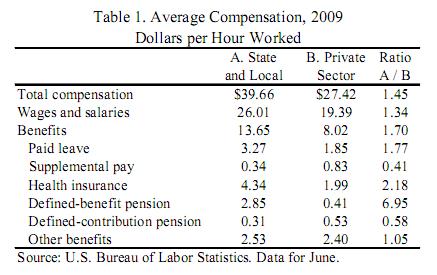
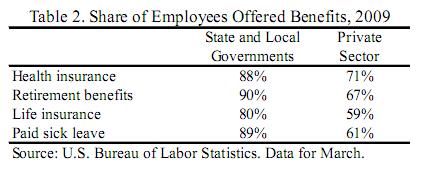
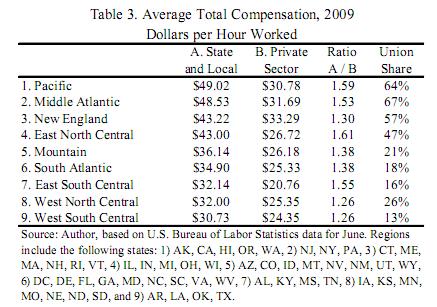

As John Carney and Kamelia Angelova (who produced the above chart) explain:
We've gone from providing jobs in profit-making private industry to providing jobs in profit-eating government work. Toward the end of 2007, the total number of government jobs exceeded the total number of goods producing jobs. Welcome to the government payroll economy.Yup.
January 4, 2010
Re: A New Year Begins...
Trying to effect change in Rhode Island at even the local level has been a monumental struggle with almost no success to show for it. Frankly, after years of trying, I have concluded it is not worth the effort.
I crossed the state border again this Fall, this time leaving Rhode Island permanently. I recommend it highly. It's relatively easy, too.
And it is liberating to rediscover that the need to fight the colossal failure that is Rhode Island is optional.
It appears that nothing will change until there is a total collapse. So let the rats go down with the Rhode Island ship. It's apparently the only possible way to get rid of them.
It's sad, isn't it? Because it did not (and does not) have to happen that way. Which is a common conclusion when looking retrospectively at crises.
Meanwhile, some (updated) previous reflections:
Meaningless talk and inaction in a crisis: Why Rhode Island's crisis will get worse before it gets better & what to do about it
Lessons for Rhode Island from Silicon Valley: An historical reflection on an actual innovation economy
Innovation and the entrepreneurial business culture revisited
December 28, 2009
Economy for Better and Worse
My thesis is that economic predictions are currently being made after the method expressed by respondents to a recent Providence Business News survey:
A sense of nervousness can be gleaned from the results, but the respondents also maintained the optimism that came to the fore in the summer 2009 survey. Many in the business community say that hopefulness is a byproduct of the feeling that Rhode Island can’t go much lower.
Things will get better because they always do. Right? The economy can't go much lower because it never has. It would be historic. Catastrophic. Well, I'm not predicting the end of the world, but the simple reality is that no economic mechanism of which I'm aware automatically kicks into gear when hard times top the Great Depression. Until we're hunting rats in the streets of Providence for food, the reality is that Rhode Island can go much lower.
Of course, one non-automatic mechanism that would help the state can be discerned in the survey's results: The pain could become so acute, and so clearly attributable, that state and local leaders will make it easier to live and do business in the state, lowering the unnecessary costs and lightening the misguided burdens that the state imposes with taxes, mandates, and regulations. A resolution by those whom Hasbro and Lifespan Chairman Alfred Verrecchia called "the collective leadership," in his keynote speech before the Rhode Island Public Expenditure Council, to set Rhode Island's economy free through rapid deregulation and dramatically shrunken government could make our state a bright spot in a dark region of a fading country.
The problem — the central flaw in Verricchia's reasoning and in the reform-by-consolidation movement to which he's contributed — is that the leadership class is going to do no such thing. Self-insulation and death-grip protection of special interests — coupled with the utter lack of a political price for their calamitous failures thus far — are going to keep RI's aristocrats marching along the same path, and the mechanisms of consolidation — moving government farther from the individual taxpaying voter, fiddling with the tax code without reducing its all-around burden, and paying out large sums to unelected administrators at the top — are all contrary to the prior necessity to end Rhode-apathy and cultivate a new collective leadership group that can wrest control of the government from incumbent hands.
December 24, 2009
Complications to Housing Recovery
So, yesterday I mentioned some news that's sparking claims of a recovery:
U.S. home sales rose 7.4 percent in November, according to the National Association of Realtors, while in neighboring Massachusetts, the single-family sales spike mirrored that of Rhode Island, at about 60 percent.
However, enthusiasm must be tempered by this:
The 11 percent slump in new home sales from October's pace shows that consumers are taking their time following an extension of a deadline for first-time buyers to qualify for a tax credit. The incentive, worth up to $8,000, was set to expire at the end of November. But Congress pushed back the date to April 30 and expanded the program to include current homeowners who move.
And this:
The industry group's mortgage applications index slid 10.7 percent in the week ended Dec. 18 to a seasonally adjusted 595.8, the lowest level since the week ended Oct. 23.An index of demand for refinance loans dropped 10.1 percent and requests for loans to buy homes fell 11.6 percent last week.
The tax credit for buyers, by the way, has been extended almost to summer, and expanded to include wealthier consumers.
It looks as if November's increase in overall sales derived from folks who had set up their transactions to cash in on the tax credit before the end of the month, buying less expensive existing homes, and now that months have been added, the market has returned to wait-and-see mode. There are a number of economic angles to this scenario, but it takes an effort of imagination to discern a sustained economic recovery in it. Indeed, as the link related to new home sales puts it:
The results show how reliant the housing market has been on government assistance. About 2 million homebuyers have taken advantage of the tax credit of up to $8,000 for first-time buyers, the National Association of Realtors estimated this week. Another 2.4 million are expected to either tap that subsidy or another one for up to $6,500 for current homeowners.
The only way increased government spending is defensible as an economic solution is if it's a short-term boost predicated on a visible and pending boom in the private sphere or if the spending accompanies a dramatic change in regulation and such meant to grease the private sector machinery. What's currently happening is that the government is spending borrowed money through various incentive programs while complicating regulations, with everything from financial industry manipulation to the purchase of car companies to cap-and-trade to the healthcare monstrosity.
The bill on both the borrowing and the complications is going to come due, and when that happens... well, I'm not inclined to imagine the outcome too vividly on the day before Christmas.
December 23, 2009
Impressions from a Declining Country
Sometimes the order in which one processes information can create broader impressions than the individual items suggest. For just such an experience, first watch Steven Crowder's short video about the crumbling, desolate city of Detroit, whose condition he attributes to the loving manipulations of big government.
Now consider this news:
Almost two months ago, the Commerce Department cheered the announcement that the third quarter GDP had grown at an annualized rate of 3.5%. The Obama administration hailed it as a sign that their economic policies had spurred real growth. Even when Commerce sharply revised the number downward a month later to 2.8%, the White House continued to argue that the lower number still meant that the US had turned the corner, even after a number of critics asked how Commerce could have missed the number so widely. ...Today, Commerce backtracked even further. The annualized growth number for Q3 turns out to have been 2.2%, a revision of over a third from its original estimate two months ago...... The Cash for Clunkers program and the first-time homebuyer tax credit was estimated to have contributed as much as half of the original Commerce estimate of 3.5%. Assuming that to still have contributed at least 1.5% of the final GDP, that leaves a rather pathetic 0.7% growth in Q3 without it. It's barely a recovery at that level.
And this morning, we learn:
November saw a dramatic increase in the number of houses sold in Rhode Island — up 61.1 percent compared with November 2008, according to statistics compiled by the Rhode Island Association of Realtors.
Part of the increase can be explained by a one-month-only $8,000 tax credit that expired at the end of November. Part of it may be related to the false prediction of growth. No doubt, there's also a genuine improvement of buyer mood; people who have been in the market for a home are more comfortable with the probability that prices are at or near their new bottom and that interest rates aren't going any lower. University of Rhode Island Economics Professor Len Lardaro puts it thus: "we're [now] in a typical recession, not a free-fall, like we were in a year ago."
Nowhere, however, has anybody explained what specifically is going to turn things around. Even up to the Commerce Department, it seems as if economic forecasts are taking as an assumption that 4% or so is simply "normal" growth, to which the economy will return as a function of its essential nature. The picture that is actually beginning to emerge more resembles an old car, and all variety of government officials, economists, and media cheerleaders are standing around trying various tricks and gimmicks to get the beast moving — not the least by employing positive thinking: "It's just about to go, now!" It whines and whirs and sputters, but it isn't turning over. And it's cold outside.
Of course, economic movement is only necessary for certain destinations. We can trust, for example, that Detroit will come to us. Rhode Islanders should be especially aware of the fact that, by contrast, economic turnaround and improvement must be pursued, not awaited
December 20, 2009
The Cost of Eliminating Prices
If you're looking for some worthwhile snowed-in reading, Kevin Williamson's recent National Review essay, "Priceless Is Worthless," would be an edifying use of your time. In sum:
... as we continue to pretend that there is another unseen economic reality beyond market prices when it comes to health care, banking, housing, labor, cotton, sugar, fuel-efficient Japanese automobiles, solar panels, and every other product with prices distorted by politics--whose interests do you imagine are being served? Yours, chump?
A timely example:
Health-care prices are a mishmash for lots of reasons, but one of the main ones is the way we pay for health care--you don't pay the doctor, your insurance company does, an arrangement that gives at least two of the three parties involved a good incentive to obscure prices, so that the consumer has no idea how good or how rotten a deal he is getting while the insurers and hospitals attempt to game and swindle each other. Given the shocking and terrifying size of serious medical bills--my mother's last stay in the hospital billed out at $360,000 (that's a Ferrari 612 Scaglietti for Doc X plus a BMW 5-Series for one of his brats)--the American health-care consumer, quaking in his paper hospital slippers, no longer even asks: "What does this procedure cost?" He only asks: "Does my insurance cover it?" No prices, no negotiation, no mystical coordination between producer and consumer--instead, maddening and expensive and often underhanded mediation by the insurer.Medicine is complicated; computers are complicated, too, but you can call Dell or Apple or Best Buy or whomever and ask: "What does this sort of computer cost?" and you will receive an answer. And then, when you get to the store--miracle of miracles!--that will be the price. Computers are damned complicated to make, with programmers in the United States and India collaborating with Taiwanese microchip fabricators, Dutch LED manufacturers, Irish customer-support agents, etc. You can get a price on an iMac, but you can't get a price quote on an ingrown toenail.
December 19, 2009
This Is About Self-Dealing, Not National Economic Health
The Democrats are clearly in grabbing mode, and this sort of thing is not going to stop until we citizens of the United States make it stop:
President Barack Obama's Democratic allies in the House Wednesday muscled through a year-end plan to create jobs, mixing about $50 billion for public works projects with another almost $50 billion for cash-strapped state and local governments.The unemployed would get continued benefits. But conspicuously absent from the plan were Obama's recently announced initiatives to give Social Security recipients $250 payments, a tax credit for small businesses that create jobs, and a program awarding tax credits to people who make their homes more energy-efficient.
This is all about the government and public bureaucracies preserving themselves at the expense of national economic health, rewarding special interests, and expanding dependencies.
It's worth noting, too, that although no Republicans voted for this particular legislation, there's little reason to believe that all, or even many, of them will allow small government principles to stand in the way of their own benefit should they return to power. The political class requires wholesale revision.
December 15, 2009
Facilitating Opportunity Is the Path to Charity
Reviewing Creating an Opportunity Society, by Ron Haskins and Isabel Sawhill, Duncan Currie emphasizes that advocates for the poor (and such) focus on the wrong measure of social progress:
Mobility, not inequality, is the key indicator of economic opportunity. The two are not necessarily correlated: If income inequality has gone up since the early 1980s, that doesn't necessarily mean income mobility has gone down. Indeed, a 2007 Treasury Department study concluded that "relative income mobility has neither increased nor decreased over the past 20 years." ...[Haskins and Sawhill] advocate a three-pronged strategy for boosting mobility: Improve public education, encourage work, and strengthen families [especially by reining in the surge in nonmarital births].
This argument runs right along the line that divides the modern American left and right (at least those on either side who are socially conscious). On the left, the the thread across the three strategic issues is government-directed action. Not trusting the masses to contrive a fair system, progressives wish to utilize the Smart Class to lay out a plan that the government can then implement objectively. On the right, we're a bit less convinced of mankind's capacity, first, to comprehend all of the necessary variables that an all-encompassing plan must consider and, then, to collect and apply the dictatorial force necessary without corrupting those who must perform the implementation.
And so, focusing on the conservative side of the comparison, the keys to strengthening public education are liberty and choice — giving those closest to the children (especially their parents) as much room as possible to determine the best focus and structure for educating them. The keys to encouraging work are to maximize incentive by removing long-term handouts and to ease the path from concept to profit — removing regulations and other restrictions that keep prices up and competition down. The keys to strengthening families are to be clear about the ways in which various relationships are similar and different and, with an emphasis on cultural institutions, to encourage the behavior appropriate to each — or, conversely, to encourage those inclined to a particular behavior toward the appropriate relationship types.
It is patently false to accuse those who agree with the preceding paragraph of not caring for people in need. Indeed, it is long overdue for naturally conservative groups, such as the Roman Catholic Church, to take the longer view, which is more in keeping with notions of individual autonomy.
December 4, 2009
This Is the Critical Issue for the State
One more statistic to paste into our collage of problems facing the state, all of which point to the same conclusion:
The Mortgage Bankers Association, which compiles the most comprehensive statistics on mortgage loan performance nationwide, also had grim numbers for Rhode Island in the third quarter of the year, the months of July, August and September. The association, which bases its statistic on a nationwide survey of 44 million mortgages serviced by banks, credit union, mortgage companies and other institutions, reported that 10.25 percent of Rhode Island's mortgages are 30 days or more past due. That's the record high since the association began keeping records in 1972, according to spokeswoman Carolyn Kemp.
And here's a bucket of cold water on the foreclosure side:
Looked at a different way, the middle-class Rhode Island suburb of Warwick has a rate -- 8.4 -- that is higher than a slew of aging Massachusetts factory communities, such as Worcester, 6.4; Fitchburg, 5.9; Lowell, 5.83; Springfield, 5.7, and Fall River, 5.3.
Warwick has about a 60% higher foreclosure rate than Fall River. How long, I wonder, until the entire state of Rhode Island becomes available for eminent domain seizure on the grounds that it's blighted?
Rhode Island needs jobs. It needs them quickly, and it needs them in large quantities. Tinkering with "targeted policies" isn't going to do it. Fiddling whith "this receipts tax" and "that receipts tax" gimmicks isn't going to do it. The state needs to cut taxes, remove mandates, and erase regulations.
If RI House Speaker Bill Murphy wants to cheerlead to promote the state, we'll get him some pom-poms and a little skirt, but he'll be performing to empty bleachers unless the message is "we're changing for your benefit." The hard part is that the change has to be credible, and that'll prove a difficult sell if we have the same people at the State House who have cheered us into the ground.
November 23, 2009
Cuts Better Than Spending
Via the Corner, some economic research out of Harvard (PDF):
Our results suggest that tax cuts are more expansionary than spending increases in the cases of a fiscal stimulus. Based upon these correlations we would argue that the current stimulus package in the US is too much tilted in the direction of spending rather than tax cuts. For fiscal adjustments we show that spending cuts are much more effective than tax increases in stabilizing the debt and avoiding economic downturns. In fact, we uncover several episodes in which spending cuts adopted to reduce deficits have been associated with economic expansions rather than recessions. We also investigate which components of taxes and spending affect the economy more in these large episodes and we try uncover channels running through private consumption and/or investment.
The irreducible bottom line is that the government is a burden and a drag on the economy. In some contexts, it's worth the cost, but when it comes to affecting the economy, we're better off lightening the burden — whether we're talking the United States or Rhode Island. (And that's not even getting into regulations and mandates.)
ProJo Comments on RI Invisible Districts
Six days after I noted the new congressional districts in RI, the ProJo has taken notice and did some digging:
We weren't sure who to call to clarify the confusion.Just clerical errors. I'm sure that'll never happen with government run health care."We do not know who represents the 86th and 5th Congressional Districts," Governor Carcieri spokeswoman Amy Kempe told Political Scene with a chuckle. "Unfortunately, I don't have those phone numbers for you."
The phantom districts here and elsewhere were part of a national embarrassment for the Obama administration that was ultimately attributed to a glitch in the reporting system. Virtually all data on the site are posted by grant recipients, which range from state governments to universities to private contractors.
The Obama Administration's Recovery Accountability and Transparency Board, at the direction of the Office of Management and Budget, investigated and adjusted the figures for several states late in the week.
Congressional District 5 was actually a company headquartered in Massachusetts' 5th District doing work in Rhode Island, according to the governor's office. District 00 represents money entered by the state reflecting crime victim compensation funding and a security grant.
And 86 "appears to be the Providence Housing Authority," Kempe told Political Scene. "We don't know how or why that happened," she said.
SNL Parodies Obama's "Wimpy Economics"
Saturday Night Live's most recent parody of President Obama (he's finally fair-game, apparently) calls attention to his "Wimpy Economics"--pay now, and we promise you'll receive later. Right.
“I am noticing that each of your plans to save money involves spending even more money.”
Health care "reform" is but the latest example--cuts and taxes will kick in immediately while benefits will start in 2013, for instance. And the promised savings are dubious anyway. For instance, the plan actually shifts Medicare costs onto the states, forcing them to deal with finding additional revenue (tax increases?) to handle the additional burden mandated by the federal health care "reform" plan.
November 22, 2009
The Green Religion and Expensive Government
Just wanted to mark this final stage in the incremental establishment of the green religion as the official doctrine of the land:
New major public projects and building renovations in Rhode Island, including schools, must be designed and constructed in conformance with high-performance green-building standards, according to legislation signed by Governor Carcieri.The law applies to new construction of more than 5,000 square feet and renovation of spaces greater than 10,000 square feet if such projects receive funding from the state. The law takes effect immediately but will apply only to buildings entering the design phase after Jan. 1. Under the law, building design must conform to the internationally recognized United States Green Building Council Leadership in Energy and Environmental Design rating system or an equivalent high-performance green-building standard, including the Northeast Collaborative for High-Performance Schools Protocol.
It almost reads like a comedic one-liner when Senator Louis DiPalma (D, East Bay Gerrymander) explains that "green building materials and systems [are] more affordable and available [...] than they used to be." Badum-bum. He goes on to assert that the investment "pays off in lower costs for energy, water and more over the life of a building," but if that's true, then the communities and organizations funding applicable projects should be easily persuaded without a state mandate.
To review: Our state is in the middle of a fiscal crisis, bleeding jobs for years on end; our government has structural deficits in the hundreds of millions in good times and bad; our communities are struggling to maintain the services that they provide; and the General Assembly and governor thought this would be an appropriate time to mandate a greater price tag on investments in public construction.
November 21, 2009
A Deadly Scheme
Henry Aaron and Isabel Sawhill, of the Brookings Institute, provide a wonderful example of the insanity of allowing individuals to plan large segments of the economy:
So here is what we propose: Congress should enact a value-added tax, the equivalent of a broad-based sales tax on all goods and services. It should take effect only after unemployment has fallen to a predetermined level or in, say, five years, whichever comes first. Congress should link revenue from the new tax and other sources directly to public healthcare spending through a newly created healthcare trust fund. The trust fund would pay for all federal healthcare spending. This framework would mean that Americans would get the healthcare they are willing to pay for. If spending outpaces projections, Congress will have to choose between raising taxes and finding ways to slow the growth of spending.By balancing revenue and healthcare spending, such a reform would help solve America’s long-term fiscal problems. In the near term, it would also support and sustain the economic recovery. Consumers would be encouraged to buy now, before the tax takes effect. And by showing financial markets that Congress is determined to put our fiscal household in order, it would help keep interest rates low and encourage investment. The trust fund mechanism would strengthen incentives to institute reforms that will actually bend the healthcare cost curve, because measures to slow the growth of healthcare spending would avoid unpopular future tax increases that would otherwise be necessary.
How is it possible that people who are paid, essentially, to think can argue that a looming tax increase equivalent to one-sixth of the U.S. economy will encourage consumers to splurge while the splurging's good without making the parallel assessment that the huge taxes will suppress the economy once implemented? One of the reasons given in a previous paragraph for rejigging the healthcare system in a public direction is that, with ever-improving "medical interventions... [p]atients will insist on having them." Well, if the government must thus bend to supply what patients demand, why won't consumers learn the lesson and start demanding the things for which Aaron and Sawhill assume they'll splurge?
This program — which one may suspect will be the end result of the Democrats' healthcare path — would be a recipe for the hollowing and destruction of the United States of America, beginning with its entrepreneurial soul.
November 20, 2009
Republicans Less Likely to be Unemployed
Data from Rasmussen Reports national telephone surveys shows that 15.0% of Democrats in the workforce are currently unemployed and looking for a job. Among adults not affiliated with either major party, that number is 15.6% while just 9.9% of Republicans are in the same situation....The percentage of unemployed Democrats has grown less than a point from 14.2% in February....Among those not affiliated with either major party, unemployment has grown by more than two percentage points from 13.3% in February to 15.6% now.Looking at this map and comparing it to what we know about the usual red/blue breakdown might add some clarification. I'm not sure, but interesting.As for Republicans, the percentage unemployed has also grown more than two points after starting at just 7.8% in February.
November 16, 2009
The Economy as Trojan Horse
It's Political Maneuvering 101 to encase your preferred issues within a popular Trojan Horse. So, if green is what you mean, declare its ability to end joblessness. However pretty a landscape that may paint, though, it's of questionable accuracy:
Green technology may help drive an economic recovery in New England but the fledgling industry will not be a major engine of growth for the region in the foreseeable future, economists said at a recent conference.The sobering assessment came during the New England Economic Partnership's fall conference, which was held last week in Boston and focused on so-called "green-collar jobs" and whether their creation will help pull Rhode Island and its neighbors out of recession.
The real hope for "green jobs" is that a particular state will become the hub of the industry. The problem is that — as is typical of politicians — the opportunity is so obvious that multiple states are competing for the title. Government operatives are good at innovating by fad, but business people survive by innovating, period.
States — and I'm speaking mainly to Rhode Island, here — should ease regulations across the board and otherwise refurbish the track along which the economy runs and let investors and corporate types discern which has the environment most conducive to their industries.
October 30, 2009
A Black Spot in the Northeast
Rhode Island's saving grace, on this sort of graphic showing state-by-state unemployment rates, is that the folks creating the images continue to use "higher than 10%" as the top category. So, a baker's dozen of other states have joined us in that group, but conspicuously, none of them are north of the Carolinas or east of Ohio. We're a little black dot in a sea of purples and maroons.
Imagine what would happen if we made a concerted effort to shed our business unfriendly image... instead of continuing to elect legislators who are apparently intent on pushing us in the other direction.
October 26, 2009
If GM and Chrysler Don’t Make It, Well That Was the Plan All Along
Remember those big auto bailouts? Did you know they were never really intended to save Chrysler or GM? At least that’s what Newsweek Senior Editor Dainel Gross says (h/t Mickey Kaus)…
By the time the government got there, the companies had essentially failed. A year ago, the choice facing the bondholders, shareholders, and executives of GM, Chrysler, Citigroup, and, to a lesser degree, Bank of America, wasn't between accepting government help or accepting the offer of other suitors; it was between Washington, D.C., and liquidation....Sure, there was brave talk of reviving these once-proud brands and returning them to their rightful place in the pantheon of American corporations. But from the outset, I've believed that the interventions were simply efforts to delay liquidation rather than to avert it altogether, to provide a breathing space in which managers could find homes for valuable assets (other companies) and find chumps to absorb the losses from bad decisions (that would be the taxpayers)....Apparently, Gross’ sources aren’t betting on GM or Chrysler becoming profitable again, ever. And the bankruptcy of a government-owned manufacturer, the event that will bring an unevadable public challenge to progressive economic ideas of more government and more spending being solutions to everything, continues to draw closer and closer…It's frustrating for taxpayers that the banks and car companies in which they have stakes aren't performing better. But Washington isn't to blame for the change in the competitive landscape. The struggling companies we now own are taking losses because, for years, they engaged in the types of business practices that cause businesses in their industries to lose market share and rack up losses—and to seek government help.
October 25, 2009
White House Acknowledges Economic Reality?
Well, here's a surprising admission:
Christina Romer, the chair of President Barack Obama's Council of Economic Advisers, said the initial jolt of the $787 billion stimulus expanded the economy in the second and third quarters of this year. But she said the remaining spending will simply keep the economy from slipping.
In other words, shoving money into the economy expanded it to fit the new dollars, and that spurt must become a constant flow in order to maintain the size of the economy. Of course, to the extent that the new money was borrowed, it will have to be repaid out of the economy (with interest), and to the extent that the new money was printed, it will deflate in value.
The sooner we let the economy return to an unstimulated state, the less the bill will be when it comes due. The economy should be encouraged, through policy changes, to grow on its own.
October 21, 2009
Passing Laws Without Legislators
Anybody catch the following in a Sunday Projo article about yet another economy-restricting practice?
The solution he refers to is the Home Valuation Code of Conduct, a set of standards for residential real estate appraisals that grew out of an investigation of the mortgage industry by New York Attorney General Andrew M. Cuomo. The code seeks to guarantee the independence of appraisals by building a "firewall" that prevents mortgage brokers from dealing directly with appraisers.In exchange for being removed from Cuomo's investigation, mortgage giants Fannie Mae and Freddie Mac agreed they would not buy mortgages whose appraisals did not adhere to the code. The two government-sanctioned corporations buy individual mortgages, collect them into packages and sell the packaged mortgages to investors. The code took effect May 1.
Although the rules are not binding on anyone but Fannie Mae and Freddie Mac, lenders follow them because, if they didn't, they would not be able to sell their loans to the two companies. Because of their size, Fannie Mae and Freddie Mac can drive what happens in the mortgage industry. "Once Fannie does something, everybody else kind of jumps on board," says [Keith White Jr., owner of White Appraisal Co. in Warwick].
Without any legislation's being passed or even, presumably, proposed, the mechanism of leveraging huge, government-backed lenders has imposed new, costly regulations on the housing market. One can see how a similar principle might result in the proliferation of — oh, I don't know — derivatives based on insecure loans granted to lower-income borrowers and crash the economy.
The new policies, by the way, add two layers to produce that "firewall." One wonders what an investigation of names and relationships branching between those layers and various government officials might uncover.
October 18, 2009
Small States, Lost Income
Duncan Currie tells a tale of economic happenings in my childhood state of New Jersey that should ring familiar to Rhode Islanders:
Hughes, Seneca, and Irving estimated that, between 2000 and 2005, net domestic out-migration cost the state a total of $7.9 billion in adjusted gross income. "Although this loss is relatively small--3.3 percent of total adjusted gross income in 2005--it is a permanent loss that will persist (or increase) each year unless net out-migration is reduced or eliminated," they wrote. ...One need not be a demography expert to understand why New Jersey is hemorrhaging human capital. According to according to state rankings compiled by the Tax Foundation, it now has the highest state and local tax burden, the highest per capita property taxes, and the worst tax climate for business. The Pacific Research Institute's latest U.S. Economic Freedom Index says that only two states (Rhode Island and New York) offer less economic freedom. The 2009 State Economic Outlook Index, co-authored by legendary economist Arthur Laffer and published by the American Legislative Exchange Council, ranks New Jersey 46th. Democratic governor Jon Corzine recently suspended property-tax rebates for most New Jerseyans and raised the state's upper individual income-tax rates to help close a yawning budget gap. New Jersey's uppermost rate (10.75 percent) is now higher than California's (10.55 percent).
Readers will recognize the measure of economic health as one that I've been tracking, in our state, for a couple of years. The dark topic aside, it's nice to see my concern about lost AGI echoed by real scholars — especially after the unions' favorite analyst (and regular Projo opinion-page contributor), Tom Sgouros, called such a measurement "farcical." I'll concede that, when it comes to that particular adjective, he may be an expert.
October 16, 2009
Just like a banana republic
Today the Obama administration's "pay czar" demanded that Ken Lewis, Chairman of the Board of Bank of America, work for free. The "czar," Kenneth Feinberg, pressured Lewis not only to forgo all remaining compensation for 2009, but to repay the $1 million he has already received this year. Lewis acquiesced, saying that "he felt it was not in the best interest of Bank of America for him to get involved in a dispute with the paymaster." I'm sure he was right about that.Response to this outrage has been surprisingly muted. In my view, it is hard to imagine anything more un-American than a "pay czar" empowered to order businessmen to work for free.
The main point here is not sympathy for Mr. Lewis, although I am, in fact, sympathetic to him. He is about to retire and will receive a substantial retirement package--only, perhaps, because the pay czar lacked jurisdiction to negate it. But the idea of empowering the federal government to dictate businessmen's compensation based on political favoritism is absolutely chilling.
This episode illustrates the problem perfectly. Lewis took on the federal government by testifying that Fed chief Ben Bernanke and Henry Paulson, a Democrat who was then Secretary of the Treasury, bullied him into committing what was, in effect, an egregious violation of the securities laws. Bank of America was due to close on its purchase of Merrill Lynch, and Lewis knew that Merrill's value was plummeting. Lewis testified under oath that Paulson and Bernanke threatened to fire the entire management and board of Bank of America, including Lewis, if Lewis backed out of the Merrill deal or communicated to the bank's shareholders what a bad deal the purchase had become.
So, according to Lewis, the federal government forced him to violate his duty to his shareholders in order to advance the government's objectives. The feds were unhappy with Lewis's blowing the whistle on their actions, which I believe would have been criminal if carried out by private citizens. Bernanke, at least, denied Lewis's version of events.
So Lewis took on the feds, and now he's paying the price. The Obama administration has taken away his entire salary for 2009. Political payback, or just a coincidence? In a banana republic, you never know.
Where is the outrage from those who love liberty? In a banana republic, your "freedom" only lasts as long as you are favored by those in power. Some definition of freedom; it is certainly not the historic definition in America.
October 14, 2009
2009 Nobel Prize in Economics
Cafe Hayek on More on the 2009 Nobel Prize in Economics. More here.
Hey, these awardees actually did something to earn their Nobels! LOL.
Valuable reading to be found in the links.
ADDENDUM #1:
David Boaz of the Cato Institute on What is Regulation?
October 13, 2009
Links to various articles
Power Line on Taking the National Debt Seriously
Veronique de Rugy on Elinor Ostrom and the Essence of Economics
Jagdish Bhagwati on Feeble Critiques: Capitalism's Petty Detractors
Power Line on Democrats to Curtail Free Speech
Cato on What Does the State Department Not Want Us to Know about Honduras?
John Derbyshire on The Thatcher Giant
ADDENDUM #1:
Harsanyi on The doers against the "thinkers"
Russ Roberts on Stimulus in the Real World
Victor Davis Hanson on The Power of Payback
Milton Friedman on 4 Ways to Spend Money
Milton Friedman on Libertarianism (Part 1 of 4)
Milton Friedman on Libertarianism (Part 2 of 4)
Milton Friedman on Libertarianism (Part 3 of 4)
College Isn't Required to Earn a Good Living
Two stories in last week's ProJo have been jangling around in my head. Then Justin noted Deborah Gist's "anger" over kids not wanting to go to college and, correctly, pointed out that college ain't for everyone. I agree, especially when the value of a B.A. seems to be less and less while we pay more and more. The first story that caught my attention last week was that the RI Board of Governors for Higher Education raised tuition and fees by almost 10% at URI, RIC and CCRI, continuing a trend. Yet, Rhode Island isn't alone, it's a national problem. One cause of these increases is what's called the "cookie monster" effect, says Ronald Ehrenberg, who directs the Higher Education Research Institute at Cornell University.
Continue reading "College Isn't Required to Earn a Good Living"
Vlog #9: Planning Against Human Nature
Herewith, further thoughts emerging from things said at healthcare town halls. The focus is, obviously, healthcare, but the argument is against socialism in general (ahem).
October 7, 2009
Collection of interesting links
Jennifer Rubin on Selling Our Souls
Andy McCarthy on If you don't get Islamic ideology, you don't get the problem in Afghanistan; follow the links, too
Richard Cohen on Does Obama Have the Backbone?
Steven Hayward on Reagan's Unfinished Agenda: A potent brew for the Tea Parties?
Anthony Gregory on Jobs Government Creates, and Destroys
Veronique de Rugy on Where is the Fat in the Federal Budget?; follow the link
October 5, 2009
The Looming Challenge for the Advancement of Euro-Style Soft-Socialism in America…
…is most likely to come from the automobile industry. Did anyone else note the statistics related to automobile sales released at the end of last week (via Reuters, in the excerpt below)…
U.S. auto sales tumbled by 23 percent in September as showrooms emptied after the government-funded boom from the "cash for clunkers" program, with General Motors Co and Chrysler hardest-hit.Assuming that Reuters is presenting an apples-to-apples comparison with Ford, the GM and Chrysler percentages would be one-month totals compared to the prior year.Sales for General Motors Co and Chrysler -- the two U.S. automakers struggling to regain momentum after emerging from bankruptcy -- dropped by 45 percent and 42 percent, respectively.
Ford -- the only U.S. automaker to have avoided bankruptcy -- managed to hold its sales decline to 5 percent from a year earlier despite low inventories and reduced incentives for car shoppers.
General Motors and Chrysler, you may recall took copious amounts of bailout money from the government -- along with copious government conditions attached -- as part of the Obama administration's economic program, which is premised largely on the idea that businesses run better when they are more aggressively regulated or directly managed by the government.
So what will be the response, if government-ownership fails in a major industry? Will advocates of government planning of the economy begin to accept that government ownership of something doesn't provide an exemption from the laws of economics, and actually look for the underlying sources of GM's troubles, instead of blithely assuming that government ownership solves them whatever they are? Will they double-down and say the problem with the auto bailout was that the amount of taxpayer money was too small and that more bailout money is needed?
Or will they say that looking that GM and Chrysler's success in conventional business terms (was more taken in than was spent) is just a distraction, and the important thing is that government has more control than it did before?
September 18, 2009
The Obama MO?
With the economy at best slowing its wobble (and reason to be wary even about that), the Obama administration has added requirements for "better gas mileage for cars and trucks and the first-ever rules on vehicle greenhouse gas emissions" to its list of desired drags thereon. Note this now-familiar feature:
The proposal will cover vehicle model years 2012 through 2016, allowing auto companies to comply at once with all federal requirements as well as standards pushed by California and about a dozen other states.
Now, I'm sure there are a whole lot of arguments that one could put forward, with respect to time for such things as research and marketing plans, but a growing fist of expensive programs seem slated to swing by during the millennium's teens — after the next presidential election.
I'd also highlight this:
The administration estimated the requirements would cost up to $1,300 per new vehicle by 2016. It would take just three years to pay off that investment, the government estimates, and the standards would save owners more than $3,000 over the life of their vehicle through better gas mileage.
Except for the fact that gas will increase in price as it adjusts for the lower demand...
September 15, 2009
You Mean Coal Fuels the Fire?
Serious as the economic times may be, it's difficult not to laugh at the apparent bewilderment of some:
A year after the financial system nearly collapsed, the nation's biggest banks are bigger and regaining their appetite for risk.Goldman Sachs, JPMorgan Chase and others — which have received tens of billions of dollars in federal aid — are once more betting big on bonds, commodities and exotic financial products, trading that nearly stopped during the financial crisis.
That Wall Street is making money again in essentially the same ways that thrust the banking system into chaos last fall is reason for concern on several levels, financial analysts and government officials say.
From my distance well beyond the halls of Wall Street and of Washington, it seems to me that the biggest banks must now realize that they are truly TBTFs (too-big-to-fails) with just about explicit government backing. Why not take risks? The remuneration flows to the individuals, and then Big Pappa Government has his hand hovering on the back of the banana seat to right the wobbles. Says Larry Summers, director of the White House National Economic Council:
You cannot rely on the scars of past crises to ensure against practices that will lead to future crises.
And neither can you rely upon government regulations, because the giants of industry are smarter than the snivelers of bureaucracy. Only the ambitions of smaller giants will put a long-term check on their behavior.
September 12, 2009
Privatizing Debt Acceptance
Anybody else uncomfortable with the implicit suggestion of this sort of report? The economy is mildly recovering, employment will likely dip a bit more, and:
The problem for the economy is that the expected growth this quarter comes mainly from the auto companies and other manufacturers, which are refilling their depleted stockpiles.Those inventories had dwindled as factories and retailers sought to bring what they had more in line with reduced sales. Any robust growth in the economy might be short-lived if shoppers don't step up their spending.
The Providence Journal headline for a shortened version of this AP article was "Fed says recovery depends on spending by consumers." Many consumers do not have jobs; the prospect of economic contraction has brought many others to a healthy appreciation of the risk that supplementing income with debt entails; and still others are intent on maintaining a cushion against an unpredictable future.
The argument that government and media elites appear to be floating is that the government has maxed out its credit cards (which are backed mainly by political will and public acceptance), and it is now consumers' turn. Not the least because the same people must ultimately pay both debts, this is simply not the way to revive the economy.
My advice to Americans — as consumers and as workers: Hold on to as much of your money as you possibly can, and whatever you do, put the credit cards away.
September 11, 2009
The Size of the Incentive
A couple of things that I've read, recently, reinforce a healthy concern about the sheer size of the aggregated pool of power that a growing government creates and the incentives that it generates. The first example comes from an article by Kevin Williamson in National Review about Congressman Barney Frank (subscription required):
Fannie Mae and Freddie Mac thought they had a shot at becoming the bond market. It was not long ago that the U.S. government was expected to be running surpluses, or near-surpluses, for the indefinite future. The folks at Fannie and Freddie calculated that this meant that Washington was going to be selling fewer Treasury bonds than it had been, and that the GSEs' bonds, with their implicit federal backing, would be able to fill the void, in effect displacing Treasuries as the new benchmark for the bond market. Issuing the benchmark bond, the GSEs would be able to borrow at the "risk free" rate, i.e. what the U.S. government pays to borrow. With a line of credit at the Treasury, the implicit backing of Uncle Sam, and the power that comes from issuing the benchmark in the all-powerful bond market, the GSEs — privately owned corporations, bear in mind — would have enjoyed a combination of political and economic power normally reserved for entities that have armies and navies. Fannie and Freddie were so sure that they’d end up stealing Treasuries' pride of place that they trademarked the name "Benchmark Bonds" and began issuing them.
It was the implicit government backing — which has the implicit power to take resources by military force — that made those dreams conceivable.
The second example comes from a First Things piece in which Reuven Brenner argues that government negligence facilitated the financial collapse. For one thing:
By accepting the rating agencies' opinions as the criteria for the amount of leverage that banks could apply, the Federal Reserve turned the ratings agencies into a quasi-official monopoly. And by securitizing trillions of dollars of structured bonds on the strength of these ratings, the financial system put the ratings agencies into a pivotal position in the economy. The ratings agencies never grasped their new roles. On the contrary, they saw their monopoly position as a license to print money by issuing rubber-stamp opinions about structured product that they neither understood nor cared to understand. Meanwhile, in the case of the federally sponsored mortgage corporations Fannie Mae and Freddie Mac, the government made it cheaper for a while for anyone to speculate in the housing market.
With the housing-related organizations, the federal government lost sight of its role by behaving as a social engineer dabbling in home ownership. In the case of the ratings agencies, the government took its eye off plain principles of economics that it ought to guard because of its belief in regulators' ability to comprehend and manipulate minute trends. The pool of power is there, glittering with the reflected light of prosperity, and is simply too much for human beings to guard, even if they are nominally accountable to voters. With all of that money and influence at stake, there's further incentive for distortion and political theater to leave others with the blame:
... relying on government and the Federal Reserve to access capital is not the same as relying on banks and other financial institutions. Bankers make decisions about who gets the loans, and on what terms, based on the ability of entrepreneurs and managements to carry on successfully. But a government's decision to finance ventures—as in the case of the auto industry—is based on political clout.Of course, political clout sometimes passes under the name of national interest, a phrase that bankruptcy judge Arthur Gonzalez used in his opinion concerning the objection of investors challenging the administration's use of TARP money for Chrysler: He wrote that the U.S. government "made the determination" that it is in the "national interest to save the automobile industry, in the same way that the U.S. Treasury concluded that it was in the national interest to protect financial institutions."
Using national interest as a criterion for financing has allowed politicians at all times and in every country to usurp the responsibilities of the private sector. It is happening again in the United States, and without much resistance, since the public's attention has been focused on the failure of private financial institutions to correct their mistakes. This failure destroyed public trust in these institutions, especially since their mistakes were visible, whereas the mistakes of the government—without which the private sector could not have carried on with its own—were less visible.
We can and should hold private institutions accountable (in part, ahem, by enabling competition and allowing them to fail), but we also shouldn't neglect the questions of whether our rule-keeper is competent and whether it's even possible for any person or group to be up to the task of keeping rules in proximity to the lure of combined governmental and economic power.
September 7, 2009
Setting Up Continuing Deficits
Don't let this tidbit slip past our awareness:
Emerging from a tough competition, four Rhode Island police forces have won money from the federal economic stimulus program to hire police officers, the White House has announced.The largest single sum, $3,529,812, goes to Providence, to hire 13 officers. The other beneficiaries are Pawtucket, to hire or retain 8 officers; Woonsocket, 4; Central Falls, 2; and the Narragansett Indian Tribe, 1. ...
The award covers the cost of hiring officers at entry-level pay and benefits for three years. But there is a "catch," as some critics of the stimulus program call it. When the aid dries up at the end of the period, the employer is required to keep the new personnel on the payroll at local expense for at least another year.
We can expect that the "stimulus" regime is full of such ramps into an uncertain future — with the government borrowing money from the future in order to obligate itself to maintain expenditures that it may or may not be able to afford a few years down the road. It's government by economic fantasy, with elected representatives and bureaucrats proving that college students aren't alone in unwise reliance on debt.
September 5, 2009
Going Right Where They Sent Us
So the national unemployment rate is 0.3% shy of 10%, and economists are debating when, not whether, it will achieve double-digits. In Rhode Island, which has been in double-digits for quite some time, already, the experts continue their reluctant predictive marches toward my initial gut estimate of 14-15%. And worst of all, usage of the term "jobless recovery," perhaps calling forth that terrifying creature, the W-shaped recovery, has moved from whisper to indoor-voice.
Oddly, for all the distinguishing between young workers and older workers, employed, unemployed, and not-looking, discouraged workers, few reports are differentiating between employers in an attempt to explain how the economy can grow without creating jobs. One wonders whether the reason has something to do with the subsequent conclusion, to which Larry Kudlow comes based on this picture:
The large companies are gradually recovering as a result of major cost-cutting, inventory reduction, and a lean-and-mean return to profitability and high productivity. So the payroll survey registered a 216,000 job loss, the smallest drop in over a year.However, the household survey, which picks up small, owner-operated, LLC/S-Corp-type businesses, registered a devastating 392,000 job loss, which follows losses of 155,000 and 374,000 in the prior two months. This is the source of the unemployment-rate jump, as 466,000 newly unemployed were scored in the report.
In a nutshell, this is without question now the Obama administration's recession:
Borrowing from Peter to redistribute to Paul is not fiscal stimulus. It's a fiscal depressant. Small businesses are having enough trouble getting their hands on credit. And now they can't find enough capital for new start-ups. The government prospers, but the small-business sector sinks.Then there are all the tax and regulatory threats related to health-care and energy reform. Until Mr. Obama retreats from his plan for a government takeover of the health-care sector, and a cap-and-trade program that will cripple the energy sector, the cost of hiring the new job will continue to rise.
The threat of higher payroll taxes and energy costs is more than enough to deter new hiring. Taxes on upper-end investors are going to rise, too, and there may be a health-care surtax on top of that. And don't forget that small businesses pay the top personal tax rate, which is going up. Oh, and how about the recent minimum-wage hike? Yet another business cost.
So while the government doles out money for transfer payments and one-time temporary tax credits, the ensuing increase in the private-sector tax-and-financing burden becomes a complete deterrent to new job creation, as well as capital formation.
Kudlow suggests that Obama and the Congressional Democrats could perhaps spur recovery simply by backing off their mad-dash for government power. Similarly, Rhode Island's General Assembly could hand their ostensible constituents hope of a quick turnaround if legislators would signal soon and decisively that the state has learned the error of its ways and intends to make itself the most business-and-taxpayer-friendly cut of land in the Northeast.
Neither of those conversions is very likely, of course, which means that our highest priority, as individuals, should be to find something buoyant to hold onto, and to grab it tightly.
August 26, 2009
A Trillion Dollars per Year
President Obama has put the government on track to realize nearly one trillion dollars per year of cumulative deficit for the next decade:
In a chilling forecast, the White House is predicting a 10-year federal deficit of $9 trillion -- more than the sum of all previous deficits since America's founding. And it says by the next decade's end the national debt will equal three-quarters of the entire U.S. economy.
Do you suppose Americans are finally waking up to the hangover resulting from their campaign-year binge of moral vanity and political superficiality? It's becoming difficult to miss the scam-pitch in such nonsense as the assertion by Obama's Budget Director Peter Orszag that rewriting our healthcare system with an emphasis on regulation and government involvement will decrease the deficit. Sorry, Pete, more and more of us simply aren't buying.
But before President Barack Obama can do much about it, he'll have to weather recession aftershocks including unemployment that his advisers said Tuesday is still heading for 10 percent.
I submit that the solution to both problems is one and the same: shrink government. Define the United States as something grander than its government, and the tidal economic rewards of freedom will lift the bureaucrats' boat, as well.
August 22, 2009
The Weekly Steyn
That's why the "stimulus" flopped. It didn't just fail to stimulate, it actively deterred stimulation, because it was the first explicit signal to America and the world that the Democrats' political priorities overrode everything else. If you're a business owner, why take on extra employees when cap'n'trade is promising increased regulatory costs and health "reform" wants to stick you with an 8 percent tax for not having a company insurance plan? Obama's leviathan sends a consistent message to business and consumers alike: When he's spending this crazy, maybe the smart thing for you to do is hunker down until the dust's settled and you get a better sense of just how broke he's going to make you. For this level of "community organization," there aren't enough of "the rich" to pay for it. That leaves you.
August 21, 2009
Up or Down, It's All Good News
So, despite a decrease in the national rate (because Americans have begun giving up on finding work), Rhode Island's unemployment moved up to 12.7%. Not to worry, though; see, when the national rate decreases because folks give up, it's a positive sign, and when Rhode Island's rate goes up, it's also a good sign:
The news is not all bad for the state. The total labor force — a number that includes the unemployed — grew to 573,700, its highest level in more than two years. A rise of 1,700 in the number of employed state residents contributed to the overall jump in the labor force, although that growth was outpaced by the increase in unemployed workers.
The silver lining, it would seem, is that, despite growing unemployment, there are more people competing for the fewer jobs. Yay!
A few minutes ago, I made a quip on the jobsite that the world is turning, the grass is growing, and RI's unemployment rate is going up. One of the electricians smiled and said, "Yeah, but that's a good thing."
I think the public's starting to discern another way in which the "analysis" with which news stories are served up isn't to be taken seriously. I can't help but wonder if this is the sort of banter that goes on under regimes with state-controlled media.
August 13, 2009
Supplies and Trends in Fund Allocation
In the comments to my post on teachers' paying for classroom supplies, Mike from Assigned Reading offers his objection:
You know I'm a public school teacher Justin, and I am generally on your side. I believe the unions and bureaucracy are the significant problems in public education.With that in mind, I found this post to be way off the mark. Yes, you need to buy expensive tools to be a carpenter. That's part of the initial investment in your profession. Teachers invest in five or six years of education, and continue to invest in education as their tools of the trade. I regularly buy professional texts to learn more, and better my practice. I pay to attend professional conferences and workshops for the same purpose. I should.
When you build a structure, you don't pay for the materials. You figure that into the amount of the job. The party that contracted you pays for the materials. The contractor determines the profit after the cost of the materials are figured in.
I could go on and on about how much I spend on my classroom. I won't. I'm not complaining. But it seems ridiculous that teachers should have to buy pencils, crayons, paper, folders, books, and the like for 25 students as part of their salaries.
I know your argument will be that teachers get too much. But this post is petty, and adds to the idea that you are anti-teacher. Teachers should not be responsible for buying classroom supplies. How much they should be paid is another argument.
I must tell you that I've been disappointed lately. The liberal RI blog is all about the unions and the teachers, and this blog seems all about the taxpayers. It mirrors the entire debate. It's the children that don't have strong advocates. I'm working on that.
Just in case there's misunderstanding as to what sorts of things carpenters need beyond hammers, nails, and wood, I jotted down a quick inventory of disposable items with which I keep my van stocked at my own expense, not including such things as screws and nails or tools: pencils, notepads, shoe guards, latex gloves, ear plugs, dust makes, garbage bags, grinder discs, flushcut blades, sawzall blades, skilsaw blades, jigsaw blades, drill bits, rotozip bits, palm sander discs, belt sander belts, masonry bits, screwdriver bits, sandpaper, light bulbs, snap line chalk, wood filler, bondo, wood cleaner, wood glue, PVC primer and glue, zip ties, caulk, silicone, construction adhesive, painter's tape, duct tape, aluminum tape, electrical tape, caution tape, air gun oil, pumice, wood putty, rope, string, primer, chip brushes, shims, Goo Gone, metal straps, and sheet plastic.
Some of these items duplicate supplies provided when needed in bulk for a job. Some of them are regular items to which I periodically have access for stocking purposes. Some of them I buy because I prefer a product other than what my boss provides. But like tools and specialty fasteners, having such things on-hand whether or not a specific need was foreseen makes me a more effective and efficient carpenter, with one of its benefits being the ability to ask for higher pay. Just so, Central Falls teacher Pam Barnes told the Providence Journal that buying school supplies "makes it easier for us to teach" — that is, it makes them more effective as teachers.
By assenting to a cookie-cutter seniority system of remuneration, the public school system has drained the practical reason for teachers to strive to be uniquely effective in this way (although many clearly continue to see moral and emotional reasons), so it's understandable that they'd develop the sense that they ought to be collectively entitled to a well-stocked supply closet courtesy of the taxpayers.
With that word, I've likely given those who share Mike's perspective an "A-ha!" moment, so the moment is opportune to insist that he is incorrect. To the extent that I make my arguments in terms of the "taxpayer," it is implicit that the complaint is against the failure to realize value, which is to say, the interest of the students. Honestly, my opinion has changed on this matter as I've listened to teachers, administrators, and school committee members talk as if the only financial options are to increase revenue or to cut programs and other direct benefits to students, and as I've collected data for charts like these.
From 2000 to 2007, Rhode Island's per-pupil expenditures increased 40% on instructional teachers and 242% on retiree benefits while per-pupil spending on instructional materials decreased 9%. If the adults who have been soaking up our ever-increasing investment in education find it necessary to cover expenses that districts can no longer afford, it strikes me as, well, not worthy of front-page news coverage. At least no more worthy than would be a story about carpenters in search of good deals on router bits or copy editors looking for sales on reference books.
August 12, 2009

Waxman-Marke: Bad for the Economy
i have a piece in today's ProJo about Waxman-Markey, which will be debated later this year in the Senate. The link is here. This legislation is on a par with Obamacare as an economic nightmare.
August 10, 2009
Taxes, Wealth, and Recovery
With the reminder that Rhode Island is at the top of the list when it comes to stimulus spending per capita, I thought of a table that I'd seen predicting the years during which each state's economy would recover to pre-recession employment levels. Curious what it would look like, I added the recovery information to the table that I used while assessing whether there might be a correlation between tax burden and the proportion of wealthy residents.
The result is below. The colors still correspond with tax burden (red being the highest), and the middle column still ranks states according to the number of IRS tax returns showing income over $200,000 (highest at the top). The patterns in the new column are meant to group the states by the year in which they'll recover, with those at the top matching previous employment levels by 2011 and those at the bottom doing the same some time after 2015.
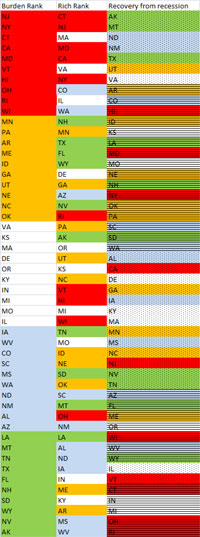
Nothing decisive, but interesting.
An Unstimulated Recovery
Having just read promises of impending economic recovery, readers may have a common question in response to news about the implementation of the "stimulus" program:
THE STATE HAD SPENT $254.2 million of the $1.1 billion [promised to Rhode Island] as of July 24, according to data released by the state Office of Economic Recovery & Reinvestment. Close to $207 million — more than 80 percent — has gone to help plug budget holes, although $31 million was used to increase unemployment benefits and another $5.6 million was spent to expand food stamp access.
Which URI Economics Professor Len Lardaro reinforces as follows:
"I will say, not that the stimulus is perfect, but the fact that there is so much criticism is because the economy is doing so much better. We can afford to gripe," he said.
So, if only $10.6 million has gone toward projects that do more than plug budget gaps and mitigate the experience of the unemployed, and yet the economy is recovering, why do we have to spend the millions and billions of taxpayer dollars still in the pool? One begins to suspect a scam:
Andres Carbacho-Burgos, an economist at Moody's Economy.com, notes that Rhode Island so far has received more stimulus dollars per capita than any other state, save Alaska.There was no immediate impact on job growth, he says. But hundreds of jobs were saved as cash-strapped schools and state and local governments used stimulus funds to plug budget holes that would have caused widespread layoffs.
The government has done little more, it would seem, than redistribute wealth from the private economy — present and future — to government workers. Sure, we know you're hurting, they say, but be encouraged about how healthy we are!
The political gamesmanship from RI Democrats, of course, is to blame Governor Carcieri for failing to spend the money more rapidly, but that is the nature of government. If he'd dumped $1.1 billion on the stairs of the State House and the corruptocrats who loiter in the shadows, there, had soaked it all up, the Democrats would be pointing to him when it came time for reckoning.
Look, if you pour money into the machine of the economy, it's going to run for a bit. Not efficiently. Not in a self-refueling way. But it'll run. That doesn't change the fact that government spending is minimally stimulative, slow, and prone to fraud. The slower it is, the less stimulative it will be, and the faster it is, the more prone to fraud it will be. Moreover, it can do no more, for this inefficient and wasteful effort, than steal money from other parts of the economy, including the economy of decades to come.
August 9, 2009
Recovering Backwards
To the extent that believing in economic recovery precipitates it, it is arguably a good thing for the Providence Journal to splash the headline, "Economic rebound seen as job losses drop in July," over a story from the New York Times. On the other hand, the whiff of dishonesty to the project may prove more powerful than the cheerleading:
Employers eliminated 247,000 jobs in July, a huge number by the standards of an ordinary recession, but the smallest monthly loss since last August, the Bureau of Labor Statistics reported. And the unemployment rate, rising for months, actually ticked down, to 9.4 percent from 9.5 percent in June, mainly because so many people dropped out of the hunt for work, ceasing to list themselves as unemployed.
One must read way down (thumb through the pages in the print edition) to read the obsidian lining elaborated:
Thousands of others are giving up. More than 400,000 who had been looking for work dropped out of the labor force in July, not even bothering to tell government pollsters that they would accept a job, part time or full time, if one came their way. ...A broader measure of the nation’s unemployment, which includes people too discouraged to look for work or forced to work only part time, slipped to 16.3 percent from its peak of 16.5 percent in June.
If the slowing decreases continue and the economy turns the corner in the near future, then people will likely infer that it just happens this way. If the recession continues beyond expectations, readers will have more evidence that the news industry is less interested in information than in promotion, in this case of the American president who made the haughty claim that his administration "rescued our economy from catastrophe."
It would seem that circumstances are already pretty catastrophic for the 400,000 who just gave up looking for work during a one-month span.
August 4, 2009
Gimme Back My Clunker
My first car cost me $700, which I just barely managed to scrape together back in the early-mid '90s. The purchase price of my 1975 Oldsmobile 98 included an adapter to play tapes in the in-dash eight-track player. Whenever my inexpensive patches gave way, the beast would roar like a Harley through its rotting exhaust pipe, and I'd periodically find myself without amenities like power steering. But the fixes were inexpensive and easily rigged, and the car kept me mobile for the first of my two years as a college drop-out. Without it, I'd have been unable to commute from my shared five-room apartment to my two part-time jobs — one making about $5.50 per hour at a record store and the other making a princely $7.00 per hour selling fish off a truck on a suburban New Jersey street corner.
There was something about those old cars — almost as if they had souls. Whether they were killers, like Steven King's Christine, or cute pals, like Herbie the Love Bug, it was easy to imagine sentience in a way that modern vehicles don't as readily permit. They were substantial; cars weren't yet throw-away commodities.
None of which should imply that I wasn't thrilled to trade in the 98 for a fresh-from-the-factory Pontiac Grand Am GT that made me, as a teenager with no prospects, feel a little more substantial. The dealer gave me $150, so my year's worth of transportation wound up costing less than two months of my subsequent car payments.
Of course, if the year had been 2009 instead of 1995, Uncle Sam might have given me $4,500, more than a 500% profit on my one-year investment, on top of the year of mobility. As wrangling over additional funding for the Cash for Clunkers program continues, those of us who put in time driving cheap cars to small-time jobs might wonder whether the architects of this bit of "stimulus" considered the personal economic equations of the poorly paid. The difficulty of finding passable three-figure vehicles will probably prove proportional to the duration of government giveaways, and some folks might decide that it just isn't worthwhile to work at all.
July 30, 2009
Going Once, Going Twice...
Purely by coincidence, I read this prediction by commenter "doughboys"...
'Exit from American investments' is poorly phrased Justin. When the Chinese will not buy American at this fall's debt auction (approximately 2 trillion dollars worth will be auctioned off) they will be swapping the $1.5 trillion US dollars they now hold for other assets before the value of the dollar falls like a rock. They will buy copper, gold, steel etc.When China exits the Treasury auctions the Fed will step in and 'monetize' the debt by printing dollars to buy debt inflation will accelerate certainly beyond anything seen in US history because countries and companies/banks will rush to spend all the dollars they have been sitting on since 'the big print' started last fall (the Fed has printed and loaned some $14 trillion since then). Inflation has not appeared since the money has not been 'spent' (see PPI) in the traditional sense) yet.
When you reach into your wallet to pay for a small pizza in the near future pulling out a $100 bill and the driver looks perturbed because you haven't tipped him remember this post.
... just prior to reading this news report regarding the U.S. Treasury:
The U.S. Treasury sold $39 billion in five-year debt Wednesday in an auction that drew poor demand, raising worries over the cost of financing the government's burgeoning budget deficit.It was the second lackluster showing in as many days, convincing analysts that the stellar results of debt auctions just a few weeks ago were a fluke and that Thursday's $28 billion seven-year offering could suffer a similar fate.
Under the weight of the ballooning deficit, the government has raised auction volumes and analysts now wonder whether the strain on the market is showing.
"Obviously everyone is inferring that tomorrow's won't be good either," said James Combias, head of government bond trading at Mizuho Securities USA in New York. "Maybe you will see more interest tomorrow but I think the increase in the auctions and the size of them may be starting to have an effect. These are very large auctions."
Demand for the five-year notes was below average, measured by the bid-to-cover ratio of 1.92, the lowest in almost a year.
Perhaps it would be prudent to finally learn how to make fire by rubbing two sticks together.
July 28, 2009
Do the Chinese Buy the Spin?
The administration likely offered something more concrete to the Chinese, during its groveling session, than we ordinary citizens apparently deserve:
Among the officials meeting with Chinese representatives Monday, the first day of two-day talks, were Treasury Secretary Timothy Geithner, Federal Reserve Chairman Ben Bernanke, National Economic Council Director Lawrence Summers and Peter Orszag, Obama's budget director.U.S. officials told reporters that the U.S. side stressed to the Chinese that the United States has a plan to bring the deficit down once the economic crisis has been resolved. Officials said Bernanke discussed the Fed's exit strategy from the current period of extraordinary monetary easing.
If U.S. officials offered only the vague scams that have constituted their public statements, then we can expect the Chinese to accelerate their exit strategy from American investments. Although, it's hard not to wonder whether it mightn't be to the nation's long-term good were the Chinese to turn off the spigot by which our government has tapped future generations.
July 20, 2009
Economy as Political Card
Noting a New York Post article on Washington's spending bonanza, Glenn Reynolds writes:
And yet members of Congress would be hard-pressed to tell you where the money's going. This isn't just undisciplined spending. It's looting.
I'd like to know whether the culprits will face a consequence for the travesty beyond their names' being footnotes in an historical tale of iniquity. Not that their focus is on anything beyond the near-term pillaging. Glenn also links to this report that's difficult not to see as pretty much the very same story:
The administration's annual midsummer budget update is sure to show higher deficits and unemployment and slower growth than projected in President Barack Obama's budget in February and update in May, and that could complicate his efforts to get his signature health care and global-warming proposals through Congress.The release of the update - usually scheduled for mid-July - has been put off until the middle of next month, giving rise to speculation the White House is delaying the bad news at least until Congress leaves town on its August 7 summer recess.
The administration is pressing for votes before then on its $1 trillion health care initiative, which lawmakers are arguing over how to finance.
Can't have the people panicking until after their representatives have already committed them to a devastating expansion of federal power.
July 19, 2009
Missing Something in the Battle Over Bucks
Perhaps somebody can explain what I'm missing in this:
Merchants across the nation, from powerhouses like Wal-Mart and Home Depot, to gas stations, mom-and-pop restaurants and 7-Eleven, have spent years unsuccessfully fighting the biggest of these costs, known as an interchange fee, which generates an estimated $40 billion to $50 billion in income annually for banks that issue credit cards.But after Congress passed a law last month to protect consumers from excessive fees and interest on credit cards, merchants are mounting a fresh offensive.
This time, they believe the momentum in Washington has turned in their favor. Legislation is winding its way through Congress, a government audit has been ordered and petitions are surfacing in hundreds of convenience stores, including Ms. Orzano's 7-Eleven, encouraging customers to voice their opposition to the fees. "Congress sort of already illustrated the willingness to take on the credit card companies and the big banks," said Keith Jones, a lobbyist for 7-Eleven. "We just feel like the job is half done."
In a nutshell, just under 2% of every credit card purchase is divided unequally among the merchant's bank, the customer's bank, and the credit card issuer (Visa, Mastercard, Amex, etc.). With customers using credit cards more extensively, greater percentages of stores' total sales are going to the card issuers, so the stores are hoping the federal government will redirect the money back to them.
Here's my question: Is there some reason that the stores don't simply tack a fee on sales completed with credit? That $1.50 coffee would therefore cost $1.53, with the explanation being that three cents is the cost of using credit. If stores such as WalMart and Target can work together to petition the government, they should be able to agree to this practice, and banks would surely decrease their take to an amount that preserves the incentive for customers to whip out their cards.
July 18, 2009
We're not Laffing - Rhode Island's ALEC/Laffer Index
Justin notes the state's latest unemployment figure. Rhode Island now has the second highest unemployment rate in the nation.
A Providence Bus News article posted July 8 suggests a major contributing factor in the form of other dubious rankings, which together mean that
Rhode Island’s economic outlook ranked 48th among states in a new study from the American Legislative Exchange Council, which said the state’s ranking suffered because of what it characterized as high income and property taxes and an estate tax.
It ain't the neighborhood.
The second annual Rich States, Poor States: ALEC-Laffer State Economic Competitiveness Index ranked Massachusetts 26th and Connecticut 32nd.
It is
15 “variables,” including top marginal personal income tax rate (7 percent, ranked 33rd), top marginal corporate income tax rate (9 percent, ranked 39th), property tax burden ($48.62 per $1,000 of personal income, ranked 46th).
Plus the state's minimum wage. The state not being right to work (50th - yikes). And throw in the state's liability system (tort litigation, judicial impartiality,etc.) - 39th - for good measure.
There were two bits of good news; we should note with applause that one was the General Assembly's discipline in precluding any form of the Economic Death and Dismemberment Act last ... er, this session.
the study gives the state good marks for a relatively low sales tax burden and moderately low workers compensation costs.
Overall, however, the ALEC/Laffer index of Rhode Island [PDF] paints a very unpleasant picture of our economic condition.
Analyzing a little deeper now to determine the cause of this condition, we turn to remarks made Wednesday by Rep Tim Williamson (D-West Warwick) on the Dan Yorke Show.
If you look at our state, you look at the western corrider, you look at the East Bay. Their issues are not the same as my issues issues in West Warwick.
Au contraire, mon frere. The ALEC/Laffer index is only the latest in a long list of analyses confirming that the entire state now suffers the considerable ill effects of a controlling party whose members too often cast votes out of misguided sympathy or to advance a self interest instead of the best interest of the state by ... oh, for example, legislating an economic climate that would attract rather than repulse those pesky entities which hire, employ, hand out paychecks, pay taxes - what are they called now? Oh, yeah. Businesses.
July 15, 2009
The Depression Is Coming! The Depression Is Coming!
It really is astonishing. With the economy flailing and the trends in job losses disappointing even the whiz kids of the Obama administration, despite its having whipped out the "stimulus" credit card, with "cap and trade" energy policy seeking to raise the cost of doing business (and of simply living), the Democrats are hitting the accelerator pedal on their hybrid healthcare suicide car:
The liberal-leaning plan lacked figures on total costs, but a House Democratic aide said the total bill would add up to about $1.5 trillion over 10 years. The aide spoke on condition of anonymity to discuss the private calculations. Most of the bill's costs come in the last five years after the 2012 presidential election.The legislation calls for a 5.4 percent tax increase on individuals making more than $1 million a year, with a gradual tax beginning at $280,000 for individuals. Employers who don't provide coverage would be hit with a penalty equal to 8 percent of workers' wages with an exemption for small businesses. Individuals who decline an offer of affordable coverage would pay 2.5 percent of their incomes as a penalty, up to the average cost of a health insurance plan.
Pay down. Employment down. Prices up.
Note that admission that the legislation's cost structure attempts to move the bill past the next presidential election. Consider also that the bulk of the stimulus money is scheduled for dispersal next year — an election year. One doesn't have to be partisan to wonder whether economic hardship and civic anxiety are being tolerated in the service of a planned political script. A few eggs must be broken, after all, in order for the Left to make the governmental omelet that the country doesn't yet know it needs.
July 14, 2009
An Image and a Corrective on Healthcare and the Economy
Ben Stein presents an excellent image:
True, by many metrics, the economy has stopped falling drastically, but we are still in a painful recession, large by postwar standards. The bank crises seem to have abated for now and Wall Street is paying itself fantastically well again, thank heavens, after being rescued with taxpayer money. But housing is still extremely weak, profits are miserable and, most important, far too many Americans are unemployed — roughly 9.5 percent, by the latest data.Just as basic, far too many Americans are living in fear.
What is President Obama doing about it? Perhaps too much. And, possibly, his efforts are too diffuse. When I think about the economy I think about a plump man who has just been hit by a truck while crossing a street and is in severely critical condition with internal bleeding. Instead of just stabilizing his hemorrhaging, the doctor decides that while the patient is unconscious, he might as well also do a face lift, some coronary bypasses and a stomach-stapling to keep him from gaining weight while he is recovering (if he does recover). After all, a crisis is not to be wasted.
The problem is that all these ambitious operations create too much of a burden for the human body to bear.
It's an old truism that one shouldn't go grocery shopping while hungry. Similarly, one shouldn't make dramatic financial decisions while panicked about paying a surprise bill. With the amped up call for extreme healthcare changes to be pushed through Congress with a minimum of deliberation, one can't help but wonder what makes the matter so dire that it must be forced through Congress in the distracted days of summer immediately before a recess. Are masses dying in the street for lack of a "public option"? It isn't unreasonable to suggest that such an outcome is much more likely if unemployment continues to mount — especially if new healthcare requirements increase the cost of employment for employers.
No, in theory, the urgency derives from a series of jumbled abstractions:
"The status quo on health care is no longer an option for the United States of America," the president said. "This is no longer a problem we can wait to fix. This is about who we are as a country. Health care reform is about every family's health, but it's also about the health of the economy."
In actuality, the urgency derives from a political necessity to rope Americans into a framework of dependency on government while we're susceptible to panic, under the thrall of a charismatic political celebrity, and as yet unable to assert regained senses through an electoral correction.
July 7, 2009
If at First You Don't Succeed, Spend, Spend Again
An economy is like water: It can't expand unless it has somewhere to go, artificially adding more volume will only cause a limited and temporary upward surge, and the extra must be taken from somewhere else. This is the image that came to mind in response to our Senators' suggestions that the nation might need another stimulus package:
"The only way we're going to get the economy out of the slump is to get people back to work and to stabilize housing values," Reed said in an interview with MSNBC. "I don't think we should rule out a second stimulus package."
The strategy on which Reed and Whitehouse wish to double down is to continue adding volume to the economy in the hopes that it will overflow some barrier currently preventing new streams. The problems with chasing that remote possibility are that it floods the extra into an area of the economy that's pretty well bounded and takes money out of the economy where it can be most productive (eroding soft dams by investment and innovation, one might say).
The move might be advisable if there were clear consensus that the economy is on the cusp of a new field into which to flow — another Internet about to be created, new frontiers to be populated — but that is not currently the case. (Green ain't it.) Improving roads and other such infrastructure repairs will keep a handful of workers occupied, but when the funding evaporates, so will the jobs.
What Rhode Island's Senators ought to be declaring — what all leaders ought to be declaring — is the need to pull down those barriers that governments of every tier have erected.
June 12, 2009
"We're From the Government and We're Here to Help"
James Poulus observes:
I’ve said elsewhere that our vision of politics is being corrupted by a well-meaning but misguided epistemology of compassion: increasingly, we consider the person or group demanding a right to be the most trustworthy source of information about whether they deserve it. Anyone aggrieved, we think, must really be suffering grief, and since suffering is the worst thing and cruel is the worst we can be, justice is served when the law — that is, judges — fast-track the claims of the aggrieved and grant them instant — that is, legislature-circumventing — relief.This leads into an observation by Keith Hennessey on private industry competing with government (ie; as proposed in the proposed health care reform):This is pretty transparently a medical way of viewing social relations. But our big medical brains are wired into big therapeutic hearts. And so what is happening in ‘politics’, which is actually the evacuation of politics by law on the one hand and desire on the other, is happening in medicine itself.
I think that government cannot compete on a level playing field with the private sector. Government always has advantages because of its sovereign power. I also think that in most markets there is a range of private health insurance plans competing for business, and so the addition of one more plan is not worth the downsides of government involvement. (I believe that competition is flawed because for most people their employer shops for health plans. I prefer a system in which individuals are shopping for health plans.)In other words, when government is involved--whether as a service provider itself or with a vested interest in particular entities within a given business sector--private companies without government help are at a disadvantage. Yet, some may welcome government intervention, according to Poulos:The government cannot compete on a level playing field with private firms:
* Fannie Mae and Freddie Mac had competitive advantages relative to their purely private counterparts. They leveraged those advantages to the gain of their management and shareholders until they collapsed and jeopardized the entire financial system.
* Ford Motor Company was not bailed out. It is now disadvantaged relative to GM and Chrysler, which benefited from government oversight, funding, and effective rewriting of bankruptcy rules.
* Government-provided terrorism reinsurance is preventing private reinsurance from returning to the marketplace.
* Most physician- and hospital-reimbursement structures are based on the methodologies of the largest payor in the market, Medicare.
* Government-run direct student loans are now crowding out the guaranteed student loan program, in which private banks and financing firms offer loans. The government advantage comes from control over small details of the program that give direct loans a competitive advantage.The ultimate fear of having a government-run “public” option is that it will crowd out private health insurance, and that ultimately most Americans will be getting their insurance from the government.
Big Pharma has a vested interest in comprehensive government regulation, too, you know — the better to squeeze out competition, get institutionalized with an unkillable monster of market share, and permanently hedge, by way of unremittant lobbying and revolving-doorism, against market risk or corporate accountability.What both illustrate is that the while government doesn't always actively pick winners, its insertion into markets results in preferred policies and "suggestions" that ultimately lead to losers: Either businesses that don't benefit from government largesse (Ford) or consumers who are affected as services are adjusted to comport with the new business model.
June 5, 2009
An Interesting Convergence of Issues
This story confounds categorization:
Eastern District of Michigan judge Lawrence P. Zatkoff handed down the decision, in a case involving an alleged violation of the constitutional separation of church and state. The issue is whether a government-owned company, AIG, can market sharia-compliant insurance products. (To be sharia-compliant, an investment vehicle must be created and structured in ways that do not violate Islamic law.) In a well-reasoned and cogently argued opinion, Judge Zatkoff refused to dismiss the case prior to factual discovery. ...The problem with all of this public largesse is that AIG sponsors, pays for, and aggressively markets sharia-compliant insurance products. The practice of sharia finance has created lucrative advisory positions for often radical imams, who get paid to guarantee the religious "purity" of sharia-compliant products. Such vehicles typically follow the Muslim principle of zakat and donate a slice of their profits to charity. Unfortunately, many of the charities receiving these funds have links to terrorism. Mr. Murray objects to his funds' being used to legitimate and promote sharia law, when that is the same law that calls for jihad. For that matter, sharia allows Saudis, Iranians, Sudanese, Somalis, Afghans, Taliban members, and other adherents to justify the following: the execution of apostates who decide to abandon the faith; the criminalizing of "Islamophobic blasphemy"; the punishment of petty crimes with amputations, floggings and stonings; and the repression of “non-believers” from practicing their respective religions freely and openly.
On one hand, a private business should be able to develop, operate, and market whatever products it likes (provided doing so does not directly support our nation's enemies). On the other hand, AIG is not alone, now, in being a not-so-private company, and the government ought not be in the position of financing the adherence to religious law. It's a precarious balance, and the conceit of mere mortals to maintain it is apt to become hamartia.
Herman Melville functions out of context here:
So, when on one side you hoist in Locke's head, you go over that way; but now, on the other side, hoist in Kant's and you come back again; but in very poor plight. Thus, some minds for ever keep trimming boat. Oh, ye foolish! Throw all these thunder-heads overboard, and then you will float light and right.
Starboard side, we carry the notion that the government should not interfere with freedoms of association and religion. Port side, we've now hung the principle that the government can become a controlling investor in industry. Express no surprise when when find the deck taking on water.
May 12, 2009
RE: Can You Imagine Doing This at Home
Justin beat me to the punch, but here's the link to the AP story he mentioned about the budget deficit. More:
The new record deficit this year -- driven by the federal government's efforts at bailing out financial institutions and automakers, the $787-billion economic stimulus act that Congress approved one month into Obama's term and slumping federal tax revenue -- will amount to 12.9% of the nation's Gross Domestic Product...."The deficits ... are driven in large part by the economic crisis inherited by this administration," budget director Peter Orszag wrote in a blog entry on Monday.Aahhhh....inherited..."It's not our fault!" Hm. Perhaps this will lend perspective on the "inheritance".

Yes, the above graph has been around for a while, but it's a useful reminder that:
1) We're engaging in way more deficit spending than ever before, and plan on continuing because...
2) The projected numbers escalate even after the current economic crisis is "solved" by the Obama Administration.
May 9, 2009
UPDATED: "A brazen new era of government"
Dave Cribbin, quoted in yesterday's WSJ:
In the Chrysler deal, the [United Auto Workers] were unsecured creditors and the Chrysler bondholders were secured creditors. The bondholders received 28% of the value of their $6.9 billion in bonds in cash; the Union will receive stock worth approximately $4.2 billion, and a note for an additional $4.58 billion, which represents 82% of the value of their claim. Either the government negotiators have dyslexia and have made a terrible mistake in their paperwork, or this is political payoff writ large. Is this not the equivalent of financial waterboarding? And thus we enter a brazen new era of government, when the White House is openly complicit in the theft of, as a matter of fact is directing, the looting of private property from investors. Welcome to the Rule of Man, or as the President calls it, change we can believe in!
Which reminds us what Gerald Ford once said:
A government big enough to give you everything you want is a government big enough to take from you everything you have.
ADDENDUM
More:
Political risk is becoming a growing concern for investors in the United States as the government plays a larger and more controversial role in private enterprise because of the financial crisis.State intervention in economic affairs is always closely watched by investors for what it means for their decisions on where to allocate money, although this is usually more of a worry in emerging markets than in developed economies.
Political risk is becoming more of a U.S. issue as some investors howl over what they see as arbitrary intrusion by the government in business affairs...
Investors concerned that politics could hurt them may demand a risk premium before they buy stocks or bonds or do a business deal. That could make the U.S. less competitive and money might flow elsewhere.
"There is a much larger political risk premium on investing in the United States than there has been in years," said Sean West, an analyst at Eurasia Group, a research and consulting firm that studies political risks.
"What we're seeing now in the United States is much more like what we see in emerging markets, where the government either by choice or as a result of circumstance is in a position to decide which companies or banks survive and which ones don't," he said. "These were almost unthinkable risks a year ago."...
In assessing political risks in emerging markets, investors often look at factors such as the stability of the government and the soundness of its economic policies. In developed countries, they assess things such as proposed changes to the tax system and the resulting impact on corporate profits.
Risks in the United States include fears the dollar could dive because of the rapidly growing budget deficit and the potential for inflation because of radical moves by the Federal Reserve to flood the financial system with money.
But a bigger immediate concern, say risk experts, is that established rules governing businesses could be changed depending on the political winds...
The fear that rules can change midstream -- and contracts investors thought were valid are no longer seen as sacred -- can drive up risk premiums, experts say.
"Investors want to know what the rules are so they can determine whether opportunities are profitable or not," said Jaret Seiberg, a financial services policy analyst at brokerage firm Concept Capital.
All this in just over 100 days. Lovely.
ADDENDUM #2
Originally disclosed here, the bullies in the White House have won the day.
Welcome to the new United States where contracts mean what they say...unless the Obama administration decides otherwise.
Isn't this how banana republics are run?
May 7, 2009
Michael Morse's Budget Plan: What Civilians Can and Can't Do Budgetwise
Michael Morse has up a humorous post describing his personal household deficit reduction plan, but his intended point isn't quite clear. It's worth reading the whole thing for enjoyment, though, before making it a subject of discussion.
In some respects, he illustrates well the things that families actually do have to cut back, but that governments tend not to parallel:
... Wait staff in area restaurants will no longer receive the customary 15% tip, 8% will now be the norm. ...Charitable contributions will cease immediately. Also, all pets will be asked to leave. These pets will not be replaced until the current economic crisis passes.
But then, there appears to be a complaint about actions the government does take against public-sector employees:
All work performed at Morse's house will be subject to a 20% co-pay by the person doing the work. Plumbers, electricians and all other contract labor will adhere to these new cost saving measures until the economic crisis passes. This plan will save the Morse budget in two ways, the contractor will charge less for work performed because their co pay will also be less. Appliance repairmen with their gold-plated "service call" fees will no longer be tolerated, a set hourly fee will be paid.
Putting aside the odd use of the co-pay concept, the laugh comes from the fact that no contractors would accede to those demands. (Of course, when they really need work, they do drop their prices to the same effect.) Similarly, public sector workers are under no obligation to continue providing services that a government body requires.
And then, there are suggestions that are impossible for the individual family, but that would be very worrisome if the government were actually to attempt similar measures:
For example, Morse plans to stop paying co-pays for prescription drugs and doctors visits, and cutting his $100.00 emergency room payment in half with a projected annual savings of $2600.00. These fees are simply unsustainable. Supermarkets are being asked to lower their prices until this economic crisis passes, realizing an additional $1380.00 in annual savings.
When families feel the economic squeeze, they must do without, because they cannot suspend the laws of supply and demand. The government cannot perform that miracle either, although it does attempt to try more frequently than is healthy.
May 3, 2009
Paloozas All Around
I'll admit some jealousy.
Over the course of a year, Matt Allen built a brand new radio gig into the number 1 show in its slot. His previous experience had been limited to production and some periodic shows here and there on the schedule. For his show's one-year anniversary, his company threw him a big "Mattapalooza" party, replete with a cake, an office-produced video, and a parade of people offering much-deserved plaudits.
During an overlapping time period, with plenty of help from other carpenters, architects, engineers, and various subcontractors, I built this addition and renovated two-thirds of the existing house (two-thirds being equivalent to two-and-a-half to three times the size of my working class ranch):

My previous experience had been limited to small jobs and a couple of suburban basement finishes. As the project — and a hellacious year — neared completion, my reward was a series of insults from the boss and a substantial cut in my pay. (The insults, I suspect, were meant to cover the fact that, just a few months earlier, he'd promised quite the opposite change to my remuneration.)
These disparate outcomes were not the result of government regulations. Unionization did not play a role. To some extent, the cultures of the industries did; with the prominence of names and personality, the information and entertainment industry is more sensitive to the competition for proven quantities. Construction is more of a dirt-field bulldog game, with a culture of teeth-gritted tolerance for struggle (which somehow seems always to benefit the honchos financially).
But what it comes down to, it seems to me, is that some employers view talent as something to be nurtured and guarded, justifying periodic costs on an individual basis as investments in a long-term competitive advantage. Other employers view talent as something to be exploited for every immediate penny that it can generate, even if the wringing process drains the last ounces of drive from its vessel.
This comparison came to mind mainly as a starting point for ruminations about ways to make the system better... or worse. Public policy ought to encourage entrepreneurship, to be sure, but not everybody, indeed a likely minority, will have the interest or specialized knack to set out on their own. For those who wish mainly to apply their non-business skills in the workplace — which is to say, those who prefer to leave organizational processes to others — advantage is to be gained to the extent that they are (one) not tied to their current employers and (two) able to go elsewhere.
Regarding the first, it is understandable to lament the loss of those storied lifetime relationships between worker and organization. However, it isn't immediately obvious that employees benefited more from, say, promised pensions, than did employers who, by those promises, had less fear of attrition. The manacles of workplace-based healthcare are a stark example of the detriment: Why should somebody's boss hold in his hands the health of his crew's families?
Regarding the second, incentives for companies to grow ever bigger should be viewed with suspicion. Technology has done much to decrease the advantage of size — for example, by bringing the development and production of marketing materials increasingly within the capability range of neophytes. On the other hand, the new implied government insurance that companies gain by becoming "too big to fail" is certain to have repercussions that are not agreeable to workers. Especially in an environment in which businesses are developing global pools of potential workers, the fewer potential employers, the less leverage the workers will have. How much worse, too, would it be to give ultimate responsibility for the economy to a governing regime of so-called public servants?
The gathering consensus appears to be that we're heading for a time of willing dependency — a European-style socialist democracy that seeks to make guarantees to citizens of a certain standard of well-being. I maintain hope that Americans are not a people who will find the taste of such a life to be to their liking, but ultimately, Americans will have the system that they desire.
Whatever our decision, we should pause to reflect on the subtle, yet profound, significance of relations. Assistance given for family or for charity is a pleasure for the giver. Recognition of an employee, freely offered, is an opportunity. Better to be the recipient of these than to be the obligation of government functionaries or, more directly to the point, the ostensible beneficiary of mandates on one's employer. A person who is a mandated obligation is a burden to be minimized.
Reality is not such that we can each and every one of us expect paloozas in our own names, but our individual freedom and independence correlates with the value that we can place on our time. What we need, for our own fulfillment, is for those who would claim more of that time to realize that talent is more precious than money, even if their market values are the same.
April 27, 2009
There are no (retirement) Guarantees
In light of this story ("Auto Retirees Brace for Hardship"), Michael Barone observes:
Liberals like to argue that defined contribution pension plans, in which you and your employer contribute money and you invest it, don’t provide absolute protection, because you may invest the money foolishly or the whole market may go down. And they’re right. But it’s also true that a defined benefit pension plan, like those of Chrysler and General Motors, don’t provide absolute protection either. And one might add, as Megan McArdle does in a very wise blogpost, government pension plans don’t provide absolute protection either. Just read the recent stories about how CalPERS, America’s biggest public pension plan, long lauded for its sagacity, has lost oodles and oodles of money.McArdle makes the salient point that government pension funds aren't much better:
Er . . . look at the state of state pension funds. They're often worse, because the private pension funds (now) have the government to sit on them and make sure their assets bear at least a theoretical relationship to their eventual liabilities. The government is rather too inclined to cut itself slack on that necessity.That's for sure.
April 25, 2009
Bank of America, TARP, and Government in Crisis Mode
Among the problems of government central planning is that the segment of society that is apt to make decisions that skirt the rules is the same one that must enforce them. Take, for instance, information that's coming out as a result of Bank of America CEO Ken Lewis's testimony to New York Attorney General Andrew Cuomo. Lewis and the bank's board failed to fully inform shareholders of material circumstances during the run-up to the merger with Merrill Lynch, which is in violation of securities law.
Complicating matters is that government officials, prominently former Treasury Secretary Henry Paulson, appear to have forbid the transfer of that information.
"Everyone involved knew that was a clear violation, that's material non-public information, so basically we just closed the rule book during the crisis and said we don't care, we need to keep the lights on, and we'll deal with that manana," [portfolio manager Peter] Sorrentino said. "Logic went out the window and they were just acting out of fear," he said. It was "completely panic mode."
The shadow lengthens:
Lewis testified that he asked Federal Reserve Chairman Ben S. Bernanke to "put something in writing" regarding the U.S. government's plan to support Bank of America's acquisition in view of Merrill's mounting losses.After Bernanke said he would consider the idea, Paulson called Lewis and said, according to Lewis, "First it would be so watered down, it wouldn't be as strong as what we were going to say to you verbally, and secondly, this would be a disclosable event and we do not want a disclosable event."
Attached to Cuomo's letter Thursday was a Dec. 22 e-mail from Lewis to his board. "I just talked with Hank Paulson," the e-mail says. "He said that there was no way the Federal Reserve and the Treasury could send us a letter of any substance without public disclosure which, of course, we do not want."
Plainly and simply, public officials should not be making promises to private institutions concerning public money with the explicit instruction that the public shouldn't know. Much like the trend for all of the laws, debts, and obligations of lower levels of government to flow back toward the broadly diluting sea of the feds, as well as the financial recklessness resulting from the implicit backing of Fannie and Freddie loans, backroom deals will erode responsibility in the private sector, insulating its actors and solidifying an untouchable class that cuts across the two sectors. The line of conflict will shift from public vs. private to elite vs. everybody else.
April 24, 2009
More Kids, Now
David Goldman (aka "Spengler") writes in First Things:
After a $15 trillion reduction in asset values, Americans are now saving as much as they can. Of course, if everyone saves and no one spends, the economy shuts down, which is precisely what is happening. The trouble is not that aging baby boomers need to save. The problem is that the families with children who need to spend never were formed in sufficient numbers to sustain growth.Continue reading "More Kids, Now"In emphasizing the demographics, I do not mean to give Wall Street a free pass for prolonging the bubble. Without financial engineering, the crisis would have come sooner and in a milder form. But we would have been just as poor in consequence. The origin of the crisis is demographic, and its solution can only be demographic.
April 22, 2009
Imposed "Responsibility" Is Just Coercion
It's disorienting to hear folks who follow politics for a living take speeches as sincere explanations of politicians' hopes and intentions. One would expect, as a case in point, David Brooks to understand the dangerous undercurrents of a speech by President Obama that Brooks describes as "a small masterpiece" of "explication."
His view was clear. The market is dynamic and important, but it makes people reckless, parochial and dangerously shortsighted. The market needs adult supervision — a leadership class made up of people who appreciate the market but who also have committed themselves to public service, and who therefore take the long view and are more conscious of the public good.Obama is building this new leadership class. His administration has become a domestic I.M.F., consisting of teams of experts who can swoop in and provide long-term solutions when systems — finance, housing, health care, education, autos — have broken down.
When the members of this new establishment are confronted with a broken system — whether it involves hospitals, energy, air pollution or cars — their approach is the same. They aim to restructure incentives in order to channel the animal drives of the marketplace in responsible directions.
Brooks does put forward two significant objections, but they're easily rebuffed. The first is that this "leadership class" might fail, to which the plain response would be, essentially, that the current system has failed and that the administration feels a moral obligation to try to right it. The second is that Obama's spending spree does not exemplify the responsibility and "hard choices" that he wishes to impose on others, ranging from passivity to Congress's worsening of his proposals to the attempt to do all things at once to his recent "cynical Potemkin cuts." But the simple answers to this are that America's problems are deep, requiring the large dollar amounts to stabilize, and that an administration can only work within its context and must cooperate with coequal government branches.
The way I see it, there are only two possibilities that join the president's Georgetown speech and his actions. His words could be cynical political rhetoric intended to obscure for citizens the differences between his approach and that of his opposition. That, after all, is how he got himself elected: by convincing everybody that he was going to govern the way that they wanted, even if each preference was incompatible with the other.
The other possibility is that Obama is sincere, in which case raising the specter of fascism is not unreasonable. The emergence of "planners" and (being human) their inevitable failure are milestones on the road to serfdom. Indeed, this leveraging of a market system for the government's use in serving the "public good" is the central theme of Jonah Goldberg's Liberal Fascism.
To repeat my suggestion at the Providence tea party, if we aren't free to take risks, we aren't free. If the government can "swoop in" and save us, then our eyes will always look first to the dark shadow circling around us. Moreover, the rest of our society isn't free if it is obligated to pay for insuring others' risks, whether those others are businesspeople or public officials who, by corruption or incompetence, find themselves with failures to cover up and all the tools of government to apply toward that effort.
April 21, 2009
Tea Parties and Public Choice Theory
Put your wonk hat on. Economists Brian Wesbury and Robert Stein write:
While the theory of public choice can be broadly applied, it is the ideas of "special interests" and "rational ignorance" that are useful in understanding last week's tea parties.It also explains why we Rhode Islanders seem so apathetic when it comes to giving Joey Downthestreet a little more cake. Not for nothin', but it ain't really a big deal. At least for a while. Oh, and incidentally:Here's an example of public choice at work. Let's say teachers could benefit by $2,000 each per year (in higher pay or benefits, smaller classes, etc.) from a piece of legislation currently under debate. But the cost per taxpayer averages just $15 per year.
The "special interests" (teachers and politicians) have substantial personal incentive to see that the bill is passed. Teachers, who benefit directly, will use time and money to lobby for the bill. And lawmakers will expect campaign contributions, votes or both, in exchange for their support.
But the taxpayer will remain "rationally ignorant" of the whole process. Why spend time even thinking about an issue when the cost is only $15 per year?
....This is why government will tend to grow in excess of what a true democracy really wants. At least, it will grow until those $15 hits accumulate to such a level that people have finally had enough, and in a seemingly spontaneous eruption, the average voter finds the energy to fight back.
Apparently, this is what happened last week.
Here is an interesting set of facts. If the government increased the top tax rate from the current rate of 35% to 100% (yes, that's right 100%), it would only collect an extra $400 billion this year. In other words, confiscating all the income that is currently taxed at 35% would not raise enough revenue to cover any of the annual deficits projected in the next 10 years. There is no way that tax hikes on the rich alone can pay for proposed spending in the current budget.
About the Economic Knowledge of the Public...
Michael Barone writes, "Many of the sneering comments about the participants in last week’s hundreds of tea parties across the nation were premised on the idea that these people didn’t know much about public policy." (Sounds familiar). However, as Barone mentions, a Pew Research poll conducted at the end of March (you can take the related quiz here) "finds the American public reasonably well-informed about a number of basic facts pertaining to the current economic situation." Further, a new Rasmussen poll shows that 52% of Americans are worried that the government is getting too involved in the economy. This tracks closely with the results of another Rasmussen poll showing that 51% of Americans viewed the Tea Party protests favorably. That puts this slight majority at odds with the "Political Class" polled by Rasmussen:
[J]ust 13% of the political elite offered even a somewhat favorable assessment while 81% said the opposite. Among the Political Class, not a single survey respondent said they had a Very Favorable opinion of the events while 60% shared a Very Unfavorable assessment.Then there's this:
Most Americans trust the judgment of the public more than political leaders, view the federal government as a special interest group and believe that big business and big government work together against the interests of investors and consumers. Only seven percent (7%) share the opposite view and can be considered part of the Political Class.So, according to these polls, the tea parties were supported and attended by a basically bi-partisan, well-informed and populist crowd. Yikes!On many issues, there is a bigger gap between the Political Class and Mainstream Americans than between Mainstream Republicans and Mainstream Democrats. That was true on the tea parties, but Mainstream Republicans do express a more positive view of the protests than Mainstream Democrats. Still, a majority (54%) of Mainstream Democrats had a favorable opinion of the tea parties.
April 18, 2009
Giving Whitehouse an Easy Go
Although Arlene Violet subsequently whacked him with a great question about using stimulus money to suppress changes to teachers' healthcare benefits, I'm very disappointed that the Newsmakers gang let Sen. Sheldon Whitehouse ramble on with this partisan mumbo-jumbo for three minutes:
I think it's sort of an ironic moment on this subject, and particularly to the extent that the tea party was orchestrated through the Republican Party and its organizations, because here we are in a bleak recession, which is the one time when economists agree that federal spending is really important, even when you have to borrow to spend, because families are contracting their budgets, businesses are contracting their budgets, states and municipalities are contracting their budgets, and so the whole economy contracts and collapses unless the federal government can engage in what they call "countercyclical spending" to moderate the downturn. So, this is the one time when it really makes sense.When George Bush took office, we were headed for being a debt-free nation now. The non-partisan Congressional Budget Office took a look at where the budget was when President Clinton left it, and we were in surplus, and we were headed for debt-free, and in eight years, George Bush changed that, nine trillion now, 8.9 trillion, to be specific, and that was fair-weather times. That was money for everybody. That was Wall Street on a roll, and he spent that 8.9 trillion on things like a war in Iraq and letting Wall Streeters rake in billions of dollars and get their taxes reduced while they were doing that.
So, there's a kind of sad irony in, now that we need it, people becoming so upset about the federal spending when nobody really paid attention to it, and there weren't tea parties going on when George Bush was running up $9 trillion in debt to give tax breaks to Wall Street millionaires.
First of all, the Republican Party did not "orchestrate" the tea parties. Watch, for evidence, big-spending Republicans being booed at them across the country.
On the financial points, what is Whitehouse talking about with that $8.9 trillion? The total national debt now stands at $11.1 trillion (PDF). When President Bush left office, it was $10.6 trillion (PDF). But when Bush took office, it was $5.7 trillion.
It risks a fatal tangent, but it's worth noting that this number includes intragovernmental holdings, most notably the infamous Social Security IOUs. Such internal borrowing is not typically included in annual deficit numbers. In a sense, the government owes this money in promised services, but there aren't lenders with bills for eventual payment. Excluding this total, the debt under Bush grew from $3.4 trillion (9/29/00) to $5.8 trillion (9/29/08).
Whether we count the increase in the debt as $4.9 trillion or $2.4 trillion, it's still too much — anything above zero is too much — but it simply isn't true that the federal government under President Bush ran up "$9 trillion in debt." It's a lie. And it doesn't take into account the fact that about half of the increase — by either measure — occurred during the two of Bush's eight years during which Democrats controlled Congress, which controls the federal purse.
Moving on to Whitehouse's assertion of Wall Street's being on "a roll" during the Bush presidency enables a nice return to the notion of that "countercyclical spending" of which he's so fond. In actuality, the DOW dipped about 2,000 points around the time of 9/11, recovered some, and then spent much of 2H02 and 1H03 even lower. According to the federal Bureau of Economic Analysis, private domestic investment dipped from 2001 through 2003. During and beyond this period, government revenues plummeted.
Bush and the Republican Congress increased outlays at the outset of this downturn and held them reasonably steady as a percentage of GDP. (The fiscal conservative in me, though, is still inclined to complain that outlays went up steadily in absolute terms no matter the economic situation, PDF.) Then the economy improved. Consequently, the deficits under Bush show a U pattern, maxing out in 2004 and then heading back toward zero, until the recession began to really sink in in 2008.
An inconceivable number of factors come into play, here, but the point is that, if you buy Senator Whitehouse's economic excuse for the Obama-Dem spending spree (which I don't), the Bush years would have to count as a prime example of mitigating recessions through government spending. This intellectual necessity is evidenced most strongly in the fact that the dot-com bust, an unprecedented terrorist attack in the U.S. financial core, and years of war did not prevent those years from being such that Whitehouse speaks so glowingly of the economy, then.
Even so, in the graphic shown at that last link, the jaw-dropping difference between the Bush deficits and those projected for Obama and beyond makes so much mumbling of Whitehouse's chatter. The Congressional Budget Office expects most of the next decade to have annual deficits that more than double Bush's worst year.
It's understandable that the journalists wouldn't have had the information at hand to rebut the Senator's talking-points nonsense on air, but Whitehouse was sufficiently brazen that they should have recognized a need for him to explain his numbers. Maybe an inevitable stumble or two would have at least given viewers a sense that he wasn't rolling through economic gospel truth.
April 15, 2009
A Wild and Unwieldy Beast
We must keep in mind, of course, that economic recoveries occur in fits and starts, and that factors of timing and non-economic events play a role in the month-to-month numbers, but we also shouldn't gainsay the possibility that disappointing results may in part reflect a lack of confidence that has been a byproduct of the declaration that only government can save our ailing economy:
The recession is easing? Not so fast. An unexpected drop in sales of just about everything from cars to clothes sent a sobering message Tuesday: The economy is still vulnerable.That cautionary guidance was seconded by President Barack Obama and Federal Reserve Chairman Ben Bernanke, though they had encouraging words as well. Bernanke spoke of "tentative signs" that at least the economy is declining more slowly, and Obama repeated his recent analysis that he sees "glimmers of hope."
With Americans still losing jobs by the thousands, a major fear is that people will cut back even further on their spending, and that could plunge the economy into a sharper tailspin.
It's not just that people are worried for their own jobs. It could also be that they aren't sold on the idea of trillion-dollar deficits and stultifying bureaucratic control.
April 4, 2009
Well, That Settles It; Tax the Rich
My fellow right-wingers, I suppose we must rearrange our thinking. The governor of New York has spoken with some rich people, and they have assured him that they will not leave the state as a result. Clearly, taxation has no effect on the domestic decisions that wealthy families make.
I apologize if there's a nagging something — a poor choice of words, perhaps — that leaves me unable to disregard my prior suspicions entirely:
On Thursday, Mr. Paterson said his views on this matter had not changed. But fiscal and political realities had. And thus he yielded to fellow Democrats who insisted on raising the tax rate for the state's highest earners — up to 8.97 percent for those making $500,000 or more.So if we correctly understood past warnings from the governor and the mayor, we should soon witness a mass exodus of the wealthy to other states, right? Well, maybe not quite, Mr. Paterson told reporters after his speech. He had spoken with rich people. "A lot of them said they're going to stay," he said, and "ride out this storm."
"Riding out a storm" is something that one does when the storm is expected to pass. The implementation of permanent principles of higher taxation are quite another matter, and New York should not be surprised if its unnamed fat cats renege on their pledge and quietly shift their full-year residencies elsewhere.
(via RI Future)
March 30, 2009
Our Best Minds Must Be in Government
Yeah, we could discuss the rights of a governing entity that is spending billions of dollars to prop up a specific company, but that would slide past the real question of political philosophy that makes this such a frightening proposition, no matter which step we highlight as the one in the wrong direction:
The Obama administration asked Rick Wagoner, the chairman and CEO of General Motors, to step down and he agreed, a White House official said.On Monday, President Barack Obama is to unveil his plans for the auto industry, including a response to a request for additional funds by GM and Chrysler. The plan is based on recommendations from the Presidential Task Force on the Auto Industry, headed by the Treasury Department.
It is nearly irrelevant whether Wagoner deserves to lose his job (the answer being pretty self evident, if you ask me). The critical first principle requires an explanation of why it can be supposed that a handful of brains on a Presidential Task Force can be expected to step into a gigantic, ailing industry and prescribe the appropriate steps to save it:
Industry sources had said the White House planned very tough medicine in Monday's announcement, which turned out to be an understatement. And it went to the very top. The measures to be imposed by the government will have a dramatic effect on workers, unions, suppliers, bondholders, shareholders, retirees and the communities where plants are located, the sources said.
One needn't have the IQ of a Task Forcer to predict one likely path should the industrial plans of an entity with the power to tax fall flat. One needn't be a community organizing short-term Senator and first-rate orator to see the incentives tilting in all the wrong directions. When the chief executive of a business is — in fact, if not on paper — the chief executive of the United States of America, the need to safeguard a résumé and reputation meets with unparalleled power to buy and coerce cover-ups.
March 29, 2009
Gotta Take a Dollar to Give a Dollar
Tom Sgouros has penned another missive explaining why Rhode Island's fiscal conservatism has spelled its doom, and why more progressive spending and a bigger state government is the solution. I know. I know. Such are the indications that, though we all breathe the same air, we live in the different realities of our preconceptions.
One side's obvious conclusions are the other side's insidious illusions. My first reaction is to see in Tom's rhetoric and in his sources a deliberate deception founded in financial and ideological motivation. His sympathizers will see in my response a desperate attempt to spin away the incontrovertible at the behest of the puppet masters who control my financial well-being (and at whose suggestion I suffer through those staged photo shoots on construction sites).
I'll give Tom this: He bases his argument on a persuasive table, which Economy.com's Mark Zandi has gone so far as to present to Congress (PDF):
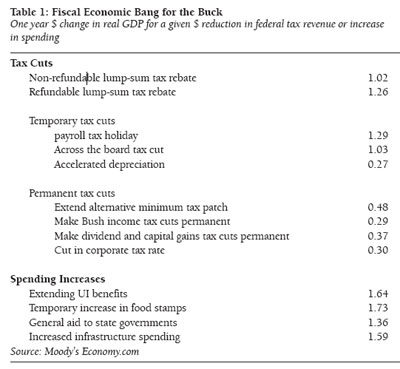
My understanding of this data — although specifics aren't easily available — is that it derives from a macroeconomic model into which Zandi plugged the various instances of government spending. If that's correct, then the exercise is fatally skewed based on the simple fact that the government must take a dollar in order to give a dollar.
Actually, the government must take more than a dollar in order to give a dollar. In 2004, for example, the Food Stamp Program spent about $0.20 for every dollar that it gave away (PDF). That's not the whole story, of course, because there were expenses associated with collecting, allocating, and processing the program's budget. According to Charity Navigator, 9 out of 10 charities spend no more than $0.54 per dollar given away on administrative costs, and 7 out of 10 spend no more than $0.33. For the sake of consideration, then, let's assume that it costs the federal government no more than another five cents per dollar handed out to get that money from the taxpayer to the Food Stamp Program, so the total cost per food stamp dollar would be $0.25.
That means that, for every food stamp dollar given, the government must take $1.25 out of the economy at some other point. According to Zandi, an across-the-board tax cut would add $1.03 to the next year's GDP, so it follows that taking a dollar costs $1.03. Based on an across-the-board increase in taxation, the cost of every food stamp dollar is therefore $1.29, making the actual amount that the whole process adds to the next year's GDP only $0.44. Inasmuch as it does not cost any money not to take a dollar from somebody, a broad tax cut would actually add $0.59 more to GDP than would the food stamp.
The intuitive sense, here, is that it doesn't make any difference, economically, whether I spend a cash dollar on groceries or a welfare recipient spends a food stamp dollar on the same items. If the government largess is extracted from everybody, then the working poor and middle class don't have those dollars to spend. In fact, it appears that funding food stamps by taking a dollar from a family that must therefore reduce its grocery bill in response winds up costing the GDP $0.43.
The appeal of Sgouros's argument comes in the fact that those who don't have to spend will tend to save; those who take in more than they could possibly spend will save even more. Indeed, looking at the numbers on the table, it's tempting to observe that a one-dollar increase in the corporate tax rate would appear to cost the GDP only $0.30, so reprocessing that dollar into food stamps would provide a net GDP gain of $1.43. That possibility is an illusion for two reasons. The first is that the $0.70 difference must come from some theoretical savings account (or untapped credit); thought through in reverse, the reason a dollar of corporate tax cuts only results in a GDP gain of $0.30 is that the rest goes somewhere unproductive. If that tax rate becomes confiscatory in order to alleviate the tax burden on the poor and middle class, corporations and the proverbial rich will not for long watch their reserves being depleted without reacting.
The second reason is that, when heavily taxing the rich, a marker of single dollars no longer applies. Wealthy entities (whether families or organizations) work in different amounts than do the the rest of us. It's true that a rich man may be less productive with a free dollar than would a poor man, but take from him ten million dollars, and he won't invest in a company, donate to charity, build a house, and so on, and those activities all filter down to folks who'll spend their money in the same fashion as welfare recipients, but without the government processing fee. If a few percent of the society is going to pay most of the cost of government, the taxation dollar amounts are exponential.
To be sure, Sgouros whistles an enticing tune when he writes:
People routinely misunderstand the important points of policy that stem from Keynes's findings. Government spending and progressive taxation aren't good things because they support government workers or "punish" rich people. They are good things because they are how a government can help the economy grow. (Up to a point, of course, a detail Keynes made clear.) Government workers with money to spend will spend it, and that drives the economy. Progressive taxation keeps more money in the hands of the poor and people in the middle, both of whom are more likely to spend their income than rich people are.
But he loses the thread of his earlier wisdom. Private-sector workers funded via mutual agreement will also spend their money, but they have more reason to earn it efficiently than public-sector workers funded via compulsory taxation. They also can't hide their wealth as thoroughly. Tom notes that a "dollar saved is not a dollar invested" and that "people have different preferences for how they hold their money," but he doesn't acknowledge that unionized government workers save their money in the form of perks, accumulating benefits, and defined-benefit pensions. There must be some form of savings — actual or theoretical against future taxation and revenue — in order for somebody in his '40s or '50s to retire for the rest of his life. A person who lives for thirty years on an annual pension of $35,000 had stored away over a million dollars in some nook of the system.
For its larger projects and continued growth, a society needs people with financial reserves, but those reserves have to be accessible for spending. A society also needs people motivated to create, and capable of creating, wealth, and those (as I've argued here, here, and here) are the families that Rhode Island has been chasing out. Sgouros and Co. can flash all the statistical pictures they want, but what Rhode Island must do is to maintain the number of wealthy taxpayers while relieving the burden of (and thereby attracting) the productive class.
Ultimately, that leaves only one broad category to which to turn to balance the state's budget: Those who represent a net cost to the government.
March 27, 2009
Right on the Bailout Nation
Already talking about his next run against Rep. Jim Langevin, Mark Zaccaria is pitch perfect on the AIG mess, as far as I'm concerned:
"I don't anticipate that all of the stimulus money will be effectively used,'' he said. Zaccaria said he is not opposed in principle to such federal pump-priming measures to invigorate an ailing economy. But the law that Congress passed was so flawed that it should have been scrapped, he said.Zaccaria also found fault with the federal bailout of the insurance giant AIG. "My inclination,'' Zaccaria said of AIG, would have been ``to let it fail.'' As a business-oriented Republican, he explained, "I'm not entirely opposed to sitting back and watching the forces of nature and the economy take their course'' when businesses make mistakes that endanger them.
A Consistent Stand from the Right Perspective
W. Edward Massey reminds us that conservative free-marketism doesn't really dictate was can or cannot be put into a contract by one of the parties creating it — salary caps are a perfectly legitimate item for negotiation — as long as the agreement is mutually agreeable and considered binding. The possibility of changing the rules midstream is among the reasons that certain tendencies in government make it a treacherous partner:
It is possible to set rules for reasonable compensation of executives. It should matter little whether the money source is the government or the shareholder. What matters is that men with good judgment and better character come together to agree on what is reasonable. It can be done when the money is private, if there are truly interested parties involved.It cannot be done when the senator who heads the Banking Committee asserts that exemption of contractual bonuses in his bill had actually been inserted at the insistence of the Treasury Department. There is the second rub: Politicians are rarely reasonable because power is a non-economic force that interferes. When the money is public, we are left with nothing but the forlorn hope that men with good judgment and better character are involved.
Except inasmuch as is necessary for its own operation, government should remain — at most — an arbiter of market exchanges, not a participant.
March 24, 2009
The End of the Labor Line
One can't help but see France as an example of the future several steps down a path toward which Rhode Island (and to some degree the United States) seems sometimes to threaten to take. This sentence captures the total absurdity of the mindset:
More than 1 million people marched in France yesterday to demand that the government do more to overcome the economic crisis, but planned strikes failed to fulfill a key goal - to paralyze the country.
Paralyzing the country to spur an overcoming of an economic crisis. Yeah, that'll work. I've an affection for the concept of revolution, but in practice, it often seems to be a manipulated excuse for citizens to enjoy a period of havoc.
March 23, 2009
"Lou Dobbs Tonight" Highlights (sort of) Rhode Island
Ten percent unemployment and Forty Sixth worst business tax climate. Can there be a connection ...?
March 21, 2009
Tying Workers to Their Employers
The other day, a coworker and I had a discussion — while we worked, of course — about the many ways the law seems intended to lash us to our employers, in turn providing them with a measure of protection from competition. If they go out on their own, carpenters in Rhode Island must register with the state, which requires an application and fee as well as proof of liability coverage. Also on the form is a requirement of proof of continuing education, although that requirement is currently waived pending somebody's figuring out what carpenters could possibly need to know that they don't learn on the job.
Then there's the tax side. The self employed must pay income tax and self-employment tax, for which (as I understand) they are required to make quarterly estimated payments, all of which begins to make the hiring of an accountant an advisable option.
Then there's hiring employees. With a single hire, the new business must adjust for thousands of dollars in insurance and various payments, which leads many small players in the construction industry to hire employees as subcontractors.
And then there's health insurance, with which Congress looks likely to cinch employees a bit tighter:
Three powerful House committee chairmen have agreed to work together on legislation to overhaul the health care system, starting with the view that most employers should help finance coverage and that the government should offer a public health insurance plan as an alternative to private insurance. ...Many issues, including the question of how to pay for it, are unresolved. But the House chairmen said they had informally agreed to plow ahead on the assumptions that individuals would be required to carry insurance and that most employers would be required to help pay for it.
Of course, that required "healthcare assistance" will come right out of employees pay, yet it will create that much less incentive for employees to take educated risks to break out on their own, and providing it will create one more barrier to growth for the striving entrepreneur. All of which will increase employers' power over their employees, while increasing the financial benefit to most employees not at all.
Furthermore, as regulations seek to provide workers protection, they create incentive for employers to behave in ways that would leverage loopholes. With Rhode Island's unemployment insurance system, employers have reason to motivate employees to quit (or to trick them into doing so, as I have seen done).
Eventually, we can hope, Americans will figure out — and elect representatives who appreciate — that freedom and opportunity are the best protections against abuse, poverty, and healthcarelessness.
March 7, 2009
Saturday night laughs
Isn't this just wonderful? Obama Car Czars To Visit Detroit To Learn About Industry
President Barack Obama’s chief auto advisers, Ronald Bloom and Steven Rattner, plan a one-day trip to Detroit next week to meet with executives at General Motors Corp. and Chrysler LLC, people familiar with the matter said...The trip follows two weeks of meetings with auto executives, suppliers, analysts and others as they review the two carmakers’ plans to keep $17.4 billion in loans and borrow as much as $21.6 billion more to survive. GM and Chrysler executives met with the committee last week in Washington to discuss progress.
Two weeks of immersion in a failing industry that they don't know after which they will then play a critical role in deciding whether to spend tens of billions of our hard-earned monies.
Golly, I feel better, don't you?
When they have figured out Detroit, I'll bet they can then resolve any healthcare industry issues by the end of the month.
Okay, Iran's nuclear program is especially tough so they might need the whole month of April to work it out with those crazy mullahs.
World peace and economic serenity by summertime 2009. I can see it, can't you? LOL.
And, by the way, who is going to be overseeing these wonderful bureaucrats? People in Congress like the ones who oversaw Fannie Mae and Freddie Mac.
With such comfort, I am going to sleep well tonight. How about you?
UPDATED: Is Obama clueless or are his actions intentional?
UPDATED: Roger Kimball:
I was having lunch yesterday with a prominent critic of the Spender in Chief, and he raised a possibility that many of us have entertained over the past several weeks: that Obama is simply out of his depth: that he hasn’t a clue about what makes the economy tick and his talk about the "profit-to-earnings ratio" was not a slip of the tongue but a worrisome confirmation of the suspicion that he is an empty suit floundering around in the dark.We kicked around that possibility for a few minutes: certainly the Obama administration seems like a monument to incompetence. Consider the multiple appointment fiascos. Consider his treatment of Gordon Brown, Prime Minister of the country that has been our staunchest ally. Consider, if you can stand it, the economy: That sucking sound–the only palpable trace of the once-mighty U.S. stock market–reminds us what the market makes of Obama’s plans to raise taxes on "the rich," the middle class, business. It reminds us what the market thinks of his efforts to shove the coal industry into a death spiral with absurd cap-and-trade carbon emissions regulations. And that’s all before breakfast, before he sets about wrecking the U.S. health care industry by turning it, too, over to Washington for ruination.
Yes, we agreed, it certainly looks like incompetence and, judged by its results, is effects, its consequences for this great country, it is incompetence on a breathtaking scale.
And yet, is it only incompetence? Remember, shortly before the election, Obama boasted to his mesmerized supporters that "We are five days away from fundamentally transforming the United States of America." Is that not what he has set about doing–with a vengeance? [Here.]
And here’s where we began talking about another possibility: that Team Obama was deliberately targeting the U.S. economy, deliberately impoverishing millions of Americans, deliberately angering our closest allies while coddling dictators like Putin and his puppet Medvedev and funneling millions to terrorist organizations like Hamas...
...Each step strengthens the role of government in people’s lives. That’s exactly what Lenin sought to do...
Lenin, too, wished to "spread the wealth around." And Obama, like Lenin, has been perfectly frank in recommending that we need to go beyond the "merely formal" rights enunciated in the Constitution in order to "bring about redistributive change" in society.
That’s where Obama’s much heralded–and astronomically expensive–"green" initiatives come in. Only they aren’t really (or are only incidentally) "green," i.e., concerned with the environment. At bottom, they are pink, i.e., they are political weapons in a socialist battle against "greedy" business interests.
Who, I wonder, was the political genius who saw the advantages of exploiting people’s sentimental gullibility about the environment for partisan profit? We’ve long known that environmentalism, as the philosopher Harvey Mansfield put it, is "school prayer for liberals." But I wonder whether even Professor Mansfield could have foreseen what a tool pseudo-environmentalism would be for the radical wing of the Democratic party? The inestimable value of a green, that is, a pink, philosophy is that you can never be green enough. And in pursuit of zero-carbon-emissions purity a government can impose crippling sanctions in order to force compliance. And don’t say Obama didn’t warn you: as I and many others pointed out during the campaign, he promised that, if elected, he would do all he could to "bankrupt" the coal industry...
ORIGINAL MARCH 5 POST & ADDENDUMS
Hmmm.
Jennifer Rubin has written a piece entitled 'I'm Maureen Dowd, and I've Been Had' (H/T):
They may need a support group before the month is out. They could gather in New York or Washington where many victims reside. The meetings would start: “I’m Maureen [or David]. I’m a duped Barack voter. And I’m mad.”The ranks indeed are filling with the disaffected and the disappointed — Chris Buckley, Maureen Dowd, David Brooks, David Gergen, and even that gynecological sleuth and blogger Andrew Sullivan. And then there is the very angry Marty Peretz. Their complaints are varied but expressed with equal amounts of remorse and bitterness. They all have been done wrong by Barack...
All in all it is one dismayed and bitter group, filled with recriminations and a bit of self-flagellation. And it’s not hard to recognize that, as in any grieving process, they have passed through denial (when all who criticized their beloved Obama were excoriated and ridiculed) and are in the second step: anger. They were misled or deluded into believing Obama was a moderate or an indefatigable supporter of Israel or a fiscal grown-up or a reformer (take your pick).
They and the rest of the country are figuring out the bitter truth: Obama bears little resemblance to the moderate and soothing figure who tied up John McCain in knots. He bears even less resemblance to the Agent of Change. Rather he’s pretty much the Chicago pol who went to the Senate to be its most liberal member.
And for the wounded Obama supporters, we can offer just one bit of counsel: you have lots of company. There are trading floors filled with sympathetic souls and businesses filled with stunned executives. They didn’t get what they bargained for either...
Kind of like yesterday's post here on AR. Stuart Taylor has more: Obama's Left Turn - Centrists fear that the president's budget reveals his liberal leanings.
Peter Robinson: "A couple of implications here are worth noting. The first is that a deep, recurring pattern of American life has asserted itself yet again: the cluelessness of the elite...The elite journalists, I repeat, got Obama wrong. The troglodytes got him right. As our national drama continues to unfold, bear that in mind."
The conventional wisdom is that Obama, with strong majorities in both houses of Congress, will get every legislative initiative he wants. And from a sheer vote counting viewpoint, that would certainly be true.But could the countervailing force not be the oft-spineless Republicans with their limited votes in Congress?
Could the real counter come from the financial markets themselves, which sense both the magnitude of the economic downturn and how Obama's proposed statist solutions will only compound the problems and adversely impact any recovery?...
So is it a race between a financial market collapse, accelerated by its reaction to Obama's policy proposals, and Obama's aggressive and statist policy implementation effort?
Will the financial markets then be the force which galvanizes a broad reaction from the American people?...
Incentives matter deeply and drive human behavior. It is a lesson statists and socialists never learn...
Ledeen on de Tocqueville from the second link above:
...We will not be bludgeoned into submission; we will be seduced. [Tocqueville] foresees the collapse of American democracy as the end result of two parallel developments that ultimately render us meekly subservient to an enlarged bureaucratic power: the corruption of our character, and the emergence of a vast welfare state that manages all the details of our lives. His words are precisely the ones that best describe out current crisis:That power is absolute, minute, regular, provident and mild. It would be like the authority of a parent if, like that authority, its object was to prepare men for manhood; but it seeks, on the contrary, to keep them in perpetual childhood: it is well content that the people should rejoice, provided they think of nothing but rejoicing. For their happiness such a government willingly labors, but it chooses to be the sole agent and the only arbiter of that happiness; it provides for their security, foresees and supplies their necessities, facilitates their pleasures, manages their principal concerns, directs their industry, regulates the descent of property, and subdivides their inheritances: what remains, but to spare them all the care of thinking and all the trouble of living?It is evident that our associations, along with religion one of the two keys to the great success of the American experiment, are prime targets for the appetite of the state. In the seamless web created by the new tyranny, everything from the Boy Scouts to smoking clubs will be strictly regulated. It is no accident that the campaign to drive religion out of American public life began in the 1940s, when the government was consolidating its unprecedented expansion during the Depression and the Second World War, having asserted its control over a wide range of activities that had previously been entrusted to the judgment of private groups and individuals.
When we console ourselves with the thought that the government is, after all, doing it for a good reason and to accomplish a worthy objective, we unwittingly turn up the temperature under our lobster-pot. The road to the Faustian Deal is paved with the finest intentions, but the last stop is the ruin of our soul.
Permitting the central government to assume our proper responsibilities is not merely a transfer of power from us to them; it does grave damage to our spirit. It subverts our national character. In Tocqueville’s elegant construction, it "renders the exercise of the free agency of man less useful and less frequent; it circumscribes the will within a narrower range and gradually robs a man of all the uses of himself."...
...The great Israeli historian Jacob Talmon coined the perfect name for this perversion of the Enlightenment dream, which enslaves all in the name of all: totalitarian democracy.
These extreme cases help us understand Tocqueville’s brilliant warning that equality is not a defense against tyranny, but an open invitation to ambitious and cunning leaders who enlist our support in depriving ourselves of freedom. He summarizes it in two sentences that should be memorized by every American who cherishes freedom:
The…sole condition required in order to succeed in centralizing the supreme power in a democratic community is to love equality, or to get men to believe you love it. Thus the science of despotism, which was once so complex, is simplified, and reduced, as it were, to a single principle.
Will the next question for these disillusioned pundits be to ask whether Obama is truly clueless on economic issues OR whether he is intentionally acting in a way to bring down the economy so as to justify his socialist beliefs/policies?
There is a paper trail which stands behind these thoughts regarding Obama's radical beliefs - More here, here, here, here, and here.
Then there is Obama's pre-election paper trail with numerous links to his many statements not covered well by the MSM.
A thoughtful person has to admit that no other U.S. President has ever had political connections or espoused beliefs which are so questionnable and out-of-line with mainstream opinions.
Is the evidence pattern enough to at least make more people stop and think about what are Obama's true intentions? Will they then take the next step and speak up against Obama's wealth-destroying and liberty-limiting policies?
Or are we all going to be looking belatedly for our own support groups where we talk about how we were also duped?
ADDENDUM
Power Line writes:
[Obama doing it intentionally] is, I admit, an intriguing theory, but I don't buy it. Obama can't possibly want to be a one-term failure. That's what happened to Jimmy Carter, and Obama must know that it will happen to him, too, if his policies are perceived as dragging down the economy.More likely the explanation is that Obama is an economic illiterate, and subscribes to the idea--which I think is rather common among Democrats--that what the government does has little impact on the economy. Obama likely believes that the economy will recover on its own, and in the meantime--in Rahm Emanuel's immortal words--he shouldn't let the crisis go to waste. So he enacts every left-wing measure that he wanted to do anyway, expecting that when the economy eventually recovers he can take credit for it, even though his policies, if anything, retarded and weakened the recovery.
That's a cynical strategy, although not quite as cynical as destroying the economy on purpose; the difference is that it may well work.
During the general election, Obama showed himself to be ignorant about history so it is not unreasonable that he would also be economically illiterate, too.
But he is also showing himself to be quite the leftist ideologue. Since ideologues act based on their faith beliefs, regardless of empirical evidence, I think it is hard to say definitively it is just illiteracy.
ADDENDUM 2
Boskin: Obama's Radicalism is Killing the Dow. Rubin's comments:
...Democrats may shrink from the label "socialist," but they can’t deny the scope and direction of the president’s agenda. More important, they’re not embracing a model which has (ever?) succeeded in producing growth and prosperity. So whatever you call it, it is not a recipe for recovery.
The radical implications of Obama's budget proposal. Victor Davis Hanson provides some historical context. Michael Barone:
The Obama tax plan, combined with major state tax plans, puts not a three in front of the high earners' tax rate as the Clinton plan did, it puts a four or a five in front of it. And at that point, I fear, the animal spirits of high earners are going to be directed away from productive investment and toward tax avoidance and tax shelters. Away from creating new enterprises that can provide avenues upward for any and all, and toward gaming the system for the well-connected and shrewd insiders. Away from an economy that grows more than anyone imagined and toward an economy where system-gamers take shares of a static pie away from the rest of us. Is that where we really want to go?
Fred Barnes is onto the scam: "Given the moderate-to-conservative viewpoint of voters, Obama has a motive in pushing to have his uniformly liberal agenda approved by Congress as rapidly as possible–before voters catch on to the fact it’s not what they voted for."Or to put it differently, the Wall Street Journal editors conclude that "economies don’t spiral down forever without a reason and without policy encouragement. What’s worrying about the plunge in equities since January 2, and especially in the last week since Mr. Obama released his radical budget, is that it has come amid the unveiling of the President’s policy agenda. Equity prices have reacted to those proposals by signaling that they expect a much deeper and longer recession."...
Charles Krauthammer calls Obama on the bait-and-switch: "Clever politics, but intellectually dishonest to the core. Health, education and energy — worthy and weighty as they may be — are not the cause of our financial collapse. And they are not the cure. The fraudulent claim that they are both cause and cure is the rhetorical device by which an ambitious president intends to enact the most radical agenda of social transformation seen in our lifetime." Actually the proposals not only aren’t the cure, the taxes and regulatory regime which accompany these plans are likely to make things worse.
Healthcare policy: The latest example of Obama's disdain for liberty.
ADDENDUM 3
Rediscovering first principles. (Lots more here if you want to do a deep dive on many first principles.)
A focused, video comparison between two different world views: Obama versus Reagan.
March 6, 2009
Boskin: Obama's Radicalism is Killing the Dow
It's hard not to see the continued sell-off on Wall Street and the growing fear on Main Street as a product, at least in part, of the realization that our new president's policies are designed to radically re-engineer the market-based U.S. economy, not just mitigate the recession and financial crisis.
Martin KozlowskiThe illusion that Barack Obama will lead from the economic center has quickly come to an end. Instead of combining the best policies of past Democratic presidents -- John Kennedy on taxes, Bill Clinton on welfare reform and a balanced budget, for instance -- President Obama is returning to Jimmy Carter's higher taxes and Mr. Clinton's draconian defense drawdown.Mr. Obama's $3.6 trillion budget blueprint, by his own admission, redefines the role of government in our economy and society. The budget more than doubles the national debt held by the public, adding more to the debt than all previous presidents -- from George Washington to George W. Bush -- combined. It reduces defense spending to a level not sustained since the dangerous days before World War II, while increasing nondefense spending (relative to GDP) to the highest level in U.S. history. And it would raise taxes to historically high levels (again, relative to GDP). And all of this before addressing the impending explosion in Social Security and Medicare costs...
From the poorly designed stimulus bill and vague new financial rescue plan, to the enormous expansion of government spending, taxes and debt somehow permanently strengthening economic growth, the assumptions underlying the president's economic program seem bereft of rigorous analysis and a careful reading of history...
On the growth effects of a large expansion of government, the European social welfare states present a window on our potential future: standards of living permanently 30% lower than ours. Rounding off perceived rough edges of our economic system may well be called for, but a major, perhaps irreversible, step toward a European-style social welfare state with its concomitant long-run economic stagnation is not.
President Barack Obama now has the distinction of presiding over his own bear market.The Dow Jones Industrial Average fell 20 percent since Inauguration Day, the fastest drop under a new president in at least 90 years, according to data compiled by Bloomberg...
Yep.
ADDENDUM
(H/T)
March 4, 2009
Riding the buyers' remorse train on day 44 of Obama's presidency
Now Silicon Valley entrepreneurs see their incentives are being altered for the worse:
Like the college students who stayed up late to be inspired by his campaign rallies only to find Obama's first significant action to be a stimulus program that will transfer about a trillion dollars from them to the Baby Boomers, Silicon Valley Obama supporters are likely to find that a government-dominated economic era will not a great one in which to start companies that threaten big incumbent corporations that have juice with the government. I hope they appreciate the irony.
More here on entrepreneurs in general from the ever-thoughtful Jim Manzi. How do statists like Obama think jobs are created?
Whose next on the Obama buyers' remorse train?
Will it matter enough to force changes in Obama's radical agenda?
ADDENDUM
Democratic Senator Evan Bayh writes in the Wall Street Journal:
...Our nation's current fiscal imbalance is unprecedented, unsustainable and, if unaddressed, a major threat to our currency and our economic vitality. The national debt now exceeds $10 trillion. This is almost double what it was just eight years ago, and the debt is growing at a rate of about $1 million a minute.Washington borrows from foreign creditors to fund its profligacy. The amount of U.S. debt held by countries such as China and Japan is at a historic high, with foreign investors holding half of America's publicly held debt. This dependence raises the specter that other nations will be able to influence our policies in ways antithetical to American interests. The more of our debt that foreign governments control, the more leverage they have on issues like trade, currency and national security. Massive debts owed to foreign creditors weaken our global influence, and threaten high inflation and steep tax increases for our children and grandchildren.
The solution going forward is to stop wasteful spending before it starts. Families and businesses are tightening their belts to make ends meet -- and Washington should too.
The omnibus debate is not merely a battle over last year's unfinished business, but the first indication of how we will shape our fiscal future. Spending should be held in check before taxes are raised, even on the wealthy. Most people are willing to do their duty by paying taxes, but they want to know that their money is going toward important priorities and won't be wasted...
...But what ultimately matters are not meetings or words, but actions. Those who vote for the omnibus this week -- after standing with the president and pledging to slice our deficit in half last week -- jeopardize their credibility.
As Indiana's governor, I balanced eight budgets, never raised taxes, and left the largest surplus in state history. It wasn't always easy. Cuts had to be made and some initiatives deferred. Occasionally I had to say "no."
But the bloated omnibus requires sacrifice from no one, least of all the government. It only exacerbates the problem and hastens the day of reckoning. Voters rightly demanded change in November's election, but this approach to spending represents business as usual in Washington, not the voters' mandate...
More on 14 centrist Democratic Senators from Politico.
Jennifer Rubin comments:
Barack Obama’s lurch to the left is costing him some support among centrist pundits, but now he’s lost a prominent Democratic Senator, Evan Bayh....Bayh and Nelson both pushed back against the idea of raising taxes in a recession. Presumably there are more legislators who are not ready for this lurch to the left.
This is potentially a turning point, as Democrats step forward willing to say, "Enough!" Whether they succeed in dragging the president back to a more centrist and sensible agenda remains to be seen. But one thing is clear: the center, at least in the Senate, is closer to the Republicans than to the Obama administration when it comes to fiscal sobriety and taxation.
Want the definition of overreach? When even Maureen Dowd whines about Obama. LOL.
March 3, 2009
Re: Could it be? Part III
The key point from the original post:
Incentives matter deeply and drive human behavior. It is a lesson statists and socialists never learn.
You want real world examples? Read this. My two favorite ones:
First:
I have a few thoughts concerning your Corner post titled Bracketology. My wife and I are both Pediatricians. We own our own practice together. We have one PA and 7 other employees. We each gross about $200K a year. We have 3 young children at home, 2 of which are not in school. We also employ an in home Nanny. My wife has been torn for years about not being at home for these children, which are our biggest investment in the future. We operate parallel S corperations as PC's, with a 50/50 ownership of the LLC that is our business. We file taxes jointly. After crunching some numbers concerning the President's tax hike proposals, I have come to the following conclusions. If the President's plan is [e]nacted, we will do the following:1. My wife will become a stay at home mother.
2. At least 3 of my 7 employees will be released.
3. The practice will downsize to a smaller office space, i.e. less rent.
4. The number of patients cared for on a daily basis will drop by 40%.
5. My wife will come out of the forced ER call schedule for good.
6. I will gross $249,999.00 a year, exactly.
7. The net income of our personal home will decrease by less than $10 K a year from where it would have been if we changed nothing.
Second:
Reagan used to tell the story about how when he was a movie actor he'd make 2 pictures a year, which would take maybe 8-9 months, then lay on the beach for the rest of the year. The reason was by the end of the second picture he was in the 90% tax bracket, and it wasn't worth all that effort to get another 10 cents on the dollar.It didn't hurt him, he said, as he made plenty of money anyway. But what it meant is that the cameramen, set designers, sound people, etc had to go out and look for part time work the rest of the year.
This experience was a primary factor in leading him to advocate lower marginal rates for top income earners. It helped average income earners too.
Some of us are old enough to remember the real-world folly of socialism. The collateral damage across the society is huge.
Guess some people are going to have to re-learn some timeless lessons. How many innocent people will suffer in the meantime, though?
ADDENDUM
Here is something for those who think we at Anchor Rising are being too rough on the Messiah. More here, too. Geez, whodathunk people would ever go that far to redistribute wealth? LOL.
Meanwhile, Malkin links to several good posts on the subject.
Come on now, just go buy stocks. After all, he says they are such a bargain now.
ADDENDUM 2
Here is more from (former Obama supporter) Cramer.
Instapundit links to thoughts about some bigger issues.
ADDENDUM 3
See below the line for Ledeen's interpretation of how de Tocqueville would see current events:
Continue reading "Re: Could it be? Part III"
Re: Could it be?
So when President Obama says that…
Profit and earning ratios are starting to get to the point where buying stocks is a potentially good deal…if you’ve got a long-term perspective on it.…isn’t he basically saying that…
The fundamentals of our economy are strong.Those who were critical of the attitude expressed in the second statement should feel free to reiterate their concerns about leaders who really don't understand economics, in response to the first. That is, if their criticism was ever about substance.
Could it be?
The conventional wisdom is that Obama, with strong majorities in both houses of Congress, will get every legislative initiative he wants. And from a sheer vote counting viewpoint, that would certainly be true.
But could the countervailing force not be the oft-spineless Republicans with their limited votes in Congress?
Could the real counter come from the financial markets themselves, which sense both the magnitude of the economic downturn and how Obama's proposed statist solutions will only compound the problems and adversely impact any recovery?
Consider this stock trend.
So is it a race between a financial market collapse, accelerated by its reaction to Obama's policy proposals, and Obama's aggressive and statist policy implementation effort?
Will the financial markets then be the force which galvanizes a broad reaction from the American people? Remember, the last time we had a downturn this deep was at the beginning of the 1980's and 401(k)'s weren't in place yet so the average American had far less at stake financially.
(The underlying philosophical issues on why Obama's policies are wrong are here.)
And, if you don't think the American people are beginning to pick up on it, read further down the earlier link and consider how rapidly the idea of going-John-Galt has spread.
Incentives matter deeply and drive human behavior. It is a lesson statists and socialists never learn.
It's all enough to make you shrug, isn't it?
ADDENDUM
Will Wilkinson reflects on Obama's dilemma, which some of us believe is being reflected in the declining stock market prices:
The upshot is that if you want to reduce inequality through redistribution, tax progressivity barely helps. You need to take a huge chunk of GDP in taxes in order to finance progressive spending. The more general, sort of obvious point is that if you want to massively increase government spending, the government needs a lot more revenue. But you can take everything from the rich and you still won’t have enough. So you’ve got to massively increase taxation on the middle class. The best way to do this is through a consumption tax. But Obama keeps reinforcing, again and again, that middle-class tax rates won’t rise, as if this is itself a matter of justice. So where’s all the money going to come from to do all these amazing things? Eventually, it’s a huge increase in taxes for the middle class or nothing. This may not be a big political winner.The progressivity of the American tax system puts big-spending progressives in a bind. They should want a consumption tax with a huge, wide base. The easiest way for government to devour ever-larger chunks of economic output is through the device of a slow series of very small rate increases on a broad base. The smaller the tax base, the more dramatically you have to hike rates in order to significantly increase revenue. But dramatically hiking rates tends to discourage political buy-in from those who must pay. Indeed, it tends to incite heated resistance. Obama did very well with the rich. But that may not last if he hits them as hard as it looks like he’s aiming to. At the very least, pushback from this very powerful bloc of voters will limit his success in raising rates at the top....But even the large [increases on the small tax base] leave him massively short. And government spending cannot be debt-financed forever. And he can only inflate so much of it away.
...Democratic strategists need to be looking at clever ways for the government to take a lot more money away from middle-class families without thereby making the GOP look golden again. Obama’s been behaving as though he’s much less fiscally constrained than he really is. But by catering to the idea that middle-class taxes shouldn’t ever go up, he’s making it even tougher on himself. Unless he’s in the middle of some kind of ten-steps-ahead rope-a-dope wherein reaffirming the middle class’ right to not pay taxes is a way of softening them up to accept huge tax increases, he may be making a mistake.
ADDENDUM 2
Even David Brooks is disillusioned by Obama's proposals:
...But the Obama budget is more than just the sum of its parts. There is, entailed in it, a promiscuous unwillingness to set priorities and accept trade-offs. There is evidence of a party swept up in its own revolutionary fervor — caught up in the self-flattering belief that history has called upon it to solve all problems at once.So programs are piled on top of each other and we wind up with a gargantuan $3.6 trillion budget. We end up with deficits that, when considered realistically, are $1 trillion a year and stretch as far as the eye can see. We end up with an agenda that is unexceptional in its parts but that, when taken as a whole, represents a social-engineering experiment that is entirely new.
The U.S. has never been a society riven by class resentment. Yet the Obama budget is predicated on a class divide. The president issued a read-my-lips pledge that no new burdens will fall on 95 percent of the American people. All the costs will be borne by the rich and all benefits redistributed downward.
The U.S. has always been a decentralized nation, skeptical of top-down planning. Yet, the current administration concentrates enormous power in Washington, while plan after plan emanates from a small group of understaffed experts.
The U.S. has always had vibrant neighborhood associations. But in its very first budget, the Obama administration raises the cost of charitable giving. It punishes civic activism and expands state intervention.
The U.S. has traditionally had a relatively limited central government. But federal spending as a share of G.D.P. is zooming from its modern norm of 20 percent to an unacknowledged level somewhere far beyond...
The first task will be to block the excesses of unchecked liberalism. In the past weeks, Democrats have legislated provisions to dilute welfare reform, restrict the inflow of skilled immigrants and gut a voucher program designed for poor students. It will be up to moderates to raise the alarms against these ideological outrages.
But beyond that, moderates will have to sketch out an alternative vision...This is a vision of a nation that does not try to build prosperity on a foundation of debt. This is a vision that puts competitiveness and growth first, not redistribution first.
Moderates are going to have to try to tamp down the polarizing warfare that is sure to flow from Obama’s über-partisan budget. They will have to face fiscal realities honestly and not base revenue projections on rosy scenarios of a shallow recession and robust growth next year.
They will have to take the economic crisis seriously and not use it as a cue to focus on every other problem under the sun...
Malkin ridicules Brooks here.
ADDENDUM 3
Amateur hour at the White House. Obama thinks a monotonically decreasing price level is a gyration. What a sense of economic insight. Follow the links, especially the WSJ editorial.
More on the budget here.
Meanwhile Jennifer Rubin responds to White House nonsense and includes a quote from investor (and former Obama supporter) Jim Cramer:
Until the Obama administration starts listening, until they start paying attention to what you’re watching, to the stock market, until they realize that their agenda is destroying the life savings of millions of Americans, then all I can give you is caution. … I just want some sign that Obama realizes the market is totally falling apart. And that his agenda has a big hand in that happening.
March 2, 2009
Liberty & the proper role of government in a free society
Obama's budget proposal presents plans which run radically counter to the proper role of government if America is to remain a free society:
...The widespread use of the market reduces the strain on the social fabric by rendering conformity unnecessary with respect to any activities it encompasses. The wider the range of activities covered by the market, the fewer are the issues on which explicitly political decisions are required and hence on which it is necessary to achieve agreement. In turn, the fewer the issues on which agreement is necessary, the greater is the likelihood of getting agreement while maintaining a free society....a good society requires that its members agree on the general conditions that will govern relations among them, on some means of arbitrating different interpretations of these conditions, and on some device for enforcing compliance with the generally accepted rules...most of the general conditions are the unintended outcome of custom, accepted unthinkingly...no set of rules can prevail unless most participants most of the time conform to them without external sanctions...But we cannot rely on custom or on this consensus alone to interpret and to enforce the rules; we need an umpire. These then are the basic roles of government in a free society: to provide a means whereby we can modify rules, to mediate differences among us on the meaning of the rules, and to enforce compliance with the rules on the part of those few who would otherwise not play in the game.
...the organization of economic activity through voluntary exchange presumes that we have provided, through government, for the maintenance of law and order to prevent coercion of one individual by another, the enforcement of contracts voluntarily entered into, the definition of the meaning of property rights, the interpretation and enforcement of such rights, and the provision of a monetary system.
The role of government just considered is to do something that the market cannot do for itself, namely, to determine, arbitrate, and enforce the rules of the game...
Earlier posts here and here discuss what combination of economic freedom and limited government enables liberty for us:
...How can we benefit from the promise of government while avoiding the threat to freedom? Two broad principles embodied in our Constitution give an answer...First, the scope of government must be limited. Its major function must be to protect our freedom both from the enemies outside our gates and from our fellow-citizens: to preserve law and order, to enforce private contracts, to foster competitive markets...By relying primarily on voluntary co-operation and private enterprise, in both economic and other activities, we can insure that the private sector is a check on the powers of the governmental sector...
The second broad principle is that government power must be dispersed...If government is to exercise power, better in the county than in the state, better in the state than in Washington. If I do not like what my local community does...I can move to another local community, and though few may take this step, the mere possibility acts as a check...If I do not like what Washington imposes, I have few alternatives in this world of jealous nations...
...The power to do good is also the power to do harm; those who control the power today may not tomorrow; and, more important, what one man regards as good, another may regard as harm...
The preservation of freedom is the protective reason for limiting and decentralizing governmental power. But there is also a constructive reason. The great advances of civilization...have never come from centralized government...
Government can never duplicate the variety and diversity of individual action...
It is widely believed that politics and economics are separate and largely unconnected; that individual freedom is a political problem and material welfare an economic problem...such a view is a delusion...
Economic arrangements play a dual role in the promotion of a free society. On the one hand, freedom in economic arrangements is itself a component of freedom broadly understood, so economic freedom is an end in itself. In the second place, economic freedom is also an indispensible means toward the achievement of political freedom...
Viewed as a means to the end of political freedom, economic arrangements are important because of their effect on the concentration or dispersion of power...competitive capitalism also promotes political freedom because it separates economic power from political power and in this way enables the one to offset the other...
Because we live in a largely free society, we tend to forget how limited is the span of time and the part of the globe for which there has ever been anything like political freedom: the typical state of mankind is tyranny, servitude, and misery. The nineteenth century and early twentieth century in the Western world stand out as striking exceptions to the general trend of historical development. Political freedom in this instance clearly came along with the free market and the development of capitalist institutions...
History suggests only that capitalism is a necessary condition for political freedom. Clearly it is not a sufficient condition...
The relation between political and economic freedom is complex and by no means unilateral...
As [nineteenth-century, not twentieth-century] liberals, we take freedom of the individual, or perhaps the family, as our ultimate goal in judging social arrangements. Freedom as a value in this sense has to do with the interrelationship between people...in a society freedom has nothing to say about what an individual does with his freedom; it is not an all-embracing ethic...a major aim of the liberal is to leave the ethical problem for the individual to wrestle with. The "really" important ethical problems are those that face an individual in a free society - what he should do with his freedom. There are thus two sets of values that a liberal will emphasize - the values that are relevant to relations among people, which is the context in which he assigns first priority to freedom; and the values that are relevant to the individual in the exercise of his freedom, which is the realm of individual ethics and philosophy.
The liberal conceives of men as imperfect human beings. He regards the problem of social organizations to be as much a negative problem of preventing "bad" people from doing harm as of enabling "good" people to do good...
Fundamentally, there are only two ways of co-ordinating the economic activities of millions. One is central direction involving the use of coercion - the technique of the army and of the modern totalitarian state. The other is voluntary co-operation of individuals - the technique of the market place.
The possibility of co-ordination through voluntary co-operation rests on the elementary - yet frequently denied - proposition that both parties to an economic transaction benefit from it, provided the transaction is bi-laterally voluntary and informed.
Exchange can therefore bring about co-ordination without coercion...
...Political freedom means the absence of coercion of a man by his fellow men. The fundamental threat to freedom is power to coerce...The preservation of freedom requires the elimination of such concentration of power to the fullest extent and the dispersal and distribution of whatever power cannot be eliminated - a system of checks and balances. By removing the organization of economic activity from the control of political authority, the market eliminates this source of coercive power. It enables economic strength to be a check to political power rather than a reinforcement.
Economic power can be widely dispersed...Political power, on the other hand, is more difficult to decentralize...if economic power is joined to political power, concentration seems almost inevitable. On the other hand, if economic power is kept in separate hands from political power, it can serve as a check and a counter to political power...
Obama's budget proposal also runs counter to the philosophical principles underlying the American Founding.
March 1, 2009
The radical implications of Obama's budget proposal
Commentators on the evolving Obama presidency:
Charles Krauthammer: Obama proposes a European U.S.
Not a great speech, but extremely consequential. If Barack Obama succeeds, his joint address to Congress will be seen as historic -- indeed as the foundational document of Obamaism. As it stands, it constitutes the boldest social democratic manifesto ever issued by a U.S. president......The economic crisis is to Obama a technocratic puzzle that needs to be solved because otherwise he loses all popular support.
Unlike most presidents, however, he doesn't covet popular support for its own sake. Some men become president to be someone, others to do something. This is what separates, say, a Ronald Reagan from a Bill Clinton. Obama, who once noted that Reagan altered the trajectory of America as Clinton had not, sees himself a Reagan.
...Obama made clear Tuesday night that he intends to be equally transformative. His three goals: universal health care, universal education, and a new green energy economy highly funded and regulated by government.
(1) Obama wants to be to universal health care what Lyndon Johnson was to Medicare...
...Obama will create the middle step that will lead ultimately and inevitably to single-payer. The way to do it is to establish a reformed system that retains a private health-insurance sector but offers a new government-run plan (based on benefits open to members of Congress) so relatively attractive that people voluntarily move out of the private sector, thereby starving it. The ultimate result is a system of fully socialized medicine. This will likely not happen until long after Obama leaves office. But he will be rightly recognized as its father.
(2) Beyond cradle-to-grave health care, Obama wants cradle-to-cubicle education. He wants far more government grants, tax credits and other financial guarantees for college education -- another way station to another universal federal entitlement...
(3) Obama wants to be to green energy what John Kennedy was to the moon shot, its visionary and creator. It starts with the establishment of a government-guided, government-funded green energy sector into which the administration will pour billions of dollars from the stimulus package and billions more from budgets to come.
But just picking winners and losers is hardly sufficient for a president who sees himself as world-historical. Hence the carbon cap-and-trade system he proposed Tuesday night that will massively restructure American industry and create a highly regulated energy sector.
These revolutions in health care, education and energy are not just abstract hopes. They have already taken life in Obama's massive $787 billion stimulus package, a huge expansion of social spending constituting a down payment on Obama's plan for remaking the American social contract.
Obama sees the current economic crisis as an opportunity. He has said so openly. And now we know what opportunity he wants to seize. Just as the Depression created the political and psychological conditions for Franklin Roosevelt's transformation of America from laissez-faireism to the beginnings of the welfare state, the current crisis gives Obama the political space to move the still (relatively) modest American welfare state toward European-style social democracy...
Conservatives take a dim view of the regulation-bound, economically sclerotic, socially stagnant, nanny state that is the European Union. Nonetheless, Obama is ascendant and has the personal mandate to take the country where he wishes. He has laid out boldly the Brussels-bound path he wants to take.
Let the debate begin.
We shouldn't be surprised by the radicalism of Obama's domestic agenda. He was, after all, the most liberal member of the Senate. And he found congenial both the preaching of Rev. Wright and the educational agenda of William Ayers...Continue reading "The radical implications of Obama's budget proposal"Obama's unwillingness, as a formal matter, to take Republican views on domestic issues seriously should not be surprising either. There is no room for meaningful discussion between radicals and non-radicals...
But Obama no longer needs Harvard conservatives or Illinois Republicans to vouch for his "reasonableness." Moreover, he is now engaged in an enterprise that requires a greater single-mindedness -- the transformation of the American economic system...
Under the circumstances, conservatives should be grateful for the clarity of the situation. It is better that battle lines be drawn in sharp relief than that Republicans have the opportunity to pull off this or that legislative tweak...Economic radicalism cannot be tweaked into something palatable.
We now know for certain that Obama is an out-and-out statist bent on redistributing income and clamping down on free markets. He desires, as Charles Krauthammer has shown, to convert our free and vibrant economy into a European-style nanny state.
Conservatives must be equally single-minded in the defense of our country's way of life. There is no cooperating with Obama on domestic issues, and to the extent that Republican Senators like Arlen Specter cooperate, conservatives must do whatever we can to end their public careers.
February 28, 2009
Everything Is Rosy, Now Obama's Found Rosy
So that two-trillion-dollar deficit? Turns out it might be the optimistic scenario:
The administration insists it isn't so, but some private economists are wondering if the Obama administration has brought "Rosy Scenario" back to town.In unveiling his budget, President Barack Obama pledged to bring "honesty and fairness" back to the budget process by getting rid of the gimmicks past administrations had used to hide the real costs of government programs and proposed tax cuts.
But many economists who examined the economic assumptions that undergird the spending plan believe that Obama may have resorted to one of the oldest gimmicks around — relying on overly optimistic economic assumptions to make it look like you are dealing with soaring budget deficits when in reality you are only closing the gap on paper.
I suppose nobody should have expected that the president would be able to change the world on the cheap, and as Mark Steyn reminds us, that is the project on which our nation has now embarked:
If you find it hard to keep track of these all these evolutions, the President in his address to Congress finally spilled the beans and unveiled our new hero in his final form: the Incredible Bulk, Statezilla, Governmentuan, a colossus bestriding the land like a, er, colossus. What superpowers does he have? All of them! He can save the economy, he can reform health care, he can prevent foreclosures, he can federalize daycare, he can cap the salary of his archenemies the sinister Fat Cats who "pad their pay checks and buy fancy drapes." No longer will the citizenry cower in fear of fancy drapes: Pay no attention to the man behind the curtain! With one solar panel on the roof of his underground headquarters, Governmentuan can transform the American energy sector and power his amazing Governmentmobile, the new environmentally friendly supercar that soon we’ll all be driving because we'll be given government car loans to buy the government cars! He'll have hundreds of thousands of boy sidekicks, none of whom will ever be allowed to drop out of high school because (in the words of his famous catchphrase) "that's no longer an option!" "Gee, thanks, Governmentuan!" says Diplomaboy the Boy Wonder, as he goes off to college to study Gender As A Social Construct until he's 34.
February 26, 2009
Obama Doomsayer!
Dick Morris is hit or miss, and I can't say I'm sure which it is with this column:
In addressing this panic, the president of the United States must truly be the leader of the world — showing the way back to confidence.Instead, Obama has been instrumental in purveying fear and spreading doubt. It is his pronouncements, reinforced by the developments they kindle and catalyze, that are destroying good businesses, bankrupting responsible people and wiping out even conservative financial institutions. Every time he speaks, he sends the markets down and stocks crashing. He doesn't seem to realize that the rest of the world takes its cue from him. He forgets that he stands at the epicenter of power, not on the fringes campaigning for office. This ain't Iowa.
Why does Obama preach gloom and doom? Because he is so anxious to cram through every last spending bill, tax increase on the so-called rich, new government regulation, and expansion of healthcare entitlement that he must preserve the atmosphere of crisis as a political necessity. Only by keeping us in a state of panic can he induce us to vote for trillion-dollar deficits and spending packages that send our national debt soaring.
There's a note of truth to that, but time must pass — and escalating, leveling, or waning pain — before such pronouncements can be judged.
And then, of course, there's Obama's first deficit:
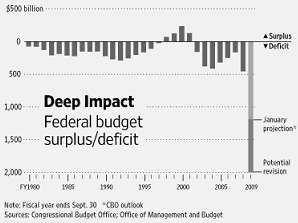
(via Drudge)
Hillary Clinton's Parting Words to the Chinese - Let's Look at the Tape Again
Treasuries fell for a third day as the government sold $22 billion of seven-year notes in the last of three auctions this week as it issues an unprecedented amount of debt to spur the U.S. economy.
Secretary of State Clinton's plea that the Chinese government continue to purchase US paper now comes into sharper perspective. It's important to encourage/schmooze your biggest customer when you're about to roll out a record-breaking amount of product.
By the way, if issuing all this government debt spurs the economy, what happens to the economy when we go to pay it back?
The Problem with Retrospect
A rule of thumb for government manipulations of the economy ought to be that regulations be as minimally invasive and starkly drawn as possible. That's the principle that has kept the following paragraph from a Providence Journal editorial buzzing in the back of my mind since yesterday:
Some take-home lessons: A prudent society imposes regulations to stop lenders from selling mortgages destined to fail. It doesn't feed an asset bubble, in this case housing, by keeping interest rates absurdly low. And it doesn't tolerate a financial system that takes vast risks and hides them because of campaign contributions to elected officials.
The last clause, about political corruption, is obvious, but the rest steps into some sticky retrospective ground. Allowing government determinance of what investment and loan practices are "destined to fail" is destined to constrict the economy. Popping bubbles assumes that no economic change is possible. And why shouldn't risks be allowed when made with private dollars?
Far less invasive and more easily managed, I'd say, would be regulations that prevent organizations from achieving "too big to fail" status and then allowing them to fail when their risks don't resolve well.
At What Point Do We Begin Using the Phrase "Out of Control"?
Turning debate into bickering over legislation that would increase departmental budgets by eight percent, Rep. James McGovern (D, MA) offered this irrelevancy:
"The same people who drove the economy into the ditch are now complaining about the size of the tow truck," said Rep. James McGovern, a Democrat from Massachusetts, pointing out the large increase in deficits that President George W. Bush and GOP-controlled Congresses amassed.
I guess responding to a wrong with a wronger makes it right. Reading the Nation section of the newspaper is beginning to feel like watching teenagers run up the family's credit cards while the parents recover from a peculiar illness that had caused financial delusions.
On the healthcare side, the change in the flow of money couldn't be more dramatically drawn:
Obama's budget proposal would effectively raise income taxes and curb tax deductions on couples making more than $250,000 a year, beginning in 2011. By not extending all of former President George W. Bush's tax cuts, Obama would allow the marginal rate on household incomes above $250,000 to rise from 35 percent to 39.6 percent, said an administration official.To raise more money, Obama wants to reduce the rate by which wealthier people can cut their taxes through deductions for mortgage interest, charitable contributions, local taxes and other expenses to 28 cents on the dollar, rather than the nearly 40 cents they could claim otherwise.
That proposal is deeply controversial, particularly with nonprofit institutions that depend on wealthy donors and with lawmakers representing high-tax states such as New York and New Jersey.
The plan also contains a contentious proposal to raise hundreds of billions of dollars by auctioning off permits to exceed carbon emissions caps Obama wants to impose on users of fossil fuels to address global warming. Some of the revenue from the pollution permits would be used to extend the Making Work Pay tax credit of $400 for individuals and $800 for couples beyond 2010 as provided in the just-passed economic stimulus bill.
About half of what officials characterized as a $634 billion "down payment" toward healthcare coverage for every American would come from cuts in Medicare. That is sure to incite battles with doctors, hospitals, health insurance companies and drug manufacturers.
Some of the Medicare savings would come from scaling back payments to private insurance plans that serve older Americans, which many analysts believe to be inflated. Other proposals include charging upper-income beneficiaries a higher premium for Medicare’s prescription drug coverage.
Even after all those difficult choices, Obama’s budget would still leave the federal government heavily in the red, with deficits remaining above $500 billion over the second half of the decade — even after a series of wrenching policy choices.
Running with the just-make-it-so liberal fantasy that policy can simply be dictated to society without consequence, the current regime is going to stultify economic growth and foster dependence. Well, America, you asked for change, and you're going to get it; let's hope we all survive the experience.
February 25, 2009
Mark Zaccaria: Money, Politics, and PR Legerdemain in the Public Sector, Part 2
Mark Zaccaria concludes his response to Bruce Bartlett's postulates on the relationship between deficits, monetary policy, interest rates with some specific economic suggestions of his own…
Raise Interest Rates: Money is like water, in that if you want it to flow you have to tilt the table. With effective rates at zero there is no incentive whatsoever to risk private capital on innovation or new infrastructure. Even if the start-up you back is a success it could be that all you’ll get in return is the original check you invested in it. Using federal capital is not the answer. Deficit spending will always go to pork and pet projects because of the political process that has to take place to authorize it in the first place. (Remember: Inefficient Spending).
I am certainly not counseling a return to the double digit primes of the Carter Administration. To get money now sitting on the sidelines back into the game and then to get it moving more quickly there has to be an incentive. So far the best one ever devised is Profit.
Create Industries, not just Programs: Recently the federal government arranged for massive loans to be made to Chrysler and GM to keep them afloat in their present configurations. Their present configurations are the problem. That loan money will be spent to perform high cost manufacturing of products consumers don’t want. If the government had, instead, created a tax credit or other individual incentive to BUY any American automobile it would have created demand that favored the low cost producers and those with the best products to sell. That still might have cut Chrysler and GM out of the transaction, but it would have made them move a whole lot faster to shed inefficiencies and focus on strengths. To put it another way, nobody ever runs as fast as they do when their hair is on fire. As it stands, politicians may claim some short term victory because employees of these two behemoths will get their pay checks for a couple more months. It just puts off the inevitable, though, and you have to wonder if the loans were a better idea than just having a bonfire with the Hundred Dollar Bills on the East Lawn of the White House. The fire would at least rein in the money supply slightly.
Federal action on the requests from the car makers is just one example of a policy that has to change…because it won’t work. Look at what’s happening to the big banks. They are being nationalized through deficit spending to bail them out. I say nationalized because their new venture capitalist, the US Government, is imposing all sorts of requirements on them. You may think its just deserts to force limits on executive pay or make them send back a private jet or two. When the US Government insisted that the payment of dividends be suspended until its loans were repaid, however, it effectively downgraded the investment value of the banks’ common stock to zero. Have you been watching? As I write this Citi Group is trading at just above $2.00 per share, a 52 week low (of course), down from nearly $30.00 per share last year. Bank of America? Today it’s trading around $3.50 per share, down from well over $40.00 last year. The Shareholder of last resort? You and Me, in the form of our federal government. I call that nationalizing the banks.
The programs the government devises are inherently flawed because they do not take market forces into account, only political forces. It’s time for government to start promoting manufacturing and get out of the business of owning equities. And what’s the best way to do that?
Reduce Government Spending: The trillion dollar emergency bailout will not work but it will run up the balance on our National Credit Card such that we will all be indentured servants of the government for generations. It is exactly the wrong thing to do. If the government reduced spending it would also reduce BORROWING. That would leave more money available for productive use by the private sector, the one more likely to make efficient decisions with money.
Reduce Marginal Tax Rates: When you cut taxes you create new taxpayers. The net dollar impact of that larger taxable base is an increase in the overall number of dollars flowing to the US Treasury. That may sound counterintuitive but it has worked every time it’s been tried. Look at the Kennedy Tax Cuts in 1961, or the Regan Cuts in 1981, or the Clinton edition of tax cuts in 1997. The money may not have always been used wisely but it has always materialized.
This time let’s bring in the extra income and resolve to use it in the best interests of re-establishing a conservative financial foundation for the United States of America.
Conclusion
Mr. Bartlett has far more big government experience than I do, but that very fact may prejudice his judgments. He may be like a military general fighting the last war rather than this one. Things may be sufficiently different today to make the policies that worked for Mr. Bartlett in the past unusable today. Two of those changes are the massive accumulated debt and the nearly complete globalization of the economy. New times demand a new analysis of the environment and fresh approaches to having government fulfill its most fundamental responsibility: to protect the people.
Mark Zaccaria is a small businessman in North Kingstown. He is a former member of the North Kingstown Town Council and was the Republican Candidate for the state’s District 2 seat in Congress in 2008.
February 24, 2009
Mark Zaccaria: Money, Politics, and PR Legerdemain in the Public Sector, Part 1
North Kingstown's Mark Zaccaria, active small businessman and Republican Party Second District Congressional Candidate in 2008, has taken up the challenge of expounding upon Bruce Bartlett's basic view of why deficit spending is needed now. Mr. Bartlett has said that…I do not believe that budget deficits are inherently stimulative. However, when we are in a liquidity trap, as we were in the 1930s and I believe we are today, deficits are essential to make monetary policy effective. Monetary policy provides the real stimulus. But it doesn't work when interest rates are close to zero.
Mr. Zaccaria responds...
When asked to fill in the blanks regarding deficits, monetary policy, and interest rates that were left by no less a person than Bruce Bartlett, a respondent is probably guilty of one of two sins. Any otherwise normal mortal taking up that challenge can probably be charged with either a colossal excess of ego or an other-worldly level of naïveté. I will plead guilty to the latter and leave it to you to indict on the former.
Actually, naïveté can be spun as a strength in any economic argument where numbers in the trillions are being tossed around. Naïveté, by its uncomplicated nature, simplifies all fractions and reduces all proofs to their most elemental form. So here goes.
Bartlett is correct when he states that federal deficits, in and of themselves, are not inherently inflationary. If the government runs a trillion-dollar deficit it certainly gets to buy more than it would have just sticking to income from tax revenues. No doubt there will be instances of suppliers raising prices because they can. But where does that trillion come from? It is sucked out of the private sector where it would otherwise be spent by you and me. If Inflation is too many dollars chasing too few commodities then the deficit, alone, won’t do that. For every dollar the government spends in deficit there’s a dollar forcibly extracted from the private sector. Net change in the Money Supply: Zero.
Deficits are bad, of course, but the reason they are is that they crowd out private investment. The private sector is much more likely to make its spending decisions based on the potential for profit. The government must make spending decisions on the basis of political imperatives. The government almost always makes buying decisions that are inefficient, at best, in terms of profit or the creation of wealth. Don’t react with righteous indignation to that term -- another expression for it is gross domestic product.
The private sector only makes inefficient buying decisions some of the time.
Treasury bonds have a stronger guarantee than the bonds of a Fortune 500 Company. So treasury bonds commonly attract capital to inefficient deficit spending, thus preventing it from being used to increase productivity through new infrastructure or new R&D.
So if everyone agrees that deficits are bad, how do we get rid of them? Some politicians try to paint themselves as mature and responsible when they propose additional taxation as a means to bring in cash to cut the deficit. Nice try. Those additional taxes will just go to support the inefficient spending spree the government is on. At least with treasury bonds someone gets some sort of a return on their investment. The money you pay out in taxes is just gone.
Increasing taxes to cut the deficit has the same bad effect as allowing the deficit to begin with, except that you and I don’t even get dinner and a movie first.
The way to cut the deficit is to cut spending. Period.
Fine, but what about the Global Economic Meltdown currently in progress? Shouldn’t the government ‘do’ something to make it better? Agreed. But doing the wrong thing may be far worse than doing nothing at all.
Bartlett claims that the key failure of the Roosevelt Administration in the Great Depression was that they didn’t do enough deficit spending. He suggests that FDR should have spent whatever it took to offset the gap between potential productivity and the much lower rate of actual productivity. He may be right. America in 1929 was a far different place than the America we live in, in 2009.
During the Great Depression we had a virtually all cash society. If you didn’t have the money in your pocket to buy something you went without it. In that environment you can see where any new cash injected would have resulted in new spending. Today, though, we live in a nation and a world with a tremendous amount of accumulated debt. Today’s found money will not go to additional consumer spending. It will go instead to paying off old debt that’s already on the books. And there’s enough of that to suck up more deficit spending by the government than even the Obama Administration has ever fantasized about.
Remember what we just decided, above: deficits are bad, and most especially when the country is as far in the hole as we find America today.
The problems we face today are problems of monetary policy. The overly aggressive moves by the US Federal Reserve Corporation and other central banks to lower interest rates have fought the demon of Inflation so successfully that they have decreased the Velocity of capital to near zero. Today money isn’t moving. Having the Federal Reserve Corporation print lots more of it won’t get it moving, it will just set the stage for real inflation later by bloating the Money Supply. (Remember: Too Many Dollars Chasing Too Few Things to Buy)
We need to get the money we’ve already got moving again. If we simply dump a lot of deficit dollars into the pool today we will buy ourselves some infrastructure goodies and a whole lot of new government bureaucracy but little, if any help will be provided to average citizens. And when we’ve spent all those deficit dollars? We will be right back to where we are today, but with a much bigger national credit card balance.
In his piece on the subject former US Treasury official and Regan White House staffer Bruce Bartlett calls a number of current GOP Senators to task for asserting that the New Deal did not end the Great Depression, World War II did. Bartlett’s problem with that position is that during WWII the US Deficit climbed to levels something like 20% of GDP, and that it was all that deficit spending that did it.
While Bartlett’s facts are straight his analysis of them misses one important point, in my naïve opinion. During the 1930’s what federal deficit spending that was done was used to fund WPA, and CCC, and a number of other Alphabet Soup programs to put people to work on the federal payroll. Those people largely produced things that no private company ever would have. Thus the deficit spending of the 30’s took resources away from the productive economy.
During the War the money was spent on the all-out industrial production of goods and services. Perhaps the federal shopping list was tilted heavily towards guns and ammunition, but it also included vehicles, foodstuffs aplenty, clothing, tools of all types, and huge orders for durable goods. During WWII the federal government created industries with its deficits, not just spending programs.
Rule #1: Manufacturing is the only way to Create Wealth
To continue the astonishing, historic increases in the worldwide Standards of Living that were triggered by the emergence of American industrial production we have to keep making things. And just producing something is not enough (as General Motors is now learning). The product has to be something people will buy. The product has to be something that performs a needed task fairer, faster, funnier, or at a lower cost than whatever’s out there now. So it takes more than just factories. It takes new product definitions and the engineering muscle to make those ideas into actual hardware (or, these days, software).
Coming in Part 2: "So here’s the medicine..."
Mark Zaccaria is a small businessman in North Kingstown. He is a former member of the North Kingstown Town Council and was the Republican Candidate for the state’s District 2 seat in Congress in 2008.
Martingale Watch
Today's New York Times (h/t Kathryn Jean Lopez) reports that the multi-billion dollar bets that the government has made on several too-big-to-fail institutions don't look like they are going to pay off -- but that the big institutions have a plan that they think can turn things around: just have the government put even more money down, and eventually it has to payoff…
The government’s boldest rescue to date, its $150 billion commitment for the insurance giant American International Group, is foundering. A.I.G. indicated on Monday it was now negotiating for tens of billions of dollars in additional assistance as losses have mounted.At this point, is there anyone who seriously believes that the collective thinking behind too-big-to-fail bailouts is significantly different from the thinking of a gambler doubling down at the roulette wheel every time he loses as he plays a doomed martingale strategy?Separately, the Obama administration confirmed it was in discussions to aid Citigroup, the recipient of $45 billion so far, that could raise the government’s stake in the banking company to as much as 40 percent.
The Treasury Department named a special adviser to work with General Motors and Chrysler, two of Detroit’s biggest automakers, which are seeking $22 billion on top of the $17 billion already granted to them.
February 23, 2009
Mayer and Hubbard on What a Stimulus for Regular Folks Would Look Like
Columbia University Business School Professors Christopher Mayer and Glenn Hubbard believe that the best way to arrest the slump in the housing and mortgage industry at the heart of the present financial crisis is to have Fannie Mae and Freddie Mac (already nationalized by the government) offer low-interest loans that would be accessible by anyone with respectable credit -- even by people who are not in trouble or behind on their mortgage payments. Professors Hubbard and Mayer, as B-school professors, provide a very precise definition of "low-interest"…
In September of last year, we began to call for the government live up to its promise to fix the mortgage market when it took over conservatorship of the GSEs. We proposed bringing mortgage spreads back to their historical level of 160 basis points over the 10-year U.S. Treasury yield, with the promise that such a move would help stabilize the housing market and reduce consumer borrowing costs, as well as injecting a much-needed stimulus into the economy of nearly $200 billion per year in lower mortgage payments. We have never argued for a fixed mortgage rate, but a rate defined as a spread over 10-year U.S. Treasury rates.And, as Professors Hubbard and Mayer explain, this idea would also work as a direct economic stimulus…
Under the newest version of this plan, more than 40 million borrowers would save over $400 per month by refinancing. In...Kentucky, 500,000 borrowers would save $250 per month. In...Nevada, 477,000 borrowers would save $443 per month. In the hard-hit states of California and Florida, about 4.5 million and 3.2 million homeowners would save $700 and $393 per month, respectively. These figures translate to a total fiscal stimulus that totals $200 billion per year that borrowers would benefit from within months. It is the equivalent of a significant permanent tax cut for middle-income Americans, with a much greater effect on consumer spending of a one-time rebate.A full description of the plan and some responses to its critics are below the fold…
Continue reading "Mayer and Hubbard on What a Stimulus for Regular Folks Would Look Like"
Professor Christopher Mayer on the Obama Housing Plan
Christopher Mayer, Vice-Dean and Professor at Columbia University's Graduate School of Business, has offered the public a detailed critique of President Barack Obama's mortgage and housing Plan. Professor Mayer explains that the crisis is, in large measure, the result of an incentive structure in the mortgage industry that currently makes modifying the loan agreements for a bunch of homeowners more risky for mortgage servicers than going ahead with a bunch of foreclosures.
Professor Mayer believes that President Obama's plan begins to address this problem, but not in the most optimal way possible…
Last week President Obama revealed his plan for tackling the US housing crisis. It will use financial and non-financial incentives to encourage lenders to modify mortgages and help homeowners avoid foreclosure. The plan is a step in the right direction, but only a half-step. In its current form, it makes unrealistic assumptions about mortgage markets, and is unnecessarily expensive to boot. With a few important changes, however, the plan could save many more homes. As well, the excessively generous provisions to pay homeowners to make their mortgage payments on time and the call for bankruptcy cramdown raises the appreciable risk of moral hazard.
President Obama’s plan rightly recognizes that securitized subprime and Alt-A mortgages lay at the core of the housing crisis. These mortgages were pooled together, bundled into securities, and then sold to investors. While they represent only 15% of all outstanding mortgages, they account for more than 50% of all the foreclosures starts. The problem is that, when a subprime or Alt-A homeowner becomes at-risk of foreclosure, she can’t find a lender to talk to. Her mortgage is owned by hundreds of dispersed lenders, each with a small stake (“tranche”) in her loan. The homeowner can talk to one person—the servicer, who collects her monthly payments—but this servicer has few incentives (and sometimes no authority) to discuss a mortgage modification. It’s costly to perform a modification—estimates put the cost at $750 to $1,000. And because modifications sometimes fail to prevent foreclosure, they are risky too, making it hard for servicers to recoup the costs of doing the modification in the first place. Foreclosures, by contrast, are cheap: if the servicer incurs any costs, they are compensated by investors.
The Obama plan begins to change this situation by giving servicers incentives to pursue mortgage modifications instead of foreclosure. The plan would pay every servicer an up-front fee of $1,000 for performing a modification and an additional $1,000 every year that the modified loan avoids foreclosure, for up to three years. Servicers can earn $4,000 for keeping homeowners in their homes. These amounts are more generous than needed, based on our research, but they will go a long way toward reversing existing incentives that push servicers away from modifications and toward foreclosure.
But they don’t go far enough. First, the Obama plan is paying for modifications, not success. Success is avoiding foreclosure, and that can be done in a variety of ways. For some loans, for example where the borrower has a mortgage facing a reset to a higher rate, early interventions to avoid a reset may be optimal. For others, maybe a borrower whose income has fallen due to a job loss in the family, early interventions may no longer be possible and large modifications may be necessary. Only servicers have the right information to know the right modification for a particular situation. Obama’s plan, by contrast, imposes a one-size-fits-all approach, telling servicers what to do. We could end up with too many, overly-aggressive mortgages that impose large burdens on investors. And, remember, thanks to TARP bailouts, we taxpayers own many of these investors. A superior plan would pay for success, not modification, by paying servicers for every loan that avoids foreclosure. Servicers could be paid an amount equal to 10 percent of monthly homeowner payments, on all outstanding loans. This would give servicers a stake in their mortgages, and give them freedom to decide the best way to save homes.
Also, it’s one thing to offer incentives; it’s another for servicers to respond. And there are various legal obstacles that will mute any servicer response. In roughly fifty percent of mortgage securitizations, the servicer is forbidden from performing modifications that reduce principal or interest. Even when the servicer faces no explicit barriers to modification, it still faces serious litigation risk. Though the Administration acknowledges the problem, its plan does very little to address it. It’s not realistic to assume that litigation will go away. Just ask Countrywide, which is now modifying loans pursuant to a consent decree.
What’s needed is a “safe harbor” that insulates servicers from liability when they pursue modifications in a reasonable, good-faith belief that they are improving recoveries for investors. Rep. Kanjorski has proposed a bill that does this; a safe harbor was also part of Sen. Dodd’s and Martinez’s amendment to the Senate Stimulus bill (the amendment was booted as the House and Senate reached a compromise).
What’s also needed is a program for dealing with second liens. Roughly 8.9 million homes have both second liens and debt exceeding 92 percent of the home’s value. Unless second liens are paid to go away, they will deter efforts to modify a primary mortgage. Why modify the primary mortgage if that will just free-up cash to pay the second lien? We have proposed that the government offer second liens up to $1,500 in incentives to drop their claim on the property, a claim that right now has little value with house prices plummeting and the prospect of receiving nothing in a foreclosure. Fannie Mae and Freddie Mac have a similar program that, while slightly more generous for second liens, has been highly effective at eliminating problematic second liens.
Instead of dealing with these problems, and giving servicers realistic incentives, Obama’s plan spends excessive sums on unnecessary payments to lenders and borrowers. It’s important to keep in mind that, under Obama’s plan, servicers are paid to modify mortgages only when that makes both homeowners and lenders better off than a foreclosure. Yet, though servicers are paid billions of dollars to make lenders better off, the Obama plan would pay still more to lenders. Billions of additional dollars will be paid to lenders, in order to encourage reductions in interest or principal. These payments are unnecessary for lenders who are already receiving massive subsidies thanks to the TARP bailouts.
And even after making payments affordable, homeowners who participate are paid $1,000 per year to make their mortgage payments on time, something they should do anyway and something that 90% of American borrowers are doing without any financial payment. The generosity of the plan will encourage as many homeowners a possible to try to qualify.
The Obama plan would also give homeowners the option to file for bankruptcy and have a judge modify the mortgage (so-called “cramdown”). That option is deeply problematic. It would let judges modify mortgages that, even under Obama’s plan, no servicer or lender was willing to modify. If the Administration believes in its plan, there’s no need for overworked bankruptcy judges to interfere. Given the poor track record of Chapter 13 bankruptcy plans—two-thirds fail—“cramdown” could just delay the foreclosure crisis for years. As well, the option of a bankruptcy cramdown may encourage consumers to forgo working hard with lenders under this plan and take their chances with the bankruptcy system where they can get permanent reductions in their mortgage balances. We know from previous downturns that reducing principal is usually unnecessary to encourage borrowers to keep paying their mortgage; what is needed is to make payments on the home affordable, which is what this plan does.
We applaud President Obama’s plan, but encourage the Administration to treat it as a first step toward an effective solution. If the plan took a more realistic approach toward servicer incentives, it would be more effective and make it unnecessary to waste taxpayer money on lender payments and bankruptcy cramdown. We need a policy that doesn’t ask taxpayers to overpay.
February 22, 2009
Creative Destruction in U.S. Manufacturing
Both Justin and I have recently posted about the RI employment market, with a particular focus on manufacturing jobs. In the February 23 edition of National Review, Jim Manzi has an interesting piece on the decline of manufacturing in the U.S.
Except, as Manzi explains, it hasn't. Manufacturing jobs have declined, but output is the same as it ever was.
At the end of World War II, manufacturing accounted for about one-third of the U.S. workforce. Today it is about one-tenth. In terms of employment, we are no longer transitioning to a services economy; we are there. Over that same period, manufacturing has consistently represented about 15 percent of rapidly growing U.S. economic output. Manufacturing has become ever more productive; as any industry matures, this becomes increasingly necessary for survival. While continuous improvement is essential for any relatively mature business, the process of improvement itself is fairly routinized, and almost inexorably eliminates labor. Productivity gains are beneficial to consumers, but not so much to employees who have trouble moving or learning new skills.He provides this graph to illustrate.
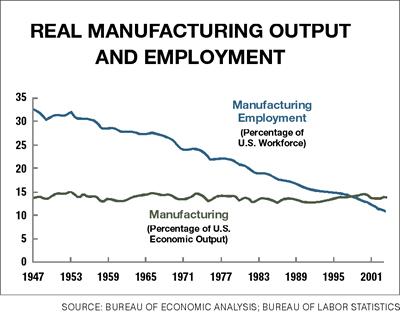
That was news to me too. Manzi spent the 1980's "as one small part of a self-conscious movement to rescue American manufacturing from its projected obsolescence." He compares the decline in 20th Century manufacturing jobs to the earlier decline in agricultural jobs. In both cases, we have fewer workers making more. Manzi has several other interesting insights.
Continue reading "Creative Destruction in U.S. Manufacturing"February 19, 2009
Calling All Economics Experts…
Would anyone with an understanding of markets and finance -- I know we have a few people qualified on this subject in our reading audience -- like to take a stab at filling in the details about the relationship between deficits, monetary policy and interest rates that former White House (under Reagan) and Treasury Department (under Bush II) official Bruce Bartlett briefly explained in a recent posting to National Review Online…
I do not believe that budget deficits are inherently stimulative. However, when we are in a liquidity trap, as we were in the 1930s and I believe we are today, deficits are essential to make monetary policy effective. Monetary policy provides the real stimulus. But it doesn't work when interest rates are close to zero.A longer version of Mr. Bartlett's economic prescriptions are available in his Forbes Magazine column, here.
February 17, 2009
Some Cheering Perspective
I'm not saying that we're imagining outsourcing, automation, and other economic factors, but it's nice to read such things as this from time to time:
It may seem like the country that used to make everything is on the brink of making nothing. In January, 207,000 U.S. manufacturing jobs vanished in the largest one-month drop since October 1982. Factory activity is hovering at a 28-year low. Even before the recession, plants were hemorrhaging work to foreign competitors with cheap labor. And some companies were moving production overseas. But manufacturing in the United States isn't dead or even dying. It's moving upscale, following the biggest profits, and becoming more efficient, just like Henry Ford did when he created the assembly line to make the Model T.The U.S. by far remains the world's leading manufacturer by value of goods produced. It hit a record $1.6 trillion in 2007 -- nearly double the $811 billion in 1987. For every $1 of value produced in China's factories, America generates $2.50.
We must continue to strive to better educate ourselves and find innovative ways in which to advance our economy (neither of which is a goal facilitated by an interventionist, nanny-state government). Rhode Island, being worse-off than the nation overall, would be a wonderful testing ground for a new paradigm of freedom and self-reliance.
(I know, I know. My boss is on vacation, and it's possible I'm letting the increased liberty go to my head.)
February 15, 2009
Welcome to the Era of Dependency
I have a question. Once the dust settles on the big grandchildren's money drop heading the states' way, how is our failed public finance system going to maintain all of this on top of the infrastructure and assets that it currently struggles to keep in one piece?
To Providence Mayor David N. Cicilline, new federal investment in his city means streetcars.Not the RIPTA buses with the fine wood trim that resemble trolleys. But real trolleys running on rails along city streets. He sees crater-pocked Bridgham Street in the city's Elmwood section and dozens of other neglected city streets and sidewalks finally repaved and refinished.
In Warwick, Mayor Scott Avedisian sees a new bridge over Mill Creek on Tidewater Drive, and maybe a boardwalk and a handicap-accessible pier at Gorton Pond, a freshwater pond that is a popular spot for bass fishermen and beachgoers.
In Pawtucket, Mayor James E. Doyle sees something that young city residents have been dreaming about for well over a decade: a skateboard park in the heart of the city, right across from McCoy Stadium, at Joseph Jenks Junior High School.
It's the dawn of a new era of big government, and big government spending. Millions of federal dollars are expected to come to Rhode Island as part of an economic stimulus plan.
The certainty of the windfall has inspired local cities and towns to dust off development plans, some long-held and many that may have just never had the money to begin with, in the hopes that maybe, finally, they’ll see the light of day.
Perhaps the most important whisper to heed comes from our Congressional delegation, which doesn't think the current borrow-and-spend plan is big enough. It's a sort of trap we're in:
- If the stimulus money doesn't boost the economy, the powers who be will insist that the windfall wasn't big enough, and nobody down the money-grubbing line will be inclined to disagree.
- If the stimulus money has a mild effect on the economy, the powers will say the same thing, and states will have all sort of new items and programs for which they have no real prospects of continued funding.
- And if by some miracle throwing borrowed money at the country really does revive the economy, it will be seen as having validated the principle, and the practice will be continued in good times and amplified even more in bad.
Some would argue that this monster will be something worse than ineffective.
Through it all, the spectacle of hearing officials of every layer of government, right down to small-town school committees, place their hopes and dreams in a federal check writer is evidence of that malignant addiction to receiving. Yes, it's the dawn of the Era of Dependency, and not a few paths that lead from here into the future begin the end of the United States of America.
February 13, 2009
The Public/Private Disconnect
What takes up 10% of my weekly paycheck? Family health care, that's what. And that's just my share. My employer kicks in some, too.
Like so many other employees of small businesses, my company had to health-plan shop again this year to find a way of keeping costs down. In our case, the health care costs went up, just not as much as they would have if we hadn't switched plans. So now, like so many others, I take home a little less than I used to. That's just the way it is.
I'm not alone. You see, in the private sector, yearly reassessment of benefits is the norm. There's no locking in with contracts, no long term "promises." Be flexible or be out of business. Right now, tens of thousands of Rhode Islanders who work in the private sector are taking the hits, sucking it up and living with a little less. In many cases, it is necessary that employees recognize that they can either make a little sacrifice or say goodbye to their job or that of some of their co-workers and friends. I know of a few cases where people have taken pay cuts to stay employed. Or companies that have instituted mandatory furloughs to keep their doors open and avoid further layoffs. Imagine that? That's the simple reality in today's economy.
This is why the compassion meter is just about pegged at "0" when we hear public employees complaining about deals "made in good faith" being broken because they may have to endure reductions in their generous benefit packages or increases in their relatively minuscule co-pays and co-shares. There is no money. And politicians, wisely, are reticent to go to taxpayers asking for more. Everyone else is making sacrifices, now it's their turn.
Small-business owners and their employees are used to cinching their belts and spreading the hardship amongst themselves. That way, hopefully, we can help keep more people employed. Making a little less is better than none at all. The question we keep asking is, how come the public sector isn't willing to do the same for their "brothers and sisters" or the communities they serve?
February 12, 2009
OPEN FORUM: So Whaddya gonna do with your $13?
Hey, looks like the average Joes and Jills are going to get a whole $13 extra a week thanks to the "stimulus" bill. So, what are YOU gonna do with all that extra coin?
February 11, 2009
CBO analysis of House-passed porkulus bill
Here.
Sometimes pictures do tell more than words can say.
Correcting Myths About The Great Depression
Burton Folsom, Jr. on the Great Depression.
February 10, 2009
The Healthcare Trojan Horse in the Porkulus Bill
Betsy McCaughey writes:
...Tragically, no one from either party is objecting to the health provisions slipped in without discussion. These provisions reflect the handiwork of Tom Daschle, until recently the nominee to head the Health and Human Services Department.Senators should read these provisions and vote against them because they are dangerous to your health. (Page numbers refer to H.R. 1 EH, pdf version).
The bill’s health rules will affect “every individual in the United States” (445, 454, 479). Your medical treatments will be tracked electronically by a federal system. Having electronic medical records at your fingertips, easily transferred to a hospital, is beneficial. It will help avoid duplicate tests and errors.
But the bill goes further. One new bureaucracy, the National Coordinator of Health Information Technology, will monitor treatments to make sure your doctor is doing what the federal government deems appropriate and cost effective. The goal is to reduce costs and “guide” your doctor’s decisions (442, 446). These provisions in the stimulus bill are virtually identical to what Daschle prescribed in his 2008 book, “Critical: What We Can Do About the Health-Care Crisis.” According to Daschle, doctors have to give up autonomy and “learn to operate less like solo practitioners.”
Keeping doctors informed of the newest medical findings is important, but enforcing uniformity goes too far.
New Penalties
Hospitals and doctors that are not “meaningful users” of the new system will face penalties. “Meaningful user” isn’t defined in the bill. That will be left to the HHS secretary, who will be empowered to impose “more stringent measures of meaningful use over time” (511, 518, 540-541)
What penalties will deter your doctor from going beyond the electronically delivered protocols when your condition is atypical or you need an experimental treatment? The vagueness is intentional. In his book, Daschle proposed an appointed body with vast powers to make the “tough” decisions elected politicians won’t make.
The stimulus bill does that, and calls it the Federal Coordinating Council for Comparative Effectiveness Research (190-192). The goal, Daschle’s book explained, is to slow the development and use of new medications and technologies because they are driving up costs. He praises Europeans for being more willing to accept “hopeless diagnoses” and “forgo experimental treatments,” and he chastises Americans for expecting too much from the health-care system.
Elderly Hardest Hit
Daschle says health-care reform “will not be pain free.” Seniors should be more accepting of the conditions that come with age instead of treating them. That means the elderly will bear the brunt.
Medicare now pays for treatments deemed safe and effective. The stimulus bill would change that and apply a cost- effectiveness standard set by the Federal Council (464).
The Federal Council is modeled after a U.K. board discussed in Daschle’s book. This board approves or rejects treatments using a formula that divides the cost of the treatment by the number of years the patient is likely to benefit. Treatments for younger patients are more often approved than treatments for diseases that affect the elderly, such as osteoporosis.
In 2006, a U.K. health board decreed that elderly patients with macular degeneration had to wait until they went blind in one eye before they could get a costly new drug to save the other eye. It took almost three years of public protests before the board reversed its decision.
Hidden Provisions
If the Obama administration’s economic stimulus bill passes the Senate in its current form, seniors in the U.S. will face similar rationing. Defenders of the system say that individuals benefit in younger years and sacrifice later.
The stimulus bill will affect every part of health care, from medical and nursing education, to how patients are treated and how much hospitals get paid. The bill allocates more funding for this bureaucracy than for the Army, Navy, Marines, and Air Force combined (90-92, 174-177, 181).
Hiding health legislation in a stimulus bill is intentional. Daschle supported the Clinton administration’s health-care overhaul in 1994, and attributed its failure to debate and delay. A year ago, Daschle wrote that the next president should act quickly before critics mount an opposition. “If that means attaching a health-care plan to the federal budget, so be it,” he said. “The issue is too important to be stalled by Senate protocol.”
More Scrutiny Needed
On Friday, President Obama called it “inexcusable and irresponsible” for senators to delay passing the stimulus bill. In truth, this bill needs more scrutiny.
The health-care industry is the largest employer in the U.S. It produces almost 17 percent of the nation’s gross domestic product. Yet the bill treats health care the way European governments do: as a cost problem instead of a growth industry. Imagine limiting growth and innovation in the electronics or auto industry during this downturn. This stimulus is dangerous to your health and the economy.
The actual article has all the links.
Welcome to the beginnings of socialistic medicine in the United States. Brought to you by your favorite community organizer. It's not like he didn't tell us his intentions in advance.
Think about it: If you oppose the porkulus, Obama says you are a partisan. And if you don't cave to these terms asap, Obama says it will turn into a catastrophe.
Isn't hope and change simply wonderful?
February 9, 2009
Forbes: America's Two Nations
Forbes magazine examines the difference between America's private and public sector (H/T):
In public-sector America things just get better and better. The common presumption is that public servants forgo high wages in exchange for safe jobs and benefits. The reality is they get all three. State and local government workers get paid an average of $25.30 an hour, which is 33% higher than the private sector's $19, according to Bureau of Labor Statistics data. Throw in pensions and other benefits and the gap widens to 42%.Continue reading "Forbes: America's Two Nations"***
Cops and firemen initially were granted early retirement because their work was physically demanding and they tended to die young. These days they live as long as everyone else, but early retirement lives on for an ever expanding pool of public workers. So do liberal disability rules. Nevada law 617.457 decrees that heart disease among uniformed safety workers is job-related. The medical reality, says the American Heart Association, is that a fireman gets heart disease from diet, lack of exercise or genes, not from dashing into burning buildings. Still, veteran Las Vegas firemen hobbled by heart disease can collect an inflation-protected $40,000 a year for life on top of their pension. That applies even if they're healthy enough to work in another occupation.
***
All this would be infuriating enough if public employees were merely retiring with pensions that paid out a reasonable percentage of their working wages. Instead, they have found legions of ways to boost payments well beyond those levels. In New York, Philadelphia and several other cities police officers rack up huge amounts of overtime in their last two or three years on the job to goose the base pay used to calculate lifetime pension benefits.
February 7, 2009
Challenging the socialistic onslaught
As Obama, Pelosi and Reid accelerate the implementation of socialistic practices in America - building on what Bush started - it is helpful and necessary to reacquaint ourselves with fundamental economic principles and some specific significant issues animating today's public debate.
FUNDAMENTAL ECONOMIC PRINCIPLES
The 17-blog post series below was originally put together in 2006 and contains excerpts from the writings of Thomas Sowell, Reason magazine, Bruce Caldwell, Friederich Hayek, Milton Friedman, Arthur Seldon, Gordon Tullock, Jane Shaw, Lawrence Reed, The Freeman magazine, Leonard Read, Donald Boudreaux, John Gray, Bertrand de Jouvenel, and Michael Novak, with links to others like Walter Williams, David Boaz, and David Schmidtz:
No matter how emphatically these politicians rant and rave in their effort to re-write history, they cannot re-write the basic laws of economics. As a Reverend once said, those chickens will come home to roost at some point. The only question is when and how big a price we will pay when it happens.
PRIMERS ON ECONOMICS
As some of the above posts note and as further ammunition for the public debate, these books are excellent primers on important economic topics:
- James Gwartney et al - Common Sense Economics: What Everyone Should Know About Wealth and Prosperity
An excellent site for articles, blogging, and podcasts on a broad range of economic issues is Library of Economics and Liberty.
Furthermore, the budding public debate in America touches on 5 significant issues, highlighted below and drawing on the 17 blog posts:
ISSUE #1: UNDERSTANDING THE GREAT DEPRESSION
Since numerous politicians and the media are already trying to re-write the history of the Great Depression so as to justify a significantly larger role for the federal government in our society, we need to arm ourselves for that debate. Here are some good starting points:
Not for the casual reader, here is the book which famously explained how monetary policy was a fundamental cause of the Great Depression:
ISSUE #2: GRASPING THE ACTUAL INCENTIVES WHICH DRIVE GOVERNMENTAL ACTIONS
As part of their argument for a more intrusive government, one of the core arguments of the Left is that interventions by government in the marketplace are somehow more high-minded and of purer intent than private sector actions in the same marketplace.
Part VIII in the above blog series describes public choice theory, which explains the fallacy of that world view. While false, it is nonetheless a pervasive view that holds sway in many minds - even if not articulated explicitly - and has to be tackled directly.
Here are some excerpts from Part VIII about government failure:
...Many economics writers and teachers still present economic systems of exchange between private individuals or firms as "imperfect" and requiring "correction" by government. Most teachers of politics, politicians, and political journalists still present government as well-meaning and able to remove such "imperfections."...In the past many economists have argued that the way to rein in "market failures"...is to introduce government action. But public choice economists point out that there also is such a thing as "government failure."...
...that government is imperfect carries with it two consequences. The first is that imperfections in the market process do not necessarily call for government intervention; the second is a desire to see if we cannot do something about government processes that might conceivably improve their efficiency...
Although public choice economists have focused mostly on analyzing government failure, they also have suggested ways to correct problems. For example, they argue that if government action is required, it should take place at the local level whenever possible. Because there are many local governments, and because people "vote with their feet," there is competition among local governments, as well as some experimentation...
What causes governmental failure?
...One of the chief underpinnings of public choice theory is the lack of incentives for voters to monitor government effectively...the voter is largely ignorant of political issues and that this ignorance is rational. Even though the result of an election may be very important, an individual's vote rarely decides an election.Public choice economists point out that this incentive to be ignorant is rare in the private sector...he or she pays only for the [purchased item] chosen. If the choice is wise, the buyer will benefit; if it is unwise, the buyer will suffer directly. Voting lacks that kind of direct result...
Public choice economists also examine the actions of legislators. Although legislators are expected to pursue the "public interest," they make decisions on how to use other people's resources, not their own. Furthermore, these resources must be provided by taxpayers and by those hurt by regulations whether they want to provide them or not...Efficient decisions, however, will neither save their own money nor give them any proportion of the wealth they save for citizens. There is no direct reward for fighting powerful interest groups in order to confer benefits on a public that is not even aware of the benefits or of who conferred them. Thus, the incentives for good management in the public interest are weak. In contrast, interest groups are organized by people with very strong gains to be made from governmental action. They provide politicians with campaign funds and campaign workers. In return they receive at least the "ear" of the politician and often gain support for their goals.
In other words, because legislators have the power to tax and to extract resources in other coercive ways, and because voters monitor their behavior poorly, legislators behave in ways that are costly to citizens.
...bureaucrats in government...incentives explain why many regulatory agencies appear to be "captured" by special interests...Capture occurs because bureaucrats do not have a profit goal to guide their behavior. Instead, they usually are in government because they have a goal or mission. They rely on Congress for their budgets, and often the people who will benefit from their mission can influence Congress to provide more funds. Thus interest groups...become important to them. Such interrelationships can lead to bureaucrats being captured by interest groups...
Or, as is stated in Part III about any government action:
...One of the recurring themes in our consideration of various policies and institutions...has been the distinction between the goals of these policies and institutions versus the incentives they create...What must be asked about any goal is: What specific things are going to be done in the name of that goal? What does the particular legislation or policy reward and what does it punish? What constraints does it impose? Looking to the future, what are the likely consequences of such incentives and constraints? Looking back at the past, what have been the consequences of similar incentives and constraints in other times and places?...
Now, does any sane person believe that the railroading of a nearly $1 trillion spending spree in about two weeks by Obama, Pelosi and Reid passes the smell test here?
Similarly, the financial crisis of the last year has provided numerous examples of governmental actions and inactions which created incentives for tawdry behaviors in the marketplace. Meanwhile, governmental agencies or individual players have not only suffered no adverse consequences but they are now using these recent events as justification for further governmental involvement in economic activities.
ISSUE #3: THE ROLE OF TACIT KNOWLEDGE IN COORDINATING ACTIONS IN A FREE MARKETPLACE
As Bastiat noted in the 1800's, Paris got fed every day without anyone intentionally planning that outcome. Similarly, Part XII above describes how a pencil is made without one person knowing or doing all the work. Why do those outcomes occur?
Appreciating how these outcomes occur via prices which comunicate the knowledge that enables individuals to coordinate their actions and create economic value is a critical issue usually ignored by public sector players. For example, when they aggressively insert disruptive government actions into the marketplace via a TARP bailout and pork-intensive spending legislation. Contrast that blunt hammer approach with potential legislation which seeks to alter incentives in a way which encourages certain constructive economic behaviors to happen naturally.
Parts III and IV above elaborate further on the role of dispersed knowledge:
...In addition to the role of incentives and constraints, one...other central theme has been the role of knowledge......the role of prices...[is to coordinate]...social action where knowledge is dispersed...
Hayek...zeroed in on the critical assumption of full or perfect information. He said that in the real world, we have millions of individuals who have little bits of knowledge. No one has full knowledge, and yet we see a great deal of social coordination...How does that happen? Hayek's answer is that a market system ends up coordinating individual activity. Millions of people are out there pursuing their own interests, but the net result is a coordination of economic activities. And prices are the things that contain people's knowledge.
Mainstream economists have picked up on this and talk about prices as containing information. Modern information theory certainly nods to Hayek as a precursor. He argued that pricing contains knowledge of specific time and place and the man on the spot. Prices contain knowledge that is tacit, that can't really be expressed by individuals. Individuals make actions in markets, and that's what causes prices to be what they are. People are acting in markets. They are not always explicitly saying why they are acting, but they are acting on their knowledge of local situation, the past, and more...
...Given the decisive advantages of knowledge and insight in a market economy...we can see why market economies have outperformed other economies that depend on ideas originating within a narrow elite of birth or ideology. While market economies are often thought of as money economies, they are still more so knowledge economies, for money can always be found to back new insights, technologies and organizational methods that work...Capital is always available under capitalism, but knowledge and insight are rare and precious under any system.
Knowledge can be bought and sold in a free market, like anything else...
...In all these cases, it was the knowledge that was built up over the years - the human capital - which ultimately attracted the financial capital to make ideas become reality...
Success is only part of the story of a free market economy. Failure is at least as important a part, though few want to talk about it and none want to experience it...Economics is not about "win-win" options, but about often painful choices in the allocation of scarce resources which have alternative uses. Success and failure are not isolated good fortunes and misfortunes, but inseparable parts of the same process.
All economies...are essentially ways of cooperating in the production and distribution of goods and services, whether this is done efficiently or inefficiently, voluntarily or involuntarily...
By portraying cooperative activities as if they were zero-sum contests...those with the power to impose their misconceptions on others through words or laws can create a negative-sum contest, in which all are worse off...
More on prices/knowledge is in Parts X and XI above.
Friedrich Hayek addressed the subject of knowledge in a seminal 1945 article and his 1974 Nobel Prize speech:
ISSUE #4: RELEARNING THE FATAL FLAWS OF SOCIALISM
In a simplistic layman's nutshell, one could say that the failure of socialism rests on its assuming away the real government incentives problem described in Issue #2 while blocking the flow of knowledge required to enable a free marketplace as depicted in Issue #3.
If you want to better understand and counter the world view which drives the socialistic mentality, here are some classics which rigorously address the fatal flaws of various shades of socialism:
Parts XVI and XVII above discuss the ethics of redistributive policies and the meaning of social justice, two themes which run through socialistic thought and require the coercive force of government. Part IX above elaborates further on the coercive nature of government. Part XV above discusses the consequences of price controls.
ISSUE #5: LIBERTY & THE PROPER ROLE OF GOVERNMENT IN A FREE SOCIETY
The impact of the confusion regarding Issue #2 has caused the core American principle of liberty to be missing in action in the current public debate.
This lack of focus on liberty can translate into policies which have a repressive definition of equality measured by outcomes instead of the liberating equality of opportunity; see Part XIV above for further thoughts.
More specifically, this lack of focus on liberty has further highlighted the lack of commonly shared beliefs about the proper role of government if America is to remain a free society - a topic discussed in Part VII above, including these excerpts about the role of government:
...The widespread use of the market reduces the strain on the social fabric by rendering conformity unnecessary with respect to any activities it encompasses. The wider the range of activities covered by the market, the fewer are the issues on which explicitly political decisions are required and hence on which it is necessary to achieve agreement. In turn, the fewer the issues on which agreement is necessary, the greater is the likelihood of getting agreement while maintaining a free society....a good society requires that its members agree on the general conditions that will govern relations among them, on some means of arbitrating different interpretations of these conditions, and on some device for enforcing compliance with the generally accepted rules...most of the general conditions are the unintended outcome of custom, accepted unthinkingly...no set of rules can prevail unless most participants most of the time conform to them without external sanctions...But we cannot rely on custom or on this consensus alone to interpret and to enforce the rules; we need an umpire. These then are the basic roles of government in a free society: to provide a means whereby we can modify rules, to mediate differences among us on the meaning of the rules, and to enforce compliance with the rules on the part of those few who would otherwise not play in the game.
...the organization of economic activity through voluntary exchange presumes that we have provided, through government, for the maintenance of law and order to prevent coercion of one individual by another, the enforcement of contracts voluntarily entered into, the definition of the meaning of property rights, the interpretation and enforcement of such rights, and the provision of a monetary system.
The role of government just considered is to do something that the market cannot do for itself, namely, to determine, arbitrate, and enforce the rules of the game...
Parts V and VI discuss what combination of economic freedom and limited government enables liberty for us:
...How can we benefit from the promise of government while avoiding the threat to freedom? Two broad principles embodied in our Constitution give an answer...First, the scope of government must be limited. Its major function must be to protect our freedom both from the enemies outside our gates and from our fellow-citizens: to preserve law and order, to enforce private contracts, to foster competitive markets...By relying primarily on voluntary co-operation and private enterprise, in both economic and other activities, we can insure that the private sector is a check on the powers of the governmental sector...
The second broad principle is that government power must be dispersed...If government is to exercise power, better in the county than in the state, better in the state than in Washington. If I do not like what my local community does...I can move to another local community, and though few may take this step, the mere possibility acts as a check...If I do not like what Washington imposes, I have few alternatives in this world of jealous nations...
...The power to do good is also the power to do harm; those who control the power today may not tomorrow; and, more important, what one man regards as good, another may regard as harm...
The preservation of freedom is the protective reason for limiting and decentralizing governmental power. But there is also a constructive reason. The great advances of civilization...have never come from centralized government...
Government can never duplicate the variety and diversity of individual action...[see Part XIII above for more on how the individual is the unit of economic action]
It is widely believed that politics and economics are separate and largely unconnected; that individual freedom is a political problem and material welfare an economic problem...such a view is a delusion...
Economic arrangements play a dual role in the promotion of a free society. On the one hand, freedom in economic arrangements is itself a component of freedom broadly understood, so economic freedom is an end in itself. In the second place, economic freedom is also an indispensible means toward the achievement of political freedom...
Viewed as a means to the end of political freedom, economic arrangements are important because of their effect on the concentration or dispersion of power...competitive capitalism also promotes political freedom because it separates economic power from political power and in this way enables the one to offset the other...
Because we live in a largely free society, we tend to forget how limited is the span of time and the part of the globe for which there has ever been anything like political freedom: the typical state of mankind is tyranny, servitude, and misery. The nineteenth century and early twentieth century in the Western world stand out as striking exceptions to the general trend of historical development. Political freedom in this instance clearly came along with the free market and the development of capitalist institutions...
History suggests only that capitalism is a necessary condition for political freedom. Clearly it is not a sufficient condition...
The relation between political and economic freedom is complex and by no means unilateral...
As [nineteenth-century, not twentieth-century] liberals, we take freedom of the individual, or perhaps the family, as our ultimate goal in judging social arrangements. Freedom as a value in this sense has to do with the interrelationship between people...in a society freedom has nothing to say about what an individual does with his freedom; it is not an all-embracing ethic...a major aim of the liberal is to leave the ethical problem for the individual to wrestle with. The "really" important ethical problems are those that face an individual in a free society - what he should do with his freedom. There are thus two sets of values that a liberal will emphasize - the values that are relevant to relations among people, which is the context in which he assigns first priority to freedom; and the values that are relevant to the individual in the exercise of his freedom, which is the realm of individual ethics and philosophy.
The liberal conceives of men as imperfect human beings. He regards the problem of social organizations to be as much a negative problem of preventing "bad" people from doing harm as of enabling "good" people to do good...
Fundamentally, there are only two ways of co-ordinating the economic activities of millions. One is central direction involving the use of coercion - the technique of the army and of the modern totalitarian state. The other is voluntary co-operation of individuals - the technique of the market place.
The possibility of co-ordination through voluntary co-operation rests on the elementary - yet frequently denied - proposition that both parties to an economic transaction benefit from it, provided the transaction is bi-laterally voluntary and informed.
Exchange can therefore bring about co-ordination without coercion...
...Political freedom means the absence of coercion of a man by his fellow men. The fundamental threat to freedom is power to coerce...The preservation of freedom requires the elimination of such concentration of power to the fullest extent and the dispersal and distribution of whatever power cannot be eliminated - a system of checks and balances. By removing the organization of economic activity from the control of political authority, the market eliminates this source of coercive power. It enables economic strength to be a check to political power rather than a reinforcement.
Economic power can be widely dispersed...Political power, on the other hand, is more difficult to decentralize...if economic power is joined to political power, concentration seems almost inevitable. On the other hand, if economic power is kept in separate hands from political power, it can serve as a check and a counter to political power...
CONCLUSION
With the framework provided by the points raised in this post, we can assess and join in the public debate about the policy proposals we will see over the next few years. Along the way as we defend the marketplace, we will have to be careful to distinguish between crony capitalism/corporate welfare and the innovation arising from the more competitive entrepreneurial capitalism as well as ask ourselves if our private sector leaders, public sector leaders and citizens are holding themselves to a high enough set of ethical standards and transparency in their public behaviors. I predict that finding a way to do the latter in a way that promotes liberty and personal accountability without increasing the number of laws and regulations will be critical to neutralizing the self-righteousness and influence of those who promote various forms of coercive socialism today. In that sense, winning the debate will require a modified strategy from what worked in the 20th century.
Finally, as another part of the discussion, we should also not forget to draw strength from the unique principles underlying our American Founding, including equality before God, as we engage in this ideological struggle to retain our liberty.
February 4, 2009
Democrats "Staunchly Opposed" to a Stimulus for Regular Folks
According to the New York Times, "senior Democratic lawmakers" are opposed to the Republican proposal to create a long-term stimulus by lowering mortgage rates...
[Senator Mitch McConnell] has proposed that the federal government subsidize mortgages with a fixed interest rate of 4 percent to 4.5 percent. Fannie Mae and Freddie Mac, the two government-controlled mortgage-finance companies, would use their buying power in the mortgage market to drive the rates down....Translation: Responsible, middle-class folks who have been scraping by, but are feeling strained because of the condition of the broader economy have no place in the Democratic agenda.The low rates would be open to any “creditworthy” borrowers, which would probably exclude many if not most homeowners who are now facing foreclosure. But supporters of the plan argue that it would help lift housing prices, which would make it easier for troubled homeowners to either refinance or sell their houses.
But senior Democratic lawmakers are staunchly opposed to the plan, warning that the costs could climb as high as $1 trillion.
Isn't this the best reason you've heard so far for supporting the McConnell plan?
February 3, 2009
Stimulus is no Cure-All for Rhode Island
This is a political wonder that manages to spend money on just about every pent-up Democratic proposal of the last 40 years....this bill was written based on the wish list of every living -- or dead -- Democratic interest group.Here in Rhode Island, Governor Carcieri is trying to explain (in a radio ad) that the Ocean State's portion of the package will do nothing to solve the long-term problems that got us into these straits.
With a federal bailout on its way, some may think Rhode Island’s budget crisis will soon be over. But don’t be fooled by those who would ignore the real issues, and simply patch the budget with this newfound money. Such sudden windfalls may solve our immediate budget problem, but in the long run they will only make things worse.North Providence Mayor Charles Lombardi welcomes the relief--a "shot in the arm"--but agrees with the Governor and recognizes that it's not a cure-all. For their part, the ProJo sought out the always-present NEA official for his (original?) comments:
This was the response from Patrick Crowley, assistant executive director of National Education Association Rhode Island, after hearing the Carcieri radio spot: “The governor’s so-called recovery plan was nothing more than a conservative wish list of proposals having very little to do with the economic plight of working Rhode Islanders. What the people of Rhode Island need today is leadership, not finger pointing or campaign attack ads. “But more importantly, the people of Rhode Island need good-paying jobs and the stimulus package from the federal government is just the shot in the arm our state economy needs,” he said.Must be running close to the end of the playbook and running out of "original" material. Meanwhile, I found this graphic, well, illustrative!

A Stimulus Proposal that Even Responsible, Non-Politically Connected Americans Can Love?
If there is going to be a major binge of stimulus spending in one form or another, and since Fannie Mae and Freddie Mac have already been taken over by the government anyway, doesn't this stimulus proposal being put forth by Senate Republicans make a lot of sense, because it brings regular folks who have been spending responsibly and living within their means into the program...
Senate Minority Leader Mitch McConnell, R-Ky., told reporters Monday that Republicans would offer a plan to have the government step in to reduce mortgage rates to around 4 percent, which could shore up home prices and lower housing payments for millions of Americans.Yeas or nays, anyone?"A stimulus bill must fix the main problem first, and that's housing," McConnell said. "That's how all of this began. We think you ought to go right at housing first."
Republicans want to have banks lower the interest rates to 4 percent or 4.5 percent on 30-year fixed rate loans, up to a certain cap. Rates could drop if Fannie Mae and Freddie Mac agreed to buy the mortgages.
The two companies were seized by the government in September, and have bought the majority of the new home loans issued over the past year because Wall Street's appetite for mortgage securities has vanished. The new rates would be available through 2010 for both new purchases and refinanced loans.
February 2, 2009
Money Makes the World Go Mad
Disappointingly, URI economics professor Len Lardaro sums up the zeitgeist of the times:
"These may not be stimulus funds in the strict sense," Lardaro said, but they convey the sense that government is attacking the crisis head on.
Bryant's Edinaldo Tebaldi displays another symptom of the intellectual virus currently infecting economics academia:
To Tebaldi, the separate streams of money expanding unemployment insurance, food stamps and home heating aid for the poor are necessary parts of the stimulus blend. "You cannot let people suffer if it can be avoided," he said.
For his part, Representative Pat Kennedy runs onto the thin ice that cooler heads have avoided:
Democrats disagree, of course, and some, including Rep. Patrick J. Kennedy fear that the stimulus bill — far from being too expansive — is too timid."We need a bolder vision," said Kennedy.
Personally, I think these speakers — especially the academics — provide a fine expansion to economist William Poole's observation in the article:
A new program to extend Medicaid to the unemployed at all income levels might have the perverse incentive of prompting people to pass up job opportunities that do not carry health insurance, Poole said.
Thus grows the gravity of an expanding government. Little wonder that professors — whether employed by public universities or merely benefiting from huge government subsidies and lending for higher education tuition — move toward the principle that government must be seen to be doing something — that pouring money drawn from some unmentioned corner of the financial universe onto "suffering" is a moral imperative.
The reality ignored is that none of these steps can "jump start" the economy; at best, they have some chance of forestalling utter collapse, in the hopes that the next bubble will begin to inflate before the temporary bridge crumbles. At this magnitude, however, the effort may be draining gallons rather than sprinkles of precisely those resources and incentives that ultimately generate the booms. The money and initiative is being taken out of the striving and entrepreneurial segments of the economy in order to support bureaucrats, workers, non-workers, and the already rich. The larger the expenditure, the less likely it is that the next lurch forward will ever come.
Kennedy, no doubt, exists in the blissfully ignorant state of a kid gathering snowflakes on his tongue. One can only hope that the economists feel some small twinge from the deep-down knowledge that they're merely rationalizing a calamitous economic blunder.
January 30, 2009
401k, 401k, Wherefore art thou oh 401k?
John Kostrzewa's article on the failure of the 401(k) in this past Sunday's ProJo (which didn't go immediately on line, for some reason) hit home for many, I'm sure. He focuses on the fact that the 401(k) "system" requires rank amateurs to make relatively un-educated investment decisions. He has a point, but it's not just the untrained, risk-taking (or naive) investors who have taken a bath in this market. Even careful investors who take the time to educate themselves have been hit hard. I'm no financial wiz, but I do my homework and I've now got less in my 401(k) than what I've actually contributed over the past 12 years. The mattress would have been better (I kid....I think...). So, how did we get to rely on the 401(k) so much?
The reason for the tumult is that the self-guided 401(k) replaced defined-benefit plans in which companies guaranteed a pension for loyal workers. Under the pension plan system, companies assigned professionals to mange pools of money to make sure the funds would be there to cover a worker’s retirement.It sure has. Kostrzewa mentions some possible solutions, but this WSJ piece by Anne Tergesen is much more in-depth. I still think the 401(k) is an important piece of the equation, but only a piece.But it was expensive. And Congress was convinced to expand the availability of the 401(k), which was written into law in 1978 and for years used only as a supplement to the pension and Social Security system.
The use of 401(k)s expanded as the philosophy of an “ownership society” took hold and the responsibility and risk of planning a financial future shifted to individuals. The 401(k) program grew to 50 million Americans with $2.5 trillion in total assets.
For awhile, during the bull markets, everybody seemed happy with the switch. But the bear market that has devalued stocks, and sliced 401(k) investments, has exposed the flaws.
Porkulus
Ben Stein (h/t) boils the "porkulus" package down:
I love this. The new kind of politics of hope. Eight hours of debate in the HR to pass a bill spending $820 billion, or roughly $102 billion per hour of debate.Only ten per cent of the "stimulus" to be spent on 2009.
Close to half goes to entities that sponsor or employ or both members of the Service Employees International Union, federal, state, and municipal employee unions, or other Democrat-controlled unions.
This bill is sent to Congress after Obama has been in office for seven days. It is 680 pages long. According to my calculations, not one member of Congress read the entire bill before this vote. Obviously, it would have been impossible, given his schedule, for President Obama to have read the entire bill.
For the amount spent we could have given every unemployed person in the United States roughly $75,000.
We could give every person who had lost a job and is now passing through long-term unemployment of six months or longer roughly $300,000.
There has been pork barrel politics since there has been politics. The scale of this pork is beyond what had ever been imagined before -- and no one can be sure it will actually do much stimulation.
January 28, 2009
Re: "40 Year Wish List"
Another excerpt from that excellent WSJ article cited by Marc:
... by our estimate only $90 billion out of $825 billion, or about 12 cents of every $1, is for something that can plausibly be considered a growth stimulus. And even many of these projects aren't likely to help the economy immediately.
One of the many sound reasons against any government bailout ... sorry, stimulus package - can someone please advise the difference between a gov't bailout and gov't stimulus? - is the Congressional variation of Newton's First Law of Motion ("A body in motion will stay in motion ..."): A legislative body in spending mode will stay in spending mode. Gee, we're already spending on this, why don't we spend on that? Limiting this bill to expenditures of genuine economic stimulus proved too predictably impossible for the House.
Digging a little deeper, the reason for Newton's First Law of Congressional Spending is the necessity to purchase the voting cooperation of several hundred people. These people, while they definitely back everything the President wants to do and may or may not actually believe in the efficacy of this stimulus package (but what the heck, let's give it a shot), above all, want to go back to their home district waving a fist full of federal goodies. And in this case, passage of $98 billion of economic stimulus required a staggering $720 billion of pointless spending federal goodies to purchase a sufficient number of yea votes.
If members of Congress cannot see the intrinsic value of such legislation without expensive political inducement, it is far safer, far better not to start the spending in motion to begin with.
"40 Year Wish List"
WSJ:
"Never let a serious crisis go to waste. What I mean by that is it's an opportunity to do things you couldn't do before."So said White House Chief of Staff Rahm Emanuel in November, and Democrats in Congress are certainly taking his advice to heart. The 647-page, $825 billion House legislation is being sold as an economic "stimulus," but now that Democrats have finally released the details we understand Rahm's point much better. This is a political wonder that manages to spend money on just about every pent-up Democratic proposal of the last 40 years.
We've looked it over, and even we can't quite believe it. There's $1 billion for Amtrak, the federal railroad that hasn't turned a profit in 40 years; $2 billion for child-care subsidies; $50 million for that great engine of job creation, the National Endowment for the Arts; $400 million for global-warming research and another $2.4 billion for carbon-capture demonstration projects. There's even $650 million on top of the billions already doled out to pay for digital TV conversion coupons....
This is supposed to be a new era of bipartisanship, but this bill was written based on the wish list of every living -- or dead -- Democratic interest group. As Speaker Nancy Pelosi put it, "We won the election. We wrote the bill." So they did. Republicans should let them take all of the credit.
January 25, 2009
Robert Reich - Some Follow Up Questions
Setting aside the fact that he apparently didn't get Martin Luther King Jr.'s memo, can former Labor Secretary Robert Reich please clarify several confusing aspects of his remarks a couple of weeks ago in front of the House Democratic Steering and Policy Committee? Outlining what he believes should be the focus of President Obama's economic stimulus, he said [h/t NewsBusters]
I am concerned, as I'm sure many of you are, that these jobs not simply go to high school people who are already professionals or to white male construction workers. I have nothing against white male construction workers. I'm just saying that there are a lot of other people who have needs as well.And therefore, in my remarks, I have suggested to you, and I'm certainly happy to talk about it more, ways in which the money can be -- criteria can be set so that the money does go to others. The long- term unemployed, minorities, women, people who are not necessarily construction workers or high skilled professionals.
1.) "high school people who are already professionals"
Don't most professionals possess education beyond the high school level? So are you opposed to high school graduates receiving government stimulus money or professionals receiving it? [Edit: To quote Emily Litella, never mind. Andrew just pointed out that I mis-read "high skilled" as "high school".]
2.) "there are a lot of other people who have needs as well"
So among all the needy people in the country, you wish Congress to choose certain ones who will receive this government largesse. What do you propose as their criteria for making this selection? Will such criteria identify those who are neediest? Or is that not a requisite?
3.) "people who are not necessarily construction workers or high skilled professionals"
Isn't this stimulus money supposed to go to rebuild the national infrastructure? How would we accomplish that without employing construction workers, architects and engineers?
As to the theory that underlies his remarks:
And that vicious cycle is that because consumers don't have the money, then businesses are not going to produce. And if businesses don't produce, they're going to lay people off. And if they lay people off people have even less money.
In fact, Mr. Reich indicates that much of the stimulus package should be spent on expanded unemployment benefits, food stamps and aid to state governments. Is there any indication, any basis to assert that directing large amounts of money in these particular directions will pull our economy out of its slump?
Further, stipulating for a moment that simply getting money into certain people's hands as fast as possible however we do it is the right answer, whose money would we give them? Who would fund this massive distribution of government money?
Which Way to Stimulate
Bruce Bartlett's summary of the past 80 years of stimulus debate is well worth a few minutes of your time. He concludes thus:
The problem is that fiscal stimulus needs to be injected right now to counter the liquidity trap. If that were the case, I think we might well get a very high multiplier effect this year. But if much of the stimulus doesn't come online until next year, when we are likely to be past the worst of the slowdown, then crowding out will greatly diminish the effectiveness of the stimulus, just as the critics argue. According to the Congressional Budget Office, only a fraction of proposed infrastructure spending can be spent before October of next year; the bulk would come long after. ...... I think there is a better case for stimulating the economy through tax policy than has been made. Congress can change incentives instantly by, for example, saying that new investments in machinery and equipment made after today would qualify for a 10% Investment Tax Credit, and this measure would be in effect only for investments largely completed this year. Businesses will start placing orders tomorrow. By contrast, it will take many months before spending on public works begins to flow through the economy, and it is very hard to stop it when the economy turns around.
Stimulus based on private investment also has the added virtue of establishing a foundation for future growth, whereas consumption spending does not. As economist Hal Varian of the University of California at Berkeley recently put it, "Private investment is what makes possible future increases in production and consumption. Investment tax credits or other subsidies for private sector investment are not as politically appealing as tax cuts for consumers or increases in government expenditure. But if private investment doesn't increase, where will the extra consumption come from in the future?"
It's important to note, especially given his right-leaning conclusion, that Bartlett treats the discussion from a purely academic point of view, while much of the debate between supply-siders and Keynesians has actually been political. Readers are free to disagree, but I'd place the bulk of the blame for that with the latter group, which tends to see government spending as a means of reshaping society in a way that they believe to be better. They're less concerned, that is, with comprehension of economic reality than with implementing a social program.
In the current debate, that observation brings us around to the prognostications of Dick Morris that have gotten so much play over the past few days:
2009-2010 will rank with 1913-14, 1933-36, 1964-65 and 1981-82 as years that will permanently change our government, politics and lives. Just as the stars were aligned for Wilson, Roosevelt, Johnson and Reagan, they are aligned for Obama. Simply put, we enter his administration as free-enterprise, market-dominated, laissez-faire America. We will shortly become like Germany, France, the United Kingdom, or Sweden — a socialist democracy in which the government dominates the economy, determines private-sector priorities and offers a vastly expanded range of services to many more people at much higher taxes.Obama will accomplish his agenda of "reform" under the rubric of "recovery." Using the electoral mandate bestowed on a Democratic Congress by restless voters and the economic power given his administration by terrified Americans, he will change our country fundamentally in the name of lifting the depression. His stimulus packages won't do much to shorten the downturn — although they will make it less painful — but they will do a great deal to change our nation.
January 20, 2009
So How Will He Do?
Fans of our new president perhaps imagine us non-fans as scowling through the day today, embittered by all that hope and rueful of the change to come. Me, I'm just going about my business, as I have on every inauguration day within my lifetime. That said, Andrew Stuttaford's suggestion is an attractive one, although I can't afford any of the Obama-branded merchandise that he subsequently lists:
It's better, I think, to borrow a few ideas from the Orange Alternative (Pomaranczowa Alternatywa). Fearless prankster surrealists of the Polish sort-of-Left from the 1980s, they used to taunt their country's crumbling Communist regime with cheers, not jeers, their specialty being sporadic displays of unsettlingly enthusiastic loyalty. These included a reenactment of the storming of the Winter Palace and a procession through the streets of Warsaw by 4,000 people chanting their love for Lenin. Now, I would not want to compare Obama with that other community organizer—no, not for a second!—but the cult of personality now surrounding our next president suggests that hosting an Orange Alternative inauguration dinner would be a perfect counterpoint to the pomp, sincerity, and cynicism on display in Washington. It'll also be an ideal opportunity to treat friends of all political persuasions to a confused, confusing, and almost certainly annoying celebration that can be read, as Obama has said about himself, in any way they like.
With a little more notice, a Long Live the King party might have been a pleasant way to spend this evening. Indeed, we could have begun with an extolment of a newly introduced bill from U.S. Representative Jose Serrano (D, NY) to repeal the 22nd Amendment and enable a longer reign for the One. Several party games involving the national debt and antes of coolness also come to mind.
The levity does raise a serious (if unanswerable) question, though: How is President Obama likely to do? The variables are infinite, and the wildcards too many to count. Not the least of the unknowns is what Obama will do, because his past is like a novelist's thumbnail sketch of a character. He's all personality.
The economy will be the irreducible determinant of his level of success, and there's little a president can actually do to affect it. Within the degree of economic influence that the government can be said to have, the general approach suggested by Obama and the Democrat Congress (with complicit Republicans, to be sure) does not give reason for optimism.
In order to escape recession and surpass stagnation, the economy requires an open field. That running room can emerge with a new technology that creates whole new industries. It can open up literally as new space to fill. Innovative financial tools can create economic activities as if out of air (or, as was the case with the recent bubble, make future income the open field). Where the government has built artificial walls, knocking them down in a spell of deregulation can free the economy. A newly opened national market can bring a burst in demand.
All of these possibilities are of like form — involving the creation, development, or discovery of voids that the economy can surge to fill — and none look likely in the near future. Put what hopes as we may into the everything-green movement, nothing new is being created; energy is still energy, and more cost-effective ways exist for creating it. The emphasis on government spending and "shovel ready" projects as stimulus may run the economic engine, but with nowhere to go, and eventually we'll run out of our borrowed fuel. New financial tools and deregulation are probably out of the question in the short term. And the international market is fraught with nations acting in their own interests.
Dealing with those foreign bodies is another variable. I believe the major players will postpone testing and challenging Obama for a while — not because the world sincerely wishes to see if the new U.S. president will govern in a way more to their liking than his predecessor, but out of strategy. If he takes his foot off the accelerator in the War on Terror, terrorist groups won't attempt an immediate strike; they'll regroup and rebuild, taking into account lessons learned since 9/11. Foreign powers such as Russia and China will want to see how sympathetic and manipulable Obama is. They'll begin to test him in ways so minor that it won't be immediately apparent that that's what they're doing.
In the meantime, once the elation of a new presidential face subsides, domestic turmoil may simmer as economic frustration spills over into the culture war. The left has its wish list out, and with Democrats controlling two branches of government, it will expect results. For its part, the right is arguably enlivened when on the defensive.
So in all of this, how will President Obama do? I won't hazard to say, but I will offer a three-part generality: Liberalism is a recipe for disaster; centrism is an inadequate approach when the economy requires inspiration, foreign affairs require a set jaw, and the sides refuse to let social issues balance; and powerful institutions have installed constructs to make conservatism a very painful option. Obama will probably shoot for a leftish centrism until circumstances knock over the fulcrum.
The real change, that brought by the tectonic forces of history, could be serendipitous or calamitous. Which it will be and how the president will react are questions sure to bring silence to the party.
January 18, 2009
Newly Discovered Concept: Self Interest
I'm not sure why anybody's surprised at bailout recipients' reaction:
At the Palm Beach Ritz-Carlton last November, John C. Hope III, the chairman of Whitney National Bank in New Orleans, stood before a ballroom full of Wall Street analysts and explained how his bank intended to use its $300 million in federal bailout money."Make more loans?" Mr. Hope said. "We're not going to change our business model or our credit policies to accommodate the needs of the public sector as they see it to have us make more loans."
There's really no way around the reality of human nature and its self interest — especially when the decision makers are acting in their capacity as employees or representatives of business entities. Add strings, and the question will become one of cost-benefit, and in this case, the government wanted to make sure that the money wasn't refused.
That's why I'm not sure what difference this is supposed to make:
That lack of specificity has led to calls for tighter restrictions on the next wave of disbursements, approved by the Senate last week as President-elect Barack Obama pledged to "change the way this plan is implemented and keep faith with the American taxpayer." The incoming administration promises to create a system to track how the money is spent and place stronger limitations on executive pay.
Track it or not, the recipients will siphon as much out of the funding flood as they can. They'll look out toward the future and leverage unplanned windfalls to increase their competitive edge when circumstances change, buying up or elbowing out smaller competitors. And if the government is so perspicacious as to know precisely how banks ought to spend the money, then there's no need for the middle man.
Me, I say that the government should learn from my financial straits: Spending money that you don't have doesn't patch the floor in hard times; it digs a hole.
January 11, 2009
The Declarational Power of the O
"O" continues to stand for "audacity":
President-elect Obama countered critics with an analysis yesterday by his economic team showing that a program of tax cuts and spending such as he has proposed would create up to 4.1 million jobs, far more than the 3 million that he has insisted are needed to lift the country out of recession.
Of course, in the AP style book, "showing" apparently means "insisting based on data and plans that remain secret":
Obama has provided few details of his $775 billion plan so far. This fresh report does not include the specific construction of his tax cuts, the amounts dedicated to state aid or public works -- key questions that Obama aides have closely held.Yesterday, economic aides and advisers wouldn't lay out even rough estimates for the plan's components. They said they worked with broad instructions from Obama but didn't want to limit negotiations with congressional leaders by outlining their limits in public.
In other words, there's more than a little showmanship involved in the declaration that the plan will now "save or create" an additional million jobs. This is a telling tidbit, though:
If Congress fails to enact a big economic recovery plan, Obama's advisers estimate that an additional 3 million to 4 million jobs will disappear before the recession ends.
It's conceivable that the Obama team revised its analysis upwards because updated economic indicators suggested another million jobs might be lost, and they're operating under the assumption that pumping a bunch of borrowed federal dollars into the economy will halt the slide. It's difficult enough to tell whether a particular action helped to create jobs; promises to "save" them on this scale are meaningless.
January 10, 2009
A Better Peace?
Like any patriot, I've got a problem with this:
U.S. manufacturers say they've learned to compete against China's lower wages. What they can't compete with are government subsidies that enable China to sell some finished products for less than the fiber alone costs in the United States.
The difficulty is in the solution. I've got my reservations about such manifestations of internationalism:
In an effort to mitigate the possibility of the Chinese dumping textiles, several members of Congress have called for the International Trade Commission to monitor Chinese textiles more closely now that the quotas are expiring. ...She initiated a case with the WTO to get China to stop its allegedly unfair trade practices, but it probably will be up to the incoming Obama administration to decide whether to file a formal case. China would face sanctions, such as penalty tariffs, if it didn't agree to stop violating trade rules.
No doubt, international organizations help to smooth the flow of history, and they probably do much to avert war. I wonder, though, at the cost of history with no sharp edges, as I wonder who benefits most from negotiated peace. The former will yield no satisfying answers until an edge pokes through the veneer and we all observe how well the tear heals. The answer to the latter would seem to be "the aggressor."
An aggressive nation like China will seek ways — in front of and behind the podium — to influence votes on any relevant council, and the outcome will be the imposition of various members' desires. On the other hand, if the United States acted alone, explicitly matching China's nakedly self-interested actions, the Chinese market would be harmed, and escalation would be its call.
In general, I think our state-to-state federal system works because national patriotism exists. There is no such emotion, and no fortified culture, behind international federations. In part for that reason, they bind the hands of those who follow the rules and hesitate to trip up those who do not.
January 9, 2009
The Next Big Oops
Across the society, from cornered municipal officials to the national commentariate, people are preparing the way with palms for the eye-popping stimulus proposals of Obama and Congressional Democrats. A radio report, the other day, explained that the president-elect recognized that the stimulus plan required a tax cutting component, and although, unlike conservatives, liberals see tax cuts as expenditures, alongside a trillion dollar spending plan, a few hundred more billion tacked on to the end hardly registers. Why hasn't anybody thought of the spend-without-reservation federal economic strategy before?
One can almost hear the twenty-second century history books being written: "At that time the flawed idea that government spending needn't be controlled swept the troubled nation like an opiate wildfire."
Paul Krugman, for high-profile example, thinks that both the short and the long term focus should be on nationalizing budgets. "No modern American president would repeat the fiscal mistake of 1932," he writes, "in which the federal government tried to balance its budget in the face of a severe recession." Casting his argument in terms of state-level action, Krugman sees the advantage of federal concentration mainly as being that the federal government can "borrow [its] way through the crisis." Frankly, it's as if Krugman isn't aware that the federal government's financial prospects are affected by the economy:
Think about it: is America — not state governments, but the nation as a whole — less able to afford help to troubled teens, medical care for families, or repairs to decaying roads and bridges than it was one or two years ago? Of course not. Our capacity hasn't been diminished; our workers haven't lost their skills; our technological know-how is intact. Why can't we keep doing good things?It's true that the economy is currently shrinking. But that's the result of a slump in private spending. It makes no sense to add to the problem by cutting public spending, too.
To any arguments involving the cost of paying workers to utilize those skills or of employing that technological know-how, Krugman would apparently answer: borrow.
Me, I believe the public needs a strong dose of this sort of thinking to counter its current delirium:
Former U.S. comptroller David Walker has long been a leading advocate of fiscal sanity, and I called him today to get his take on the latest CBO budget-deficit projections ($1.2 trillion for next year, trillion-plus deficits for years to come). "If trillion-dollar deficit numbers for several years in a row don’t wake up Washington and America to the nature of our fiscal problems, then I don’t know what will," he says.Walker says, "For the first time in the history of the U.S., the federal government owes more in liabilities [including unfunded commitments for Social Security and Medicare] than American households are worth." And that gap is widening, he says. "The fiscal hole is getting deeper, and household worth continues to decline." ...
He adds, "We need to realize that the same factors that led to the subprime crisis — too much debt, too little attention to cash flow, ineffective risk management, and waiting to do something until the crisis hits the door — those same factors exist for the federal government’s fiscal situation, with one big difference: No one is going to bail out America."
Walker seems to have missed the lesson about economic rules not applying to the federal government, which can simply wish things to be true.
January 5, 2009
Taking Wealth Morally
By all means, let's declare the immorality of gargantuan wealth. Every story of catastrophe and dire need must make the rightly ordered person marvel at the spiritual putrefaction of those who hoard their millions and billions. How could a man of clear conscience sift money idly through his fingers in such sums as could effect salvation for untold thousands? How detrimental to a woman's soul to ignore those who suffer in her time while she looks across potentially infinite generations of her own progeny who will be freed from the necessity of earning.
Let's not be squeamish in admitting the ugliness of even the passive greed that allows wealth to amass in obscene amounts under one's name, as if it jangled together by some sort of natural force of economic gravity. Let's assert a moral duty to cast those riches back out into the economy as both a charitable and a productive force.
But what then?
Inasmuch as the actions that lead to wealth — earning, investing, saving — are not immoral (indeed, are generally positive), the community's legitimate complaint is of the excessive proportion. Hoarding amounts that could never be spent is an iniquitous triviality when weighed against mouths that are never fed. On the other hand, the accumulation of vast wealth enables a higher degree of risk in investment, whereby society can benefit from the gamble, and a higher degree of conservation of property, whereby possessions that might otherwise be divided and drained are instead preserved. The initial difficulties, therefore, are determining how we ought to balance competing goods and who ought to be empowered to pass judgment.
In his May 25 op-ed in the Providence Journal ("The immorality of private wealth"), retired Superior Court judge and current law professor Stephen J. Fortunato, Jr., cites the amassment of wealth among such other "immoral" activities as "murder, rape, theft," running red lights, violating OSHA standards, "muggings and convenience store holdups." Moreover, his prescription is not the social opprobrium with which we might respond to an adult who whispers obscenities to children, but high taxes on the rich by a government with "a redistributive and a regulatory role." In short, the aptly named jurist unsurprisingly treats immorality and illegality as if they ought to be equivalent.
Thus, in answer to the above-described difficulties, Fortunato puts forward our representative democracy as economic arbiter. The government will decide how much is too much for what purposes. Our legislative, executive, and judicial triumvirate will draw a line above which elected and appointed officials allocate the appropriate usage of monetary wealth — this much to conserve open space, this much to support research, this much to preserve arts and culture, this much toward the welfare of our society's poor.
Unfortunately, with money flowing along this path, the difficulties can only compound. Previously, the transfer of wealth involved the relatively simple transaction of a provider's persuading a consumer to part with dollars, whether for luxuries, investments, or the emotional balm of charity. Now, the government has translated the wealth into power — greatly magnified by its aggregation — and muddied the judgment of its dispersal.
Parties begin to petition government officials to expend the public largesse on their preferred goods. The petitioners convert some of the power back into cash by way of campaign contributions or other perks of office (or perks available upon leaving office). They may promise moral gratification and burnished legacies. They may concentrate the flexed muscle of voters.
None of which is immoral, of itself, but observe what has happened: The economic power that exists naturally in any society has been overlapped in the same stratum as the legal and police power with which we vest government. The same segment of the community that can, to some degree, dictate behavior under threat of criminal prosecution can increasingly manipulate economic behavior under threat of regulation and confiscation. The one entity empowered to take money by force is increasingly a source of money for politically powerful lobbies.
In short, the point at which power and money flow together has greater gravity for corruption, and there is less independent power (in the form of independent wealth) counterbalancing it. Worse still, to the degree to which money is power, those with more are the ones ultimately increasing their control as the government asserts authority over the flow of capital and the determination of what and whom to tax and regulate.
So yes, let's conspire to take money from the rich and spread it across the society, but let's consider the possibility that the only way actually to accomplish that end is to empower those in lower economic tiers to take the wealth for themselves — not by force or democratic assertions of power, but through persuasion, production, and competition, which is to say through freedom and economic ingenuity.
December 27, 2008
America Gets It in the End, Again
This has a sadly familiar feel for conservatives, who've again and again been vexed by a president mislabeled as one of us:
Last week's deal was supposed to hold both the managers' and unions' feet to the fire. In handing out the taxpayer money, the White House insisted the auto union cut worker pay roughly to the levels of their successful competitors, Toyota, Honda and Nissan.For $17 billion in emergency bailout cash and possibly much more later, it was a reasonable request. As President Bush said, "The time to make the hard decisions to become viable is now — or the only option will be bankruptcy." He added that a deadline of March 31 for the industry to prove its "viability" and other limits "send a clear signal to everyone involved."
Well, if so, the United Auto Workers didn't get it.
Just days before Christmas, the UAW let it be known it'll fight any concessions on wages and benefits. "An undue tax on the workers" is how union boss Ron Gettelfinger described it as the UAW reneged on the deal almost before the ink was dry.
This will go down as one of the most cynical acts of political manipulation ever. The UAW agreed to one thing with President Bush, knowing full well President-elect Barack Obama and congressional Democrats were big recipients of union largesse and would let them slide. They read the situation correctly.
Democratic Rep. Barney Frank this week called union concessions an "unfair assault on working men and women" — a not-accidental echo of Gettelfinger's comments.
Something tells me that the sinking feeling of America's being had will only worsen over the next four years, and Chrysler's use of our own money to pay for a $100,000 ad to thank us for allowing our representatives to fleece us is probably not the greatest insult we'll see during that time.
December 23, 2008
Another Square-Peg-Round-Hole Task Force
Obama's "task force to bolster the standard of living of middle-class and working families in America" can't possibly succeed at its stated objectives, because the ideas and priorities that constitute its basis for formation are deeply flawed, even inimical to the goal that it professes. Here's a bit of ready evidence (emphasis added):
The effort, which is called the White House Task Force on Working Families, is intended to focus on improving education and training for working Americans as well as protecting incomes and retirement security of the middle class. The group, officials said, will work with labor and business leaders.
Labor and business leaders can be relied upon to push their own interests as if they are the interests of whatever group is being targeted. Can you imagine, for example, such a group finding that regulations that favor established businesses and hinder the movement and earning power of private-sector entrepreneurs must be curtailed?
December 22, 2008
Forcing Opportunity into the Mix
My emphasis is always on increasing opportunity. Because it's the situation in which I find myself, for example, I believe that many (maybe most) of the people with credit card problems didn't sink into debt living lavishly with their few thousand dollars of Monopoly credit, but rather because life has continually thrown obstacles at them, keeping the monthly bills from being paid. Given opportunity, and seeing clearly the trap of high interest rates, people will work hard and strive to be debt free, and government meddling tends to result in less opportunity — often for unpredicted reasons.
The urge to reach federal fingers into the credit industry and dictate the terms governing credit cards has therefore been suspect, in my estimation. Doing so would decrease access to credit at the low end, and credit schemers would probably find some other way to manipulate the system to their own iniquitous ends, harming those who've avoided pitfalls thus far.
I'll say, though, that Ed Fitzpatrick's presentment of Mr. Potter from It's a Wonderful Life as the poster villain for the credit card industry softened my view a little:
... credit card companies are making the most money when they get consumers in the "sweat box" of credit card debt, Lawless said, borrowing a phrase from a law review article by Columbia Law School Prof. Ronald J. Mann.In that sweat box, "People are not in good enough shape that they are paying on time but they are not in bad enough shape that they can file bankruptcy," Lawless explained. "They are piling up the huge interest rates, piling up the big penalty fees, and the longer the credit card companies can keep people in that sweat box, the more money the credit card companies are going to make." ...
"Once a debtor falls into the trap of exponential debt growth, can such a person ever climb his or her way out?" Chung asked. "I highly doubt it. Perhaps we are witnessing the 21st-century equivalent of the company store where the debtor is just another day older and deeper in debt because he has sold his soul to his credit card issuer."
Surely there are changes of policy that could benefit credit card users, but it's not clear that those who would "solve" the problem won't make it worse. Consider Fitzpatrick's brief history of the problem, which has left credit card companies able to use Nevadan interest laws to snare Rhode Islanders with higher rates and fees than Rhode Island would allow. Conspicuously, none of the proposals listed from Sen. Sheldon Whitehouse address the laws and court rulings that made the practice of interstate usury possible; they all federalize rates and such.
Moreover, it seems to me that representatives who truly wished to help families who've become ensnared in the plastic trap could find creative ways to shift the end results of fees and punitive interest rates. Rather than capping interest rates, for instance, the law could require a formula that would boost minimum payments to outpace the heightened interest. That would put creditors in the position of having to judge the profitability of forcing their customers into bankruptcy, and it would give imprudent borrowers a more immediate lesson in wise practices.
Surely, too, some portion of fees could be required to go toward some mechanism or other that would actually help families to get out of debt. The point is that the "just do something obvious" strategy of mitigating the consequences of past policy changes will only ensure more dire consequences in the future. The Mr. Potters of the world have made it their business to push regulations in their favor, and the predictable noises of activist representatives seem likely to play into their hands, one way or another.
December 17, 2008
Using Immigration Law Toward an End
Yeah, I'm aware that a politically noisy segment of our society views immigration more as a social work process than a set of policies intended for the benefit of the country, but Dori Segal and Brian Lee Crowley have a worthy (if politically infeasible) idea:
... America should immediately offer fast-track immigration to foreigners willing to do two things.First, they must buy a house in the United States worth a minimum of $200,000 or with a minimum area of 2,000 square feet, paying cash up front. Second, they must place a further $250,000 in a government-insured account with a U.S. financial institution or spend $250,000 to create a business in the U.S. employing a minimum of three U.S. citizens. The need is immediate and urgent, and so upfront entry requirements should be stripped to the bare minimum.
The fatal flaw of the plan is that, as with military action, Americans have absorbed the principle that the only morally legitimate actions and policies are those with no immediate national interests tainting their purity. How can the wealthiest nation in the world give preference to entrepreneurs with a strong financial starting point over poor, unskilled laborers?
One can hope that this attitude will change when the "wealthiest nation" tag begins not to apply, but given the politically claimed definitions of "hope" and "change," which have been retooled to point toward a dreamlight of national morality, a healthy dose of skepticism is advisable.
December 16, 2008
Don't Believe the Worst-Case
Andrew Redleaf and Richard Vigilante's argument for letting the automakers (and the union that feeds off them) face bankruptcy should definitely be on your reading list for today:
Over the past couple of decades, the suppliers - actually systems makers - have taken over most manufacturing of American cars. The "hollowed out" Big Three now have not much more to do with making cars than Dell has to do with making PCs (which of course are really made by Intel and Microsoft).In that sense, the Big Three have already been through bankruptcy once - except that they outsourced their bankruptcies over the last 20 years to their suppliers, along with their design and manufacturing. ...
... Bankruptcies are essentially negotiations among claimholders, supervised by a judge. To get to a "fire sale" liquidation, most of the most powerful claimholders must first want to get there, and then the judge must agree to enforce this outcome against claimholders who oppose it. ...
As long as the government continues to conceive its job as saving bad companies from their just deserts - rather than getting the trillions of dollars of credit destroyed by the panic back out to the productive economy - the bailout will continue to expand and continue to fail.
How did the Big 3 and UAW Get to this point?
In his most recent column, Ed Achorn cites information from Investors Business Daily, which states that "U.S. automakers pay their average worker just over $70 an hour in total compensation, compared with about $45 an hour for Toyota, Nissan, Hyundai and other transplants." However, the way the information is presented has led to some confusion. As a recent NY Times article explains, the average current auto worker isn't making $70/hour, more like $55/hour (this includes salary and benefits). However, the Big 3 are paying all of their workers--past and present--the equivalent of $70+/hour. How did they get to this point?
Continue reading "How did the Big 3 and UAW Get to this point?"December 15, 2008
Minimum Wage, EITC and Poverty
One of President-elect Obama's solutions to fighting poverty is to "raise the minimum wage to $9.50 an hour by 2011." In their forthcoming book Minimum Wages, M.I.T. professor David Neumark and William L. Wascher of the Federal Reserve Board make the following conclusions (PDF):
Further, research (PDF) done by Joseph J. Sabia of American University and Richard V. Burkhauser of Cornell University for the Employment Policies Institute shows that raising the minimum wage "is an increasingly ineffective anti-poverty strategy."
First, minimum wages reduce employment opportunities for less-skilled workers, especially those who are most directly affected by the minimum wage....Second, although minimum wages compress the wage distribution, because of employment and hours declines among those whose wages are most affected by minimum wage increases, a higher minimum wage tends to reduce rather than to increase the earnings of the lowest-skilled individuals....
Third, minimum wages do not, on net, reduce poverty or otherwise help low-income families, but primarily redistribute income among low-income families and may increase poverty....
Fourth, minimum wages appear to have adverse longer-run effects on wages and earnings, in part because they hinder the acquisition of human capital.
Our results show that recent minimum wage increases between 2003 and 2007 had no effect on state poverty rates. Moreover, the proposal to raise the Federal minimum wage to $9.50 per hour is unlikely to be any better at reducing poverty because (i) most workersHowever, their research also examined the possible effects of another Obama proposal, which is to increase the EITC (Earned Income Tax Credit).
(89.0 percent) who are affected are not poor, (ii) many poor workers (48.9 percent) already earn hourly wages greater than $9.50 per hour, and (iii) the minimum wage increase is likely to cause adverse employment effects for the working poor.
While raising the Federal minimum wage is an increasingly ineffective anti-poverty strategy, expansions in the Earned Income Tax Credit (EITC) program may be a promising alternative for several reasons. First, because eligibility is based on family income rather than a wage rate, the benefits are much more likely to be received by workers living in poor families....Thus, most of the 48.9 percent of poor workers whoYet, Neumark conducted a study (PDF) in 2007 that helped to describe how increases in both the minimum wage and the EITC affect different groups.
earned hourly wages greater than $9.50 per hour in March 2008 and who would thus not gain from the proposed increase in the Federal minimum wage, could gain from expansions in the EITC. Second, because the costs of the EITC are not directly borne by employers, expansions in this wage subsidy do not cause adverse labor demand effects. In fact, a large body of empirical literature finds that expansions in the EITC increase employment among low-skilled single mothers....Given that employment is an important anti-poverty mechanism and wage subsidies can increase income to the working poor, expansions in the EITC may be a more effective means of aiding the working poor than increasing the Federal minimum wage.
Higher minimum wages reduce earnings of minority men, and more so when the EITC is high. In contrast, the EITC boosts minority women’s employment and earnings, and coupling the EITC with a higher minimum wage appears to enhance the positive effect of the EITC for minority women, although it hurts female teenagers and 20-24 year-old high school dropouts. Whether or not the policy combination of a high EITC and high minimum wages is viewed as favorable or unfavorable therefore depends in part on whose incomes policymakers are trying to increase. There is a potential argument for more concern with the incomes of younger minority women, who may be more likely to have and be caring for children. On the other hand, the estimates suggest that at high EITC rates the negative effects on men’s earnings are somewhat larger, and the apparent adverse effects for female teenagers and dropouts also have to enter into the equation. Given the variation in effects, there is no clear policy prescription. We hope, though, that we have helped to identify some of the important distributional effects that need to be weighed by policymakers.In short, the solution is never cut and dried. Helpful, I know, but worth realizing that there is no poverty panacea. Never has been, never will be.
December 12, 2008
Trying to Predict the Economy
Dan Yorke had an economic back-and-forth with Richard from Tiverton, just before 5:00, that points to a consideration of which we ought all be in awe: The economic big picture is just too complicated to predict or guide (hence the genius of the free market). Dan argued that ancillary industries to the Big Three would suffer the consequences of an industry failure. Richard argued that surviving auto manufacturers (whether domestic or foreign) would pick up the demand slack. Dan pointed out that there would be a lag time while suppliers ramp up production. The exchange shouldn't stop there.
As the remaining manufacturers come up short in meeting demand, they would be willing to pay more for parts (etc.), which would make up some of the lag gap for the suppliers, which would be able to charge more for the same number of units. On the finished side, as the supply of cars constricts, the prices would go up, which would open a little bit of cushion for restructuring companies.
Similarly, as workers lose their jobs, surviving and restructuring companies would find labor costs going down. The manufacturers and suppliers would be able to hire more people to make the products that they'd be producing for a smaller pool of manufacturers. Of course, increasing prices would also begin to suppress demand, but my point is that it would be folly to declare a particular outcome, and it is conceit to attempt to tweak and control the industry from the governmental tower.
By contrast, I'd suggest that the political-cultural big picture is a bit easier to predict: The effect of asserting government interest in and practice of sustaining particular companies or industries would be deleterious to innovation and would encourage deeper and deeper unwise meddling in the marketplace, ultimately putting our entire economy in the too-big-to-fail category, but with nobody left to bail it out. Putting emphasis back on the people whose lives actually depend on their own actions, we shouldn't lose sight of the fact that a large dump of unemployed Americans into the marketplace would create an army of workers who must find some way to earn a living and would, therefore, have huge motivation for innovation and the creation of wholly new industries or industrial practices.
Let the car companies go down. No good can come of the process of propping them up, while the process of surviving — of thriving — can renew America for the new century if the government will let it happen.
December 7, 2008
Deja Vu
As the master of malaprops, Yogi Berra, once said:
This is like deja vu all over again.
I guess it isn't enough to pull out all the old books which tackled the realities around the Great Depression and FDR's New Deal versus the commonly held myths.
It now looks like the time to also pull out the decades-old books on the fallacies of industrial policy:
A proposed government "car czar" would oversee any bailout of U.S. automakers under terms being negotiated by the White House and Congress for extending billions in emergency loans to the auto giants, Reuters reported.Sources familiar with the plan for oversight by an official within the executive branch said Saturday conditions were not final as Democratic leaders and the White House tried to cut a deal.
One leadership aide said both sides favored creation of a "car czar" role to ensure proposed conditions were met, Reuters reported. The funds are designed to last until March, giving the incoming Obama administration and the new Congress time to consider the issue anew.
Racing to seal a deal with the White House, Democratic congressional leaders dispatched aides Saturday to draft an emergency $15 billion aid package to pull Detroit's Big Three automakers from the brink of collapse...
Still, with Washington spooked by massive job losses that provided the latest evidence of a deepening recession, the White House said it was in "constructive discussions" with lawmakers in both parties on the assistance. House and Senate Democratic staff aides worked through the weekend to hammer out details, with votes on the plan expected in the week ahead.
The emerging measure would speed short-term help to General Motors Corp., Ford Motor Co. and Chrysler LLC, while empowering the government to order a wholesale restructuring of the industry and imposing tight restrictions on the Big Three, according to congressional officials and others close to the talks...
Does anybody old enough to know any history appreciate the irony that these politicians are pursuing government-driven industrial policy - like the Japanese advocated decades ago - while Japanese auto companies have moved beyond that and are now profitability producing vehicles here in the USA in a way which cleans Detroit's economic clock?
As Santayana wrote back in 1905:
Progress, far from consisting in change, depends on retentiveness. When change is absolute there remains no being to improve and no direction is set for possible improvement: and when experience is not retained, as among savages, infancy is perpetual. Those who cannot remember the past are condemned to repeat it. In the first stage of life the mind is frivolous and easily distracted, it misses progress by failing in consecutiveness and persistence. This is the condition of children and barbarians, in which instinct has learned nothing from experience.
More:
Bailing out Detroit
Bankruptcy, please
Irresponsible talk
Told you so...
December 6, 2008
Real Stimulus
I suspect that this idea from Congressman Louie Gohmert (R-TX) would have broad support among the Republican Assembly members and sympathizers with whom I'm spending time this evening:
Where the Pelosi-Paulson plan takes the taxpayers' money and puts it under the government's thumb so that predatory politicians and micromanaging bureaucrats have more and more control over the American economy, Congressman Gohmert's plan puts the money back into the pockets of the American people and allows them to choose. ...For the $350 billion second bailout installment Treasury Secretary Henry Paulson is going to request, every American taxpayer could have a two-month tax holiday from both income tax and the Social Security-Medicare (FICA) tax.
That means that for all of January and all of February you would pay no federal income tax and no FICA tax, which—for most Americans—amounts to about 33 percent of your gross income.
Furthermore, House Speaker Nancy Pelosi has proposed an additional $700 billion as a stimulus package.
That would pay for an additional four months of a tax holiday.
Thus, if you combined the Pelosi and Paulson proposals, you could create a tax holiday through June.
That would mean no working American would pay a penny in income tax or a penny in FICA tax for the first six months of the year.
And that would mean no business would pay a penny in matching FICA tax for the first six months of the year.
As a pro-small business, pro-jobs creation, pro-market stimulation measure, imagine the power of that much extra money in the hands of the American workers and the American entrepreneur.
If the unalloyed objective of the political class were to effect economic recovery and set the nation on a course of greater opportunity, it would be talking more about such approaches. Cynic though it may mark me, I can't help but infer the strategy of using difficult times to advance ulterior goals — such as expanding and centralizing government influence. Sure it'll extend and deepen the hardships of average Americans, but the powers will make it up to us one day, when they've got this whole economy problem licked.
December 4, 2008
Told you so....
Jim Manzi does good work for all of us in GM's Magical Thinking:
I’ve been working my way through GM’s much-heralded restructuring plan that is being submitted to Congress tomorrow. It’s a lot less work than I thought it might be (though I’m blogging late at night as I’m reading it, so all of my comments are subject to revision).It makes at least one point very effectively: GM has an incredible short-term cash problem. While I am skeptical of bankruptcy in the next 27 days — which GM claims will happen without a $4 billion government cash infusion by the end of the month — it is surely true that at current course and speed, this company is going to run out of money within a few months.
And even worse, if we look out over the next 6 – 9 months, it’s very discouraging, even if they get the bailout. GM has requested $18 billion in loans from the government, in addition to the $8.3 billion they are already getting under the fuel-efficient cars program (which, in practice, will provide a ton of general financial support — I’m willing to bet a lot of money that the green cars program at GM is soon going to find that it simply can’t do without a huge number of accounts payable clerks, market research managers and prime Warren, Michigan office space that just happens to be paid for today out of GM’s general treasury). GM’s base case restructuring plan calls for them to use $4 billion dollars of this $18 billion in December, $4 billion more in January and $2 billion more by the end of March. That’s about a $10 billion drawdown. They also present a far from unthinkable “downside scenario” in which industry auto demand is 10 – 15% lower than in their base case. In the downside scenario, they would draw down about $15 billion instead of $10 billion by the end of March, and have a cash balance at that time of about $13 billion. If industry demand stays at this lower level for the next quarter, they would burn through another $6 billion of cash in the second quarter, and would therefore consume the last $3 billion of the $18 billion they have requested, plus drive their cash balance down by $3 billion, to about $10 billion, or right where it is now. In other words, even if they got everything they asked for and achieved whatever short-term operational and asset sale plans they have, but consumer demand were soft over the next six months, we’d be right back to same place by the end of June.
However, if GM got the loans, and if we have a decent consumer auto purchase market for the next year or two (how’d you handicap that?), and if GM is able to improve its operations sufficiently, then they could squeak by. The point of this document was supposed to be the presentation of the plan to achieve these operational improvements. But there’s no there there. I guess somebody who’s never read a real business plan might mistake this document for one, but it’s a joke. It’s basically a list of assertions of amazing improvements, entirely discontinuous with actual performance to date, that they will achieve. What's missing is any real indication of how they will go about accomplishing this.
Here are four huge examples:
1. As a practical matter, the core of any GM restructuring plan to achieve sustained cash profitability is unit cost reduction. GM simply asserts that they will do this, and lays out the targets. The only support is a bunch of rhetoric and cherry-picked facts about the recent past designed to lend credibility to these assertions. Consider the chart of historical and projected U.S. active hourly manufacturing costs shown in Figure 3. This total cost has been reduced from $12.8 billion in 2004 to $7.4 billion in 2008. This makes the projected reduction from $7.4 billion to $4.5 billion from 2008 to 2012 seem pretty reasonable — it’s fairly close to a continuation of the pre-existing cost trend. But consider this in context of (as per Table 6) total employment of 167,465 in 2004 and 96,537 in 2008. If we calculate the crude productivity measure of active hourly manufacturing cost / employee, this was $76,434 in 2004. In 2008, it was…$76,655. In other words, the reduction in aggregate active hourly manufacturing costs between 2004 and 2008 appears to have been driven by simply having fewer workers, with unchanged productivity. If we apply this same productivity assumption to the projected headcount of 67,500 for 2012, we get total active manufacturing costs for 2012 of about $5.2 billion, instead of GM’s plan of $4.5 billion. Where does this $700 million dollars of productivity improvement that seems to have heretofore escaped management come from? — No idea.
2. Similarly, look at Figure 4. It is an assertion that so-called structural costs will decline from 34% of revenue today to 25% of revenue within 4 years. That’s close to a nine-point gain in margin in four years, which would be pretty awesome operational performance improvement. Actual structural costs have fluctuated between 30 and 35 percent of revenue over the past five years — so how is GM going to get this huge improvement? They provide one sentence that claims that already-negotiated reductions in legacy costs will do this, and provide a chart in the appendix (Exhibit C-2) that breaks this cost reduction into four big categories. That’s it, as far as I can see. What a coincidence — GM just happens to be at the moment when their fixed cost problems, which have plagued them for decades, are about to go away, if they can just get a bridge loan.
3. In Exhibit B-1, GM notes that last year they forecast that GM would achieve a 2009 unit market share of about 20.6% (3.3M / 16MM), but now project a 2009 unit market share of 22.5% (2.7M / 12MM). Are they really asserting that their competitive position has improved over the past year, in direct contradiction to all external evidence and their own statements elsewhere in the plan? Of course, we have no idea what market share their plan assumes going forward, since they don’t provide this. They also don’t provide any serious financial statements or projections, only a projection for ultimate cash flow by year, without any useful description of the assumptions that generate this forecast.
4. In Table 4, GM claims that total debt will go down from $62 billion to $30 billion, or be reduced by $32 billion. They are asking for a loan of $18 billion. How do they get the extra debt reduction of $16 billion? They don’t say in the plan, but they appear to be basically assuming that their debt holders are going to “restructure” too, which is a 50 cent Wall Street word for agreeing to give up a lot of the debt in the hopes of getting paid at least something. This is like your brother-in-law’s plan to get out of credit card debt by getting Visa to just agree to forgive a lot of what he owes. Felix Salmon made the same observation, and called Troy Clarke, the head of GM’s North America business. Clarke confirmed that GM is assuming exactly this.
Now, the most obvious response to all of this is to say that I’m the fish at this table, because this is not a real business plan, but simply a political document. It exists to provide political cover to members of Congress. But if that’s the case, it’s an unintentionally beautiful illustration of why industrial policy fails. It’s both economically crucial and very hard to allocate capital well; that’s why people who are good at it make so much money. Businesses struggle to do this well, and they’re really trying. What do you think the odds are that this is a wise use of money, when the people involved are barely pretending to try?
December 3, 2008
Irresponsible talk
As a long-time turnaround professional, I deal all the time with companies which only have enough cash left to maintain operations for a limited number of months.
It is a setting which requires intense focus, an unrelenting sense of urgency, and the ability to take decisive actions on many, many fronts - usually all at the same time - in an effort to restructure operations and survive.
Which is why this is simply irresponsible talk:
A top executive of Chrysler LLC cautioned Wednesday that a carmaker collapse could send the economy spiraling into a depression, as the United Auto Workers union braced for contract concessions. Jim Press, Chrysler's vice chairman, said the U.S. automakers were "down to months left," as industry officials ratcheted up a fierce lobbying push to persuade Congress to approve as much as $34 billion in emergency aid."We're on the brink with the U.S. auto manufacturing industry," Press told The Associated Press in an interview. "If we have a catastrophic failure of one of these car companies, in this tender environment for the economy, it's a huge blow. It could trigger a depression."
No, the American auto industry is not on the brink. The unionized Detroit auto industry is on the brink. And until their management and unions have the backbone to make themselves cash flow positive and cost competitive with the rest of the vehicle manufacturers operating in the USA, they will fail and deserve to do so.
The article continues:
Under consideration were the possibility of scrapping a much-maligned jobs bank in which laid-off workers keep receiving most of their pay and postponing the automakers' payments into a multibillion-dollar union-administered health care fund.
If the Big 3 were serious about surviving as economically viable companies, they would not be addressing these issues only now, at the last minute.
The article continues:
...[Henderson, president and COO of General Motors said]...choosing the bankruptcy route would further erode consumer confidence in the automaker and "we want them to be confident in their ability to buy our cars and trucks."
If consumer confidence is eroding, it is because Americans have grasped the now-obvious fact that other auto manufacturers have come to America and shown it is possible to run profitable domestic manufacturing operations but Detroit only knows how to whine for corporate welfare funds as they lose money.
There are plenty of valuable assets in the Big 3 - trained workers, facilities, physical materials, etc. Those assets don't go away in a bankruptcy. Rather, someone who is more capable of thinking outside the box will figure out how to deploy them economically. Bankruptcy gives such new actors the time to figure out a new business model which is cash flow positive - including the right to reject contracts which inhibit implementation of such a model.
More here.
ADDENDUM
The Big 3 spent $50 million on lobbying Washington politicians in the first 9 months of this year and gave another $15 million in campaign contributions to politicians.
Think if they had spent that money instead on restructuring professionals and figured out how to make their businesses cash flow positive instead of begging politicians for more corporate welfare.
These are just the latest two examples of why they deserve NO bailout monies.
ADDENDUM #2
Don Boudreaux offers these thoughts:
Detroit auto executives advocate "government getting a stake in the auto companies that would allow taxpayers to share in future gains if they recover."I remind these executives that each American is already perfectly free and able, with no action from government, to "get a stake" in these companies. Of course, few Americans now choose to do so – a fact that reflects the considered judgment of millions of people that these companies are unworthy recipients of investment funds. If millions of investors, spending their own funds, refuse to invest in GM, Ford, and Chrysler, why should Congress force them to make such investments? Why should we trust that Congress will make wiser investment decisions with other people's money than these people themselves make with their own money?
December 2, 2008
Green Jobs to Put Us in the Red
Russ Harding is skeptical of the persistent claims about "green jobs" being an economic stimulus:
Economic prosperity requires that we have access to both reliable and affordable energy to heat our homes and power our factories and vehicles. A steep run up in energy costs coincided with an economic recession in the 1970s and is once again a contributing factor to our current economic problems. Alternative energy mandates supposedly will serve as an economic stimulus by creating new jobs such as building wind mills and solar panels.Claims similar to those being made by Phil Angelides of the Apollo Alliance that the development of clean energy will provide concomitant "growth in jobs, technology, equipment, suppliers and productivity if the United States actually treated the development of clean energy as a national economic priority" conveniently ignore economic realities. Mandating more expensive forms of alternative energy takes money out of the pocket of consumers and drives up business costs, resulting in the loss of jobs. An additional test for the viability of green job economic benefit claims is whether these projects require government subsides or not. If the answer is yes, the end economic results are more likely negative rather than positive.
I've no problem with environmentally friendly sources of energy and would much rather live around windmills than coal plants. The thing that concerns me is that expending public money and public effort seeding the industry is essentially a gamble, and the potential risk outweighs the probable costs.
November 28, 2008
A Guide for RI
Jonah Goldberg summarizes for the nation the frame of mind that Rhode Island should take in these tough economic times:
... rather than blow money on a lavish reenactment of the New Deal, or continue bailing out undeserving corporations, why not really think outside the box? Rep. Louie Gohmert (R., Texas) suggests an across-the-board reprieve on paying 2008 income taxes. This would leave an extra $1.2 trillion in the hands of Americans, who are the best stewards of their own money. Nobel Prize-winning economist Robert Mundell proposes a one-year moratorium on corporate income taxes in order to stimulate investment, job creation and the like. That wouldn't be as popular, for understandable reasons.The details can be negotiated, but this sort of approach would certainly create more jobs and spur more consumer demand than paying for a lot of asphalt. It would buy a lot more prosperity than any corporate bailout.
Let people who earn money keep their money, because it's a safe bet that they're earning it for a reason, in two senses: They have a reason for their actions, and there's a reason their actions prove profitable.
November 27, 2008
Thankful for... Bankruptcy
On last night's Matt Allen show, Don explained why bankruptcy isn't such a frightening thing — and far preferable to business restructuring as performed by congressional Democrats. Stream by clicking here, or download it.
November 26, 2008
Does anyone in Washington, D.C. believe in liberty?
Continuing the earlier discussion about the Detroit bailouts, there is a broader debate taking shape:
Obama Chief of Staff Hopes to Exploit the Economic Crisis to Expand the Growth of Government: In earlier posts I have emphasized the risk that the combination of economic crisis and unified Democratic control of Congress and the White House would lead to a vast expansion of government. It looks like key Obama advisers and congressional Democrats are thinking along the same lines. As Obama Chief of Staff Rahm Emanuel puts it, the crisis is "an opportunity to do things you could not do before...You never want a serious crisis to go to waste." The WSJ article from which the quote comes makes clear that the "things" Emanuel has in mind are government policies that "pick winners" by subsidizing particular industries on a massive scale - as Congress is already doing with the finance industry, auto industry and othersGiven the serious flaws in this kind of central planning, it is highly unlikely that even a well-intentioned federal government could do a better job than the market in choosing which industries to fund. On this point, F.A. Hayek's critique of government planning is still relevant - even more so than I thought when I defended Hayek's continuing relevance earlier this year. In the real world, of course, it is highly unlikely that government planning decisions will be determined by experts whose only concern is the public good. Rather, politically powerful industries will use their influence to lobby for bailouts and other government assistance that will probably be denied to the politically weak - irrespective of the true merits of helping the industries in question.
Interest group pressure has already played a key role in the congressional vote on the finance industry bailout, and it is likely to be equally important in structuring the massive future bailouts to come. Once Obama takes office, we are likely to see some $500 billion to 1 trillion in additional bailout spending - and that may be just for starters. Interest groups will play a major role in allocating this money, and they are already ramping up their lobbying efforts.
The end result will probably be an enormous transfer of resources from taxpayers and wealth-producing industries to interest groups with political leverage. That is likely to serve the interests of those groups and of the political leaders in charge of doling out the government largesse. But it will also impede economic growth by transferring resources away from productive firms to those that are failing.
Go to the article itself and follow the links.
Here are excerpts from one of them:
Jesse Larner has an interesting and much talked-about article on F.A. Hayek in the left-liberal journal Dissent...Larner gives Hayek credit for his pathbreaking critique of socialist central planning. But he argues that Hayek's thought is largely irrelevant today.To very briefly summarize Hayek's two most important ideas, he argued that socialism can't work as an effective system for producing and distributing goods because it has no way of aggregating the necessary information about people's wants and needs. By contrast, the price system of the market is a very effective method for collecting and using information about people's preferences and the relative value of different goods. Hayek's 1945 article "The Use of Knowledge in Society" is the best short statement of this argument. Hayek also argued that government control of the economy under socialism necessarily leads to the destruction of democracy and personal freedom. The central planners' control of the economy enables them to crush potential opposition and strangle civil society. This, of course, was the main argument of Hayek's most famous book, The Road to Serfdom (1944).
Larner concedes the validity of both of these Hayekian claims. But he suggests that they are largely irrelevant today because the modern left has mostly abandoned central planning and because Hayek failed to recognize that "collectivism" could be a "spontaneous, nongovernmental, egalitarian phenomenon," not just a totalitarian order imposed by the state. He also suggests that "Hayek doesn’t seem to grasp that human beings can exist both as individuals and as members of a society, without necessarily subordinating them to the needs of an imposed social plan (although he acknowledges that the state can legitimately serve social needs, he contradictorily views collective benefits as incompatible with individual freedom)."
Larner makes some defensible points. For example, he is right to imply that Hayek's arguments are more compelling as a critique of full-blown central planning than of more modest forms of government intervention. It is also true that full-blown economic central planning has a lot less support among left-wing intellectuals today than fifty or sixty years ago. Nonetheless, Hayek's ideas are far more relevant to our time than Larner thinks.
I. The Persistence of Central Planning in Left-Wing Thought.
Although the modern mainstream left no longer favors central planning of the entire economy, many left-wingers do favor government control of large parts of the economic system. Most European leftists and a good many American ones favor government control of the health care industry, which constitutes some 10-15% of the economy in advanced industrialized society. Some forms of government planning are favored not only by left-wingers but also by many moderates and conservatives. For example, government owns and operates some 90% of the schools in Western Europe and the United States. However much we take public education for granted, it still represents the socialization of a vast swathe of the economy.
In addition, many mainstream liberals such as Cass Sunstein and Supreme Court Justice Stephen Breyer (as well as some conservatives and moderates) favor giving broad regulatory authority to "expert" government bureaucrats. This is not quite the same thing as government ownership of large enterprises. But it has important ideological affinities with it, to the extent that both policies rely on central planning by expert government bureaucrats. Hayek's arguments in "The Use of Knowledge in Society" are certainly relevant as potential critiques of these various forms of planning - both those that involve government ownership of large enterprises in health care and education and those that rely on regulations administered by expert bureaucrats. If Hayek is right, all these planners and experts don't know as much as they think they do, and certainly can't aggregate knowledge as effectively as the free market can.
Finally, it's worth noting that even full-blown socialism isn't as completely dead as Larner assumes. For details, see my September 2007 post on "Why the Debate Over Socialism Isn't Over."
Fundamentally, most liberals and leftists still look to the state to plan large portions of the economy and other aspects of our lives. So too do many conservatives and moderates, as witness the rise of "big government conservatism" under George W. Bush. Today's advocates of government planning are more modest in their ambitions than the mid-twentieth century socialists whom Hayek criticized. But they are not modest enough to make his arguments irrelevant.
II. Hayek and "Voluntary" Collectivism.
Larner also criticizes Hayek for ignoring the possibility that "collectivism" could be voluntary rather than imposed by the state. He suggests that Hayek was wrong to ignore the thought of socialist anarchists such as Proudhon and Kropotkin, who favored communal enterprise without state control.
Much depends on what is meant here by "collectivism." To the extent that it simply means voluntary cooperation between individuals and groups in civil society, Hayek not only didn't ignore it, he was a great advocate of it. Throughout nearly all his major works, Hayek stressed the importance of voluntary social cooperation and repeatedly emphasized that individuals can't progress or even survive for long without civil society institutions and traditions that are the product of cooperation. Hayek's famous theory of "spontaneous order" was of course based on the idea that society progresses through the development of social norms and customs produced by voluntary cooperation in civil society. Hayek favored free markets and strict limits on government power in large part because he thought that they fostered such voluntary cooperation better than government planning does. Far from denying that "human beings can exist both as individuals and as members of a society, without necessarily subordinating them to the needs of an imposed social plan," Hayek wrote that:
[T]rue individualism affirms the value of the family and all the common efforts of the small community and group . . . [and] believes in local autonomy and voluntary associations . . [I]ndeed, its case rest largely on the contention that much for which the coercive action of the state is usually invoked can be done better by voluntary collaboration.
Some relevant earlier writings can be found here:
"Who You Gonna Call?" The Little Platoons
Sometimes What is New is Old: Misguided Incentives Drive Public Sector Taxation
Thoughts on the Law & Social Order
On the meaning of social justice
Moving Beyond Loyalty to the Rule of Law Mixes Law & Politics
The Radically Different Visions of Tax-Eaters Versus Taxpayers
ADDENDUM
Obama's rewriting of history continues. It is smart politics and the media will comply with repeating the mantra, likely leading to myths becoming viewed as historical facts.
November 21, 2008
Robin Hood Government Isn't an Economic Stimulus
Bryant University Assistant Professor of Economics Edinaldo Tebaldi steps around an important consideration with the following:
During recessions, the government often acts as a "buffer" to help revive the economy, Tebaldi said, by increasing spending to generate jobs and boost economic activity. But state government is actually "doing the opposite" by cutting personnel and programs in order to close a budget deficit, he said."So rather than operating as a buffer to help the economy get out of the recession faster," Tebaldi said, "they're actually contributing to make the recession even more severe."
This may be true in situations in which the government has been tightly controlled and limited prior to the economic downturn or in which the private sector is, for some reason, not maximizing its opportunity potential. But Rhode Island has been operating under a de facto deficit for years, plugging the holes with one-time fixes, and its productive citizens have been fleeing for lack of opportunity.
Expanding government, at this time, by borrowing or increasing taxes would "buffer" the private sector right out of the state. Public sector employees, and those who rely on government for funding do not create wealth, private sector innovators and go-getters do. Rhode Island state government can only help its cause by encouraging people to move from the former group to the latter.
November 19, 2008
Bankruptcy, please
Continuing the previous discussion here and here about what should be done about the (formerly) "Big 3" automakers, the Editors at National Review offer their thoughts:
Bailout or bankruptcy? For General Motors, the answer is — yes. But mostly the latter.There is no saving GM in its present state and no good argument for trying. It is currently losing $500 or more on every car it makes. As of 2007, it was paying its workers at a $20-per-hour premium over what Toyota was paying just down the road. It’s a company with terrible management, terrible unions, and not very many good products. Its shareholders already have been substantially wiped out; there’s very little left for them to lose.
Congress must be reminded to view GM as a car company. It isn’t a health-care provider for the state of Michigan or a federal jobs program, even though members of Congress talk as though it were...It’s not Congress’s business to evaluate business models.
We have a good, proven process for dealing with companies that have short-term cash-flow problems and valuable underlying assets, and that process is called bankruptcy. There was a reasonable (though not ironclad) case to be made that government intervention was prudent in the case of the bank failures because of the risk of a systemic crisis in the credit markets. There is no comparable argument for GM...
There is no shame in bankruptcy. It can be a good thing — dozens of companies have entered bankruptcy, reorganized their finances, and emerged stronger than before. Policymakers should endeavor to make use of the time-tested institutions we already have rather than invent new solutions — also known as "making it up as we go along" — whose unintended consequences we must later endure. We have 200 years of bankruptcy law behind us; our Constitution itself touches on the subject...
GM has real assets — by some estimates, the steel in its buildings is worth more than its current market capitalization of just under $2 billion. GM’s factories, distribution network, intellectual property, and inventory — as well as the expertise of its workforce — are all highly valuable assets. The United Auto Workers are keen on saving their jobs and the $70-an-hour paychecks that go with them, but GM’s payouts to UAW members are one of the major drains on the firm’s future, and a big part of why its market value as a company is less than the value of its buildings and other assets.
While we hope that most of the UAW’s members stay on the job — these highly skilled workers will be needed, whatever happens next — GM’s management has to go. Any taxpayer exposure should be contingent on the exit of every C-level executive from the company, at a minimum.
Shareholders have claims on GM. So do the UAW and its retirees, and so do creditors. The place to work out those competing claims is in bankruptcy court. GM and its taxpayer-funded lobbyist Debbie Stabenow — who moonlights as a U.S. senator — will come with their hands out, telling tales of global financial woe and talking rot about the Big Three’s being essential to national security. But GM isn’t in trouble because of the global credit crisis — it’s in trouble because it’s a poorly run company. If it is essential that American drivers have cars made in America by Americans, there are Toyotas rolling out of Kentucky. GM should roll into bankruptcy court.
As a long-time restructuring professional who has been hired as an interim CEO or consultant to take numerous companies through bankruptcy and other out-of-court restructurings, the only viable solution for companies in GM's condition is bankruptcy.
There is a myth that every bankruptcy equals a liquidation outcome. Simply not true. Think of a typical bankruptcy as a court-ordered timeout where the company is provided with protection and time to restructure its operations so they can become cash flow positive, profitable and therefore offer more reliable employment to the remaining employees.
Many companies do such restructurings on their own and out-of-court when market trends require changes in strategy or operations. Adapting to changing market dynamics is simply part of good management. And sometimes circumstances beyond management's control change so swiftly that a formal restructuring process like bankruptcy is necessary.
By contrast, the Big 3 have had opportunities for years to complete their respective out-of-court restructurings. Their key stakeholders - including both management and the UAW leadership - have all failed to get the job done.
Any government bailout would reward past bad behaviors by leaving the stakeholders - with their ongoing track record of failure - in positions of power. Why would anyone trust people who have blown through billions of dollars of cash and destroyed shareholder value with more billions of other people's money? They deserve to be kicked out, not bailed out.
A government bailout would also implicitly suggest that political power in DC can trump economic reality at the companies. Only politicians and incompetent executives would believe the dangerous illusion that economic reality can be wished away by legislation and funny money. A bailout is nothing but corporate welfare for powerful corporations.
A bailout would only serve to perpetuate the negative cash flow status quo, which would require further bailouts. Why? Because a bailout undermines incentives for real change, for key stakeholders to make the necessary hard decisions...and we have years of empirical proof that the necessary tough decisions never get made in Detroit.
The business model for the Big 3 is an outright failure. It must be blown up and rebuilt to be cash flow positive and profitable. It can be done; all you have to do is look at the numerous other auto makers in the USA to find auto companies who have cash flow positive operations.
Restructuring the Big 3 is not a job for Congress, any politicians, taxpayer's monies, or current management. It is a job for turnaround professionals, distressed investors, and a new set of industry professionals, people who know what has to happen now, who are not bound to legacy issues, and who bring a sense of urgency to the problems at hand. Only then will a genuine rebirth be possible.
(BTW, the next time CEO's fly to DC to beg for billions of other people's dollars, don't take your private jets. It is a wonderfully symbolic example of why they should all be given their walking papers.)
ADDENDUM
Expanding on the thoughts found in the two previous links at the beginning of this post, here are more thoughts -
Mitt Romney: Let Detroit go bankrupt
Rand Simberg: Want change? Let's try truly free markets
Don Boudreaux: 'Too Big to Fail' Gets it Wrong - Failure is vital for unproductive companies, especially the big ones
Megan McArdle: Right to work
Megan McArdle: Keep bailing...
Megan McArdle: Save the Rust Belt
Megan McArdle: Invidious Comparisons
Megan McArdle: Viewed from afar, it's lovely...
Acre of Independence: Saving Detroit - An investment in future failure
Jim Lindgren: A Simple Argument Against the Auto Bailout: A Bailout Would Destroy Jobs
Will Wilkerson: Failure - for our future
Will Wilkerson: I Find Myself Agreeing with My Own Assumptions More Often Than Not
George Will: In Detroit, failure's a done deal
David Yermack: Just say no to Detroit - Given the abysmal performance by Detroit's Big Three, it would be better to send each employee a check than to waste it on a bailout
Tiger Hawk: Do not bail out the Detroit Three
Jim Manzi: Two questions about the Motor City shakedown
Jim Manzi: Detroit - Same old, same old
Jim Manzi: That 70's show
David Brooks: Bailout to nowhere
Jennifer Rubin commenting on David Brooks: You mean he thinks government knows best?
Eric Torbenson: Why we shouldn't bail out the Big 3 automakers
John Derbyshire: Next Under the Bus: UAW? Or an auto-industry bailout?
Power Line: No UAW bailout
Don Boudreaux: Truer words were never spoken
Rodney Long: Corporations versus the market
ADDENDUM #2
On the broader, philosophical issues underlying the bailout debate, Victor Davis Hanson: Failure is not an option - Today it seems the grossly incompetent and inefficient must be preserved at all costs:
We all remember the advice about failure we received from our parents and teachers. "If at first you don’t succeed, try, try again." "Learn from your mistakes." "Failure breeds success."The common theme was that some sort of failure in life is inevitable. It is a wake-up call for reflection — and should prompt needed change. Our character is not just built from success, but during setbacks as well.
But now Americans seem to think such folk wisdom is obsolete. First came the $700-billion bailout of the financial industry. Such a one-time federal guarantee was perhaps necessary to restore liquidity for the failed banking system, but it sent a terrible message.
Those who caused the mess — greedy traders, corrupt politicians, incompetent CEOs, and gullible stockbrokers — got a collective reprieve...
The teetering U.S. auto industry is now next in line for a multi-billion-dollar federal bailout. But for decades, Detroit made gas-guzzling automobiles that the public believed were not as well built as the Japanese competition — despite being made by unionized workers who were paid far more than those somehow building better cars. Will overpaid auto executives and workers worry about the consequences of their ongoing mistakes when the government has assured them that failing is not an option?
States and cities are lining up as well for fail-safe cash...
All sorts of promises are proposed to bail out mortgage holders who have defaulted or owe more than their homes are worth. Apparently, no debtor is really culpable. And apparently, no one took out second or third mortgages for optional consumer purchases, or bought homes too large for their incomes.
What is the lesson here for other pinched families who will not default and will somehow meet their mortgage obligations, even on homes with negative equity? Is it that those who pay what they owe are punished while those who fail to do so are excused?
President-Elect Barack Obama promised over $1 trillion in new entitlements at a time when the Bush administration may well run a $500 billion annual deficit, only adding to a $10 trillion national debt. We also have $50 trillion in federal unfunded liabilities, ranging from long-term promises to Medicare and Social Security to payouts for government bonds and guaranteed loans.
Such massive borrowing and guarantees all offer cover for insolvent or poorly run programs (that face no worry of running out of money — and thus have no incentive to change). Corporate farmers just learned that the current $288-billion farm bill will once again provide government subsidies to ensure that it won’t matter much whether they plant the wrong crop at the wrong time.
Universities raise tuition rates that exceed the rate of inflation. But in our brave, new no-failure world, why worry when more promised federal-guaranteed student loans and credits will ensure steady paying enrollment?...
Americans are creating a therapeutic society in which none of us need fail. No one loses in T-ball anymore. Schools honor a dozen valedictorians. In universities, a "C" passing grade is now the understood kinder and gentler version of the old and now-rare "F."
Our culture forgot that there was once a utility in failure. Failing reminded us of what works and what doesn’t — and how we must learn to avoid the latter. Instead, in our new economic purgatory, no firm, company, state, city, or individual ever quite goes to financial heaven or hell. A Bear Stearns or Chrysler neither succeeds nor fails but just sort of endlessly exists.
Russell Roberts: How to move the economy forward? Nobody knows - not even Obama:
President-elect Obama announced the other day that the government would do "whatever it takes" to revive the economy.I suppose that made some people feel good. After all, who wouldn't want tireless effort in the face of a crucial problem?
Unfortunately, the problem with the economy isn't insufficient effort or focus. The problem is that no one knows what to do next...
If reviving the economy were like reviving a patient whose heart has stopped, then relentless effort would be the key...
But reviving an economy is more like parenting. There's no manual. If there were a parenting manual, every hospital would hand one out with every newborn. But there isn't a manual because each kid is different. And parents come to learn that they aren't really in charge. There's too much of the process they can't control. So great parenting isn't about doing whatever it takes. It's an art. It's about a set of principles and knowing which principle to apply in which situation. When to be tough. When to be soft. When to give a kid a do-over.
Even the most skilled parents make mistakes. Not because they don't understand what it takes to be a good parent. Not because they aren't committed to doing the job as well as it can humanly be done. But simply because there's no way of knowing what to do next.
Often what's called for in parenting is the exact opposite of whatever it takes--what's called for is doing nothing.
Welcome to the world of macroeconomics. Even the wisest president and most skilled secretary of the Treasury doing whatever it takes isn't enough if you don't know what it takes. And there's no way of knowing.
Look at poor Henry Paulson. He can't figure out what to do. But you think it's easy? To revive financial markets, he just has to create confidence and a desire to invest. Piece of cake. Alas, no one knows how to do it. And it isn't from lack of trying. Or desire. Paulson's successor will have one advantage Paulson doesn't have. He'll know something about what not to do. But unfortunately, that isn't enough.
After all the changes in policy and the uses of the TARP that have been announced in the last six weeks, I suspect that confidence and a desire to invest are no longer under the control of the Treasury secretary or the president. If anything, many of Paulson's relentless efforts to move markets forward have made the situation worse.
Obama may promise whatever it takes, but the unfortunate reality is that he faces the same situation that Bush and Paulson have been facing. We need confidence and optimism, but there's no way of knowing how to get there from here.
Obama's only practical suggestion has been to support the idea floating around Congress for a stimulus package of $100 billion or more.
That doesn't exactly meet expectations of doing whatever it takes. That's doing what we've already done.
We tried a $160 billion stimulus package last spring. That accomplished very little. What's the argument for spending $100 billion to revive a $14 trillion economy? A $14 trillion economy where the government has just spent a few hundred billion and counting on financial bailouts and capital injections. To no avail. Does anyone really think that we haven't spent enough?
What if markets are spooked by the specter of government spending without any constraints? What if doing whatever it takes means doing less, rather than more?
That is the conundrum for Obama and the successor to Paulson. The more options there are, the harder it is to know which one is the right one. The more options you try, the more uncertainty is injected into the economy, and the more cautious are investors and employers and consumers.
Nobody knows what it takes to move the economy forward right now.
Which is why policies which create the proper incentives for economic growth and then stepping back to let the marketplace unfold will always be a more productive course of action than direct governmental interventions by politicians and bureaucrats.
Rhode Island a "New Economy" Leader
According to this report, Rhode Island is making headway in the "new economy." As reported by the PBN:
Rhode Island moved up to 11th place in the 2008 State New Economy Index released today by the Ewing Marion Kauffman Foundation and the Information Technology and Innovation Foundation (ITIF)....This year’s report cited the state’s R&D tax credit of 22.5 percent – the nation’s highest – “as a key investment,” state economic development officials noted today.There were some negative moves in rankings, but overall the trend is "up." However, these rankings have to be viewed regionally, and the Northeast is extremely strong as whole. To make an analogy, Rhode Island is like the Tampa Bay Rays to the Yankees and Red Sox of New York and Massachusetts, for instance. Still, good news.Rhode Island was No. 2 for health-IT initiatives, behind only the Bay State. The report credited government leadership and “an organized effort to make the state a leader in e-prescribing.” It also was No. 2 for residential broadband.
It was No.3 for industry research spending, as a percentage of worker earnings. “Rhode Island may score so well [on industry investment in R&D] because a number of defense electronics and biotechnology firms operate there, and the fact that it instituted the nation’s most generous R&D tax credit several years ago,” the Kauffman / ITIF report said. State economic development officials also cited the 22.5-percent credit, calling it a “key investment.” It was No. 4 for non-industry investment in R&D; the report credited the presence of large federal facilities – mainly, Naval Station Newport.
The state also ranked No. 4 for both its digital economy, based in part on government use of IT, and local industry investment in R&D; and No. 5 for its population of scientists and engineers, as a percentage of the total work force, in part because of the presence of the federal laboratories at the Naval Undersea Warfare Center (NUWC) Division Newport. In the agriculture and IT ranking, the state tied for No. 5 with Connecticut, Maine, Massachusetts and Vermont.
The Ocean State was honored as the nation’s “Top Mover” for its increase in inventor patents. And it was ranked among the top five movers in the fastest-growing firms category – a ranking by the percentage of local companies on the Deloitte Technology Fast 500 and Inc. 500 lists – where it moved up 10 points from last year to No. 32.
Rhode Island was 23rd in initial public offerings (IPOs); 19th in “gazelle jobs” at companies with fast revenue growth (7.8 percent); and 17th in foreign direct investment (3.1 percent).
November 17, 2008
Father Sirico: The Way Forward
With a H/T to Rossputin, here is Father Sirico of the Acton Institute offering his assessment of the current state of economic thinking:
...That when one divorces freedom from faith both freedom and faith suffer. Freedom becomes rudderless (because truth gives freedom its direction). It is left up for grabs to the most adept political thug with the flashiest new policy or program; freedom without a moral orientation has no guiding star. Likewise, without freedom and the ability to make moral, economic and social choices, people of faith have restricted practical impact. Theocracy is the destruction of human freedom in the name of God. Libertinism is the destruction of moral norms in the name of liberty. I say a plague on both their houses.All too many in recent years have at times fallen prey to a consumerist mentality, which is not merely the desire to live better, but the confused idea that only in having more can we be more. Rather than the Cartesian formulation, "cogito ergo sum" we have a new one: "consumo ergo sum."
How common it has become to live outside one’s means, whether it’s the huge flat screen TV we think we can’t do without or the newest automobile or the house larger than our income can afford. The old rallying cry, "Live free or die," has given way to "I’ll die if I can’t have it." Consumerism is wrong not because material things are wrong. No, the Creator pronounced his creation ‘good.’ Consumerism is wrong because it worships what is beneath us.
Then there are the imprudent risks assumed in piling up debt on mortgages with a hubris which assumed that values could only continue to rise at 10% or better per year.
To balance the heresy of consumerism, our culture has invented its opposite, environmentalism-as-holy-order. Here the virtue of thrift—a traditional, indeed, conservative virtue—is reconfigured as a ‘progressive’ or ‘liberal’ political demand. Thrift, that "handmaid of enterprise," was mothered by scarcity, a scarcity that unregulated pricing in a free market has, better than all economic systems in human history, served best to mitigate. What an obscenity, then, that the principle of thrift should be employed in the mouths of those who oppose this system of natural rationing and allocation, preferring instead top down systems of distribution that would bring poverty and misery to any nation that fully embraced them.
And what must be said about the mortgage originator who sold a loan knowing the customer could ill afford it? Who cared only for the bonus that loan would generate, knowing that the loan would be sold off to some other unknowing bank within days?
And then there is Wall Street. How often the greed and avarice of Wall Street has been skewered and denounced by the East Coast cognoscenti literati, creatures who would not recognize a moral principle if it bit them in their Aspen condos. Most often Wall Street, functioning as a surrogate for the free economy, is denounced for all the wrong reasons: for seeking and making a profit, as though running in the red was somehow a moral virtue and every attempt to be productive was greed. No, if we are going to offer a moral critique of Wall Street, let us not do it because free markets allocate and produce capital, without which people’s homes and savings evaporate, or to be more precise, never get created in the first place. Rather, let us offer a moral critique because all these previously private businesses are now waddling up to the governmental trough begging to be nationalized or subsidized and demanding their share of the dole. Isn’t it obvious that once we concede the principle of a bail-out for those "too big to fail," we invite a queue that will wrap around the globe?
But if tonight I appear to be a generous distributor of anathemas, let me now turn my attention to the institution which initiated, enabled, enhanced and will deepen and sustain this economic and moral hazard. I speak of that institution which has been doing this for the last several decades, and that is the Invasive State as opposed to a limited government. Tocqueville taught us long ago the lesson we are about to re-learn, namely that a society where the moral tie is weakened and where no one accepts responsibilities and consequences for their actions will quickly morph into an authoritarian, State-centered society.
The only society worthy of the human person is a society that embraces freedom and responsibility as its two indispensable pillars which is a society that understands that our individual good depends on our common good and vice versa. Let us reflect upon some crucial facts that are too often overlooked.
The institution of government—what many view as the first resort of charity—is the very thing that unleashed and encouraged those vices of greed and avarice and reckless use of money that got us into the current financial imbroglio. It did so by first placing a policy priority on a worthy goal, increased home ownership, but pursued it with a fanaticism that neglected other goods such as prudence, personal responsibility and rational risk assessment.
Moreover, its official banking centers enjoyed subsidies which distorted that most sensitive of price signals—the price of money—to delude both investors and consumers into believing that capital existed to support vast and extravagant consumerism when in fact no such capital and savings existed.
It’s an obvious point but one the mainstream media appears intent on missing: The financial crisis did not occur within a free market, a market permitted to work within its own indigenous mechanism of risk and reward, overseen by a juridical framework marked by clarity, consistency and right judgment. Quite the contrary. The crisis occurred within a market deluged and deluded by interventionism.
Today we find institution after institution "in the tank" for unrestrained government intervention. One is reminded of Italian philosopher Antonio Gramsci’s call for the left to begin a long march through the institutions of Western Civilization. The left, it seems, got the memo. How will we respond to this disheartening situation? Now is no time to retreat in disarray. Now is no time to stumble. There remains a remnant … a potent remnant who has not bowed the knee to big government. My call to you tonight is a transparent one: strengthen the soldiers of that remnant. In particular—strengthen that band of brothers gathered with you tonight, the Acton Institute.
Never in Acton’s nearly 20 year history has our message been more essential than right now. As an institution that cherishes the free and virtuous society, we are living through this thing with all of you, and we need your help to continue. Our history of integrity; the quality of our products and programs; the responsible tone with which we approach the questions at hand, all speak to the fact that this work is worthy of your investment. I humbly ask for it with the promise that we will use it well and prudently.
The fact of the matter is that too many of us have become much too comfortable and yielded to a perennial temptation, the temptation to take our liberty for granted. Those of you who have invested in the work of the Acton Institute over the years know—and especially those of you who have had a chance to see our latest media effort "The Birth of Freedom" know—we believe the time has come for a renewal of those principles that form the very foundation of civilization, the same principles that make prosperity possible and accessible to those on the margins.
Liberty is indeed, as Lord Acton said, "the delicate fruit of a mature civilization." As such it is in need of a nutritious soil in which to flourish. In this sense you and I are tillers of the soil, if you will.
Liberty is a delicate fruit. It is also an uncommon one. When one surveys human history it becomes evident how unusual, how precious is authentic liberty, as is the economic progress that is its result. These past few weeks are a vivid and sad testimony to this fact. As a delicate fruit, human liberty as well as economic stability must be tended to, lest it disintegrate. It requires constant attention, new appreciation and understanding, renewal, moral defense and integration into the whole fabric of society.
In a trenchant analysis of the free society, Friedrich Hayek once offered a sobering speculation:
"It may be that as free a society as we have known it carries in itself the forces of its own destruction, and that once freedom is achieved it is taken for granted and ceases to be valued…" and then he goes on to ask, "Does this mean that freedom is valued only when it is lost, that the world must everywhere go through a dark phase of socialist totalitarianism before the forces of freedom can gather strength anew?"
He answers, "It may be so, but I hope it need not be."
Hayek offers what I consider a partial remedy to this threat. He argues that "if we are to avoid such a development, we must be able to offer a new liberal program which appeals to the imagination. We must make the building of a free society once more an intellectual adventure, a deed of courage." (The Intellectuals and Socialism, F. A. Hayek).
He is right of course, but Hayek left something out: We must make the building of the free society once more a moral adventure – for its construction was morally inspired in the first place. It emerged from a vision of man as a creature with an inherent and transcendent destiny. This vision, this anthropology, inspired the institutions of Western Civilization: Universal human rights; the right to contract and private property; international institutions of charity; the university. All these formed because of the high view of human dignity we inherited from our Judaeo-Christian tradition.
Earlier, I gave you only the dark side of St. Jerome’s story. A brighter side emerged however, when St. Athanasius came on the scene and scattered the errors of Arianism, defeating its arguments and confounding its proponents. The rectitude of Athanasius’ ideas inspired the Christian faithful to rise up and affirm what they knew to be their tradition, their prayer, their birthright and their heritage.
As a priest, part of my calling is to defend that Tradition. As a child of America and the West, I have a second birthright to defend—the free and virtuous society. Please help us in the critical task of demonstrating why it is not merely the technical proficiency of markets that will enable us to surmount the economic crisis we face. Help us to continue our effort to convince people that economic and moral excellence is of a piece.
People will never surrender themselves for an abstract point of utility. But for a moral adventure? For a deed of moral courage on behalf of human liberty? For this, we will be able to summon a vast army.
I can't use the words that really deserve to be said in this title
After all his administration has done already and how they have laid the groundwork for even more under an Obama administration, President George W. Bush has the gall to say this?
Give me a break.
November 13, 2008
Where the Cooler Heads?
It's time for any remaining sober officials in the federal government to tell Treasury Secretary Henry Paulson that enough is enough:
The Treasury Department yesterday officially abandoned the original strategy behind its $700 billion effort to rescue the financial system, as Bush administration officials acknowledged that banks and other institutions were as unwilling as ever to lend to consumers.With a little more than two months left before President Bush leaves office, Treasury Secretary Henry Paulson is hoping to put in place a major new lending program that would be run by the Federal Reserve and aimed at unlocking the frozen consumer credit market.
The program, still in the planning stages, would for the first-time use bailout funds specifically to help consumers instead of banks, savings and loans and Wall Street firms.
The bailout funds were not intended (and/or should not have been intended) as mere sand to dump into the economic swamp in the hopes that it would fill in a passable bridge. (For one things, the rats are to expert at digging trenches to receive it.)
Real world consequences of Obama's taxation policies
Jennifer Rubin points out how this trend is not being covered by the MSM:
No President-elect in the postwar era has been greeted with a more audible hiss from Wall Street. The Dow has lost 1,342 points, or about 14%, since the election, with the S&P 500 and Nasdaq hitting similar skids. The Dow fell another 4.7% yesterday. Much of this is due to hedge fund deleveraging, as well as dreadful corporate earnings reports and pessimism that the recession will be deeper than many had hoped. We also don’t want to read too much into short-term market moves. But there’s little doubt that uncertainty, and some fear, over Barack Obama’s economic agenda is also contributing to the downdraft.
ADDENDUM
Some commentators to this post are in denial that Obama's stated taxation policies could have any correlation with the market's downward trend since his election. To which I respond:
The country elects a president who promises to raise tax rates on capital gains, dividends, and income taxes as well as take off the $102,000 earnings cap on social security taxes...and you think there will be no adverse consequences in the financial markets?To argue otherwise is to believe that explicit wealth-reducing financial disincentives or, at a minimum, the uncertainty about such [prospective] disincentives has no impact on human behavior.
TomW's comment raises the additional adverse impact of "Employee Free Choice Act," where the prospect of greater unionization and forced mediation can only make companies less competitive in a global marketplace. Anybody compared lately the unprofitable performance of unionized car companies in Detroit with their profitable, non-unionized competitors elsewhere in America?
It is a long-time habit of the Left to ignore how incentives drive human behavior and changes in incentives modify existing human behavior. Which is why they think politicians and bureaucrats in far-away Washington, D.C. - most of whom, like Obama, have never had to manage anything or meet a payroll - can be better economic policy-makers than the entrepreneurial small business owners who run much of America's businesses. And why they perpetually ignore the intended and unintended consequences of the incentives created by their governmental actions.
To put it another way, who has the greater incentive to make better decisions for a business: The small business owner, who lives and breathes the business issues on a daily basis and whose personal wealth is directly invested in the business, or remote politicians and bureaucrats, who have nothing at risk and never have to live with the consequences of their actions?
November 1, 2008
Letting the System Learn
Although she's added depth to her explanation, Froma Harrop is still trying to find the individual responsible for our country's financial predicament:
The 2000 Commodity Futures Modernization Act revived the bucket-shop bet. It was a rider attached to an 11,000-page appropriations bill hours before Congress planned to leave for Christmas recess. Page 262 forbade states to ban or regulate financial derivatives.The Republican Congress passed the legislation, and Democratic President Bill Clinton signed it. Whatever Alan Greenspan wanted he got, which was capitalism unlocked from its regulatory chains.
She apparently has yet to hit upon the idea that government policies implying economic rescue distorted the system of incentives on which Greenspan's philosophy relied.
Be that as it may, Harrop's column brought to mind something that I don't believe I've seen argued explicitly: A free system learns, often by trial and error. Isn't heavy regulation, in that case, somewhat redundant? I mean, won't banks and investment firms and other such players be more inclined to implement the safeguards that Greenspan assumed they would now that they've seen the consequences? It seems to me that childproofing the economic playroom will only allow for innovative thinkers to find new ways to profit from the absence of risk.
A Question of How
In a comment to Marc's post mocking Obama's campaign wealth, Erik cites some data related to wealth and stock ownership and states the following:
Considering the USA has the widest gap between rich and poor in the entire industrialized world, the idea of "spreading the wealth" seems pretty realistic at this time. ...Is it really fair or just that 80% of all stocks are owned by just 10% of Americans, and 60% of all Americans barely own any stock at all, especially considering that corporations have to harness the labor of huge numbers of workers, many of whom never get to equitably share in the fruits of their labors?
Let's stipulate that wealth disparity of massive proportions is unjust. Having spent many days toiling in the frigid ocean-side wind under the verbal equivalent of a whip for the benefit of clientele whose occupation seems mainly to be the extraction of every comfort and pleasure from life, I certainly believe it to be. The question — which many on the left find far too easy to answer — is how we go about salvaging justice from such a scenario. There are basically three options.
The first is to take wealth from the rich by disorganized force. In other words, those who want simply take. Where police authority to stop and to punish such activity has been subverted, inequity leans toward those of physical or martial strength. The stronger one is — however strength may be measured — the more one gets to keep, and the end result is likely to be that the public buys its way out of the bloody chaos by giving unprecedented power to whoever can restore order.
The second is to take wealth from the rich by organized force — that is, through the government. In order to avoid the pitfall of option 1, the government seeks to take via taxation, to filter the money through its bureaucracy, and to redistribute it more justly. But the government is, by definition, a playground of influence, and the wealthy are disproportionately influential. The innovation of such socialism is to create another layer of power for redistributionists in which interested individuals will vie for positions, the price of which will be the protection of those who already hold power. As Shannon Love puts it:
The ugly truth is that the really wealthy can manipulate the political system to their own ends better than ordinary people. They can lobby for specific tax breaks that only they can take advantage of. They can get government trade protection for their companies. They can get bailouts. If all else fails, the truly wealthy can simply relocate their wealth into whatever area the government policies du jour make the most profitable.In the extremes, they can simple sit on their wealth and wait for the political winds to change.
The third option is to find ways to get the rich to give up their money voluntarily, whether through charity or commerce. The former requires the application of cultural pressure, and the latter requires freedom of trade with careful, principled regulation, such that those with disproportionate influence cannot rig the system — via the aforementioned government bureaucrats — to decrease the price to them.
Glenn Reynolds periodically posts a great quotation from science fiction writer Robert Heinlein:
Throughout history, poverty is the normal condition of man. Advances which permit this norm to be exceeded — here and there, now and then — are the work of an extremely small minority, frequently despised, often condemned, and almost always opposed by all right-thinking people. Whenever this tiny minority is kept from creating, or (as sometimes happens) is driven out of a society, the people then slip back into abject poverty.This is known as "bad luck."
The answer to the slippery "how" of economic justice is to allow the system to expand to the degree that very few at the low end have lives of true poverty, no matter the effect on the dollar amounts at the high end. Attempting to exert godlike power on what is essentially a natural system (rooted in human nature) will disproportionately harm those at the bottom, because they are so much closer to mere subsistence and because the ultra rich live upon a massive cushion from which they have a strategic high view of the playing field.
October 30, 2008
A Clear Non-Dividend
The Providence Journal editorial writers have this one right:
Should the taxpayers now bailing out some big banks let the troubled companies pay dividends to their stockholders? We think not.A dividend is a distribution of earnings to shareholders. The nine banks don't have earnings; they have losses. If they had earnings, the banks at issue that have sought federal aid wouldn't need a $125 billion bailout. The funds that taxpayers are funneling into their vaults should not be confused with earnings.
Keeping companies alive and the credit market on its feet does not require that shareholders not feel the pain of business executives poor decisions. Indeed, the only way the bailout has a hope of not making the investment culture worse is if those involved throughout have reason to avoid similar behavior in the future.
October 29, 2008
Monique: Radio Star!
Monique will be calling in for Anchor Rising's regular pre-7:00 spot, tonight, on the Matt Allen Show, and she also took a few minutes to discuss Barney Frank with John DePetro on Monday morning. Stream the latter by clicking here, or download it.
October 25, 2008
The Year of Saving Face
One needn't have been an economic guru to understand that, when calamity comes, folks will look to save face. Some will point fingers. Some will bow their heads in contrition, but with resolve. And some will disavow their beliefs in an attempt to do both. Alan Greenspan appears to be doing that last:
Greenspan's interrogation by the House Oversight Committee was a far cry from his 18 1/2 years as Fed chairman, when he presided over the longest economic boom in the country's history. He was viewed as a free-market icon on Wall Street and held in respect bordering on awe by most members of Congress.Not now. At an often contentious four-hour hearing, Greenspan, former Treasury Secretary John Snow and Securities and Exchange Commission Chairman Christopher Cox were repeatedly accused by Democrats on the committee of pursuing an anti-regulation agenda that set the stage for the biggest financial crisis in 70 years.
"The list of regulatory mistakes and misjudgments is long," panel chairman Henry Waxman declared.
Greenspan, 82, acknowledged under questioning that he had made a "mistake" in believing that banks, operating in their own self-interest, would do what was necessary to protect their shareholders and institutions. Greenspan called that "a flaw in the model ... that defines how the world works." ...
"A critical pillar to market competition and free markets did break down," Greenspan said. "I still do not fully understand why it happened."
I've no information, of course, that Mr. Greenspan had indeed been operating under a better model, but I note that this report, at least, skirts the catalyst of that breakdown. It has seemed to me that banks initially stepped outside of their self-interest-driven caution because the government had, via Fannie Mae and Freddie Mac, given the impression of protecting their investors for them. That shift created a bandwagon onto which investment leaders were compelled to leap when it turned out to be a monetary bonanza.
The principle is similar to the unexpected expansion of those depending on a social safety net, when one is installed. A group on the margins finds it worth its while to let go of the sheer face of economic struggle and recline in the net. Others observe the disparity in lifestyle (and the decrease in stigma) and join them, without much thought to the maximum capacity of the supports.
ADDENDUM:
I've always thought the name "Greenspan" to be a curios one for a money man, but it's nowhere near the league of the name of "the Treasury official overseeing the bailout program": Neel Kashkari. As I've quipped before, I wouldn't dare use such obvious names in a work of fiction.
October 19, 2008
Don't Overlook This Part of the Story
It doesn't pass judgment upon nor level recriminations against Regino Romero — who appears to be doing his best to support his family and do right by his children — to note an easily ignored and often dismissed piece of his story (emphasis added):
If money were not so tight, Regino Romero would use the basement of his Lorton, Va., town home some other way. But with his former wife gone, his paycheck flat and his bills rising, he sees no option but to rent the place out.
In the course of the Washington Post report, we learn Romero's salary, place of employment, the general terms of his benefits package, how much he charges tenants to rent rooms in his house, and the influence of Wall Street on the economy, but nowhere are the circumstances of his divorce or separation explained. Surely that's a significant part of a family's economy.
That disconnect is endemic in our society, and it seems to me that we do ourselves and our fellow citizens no favors by ignoring it and excluding the topic of marriage and divorce from our economic discussions.
October 17, 2008
People resort to "moral equivalence" arguments when they don't have the facts on their side
David Boaz of the Cato Institute shreds more illogical thinking by the Left:
Harold Meyerson in the Washington Post has a column titled "Gods That Failed." He’s referring to a famous book:In 1949, a number of famous writers, among them Arthur Koestler, André Gide, Richard Wright, Stephen Spender and Ignazio Silone, wrote essays explaining why they were no longer communists. The essays were collected in a volume entitled “The God That Failed."And then he makes this analogy: “Today, conservative intellectuals might want to consider writing a tome on the failure of their own beloved deity, unregulated capitalism. ”
Where to begin? Certainly we haven’t had any unregulated capitalism lately. As I put it the other day, the kind of capitalism that has encountered the current crisis is "the kind in which a central monetary authority manipulates money and credit, the central government taxes and redistributes $3 trillion a year, huge government-sponsored enterprises create a taxpayer-backed duopoly in the mortgage business, tax laws encourage excessive use of debt financing, and government pressures banks to make bad loans."...
Communism’s failure involved Stalin’s terror-famine in Ukraine, the Gulag, the deportation of the Kulaks, the Katyn Forest massacre, Mao’s Cultural Revolution, Che Guevara’s executions in Havana, the flight of the boat people from Vietnam, Pol Pot’s mass slaughter — a total death toll of 94 million people, according to the Black Book of Communism. Prominent American leftists — from Lillian Hellman and Dalton Trumbo and lots of other writers to Alger Hiss of the State Department and FDR speechwriter Michael Straight, who became the publisher of The New Republic – were members of the party that did these things. And that party had total control in the countries that it ruled. There were no opposition parties, no filibusters, no election-related maneuverings that prevented the party in power from getting what it wanted.
What the Communist Party wanted, it got. Communism in practice was communist theory made real.
In the United States, on the other hand, economic and political outcomes are always the result of jockeying between parties and interest groups. So even if Ronald Reagan and his advisers wanted to give Americans "unregulated capitalism," they had to deal with Tip O’Neill and the Democrats, and with critics in the media, and with many other players. As these forces played out, in the late 1970s and early 1980s some deregulation did occur, along with some tax-cutting. And indeed there was some financial deregulation in the Clinton years as well.
And what is the "failure," as Meyerson puts it, of this semi-deregulated capitalism? Does it involve mass starvation? Does it involve terror-famines? Does it involve millions of deaths? No, so far it involves a sharp decline in the stock market from record levels. Taking 1980 as the starting point for Meyerson’s nightmare vision of "unregulated capitalism," here’s what has happened to the S&P 500. It’s had some dips, but it still reflects vast wealth creation, and vast increases in the assets of our IRAs and 401(k)s. [Click on link to article to view graph.]
The "failure" of capitalism and the failure of communism are not morally equivalent, and Meyerson should be embarrassed to even imply such a comparison.
People resort to "moral equivalence" arguments when they don't have the facts on their side.
Meanwhile, Peter Robinson writes about What would Milton Friedman say?. More from Robinson.
ADDENDUM
Jonah Goldberg on The Forgotten Man:
For fans of Amity Shlaes' excellent book, this might not seem like such a novel insight (heck maybe nobody will). But it seems to me that Joe the Plumber fits William Graham Sumner's conception of the forgotten man quite well. And Obama's attitude is exactly like FDR's.Sumner wrote:
The type and formula of most schemes of philan-thropy or humanitarianism is this: A and B put their heads together to decide what C shall be made to do for D. The radical vice of all these schemes, from a sociological point of view, is that C is not allowed a voice in the matter, and his position, character, and interests, as well as the ultimate effects on society through C's interests, are entirely overlooked. I call C the Forgotten Man. For once let us look him up and consider his case, for the characteristic of all social doctors is that they fix their minds on some man or group of men whose case appeals to the sympathies and the imagination, and they plan remedies addressed to the particular trouble; they do not understand that all the parts of society hold together and that forces which are set in action act and react throughout the whole organism until an equilibrium is produced by a readjustment of all interests and rights. They therefore ignore entirely the source from which they must draw all the energy which they employ in their remedies, and they ignore all the effects on other members of society than the ones they have in view. They are always under the dominion of the superstition of government, and forgetting that a government produces nothing at all, they leave out of sight the first fact to be remembered in all social discussion — that the state cannot get a cent for any man without taking it from some other man, and this latter must be a man who has produced and saved it. This latter is the Forgotten Man.
October 16, 2008
The Wisdom of Joe the Plumber
Google "Joe the Plumber": you'll get 1,953 news articles, like this. For those who don't know, Joe Wurzelbacher had this conversation with Senator Obama last weekend:
Your new tax plan is going to tax me more, isn't it?" the plumber asked, complaining that he was being taxed "more and more for fulfilling the American dream."Is this something that can resonate with the American voter? Perhaps. It certainly featured prominently in last night's debate. And though some in the media are trying to show that, despite his concerns, "Joe" will actually benefit from Obama's plan, they miss the actual point that Joe Wurzelbacher is trying to make."It's not that I want to punish your success. I just want to make sure that everybody who is behind you, that they've got a chance for success too," Obama responded. "My attitude is that if the economy's good for folks from the bottom up, it's gonna be good for everybody ... I think when you spread the wealth around, it's good for everybody."
I mean, not that I don't want to be taxed. You have to be taxed. But to -- just because you work a little harder to have a little bit more money taken from you, I mean, that's scary. You know, as opposed to other people. I worked hard for it. Why should I be taxed more than other people...? Well, I mean, quite honestly, why should [the top 5%] be penalized for being successful? I mean, that's what you're telling me. That's what it sounds like you're saying. That's wrong. Because you're successful, you have to pay more than everybody else? We all live in this country. It's a basic right. And Obama wants to take that basic right and penalize me for it, is what it comes down to. That's a very socialist view and it's incredibly wrong. I mean, $250,000 now. What if he decides, well, you know, $150,000, you're pretty rich, too. Let's go ahead and lower it again. You know it's a slippery slope. When's it going to stop?Yes, when? And this is but another example of the sort of down-to-earth wisdom that too often gets overlooked and dismissed in the coastal regions. An accent doesn't indicate stupidity. Nor does the lack of a sheepskin. To quote Victor Davis Hanson, writing about Sarah Palin:
Half of what I learned did not come from books or graduate school or teaching or writing, but from some rather rough characters who taught me how to prune, hammer, wire, and fix things—as well as their world view that came along with those tasks. Thank God, we have that experience represented in Sarah Palin. Can’t her critics grasp that? It ain’t easy to step up to the city-council, mayorship, or governor’s office while raising kids, on a short budget, without family money or connections, and out in Alaska? Did not the career of Truman teach us anything? We have plenty of highly educated politicos, so there is no worry we are a nation of populist yokels; what is lacking in public life are just a few people who aren’t lawyers, professors, consultants, and bureaucrats.As a former merchant mariner who also holds an MA, I've got to second that. I've gained wisdom from the stories of old salts and from the annals of History and scholarly journals, but not everyone can have that experience. So, as Hanson argues, we should really listen some of both to get a more complete picture. I know she drives some people crazy, but Sarah Palin resonates with some people. So does Joe the Barber.
Redistributing Your Own Earnings Back to You
Last night, Barack Obama stated:
I think Exxon Mobil, which made $12 billion, record profits over the last several quarters, they can afford to pay a little more so that ordinary families who are hurting out there, they are trying to figure out how they are going to afford food, how they are going to save for their kids' college education, they need a break.Pretty much liberal boilerplate and it's so unsurprising that one is inclined to just let it pass. But it does deserve a closer examination.
Obama thinks businesses--and note how he uses a mega-corporation instead of a more typical small business as an example--"can afford" to pay higher taxes. But ExxonMobil isn't some benign entity that will fork over the money on it's own. It is owned by someone, many people in fact, and it is they who will be paying higher taxes to support Obama's plan. So who are the mysterious owners of oil companies, like ExxonMobil? Probably you.

Looking specifically at education, many of us are saving for college by putting money into a 529 savings plan, which is essentially a mutual fund designed to grow for the purpose of paying college tuition in the future. The same sort of mutual fund that has a stake in ExxonMobil, for instance.
So what's the effect of Obama's plan? He'll raise taxes on public companies, which will reduce their earnings, thereby reducing the amount that average people as individual investors can accumulate on their own as they try to save for college. Further, Obama's plan will then pass a portion of that corporate tax money--with all the efficiency of government--back to some of these same families as well as others who are not saving for college in this manner.
The net effect: people saving for college via a 529 will also be saving to put other people's kids through college. Same with those of you saving for retirement via a 401(k) or a pension fund. And here you thought only the rich were going to pay their fair share. Ain't redistribution grand?
October 13, 2008
On Obama's economic and tax policies
From TaxProfBlog, with H/T to Instapundit:
Hundreds of economists (including Nobel Prize winners Gary Becker, James Buchanan, Robert Mundell, Edward Prescott, and Vernon Smith) have signed letters opposing Barack Obama's economic and tax plans (here, here, and here):We are equally concerned with his proposals to increase tax rates on labor income and investment. His dividend and capital gains tax increases would reduce investment and cut into the savings of millions of Americans. His proposals to increase income and payroll tax rates would discourage the formation and expansion of small businesses and reduce employment and take-home pay, as would his mandates on firms to provide expensive health insurance.After hearing such economic criticism of his proposals, Barack Obama has apparently suggested to some people that he might postpone his tax increases, perhaps to 2010. But it is a mistake to think that postponing such tax increases would prevent their harmful effect on the economy today. The prospect of such tax rate increases in 2010 is already a drag on the economy. Businesses considering whether to hire workers today and expand their operations have time horizons longer than a year or two, so the prospect of higher taxes starting in 2009 or 2010 reduces hiring and investment in 2008.
Seems like Obama needs to discover Economics 101. From an earlier series I did in 2006, excerpting thoughts from other leading economists:
Part I: What is Economics?
Part II: Myths About Markets
Part III: Why Policy Goals are Trumped by Incentives They Create & the Role of Knowledge in Economics
Part IV: The Abuse of Reason, Fallacies & Dangers of Centralized Planning, Prices & Knowledge, and Understanding Limitations
Part V: The Relationship Between Economic Freedom and Political Freedom
Part VI: More on the Relationship Between Economic Freedom and Political Freedom
Part VII: The Role of Government in a Free Society
Part VIII: The Unspoken, But Very Real, Incentives That Drive Governmental Actions
Part IX: More on the Coercive Role of Government
Part X: The Power of the Market
Part XI: Prices
Part XII: I, Pencil - A Story about the Free Market at Work
Part XIII: It is Individuals - Not the Society, Government or Market - Who Think & Act
Part XIV: On Equality
Part XV: Consequences of Price Controls
Part XVI: The Ethics of Redistribution
Part XVII: What Does "Social Justice" Mean?
ADDENDUM
The Wall Street Journal's editorial entitled Obama's 95% Illusion: It depends on what the meaning of a 'tax cut' is:
One of Barack Obama's most potent campaign claims is that he'll cut taxes for no less than 95% of "working families." He's even promising to cut taxes enough that the government's tax share of GDP will be no more than 18.2% -- which is lower than it is today. It's a clever pitch, because it lets him pose as a middle-class tax cutter while disguising that he's also proposing one of the largest tax increases ever on the other 5%. But how does he conjure this miracle, especially since more than a third of all Americans already pay no income taxes at all? There are several sleights of hand, but the most creative is to redefine the meaning of "tax cut."For the Obama Democrats, a tax cut is no longer letting you keep more of what you earn. In their lexicon, a tax cut includes tens of billions of dollars in government handouts that are disguised by the phrase "tax credit." Mr. Obama is proposing to create or expand no fewer than seven such credits for individuals...
Here's the political catch. All but the clean car credit would be "refundable," which is Washington-speak for the fact that you can receive these checks even if you have no income-tax liability. In other words, they are an income transfer -- a federal check -- from taxpayers to nontaxpayers. Once upon a time we called this "welfare"...
There's another catch: Because Mr. Obama's tax credits are phased out as incomes rise, they impose a huge "marginal" tax rate increase on low-income workers...the marginal rate for millions of low- and middle-income workers would spike as they earn more income.
Some families with an income of $40,000 could lose up to 40 cents in vanishing credits for every additional dollar earned from working overtime or taking a new job. As public policy, this is contradictory. The tax credits are sold in the name of "making work pay," but in practice they can be a disincentive to working harder, especially if you're a lower-income couple getting raises of $1,000 or $2,000 a year. One mystery -- among many -- of the McCain campaign is why it has allowed Mr. Obama's 95% illusion to go unanswered.
From The Corner:
The Democrats want another round of tax-rebate checks, in addition to the $100 billion in tax-rebate checks that went out last spring. Democrats are essentially conceding that tax cuts are good for the economy, but they are opposed to the kind of long-term tax relief workers and businesses can count on. They'd rather confiscate your money first, so they can take credit for giving it back. Viewed in this light, it is appropriate that so much of Obama's tax plan consists of "tax credits."Ed Morrissey writes, "Put it this way: does it cost more to take money from taxpayers and then pay bureaucrats to filter it back to us, or just leave it in our pockets in the first place?"
This is economic amateur hour, all at the expense of small businesses and American families.
ADDENDUM #2
Listen to this. It's called socialism.
More on Obama's exchange with the plumber here.
ADDENDUM #3
More on Obama's "spread the wealth" statement and a history of taxation in America, including who pays how much right now.
ADDENDUM #4
Philip Klein writes about Searching for Obama's 95%:
...It's a claim that the Wall Street Journal editorial board dubbed "Obama's 95% Illusion," noting that more than a third of Americans don't pay any income taxes, and that what Obama's plan does do is offer a raft of subsidies and government payments to individuals and families that he redefines as "tax cuts." His proposal looks more like a redistribution scheme than an honest effort to reduce taxes -- as he revealed on Monday when he told a now famous Ohio plumber that his plan aimed to "spread the wealth around."So when Plouffe reiterated the 95 percent claim, I asked him a simple question aimed at clarifying whether Obama's tax plan was about cutting rates, or merely handing out government checks. "What rates would actually go down"? I asked.
"Middle class people are going to see, systemically, their taxes reduced, and small businesses," Plouffe responded.
"But what rate would go down for lower-income Americans?" I persisted, seeking more information.
"We'll have to get you the exact details on that," Obama's campaign manager told me.
I followed up, recapping the claim he had just made moments ago: "Well, you said that there's going to be a tax cut on 95 percent, so what rate would go down?"
He replied, "I'll have to get you the exact rate differential."
Given that he wasn't clear on the actual rate changes involved, I asked, "but which type of tax would go down?"
He insisted that under Obama's plan, income taxes would be lower, as well as capital gains taxes on start up businesses and small entrepreneurs (though the capital gains tax would otherwise increase)...
In fairness, politicians long ago began to use the tax code as a tool for crafting social policy rather than merely as a way to raise revenue. Republicans and Democrats alike have abused terms such as "tax credit" and "tax rebate" to make their policy goals more palatable. But Obama is getting away with defining tax cuts so broadly, that future candidates will simply claim any form of increased government spending as a tax cut...
If Barack Obama can effectively claim that his plan cuts taxes on 95 percent of Americans, then the term "tax cut" has no meaning.
October 10, 2008
Argument by Example
John's comment to my "Not a Trick Question, but Close" post is well worth a read:
Let me use a real life, real RI example to rebut your argument. Let's assume that your theoretical factory owner in fact owned a jewelry factory. Now let's look at what happened to his economics over the past decade. As an economist would say, they were "non-stationary" -- there was a major structural break called the entry of China into the global economy, followed closely by radical fall in the cost of communications and computing. Now what did this mean to our jewelry factory in Pawtucket?First, our factory owner now faced competitors who had drastically lower wage costs. Second, many Asian competitors had invested in the latest generation of equipment. For example, such equipment enabled them to translate designs into finished products much more quickly. Third, the odds are quite high that the Asian (read Chinese) competitors probably had a more educated workforce.
The result was superior productivity and time to market on the part of Chinese competitors, which translated into brutal competition for our Pawtucket based jewelry factory. Rather than raising their wages to the "living wage" you propose, most of them went out of business instead.
Now I know what you will say at this point. The difference is all about China's weaker environmental laws, labor laws and undervalued exchange rate.
And I say to you: not true. You could raise the level of environmental compliance in the Chinese factory to Western standards, and the productivity difference alone would sill give them an incredible pricing advantage. Evidence? Most Western countries operating in China (due to pressure from their shareholders, the media, watchdog groups and the like) actually comply with Chinese environmental laws (unlike many of the locals) -- and China's environmental laws, on paper at least, are quite stringent. Actually most Western companies have to comply with global company standards, which are generally even more strict. But do you see this additional cost driving those companies from China? No, you don't.
Ditto for the labor laws. Western companies in China actually do quite a good job treating their workers -- if they didn't, the NYT would be writing front page stories about it. But here's what they don't report (often enough): the relatively stunning level of education and training available in huge quantities in India and China. I know of a global chemical company with a plant in India where all the first line operators are degreed chemical engineers. Think about that. And guess which of this company's plants is number one in productivity and quality on its internal benchmarking charts? Right -- the one in India.
Finally, let's look at your inevitable argument that our Pawtucket factory owner can't offer a living wage to his workers (or keep them employed at all) because China undervalues it exchange rate. I will not deny that this has happened, as part of China's strategy (the same one used by other Asian countries) to rapidly grow its economy via exports. But if you take the IMF's analysis of where an equilibrium exchange rate for the Renminbi might lie, and you then impose it on the Chinese company's cost structure, guess what? The Chinese company is still more than competitive because of its superior productivity, which is enabled by newer capital and better educated workers.
So turning back the clock a bit, was there anything our factory owner in Pawtucket could have done to preserve jobs and, in Matt's wildest dreams, pay the mythical living wage?
Since some companies have successfully competed against Chinese competitors, it is obvious that the answer is yes. Our factory owner could have invested in new equipment, or, over time, built strong customer relationships (e.g., based on integrated IT enabled supply chains), funded in renminbi denominated debt, and focused on improving productivity.
But the more important question is whether this would have been possible in RI, as opposed to, say, North Carolina. Capital investment per worker across multiple industries in RI has long been among the lowest in the country. Why? Part of the reason has been high energy and tax costs, which depress the return on capital and thereby discourage new investment. Improving worker productivity requires highly educated workers as well as superior equipment and organizational changes. RI's public schools have done a terrible job at creating a highly educated workforce, while its high costs and taxes have discouraged highly productive workers from moving here.
Finally, it is also likely that our Pawtucket factory owner had what I call the "RI attitude." Top down, command and control, I'm in this for myself, I know a guy, etc. Basically, the antithesis of what modern management researchers say is the attitude needed to compete in today's world. So, even if the superior equipment and educated workforce was there, I'm not sure our factory owner would have been capable of the organizational change required to maximize productivity. Why not just suck out as much profit as you can and then, like so many other private and public sector workers, retire to Florida? The cynicism bred by RI's highly dysfunctional political culture has inevitably infected the private sector here too -- just ask any business person who has moved to RI from another state, and wondered what time warp they hit.
Finally, Matt, let's make the further assumption that our factory in Pawtucket is a public company, whose CEO decides to tell his shareholders that he is going to cut their returns in order to pay workers a "living wage", despite the competitive conditions facing the company. How long do you think it would be before he or she was fired? With institutional investors (like those from union and public sector -- who, in order to pay pension benefits, must earn high returns) leading the charge?
Matt, there is a word for all this: it is called "reality." But don't take it from me. Call your father, and ask him where he disagrees with what I've written.
Basically, your writing provides consistent evidence that you don't have a clue about what goes on in the private sector, whose struggles you degrade and whose success you seem to deeply resent.
Trying Different Things unto Socialism
Yeah, I gotta vote "no" on this one:
Having tried without success to unlock frozen credit markets, the Treasury Department is considering taking ownership stakes in many United States banks to try to restore confidence in the financial system, according to government officials.Treasury officials say the just-passed $700 billion bailout bill gives them the authority to inject cash directly into banks that request it. Such a move would quickly strengthen banks' balance sheets and, officials hope, persuade them to resume lending. In return, the law gives the Treasury the right to take ownership positions in banks, including healthy ones.
The Treasury plan was still preliminary and it was unclear how the process would work, but it appeared that it would be voluntary for banks.
"Restore confidence" is another way of saying "promise public backing and rescue." That's exactly what created the environment in which Fannie and Freddie allowed things to get so out of whack.
If we're not going to let the market be the market, then give a quick infusion of cash, with some strings ensuring repayment to the government, and leave it alone. You can't cure a sickness with more of the same poison.
October 8, 2008
Today's Peculiar Statement on RI Future
Even beyond the implicit suggestion that a change of the credit score system ought to be imposed, it's very clear from the following that Matt Jerzyk and Co. see the world very differently than I do at the basic level of the brain's first impressions:
Shouldn't there be some kind of financial reward for those Americans who chose NOT to be a part of the housing bubble (and lived within their means and didn't use the house like a credit card)?
Isn't the reward that they aren't left holding over-priced assets that they can't afford?
October 6, 2008
Partisan Spin, or Something Else?
Does Froma Harrop even try to understand the other side? A couple of columns ago, she laid the entire economic crisis at the feet of Phil Gramm, and now, she dismisses a contrary explanation by reducing it to one component:
ACCOMPLISHED GOOGLERS can probably find the original talking points off which dozens of conservatives have made essentially the same case: The Community Reinvestment Act of 1977 caused the financial crisis. For example, a Wall Street Journal editorial lumped CRA together with far more plausible causes of the meltdown. This liberal-inspired law, it complained, "compels banks to make loans to poor borrowers who often cannot repay them." In fact, the CRA had about zero to do with today's problems.
One need only watch that ubiquitous explanatory video to know that the CRA is only the beginning of a long tale. For her part, Harrop doesn't so much as mention the Clinton administration's modifications to the law.
October 4, 2008
Why blaming the current financial turmoil on "greed" doesn't work
Once again, Don Boudreaux, a George Mason University economics professor, cuts to the chase:
...[the] explanation of the current financial turmoil -- as being caused by "greed" -- is inadequate...Saying that "greed" caused today's problems is like saying that gravity caused the death of someone pushed from the top floor of the Empire State building. Some things are sufficiently constant in human affairs - and self-interest, even greed, is among them - that they explain nothing."Greed" certainly can be unleashed to do harm, but it can also be harnessed to do good. Any compelling explanation of any observed economic reality must take "greed" as a given while identifying the specific incentives provided by prevailing social institutions. If these institutions make serving the needs of others the best path to personal gain, then "greed" is harnessed for human betterment. But if these institutions make predating on others - either through force or fraud, or either intentionally or unintentionally - the best path to personal gain, then "greed" will indeed lead people to act destructively. In either case, though, it is the institutions and their accompanying incentives, rather than "greed," that explain economic reality.
Why won't McCain and Palin take it to Obama and the Dems over Fannie Mae and Freddie Mac?
Why McCain Goes Easy on Fannie and the CRA.
More on how McCain could respond.
More historical particulars here and here.
ADDENDUM
And now this news about Barney Frank's
October 3, 2008
Defining government's role in the current financial mess
In addition to the links found here, Russell Roberts of Cafe Hayek offers one of the clearest explanations of the current financial mess in How Government Stoked the Mania: Housing prices would never have risen so high without multiple Washington mistakes -
Many believe that wild greed and market failure led us into this sorry mess. According to that narrative, investors in search of higher yields bought novel securities that bundled loans made to high-risk borrowers. Banks issued these loans because they could sell them to hungry investors. It was a giant Ponzi scheme that only worked as long as housing prices were on the rise. But housing prices were the result of a speculative mania. Once the bubble burst, too many borrowers had negative equity, and the system collapsed. Part of this story is true. The fall in housing prices did lead to a sudden increase in defaults that reduced the value of mortgage-backed securities. What's missing is the role politicians and policy makers played in creating artificially high housing prices, and artificially reducing the danger of extremely risky assets.Beginning in 1992, Congress pushed Fannie Mae and Freddie Mac to increase their purchases of mortgages going to low and moderate income borrowers. For 1996, the Department of Housing and Urban Development (HUD) gave Fannie and Freddie an explicit target -- 42% of their mortgage financing had to go to borrowers with income below the median in their area. The target increased to 50% in 2000 and 52% in 2005.
For 1996, HUD required that 12% of all mortgage purchases by Fannie and Freddie be "special affordable" loans, typically to borrowers with income less than 60% of their area's median income. That number was increased to 20% in 2000 and 22% in 2005. The 2008 goal was to be 28%. Between 2000 and 2005, Fannie and Freddie met those goals every year, funding hundreds of billions of dollars worth of loans, many of them subprime and adjustable-rate loans, and made to borrowers who bought houses with less than 10% down.
Fannie and Freddie also purchased hundreds of billions of subprime securities for their own portfolios to make money and to help satisfy HUD affordable housing goals. Fannie and Freddie were important contributors to the demand for subprime securities.
Congress designed Fannie and Freddie to serve both their investors and the political class. Demanding that Fannie and Freddie do more to increase home ownership among poor people allowed Congress and the White House to subsidize low-income housing outside of the budget, at least in the short run. It was a political free lunch.
The Community Reinvestment Act (CRA) did the same thing with traditional banks. It encouraged banks to serve two masters -- their bottom line and the so-called common good. First passed in 1977, the CRA was "strengthened" in 1995, causing an increase of 80% in the number of bank loans going to low- and moderate-income families.
Fannie and Freddie were part of the CRA story, too. In 1997, Bear Stearns did the first securitization of CRA loans, a $384 million offering guaranteed by Freddie Mac. Over the next 10 months, Bear Stearns issued $1.9 billion of CRA mortgages backed by Fannie or Freddie. Between 2000 and 2002 Fannie Mae securitized $394 billion in CRA loans with $20 billion going to securitized mortgages.
By pressuring banks to serve poor borrowers and poor regions of the country, politicians could push for increases in home ownership and urban development without having to commit budgetary dollars. Another political free lunch.
Fannie and Freddie and the banks opposed these policy changes at first through both lobbying and intransigence. But when they found out that following these policies could be profitable -- which they were as long as rising housing prices kept default rates unusually low -- their complaints disappeared. Maybe they could serve two masters. They turned out to be wrong. And when Fannie and Freddie went into conservatorship, politicians found out that budgetary dollars were on the line after all.
While Fannie and Freddie and the CRA were pushing up the demand for relatively low-priced property, the Taxpayer Relief Act of 1997 increased the demand for higher valued property by expanding the availability and size of the capital-gains exclusion to $500,000 from $125,000. It also made it easier to exclude capital gains from rental property, further pushing up the demand for housing.
The Fed did its part, too. In 2003, the federal-funds rate hit 40-year lows of 1.25%. That pushed the rates on adjustable loans to historic lows as well, helping to fuel the housing boom.
The Taxpayer Relief Act of 1997 and low interest rates -- along with the regulatory push for more low-income homeowners -- dramatically increased the demand for housing. Between 1997 and 2005, the average price of a house in the U.S. more than doubled. It wasn't simply a speculative bubble. Much of the rise in housing prices was the result of public policies that increased the demand for housing. Without the surge in housing prices, the subprime market would have never taken off.
Fannie and Freddie played a significant role in the explosion of subprime mortgages and subprime mortgage-backed securities. Without Fannie and Freddie's implicit guarantee of government support (which turned out to be all too real), would the mortgage-backed securities market and the subprime part of it have expanded the way they did?
Perhaps. But before we conclude that markets failed, we need a careful analysis of public policy's role in creating this mess. Greedy investors obviously played a part, but investors have always been greedy, and some inevitably overreach and destroy themselves. Why did they take so many down with them this time?
Part of the answer is a political class greedy to push home-ownership rates to historic highs -- from 64% in 1994 to 69% in 2004. This was mostly the result of loans to low-income, higher-risk borrowers. Both Bill Clinton and George W. Bush, abetted by Congress, trumpeted that rise as it occurred. The consequence? On top of putting the entire financial system at risk, the hidden cost has been hundreds of billions of dollars funneled into the housing market instead of more productive assets.
Beware of trying to do good with other people's money. Unfortunately, that strategy remains at the heart of the political process, and of proposed solutions to this crisis.
More here.
And now this news about Barney Frank.
October 2, 2008
Senator, You're Sweet Enough
A ton of pork, referred to as "sweeteners" - i.e., sweetening the deal so as to obtain the commitment of an individual senator to the bill - made it into the bailout bill passed by the Senate last night.
If this is indeed the major financial crisis represented by some of our elected officials, why do senators have to be bribed to do the right thing and vote in favor of this bill? If they believed this measure was necessary, they should have voted for it without insisting on the addition of pork. If they do not believe this measure is necessary, then what they did was vote for pork (itself defined as unnecessary spending) with a $700 billion surcharge.
October 1, 2008
Explaining the current financial mess
Confused by all the posturing by Republican and Democratic politicians regarding the current financial problems? Well, that is no surprise is it? Politicians typically know little-to-nothing about economics, rarely grasp how incentives drive human behavior, and usually don't pay attention to the consequences, intended or otherwise, of their actions.
To assist in peeling away the confusion, this post offers a series of links. No attempt has been made to confirm whether all arguments are valid, let alone logically compatible with each other. They are offered in the spirit of putting more information out there so we can begin to improve all citizens' knowledge about the situation in a way that leads to a more informed public debate about the financial problems and whether the bailout addresses them.
Building on Andrew's recent post, here you go:
The Financial Crisis: What Went Wrong?
Who caused "the biggest financial crisis since the Great Depression?"
A Memo Found in the Street: Uncle Sam the Enabler
Blame Fannie Mae and Congress For the Credit Mess
How the Democrats Created the Financial Crisis
A mortgage fable
Kling on Freddie and Fannie and the Recent History of the U.S. Housing Market
The Long Road to Slack Lending Standards
Shiller and fundamentals
High Anxiety: We went from playing inflation-era Monopoly to playing depression-era Monopoly in mid-game
Neither Fish Nor Fowl: An Overview of the Big-Three Government-Sponsored Enterprises in the U.S. Housing Finance Markets
Hindsight regulation
How close was the financial system to melting down?
Bear Stearns, the CRA, and Freddie Mac
No money down, revisited
Stubborn ignorance
It's not the CRA
The role of the CRA
The Real Culprits In This Meltdown
Deregulation Not to Blame for Financial Woes
Because it wasn't a complete deregulation at all
Did the Gramm-Leach-Bliley Act cause the housing bubble?
Bill v. Barack on Banks: Clinton instructs Obama on finance and Phil Gramm
Various on Instapundit
Principled Libertarians Put Their Money Where Their Mouths Are
Bankruptcy, not bailout, is the right answer
Frank's fingerprints are all over the financial fiasco
Party like it’s 1999 redux: The New York Times predicted Fannie Mae failure
Why We're Floundering: And a better way forward
A Simpler Solution
S.E.C. Concedes Oversight Flaws Fueled Collapse
The Conservative Case for Unlimited Deposit Insurance
Why the Bailout is Bad for America
The Paulson Sale
Bailout Politics
Congressman Mike Pence
New Capitalism: Market capitalism in the United States will never be the same
Before D.C. Gets Our Money, It Owes Us Some Answers
Pop! Welcome to the 'Mentos Economy' - Like Mentos in Soda, Today's Economy Is Full of Bubbles
The Bailout
Bailout Primer
This is what I understand the reasoning behind the bailout to be. It’s based mostly on what I’ve learned from speaking with Rhode Island Congressional candidates Mark Zaccaria and Jon Scott.
1. The bailout is not a plan to rescue anyone, banker or borrower, from bad mortgages. It's about getting the credit market moving again.
2. The problem began with lenders creating "mortgage backed securities" based on the mortgages they held. Roughly speaking, they did the same thing as creating options on a stock. Banks and other lenders began trading these mortgage backed securities with one another, in the same manner that options are traded.
3. When the housing market tanked, many of these MBS's that banks had put money into lost value.
4. Nobody knows how to determine the value of the different varieties of mortgage backed securities out there. More to the point, nobody knows how to reliably estimate how much you should expect to gain or lose if you have to sell your MBS portfolio a week from now.
5. Partially because of regulations related to the fact that the value of MBS portfolios have been dropping, and partially because of a real fear of future drops, banks owning MBS's need to keep a pile of extra cash on hand, to cover the costs of sudden losses that may occur.
6. A bank can't be loaning out the extra cash it needs to be keeping on hand. Hence the credit crunch.
7. Many "main street" businesses, to use the cliché, use short-term credit to keep their operations moving without interruption. If short-term credit is not available or its costs go up, businesses have to find some way to trim their costs, or face bankruptcy.
8. The Paulson plan, more or less, is to have the government take the mortgage-backed securities off of the hands of the banks by buying them directly. The hope is that, relieved from the threat of crashing MBS values, banks will feel free to start loaning again, and the credit market will return to its pre-crisis state.
9. But then the government would own all these exotic mortgage-backed assets that no one can accurately value.
Optimists say of the Paulson plan: Don't worry, if the government owns a wide spectrum these MBS's, the gains made by the "good" derivatives, over time, will cover the losses of the junk ones. (I'm not sure what the mechanism to prevent banks from dumping the really trashy MBS's while holding on to the ones most likely to recoup their value is supposed to be).
Pessimists say of the Paulson plan: You're telling me that buying everything in sight and hoping that there’s a net improvement in value is a workable investment strategy?
Economist Jeffrey Miron offers another perspective – why should anyone be expecting economically rational bankers to get things moving on their own, when dumping their MBS's a day too early may cost them their slice of a big government bailout?
Any bailout plan needs to be evaluated against the entire context above
After Monday's failure of the bailout bill in the House of Representatives John E. Mulligan of the Projo reported on the reaction from Rhode Island First District Congressman Patrick Kennedy… “Unfortunately, the president hasn’t done a good job of explaining” the need for the rescue, Kennedy said.
“You’d want to prevent a crisis before your constituents had to feel it,” Kennedy said, “but maybe now we are going to have to find out the hard way.”But instead of waiting for his constituents to “find out the hard way”, perhaps Congressman Kennedy should himself try explaining the rationale for the bailout to Rhode Islanders. Discussing public policy with the people is not exclusive the job of the President – it’s the job of Congressmen too.
It’s long past time for Congressmen James Langevin and Patrick Kennedy to return to Rhode Island and debate the merits of a bailout plan in a public forum with two gentlemen who are up to speed on the subject, Mark Zaccaria and Jon Scott. Under present circumstances, standard-issue political thinking of “it’s not a good idea for me to recognize my opponent” doesn’t cut it. As we approach the election this November, the people of Rhode Island deserve to hear clear statements on their options regarding the big fiscal and economc choices that our country is now facing.
Bailout Primer
This is what I understand the reasoning behind the bailout to be. It’s based mostly on what I’ve learned from speaking with Rhode Island Congressional candidates Mark Zaccaria and Jon Scott.
1. The bailout is not a plan to rescue anyone, banker or borrower, from bad mortgages. It's about getting the credit market moving again.
2. The problem began with lenders creating "mortgage backed securities" based on the mortgages they held. Roughly speaking, they did the same thing as creating options on a stock. Banks and other lenders began trading these mortgage backed securities with one another, in the same manner that options are traded.
3. When the housing market tanked, many of these MBS's that banks had put money into lost value.
4. Nobody knows how to determine the value of the different varieties of mortgage backed securities out there. More to the point, nobody knows how to reliably estimate how much you should expect to gain or lose if you have to sell your MBS portfolio a week from now.
5. Partially because of regulations related to the fact that the value of MBS portfolios have been dropping, and partially because of a real fear of future drops, banks owning MBS's need to keep a pile of extra cash on hand, to cover the costs of sudden losses that may occur.
6. A bank can't be loaning out the extra cash it needs to be keeping on hand. Hence the credit crunch.
7. Many "main street" businesses, to use the cliché, use short-term credit to keep their operations moving without interruption. If short-term credit is not available or its costs go up, businesses have to find some way to trim their costs, or face bankruptcy.
8. The Paulson plan, more or less, is to have the government take the mortgage-backed securities off of the hands of the banks by buying them directly. The hope is that, relieved from the threat of crashing MBS values, banks will feel free to start loaning again, and the credit market will return to its pre-crisis state.
9. But then the government would own all these exotic mortgage-backed assets that no one can accurately value.
Optimists say of the Paulson plan: Don't worry, if the government owns a wide spectrum these MBS's, the gains made by the "good" derivatives, over time, will cover the losses of the junk ones. (I'm not sure what the mechanism to prevent banks from dumping the really trashy MBS's while holding on to the ones most likely to recoup their value is supposed to be).
Pessimists say of the Paulson plan: You're telling me that buying everything in sight and hoping that there’s a net improvement in value is a workable investment strategy?
Economist Jeffrey Miron offers another perspective – why should anyone be expecting economically rational bankers to get things moving on their own, when dumping their MBS's a day too early may cost them their slice of a big government bailout?
Any bailout plan needs to be evaluated against the entire context above
After Monday's failure of the bailout bill in the House of Representatives John E. Mulligan of the Projo reported on the reaction from Rhode Island First District Congressman Patrick Kennedy… “Unfortunately, the president hasn’t done a good job of explaining” the need for the rescue, Kennedy said.
“You’d want to prevent a crisis before your constituents had to feel it,” Kennedy said, “but maybe now we are going to have to find out the hard way.”But instead of waiting for his constituents to “find out the hard way”, perhaps Congressman Kennedy should himself try explaining the rationale for the bailout to Rhode Islanders. Discussing public policy with the people is not exclusive the job of the President – it’s the job of Congressmen too.
It’s long past time for Congressmen James Langevin and Patrick Kennedy to return to Rhode Island and debate the merits of a bailout plan in a public forum with two gentlemen who are up to speed on the subject, Mark Zaccaria and Jon Scott. Under present circumstances, standard-issue political thinking of “it’s not a good idea for me to recognize my opponent” doesn’t cut it. As we approach the election this November, the people of Rhode Island deserve to hear clear statements on their options regarding the big fiscal and economc choices that our country is now facing.
September 30, 2008
165 Economists Agreed in Advance with the 228 Nay Votes Yesterday
From WorldNetDaily September 25:
At least 165 economists have signed a letter to Congress members warning of three pitfalls in the Bush administration's $700 billion proposal to deal with the Wall Street crisis.
Their objections are not partisan but seem to apply to any large-scale government bail-out/buy-in. [Emphasis added.]
The economists contend the plan is unfair, because it's a "subsidy to investors at taxpayers' expense.""Investors who took risks to earn profits must also bear the losses," the economists say in their letter. "Not every business failure carries systemic risk. The government can ensure a well-functioning financial industry, able to make new loans to creditworthy borrowers, without bailing out particular investors and institutions whose choices proved unwise."
The plan is ambiguous, they contend, as neither "the mission of the new agency nor its oversight are clear."
"If taxpayers are to buy illiquid and opaque assets from troubled sellers, the terms, occasions, and methods of such purchases must be crystal clear ahead of time and carefully monitored afterwards," the letter states.
If the plan is enacted, the economists argue further, "its effects will be with us for a generation."
Good to Be Leader (Bad to Be Beholden)
Pelosi and her aides have made it clear they were not going to "whip" or twist the arms of members who did not want to vote, but they also made no effort to rally any support for a bill they attempted to hijack over the weekend.Further, according to House Oversight Committee staff, Emanuel has received assurances from Pelosi that she will not allow what he termed a "witch hunt" to take place during the next Congressional session over the role Fannie Mae and Freddie Mac played in the economic crisis.
Emanuel apparently is concerned the roles former Clinton Administration members may have played in the mortgage industry collapse could be politically -- or worse, if the Department of Justice had its way, legally -- treacherous for many.
A President Obama would likely be helpful in that regard, as well.
September 29, 2008
Financial Bailout DEFEATED in House
It just went down (ROLL CALL here. Both RI Reps voted YEA).
The House has defeated the $700 billion bail-out legislation for the financial industry.More than enough members of the House had cast votes to defeat the Bush administration-pushed bill, but the vote was held open for a while, apparently as efforts were under way to persuade people to change their vote.
On Wall Street, stocks plummeted as investors followed the developments in Congress.
MORE:
When the critical vote was tallied, too few members of the House were willing to support the unpopular measure with elections just five weeks away. Ample no votes came from both the Democratic and Republican sides of the aisle.Bush and a host of leading congressional figures had implored the lawmakers to pass the legislation despite howls of protest from their constituents back home.
The overriding question for congressional leaders was what to do next. Congress has been trying to adjourn so that its members can go out and campaign. And with only five weeks left until Election Day, there was no clear indication of whether the leadership would keep them in Washington. Leaders were huddling after the vote to figure out their next steps.
Monday's mind-numbing vote had been preceded by unusually aggressive White House lobbying, and spokesman Tony Fratto said that Bush had used a "call list" of people he wanted to persuade to vote yes as late as just a short time before the vote.
Lawmakers shouted news of the plummeting Dow Jones average as lawmakers crowded on the House floor during the drawn-out and tense call of the roll, which dragged on for roughly 40 minutes as leaders on both sides scrambled to corral enough of their rank-and-file members to support the deeply unpopular measure.
They found only two.
Bush and his economic advisers, as well as congressional leaders in both parties had argued the plan was vital to insulating ordinary Americans from the effects of Wall Street's bad bets. The version that was up for vote Monday was the product of marathon closed-door negotiations on Capitol Hill over the weekend.
"We're all worried about losing our jobs," Rep. Paul Ryan, R-Wis., declared in an impassioned speech in support of the bill before the vote. "Most of us say, 'I want this thing to pass, but I want you to vote for it - not me.' "
UPDATE: After days of bi-partisan work, it appears Speaker Pelosi ticked some GOPers off with an 11th hour, highly-partisan speech on the floor of the House:
Opponents said part of the reason for the opposition from Republicans was what they termed a partisan speech by House Speaker Nancy Pelosi, said one GOP source.Yeah, that's bipartisanship. And she left around 90 Democratic votes on the floor. Nice example of leadership, Madame Speaker."Pelosi's partisan speech has caused our members to go berserk and may cost us any remaining chance to pass the bill," the source said.
Pelosi had said that Congress needed to pass the bill, even though it was an outgrowth of the "failed economic policies" of the last eight years.
"When was the last time someone asked you for $700 billion?" she asked. "It is a number that is staggering, but tells us only the costs of the Bush administration's failed economic policies — policies built on budgetary recklessness, on an anything goes mentality, with no regulation, no supervision, and no discipline in the system." {emphasis added}
September 28, 2008
The Whole Shebang
Here's the big bailout bill, uncensored (h/t National Review Online).
The slippery slope
First, they bail out the financial institutions.
Now, the automakers. More here.
Next, the homebuilders are clammering for their time at the taxpayers' trough.
Surely the airlines and other industries can't be far behind. Isn't corporate welfare grand?
All funded out of the hard-earned monies of ordinary citizens whose only "crime" was to pay their bills and not be connected to powerful lobbying interests in Washington, D.C. Hey, if all the ordinary citizens of America stopped paying any monies to the IRS, could we just call that the "average Joe and Josephine" bailout?
We have embarked on one heckuva slippery slope toward socialism.
The latest version of the bailout bill
House Republican Whip Roy Blunt's office provides this side-by-side comparison of Treasury Secretary Henry Paulson's original Wall Street bailout proposal with the final compromise agreed to over the weekend by congressional and Treasury negotiators here.
Much better. Thanks are due from the American taxpayers to the House Republicans. After the debacles of recent years, I never thought I would say that.
Now watch out for devious, last-minute maneuvers by the Left prior to final passage.
ADDENDUM
Michelle Malkin reiterates her objections to any bailout and reminds us that there is no draft legislation available to anyone yet. She also provides a link to another interesting post, which says:
...My take: The way the WaMu bondholders are being treated [wiped out] is unprecedented (I also read that at another link), and is a major and again (sorry for the tired word) unprecedented threat to the markets’ confidence.I think that Hank Paulson threatened to tank the markets himself if the bailout deal didn’t get done very quickly. Maybe Ben Bernanke, too.
If the government changes its position on the treatment of WaMu bondholders and makes them whole or almost whole, you will know that I was right. If the government treats future situations as it did pre-WaMu, you will know that I was right.
You have no idea how much I want to be wrong.
This is sickening.
The post links to a UK Times article, which says:
The broader debt markets were crippled by fears on Friday after the sale of WaMu. Unlike other recent bank deals, this one saw senior creditors wiped out alongside shareholders - an unexpected blow.The wipeout of WaMu bonds is likely to make it much more difficult for any struggling US bank to raise new finance. If bondholders can be wiped out so easily, there is little point in extending debt to struggling firms. The added uncertainty is likely to make it harder for all companies to renew their debt facilities, and put a further squeeze on the price.
to which these comments are added:
Chances are very great that the uncertainty will bleed into the equity markets, perhaps even giving Paulson & Co. the 1/3 meltdown "Treasury officials have warned of."I detect a whiff of financial sedition.
More here. (H/T Instapundit)
Well, this wouldn't be the first time that Washington politicians and bureaucrats acted against the best interests of American citizens, now would it?
ADDENDUM #2
Conservative stalwart Congressman Mike Pence says no to the bailout:
...We now have a deal that promises to bring near term stability to our financial turmoil, but at what price?Economic freedom means the freedom to succeed and the freedom to fail.
The decision to give the federal government the ability to nationalize almost every bad mortgage in America interrupts this basic truth of our free market economy.
Republicans improved this bill but it remains the largest corporate bailout in American history, forever changes the relationship between government and the financial sector, and passes the cost along to the American people. I cannot support it...
ADDENDUM #3: IMPORTANT UPDATE
Michelle Malkin has lots more on the actual language of the bill and it is NOT pleasant reading.
More here.
There appear to be some genuine problems in the financial markets but this bailout bill appears to be another federal government travesty.
September 26, 2008
Congressional Democrats: Letting "I Dare Not" Wait Upon "I Would"
Senator Jack Reed (D-RI) appeared on the John DePetro Show this morning [no podcast yet available] [edit: podcast available here courtesy WPRO] to discuss the status of the bailout. At one point, he pointed to Congressional Republicans as the reason that bailout legislation has so far failed.
Question for all Democrats in Congress. You control Congress. You have the votes to pass a bailout. If you believe the situation is serious - President George Bush (R) certainly thinks so - and the health if not the very existence of the American economy is at stake, why the hesitation? What is more important than passing a bailout?
Yep. Scary.
Irwin Stelzer writes New Capitalism: Market capitalism in the United States will never be the same:
No matter what deal is finally cut between Hank Paulson, the Democrats, and unhappy conservative Republicans, or even if no deal at all is finally worked out, market capitalism as practiced in the United States will never be the same. Well, "never" might be too long, so let's say it won't be the same for a very, very long time.We are witnessing a radical modification of capitalism. Some of this is obvious. We know that the old view that some banks are too big to fail has been augmented by the view that some financial institutions are too interconnected to fail. So Freddie Mac, Fannie Mae, AIG and others are bailed out by one device or other, even though no depositors were directly threatened by the demise of these institutions. Carnegie Mellon economist Allan Meltzer might be right when he says, "Capitalism without failure is like religion without sin." But it seems safe to say that our tolerance of failure is just not what it used be. The great economist Joseph Schumpeter talked of capitalism's awesome power of creative destruction. Were he still around he would be unhappy to note that we are in for both less destruction and less creativity. There is a growing desire for shelter from the storms of market economics.
But the change in attitudes and policy towards failure--the greater willingness of policymakers to risk moral hazard in order to reduce risks of threat to the financial system--is only one of the changes reshaping market capitalism.
Another is increased dissatisfaction with the way incomes are distributed. The picture of executives of failed companies strolling off with multimillion dollar bonuses has made more and more people wonder whether what goes on in the nation's boardrooms is a search for ways to reward stellar performance, or a meeting of cronies to decide how to cut up the pie, far from the view of the shareholder-owners of the company.
More important is the fact that globalization, which along with free trade has done more to alleviate world poverty than all the misbegotten foreign aid programs combined, is now producing results that are seen as unacceptable. Over one billion workers in India, China and elsewhere have entered the world labor market, putting pressure on the wages of low and not-so-low income workers. At the same time, globalization has expanded the canvass on which skilled managers can paint. That makes them more valuable, and higher-paid.
This is not the place to resolve the dispute over whether the non-rich have done well or badly in recent years. Suffice it to say that the benefits of free trade--the t-shirts and sneakers in Wal-Mart, the rising living standard of developing-country workers--are less obvious to many Americans than the costs. The perception that trade has inflicted collateral damage on innocent bystanders has taken hold sufficiently to allow Barack Obama to attack trade-opening measures, and to force John McCain to promise training and other programs to soften its consequences. Neither believes the market should be left free to sort things out, despite America's record of creating millions of new jobs every year.
Add suspicion over executive salaries, ostentatious displays of wealth by some private equity and other financial types, pressures on real wages of ordinary workers, the feeling that free trade is not "fair" trade, and you have a cocktail that might prove lethal to the principle of minimalist government intervention.
Instead we have a capitalism in which financial institutions trade freedom for the protection of access to the government's balance sheet (Goldman Sachs and Morgan Stanley). In which institutions under stress accept pervasive government regulation in return for insurance against failure. In which the advantages of free trade are sacrificed in the interests of preserving jobs in industries best left to adjust to the winds of change. In which regulation of executive salaries is seen as a necessary political price to pay for preventing systemic failure of the banking system. In which taxes on the "rich" and not-so-rich are seen as necessary to offset the inequities of the income distribution system created by capitalism as we have known it.
These changes are already being played out in the campaign for the American presidency. Barack Obama is calling for higher taxes on the "rich"--families with incomes of $250,000 or more--with the proceeds to be redistributed to the middle class. He also wants to end free trade deals that his union supporters tell him depress the wages of blue collar workers.
Meanwhile, John McCain is railing against Wall Street bankers and assorted other villains, including most notably short sellers. And promising to fund huge training programs to enable workers displaced by trade to find new jobs in growth industries--the intelligent man's alternative to protectionism.
Both do have a tiny problem: they have made promises they cannot possibly keep, now that the government has taken uncounted billions onto its balance sheet. McCain will find it impossible to cut the corporate tax rate, and Obama to spend billions on infrastructure, alternative energy and an expansion of the social programs dear to his party.
None of this is meant to do more than catalogue the changes that are occurring far from the glare of the headlines that instead report day-to-day fluctuations in markets and in the progress of various bail-out plans. Those changes will undoubtedly deny us of some of the benefits of the creativity and dynamism of a capitalism in which failure was a greater goad to achievement. Sic gloria transit mundi.
The Familiar Ring of Fascism
Something from a recent David Brooks column ought to sound familiar:
The government will be much more active in economic management (pleasing a certain sort of establishment Democrat). Government activism will provide support to corporations, banks and business and will be used to shore up the stable conditions they need to thrive (pleasing a certain sort of establishment Republican). Tax revenues from business activities will pay for progressive but business-friendly causes — investments in green technology, health care reform, infrastructure spending, education reform and scientific research.If you wanted to devise a name for this approach, you might pick the phrase economist Arnold Kling has used: Progressive Corporatism. We're not entering a phase in which government stands back and lets the chips fall. We're not entering an era when the government pounds the powerful on behalf of the people. We're entering an era of the educated establishment, in which government acts to create a stable — and often oligarchic — framework for capitalist endeavor.
After a liberal era and then a conservative era, we're getting a glimpse of what comes next.
From Jonah Goldberg's Liberal Fascism:
In reality, if you define "right-wing" or "conservative" in the American sense of supporting the rule of law and the free market, then the more right-wing a business is, the less fascist it becomes. Meanwhile, in terms of economic policy, the more you move to the political center, as defined in American politics today, the closer you get to true fascism. If the far left is defined by socialism and the far right by laissez-faire, then it is the mealymouthed centrists of the Democratic Leadership Council and the Brookings Institution who are the true fascists, for it is they who subscribe to the notion of the Third Way, that quintessentially fascistic formulation that claims to be neither left nor right. More important, these myths are often deliberately perpetuated in order to hasten the transformation of American society into precisely the kind of fascist — or corporatist — nation liberals claim to oppose. (285)As we've seen, ideologically fascist and progressive totalitarianism was never a mere doctrine of statism. Rather, it claimed that the state was the natural brain of the organic body politic. Statism was the route to collectivism. (335)
The real threat is that the promise of American life will be frittered away for a bag of magic beans called security. (393)
... both [George W. Bush and Bill Clinton] are products of a new progressive spirit in American politics. After the fall of the Berlin Wall, liberals believed that the demise of national security as a defining issue would allow them to revive the progressive agenda. They hoped to invest the "peace dividend" in all manner of Third Way schemes, including new-corporatist public-private partnerships, emulating the more enlightened industrial policies of Europe and Japan. ... The climax of all this was Hillary Clinton's attempt to take over American health care, which in turn released largely libertarian anti-bodies in the form of the Contract with America and the, alas short-lived, Gingrich revolution. (400)
September 25, 2008
Markets and Martingales
I don't know a whole lot about the world of high-finance, but I do understand a bit about probability and in probabilistic terms, the government's proposed $700 billion bailout of U.S. financial markets bears some uncanny similarities to the use of a "martingale" strategy to make money. That is not a good thing.
Gamblers have unsuccessfully tried to win using martingale strategies since at least the late 18th century. Here's how the basic version is supposed to work, applied to roulette as an example…
- Start by betting $1. If you win, pocket the $1 winning and bet $1 again.
- If you lose, play again, but double your bet to $2. If you win, your total winning is $1, $2 won on the second bet, minus $1 lost on the first. Pocket the $1 winning and begin again, with a $1 bet.
- If you lose the $2 bet, play again, doubling your bet to $4. If you win, you will again have won a total of $1, $4 won on the third bet, minus $2 lost on the second bet, minus $1 lost on the first. Pocket the $1 and begin again.
- If you lose, at this stage or any stage, double your previous bet and begin again…
The problem is that the odds favor a single catastrophic losing streak – "catastrophic" defined as bad enough to swallow your initial stake – eventually wiping out any gains made from building your winnings $1 at a time. Unless you have an infinite amount of money (in which case, why are you bothering to bet?), you will reach a point where you can't make the bet that's necessary to cover your losses.
The signs of martingale-based thinking in the recent history of U.S. financial markets are disquieting. We've seen the government, twice in the past 20 years, appear to make two late-stage bets to cover a run of large losses, first the S&L bailout in the 1980s, now the proposed $700 billion bet to cover losses from the current housing and mortgage crisis. In between, there was the bailout of Long-Term Capital Management in the late 1990s, where some big Wall Street firms -- including names like AIG and Lehman Brothers -- put up big money to rescue a multi-billion dollar hedge fund that suddenly went on a big losing streak. They won that bet, kept playing, and later went on a losing streak that they were unable to cover.
The government's resources for covering market losses are not infinite. Congress can't decide to temporarily suspend the law of large numbers or any other of law of chance and probability. If the government keeps pumping funds into a financial system that requires continual doubling-down in order to stay ahead, isn't it only a matter of time before the government experiences the catastrophic loss that wipes out all of its (er, that would be our) stake?
Investors' Nerves
The Providence Journal's in-print lead for this Business section story yesterday about the bailout:
Investors are nervous about apparent resistance to the plan in Congress.
My initial reaction: Good. Maybe next time they'll be nervous about apparently risky business ventures.
September 23, 2008
Fourth-Hand Opinions on a Complicated Topic
The eye-opening thing is how many people believe that something as extensive as the current financial crisis can be analyzed simply and placed at the door of a particular political party — even a particular individual! By the time one gets to such specific and flatly stated explanations as Froma Harrop's, it is likely that readers are receiving a restatement of a paraphrase of a summary of a synopsis of a hypothesis:
McCain's former economic adviser is ex-Texas Sen. Phil Gramm. On Dec. 15, 2000, hours before Congress was to leave for Christmas recess, Gramm had a 262-page amendment slipped into the appropriations bill. It forbade federal agencies to regulate the financial derivatives that greased the skids for passing along risky mortgage-backed securities to investors.And that, my friends, is why everything's falling apart. That is why the taxpayers are now on the hook for the follies of Fannie Mae, Freddie Mac, Bear Stearns and now the insurance giant AIG to the tune of $85 billion.
And politically motivated oversimplifications such as that, my friends, are why those on opposite ideological poles in this country often seem to be speaking about wholly different worlds. To partisans — which is a category whose siren call I hear from time to time, as I navigate the ideological waters — just about everything confirms their own view and proves competitors' to be nakedly fallacious. Such responses are natural, to be sure, and in many ways defensible. Pointing out the other side's culpability is wholly rational, and often hypocrisy-free, if it is in actual or preemptive response to one-sided accusations in the other direction.
More profoundly, though, the factors that point to one's own side don't appear as culpability so much as indication of an idea's corruption or misapplication. Harrop foists calamity on Gramm's shoulders on the grounds that he "greased the skids" of the financial industry. Well, skids need to be greased lest they stick; the key is in the choice of path, and conservatives, notably Jonah Goldberg, will point out such stearing:
The starting line for the parade of falling dominoes doesn't begin on Wall Street. Nor, alas, will the parade end there. But if you want to know where it really begins, look to the Capitol steps.The self-proclaimed angels in Washington will tell you they've been working tirelessly to expand the American dream of homeownership by making mortgages available to people unable to plunk down 20 percent on a house. Franklin Raines, the Clinton-appointed former head of Fannie Mae from 1998 to 2004, made it his top priority to make mortgages easier to get for people with poor credit, few assets and little money for a down payment.
So, without getting into the mire of who's in bed with whom (no matter how instructive, even important, that may be), what went wrong? In summary, it appears that the federal government pushed lenders to expand their market into riskier ventures and that deregulation made it easier for those lenders to spread the risks, which is typically a good thing, a safeguard. The involvement of government-backed institutions (Fannie and Freddie) and the growing sense that the likelihood of government assistance in the face of collapse decreased the gamble, and the Federal Reserve Board's efforts to keep the economy moving by means of low interest rates enabled a broader field of players.
Meanwhile, an increasing market for low-end houses due to this opportunity, in concert with a generally growing economy, pushed prices up and expanded the range of consumers turning to new means of borrowing. In other words, those who might previously have saved up a few thousand dollars for down payment on a starter home found that houses meeting their minimum standards were no longer within reach by traditional methods. An entire market segment, replete with a new category of how-to television shows, emerged to change intolerable houses into tolerable ones, flipping them to capitalize on the market's updraft.
The pot further sweetened with the use of equity mortgages to bring homes up to standards that would previously have been sought at the outset, to supplement incomes strained by outsized housing and debt costs, and (yes) to monetize families' largest investments for toys and extravagances. The pool of loans, ostensibly with the promise of guaranteed cash flow, made for an attractive addition to portfolios across the spectrum from individual investors to massive pension funds. Finally, accounting regulations enacted in response to Enron minimized lenders' ability to calculate the value of their holdings on a longer (and therefore more stable) view.
Who — or what — in all of this deserves blame, as distinct from partial responsibility: those who greased the skids, those who loaded their aspirations, dreams, and desires into the sleigh, those who pushed it down a particular hill, or those who presumed to stear it through the thicket? Personally, I'd point out that three out of four of these categories are actually different faces of the government.
Capitalism is a process, a strategy, and a very effective one. The danger comes with the pursuit of a "third way" that attempts to put it to work toward a particular cause that is chained to an immovable object like the government. Any private party attempting to push the market in one direction or another must weigh odds and calculate losses versus potential gains, which it will have to face as they arise. The government can dictate policies with consequences that can't possibly be known and — as we're seeing with the bailouts — wind up increasing its power when things go wrong. Until, that is, things go so terribly wrong that the whole system shakes itself apart.
September 22, 2008
Financial Crisis is Our Fault, too
"How the Democrats Created the Financial Crisis" by Kevin Hassett is getting heavy play in conservative circles (talk radio, the blogosphere), mostly because it is both an accurate piece of the story and attractively partisan. However, Victor Davis Hanson reminds us that, while there is plenty of blame to put on Wall Street and Washington, we also need to look in the mirror.
For two decades, we — as in we Americans — expected to buy homes, flip them, and walk away with thousands — without much thought about what might happen to the johnny-come-lately at the bottom of the pyramid when the game was finally up and housing prices cooled or crashed. Walking away from a mortgage on a house with negative equity was "smart;" putting someone in one who had no ability to come up with a down payment, monthly payments, taxes, and maintenance was "fair"; borrowing unduly against equity for cash expenditures was "understandable."But it's easier to blame someone else, right? Yes, I know that some of Hanson's litany could be attributed to what some would disdainfully consider "free market capitalism," but look again and you'll see government's hand in all of it, too. We want it all with no risk to ourselves while expecting government to bail us out for our poor choices. And the people who are left to foot the bill are those who either made the right choices in the first place or are willing to take responsibility for not. In short, those who don't regard government as the cure of all ills will be paying the bill for those who do.We deified the masters of hedge funds, derivatives, and subprime mortgages, forgetting that passé oil production, mining, farming, manufacturing, engineering and construction were the real sources of our material wealth.
We assumed mega-returns on our portfolios, without a thought what Wall Street did to get them, or the effect on others who needed to borrow at such high interest to run their businesses.
Ours became a culture that wanted larger cars but less drilling to fuel them, more stuff and more credit from — and more anger at — the Chinese; less taxes but even more government hand-outs; ever more electricity, but fewer icky coal and nuclear plants — and always more health-care, education-care, prescription drug-care, housing-care, and always less care how to pay for it.
So by all means let us prosecute the lawbreakers, finger-point at the enablers, lecture the stupid, but at least spare us the sanctimonious "they" did this to poor "us." If there were not a Senate Banking Chairman like Chris Dodd without shame cozying up to the creeps at Freddie Mac and Fannie Mae, or a Richard Fuld playing casino roulette with someone else's money, we would have had to invent them.
September 21, 2008
Don Roach: Is the AIG Bailout a Long-Term Solution?
With the Fed's announcement that it will bail out insurance behemoth AIG, taxpayers are left asking, "Who's on first?" It's as if most corporations were asleep at the wheel during the subprime mortgage boom earlier this decade. And now, everyone's looking at each other trying to figure out where to cast blame and unsure of what to do next.
According to the Fed, if the 18th largest company in the world, which is AIG, were to fall into bankruptcy, the ripple effects would be devastating. Many of us may have an AIG life insurance policy, or the company for which we work uses AIG products. Despite AIG's connections to many Americans, is this bailout about us or the stabilization of a market collapse due to greed?
If anything, it's certainly about staving off a catastrophic disruption within the insurance market, as an AIG bankruptcy would be the largest corporate bankruptcy filing in history. Yet, what does such a rescue say to other large companies that played the high-risk short-term-reward game of subprime mortgages? Democrats are saying that it's all a part of "crony capitalism" and are blaming Republicans. That's just political posturing.
Instead, we're seeing that the government — both the White House and Congress — did not police the market during the subprime boon, which led to numerous companies' either going belly-up or facing historic financial crises due to the pursuit of profits. There's nothing wrong with deregulation, but only if the government allows the market to correct itself. If companies bet the farm on subprime mortgages, they need to feel the pain as debtors' inability to repay their loans contracts the value of these mortgages. That type of accountability will help the survivors make better market decisions in the future.
By contrast, when the government doesn't regulate industries but does barge in to help the largest corporations, it sets up a dichotomy for disaster. In fact, if I'm any of the world's largest companies — for which there is the most risk of market disruption — I'm feeling very good about taking a chance on a risky industry right now. Why? Because in the back of my mind, I know if things go wrong, the Fed might be there to help me out.
Obviously, this too is a risky game, just ask Lehman Brothers, but the Fed is setting precedent here, and one that will not foster a more responsible marketplace.
Whether you're a proponent of regulation or deregulation, what's clear is that mixing the two at arbitrary points in time for selective corporations is only a short-term solution potentially creating even more extensive long-term damage.
September 20, 2008
So What's the Lesson?
Charles Pinning's op-ed in today's Providence Journal may present an awkward blend of maudlin setting and ideological sneer, but perhaps it offers a chance for productive conversation. Pinning puts the following in the mouth of an older male character from Providence's west side, speaking of the regular schmoes whom his elderly sweetheart just encountered at the supermarket (emphasis added):
"Right — they're always kept off-balance. It is the goal of corporations to do this. Deny traction, and you keep people herky-jerky, running in place and churning profits for you. Listen to this:" (He picked up the newspaper.)"August 27, Business section, front page, headline: 'National Grid asks rate hike of about 5 percent.' It goes on to say . . . 'National Grid also wants the Public Utilities Commission to restructure distribution rates in a way that would protect the company from revenue losses that result from the conservation efforts of its customers.'
"Got that? The raping has been so blatant for so long that National Squid feels it can come straight out and essentially say, 'You can conserve all you want. We're still going to squeeze the same amount of money out of you! We're just shifting the charges to another area.'
"It's the same thing that the Narragansett Bay Commission is trying to pull by asking the PUC to raise rates because of revenue loss due to customers' conserving water over the past three years. People logically think they're going to save a few bucks by using less water or less natural gas — but no! The utilities . . . Narragansett Bay . . . they're petitioning the PUC to get the same level of bucks they want no matter how much water or gas you use. Where's the incentive to conserve? We might as well keep nice and cozy and warm, or use as much water as we want because they're gonna get the same amount of money, whether you use five therms of gas or five hundred; a thimbleful of water or a hundred gallons a day!
"How do I make it clear to people that these corporations have people on a gerbil wheel? That instead of being rewarded for doing the right thing, you will be punished."
Note the player that is conveniently left out of the condemnation: the Public Utilities Commission, itself — the existence of which gives the evil corporations a limited government body to petition, and the authority of which gives a sheen of legitimacy, even inevitability, to the corporate machinations, should it be persuaded. In the absence of such a group, National Grid might simply enact the rate hikes that it desires, and people would respond by seeking ways to conserve or look elsewhere. At some point, it would become sufficiently profitable for competition to arise (whether direct or with the presentation of an alternative), which safeguard comes with a higher threshold to the extent that market entrants face regulatory hurdles.
Corporations alone are not the enemy, here. Corporations in concert with a limited governing body that is human, and therefore manipulable, create the problem.
That perspective is why such news as the following brings out the conspiracy theorist in me:
The outlines of the plan [to rescue financial institutions], described in conference calls to lawmakers on Friday, include buying assets only from United States financial institutions — but not hedge funds — and hiring outside advisers who would work for the Treasury, rather than creating a separate agency. ...At the end of a week that will be long remembered for the wrenching changes it brought to Wall Street and Washington, Mr. Paulson and Ben S. Bernanke, the Federal Reserve chairman, told lawmakers that the financial system had come perilously close to collapse. According to notes taken by one participant in a call to House members, Mr. Paulson said that the failure to pass a broad rescue plan would lead to nothing short of disaster. Mr. Bernanke said that Wall Street had plunged into a full-scale panic, and warned lawmakers that their own constituents were in danger of losing money on holdings in ultra-conservative money market funds.
People involved in the discussions on Friday said that Mr. Paulson said he did not want to create a new government agency to handle the rescue plan. Rather, he said, the Treasury Department would hire professional investment managers to oversee what could be a huge portfolio of mortgage-backed securities.
The current financial industry is not wholly a free-market animal. It's a pack of abnormally large beasts nurtured in a particular regulatory environment. And it begins to look awfully convenient that the government that nurtured the creatures will bring their power and responsibilities within its own walls. A quick scan of the economic landscape makes one shudder to think how many industries are evolving in this way.
In other spheres — the social, the religious, the historical — I can at least comprehend the other side's reasoning, and usually empathize with its motivation. But for the life of me, I cannot understand why subscribers to an ideology so distrustful of people with economic power believe that the answer is to consolidate that power, with other forms, in the hands of an even more limited group.
Absorbing everything under the aegis of Government doesn't put everybody on equal footing; it puts us within the walls of a political master.
September 19, 2008
McCain Explains Government's Role in Current Financial Crisis
John McCain today (via The Corner):
The financial crisis we're living through today started with the corruption and manipulation of our home mortgage system. At the center of the problem were the lobbyists, politicians, and bureaucrats who succeeded in persuading Congress and the administration to ignore the festering problems at Fannie Mae and Freddie Mac.These quasi-public corporations led our housing system down a path where quick profit was placed before sound finance. They institutionalized a system that rewarded forcing mortgages on people who couldn't afford them, while turning around and selling those bad mortgages to the banks that are now going bankrupt. Using money and influence, they prevented reforms that would have curbed their power and limited their ability to damage our economy. And now, as ever, the American taxpayers are left to pay the price for Washington's failure.
Two years ago, I called for reform of this corruption at Fannie Mae and Freddie Mac. Congress did nothing. The Administration did nothing. Senator Obama did nothing, and actually profited from this system of abuse and scandal. While Fannie and Freddie were working to keep Congress away from their house of cards, Senator Obama was taking their money. He got more, in fact, than any other member of Congress, except for the Democratic chairmen of the committee that oversees them. And while Fannie Mae was betraying the public trust, somehow its former CEO had managed to gain my opponent's trust to the point that Senator Obama actually put him in charge of his vice presidential search. {Johnson resigned over the controversy --ed.}
This CEO, Mr. Johnson, walked off with tens of millions of dollars in salary and bonuses for services rendered to Fannie Mae, even after authorities discovered accounting improprieties that padded his compensation. Another CEO for Fannie Mae, Mr. Raines, has been advising Senator Obama on housing policy. {This charge is based on Washington Post reporting and the Post now says it's a stretch, apparently, it is doubting its own veracity -- ed. This even after Fannie Mae was found to have committed quote "extensive financial fraud" under his leadership. Like Mr. Johnson, Mr. Raines walked away with tens of millions of dollars. {All links added -- ed.}
September 18, 2008
Economics and Taxes
Last night, Andrew took up the topics of economics and taxation with Matt Allen on 630AM/99.7FM WPRO. Stream by clicking here, or download it.
ADDENDUM:
The audio links weren't working when I first posted this in the a.m. They're fixed.
September 16, 2008
No Single Reason for Recent Financial Failures
We simple-minded humans often like to boil things down to a simple cause/effect (ie; reductionism). It makes it easier for us to understand complex issues. The recent financial crisis is a case in point. Liberals and Democrats are predisposed to blame greedy Wall Street and are calling for more regulation. (And some have added this to the list of "things that are Bush's fault"---think again). Some Republicans are also calling for more regulation, while others, including many conservatives, are blaming government intervention and regulation for setting the tone for the current problems. In short, predictable ideological lines have been drawn. The truth is that the blame lay at the feet of "all of the above," including average American consumers.
...it was the Clinton administration...[that] originally helped create the market for the high-risk subprime loans now infecting like a retrovirus the balance sheets of many of Wall Street's most revered institutions.But we shouldn't gloss over this last. There was greed on the part of some coupled with honest-to-goodness risk aversion on the part of others that combined to create the "mortgaged-backed securities" through "financial engineering" that lay at the root of the failures. Meanwhile, the people who ran Fannie Mae and Freddy Mac were clever in doling out political contributions and keeping the prying eyes away.Tough new regulations forced lenders into high-risk areas where they had no choice but to lower lending standards to make the loans that sound business practices had previously guarded against making. It was either that or face stiff government penalties.
The untold story in this whole national crisis is that President Clinton put on steroids the Community Redevelopment Act, a well-intended Carter-era law designed to encourage minority homeownership. And in so doing, he helped create the market for the risky subprime loans that he and Democrats now decry as not only greedy but "predatory."
Yes, the market was fueled by greed and overleveraging in the secondary market for subprimes, vis-a-vis mortgaged-backed securities traded on Wall Street. But the seed was planted in the '90s by Clinton and his social engineers. They were the political catalyst behind this slow-motion financial train wreck.
And there were warning signs a-plenty. Heck, in 2004 many were recognized but not heeded by government, business and consumer groups alike. We also should hold individuals responsible for making poor financial choices. By now, we're all familiar with stories of people who began to consider their home-equity as an endless font of wealth, aren't we? Or people who took "interest only" loans or 5-and-1 ARMs to buy houses that were WAY outside of what they could afford.
What we had, then, was well-intentioned (isn't it always...) government intervention into the housing markets that led to the market-share explosion of public/private partnerships (Fanny and Freddy) with little aversion to risk. At the same time, risk-averse private institutions created multi-layered, risk-hiding investment "opportunities" to simultaneously profit and pass on as much risk as possible to "the other guy." All of this was built on houses of cards purchased by fiscally naive consumers. Yes, there is plenty of blame to go around.
UPDATE: And someone saw this coming in 2000.
UPDATE II: Not to absolve business, but the more we look into it, the more we see the role that government had in screwing things up. Neil Boortz has a ground level view. James Pethokoukis gives a summary:
The more you look at the history of the housing-spawned credit crisis, the more you notice Uncle Sam popping up, Zelig-like, in every scene. Fannie Mae and Freddie Mac were government-birthed entities that decided to buy securities tied to subprime loans. And it was government officials on Capitol Hill, the recipients of millions in campaign donations from the F&F lobby, who decided not to rein in those entities. You had the government ' s Community Reinvestment Act nudging banks to make unsound loans. Government banker Alan Greenspan pushed interest rates too low for too long earlier this decade, creating an extreme financial situation that made the crazy Wall Street strategies look temporarily reasonable. And for decades, government has pushed higher homeownership as a national goal, via F&F as well as through the tax code, siphoning off resources that might have been better devoted to other economic sectors.
Variations on a Theme
The spontaneous emergence of social cooperation—the emergence of a system vastly more complex, responsive and efficient than any government could organize—is not universally acknowledged or appreciated. It discomforts a certain political sensibility, the one that exaggerates the importance of government and the competence of the political class.
... you don't have to be rich to be skeptical when a candidate argues that the top 1 percent of taxpayers, who already pay 40 percent of federal income taxes, aren't being taxed enough. Nor do you have to be an economist to wonder about the grasp of a nominee who tells 95 percent of the public that they can have something for nothing. Obamanomics may look pretty at first glance. But voters are focusing more closely now, and they can see beyond the lipstick.
September 7, 2008
Re: A Study in Contrasting Responses
UPDATED ON SEPTEMBER 8 & 9
Incentives drive human behavior but, especially in government where there are no market forces, rarely does anybody pay attention to the impact of the incentives created by laws, regulations or government actions. Which is why government actions will always create "unintended" consequences and less than efficient solutions.
There is a concept called "moral hazard" in the finance world which one source defines as:
One of two main sorts of MARKET FAILURE often associated with the provision of INSURANCE...Moral hazard means that people with insurance may take greater risks than they would do without it because they know they are protected, so the insurer may get more claims than it bargained for.
What both Palin and especially Obama are missing in the Freddie and Fannie bailouts/takeovers is the larger issue of moral hazard. These bailouts/takeovers are signaling to the marketplace that nobody in the future will suffer meaningful adverse economic consequences as a result of their bad decisions.
As a first step into the moral hazard world, the federal government enabled this situation by not officially giving its full faith and credit guarantee to backstop any future defaults by Freddie and Fannie, as government-sponsored enterprises...but then winking at investors, as if to tell them that the government would step up if they had to.
Now think of how a bailout works, about what incentives and rewards it dishes out:
- Investors have generated greater than T-bill rates of return on Freddie and Fannie debt investments in past years while really only having marginally more risk than T-bills, which are explicitly guaranteed by the federal government. So investors have made out by generating a higher rate of return.
- Who paid for giving investors that higher rate of return? The American taxpayers. By now bailing them out, American taxpayers - who never contributed one iota to the misdeeds of Freddie and Fannie - are forced to pay billions of dollars of their hard-earned monies toward the bailouts. Said another way, taxpayers are being forced to make a payment for a past-due risk premium which is the difference between a T-bill level of risk and the Freddie and Fannie risk actually taken.
- The government says that the bailout proceeds will be repaid, while adding that it will be up to the next administration and Congress to decide the particulars. The players committing publicly today to a payback won't be around to ensure it happens so their words are meaningless. The government players who could be responsible for repaying taxpayers in the future have no obligation to do so and the government world provides them with no incentives to do so. Which, I predict, will yield a not-surprising indifference to paying back American taxpayers.
- Meanwhile, the people in Freddie and Fannie who actually made the bad decisions (including, it sounds like, aggressive accounting practices) that led to the bailout have no incentive to moderate their risk-taking behaviors because they have learned - just like children learn from bad parenting practices - that they will get away with acting out of line. Sure a few top executives lost their jobs but what else has changed? So the bailout/takeover has largely rewarded bad behavior and even those who lost their jobs have not suffered consequences anywhere near the magnitude of the actions they took or allowed under their watch.
The only genuine solution to stop the stupidity of incentivizing bad behavior that costs taxpayers money is to let something fail completely. Yes, it would be painful and that is never pleasant. But if anybody had the courage to do it, the proper alignment of incentives, of risk and reward, would ensure organizations rapidly returned to paying attention to their business fundamentals.
This is yet another example of what happens when government gets too large and when big business can buy favors from government.
ADDENDUM
See, once it starts, it just keeps going.
Don't lose sight of the obvious: It's big government and big companies doing corporate welfare OR it's big government doing other forms of undeserved welfare.
Meanwhile, average working Americans have no such welfare options. Nope, the government just takes more of their hard-earned monies via taxation to fund everyone else's misbehavior.
Call it justice, big-government style.
ADDENDUM #2
With a H/T to Ramesh Ponnuru, the Wall Street Journal weighs in:
...Treasury Secretary Henry Paulson wants to prop up the walking dead so the world keeps buying their mortgage-backed securities. His action may calm jittery credit markets, and it may get the companies through the current mortgage crisis -- albeit at enormous cost to American taxpayers. The tragedy is that he and Congress didn't act 18 months ago -- when the cost would have been far less -- and that he still isn't killing the Fannie and Freddie business model that has done so much damage. These corpses could still return to haunt us again...At least Mr. Paulson has finally figured out he's been lied to...[previously] saying that the battle over the two government-sponsored enterprises (GSEs) was nothing but a scrap between "ideologues." So he bought the Congressional line that Fan and Fred weren't a problem and would help financial markets through the housing recession...
This weekend's formal rescue puts an end to those illusions...
The new federal "conservatorship" is a form of nationalization that puts regulators firmly in control. The feds fired the company boards and CEOs, though the clean up needs to go further to change the corporate cultures. Both companies remain Beltway satraps that hire for reasons of political connection, not financial expertise.
The taxpayer purchase of preferred stock means that the feds will own about 80% of the companies if all the warrants are ultimately exercised. The feds also stopped dividend payments, saving about $2 billion a year. This amounts to significant dilution for current Fannie and Freddie shareholders, and it offers taxpayers some return on their bailout risk if the companies recover.
We only wish Mr. Paulson had gone further and erased all private equity holders the way the feds do in a typical bank failure. Fan and Fred holders had profited handsomely for decades by exploiting an implicit taxpayer guarantee that their management claimed didn't exist. Now that the taxpayers are in fact stepping in, the current common and preferred holders deserve to lose everything. Mr. Paulson apparently wanted to dodge that political fight...
The Treasury chief also gave a free pass to the holders of some $18 billion in Fan and Fred subordinated debt. He did so even though these securities were understood not to have the same status as mortgage-backed securities or other Fannie debt, and even though this will set a bad precedent for other bailouts. Watch for Citigroup's subordinated debt to jump in price as investors conclude that the feds would do the same thing if Citi needs a rescue.
By far the biggest risk here, however, is that the companies could still emerge with their business model intact. That model is the perverse mix of private profit and public risk, which gave them an incentive to make irresponsible mortgage bets with a taxpayer guarantee.
Mr. Paulson could have ended that model immediately by putting the companies into "receivership." Both companies could have continued to securitize mortgages, even as their riskiest businesses were wound down...And in any case, had Mr. Paulson acted sooner and given markets time to understand that receivership doesn't mean immediate liquidation, the risk of a run might now be far less.
The Treasury plan does at least put some useful limits on Fan and Fred risk-taking, albeit starting only in 2010...
Treasury says all of this will provide a motive for Congress and the new President to change how Fan and Fred do business, and in the meantime the conservator has also ordered a stop to their political lobbying. It's also nice to see that on this point Mr. Paulson has found religion. In his statement Sunday, he blamed the need for a bailout on "the inherent conflict and flawed business model embedded in the GSE structure." Welcome to our merry band of "ideologues," Mr. Secretary.
The Treasury chief has nonetheless decided to leave the hardest political choices to his successor, who will have to face down the usual phalanx of Fannie apologists: Democratic barons Barney Frank and Chuck Schumer, the homebuilders, various Wall Street sages and left-wing journalists...
...who knows how the political mood will have shifted once the housing slump passes. It's easy to imagine the next Treasury Secretary concluding that he also thinks the fight for permanent reform is too difficult. Then we are back to the same old stand.
The Fannie-Freddie bailout is one of the great political scandals of our age, all the more because it was so obviously coming for so long. Officials at the Federal Reserve warned about it for years, only to be ignored by both parties on Capitol Hill. The least we can do now is bury these undead monsters for all time.
ADDENDUM #3
More from Jim Rogers:
Has America created its own variety of communism with the U.S. Treasury Department’s bailout of two beleaguered government-sponsored enterprises (GSEs), Fannie Mae and Freddie Mac? According to Rogers Holding CEO Jim Rogers, the answer is yes."America is more communist than China is right now," Rogers told CNBC Europe’s "Squawk Box Europe" September 8. "You can at least have a free market in housing and a lot of other things in China. And you can see that this is welfare for the rich. This is socialism for the rich. It’s bailing out the financiers, the banks, the Wall Streeters."
Rogers...said the bailout was not benefiting homeowners or helping average citizens improve their standing for a home mortgage.
“It’s not bailing out the homeowners who are in trouble, by the way,” Rogers said. “It’s not bailing out people who want a mortgage – it’s just bailing out financial institutions...I think it’s a mistake.”...
"This is a big huge mess and neither [Obama nor Palin] has a clue as to what to do next year," Rogers said. "Bank stocks around the world are going through the roof, that’s because they’ve all been bailed out. You don’t see the homeowners in Kansas going through the roof because they’re not being bailed out."
Rogers had previously called for Fannie and Freddie to be allowed to go bankrupt...
"Let the patient go bankrupt,” he said. “We have courts in America; they will be reorganized."
Fannie Mae and Freddie Mac were "wove a mantle of invincibility" through lobbying according to a September 8 Wall Street Journal "Deal Journal" blog post. According to the Journal’s Heidi N. Moore, the mortgage giants had $170 million in lobbying bills in the past decade and spent $3.5 million on lobbying just in this year’s first quarter, spreading their largesse among 42 outside lobbying firms.
Yep, big government works for the powerful who can buy favors. Now if the less powerful only had some more community organizers to help them out...
ADDENDUM #4
McCain and Palin weigh in with a WSJ editorial.
Corruption. Politicians and former politicians scratching each other's backs, getting wealthy at the expense of average Americans while not serving the public. Where is the outrage?
August 27, 2008
Congress Makes the Economy Hibernate
Jeff Jacoby offers an interesting tidbit in today's Globe:
... it's a quantifiable phenomenon. Scholars call it the "congressional effect" - markets tend to get nervous when Congress is in session, and generally perform better when it isn't. As economists Michael Ferguson and H. Douglas Witte have shown, the impact this tendency can have is dramatic. Analyzing stock returns since the Dow Jones Industrial Average was created in 1897, they found that an astonishing 90 percent of its gains occurred when lawmakers were on vacation. A dollar invested in the index's stocks in 1897 and converted back to cash whenever Congress recessed would have grown to just $2 by 2000. On the opposite strategy - investing in stocks only when the House and Senate were away and cashing out when they came back into session - that dollar would have grown to $216.10.
Maybe our homegrown reachers-for-the-stars — those non-Democrats who challenge Rhode Island's national representatives — should make this a talking point. You know, something about transforming the national legislature into an organization to which the nation can look to solve problems, not perpetually recreate them.
August 8, 2008
Glocalization
Some of you may be familiar with Thomas Barnett for his The Pentagon's New Map and other books. He also has his own blog on which he's posted a few thoughts (h/t) on how higher energy prices may affect globalization (inspired by this piece).
Up to now, accessing virtually any cheap, reliable labor made sense, given the cheapness of energy. Now, only those who can figure out how to make that happen with commensurately lower energy costs will be able to do so, and frankly, that should produce a better globalization. We've long let several crucial sectors of our economy off the hook in terms of serious innovation because there was no great incentive to pursue it....I would expect to see a lot of glocalization by global corporations: continuing to "go global" by "going local," meaning they become truly "globally integrated enterprises" of the Sam Palmisano mode (R&Ding locally, hiring and resourcing locally, and producing and selling locally--all the while remaining a global corp). So the Ikea that imports everything now starts producing locally, creating local manufacturing jobs. Sure, expect jobs to be "saved," just don't expect to get unduly picky about who the employer is. You can call that a "reversal" if you want, but that's what a lot of economists and business types have been describing as the next stage of globalization anyway.
July 15, 2008
Cleaning the Attic
Time to clean out the "To do" link "attic" I keep handy. So, before they vanish into the ether, here are some that may be interesting to others.
Part I: Politics and Economy
Obama, Shaman by Michael Knox Beran:
Obama-mania is bound in the end to disappoint. Not only does it teach us to despise our political system’s wise recognition of human imperfection and the pursuit of private happiness; it encourages us to seek for perfection where we will not find it, in politics, in the hero worship of a charismatic shaman, in the speciousness of a secular millennium.But Obama is for school choice...and for union "card-checks," as Mickey Kaus mentions in his refutation of the same:
It seems to me that a) a tight 90s-style labor market and b) direct government provision of benefits (e.g. health care, OSHA) accomplishes what we want traditional unions to accomplish, but on a broader basis and without encouraging a sclerotic, adversarial bureaucracy that gets in the way of the productive organization of work.
A Newsweek report on the economic feasibility of oil shale.
Megan McCardle on Sweden, cultural homogeneity and the welfare state.
"A behavioral economist explores the interaction of moral sentiments and self-interest." Surprise! The guy who wrote about the "Invisible Hand" and The Theory of Moral Sentiments was on to something.
Part II: History
A piece on America's "special grace" :
If America has been given a special grace, it is because its founders as well as every generation of its people have taken as the basis of America's legitimacy the Judeo-Christian belief that God loves every individual, and most of all the humblest. Rights under law, from the American vantage point, are sacred, not utilitarian, convenient or consensual. America does not of course honor the sanctity of individual rights at all times and in all circumstances, but the belief that rights are sacred rather than customary or constructed never has been abandoned.
"The Paranoid Style Is American Politics" reminds that conspiracy theories have abounded in American politics since, and including, the American Revolution. Mentions one of my favorites, Bernard Bailyn.
How "luck" is an important, if often overlooked, factor in American History (or any History, for that matter). It's not all about conspiracy or inevitability.
A long and interesting piece on Herodotus and why he wrote his history (from the New Yorker--if you're not banning it or anything...).
Book review of Sean Wilentz's Age of Reagan.
A review of a book about the "Black Death."
Part III: Culture
A "conservative" review of Iron Man (I haven't seen it):
The fantasy wish-fulfillment that makes Iron Man so winning is not being a guy who can fly around and shoot fire from his robot suit. It's being the guy with all the money in the world, the guy who can afford to make that suit.
In "Cleavers to Lohans: The Downhill Slide of the American TV Family", Katherine Berry traces the devolution of "quality family TV" to the reduced importance of parental figures. (Isn't the Lohan show reality tv?).
"Violence and the Video Game Paradox," a fairly recent ProJo op-ed by Dr. Gregory K. Fritz:
...the boom in violent video games correlates with the sharpest decline in youth violence in many decades....The answer to this apparent paradox is that correlation does not prove causation.But, says Dr. Fritz, parents should still pay attention!
Finally, Where'd Generation X go?
July 13, 2008
The Coming China Wars
I recently finished reading Peter Navarro's new book, The Coming China Wars: Where They Will be Fought, How The Can Be Won.
The purpose of this book is to warn that unless strong actions are taken now both by China and the rest of the world, The Coming China Wars are destined to be fought over everything from decent jobs, livable wages, and leading-edge technologies to strategic resources such as oil, copper, and steel, and eventually to our most basic of all needs--bread, water, and air.To achieve his purpose, Navarro explains and examines how various Chinese policies affect its people and government and those of the rest of the world. For example, the book is replete with examples of how China's government has set-up uneven economic playing fields domestically and globally through currency manipulation, protectionism, worker mistreatment, lax regulation--if any at all--and ignoring product piracy within its borders (80% of pirate products seized at U.S. borders come from China). Such practices have fueled China's economic growth at an unsustainable pace, according to Navarro. Throw in a growing appetite for natural resources, both its own and those of other countries, and China is a ravenous beast not easily sated. Its economic needs affect its judgment as the pressure to maintain the rate of economic growth encourages the maintenance of the same unfair and immoral practices.
Given the way China operates within its own borders, it is no surprise to learn that it makes no moral ties to its economic needs abroad; looking the other way when dealing with dictators in Africa or Iran or North Korea for natural resources in exchange for weapons or help with infrastructure, which in turn helps China extract the aforementioned resources. Environmental issues are also not high on their list of priorities. 18 of the 20 smoggiest cities are in China and that so-called "chog" finds its way into the air of its Asian neighbors and the West Coast of North America. Then there is the disastrous treatment of the Chinese waterways: the Yellow River is often also blue, green or red; the three Gorges Damn is proving to be an environmental and health disaster. Recent coverage of the upcoming Beijing Olympics has revealed to the world such things as a particularly large algae bloom and Beijing's poor air quality.
Their willingness to take environmental short-cuts buys them economic growth because such a lax atmosphere proves too tempting to foreign companies. Here, Navarro makes an important historical point:
There is both a danger and a paradox here that should not be lost on any student of Chinese history aware of the "foreign humiliation" that China was subjected to in the nineteenth and twentieth centuries. The danger is that these powerful foreign economic interests are overpowering the political will of the central government, thereby rendering it impossible for China to get a handle on its own pollution problems. The paradox is that as China's Communist Party seeks to mold the country into a superpower, it is quickly losing control of its own destiny to powerful foreign economic interests.Thus do foreign companies and countries (and their consumers) prop up Chinese economic practices. However, Navarro does suggest that such a climate is causing worker unrest upset over unpaid wages, revoked or reduced pensions and poor health. Then again, the Chinese government has also engaged in repression (Falun Gong, Tibet, Uighur), often with the implicit help of foreign companies (Yahoo! is singled out). This belligerence is also turning outward as China is amidst a dramatic military buildup with the apparent goal of power projection around the world and even into outer space. (An aside: this was the first time I'd heard that the moon may have rich deposits of Helium 3, a rare isotope that scientists believe could help with nuclear fusion.)
So what should we do about all of this? Navarro's concluding chapter offers some suggestions to both governments and to we the people. Focusing on his prescriptions for the individual, Navarro explains that we haven't really, truly been paying attention because of "the narcotic effect that cheap Chinese goods have had on us" or we've been more worried about the Middle East. Or, perhaps most importantly, there "is a general lack of awareness of the far-ranging implications of a world increasingly 'Made in China.'" As to this last, The Coming China Wars is a quick and succinct way to get up to speed. Cheap goods are good for the American consumer, but not if they are produced on playing field tilted as dramatically as portrayed by Navarro.
Note: Original version posted at Spinning Clio.
July 12, 2008
Progressive Culture Shock
Believe it or not, I'm not a big fan of class warfare. I'm a blue-collar capitalist, after all. I break my back merely to get by, but I'm deeply suspicious of plans to grant the government authority to redistribute income away from those who are more likely to have their backs massaged than strained.
Still, when a behind-the-scenes architect of the progressive Economic Death and Dismemberment Act laments that working stiffs aren't helping to make his commute to work via public transportation more pleasant, it's a bit much to take:
Last week, I was a little startled to get a phone call from my daughter, who is 14. She plays the viola, you see, and is traveling with her high-school orchestra in Europe for ten days this summer, and I'm the kind of 20th-century guy who is surprised by phone calls from Germany.But it was a happy call, and she reported to me that they were in Berlin, and told me about the Checkpoint Charlie museum (giving me the opportunity to reflect that the Berlin wall, which seemed eternal to me once, came down three years before she was born), and the Fernsehturm, a giant TV tower with a rotating platform from which to view the city. But she also reported that the trains and buses were cool, too. She was thrilled that she and her friends could get wherever they wanted to go -- by themselves. We had a 3-minute call, and probably half of it was about the feeling of independence and how much fun the trains were to use. ...
The problem [in Rhode Island] is that the system is stuck: endlessly starved of resources by a legislature and Governor who don't ever ride the bus themselves and don't see its value. The result: overcrowded and unpleasant riding conditions, schedules so sparse they barely work at all, and unreliable service to boot. The truth is that RIPTA is barely adequate as public transit, and the proof is in the number of cars parked at RIPTA's Elmwood Avenue garage each day -- even the drivers and managers who get a free ride don't take it.
My question for Tom Sgouros: If my wife and I don't have the global mobility that his teenage daughter enjoys, why should we subsidize her vehicular independence back home? If we haven't been able to afford to take a whole week off in two years or to take those sorts of vacations that involve, you know, hotels and stuff for about a decade (since our honeymoon), perhaps it isn't merely the elitism of the governor and the GA that limits the distribution of public finances.
If Mr. Sgouros wishes to transfer more of the state government's current spending toward public transportation and infrastructure, he'll earn my support. But he'll have to explain to his union and other public-dime friends and employers that their largess must be the source of the funds. The rest of us are tapped, and those who need to carry van-loads of tools (rather than laptops and leather briefcases) to work don't derive quite the same cost-benefit analysis.
And if public transportation is such a great deal, by the way, why can't its managers charge enough of a fare to make ends meet without tax dollars? Their doing so might deprive a viola or two of international airfare, but at least Dad wouldn't have to ride to the office on the backs of the proles.
July 11, 2008
Rhode Island 48th Most Attractive State to Business (Again)
CNBC rated the business climate of the 50 states. Well, at least we didn't get worse....
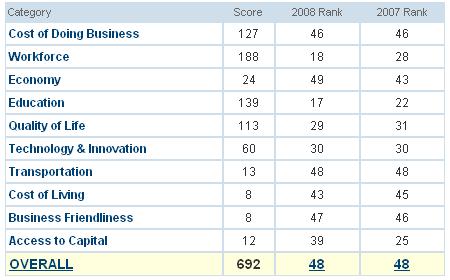
Interestingly, while RI was pretty static in most categories, there were gains in Workforce and Education (almost into the upper 1/3 in each). Here is CNBC's description of each category, respectively:
Many states point with great pride to the quality and availability of their workers, as well as government-sponsored programs to train them. We rated states based on the education level of their workforce, as well as the numbers of available workers. We also considered union membership. While organized labor contends that a union workforce is a quality workforce, that argument, more often than not, doesn’t resonate with business. We also looked at the relative success of each state’s worker training programs in placing their participants in jobs....It appears as if the aforementioned gains were offset in the overall rankings by a big dive in the ranking of Access to Capital, which CNBC explainsEducation and business go hand in hand. Not only do companies want to draw from an educated pool of workers, they want to offer their employees a great place to raise a family. Higher education institutions offer companies a source to recruit new talent, as well as a partner in research and development. We looked at traditional measures of K-12 education including test scores, class size and spending. We also considered the number of higher education institutions in each state.
Companies go where the money is, and venture capital—an increasingly important source of funding—flows to some states more than others.Plus we're still way at the bottom in most other categories. So it would appear that the business climate in this state is so poor that even our relatively attractive workforce can't lure businesses to open up shop. Instead, they stay away. And that young and educated workforce? They leave.
June 21, 2008
The Sweet Simplicity of Progressivism
If only progressives' plans were always this straightforward:
Statewide Wifi available everywhere to everyone... for free .And let the cable/telephone companies bid on the right to be the State's sole provider. How would it be paid for? The company winning the bid to provide the service will maintain sole rights to sell advertising space on the statewide network.
So, we take a centralized power with tax and police powers and invest it with the authority to determine the single corporate provider of Internet services in the state, and that provider wouldn't charge a penny because it would reap its rewards by selling advertising targeting its monopolized captive audience. No chance of corruption and ossification there!
Where would the ads appear, again?
June 20, 2008
Innovation and the entrepreneurial business culture revisited
A recent post, Lessons for Rhode Island from Silicon Valley: An historical reflection on an actual innovation economy, discussed what made Silicon Valley's entrepreneurial culture so unique and what some of its economic growth policy lessons are for Rhode Island.
In the latest edition of The Weekly Standard, Thomas Hazlett has written about the book, Overcoming Barriers to Entrepreneurship in the United States, in a review entitled Mastering the Game: The business of America is small business - and entrepreneurship.
Hazlett has these words to say about the entrepreneurial culture of Silicon Valley:
...The entrepreneurs who stir the pot in brash and productive new ways are a mysterious force, difficult to chart with PowerPoint bullets. There is no doubt that innovation and risk-taking--the contributions of these master chefs of the economic stew--drive progress. But they are elusive, and will not hold still for measurements.This sleek, nifty volume of essays seeks to pursue the beast--and if not to capture it, then, at least, to triangulate its position. Edited by labor economist Diana Furchtgott-Roth, it teaches us why venture capitalists cluster in places like Silicon Valley...
...the book is, caveat emptor, not a cheerleading manual: Neither Henry Ford nor Sam Walton nor Bill Gates is mentioned. The authors are social scientists at prominent institutions who probe substrata economic formations looking for clues as to what factors drive the self-employed to leave their wage jobs behind, and how public policies impact this migration.
For instance, the chapter on Silicon Valley's venture capital hub offers a fascinating window into the sociology of entrepreneurial nurturing. Venture capital investments in Silicon Valley appear to be made differently than elsewhere: They come earlier to start-ups, and lavish more capital on firms. Either due to this, or the other way around, start-ups there outperform those elsewhere, on average.
Why is this? The answer seems to lie in the commercial culture. Unlike investment bankers doling out high-risk, early-money investments on the East Coast, Northern California financial sources are run by technical experts possessing business experience--entrepreneurs funding entrepreneurs. These capitalists operate like bankers, but they know more. Which may account for the more frequent huge payoffs in Silicon Valley and a higher wipeout rate. No irony here: Risk is hardwired into the entrepreneurial economy, and ugly failures are inputs into spectacular successes.
Economist Junfu Zhang, the author of the VC chapter, concludes that the mission launched by many local or state governments--to replicate the Silicon Valley experience--is a fool's errand. The social networks that form are key; capital chases smart people connected to other smart people. Wealth is created when those dollars and networks combust. The best strategy is to eliminate the underbrush of tax and regulatory disincentives that inhibit productive economic activity generally. Or somewhat more ambitiously, create a Stanford University and let the graduate students figure out the rest.
After 17 years in Silicon Valley, I have worked as an interim executive in numerous cities east of the Mississippi River over the last decade. One of the most striking observations from these experiences is how many people tried to replicate Silicon Valley without understanding or paying attention to any of the fundamentals which made the Valley successful. The social network out West (or in the Cambridge/Boston area) did not spring up overnight and the operating companies and the services infrastructure which support them are now firmly rooted in an entrepreneurial culture where explicit and tacit knowledge flows freely.
On a broader policy level, Hazlett writes:
...In the essay on tax policy, written by Donald Bruce and Tami Gurley-Calvez, an interesting body of research is presented. It shows that the vast majority of business owners in the United States pay taxes as individuals, not corporations. This means that rate increases for high-income taxpayers reduce pay-offs for the start-up entrepreneur. And tax hikes on capital reduce the pool of risky funds that these new ventures seek to tap.Soaking the rich sinks this ship. Entrepreneurship is all about creating new wealth while tax redistribution is premised on the assumption that resources are static and the collateral damage from tax hikes is no more than the cost of ear plugs to block out the whining at the country club...
Therefore, given the tax filing nature of small businesses and entrepreneurs described above, the Left's negative description of the recent reduction in RI income tax rates for higher earning individuals as only tax cuts for the wealthy and their desire to roll back the reductions has a clear economic impact: Restoring higher taxes is likely to take away cash flow from many of the very small businesses which could otherwise invest the higher profits in expanding their operations and providing more jobs.
Rhode Island's economic engine will only begin to heal itself when the lessons articulated above and in the earlier post are heeded.
June 16, 2008
Environmental Mania Claims Jobs
Something has seemed forced — in a "just a bit too perfect" way — about the promise of "green jobs" as some sort of savior of our economy. Ben Lieberman suggests that, even if such jobs do proliferate, they don't match up with the number of jobs lost to the larger ecological zeitgeist:
According to a study conducted by the Heritage Foundation, the bill would cost half a million manufacturing jobs by 2018, 1 million by 2022, and more than 2 million by 2027. Of course, most of these displaced workers will eventually find something else to do, but often at lower wages.Some proponents claim that new "green collar" jobs would make up the difference. For example, there will be more work at solar-panel manufacturers and other industries helped by the bill. But these jobs will be swamped by the number of those lost. The Heritage figures are net of any manufacturing jobs gained, and also exclude blue-collar jobs likely to be lost for reasons unrelated to the global-warming bill. ...
To add insult to injury, as many households struggle with layoffs and shifts to lower-paying jobs, they also will have to endure higher prices for electricity, natural gas and gasoline thanks to this bill — a costly double whammy.
All for the promise of an ultimately minor benefit to the environment, if any. As some of us have been unable to avoid noticing, however, "green" is more of a religion than a considered reaction. It brooks no dissent and tabulates no costs, but permits the insertion of all manner of prior political preferences.
June 11, 2008
Lessons for Rhode Island from Silicon Valley: An historical reflection on an actual innovation economy
With the economic crisis in Rhode Island, there is much talk (e.g., my recent post and Ian Donnis) about what it will take to generate real change and economic growth in the state.
Leonard Lardaro, professor of economics at URI, offers his thoughts in a ProJo editorial Only RI Cure: Cut spending and taxes, where he writes:
...There is a great deal of angst about our state’s economy by both citizens and lawmakers. In a recent exchange, a member of the legislature’s Joint Committee on Economic Development took the head of the Economic Development Corporation (EDC), Saul Kaplan, to task for his alleged contribution to our state’s current economic dilemma. According to a May 2 story on the exchange (“EDC is grilled on bad R.I. economy”), EDC was: “chastised . . . for allowing the state to slip into . . . the Northeast’s only recession.” Wow! I never imagined Mr. Kaplan was powerful enough to single-handedly draw us over the edge into recession!Pardon my sarcasm, but I remain stunned by what this quote reveals: how grossly out of touch with economic reality some of our state’s legislators are. What a vivid illustration of the paropic (parochial and myopic) mindset held by so many of our state’s leaders!...what was sorely missing from this exchange is cause and effect.
To understand the state’s problems, it is necessary to go back to the end of 1987, when Rhode Island first became a post-manufacturing economy. The rules of the economic game today are very different from those in the “good old days” of manufacturing. Because job loss today often entails the permanent elimination of jobs, job creation has become job initiation, not job resumption (factories rehiring after usually temporary layoffs). And since the initiation of new jobs is more risky and costlier than job resumption, production and employment costs are more critical to the success of states in creating jobs.
Taken by itself, this presents one glaring problem for Rhode Island in the post-manufacturing era: Our tax and cost structure (which includes fees, regulations and potential problems with the skills of our labor force) is nowhere near as competitive as it must be for us to be successful in this post-manufacturing environment...
But, getting back to the exchange with the EDC, given Rhode Island’s current non-competitive tax and cost structure, what “cards” does EDC have to play in attempting to expand businesses and employment here?...
This brings me to the second problem for Rhode Island: What is our state’s dominant niche? Recently, we decided to move toward biotechnology, pharmaceuticals, life sciences and oceanography. Is our tax and cost structure consistent with success in this niche? I doubt it. How far will our existing economic climate be able to carry us? Will we be able to generate the levels of employment, income and tax revenue that will allow us to attain our desired economic goals?
It is on this count that the glaring deficiency of our non-competitive tax and cost structure exacts its toll. All too often, EDC is forced to make deals with individual companies or industries to generate these types of economic gains. How large have these gains been? Generally, not large enough, as employment here has continued to fall since January of 2007.
In terms of fairness, these deals add insult to injury for existing firms here, which wonder why they can’t receive better treatment all the time. Efforts to expand existing businesses and to get new firms to locate here absent specific incentives have not been sufficient for us to be as successful as we should have been in this post-manufacturing era...
Because the legislative and executive branches, along with the EDC, have jointly failed to produce a competitive tax and cost structure, economic growth here has suffered...
The deficits we now face are largely self-imposed, resulting from unsustainable spending practices over the last 20 years, the failure of our paropic leaders to redefine our state in terms of a niche with a compatible tax and cost structure until very recently, and a separation of economic leadership that, as the exchange between the EDC and legislature shows, is all too often "us" versus "you."
Deficits are not pleasant, especially when largely self-imposed. But they will serve our state’s long-term interest by forcing the type of fiscal discipline that has been so sorely lacking, and, hopefully, an end to factionalized economic policymaking.
Tax and spending policies by RI government do matter in a big way and fixing those problems in the short-term is an essential part of an overall solution. But unwinding the taxation and spending disincentives in RI only opens the door to a positive future. There are more changes which have to happen as part of a total solution.
One way to look to the future is to learn lessons from the past. And no place has been an economic growth engine like the innovation economy of Silicon Valley over the decades, a place I lived and worked in for 17 years.
What were the critical success factors which powered entrepreneurial innovation there? It is a conversation I have been having with friends and colleagues for years. And in the last few weeks, I went back to venture capital, investment banking and university technology licensing friends from Silicon Valley to continue the conversation.
Here is what we pulled together as some of the critical success factors:
- Stanford Engineering School Dean Fred Terman: Terman hired faculty with industrial experience and encouraged academic/ industry relationships. This dated as far back as the 1930's so there was a cultural legacy of interactions between the two communities. More on Terman here and here.
- Stanford University Office of Technology Licensing: With its outstanding engineering/science/medicine programs, Stanford was both a center of technology development and had more liberal technology licensing practices which encouraged commercialization of innovation. The university also allowed faculty to spend time doing outside work. This provided a pipeline for new technologies which, over time, was supplemented by technology within companies.
- Management Development: Businesses can't grow without a pool of talented and trained management. The early growth at both Hewlett Packard and Fairchild/Intel, including both their legacies of excellent management practices and at least HP's original practice of regularly spinning off new divisions, provided a number of decades of management training and development. Their efforts, like Genentech later in the life sciences area, provided much of the original management team infrastructure as newer ventures were launched.
- California's Entrepreneurial Culture & Services Infrastructure: While the nice weather didn't hurt either, California's historical culture was inherently entrepreneurial and, over the decades, an entrepreneurial culture took root and led to an ongoing practice of starting new companies and providing infrastructure services to those companies.
- Capital Gains Tax Rate Reduction Powers Early Stage Financings: The capital gains tax cut in 1978 really launched the growth in the venture capital world and provided the financial capital infrastructure to fuel early growth.
- Local Investment Banks Provide Later Stage Capital: Local investment banks, such as Hambrecht & Quist, Robertson Stephens, and Montgomery Securities, themselves entrepreneurial organizations, were formed to provide later stage capital. In addition, led by Frank Quattrone, some leading New York City-based investment banks set up operations in Silicon Valley, creating an even more competitive environment for later stage capital.
Here are some comments from my friends:
- You're spot on with the influence of Fred Terman. His should be a household name for all the contributions he made and culture tone he established. I think he's the real hero of the story and more should be written about him.
- By way of contrast, it's noteworthy that RTP in NC has been promoting itself as a tech center since the 1950's, only gained traction from the 1980's on, and built itself primarily through the Chamber of Commerce route of attracting large multi-national companies, with start-ups being an after-thought until they started to evolve and grabbed some of the spotlight.
- At a time when universities are paranoid about blurring the distinction between academia and industry it's instructive to recall that the Varian brothers's company made and shipped Klystron tubes from a Stanford lab during WWII, and that technology transported back and forth between Stanford labs and HP in the early days. We should collectively learn that current conflict-of-interest phobias preclude arrangements such as these, which ultimately were of tremendous benefit to both the local and national economy.
- Current practice of most tech transfer offices impedes entrepreneurism, and the most productive approach is found in those offices that minimize these barriers. For those who think there's some abdication of the public trust in this view, I query why it is better from a public policy perspective for [a big pharma company] to profit from a new drug than a local start-up, so long as the drug comes into public use...and I would postulate that the amount of financial return that Stanford would have obtained from the most perfectly optimized licenses from all that early technology traipsing out to HP is dwarfed by the magnanimous giving of the Hewlett and Packard families--giving born out of the goodwill generated by Stanford being helpful to them in their early days.
- The Stanford Licensing Office was formalized in 1970, and Niels Reimers ran it with an approach different from any other university licensing office. Rather than staffing it with JDs, PhDs and/or bureaucrats who focused on filing patents, Niels focused on marketing, and filing patents only when a licensee was identified (see article). Most importantly, Niels made his priorities clear: our job was to ensure Stanford technology was efficiently put into public use and benefit; that the best technology transfer is the graduating student; that our job was to create opportunities for research staff and students; that exclusive licenses were not only acceptable but desirable to provide companies incentive to commercialize; and that--whenever possible with the above, we should try to obtain a financial return to Stanford (as opposed to many offices, where they act to maximize every dollar they can up-front, which is to their long-term detriment). Niels kept a long-term view on creating opportunities, with faith that our activities in promoting industry - university connections was justification in itself, and that the financial returns would take care of themselves. As the office grew, Niels maintained an entrepreneurial and marketing-oriented approach. Every licensing person had a high level of freedom to negotiate a license, with review only at the end of the process (we knew what terms were important to safeguard, and were given freedom to negotiate other--mostly financial--terms to the best of our judgment). This enabled us to work expeditiously. It also kept us focused on industry, with a respect for their needs. Stanford's overall attitude enabled researchers to devote time to outside activities and consulting--as you point out. Although the amount of time for outside consulting was the same as other institutions (such as UC), the key difference was that Stanford encouraged researchers to interact with industry. At many institutions, the culture has in the past been (and often still is!) adversarial to this. Seems like every researcher I knew at Stanford kept a business plan in the top left drawer of their desk--they'd pull it out after every meeting and would ask if I knew any VCs...The cultural issue is huge, and has been tough for other institutions to duplicate. The strongest lever for change is the Faculty Club Effect, where researchers sit at lunch and stare enviously at the guy who just made $10 million from selling his company, and gripe to themselves that they're at least as smart as him...Every institution seeking to replicate Stanford's culture has to have at least one success story, place that guy in the Faculty Club, AND change top administration's attitude so they're more enlightened (and not sending out the conflict of interest police to find alleged corruption underneath every desk).
- ...the risk taking/supportive culture [was] a shocker coming here from the East Coast. There were all sorts of services - VC, banking, legal, real estate, equipment leasing, etc. that would believe and take chances on these companies and enable them to take risk. If they succeeded, they would be celebrated. If they failed - most importantly - that was not viewed as a disgrace but instead a learning experience that made them more valuable to the next venture. A few more modern day success stories that sprang from Stanford - SUN, Silicon Graphics, MIPS (of which the current Stanford President was a founder), Cisco, Yahoo, and Google all started as projects within Stanford.
There are some clear lessons for Rhode Island in this review:
- Consistent, long-term incentives drive lasting economic behaviors: People and institutions respond rationally to explicit and implicit economic incentives. Consistent, long-term incentives matter the most and drive structural changes in behaviors. Offering taxation incentives and then taking them away, as has been proposed recently during the budget crisis by some on the Left, sends a clear signal to the marketplace that RI is not serious about creating the necessary long-term incentives which will lead to favorable investment decisions in RI.
- Competitive alternatives exist and will be favored until RI's taxation and regulatory policies are competitive: The greater Boston/Cambridge area, with the influences of many existing companies, MIT, Harvard, Massachusetts General Hospital, etc., is a place where experienced management and services infrastructures already exist without the uncompetitive taxation burden and budget problems of RI. One-off solutions like selling portions of the Lottery do not solve the fundamental competitive disadvantage problem and are, therefore, not viable solutions which will make RI a place to favor for new business development, especially given the nearby alternatives.
- No economic czars are needed: If broad economic incentives are consistent, favorable and there for the long-term, individuals and organizations will have all of the proper incentives to act rationally and bring business into the state. There is no need for an economic czar or targeted tax incentives here. As the Frenchman Bastiat wrote in the 1800's: Paris gets fed...without any central planning and it occurs because knowledge is shared and the right incentives exist for people to act, people who don't even know each other. A future post will explore further how the role of knowledge, tacit and otherwise, drives economic decision-making and why centralized economic planning will always fail.
- Quality of state services and public education matter: A crumbling infrastructure and lousy public schools create a disincentive for people to bring their families into RI. Why pay higher taxes for worse services? Why pick mediocre RI public schools when MA schools just across the border offer a better education to kids?
- A sense of urgency is critically important: One of the central lessons from Silicon Valley is that its economic growth engine did not come about overnight. Building the management development engine and the services infrastructure took time. Yet there is no sense of urgency among state leaders in RI to either grasp the lessons from Silicon Valley or implement policies which create the required consistent, long-term incentives that will lead to such infrastructure solutions.
We will see the budget proposals shortly from state officials. Will they show any real leadership and offer serious proposals for change? Will they change the long-term economic incentives which will contribute to economic growth? Or will they dither and make it even more likely that the only solution for RI will be to let it blow up and then pick up the pieces? Bluntly, there is little reason to be optimistic. I hope I am wrong.
Attacking the Wise for the Sake of the Fools
The immorality of wealth is a notion that has been in the air lately, with the latest example being David Brooks's lamentation of "The Great Seduction" in the New York Times:
The United States has been an affluent nation since its founding. But the country was, by and large, not corrupted by wealth. For centuries, it remained industrious, ambitious and frugal.Over the past 30 years, much of that has been shredded. The social norms and institutions that encouraged frugality and spending what you earn have been undermined. The institutions that encourage debt and living for the moment have been strengthened. The country's moral guardians are forever looking for decadence out of Hollywood and reality TV. But the most rampant decadence today is financial decadence, the trampling of decent norms about how to use and harness money.
Inasmuch as I believe conscience and social pressure to be ultimately more likely to precipitate the sharing of wealth than political demands (short, perhaps, of violent revolution), frequent and visible criticism of the unproductive amassment of wealth is certainly to be encouraged. Brooks's allocation of blame, however, misses the critical other side of the coin:
The agents of destruction are many. State governments have played a role. They aggressively hawk their lottery products, which some people call a tax on stupidity. Twenty percent of Americans are frequent players, spending about $60 billion a year. The spending is starkly regressive. A household with income under $13,000 spends, on average, $645 a year on lottery tickets, about 9 percent of all income. Aside from the financial toll, the moral toll is comprehensive. Here is the government, the guardian of order, telling people that they don't have to work to build for the future. They can strike it rich for nothing.Payday lenders have also played a role. They seductively offer fast cash — at absurd interest rates — to 15 million people every month.
Credit card companies have played a role. Instead of targeting the financially astute, who pay off their debts, they've found that they can make money off the young and vulnerable. Fifty-six percent of students in their final year of college carry four or more credit cards.
Congress and the White House have played a role. The nation's leaders have always had an incentive to shove costs for current promises onto the backs of future generations. It's only now become respectable to do so.
Wall Street has played a role. Bill Gates built a socially useful product to make his fortune. But what message do the compensation packages that hedge fund managers get send across the country?
Failing to mention those who've sought the instant gratification facilitated by debt (a group that most definitely includes me) leaves open a frame of mind that greatly contributes to our culture's financial problems. We whom the above listed role-players have affected are taken to be reactive children with no capacity to withdraw our demand in response to the pushed supply. We're "vulnerable."
Brooks lauds Ben Franklin as an archetypal advocate of "hard work, temperance and frugality," so it's conspicuous that his emphasis is so different from the founder, who penned such aphorisms as the following:
Fools make feasts, and wise men eat them. ...Wise men learn by others' harms, fools scarcely by their own. ...
Get what you can, and what you get hold; ’Tis the stone that will turn all your lead into go.
Well, 'tis better to be wise than to be a fool, so "rather go to bed supperless than rise in debt." To some extent, the steps toward healing our financial culture that Brooks enunciates are determined by his audience, which probably includes more lenders than lower-income borrowers.
What is needed before all else, however, is confirmation of the individual's agency and responsibility, because without a sense of those, we're all just waiting for that winning lottery ticket, heedless of Franklin's suggestion that "diligence is the mother of good luck."
June 9, 2008
The Demographics of Joblessness
It would seem that there's something cultural about young-adult joblessness:
Much of the spike in unemployment was caused by an unusually large surge of teenagers and people in their 20s into the labor force. And those young workers had little success finding work. The jobless rate among 16- to 19-year-olds rose to 18.7 percent from 15.4 percent in April. Retailers, who employ a large number of unskilled teenagers during the summer, cut 27,000 positions in the month.Rising unemployment, however, spread well beyond young people. The jobless rate rose among almost every other group -- men, women, blacks and whites. The rate was unchanged among Latinos.
This recent article on H-2B visas comes to mind:
Several factors make recruiting American workers for seasonal jobs difficult, Venturini said. Some people just don't want to clean dirty rooms, she said, plus the jobs are temporary and often require working weekends and holidays. ...As for college students, they are increasingly more interested in internships or jobs that will directly enhance their career prospects. And with Newport and Block Island trying to create "shoulder seasons" before Memorial Day and after Labor Day, college students are often not available when employers need them. ...
"We would love to hire American workers, and not have to deal with housing, airline tickets, fees. As a business, why would you go through all this unless you had to?" said the Hotel Viking's O'Donnell. "We're a hotel, first and foremost. We need clean rooms. We need to have skilled housekeepers."
In the fashion after which issues tumble and blend, some cultural readjustment may result from and alleviate economic hardship. (Maybe.)
June 6, 2008
Ignoring a Force of Market
Here's a statement that I've read multiple times with reference to "alternative energy", specifically the bills to provide incentive to National Grid to buy it that have just passed the RI House:
Matt Auten of the advocacy group Environment Rhode Island denied that renewable energy would drive up electricity costs, describing the bill instead as a "prudent response to skyrocketing prices for electricity [and natural gas] because it will lock in a fixed price not tied to polluting fossil fuels for a portion of Rhode Island’s electric needs."
What am I missing in the provision of "alternative energy" that makes it free from market forces? As far as I can tell — letting legislators mandate what they will — the price of any energy will ultimately be "tied" to non-alternative energy prices, among other things. (One can foresee future conversations about the lack of wind in a given year.)
And that doesn't take into consideration the side effects of solidifying National Grid as a state monopoly through mandates and regulations.
June 4, 2008
URI Experts Worried About Fixing the State
Dan Yorke had URI Professor Dr. Ed Mazze on yesterday (podcast and related column here), who sketched out how we got in this mess (sub-prime collapse and overall housing problem in RI was the leading cause of recession in the state; 6000 jobs lost since January). Such things contribute to a simultaneous lack of consumer and business confidence in RI's economic future. His colleague, URI Economics Professor Leonard Lardaro has been sounding the warning bells on this too.
Mazze also explained that, since at the end of day its about getting better paying jobs that can lead to higher tax revenue, we are in a bad spot because people, talented people, are leaving the state. So how do we keep them here? Well, stop being one of the highest taxed states, for one.
We also need to get focused on attracting businesses to the state. Mark Higgins, Dean of the College of Business Administration at URI, was recently on A Lively Experiment and emphasized that the State needs to focus on aid to higher education because an educated work force attracts employers, etc. Further, Higgins also noted that we don't have an overall economic strategy and instead rely on ad-hoc incentives to different businesses (like movie studios). The smart thing would be to focus on making the state attractive to a few key industries. Instead, we have a Legislature that wants to immediately spend "new" casino money (from 24 hr gambling) instead of finding a way to strategically invest it.
For his part, Mazze believes that health care and oceanography would be fruitful areas for RI to focus on. The latter makes sense given Bob Ballard's presence at URI and the proximity of Raytheon and other maritime related businesses in our state.
Mazze stated we had to be realistic about size of state and the size of government. There are too many superintendents and fire & police chiefs: top dollar jobs. He thinks a centralized school system and a 5 county system would help. He believes that the Governor has done what he can, but too many cuts, which will result in top level, experienced people leaving to take buyouts, will affect the quality of state government services. Higgins echoes this concern, noting that Democrats haven't taken action and that cuts across the board weaken everything. Further, Higgins agrees that legislators should be asked to sacrifice (health care, pensions) like the private and portions of the public sector already have. (Not sure if he's keen on revoking free tuition for the progeny of college professors, though.)
Mazze is not in favor of raising taxes, but isn't sure if we can get out of this situation without raising taxes. He fully expects to see tax hikes after the November elections. There is simply no other way to raise revenue, shortsighted though it may be. In short, we've lost too many people (taxpayers) and the revenue they generate. Those of us left behind will have to pay more. Of course, we could also demand that we shrink government!
Finally, Mazze said he was "freaking out" because he hears talk from our elected officials, but sees very little action.
May 31, 2008
Everybody's the Boss
There's a certain wrongheadedness — an insecurity — to the feeling of which Rita Lussier's expression is merely one example of many:
"Yeah, the $4-dollar-a-gallon thing is hard to take," he says as he puts the hose back on the hook and screws the cover on his tank. All the while, he keeps smiling, smiling, smiling.And then, just before he hops in his truck, this is what he says: "I just pass the cost along to my customers."
I JUST PASS THE COST ALONG TO MY CUSTOMERS.
He's not alone.
The electric company is asking for another rate hike. The airlines are raising their fares, some are even charging for baggage. No question, when companies have to pay more for fuel, what else can they do?
That's right. They just pass the cost along to their customers. ...
So here we are, standing at the pain station and what are we supposed to do? Who do you and I pass our costs on to? We, who are bearing the brunt of all the landscapers, the painters, the plumbers, the electric companies, the natural gas companies, the grocery stores, the buses, the trains, the airplanes, the state and federal government and everyone else who's putting their load on our backs.
What a declaration of helplessness! Sure, Lussier goes on to offer some ways to use less fuel, but she nonetheless misses the reality that everybody is both supplier and customer. I mean this in the sense that the landscaper with whom she's speaking still has costs for the fuel that he uses for his home and his private vehicles, but I also mean it in the sense that anybody with a job is ultimately supplying something to somebody and every business is seeking to "buy" money from clients with their goods and their services.
So, pass your costs on to your employer. If you don't think you've the grounds to seek more, find ways to make yourself more apparently valuable. On the other side (and probably more easily), pass your costs on to businesses by doing your own landscaping, painting your own house, learning basic plumbing and electric, perhaps growing some of your food, walking more, and demanding that your government take less from you.
Nobody's passive in the economy, and to turn to federal legislators for help — as Lussier suggests, even providing Sheldon Whitehouse's phone number — is to dig one's nation more deeply into helplessness, because nothing's free, especially when it comes from Washington.
May 28, 2008
Michigan's Lesson to Rhode Island
From an editorial in today's Wall Street Journal:
[T]he latest news of Michigan's deepening budget woe is a national warning of what happens when you raise taxes in a weak economy.Officials in Lansing reported this month that the state faces a revenue shortfall between $350 million and $550 million next budget year. This is a major embarrassment for Governor Jennifer Granholm, the second-term Democrat who shut down the state government last year until the Legislature approved Michigan's biggest tax hike in a generation. Her tax plan raised the state income tax rate to 4.35% from 3.9%, and increased the state's tax on gross business receipts by 22%. Ms. Granholm argued that these new taxes would raise some $1.3 billion in new revenue that could be "invested" in social spending and new businesses and lead to a Michigan renaissance.
Not quite. Six months later one-third of the expected revenues have vanished as the state's economy continues to struggle. Income tax collections are falling behind estimates, as are property tax receipts and those from the state's transaction tax on home sales....The tax hikes have done nothing but accelerate the departures of families and businesses. Michigan ranks fourth of the 50 states in declining home values, and these days about two families leave for every family that moves in. Making matters worse is that property taxes are continuing to rise by the rate of overall inflation, while home values fall. Michigan natives grumble that the only reason more people aren't blazing a path out of the state is they can't sell their homes. Research by former Comerica economist David Littmann finds that about the only industry still growing in Michigan is government. Ms. Granholm's $44.8 billion budget this year further fattened agency payrolls.
There's another national lesson from the Granholm tax dud. If Democrats believe that anger over the economy and high gas prices have put voters in a receptive mood for higher taxes, they should visit the Wolverine State.
May 21, 2008
On the Golden Path to Debt
Related to Andrew's "Finance and Demography" post, I've been wondering, lately, how much economic growth of late has relied on increasing debt. Sure, production expands the economy, but somehow it has to correspond with consumption, no?
In particular, I'm thinking of Spenlger's line: "The financial markets, in turn, found ways to persuade Americans to borrow more and more money." It brings to mind Michele Singletary's suggestion that people make a comparison of their spending on and off credit cards:
I'm reasonably sure that many people do not make the same purchases when they pay with plastic. This isn't just a feeling or anecdotal evidence. Researchers have found that people's willingness to purchase more products or services increases with the use of plastic.In their groundbreaking research, Drazen Prelec and Duncan Simester of the Sloan School of Management at MIT found that study subjects paid more when instructed to use a credit card rather than cash. In fact, they found that people were willing to pay up to 100 percent more with plastic. ...
"This customer behavior is at odds with standard economic theory, which argues that the method of payment should have no effect on spending, so consumers seem to be indulging in 'irrational' behavior,' " Davies says in a research article, "The Realities of Spending."
Davies explains that credit cards boost spending because of the psychophysics of how our brains work.
When one's spending fits within a tight budget, like mine, some of the "psychophysic" tendencies run into other limits (although I'm sure I slip more often than I would with cash). And it's nice to get those periodic checks for things that we'd be buying at BJs anyway. Still, that money isn't just a gift without cost; it's just that the cautious consumers are overbalanced by the not-so-cautious.
May 14, 2008
Meaningless talk and inaction in a crisis: Why Rhode Island's crisis will get worse before it gets better & what to do about it
The state of Rhode Island is in a deep financial crisis. Resolving its large budget deficits will require real and significant structural changes to the status quo.
The status quo was best summed up in a passing comment by Representative Gorham last night on the Matt Allen show: Gorham talked about how the state budget deal is typically reached in a "clandestine" fashion in the office of a just a few state legislators and then rapidly moved to a vote.
That approach is, in no small way, how RI got into its current mess and maintaining such practices won't yield successful and lasting change.
As someone who has led corporate turnarounds for nearly 20 years and has read extensively on what it takes to lead successful change initiatives, it is appalling how little progress has been made to effect real change in the face of the current crisis here in RI. It's not like these structural problems are a new development!
One of my favorite authors on leadership and change is Harvard Business School professor John Kotter. He has been writing for years about the topic of leading change and is a world authority on the subject. More on his books can be found here.
For the last decade, Kotter has been writing extensively on what he calls the "Eight Step Process of Successful Change." Here is an excerpt from his "Iceberg" book, a book which uses a fable to describe what it takes to realize successful change. Easily accessible to the layperson, I recommend reading it.
Set the Stage1. Create a sense of urgency: Help others see the need for change and the importance of acting immediately.
2. Pull together the guiding team: Make sure there is a powerful group guiding the change - one with leadership skills, credibility, communications ability, authority, analytical skills, and a sense of urgency.
Decide What to Do
3. Develop the change vision and strategy: Clarify how the future will be different from the past, and how you can make that future a reality.
Make it Happen
4. Communicate for understanding: Make sure as many others as possible understand and accept the vision and strategy.
5. Empower others to act: Remove as many barriers as possible so that those who want to make the vision a reality can do so.
6. Produce short-term wins: Create some visible, unambiguous successes as soon as possible.
7. Don't let up: Press harder and faster after the first successes. Be relentless with initiating change after change until the vision is a reality.
Make It Stick
8. Create a new culture: Hold on to the new ways of behaving, and make sure they succeed, until they become strong enough to replace old traditions.
As we all reflect on the severe crisis here in RI, one of the most disconcerting conclusions is how RI is currently 0-for-8 in moving in the right direction.
Where is the sense of urgency?
Where is the powerful guiding team?
What is the change vision and strategy?
There will be no successful structural changes in RI until those questions are answered in tangible and affirmative ways. If they are not, the crisis will worsen instead of getting better.
Avoiding the hard choices which go with implementing difficult changes is a part of human nature and, at one level, perfectly understandable. Which is why it is so important for there to be leaders who display the requisite courage to initiate the change dynamic.
The structural status quo in Rhode Island is built on a foundation of economic fiction. And, whether certain people like it or not, economic fictions simply cannot persist - even if many people choose to ignore the problems in the hope they will just go away. Which is exactly what causes bad situations to turn into crises.
Tackling RI's economic fictions matters for reasons beyond just balancing a budget. The well-being and futures of many families will be affected. As I wrote back in 2004:
...Even so, this debate is about more than current taxation levels and today's family budgets. It is about freedom and opportunity for all -- and family budgets in the future. The greatness of our country is that people can live the American dream through the power of education and hard work.High taxation and mediocre public education create a disincentive for new-business formation in Rhode Island. That means fewer new jobs, and less of a chance for working people to realize the American dream. It also means people have an economic incentive to leave the state -- and the ones who can afford to do so will continue to leave.
Unfortunately, the ones who cannot afford to leave are the people who can least afford the crushing blow of high taxation and mediocre education. The status quo dooms these families to an ongoing decline in their standard of living. That is unjust...
We are at a crossroads in Rhode Island. If we tackle issues now, a turnaround with only some pain is possible. If we delay, we will doom multiple generations of working families and retirees to further tax hell and a reduction in their standard of living. That is wrong.
This public debate is about breaking the chains of bondage and giving all citizens the freedom to live the American dream here in Rhode Island. What greater legacy can we leave for our children than a fair shot at the American dream here in their state?
...Let's tear down this wall of economic fiction, and let freedom ring out across the state. Let's make Rhode Island a vibrant land of freedom and opportunity, for all working families.
Either we will do change here in RI or change will do us. The failure to act over the last 4 years means the changes will now be far more painful. And the pain will only deepen more if further inaction accompanies the passage of yet more time.
So, have you done your part to increase the sense of urgency? Have you stepped up to become part of a team dedicated to real change? Have you worked, even at your town level, to identify a vision for change?
One of the most striking observations I regularly find when going into troubled companies is how many people at all levels instinctively know what is wrong. One of the most heart-warming outcomes is how many of those people want to pitch in and be part of a solution. And one of the most satisfying developments is watching those people rise to the occasion, often in ways that would never have been predicted. Never under-estimate the power of the human spirit to be selfless and do great things. Even when it requires going through pain.
But before those wonderful developments can ever occur, we have to start with the basic first steps of a successful change initiative. Unlike the business community where companies die if they base their plans on economic fictions, change in the political world is much more difficult because entrenched special interests have no incentive to be part of constructive solutions. They have no incentive since their demands are funded by third-parties - taxpayers - while the special interests suffer no direct adverse economic consequences from making unrelenting demands.
Any real solutions in the RI public sector will require taking enough power away from those special interests so that the economic price of their demands is reduced. Yet the people to do that - politicians - usually have a focus on their own re-election and thus have no incentive to challenge the very interests who can subsequently cause them to lose an election. The problem is compounded further because the same politicians and bureaucrats have no incentive to help solve the problems because they also suffer no direct adverse consequences from their failure to act.
So any solution to RI's problems will require some selfless and courageous politicial leaders who care more about change and doing the right thing than winning elections. Part of their challenge will be to build a large enough coalition of citizens committed to change. It is only then that a courageous citizen coalition can exert the requisite pressure on enough fence-sitting politicians, providing the latter with a sufficient re-election incentive to join the change initiatives and the majority votes for change.
Bluntly, I don't see any of those dynamics even starting to happen in RI right now. Which says things will get far worse before they have any chance to get better.
We are faced with an ongoing political stalemate in place in RI: The window of opportunity for "reasonable" solutions passed some years ago. When RI already has one of the highest taxation rates among the 50 states, raising them even higher is a certain doom loop. It is too late to solve the problem by tinkering on the margin. Yet the special interests have shown zero willingness to back off their entitlement demands so as to make structural changes possible. With each passing month, there will be even less flexibility.
We are on a treacherous path as a state. But sometimes it takes going through sheer hell before the will to make tough decisions arises. Given the incredibly powerful and entrenched special interests and the political balance of power, maybe the only viable solution for RI is to let it all blow up and then pick up the pieces. Maybe we just have to become a statewide version of Vallejo.
Since the status quo political debate on these problems is an abject failure, here is my provocative proposal for public discussion:
- Building the sense of urgency: Begin talking publicly and bluntly about exactly how bad the structural problems are. No sense of urgency will be built until after these problems are crisply defined and transparently obvious for citizens across the state. Simply saying we have a budget deficit of $X million is insufficiently compelling; we need to talk about the ongoing budget deficit and how we have masked it previously, the structural problems which have caused recurring deficits, the unfunded pension liabilities, and the unfunded healthcare liabilities - all of which were incurred despite extremely high taxation levels.
- Pull together a team of leaders and active citizens: There has to be a conscious building of a powerful group of people from across the business community, policy community, and political community who are committed to change. It is a group which will only coalesce when we stop being so delicate in our conversations about the crisis. In RI, that means we need some people who are willing to take on previously unseen levels of personal risks. As they say, we need a few good men and women who have both the sense of urgency and the willingness to talk about the stark challenges faced in RI. Who are equally willing to talk bluntly about how the inaction of politicians and bureaucrats as well as the resistance from powerful special interests make it necessary to either do some major restructuring immediately or implement a radical solution of throwing the state into receivership/bankruptcy. Said another way, we need leaders who are willing to use that blunt public conversation to shake the foundation, thereby either stimulating real and previously non-existent policy ideas for serious change outside a legal restructuring or making the case on why there is no other alternative.
- The change vision for RI: By the middle of the next decade, do what Massachusetts did in recent years by going from taxation levels which earned it the nickname "Taxachusetts" to middle of the pack among the 50 states.
- The strategy for achieving the change vision: Set a specific and firm near-term time deadline for implementing the necessary major structural changes to realize the change vision. If the changes don't occur by the deadline, throw the state into some form of receivership/bankruptcy and then restructure everything by brute force.
What do you want the future of RI to look like? How are you willing to help bring about change?
April 21, 2008
Free Trade Is a Two-Way Street
Trade isn't a topic on which I can express all of the relevant arguments, but this suggestion from University of Maryland School of Business Professor Peter Morici sounds reasonable to me:
China is the biggest problem. It subsidizes foreign purchases of its currency, the yuan, more than $460 billion a year, making Chinese products artificially cheap at Wal-Mart. The U.S. trade gap with the Middle Kingdom has swelled to $250 billion. ...As long as China subsidizes the sale of yuan to Wal-Mart and other U.S. importers, the U.S. Treasury should tax dollar-yuan conversions. When China stops manipulating currency markets, the tax would stop. That would reduce imports from and exports to China, create new jobs in the U.S., raise U.S. productivity and workers' incomes, and reduce the federal deficit.
Free trade has to go both ways. No doubt, there are economic arguments having to do with investment and leverage that support the allowance of manipulated imbalance, but then, once again, I think we're shifting toward the topic of government's appropriate behavior as a business entity.
Class Warfare Is a Highway, and I Wanna Ride It
Things aren't equal on the highway. Some folks happen to pull into pockets of traffic that engulf them for an entire commute, while some ease into the lull just five minutes earlier. Some folks have faster cars; some folks have bigger, more-imposing cars. Some have drivers; some have GPS; some have government plates. Some are in a rush, and some have all the time in the world to cruise. Some have quick reflexes; some have bad vision; some are hung-over; some are on those fancy new clarity drugs that (I've recently read) are increasingly popular among academics.
During a trip, you pull onto the highway and you go, making the best of what you've got, driving according to your personality, state of mind, and various pressures. That's all you can do.
I bring this up because something about David's comment to a recent post of mine won't leave me alone, and the highway metaphor may help to clarify how I view class strata:
Justin, you argue for wealth redistribution favoring the wealthy with your personal anecdotal evidence. True, wealthy people do employ people, own and hold large tracts of land as open spaces that otherwise would be chopped up and developed. Evidence of those positive effects can be seen in our state in Newport, Jamestown, and Westerly.A veritable army of leaf blowers, cleaning crews, painters and other service people clog the streets of the east side of Providence. Diaper services, too. (since it is less polluting) But you fail to convince with any evidence that the Bush tax cuts are a cause for this. The wealthy are always going to employ people to maintain their property. They have the means and desire to add to their holdings. Good for them! Bravo! And you are right to suggest that they are a positive part of the whole. But the tax cuts were nothing more than a looting of the treasury. The top pays less than what fairness requires. Warren Buffet acknowledged this when he pointed out that he paid a lower percentage in taxes than his workers. Sometime stinks in America. Taxes should be fair and should reflect the democratic construct – we are in this together. You seem to be the one doing the social engineering – let the wealthy few own all of the goods because they know how to handle it. We dummies would just screw it up.
Right from the beginning, David illustrates that my argument didn't traverse the space between us. I have not argued for wealth redistribution favoring the rich; I've argued that commerce is a better mechanism for distributing money away from the wealthy than government dictat. I most definitely did not argue that the rich ought to be considered the masters of economic allocation or that average citizens ought to be deprived on the grounds of ineptitude.
There is nothing fair about a society in which talented and hard-working people fail time and again to achieve just the modest income that would support a reasonably comfortable life with sufficient room for intellectual and spiritual improvement while others sit back and watch fortunes grow that are several generations removed from anything that might be recognizable as earning. I know of families that have kept pets on expensive life support for months on end to bring them back from the brink of death after coyote attacks, while we had to put our otherwise healthy dog down last year because we couldn't afford diabetes medicine. No, the unanswered question isn't whether the situation is fair; it's how we address that inequity from our place on the road as we've found it at the end of the entrance ramp.
Here I must correct another misunderstanding on David's part: neither of my posts in this run have had anything to say about tax policy except to this degree:
For the most part, the funds that support so many local workers building and rebuilding summer homes for the rich are not available for taxation. The owners tend not to be full-year residents, and if they were to find that they could no longer afford to lavish themselves in this way in Rhode Island, they'd find somewhere else to do it. Even with full-year residents, the difference is mainly one of threshold for redistributive pain. The progressives' willingness to insist on the right kind of commerce would certainly result in lost revenue to the state, less money in the state's economy, and lost jobs.
Because I see its circumstances as acutely dire, my focus for commentary has overwhelmingly been within Rhode Island's borders for several years, and in that context, heavily redistributive taxation schemes are an invitation for the rich to avoid paying Rhode Island taxes altogether (or, more likely, to pay somebody else to avoid those taxes for them), and that will hurt working Rhode Islanders both by draining our public coffers and by stemming the economic activity from which all tax revenue is ultimately derived. If a driver knows that you intend to pull in front of him to slow him down below his preferred speed, he won't let you get alongside him in the first place, if he can help it.
To this perspective, I would add one way in which David may have me right that "We dummies would just screw it up": if by "we dummies" he means the population operating by means of a government structure (rather than as individually responsible economic entities). Siphoning off wealth for the government's usage to the degree that left-wingers would consider to be "fair taxation" creates a pinch-point for power, and that is an ineluctable lure for precisely the sorts of people whom a fair — and wise! — society would keep far from the steering wheel. (In some ways, this is Rhode Island's tale.)
If we want fairness, we must pursue freedom. Putting up roadblocks generally proves to be to the advantage of those who already have an edge and to hinder those who would otherwise break free from the snarl of traffic.
April 16, 2008
The Carpenter You'd Rather Be
PROEM:
We'd like to encourage this sort of conversation, so commenters will have a very short leash for ad hominem with this post.
Matt Jerzyk's response to my post about the rich giving their money to we in the working class strikes me as so tangential as to raise a wholly separate topic, and as so misrepresenting what I've written as to be a response to a wholly separate person. That said, I think he raises some interesting points of distinction between his worldview and mine:
I have seen you write on several occasions about how much you appreciate this rich family's wealth; a wealth that allows you and your coworkers to keep working on their many luxurious projects.You reason that if this rich family moves or if they stop spending money, then you and your coworkers would be out of a job.
I can understand your concerns about your own job. That is a baseline concern for all of us.
But, doesn't your point limit the opportunities that are facing the 21st century American tradesman? Is your crew truly confined to working for one rich family? Do the presence of rich people define opportunities for carpenters in RI? Are there no entrepreneurs among you who could strike out on your own and work on building green homes and commercial spaces (quite an emerging and lucrative market these days)? Or, you wouldn't rather be rebuilding America's crumbling bridges, roads and infrastructure?
I don't doubt that you want your particular job to continue - we all do. However, there is something to be said for untethering the American entrepreneurial spirit and seeing what can happen- in the construction industry and in all industries.
Relying on the presence of only a few hundred wealthy families for the economic development of our state just seems a tad naive, a bit unrealistic and incredibly hopeless.
To begin with the non sequitur, the statement of my post was that we do have a mechanism for transferring wealth from the rich to the working-class: it's called the marketplace, capitalism. It does not follow from that suggestion that my primary concern is for my own specific job. It follows even less that I'm arguing for total economic reliance on our state's few hundred wealthiest families.
As to my professional biography, the company for which I work has had clients across the spectrum, several at any given time, and all of my side work has been for working-to-middle class families. There are some notable differences from one project to another, although I don't know that I'd rate any as preferable on their basis. Moneyed projects offer the opportunity to do some very interesting, very involved work that makes a hammer swinger feel a bit more like an artisan. In my industry, the worker has a sense of "the right way" to do things, but that often must be compromised for the sake of budgets, usually at the direct request of the client. With the rich, the fight between funds and workmanship is not as dramatic.
On the other hand, lower-end work brings the satisfaction of efficiency and, more importantly, of appreciation. Those who've worked for what they have are tangibly more excited by improvements, and that's a very gratifying thing to see.
Me, I like variety, so I'd surely be unhappy with either niche's being my foreseeable future. It speaks to the difference between Matt's point of view and my own that (1) he's so compelled to drape a job like carpentry with political meaning, and (2) he throws commercial spaces in the mix and asks about transportation construction.
From the carpentry perspective, I'm sure there would be new and interesting aspects to an explicitly "green" project, and I'd love to take one on. But, contra Matt, I'm not interested in limiting "the opportunities that are facing the 21st century American tradesman." The game isn't zero sum, and a casual observer can see that there are not "green" projects languishing for lack of carpenters. (If they were, the general pay of the trade would be going up.)
As for commercial work, to my experience, it lacks both the edification of the high-end project and the appreciation of the lower-end private work. Concerning bridges and roads, while I'd love to undertake an old-style New England covered bridge, transportation and infrastructure projects are generally for the heavier tradesmen, such as masons, welders, and excavators, not carpenters.
This thread all unravels to the truly peculiar apex of Matt's comment:
... there is something to be said for untethering the American entrepreneurial spirit and seeing what can happen- in the construction industry and in all industries.
What could he possibly mean by that? It would stretch credulity to the breaking point to suggest that I was (or am) advocating for the high-end construction submarket to be an especial area of focus at the expense of other submarkets. Yes, as a tally of man-hours, my current project has probably kept a couple dozen people employed full time for a cumulative year, while proportional projects for the working class have kept a few people busy for a cumulative month. But for Matt's riposte even to make logical sense, he must be implying a government forced shift of private construction dollars to publicly funded construction projects. That's not just a "tad" and a "bit." That's dangerously naive, unrealistic, and hopeless.
For the most part, the funds that support so many local workers building and rebuilding summer homes for the rich are not available for taxation. The owners tend not to be full-year residents, and if they were to find that they could no longer afford to lavish themselves in this way in Rhode Island, they'd find somewhere else to do it. Even with full-year residents, the difference is mainly one of threshold for redistributive pain. The progressives' willingness to insist on the right kind of commerce would certainly result in lost revenue to the state, less money in the states economy, and lost jobs. (Emphasizing that mine might be one of them is merely an attempt to invalidate my testimony.)
Bringing about this shift of opportunities would add layers of unnecessary government bureaucracy, as the public sector goes about its inefficient business of transferring the wealth, deciding to whom to give it, overseeing its distribution, and regulating its usage. The entire process, moreover, would funnel money and power through a limited social point that would be sure to attract manipulators and despots.
Jerzyk's mode of "untethering the American entrepreneurial spirit," in other words, can only result in lost jobs and less varied, less gratifying employment for those in the working class who manage to stay employed. The vision dehumanizes us as cogs who must find meaning in the political wonderfulness of a more restrictive system. And (perhaps not without calculation) it benefits a class of people — not doing too poorly, already — of meddlers and would-be social engineers.
April 15, 2008
Taking from the Rich
Over on Kmareka, David Jaffe suggests that, thanks to those awful ultra-rich, working-class Americans have every reason to be bitter. Joins in commenter Miami Mama:
If those ultra-rich would spend just a fraction of their wealth to help the poor and middle-class instead of selfishly splurging on themselves, it would be a much better world.
Don't I know it! If only the rich family on whose summer house my boss’s crew has been working for almost two years would find some way to give its money to the dozens of working-class folks who’ve been employed on the project.
I’ll tell ya: talk about splurging! They’ve been so lavish that they’ve had to hire carpenters, electricians, masons, plumbers, roofers, drywallers, painters, security system technicians, audio/video installers, glass installers, cabinet makers, custom window makers, pool installers, sauna installers, gas & oil technicians, tilers, welders, sheet metal fabricators, excavators, form builders, and concrete pourers. And that doesn’t even include the architects, engineers, landscapers, contractors, construction material suppliers, waste disposal professionals, porta-john suppliers, and professional cleaners! And that doesn't include all of the manufacturers, service providers, and other professionals that all of those companies must bring into the picture at some point.
If only we could come up with a way to encourage the rich to transfer just a fraction of their wealth to working-class people…
April 14, 2008
We are the Free Market Change We are Waiting For
The April 7, 2008 edition of National Review (dead-tree: subscriber only) contains a piece by Stephen Spruiell, "The Buckeye Stops Here," that focuses on the Ohio economy. Here's an illuminating excerpt:
Continue reading "We are the Free Market Change We are Waiting For"April 13, 2008
The Problem with Giving All the Power to the Nice Guys
What a jumble has politico-economic thought become in America! It's as if so much access to information (and ability to propagate it) has served mainly to allow us all to slip into ruts of prepared thoughtlines. Consider this interesting comment from Evan, at RIFuture (emphasis added):
What most "free market" bozos ignore is that most of those at the very top of the pyramid are born into wealth, and don't have to strive for it whatsoever.If you're born poor, you aren't born on a fair playing field in this country anymore. That may have been less true in years past, but it certainly is not true anymore.
"Free Market" idiots are going the way of the dodo, let them clog this blog with their nonsense, it doesn't make a bit of difference.
According to the Economist Magazine, the majority of Americans want LESS Free Trade and MORE Protectionism. This actually is the opposite of our cousins in the British Isles! But if you turn on the TV Media in this country you'd never know it.
Now I'm not advocating protectionism, but we do need to alter free trade to make it fair. "Free Marketers" act like they hold a common sense and unchallenged position - but the truth of the matter is they are fast becoming the minority - (for better or worse) and are loathe to even realize this since they glean all their economic information from echo chamber media.
Put aside the distraction of public opinion (which is more a measure of persuasion than truth). The key thread is Evan's statement of the obvious observation that those born with advantages have advantages and his suggestion that "we" can "alter free trade to make it fair." In the context of a discussion about income inequality and taxes, the "we" can be presumed to mean "the government."
Now a quotation from Madison's Federalist 10 entered into the debate by Thomas Schmeling:
AMONG the numerous advantages promised by a well constructed Union, none deserves to be more accurately developed than its tendency to break and control the violence of faction....the most common and durable source of factions has been the various and unequal distribution of property.
Schmeling translates this as the recognition "that extreme wealth inequalities pose a threat to the stability of a society," and (owing to a lack of familiarity, as well as a subsequent Madison quotation) I won't dispute that aspect, but I would note that the object of the sentence is "the violence of faction," of which unequal property distribution is just a leading context for factionalism. Property, in this regard, is notable as a measurement of power, and inequality is violent in its allowance of one faction to subject another to its will.
Schmeling's second Madison quotation cites as a "great object" the limitation of parties' development by, for one thing, "withholding unnecessary opportunities from a few, to increase the inequality of property, by an immoderate, and especially an unmerited accumulation of riches" (National Gazette, January 1792). Readers should spend some time with that first phrase — "withholding unnecessary opportunities from a few" — because it is crucial to an understanding of how Schmeling's editing of the following down to points 1 and 2 enables the Evans of the Left to slip into the rut of centralized control. Take particular note of points 4 and 5:
In every political society, parties are unavoidable. A difference of interests, real or supposed, is the most natural and fruitful source of them. The great object should be to combat the evil: 1. By establishing a political equality among all. 2. By withholding unnecessary opportunities from a few, to increase the inequality of property, by an immoderate, and especially an unmerited, accumulation of riches. 3. By the silent operation of laws, which, without violating the rights of property, reduce extreme wealth towards a state of mediocrity, and raise extreme indigence towards a state of comfort. 4. By abstaining from measures which operate differently on different interests, and particularly such as favor one interest at the expence of another. 5. By making one party a check on the other, so far as the existence of parties cannot be prevented, nor their views accommodated. If this is not the language of reason, it is that of republicanism.
As is often a necessity of communication, Madison lists these as five separate instructions, but they are really five aspects of a single mandate for freedom, which I would apply to contemporary economic debate as encouraging an abstinence from regulations that, because of established players' imbalanced ability to overcome them, serve as opportunities to exclude up-and-comers who would act as checks on immoderate behavior. As I put it (with incidental reference to legislation related to construction) in the Providence Journal last August:
Registration/licensure, continuing education, various industry-specific and even minimum-wage requirements all dam the flow of competition, while doing little more than adding administrative costs for corporations, category killers, and Big Box stores. Established players can pass on those costs to customers with an ease of inverse proportion to the difficulty that upstarts and up-and-comers have addressing the same necessities. Moreover, in a world of rapid transportation and instantaneous communication, the capability of moving facilities overseas makes larger companies the ones that benefit from the possibility of excising regulatory baggage.Notwithstanding the good intentions of those who would wield the law to protect the little guy, nothing is so much to his advantage as freedom.
That includes the freedom to make bad choices, as well as the freedom to profit from others'. Immoral and unfair business practices can be prosecuted; complaints can be filed and posted for the public. More importantly, businesses can leverage the poor behavior of their competition.
Jonah Goldberg traces the line in his investigation of modern liberalism's fascistic roots in his book:
Just because business thrives under capitalism doesn't mean businessmen are necessarily principled capitalists. Businessmen — at least those at the helm of very large corporations — do not like risk, and capitalism by definition requires risk. Capital must be put to work in a market where nothing is assured. But businessmen are, by nature and training, encouraged to beat back uncertainty and risk. Hence, as a group, they aren't principled capitalists but opportunists in the most literal sense. ...Now imagine you are the CEO of Coca-Cola. Your chief objection to [the Americans with Disabilities Act] is that it will cost you a lot of money, right? Well, not really. If you know that the CEO of Pepsi is going to have to make the same adjustments, there's really no problem for you. All you have to do is add a penny — or really a fraction of a penny — to the cost of a can of Coke. Your customers will carry the freight, just as Pepsi's customers will. The increase won't cost you market share, because your price compared with your competitor's has stayed pretty much the same. Your customers probably won't even notice the price hike.
Now imagine that you own a small, regional soft drink company. You've worked tirelessly toward your dream of one day going eyeball-to-eyeball with Coke or Pepsi. Proportionally speaking, making your factories and offices handicapped-friendly will cost you vastly more money, not just in terms of infrastructure, but in terms of the bureaucratic legal compliance costs (Coke and Pepsi have enormous legal departments; you don't). Plans to expand or innovate will have to be delayed because there's no way you can pass on the costs to your customers. Or imagine you're the owner of an even smaller firm hoping to make a play at your regional competitors. But you have 499 employees, and for the sake of argument, the ADA fully kicks in at 500 employees. If you hire just one more, you will fall under the ADA. In other words, hiring just one thirty-thousand-dollar-a-year employee will cost you millions.
The ADA surely has admirable intent and legitimate merits. But the very nature of such do-gooding legislation empowers large firms, entwines them with political elites, and serves as a barrier to entry for smaller firms. ...
This is the hidden history of big business from the railroads of the nineteenth century, to the meatpacking industry under Teddy Roosevelt, to the outrageous cartel of "Big Tobacco" today: supposedly right-wing corporations work hand in glove with progressive politicians and bureaucrats in both parties to exclude small businesses, limit competition, ensure market share and prices, and generally work as government by proxy.
In short, the only practicable way in which "we" can make the market more fair is to avoid the natural tendency to reach in and manipulate things, because those who already hold the advantage will have imbalanced influence in building the hurdles. Somewhere between some Evan's declaration of unfairness and the successful accumulation of sufficient power to force change, the unfair playing field will have already been tilted such that the new regulations will actually increase the inequity.
Contrary to popular belief, recent economic history hasn't been one of free-market experimentation. It's seen an unwieldy blend of carefully selected free-market principles with strategic gates constructed by an ostensibly benevolent political class. Hence astonishing executive salaries. Hence outsourcing. Hence megacorporations.
The discouraging thing is that, by his language, Evan makes it explicitly known that his mind is already closed to the observation that he and we idiotic free-market bozos really do have the same ends in view. And if you share my understanding of the world, the added injury to that insult is that we've got better directions to the shared goal.
April 10, 2008
The Sense of a Gap
So flawed is the construction of the ballyhooed income gap finding that one hardly knows where to begin. How about with a statement of principle on page 17 of the source report (PDF)?
The United States was built on the ideal that hard work should pay off, that individuals who contribute to the nation's economic growth should reap the benefits of that growth.
It's curious that the folks at the Center on Budget and Policy Priorities and the Economic Policy Institute should declare such a thing, because (apart from the reality that their policy suggestions would retard Americans' ability to receive a pay off) a citizen who is rewarded for hard work would be very difficult to trace in their measurements. "Climbing the ladder," in other words, brings one's family out of a lower quintile and to a higher (from the bottom 20% to the middle 20%, say). A person who moves from an entry level position in the lowest income quintile into a management position will no longer contribute to the former's statistics. At the same time, the entry level position is likely filled with somebody at a lower rate commensurate with experience. For those who reach the high end, by contrast, hard work pushes the upward boundary farther.
The report doesn't define the income ranges of each quintile, so it's impossible to illustrate this using the relevant numbers, but the method of "adjusting" income also skews results: The reported family income is divided by the square root of the number of people in the family, and only households of two or more people are included. In other words, every actual income is divided by at least 1.4. So, a young couple finishing school and living off an entry level salary of $24,000 would be reported as having income of $16,970. If that couple chooses to begin building its family, having one child, the working parent would have to receive a 22.5% raise just to maintain the same reported income (the denominator now being the square root of three). A family that, like mine, grew from two to five people between the analyzed periods would have to increase its actual income by 58% just to maintain the same "adjusted" income.
On the other end of the family cycle, a higher-income couple with children grown up and leaving (hopefully) would shoot up, even if its income were stagnant.
If all generations were of the same size, this dynamic would merely create a cycle pulling the quintile lines up and down the income scale, and the report's findings could be interpreted as proving that we're in a large-gap period. But recent generations have been smaller, which one would expect to pull the quintiles up, resulting larger increases on the bottom over time.
Here the methodology strikes again: the report's quintiles are defined by number of people, not number of families. Therefore, Baby Boomers, ostensibly at the high-end of their income trends, are experiencing their adjustment bursts, but are more than counterbalanced by the quintiles' shifting down toward young families. We don't have the data to determine whether the Boomers had the opposite effect when they were kids, but it's notable that the report explains that the lower quintiles kept pace from the 1940s to the 1970s, when this particular methodology would have most closely tracked the progress of those larger families over their actual lifespans.
The genius of our economy — which the likes of the report's authors seem intent on replacing with their own flawed ingenuity — is that it creates new avenues toward wealth, improving the lives of all. Being in the bottom quintile means something different, these days, than it did fifty years ago, even if the salaries of grocery baggers have not increased at the same rate as those of our country's most successful families.
The invention of new means of wealth creation is important to note, in this context, because the report deliberately left out capital gains, although previous iterations had included it. The reason? Current Census data (soon after a change in its own methodology) shows an "unrealistic" increase in such income among those toward the bottom.
I'd be perfectly willing to argue against "income gap" rhetoric on ideological and philosophical lines, but in this case, I can't help but feel that the other side's conclusions dictated its findings.
April 1, 2008
Solving RI's Crisis in 10 Not-So-Easy Steps
Anybody who missed it on Sunday should take a moment to read URI Business Administration Professor Edward Mazze's "10 steps to right R.I.'s dire financial state":
Any optimism for job creation next month has disappeared as the state, region and national economy slide downward. For years, we have been dealing with a partial truth that higher salaried jobs are on their way to the state and a reduction in taxes and new incentives will lead companies to move to Rhode Island. There is little evidence that any of these events took place in the last 18 months and evidence that the state's future expectations for growth may be unrealistic. There is no solution to the state's economic problems in sight.Some legislators are introducing bills in this session to harm existing businesses and deter other businesses from coming to the state. The state needs an emergency management plan that takes advantage of the "best practices" of business. The state cannot respond to its bad economic performance with denials, blaming it on unions, Band-Aids, and smoke and mirrors that in the past have led nowhere.
If Rhode Island was a business with subsidiaries such as cities, towns and municipalities, what would the board of directors of the company do to preserve the wealth of the shareholders (in our case, the taxpayers), employees and suppliers and put the company back into motion?
Certain readers will likely zoom in on Mazze's instruction to avoid "blaming it on unions," and I'll agree that the core problem that makes public sector unions so conspicuously detrimental isn't the nature of the unions, but the spinelessness of our leaders. Unions do what they do.
Unfortunately, the same can be said of elected officials, and in Rhode Island there is a well-entrenched bloc, counting the unions among its membership, that must be broken before the openness and transparency so central to Mazze's 10 steps can be achieved.
March 11, 2008
Ideomythology and Stagnation
It's a favorite argument of some of the antagonists 'round here to insist that household incomes have remained stagnant. The unions only look like they're raking it in, you see, because they're advancing at the rate that should be universal.
Now, we can (and often do) argue that the benchmark relies on impossible mandates, but over in the Corner, David Freddoso points out that the stagnation assertion is a myth:
I want to condense Brad Schiller's argument into three main points:1) Yes, the income share of the bottom 20 percent of households shrank from 4.1% in 1970 to 3.4% in 2006. But so what? That is 3.4 percent of a pie three times as large as the pie of 1970. If you adjust that for growth in the number of households, the average income of households in the bottom 20 percent has risen by 36% since 1970.
Translation: the poorest Americans are richer than they used to be, in addition to being among the richest poor people in the world.
2) Household income is a terrible measure for comparing 1970 with today — one major reason being that the average household has shrunk since then by one-fifth. Also, 27 percent of households today are one-person households — up from 17 percent in 1970. One-person households are the most likely to be in the bottom quintile. Consonant with this fact, Thomas Sowell explained in a recent NROTV interview with Peter Robinsonthat the top 20 percent household bracket contains nearly twice as many actual people as that bottom 20 percent bracket:
Households are of different sizes...There are 39 million people in the bottom 20 percent of households, and 64 million in the top 20 percent.That's not merely to say that more people equals more money. The households in the top-earning quintile contain more people because more of them represent intact traditional families — the stable social environment in which economic success is statistically most likely.
3) Nor are all of those in the bottom quintile (under $18,500 per year) economic hard-cases. The bottom 20 percent includes millions of young people starting their first jobs, who will earn more as they grow older. It includes some retirees with assets but little income, and millions of new immigrants just stepping up to the bottom rung of the economic ladder. And yes, millions of chronically unemployed householders, too.
March 3, 2008
Addressing Professor Schmeling's Arguments on the Relation of State Aid and Gross Municipal Product
PROEM II:
Not wanting to allow a disagreement about what to call them get in the way of the ideas being presented, I've re-edited my original post to remove any direct association between Professor Schmeling and the assumptions that I believe necessarily underlie his argument that a community where x% of jobs are located is entitled to x% of state aid. All of the ideas from the original version stand unaltered.
PROEM:
Professor Thomas Schmeling would like it known that he disagrees with my reasoning that the three assumptions listed below are required for making the argument that a community where x% of jobs are located deserves x% of state aid.
Needless to say, I disagree with his disagreement.
Here's the answer I promised commenter Thomas Schmeling in response to his recent statements like…
Providence provides a net 40,000+ high-paying jobs to residents of other cities…Whether the rule you prefer is "as you contribute, so shall you receive" or "from each according to his ability, to each according to his need", or something in between, Providence deserves at least the proportion of state aid that it currently gets.…and…
The top 10 towns getting the highest percentage of generated income back in overall state aid are, in order, Foster, Burrilville, Central Falls, Scituate, Exeter, Glocester, Barrington, N. Providence, Hopkinton and Tiverton. I'd say this is where the "subsidies" are going, if we want to talk that way.The validity of the idea that state aid should be paid out to communities in amounts roughly proportional to their "gross municipal products" (with GMP defined strictly in terms of positions located in a community, regardless of where the person who fills that position comes from) or other such economic metrics rests on a set of dubious assumptions…
- That government and government alone is the source of all economic activity,
- That government is entitled to a fixed amount of revenue, no matter what services it provides, and
- That whoever produces the most should receive the most in government services and payouts.
Imagine someone working for a small plumbing company with an official address in Providence. The plumber travels around the Providence metro area, fixing problems for customers in Providence, but also for customers in North Providence, Johnston, Central Falls and Pawtucket. The aid-should-reflect-GMP-by-position assumptions hold that, because the company's corporate address is in Providence, the government of Providence has claim on 100% of the economic activity generated by the plumber and his customers and that no one else does -- not even the plumber himself (unless, maybe, he resides in Providence).
Coming out of college, 3 friends start a software company. They've paid for their own educations, 5 years-plus, to the master's level. At the start, they literally operate out of a garage, maybe in East Providence or Cranston. They put three years of fourteen hour days into their company; eventually they have enough success to justify renting some office space, for the purposes of this example, in Providence. From the moment they sign their lease onward, the aid-should-reflect-GMP-by-position assumptions assign credit for 100% of the economic activity they generate to the government of Providence, the schooling and money and resources brought by the entrepreneurs (who may live in some other community) counting for nothing. It is the government of Providence that has provided the new jobs created, not the young entrepreneurs. Even more dubiously, the aid-should-reflect-GMP-by-position view assumes that if the 3 friends hadn't built their company, the government of Providence would have found someone else at exactly the same time to use the rented space to create something of equal value.
A manufacturer who's been around for 20+ years opens a subsidiary plant in Providence, investing some of its capital in the new plant and moving some of its managers and employees there. The aid-should-reflect-GMP-by-position assumptions say that the government of Providence deserves 100% of the credit for those new jobs in Providence; the company and its employees get 0% credit for their efforts. And so on, and so on…
The assumption that government is entitled to a certain percentage of all of the economic activity that occurs in its vicinity (or even more radically, that government is entitled to all of everybody's income, but generously decides to let you keep some) eschews the traditional American view of limited government. In the limited government view, people who have worked hard to produce goods and services of value come together and pool a portion of the income they generate to achieve a few goals like building roads or public schools or staffing a fire department, items more rationally handled by the entire community than by individuals. Beginning from the conclusion that state aid should reflect a community's position-based GMP reverses that chain of reasoning, asserting that government is entitled to take a certain percentage of all economic activity to do with it what it pleases, whether or not it uses those resources to benefit the people who are doing the paying and whether or not government is performing activities that could better be done through non-governmental means.
The flaw most fundamental in this view is the assertion that government is the dynamic economic force in society, while individuals are simple commodities to be managed. A community like Foster can only be labeled a drain on Rhode Island under the assumption that the thousands of residents from there contribute nothing unique to the Rhode Island economy. The positions those residents occupy may be important, but the people themselves aren't; they are mere interchangeable cogs in an economic machine that can be immediately replaced with people from somewhere else if need be. That is an assumption of dubious accuracy -- and the kind of assumption that has led governments throughout history into strange and disastrous decisions.
Finally, as to the third of the assumptions listed at the top of this post, that whoever produces the most should receive the most in government services and payouts, Professor Schmeling has not made clear exactly why he believes government should be assigned a place apart from the other institutions and the individuals in society, i.e. if the government that produces the most (however loosely "production" is defined) deserves to have the most spent on it, then why shouldn't the non-government organizations or individuals who produce the most also have the most spent on them?
February 12, 2008
Look at the Consumption Gap Instead of the Income Gap
Income statistics, however, don’t tell the whole story of Americans’ living standards. Looking at a far more direct measure of American families’ economic status — household consumption — indicates that the gap between rich and poor is far less than most assume, and that the abstract, income-based way in which we measure the so-called poverty rate no longer applies to our society.That's what W. Michael Cox and Richard Alm of the Federal Reserve Bank of Dallas wrote in a compelling presentation in yesterday's NY Times (h/t). According to them (and referring to this chart helps):
The top fifth of American households earned an average of $149,963 a year in 2006. As shown in the first accompanying chart, they spent $69,863 on food, clothing, shelter, utilities, transportation, health care and other categories of consumption. The rest of their income went largely to taxes and savings.They also explain that the quality of life we lead has been enhanced over the decades as products once too expensive for average families (cars, air conditioners, cell phones, homes) became more affordable as wages rose and prices dropped, which resulted in less time required to work to pay for these items. (Robert Rector at Heritage has made this point before). Finally, Cox and Alm take it one step further and also argue that globalization has been a net-plus contributor to this leveling effect.The bottom fifth earned just $9,974, but spent nearly twice that — an average of $18,153 a year. How is that possible? A look at the far right-hand column of the consumption chart, labeled “financial flows,” shows why: those lower-income families have access to various sources of spending money that doesn’t fall under taxable income .... While some of these families are mired in poverty, many (the exact proportion is unclear) are headed by retirees and those temporarily between jobs, and thus their low income total doesn’t accurately reflect their long-term financial status.
So, bearing this in mind, if we compare the incomes of the top and bottom fifths, we see a ratio of 15 to 1. If we turn to consumption, the gap declines to around 4 to 1. A similar narrowing takes place throughout all levels of income distribution. The middle 20 percent of families had incomes more than four times the bottom fifth. Yet their edge in consumption fell to about 2 to 1.
Let’s take the adjustments one step further. Richer households are larger — an average of 3.1 people in the top fifth, compared with 2.5 people in the middle fifth and 1.7 in the bottom fifth. If we look at consumption per person, the difference between the richest and poorest households falls to just 2.1 to 1. The average person in the middle fifth consumes just 29 percent more than someone living in a bottom-fifth household.
January 24, 2008
Down Wind from the Fed
That it hits so close to home makes the omission that much more glaring, but Lynn Arditi's article in yesterday's Providence Journal about floundering Rhode Islanders leaves out a huge component of their plight:
The Federal Reserve's surprise rate cut yesterday came too late for Steven A. Bigelow.His home remodeling and carpentry business, which once grossed six figures, is now off by at least 40 percent, he says. The bank last year foreclosed on his house. And his wife took a job as a school bus monitor so they could get health insurance for their family. ...
Just a few miles from Providence's shiny hotels and Starbucks coffee shops, in the land of variety stores, boarded-up houses and ruined credit, the hope offered by a rate cut seems at best an abstraction.
On Cranston Street, small shop owners are the neighborhood economy's lifeblood. And their condition is critical.
Santos Areas, owner of Appliance Service Sales & Repair, says sales are so slow that he now trades stoves and refrigerators to his landlord to cover his $1,800-a-month rent.
"Right now, I'm a month-and-a-half behind," says Areas, who is 38 and married with a baby daughter. "I'm not even covering my bills and I'm working for free."
He no longer hires anyone to clean the used stoves and refrigerators; he and his wife do it themselves.
"If things keep up like this for five more months," he said, "I'm going to have to shut down."
Back when business was good, Areas used to sell a lot of appliances to people who were buying houses for investments. He bought some properties of his own to rent, too.
Then, the market turned. Tenants couldn't pay the rent. He couldn't pay his mortgage and his houses fell into foreclosure.
Yup. It's all the Fed's fault. Rhode Island's tanking economy, special interest–focused government, and fleeing middle class have nothing to do with folks' difficulties.
January 10, 2008
The Ongoing Debate About Capitalism and Freedom
With a H/T to one of my favorite blog sites, Cafe Hayek, watch this YouTube "debate" between Naomi Klein and Milton Friedman.
Further videos on Klein vs Friedman can be found at the bottom of this post from Copious Dissent.
For more information on Friedman's underlying ideas, check out these Friedman-centric posts from my earlier 17-part series on Economic Thoughts, where the final post has links at the bottom to all prior posts:
The Relationship between Economic Freedom and Political Freedom
More on the Relationship Between Economic Freedom and Political Freedom
The Role of Government in a Free Society
The Power of the Market
On Equality
More from Friedman is here.
Several other key posts from the 17-part series on Economic Thought include:
Why Policy Goals are Trumped by Incentives They Create & the Role of Knowledge in Economics
The Abuse of Reason, Fallacies & Dangers of Centralized Planning, Prices & Knowledge, and Understanding Limitations
The Unspoken, But Very Real, Incentives Which Drive Governmental Action
November 18, 2007
Re: Froma Harrop's Genius Economic Cure-All
This and the absurd carbon tax are bad ideas - in fact, for the same reasons.
Firstly, no thought has been given to the millions of people of limited means who simply cannot pay such a premium on their gasoline. Are they supposed to stop working? And no, mass transit is not the answer. Beyond what is in place now, this is a non-starter. Not only have our elected officials made it clear that they prefer to spend the money elsewhere, it simply does not work in a country this big and sprawling, where a significant number of people have jobs at all hours and/or commute from one non-hub to another. (Which also makes car-pooling problematic.)
Secondly, gasoline is not just a propellant for commuters. It also moves food and goods around the country. Truck drivers are trying to make a living like the rest of us and cannot be expected to absorb the impact of this genius idea. Look for a corresponding jump in the price of everything moved by truck.
More importantly, what is the point? You are punishing me. You are hitting me with the tax stick. I want to make it stop. But as it is, I do only the driving needed to get to work and see family, I walk to do errands on the weekend and consume no more electricity at home and work than I absolutely need. What more can I do to avoid the tax stick? Band together with my neighbors and build a nuclear plant?
Oh, right, you want us to band together and lobby Washington.
And here is what would happen. The United States Congress would convene a well-intentioned study commission, comprised of scientists, environmentalists, respected former politicians, retired members of the military and ordinary citizens. The commission would take testimony and make pertinent inquiries on its own. After some honest contention and debate between members of the commission, it would eventually agree on a thoughtful, well-researched report presenting several alternative solutions. Being optimistic, let us assume that some solutions would be feasible. Being realistic, we must also assume that they would be costly and not instantaneous fixes.
The commission would then present its findings to Congress. (Add five days here for certain members of Congress to make florid, look-at-me speeches parsing the report and praising the study commission.) By then, lots of people would be even poorer, the country might well be headed into a recession and Washington would have spent all of the new gas taxes, either on pork or on basic budget items because of a significant drop in revenue due to the aforementioned inflation.
Energy is a darned important matter. To state this as offensively as possible, I have no more desire than anyone else to continue enriching the incubator of the 9/11 attackers. But it is difficult to see the value in a solution which amounts to simply increasing the amount of money sent to the nation's capitol, to be dispensed under the auspices of officials who do not have an unbroken track record of acting for the public good.
November 17, 2007
Froma Harrop's Genius Economic Cure-All
And to think — as the cost of driving my work van, carting around the tools and materials of a jobsite carpenter, resumes its upswing — Froma Harrop had the solution all along:
Take oil. It’s not Bush’s fault that fast-growing China and India have fired up the global demand for oil, thus boosting its price. But his administration spurned proposals that could have cushioned Americans against the inevitable upward march of energy prices. It fought efforts to demand greater fuel-economy standards in vehicles. And it ignored calls for higher gasoline taxes, which would have spurred consumers to buy more energy-efficient cars. ...Europeans are less worried. After decades of paying high energy taxes, they have already adjusted their lifestyles to be more fuel-efficient.
See, if we'd been paying $3.00 to $6.00 per gallon of gas for the past couple of decades, we would have already made the adjustments that the market is now mildly encouraging. Call it preemptive corrective inflation. That millions of Americans are now in a better position to deal with increased costs than they were in the past doesn't appear to enter into Harrop's calculations (nor, by the by, do the efforts of her fellow liberals, among whom she finally admits to belonging, to ensure that oil would remain as much of an import market as it is).
But it is cause for reflection that I would have avoided the harder times ahead if only the taxes on the gas that I pour copiously into my work van, whatever the cost, had forced me to change my lifestyle previously. Forcing me out of work, perhaps, inasmuch as I'm finally seeing the light beyond the hard times of the past decade.
I wonder what other future instances of inflation could use some preadjustment. Food? Maybe we should wean ourselves into starvation now so that we won't be alive to see a $10 loaf of bread in the future.
Why can't I shake the impression that Harropian liberals' brilliant spotlight of economic and social insight ends before it reaches the working class?
November 13, 2007
Income Inequality? Not Really
The U.S. Treasury Department has released a new study, "Income Mobility in the U.S. From 1996 to 2005."
This study examines income mobility of individuals over the past decade (1996 through 2005) using information reported on individual income tax returns.Says the Wall Street Journal:While many studies have documented the long-term trend of increasing income inequality in the
U.S. economy, there has been less focus on the dynamism of the U.S. economy and the opportunity for upward mobility. Comparisons of snapshots of the income distribution at points in time miss this important dimension and can sometimes be misleading.Economic historian Joseph Schumpeter compared the income distribution to a hotel where some rooms are luxurious, but others are small and shabby. Important aspects of fairness are that those in the small rooms have an opportunity to move to a better one, and that the luxurious rooms are not always occupied by the same people. The frequency with which people move between rooms is a crucial aspect of the trends in income inequality in the United States.
The key findings of this study include:
• There was considerable income mobility of individuals in the U.S. economy during the 1996
through 2005 period with roughly half of taxpayers who began in the bottom quintile moving
up to a higher income group within 10 years.• About 55 percent of taxpayers moved to a different income quintile within 10 years.
• Among those with the very highest incomes in 1996 – the top 1/100 of 1 percent – only 25
percent remained in this group in 2005. Moreover, the median real income of these
taxpayers declined over this period.• The degree of mobility among income groups is unchanged from the prior decade (1987
through 1996).• Economic growth resulted in rising incomes for most taxpayers over the period from 1996 to
2005. Median incomes of all taxpayers increased by 24 percent after adjusting for inflation.
The real incomes of two-thirds of all taxpayers increased over this period. In addition, the
median incomes of those initially in the lower income groups increased more than the median
incomes of those initially in the higher income groups.The degree of mobility in the overall population and movement out of the bottom quintile in this
study are similar to the findings of prior research on income mobility.
All of this certainly helps to illuminate the current election-year debate about income "inequality" in the U.S. The political left and its media echoes are promoting the inequality story as a way to justify a huge tax increase. But inequality is only a problem if it reflects stagnant opportunity and a society stratified by more or less permanent income differences. That kind of society can breed class resentments and unrest. America isn't remotely such a society, thanks in large part to the incentives that exist for risk-taking and wealth creation.The great irony is that, in the name of reducing inequality, some of our politicians want to raise taxes and other government obstacles to the kind of risk-taking and hard work that allow Americans to climb the income ladder so rapidly. As the Treasury data show, we shouldn't worry about inequality. We should worry about the people who use inequality as a political club to promote policies that reduce opportunity.
September 16, 2007
Where Did the Good Times Go?
That question usually implies that the good times have disappeared, but if by "good times" one means "strong economic growth," Greg Kaza would argue that the good times have gone to the Red states:
Political pundits identify 18 bona-fide Blue states, which backed Democrats Al Gore in 2000 and John Kerry in 2004, and 29 clear-cut Red states, which supported Republican President George W. Bush both times out. Blue states are said to be "liberal," and Red states "conservative." But there might be another reason to term certain states "blue": weak employment growth in a period of expansion.Total Blue-state employment growth has been only 3.3 percent during the current expansion, which began in November 2001, compared with the U.S. rate of 5.5 percent. Meanwhile, total Red-state employment growth has been 7.5 percent, more than double that of the Blue states.
It seems to me that Blue state provincialists have two directions in which to head, if they wish to improve their economic lot in comparison with those on the other side of the primary-color aisle: begin to let go of some of the cherished, but faulty, economic ideas and policy approaches that overwhelm their natural advantages, or attempt to force competing states to play by the same burdensome rules. Somehow, I don't suspect we'll be left in suspense as to their choice.
August 26, 2007
Go West, Young Welfare Recipient
I thought this sentence was a parody — or at least a cynical paraphrase — when I first saw it on Instapundit, but it's an actual quote from a news story:
Record low unemployment across parts of the West has created tough working conditions for business owners, who in places are being forced to boost wages or be creative to fill their jobs.
Here's more from the article itself:
Established baby boomers, including retirees, have been moving into Montana for the mountain views and recreation, bringing with them money for new homes that fuel construction job growth, said Swanson.Along the way, younger people have moved away searching for bigger paychecks as the state's wages still lag behind other areas and are slowly increasing overall. Now, the aging work force is unable to expand to meet the demands of the job market, Swanson said.
He said the problem is compounded by the fact that employers, accustomed to paying relatively low wages, have been slow to increase salaries. Montana wages have historically been among the lowest in the country, and still rank near the bottom. The silver lining for workers is that wages are now growing at the third-fastest rate among U.S. states.
Kinda makes a Rhode Islander wonder whether it mightn't help our disproportionate number of poor people make the healthy move to a booming economy, as in Montana, where one can start at over $20,000 a year working for McDonald's, if we were to cease contributing so much public dough to their inertia.
August 22, 2007
U.S. Incomes Aren't Falling
That this NY Times story on how "U.S. incomes are falling" is being seized upon by those looking to denigrate the "Bush economy" (and continue playing the class warfare card) is, well, unsurprising. Too bad the premise of the piece ain't exactly true, according to U.S. News economist/columnist James Pethokoukis (commenting on a derivative story published in the Boston Globe):
"More Americans making ends meet with less money," was the headline atop a Boston Globe story Tuesday morning. The newspaper went on to tell its readers that Americans in 2005 earned a smaller average income, when adjusted for inflation, than in 2000, $55,238 vs. $55, 714.Woulda, shoulda, coulda....Now how would that have advanced the class-warfare agenda, James?What the story notably failed to tell readers is that incomes have been on the rise since 2002, a fact I gleaned from a different version of the story on the New York Times website. (The original version of the Times story had a misleading headline "Average Incomes Fell for Most in 2000-05," but it was later changed to "2005 Incomes, on Average, Still Below 2000 Peak." The Globe story also said that Americans' total income in 2005 was $7.43 billion. I'm pretty sure it's "trillion," not "billion.")
It might have also been nice had either story mentioned the great likelihood that the Internal Revenue Service data the newspapers relied on will show further income gains for 2006 and 2007, given the state of the economy and the continuing rise in real wages. I would have also liked to have the seen the two stories give a nod to the fact that government numbers tend to overstate inflation, and thus real incomes probably did even better than the official numbers show. How about this for a fair headline: "Incomes Grow for Third Straight Year, Though Still Below 2000 Peak"?
T. Blumer at Bizzyblog (here and here--h/t) has much more info that takes apart the Times analysis as does Tom Maguire, who points out that the Times implies it is referring to individuals when it is using household numbers and also makes this interesting point about these wages vs. time stories:
The problem with a study comparing cross-sections of the economy at two different times is illustrated by the absurd initial headline, which read "Average Incomes Fell for Most in 2000-5"....A group of people filed tax returns in 2000. Five years later, some of those people had died, retired and had no taxable income, or otherwise fled the tax reach of Uncle Sam. Let's say, hypothetically, that the typical person has fifty years as a taxpayer, so that in five years there would be ten percent turnover. In this guess, 90% of the Tax Year 2000 group is still filing in 2005. And in addition to those filers, a whole new group of high school and college grads as well as new arrivals to our verdant shores will be filing.Finally, Engram at Back Talk makes the point that actual after-tax household income is higher now than it was in 2000.So - mathematically it is possible that every last manjack (and womanjack) in the 90 percent who filed in both 2000 and 2005 had a higher income in 2005. If the oldsters who retired and died made more than the newbies to the job market, the average income could still fall.
In which case, the headline would be what - people are dissatisfied even though 90% earn more than five years ago? Hey, that could even be true - maybe folks expected ten percent real wage boosts and only got five percent (on average); maybe new job entrants are disappointed by their current station in life relative to their expectations.
However, the IRS numbers are not helpful in gauging people's expectations, are they? Nor are they helpful in telling me what percentage of the 2000 group had a higher income in 2005.
Average after-tax household income was $62,500 in the year 2000, but that income value was already exceeded by the year 2004 (with an average value of $62,900). For 2005, the numbers will look even better. Isn't the the New York Times trying to convince us that we are still lagging 2000 income values even as of 2005? Yes, but the New York Times is wrong....I guess that explains the continual economic mis-reporting: they are only engaging in self-preservation!Even when looking at after-tax income (i.e., even when taking into account the Bush tax cuts), the top 20%, unlike the median income group, had not recovered their 2000 income levels by 2004 (update: actually, the values are an exact tie, so the rich have just gotten back to where they were by 2004). Numbers like these should come with a government warning because they could easily cause one's liberal head to simply explode.
August 17, 2007
ProJo: In Foreclosure, there's profit!
What to make of the "Housing in R.I." section displayed prominently on today's ProJo.com frontpage?
Let's see, hmmm....wow, how ironic, Both condo sales and foreclosures are rising. Weird. Aw gee, Foreclosures taking a toll on Providence neighborhoods that's sad. Not just here either? Nation's mortgage woes put brakes on construction of homes, apartments. Yikes.
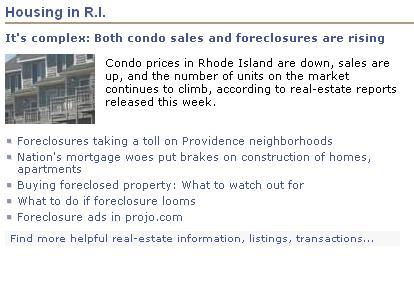
Wait a sec, I wonder.....I've seen those house flipping shows....hey look! Buying foreclosed property: What to watch out for. Oh, and What to do if foreclosure looms, yeah whatever....take me to the....
Talk about your journalistic and advertising symbiosis!
Heck, I recognize there are opportunities out there given current housing market conditions. (Full disclosure: I spent a summer as a cleaner of recently foreclosed homes). But isn't it a little weird for the ProJo to have a bunch of stories on various aspects of the current crunch all seem to lead into their own foreclosure advertisements?
July 11, 2007
Blame Democrats in Congress for High Gas Prices
Turns out President Bush is only partially to blame for the high gas prices....(h/t and a wink)
An eagle-eyed Senate GOP aide, perusing House Speaker Nancy Pelosi's Web site, calls attention to her assertion there that "Americans are paying more than double for gas than when President Bush first took office."More here. Personally, I blame it on the Red Sox signing Dice-K. Ever since then....She says the average price per gallon when he took office in 2001 was $1.47 and had reached $3.22 by May 21.
So that means gas prices went up by $1.75 a gallon over six years. But more than half of that increase, 90 cents, our source says, has come in the past six months -- the six months that she's been speaker of the House. Our source says the average price per gallon on Jan. 3, the day before she became speaker, was $2.32.
July 9, 2007
ProJo Against Yacht Center at Quonset
The ProJo editorializes against putting a Yacht yard on the spot where a container port would go:
The explanation for the state’s alacrity in welcoming a mega-yacht center: Governor Carcieri, who entered public life by opposing a container port, and some of his followers in the summer yacht-club crowd (some of whom only live in Rhode Island in the summer), will do just about anything to keep out a real port — in this case, by filling the site with the yacht center, or at least the promise of it.The rest we know by heart. For some perspective, here's an example of what a generic, two-berth container port would look like (from a study commissioned by the Maine DOT). It would take up about 320 acres to be viable.The Island Global Yachting project could, it is said, handle private yachts up to 600 feet long. The Florida-based company would pay the Quonset Development Corporation $120 million to $150 million for the property and hopes to employ 390 to 450 with average salaries around $50,000. It is also negotiating the purchase of an additional 32 acres. That’s not peanuts, and we’d welcome the project if it were located anywhere else. (How about elsewhere at Quonset?)
But it would be a terrific disservice to Rhode Islanders if the Carcieri adminstration were to permanently foreclose the possibility of building a container port...
June 28, 2007
ProJo's Perpetual Port Promotion: What Say You?
Another week, another pro-Port development editorial from the ProJo:
Port jobs pay exceptionally well and tend to be outsourcing-proof, since businesses must move goods to population centers, wherever they are produced. Further, the ports spin off other business, for which there is plenty of room at a place like Quonset Point, in manufacturing and services.Though I wish otherwise, I don't think it's ever gonna happen. {Rank self-interest Alert! I work in the maritime industry.} I know a lot of people don't want a port for all of the known reasons--bay traffic, potential pollution, truck traffic, etc.--but they are countered by the economic arguments laid forth (often) by the ProJo. Keep in mind, it doesn't have to be a container port. It can be multi-cargo (cars, bulk and containers). There is a way to compromise.Rhode Island has an opportunity to develop a thriving port at Quonset Point, but Governor Carcieri and some other leaders have squelched it so far. The yacht-club set around Narragansett Bay did not want to share the water with a couple of big ships a week in the summer, even though this occurs without conflict in other parts of the country, where politicians better understand that new jobs are essential to a healthy state, providing the tax revenues to balance the budget and provide public services without, for instance, big budget deficits. And for that matter, the yachting season around here is not exactly year round.
It seems the height of foolishness that Rhode Island refuses to exploit its tremendous natural advantages as a strong site for a thriving port in the midst of the Northeastern megalopolis, but there you have it.
For example, it looks like the current favorite plan for expanding T.F. Greene is an example of the sort of "90% solution" that may work (he said, holding his breath). A similar hashing out process could work when looking into a potential port in Quonset. It's time for some real cost-benefit analysis. Is their a way to have an economically successful port (ie; kinda big) that won't damage the "quality of life" of both the communities surrounding the port and the rest of Rhode Island?
May 24, 2007
Economics and Art
I don’t think Daniel Hunter’s theory of economics is going to play well with taxpayers. (Legislators, on the other hand, might be a different story.) From Brian C. Jones in this week’s Providence Phoenix…
Beware of questions always asked about the arts in troubled budget times, [Daniel R. Hunter, borrowed from the Massachusetts Advocates for the Arts, Sciences and Humanities] warns. The challenge goes like this: “How can we fund the arts when we cannot fund domestic violence and shelters for the homeless”?….How can the arts advocates seek another $400,000 for the Rhode Island State Council for the Arts, on top of the $2.8 million it gets now, for more poetry, dancing, painting and storytelling, when grown women don’t even have a place to sleep?The answer, of course, is that you need economic development -- by definition -- to create the resources needed to fund anything.
Hunter answered his question during his earlier pep talk.
“There isn’t anyone in the arts community who doesn’t want to fund the homeless,” he says, explaining how the fault is not with competing causes, but with the question.
Hunter says: “You never hear: ‘How can you fund economic development, when you can’t fund the homeless?’ ”
May 23, 2007
Economic States of Being and Forces of Nature
Kiersten Marek offers what might be thought of as the social worker's response to Friday's cris de coeur, and I'm not sure she's understood my complaints or my worries. Most starkly, as I explained in the comments to my post, I do not blame Rhode Island's politico-economic environment — much less the people who take advantage of it — for the loss of my Massachusetts job. That would be, as Kiersten notes, "ridiculously flawed." Rather, I blame it, first, for requiring me to go out of state for work after college and, now, for making dim my prospects for continuing to earn at my already inadequate level. Note that I mentioned my job mainly as context for my mood, referring to recent news as the subject to which I was responding.
The "wild idea" with which Kiersten closes her post represents less stark of a misunderstanding, but perhaps justifying more umbrage for that:
... try spending a year working in the social services. You would probably need to work two jobs in order to make the money you were making in construction, but many people do this. This would give you the opportunity to learn about the struggles of people who end up using social services, and see how many of them, like you, want our economy to work so that they can be successful. It might be a life-altering experience that will help you appreciate a fuller range of the human experience. Or, if it turns out that all you find are a bunch of indolent leeches on the system, it will make great fodder for a book.
I realize that folks of a liberal social service bent like to think that it is merely a heartless lack of familiarity that leads conservatives to take the positions that they do, but on the basis of what presumption does Kiersten conclude that I, one, have never had occasion to know people who've found it necessary to turn to public resources and, two, do not take the wellbeing of such people into account when formulating my concept of how our society ought to structure its economy? Putting aside my expectation that a year of social service work would actually require me to work three jobs — and contrary to the lack-of-empathy thesis — I'm quite certain that my conclusions would remain the same: mainly, that attempts to manage the economy for their benefit and to ease the experience of unemployment cause broader harm than good, particularly to the class of people whom such attempts are intended to help.
Kiersten admiringly quotes commenter Klaus's vilification of the Market (his cap, not mine) as if it were a burdensome, avaricious beast created by Ronald Reagan. But market pressures exist more as forces of nature than as a man-made machine for drawing wealth to the wealthy. It is convenient for those who have built an ideology out of wishful insistence that society can stamp out inequities to characterize the market as a conscious actor manipulating the economy to the detriment of the poor, but it clouds comprehension to mock its "infallible wisdom" and to suggest, for example, that it "has decided to stop allocating capital to construction and to put it elsewhere." Capital is flowing elsewhere, and the alternative to "the 'creative destruction' of capitalism" is not "creative management," but slow deterioration and a deflation of creativity, as capital and innovation both evaporate from the stagnant pool.
There are two ways to read Kiersten's suggestion that social services users "want our economy to work so that they can be successful," and the distinction between them is instructive. The reading that would evoke encouragement from me would be that they want our economy to work [comma] because that would make it possible for them to become successful. The second reading — which, I suspect, more people accept subconsciously than would declare it — is that they want our economy to work in such a way as to ensure their success. Being a diverse species, however, with a multitude of variegated talents and inclinations, it is necessary that a system that favors a particular set of qualities would disfavor people who do not possess them. A basic premise of capitalism is that we all benefit maximally if we privilege hard work, ingenuity, and a willingness to adapt.
For simplicity's sake, consider one step that we might take in a serious attempt to prevent capital from flowing too easily away from construction workers: increasing their value by requiring a certain degree of expertise and certification. (As I've previously explored, Rhode Island goes above and beyond with this strategy.) From the point of view of plumbers (to pick a trade), the benefits of a rigid apprentice-journeyman-master process are well worth the hassle; the speed with which competition can arise is retarded, so they can charge more for their necessary, often emergency, services, and their industry cannot respond but so rapidly to increasing demand, so there's less excess capacity when demand lightens. By the same token, however, the trade will not usually be accommodating as much of the workforce as it is able. In other words, those unfortunate souls who find themselves out of work and uncertified have less ability to take advantage of the opportunities that exist in their area. The education industry provides perhaps the most full illustration of this dynamic, with arduous procedures for procuring and maintaining certification and unionized protection of jobs once procured.
As a carpenter, I have to admit that the trade was once much more complicated. More intricate knowledge was required to build a window and chisel a run of molding than is now involved in installing either. Particular muscles and techniques required more development to hand-nail and crank screw than to work the triggers of nail and screw guns. And room for this slow developmental process was made necessary and possible by the lower speed of both information and competition. Just so, the full panoply of technological advances ought to give upstarts and innovators a stronger hand in the market. It ought to be becoming easier to change fields, not more difficult.
Klaus writes with scorn about companies' ability "to react nimbly to changes in the Market," but even if we allow him to ignore the reality that all workers are reliant on the health of their employers, we cannot ignore the fact that, to the extent that current employees are entrenched, workers in general are less nimble. And in the larger view, a less nimble workforce creates an environment in which large companies can become more exploitative. For one thing, raising salaries in a closed field, such as education or master plumbers, does not have the same upward effect on salaries in general, because employers don't have to compete as immediately with other industries for the best workers.
See, my worldview does not hold that people are "indigent drags" (much less Kiersten's rephrasing, "indolent leeches"), as if it were some sort of state of being. Rather, I'd argue that we are providing them with that role to play. Moreover — partly in tandem, partly as a consequence — we are making it more difficult for them to exit that role and, thereafter, to climb well beyond its gravity.
Yes, as a moral matter, as well as a calculated investment, our society ought to provide a safety net for those whose lives take harmful turns. Yes, our public constructs have a role in ensuring that those with privileged access to and control over capital do not abuse their resources to lock others out. But as technology increases individuals' access to information and opportunities for networking and production, government interference will be increasingly likely to create advantages for incumbents than to assist outsiders. Less light, after all, can pierce murky glass and wind labyrinthine halls.
May 22, 2007
Economic Impact of Illegal Immigration
Now that the Senate has slowed down the "amnesty" process a bit (phew!), perhaps they will be able to thoughtfully examine the economic impact of allowing massive numbers of low-skilled immigrant workers into this country (whether they're here illegally or not). This isn't to say that we shouldn't allow such workers in, only that we shouldn't allow so many--and we certainly shouldn't do so by enabling illegal entry by "looking the other way."
It is often argued that the American economy relies on low-skill immigrants--illegal or not--who can be paid a low wage to perform the "jobs Americans won't do." What is left unsaid is that these workers effectively hold down the wages of American citizens, as this study {PDF} shows.
• By increasing the supply of labor between 1980 and 2000, immigration reduced the average annual earnings of native-born men by an estimated $1,700 or roughly 4 percent.Continue reading "Economic Impact of Illegal Immigration"
• Among natives without a high school education, who roughly correspond to the poorest tenth of the workforce, the estimated impact was even larger, reducing their wages by 7.4 percent.
• The 10 million native-born workers without a high school degree face the most competition from immigrants, as do the eight million younger natives with only a high school education and 12 million younger college graduates.
• The negative effect on native-born black and Hispanic workers is significantly larger than on whites because a much larger share of minorities are in direct competition with immigrants.
• The reduction in earnings occurs regardless of whether the immigrants are legal or illegal, permanent or temporary. It is the presence of additional workers that reduces wages, not their legal status.
May 18, 2007
Hide Your Wallets, D.C. Dems are Coming....
Republican Senator Mitch McConnell writes:
While most of the media were busy covering the latest developments on the Iraq funding bill or the bipartisan immigration proposal, congressional Democrats on Thursday quietly passed a budget creating the framework for the largest tax increases in American history...Heritage also has some analysis on the Senate Budget--most of the tax increases are because the Senate is going to simply let the Bush tax cuts expire--and more here:Everyone takes a hit. Forty-five million working families with two children will see their taxes increase by nearly $3,000 annually. They’d see the current child tax credit cut in half — from $1,000 to $500. The standard deduction for married couples is also cut in half, from the current $3,400 to $1,700. The overall effect on married couples with children is obvious: Far from shifting the burden onto the wealthy, the Democratic budget drives up taxes on the average American family by more than 130 percent.
Seniors get hit hard too. Democrats like to crow that only the richest one percent of Americans benefit from the stimulative tax cuts Republicans passed in 2001 and 2003. What they rarely mention is how much seniors benefited from those cuts in the form of increased income as a result of lower taxes on dividends and capital gains. More than half of all seniors today claim income from these two sources, and the Democratic budget would lower the income of every one of them by reversing every one of those cuts.
With federal spending surging above $24,000 per household per year, the incoming Democratic majority of Congress promised to restore fiscal responsibility in Washington. Instead of paring back the growth of government, however, Congress came to agreement in conference on a budget resolution that:President Bush has vowed to veto the Democratic budget.* Raises taxes by $721 billion over five years, and a projected $2.7 trillion over 10 years, or more than $2,000 per household;
* Includes 23 reserve funds that could be used to raise taxes by hundreds of billions more;
* Increases discretionary spending by nearly 9 percent in FY 2008 and does not terminate a single wasteful program;
* Completely ignores the impending explosion of Social Security, Medicare, and Medicaid costs; and
* Creates rules that bias the budget toward tax increases.
...Congress’s budget resolution is consistent with the Democratic majority’s budget agenda so far. In just a few months in Washington, the Democratic Congress has tacked $21 billion in unrelated deficit spending onto the Iraq war emergency bill; passed a $7 billion farm bailout—without any offsets—that violates the majority’s own pay-as-you-go (PAYGO) rules by adding new mandatory spending;[1] and waived its own PAYGO rules in order to add new mandatory spending as part of a bill to expand the House of Representatives.[2] Coming on the heels of these initiatives, Congress’s irresponsible budget resolution is hardly a surprise.
May 9, 2007
What to Do About Economic Perversity
I agree with the Providence Journal that it is "perverse" for the CEO of a health insurance company to make one-and-a-half times the entire payroll of a 2,000-employee hospital. Considering how often Republicans and conservatives are saddled with the ideological blame for these supposed excesses of the free market, that admission may surprise some readers. We're not talking an ideological paradox — or even run-of-the-mill self-contradiction — though.
Such stark comparisons should actually lead one to question whether we're seeing evidence of capitalism unbound or capitalism unwisely bounded. The fundamental differences between modern economic philosophies (e.g., between Keynesianism and supply-side economics) sometimes seem to come down to conflicting opinions about how to get the rich to keep their money moving (e.g., as corporate profits or as private income) — indicating a general understanding that those who control wealth will tend to try to take as much as possible for themselves. It is reasonable to suggest, therefore, that the encouragement of competition is perhaps the most effective means of placing natural, market-driven limits on the amount of wealth that it is reasonable for the rich to siphon away from productive ends. Try to grab a $100 bill from somebody, and he'll hold it out of reach, dodge left, dodge right, and run you in circles; offer somebody else a profitable opportunity while the first guy is hoarding his cache, and that $100 bill might not be so difficult to liberate.
The healthcare industry is plainly not an example of a free market, what with regulations, coverage dictat's, and the insurer/customer relationship's being all tangled up with the customers' unrelated careers. as much money as $124 million might be, throwing it away is apparently not a competitive handicap in the face of high barriers to entry and high costs of doing business once a company has entered the industry.
So no, I don't support a system of such gargantuan inequalities. I support a system in which competition puts the avaricious in danger of eating themselves.
April 11, 2007
A Philosophy of Shopping
Marc recently raised the question of conservative imperatives bearing on local versus big-brand shopping habits. It's an interesting topic, because it lies at the intersection of various philosophical principles and general preferences.
Chief among the principles is the acknowledgment that we must work within, rather than deny, the incomprehensible forces that govern human society. In this case, that means respecting the market. If national chains can more efficiently provide goods or services in a way that society prefers or needs — more quickly, less expensively, more reliably — then the competitive odds will be stacked in their favor, and denying that reality will result in a loss somewhere in the economy and the society, not the least because smart, entrepreneurial people will be devoting their efforts in wasteful ventures.
Market forces should draw workers from occupations and locations in which it is difficult to compete toward those in which opportunities outnumber employees. People who are able to do so would greatly benefit society and themselves by creating new markets or discovering untapped demand for existing ones. And the market will require folks who are especially gifted at or tied to particular markets in which competition has increased to differentiate themselves by finding angles that the competition hasn't exploited or cannot exploit as effectively. One obvious strategy aligns with a social preference dear to conservative hearts: encouragement of a sense of community.
Clements' Market in Portsmouth is an example of a business that leverages its available differentiators well. Local produce compounds the "buy local" appeal. Familiar faces are behind the registers by day, and after the schoolday ends, checking out is like stepping into a pleasant 1950s cliché. A program involving register receipts can benefit local charities. The store also takes advantage of Portsmouth's upper middle class standing with high-end offerings, including a sushi bar.
All of this comes at a cost, of course, which is why it is strange for liberals to hate Wal-Mart so fervently. Granted, that company's executives are rich beyond belief, but people who prioritize distributed wealth ought to appreciate that the stores' efficiency and economy of scale have given families of average and below wealth an opportunity for a higher quality of life.
Of course, a reasonable response is that the proximity of a superstore raises the cost — often to a prohibitive degree — of Clements'-like values, putting a premium on what once was ordinary. The urge to block big-box development is therefore understandable — even were it to prove largely futile in context of the larger economy — and there are legitimate and conflicting claims across class lines.
Whether particular developments are good or bad depends on group perspective. To families struggling to get by, sushi and smiles weren't on the table to begin with, but to others, business ownership and community are critical, defining characteristics of our culture that ultimately benefit everybody. As Hayek argued in Road to Serfdom — observing that Naziism was socialism for the class that working class socialism had suppressed — attempting to manage these endless complexities involved is an act of perilous vanity.
Even just the common assumption that disproportionate wealth is nearly evil in its unfairness is fraught with crucial subtleties. It's occurred to me, as I've passed the obscene wealth on display along Ocean Drive in Newport, that the alternative might resemble one of those seaside teenage paradise boardwalk cities that litter the New Jersey coast. Such areas have their place (and I was one of the teenagers who thought them paradise), but just as the wealth of upper middle class suburbanites preserves aspects of our culture, the wealth of the ultrarich is not purely to their benefit alone.
(One implication of this that the populist in me feels compelled to note is that an elite that loses its taste for the refined and hand-crafted also loses part of its argument for being tolerated. At the same time, the Christian in me must note that wealth is not all, and that some rewards come at a cost that our culture has a tendency to ignore.)
What this all comes down to for the conservative who wishes for a practical rule of thumb when forming shopping habits isn't very conclusive, because all courses of action are acceptable given the individual's preferences and circumstances. My own thinking on the matter is that we do well to treat those values that come at a premium — whether they are atmospheric or community-related or what have you — as exactly what they are: cost/benefit considerations. And here, traditionalist leanings point toward the wise strategy of looking to one's own family and assessing its wants and needs as a prior concern.
March 26, 2007
Buy Local, or Buy Cheap?
This snippet from the ProJo's Robert Whitcomb got me thinking:
This past Sunday’s Boston Herald detailed, in a story by Phil Restuccia, a growing movement of consumers and local businesspeople called Local First. This national group has organized 17,000 businesses around the country into 50 groups promoting their services directly to local shoppers, appealing to geographic loyalty and a sense of community. It’s kind of the “Small Is Beautiful” movement redux, or a cousin of the New Urbanism.As the sole breadwinner of a family of four, I certainly have some "free-market" proclivities (ie; cheap=good!). Nonetheless, I also have always felt a certain--responsibility?--to frequent local, mom-and-pop or small businesses when I can.Founded by Massachusetts health-club owner Laury Hammel, the movement wants to strengthen community ties by keeping locally owned businesses in, well, business and in so doing to strengthen frayed community ties in anomie-ridden America.
The movement has gained considerable traction, but given Americans’ obsession with the low prices offered by national store chains whose stuff is made by cheap labor abroad, and the comfort factor for many consumers of national brands, you have to wonder how far this movement can go — as attractive as it is to affluent and urbane people in the Northeast. {Links added by me--MAC}
But I wonder what a conservative economic theory would hold as being more, well, conservative. I think it safe to say that, generally speaking, if the quality of the product is the same, that a larger business--like the big box retailers--can offer the same product at a cheaper price. But is it--should it be--all about price?
In the short term, it's hard to argue against paying the cheaper price. But what about long term consequences? Should we promote buying local, even if it's more expensive, because it helps out our own micro (Rhode Island) and micro-micro (town or city) economy? I would think that buying local will help local business (wow, how insightful, huh?), the local economy and, yes, even local tax revenues. I suppose this is a micro-economic version of the argument for "Buying American."
I realize this is theoretical and that most people will go for the lowest price, but what do other conservatives think? In other words, quality of product being equal, does it make fiscally conservative sense to prioritize buying local?
March 19, 2007
The Proof is in the Pudding: Americans DO Want "Those" Jobs
I had heard last week that the recently-raided M. Bianco plant in New Bedford had opened it's doors to applicants and that they were mobbed. As Mark Krikorian reminds, this is just another example that undercuts the claim that illegal immigrants do the jobs Americans won't do.
After the Swift meatpacking raids in Greeley. Colo., Americans lined up out the door of the hiring office seeking the newly freed-up positions. Then, after the Crider chicken plant in Stillmore, Ga., was cleared of its illegal aliens, "For the first time in years, local officials say, Crider aggressively sought workers from the area's state-funded employment office." And now, after the raid on a New Bedford, Mass., military contractor (that has caused such hyperventilation from the party apparat in the people's republic), guess what? Yup. Americans in that high-unemployment city are actually getting hired.He links to this video, from New England Cable News (wish Cox gave us the option...). Watching the video, it becomes clear that--at least anecdotally--the people taking those newly-available jobs are members of the poor and working class minority community. (One gentleman even goes so far as to say--to paraphrase--that it doesn't matter if it's at the minimum wage, it's a job). These are exactly the people most hurt by illegal immigrants working at sub-standard wages. We all have to start somewhere, and by enabling illegal immigrants, those who claim to be advocates for the unemployed are actually doing them a disservice.
If this is the Future of Republican Economic Thought, then I’m Changing my Affiliation to Whig
Who says that Republican big-business types don’t care about income inequality? From Bloomberg News, via the Boston Globe…
Inequality of incomes is the "critical area where capitalist systems are most vulnerable," [Former Federal Reserve Chairman Alan Greenspan] said yesterday in Washington at a conference on maintaining the competitiveness of US capital markets convened by Treasury Secretary Henry Paulson. "You cannot have a system that we have unless the people who participate in it believe it is just."And Mr. Greenspan has the solution! All we need to do to even out incomes is depress incomes at the upper end of the scale, by allowing more immigration of skilled workers into the U.S…
Allowing more skilled workers into the country would bring down the salaries of top earners in the United States, easing tensions over the mounting wage gap, Greenspan said.I don’t think Ronald Reagan, who appointed Mr. Greenspan to his original Federal Reserve term, would have gotten behind this one."Our skilled wages are higher than anywhere in the world," he said. "If we open up a significant window for skilled workers, that would suppress the skilled-wage level and end the concentration of income."
Two questions for your consideration…
- For the practically minded: If “inequality” is the concern, why not enforce existing immigration laws to tighten the labor market to increase wages at the lower end of the pay scale, rather than try to depress wages in the middle and at the top of the scale?
- And for the more theoretically minded: How is using immigration policy to control wages any less noxious than implementing direct wage controls?
February 12, 2007
On Seriousness and Incentives
Although I'll resist the temptation to offer snarky comments about the qualities of "serious" columnists, I will acknowledge that they aren't apparent in Froma Harrop's lunge into the minimum wage debate:
There is a conservative worldview that people who don’t make serious money aren’t serious people. Economic incentives are for entrepreneurs. For the low-of-wage, you put a bowl of nuggets on the ground and pat their heads.
Longtime readers might have the general sense that I haven't found Harrop's powers of perception to be particularly impressive, but it appears that she has now confused the worldviews of conservatives and liberals! Condescending handouts and a general premise that disadvantaged people are constitutionally incapable of capitalizing on profferred opportunities are ideological markers of the Left. Contra Harrop, contriving regular increases in pay for sticking it out in the same menial, bottom-rung job — far from creating it — undermines incentive. In summary, as I've said recently, piecemeal minimum wage laws are precisely the scattered nuggets and pats on the head that Harrop laments, and any attempted push of such legislation past that point would be devastating.
I'm left struggling for words to say about a columnist who could write the following:
If business owners can’t make a decent profit paying their workers a minimum wage — that adjusted for inflation would still be lower than it was in 1969 — then perhaps, just perhaps, they shouldn’t be in business.
Nevermind that, as I explained in the post just linked, beginning small businesses on razor-thin margins represents an escape from the rut of low-wage work, and knocking such businesses off the playing field will only ease the growth of megaglobalconglomerates. As is more often the case than I've interest in voicing, I find myself wondering whether the letters FROMA HARROP are some supremely clever acronym or anagram meaning "out of touch columnist" and can only opine that she is clearly too well paid.
February 4, 2007
Talking Budget: Is Compromise in the Air? (Or is it just talk?)
{N.B. Here at Anchor Rising, we watch (or TiVo) the local Sunday morning shows so you don't have to. Here is a transcript of this morning's Channel 12 Newsmakers, hosted by Steve Aveson and also features Ian Donnis of the Providence Phoenix (who has a little more, here). I've offered a few (very few) comments of my own in italics}.
Guests:
Rep. Steve Costantino - Chair, House Finance Committee
Rep. Paul Crowley, Newport - Deputy Chair, House Finance Committee
Steve Aveson (SA) - [As far as the budget], we're in a tough spot...we've hit the wall.
Steve Costantino (SC) - We have hit the wall. And if we were to pass this budget as is, putting aside whether there are some valid issues in the budget or not, the first day of July, 2009, we will have a $379 million deficit. So, although this budget is balanced, it really does very little in terms of looking at the structural problems we have with the budget. You can't grow budgets at a certain level when your revenue is growing at a different level. And that's pretty much where we are right now. Our revenue numbers are not sustaining the expenditures. So there has to be complete analysis of this budget. There are too many one time fixes in the budge, and when you have a one time fix, remember, you've lost the ability to use it in the out-years. So, if you have a $50 million, one time revenue item, you don't have that in the next year. So now you have to find it and if you don't have it terms of revenue growth, you have to go deeper in the expenditure side.
SA - In some degree, the Governor and you are kind of speaking the same tone. We've got problems, we've gotta solve the problems and we've got some specific ideas in mind. Paul, just give us the long view, after almost 27 years in the General Assembly, how is it that you think we get to this point today...
Paul Crowley (PC) - I think it's basically that...We have a very hard time, when the revenues are coming in, to get people to accept the fact that there is a limit to what government can do. And when there's money to be spent and programs can be expanded, like in good programs like RIte Care for young children, it's hard to say, well, someday there's going to be a limit as to what we as a state with a population of only a million people, how much revenue we can produce and how much government we can support. That's an argument that people don't want to hear. So it keeps kinda growing each year, each year and then finally, we hit the wall. Now, I think, what my great concern is that, not only are we facing this revenue issue--we're facing the issue of government growing--but we're also facing a significant change in our state's population. We're going to become an older state, so that all those people that have worked in this economy are going to become retirees of this economy. So it's going to become a different kind of state and we better deal with that and question from the local level--not just the state level, from the local level--how much government can we afford, what can we ask them to do and how can we make it more efficient.
Continue reading "Talking Budget: Is Compromise in the Air? (Or is it just talk?)"January 26, 2007
Kudlow: Follow the Money
Economist Larry Kudlow sites a story from the NY Times, which includes this bit:
The Bureau of Labor Statistics reported Thursday that union membership fell by 326,000 in 2006, to 15.4 million workers, bringing the percentage of employees in unions to 12 percent, down from 12.5 percent in 2005. Those figures are down from 20 percent in 1983 and from 35 percent in the 1950s...Kudlow then observes:
Take a look at the high union states vs. the low union states.For more on the "population losing" part, check out this regional analysis by Michael Barone (and he really digs deep in this breakdown). Barone notes:The high union states—New York, New Jersey, Washington, etc—also happen to be high tax, slow growth, population losing, states.
On the other hand, the low union states—places like Utah, Virginia, and both Carolinas—are low tax, pro business, population growing states, with strong economic growth.
It tells you something, doesn’t it?
As for internal migration, people are voting with their feet against the East and California in droves. Here are the states with the biggest negative net internal migration:Calif. 287,684
La. 241,201
N.Y. 225,766
N.J. 72,547
Ill. 68,661
Mich. 65,123
Mass. 49,528
Ohio 48,153These tend to be states with high tax rates, high housing costs and aging industrial bases.
Here are the states with the biggest positive net internal migration:
Texas 218,745
Fla. 165,757
Ariz. 129,987
Ga. 120,953
N.C. 104,133
Nev. 53,105
Tenn. 50,383
S.C. 47,950These tend to be low tax states, with booming economies. And mostly southern: the only western states are Arizona and Nevada. Indeed, the net internal in-migration into the Rocky Mountain states (268,607) is lower than the net internal out-migration from California (287,684).
January 14, 2007
What Conservatives Ought to Explain to Working Families About Minimum Wages
Although I can't recall any particular instances of his using it, except when helping me with my homework, I associate the phrase "think it through" with my father. It has always seemed, I suppose, to summarize a particular approach to the world — almost a philosophy — that he emphasizes.
Not to leap too quickly from general philosophy to economic specificity, but the phrase comes to mind now because I wish people would apply the principle to the issue of the minimum wage, which is in the news of late. The most recent example in the media is the accusation of Nancy Pelosi's hypocrisy, upon the House of Representatives' voting to raise the minimum wage from $5.15 to $7.25 per hour (or about 41%). Not to single him out, but in a comment to Marc's post on that story, Scott Bill Hirst writes:
I support an increase in the minimum wage. ... I do not believe the GOP needs to be a puppet of organized labor but it needs to reach out to working class Americans more. Serious issues of affordable health care and affordable housing are issues that put great financial pressures on Rhode Island households and need to be adequately addressed in our state.I am still a Republican and Republicans need to facilitate addressing their positions on these issues. We need to look at imports and the respective policies of those countries on how they treat labor.
"Thinking through" the minimum wage brings to the fore the superficial, cynical, and injurious nature of this sort of "reaching out." As I noted in the comments, conservatives and Republicans ought to concentrate on explaining to working families that market forces confound efforts to force-raise wages, often to the detriment of those ostensibly intended to benefit.
Businesses Will Do as Business Requires
First consider the issue from employers' perspective: a business that suddenly finds itself having to pay 41% more for low-end, unskilled labor will have to find that money somewhere else in the budget. In the fantasy land of progressives, perhaps companies would shift resources from the higher ends of their payrolls, but in the real world, isolated excesses aside, those jobs pay better for a reason. More likely, companies will decrease their low-end employment, shifting their tasks either up the pay scale or to technology.
They will also increase their prices. Doing so may push smaller companies past the threshold of being able to compete, ceding the field to category killers (such as Home Depot) that bring economy of scale to their business models. In industries with captive customer bases (e.g., retail), these companies can pass increased costs on to consumers almost as a matter of course. In other words, the cost of goods — often essentials — will go up for everybody, including those at the minimum wage, as well as those who were just barely getting by before. In industries that aren't as tied to particular locations (e.g., high tech), companies that raise their prices too high will lose their ability to compete with firms elsewhere or will have to move elsewhere, themselves.
So, to sum up the effects of aggressive minimum wage hikes from the employers' point of view:
- Fewer employees at the low end of the pay scale
- Additional work for those higher up the pay scale
- Higher prices
- Fewer small companies
- Fewer big companies operating locally
Workers Will Go Where the Money Is
To consider the issue from the perspective of employees, I'll draw from my own experience of jobs that required roughly the same level of prior experience (i.e., very little), estimating current pay ranges:
- Music store clerk: very simple, low stress, few discomforts, no danger, not strenuous, $5.30–6.50
- Laborer in seafood retail: very simple, low stress, moderate discomforts, low danger, strenuous, $7.00–9.00
- Laborer in construction: very simple, moderate stress, significant discomforts, high danger, strenuous, $10.00–12.00
(Note that these pay ranges are purely for argument's sake; they don't have to be but so accurate.)
Although I'm simplifying the dynamic involved, there are direct and clear reasons that each form of low-end work has to, or can get away with, paying employees at the relevant rate. Jobs that are more difficult, dangerous, and strenuous have to pay better to attract employees from jobs that are more comfortable. If the music store must now pay employees $7.25 to hang out and watch the register, then the seafood store is going to have to up the ante to find laborers. If the seafood store breaks the $10.00 mark, the construction company is going to have to maintain the margin of remuneration. If laborers approach the wages of carpenter's helpers, then they aren't going to want to begin investing in tools and attention unless that rung moves higher, too, and if carpenter's helpers begin earning at a rate similar to carpenters, then the latter aren't going to take on more responsibility. And so on and so forth, throughout the economy.
Thus, costs rise for companies throughout the pay scale, and prices inflate to cover them. Plainly put, the pay scale just shifts, without an increase in the buying power of anybody involved. And in a globalized economy — with technology always threatening to replace human workers, if there's sufficient incentive for companies to invest in it — it shifts toward a ledge of layoffs and bankruptcies.
A Wage to Die By
In New England, government-types have been toying with the more insidious idea of a "living wage," which, in Norwalk, CT, means "115% of the poverty threshold for a family of four," currently $11.05 (via RIFuture). In Providence, the heated debate is over $11.97 per hour (or $10.19 with healthcare). I use the word "insidious" for four reasons:
- The idea that salaries should be determined starting with the worker, rather than the work to be done, while sounding like a compassionate approach, takes no account of the market forces that have made capitalism such a powerful system — and a force for good. We might as well just divvy up the nation's capital and allow people to do whatever work they want (except jobs that nobody wants, and we'll, I don't know, take turns at those), which everybody except deluded socialists understands to be an unworkable fantasy. The first indication that this is true is that any sort of "living wage" proposal is necessarily so unrealistically above the current minimum wage.
- The formula for determining a "living wage" carries implicit social engineering. Just the idea that a single 40 hour per week should be forced to be sufficient for a "family of four" brushes away layers of social and cultural input and creates incentives that are deleterious to social and cultural well-being. The incentives emphasize the single person. If a single person can, working even the lowest-level job, earn at the rate that a family of four needs, then there will be fewer families of four. There will be less motivation to form marital unions, and the motivation for advancement that a family naturally provides will begin to seep from our society. Alternately or simultaneously, the policy will create a perpetual inflation machine, as the prices of goods and services increase in response to what families will initially see as disposable income.
- These proposals (being unrealistic for a realm in which market forces apply) tend to focus on employees of the government or organizations that do business with the government. And when the government has to come up with more money, it doesn't raise prices in the hope that customers will still find its deals attractive; governments raise taxes, taking the money they need by force of the law, taking from those who make the minimum wage in the private sphere as well as those who were just barely getting by before. As far as organizations that do business with the government are concerned, mandating pay rates that simply won't work in the private sphere creates bifurcated industries, in which the majority of companies are locked out of government work, while the smaller playing field and limitless revenue flow keep the prices that the taxpayers dish out absurdly high.
- Giving government industry such an imbalanced edge in the job market drains the private sector — the home of entrepreneurship and innovation — of talent, often (I'd say) luring those who might make the greatest contributions, given the push of necessity, into a static complacency.
The Conservative's Advice
Something is clearly wrong when we've reached the point of treating the government more as an employer than as a shared resource. There are activities that government structures are best positioned to undertake; driving the economy is not one of them. Neither is micromanaging employment relationships.
Well-intentioned people who want to help working families — as opposed to "reaching out" to them — should be able to discern, while considering the likely effects of forcing up the minimum wage, the place in which influence would best be applied: getting them past that low-end, clerk/laborer slot by opening up opportunities, not other people's wallets. I've gone on too long to explore them, here, but two areas for action toward that end are education and entrepreneurship, with the emphasis on the latter.
One difficulty with education, as a means toward broad social advancement, is that it will tend to mean advancement across industries. The college-educated laborer will not be inclined to return to the construction site and will not generally recoup his investment of time and money if he does. In contrast, manipulating government policies in such a way as to encourage small businesses — making the leap from employee to business owner more plausible in a world of Big Box stores, category killers, and multinational corporations — would harness Americans' natural drive to succeed and make every ground-floor job in every industry just a first step in each worker's quest to increase his or her own minimum wage.
ADDENDUM:
For more on the living wage movement, see this May 2006 post by Don Hawthorne.
January 12, 2007
Pelosi: Raise the Minimum Wage! (Er, Except if it Affects a Company in my District)
Heh. Something fishy is going on:
House Republicans yesterday declared "something fishy" about the major tuna company in House Speaker Nancy Pelosi's San Francisco district being exempted from the minimum-wage increase that Democrats approved this week.Yes, it's all just one big coincidence!!!"I am shocked," said Rep. Eric Cantor, Virginia Republican and his party's chief deputy whip, noting that Mrs. Pelosi campaigned heavily on promises of honest government. "Now we find out that she is exempting hometown companies from minimum wage. This is exactly the hypocrisy and double talk that we have come to expect from the Democrats."
...The bill also extends for the first time the federal minimum wage to the U.S. territory of the Northern Mariana Islands. However, it exempts American Samoa, another Pacific island territory that would become the only U.S. territory not subject to federal minimum-wage laws.
One of the biggest opponents of the federal minimum wage in Samoa is StarKist Tuna, which owns one of the two packing plants that together employ more than 5,000 Samoans, or nearly 75 percent of the island's work force. StarKist's parent company, Del Monte Corp., has headquarters in San Francisco, which is represented by Mrs. Pelosi. The other plant belongs to California-based Chicken of the Sea.
"There's something fishy going on here," said Rep. Patrick T. McHenry, North Carolina Republican....A spokeswoman for Mrs. Pelosi said Wednesday that the speaker has not been lobbied in any way by StarKist or Del Monte.
And golly gee, I was quite surprised to discover that this was missed by those who were going to be "holding the Dems accountable" and wouldn't just "monitor" (cheerlead) them as new bills went through the House and Senate. (Well, maybe they'll get around to it eventually). To help 'em along, perhaps they should also read this from the Saipan Tribune:
Democrats have long tried to pull the Northern Marianas under the umbrella of U.S. labor law, accusing the island's government and its industry leaders of coddling sweatshops and turning a blind eye to forced abortions and indentured servitude.Faleomavaega understands that it makes economic sense to pay a lower wage and keep all of those jobs on his island instead of forcing a higher wage on employers who may then move the jobs elsewhere. I guess "sweat shops" aren't "sweat shops" when "market forces" are just too strong to impose a higher minimum wage in a Democrat's district.Samoa has escaped such notoriety, and its low-wage canneries have a protector of a different political stripe, Democratic delegate Eni F.H. Faleomavaega, whose campaign coffers have been well stocked by the tuna industry that virtually runs his island's economy.
Faleomavaega has long made it clear he did not believe his island's economy could handle the federal minimum wage, issuing statements of sympathy for a Samoan tuna industry competing with South American and Asian canneries paying workers about 67 cents an hour.The message got through to House Education and Labor Committee Chairman George Miller, D-Calif., the author of the minimum wage bill who included the Marianas but not Samoa, according to committee aides. The aides said the Samoan economy does not have the diversity and vibrance to handle the mainland's minimum wage, nor does the island have anything like the labor rights abuses Miller claims of the Marianas...
...But in American Samoa the tuna industry rules the roost. Canneries employ nearly 5,000 workers on the island, or 40 percent of the work force, paying on average $3.60 an hour, compared to $7.99 an hour for Samoan government employees. Samoan minimum wage rates are set by federal industry committees, which visit the island every two years...
When StarKist lobbied in the past to prevent small minimum wage hikes, Faleomavaega denounced the efforts.
“StarKist is a billion dollar a year company,” he said after a 2003 meeting with StarKist and Del Monte executives. “It is not fair to pay a corporate executive $65 million a year while a cannery work only makes $3.60 per hour.”
But after the same meeting, Faleomavaega said he understood that the Samoan canneries were facing severe wage competition from South American and Asian competitors.
Department of Interior testimony last year before the Senate noted that canneries in Thailand and the Philippines were paying their workers about 67 cents an hour. If the canneries left American Samoa en masse, the impact would be devastating, leaving Samoans wards of the federal welfare state, warned David Cohen, deputy assistant secretary of the interior for insular affairs.{emphasis added)
Yup, this looks exactly like the sort of hypocrisy they claimed they'd be on the lookout for. Can't wait to see 'em in action!
October 25, 2006
Build a Casino or a Research Facility? The Government Officially Says "Whichever"
Here's a fascinating factoid for the day and a point to ponder in the casino debate, from Michael Mandel et. al in Business Week (h/t Jonah Goldberg)...
What you may not realize is that the government's decades-old system of number collection and crunching captures investments in equipment, buildings, and software, but for the most part misses the growing portion of GDP that is generating the cool, game-changing ideas. "As we've become a more knowledge-based economy," says University of Maryland economist Charles R. Hulten, "our statistics have not shifted to capture the effects."In other words, the government's system of economic statistics is likely to count a casino as a better investment than a new pharmaceutical research center, if the casino is in a big enough building!The statistical wizards at the Bureau of Economic Analysis in Washington can whip up a spreadsheet showing how much the railroads spend on furniture ($39 million in 2004, to be exact). But they have no way of tracking the billions of dollars companies spend each year on innovation and product design, brand-building, employee training, or any of the other intangible investments required to compete in today's global economy?
Machines and buildings were counted as future-oriented investment, but spending on education, training, and R&D was not. No attempt was made to judge the social utility of expenditures. For example, the $6 million cost of building the Flamingo Hotel, the Las Vegas casino opened by Bugsy Siegel in 1946, was tallied as an investment. But AT&T's funding of Bell Labs, where the transistor was invented around the same time, wasn't even included in GDP.
September 2, 2006

The International & Domestic Impact of Reaganomics 25 Years Later
An August 12 Wall Street Journal editorial entitled Reaganomics at 25 (available for a fee) highlights the enduring positive international effect of President Reagan's supply-side economic policies:
Twenty-five years ago this weekend, Ronald Reagan signed the Economic Recovery Tax Act. The bill cut personal income tax rates by 25% across the board, indexed tax brackets for inflation and reduced the corporate income tax rate. The anniversary is worth commemorating as a seminal moment that continues to influence policy for the better in the U.S., and around the globe.The achievement of Reaganomics can only be fully understood by recalling the miserable state of affairs a quarter-century ago. Newsweek summarized the national mood when it wrote in 1981 that Reagan "inherits the most dangerous economic crisis since Franklin Roosevelt took office 48 years ago."
That was no exaggeration. The economy was enduring a cycle of rising inflation with growing levels of unemployment. Remember 20% mortgage interest rates? Terms like "stagflation" and "misery index" entered the popular vocabulary, and declinists of various kinds were in the saddle. The perception of American economic weakness encouraged the Soviet empire to ever bolder adventures...
The reigning Keynesian policy consensus had no answer for this predicament, and so a new group of economic ideas came to the fore. Actually, they were old, classical economic ideas that were rediscovered via the likes of Milton Friedman and the Chicago School, Arthur Laffer, Robert Mundell, and such policy activists in Washington as Norman Ture and Jack Kemp...
For every policy goal, you need a policy lever...Monetary restraint was needed to break inflation, while cuts in marginal tax rates would restore the incentives to save and invest. With Paul Volcker at the Federal Reserve and Reagan at the White House, those two levers became the essence of the "supply-side" policy mix.
The results have been better than even some of its supporters hoped. The Dow Jones Industrial Average first broke 1,000 in 1972, but a decade later it was barely above 800 -- one of the worst and most enduring bear markets in history. In the 25 years since Reaganomics, however, the Dow has climbed to about 11,000, accounting for an increase in national wealth on the order of $25 trillion...American living standards have risen steadily, and U.S. businesses have created entire industries that didn't exist a generation ago.
Obviously, the economic policy path from 1981 to the present day has not been a straight line. The biggest detour occurred from 1990 through 1994, when George H. W. Bush and Bill Clinton forgot the Gipper's lesson and raised marginal income-tax rates; they suffered for it in the elections of 1992 and 1994. The arrival of the Gingrich Republicans in Congress stopped this slow-motion repeal of Reaganomics, however, and even helped to extend it at the margin with a cut in the capital-gains tax rate to 20% in 1997.
Adherents of Rubinomics -- after Clinton Treasury Secretary Robert Rubin -- are still not converts, arguing that tax increases are virtuous if they reduce the deficit...But even the Rubinites haven't dared to repeal indexing for inflation (which pushed taxpayers via "bracket creep" into ever-higher tax rates), and even the most ardent liberals don't propose to return to the top pre-Reagan income tax rate of 70%. They also now understand that, at some point along the Laffer Curve, high rates begin to yield less tax revenue. The bipartisan consensus in favor of sound money has also held.
Thus today, the top marginal personal and corporate tax rates are 35%, compared with 70% and 48% in 1981. In the late 1970s the tax on dividends was 70% and the capital gains rate was 50%; now they're both 15%. These reductions have increased the rate of return on capital, and hence some $3 trillion more was invested by foreigners in the U.S. between 1981 and 2005 than was invested by Americans abroad. One result: 40 million new jobs, more than the rest of the industrialized world combined.
The rest of the world, meanwhile, has followed the Gipper down the tax-cut curve. Daniel Mitchell of the Heritage Foundation finds that the average personal income tax rate in the industrialized world is now 43%, versus 67% in 1980. The average top corporate tax rate has fallen to 29% from 48%. This decline in global tax rates has been the economic counterpart to the fall of the Berlin Wall. Most of Eastern Europe has adopted flat tax rates of 25% or lower, and the Russians now have a flat income tax of 13%. In Old Europe, Ireland's corporate and personal income tax rate cuts have helped generate the swiftest economic growth in the EU.
...In his 1989 farewell address, Reagan said that "People say that I was a great communicator. It would be more accurate to say that I communicated great ideas." He was right, and a remarkable global prosperity has followed in his wake. The challenge for current and future political leaders is not to forget it.
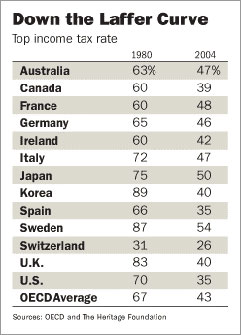
What about the enduring effect of these supply-side economic policies on domestic policies? That question is answered by Christopher DeMuth, President of the American Enterprise Institute, in Reaganomics: How’s It Going?: Two wins, a draw, and two losses (also available for a fee) published in the September 11 issue of National Review:
When Ronald Reagan came to Washington, he brought with him a conservative school of economics. This school emphasized, much more thoroughly and systematically than those associated with previous presidents of either party, the advantages of private markets, the disadvantages of government spending and regulation, and the role of private economic incentives in advancing or undermining government policies. As we pass the 25th anniversary of the August 1981 tax cuts, it is appropriate to assess Reagan’s economic record. My scorecard shows two wins, one draw, and two losses.Continue reading "The International & Domestic Impact of Reaganomics 25 Years Later"
September 1, 2006
Milton Friedman on Economic Issues
In the July 2006 issue of Hillsdale College's Imprimis, Larry Arnn interviews Nobel Laureate Milton Friedman on a number of topics. Here are his thoughts on economic issues:
LARRY ARNN: In Free to Choose, in the chapter on "The Tyranny of Controls," you argue that protectionism and government intervention in general breed conflict and that free markets breed cooperation. How do you reconcile this statement with the fact that we think of free markets as being competitive?Continue reading "Milton Friedman on Economic Issues"MILTON FRIEDMAN: They are competitive, but they are competitive over a broad range. The question is, how do you make money in a free market? You only make money if you can provide someone with something he or she is willing to pay for. You can't make money any other way. Therefore, in order to make money, you have to promote cooperation. You have to do something that your customer wants you to do. You don't do it because he orders you to. You don't do it because he threatens to hit you over the head if you don't. You do it because you offer him a better deal than he can get anywhere else. Now that's promoting cooperation. But there are other people who are trying to sell to him, too. They're your competitors. So there is competition among sellers, but cooperation between sellers and buyers...
The final outcome in China will not be decided until there is a showdown between the political tyranny on the one hand and economic freedom on the other - they cannot coexist...
Almost every country in the Middle East that is rich in oil is a despotism.
LA: Why do you think that is so?
MF: One reason, and one reason only, the oil is owned by the governments in question. If that oil were privately owned and thus someone's private property, the political outcome would be freedom rather than tyranny. This is why I believe the first step following the 2003 invasion of Iraq should have been the privatization of the oil fields. If the government had given every individual over 21 years of age equal shares in a corporation that had the right and responsibility to make appropriate arrangements with foreign oil companies for the purpose of discovering and developing Iraq's oil reserves, the oil income would have flowed in the form of dividends to the people - the shareholders - rather than into government coffers. This would have provided an income to the whole people of Iraq and thereby prevented the current disputes over oil between the Sunnis, Shiites and Kurds, because oil income would have been distributed on an individual rather than a group basis.
LA: Many Middle Eastern societies have a kind of tribal or theocratic basis and long-held habits of despotic rule that make it difficult to establish a system of contract between strangers. Is it your view that the introduction of free markets in such places could overcome those obstacles?
MF: Eventually, yes. I think that nothing is so important for freedom as recognizing in the law each individual's natural right to property, and giving individuals a sense that they own something that they're responsible for, that they have control over, and that they can dispose of...
...Following the election of Ronald Reagan, there was an abrupt and immediate halt to this expansion of government. But even under Reagan, government spending as a percentage of national income didn't come down: It has held constant from that time to now. Although the early years of the current Bush presidency did see spending increases, national income has risen, too. We have achieved some success at our first task: stopping the growth of government. The second task is to shrink government spending and make government smaller. We haven't done that yet...I should also mention as a cautionary tale that, prior to Reagan, the number of pages in the Federal Register was on the rise, but Reagan succeeded in reducing this number substantially. However, once Reagan was out of office, the number of pages in the Register began to rise even more quickly. We have not really succeeded in that area.
...since Free to Choose was published [in 1981]...in general, there has been a complete change in public opinion. This change is probably due as much to the collapse of the Soviet Union as it is to what Friedrich Hayek or Milton Friedman or somebody else wrote. Socialism used to mean the ownership and operation of the means of production, but nobody gives it that meaning today. There is no country in the world attempting to be socialist in that sense except North Korea. And perhaps Russia is moving in that direction. Conversely, opinion has not shifted far enough in terms of the dangers of big government and the deleterious effects it can have, and that's where we're facing future problems...We must make clear that the only reason we have our freedom is because government is so inefficient. If the government were efficient in spending the approximately 40 percent of our income that it currently manages, we would enjoy less freedom than we do today...
LA: ...Like Lincoln, you argue that a house divided against itself cannot stand: America is going to be a government intervention country or it's going to be a free market country, but it cannot continue indefinitely as a mixture of both. Do you still believe that?
MF: Yes, I very much believe that, and I believe that we've been making some headway since Free to Choose appeared. However, even though it is real headway compared to what was happening before, we are mostly holding ground.
LA: What do you think are the major factors behind the economic growth we have experienced since the publication of Free to Choose?
MF: Economic growth since that time has been phenomenal, which has very little to do with most of what we've been talking about in terms of the conflict between government and private enterprise. It has much more to do with the technical problem of establishing sound monetary policy. The economic situation during the past 20 years has been unprecedented in the history of the world. You will find no other 20-year period in which prices have been as stable - relatively speaking - in which there has been as little variability in price levels, in which inflation has been so well-controlled, and in which output has gone up as regularly. You hear all this talk about economic difficulties, when the fact is we are at the absolute peak of prosperity in the history of the world. Never before have so many people had as much as they do today. I believe a large part of that is to be attributed to better monetary policy. The improved policy is a result of the acceptance of the view that inflation is a monetary phenomenon, not a real phenomenon. We have accepted the view that central banks are primarily responsible for maintaining stable prices and nothing else.
LA: Do you think the Great Depression was triggered by bad monetary policy at a crucial moment?
MF: Absolutely. Unfortunately, it is still the case that if you ask people what caused the Great Depression, nine out of ten will probably tell you it was a failure of business. But it's absolutely clear that the Depression was a failure of government and not a failure of business.
Milton Friedman on Economic Issues
In the July 2006 edition of Hillsdale College's Imprimis, Larry Arnn interviews Nobel Laureate Milton Friedman on a number of topics. Here are his thoughts on economic issues:
LARRY ARNN: In Free to Choose, in the chapter on "The Tyranny of Controls," you argue that protectionism and government intervention in general breed conflict and that free markets breed cooperation. How do you reconcile this statement with the fact that we think of free markets as being competitive?Continue reading "Milton Friedman on Economic Issues"MILTON FRIEDMAN: They are competitive, but they are competitive over a broad range. The question is, how do you make money in a free market? You only make money if you can provide someone with something he or she is willing to pay for. You can't make money any other way. Therefore, in order to make money, you have to promote cooperation. You have to do something that your customer wants you to do. You don't do it because he orders you to. You don't do it because he threatens to hit you over the head if you don't. You do it because you offer him a better deal than he can get anywhere else. Now that's promoting cooperation. But there are other people who are trying to sell to him, too. They're your competitors. So there is competition among sellers, but cooperation between sellers and buyers...
The final outcome in China will not be decided until there is a showdown between the political tyranny on the one hand and economic freedom on the other—they cannot coexist...
Almost every country in the Middle East that is rich in oil is a despotism.
LA: Why do you think that is so?
MF: One reason, and one reason only—the oil is owned by the governments in question. If that oil were privately owned and thus someone's private property, the political outcome would be freedom rather than tyranny. This is why I believe the first step following the 2003 invasion of Iraq should have been the privatization of the oil fields. If the government had given every individual over 21 years of age equal shares in a corporation that had the right and responsibility to make appropriate arrangements with foreign oil companies for the purpose of discovering and developing Iraq's oil reserves, the oil income would have flowed in the form of dividends to the people—the shareholders—rather than into government coffers. This would have provided an income to the whole people of Iraq and thereby prevented the current disputes over oil between the Sunnis, Shiites and Kurds, because oil income would have been distributed on an individual rather than a group basis.
LA: Many Middle Eastern societies have a kind of tribal or theocratic basis and long-held habits of despotic rule that make it difficult to establish a system of contract between strangers. Is it your view that the introduction of free markets in such places could overcome those obstacles?
MF: Eventually, yes. I think that nothing is so important for freedom as recognizing in the law each individual's natural right to property, and giving individuals a sense that they own something that they're responsible for, that they have control over, and that they can dispose of...
...Following the election of Ronald Reagan, there was an abrupt and immediate halt to this expansion of government. But even under Reagan, government spending as a percentage of national income didn't come down: It has held constant from that time to now. Although the early years of the current Bush presidency did see spending increases, national income has risen, too. We have achieved some success at our first task: stopping the growth of government. The second task is to shrink government spending and make government smaller. We haven't done that yet...I should also mention as a cautionary tale that, prior to Reagan, the number of pages in the Federal Register was on the rise, but Reagan succeeded in reducing this number substantially. However, once Reagan was out of office, the number of pages in the Register began to rise even more quickly. We have not really succeeded in that area.
...since Free to Choose was published [in 1981]...in general, there has been a complete change in public opinion. This change is probably due as much to the collapse of the Soviet Union as it is to what Friedrich Hayek or Milton Friedman or somebody else wrote. Socialism used to mean the ownership and operation of the means of production, but nobody gives it that meaning today. There is no country in the world attempting to be socialist in that sense except North Korea. And perhaps Russia is moving in that direction. Conversely, opinion has not shifted far enough in terms of the dangers of big government and the deleterious effects it can have, and that's where we're facing future problems...We must make clear that the only reason we have our freedom is because government is so inefficient. If the government were efficient in spending the approximately 40 percent of our income that it currently manages, we would enjoy less freedom than we do today...
LA: ...Like Lincoln, you argue that a house divided against itself cannot stand: America is going to be a government intervention country or it's going to be a free market country, but it cannot continue indefinitely as a mixture of both. Do you still believe that?
MF: Yes, I very much believe that, and I believe that we've been making some headway since Free to Choose appeared. However, even though it is real headway compared to what was happening before, we are mostly holding ground.
LA: What do you think are the major factors behind the economic growth we have experienced since the publication of Free to Choose?
MF: Economic growth since that time has been phenomenal, which has very little to do with most of what we've been talking about in terms of the conflict between government and private enterprise. It has much more to do with the technical problem of establishing sound monetary policy. The economic situation during the past 20 years has been unprecedented in the history of the world. You will find no other 20-year period in which prices have been as stable—relatively speaking—in which there has been as little variability in price levels, in which inflation has been so well-controlled, and in which output has gone up as regularly. You hear all this talk about economic difficulties, when the fact is we are at the absolute peak of prosperity in the history of the world. Never before have so many people had as much as they do today. I believe a large part of that is to be attributed to better monetary policy. The improved policy is a result of the acceptance of the view that inflation is a monetary phenomenon, not a real phenomenon. We have accepted the view that central banks are primarily responsible for maintaining stable prices and nothing else.
LA: Do you think the Great Depression was triggered by bad monetary policy at a crucial moment?
MF: Absolutely. Unfortunately, it is still the case that if you ask people what caused the Great Depression, nine out of ten will probably tell you it was a failure of business. But it's absolutely clear that the Depression was a failure of government and not a failure of business.
July 17, 2006
Re: MBTA comes to Warwick
I don't think you're off base, Don. I do think, however, there's a whiff of Rhode Islandism in your thinking.
Rather than shrinking from the seepage of resources that increasing the freedom (of movement, in this case) of our citizens might entail, we ought to ponder why they're inclined to seep in the first place. It may prove that increasing the opportunities for Rhode Islanders to snub the state for anything other than living in will increase the incentive for some internal reflection.
(In know, I know... naive. But I seem to recall a thing called hope that I brought with me from elsewhere.)

MBTA comes to Warwick
From the Projo Blog:
State, local and federal officials are scheduled to break ground at 1 p.m. today on a new intermodal train station next to T.F. Green Airport. The $222.5-million facility, including a parking garage and car rental businesses, will take up 1.5 million square feet and rise six stories. It will connect travelers to the airport through a 1,250-foot elevated skywalk over Post Road. The station will extend Massachusetts Bay Transportation Authority commuter service with its scheduled opening in 2009, but Amtrak trains providing service to the Northeast corridor will bypass the station because the state cannot afford to provide the additional tracks Amtrak requires.
Anyone else hear the suck action coming from Rhode Island and going into Massachusetts? As a Rhode Islander who found better opportunities in Mass than in RI, I'm not sure how much I like this move. Am I way off base?
June 16, 2006
The Economics of Prices
Walter Williams writes about Economics of prices:
Here's what one reader wrote: "Williams, I can understand how the destruction of Hurricane Katrina and Middle East political uncertainty can jack up gasoline prices. But it's price-gouging for the oil companies to raise the price of all the gasoline already bought and stored before the crisis."...Such allegations reflect a misunderstanding of how prices are determined.Let's start off with an example. Say you owned a small 10-pound inventory of coffee that you purchased for $3 a pound. Each week you'd sell me a pound for $3.25. Suppose a freeze in Brazil destroyed half of its coffee crop, causing the world price of coffee to immediately rise to $5 a pound. You still have coffee that you purchased before the jump in prices. When I stop by to buy another pound of coffee from you, how much will you charge me? I'm betting that you're going to charge me at least $5 a pound. Why? Because that's today's cost to replace your inventory.
Historical costs do not determine prices; what economists call opportunity costs do. Of course, you'd have every right not to be a "price-gouger" and continue to charge me $3.25 a pound. I'd buy your entire inventory and sell it at today's price of $5 a pound and make a killing.
If you were really enthusiastic about not being a "price-gouger," I'd have another proposition. You might own a house that you purchased for $55,000 in 1960 that you put on the market for a half-million dollars. I'd simply accuse you of price-gouging and demand that you sell me the house for what you paid for it, maybe adding on a bit for inflation since 1960. I'm betting you'd say, "Williams, if I sold you my house for what I paid for it in 1960, how will I be able to pay today's prices for a house to live in?"
If there's any conspiracy involved in today's high gasoline prices, it's a conspiracy of cowardice and stupidity by the U.S. Congress...
Because of costly regulations and political restrictions, U.S. nuclear energy production is a fraction of what it might be...
...If Congress mandated that CEOs work for zero pay, gasoline prices would fall by less than a penny. If Congress mandated that oil companies earn zero profit, gasoline prices might fall by 10 cents; of course, we'd have to worry about gasoline availability next year.
CEOs tend to be cowards when dealing with politicians and environmental extremists...
June 7, 2006
Economic Thoughts, Part XVII: What Does "Social Justice" Mean?
This posting is Part XVII in a series of postings about economic thoughts.
The study of economics is important because economic truths directly influence outcomes in our society. People of good will want our society to be a just one. What constitutes a just society? That question is far too broad for any single posting. Nonetheless, Michael Novak offers a compelling explanation in response to a question frequently asked these days - What does "social justice" mean?
The trouble with "social justice" begins with the very meaning of the term. [Nobel Laureate Friedrich] Hayek points out that whole books and treatises have been written about social justice without ever offering a definition of it...The vagueness seems indispensable. The minute one begins to define social justice, one runs into embarrassing intellectual difficulties. It becomes, most often, a term of art whose operational meaning is, "We need a law against that." In other words, it becomes an instrument of ideological intimidation, for the purpose of gaining the power of legal coercion.Continue reading "Economic Thoughts, Part XVII: What Does "Social Justice" Mean?"
Economic Thoughts, Part XVII: What Does "Social Justice" Mean?
This posting is Part XVII in a series of postings about economic thoughts.
The study of economics is important because economic truths directly influence outcomes in our society. People of good will want our society to be a just one. What constitutes a just society? That question is far too broad for any single posting. Nonetheless, Michael Novak offers a compelling explanation in response to a question frequently asked these days - What does "social justice" mean?
The trouble with "social justice" begins with the very meaning of the term. [Nobel Laureate Friedrich] Hayek points out that whole books and treatises have been written about social justice without ever offering a definition of it...The vagueness seems indispensable. The minute one begins to define social justice, one runs into embarrassing intellectual difficulties. It becomes, most often, a term of art whose operational meaning is, "We need a law against that." In other words, it becomes an instrument of ideological intimidation, for the purpose of gaining the power of legal coercion.Continue reading "Economic Thoughts, Part XVII: What Does "Social Justice" Mean?"
June 6, 2006
Economic Thoughts, Part XVI: The Ethics of Redistribution
This posting is Part XVI in a series of postings about economic thoughts.
Robert Nisbet once said: "Only Hayek has rivaled Bertrand de Jouvenel in demonstrating why redistributionism in the democracies inexorably results in the atrophy of personal responsibility and the hypertrophy of bureaucracy and the centralized state instead of in relief to the hapless minorities it is pledged to serve." So what are some of the ethical issues that arise out of redistributionist public policies?
In the Introduction to Bertrand de Jouvenel's book, The Ethics of Redistribution, John Gray writes:
Bertrand de Jouvenel's study in the ethics of redistribution is distinctive, in the first instance, because it focuses precisely on the morality of redistribution and not on its side effects on incentives...[it] embodies a fundamental challenge to the values expressed in redistributionist thought...[he] is concerned with the impact on individual liberty and on cultural life of redistribution rather than with its effects on productivity...Continue reading "Economic Thoughts, Part XVI: The Ethics of Redistribution"
Economic Thoughts, Part XVI: The Ethics of Redistribution
This posting is Part XVI in a series of postings about economic thoughts.
Robert Nisbet once said: "Only Hayek has rivaled Bertrand de Jouvenel in demonstrating why redistributionism in the democracies inexorably results in the atrophy of personal responsibility and the hypertrophy of bureaucracy and the centralized state instead of in relief to the hapless minorities it is pledged to serve." So what are some of the ethical issues that arise out of redistributionist public policies?
In the Introduction to Bertrand de Jouvenel's book, The Ethics of Redistribution, John Gray writes:
Bertrand de Jouvenel's study in the ethics of redistribution is distinctive, in the first instance, because it focuses precisely on the morality of redistribution and not on its side effects on incentives...[it] embodies a fundamental challenge to the values expressed in redistributionist thought...[he] is concerned with the impact on individual liberty and on cultural life of redistribution rather than with its effects on productivity...Continue reading "Economic Thoughts, Part XVI: The Ethics of Redistribution"
June 5, 2006
Economic Thoughts, Part XV: Consequences of Price Controls
This posting is Part XV in a series of postings about economic thoughts.
The excerpts in this posting are taken from Thomas Sowell's book Basic Economics: A Citizens Guide to the Economy and addresses the many consequences of price controls - both ceilings and floors:
To understand the effects of price controls, it is necessary to understand how prices rise and fall in a free market. There is nothing esoteric about it, but it is important to be very clear about what happens. Prices rise because the amount demanded exceeds the amount supplied at existing prices. Prices fall because the amount supplied exceeds the amount demanded at existing prices. The first case is called a "shortage" and the second is called a "surplus" - but both depend on existing prices.Continue reading "Economic Thoughts, Part XV: Consequences of Price Controls"
Economic Thoughts, Part XV: Consequences of Price Controls
This posting is Part XV in a series of postings about economic thoughts.
The excerpts in this posting are taken from Thomas Sowell's book Basic Economics: A Citizens Guide to the Economy and addresses the many consequences of price controls - both ceilings and floors:
To understand the effects of price controls, it is necessary to understand how prices rise and fall in a free market. There is nothing esoteric about it, but it is important to be very clear about what happens. Prices rise because the amount demanded exceeds the amount supplied at existing prices. Prices fall because the amount supplied exceeds the amount demanded at existing prices. The first case is called a "shortage" and the second is called a "surplus" - but both depend on existing prices.Continue reading "Economic Thoughts, Part XV: Consequences of Price Controls"
June 3, 2006
Economic Thoughts, Part XIV: On Equality
This posting is Part XIV in a series of postings about economic thoughts.
Milton and Rose Friedman, in Chapter 5 of their 1979 book, Free to Choose: A Personal Statement, discuss the issue of equality:
...In the early decades of the Republic, equality meant equality before God; liberty meant liberty to shape one's own life. The obvious conflict between the Declaration of Independence and the institution of slavery occupied the center of the stage. That conflict was finally resolved by the Civil War. The debate then moved to a different level. Equality came more and more to be interpreted as "equality of opportunity" in the sense that no one should be prevented by arbitrary obstacles from using his capacities to pursue his own objectives. That is still its dominant meaning to most citizens of the United States.Continue reading "Economic Thoughts, Part XIV: On Equality"Neither equality before God nor equality of opportunity presented any conflict with liberty to shape one's own life. Quite the opposite. Equality and liberty were two faces of the same basic value...
A very different meaning of equality has emerged in the United States in recent decades...equality of outcome...Equality of outcome is in clear conflict with liberty. The attempt to promote it has been a major source of bigger and bigger government, and of government-imposed restrictions of our liberty.
Economic Thoughts, Part XIV: On Equality
This posting is Part XIV in a series of postings about economic thoughts.
Milton and Rose Friedman, in Chapter 5 of their 1979 book, Free to Choose: A Personal Statement, discuss the issue of equality:
…In the early decades of the Republic, equality meant equality before God; liberty meant liberty to shape one’s own life. The obvious conflict between the Declaration of Independence and the institution of slavery occupied the center of the stage. That conflict was finally resolved by the Civil War. The debate then moved to a different level. Equality came more and more to be interpreted as "equality of opportunity" in the sense that no one should be prevented by arbitrary obstacles from using his capacities to pursue his own objectives. That is still its dominant meaning to most citizens of the United States.Continue reading "Economic Thoughts, Part XIV: On Equality"Neither equality before God nor equality of opportunity presented any conflict with liberty to shape one’s own life. Quite the opposite. Equality and liberty were two faces of the same basic value…
A very different meaning of equality has emerged in the United States in recent decades – equality of outcome…Equality of outcome is in clear conflict with liberty. The attempt to promote it has been a major source of bigger and bigger government, and of government-imposed restrictions of our liberty.
June 2, 2006
Economic Thoughts, Part XIII: It is Individuals - Not the Society, Government or Market - Who Think and Act
This posting is Part XIII in a series of postings about economic thoughts.
Professor Don Boudreaux of George Mason University, who hails from New Orleans, recently published an article entitled Triumph of the Individual at Tech Central Station in which he discusses Nobel Laureate Friederich Hayek's contribution to our understanding about how it is individuals - not government or markets - that make things happen in any society:
...Hayek spent most of his career watching the worship of power supplant the love of liberty. Nazism and Stalinism were the two most grotesque forms of this power-worship, but as Hayek warned in his most famous book, The Road to Serfdom (1944), even milder forms are surprisingly dangerous....the source of Hayek's fundamental contributions to our understanding of society comes from the method of doing social theory that he learned from [Austrian economists Carl Menger and Ludwig von Mises].
This method is one of rigorous adherence to the tenets of "methodological individualism" -- a fancy name for recognizing that the only units in society who think and act are individual persons. Society doesn't think or act; the market doesn't think or act; the United States government doesn't think or act. Only individuals think and act...
Whatever the topic -- war, economic growth, government regulation -- the only way to achieve genuine understanding of what's going on is to trace all actions back to the individuals who take them. The fact that individuals often act in concert -- say, as voters -- still requires those of us seeking to understand the outcomes of elections to understand the incentives and the constraints that confront the individuals who make up these groups.
Failure to be a consistent methodological individualist leads to misunderstanding. Consider, for example, that politicians and pundits frequently go on about how "we as a nation" did this, or how "we as a nation" must not do that.
"We" who make up the American nation number 300 million people, each with our own preferences, beliefs, and expectations. It's only an illusion that "we" act -- or can act -- as one. It's no less an illusion that "we" act when government acts in our name.
Should "we as a nation" rebuild New Orleans? Asked this question unawares, the typical person says "Yes." But the student of Hayek responds that a city can be rebuilt only by individuals. Success at such efforts might require the concerted actions of many individuals. But understanding this fact, the Hayekian is instantly aware that successful rebuilding efforts must give each individual an incentive to rebuild -- must give each individual appropriate knowledge to perform his part of the rebuilding task effectively -- must give each individual the information and ability necessary to coordinate actions with those of countless other individuals.
The Hayekian also understands that the individuals who make up government are spending other people's money for yet other people's benefit. So these officials lack both the incentives and the knowledge to spend this money wisely.
...The Hayekian isn't misled by romantic talk of "we as a nation" rebuilding New Orleans (or doing any other task) because the Hayekian never forgets that only individuals choose and act -- and that the market is the only means of harnessing individual knowledge and effort for the greater good.
Part XIV to follow...
For previous postings on Economic Thoughts, refer to:
Part I: What is Economics?
Part II: Myths About Markets
Part III: Why Policy Goals are Trumped by Incentives They Create & the Role of Knowledge in Economics
Part IV: The Abuse of Reason, Fallacies & Dangers of Centralized Planning, Prices & Knowledge, and Understanding Limitations
Part V: The Relationship Between Economic Freedom and Political Freedom
Part VI: More on the Relationship Between Economic Freedom and Political Freedom
Part VII: The Role of Government in a Free Society
Part VIII: The Unspoken, But Very Real, Incentives That Drive Governmental Actions
Part IX: More on the Coercive Role of Government
Part X: The Power of the Market
Part XI: Prices
Part XII: I, Pencil - A Story about the Free Market at Work
Economic Thoughts, Part XIII: It is Individuals - Not the Society, Government or Market - Who Think & Act
This posting is Part XIII in a series of postings about economic thoughts.
Professor Don Boudreaux of George Mason University, who hails from New Orleans, recently published an article entitled Triumph of the Individual at Tech Central Station in which he discusses Nobel Laureate Friederich Hayek's contribution to our understanding about how it is individuals - not government or markets - that make things happen in any society:
…Hayek spent most of his career watching the worship of power supplant the love of liberty. Nazism and Stalinism were the two most grotesque forms of this power-worship, but as Hayek warned in his most famous book, The Road to Serfdom (1944), even milder forms are surprisingly dangerous.…the source of Hayek's fundamental contributions to our understanding of society comes from the method of doing social theory that he learned from [Austrian economists Carl Menger and Ludwig von Mises].
This method is one of rigorous adherence to the tenets of "methodological individualism" -- a fancy name for recognizing that the only units in society who think and act are individual persons. Society doesn't think or act; the market doesn't think or act; the United States government doesn't think or act. Only individuals think and act…
Whatever the topic -- war, economic growth, government regulation -- the only way to achieve genuine understanding of what's going on is to trace all actions back to the individuals who take them. The fact that individuals often act in concert -- say, as voters -- still requires those of us seeking to understand the outcomes of elections to understand the incentives and the constraints that confront the individuals who make up these groups.
Failure to be a consistent methodological individualist leads to misunderstanding. Consider, for example, that politicians and pundits frequently go on about how "we as a nation" did this, or how "we as a nation" must not do that.
"We" who make up the American nation number 300 million people, each with our own preferences, beliefs, and expectations. It's only an illusion that "we" act -- or can act -- as one. It's no less an illusion that "we" act when government acts in our name.
Should "we as a nation" rebuild New Orleans? Asked this question unawares, the typical person says "Yes." But the student of Hayek responds that a city can be rebuilt only by individuals. Success at such efforts might require the concerted actions of many individuals. But understanding this fact, the Hayekian is instantly aware that successful rebuilding efforts must give each individual an incentive to rebuild -- must give each individual appropriate knowledge to perform his part of the rebuilding task effectively -- must give each individual the information and ability necessary to coordinate actions with those of countless other individuals.
The Hayekian also understands that the individuals who make up government are spending other people's money for yet other people's benefit. So these officials lack both the incentives and the knowledge to spend this money wisely.
…The Hayekian isn't misled by romantic talk of "we as a nation" rebuilding New Orleans (or doing any other task) because the Hayekian never forgets that only individuals choose and act -- and that the market is the only means of harnessing individual knowledge and effort for the greater good.
Part XIV to follow...
For previous postings on Economic Thoughts, refer to:
Part I: What is Economics?
Part II: Myths About Markets
Part III: Why Policy Goals are Trumped by Incentives They Create & the Role of Knowledge in Economics
Part IV: The Abuse of Reason, Fallacies & Dangers of Centralized Planning, Prices & Knowledge, and Understanding Limitations
Part V: The Relationship Between Economic Freedom and Political Freedom
Part VI: More on the Relationship Between Economic Freedom and Political Freedom
Part VII: The Role of Government in a Free Society
Part VIII: The Unspoken, But Very Real, Incentives That Drive Governmental Actions
Part IX: More on the Coercive Role of Government
Part X: The Power of the Market
Part XI: Prices
Part XII: I, Pencil - A Story about the Free Market at Work
June 1, 2006
Economic Thoughts, Part XII: I, Pencil - A Story about the Free Market at Work
This posting is Part XII in a series of postings about economic thoughts.
Years ago, Leonard E. Read of the Foundation for Economic Education wrote a now-famous story entitled I, Pencil. The story describes how, in the production of something as simple as a pencil, the free market naturally brings together many different physical materials and people's efforts to meet a consumer need:
I am a lead pencil - the ordinary wooden pencil familiar to all boys and girls and adults who can read and write.Writing is both my vocation and my avocation; that's all I do.
You may wonder why I should write a genealogy. Well, to begin with, my story is interesting. And, next, I am a mystery - more so than a tree or a sunset or even a flash of lightning. But, sadly, I am taken for granted by those who use me, as if I were a mere incident and without background. This supercilious attitude relegates me to the level of the commonplace. This is a species of the grievous error in which mankind cannot too long persist without peril. For, the wise G. K. Chesterton observed, "We are perishing for want of wonder, not for want of wonders."
I, Pencil, simple though I appear to be, merit your wonder and awe, a claim I shall attempt to prove. In fact, if you can understand me - no, that's too much to ask of anyone - if you can become aware of the miraculousness which I symbolize, you can help save the freedom mankind is so unhappily losing. I have a profound lesson to teach. And I can teach this lesson better than can an automobile or an airplane or a mechanical dishwasher because - well, because I am seemingly so simple.
Simple? Yet, not a single person on the face of this earth knows how to make me. This sounds fantastic, doesn't it? Especially when it is realized that there are about one and one-half billion of my kind produced in the U.S.A. each year.
Pick me up and look me over. What do you see? Not much meets the eye - there's some wood, lacquer, the printed labeling, graphite lead, a bit of metal, and an eraser.
Innumerable Antecedents
Just as you cannot trace your family tree back very far, so is it impossible for me to name and explain all my antecedents. But I would like to suggest enough of them to impress upon you the richness and complexity of my background...
In the next part of the article, the author then describes the efforts of the numerous parties who are involved in producing a pencil. The complexity is striking.
What does all this tell us about how a free marketplace can work? The author continues:
No One KnowsDoes anyone wish to challenge my earlier assertion that no single person on the face of this earth knows how to make me?
Actually, millions of human beings have had a hand in my creation, no one of whom even knows more than a very few of the others. Now, you may say that I go too far in relating the picker of a coffee berry in far off Brazil and food growers elsewhere to my creation; that this is an extreme position. I shall stand by my claim. There isn't a single person in all these millions, including the president of the pencil company, who contributes more than a tiny, infinitesimal bit of know-how. From the standpoint of know-how the only difference between the miner of graphite in Ceylon and the logger in Oregon is in the type of know-how. Neither the miner nor the logger can be dispensed with, any more than can the chemist at the factory or the worker in the oil field--paraffin being a by-product of petroleum.
Here is an astounding fact: Neither the worker in the oil field nor the chemist nor the digger of graphite or clay nor any who mans or makes the ships or trains or trucks nor the one who runs the machine that does the knurling on my bit of metal nor the president of the company performs his singular task because he wants me. Each one wants me less, perhaps, than does a child in the first grade. Indeed, there are some among this vast multitude who never saw a pencil nor would they know how to use one. Their motivation is other than me. Perhaps it is something like this: Each of these millions sees that he can thus exchange his tiny know-how for the goods and services he needs or wants. I may or may not be among these items.
No Master Mind
There is a fact still more astounding: The absence of a master mind, of anyone dictating or forcibly directing these countless actions which bring me into being. No trace of such a person can be found. Instead, we find the Invisible Hand at work. This is the mystery to which I earlier referred.
It has been said that "'only God can make a tree.'" Why do we agree with this? Isn't it because we realize that we ourselves could not make one? Indeed, can we even describe a tree? We cannot, except in superficial terms. We can say, for instance, that a certain molecular configuration manifests itself as a tree. But what mind is there among men that could even record, let alone direct, the constant changes in molecules that transpire in the life span of a tree? Such a feat is utterly unthinkable!
I, Pencil, am a complex combination of miracles: a tree, zinc, copper, graphite, and so on. But to these miracles which manifest themselves in Nature an even more extraordinary miracle has been added: the configuration of creative human energies--millions of tiny know-hows configurating naturally and spontaneously in response to human necessity and desire and in the absence of any human master-minding! Since only God can make a tree, I insist that only God could make me. Man can no more direct these millions of know-hows to bring me into being than he can put molecules together to create a tree.
The above is what I meant when writing, "If you can become aware of the miraculousness which I symbolize, you can help save the freedom mankind is so unhappily losing." For, if one is aware that these know-hows will naturally, yes, automatically, arrange themselves into creative and productive patterns in response to human necessity and demand--that is, in the absence of governmental or any other coercive master-minding - then one will possess an absolutely essential ingredient for freedom: a faith in free people. Freedom is impossible without this faith.
Once government has had a monopoly of a creative activity such, for instance, as the delivery of the mails, most individuals will believe that the mails could not be efficiently delivered by men acting freely. And here is the reason: Each one acknowledges that he himself doesn't know how to do all the things incident to mail delivery. He also recognizes that no other individual could do it. These assumptions are correct. No individual possesses enough know-how to perform a nation's mail delivery any more than any individual possesses enough know-how to make a pencil. Now, in the absence of faith in free people - in the unawareness that millions of tiny know-hows would naturally and miraculously form and cooperate to satisfy this necessity - the individual cannot help but reach the erroneous conclusion that mail can be delivered only by governmental "master-minding."
Testimony Galore
If I, Pencil, were the only item that could offer testimony on what men and women can accomplish when free to try, then those with little faith would have a fair case. However, there is testimony galore; it's all about us and on every hand. Mail delivery is exceedingly simple when compared, for instance, to the making of an automobile or a calculating machine or a grain combine or a milling machine or to tens of thousands of other things. Delivery? Why, in this area where men have been left free to try, they deliver the human voice around the world in less than one second; they deliver an event visually and in motion to any person's home when it is happening; they deliver 150 passengers from Seattle to Baltimore in less than four hours; they deliver gas from Texas to one's range or furnace in New York at unbelievably low rates and without subsidy; they deliver each four pounds of oil from the Persian Gulf to our Eastern Seaboard - halfway around the world - for less money than the government charges for delivering a one-ounce letter across the street!
The lesson I have to teach is this: Leave all creative energies uninhibited. Merely organize society to act in harmony with this lesson. Let society's legal apparatus remove all obstacles the best it can. Permit these creative know-hows freely to flow. Have faith that free men and women will respond to the Invisible Hand. This faith will be confirmed. I, Pencil, seemingly simple though I am, offer the miracle of my creation as testimony that this is a practical faith, as practical as the sun, the rain, a cedar tree, the good earth.
Part XIII to follow...
For previous postings on Economic Thoughts, refer to:
Part I: What is Economics?
Part II: Myths About Markets
Part III: Why Policy Goals are Trumped by Incentives They Create & the Role of Knowledge in Economics
Part IV: The Abuse of Reason, Fallacies & Dangers of Centralized Planning, Prices & Knowledge, and Understanding Limitations
Part V: The Relationship Between Economic Freedom and Political Freedom
Part VI: More on the Relationship Between Economic Freedom and Political Freedom
Part VII: The Role of Government in a Free Society
Part VIII: The Unspoken, But Very Real, Incentives That Drive Governmental Actions
Part IX: More on the Coercive Role of Government
Part X: The Power of the Market
Part XI: Prices
Economic Thoughts, Part XII: I, Pencil - A Story about the Free Market at Work
This posting is Part XII in a series of postings about economic thoughts.
Years ago, Leonard E. Read of the Foundation for Economic Education wrote a now-famous story entitled I, Pencil. The story describes how, in the production of something as simple as a pencil, the free market naturally brings together many different physical materials and people's efforts to meet a consumer need:
I am a lead pencil — the ordinary wooden pencil familiar to all boys and girls and adults who can read and write.Writing is both my vocation and my avocation; that's all I do.
You may wonder why I should write a genealogy. Well, to begin with, my story is interesting. And, next, I am a mystery — more so than a tree or a sunset or even a flash of lightning. But, sadly, I am taken for granted by those who use me, as if I were a mere incident and without background. This supercilious attitude relegates me to the level of the commonplace. This is a species of the grievous error in which mankind cannot too long persist without peril. For, the wise G. K. Chesterton observed, "We are perishing for want of wonder, not for want of wonders."
I, Pencil, simple though I appear to be, merit your wonder and awe, a claim I shall attempt to prove. In fact, if you can understand me — no, that's too much to ask of anyone — if you can become aware of the miraculousness which I symbolize, you can help save the freedom mankind is so unhappily losing. I have a profound lesson to teach. And I can teach this lesson better than can an automobile or an airplane or a mechanical dishwasher because — well, because I am seemingly so simple.
Simple? Yet, not a single person on the face of this earth knows how to make me. This sounds fantastic, doesn't it? Especially when it is realized that there are about one and one-half billion of my kind produced in the U.S.A. each year.
Pick me up and look me over. What do you see? Not much meets the eye — there's some wood, lacquer, the printed labeling, graphite lead, a bit of metal, and an eraser.
Innumerable Antecedents
Just as you cannot trace your family tree back very far, so is it impossible for me to name and explain all my antecedents. But I would like to suggest enough of them to impress upon you the richness and complexity of my background...
In the next part of the article, the author then describes the efforts of the numerous parties who are involved in producing a pencil. The complexity is striking.
What does all this tell us about how a free marketplace can work? The author continues:
No One KnowsDoes anyone wish to challenge my earlier assertion that no single person on the face of this earth knows how to make me?
Actually, millions of human beings have had a hand in my creation, no one of whom even knows more than a very few of the others. Now, you may say that I go too far in relating the picker of a coffee berry in far off Brazil and food growers elsewhere to my creation; that this is an extreme position. I shall stand by my claim. There isn't a single person in all these millions, including the president of the pencil company, who contributes more than a tiny, infinitesimal bit of know-how. From the standpoint of know-how the only difference between the miner of graphite in Ceylon and the logger in Oregon is in the type of know-how. Neither the miner nor the logger can be dispensed with, any more than can the chemist at the factory or the worker in the oil field--paraffin being a by-product of petroleum.
Here is an astounding fact: Neither the worker in the oil field nor the chemist nor the digger of graphite or clay nor any who mans or makes the ships or trains or trucks nor the one who runs the machine that does the knurling on my bit of metal nor the president of the company performs his singular task because he wants me. Each one wants me less, perhaps, than does a child in the first grade. Indeed, there are some among this vast multitude who never saw a pencil nor would they know how to use one. Their motivation is other than me. Perhaps it is something like this: Each of these millions sees that he can thus exchange his tiny know-how for the goods and services he needs or wants. I may or may not be among these items.
No Master Mind
There is a fact still more astounding: The absence of a master mind, of anyone dictating or forcibly directing these countless actions which bring me into being. No trace of such a person can be found. Instead, we find the Invisible Hand at work. This is the mystery to which I earlier referred.
It has been said that "'only God can make a tree.'" Why do we agree with this? Isn't it because we realize that we ourselves could not make one? Indeed, can we even describe a tree? We cannot, except in superficial terms. We can say, for instance, that a certain molecular configuration manifests itself as a tree. But what mind is there among men that could even record, let alone direct, the constant changes in molecules that transpire in the life span of a tree? Such a feat is utterly unthinkable!
I, Pencil, am a complex combination of miracles: a tree, zinc, copper, graphite, and so on. But to these miracles which manifest themselves in Nature an even more extraordinary miracle has been added: the configuration of creative human energies--millions of tiny know-hows configurating naturally and spontaneously in response to human necessity and desire and in the absence of any human master-minding! Since only God can make a tree, I insist that only God could make me. Man can no more direct these millions of know-hows to bring me into being than he can put molecules together to create a tree.
The above is what I meant when writing, "If you can become aware of the miraculousness which I symbolize, you can help save the freedom mankind is so unhappily losing." For, if one is aware that these know-hows will naturally, yes, automatically, arrange themselves into creative and productive patterns in response to human necessity and demand--that is, in the absence of governmental or any other coercive master-minding — then one will possess an absolutely essential ingredient for freedom: a faith in free people. Freedom is impossible without this faith.
Once government has had a monopoly of a creative activity such, for instance, as the delivery of the mails, most individuals will believe that the mails could not be efficiently delivered by men acting freely. And here is the reason: Each one acknowledges that he himself doesn't know how to do all the things incident to mail delivery. He also recognizes that no other individual could do it. These assumptions are correct. No individual possesses enough know-how to perform a nation's mail delivery any more than any individual possesses enough know-how to make a pencil. Now, in the absence of faith in free people — in the unawareness that millions of tiny know-hows would naturally and miraculously form and cooperate to satisfy this necessity — the individual cannot help but reach the erroneous conclusion that mail can be delivered only by governmental "master-minding."
Testimony Galore
If I, Pencil, were the only item that could offer testimony on what men and women can accomplish when free to try, then those with little faith would have a fair case. However, there is testimony galore; it's all about us and on every hand. Mail delivery is exceedingly simple when compared, for instance, to the making of an automobile or a calculating machine or a grain combine or a milling machine or to tens of thousands of other things. Delivery? Why, in this area where men have been left free to try, they deliver the human voice around the world in less than one second; they deliver an event visually and in motion to any person's home when it is happening; they deliver 150 passengers from Seattle to Baltimore in less than four hours; they deliver gas from Texas to one's range or furnace in New York at unbelievably low rates and without subsidy; they deliver each four pounds of oil from the Persian Gulf to our Eastern Seaboard — halfway around the world — for less money than the government charges for delivering a one-ounce letter across the street!
The lesson I have to teach is this: Leave all creative energies uninhibited. Merely organize society to act in harmony with this lesson. Let society's legal apparatus remove all obstacles the best it can. Permit these creative know-hows freely to flow. Have faith that free men and women will respond to the Invisible Hand. This faith will be confirmed. I, Pencil, seemingly simple though I am, offer the miracle of my creation as testimony that this is a practical faith, as practical as the sun, the rain, a cedar tree, the good earth.
Part XIII to follow...
For previous postings on Economic Thoughts, refer to:
Part I: What is Economics?
Part II: Myths About Markets
Part III: Why Policy Goals are Trumped by Incentives They Create & the Role of Knowledge in Economics
Part IV: The Abuse of Reason, Fallacies & Dangers of Centralized Planning, Prices & Knowledge, and Understanding Limitations
Part V: The Relationship Between Economic Freedom and Political Freedom
Part VI: More on the Relationship Between Economic Freedom and Political Freedom
Part VII: The Role of Government in a Free Society
Part VIII: The Unspoken, But Very Real, Incentives That Drive Governmental Actions
Part IX: More on the Coercive Role of Government
Part X: The Power of the Market
Part XI: Prices
May 31, 2006
Economic Thoughts, Part XI: Prices
This posting is Part XI in a series of postings about economic thoughts.
The excerpts in this posting are taken from Chapter 3 in Thomas Sowell's book Basic Economics: A Citizens Guide to the Economy and discusses prices, a key structural element in a competitive capitalistic economy.
Prices play a crucial role in determining how much of each resource gets used where. Yet this role is seldom understood by the pubic and it is often disregarded entirely by politicians.Many people see prices as simply obstacles to their getting the things they want...
Prices are like messengers conveying news...prices convey...the end results...
Prices not only guide consumers, they guide producers as well. When all is said and done, producers cannot possibly know what millions of different consumers want...
While a free market economic system is sometimes called a profit system, it is really a profit-and-loss system - and the losses are equally important for the efficiency of the economy, because they tell manufacturers what to stop producing. Without really knowing why consumers like one set of features rather than another, producers automatically produce more of what earns a profit and less of what is losing money...Although the producers are only looking out for themselves and their companies' bottom line, nevertheless from the standpoint of the economy as a whole the society is using its scarce resources more efficiently because decisions are guided by prices...
What this all means as a general principle is that the price that one producer is willing to pay for milk (or any other ingredient) is the price that other producers are forced to pay for that same ingredient. Since scarce resources have alternative uses, the value placed on one of these uses by one other individual or company becomes a cost that has to be paid by others who want to bid some of these resources away for their own use...this means that resources tend to flow to their most valued uses...
Prices coordinate the use of resources, so that only that amount is used for one thing which is equal in value to what it is worth to others in other uses...The efficient allocation of scarce resources which have alternative uses is not just an abstract notion of economists. It determines how well or how badly millions of people live...
...prices convey an underlying reality: From the standpoint of society as a whole, the "cost" of anything is the value that it has in alternative uses....
Different economic systems deal with this underlying reality in different ways and with different degrees of efficiency, but the underlying reality exists independently of whatever particular economic system is used...
The consequence was that far more resources were used to produce a given amount of output in the Soviet economy as compared to a price-coordinated economic system, such as that in the United States...
The Soviet Union did not lack for resources...What it lacked was an economic system that made efficient use of scarce resources...Soviet enterprises were not forced to economize - that is, to treat their resources as both scarce and valuable in alternative uses. While such waste cost these enterprises little or nothing, they cost the Soviet people dearly, in the form of a lower standard of living than their resources and technology were capable of producing...
While history can tell us that such things happened [in the transitional years of Communist China to a less politically controlled economy], economics helps explain why they happened - what there is about prices that allows them to accomplish what political control of an economy can seldom match. There is more to economics than prices, but understanding how prices function is the foundation for understanding much of the rest of economics.
In a society of millions of consumers, no given individual or set of government decision-makers sitting around a table can possibly know just how much these millions of consumers prefer one product to another, much less thousand of products to thousands of other products - quite aside from the problem of knowing how much of each of thousand of resources should be used to produce which products. In an economy coordinated by prices, no one has to know...
Knowledge is one of the most scarce of all resources and a pricing system economizes on its use by forcing those with the most knowledge of their own particular situation to make bids for goods and resources based on that knowledge, rather than on their ability to influence other people...
In a price-coordinated economy, employees and creditors insist on being paid, regardless of whether the managers and owners have made mistakes. This means that capitalist businesses can make only so many mistakes for so long before they have to either stop or get stopped - whether by an inability to get the labor and supplies they need or by bankruptcy...
When people try to quantify a country's "need" for this or that product or service, they are ignoring the fact that there is no fixed or objective "need." The fact that people demand more at a lower price and less at a higher price may be easy to understand, but it is also easy to forget. Seldom, if ever, is there a fixed quantity demanded...
Likewise, there is no fixed supply...
When people projects that there will be a shortage...in the years ahead, they usually either ignore prices or implicitly assume that there will be a shortage at today's prices. But shortages are precisely what cause prices to rise...Price fluctuations are a way of letting a little knowledge go a long way...
There are all kind of prices. The prices of consumer goods are the most obvious examples but labor also has prices called wages or salaries, and borrowed money has a price called interest...Prices produce incentives to conserve...
...So long as people are free to spend their money for what they see fit, price changes in response to supply and demand direct resources to where they are most in demand and direct people to where their desires can be satisfied most fully by the existing supply...
To treat prices as resulting from greed implies that sellers can set prices where they wish, that prices are not determined by supply and demand...
The fact that prices fluctuate over time, and occasionally have a sharp rise or a steep drop, misleads some people into concluding that prices are deviating from their "real" values...But their usual level under usual conditions is no more real or valid than their much higher or lower levels under different conditions...
Prices not only ration existing supplies, they also act as powerful incentives to cause supplies to rise or fall in response to changing demand...
...In short, people tend to do more for their own benefit than for the benefit of others. Freely fluctuating prices can make that turn out to be beneficial to others...
Part XII to follow...
For previous postings on Economic Thoughts, refer to:
Part I: What is Economics?
Part II: Myths About Markets
Part III: Why Policy Goals are Trumped by Incentives They Create & the Role of Knowledge in Economics
Part IV: The Abuse of Reason, Fallacies & Dangers of Centralized Planning, Prices & Knowledge, and Understanding Limitations
Part V: The Relationship Between Economic Freedom and Political Freedom
Part VI: More on the Relationship Between Economic Freedom and Political Freedom
Part VII: The Role of Government in a Free Society
Part VIII: The Unspoken, But Very Real, Incentives That Drive Governmental Actions
Part IX: More on the Coercive Role of Government
Part X: The Power of the Market
Economic Thoughts, Part XI: Prices
This posting is Part XI in a series of postings about economic thoughts.
The excerpts in this posting are taken from Chapter 3 in Thomas Sowell's book Basic Economics: A Citizens Guide to the Economy and discusses prices, a key structural element in a competitive capitalistic economy.
Prices play a crucial role in determining how much of each resource gets used where. Yet this role is seldom understood by the pubic and it is often disregarded entirely by politicians.Many people see prices as simply obstacles to their getting the things they want...
Prices are like messengers conveying news...prices convey...the end results...
Prices not only guide consumers, they guide producers as well. When all is said and done, producers cannot possibly know what millions of different consumers want...
While a free market economic system is sometimes called a profit system, it is really a profit-and-loss system - and the losses are equally important for the efficiency of the economy, because they tell manufacturers what to stop producing. Without really knowing why consumers like one set of features rather than another, producers automatically produce more of what earns a profit and less of what is losing money...Although the producers are only looking out for themselves and their companies' bottom line, nevertheless from the standpoint of the economy as a whole the society is using its scarce resources more efficiently because decisions are guided by prices...
What this all means as a general principle is that the price that one producer is willing to pay for milk (or any other ingredient) is the price that other producers are forced to pay for that same ingredient. Since scarce resources have alternative uses, the value placed on one of these uses by one other individual or company becomes a cost that has to be paid by others who want to bid some of these resources away for their own use...this means that resources tend to flow to their most valued uses...
Prices coordinate the use of resources, so that only that amount is used for one thing which is equal in value to what it is worth to others in other uses...The efficient allocation of scarce resources which have alternative uses is not just an abstract notion of economists. It determines how well or how badly millions of people live...
...prices convey an underlying reality: From the standpoint of society as a whole, the "cost" of anything is the value that it has in alternative uses....
Different economic systems deal with this underlying reality in different ways and with different degrees of efficiency, but the underlying reality exists independently of whatever particular economic system is used...
The consequence was that far more resources were used to produce a given amount of output in the Soviet economy as compared to a price-coordinated economic system, such as that in the United States...
The Soviet Union did not lack for resources...What it lacked was an economic system that made efficient use of scarce resources...Soviet enterprises were not forced to economize - that is, to treat their resources as both scarce and valuable in alternative uses. While such waste cost these enterprises little or nothing, they cost the Soviet people dearly, in the form of a lower standard of living than their resources and technology were capable of producing...
While history can tell us that such things happened [in the transitional years of Communist China to a less politically controlled economy], economics helps explain why they happened - what there is about prices that allows them to accomplish what political control of an economy can seldom match. There is more to economics than prices, but understanding how prices function is the foundation for understanding much of the rest of economics.
In a society of millions of consumers, no given individual or set of government decision-makers sitting around a table can possibly know just how much these millions of consumers prefer one product to another, much less thousand of products to thousands of other products - quite aside from the problem of knowing how much of each of thousand of resources should be used to produce which products. In an economy coordinated by prices, no one has to know...
Knowledge is one of the most scarce of all resources and a pricing system economizes on its use by forcing those with the most knowledge of their own particular situation to make bids for goods and resources based on that knowledge, rather than on their ability to influence other people...
In a price-coordinated economy, employees and creditors insist on being paid, regardless of whether the managers and owners have made mistakes. This means that capitalist businesses can make only so many mistakes for so long before they have to either stop or get stopped - whether by an inability to get the labor and supplies they need or by bankruptcy...
When people try to quantify a country's "need" for this or that product or service, they are ignoring the fact that there is no fixed or objective "need." The fact that people demand more at a lower price and less at a higher price may be easy to understand, but it is also easy to forget. Seldom, if ever, is there a fixed quantity demanded...
Likewise, there is no fixed supply...
When people projects that there will be a shortage...in the years ahead, they usually either ignore prices or implicitly assume that there will be a shortage at today's prices. But shortages are precisely what cause prices to rise...Price fluctuations are a way of letting a little knowledge go a long way...
There are all kind of prices. The prices of consumer goods are the most obvious examples but labor also has prices called wages or salaries, and borrowed money has a price called interest...Prices produce incentives to conserve...
...So long as people are free to spend their money for what they see fit, price changes in response to supply and demand direct resources to where they are most in demand and direct people to where their desires can be satisfied most fully by the existing supply...
To treat prices as resulting from greed implies that sellers can set prices where they wish, that prices are not determined by supply and demand...
The fact that prices fluctuate over time, and occasionally have a sharp rise or a steep drop, misleads some people into concluding that prices are deviating from their "real" values...But their usual level under usual conditions is no more real or valid than their much higher or lower levels under different conditions...
Prices not only ration existing supplies, they also act as powerful incentives to cause supplies to rise or fall in response to changing demand...
...In short, people tend to do more for their own benefit than for the benefit of others. Freely fluctuating prices can make that turn out to be beneficial to others...
Part XII to follow...
For previous postings on Economic Thoughts, refer to:
Part I: What is Economics?
Part II: Myths About Markets
Part III: Why Policy Goals are Trumped by Incentives They Create & the Role of Knowledge in Economics
Part IV: The Abuse of Reason, Fallacies & Dangers of Centralized Planning, Prices & Knowledge, and Understanding Limitations
Part V: The Relationship Between Economic Freedom and Political Freedom
Part VI: More on the Relationship Between Economic Freedom and Political Freedom
Part VII: The Role of Government in a Free Society
Part VIII: The Unspoken, But Very Real, Incentives That Drive Governmental Actions
Part IX: More on the Coercive Role of Government
Part X: The Power of the Market
May 29, 2006
Economic Thoughts, Part X: The Power of the Market
This posting is Part X in a series of postings about economic thoughts.
Milton and Rose Friedman, in Chapter 1 of their 1979 book, Free to Choose: A Personal Statement, discuss the power of the market:
...we know of no society that has ever achieved prosperity and freedom, unless voluntary exchange has been its dominant principle of organization. We hasten to add that voluntary exchange is not a sufficient condition for prosperity...but...is a necessary condition...Continue reading "Economic Thoughts, Part X: The Power of the Market"THE ROLE OF PRICES
The key insight of Adam Smith's Wealth of Nations is misleadingly simple: if an exchange between two parties is voluntary, it will not take place unless both believe they will benefit from it. Most economic fallacies derive from the neglect of this simple insight, from the tendency to assume that there is a fixed pie, that one party can gain only at the expense of another.
This key insight is obvious for a simple exchange between two individuals. It is far more difficult to understand how it can enable people living all over the world to cooperate to promote their separate interests.
The price system is the mechanism that performs this task without central direction, without requiring people to speak to one another or to like one another...the price system enables people to cooperate peacefully in one phase of their life while each one goes about his own business with respect of everything else...
...It was a startling idea then, and it remains one today, that economic order can emerge as the unintended consequence of the actions of many people, each seeking his own interest.
The price system works so well, so efficiently, that we are not aware of it most of the time. We never realize how well it functions until it is prevented from functioning, and even then we seldom recognize the source of the trouble...
Prices perform three functions in organizing economic activity: first, they transmit information; second, they provide an incentive to adopt those methods of production that are least costly and thereby use available resources for the most highly valued purposes; third, they determine who gets how much of the product - the distribution of income. These three functions are closely interrelated...
Transmission of Information
The price system transmits only the important information and only to the people who need to know...
A major problem in transmitting information efficiently is to make sure that everyone who can use the information gets it without clogging the "in" baskets of those who have no use for it. The price system automatically solves this problem. The people who transmit the information have an incentive to search out the people who can use it and they are in a position to do so. People who can use the information have an incentive to get it and they are in a position to do so...
The transmission of information through prices is enormously facilitated these days by organized markets and by specialized communication facilities...
Anything that prevents prices from expressing freely the conditions of demand or supply interferes with the transmission of accurate information. Private monopoly...is one example...Price controls on oil and other forms of energy by the U.S. government [are another.]...
Important as private distortions of the price system are, these days the government is the major source of interference with a free market system - through tariffs and other restraints on international trade, domestic action fixing or affecting individual prices, including wages, government regulation of specific industries, monetary and fiscal policies producing erratic inflation, and numerous other channels...
Incentives
The effective transmission of accurate information is wasted unless the relevant people have an incentive to act, and act correctly on the basis of that information...One of the beauties of a free price system is that the prices that bring the information also provide both an incentive to react to the information and the means to do so.
This function of prices is intimately connected with the third function - determining the distribution of income - and cannot be explained without bringing that function into the account...
Prices also provide an incentive to act on information not only about the demand for output but also about the most efficient way to produce a product...
We have discussed the incentive effect so far in terms of producers and consumers. But it also operates with respect to workers and owners of other productive resources...
Distribution of Income
In countries like the United States the major productive resource is personal productive capacity - what economists call "human capital." Something like three-quarters of all income generated in the United States through market transactions takes the form of the compensation of employees (wages and salaries plus supplements) and about half the rest takes the form of the income of proprietors of farm and nonfarm enterprises...
The accumulation of physical capital...has played an essential role in economic growth...
But the accumulation of human capital - in the form of increased knowledge and skills and improved health and longevity - has also played an essential role. And the two have reinforced each other. The physical capital enabled people to be far more productive by providing them with the tools to work with. And the capacity of people to invent new forms of physical capital, to learn how to use and get the most out of physical capital, and to organize the use of both physical and human capital on a larger and larger scale enabled the physical capital to be more productive. Both physical and human capital must be cared for and replaced...
The amount of each kind of resource each of us owns is partly the result of chance, partly of choice by ourselves or others...
The price that the market sets on the services of our resources is similarly affected by a bewildering mixture of chance and choice...the price we receive for the services of our resources through the market also depends on our own choices - where we choose to settle, how we choose to use those resources, to whom we choose to sell...services, and so on.
In every society, however it is organized, there is always dissatisfaction with the distribution of income...In a command system envy and dissatisfaction are directed at rulers. In a free market system they are directed at the market.
One result has been an attempt to separate this function of the price system - distributing income - from its other functions - transmitting information and providing incentives. Much government activity during recent decades...has been directed at altering the distribution of income generated by the market in order to produce a different and more equitable distribution of income...
However we might wish it otherwise, it simply is not possible to use prices to transmit information and provide an incentive to act on that information without using prices also to affect, even if not completely determine, the distribution of income. If what a person gets does not depend on the price he receives for the services of his resources, what incentive does he have to seek out information on prices or act on the basis of that information?...If prices are prevented from affecting the distribution of income, they cannot be used for other purposes. The only alternative is command. Such authority would have to decide who should produce what and how much...
A BROADER VIEW
Adam Smith's "invisible hand" is generally regarded as referring to the purchases or sales of goods or services for money. But economic activity is by no means the only area of human life in which a complex and sophisticated structure arises as an unintended consequence of a large number of individuals cooperating while each pursues his own interests.
Consider, for example, language...
How did language develop? In much the same way as an economic order develops through the market - out of the voluntary interaction of individuals...One or another meaning was attributed to a word, or words were added as the need arose. Grammatical usages developed and were later codified into rules. Two parties who want to communicate with one another both benefit from coming to a common agreement about the words they use...As a wider and wider circle of people find it advantageous to communicate with one another, a common usage spreads and is codified in dictionaries. At no point is there any coercion, any central planner who has power to command...
Another example is scientific knowledge. The structure of disciplines [within science] was not the product of a deliberate decision by anyone...
Within any discipline the growth of the subject strictly parallels the economic marketplace. Scholars cooperate with one another because they find it mutually beneficial. They accept from one another's work what they find useful. They exchange their findings...The esteem or approval of fellow scholars serves very much the same function that monetary reward does in the economic marketplace....
A society's values, its culture, its social conventions - all these develop in the same way, through voluntary exchange, spontaneous cooperation, the evolution of a complex structure through trial and error, acceptance and rejection...
The structures produced by voluntary exchange...develop a life of their own. They are capable of taking many different forms under different circumstances. Voluntary exchange can produce uniformity in some respects combined with diversity in others. It is a subtle process whose general principles of operation can fairly readily be grasped but whose detailed results can seldom be foreseen.
These examples may suggest not only the wide scope for voluntary exchange but also the broad definition that must be attached to the concept of "self-interest." Narrow preoccupation with the economic market has led to a narrow interpretation of self-interest as myopic selfishness, as exclusive concern with immediate material rewards...That is a great mistake. Self-interest is not myopic selfishness. It is whatever it is that interests the participants, whatever they value, whatever goals they pursue...all are pursuing their interests, as they see them, as they judge them by their own values.
Economic Thoughts, Part X: The Power of the Market
This posting is Part X in a series of postings about economic thoughts.
Milton and Rose Friedman, in Chapter 1 of their 1979 book, Free to Choose: A Personal Statement, discuss the power of the market:
...we know of no society that has ever achieved prosperity and freedom, unless voluntary exchange has been its dominant principle of organization. We hasten to add that voluntary exchange is not a sufficient condition for prosperity...but...is a necessary condition...Continue reading "Economic Thoughts, Part X: The Power of the Market"THE ROLE OF PRICES
The key insight of Adam Smith's Wealth of Nations is misleadingly simple: if an exchange between two parties is voluntary, it will not take place unless both believe they will benefit from it. Most economic fallacies derive from the neglect of this simple insight, from the tendency to assume that there is a fixed pie, that one party can gain only at the expense of another.
This key insight is obvious for a simple exchange between two individuals. It is far more difficult to understand how it can enable people living all over the world to cooperate to promote their separate interests.
The price system is the mechanism that performs this task without central direction, without requiring people to speak to one another or to like one another...the price system enables people to cooperate peacefully in one phase of their life while each one goes about his own business with respect of everything else...
...It was a startling idea then, and it remains one today, that economic order can emerge as the unintended consequence of the actions of many people, each seeking his own interest.
The price system works so well, so efficiently, that we are not aware of it most of the time. We never realize how well it functions until it is prevented from functioning, and even then we seldom recognize the source of the trouble...
Prices perform three functions in organizing economic activity: first, they transmit information; second, they provide an incentive to adopt those methods of production that are least costly and thereby use available resources for the most highly valued purposes; third, they determine who gets how much of the product - the distribution of income. These three functions are closely interrelated...
Transmission of Information
The price system transmits only the important information and only to the people who need to know...
A major problem in transmitting information efficiently is to make sure that everyone who can use the information gets it without clogging the "in" baskets of those who have no use for it. The price system automatically solves this problem. The people who transmit the information have an incentive to search out the people who can use it and they are in a position to do so. People who can use the information have an incentive to get it and they are in a position to do so...
The transmission of information through prices is enormously facilitated these days by organized markets and by specialized communication facilities...
Anything that prevents prices from expressing freely the conditions of demand or supply interferes with the transmission of accurate information. Private monopoly...is one example...Price controls on oil and other forms of energy by the U.S. government [are another.]...
Important as private distortions of the price system are, these days the government is the major source of interference with a free market system - through tariffs and other restraints on international trade, domestic action fixing or affecting individual prices, including wages, government regulation of specific industries, monetary and fiscal policies producing erratic inflation, and numerous other channels...
Incentives
The effective transmission of accurate information is wasted unless the relevant people have an incentive to act, and act correctly on the basis of that information...One of the beauties of a free price system is that the prices that bring the information also provide both an incentive to react to the information and the means to do so.
This function of prices is intimately connected with the third function - determining the distribution of income - and cannot be explained without bringing that function into the account...
Prices also provide an incentive to act on information not only about the demand for output but also about the most efficient way to produce a product...
We have discussed the incentive effect so far in terms of producers and consumers. But it also operates with respect to workers and owners of other productive resources...
Distribution of Income
In countries like the United States the major productive resource is personal productive capacity - what economists call "human capital." Something like three-quarters of all income generated in the United States through market transactions takes the form of the compensation of employees (wages and salaries plus supplements) and about half the rest takes the form of the income of proprietors of farm and nonfarm enterprises...
The accumulation of physical capital...has played an essential role in economic growth...
But the accumulation of human capital - in the form of increased knowledge and skills and improved health and longevity - has also played an essential role. And the two have reinforced each other. The physical capital enabled people to be far more productive by providing them with the tools to work with. And the capacity of people to invent new forms of physical capital, to learn how to use and get the most out of physical capital, and to organize the use of both physical and human capital on a larger and larger scale enabled the physical capital to be more productive. Both physical and human capital must be cared for and replaced...
The amount of each kind of resource each of us owns is partly the result of chance, partly of choice by ourselves or others...
The price that the market sets on the services of our resources is similarly affected by a bewildering mixture of chance and choice...the price we receive for the services of our resources through the market also depends on our own choices - where we choose to settle, how we choose to use those resources, to whom we choose to sell...services, and so on.
In every society, however it is organized, there is always dissatisfaction with the distribution of income...In a command system envy and dissatisfaction are directed at rulers. In a free market system they are directed at the market.
One result has been an attempt to separate this function of the price system - distributing income - from its other functions - transmitting information and providing incentives. Much government activity during recent decades...has been directed at altering the distribution of income generated by the market in order to produce a different and more equitable distribution of income...
However we might wish it otherwise, it simply is not possible to use prices to transmit information and provide an incentive to act on that information without using prices also to affect, even if not completely determine, the distribution of income. If what a person gets does not depend on the price he receives for the services of his resources, what incentive does he have to seek out information on prices or act on the basis of that information?...If prices are prevented from affecting the distribution of income, they cannot be used for other purposes. The only alternative is command. Such authority would have to decide who should produce what and how much...
A BROADER VIEW
Adam Smith's "invisible hand" is generally regarded as referring to the purchases or sales of goods or services for money. But economic activity is by no means the only area of human life in which a complex and sophisticated structure arises as an unintended consequence of a large number of individuals cooperating while each pursues his own interests.
Consider, for example, language...
How did language develop? In much the same way as an economic order develops through the market - out of the voluntary interaction of individuals...One or another meaning was attributed to a word, or words were added as the need arose. Grammatical usages developed and were later codified into rules. Two parties who want to communicate with one another both benefit from coming to a common agreement about the words they use...As a wider and wider circle of people find it advantageous to communicate with one another, a common usage spreads and is codified in dictionaries. At no point is there any coercion, any central planner who has power to command...
Another example is scientific knowledge. The structure of disciplines [within science] was not the product of a deliberate decision by anyone...
Within any discipline the growth of the subject strictly parallels the economic marketplace. Scholars cooperate with one another because they find it mutually beneficial. They accept from one another's work what they find useful. They exchange their findings...The esteem or approval of fellow scholars serves very much the same function that monetary reward does in the economic marketplace....
A society's values, its culture, its social conventions - all these develop in the same way, through voluntary exchange, spontaneous cooperation, the evolution of a complex structure through trial and error, acceptance and rejection...
The structures produced by voluntary exchange...develop a life of their own. They are capable of taking many different forms under different circumstances. Voluntary exchange can produce uniformity in some respects combined with diversity in others. It is a subtle process whose general principles of operation can fairly readily be grasped but whose detailed results can seldom be foreseen.
These examples may suggest not only the wide scope for voluntary exchange but also the broad definition that must be attached to the concept of "self-interest." Narrow preoccupation with the economic market has led to a narrow interpretation of self-interest as myopic selfishness, as exclusive concern with immediate material rewards...That is a great mistake. Self-interest is not myopic selfishness. It is whatever it is that interests the participants, whatever they value, whatever goals they pursue...all are pursuing their interests, as they see them, as they judge them by their own values.
May 28, 2006
Economic Thoughts, Part IX: More on the Coercive Role of Government
This posting is Part IX in a series of postings about economic thoughts.
D. W. MacKenzie wrote in the October 2002 issue of The Freeman: Ideas on Liberty, the monthly publication of the Foundation for Economic Education, about the coercive role of government:
I am government...Coercion is both my vocation and my avocation; it is in my very nature to compel others to do that which they otherwise would not do. My nature should then be of great concern to you as I impinge on your liberty. My nature affects your life profoundly. Indeed, there is little in your life that escapes my grasp. I am also a mystery to many. Some see me as benevolent, though I murdered 119 million people in the twentieth century. Some see me as omniscient, though I face an insurmountable knowledge problem in trying to comprehend the society I seek to control. Some see me as an absolute necessity, though people have lived in societies without me. But those whom I use seldom recognize any of this. These naive convictions grant me an unwarranted place in society. These misconceptions have imposed great hardships on ordinary people, though they have served an elite of rulers well...
I benefit few at the expense of the many. Small groups organize easily, and large ones do not. Hence if I serve any interests other than those of actual rulers, I serve narrow interests. I grant monopoly privileges to influential industrialists and trade associations. I do this with tariffs and import restrictions that hobble foreign competitors. I do this with regulations that place burdens on new businesses. I do this with licensing laws that restrict access to professions. Of course, these interests pay me to get what they want. Sometimes they pay me simply to leave them alone.
My form is difficult to comprehend as well. I am vast and complex. No one can fathom me in all my complexity. I comprise a gargantuan array of agencies, statutes and regulations, and discretionary policies. No one would have the time or the intellectual capacity to know me fully even if he were to try. There is little point in trying anyway. One person can do nothing to me. No significant election has ever turned on a single vote, so voters have no obvious incentive to learn about me...
I am responsible for all the worst unnatural tragedies and unnecessary burdens that mankind has endured. Yet it seems that no one knows how to stop me. How can this be? My true nature is not easy to discern. When tragedy strikes, I am called into action. If I raise taxes to fund the effort to deal with crises, all can see my costs clearly. If I instead expand my authority to conscript resources, I hide my true costs, thus causing many to overestimate the net benefit of my actions. This instills unduly favorable beliefs about me in many minds.
...There have been successful efforts to restrain me for extended periods of time...In such places, people have prospered. But I have often succeeded in making strong comebacks. Some seek to limit my power with constitutional rules. However, there are strong reasons to doubt the efficacy of these rules. Persons who have power to enforce constitutional rules also have the power to flout them.
Why then do I ever fail?...There must be an answer, because I do sometimes falter...my failures are relatively uncommon. As difficult as the issues here are, they are vitally important to you because the continued success of free societies hinges on them. What is more important to you than that?
Part X to follow...
For previous postings on Economic Thoughts, refer to:
Part I: What is Economics?
Part II: Myths About Markets
Part III: Why Policy Goals are Trumped by Incentives They Create & the Role of Knowledge in Economics
Part IV: The Abuse of Reason, Fallacies & Dangers of Centralized Planning, Prices & Knowledge, and Understanding Limitations
Part V: The Relationship Between Economic Freedom and Political Freedom
Part VI: More on the Relationship Between Economic Freedom and Political Freedom
Part VII: The Role of Government in a Free Society
Part VIII: The Unspoken, But Very Real, Incentives That Drive Governmental Actions
Economic Thoughts, Part IX: More on the Coercive Role of Government
This posting is Part IX in a series of postings about economic thoughts.
D. W. MacKenzie wrote in the October 2002 issue of The Freeman: Ideas on Liberty, the monthly publication of the Foundation for Economic Education, about the coercive role of government:
I am government...Coercion is both my vocation and my avocation; it is in my very nature to compel others to do that which they otherwise would not do. My nature should then be of great concern to you as I impinge on your liberty. My nature affects your life profoundly. Indeed, there is little in your life that escapes my grasp. I am also a mystery to many. Some see me as benevolent, though I murdered 119 million people in the twentieth century. Some see me as omniscient, though I face an insurmountable knowledge problem in trying to comprehend the society I seek to control. Some see me as an absolute necessity, though people have lived in societies without me. But those whom I use seldom recognize any of this. These naive convictions grant me an unwarranted place in society. These misconceptions have imposed great hardships on ordinary people, though they have served an elite of rulers well...
I benefit few at the expense of the many. Small groups organize easily, and large ones do not. Hence if I serve any interests other than those of actual rulers, I serve narrow interests. I grant monopoly privileges to influential industrialists and trade associations. I do this with tariffs and import restrictions that hobble foreign competitors. I do this with regulations that place burdens on new businesses. I do this with licensing laws that restrict access to professions. Of course, these interests pay me to get what they want. Sometimes they pay me simply to leave them alone.
My form is difficult to comprehend as well. I am vast and complex. No one can fathom me in all my complexity. I comprise a gargantuan array of agencies, statutes and regulations, and discretionary policies. No one would have the time or the intellectual capacity to know me fully even if he were to try. There is little point in trying anyway. One person can do nothing to me. No significant election has ever turned on a single vote, so voters have no obvious incentive to learn about me...
I am responsible for all the worst unnatural tragedies and unnecessary burdens that mankind has endured. Yet it seems that no one knows how to stop me. How can this be? My true nature is not easy to discern. When tragedy strikes, I am called into action. If I raise taxes to fund the effort to deal with crises, all can see my costs clearly. If I instead expand my authority to conscript resources, I hide my true costs, thus causing many to overestimate the net benefit of my actions. This instills unduly favorable beliefs about me in many minds.
...There have been successful efforts to restrain me for extended periods of time...In such places, people have prospered. But I have often succeeded in making strong comebacks. Some seek to limit my power with constitutional rules. However, there are strong reasons to doubt the efficacy of these rules. Persons who have power to enforce constitutional rules also have the power to flout them.
Why then do I ever fail?...There must be an answer, because I do sometimes falter...my failures are relatively uncommon. As difficult as the issues here are, they are vitally important to you because the continued success of free societies hinges on them. What is more important to you than that?
Part X to follow...
For previous postings on Economic Thoughts, refer to:
Part I: What is Economics?
Part II: Myths About Markets
Part III: Why Policy Goals are Trumped by Incentives They Create & the Role of Knowledge in Economics
Part IV: The Abuse of Reason, Fallacies & Dangers of Centralized Planning, Prices & Knowledge, and Understanding Limitations
Part V: The Relationship Between Economic Freedom and Political Freedom
Part VI: More on the Relationship Between Economic Freedom and Political Freedom
Part VII: The Role of Government in a Free Society
Part VIII: The Unspoken, But Very Real, Incentives That Drive Governmental Actions
May 26, 2006
Economic Thoughts, Part VIII: The Unspoken, But Very Real, Incentives Which Drive Governmental Action
This posting is Part VIII in a series of postings about economic thoughts.
This posting contains excerpts from a previous posting that addressed the often unspoken, but very real and deeply influential, incentives that drive government behavior - and how they compare unfavorably with the incentives that drive behaviors in a competitive capitalism system:
In the book entitled Government Failure: A Primer in Public Choice, Arthur Seldon writes:
Many economics writers and teachers still present economic systems of exchange between private individuals or firms as "imperfect" and requiring "correction" by government. Most teachers of politics, politicians, and political journalists still present government as well-meaning and able to remove such "imperfections."
In spite of this view of government, Seldon notes:
Economic systems based on exchange between individuals and on selling and buying between firms usually correct themselves in time if they are free to adapt themselves to changing conditions of supply and demand. Government "cures" usually do more harm than good in the long run because of three stubborn and too-long neglected excesses of government: their "cures" are begun too soon, they do too much, and they are continued for too long.
Gordon Tullock, writing in the same book, explains the evolution of public choice theory:
Throughout the 19th and well into the 20th century, economists assumed that individuals were primarily concerned with their own interest and worked out the consequences of that assumption. In contrast, during this same period political science largely assumed that political actors are mainly concerned with the public interest. Thus individuals who enter a supermarket and purchase items of their choice are assumed, when they enter the voting booth, to vote not for the politicians and laws that will benefit themselves, but for politicians and laws that will benefit the nation as a whole. People in the supermarket mainly buy the food and other goods that are, granted the price, found to benefit themselves and their families. However, when individuals become politicians, a transformation is assumed to occur so that a broader perspective guides them to make morally correct decisions rather than follow the course of behavior that pleases the interest groups that supported them or the policies that may lead to reelection.Economists changed this bifurcated view of human behavior by developing the theory of public choice...
We must accept that in government, as in any form of commerce, people will pursue their private interests, and they will achieve goals reasonably closely related to those of company stockholders or of citizens only if it is in their private interest to do so...
Jane Shaw, in her article entitled Public Choice Theory, offers a more detailed explanation of how there is such a mismatch between our expectations of government and the actual performance by government:
...Economists who study behavior in the private marketplace assume that people are motivated mainly by self-interest...Public choice economists make the same assumption�that although people acting in the political marketplace have some concern for others, their main motive, whether they are voters, politicians, lobbyists, or bureaucrats, is self-interest. In [Nobel Laureate James] Buchanan's words the theory "replaces... romantic and illusory... notions about the workings of governments [with]... notions that embody more skepticism."In the past many economists have argued that the way to rein in "market failures" such as monopolies is to introduce government action. But public choice economists point out that there also is such a thing as "government failure."...
One of the chief underpinnings of public choice theory is the lack of incentives for voters to monitor government effectively...the voter is largely ignorant of political issues and that this ignorance is rational. Even though the result of an election may be very important, an individual's vote rarely decides an election. Thus, the direct impact of casting a well-informed vote is almost nil; the voter has virtually no chance to determine the outcome of the election. So spending time following the issues is not personally worthwhile for the voter...
Public choice economists point out that this incentive to be ignorant is rare in the private sector...he or she pays only for the [purchased item] chosen. If the choice is wise, the buyer will benefit; if it is unwise, the buyer will suffer directly. Voting lacks that kind of direct result...
Public choice economists also examine the actions of legislators. Although legislators are expected to pursue the "public interest," they make decisions on how to use other people's resources, not their own. Furthermore, these resources must be provided by taxpayers and by those hurt by regulations whether they want to provide them or not...Efficient decisions, however, will neither save their own money nor give them any proportion of the wealth they save for citizens. There is no direct reward for fighting powerful interest groups in order to confer benefits on a public that is not even aware of the benefits or of who conferred them. Thus, the incentives for good management in the public interest are weak. In contrast, interest groups are organized by people with very strong gains to be made from governmental action. They provide politicians with campaign funds and campaign workers. In return they receive at least the "ear" of the politician and often gain support for their goals.
In other words, because legislators have the power to tax and to extract resources in other coercive ways, and because voters monitor their behavior poorly, legislators behave in ways that are costly to citizens. One technique analyzed by public choice is log rolling, or vote trading. An urban legislator votes to subsidize a rural water project in order to win another legislator's vote for a city housing subsidy. The two projects may be part of a single spending bill. Through such log rolling both legislators get what they want. And even though neither project uses resources efficiently, local voters know that their representative got something for them. They may not know that they are paying a pro-rata share of a bundle of inefficient projects! And the total expenditures may well be more than individual taxpayers would be willing to authorize if they were fully aware of what is going on.
...bureaucrats in government...incentives explain why many regulatory agencies appear to be "captured" by special interests...Capture occurs because bureaucrats do not have a profit goal to guide their behavior. Instead, they usually are in government because they have a goal or mission. They rely on Congress for their budgets, and often the people who will benefit from their mission can influence Congress to provide more funds. Thus interest groups...become important to them. Such interrelationships can lead to bureaucrats being captured by interest groups.
Although public choice economists have focused mostly on analyzing government failure, they also have suggested ways to correct problems. For example, they argue that if government action is required, it should take place at the local level whenever possible. Because there are many local governments, and because people "vote with their feet," there is competition among local governments, as well as some experimentation. To streamline bureaucracies, Gordon Tullock and William Niskanen have recommended allowing several bureaus to supply the same service on the grounds that the resulting competition will improve efficiency...
From the previously mentioned book, Tullock continues by explaining how public choice theory impacts public policy expectations and the broad question of what role should be played by government:
But the different attitude toward government that arises from public choice does have major effects on our views of what policies government should undertake or can carry out. In particular, it makes us much less ambitious about relying on government to provide certain services...Continue reading "Economic Thoughts, Part VIII: The Unspoken, But Very Real, Incentives Which Drive Governmental Action"A deep-seated feeling that government is imperfect carries with it two consequences. The first is that imperfections in the market process do not necessarily call for government intervention; the second is a desire to see if we cannot do something about government processes that might conceivably improve their efficiency...
A final area where knowledge of public choice has an effect on people's views about policy concerns the behavior of government officials. The student of public choice is unlikely to believe that government officials are overly concerned with the public interest. Because they operate in an area where information is very poor (and the proof that the voters' information on political issues would be poor was one of the first achievements of the public choice theory), deception is much more likely to be a worthwhile tactic than it is in the marketplace. Therefore, one would anticipate much more dishonesty in government. Indeed, granted that government officials are the only people who can check on the dishonesty of government officials, the problem of curing dishonesty in government involves an infinite regression. Private businesspeople, who deal with better-informed consumers than do politicians, are also subject to surveillance by public officials who, dishonest though some may be, very commonly have no personal motive to protect a particular private businessperson. The amount of dishonesty that has turned up in private business in spite of these inspections gives a rough idea of the almost complete uniformity of dishonesty in politics...
Economic Thoughts, Part VIII: The Unspoken, But Very Real, Incentives That Drive Governmental Actions
This posting is Part VIII in a series of postings about economic thoughts.
This posting contains excerpts from a previous posting that addressed the often unspoken, but very real and deeply influential, incentives that drive government behavior - and how they compare unfavorably with the incentives that drive behaviors in a competitive capitalism system:
In the book entitled Government Failure: A Primer in Public Choice, Arthur Seldon writes:
Many economics writers and teachers still present economic systems of exchange between private individuals or firms as "imperfect" and requiring "correction" by government. Most teachers of politics, politicians, and political journalists still present government as well-meaning and able to remove such "imperfections."
In spite of this view of government, Seldon notes:
Economic systems based on exchange between individuals and on selling and buying between firms usually correct themselves in time if they are free to adapt themselves to changing conditions of supply and demand. Government "cures" usually do more harm than good in the long run because of three stubborn and too-long neglected excesses of government: their "cures" are begun too soon, they do too much, and they are continued for too long.
Gordon Tullock, writing in the same book, explains the evolution of public choice theory:
Throughout the 19th and well into the 20th century, economists assumed that individuals were primarily concerned with their own interest and worked out the consequences of that assumption. In contrast, during this same period political science largely assumed that political actors are mainly concerned with the public interest. Thus individuals who enter a supermarket and purchase items of their choice are assumed, when they enter the voting booth, to vote not for the politicians and laws that will benefit themselves, but for politicians and laws that will benefit the nation as a whole. People in the supermarket mainly buy the food and other goods that are, granted the price, found to benefit themselves and their families. However, when individuals become politicians, a transformation is assumed to occur so that a broader perspective guides them to make morally correct decisions rather than follow the course of behavior that pleases the interest groups that supported them or the policies that may lead to reelection.Economists changed this bifurcated view of human behavior by developing the theory of public choice...
We must accept that in government, as in any form of commerce, people will pursue their private interests, and they will achieve goals reasonably closely related to those of company stockholders or of citizens only if it is in their private interest to do so...
Jane Shaw, in her article entitled Public Choice Theory, offers a more detailed explanation of how there is such a mismatch between our expectations of government and the actual performance by government:
...Economists who study behavior in the private marketplace assume that people are motivated mainly by self-interest...Public choice economists make the same assumption—that although people acting in the political marketplace have some concern for others, their main motive, whether they are voters, politicians, lobbyists, or bureaucrats, is self-interest. In [Nobel Laureate James] Buchanan's words the theory "replaces... romantic and illusory... notions about the workings of governments [with]... notions that embody more skepticism."In the past many economists have argued that the way to rein in "market failures" such as monopolies is to introduce government action. But public choice economists point out that there also is such a thing as "government failure."...
One of the chief underpinnings of public choice theory is the lack of incentives for voters to monitor government effectively...the voter is largely ignorant of political issues and that this ignorance is rational. Even though the result of an election may be very important, an individual's vote rarely decides an election. Thus, the direct impact of casting a well-informed vote is almost nil; the voter has virtually no chance to determine the outcome of the election. So spending time following the issues is not personally worthwhile for the voter...
Public choice economists point out that this incentive to be ignorant is rare in the private sector...he or she pays only for the [purchased item] chosen. If the choice is wise, the buyer will benefit; if it is unwise, the buyer will suffer directly. Voting lacks that kind of direct result...
Public choice economists also examine the actions of legislators. Although legislators are expected to pursue the "public interest," they make decisions on how to use other people's resources, not their own. Furthermore, these resources must be provided by taxpayers and by those hurt by regulations whether they want to provide them or not...Efficient decisions, however, will neither save their own money nor give them any proportion of the wealth they save for citizens. There is no direct reward for fighting powerful interest groups in order to confer benefits on a public that is not even aware of the benefits or of who conferred them. Thus, the incentives for good management in the public interest are weak. In contrast, interest groups are organized by people with very strong gains to be made from governmental action. They provide politicians with campaign funds and campaign workers. In return they receive at least the "ear" of the politician and often gain support for their goals.
In other words, because legislators have the power to tax and to extract resources in other coercive ways, and because voters monitor their behavior poorly, legislators behave in ways that are costly to citizens. One technique analyzed by public choice is log rolling, or vote trading. An urban legislator votes to subsidize a rural water project in order to win another legislator's vote for a city housing subsidy. The two projects may be part of a single spending bill. Through such log rolling both legislators get what they want. And even though neither project uses resources efficiently, local voters know that their representative got something for them. They may not know that they are paying a pro-rata share of a bundle of inefficient projects! And the total expenditures may well be more than individual taxpayers would be willing to authorize if they were fully aware of what is going on.
...bureaucrats in government...incentives explain why many regulatory agencies appear to be "captured" by special interests...Capture occurs because bureaucrats do not have a profit goal to guide their behavior. Instead, they usually are in government because they have a goal or mission. They rely on Congress for their budgets, and often the people who will benefit from their mission can influence Congress to provide more funds. Thus interest groups...become important to them. Such interrelationships can lead to bureaucrats being captured by interest groups.
Although public choice economists have focused mostly on analyzing government failure, they also have suggested ways to correct problems. For example, they argue that if government action is required, it should take place at the local level whenever possible. Because there are many local governments, and because people "vote with their feet," there is competition among local governments, as well as some experimentation. To streamline bureaucracies, Gordon Tullock and William Niskanen have recommended allowing several bureaus to supply the same service on the grounds that the resulting competition will improve efficiency...
From the previously mentioned book, Tullock continues by explaining how public choice theory impacts public policy expectations and the broad question of what role should be played by government:
But the different attitude toward government that arises from public choice does have major effects on our views of what policies government should undertake or can carry out. In particular, it makes us much less ambitious about relying on government to provide certain services...Continue reading "Economic Thoughts, Part VIII: The Unspoken, But Very Real, Incentives That Drive Governmental Actions"A deep-seated feeling that government is imperfect carries with it two consequences. The first is that imperfections in the market process do not necessarily call for government intervention; the second is a desire to see if we cannot do something about government processes that might conceivably improve their efficiency...
A final area where knowledge of public choice has an effect on people's views about policy concerns the behavior of government officials. The student of public choice is unlikely to believe that government officials are overly concerned with the public interest. Because they operate in an area where information is very poor (and the proof that the voters' information on political issues would be poor was one of the first achievements of the public choice theory), deception is much more likely to be a worthwhile tactic than it is in the marketplace. Therefore, one would anticipate much more dishonesty in government. Indeed, granted that government officials are the only people who can check on the dishonesty of government officials, the problem of curing dishonesty in government involves an infinite regression. Private businesspeople, who deal with better-informed consumers than do politicians, are also subject to surveillance by public officials who, dishonest though some may be, very commonly have no personal motive to protect a particular private businessperson. The amount of dishonesty that has turned up in private business in spite of these inspections gives a rough idea of the almost complete uniformity of dishonesty in politics...
May 25, 2006
Economic Thoughts, Part VII: The Role of Government in a Free Society
This posting is Part VII in a series of postings about economic thoughts.
This posting contains excerpts from Chapter 2 of Nobel Laureate Milton Friedman's 1962 classic book, Capitalism & Freedom in which he discusses the role of government in a free society:
...To the [nineteenth-century] liberal, the appropriate means are free discussion and voluntary co-operation, which implies that any form of coercion is inappropriate. The ideal is unanimity among responsible individuals achieved on the basis of free and full discussion. This is another way of expressing the goal of freedom...From this standpoint, the role of the market...is that it permits unanimity without conformity; that it is a system of effectively proportional representation. On the other hand, the characteristic feature of action through explicitly political channels is that it tends to require or to enforce substantial conformity...the fact that the final outcome generally must be a law applicable to all groups, rather than separate legislative enactments for each "party" represented, means that proportional representation in its political version, far from permitting unanimity without conformity, tends toward ineffectiveness and fragmentation. It thereby operates to destroy any consensus on which unanimity with conformity can rest.
There are clearly some matters with respect to which effective proportional representation is impossible...With respect to such indivisible matters we can discuss, and argue, and vote. But having decided, we must conform. It is precisely the existence of such indivisible matters - protection of the individual and the nation from coercion are clearly the most basic - that prevents exclusive reliance on individual action through the market...
The use of political channels, while inevitable, tends to strain the social cohesion essential for a stable society. The strain is least if agreement for joint action need be reached only on a limited range of issues on which people in any event have common views. Every extension of the range of issues for which explicit agreement is sought strains further the delicate threads that hold society together...Fundamental differences in basic values can seldom if ever be resolved at the ballot box; ultimately they can only be decided, though not resolved, by conflict...
The widespread use of the market reduces the strain on the social fabric by rendering conformity unnecessary with respect to any activities it encompasses. The wider the range of activities covered by the market, the fewer are the issues on which explicitly political decisions are required and hence on which it is necessary to achieve agreement. In turn, the fewer the issues on which agreement is necessary, the greater is the likelihood of getting agreement while maintaining a free society.
Unanimity is, of course, an ideal. In practice, we can afford neither the time nor the effort that would be required to achieve complete unanimity on every issue...We are thus led to accept majority rule in one form or another as an expedient. That majority rule is an expedient rather than itself a basic principle is clearly shown by the fact that our willingness to resort to majority rule, and the size of the majority we require, themselves depend on the seriousness of the issue involved. If the matter is of little moment and the minority has no strong feelings about being overruled, a bare plurality will suffice. On the other hand, if the minority feels strongly about the issue involved, even a bare majority will not do...
...a good society requires that its members agree on the general conditions that will govern relations among them, on some means of arbitrating different interpretations of these conditions, and on some device for enforcing compliance with the generally accepted rules...most of the general conditions are the unintended outcome of custom, accepted unthinkingly...no set of rules can prevail unless most participants most of the time conform to them without external sanctions...But we cannot rely on custom or on this consensus alone to interpret and to enforce the rules; we need an umpire. These then are the basic roles of government in a free society: to provide a means whereby we can modify rules, to mediate differences among us on the meaning of the rules, and to enforce compliance with the rules on the part of those few who would otherwise not play in the game.
The need for government in these respects arises because absolute freedom is impossible. However attractive anarchy may be as a philosophy, it is not feasible in a world of imperfect men...
The major problem in deciding the appropriate activities of government is how to resolve such conflicts among the freedom of different individuals...
...the organization of economic activity through voluntary exchange presumes that we have provided, through government, for the maintenance of law and order to prevent coercion of one individual by another, the enforcement of contracts voluntarily entered into, the definition of the meaning of property rights, the interpretation and enforcement of such rights, and the provision of a monetary system.
The role of government just considered is to do something that the market cannot do for itself, namely, to determine, arbitrate, and enforce the rules of the game...These all reduce to cases in which strictly voluntary exchange is either exceedingly costly or practically impossible. There are two general classes of such cases: monopoly and similar market imperfections, and neighborhood effects.
Exchange is truly voluntary only when nearly equivalent alternatives exist. Monopoly implies the absence of alternatives and thereby inhibits effective freedom of exchange...
When technical conditions make a monopoly the natural outcome of competitive market forces, there are only three alternatives that seem available: private monopoly, public monopoly, or public regulation. All three are bad so we must choose among evils...
In a rapidly changing society, however, the conditions making for technical monopoly frequently change and I suspect that both public regulation and public monopoly are likely to be less responsive to such changes in conditions, to be less readily capable of elimination, than private monopoly...
The choice between the evils of private monopoly, public monopoly, and public regulation cannot, however, be made once and for all, independently of the factual circumstances. If the technical monopoly is of a service or commodity that is regarded as essential and if its monopoly power is sizable, even the short-run effects of private unregulated monopoly may not be tolerable, and either public regulation or ownership may be a lesser evil...
Technical monopoly may on occasion justify a de facto public monopoly. It cannot by itself justify a public monopoly achieved by making it illegal for anyone else to compete...
A second general class of cases in which strictly voluntary exchange is impossible arises when actions of individuals have effects on other individuals for which it is not feasible to charge or recompense them. This is the problem of "neighborhood effects." An obvious example is the pollution of a stream...
A less obvious example is the provision of highways...
Neighborhood effects impede voluntary exchange because it is difficult to identify the effects on third parties and to measure their magnitude; but this difficulty is present in governmental activity as well...when government engages in activities to overcome neighborhood effects, it will in part introduce an additional set of neighborhood effects by failing to charge or compensate individuals properly...Every act of government intervention limits the area of individual freedom directly and threatens the preservation of freedom indirectly...
Freedom is a tenable objective only for responsible individuals. We do not believe in freedom for madmen or children. The necessity of drawing a line between responsible individuals and others is inescapable, yet it means that there is an essential ambiguity in our ultimate objective of freedom. Paternalism is inescapable for those whom we designate as not responsible...
The paternalistic ground for governmental activity is in many ways the most troublesome to a [nineteenth-century] liberal; for it involves the acceptance of a principle - that some shall decide for others - which he finds objectionable in most applications and which he rightly regards as a hallmark of his chief intellectual opponents, the proponents of collectivism...Yet there is no use pretending that problems are simpler than in fact they are. There is no avoiding the need for some measure of paternalism...There is no formula that can tell us where to stop. We must rely on our fallible judgment...We must put our faith, here as elsewhere, in a consensus reached by imperfect and biased men through free discussion and trial and error.
A government which maintained law and order, defined property rights, served as a means whereby we could modify property rights and other rules of the economic game, adjudicated disputes about the interpretation of the rules, enforced contracts, promoted competition, provided a monetary framework, engaged in activities to counter technical monopolies and to overcome neighborhood effects widely regarded as sufficiently important to justify governmental intervention, and which supplemented private charity and the private family in protecting the irresponsible, whether madman or child - such a government would clearly have important functions to perform...
Yet it is also true that such a government would have clearly limited functions and would refrain from a host of activities that are now undertaken by federal and state governments in the United States and their counterparts in other Western countries...
Part VIII to follow...
For previous postings on Economic Thoughts, refer to:
Part I: What is Economics?
Part II: Myths About Markets
Part III: Why Policy Goals are Trumped by Incentives They Create & the Role of Knowledge in Economics
Part IV: The Abuse of Reason, Fallacies & Dangers of Centralized Planning, Prices & Knowledge, and Understanding Limitations
Part V: The Relationship Between Economic Freedom and Political Freedom
Part VI: More on the Relationship Between Economic Freedom and Political Freedom
Economic Thoughts, Part VII: The Role of Government in a Free Society
This posting is Part VII in a series of postings about economic thoughts.
This posting contains excerpts from Chapter 2 of Nobel Laureate Milton Friedman's 1962 classic book, Capitalism & Freedom in which he discusses the role of government in a free society:
...To the [nineteenth-century] liberal, the appropriate means are free discussion and voluntary co-operation, which implies that any form of coercion is inappropriate. The ideal is unanimity among responsible individuals achieved on the basis of free and full discussion. This is another way of expressing the goal of freedom...From this standpoint, the role of the market...is that it permits unanimity without conformity; that it is a system of effectively proportional representation. On the other hand, the characteristic feature of action through explicitly political channels is that it tends to require or to enforce substantial conformity...the fact that the final outcome generally must be a law applicable to all groups, rather than separate legislative enactments for each "party" represented, means that proportional representation in its political version, far from permitting unanimity without conformity, tends toward ineffectiveness and fragmentation. It thereby operates to destroy any consensus on which unanimity with conformity can rest.
There are clearly some matters with respect to which effective proportional representation is impossible...With respect to such indivisible matters we can discuss, and argue, and vote. But having decided, we must conform. It is precisely the existence of such indivisible matters - protection of the individual and the nation from coercion are clearly the most basic - that prevents exclusive reliance on individual action through the market...
The use of political channels, while inevitable, tends to strain the social cohesion essential for a stable society. The strain is least if agreement for joint action need be reached only on a limited range of issues on which people in any event have common views. Every extension of the range of issues for which explicit agreement is sought strains further the delicate threads that hold society together...Fundamental differences in basic values can seldom if ever be resolved at the ballot box; ultimately they can only be decided, though not resolved, by conflict...
The widespread use of the market reduces the strain on the social fabric by rendering conformity unnecessary with respect to any activities it encompasses. The wider the range of activities covered by the market, the fewer are the issues on which explicitly political decisions are required and hence on which it is necessary to achieve agreement. In turn, the fewer the issues on which agreement is necessary, the greater is the likelihood of getting agreement while maintaining a free society.
Unanimity is, of course, an ideal. In practice, we can afford neither the time nor the effort that would be required to achieve complete unanimity on every issue...We are thus led to accept majority rule in one form or another as an expedient. That majority rule is an expedient rather than itself a basic principle is clearly shown by the fact that our willingness to resort to majority rule, and the size of the majority we require, themselves depend on the seriousness of the issue involved. If the matter is of little moment and the minority has no strong feelings about being overruled, a bare plurality will suffice. On the other hand, if the minority feels strongly about the issue involved, even a bare majority will not do...
...a good society requires that its members agree on the general conditions that will govern relations among them, on some means of arbitrating different interpretations of these conditions, and on some device for enforcing compliance with the generally accepted rules...most of the general conditions are the unintended outcome of custom, accepted unthinkingly...no set of rules can prevail unless most participants most of the time conform to them without external sanctions...But we cannot rely on custom or on this consensus alone to interpret and to enforce the rules; we need an umpire. These then are the basic roles of government in a free society: to provide a means whereby we can modify rules, to mediate differences among us on the meaning of the rules, and to enforce compliance with the rules on the part of those few who would otherwise not play in the game.
The need for government in these respects arises because absolute freedom is impossible. However attractive anarchy may be as a philosophy, it is not feasible in a world of imperfect men...
The major problem in deciding the appropriate activities of government is how to resolve such conflicts among the freedom of different individuals...
...the organization of economic activity through voluntary exchange presumes that we have provided, through government, for the maintenance of law and order to prevent coercion of one individual by another, the enforcement of contracts voluntarily entered into, the definition of the meaning of property rights, the interpretation and enforcement of such rights, and the provision of a monetary system.
The role of government just considered is to do something that the market cannot do for itself, namely, to determine, arbitrate, and enforce the rules of the game...These all reduce to cases in which strictly voluntary exchange is either exceedingly costly or practically impossible. There are two general classes of such cases: monopoly and similar market imperfections, and neighborhood effects.
Exchange is truly voluntary only when nearly equivalent alternatives exist. Monopoly implies the absence of alternatives and thereby inhibits effective freedom of exchange...
When technical conditions make a monopoly the natural outcome of competitive market forces, there are only three alternatives that seem available: private monopoly, public monopoly, or public regulation. All three are bad so we must choose among evils...
In a rapidly changing society, however, the conditions making for technical monopoly frequently change and I suspect that both public regulation and public monopoly are likely to be less responsive to such changes in conditions, to be less readily capable of elimination, than private monopoly...
The choice between the evils of private monopoly, public monopoly, and public regulation cannot, however, be made once and for all, independently of the factual circumstances. If the technical monopoly is of a service or commodity that is regarded as essential and if its monopoly power is sizable, even the short-run effects of private unregulated monopoly may not be tolerable, and either public regulation or ownership may be a lesser evil...
Technical monopoly may on occasion justify a de facto public monopoly. It cannot by itself justify a public monopoly achieved by making it illegal for anyone else to compete...
A second general class of cases in which strictly voluntary exchange is impossible arises when actions of individuals have effects on other individuals for which it is not feasible to charge or recompense them. This is the problem of "neighborhood effects." An obvious example is the pollution of a stream...
A less obvious example is the provision of highways...
Neighborhood effects impede voluntary exchange because it is difficult to identify the effects on third parties and to measure their magnitude; but this difficulty is present in governmental activity as well...when government engages in activities to overcome neighborhood effects, it will in part introduce an additional set of neighborhood effects by failing to charge or compensate individuals properly...Every act of government intervention limits the area of individual freedom directly and threatens the preservation of freedom indirectly...
Freedom is a tenable objective only for responsible individuals. We do not believe in freedom for madmen or children. The necessity of drawing a line between responsible individuals and others is inescapable, yet it means that there is an essential ambiguity in our ultimate objective of freedom. Paternalism is inescapable for those whom we designate as not responsible...
The paternalistic ground for governmental activity is in many ways the most troublesome to a [nineteenth-century] liberal; for it involves the acceptance of a principle - that some shall decide for others - which he finds objectionable in most applications and which he rightly regards as a hallmark of his chief intellectual opponents, the proponents of collectivism...Yet there is no use pretending that problems are simpler than in fact they are. There is no avoiding the need for some measure of paternalism...There is no formula that can tell us where to stop. We must rely on our fallible judgment...We must put our faith, here as elsewhere, in a consensus reached by imperfect and biased men through free discussion and trial and error.
A government which maintained law and order, defined property rights, served as a means whereby we could modify property rights and other rules of the economic game, adjudicated disputes about the interpretation of the rules, enforced contracts, promoted competition, provided a monetary framework, engaged in activities to counter technical monopolies and to overcome neighborhood effects widely regarded as sufficiently important to justify governmental intervention, and which supplemented private charity and the private family in protecting the irresponsible, whether madman or child - such a government would clearly have important functions to perform...
Yet it is also true that such a government would have clearly limited functions and would refrain from a host of activities that are now undertaken by federal and state governments in the United States and their counterparts in other Western countries...
Part VIII to follow...
For previous postings on Economic Thoughts, refer to:
Part I: What is Economics?
Part II: Myths About Markets
Part III: Why Policy Goals are Trumped by Incentives They Create & the Role of Knowledge in Economics
Part IV: The Abuse of Reason, Fallacies & Dangers of Centralized Planning, Prices & Knowledge, and Understanding Limitations
Part V: The Relationship Between Economic Freedom and Political Freedom
Part VI: More on the Relationship Between Economic Freedom and Political Freedom
May 24, 2006
Economic Thoughts, Part VI: More on the Relationship Between Economic Freedom and Political Freedom
This posting is Part VI in a series of postings about economic thoughts.
This posting contains excerpts from Chapter 1 of Nobel Laureate Milton Friedman's 1962 classic book, Capitalism & Freedom in which he continues a discussion about the relationship between economic freedom and political freedom:
It is widely believed that politics and economics are separate and largely unconnected; that individual freedom is a political problem and material welfare an economic problem...The thesis of this chapter is that such a view is a delusion...Economic arrangements play a dual role in the promotion of a free society. On the one hand, freedom in economic arrangements is itself a component of freedom broadly understood, so economic freedom is an end in itself. In the second place, economic freedom is also an indispensible means toward the achievement of political freedom.
The first of these roles of economic freedom needs special emphasis because intellectuals in particular have a strong bias against regarding this aspect of freedom as important...
Viewed as a means to the end of political freedom, economic arrangements are important because of their effect on the concentration or dispersion of power...competitive capitalism also promotes political freedom because it separates economic power from political power and in this way enables the one to offset the other...
Because we live in a largely free society, we tend to forget how limited is the span of time and the part of the globe for which there has ever been anything like political freedom: the typical state of mankind is tyranny, servitude, and misery. The nineteenth century and early twentieth century in the Western world stand out as striking exceptions to the general trend of historical development. Political freedom in this instance clearly came along with the free market and the development of capitalist institutions...
History suggests only that capitalism is a necessary condition for political freedom. Clearly it is not a sufficient condition...
The relation between political and economic freedom is complex and by no means unilateral...
As [nineteenth-century, not twentieth-century] liberals, we take freedom of the individual, or perhaps the family, as our ultimate goal in judging social arrangements. Freedom as a value in this sense has to do with the interrelationship between people...in a society freedom has nothing to say about what an individual does with his freedom; it is not an all-embracing ethic...a major aim of the liberal is to leave the ethical problem for the individual to wrestle with. The "really" important ethical problems are those that face an individual in a free society - what he should do with his freedom. There are thus two sets of values that a liberal will emphasize - the values that are relevant to relations among people, which is the context in which he assigns first priority to freedom; and the values that are relevant to the individual in the exercise of his freedom, which is the realm of individual ethics and philosophy.
The liberal conceives of men as imperfect human beings. He regards the problem of social organizations to be as much a negative problem of preventing "bad" people from doing harm as of enabling "good" people to do good...
The basic problem of social organization is how to co-ordinate the economic activities of large numbers of people. Even in relatively backward societies, extensive division of labor and specialization of function is required to make effective use of available resources. In advanced societies, the scale...is enormously greater...The challenge to the believer in liberty is to reconcile this widespread interdependence with individual freedom.
Fundamentally, there are only two ways of co-ordinating the economic activities of millions. One is central direction involving the use of coercion - the technique of the army and of the modern totalitarian state. The other is voluntary co-operation of individuals - the technique of the market place.
The possibility of co-ordination through voluntary co-operation rests on the elementary - yet frequently denied - proposition that both parties to an economic transaction benefit from it, provided the transaction is bi-laterally voluntary and informed.
Exchange can therefore bring about co-ordination without coercion...
Specialization of function and division of labor would not go far if the ultimate productive unit were the household. In a modern society, we have gone much farther. We have introduced enterprises which are intermediaries between individuals in their capacities as suppliers of service and as purchasers of goods...money has been introduced as a means of facilitating exchange, and of enabling the acts of purchase and of sale to be separated into two parts...
...so in the complex enterprise and money exchange economy, co-operation is strictly individual and voluntary provided: (a) that enterprises are private, so that the ultimate contracting parties are individuals and (b) that individuals are effectively free to enter or not to enter into any particular exchange, so that every transaction is strictly voluntary...
The basic requisite is the maintenance of law and order to prevent physical coercion of one individual by another and to enforce contracts voluntarily entered into, thus giving substance to "private." Aside from this, perhaps the most difficult problems arise from monopoly...and from "neighborhood effects." [These problems will be addressed in a subsequent posting.]...
...the central feature of the market organization of economic activity is that it prevents one person from interfering with another in respect of most of his activities. The consumer is protected from coercion by the seller because of the presence of other sellers with whom he can deal. The seller is protected from coercion by the consumer because of other consumers to whom he can sell. The employee is protected from coercion by the employer because of other employers for whom he can work, and so on...the market does this impersonally and without centralized authority.
Indeed, a major source of objection to a free economy is precisely that it does this task so well. It gives people what they want instead of what a particular group thinks they ought to want. Underlying most arguments against the free market is a lack of belief in freedom itself.
The existence of a free market does not of course eliminate the need for government. On the contrary, government is essential both as a forum for determining the "rules of the game" and as an umpire to interpret and enforce the rules decided on. What the market does is reduce greatly the range of issues that must be decided through political means, and thereby to minimize the extent to which government need participate directly in the game. The characteristic feature of action through political channels is that it tends to require or enforce substantial conformity. The great advantage of the market, on the other hand, is that it permits wide diversity...
...Political freedom means the absence of coercion of a man by his fellow men. The fundamental threat to freedom is power to coerce...The preservation of freedom requires the elimination of such concentration of power to the fullest extent and the dispersal and distribution of whatever power cannot be eliminated - a system of checks and balances. By removing the organization of economic activity from the control of political authority, the market eliminates this source of coercive power. It enables economic strength to be a check to political power rather than a reinforcement.
Economic power can be widely dispersed...Political power, on the other hand, is more difficult to decentralize...if economic power is joined to political power, concentration seems almost inevitable. On the other hand, if economic power is kept in separate hands from political power, it can serve as a check and a counter to political power...
In a capitalist society, it is only necessary to convince a few wealthy people to get funds to launch any idea, however strange, and there are many such persons, many independent foci of support...
...the market breaks the vicious cycle and makes it possible ultimately to finance such ventures by small amounts from many people without first persuading them. There are no such possibilities in the socialist state; there is only the all-powerful state...
...freedom to advocate unpopular causes does not require that such advocacy be without cost. On the contrary, no society could be stable if advocacy of radical change was costless, much less subsidized. It is entirely appropriate that men make sacrifices to advocate causes in which they deeply believe. Indeed, it is important to preserve freedom only for people who are willing to practice self-denial, for otherwise freedom degenerates into license and irresponsibility. What is essential is that the cost of advocating unpopular causes be tolerable and not prohibitive.
But we are not through yet. In a free market society, it is enough to have the funds...In a socialist society, it would not be enought to have the funds. The hypothetical supporter of socialism would have to persuade [various governmental agencies to provide materials and rights to him]...
...What is clear, however, is that there are very real difficulties in establishing institutions that will effectively preserve the possibility of dissent...none of the people who have been in favor of socialism and also in favor of freedom have really faced up to this issue, or made even a respectable start at developing the institutional arrangements that would permit freedom under socialism. By contrast, it is clear how a free market capitalist society fosters freedom.
No one who buys bread knows whether the wheat from which it is made was grown by a Communist or a Republican, by a constitutionalist or a Fascist, or, for that matter, by a Negro or a white. This illustrates how an impersonal market separates economic activities from political views and protects men from being discriminated against in their economic activities for reasons that are irrelevant to their productivity - whether these reasons are associated with their views or their color.
As this example suggests, the groups in our society that have the most at stake in the preservation and strengthening of competitive capitalism are those minority groups which can most easily become the object of the distrust and enmity of the majority...
Part VII to follow...
For previous postings on Economic Thoughts, refer to:
Part I: What is Economics?
Part II: Myths About Markets
Part III: Why Policy Goals are Trumped by Incentives They Create & the Role of Knowledge in Economics
Part IV: The Abuse of Reason, Fallacies & Dangers of Centralized Planning, Prices & Knowledge, and Understanding Limitations
Part V: The Relationship Between Economic Freedom and Political Freedom
Economic Thoughts, Part VI: More on the Relationship Between Economic Freedom and Political Freedom
This posting is Part VI in a series of postings about economic thoughts.
This posting contains excerpts from Chapter 1 of Nobel Laureate Milton Friedman's 1962 classic book, Capitalism & Freedom in which he continues a discussion about the relationship between economic freedom and political freedom:
It is widely believed that politics and economics are separate and largely unconnected; that individual freedom is a political problem and material welfare an economic problem...The thesis of this chapter is that such a view is a delusion...Economic arrangements play a dual role in the promotion of a free society. On the one hand, freedom in economic arrangements is itself a component of freedom broadly understood, so economic freedom is an end in itself. In the second place, economic freedom is also an indispensible means toward the achievement of political freedom.
The first of these roles of economic freedom needs special emphasis because intellectuals in particular have a strong bias against regarding this aspect of freedom as important...
Viewed as a means to the end of political freedom, economic arrangements are important because of their effect on the concentration or dispersion of power...competitive capitalism also promotes political freedom because it separates economic power from political power and in this way enables the one to offset the other...
Because we live in a largely free society, we tend to forget how limited is the span of time and the part of the globe for which there has ever been anything like political freedom: the typical state of mankind is tyranny, servitude, and misery. The nineteenth century and early twentieth century in the Western world stand out as striking exceptions to the general trend of historical development. Political freedom in this instance clearly came along with the free market and the development of capitalist institutions...
History suggests only that capitalism is a necessary condition for political freedom. Clearly it is not a sufficient condition...
The relation between political and economic freedom is complex and by no means unilateral...
As [nineteenth-century, not twentieth-century] liberals, we take freedom of the individual, or perhaps the family, as our ultimate goal in judging social arrangements. Freedom as a value in this sense has to do with the interrelationship between people...in a society freedom has nothing to say about what an individual does with his freedom; it is not an all-embracing ethic...a major aim of the liberal is to leave the ethical problem for the individual to wrestle with. The "really" important ethical problems are those that face an individual in a free society - what he should do with his freedom. There are thus two sets of values that a liberal will emphasize - the values that are relevant to relations among people, which is the context in which he assigns first priority to freedom; and the values that are relevant to the individual in the exercise of his freedom, which is the realm of individual ethics and philosophy.
The liberal conceives of men as imperfect human beings. He regards the problem of social organizations to be as much a negative problem of preventing "bad" people from doing harm as of enabling "good" people to do good...
The basic problem of social organization is how to co-ordinate the economic activities of large numbers of people. Even in relatively backward societies, extensive division of labor and specialization of function is required to make effective use of available resources. In advanced societies, the scale...is enormously greater...The challenge to the believer in liberty is to reconcile this widespread interdependence with individual freedom.
Fundamentally, there are only two ways of co-ordinating the economic activities of millions. One is central direction involving the use of coercion - the technique of the army and of the modern totalitarian state. The other is voluntary co-operation of individuals - the technique of the market place.
The possibility of co-ordination through voluntary co-operation rests on the elementary - yet frequently denied - proposition that both parties to an economic transaction benefit from it, provided the transaction is bi-laterally voluntary and informed.
Exchange can therefore bring about co-ordination without coercion...
Specialization of function and division of labor would not go far if the ultimate productive unit were the household. In a modern society, we have gone much farther. We have introduced enterprises which are intermediaries between individuals in their capacities as suppliers of service and as purchasers of goods...money has been introduced as a means of facilitating exchange, and of enabling the acts of purchase and of sale to be separated into two parts...
...so in the complex enterprise and money exchange economy, co-operation is strictly individual and voluntary provided: (a) that enterprises are private, so that the ultimate contracting parties are individuals and (b) that individuals are effectively free to enter or not to enter into any particular exchange, so that every transaction is strictly voluntary...
The basic requisite is the maintenance of law and order to prevent physical coercion of one individual by another and to enforce contracts voluntarily entered into, thus giving substance to "private." Aside from this, perhaps the most difficult problems arise from monopoly...and from "neighborhood effects." [These problems will be addressed in a subsequent posting.]...
...the central feature of the market organization of economic activity is that it prevents one person from interfering with another in respect of most of his activities. The consumer is protected from coercion by the seller because of the presence of other sellers with whom he can deal. The seller is protected from coercion by the consumer because of other consumers to whom he can sell. The employee is protected from coercion by the employer because of other employers for whom he can work, and so on...the market does this impersonally and without centralized authority.
Indeed, a major source of objection to a free economy is precisely that it does this task so well. It gives people what they want instead of what a particular group thinks they ought to want. Underlying most arguments against the free market is a lack of belief in freedom itself.
The existence of a free market does not of course eliminate the need for government. On the contrary, government is essential both as a forum for determining the "rules of the game" and as an umpire to interpret and enforce the rules decided on. What the market does is reduce greatly the range of issues that must be decided through political means, and thereby to minimize the extent to which government need participate directly in the game. The characteristic feature of action through political channels is that it tends to require or enforce substantial conformity. The great advantage of the market, on the other hand, is that it permits wide diversity...
...Political freedom means the absence of coercion of a man by his fellow men. The fundamental threat to freedom is power to coerce...The preservation of freedom requires the elimination of such concentration of power to the fullest extent and the dispersal and distribution of whatever power cannot be eliminated - a system of checks and balances. By removing the organization of economic activity from the control of political authority, the market eliminates this source of coercive power. It enables economic strength to be a check to political power rather than a reinforcement.
Economic power can be widely dispersed...Political power, on the other hand, is more difficult to decentralize...if economic power is joined to political power, concentration seems almost inevitable. On the other hand, if economic power is kept in separate hands from political power, it can serve as a check and a counter to political power...
In a capitalist society, it is only necessary to convince a few wealthy people to get funds to launch any idea, however strange, and there are many such persons, many independent foci of support...
...the market breaks the vicious cycle and makes it possible ultimately to finance such ventures by small amounts from many people without first persuading them. There are no such possibilities in the socialist state; there is only the all-powerful state...
...freedom to advocate unpopular causes does not require that such advocacy be without cost. On the contrary, no society could be stable if advocacy of radical change was costless, much less subsidized. It is entirely appropriate that men make sacrifices to advocate causes in which they deeply believe. Indeed, it is important to preserve freedom only for people who are willing to practice self-denial, for otherwise freedom degenerates into license and irresponsibility. What is essential is that the cost of advocating unpopular causes be tolerable and not prohibitive.
But we are not through yet. In a free market society, it is enough to have the funds...In a socialist society, it would not be enought to have the funds. The hypothetical supporter of socialism would have to persuade [various governmental agencies to provide materials and rights to him]...
...What is clear, however, is that there are very real difficulties in establishing institutions that will effectively preserve the possibility of dissent...none of the people who have been in favor of socialism and also in favor of freedom have really faced up to this issue, or made even a respectable start at developing the institutional arrangements that would permit freedom under socialism. By contrast, it is clear how a free market capitalist society fosters freedom.
No one who buys bread knows whether the wheat from which it is made was grown by a Communist or a Republican, by a constitutionalist or a Fascist, or, for that matter, by a Negro or a white. This illustrates how an impersonal market separates economic activities from political views and protects men from being discriminated against in their economic activities for reasons that are irrelevant to their productivity - whether these reasons are associated with their views or their color.
As this example suggests, the groups in our society that have the most at stake in the preservation and strengthening of competitive capitalism are those minority groups which can most easily become the object of the distrust and enmity of the majority...
Part VII to follow...
For previous postings on Economic Thoughts, refer to:
Part I: What is Economics?
Part II: Myths About Markets
Part III: Why Policy Goals are Trumped by Incentives They Create & the Role of Knowledge in Economics
Part IV: The Abuse of Reason, Fallacies & Dangers of Centralized Planning, Prices & Knowledge, and Understanding Limitations
Part V: The Relationship Between Economic Freedom and Political Freedom
May 23, 2006
Economic Thoughts, Part V: The Relationship between Economic Freedom and Political Freedom
This posting is Part V in a series of postings about economic thoughts.
This posting contains excerpts from the Introduction of Nobel Laureate Milton Friedman's 1962 classic book, Capitalism & Freedom in which he begins a discussion about the relationship between economic freedom and political freedom:
...The free man will ask neither what his country can do for him nor what he can do for his country. He will ask rather "What can I and my compatriots do through government" to help us discharge our individual responsibilities, to achieve our several goals and purposes, and, above all, to protect our freedom? And he will accompany this question with another: How can we keep the government we create from becoming a Frankenstein that will destroy the very freedom we establish it to protect?...the greatest threat to freedom is the concentration of power. Government is necessary to preserve our freedom, it is an instrument through which we can exercise our freedom; yet by concentrating power in political hands, it is also a threat to freedom...How can we benefit from the promise of government while avoiding the threat to freedom? Two broad principles embodied in our Constitution give an answer...
First, the scope of government must be limited. Its major function must be to protect our freedom both from the enemies outside our gates and from our fellow-citizens: to preserve law and order, to enforce private contracts, to foster competitive markets...By relying primarily on voluntary co-operation and private enterprise, in both economic and other activities, we can insure that the private sector is a check on the powers of the governmental sector...
The second broad principle is that government power must be dispersed...If government is to exercise power, better in the county than in the state, better in the state than in Washington. If I do not like what my local community does...I can move to another local community, and though few may take this step, the mere possibility acts as a check...If I do not like what Washington imposes, I have few alternatives in this world of jealous nations...
...The power to do good is also the power to do harm; those who control the power today may not tomorrow; and, more important, what one man regards as good, another may regard as harm...
The preservation of freedom is the protective reason for limiting and decentralizing governmental power. But there is also a constructive reason. The great advances of civilization...have never come from centralized government...[Columbus, Newton, Leibnitz, Einstein, Bohr, Shakespeare, Milton, Pasternak, Whitney, McCormick, Edison, Ford, Nightingale, Schweitzer] achievements were the product of individual genius, of strongly held minority views, of a social climate permitting variety and diversity.
Government can never duplicate the variety and diversity of individual action...
This book's...major theme is the role of competitive capitalism - the organization of the bulk of economic activity through private enterprise operating in a free market - as a system of economic freedom and a necessary condition for political freedom...
As it developed in the late eighteenth and early nineteenth centuries, the intellectual movement that went under the name of liberalism emphasized freedom as the ultimate goal and the individual as the ultimate entity in the society. It supported laissez faire at home as a means of reducing the role of the state in economic affairs and thereby enlarging the role of the individual; it supported free trade abroad as a means of linking the nations of the world together peacefully and democratically. In political matters, it supported the development of representative government and of parliamentary institutions, reduction in the arbitrary power of the state, and protection of the civil freedoms of individuals...
...especially after 1930 in the United States, the term liberalism came to be associated with a very different emphasis...The catchwords became welfare and equality rather than freedom. The nineteenth-century liberal regarded an extension of freedom as the most effective way to promote welfare and equality; the twentieth-century liberal regards welfare and equality as either prerequisites of or alternatives to freedom. In the name of welfare and equality, the twentieth-century liberal has come to favor...state intervention and paternalism...
...Jealous of liberty, and hence fearful of centralized power, whether in governmental or private hands, the nineteenth-century liberal favored political decentralization. Committed to action and confident of the beneficence of power as long as it is in the hands of a government ostensibly controlled by the electorate, the twentieth-century liberal favors centralized government. He will resolve any doubt about where power should be located in favor of the state instead of the city, of the federal government instead of the state, and of a world organization instead of a national government...
Part VI to follow...
For previous postings on Economic Thoughts, refer to:
Part I: What is Economics?
Part II: Myths About Markets
Part III: Why Policy Goals are Trumped by Incentives They Create & the Role of Knowledge in Economics
Part IV: The Abuse of Reason, Fallacies & Dangers of Centralized Planning, Prices & Knowledge, and Understanding Limitations
Economic Thoughts, Part V: The Relationship Between Economic Freedom and Political Freedom
This posting is Part V in a series of postings about economic thoughts.
This posting contains excerpts from the Introduction of Nobel Laureate Milton Friedman's 1962 classic book, Capitalism & Freedom in which he begins a discussion about the relationship between economic freedom and political freedom:
...The free man will ask neither what his country can do for him nor what he can do for his country. He will ask rather "What can I and my compatriots do through government" to help us discharge our individual responsibilities, to achieve our several goals and purposes, and, above all, to protect our freedom? And he will accompany this question with another: How can we keep the government we create from becoming a Frankenstein that will destroy the very freedom we establish it to protect?...the greatest threat to freedom is the concentration of power. Government is necessary to preserve our freedom, it is an instrument through which we can exercise our freedom; yet by concentrating power in political hands, it is also a threat to freedom...How can we benefit from the promise of government while avoiding the threat to freedom? Two broad principles embodied in our Constitution give an answer...
First, the scope of government must be limited. Its major function must be to protect our freedom both from the enemies outside our gates and from our fellow-citizens: to preserve law and order, to enforce private contracts, to foster competitive markets...By relying primarily on voluntary co-operation and private enterprise, in both economic and other activities, we can insure that the private sector is a check on the powers of the governmental sector...
The second broad principle is that government power must be dispersed...If government is to exercise power, better in the county than in the state, better in the state than in Washington. If I do not like what my local community does...I can move to another local community, and though few may take this step, the mere possibility acts as a check...If I do not like what Washington imposes, I have few alternatives in this world of jealous nations...
...The power to do good is also the power to do harm; those who control the power today may not tomorrow; and, more important, what one man regards as good, another may regard as harm...
The preservation of freedom is the protective reason for limiting and decentralizing governmental power. But there is also a constructive reason. The great advances of civilization...have never come from centralized government...[Columbus, Newton, Leibnitz, Einstein, Bohr, Shakespeare, Milton, Pasternak, Whitney, McCormick, Edison, Ford, Nightingale, Schweitzer] achievements were the product of individual genius, of strongly held minority views, of a social climate permitting variety and diversity.
Government can never duplicate the variety and diversity of individual action...
This book's...major theme is the role of competitive capitalism - the organization of the bulk of economic activity through private enterprise operating in a free market - as a system of economic freedom and a necessary condition for political freedom...
As it developed in the late eighteenth and early nineteenth centuries, the intellectual movement that went under the name of liberalism emphasized freedom as the ultimate goal and the individual as the ultimate entity in the society. It supported laissez faire at home as a means of reducing the role of the state in economic affairs and thereby enlarging the role of the individual; it supported free trade abroad as a means of linking the nations of the world together peacefully and democratically. In political matters, it supported the development of representative government and of parliamentary institutions, reduction in the arbitrary power of the state, and protection of the civil freedoms of individuals...
...especially after 1930 in the United States, the term liberalism came to be associated with a very different emphasis...The catchwords became welfare and equality rather than freedom. The nineteenth-century liberal regarded an extension of freedom as the most effective way to promote welfare and equality; the twentieth-century liberal regards welfare and equality as either prerequisites of or alternatives to freedom. In the name of welfare and equality, the twentieth-century liberal has come to favor...state intervention and paternalism...
...Jealous of liberty, and hence fearful of centralized power, whether in governmental or private hands, the nineteenth-century liberal favored political decentralization. Committed to action and confident of the beneficence of power as long as it is in the hands of a government ostensibly controlled by the electorate, the twentieth-century liberal favors centralized government. He will resolve any doubt about where power should be located in favor of the state instead of the city, of the federal government instead of the state, and of a world organization instead of a national government...
Part VI to follow...
For previous postings on Economic Thoughts, refer to:
Part I: What is Economics?
Part II: Myths About Markets
Part III: Why Policy Goals are Trumped by Incentives They Create & the Role of Knowledge in Economics
Part IV: The Abuse of Reason, Fallacies & Dangers of Centralized Planning, Prices & Knowledge, and Understanding Limitations
May 22, 2006
Economic Thoughts, Part IV: The Abuse of Reason, Fallacies & Dangers of Centralized Planning, Prices & Knowledge, and Understanding Limitations
This posting is Part IV in a series of postings about economic thoughts.
This posting contains excerpts from a January 2005 Reason magazine article, entitled Hayek for the 21st Century, which discusses biographer Bruce Caldwell's thoughts on Nobel Laureate Friedrich Hayek's ideas regarding: (i) the abuse of reason; (ii) fallacies and dangers of centralized planning; (iii) prices & knowledge; and, (iv) understanding limitations.
The Abuse of Reason
Bruce Caldwell: In the 1930s, Hayek was writing articles criticizing the economics of socialism...In Hayek's Challenge, I mention [sociologist] Karl Mannheim in particular as a figure who argued that planning was the only way to avoid totalitarianism, but everyone was making a similar sort of argument. Hayek turned that on its head and said that extensive planning of the economy was in fact the road to serfdom, to less and less freedom.He was engaging a widespread belief that socialism was not only more just but more efficient than capitalism, that it was the way to make the world work better. Not just economics should be planned. Science should be planned. Everything should be planned. There was an influential magazine around at the time called Science. Virtually every third or fourth week, they'd run an editorial that said we need to have scientists helping plan all sorts of things. Not just the war effort, but everything about the economy to make it work better. This is what everyone who was "intelligent" thought.
If you look at the early 1930s, there was this sense that the Soviet Union had a huge commitment to science and scientific progress...
His critique of the way "science" gets used in social settings. Science is a very powerful tool that has brought a lot of technological and material progress. But the mistaken notion that we can plan social structures and social realities and social institutions in the same way that we can accomplish goals like putting people in space is very, very seductive. That belief is something that never goes away. Hayek's critique of that mind-set is part and parcel of The Road to Serfdom and many of his other writings. Road is part of a larger effort called "The Abuse of Reason Project," which attacked what he eventually called "rationalist constructivism," the idea that we are able to reconstruct or correct society along rational lines.
He argued that you can't easily improve on what he called "spontaneous orders." There are many situations in which an order has arisen by individuals following rules. They often can't articulate why they follow the rules, some of them are moral rules, whatever, and this has lead to a certain amount of coordination of people's activity. To the extent that it's done, that it's allowed, groups that have followed those rules tend to prosper. That's what he defined as "a spontaneous order."...Language, the market, money, and more reflect this.
To simply come in and say, "OK, this stuff all needs changing," ignores that social evolution has taken place through time...
The way socialism was implemented in the 20th century is one of the pre-eminent examples of what goes wrong when you try to reconstruct society along more "rational" lines...
Fallacies & Dangers of Centralized Planning
Reason: Give us the stripped-down version of The Road to Serfdom.Caldwell: Let's say you agree that the definition of socialism is the ownership of the means of production by the state. That means the state is making decisions about production...
Hayek's point is that when people are not under war conditions, they have many different values. So the question then becomes, if you have socialism, who makes the decision of what gets produced? If people have different values, they are going to disagree with the planners. The planners end up being frustrated because they are unable to decide what to produce and gain full consensus. So they completely take over the production process. Hayek argues that you can't make that neat separation between economics and politics that implicitly fills in the claims of the socialists.
...I think his argument was shown to be absolutely correct. States that went to full socialization of production also placed considerable restrictions on personal liberty and decision making. You don't get the kind of choice that you get under a more liberal system.
Prices & Knowledge
Reason: Beyond his critique of wide-scale social planning, what would you say are Hayek's other major contributions to 20th century thought?Caldwell: Another very important one has to do with the role of prices in coordinating social action where knowledge is dispersed.
...The model that was then used to describe how an economic system works assumed that all agents had full knowledge and that [an efficient distribution of goods and services] gets obtained [through various transactions]. Some of the socialists argued that the differences between socialism and capitalism, or the market system, were really about what set of people [made the transactions]. Under socialism, you had planners; under capitalism, you had individuals.
Reason: And the socialists argued that their planners could coordinate the production and distribution of goods and services with less trial and error, more quickly, more efficiently?
Caldwell: That's right, because they would be centrally gathering information. The socialists argued that individual entrepreneurs are just looking over their own markets whereas the planners are taking everything into account.
Hayek said, "Well, wait a second, this does not make sense. Markets do a lot of stuff, but this model does not shed light on what markets do." He zeroed in on the critical assumption of full or perfect information. He said that in the real world, we have millions of individuals who have little bits of knowledge. No one has full knowledge, and yet we see a great deal of social coordination. As Frederic Bastiat said, "Paris gets fed." No one intentionally plans on feeding Paris, but millions upon millions of people get up every morning and get what they want for breakfast. How does that happen? Hayek's answer is that a market system ends up coordinating individual activity. Millions of people are out there pursuing their own interests, but the net result is a coordination of economic activities. And prices are the things that contain people's knowledge.
Mainstream economists have picked up on this and talk about prices as containing information. Modern information theory certainly nods to Hayek as a precursor. He argued that pricing contains knowledge of specific time and place and the man on the spot. Prices contain knowledge that is tacit, that can't really be expressed by individuals. Individuals make actions in markets, and that's what causes prices to be what they are. People are acting in markets. They are not always explicitly saying why they are acting, but they are acting on their knowledge of local situation, the past, and more...
Understanding Limitations
Reason: What do you think Hayek's legacy in the 21st century will be?Caldwell: To the extent that the ideas in papers like "The Theory of Complex Phenomena" get developed, that could be a big part of his legacy. He didn't get very far in developing the concept, but it's the basis for his claims that what we can know in the social sciences is ultimately very limited. It holds that pattern predictions are the best that we can often do when it comes to society. He suggested that it's better to provide explanations of the principle by which something works than to make precise predictions of how people will act.
Reason: So he taught us that the starting point of our plans has to be a recognition of the necessary limits of our understanding, that the grand old Enlightenment dream of total knowledge has to be replaced with one that is limited and provisional.
Caldwell: That is a Hayekian theme. One of the things that I take away from Hayek is you can't really prove any of this stuff in a traditional way. What you can do is develop a way of thinking and all sorts of different evidence that ultimately convinces you that this is an appropriate way of looking at this particular type of social phenomenon. I think this is part and parcel of Hayek's method. It's certainly what I took from him in my book.
Understanding the limits of what we can do is an important legacy. And so is understanding that in trying to do too much, we often end up making situations much worse.
Part V to follow...
For previous postings on Economic Thoughts, refer to:
Part I: What is Economics?
Part II: Myths About Markets
Part III: Why Policy Goals are Trumped by Incentives They Create & the Role of Knowledge in Economics
Economic Thoughts, Part IV: The Abuse of Reason, Fallacies & Dangers of Centralized Planning, Prices & Knowledge, and Understanding Limitations
This posting is Part IV in a series of postings about economic thoughts.
This posting contains excerpts from a January 2005 Reason magazine article, entitled Hayek for the 21st Century, which discusses biographer Bruce Caldwell's thoughts on Nobel Laureate Friedrich Hayek's ideas regarding: (i) the abuse of reason; (ii) fallacies and dangers of centralized planning; (iii) prices & knowledge; and, (iv) understanding limitations.
The Abuse of Reason
Bruce Caldwell: In the 1930s, Hayek was writing articles criticizing the economics of socialism...In Hayek’s Challenge, I mention [sociologist] Karl Mannheim in particular as a figure who argued that planning was the only way to avoid totalitarianism, but everyone was making a similar sort of argument. Hayek turned that on its head and said that extensive planning of the economy was in fact the road to serfdom, to less and less freedom.He was engaging a widespread belief that socialism was not only more just but more efficient than capitalism, that it was the way to make the world work better. Not just economics should be planned. Science should be planned. Everything should be planned. There was an influential magazine around at the time called Science. Virtually every third or fourth week, they’d run an editorial that said we need to have scientists helping plan all sorts of things. Not just the war effort, but everything about the economy to make it work better. This is what everyone who was "intelligent" thought.
If you look at the early 1930s, there was this sense that the Soviet Union had a huge commitment to science and scientific progress...
His critique of the way "science" gets used in social settings. Science is a very powerful tool that has brought a lot of technological and material progress. But the mistaken notion that we can plan social structures and social realities and social institutions in the same way that we can accomplish goals like putting people in space is very, very seductive. That belief is something that never goes away. Hayek’s critique of that mind-set is part and parcel of The Road to Serfdom and many of his other writings. Road is part of a larger effort called "The Abuse of Reason Project," which attacked what he eventually called "rationalist constructivism," the idea that we are able to reconstruct or correct society along rational lines.
He argued that you can’t easily improve on what he called "spontaneous orders." There are many situations in which an order has arisen by individuals following rules. They often can’t articulate why they follow the rules, some of them are moral rules, whatever, and this has lead to a certain amount of coordination of people’s activity. To the extent that it’s done, that it’s allowed, groups that have followed those rules tend to prosper. That’s what he defined as "a spontaneous order."...Language, the market, money, and more reflect this.
To simply come in and say, "OK, this stuff all needs changing," ignores that social evolution has taken place through time...
The way socialism was implemented in the 20th century is one of the pre-eminent examples of what goes wrong when you try to reconstruct society along more "rational" lines...
Fallacies & Dangers of Centralized Planning
Reason: Give us the stripped-down version of The Road to Serfdom.Caldwell: Let’s say you agree that the definition of socialism is the ownership of the means of production by the state. That means the state is making decisions about production...
Hayek’s point is that when people are not under war conditions, they have many different values. So the question then becomes, if you have socialism, who makes the decision of what gets produced? If people have different values, they are going to disagree with the planners. The planners end up being frustrated because they are unable to decide what to produce and gain full consensus. So they completely take over the production process. Hayek argues that you can’t make that neat separation between economics and politics that implicitly fills in the claims of the socialists.
...I think his argument was shown to be absolutely correct. States that went to full socialization of production also placed considerable restrictions on personal liberty and decision making. You don’t get the kind of choice that you get under a more liberal system…
Prices & Knowledge
Reason: Beyond his critique of wide-scale social planning, what would you say are Hayek's other major contributions to 20th century thought?Caldwell: Another very important one has to do with the role of prices in coordinating social action where knowledge is dispersed.
...The model that was then used to describe how an economic system works assumed that all agents had full knowledge and that [an efficient distribution of goods and services] gets obtained [through various transactions]. Some of the socialists argued that the differences between socialism and capitalism, or the market system, were really about what set of people [made the transactions]. Under socialism, you had planners; under capitalism, you had individuals.
Reason: And the socialists argued that their planners could coordinate the production and distribution of goods and services with less trial and error, more quickly, more efficiently?
Caldwell: That's right, because they would be centrally gathering information. The socialists argued that individual entrepreneurs are just looking over their own markets whereas the planners are taking everything into account.
Hayek said, "Well, wait a second, this does not make sense. Markets do a lot of stuff, but this model does not shed light on what markets do." He zeroed in on the critical assumption of full or perfect information. He said that in the real world, we have millions of individuals who have little bits of knowledge. No one has full knowledge, and yet we see a great deal of social coordination. As Frederic Bastiat said, "Paris gets fed." No one intentionally plans on feeding Paris, but millions upon millions of people get up every morning and get what they want for breakfast. How does that happen? Hayek's answer is that a market system ends up coordinating individual activity. Millions of people are out there pursuing their own interests, but the net result is a coordination of economic activities. And prices are the things that contain people’s knowledge.
Mainstream economists have picked up on this and talk about prices as containing information. Modern information theory certainly nods to Hayek as a precursor. He argued that pricing contains knowledge of specific time and place and the man on the spot. Prices contain knowledge that is tacit, that can't really be expressed by individuals. Individuals make actions in markets, and that's what causes prices to be what they are. People are acting in markets. They are not always explicitly saying why they are acting, but they are acting on their knowledge of local situation, the past, and more...
Understanding Limitations
Reason: What do you think Hayek's legacy in the 21st century will be?Caldwell: To the extent that the ideas in papers like "The Theory of Complex Phenomena" get developed, that could be a big part of his legacy. He didn’t get very far in developing the concept, but it's the basis for his claims that what we can know in the social sciences is ultimately very limited. It holds that pattern predictions are the best that we can often do when it comes to society. He suggested that it's better to provide explanations of the principle by which something works than to make precise predictions of how people will act.
Reason: So he taught us that the starting point of our plans has to be a recognition of the necessary limits of our understanding, that the grand old Enlightenment dream of total knowledge has to be replaced with one that is limited and provisional.
Caldwell: That is a Hayekian theme. One of the things that I take away from Hayek is you can’t really prove any of this stuff in a traditional way. What you can do is develop a way of thinking and all sorts of different evidence that ultimately convinces you that this is an appropriate way of looking at this particular type of social phenomenon. I think this is part and parcel of Hayek’s method. It’s certainly what I took from him in my book.
Understanding the limits of what we can do is an important legacy. And so is understanding that in trying to do too much, we often end up making situations much worse.
Part V to follow...
For previous postings on Economic Thoughts, refer to:
Part I: What is Economics?
Part II: Myths About Markets
Part III: Why Policy Goals are Trumped by Incentives They Create & the Role of Knowledge in Economics
May 21, 2006
Economic Thoughts, Part III: Why Policy Goals are Trumped by Incentives They Create & the Role of Knowledge in Economics
This posting is Part III in a series of postings about economic thoughts.
The excerpts in this posting are taken from Chapter 24, entitled Parting Thoughts, in Thomas Sowell's book Basic Economics: A Citizens Guide to the Economy and discuss: (i) why policy goals are trumped by incentives they create; and, (ii) the role of knowledge in economics.
Why Policy Goals are Trumped by Incentives They Create
Many economic fallacies depend upon not thinking beyond the initial consequences of particular policies...One of the recurring themes in our consideration of various policies and institutions...has been the distinction between the goals of these policies and institutions versus the incentives they create...
What must be asked about any goal is: What specific things are going to be done in the name of that goals? What does the particular legislation or policy reward and what does it punish? What constraints does it impose? Looking to the future, what are the likely consequences of such incentives and constraints? Looking back at the past, what have been the consequences of similar incentives and constraints in other times and places?...
The Role of Knowledge in Economics
In addition to the role of incentives and constraints, one of our other central themes has been the role of knowledge. In free market economies, we have seen giant multi-billion dollar corporations fall from their pinnacles...because their knowledge of changing circumstances, and the implication of those changes, lagged behind that of upstart rivals...The public benefitted from that, by getting what it wanted at lower prices...In centrally planned economies, we have seen the planners overwhelmed by the task of trying to set literally millions of prices and keep changing those prices in response to innumerable and often unforeseeable changes in circumstances. It was not remarkable that they failed so often. What was remarkable was that anyone had expected them to succeed, given the vast amount of knowledge that would have had to be marshalled and mastered in one place by one set of people...
Given the decisive advantages of knowledge and insight in a market economy...we can see why market economies have outperformed other economies that depend on ideas originating within a narrow elite of birth or ideology. While market economies are often thought of as money economies, they are still more so knowledge economies, for money can always be found to back new insights, technologies and organizational methods that work...Capital is always available under capitalism, but knowledge and insight are rare and precious under any system.
Knowledge can be bought and sold in a free market, like anything else...
Knowledge should not be narrowly conceived as the kind of information in which intellectuals and academics specialize...
In reality, there is much that the intelligentsia do not know that is vital knowledge in the functioning of an economy. It may be easy to disdain the kinds of highly specific knowledge and implications which are often economically decisive by asking, for example: How much knowledge does it take to fry a hamburger? Yet McDonald's did not become a multi-billion-dollar corporation...for no reason - not with so many rivals trying desperately and unsuccessfully to do the same...
...In all these cases, it was the knowledge that was built up over the years - the human capital - which ultimately attracted the financial capital to make ideas become reality. The other side of this is that, in countries where the mobilization of financial resources is made difficult by deficiencies in property rights laws, those at the bottom have fewer ways of getting the capital needed to back their entrepreneurial endeavors. More important, the whole society loses the benefits it could gain...
Success is only part of the story of a free market economy. Failure is at least as important a part, though few want to talk about it and none want to experience it...Economics is not about "win-win" options, but about often painful choices in the allocation of scarce resources which have alternative uses. Success and failure are not isolated good fortunes and misfortunes, but inseparable parts of the same process.
All economies...are essentially ways of cooperating in the production and distribution of goods and services, whether this is done efficiently or inefficiently, voluntarily or involuntarily. Naturally, individuals and groups want their own particular contributions to the process to be better rewarded, but their complaints or struggles over this are a sideshow to the main event of complementary efforts which produce the output on which all depend. Yet invidious comparisons and internecine struggles are the stuff of social melodrama, which in turn is the lifeblood of the media and politics, as well as for portions of the intelligentsia.
By portraying cooperative activities as if they were zero-sum contests...those with the power to impose their misconceptions on others through words or laws can create a negative-sum contest, in which all are worse off...
Those with a zero-sum vision who have seen property rights as mere special privileges for the affluent and the rich have helped erode or destroy such rights, or have made them practically inaccessible to the poor in Third World countries, thereby depriving the poor of one of the mechanisms by which people from backgrounds like theirs have risen to prosperity in other times and places.
However useful economics may be for understanding many issues, it is not as emotionally satisfying as more personal and melodramatic depictions of these issues often found in the media and in politics. Dry empirical questions are seldom as exciting as political crusades or moral pronouncements. But they are questions that must be asked, if we are truly interested in the well-being of others, rather than in excitement or a sense of moral superiority for ourselves. Perhaps the most important distinction is between what sounds good and what works. The former may be sufficient for purposes of politics or moral preening, but not for the economic advancement of people in general or the poor in particular...
Part IV to follow...
For previous postings on Economic Thoughts, refer to:
Economic Thoughts, Part III: Why Policy Goals are Trumped by Incentives They Create & the Role of Knowledge in Economics
This posting is Part III in a series of postings about economic thoughts.
The excerpts in this posting are taken from Chapter 24, entitled Parting Thoughts, in Thomas Sowell's book Basic Economics: A Citizens Guide to the Economy and discuss: (i) why policy goals are trumped by incentives they create; and, (ii) the role of knowledge in economics.
Why Policy Goals are Trumped by Incentives They Create
Many economic fallacies depend upon not thinking beyond the initial consequences of particular policies...One of the recurring themes in our consideration of various policies and institutions...has been the distinction between the goals of these policies and institutions versus the incentives they create...
What must be asked about any goal is: What specific things are going to be done in the name of that goals? What does the particular legislation or policy reward and what does it punish? What constraints does it impose? Looking to the future, what are the likely consequences of such incentives and constraints? Looking back at the past, what have been the consequences of similar incentives and constraints in other times and places?...
The Role of Knowledge in Economics
In addition to the role of incentives and constraints, one of our other central themes has been the role of knowledge. In free market economies, we have seen giant multi-billion dollar corporations fall from their pinnacles...because their knowledge of changing circumstances, and the implication of those changes, lagged behind that of upstart rivals...The public benefitted from that, by getting what it wanted at lower prices...In centrally planned economies, we have seen the planners overwhelmed by the task of trying to set literally millions of prices and keep changing those prices in response to innumerable and often unforeseeable changes in circumstances. It was not remarkable that they failed so often. What was remarkable was that anyone had expected them to succeed, given the vast amount of knowledge that would have had to be marshalled and mastered in one place by one set of people...
Given the decisive advantages of knowledge and insight in a market economy...we can see why market economies have outperformed other economies that depend on ideas originating within a narrow elite of birth or ideology. While market economies are often thought of as money economies, they are still more so knowledge economies, for money can always be found to back new insights, technologies and organizational methods that work...Capital is always available under capitalism, but knowledge and insight are rare and precious under any system.
Knowledge can be bought and sold in a free market, like anything else...
Knowledge should not be narrowly conceived as the kind of information in which intellectuals and academics specialize...
In reality, there is much that the intelligentsia do not know that is vital knowledge in the functioning of an economy. It may be easy to disdain the kinds of highly specific knowledge and implications which are often economically decisive by asking, for example: How much knowledge does it take to fry a hamburger? Yet McDonald's did not become a multi-billion-dollar corporation...for no reason - not with so many rivals trying desperately and unsuccessfully to do the same...
...In all these cases, it was the knowledge that was built up over the years - the human capital - which ultimately attracted the financial capital to make ideas become reality. The other side of this is that, in countries where the mobilization of financial resources is made difficult by deficiencies in property rights laws, those at the bottom have fewer ways of getting the capital needed to back their entrepreneurial endeavors. More important, the whole society loses the benefits it could gain...
Success is only part of the story of a free market economy. Failure is at least as important a part, though few want to talk about it and none want to experience it...Economics is not about "win-win" options, but about often painful choices in the allocation of scarce resources which have alternative uses. Success and failure are not isolated good fortunes and misfortunes, but inseparable parts of the same process.
All economies...are essentially ways of cooperating in the production and distribution of goods and services, whether this is done efficiently or inefficiently, voluntarily or involuntarily. Naturally, individuals and groups want their own particular contributions to the process to be better rewarded, but their complaints or struggles over this are a sideshow to the main event of complementary efforts which produce the output on which all depend. Yet invidious comparisons and internecine struggles are the stuff of social melodrama, which in turn is the lifeblood of the media and politics, as well as for portions of the intelligentsia.
By portraying cooperative activities as if they were zero-sum contests...those with the power to impose their misconceptions on others through words or laws can create a negative-sum contest, in which all are worse off...
Those with a zero-sum vision who have seen property rights as mere special privileges for the affluent and the rich have helped erode or destroy such rights, or have made them practically inaccessible to the poor in Third World countries, thereby depriving the poor of one of the mechanisms by which people from backgrounds like theirs have risen to prosperity in other times and places.
However useful economics may be for understanding many issues, it is not as emotionally satisfying as more personal and melodramatic depictions of these issues often found in the media and in politics. Dry empirical questions are seldom as exciting as political crusades or moral pronouncements. But they are questions that must be asked, if we are truly interested in the well-being of others, rather than in excitement or a sense of moral superiority for ourselves. Perhaps the most important distinction is between what sounds good and what works. The former may be sufficient for purposes of politics or moral preening, but not for the economic advancement of people in general or the poor in particular...
Part IV to follow...
For previous postings on Economic Thoughts, refer to:
May 20, 2006
Economic Thoughts, Part II: Myths About Markets
This posting is Part II in a series of postings about economic thoughts.
The excerpts in this posting are taken from Chapter 23 in Thomas Sowell's book Basic Economics: A Citizens Guide to the Economy and discuss myths about markets, including: (i) morality and markets; (ii) prices; (iii) the role of profits; (iv) non-profit organizations; and, (v) "trickle down" theory.
Morality and Markets
The market is as moral or immoral as the people in it. So is the government. The fact that we call one set of people "the market" and another set of people "society" does not mean that the moral or other imperfections of the first set of people automatically justify having the second set of imperfect people over-ruling their decisions...the market...is people making their own individual choices and their mutual accomodations.Once it was fashionable to contrast the selfishness of the isolated individual in a market economy with cooperative actions among people with a more communal spirit under various forms of socialism. One reason such rhetorical or ideological fashions no longer have the same effectiveness is the actual track record of socialist systems in practice. What also needs to be considered is the track record of market economies in creating widespread cooperation among people through individual incentives...
Is cooperation any less because the incentives behind it are the individual benefits of the participants?
Despite the painful facts of history, the idea persists in many places that political decisions are more moral than decisions made through the marketplace...
Empirical consequences, however, often matter less than deeply ingrained beliefs and attitudes. Whether in urgent or less urgent matters, many believe those with political power are better qualified to make moral decisions than are the private parties directly involved...
The idea that third party observers can impose morally better decisions often includes the idea that they can define what are "luxuries of the rich," when it is precisely the progress of free market economies which has turned luxuries of the rich into common amenities of people in general, including the poor...
Prices
There seem to be almost as many myths about prices as there are prices...Physically identical things are often sold for different prices, usually because of accompanying conditions that are quite different...
Part of the reason for the variations in price [is] the variation in the cost of real estate in the different communities...
Another reason is the cost of inventory...going to different stores meant having different probabilities of finding what you wanted...Cost differences reflected differences in availability, which is to say, differences in the costs of maintaining inventory, even when the particular commodities were physically the same. It also meant differences in the costs measured in the time that a customer would have to spend going from store to store to find all the items on a grocery shopping list.
Mistakes or miscalculations may sometimes cause the same thing to be sold for different prices under comparable conditions temporarily, but competition usually makes this a passing phenomenon...
One of the popular myths that has become part of the tradition of anti-trust law is "predatory pricing."...
One of the most remarkable things about this theory is that those who advocate it seldom provide concrete examples of when it ever actually happened. Perhaps even more remarkable, they have not had to do so, even in courts of law...
A company that sustains losses by selling below cost to drive out a competitor is following a very risky strategy. The only thing it can be sure of is losing money initially. Whether it will ever recover enough extra profits to make the gamble pay off in the long run is problematical...it is by no means clear that eliminating all existing competitors will mean eliminating competition.
Even when a rival firm has been forced into bankruptcy, its physical equipment and the skills of the people who once made it viable do not vanish into thin air. A new entrepreneur can come along and acquire both - perhaps at low distress sale prices...enabling the new competitor to have lower costs than the old and hence be a more dangerous rival...
Bankruptcy can eliminate particular owners and managers, but it does not eliminate competition in the form of new people...Destroying a particular competitor without destroying competition can be an expensive endeavor...
The Role of Profits
Those who favor government intervention in the economy often depict those who prefer free competition as pro-business apologists. This has been profoundly wrong for at least two centuries. Adam Smith, the eighteenth-century father of free-market economics, was so scathingly critical of businessmen that it would be impossible to find a single favorable reference to them...Skepticism about the business community has remained part of the tradition of free-market economists throughout the twentieth century as well, with Milton Friedman's views being very similar to those of Adam Smith on this point.
Free market competition has often been opposed by the business community...business leaders and organizations have proven equally willing to seek government intervention to keep out foreign competition, bail out failing corporations and banks, and receive billions of dollars in agricultural subsidies, ostensibly for the sake of saving family farms, but in reality going disproportionately to large agricultural corporations...
...Business leaders are not wedded to a free market philosophy or any other philosophy. They promote their own self-interest any way they can, like other special interest groups...
...efficient uses of scarce resources by the economy as a whole depends on a system that features both profits and losses. Businesses are interested only in the profit half. If they can avoid losses by getting government subsidies, tariffs and other restrictions against imports, or domestic laws that stifle competition in various agricultural products, they will do so. Losses, however, are essential to the process that shifts resources to those who are providing what consumers want at the lowest prices - and away from those who are not...
Even people who understand the need for competition, and for both profits and losses, nevertheless often insist that it should be "fair" competition. But this is a slippery word that can mean almost anything...Like discussions of fairness in other contexts besides economics, this kind of reasoning ignores the costs imposed on third parties - in this case, the consumers who pay needlessly high prices to keep less efficient businesses operating, using scarce resources which have more valuable alternative uses.
Some people consider it a valid criticism of corporations that they are "just in business to make profits." By this kind of reasoning, workers are just working to earn their pay. In the process, however, they produce all the things that give their contemporaries the highest standard of living the world has known. What matters is not the motivation but the results...the real question is: What are the preconditions for earning a profit?
One precondition is that profit-seeking corporations cannot squander scarce resources the way Soviet enterprises did. Corporations operating in a market economy have to pay for all their inputs - whether labor, raw materials, or electricity - and they have to pay as much as others are willing to bid for them. Then they have to sell their own end product at a price as low as their competitors are charging. If they fail to do both, they fail to make a profit. And if they keep on failing to amke a profit, either the management will be replaced or the whole business will be replaced by some competitor who is more efficient...
...It is in the absence of a profit-and-loss economy that there are few incentives to maintain the long-run productivity of an industrial enterprise or a collective farm, as in the Soviet Union...
Non-Profit Organizations
...what are called "non-profit organizations" can be better understood when they are seen as non-profit and non-loss institutions...Non-profit organizations have additional sources of income, including fees from those who use their services...However, these fees do not cover the full costs of their operation - which is to say, the recipients are receiving goods and services that cost more than these recipients are paying...Such subsidized beneficiaries cannot impose the same kind of economic discipline as the customers of a profit-and-loss business who are paying the full cost of everything they get...
What changes incentives and constraints is the fact that the money received by a profit-and-loss business comes directly from those who use its goods and services, while the money received by a non-profit organization comes primarily from subsidized beneficiaries, from donors and - indirectly - from the taxpayers who pay the additional taxes made necessary by the tax exemptions of non-profit organizations. That gives the managers of non-profit organizations far more room to do what they want, rather than what either the public wants or what their deceased donors wanted when these organizations were set up.
"Trickle Down" Theory
People who are politically committed to policies of redistributing income and who tend to emphasize the conflicts between business and labor, rather than their mutual interdependence, often accuse those opposed to them of believing that benefits must be given to the wealthy in general or to business in particular, in order that these benefits will eventually "trickle down" to the masses of ordinary people. But no recognized economist of any school of thought has ever had any such theory or made any such proposal. It is a straw man...In reality, economic processes work in the directly opposite way from that depicted by those who imagine that profits first benefit business owners and that benefits only belatedly trickle down to workers.
When an investment is made...the first money is spent hiring people to do the work...Money goes out first to pay expenses and then comes back as profits later - if at all. The high rate of failure of new businesses makes painfully clear that there is nothing inevitable about the money coming back.
Even with successful and well-established businesses, years may elapse between the initial investment and the return of earnings...The real effect of a reduction in the capital gains tax is that it opens the prospect of greater future net profits and thereby provides incentives to make current investments...
In short, the sequence of payments is directly the opposite of what is assumed by those who talk about a "trickle-down" theory...
Part III to follow...
For the previous posting on Economic Thoughts, refer to:
Economic Thoughts, Part II: Myths About Markets
This posting is Part II in a series of postings about economic thoughts.
The excerpts in this posting are taken from Chapter 23 in Thomas Sowell's book Basic Economics: A Citizens Guide to the Economy and discuss myths about markets, including: (i) morality and markets; (ii) prices; (iii) the role of profits; (iv) non-profit organizations; and, (v) "trickle down" theory.
Morality and Markets
The market is as moral or immoral as the people in it. So is the government. The fact that we call one set of people "the market" and another set of people "society" does not mean that the moral or other imperfections of the first set of people automatically justify having the second set of imperfect people over-ruling their decisions...the market...is people making their own individual choices and their mutual accomodations.Once it was fashionable to contrast the selfishness of the isolated individual in a market economy with cooperative actions among people with a more communal spirit under various forms of socialism. One reason such rhetorical or ideological fashions no longer have the same effectiveness is the actual track record of socialist systems in practice. What also needs to be considered is the track record of market economies in creating widespread cooperation among people through individual incentives...
Is cooperation any less because the incentives behind it are the individual benefits of the participants?
Despite the painful facts of history, the idea persists in many places that political decisions are more moral than decisions made through the marketplace...
Empirical consequences, however, often matter less than deeply ingrained beliefs and attitudes. Whether in urgent or less urgent matters, many believe those with political power are better qualified to make moral decisions than are the private parties directly involved...
The idea that third party observers can impose morally better decisions often includes the idea that they can define what are "luxuries of the rich," when it is precisley the progress of free market economies which has turned luxuries of the rich into common amenities of people in general, including the poor...
Prices
There seem to be almost as many myths about prices as there are prices...Physically identical things are often sold for different prices, usually because of accompanying conditions that are quite different...
Part of the reason for the variations in price [is] the variation in the cost of real estate in the different communities...
Another reason is the cost of inventory...going to different stores meant having different probabilities of finding what you wanted...Cost differences reflected differences in availability, which is to say, differences in the costs of maintaining inventory, even when the particular commodities were physically the same. It also meant differences in the costs measured in the time that a customer would have to spend going from store to store to find all the items on a grocery shopping list.
Mistakes or miscalculations may sometimes cause the same thing to be sold for different prices under comparable conditions temporarily, but competition usually makes this a passing phenomenon...
One of the popular myths that has become part of the tradition of anti-trust law is "predatory pricing."...
One of the most remarkable things about this theory is that those who advocate it seldom provide concrete examples of when it ever actually happened. Perhaps even more remarkable, they have not had to do so, even in courts of law...
A company that sustains losses by selling below cost to drive out a competitor is following a very risky strategy. The only thing it can be sure of is losing money initially. Whether it will ever recover enough extra profits to make the gamble pay off in the long run is problematical...it is by no means clear that eliminating all existing competitors will mean eliminating competition.
Even when a rival firm has been forced into bankruptcy, its physical equipment and the skills of the people who once made it viable do not vanish into thin air. A new entrepreneur can come along and acquire both - perhaps at low distress sale prices...enabling the new competitor to have lower costs than the old and hence be a more dangerous rival...
Bankruptcy can eliminate particular owners and managers, but it does not eliminate competition in the form of new people...Destroying a particular competitor without destroying competition can be an expensive endeavor...
The Role of Profits
Those who favor government intervention in the economy often depict those who prefer free competition as pro-business apologists. This has been profoundly wrong for at least two centuries. Adam Smith, the eighteenth-century father of free-market economics, was so scathingly critical of businessmen that it would be impossible to find a single favorable reference to them...Skepticism about the business community has remained part of the tradition of free-market economists throughout the twentieth century as well, with Milton Friedman's views being very similar to those of Adam Smith on this point.
Free market competition has often been opposed by the business community...business leaders and organizations have proven equally willing to seek government intervention to keep out foreign competition, bail out failing corporations and banks, and receive billions of dollars in agricultural subsidies, ostensibly for the sake of saving family farms, but in reality going disproportionately to large agricultural corporations...
...Business leaders are not wedded to a free market philosophy or any other philosophy. They promote their own self-interest any way they can, like other special interest groups...
...efficient uses of scarce resources by the economy as a whole depends on a system that features both profits and losses. Businesses are interested only in the profit half. If they can avoid losses by getting government subsidies, tariffs and other restrictions against imports, or domestic laws that stifle competition in various agricultural products, they will do so. Losses, however, are essential to the process that shifts resources to those who are providing what consumers want at the lowest prices - and away from those who are not...
Even people who understand the need for competition, and for both profits and losses, nevertheless often insist that it should be "fair" competition. But this is a slippery word that can mean almost anything...Like discussions of fairness in other contexts besides economics, this kind of reasoning ignores the costs imposed on third parties - in this case, the consumers who pay needlessly high prices to keep less efficient businesses operating, using scarce resources which have more valuable alternative uses.
Some people consider it a valid criticism of corporations that they are "just in business to make profits." By this kind of reasoning, workers are just working to earn their pay. In the process, however, they produce all the things that give their contemporaries the highest standard of living the world has known. What matters is not the motivation but the results...the real question is: What are the preconditions for earning a profit?
One precondition is that profit-seeking corporations cannot squander scarce resources the way Soviet enterprises did. Corporations operating in a market economy have to pay for all their inputs - whether labor, raw materials, or electricity - and they have to pay as much as others are willing to bid for them. Then they have to sell their own end product at a price as low as their competitors are charging. If they fail to do both, they fail to make a profit. And if they keep on failing to amke a profit, either the management will be replaced or the whole business will be replaced by some competitor who is more efficient...
...It is in the absence of a profit-and-loss economy that there are few incentives to maintain the long-run productivity of an industrial enterprise or a collective farm, as in the Soviet Union...
Non-Profit Organizations
...what are called "non-profit organizations" can be better understood when they are seen as non-profit and non-loss institutions...Non-profit organizations have additional sources of income, including fees from those who use their services...However, these fees do not cover the full costs of their operation - which is to say, the recipients are receiving goods and services that cost more than these recipients are paying...Such subsidized beneficiaries cannot impose the same kind of economic discipline as the customers of a profit-and-loss business who are paying the full cost of everything they get...
What changes incentives and constraints is the fact that the money received by a profit-and-loss business comes directly from those who use its goods and services, while the money received by a non-profit organization comes primarily from subsidized beneficiaries, from donors and - indirectly - from the taxpayers who pay the additional taxes made necessary by the tax exemptions of non-profit organizations. That gives the managers of non-profit organizations far more room to do what they want, rather than what either the public wants or what their deceased donors wanted when these organizations were set up.
"Trickle Down" Theory
People who are politically committed to policies of redistributing income and who tend to emphasize the conflicts between business and labor, rather than their mutual interdependence, often accuse those opposed to them of believing that benefits must be given to the wealthy in general or to business in particular, in order that these benefits will eventually "trickle down" to the masses of ordinary people. But no recognized economist of any school of thought has ever had any such theory or made any such proposal. It is a straw man...In reality, economic processes work in the directly opposite way from that depicted by those who imagine that profits first benefit business owners and that benefits only belatedly trickle down to workers.
When an investment is made...the first money is spent hiring people to do the work...Money goes out first to pay expenses and then comes back as profits later - if at all. The high rate of failure of new businesses makes painfully clear that there is nothing inevitable about the money coming back.
Even with successful and well-established businesses, years may elapse between the initial investment and the return of earnings...The real effect of a reduction in the capital gains tax is that it opens the prospect of greater future net profits and thereby provides incentives to make current investments...
In short, the sequence of payments is directly the opposite of what is assumed by those who talk about a "trickle-down" theory...
Part III to follow...
For the previous posting on Economic Thoughts, refer to:
Economic Thoughts, Part I
This posting is Part I in a series of postings about economic thoughts.
The excerpts in this posting are taken from Thomas Sowell's book Basic Economics: A Citizens Guide to the Economy and define what is economics.
Chapter 1: What is Economics?
Virtually everyone agrees on the importance of economics, but there is far less agreement on just what economics is...economics is not personal finance or business administration...To know what economics is, we must first know what an economy is. Perhaps most of us think of an economy as a system for the production and distribution of the goods and services we use in everyday life. That is true as far as it goes, but it does not go far enough...Without scarcity, there is no need to economize - and therefore no economics. A distinguished British economist named Lionel Robbins gave the classic definition of economics:
Economics is the study of the use of scarce resources which have alternative uses.... But every era has always been an era of scarcity.
What does "scarce" mean? It means that what everybody wants adds up to more than there is. This may seem like a simple thing, but its implications are often grossly misunderstood...
However, it is not something as man-made as a budget that constrains them: Reality constrains them. There has never been enough to satisfy everyone completely. That is the real constraint. That is what scarcity means...
...nothing has been more pervasive in the history of the human race than scarcity and all the requirements for economizing that go with scarcity.
Not only scarcity but also "alternative uses" are at the heart of economics. If each resource had only one use, economics would be much simpler...How much of each resource should be allocated to each of its many uses? Every economy has to answer that question, and each one does, in one way or another, efficiently or inefficiently. Doing so efficiently is what economics is all about...
Economics is not about the financial fate of individuals. It is about the material well-being of society as a whole. It shows cause and effect relationships involving prices, industry and commerce, work and pay, or the international balance of trade - all from the standpoint of how this affects the allocation of scarce resources in a way that raises or lowers the material standard of living of the people as a whole...
...life does not ask what we want. It presents us with options. Economics is just one of the ways of trying to make the most of those options.
While there are controversies in economics, as there are in science, this does not mean that economics is just a matter of opinion...
All sorts of economies - capitalist, socialist, feudal, etc. - must determine in one way or another how the available resources are directed toward their various uses. But how well they do it can lead to poverty or affluence for a whole country. That is what the study of economics is all about and that is what makes it important.
Part II to follow...
Economic Thoughts, Part I: What is Economics?
This posting is Part I in a series of postings about economic thoughts.
The excerpts in this posting are taken from Thomas Sowell's book Basic Economics: A Citizens Guide to the Economy and define what is economics.
Chapter 1: What is Economics?
Virtually everyone agrees on the importance of economics, but there is far less agreement on just what economics is...economics is not personal finance or business administration...To know what economics is, we must first know what an economy is. Perhaps most of us think of an economy as a system for the production and distribution of the goods and services we use in everyday life. That is true as far as it goes, but it does not go far enough...Without scarcity, there is no need to economize - and therefore no economics. A distinguished British economist named Lionel Robbins gave the classic definition of economics:
Economics is the study of the use of scarce resources which have alternative uses.... But every era has always been an era of scarcity.
What does "scarce" mean? It means that what everybody wants adds up to more than there is. This may seem like a simple thing, but its implications are often grossly misunderstood...
However, it is not something as man-made as a budget that constrains them: Reality constrains them. There has never been enough to satisfy everyone completely. That is the real constraint. That is what scarcity means...
...nothing has been more pervasive in the history of the human race than scarcity and all the requirements for economizing that go with scarcity.
Not only scarcity but also "alternative uses" are at the heart of economics. If each resource had only one use, economics would be much simpler...How much of each resource should be allocated to each of its many uses? Every economy has to answer that question, and each one does, in one way or another, efficiently or inefficiently. Doing so efficiently is what economics is all about...
Economics is not about the financial fate of individuals. It is about the material well-being of society as a whole. It shows cause and effect relationships involving prices, industry and commerce, work and pay, or the international balance of trade - all from the standpoint of how this affects the allocation of scarce resources in a way that raises or lowers the material standard of living of the people as a whole...
...life does not ask what we want. It presents us with options. Economics is just one of the ways of trying to make the most of those options.
While there are controversies in economics, as there are in science, this does not mean that economics is just a matter of opinion...
All sorts of economies - capitalist, socialist, feudal, etc. - must determine in one way or another how the available resources are directed toward their various uses. But how well they do it can lead to poverty or affluence for a whole country. That is what the study of economics is all about and that is what makes it important.
Part II to follow...
Explaining the Causes of the Great Depression
There are still many people who persist in propagating the myth that the Great Depression represented a failure of the capitalist system that could only be solved by active government intervention in the economy. Like all myths, the empirical data does not support that belief even as the belief has continued to reside in the superficial understandings of many people.
Lawrence Reed at the Mackinac Center for Public Policy wrote Great Myths of the Great Depression, a very approachable document for reading by the layman.
Milton Friedman won his Nobel Prize in Economics in part for his book, Monetary History of the United States, 1867-1960, in which he offered the first rigorous explanation of what caused the Great Depression.
In the third chapter of his book, Capitalism & Freedom, Friedman offers some highlights of what is in his more indepth study of the Great Depression:
However, in view of the importance which the Great Depression of 1929-1933 played in forming - or, I would say, deforming - general attitudes toward the role of government in economic affairs, it may be wroth indicating more fully...the kind of interpretation suggested by the evidence.Because of its dramatic character, the stock market crash in October 1929, which terminated the bull market of 1928 and 1929 is often regarded as both the start and the major proximate cause of the Great Depression. Neither is correct. The peak of business was reached in mid-1929...
For something like the first year, the contraction showed none of those special features that were to dominate its later course. The economic decline was more severe than during the first year of most contractions, possible in response to the stock market crash plus the unusually tight monetary conditions that had been maintained since mid-1928...
...it is clear that the Reserve System should already have been behaving differently than it did, that it should not have allowed the money stock to decline by nearly 3 percent from August 1929 to October 1930...
The character of the contraction changed drastically in November 1930 when a series of bank failures led to widespread runs on banks, which is to say attempts by depositors to convert deposits into currency...
Prior to 1930, there had been no sign of a liquidity crisis, or any loss of confidence in banks. From this time on, the economy was plagued by recurrent liquidity crises...These [runs on banks] were important not only or even primarily because of the failures of the banks but because of their effect on the money stock...
This was precisely the kind of a situation that had led to a banking panic under the pre-Federal Reserve banking system...
...one of the major reasons for establishing the Federal Reserve System was to deal with such a situation...
The first need for these powers and hence the first test of their efficacy came in November and December 1930 as a result of the string of bank closings...The Reserve System failed the test miserably. It did little or nothing to provide the banking system with liquidity...It is worth noting that the System's failure was a failure of will, not of power...the System had ample power to provide the banks with the cash their depositors were demanding. Had this been done, the bank closings would have been cut short and the monetary debacle averted...
The [economic] figures for the first four or five months of 1931...have all the earmarks of the bottom of a cycle and the beginning of revival.
The tentative revival was however short-lived. Renewed bank failures started another series of runs and again set in train a renewed decline in the stock of money. Again, the Reserve System stood idly by. In the face of an unprecedented liquidation of the commercial banking system, the books of the [Reserve System] show a decline in the amount of credit it made available to its member banks...
After more than two years of severe economic contraction, the System raised the discount rate...more sharply that it has within so brief a period in its whole history before or since....It was also accompanied by a spectacular increase in bank failures and runs on banks...
A temporary reversal of policy in 1932 involving the purchase of $1 billion of government bonds slowed down the rate of decline. Had this measure been taken in 1931, it would almost surely have been sufficient to prevent the debacle just described. By 1932, it was too late to be more than a palliative and, when the System relapsed into passivity, the temporary improvement was followed by a renewed collapse terminating in the Banking Holiday of 1933...A system established in large part to prevent a temporary suspension of convertibility of deposits into currency - a measure that had formerly prevented banks from failing - first let nearly a third of the banks of the country go out of existence and then welcomed a suspension of convertibility that was incomparably more sweeping and severe than any earlier suspension...
All told, from July 1929 to March 1933, the money stock in the United States fell by one-third...it is literally inconceivable that money income could have declined by over one-half and prices by over one-third in the course of four years if there had been no decline in the stock of money. I know of no severe depression in any country or any time that was not accompanied by a sharp decline in the stock of money and equally of no sharp decline in the stock of money that was not accompanied by a severe depression.
The Great Depression in the United States, far from being a sign of the inherent instability of the private enterprise system, is a testament to how much harm can be done by mistakes on the part of a few men when they wield vast power over the monetary system of a country...
ADDITIONAL INFORMATION:
In the comments section below, Marc has added some important links that further elaborate on the causes for the Great Depression. In addition to the Lawrence Reed piece from the Mackinac Institute referenced above, Marc guides us to:
The Government and the Great Depression by Chris Edwards, Director of Tax Policy at the Cato Institute
The Fed's Depression and the Birth of the New Deal by Paul Craig Roberts and Lawrence Stratton
You can also learn more by reading FDR's Folly: How Roosevelt and His New Deal Prolonged the Great Depression.
ADDITIONAL INFORMATION II:
Professor Don Boudreaux from Cafe Hayek has more.
The Difference Between Private Sector and Public Sector Unions
Jon Coupal and Richard Rider have written Private and Public Sector Unions are not Equal, in which they say:
...When government watchdogs ask reasonable questions about the wisdom of promising high pay and lavish pensions that are far above what is available to most private sector workers, union leaders accuse critics of being "anti-union." In this manner, they hope to protect their efforts under the umbrella of America's labor union movement. After all, the implication of calling someone "anti-union" is that the person favors sweatshops and employer tactics that use coercion to deny workers a fair wage in return for their labor.However, government worker unions have little in common with the private sector unions that have spearheaded the American labor movement -- aside from the "union label."
Taxpayer advocates have no fundamental problem with private worker labor unions. There we see the proper balance between labor and management, between employees and owners. While some may disagree with an individual union's policies and tactics -- just as they may disagree with a company's conduct -- most understand that these unions are a part of a productive private sector...
But public employee labor unions are another matter. In essence, particularly on the local level, they select the "owners," or at least the management. They expend manpower and money to see that "their" candidates are elected to office. This way, when it is time to sit down at the bargaining table to discuss wages and benefits, the union has representatives on both sides of the table. There is no balance -- quite the opposite. The fox is guarding the henhouse. And the taxpaying citizens are on the menu.
A major difference between private and public entities is that the private firms have to earn their money through voluntary transactions. For all their rhetoric, private employee union leaders usually understand that it's best that the companies they negotiate with be competitive enough to stay in business and thrive -- and businesses can do that only if they provide a desirable good or service at a price the customers are willing to voluntarily pay.
On the other hand, public employee unions rely on the coercive power of government to tax anyone and anything within their jurisdiction...
Does this make the government union members "bad guys?" No, they are simply acting in their own, and their members', self-interest. But they are playing a zero sum game, thanks to the involuntary nature of taxation. Every dollar that goes to a government worker has to be taken from someone else by the threat of force.
And remember, public employees have something that private employees do not -- a civil service system. Indeed, there is good argument that collective bargaining for public employees is unnecessary because of all the employment protections they already receive. (Ever tried to fire a public employee?)
We need balance to protect the real owners of the public sector -- the vast majority of citizens and taxpayers who do not work for a city, county or state government. It is time to break the government worker union hammerlock by giving the private sector a chance to provide government services at a substantial cost savings...
The authors' description of the political dynamics surrounding public sector unions is explained further in The Radically Different Visions of Tax-Eaters Versus Taxpayers.
May 11, 2006
Stephen Fortunato's Dystopian Fantasy
Follow along to understand the problem with the Marxist philosophy(*) espoused by Rhode Island Superior Court Judge Stephen Fortunato in Wednesday's Projo.
1. Start in a place where Marxists and non-Marxists can find common ground. People get compensated differently for the work they do and there's not always a strong correlation between some quantity like "importance to society" (or even "importance to your company") and income received.
2. So how are incomes allocated? At present, they are determined by a market system, which Judge Fortunato believes to be inherently amoral...
In sum, globalization, whether called imperialism or capitalism, is neither benign nor moral for the majority of the earth's 6 billion people. It has always been thus, and there is nothing inherent in capitalism -- whose only guiding principles are increasing profits and cutting costs -- that results in just wages and benefits for all...3. Since capitalism is neither "benign nor moral", Judge Fortunato wants to do away with it. In Judge Fortunato's opinion, to reject that "fundamental changes in the current economic order" are necessary is to accept a "dire and fatalistic view".The exorbitant salaries and lavish lifestyles of corporate profiteers is not a result of irresistible natural forces but, rather, of their domination of economic and political power. An executive makes $12 million a year not because some free-market force dictates this, or because of his inherent worth to the community, but because of decisions by executive-pay consultants and cross-pollinated boards of directors, who sup at the same trough.
4. Wanting to do away with a system because it is neither benign nor moral implies there is a system more benign and moral that can replace it. The Judge doesn't tell us in his op-ed what the new system is, but he does drop a few clues...
4a. The new system will be based on the "laws of right"...
The 19th Century philosopher of art and social reformer John Ruskin put it well: "It [is] the privilege of the fishes as it is of rats and wolves to live by the laws of demand and supply; but the distinction of humanity, to live by those of right."4b. The new system must be powerful enough to mandate income levels for everybody...
Equally unjust and irrational economic arrangements lead to the payment of exorbitant amounts of money to celebrities and sports figures, but no one could legitimately argue that the absence of Britney Spears or Paris Hilton -- or even Johnny Damon -- from society's stage would be as calamitous as the departure of local nurses or garbage collectors.5. But who will determine what the "laws of right" are? And who will determine how much income each person rationally and justly deserves?
Trying to answer these questions leads straight to the heart of the internal contradiction that ultimately unravels any socialist argument.
Having decried the "domination of economic and political power" by a few, Judge Fortunato implies that the remedy is more consolidation of economic and political power in a single set of hands; what is needed is a government powerful enough to manage all economic activity in a country so as to guarantee that everything is "fair" according to the "laws of right".
But on what basis does the Judge assume that the people that rise to the top of his unspecified ideal system will be any more benign and moral than the people at the top of the current system? He doesn't answer that question, ignoring the fact that the oligarchs in his centrally-planned dystopia will have much more power to pursue selfish interests at the expense of everyone else than do the elites in a free-market system.
Ultimately, Winston Churchill said it best...
It has been said that democracy is the worst form of government except all the others that have been tried.The same sentiment can be applied to capitalism and economic systems.
Continue reading "Stephen Fortunato's Dystopian Fantasy"
Creeping Socialism: ACORN & the Living Wage
I have never understood the logic of the "living wage" argument, where certain organizations - like ACORN - seek to have government agencies mandate new and higher wage rates. Such people believe that higher wages must be realized and that they can only be achieved by government fiat, not by the ability of the market to efficiently incorporate wage information into the best possible outcomes over time.
More specifically, if they really believe it is possible for government to unilaterally set higher wages without any adverse economic consequences to private sector businesses or public sector operations, they sure do not think very expansively. Instead of mandating wages of $10-12/hour, why not simply legislate that everyone will earn $100,000/year? Or $150,000/year? Yet nobody does that. Could it be that they really do know there are adverse economic consequences to higher wages?
If only the living wage debate was so straightforward. But, more on that shortly.
ACORN stands for the Association of Community Organizations for Reform Now and they are a key player in the tax-eater world. In their words, "the mission of ACORN is clear, the vision remains: power through organization and direct action." A close reading of their website will quickly clarify their socialistic politics and alignment with the more politically radical labor unions.
Steven Malanga, in his book The New New Left: How American Politics Works Today (reviewed here), has this to say about the living wage movement:
...The living wage poses a big threat to [cities] economic health because the costs and restrictions it imposes on the private sector will destroy jobs - especially low-wage jobs - and send businesses fleeing to other locales. Worse still, the living-wage movement's agenda doesn't end with forcing private employers to increase wages. It includes opposing privatization schemes, strong-arming companies into unionizing...Continue reading "Creeping Socialism: ACORN & the Living Wage"The living-wage movement got its start in mid-1990's Baltimore...
As it spread beyond Baltimore, the living-wage movement at first purposely kept its aims narrow...
Soon, though, living-wage supporters began to win ever broader laws, covering ever more workers and businesses. Detroit's 1998 living wage applied to any business or non-profit with a city contract or to any firm that had received $50,000 or more in economic development assistance - ranging from the Salvation Army to small manufacturers located in the city's economic development zones. San Francisco's law went beyond city contractors to cover workers at the city airport, on the grounds that businesses there leased land from the city; airlines, newsstands, fast-food restaurants - none was exempt...Today forty-three states have at least one municipality with living-wage legislation on the books, or proposed laws.
The movement owes much of its success to the model campaign - exportable anywhere, anytime, fast - that its proponents, above all ACORN's national living-wage center, have created...The prospective living-wage activist can find everything he needs to know in a step-by-step manual, concocted by ACORN director of living-wage campaigns Jed Kern and Wayne State University labor economist David Reynolds.
The manual echoes the organizational theories of legendary radical Saul Alinsky. Coalition building is key. Alinsky's modus operandi was to get diverse constituencies to support his various causes by emphasizing their shared interests...
To pull off such coalition building in practice, you need more than a manual, of course; you need money - and the movement has lots of it, thanks to the backing of leftist foundations. The Tides Foundation has given hundreds of thousands of dollars...The Ford Foundation has been another big contributor.
The coalitions the movement has assembled have included hundreds of religious groups, allowing organizers to present their economic agenda as deeply moral...Labor groups have signed on too...
Living-wage campaigns have repeatedly outflanked the business community by practicing what ACORN calls "legislative outmaneuver." Local groups work behind the scenes for months before going public. They draft partisan economics to release timely studies on the prospective benefits of the living wage before opponents can come up with any countering data, and they try to keep any actual legislation off the table until the very last minute, so that there's no fixed target for opponents to get a bead on...
Providing the intellectual muscle (such as it is) for the living-wage movement is a small group of Marxoid economists led by University of Massachusetts-Amherst professor Robert Pollin, a longtime board member of the Union of Radical Political Economists, founded in the 1960's to bring Marxist economics to American universities...in 1998 he co-authored...the book that has become the movement's bible, The Living Wage: Building a Fair Economy.
In The Living Wage, the class war rages on - and on. Businesses, assert Pollin and Luce, have grown increasingly hostile toward workers in recent years. Their sole evidence for this claim - that the unionization rate has plummeted over the last three decades - ignores the conventional explanations for union decline in the United States: more intense global competition, the shift to a service-oriented, knowledge-based economy, and more generous benefits at nonunionized companies. But never mind: to keep ravenous capitalists under control, they argue, government clearly needs to impose a national living wage on the private sector. And that's just the beginning. Caps on profits, mandated benefits, rules to make unionization easier, massive taxation - government will manage the economy from top to bottom in The Living Wage's warmed-over socialism...
The complete rejection of a free-market economy by these living-wage gurus...is too much even for many liberal economists. One of the most telling critiques of The Living Wage came from self-professed liberal economist and New York Times columnist Paul Krugman. In an article archived on the "cranks" section of his website, Krugman observes that "what the living wage is really about is not living standards, or even economics, but morality. Its advocates are basically opposed to the idea that wages are a market price - determined by supply and demand."
April 11, 2006
Revisiting Why Current Lobbyist Reforms Will Fail
David Boaz, the Executive Vice President of the Cato Institute, recently wrote these words about why lobbyist reform initiatives will fail:
When you spread food out on a picnic table, you can expect ants. When you put $3 trillion on the table, you can expect special interests, lobbyists and pork-barrel politicians.That's the real lesson of the Abramoff scandal.
Jack Abramoff may have been the sleaziest of the Washington lobbyists but he's not unique. As the federal government accumulates more money and more power, it draws more lobbyists like honey draws flies.
People invest money to make money. In a free economy they invest in building homes and factories, inventing new products, finding oil, and other economic activities. That kind of investment benefits us all -- it's a positive-sum game, as economists say. People get rich by producing what other people want.
But you can also invest in Washington. You can organize an interest group, or hire a lobbyist, and try to get some taxpayers' money routed to you. That's what the farm lobbies, AARP, industry associations, and teachers unions do. And that kind of investment is zero-sum -- money is taken from some people and given to others, but no new wealth is created…
The number of companies with registered lobbyists is up 58 percent in six years. The amount of money lobbyists report spending has risen from $1.5 billion to $2.1 billion in that time…
And why not? After all, federal spending is up 39 percent in the same period. That means another $640 billion a year for interest groups to get their hands on.
With federal spending approaching $3 trillion a year -- and even more money moved around by regulations and the details of tax law -- getting a piece of that money can be worth a great deal of effort and expense…
Nobel laureate F.A. Hayek explained the process 60 years ago in his prophetic book The Road to Serfdom: "As the coercive power of the state will alone decide who is to have what, the only power worth having will be a share in the exercise of this directing power."
The United States is not Russia or Nigeria, states where government power really is the only thing worth having. But when the government has more money and power, then more of society's resources will tend to be directed toward influencing government…
Abramoff specialized in manipulating regulations, especially the licensing of casinos. If gambling wasn't so tightly licensed and regulated, then it wouldn't produce extraordinary profits and lavish lobbying…But his efforts were small potatoes compared with the hugely expensive and complex programs of the federal government and the lobbying generated by all that spending and regulation.
During the 1970s, when Congress created massive new government regulations, businesses had to invest more heavily in lobbying. Some of it was defensive -- to try to minimize the cost and burden of regulation.
But of course some of the lobbying was more cynical, to ensure that costs fell more heavily on competitors. One study in 1980 showed that 65 percent of the CEOs of Fortune 500 companies came to Washington at least every two weeks. That was up sharply from 1971, when only 15 percent of CEOs visited Washington even once a month…
Meanwhile, the taxpayers have little voice in the halls of Congress. The National Taxpayers Union spent less than $175,000 on lobbying in 2004. And the NTU is one of the very few organizations whose lobbying is aimed at decreasing the size and overall reach of government.
As long as the federal government has so much money and power to hand out, we'll never get rid of the Abramoffs. Restrictions on lobbying deal with symptoms, not causes.
Boaz' thoughts build on the thoughts of Walter Williams and Frederich Hayek, as highlighted in this posting. Follow the link in that posting to another posting with multiple examples of how both political parties are guilty of increasing the size of government at the expense of working families and retirees all across America.
The issue is the engorged size of government, which only benefits the powerful - be they corporations, unions or any other significant special interest.
Why do we tolerate this?
April 9, 2006
The Radically Different Visions of Tax-Eaters Versus Taxpayers
In an earlier posting, I introduced a book entitled The New New Left: How American Politics Works Today by Steven Malanga and a review of the book in the Claremont Review of Books. The core theme of the book was described by one reviewer as "American politics is not about [political] parties, it is about special interest group against special interest group."
Expanding on that comment, here are some excerpts from the Introduction: Tax Eaters versus Taxpayers, where the author writes:
...A new political dynamic has slowly been emerging over the past forty years, a face-off between those who benefit from an expanding government and those who must pay for it - the tax-eaters versus the taxpayers...coalitions of public employees, staffers at publicy funded social-services programs, and the recipients of government aid have emerged as effective new political forces...This increasingly powerful public-sector movement results from the joining together of two originally distinct forces. First are the government-employee unions...
For years, government employees had no right to organize, on the grounds that there was no competition in the delivery of government services and that therefore public unions could hold cities and states hostage by going on strike and denying essential services to the public...that began to change in the mid-1950's...
...In 1960 the American Federation of Teachers mapped out a controversial strategy to win collective bargaining rights for teachers around the country, using...labor-friendly New York City as a test case...
...most of the warnings voiced about public-employee unions in those tumultuous years have proven accurate. Political leaders and labor experts predicted that government-employee unions would use their power over public services to win contracts with work rules far more generous and undemanding than in the private sector; and that without the restraints on salaries and benefits that the free marketplace imposes on private firms, unions would win increasingly meaty compensation packages that would be impossible to restrain or to roll back...
But what critics did not anticipate was how far public-employee unions would move beyond collective bargaining to inject themselves into the electoral and legislative processes...
Reinforcing the public-employee unions in the powerful new coalition of tax-eaters are the social-services groups created by the War on Poverty. Nominally private, they are sustained by and organized around public funding...This flood of money transformed many formerly private welfare organizations into government contractors, and their employees into quasi-public workers. It also spurred the creation of vast new networks of such organizations...
This social-services funding vastly expanded the publicly supported workforce almost overnight...
Almost from the War on Poverty's inception, these social-services employees and their clients began to show themselves as a powerful political force...
The gradual government takeover...has transformed...institutions, executives, and workers into unremitting lobbyists for ever greater public monies and expanding programs, and tireless foes of efforts to restrain costs...
The electoral activism of this New New Left coalition of tax eaters - public-employee unions, hospitals and healthcare -worker unions, and social-services agencies - has reshaped the politics of many cities. As the country's national political scene has edged rightward, thwarting their ambitions in Washington, these groups have turned their attention to urban America, where they still have the power to influence public policy...
Increasingly in cities around the country, the road to electoral success passes through the public-employee/health/social-services sector...
One reason why these politicians have succeeded electorally is that those who work in the tax-eater sector clearly have different voting priorities from private-sector workers or business owners...
....public-sector workers, who realize they are going to the polls to elect their bosses, make sure to remember to vote...
With so much of their economic future at stake in elections, the tax eaters have emerged as the new infantry of political campaigns, replacing the ward captains and district leaders of old-time political clubs...
Although it started out as a romantic but wrongheaded idea, the War on Poverty was the child of idealists who really believed that a benevolent, paternalistic government could offer solutions that America's private economy couldn't provide for the poor. But the most cherished ideals and programs of the movement have turned out to demonstrably wrong...
By the mid-1990's, Americans were eager for reform, and they got it...
In the face of such results, the new urban left has emerged as an increasingly cynical coalition, ever more focused on goals that benefit its members and their allies, even thought it retains the jargon of "social justice."...
Regardless of how transparent its aims now seem, this new coalition will remain formidable because the tax-eater sector is now so large in many cities and states that it can easily thwart reforms aimed at undermining its programs. With much of the legislative agenda merely concerned with expanding programs and enacting laws that add to its own numbers, the New New Left may be in the ascendancy for a long time to come.
A recent editorial in the Wall Street Journal entitled GM, France and Albany: What the declines of all three have in common (available for a fee) states:
At first glance, they seem to have little in common. But the riots in France over labor reform, the slow-motion suicide of General Motors, and the continuing decline of the New York economy all share one defining trait: entrenched and unchangeable union power.These columns have always favored the right to collectively bargain...we should [not] fail to appreciate the consequences when unions become entrenched inside any organization...unions do not provide individual job or income security. On the contrary, they undermine security by contributing to broader business and economic decline.
At the national level, the French example is clear enough. While the French private sector is less unionized than America's, it must cope with mandated work rules that make it all but impossible to fire someone; so naturally companies are also reluctant to hire. The jobless rate is double America's, while youth unemployment is 23%. More significant is that the political clout of public-sector unions has blocked all but minor changes in these rules. Public-sector workers account for more than a quarter of the entire French work force (6.4 million of out 24.6 million), and their salaries and pensions made up 45% of the entire state budget as recently as 2003.
The current French protests are in response to a modest change that would allow employers to fire people under age 26 more easily. So entrenched has the politics of union entitlement become in France that even at the onset of their careers these young protesters are demanding security over opportunity. In the global economy, this means they will end up with less of both.
France remains a wealthy country, and its economic decline can be masked for a time as it lives off accumulated capital. But already the promises that its unions have extracted from the government seem unlikely to be kept. A growth rate of between 1% and 2% a year won't be enough to finance the pensions and health care of an aging nation. And facing up to those facts will require an increasingly painful political reckoning.
Here in the U.S., the same burden is slowly crippling New York...Power in the state capital of Albany is shared by Republicans and Democrats. But both parties bow before the public-sector unions, especially the teachers, and the health-care workers...
...New York's Medicaid costs are higher than those of Texas and Florida combined; a health-care insurance premium for a young family of four is roughly six times what it is across the border in Connecticut; and high-deductible health-savings accounts that can help the self-employed afford insurance can't even be offered in the state...
Another union-driven business cost is workers' compensation, and in New York the average cost per claim is second highest in the nation (after Louisiana) and 72% higher than the national average...
...upstate [New York] is a different story, with jobs and young people fleeing to better business climes. New York manufacturing employment fell by 41% between 1990 and 2005, or double the national rate.
Even Eliot Spitzer recently referred to upstate New York as "Appalachia." Alas, the Attorney General shows no sign of understanding that the heart of the problem lies in Albany...
As for GM, its management mistakes are legion and its weak product line well-known. But the root of its problem is that it long ago became a corporate version of the welfare state, with the same entrenched union interests...the size of its market dominance going back to its heyday 40 years ago allowed its managers to avoid confronting its uncompetitive wages, benefits and work rules even as they saw Toyota and Honda gaining in the rearview mirror.
In retrospect, GM management should have provoked a union showdown. Yet only a very brave CEO would have been willing to risk a potentially catastrophic strike on his watch for the sake of making the company more competitive after he retired. In any case, would the United Auto Workers really have budged? In 1998, young executive and future CEO Rick Wagoner endured a 54-day UAW wildcat strike at two plants in Flint, Michigan, after GM had tried to change some production rules. The strike shut down most GM production in North America and cost the company some $2 billion. In the end GM caved and the UAW escaped, having made virtually no concessions.
Even now at auto-parts maker Delphi--which is already in Chapter 11--the UAW is declaring it will take a strike that could destroy both Delphi and GM rather than agree to Delphi's proposed job cuts and work changes. As in France and New York, these union leaders would rather sink the company than make concessions that would reduce their own power.
This pattern has repeated itself again and again--in the steel and textile industries attacked by foreign competition, or the unionized grocery chains routed by Wal-Mart. The union answer has rarely been to work with a company to allow more job flexibility to become more competitive. The answer has typically been to seek a ruinous strike or lobby for political intervention that might stave off disaster for at best a few more years.
We recount all this because, even amid GM's decline and France's economic turmoil, most of America's liberal elites refuse to draw the right lesson. They cling to the belief that if only the Democrats can retake Congress, or the union movement can once again organize more of the American labor force, the old economy of union-backed job security and egalite will return. Or, worse, they propose seceding from global competition via protectionism. It is all a delusion. Down that road lies France--a nice place to vacation, but you wouldn't want to work there.
This is the central problem the liberal wing of the Democratic Party faces as it plots what to do if it does regain power this year, or in 2008...to govern for the long haul they need better ideas than trade barriers, a tax hike to increase the size of government, or the defense of the entitlement status quo.
They need to champion reforms to help individual workers better secure their own futures in a competitive global economy, rather than relying on the false hope of restoring the age of Walter Reuther. They need to promote portable pensions, cheaper health insurance and education choice. So far all we see is Jacques Chirac in American drag.
The Radically Different Visions of Tax-Eaters Versus Taxpayers
In an earlier posting, I introduced a book entitled The New New Left: How American Politics Works Today by Steven Malanga and a review of the book in the Claremont Review of Books. The core theme of the book was described by one reviewer as "American politics is not about [political] parties, it is about special interest group against special interest group."
Expanding on that comment, here are some excerpts from the Introduction: Tax Eaters versus Taxpayers, where the author writes:
...A new political dynamic has slowly been emerging over the past forty years, a face-off between those who benefit from an expanding government and those who must pay for it - the tax-eaters versus the taxpayers...coalitions of public employees, staffers at publicy funded social-services programs, and the recipients of government aid have emerged as effective new political forces...This increasingly powerful public-sector movement results from the joining together of two originally distinct forces. First are the government-employee unions...
For years, government employees had no right to organize, on the grounds that there was no competition in the delivery of government services and that therefore public unions could hold cities and states hostage by going on strike and denying essential services to the public...that began to change in the mid-1950's...
...In 1960 the American Federation of Teachers mapped out a controversial strategy to win collective bargaining rights for teachers around the country, using...labor-friendly New York City as a test case...
...most of the warnings voiced about public-employee unions in those tumultuous years have proven accurate. Political leaders and labor experts predicted that government-employee unions would use their power over public services to win contracts with work rules far more generous and undemanding than in the private sector; and that without the restraints on salaries and benefits that the free marketplace imposes on private firms, unions would win increasingly meaty compensation packages that would be impossible to restrain or to roll back...
But what critics did not anticipate was how far public-employee unions would move beyond collective bargaining to inject themselves into the electoral and legislative processes...
Reinforcing the public-employee unions in the powerful new coalition of tax-eaters are the social-services groups created by the War on Poverty. Nominally private, they are sustained by and organized around public funding...This flood of money transformed many formerly private welfare organizations into government contractors, and their employees into quasi-public workers. It also spurred the creation of vast new networks of such organizations...
This social-services funding vastly expanded the publicly supported workforce almost overnight...
Almost from the War on Poverty's inception, these social-services employees and their clients began to show themselves as a powerful political force...
The gradual government takeover...has transformed...institutions, executives, and workers into unremitting lobbyists for ever greater public monies and expanding programs, and tireless foes of efforts to restrain costs...
The electoral activism of this New New Left coalition of tax eaters - public-employee unions, hospitals and healthcare -worker unions, and social-services agencies - has reshaped the politics of many cities. As the country's national political scene has edged rightward, thwarting their ambitions in Washington, these groups have turned their attention to urban America, where they still have the power to influence public policy...
Increasingly in cities around the country, the road to electoral success passes through the public-employee/health/social-services sector...
One reason why these politicians have succeeded electorally is that those who work in the tax-eater sector clearly have different voting priorities from private-sector workers or business owners...
....public-sector workers, who realize they are going to the polls to elect their bosses, make sure to remember to vote...
With so much of their economic future at stake in elections, the tax eaters have emerged as the new infantry of political campaigns, replacing the ward captains and district leaders of old-time political clubs...
Although it started out as a romantic but wrongheaded idea, the War on Poverty was the child of idealists who really believed that a benevolent, paternalistic government could offer solutions that America's private economy couldn't provide for the poor. But the most cherished ideals and programs of the movement have turned out to demonstrably wrong...
By the mid-1990's, Americans were eager for reform, and they got it...
In the face of such results, the new urban left has emerged as an increasingly cynical coalition, ever more focused on goals that benefit its members and their allies, even thought it retains the jargon of "social justice."...
Regardless of how transparent its aims now seem, this new coalition will remain formidable because the tax-eater sector is now so large in many cities and states that it can easily thwart reforms aimed at undermining its programs. With much of the legislative agenda merely concerned with expanding programs and enacting laws that add to its own numbers, the New New Left may be in the ascendancy for a long time to come.
A recent editorial in the Wall Street Journal entitled GM, France and Albany: What the declines of all three have in common (available for a fee) states:
At first glance, they seem to have little in common. But the riots in France over labor reform, the slow-motion suicide of General Motors, and the continuing decline of the New York economy all share one defining trait: entrenched and unchangeable union power.These columns have always favored the right to collectively bargain…we should [not] fail to appreciate the consequences when unions become entrenched inside any organization…unions do not provide individual job or income security. On the contrary, they undermine security by contributing to broader business and economic decline.
At the national level, the French example is clear enough. While the French private sector is less unionized than America's, it must cope with mandated work rules that make it all but impossible to fire someone; so naturally companies are also reluctant to hire. The jobless rate is double America's, while youth unemployment is 23%. More significant is that the political clout of public-sector unions has blocked all but minor changes in these rules. Public-sector workers account for more than a quarter of the entire French work force (6.4 million of out 24.6 million), and their salaries and pensions made up 45% of the entire state budget as recently as 2003.
The current French protests are in response to a modest change that would allow employers to fire people under age 26 more easily. So entrenched has the politics of union entitlement become in France that even at the onset of their careers these young protesters are demanding security over opportunity. In the global economy, this means they will end up with less of both.
France remains a wealthy country, and its economic decline can be masked for a time as it lives off accumulated capital. But already the promises that its unions have extracted from the government seem unlikely to be kept. A growth rate of between 1% and 2% a year won't be enough to finance the pensions and health care of an aging nation. And facing up to those facts will require an increasingly painful political reckoning.
Here in the U.S., the same burden is slowly crippling New York…Power in the state capital of Albany is shared by Republicans and Democrats. But both parties bow before the public-sector unions, especially the teachers, and the health-care workers…
…New York's Medicaid costs are higher than those of Texas and Florida combined; a health-care insurance premium for a young family of four is roughly six times what it is across the border in Connecticut; and high-deductible health-savings accounts that can help the self-employed afford insurance can't even be offered in the state…
Another union-driven business cost is workers' compensation, and in New York the average cost per claim is second highest in the nation (after Louisiana) and 72% higher than the national average…
…upstate [New York] is a different story, with jobs and young people fleeing to better business climes. New York manufacturing employment fell by 41% between 1990 and 2005, or double the national rate.
Even Eliot Spitzer recently referred to upstate New York as "Appalachia." Alas, the Attorney General shows no sign of understanding that the heart of the problem lies in Albany…
As for GM, its management mistakes are legion and its weak product line well-known. But the root of its problem is that it long ago became a corporate version of the welfare state, with the same entrenched union interests…the size of its market dominance going back to its heyday 40 years ago allowed its managers to avoid confronting its uncompetitive wages, benefits and work rules even as they saw Toyota and Honda gaining in the rearview mirror.
In retrospect, GM management should have provoked a union showdown. Yet only a very brave CEO would have been willing to risk a potentially catastrophic strike on his watch for the sake of making the company more competitive after he retired. In any case, would the United Auto Workers really have budged? In 1998, young executive and future CEO Rick Wagoner endured a 54-day UAW wildcat strike at two plants in Flint, Michigan, after GM had tried to change some production rules. The strike shut down most GM production in North America and cost the company some $2 billion. In the end GM caved and the UAW escaped, having made virtually no concessions.
Even now at auto-parts maker Delphi--which is already in Chapter 11--the UAW is declaring it will take a strike that could destroy both Delphi and GM rather than agree to Delphi's proposed job cuts and work changes. As in France and New York, these union leaders would rather sink the company than make concessions that would reduce their own power.
This pattern has repeated itself again and again--in the steel and textile industries attacked by foreign competition, or the unionized grocery chains routed by Wal-Mart. The union answer has rarely been to work with a company to allow more job flexibility to become more competitive. The answer has typically been to seek a ruinous strike or lobby for political intervention that might stave off disaster for at best a few more years.
We recount all this because, even amid GM's decline and France's economic turmoil, most of America's liberal elites refuse to draw the right lesson. They cling to the belief that if only the Democrats can retake Congress, or the union movement can once again organize more of the American labor force, the old economy of union-backed job security and egalité will return. Or, worse, they propose seceding from global competition via protectionism. It is all a delusion. Down that road lies France--a nice place to vacation, but you wouldn't want to work there.
This is the central problem the liberal wing of the Democratic Party faces as it plots what to do if it does regain power this year, or in 2008…to govern for the long haul they need better ideas than trade barriers, a tax hike to increase the size of government, or the defense of the entitlement status quo.
They need to champion reforms to help individual workers better secure their own futures in a competitive global economy, rather than relying on the false hope of restoring the age of Walter Reuther. They need to promote portable pensions, cheaper health insurance and education choice. So far all we see is Jacques Chirac in American drag.
March 25, 2006
Hayek: Helping Us Clarify How A Society Works
We frequently hear phrases like "the government should do something about that." Do any of us really know what that phrase truly means?
Moreover, do any of us really think the government is capable of doing something constructive about the numerous challenges across a society? (If so, why do most government programs fail to meet their original policy objectives and rarely, if ever, stay within original budget projections?)
These latter questions beg a larger, philosophical question about whether the government should act in the first place, in spite of what is a common expectation among many that we should turn first to government for solutions. The larger question arises because many people do not have a clear understanding of how a "society" really works. A number of earlier postings - which address the misguided incentives that result from many government actions - are found at the bottom of this posting. But, while these postings often identify many failure points, we need to understand better what really drives positive outcomes in the world around us.
I recently discovered a wonderful new blog site, Cafe Hayek, run by two economics professors from George Mason University.
One of the site's contributors, Professor Don Boudreaux has published an article entitled Triumph of the Individual at Tech Central Station in which he discusses Nobel Laureate Hayek's contribution to our understanding about how it is individuals - not government or markets - that make things happen in any society:
...Hayek spent most of his career watching the worship of power supplant the love of liberty. Nazism and Stalinism were the two most grotesque forms of this power-worship, but as Hayek warned in his most famous book, The Road to Serfdom (1944), even milder forms are surprisingly dangerous....the source of Hayek's fundamental contributions to our understanding of society comes from the method of doing social theory that he learned from these scholars.
This method is one of rigorous adherence to the tenets of "methodological individualism" -- a fancy name for recognizing that the only units in society who think and act are individual persons. Society doesn't think or act; the market doesn't think or act; the United States government doesn't think or act. Only individuals think and act...
Whatever the topic -- war, economic growth, government regulation -- the only way to achieve genuine understanding of what's going on is to trace all actions back to the individuals who take them. The fact that individuals often act in concert -- say, as voters -- still requires those of us seeking to understand the outcomes of elections to understand the incentives and the constraints that confront the individuals who make up these groups.
Failure to be a consistent methodological individualist leads to misunderstanding. Consider, for example, that politicians and pundits frequently go on about how "we as a nation" did this, or how "we as a nation" must not do that.
"We" who make up the American nation number 300 million people, each with our own preferences, beliefs, and expectations. It's only an illusion that "we" act -- or can act -- as one. It's no less an illusion that "we" act when government acts in our name...
The Hayekian also understands that the individuals who make up government are spending other people's money for yet other people's benefit. So these officials lack both the incentives and the knowledge to spend this money wisely.
...The Hayekian isn't misled by romantic talk of "we as a nation" rebuilding New Orleans (or doing any other task) because the Hayekian never forgets that only individuals choose and act -- and that the market is the only means of harnessing individual knowledge and effort for the greater good.
Boudreaux, in the comments section of his posting, offers this Leonard Read classic, I, Pencil.
Continue reading "Hayek: Helping Us Clarify How A Society Works"
Hayek: Helping Us Clarify How A Society Works
We frequently hear phrases like "the government should do something about that." Do any of us really know what that phrase truly means?
Moreover, do any of us really think the government is capable of doing something constructive about the numerous challenges across a society? (If so, why do most government programs fail to meet their original policy objectives and rarely, if ever, stay within original budget projections?)
These latter questions beg a larger, philosophical question about whether the government should act in the first place, in spite of what is a common expectation among many that we should turn first to government for solutions. The larger question arises because many people do not have a clear understanding of how a "society" really works. A number of earlier postings - which address the misguided incentives that result from many government actions - are found at the bottom of this posting. But, while these postings often identify many failure points, we need to understand better what really drives positive outcomes in the world around us.
I recently discovered a wonderful new blog site, Cafe Hayek, run by two economics professors from George Mason University.
One of the site's contributors, Professor Don Boudreaux has published an article entitled Triumph of the Individual at Tech Central Station in which he discusses Nobel Laureate Hayek's contribution to our understanding about how it is individuals - not government or markets - that make things happen in any society:
…Hayek spent most of his career watching the worship of power supplant the love of liberty. Nazism and Stalinism were the two most grotesque forms of this power-worship, but as Hayek warned in his most famous book, The Road to Serfdom (1944), even milder forms are surprisingly dangerous.…the source of Hayek's fundamental contributions to our understanding of society comes from the method of doing social theory that he learned from these scholars.
This method is one of rigorous adherence to the tenets of "methodological individualism" -- a fancy name for recognizing that the only units in society who think and act are individual persons. Society doesn't think or act; the market doesn't think or act; the United States government doesn't think or act. Only individuals think and act…
Whatever the topic -- war, economic growth, government regulation -- the only way to achieve genuine understanding of what's going on is to trace all actions back to the individuals who take them. The fact that individuals often act in concert -- say, as voters -- still requires those of us seeking to understand the outcomes of elections to understand the incentives and the constraints that confront the individuals who make up these groups.
Failure to be a consistent methodological individualist leads to misunderstanding. Consider, for example, that politicians and pundits frequently go on about how "we as a nation" did this, or how "we as a nation" must not do that.
"We" who make up the American nation number 300 million people, each with our own preferences, beliefs, and expectations. It's only an illusion that "we" act -- or can act -- as one. It's no less an illusion that "we" act when government acts in our name…
The Hayekian also understands that the individuals who make up government are spending other people's money for yet other people's benefit. So these officials lack both the incentives and the knowledge to spend this money wisely.
…The Hayekian isn't misled by romantic talk of "we as a nation" rebuilding New Orleans (or doing any other task) because the Hayekian never forgets that only individuals choose and act -- and that the market is the only means of harnessing individual knowledge and effort for the greater good.
Boudreaux, in the comments section of his posting, offers this Leonard Read classic, I, Pencil.
Continue reading "Hayek: Helping Us Clarify How A Society Works"March 14, 2006
An Accuracy Deficit Won't Help Close Rhode Island's Fiscal Deficit
The Emergency Campaign for Rhode Island’s Priorities wants to blame George W. Bush for the state budget deficit…
In fact, a significant state deficit is due to slashed spending by the Bush Administration in order to fund deep tax breaks for millionaires.Yet most other states aren’t facing defecits, they are running surpluses. If the problem is Federal level tax-cuts, then why is Rhode Island one of the only states affected?
There are further problems with the ECRIP position. It's not really accurate to say that tax breaks that are being "funded" by the Federal Government at the expense of other programs. First, the actual amount of revenue collected by the Feds has gone up since the 2003 tax cuts. Even more directly, the Bush administration has presided over major increases in social spending. Here are the statistics from USA Today…
A sweeping expansion of social programs since 2000 has sparked a record increase in the number of Americans receiving federal government benefits such as college aid, food stamps and health care.If ECRIP wants to address the budget problem in an honest way, they need to explain why Rhode Island has been unable to take advantage of the current economic and policy climates to meet its needs in the way that most other states have.A USA TODAY analysis of 25 major government programs found that enrollment increased an average of 17% in the programs from 2000 to 2005. The nation's population grew 5% during that time…
It was the largest five-year expansion of the federal safety net since the Great Society created programs such as Medicare and Medicaid in the 1960s.
Spending on these social programs was $1.3 trillion in 2005, up an inflation-adjusted 22% since 2000 and accounting for more than half of federal spending. Enrollment growth was responsible for three-fourths of the spending increase, according to USA TODAY's analysis of federal enrollment and spending data. Higher benefits accounted for the rest.
February 7, 2006
Guess What? Supply-Side Economic Policies Work...Again
Lawrence Kudlow writes about the latest positive economic news in The Silence of the Good News: An explosive jobs report and Bush says nothing? What’s up?:
Economic pessimists have had a field day ever since GDP was reported a week ago at only 1.1 percent for the fourth quarter. But the latest jobs report released on Friday blew them out of the water. Including revisions, January employment is a huge 317,000 above the initial December level. In fact, over the past three months, non-farm payrolls have increased an average 229,000 per month. That’s explosive. We’re on pace for another 2 million jobs in 2006, following gains of 2 million in 2004 and 2005. Wages are also picking up steam, and with gasoline prices falling, consumer purchasing power and retail sales are climbing.So the question for the Bush Administration is this: What are you waiting for?
As soon as the breakout employment news was released, Salesman-in-Chief George W. Bush should have been in the Rose Garden giving it air time. He should have declared that jobs have continued to grow big time while the unemployment rate has fallen — all the way down to 4.7 percent. He then could have used this optimistic data to build his already strong case for extending the tax cuts on dividends and capital gains. These 2003 tax cuts, along with lower income taxes, are a good reason why jobs numbers are strong and the economy is prosperous.
What are they waiting for?
In his State of the Union message, Bush noted that recent tax relief has left $880 billion in the hands of American workers, investors, small businesses, and families — money that has been used to help produce more than four years of uninterrupted economic growth. People will spend their money more wisely than government will.
Bush ought to keep this drumbeat up. On Friday, the drums were deafeningly silent.
The latest numbers from the Congressional Budget Office show a clear supply-side effect where lower tax rates and higher after-tax rewards for work and investment have expanded the economy and created a huge surge of tax collections. Dan Clifton of the American Shareholders Association first reported that actual revenues from the lower capital-gains tax rate came in $46 billion higher over the last three fiscal years and $62 billion higher over the last three calendar years than congressional estimates. The Laffer curve is alive and well...
Good news is all over this still very new year. The "January effect" — the traditional January stock market rally that follows the traditional December sell-off — was the best since 1999. Same-store retail sales in January beat all projections with a 5.2 percent yearly gain. Car sales have had a nice comeback. And consumer confidence has now increased for three straight months.
Even wages are coming online. According to the Bureau of Labor Statistics, average weekly earnings are up 3.6 percent year-on-year. That’s the best since 2000. Then there’s the personal-income proxy derived from hours worked multiplied by wages. This measure registered a 6 percent gain in the year ending January, way up from 4.5 percent last October. With retail gasoline prices coming down 23 percent last fall, from $3.07 to $2.36, real wages are on the rise.
Pessimists can obsess about a mild housing slowdown, but expanding businesses and jobs are throwing off plenty of income. If only the president would jump on all this positive economic data, the pessimists would be exposed as data-deprived, hyperbolic, and just plain wrong. More, by truly seizing the economic moment, he would strengthen his case for tax-cut extensions. Right now, he doesn’t yet have the votes in the Senate. The battle must be joined...
If there is no turnaround, overspending and headline deficits will politically crowd out the vital tax-cut extensions that are so necessary to investor, business, and consumer confidence.
The supply-side economic growth plan is working. But the governing GOP coalition must close the circle on budget restraint. Economic growth and Republican political longevity depend on it. The president must do his part by turning up the volume on the good-news economic data.
A Wall Street Journal editorial entitled Tastes Great, More Filling (available for a fee) talks about further good news resulting from supply-side economic policies:
...As part of President Bush's 2003 investment tax cut package, the capital gains tax rate was reduced to 15% from 20%. Opponents predicted, as ever, that this would reduce tax revenue.Not even close. Here's what actually happened. This 25% reduction in the tax penalty on stock and other asset sales triggered a doubling of capital gains realizations, to $539 billion in 2005 from $269 billion in 2002. One influence was the increase in stock values over that time, thanks in part to the higher after-tax return on capital induced by the tax cuts.
But another cause for the windfall was almost certainly the "unlocking" effect from investors selling their existing asset holdings in order to realize some of their profits and pay taxes at the lower rate. They could then turn around and buy new assets, hoping for higher rates of return. This "unlocking" promotes the efficiency of capital markets by redirecting investment into new and higher value-added companies.
It also yields a windfall for the Treasury. In 2002, the year before the tax cut, capital gains tax liabilities were $49 billion at the 20% rate. They rose slightly to $51 billion in 2003, then surged to $71 billion in 2004, and were estimated by CBO to have reached $80 billion last year -- all paid at the lower 15% rate. In short, the lower rate yielded more revenue.
The CBO also found that total tax collections from all "non-withheld tax receipts" -- typically, non-salaried income -- surged by 32%. Dividend tax payments are undoubtedly a big part of that jackpot. Since 2003 when Congress cut the tax rate on dividends paid out to shareholders to 15% from 39.6% (the top income tax rate that was also reduced to 35%), dividend payouts by American companies have roughly tripled. The government gets 15% of those larger payouts, which sure beats 35% of nothing.
None of this is good news for the Rubinomics crowd, who predicted deficit doom from the tax cuts...
All of which means that Senate Republicans would be wise for their own revenue sake to vote quickly to extend the 15% dividend and capital gains rates through 2010 from 2008, as the House has already done. Letting the rates increase would cause tax receipts to decline. Even better, Republicans should vote to make the rates permanent...
Another Wall Street Journal editorial, Look Who's Working (available also for a fee), comments further on the favorable economic news and how the mainstream media won't tell the full story to the American people:
...The economy seems to have begun 2006 with a roar.Ford's announcement last week that it will lay off 30,000 workers was seized upon by the media as evidence that America is caught in a spiral of industrial decline. We'll be surprised if the news of a 4.7% unemployment rate, the lowest in 4 1/2 years, gets half the attention that the auto layoffs did. In any case, since the Bush investment tax cuts took hold in May of 2003, just under five million jobs have materialized...
Yesterday's report also confirms that America is creating more than 30,000 new jobs, mostly in new-age industries, every week. Real wages are higher now than at the peak of the 1990s boom. This is no burger-flipper economy. You also won't hear much about the fact that the black unemployment rate in America has tumbled in the past three years to 8.9% from 11.5%. Hispanics have seen their jobless rate dip to 5.8% -- nearly their lowest rate ever. Many Latino immigrants are filling employment demand at a record pace, suggesting that these newcomers are assimilating into the labor force fluidly and filling vital economic niches.
And so the American jobs machine rolls on. Will the critics now concede that the 2003 tax cuts were not just "giveaways to the rich?"
You can read more about supply-side economics in these two postings:
Economics 101: Never Underestimate the Incentive Power of Marginal Tax Cuts
Celebrating Reaganomics, 25 years later
Finding New Sources of Energy: Contrasting How Free Markets Allocate Economic Resources Without the Perverse Outcomes Generated by Government Meddling in the Marketplace
An earlier posting, Government Makes Us Pay Higher Gasoline Prices, offered another example of the perverse economic incentives that arise when the government meddles in the marketplace, violating our Founders' guidance about the importance of limited government.
Another posting, Government Meddling Creates Marketplace Distortions, Increasing Long-Term Costs, makes it clear that a meddlesome government can wreck havoc in other important areas of our lives like health care.
Returning to the issue of energy, do you recall how Congress worked itself up in the Fall of 2005 over allegations of "excessive profits" by the oil companies? How they brought oil company executives in for a public grilling?
As the current tensions with Iran are expected to continue, the price of oil is unlikely to decrease and that means the issue of oil industry profits will be with us for a while.
Once again, the public story about "high" oil industry profits masks another perversion created by government meddling in the energy marketplace. Scott Hodges and Jonathan Williams wrote about this in Who Profits at the Pump? Our government, for one:
Over the past quarter century, oil companies directly sent more than $2.2 trillion in taxes, adjusted for inflation, to state and federal governments — three times what they collectively earned in profits over the same time period. Yet some politicians say this is not enough and are proposing a new “windfall profits” tax to raise billions more for federal coffers.Of course, as most economists agree, corporations don’t pay taxes, people do. Folks like us will really pay those new taxes, either through higher prices at the gas pump or through lower returns in our 401(k)s. Smaller profits for companies means smaller returns for our retirement funds.
...At a minimum, both politicians and the media are guilty of biting the hand that feeds them and, perhaps, a bit of hypocrisy: Oil companies hand over more than $35 million per year to newspapers for advertising, while the government profits far more from each gallon of gas sold than do the oil companies.
Today, Americans pay an average of 45.9 cents in taxes per gallon of gas. The federal gas tax is 18.4 cents per gallon while the average state and local tax is 27.5 cents. These taxes pumped more than $54 billion into federal and state coffers last year alone. Diesel taxes totaled $9 billion more.
Almost all gas taxes are levied at a flat rate per gallon, regardless of whether a gallon of gas costs $1.49, $2.49, or $3.49. So while industry profits go through booms and busts, government profits grow steadily larger.
While politicians decry large corporate profits, those profits generate large corporate income-tax payments. We estimate that over the past 25 years, the major domestic oil companies paid about $518 billion in corporate income taxes to Uncle Sam and state governments. Oil companies pay billions more to governments in off-shore royalties, severance taxes, property taxes, and payroll taxes — and the list goes on.
The last time this country experimented with a windfall profits tax was in the 1980s. Back then, the tax depressed the domestic oil industry, increased our reliance on foreign oil, and failed to raise a fraction of the revenue forecasted...
Because it receives so much tax revenue from this one industry, the government is subject to the same risk as any parasitic organism: If it eats too much it will kill the host...
Check out the graph in the referenced article for a visual on taxes paid by the oil companies.
Continue reading "Finding New Sources of Energy: Contrasting How Free Markets Allocate Economic Resources Without the Perverse Outcomes Generated by Government Meddling in the Marketplace"February 2, 2006
Finding Brian C. Jones' Outrage
Brian C. Jones of the Providence Phoenix is troubled by the lack of anger in response to the recent layoffs announced by Ford Motor Company…
As the Ford “restructuring” announcement was unfolding this week, I read the Associated Press stories on the Internet, digested the New York Times’ substantial package, viewed PBS’ long discussion on the NewsHour with Jim Lehrer, and listened dutifully to National Public Radio’s programming, including bits of On Point, Tom Ashbrook’s always-remarkable morning program….American conservatives, believe it or not, share at least one part of Jones’ concern. Right-leaning commentators use the uncomplimentary term "post-patriotic business elites" to describe business leaders who believe that it doesn’t matter who owns the auto factories, or any other factories, so as long they keep pumping out their products. If you prefer a more colorful but less descriptive term, call them "Republican Marxists" who believe that economic forces are all that matter and that it doesn’t matter how much foreign companies own in America, so long as competent managers stay properly focused on their bottom lines.Nobody’s really mad, it seems, just resigned….What I wanted to hear from somebody, somewhere — from a factory worker, an academic, even a Wall Street analyst — is that this is an emergency, both for the economy and the American soul.
Instead, there was preposterous babble, including some analyst’s observation that there is nothing wrong, in fact, with auto-building in America: The jobs lost by the Big Three are being absorbed by the Toyota, Honda, and other foreign produces — which are expanding their American factories. And if you are an investor looking for a good stock market buy in the industry, log onto the Internet or call your broker and buy shares of those companies; who cares where they have their corporate headquarters? There are no losers.
This is simply crap.
If you accept that post-patriotic elitism is a problem, you have the answer to this question asked by Jones…
Where is a note of concern — that these jobs have defined the American way of life? Where is any note of respect for what unionized autoworkers have represented as a standard to be honored and emulated? Instead, what respect they’re accorded is put in sort of a museum-like context, describing autoworkers as being like some Indian tribe that had it good on the prairie long ago, but times change and so what?Respect for unions is absent because of a sense that it is not just management who has entered their post-patriotic phase. Union leadership seems to have gone PP on the country too. In the same way that business leaders can put their company’s profits before patriotism, union leadership seems to put its narrow interests before any concern for America as a whole.
In fact, union leaders seem to have other things on their minds than even the good of their members. Here is pollster John Zogby on the subject of how well union leaders represent their workers…
I asked voters whether the AFL-CIO spoke for them when they went to the polls. The answers produced a real surprise: Among unionized likely voters, just 27% said the AFL-CIO spoke for them all or most of the time.If union workers don’t believe that union leadership representing their interests, then how is it reasonable to expect non-union Americans to associate protecting unions with protecting America’s best interests?
I realize that this unfairly blames union workers for the errors of union management. But if you can’t trust the union to look out for you because they’re too busy with their own political agenda, and you can’t trust management to look out for you because they’re just trying to maximize profits (and taxpayers can’t trust public-sector unions because they're just trying to grab as much of the budget as possible), then the result is a world of every-man-for-himself. And once people have bought into an every-man-for-himself ethic, it’s hard to get them outraged over what happens to anybody else.
That’s why, contrary to Jones’ opinion, outrage is not the first step to fixing the problems he sees. The changes that Jones wants, a focus on helping others receive "good products and fair wages", cannot begin until people view life in terms larger than their own narrow economic self-interest. Too many members of our post-patriotic commercial elites and our post-patriotic union leadership are doing nothing to help build any such wider vision.
January 21, 2006
The Fundamentals of Casino Economics
Earlier this week, Marc asked why Rhode Island's casino proponents are taking such a convoluted route towards changing the state constitution to legalize gambling...
Instead of writing a clean, concise line or two saying something like, oh, I don't know...."gambling does not have to be state-operated", we have this:For an expert opinion on this matter, I refer you to Richard Posner, currently a judge on the Seventh Circuit Court of Appeals, a faculty member at the University of Chicago, and author of books with titles like Economic Analysis of Law and the Economics of Justice. Judge Posner recently posted to the Becker-Posner Blog (which he hosts along with Nobel Prize winning economist Gary Becker) on The Economics of Indian Casinos."Approval of this amendment to the state Constitution will authorize a casino gaming facility in the town of West Warwick, to be privately owned and operated in association with the Narragansett Indian Tribe, with tax proceeds from the casino being dedicated to property-tax relief for Rhode Island citizens, and will permit future privately owned and operated casino gaming facilities in this state only upon further vote of the people."
Where's the part that says only Del's Lemonade and Saugy's weiners can be served at the establishment?
Posner begins by describing the essential nature of a casino, arguing, in an economic sense, that there is no difference between a casino and any other entertainment business...
A casino is just a retail entertainment establishment, like a restaurant, bar, nightclub, supermarket, or game room. The investment involved in a casino is modest, consisting of little more than a building plus gambling tables, roulette wheels, and one-armed bandits.So if a casino is just a business, then why are casinos so much more profitable than movie theaters or restaurants? Or, to put the question in local context, why is it believed that a casino in West Warwick will have an economic impact on the entire state of Rhode Island that a multiplex movie theatre will not? Posner answers...
The answer is that gambling is a regulated industry. More particularly, entry is limited by government. This is not just a matter of requiring a license available to anyone able to pay a modest fee and perhaps meet some minimum legal and financial qualifications. In many states entry requires as a practical matter the entrant to prove that it is a bona fide Indian tribe, or, if it is not Indian, to convince a state legislature to permit non-Indians to compete.The high-profitability of casinos is created by an artificially low casino "supply" created by strict government regulation.The huge profits of gambling and the resulting temptations to corruption, both the quasi-corruption of large campaign contributions and the outright corruption of bribes, could be eliminated at a stroke by abolishing the limitations of entry into gambling. Then entry into the gambling business would proceed until the price of gambling fell to the cost of operating a gambling business.
So this is my question to Rhode Island's gambling proponents. Government, we agree (at least in public) should not be in the business of protecting artificially high profits of non-essential business sectors. You cannot get any more non-essential than a casino. What, then, is the justification for government being so intimately intertwined with the casino business and carving out monopolies for a group of preferred casino operators and a particular town? If there really is strong public support to bring gambling to Rhode Island, then why not just legalize gambling in general?
Celebrating Reaganomics, 25 years later
Yesterday, the Wall Street Journal carried an editorial entitled Still Morning in America: Reaganomics, 25 years later:
Twenty-five years ago today, Ronald Reagan was inaugurated as the 40th President of the United States promising less intrusive government, lower tax rates and victory over communism…If the story of history is one long and arduous march toward freedom, this was a momentous day well worth commemorating.All the more so because over this 25-year period prosperity has been the rule, not the exception, for America--in stark contrast to the stagflationary 1970s. Perhaps the greatest tribute to the success of Reaganomics is that, over the course of the past 276 months, the U.S. economy has been in recession for only 15. That is to say, 94% of the time the U.S. economy has been creating jobs (43 million in all) and wealth ($30 trillion). More wealth has been created in the U.S. in the last quarter-century than in the previous 200 years. The policy lessons of this supply-side prosperity need to be constantly relearned, lest we return to the errors that produced the 1970s.
The heart and soul of Reagan's economic agenda were sound money (making the dollar "as good as gold," as Reagan used to put it) and lower tax rates. On monetary policy, Reagan has won a resounding victory. Today, nearly all economists agree with Reagan's then-controversial belief that the sole purpose of monetary policy should be to keep prices stable…
On tax policy, Reaganomics has also carried the day, if somewhat less completely. Tax rates in the U.S. are on average half as high now as they were in the 1970s, and almost every nation has followed the Reagan model of lower tax rates…
Nonetheless, tax cuts still stand in disrepute among most of the media, academics and Democrats in Congress, albeit for shifting reasons. When Reagan proposed his 30% across-the-board tax-rate cut, his critics howled that this would cause demand to rise and lead to hyper-inflation. In fact, supply rose faster than demand, and inflation fell to 4% from 13% and has fallen even lower since…the moment the final leg of the tax cut took effect, in January of 1983, the economy roared to life with an expansion that lasted more than seven years.
When the budget deficit rose in the mid-1980s, the liberals warned that if Reagan would not raise taxes interest rates would skyrocket. He didn't and rates didn't…
The Gipper's critics have written an economic history of the 1990s that they portray as a repudiation of Reaganomics. In this telling--known as Rubinomics--the Clinton tax hikes of 1993 ended the budget deficit, which caused interest rates to fall, which produced the boom of the mid- to late-1990s. In fact, the budget deficit hardly fell at all in the immediate aftermath of the tax hike, and while long-term interest rates fell in 1993, they shot back up again in 1994 almost precisely through Election Day…
On that day, voters…gave Republicans control of Capitol Hill to govern on the Reaganite agenda of lowering taxes and shrinking runaway government. Both the stock and bond markets turned upward precisely on Election Day in 1994, beginning a whirlwind six-year rally. By 1998, growth and fiscal restraint delivered a budget surplus for the first time in nearly 30 years. In 1997 President Clinton signed a further reduction in the capital gains tax, which propelled investment and the stock market to even greater heights.
The latest chapter of this story is the 2003 income and investment tax cuts enacted by the current President Bush…in the two and a half years since those tax cuts passed, the economy and tax revenues have both surged.
Where Republicans have most strayed from the Reagan vision has been on controlling federal spending…They should all recall the Gipper's words in his inauguration speech 25 years ago: "It is no coincidence that our present troubles parallel and are proportionate to the intervention and intrusion in our lives that result from unnecessary and excessive growth of government."
For more economic/taxation history, check out the posting entitled Economics 101: Never Underestimate the Incentive Power of Marginal Tax Cuts.
January 19, 2006
Walter Williams: Attacking Lobbyists is Wrong Battle
Walter Williams, once again, cuts through all the political posturing about the rationale for lobbying reforms in his latest editorial:
...Whatever actions Congress might take in the matter of lobbying are going to be just as disappointing in ending influence-peddling as their Bipartisan Campaign Reform Act of 2002, known as the McCain-Feingold bill. Before we allow ourselves to be bamboozled by our political leaders, we might do our own analysis to determine whether the problem is money in politics or something more fundamental.Let's start this analysis with a question. Why do corporations, unions and other interest groups fork over millions of dollars to the campaign coffers of politicians? Is it because these groups are extraordinarily civic-minded Americans who have a deep interest in congressmen doing their jobs of upholding and defending the U.S. Constitution?...Anyone answering in the affirmative...probably also believes that storks deliver babies and there really is an Easter Bunny and Santa Claus.
A much better explanation for the millions going to the campaign coffers of Washington politicians lies in the awesome growth of government control over business, property, employment and other areas of our lives. Having such power, Washington politicians are in the position to grant favors. The greater their power to grant favors, the greater the value of being able to influence Congress, and there's no better influence than money.
The generic favor sought is to get Congress, under one ruse or another, to grant a privilege or right to one group of Americans that will be denied another group of Americans. A variant of this privilege is to get Congress to do something that would be criminal if done privately.
Here's just one among possibly thousands of examples. If Archer Daniels Midland (ADM) used goons and violence to stop people from buying sugar from Caribbean producers so that sugar prices would rise, making it easier for ADM to sell more of its corn syrup sweetener, they'd wind up in jail. If they line the coffers of congressmen, they can buy the same result without risking imprisonment. Congress simply does the dirty work for them by enacting sugar import quotas and tariffs...
...A tweak here and a tweak there in the tax code can mean millions of dollars.
...Campaign finance and lobby reform will only change the method of influence-peddling. If Congress did only what's specifically enumerated in our Constitution, influence-peddling would be a non-issue simply because the Constitution contains no authority for Congress to grant favors and special privileges. Nearly two decades ago, during dinner with the late Nobel Laureate Friedrich Hayek, I asked him if he had the power to write one law that would get government out of our lives, what would that law be? Professor Hayek replied he'd write a law that read: Whatever Congress does for one American it must do for all Americans. He elaborated: If Congress makes payments to one American for not raising pigs, every American not raising pigs should also receive payments. Obviously, were there to be such a law, there would be reduced capacity for privilege-granting by Congress and less influence-peddling.
Whatever Congress does for one American it must do for all Americans: A simple, but powerful, policy spoken by one of the greatest economists. Now ponder how that would change Washington's game of pork.
January 10, 2006
Tax Reform and the Minimum Wage III
Secretary of State candidate Guillaume de Ramel helps advance a point I began making at the end of last week (h/t RI Future)...
I write today to strongly support legislation (2006 H 6718) that will incrementally increase the minimum wage in Rhode Island from $6.75 to $7.40 by January 1, 2007.I submit that this response was entirely predictable. Whenever any fiscally reasonable politician (like Governor Carcieri) discusses some aspect of fiscal and economic policy as a standalone issue, he loses, unless there is a major crisis looming. No matter how much is proposed, Dems argue that even more on the one issue -- be it more regulation, higher taxes, or greater redistribution of wealth -- is necessary to fix the problems that are there. Or, to paraphrase Mr. de Ramel, "You want to raise the minimum wage? Well, you should want to raise it more!"Your committee members and House and Senate leaders showed real leadership when you passed legislation last year that would have increased the minimum wage, affording hardworking Rhode Islanders the opportunity to earn more critically-needed dollars in each paycheck. Unfortunately, as we are both aware, Governor Carcieri turned his back on Rhode Island's workers and vetoed that measure. Now he is offering the General Assembly and these same hardworking Rhode Islanders a half-hearted compromise of increasing the minimum wage to $7.10 an hour.
Governor Carcieri's hollow election year compromise is not enough. All working Rhode Islanders should be able to afford life's basic necessities without compromise -- especially in this time of extraordinary home heating and utility costs. A $7.40 minimum wage is critical to that goal.
The result, as this case illustrates, is that the Governor gets limited political benefit from something like a minimum wage increase presented in isolation from the rest of his economic policies. His opponents join together to say the increase was not enough, that it would have been more had they been in office, and who cares about what other effects it might have.
The way for the Governor to overcome this dynamic is to clearly link taxation and regulation in his policymaking. Had Governor Carcieri established the connection between business taxation and the minimum wage as soon as the proposed wage increase was announced, he would have had a response ready for his detractors...
We can raise the minimum wage as high as you want, as long as additional costs being imposed on small and medium size businesses can be offset with a set of appropriate tax-cuts. Aren't you willing to cut back the money that the state takes in to help give more money to the people -- in terms of both an increased minimum wage and a smaller tax burden?
January 8, 2006
Governor Carcieri and the Politics, Maybe, of Tax Reform
Possibilites for tax-reform in this session of the Rhode Island legislature appear strangely muddled. On the one hand, Speaker of the House William Murphy named tax-reform as one of the three highest priorities for the 2006 legislative session...
Let it be our New Year's resolution; let it be our sense of duty to every Rhode Islander struggling to make ends meet that puts Responsible Tax Reform, A Comprehensive Energy Strategy, and A Fair Minimum Wage and to protect identities of individuals and other things that come to the floor front. Let?s resolve to make those some of our legislative priorities this year (emphasis in original).(Sidebar: Does anybody understand what the phrase "to protect identities of individuals" means in this context?)
Despite the fact that the Speaker of the House -- generally regarded as the most powerful individual in Rhode Island politics -- is amenable to tax-reform, Governor Donald Carcieri was recently quoted in an Andrea L. Stape article in the Projo as saying that he doesn't believe tax-reform is possible this year...
Consequently, he is considering a legislative proposal that would phase in a reduction of the historic-preservation tax credit and follow that with a phased-in income tax cut. Overall, he said that structural change would bring the state's tax burden more in line with neighboring New England states and make it more attractive to companies.I see two possibilities for the disconnect between Governor Carcieri and Speaker Murphy. The first is that the governor wants to proceed with extreme caution due to the budget shortfall. The most recent estimate says that Rhode Island needs to close a gap of about $77,000,000 for the current fiscal year. It could be that the Governor doesn't want to advocate tax-cuts while the budget still needs to be reconciled and program cuts may be necessary.The governor said the proposal is interesting now, since it would work to reduce the state's tax burden in future years without significantly affecting the 2007 fiscal budget.
"This year is probably not the year to get tax [reform] done," he said.
However, there may also be a political element at work here. The Governor's political strategists could be telling him that he and Republican legislative candidates would lose an issue to run on if a major tax-reform package were to pass this session. The idea that the Governor is thinking politics also explains why he has embraced the minimum-wage increase this (election) year that he vetoed last year.
Either way, I fear the Governor is being a tad shortsighted. Governor Carcieri needs to seize this opportunity to shape the debate about Rhode Island's economic and fiscal future. By talking about the minimum wage increase and tax-reform at the same time, explaining how employers and employees are all part of the same community, and how taxes and regulations are all part of the same system, the Governor could effectively counter the Democrat's message of class warfare in a way that cannot be done when fiscal and economic issues are discussed in an isolated, unconnected manner.
December 9, 2005
Economic Eye Candy
Tim Graham noticed that the Washington Post seems to have a policy of "Good Economic News on D-1, Bad Economic News on A-1" and Brian Wesbury commented last week about the ominipresent pessimism that seems to surround any and all economic news, noting:
During a quarter century of analyzing and forecasting the economy, I have never seen anything like this. No matter what happens, no matter what data are released, no matter which way markets move, a pall of pessimism hangs over the economy.This sort of spin--along with the negativity of the reporting of the Iraq War--has led to a lot of unwarranted public pessimism. Perhaps these two charts will help cheer people up.It is amazing. Everything is negative. When bond yields rise, it is considered bad for the housing market and the consumer. But if bond yields fall and the yield curve narrows toward inversion, that is bad too, because an inverted yield curve could signal a recession.
If housing data weaken, as they did on Monday when existing home sales fell, well that is a sign of a bursting housing bubble. If housing data strengthen, as they did on Tuesday when new home sales rose, that is negative because the Fed may raise rates further. If foreigners buy our bonds, we are not saving for ourselves. If foreigners do not buy our bonds, interest rates could rise. If wages go up, inflation is coming. If wages go down, the economy is in trouble.
First, Treasury Secretary John Snow released the below chart (via Taxprof), which shows the increase in government revenue that has occurred since the Jobs and Growth Act of 2003:
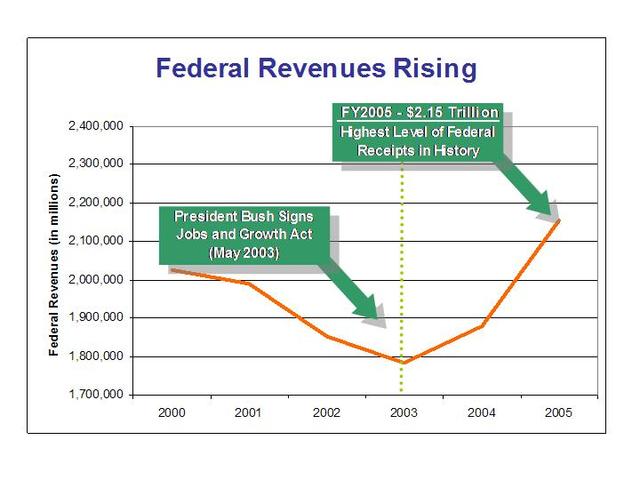
Second, Angry Bear has charted spending growth over the last 35 years:
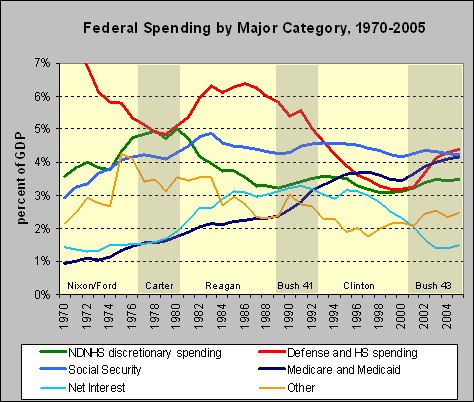
For "supply-siders," the first graph really needs no explanation. As far as the second, Angry Bear explains:
What strikes me about this chart is that while spending on Defense and Homeland Security (the red line) has indeed risen quite sharply under the Bush administration, other types of discretionary spending (the green line) have risen only quite modestly, and are still slightly below where they were in 1995. While Bush 43's budgets have clearly benefited from low interest payments (thanks in part to the low deficits and surpluses of the late 1990s, and in part to the very low interest rates of the past few years), the one other category of spending that has grown rapidly during his presidency is government-provided health insurance.UPDATE: Don notes that the Powerline guys had a post on Angry Bear's chart, saying:So perhaps Bush is indeed no Reagan when it comes to non-defense-related discretionary spending. But neither has such federal spending grown dramatically in the past few years.
No, the only category where it seems clear that Bush has deliberately let the money flow freely is in defense. So if you think that the federal government's spending has grown too fast in recent years, turn your attention to defense spending and health care. That's where the money has been going.
This chart tends to undermine the stereotype of the free-spending, money-hemorrhaging Bush administration. If the numbers are correct, only defense and medical care have risen significantly during the present administration, measured as a percentage of GDP. The increase in defense spending is good, and the increase in medical costs is bad, but typical of what has happened at all levels of government under current law.They, in turn, got a heads up that In the Agora has a more negative takeaway from the numbers:Another way of looking at the data, of course, is to say that everything has risen as a percentage of GDP except interest and Social Security, the latter of which, at least, has nothing to do with the administration's policies.
[The] analysis is short-sighted. It fails to account for the fact that Bush's massive $400 billion increase in Medicare spending has yet to take place; it phases into place over the next 10 years. The devastating effects of Republican spending will be like the slow impaling of a dagger, not a swift jab that we can see in a real time graph.In the Agora is conceptually right concerning the economies of scale and government efficiency, but the simple fact is that the government is always expanding. Agora is also correct regarding the usefulness of the graph as far as a projection tool, but simply because history doesn't necessarily repeat, doesn't mean it is not useful.Finally, Angry Bear appears to assume that because something costs X% of the economy to function properly, it must always cost X%. Why must that always be the case? With efficiencies and economies of scale, some government costs should actually decline as a percentage, not necessarily stay the same.
Either way, looking at government spending as a percentage of the GDP in the status quo tells us very little about the long term budget decisions of a government.
November 29, 2005
Rhode Island's Retrograde Fiscal Culture
Rhode Island has a $60,000,000 budget shortfall. And the news gets worse. Rhode Island’s revenues have gone bust at a time when tax revenues in most other states are booming. According to a recent USA Today article…
Soaring state tax collections have created momentum for tax cuts in 2006, when most governors and legislators will face voters.The problem is not that conditions in Southern New England are somehow different from conditions in the rest of the country. The Boston Globe reports that Massachusetts is ahead in its revenue collection for the current fiscal year…State and local revenue rose 7.2% in the first nine months of this year, the biggest jump since 1990, according to the U.S. Bureau of Economic Analysis.
Because of the improved economy, tax revenues from personal income taxes, corporations, and other levies are running 7.9 percent ahead of projections for the current fiscal year, putting the state $232 million ahead of what it expected to have by the end of October.(Most of the Globe story is about how Massachusetts is, in fact, very much like Rhode Island; with revenues running ahead, the Democratic controlled state legislature is preparing to spend! spend! spend!)
The State Comptroller of Connecticut projects that Connecticut will also end the year with a significant surplus…
State Comptroller Nancy Wyman today projected the state will end the 2006 fiscal year with a $135.4 million budget surplus.The fact that our neighbors doing well shows that the Rhode Island budget shortfall is not a problem created by implacable macroeconomic forces spiraling out of control; economic conditions in Rhode Island are similar to economic conditions in Massachusetts and Connecticut.The estimated surplus has risen by about $106 million in the last month, mainly due to strong collection of income taxes related to taxpayers' investments in financial markets.
Rhode Island's problems are rooted in poor fiscal management and irrational spending policies. They cannot be be solved by giving even more money to the government that created this mess in the first place.
October 20, 2005
Rhode Island’s Senators: They were in Favor of Raising the Minimum Wage before they were Against it.
If I understand the news stories and the roll call votes properly, Senators Jack Reed and Lincoln Chafee both voted in favor of and against raising the minimum wage – on the same day.
Senators Reed and Chafee voted in favor of a bill sponsored by Senator Edward Kennedy that would have raised the Federal minimum wage to $6.25 an hour. The bill failed, 47-51. Then, Reed and Chafee voted against a bill sponsored by Senator Michael Enzi which would have raised the Federal minimum wage to $6.25 an hour. The bill failed, 42-57.
According to the Associated Press, the difference between the two bills is that the Enzi bill would “provide tax and regulatory relief for small business, permit tips to be credited in complying with minimum wage hikes, and expand the small business exemption from the Fair Labor Standards Act” in a way that the Kennedy bill wouldn't.
Senator Reed’s vote appears to be simple party politics. Vote for a Democratic sponsored proposal, vote against a Republican one.
Senator Chafee’s vote is a tad harder to explain. Chafee abandoned the usual gang of Republican liberals – Susan Collins, Olympia Snowe, Arlen Specter, George Voinovich – who voted for the Enzi increase, and joined a coalition of Democrats and mostly-Southern state Republicans(?) to vote down the Enzi increase.
I’m not sure if the Enzi exceptions are good ideas or not. I do know that our national politics shouldn’t be motivated by two sides trying to hang the “You voted against the minimum wage!!!” tag on one another.
July 4, 2005
The Ongoing Squabble Between General Motors & the United Auto Workers Union
This posting continues a discussion about General Motors and the UAW union covered in three previous postings:
If You Won't Deal With Economic Reality, Then It Will Deal With You (includes heavy dose of United Airlines information, too)
Why the Big Three Auto Companies Could Easily Fail
In a mid-June article in the Wall Street Journal entitled GM Warns UAW on Health Benefits (available for a fee), the following was reported:
General Motors Corp. has warned the United Auto Workers that the auto maker could unilaterally reduce health benefits for UAW retirees unless the union agrees to various cost-cutting concessions before its contract expires in 2007.GM has set a goal of reducing the burden of its annual health-care costs by $1 billion in 2005 and another $1 billion in 2006, from a current estimated annual rate of $5.6 billion. The company also is aiming to reduce its long-term retiree health-care liabilities, an obligation that it carries on its balance sheet, by $20 billion from about $77 billion. But UAW leaders, who have conducted their own analysis, claim that GM's targets are unrealistic, according to UAW officials.
GM is pressing the UAW to agree to concessions by the end of this month, according to people familiar with the situation. UAW officials have largely discounted that deadline, and there are growing signs that the UAW and GM Chairman and Chief Executive Officer Rick Wagoner could be headed for a clash.
At a UAW meeting June 9, according to two people present, UAW Vice President Richard Shoemaker told officials of union locals: "If GM does anything unilaterally, they'll have a very hard time making automobiles in this country. You can go back and tell your membership that."...
National UAW leaders informed local union presidents and other UAW officials at last week's meeting that GM believes it has legal standing to reduce the health care of its retirees. Whereas the current labor contract provides specific benefits the company gives its current workers, the contract is less clear about benefits for retirees, according to some industry analysts. The UAW disputes that position.
People familiar with the situation say GM has implied in meetings with UAW officials that it could reduce the retiree benefits if the union doesn't agree to several concessions that could help the company save billions of dollars over the next few years.
GM provides health insurance for about 1.1 million people in the U.S., of whom about 700,000 are covered under plans negotiated under the GM-UAW master agreement that expires in 2007. UAW members on average pay 7% of their health-care costs under those plans, compared with about 27% paid by GM salaried workers, according to figures provided by GM management. In March, the former head of GM's North American operations, Gary Cowger, suggested in a speech that hourly and salaried workers should be covered by the same plan. UAW officials have publicly rebuffed that suggestion...
...[S]aid Rob Betts, president of UAW 2151, in Coopersville, Mich., a Delphi plant that makes fuel injectors: "We believe that they don't have the right to do this. This money has already been earned. They can't take it from us. They owe it to us."...
The last time the UAW launched a major strike against GM, in 1998, GM production was crippled for nearly eight weeks and the disruption cost the company an estimated $2 billion...
...with GM's North American operations facing their worst financial crisis since the early 1990s and GM's debt rated at junk levels by two major credit rating agencies, Mr. Wagoner is under increased pressure to accelerate cost-cutting in GM's U.S. auto business. At GM's annual meeting earlier this month, Mr. Wagoner indicated GM will close more North American factories and continue to shed hourly workers through attrition...
In another Wall Street Journal article the next day entitled UAW Asks GM For More Time on Health Talks (available also for a fee), the following statements were made:
...In a joint statement, UAW President Ron Gettelfinger and UAW-GM Vice President Richard Shoemaker reiterated recent comments that the union won't agree to reopen its current contract with GM before it expires in 2007 in order to accommodate GM management proposals to slash the company's estimated $5.6 billion annual U.S. health-care bill.But Mr. Gettelfinger and Mr. Shoemaker stressed a desire to maintain the spirit of cooperative labor-management relations that has largely characterized the UAW and GM management's dealings since a costly eight-week strike in 1998.
It "is in the best interests of all GM stakeholders for the UAW and GM to work together on these issues -- and to maintain the solid working relationship that we have worked so hard to build since 1998," the UAW leaders said in their statement.
"By working together, the UAW and GM have done a lot of important things over the past several years, including making dramatic improvements in workplace safety, productivity and product quality. It would be a huge mistake for GM to throw all that away by taking any unilateral action on health care benefits or other matters covered by our national agreement," the UAW leaders said...
One issue that could complicate talks between the company and the union is rank-and-file UAW displeasure at being asked to sacrifice benefits when Mr. Wagoner and other senior GM executives received bonuses for last year, and stockholders are still receiving dividends.
These people in Detroit are economic fools. 7% co-pays for union employees are an outdated historical artifact, especially when salaried employees are paying 27% - but the UAW won't talk about it until 2007 "because they owe it to us." Even if the payment of such benefits makes the company non-competitive in a global industry. No less outlandish is the continuing payment of bonuses to GM executives while they threaten to unilaterally reduce unionized worker healthcare benefits. As I have said before, these buffoons all deserve each other.
While the fools in GM management and the UAW union re-arrange the chairs on their economic Titanic, the competition is not waiting until 2007 to move ahead smartly. E.g., check out the newly built Hyundai plant in Alabama with its lack of healthcare legacy costs.
Here is another simple way to look at the issues here: Suppose you were a financial investor. Would you place your incremental investment dollar in the rigid, high-cost producer or the flexible, low-cost producer? Not a hard question to answer is it? And that's why GM's debt rating has been lowered recently to "junk" status, which means it is NOT investment grade debt.
If you won't deal with economic reality, then it will deal with you - on its own terms. In other words, GM and the UAW will either adjust their cost structure to be globally competitive and do it in a timely manner or they will die a well-deserved economic death.
Of course there is one other alternative for the more cynically minded: GM and the UAW can do little-to-nothing and then turn to the meddlesome U.S. government for a bailout like the airline industry has done.
But be very clear about the consequences of such a bailout - it won't make the underlying economic problem of being a high-cost producer go away and it will result in the working families and retirees of America paying what amounts to an extra tax so GM and the UAW can avoid making the kind of hard decisions American families make every day of the year to live within their budgets. Such a tax is neither fair nor just. And it makes no economic sense.
They need to get real in Detroit - all of them. And do it now.
Continue reading "The Ongoing Squabble Between General Motors & the United Auto Workers Union"
Airline Industry: How Government Meddling in Marketplace Costs Taxpayers & Consumers
Good economic outcomes typically happen when the government does not directly meddle in the marketplace but, instead, acts only to ensure the existence of the rule of law and property rights so third parties can enter into viable contracts as well as count on a level playing field for all participants in the market.
Bad economic outcomes typically happen when the government meddles in the marketplace. E.g., see this posting about the impact of government meddling in the healthcare marketplace.
The meddling typically creates new (and often unforeseen) behaviorial incentives for market participants to act in economically inefficient ways. As the cost of those inefficiencies grow, the government most often then further meddles in the marketplace and only compounds the problems they helped create in the first place.
The travails of the U.S. airline industry show how one bad government meddling begets more government meddling and creates incentives for avoiding dealing with economic reality - all at a greater long-term economic cost to taxpayers and/or consumers.
For example, consider the news in this WSJ article entitled Global Airlines Rise Above Crisis As U.S. Carriers Struggle (available for a fee):
At a time when many U.S. carriers are still struggling to survive, much of the rest of the global airline industry appears to have pulled out of crisis and is entering the summer travel season in its best shape in five years.Carriers in Asia and Europe are starting to see cost savings from several years of difficult restructuring. Passenger demand is ballooning in many markets...That means some airlines are able to stanch their losses by raising fares -- and some are even strongly profitable.
The big exception is in North America, where several giant carriers are operating either in or near bankruptcy-court protection. U.S. airlines have been filling planes to record levels recently, surpassing demand seen before the terrorist attacks of Sept. 11, 2001. Still, much of that traffic has been stoked by aggressively slashing fares.
The U.S. airline market is lagging behind the rest of the global industry for a variety of reasons. After reaching unprecedented heights in the economic boom of the 1990s, U.S. carriers were hurt worse by the Sept. 11 attacks. And the U.S. industry remains an uncomfortable mix of rabid competition and government intervention -- such as loan guarantees and pension-obligation relief -- that allows weak carriers to limp along far longer than ailing businesses do in other industries.
Outside the U.S., where Chapter 11 bankruptcy protection doesn't exist and many governments lack funds to prop up airlines, carriers have been faced since 9/11 with restructuring or going out of business -- and many have. Aiding the survivors, airlines outside the U.S. generally don't face labor unions as strong as in the U.S., and few face the sort of free-for-all competition that U.S. carriers do..."Operating fundamentals are probably as good as they've ever been" in the U.S., thanks to deep restructuring, "although balance sheets are not," says John Heimlich, chief economist at the International Air Transport Association...
This nascent global pickup remains tenuous and could quickly disappear...
In Asia and the Middle East, airlines actually are growing, posting big profits, and appear to have shaken the crisis. The giant markets of China and India are deregulating and growing quickly. Carriers in the more mature markets of Japan, Southeast Asia and Australia-New Zealand also are expanding operations and renewing their fleets.
Airlines in the Asia-Pacific region started restructuring earlier than their peers in America and Europe...
"In Asia, we've got lower cost bases, tighter capacity and a much stronger demand recovery" than in the U.S. or Europe, says Kevin O'Connor, an analyst with investment bank CLSA Asia-Pacific Markets in Hong Kong...
In Europe, several large, traditional airlines and budget newcomers are reporting solid results...
"The results show that established carriers are able to deal with the cyclical crisis," said Ulrich Schulte-Strathaus, secretary-general of the Association of European Airlines in Brussels...
But for most airlines in the U.S., which for years had some of the world's strongest airline labor unions, slashing overhead remains a way simply to avoid insolvency. Rising jet-fuel prices have far outstripped most airlines' ability to reduce overhead expenses such as labor...
Underfunded pension plans are another big drag on airlines. US Airways and UAL Corp.'s United Airlines, both of which are operating under Chapter 11 bankruptcy-court protection, were able to escape their obligations through bankruptcy proceedings...
The two carriers' escape from their pensions has increased pressure on rivals to seek relief from their own burdens...
This attempt to help U.S. carriers is raising trade tensions within the inherently international industry, however...
"The U.S. government is subsidizing the airline industry," charged Pierre-Henri Gourgeon, chief operating officer of Air France-KLM. In Europe, "where no subsidies are possible, market strength forces the industry to adapt."
European Union officials have been strict since 2001 in limiting state money to airlines, and EU governments resisted paying for services such as airport security that politicians in the U.S. and some other countries have moved to underwrite...
Think about it: Government loan guarantees enabled inefficient airlines to survive without having to deal rigorously with their bloated, non-competitive cost structures. The problems were then only compounded by governmental policies that allowed United Airlines and USAirways to throw off their pension obligations. Which, predictably, is creating a reaction by the airlines which are still obligated to their pension liabilities as this next WSJ article entitled Delta, Northwest Seek Pension Aid; Senators Critical (available for a fee) shows:
Continue reading "Airline Industry: How Government Meddling in Marketplace Costs Taxpayers & Consumers"
Economics 101: Never Underestimate the Incentive Power of Marginal Tax Cuts
In the June 13 edition of the Wall Street Journal, Stephen Moore wrote an editorial entitled Real Tax Cuts Have Curves (available for a fee):
...The Laffer Curve helped launch the Reaganomics Revolution here at home and a frenzy of tax rate cutting around the globe that continues to this day.The theory is really one of the simplest concepts in economics. Yet its logic continues to elude the class-warfare lobby whose disbelief is unburdened by the multiple real-life examples which validate its conclusions. The idea is that lowering the tax rate on production, work, investment, and risk-taking will spur more of these activities and thereby will often lead to more tax revenue collections for the government rather than less.
In the 1980s, President Ronald Reagan chopped the highest personal income tax rate from the confiscatory 70% rate that he inherited when he entered office to 28% when he left office and the resulting economic burst caused federal tax receipts to almost precisely double: from $517 billion to $1,032 billion. [Remember these numbers the next time someone tries to tell you the deficits under Reaganomics were a revenue problem and not a spending a problem!]
Now we have overpowering confirming evidence from the Bush tax cuts of May 2003. The jewel of the Bush economic plan was the reduction in tax rates on dividends from 39.6% to 15% and on capital gains from 20% to 15%. These sharp cuts in the double tax on capital investment were intended to reverse the 2000-01 stock market crash, which had liquidated some $6 trillion in American household wealth, and to inspire a revival in business capital investment, which had also collapsed during the recession. The tax cuts were narrowly enacted despite the usual indignant primal screams from the greed and envy lobby about "tax cuts for the super rich."
Last week the Congressional Budget Office released its latest report on tax revenue collections. The numbers are an eye-popping vindication of the Laffer Curve and the Bush tax cut's real economic value. Federal tax revenues have surged in the first eight months of this fiscal year by $187 billion. This represents a 15.4% rise in federal tax receipts over 2004. Individual and corporate income tax receipts have exploded like a cap let off a geyser, up 30% in the two years since the tax cut. Once again, tax rate cuts have created a virtuous chain reaction of higher economic growth, more jobs, higher corporate profits, and finally more tax receipts.
This Laffer Curve effect has also created a revenue windfall for states and cities. As the economic expansion has plowed forward, and in some regions of the country accelerated, state tax receipts have climbed 7.5% this year already...Many of President Bush's critics foolishly predicted that states and localities would be victims of the Bush tax cut gamble.
Alas, all of the fiscal news is not celebratory. The CBO also reports that federal expenditures are up $110 billion, or 7.2%, so far this year as the congressional Republican spending spree rolls on. Nonetheless, it now appears that the budget deficit will be at least $60 billion lower than last year and states and cities, led by California, which a few years ago were awash in debt themselves, will enjoy net surpluses of at least $50 billion. This means that total government borrowing will come in at below 2.5% of national output, which is hardly a crisis level of debt...
On the private-sector side of the ledger, what we are now witnessing is a broad-based investment boom. The lower capital gains and dividends taxes have been capitalized into higher stock values, and that in part explains why the Dow is up 24% since May of 2003 while the Nasdaq has risen 39%. Dan Clifton of the American Shareholder Association estimates that this rise in stock values has translated into roughly $3 trillion in added wealth holdings of American households. The severe slump in business capital spending in 2001 and 2002 has now taken the shape of a U-turn, with spending on capital purchases up an enormous 22% since 2003. Because higher wages and new job creation are highly dependent on business capital investment, the mislabeled "Bush tax cut for the rich" has in reality enormously benefited middle-income workers.
...Thanks to inane budget rules in Congress the capital gains and dividend tax cuts are currently set to expire in 2008. (When was the last time a spending program in Washington expired?) One thing would seem certain: Raising the tax rates on capital gains and dividends would be a formula for choking off the expansion and reversing the stock market climb. Until now, the Democrats in Congress have in unison sanctimoniously charged that the government can't afford the price tag of making the tax cut permanent. But, of course, all this new fiscal evidence points to precisely the opposite conclusion: that we can't afford not to make the tax cuts permanent.
Whether Mr. Bush's critics' ideological blinders make them capable of being persuaded by facts and evidence is an altogether different issue.
If you want even more empirical data, read this excellent article by Arthur Laffer, in which he presents historical data on the effects of marginal tax cuts from the Harding-Coolidge (1920's), Kennedy (1960's) and Reagan (1980's) eras - which also turn out to be the three times of greatest economic growth in the last 100 years. In the article, Laffer explains the drivers which provide the underlying logic for the Curve:
The Laffer Curve illustrates the basic idea that changes in tax rates have two effects on tax revenues: the arithmetic effect and the economic effect. The arithmetic effect is simply that if tax rates are lowered, tax revenues (per dollar of tax base) will be lowered by the amount of the decrease in the rate. The reverse is true for an increase in tax rates. The economic effect, however, recognizes the positive impact that lower tax rates have on work, output, and employment--and thereby the tax base--by providing incentives to increase these activities. Raising tax rates has the opposite economic effect by penalizing participation in the taxed activities. The arithmetic effect always works in the opposite direction from the economic effect. Therefore, when the economic and the arithmetic effects of tax-rate changes are combined, the consequences of the change in tax rates on total tax revenues are no longer quite so obvious.
It is important to note that, in evaluating the effects of tax cuts, many opponents of such cuts (including the "pay as you go" budget deficit hawks as well as the methodology used by the Congressional Budget Office) only present a calculation of the arithmetic effect - called a "static analysis" - thereby assigning a zero value to the economic effect. Yet the empirical data from the three eras of tax cuts clearly show the error of that approach. That is why it is crucial that a "dynamic scoring" methodology be used, incorporating both arithmetic and economic effects. It is no less important to note that cash refunds from government, which do not change marginal tax rates, will have no lasting economic effect because they create no incentive to change human behavior and create new economic value.
Never underestimate the incentive power of marginal tax cuts. It's Economics 101, after all.
June 22, 2005
Risk Analysis
Anne Applebaum, writing about airport security, also touches on cost-benefit risk analysis.
By their own account, federal screeners have intercepted "7 million prohibited items." But of that number, only 600 were firearms. So, according to the calculations of economist Veronique de Rugy, 99.9 percent of intercepted items were nail scissors, cigarette lighters, penknives and the like. . . this isn't a country that has ever been good at risk analysis. If it were, we would never have invented the TSA at all. Instead, we would have taken that $5.5 billion, doubled the FBI's budget, and set up a questioning system that identifies potentially suspicious passengers, as the Israelis do. Even now, it's not too late to abolish the TSA, create a federal training program for airport screeners, and then let private companies worry about how many people to hire, which technology to buy and how long the tables in front of the X-ray machines should be. But every time that suggestion is made in Congress, someone denounces the plan as a "privatization" of our security and a sellout.Continue reading "Risk Analysis"
June 8, 2005
Outrageous Employee Compensation Liabilities Continue to Haunt General Motors; Will American Taxpayers End Up Paying the Bill?
Greg Wallace at What Attitude Problem? highlights this week's news on General Motors, building on the news previously highlighted here on this blogsite.
First, a Washington Post article states:
General Motors Corp., the world's biggest automaker, has offered buyout and early retirement packages to some of its nonunion, salaried workforce in North America as the company grapples with cutting costs.The offers were sent in the first quarter in hopes of speeding the normal amount of attrition the company usually has...
GM is under pressure from investors to close plants and renegotiate union contracts. Its bonds fell last week to the lowest levels against government debt since at least 2001 after the company forecast its biggest quarterly loss in 13 years. The Detroit company is the third-biggest issuer of corporate debt...
With U.S. sales this year headed for the lowest market share in 80 years, GM is finding it tougher to cover rising health care costs for its 1.1 million employees, retirees and dependents and pay for increased costs for steel and other materials...
Then Ankle Biting Pundits weighs in with some strong observations:
...A substantial part of G.M.'s problem - but hardly the only issue - is that it is supporting about two and a half retirees for every worker. With health care costs more than $5 billion a year - and about $1,400 on a vehicle produced in the United States - many G.M. workers are expecting that long-cherished benefits could be pared back...
A posting on the blogsite notes that non-union General Motors' retirees are paying an increasingly large portion of their medical costs but union contracts do not yet require union retirees to make similar contributions. The author of the posting also notes that GM's problem is quite similar to the looming problem with Social Security - fewer people working to support more and more retirees.
In a different posting, Ankle Biting Pundits makes these additional comments:
...I hope the United Auto Workers union are happy. Thanks to their insane demands for lifetime health care for retirees, not wanting to contribute to rising health care costs, and an outdated, underfunded pension system, 25,000 of their members are going to heading to the unemployment line...We take no joy in seeing anyone lose their job, that's not the reason we're mentioning this. Rather, we point out that what ails GM is a microcosm for what troubles America. The GM pension system is going bankrupt because an ever smaller number of workers are supporting a ever larger number of non-producers. Sound familiar (think Social Security)? The union could have cared less that health care and other costs were skyrocketing - they wanted to continue the free ride and refused to see how this stance could only lead to disaster for everyone...
It is not hard to imagine that the next step at some point in the near future is GM declaring bankruptcy and dumping its underfunded pension plan on the PBGC. It's really the only thing they can do to survive. The shame is that all those people who are going to have their pensions cut and their health care costs skyrocket can thank their labor unions for their plight (Granted, GM management was pretty stupid to go along with their ridiculous demands). And guess who's going to have to pay for that? Yup, us the taxpayers. Way to go UAW. Both your union members and we the taxpayers thank you.
For further examples of egregious union contract terms, read some of the comments posted to this most recent link.
A story in The Wall Street Journal states:
GM's North American operations, which posted a loss of $1.3 billion for the first quarter, already have been eliminating about 8,000 jobs a year through a combination of attrition and early-retirement programs since 2002...Those cost cuts haven't been enough to offset GM's sliding U.S. market share and declining revenue per vehicle....Mr. Wagoner said the newly announced cuts would be "an acceleration" of normal attrition...
GM's total North American work force was 181,000 as of Dec. 31. Of those, 111,000 are hourly workers in the U.S.
GM is the last of Detroit's Big Three...to announce a restructuring program within the past five years, a period during which market share for the three big, unionized U.S. auto makers has plunged from 68% in 2000 to just over 57% as of the end of May.
Reaction from the United Auto Workers, the large union that represents most GM manufacturing workers in North America, came late yesterday in a statement from its vice president and top GM negotiator, Richard Shoemaker. He said the union "is not convinced that GM can simply shrink its way out of its current problems. What's needed is an intense focus on rebuilding GM's U.S. market share, and the way to get there is by offering the right product mix of vehicles with world-class design and quality.
"It's one thing to present in a speech specific targets for job reductions and closing plants by the end of 2008," Mr. Shoemaker said, but in reality "various factors" will determine the actual outcome, including talks on a new labor agreement scheduled to take effect in 2007...
Morgan Stanley analyst Stephen Girsky said in a comment that Mr. Wagoner's plans represent "a small step in the right direction" but added, "The targeted employment reduction appears to be roughly in line with recent attrition and does not appear to be acceleration."...
Since then, he has sketched out a four-legged strategy for restoring profitability, that starts with boosting capital spending this year and next to speed the launches of several new models, including replacements for GM's aging lineup of large SUVs. Part two of the plan is a sweeping overhaul of U.S. marketing strategy. On legs three and four -- cost-cutting and reducing GM's burdensome health-care bill -- Mr. Wagoner has offered few details and appears to be avoiding drastic, short-term cuts. Much of his success will depend on the acquiescence of the UAW and suppliers that already are straining to meet GM's cost-cutting demands...
...cuts would save GM about $2.5 billion a year. That works out to savings of about $530 on average for every U.S. vehicle, using GM's 2004 sales. That is about only a third of the $1,500 higher cost per vehicle that GM suffers against foreign rivals because of its high worker costs, including health care for retirees.
A GM spokeswoman said yesterday that job cuts are only one part of GM's cost-reduction plan. The company also expects to save money in areas such as purchasing, productivity improvements and health care, she said.
On the key issue of GM's high health-care costs for workers and pensioners, Mr. Wagoner said GM management hasn't reached an agreement in talks with the UAW about ways to reduce GM's $5.6-billion-a-year U.S. health-care bill. "To be honest, I'm not 100% certain that we will," he said...
On the production front, Mr. Wagoner said GM needs "to get to 100% capacity utilization, or better" in North America, compared with about 85% in 2004. By the end of this year, based on plant closings already announced, GM will reduce its North American assembly capacity to five million vehicles from six million in 2002, Mr. Wagoner said.
"We expect to close additional assembly and component plants over the next few years, and to reduce our manufacturing employment levels in the U.S. by 25,000 or more in the 2005-2008 period," Mr. Wagoner said. He didn't identify specific plants that could be closed.
Mr. Wagoner faces a major challenge in GM's contract with the UAW. The current agreement, which expires in 2007, technically prohibits plant shutdowns, and guarantees UAW workers full pay and benefits if their plants are shuttered for a lengthy period...
...could refuse to renew those income and job protections in 2007, but the UAW has fought successfully to maintain them in each contract cycle since GM agreed to the provisions in 1990...
In his speech to shareholders, Mr. Wagoner said GM ultimately plans to "look at capacity utilization on a global basis." In other words, GM hopes to follow Japanese rivals such as Honda Motor Co. that can move production of various models rapidly from plant to plant based on sales patterns, or tool one plant to ship vehicles to any market, based on demand...
From a distance, the GM changes sound incremental and not of a size to reinvent the company's micro-economic business model. That does not bode well for the company. After all these years of struggling, you would think that management and the UAW would get the point that re-arranging the chairs on the GM Titanic will not fix the fundamental, structural problems. These people need to get real - and do it quickly.
As I have said in a previous posting: If you don't deal with economic reality, then it will deal with you - on its own terms. That does not bode well for the well-being and competitive strength of the American economy. Unless we significantly tackle the weaknesses embedded in the status quo, we are going to pay a hefty price. To be more precise, we are setting up the American economy for a fall which could deprive our children and grandchildren of the opportunity to live the American Dream. That is morally reprehensible.
When will people wake up and really pay attention?
Continue reading "Outrageous Employee Compensation Liabilities Continue to Haunt General Motors; Will American Taxpayers End Up Paying the Bill?"May 10, 2005
LNG III: Clark's Report
Richard Clarke has produced his risk analysis report (PDF)concerning expanding the KeySpan LNG facility in Providence. Given that he was hired by Attorney General Patrick Lynch, who opposes the plan, it should come as no surprise that Clarke found the proposal too risky and attractive to terrorists to be recommended. His "NET ASSESSMENT" summarizes his conclusion and offers the logical point (stripping away the hyperbole) from which to start a serious debate over where to locate an LNG facility.
While there is no adequate way in which to determine the probability of a terrorist attack on the proposed urban LNG facility and inland waterway transit routing, there is adequate grounds to judge that such an attack would be consistent with terrorists demonstrated intent and capability. There is also a basis to judge that likely enhanced security measures would not significantly reduce the risk. While there are some differences among experts about the conditions needed to generate a catastrophic explosion and about the precise extent of the resulting damage, there is significant grounds to conclude that a high risk exists of catastrophic damage from the types of attacks terrorists are capable of mounting. Those damage levels would overwhelm regional trauma, burn, and emergency medical capabilities. The LNG facility’s insurance is likely to be inadequate to fully compensate victims and to rebuild facilities. Siting the LNG off loading facility in a non-urban setting would reduce the terrorists’ incentives to attack it. Non-urban locations may possibly increase costs to the LNG operator and consumers.If this premise is accepted, then it follows that the argument of $'s for lives is an emotionally, and thus politically, unwinnable argument. That is why reasonable and cost-effective alternatives will simply have to be produced. The economic burden placed on Rhode Island by limited energy supplies needs to be addressed. As I've written before, the LNG shipping and offloading industry is intrinsically safe with a virtually spotless record. It is only when the spectre of terrorism is mentioned, correctly if sometimes too hysterically, that the dangers are nigh irrefutable. In a pre-9/11 world, the fears of an LNG explosion would be hysterical. But that's not the world we live in now.If all alternative sites do cost more and governments decide to proceed with the proposed urban location because of that cost differential, then the cost trade off can be precisely measured. Governments would be deciding that avoiding the possible additional financial cost to the LNG operator and/or consumers of a more secure location is more important public policy than avoiding the additional risk of a catastrophic attack involving mass trauma and burn injuries which does accompany a decision to permit an urban LNG facility. [Source: LNG Facilities in Urban Areas: A Security Risk Analysis for Attorney General Patrick Lynch Rhode Island, p. 9-10.]
UPDATE
Continue reading "LNG III: Clark's Report"May 1, 2005
If You Won't Deal With Economic Reality, Then It Will Deal With You
The overall economic cost structure of the American airline industry is pathetically unsustainable. This is not news; the elephant has been sitting in the room for years now but most everyone has refused to acknowledge its presence.
Continue reading "If You Won't Deal With Economic Reality, Then It Will Deal With You"April 23, 2005
LNG II: Safety History
In my last post, I began the process of trying to seperate fact from hyperbole in an attempt to begin to understand the real issues surrounding building or expanding an LNG storage facility in Rhode Island or somewhere on Narragansett Bay. From that post I concluded that the central issue was safety and that it was a real concern. I took a few steps down the path of assuming that there would be no palatable on-shore solution. As such, I considered the efficacy of off-shore facilities, though these are not without their own issues. With that being said, I think it worthwhile to go back and consider the safety history of LNG.
Continue reading "LNG II: Safety History"April 22, 2005
LNG: Trying to find a (reasonable) solution
As the debate over the efficacy of expanding or building an LNG storage and offloading facility intensifies, perhaps it's worthwhile to take a step back from the rhetoric and attempt to examine the facts. I'll save the hard numbers for others, but I think it safe to say that, with energy demands rising, New England would benefit from an increase in the natural gas supply.
However, there are risks, of which we are constantly reminded. Apart from predictable "nimbyism", the degree to which these warnings should be of real concern varies. First and foremost, despite intimations to the contrary, there has been no shipping accident in the LNG industry, to my knowledge, in at least 30 years. I believe that deeper research would reveal that the LNG transport and storage safety record is one to be applauded. Nevertheless, it is difficult to shake one of the foreboding feeling, encouraged by LNG critics, that "it could happen." The visit by Richard Clarke to analyze the potential terrorist threat has been a very public "reminder" of this.
Thus, it is important to realize that very real, and understandable, emotions (specifically fear) cannot be removed from the equation. However, informed by the aforementioned safety record, I believe that many of these fears can be calmed. However, there is this:
"Before 9/11, these terminals were very safe," says Anne Korin, director of policy and strategic planning for the Institute for the Analysis of Global Security. "Then terrorism was introduced as a factor. The risk shifted from the remote possibility of an accident to malevolence."Continue reading "LNG: Trying to find a (reasonable) solution"
March 28, 2005
Trends in International Markets & Trade
The most recent issue of The National Interest contains an article by Peter Drucker entitled "Trading Places" which discusses international economic trends:
The new world economy is fundamentally different from that of the fifty years following World War II. The United States may well remain the political and military leader for decades to come. It is likely also to remain the world's richest and most productive national economy for a long time (though the European Union as a whole is both larger and more productive). But the U.S. economy is no longer the single dominant economy.The emerging world economy is a pluralist one, with a substantial number of economic "blocs." Eventually there may be six or seven blocs, of which the U.S.-dominated NAFTA is likely to be only one, coexisting and competing with the European Union (EU), MERCOSUR in Latin America, ASEAN in the Far East, and nation-states that are blocs by themselves, China and India. These blocs are neither "free trade" nor "protectionist", but both at the same time.
Even more novel is that what is emerging is not one but four world economies: a world economy of information; of money; of multinationals (one no longer dominated by American enterprises); and a mercantilist world economy of goods, services and trade. These world economies overlap and interact with one another. But each is distinct with different members, a different scope, different values and different institutions...
Drucker concludes the article with concerns about the future competitive strength of the American economy:
For thirty years after World War II, the U.S. economy dominated practically without serious competition. For another twenty years it was clearly the world's foremost economy and especially the undisputed leader in technology and innovation. Though the United States today still dominates the world economy of information, it is only one major player in the three other world economies of money, multinationals and trade. And it is facing rivals that, either singly or in combination, could conceivably make America Number Two.
Greater economic risks lead to increased political risks. America would do well to develop strategically appropriate economic policies that anticipate these international trends.
March 14, 2005
The Deep Performance Problems With American Public Education
This posting continues a debate begun in two earlier postings here and here.
How bad is the public education performance problem in America? Consider this information from Robert J. Herbold of the President’s Council of Advisors on Science and Technology and formerly the Chief Operating Officer of Microsoft:
There are some very worrisome trends in the United States with respect to our global share of science, technology, engineering and mathematics expertise. Our share of this expertise is decreasing significantly, both at the bachelor’s and at the Ph.D. levels......among 24-year-olds in the year 2001 who had a B.S. or B.A. degree, only five percent in the U.S. were engineers, compared to 39 percent in China and 19 percent or more in South Korea, Taiwan and Japan. If you look at the actual number of engineers...China is producing three times more than the United States...
Another disturbing trend is in the numbers of individuals receiving a Ph.D. in physical science and engineering. In 1987, 4,700 U.S. citizens received these degrees, compared to 5,600 Asians. In 2001, the U.S. figure had dropped slightly to 4,400 and the number of Asians had risen to 24,900...
Why are these figures important? Traditionally, it has been our technical human talent that has driven our industrial success. Basic science, technology, engineering and mathematics knowledge is vitally important in the business world...physical science and engineering capabilities at the Ph.D. level typically drive the kind of highly prized innovations that lead to the emergence of new industries. With expertise in these fields declining in the U.S. while rising in other parts of the world, we risk seeing our industrial leadership weaken...
One of the main reasons why U.S. production of science and engineering talent in universities is low in comparison to other countries is that U.S. K-12 math and science skill levels are quite weak. Note the data from the National Assessment of Educational Progress (NAEP) from the year 2000...scores of U.S. students across the 4th, 8th, and 12th grade levels are abysmal. For example, in science, only two percent of our 12th graders are rated advanced and only sixteen percent are rated proficient...Thirty-four percent of our 12th graders are only partially proficient in science, and almost half are below partial proficiency...
...the results of the International Math and Science Study. It rates the U.S. versus other countries and provides the percentile our students achieved. For example, in mathematics, our 12th graders rated at the 10th percentile. In other words, 90 percent of the countries did better than the U.S., and only 10 percent performed worse. While we do well in grade 4, we do mediocre in grade 8 and very poorly in grade 12...
Weak K-12 results in the U.S. are not a new problem. Twenty years ago, a famous report entitled "A Nation at Risk" was published and highlighted similar findings. Recently, the Koret Task Force of the Hoover Institution at Stanford University considered the failure of that report to bring about reform. The following is a key paragraph from their report summary:
"A Nation at Risk" underestimated the resistance to change from the organized interest of the K-12 public education system, at the center of which were two big teachers unions as well as school administrators, colleges of education, state bureaucracies, school boards, and many others. These groups see any changes beyond the most marginal as threats to their own jealously guarded power.In light of this, we need the K-12 teaching community (the union leaders, the administrators and the teachers themselves) to take responsibility for the poor results they are achieving. We need them to get serious about accountability and teacher qualifications...We need them to implement the recommendation of the National Commission on Excellence, requiring three years of math and two years of science at the high school level. We need them to support new routes for teacher certification in order to increase the number of teachers qualified to teach math and science. We need them to ease their opposition to vouchers and charter schools, which will bring about the kind of competition that generates broad improvement. And we need them to stop promoting unprepared students to the next grade level.
Probably most important, the K-12 teaching community needs to implement good management practices, such as performance appraisal systems that identify superior teachers. It should then reward these top teachers with salary increases of 10 percent or more per year, leading to annual wages of over $100,000. Equally as important, it needs to isolate the bottom 5-7 percent of teachers, put them on probation, and – if no progress is made within a reasonable period – terminate them...
We need for the K-12 teaching community to take responsibility and implement these reforms in an urgent manner. If they do not, all of us in our individual communities need to hold that community to account. Failure to address our immense shortcomings in science and math education is unacceptable and will inevitably lead to the weakening of our nation.
A November 24, 2003 Wall Street Journal editorial entitled "Witness Protection for Teachers" (available here for a fee) shows how deep the problem is within American public education:
[New York City Councilwoman Eva] Moskowitz, a Democrat who heads the Council's education committee, recently held four days of hearings on the union rules and mandates that beleaguer New York's 1,200 schools and 1.1 million students. What she says she found is that "many of the rules are indefensible."...Union officials...launched a media campaign to intimidate Ms. Moskowitz into canceling her unprecedented hearings...Many [teachers and principals] were willing to criticize the contracts privately, but most requests to testify were met with, "I'm not that brave," "I might be blacklisted," "Are you kidding?" and the like...Keep in mind these are teachers, not members of the mob.
The unions have operated for decades without public scrutiny or accountability, which has enabled them to impose work rules that any average person would recognize as...well, insane...
But the rules that most damage learning are those that give primacy to seniority for teachers. Seniority-based transfers...result in the most inexperienced teachers serving the most challenging schools. A seniority-based, lock-step compensation structure bans merit pay for the large majority of teachers who meet or exceed performance expectations. So teachers with high-demand skills...are pushed into the private sector, where they can be paid what they're worth...
The City Council lacks the power to change union work rules, but never underestimate the uses of public embarrassment.
Or, consider these excerpts from a February 25, 2004 Wall Street Journal editorial entitled "Paige's Point" (also available here for a fee):
A fact of political life today is that if you favor meaningful educational reform, you can automatically count yourself a political enemy of two groups: the teachers' unions that prefer the status quo and too many politicians who depend on them for financial support...Teachers unions are among the most powerful lobbies in American public life. In political influence they rank alongside the Teamsters, the AARP and the NRA. And they use the exact same hardball tactics to try to get what they want, which in their case is to preserve their monopoly on public education.
The NEA has 2.7 million members from whom it collects hundreds of millions of dollars in involuntary dues and spends tens of millions on political activities, some 95% of which goes to Democrats. Its 1,800 designated political directors use an integrated command structure...to coordinate national, state and local activities for Democratic candidates...
It's easy to forget that all but 8% of education spending occurs at the state and local level, and that's where the teachers unions wield most of their power by pressuring legislatures, defeating state ballot initiatives, supporting campaigns and even getting their own members elected and appointed to education committees...
Back in Washington, NEA President Reg Weaver stands ready to describe any criticism of the union as an attack on public school teachers. "We are the teachers; there is no distinction"...the typical teacher, who earns a fraction of the $334,000 Mr. Weaver reportedly took home last year, may beg to differ...
"There are two big interesting education reform ideas in America today," says Chester Finn, a former Education Department official. "One involves standards and tests and accountability; the other involves competition and choice. The NEA is against both, and they will unflaggingly work to defeat both kinds of reform."
Terry Moe has written an extensive piece on how the teachers' unions operate:
Their influence takes two forms. First, they shape the schools from the bottom up, through collective bargaining activities that are so broad in scope that virtually every aspect of the schools is somehow affected. Second, they shape the schools from the top down, through political activities that give them unrivaled influence over the laws and regulations imposed on public education by government...teachers unions are...absolutely central to an understanding of America's public school. Despite their importance, the teachers unions have been poorly studied by education scholars...
A December 15, 2004 Wall Street Journal editorial entitled "America's C-" (available here for a fee) reinforces the mediocrity of America's public education system:
The report, conducted by the Organization for Economic Cooperation and Development, tested the math, science, problem-solving and reading skills of 15-year-olds in 41 countries. Only a generation ago, U.S. high school students ranked No. 1. Today, their performance has fallen below the OECD average - except in reading, where Americans manage to eke out an "average."...Less publicized has been why U.S. scores are so low. The OECD researchers identified several key characteristics that most successful school systems share - namely, decentralization, competition and flexibility...schools are given a large degree of autonomy over curriculum and budget decisions...teachers...have a large degree of autonomy and responsibility, which leads in turn to a high degree of professionalism. It is not simply a matter of renumeration. Teachers in Finland get paid relatively little, but...there is a strong professional ethos and teachers routinely exchange experience to improve their skills...With an ever-higher percentage of the work force expected to be employed in knowledge-based industries, school reform is a question of U.S. economic survival...
If we want to maintain our standard of living, we'd better change...
Can genuine reform be achieved? Consider the following success story in an article from The American Enterprise:
While New York City public schools face an epic shortage of good teachers, many private schools in the Big Apple have no trouble attracting candidates. The School of Columbia, for instance, received 1,700 applications for 39 teaching positions in its first year of operation...Unlike public schools, the School of Columbia does not offer tenure; there is no union; there is no guaranteed salary increase each year; how much teachers make depends on their performance, not their seniority; teachers are expected to come in early, stay late, and show up on weekends to do their job well; and there are no guaranteed breaks during the day.
Those do-what-it-takes-to-succeed expectations are standard in most of white-collar America today...
Offering merit pay means you also have to give teachers enough flexibility to distinguish themselves. The curriculum at Columbia includes a set of skills and "key facts" that students at each grade level must master, but teachers are allowed to use their own individual methods to get students to that point. If their method doesn't work, all the seniority in the world won't get them a promotion. And the fact that half the kids come from a depressed inner-city neighborhood is not accepted as an excuse for failure.
Teacher assessments are done every year or two. Every instructor must put together a portfolio demonstrating student progress, including test results, videos of students reading aloud, student performances, etc. A peer evaluation team sits in on several classes and submits recommendations. School administrators consider all this information and then make a final decision.
The world of public education could be so different - and better. We are paying a huge price for such mediocrity - by limiting people's access to the American Dream and by putting our nation's leadership position in the world at risk.
Why do we continue to tolerate such nonsense?

 About Community Crier