
 Click here for the new Anchor Rising & Ocean State Current page

To Starve or Gorge the Beast?, by Marc Comtois
Taxation
10:00 AM, 11/21/12
"May have been the losing side. Still not convinced it was the wrong one."*, by Marc Comtois
Conservatism
9:00 PM, 11/13/12
Things We Read Today (22), Tuesday, by Justin Katz
Under the Government's Wing
5:03 PM, 10/ 2/12
Things We Read Today, 8, by Justin Katz
Political Thought
7:11 PM, 09/11/12
Is There a Young, Rhody Reaganite?, by Marc Comtois
Conservatism
5:00 PM, 09/ 7/12
Credit for Building, Blame for Dividing, by Justin Katz
Political Thought
11:17 AM, 07/19/12
Goldberg on who's imposing what on whom, by Marc Comtois
Conservatism
10:00 AM, 06/21/12
How Private is Your Property?, by Marc Comtois
Warwick
2:00 PM, 03/ 8/12
A Local Conservative Celebrity, by Patrick Laverty
Conservatism
2:39 PM, 12/21/11
A Local Conservative Celebrity, by Patrick Laverty
Conservatism
2:39 PM, 12/21/11
November 21, 2012

To Starve or Gorge the Beast?
"[W]e've got to reduce spending before we can reduce taxes. Well, if you've got a kid that's extravagant, you can lecture him all you want to about his extravagance. Or you can cut his allowance and achieve the same end much quicker. But Government has never reduced. Government does not tax to get the money it needs. Government always needs the money it gets." ~ Ronald Reagan
Hence was born the idea of "starve the beast," a conservative core belief if ever there was one. But is it true? As explained in a recent column by Andrew Ferguson, economist (and libertarian) William Niskanen didn't think so.
Beginning in 2002, Niskanen published a series of papers and op-eds about tax cuts and spending increases that turned conventional conservative wisdom on its head....If we wanted a smaller government, he said, we would have to raise taxes....Niskanen, looking over 25 years of budget data, noticed something about STB ["Starve The Beast" ~ ed.]: It didn’t work. In fact, attempts to starve the beast by tax cuts seemed to lead to increased federal spending.That last--the ability of government to write checks on credit--was overlooked by STB advocates.Niskanen looked at both spending and taxes as a percentage of GDP. On average, he found, if federal revenues declined by 1 percent, federal spending increased by 0.15 percent. When revenues rose, on the other hand, relative spending decreased. A further study in 2009 by another Cato economist, Michael New, came to the same conclusion after the gluttonous administration of George W. Bush. Under Bush and his mostly Republican Congress, new benefits like subsidized Medicare drugs and increased federal education spending followed on the heels of large tax cuts.
Niskanen’s explanation for the failure of STB was straightforward, a conjecture based on standard economics: When you cut the price of something, demand for it will increase. Lowering taxes without lowering benefits meant that taxpayers were getting the benefits at a discount. The government made up the true cost with borrowed dollars that future taxpayers would have to repay. There was a big difference, Niskanen said, between a kid on an allowance and the federal government: The government has a credit card with no debt limit. {emphasis added}
[E]arly advocates of STB had counted on something that never materialized. They had assumed that as the debt piled up to finance annual budget deficits caused by free-flowing benefits, public outrage would force politicians to restrain spending without raising taxes. Yet we’ve had the deficits and the borrowing, in amounts that would have left Friedman and Reagan agog; what’s been missing is the outrage.People aren't outraged because they don't feel the immediate pain of increasing government because the money for government expansion is either borrowed or paid for by increasingly fewer individuals. So around 50% of the population feels no pain (they don't pay income taxes) while a majority of the rest pays relatively minimal amounts. And a lot of that pain is left to future generations. This aligns with Niskanen's reasoning for why higher tax rates lead to lower spending:
“Demand by current voters for federal spending,” he explained, “declines with the amount of this spending that is financed by current taxes.” When you make them pay for government benefits out of their own pockets, in other words, voters will want fewer of them. The journalist Jonathan Rauch put Niskanen’s point more pithily: “Voters will not shrink Big Government until they feel the pinch of its true cost.”Yet, as I mentioned, not everyone shares the tax burden evenly in our progressive income tax system. So, perhaps a flat tax would prove or disprove Niskanen's theory, but it's doubtful that will happen any time soon.
Ferguson's article brought some critiques of Niskanen's ideas. Noah Glyn offers up another reason for why government spending decreases when tax revenue increases:
[It's] the business cycle. As the economy grows, people earn more so they pay more in taxes; conversely, when the economy enters a recession, government revenue plummets. During recessions, however, the public relies on increased government spending, in the form of Medicaid, food stamps, and other transfer payments. (This can go the other way, too: Some state and local governments have used economic growth to justify increasing promises to government employees’ pension plans, but those costs typically come much further down the line.)This is buttressed by Ramesh Ponnuru's important, technical point and "thought experiment":
Let’s say we still had the Clinton-era tax rates and a (smaller but still quite large) long-term debt problem. Wouldn’t we be debating an increase in tax rates to a higher level than we are now? That seems to me pretty likely. The baseline from which we’re negotiating would be higher, perceptions of what’s tolerable would be higher, expectations of tax rates would be higher. On the Niskanen theory there would be a countervailing effect: In the interim the tax cuts caused spending to be higher and thus moved the spending baseline higher. But Niskanen didn’t find that a dollar of tax cuts were associated with a dollar of spending increases; he found that a 1 percent reduction in revenue over GDP was associated with a 0.15 percent increase in spending over GDP. So the countervailing effect would be smaller.Jonah Goldberg adds:
I always liked Niskanen’s argument, even if I didn’t quite find it persuasive. One thing that always bugged me about it which, to my surprise, Ferguson doesn’t mention, is the implicit assumption that Americans behave like rational economic actors with regard to what they get from government....The American species of homo economicus has been paying hundreds of billions to get rid of poverty for decades, what do we have to show for it? Poverty rate in 1975: 26 percent. Poverty rate in 2010: 26 percent. What a great return on the investment. Federal spending on education? Ahem...For reasons, good and bad, voters don’t treat tax dollars the way they do their own dollars. They don’t demand quality. They don’t demand accountability. They don’t push for efficiency. Many people think the government should spend money as if it comes from someplace other than the wallets of citizens and that what we get for it should be graded on some spiritual, emotional, philanthropic or metaphysical curve. How we spend for X so often seems to matter more than how much X is actually delivered.Yet, as Patrick Brennan argues, re-stating Niskanen's implicit premise, the missing demand for government quality is because so many have so little stake in the game.
People might be a lot more likely to start caring about where their tax dollars go (whether the ends are efficient and whether the money comes back to them) when those taxes are really substantial, broad-based, and they actually have to pay them.Brennan also compares U.S. expectations for government services to that of Europeans:
If you live in a society where, as Jonah pointed out Arthur Brooks has argued, the state is considered the main conduit for meeting societal needs and caring for the poor and vulnerable, you’ll care more about how well government works and whether it can care competently for you, and that’s a cultural matter. But it’s also important to homo economicus, because Leviathan has taken most of his paycheck, and he now has to hope, and should ensure, that government will provide for society at large, the poor and vulnerable, and even him at times, and do so as efficiently and competently as possible.Regarding the last, many conservatives (well, at least me) believe that a smaller government is one that is easier to make workable!There are obviously other explanations for these differences: Charlie Cooke has lamented to me on many an occasion that in Britain, the conversation about almost all government policies ends up being debates over efficacy of programs, not whether the programs should exist in the first place. Leaving aside the financial constraints Britain and elsewhere are now experiencing, if you don’t have a constitution with enumerated federal powers, a truly conservative and independently minded political movement, etc., you’re going to spend more time on making government work, not on making it smaller, and that’s for other reasons than I’ve just proposed.*
==========================
* Brennan expounded on the point later in the post: "It’s difficult to assess my thesis inasmuch as big government and the cultures that give rise to it have other negative effects on efficiency, so it’s possible citizens subject to a huge government and a regressive tax code get a more efficient government than they would if they didn’t have higher expectations than free-riding Americans, but still not a very efficient one. It’s been suggested, in fact, that it’s highly efficient yet regressive taxation (like light capital taxation, competitive corporate-tax rates, consumption taxes, etc.) that’s allowed places such as France and Scandinavia to have functional economies despite the burdens of absurdly large governments; perhaps it’s also the relative efficiency and usefulness of their government spending programs, and not just their tax system, that’s allowed them to manage as well. Thus again, economic preferences force the hand of citizens and politicians in a completely government-dominated society but not in one like America."
November 13, 2012
"May have been the losing side. Still not convinced it was the wrong one."*
I know I'm not alone in taking stock in the aftermath of last Tuesday and I do so realizing that there is an important contrast between conservatism and Republicanism. The national and local GOP continues to navel gaze as to how to make itself more appealing and marketable. In the mean time, conservatives should be consistent and, well, conservative before embracing the latest marketing plan from K Street. Political outcomes rarely change core beliefs--that's why they're "core beliefs"--but they can change the way we think those beliefs, or ideas, can be implemented and which should take priority.
While the electoral crush was significant, the actual overall vote tally wasn't. It's been the same for the last decade or so, no matter who has captured the White House. We're still a 50/50 country, and the difference is in turnout, which translates to message and effective politics; and that's the job of a political party. So, to the degree that conservatives want to see their ideas implemented, they rely upon the political process to do it and that usually means the Republican party.
In Rhode Island, though, we have seen some conservative ideas co-opted by right-thinking Democrats (albeit watered-down, ie; pension "reform"), much to the consternation of the progressives (and the few remaining elected Republicans). In fact, our own state reminds us that there is a difference between politics and ideology insofar as there are many conservatives flying under the Democrat banner out of a sense of, well, wanting to win. In general, though, the party most amenable to the conservative mindset is the GOP.
Currently, it appears as if the beltway cadre of the Grand Old Party is trying to follow a path of demographic bread crumbs out of the wilderness and are open to throwing away conservative ideals for the sake of supposedly making the GOP "brand" more marketable. Modifying the stance on immigration reform, is but one--and the most oft-cited--change in position being discussed. Meanwhile, conservatives in fly-over country--and particularly down South--argue that the ideas and philosophies that they believe still provide a straightforward path to follow and are popular with many (including those who, apparently, didn't turn out this time around). Unsurprisingly, I believe in sticking to conservative ideals, properly defined. However, there is certainly cause to hone the message, at least nationally. Locally is an entirely different matter.
Economically, most people still say they want smaller, more effective and less intrusive government. Most approve of lower taxes concomitant with the idea of keeping more of the money they've earned (though the idea of taxing the "Blue state" rich is starting to take hold amongst conservatives). Most people don't like federal deficits and think that a cut to a program actually means a cut, not a reduction in the expected increase. Most people dislike an ever-expanding social safety net that is starting to resemble a hammock. And most are against "corporate welfare", with the caveat that said welfare doesn't impact their backyard. (And there's the rub, right Ohio?). And they don't like rich people (but what else is new?).
But to touch back on the safety net: there can be no doubt that demogoguery won this time out. It's pretty clear that Republicans--and conservatives--need to find a more effective message regarding welfare, health care, social security, etc. And they need to get better at beating back the mischaracterizations of their plans.
As for the so-called social issues--which really means gay marriage and abortion--conservatives have (predictably) lost ground on the former in the northeast and west coast and were, unfortunately, defined by outliers for the latter during the last election. It's not going out on a limb to guess that the biggest schism between conservatives and Republicans will occur on this front.
In the case of gay marriage, states are different--Rhode Island ain't Texas--and the populations should be allowed to make up their own mind via statewide ballot. If people's minds are being changed in favor of gay marriage, than that fact will be evident at the ballot box. Conservatives should continue explaining and warning, but I think it's a rearguard action.** Which is why, politically, the Republican party will probably modify their stance by either promoting the aformentioned federalist approach (which I agree with) or downplaying the issue altogether. There will be conservatives who will or won't vote on this single-issue--it is a core belief, remember? Republican political calculus will be to determine whether downplaying the issue gives them a net gain. A political party's core belief is to get elected.
Regarding abortion, no matter what a couple out-of-their-depth Republican Senate candidates said, most pro-life people are willing to grant exceptions for the relatively minuscule instances of rape, incest or when the life of the mother is at risk. Of course, the reality is that there is no way that Roe v. Wade is going to be overturned, liberal scare tactics notwithstanding, which is something I think most pro-life people recognize. (And even if it was, the vast majority of states would still keep abortion legal).
Politically, a couple bone-headed statements caused the damage to national Republicans. However, as for the issue itself, pro-life conservatives continue to focus efforts on changing hearts and minds with results that have been trending in a positive direction for life. There is little doubt that this has also contributed to the increase in babies being born out of wedlock. This consequence of winning the life argument makes it incumbent on pro-life supporters to more directly address--or at least do a better job of explaining--how they would help unwed or single-mothers. We can't forget the babies and their mothers after they're born (but that doesn't mean they should become permanent wards of the state!).
While I think these and other conservative ideas were pretty consistently and clearly offered up during the last election, apparently the message wasn't clear enough (and yes, the mainstream media didn't help, but it is what it is on that front--no excuses). I suppose a better way of "messaging" could be found, particularly nationally.
Locally there is also the old adage about leading a horse to water and all that. Some horses--especially in Rhode Island--just don't want to drink from the conservative cup so long as it is identified with a Republican. Too many Rhode Islanders have only "D"s in their political DNA. But that is a cultural problem of a different sort and one for which I'm unsure--after 17 years in the state--if there will ever be a solution. It's pretty clear Rhode Islanders think voting the same people--and members of the same political party--will somehow, magically, make things better. It's not because Republicans or Independents or Moderates don't offer alternative plans. Democrat Rhode Island just doesn't seem to care. Blue team or and bust, baby!
===========================================================
*Quote from the character Captain Mal Reynolds of the short-lived sci-fi series Firefly.
** This is an area where demographics are dictating the future, like it or not (but, again, every state is a bit different). In general, I think people are more "live and let live" than before--especially the majority of GenXers and younger. The argument for gay marriage--one of equality--is simplistic and appeals to emotion. It's an emotional issue! No one wants to be called mean or a bigot. As for the argument against? Well, appeals to the great chain of being and larger social problems that may result--and just plain tradition!--may be more difficult to make and are more complicate. But worse, they just don't gin up the same empathy. I've been a lukewarm supporter of civil unions and think some sort of legal equality is fair. Marriage has always seemed a bridge to far because, for me, the most impactful argument has always been about the effect on children.*** But that has lost out to the appeal to immediate equality and fairness for those seeking to be married--to say nothing of the as yet undetermined level of (un)fairness said unions provide their potential offspring. But we've become a society of NOW and long-term thinking isn't something we're doing very well these days.
*** Yikes, notes in notes now. Anyway, this hypothetical is always in my mind: All things being equal, who would an adoption agency choose as the best couple to adopt a child? A traditional couple with two children who make a combined $60,000/year, or a gay couple with two children who make $120,000/year? Which would be deemed best able to care of the child if it comes just down to income (and therefore the relative ability to provide a "good lifestyle") and the composition of the marriage cannot be taken into account? As a traditionalist, I'd select the couple with the traditional marriage because I believe, if given a chance, every child should have a mom and a dad.
October 2, 2012

Things We Read Today (22), Tuesday
Economic development options, from all-government to government-dominated; the heartless-to-caring axis in politics; Southern New Englanders' "independence"; solidarity between Romney and his garbage man; the media coup d'etat.
September 11, 2012
Things We Read Today, 8
Today: September 11, global change, evolution, economics, 17th amendment, gold standard, and a boughten electorate... all to a purpose.
September 7, 2012
Is There a Young, Rhody Reaganite?
Interesting observation from Jean Kaufman:
Traditionally, conservatives have distrusted Republicans from blue states. The usual path to election for a blue-state Republican has been the RINO road. It seemed to make sense, too, for candidates to think that the way to appeal to the Democrats and independents necessary to win an election in a blue state would be to position oneself only somewhat to the right of the left.Chris Christie, Paul Ryan & Susana Martinez are few examples of conservatives from "blue" states who have succeeded politically. It's still to be seen if they can translate that success on a national level, but here's why Kaufman thinks they may have a chance:Ronald Reagan...presented himself as a conservative rather than a moderate, and yet was able to attract Democrats and moderates. Reagan appealed to voters in his state [California], and later very successfully at the national level, by being personally compelling while at the same time articulating his conservative beliefs in a clear and convincing manner. That combination was remarkably persuasive.
Reagan...had no immediate heirs. George H.W. Bush, his vice president, was personally and ideologically quite different. So it is not insignificant that the current crop of conservative leaders-in-the-making were children or young adults during the Reagan years. Unlike those who cut their political teeth before Reagan was president, they didn’t think moderation was necessary for success. They saw for themselves that it was possible to stick to conservative principles and yet remain a viable candidate in a state that was not fundamentally conservative, and then to succeed at the national level. In a metaphoric sense, they are Reagan’s children.
A conservative who has managed to get elected in a blue state or district has a distinct advantage over others who have followed the more traditional red-state route to Republican prominence. In a more Darwinian struggle for political existence, only the most charismatic, nimble, and appealing minds and personalities among conservatives would be able to win, swimming against such a strong tide without sinking. This background is exactly what a conservative would seem to need in order to prevail on the national level in a country that features slightly more registered Democrats than Republicans, as well as a growing number of independents.
July 19, 2012
Credit for Building, Blame for Dividing
President Obama's teleprompter style has been the subject of substantial (often mocking) critical commentary, and with some justification, as this nearly parodic 2010 video from a Virginia classroom proves:
Given recent political events, one can sympathize with the desire of public officials to avoid extemporaneous speech. In a world in which one's every public utterance can be recorded, scrutinized, and exploited, one can't rely on an audience's capacity to get your drift and give you the benefit of the doubt. And it's all to easy to blurt out a sentence such as the now infamous, "If you've got a business, you didn't build that."
Predictably, in the realm of commentary, the debate has moved to the meta matter of whether commentators are deliberately misconstruing the President's meaning. On Slate, Dave Weigel charitably infers "a missing sentence or clause" that Obama neglected to utter because he was "rambling." On Reason, Tim Cavanaugh rejoins that "at some point it helps to look at that thing above the subtext, which is generally known as 'the text.'"
June 21, 2012
Goldberg on who's imposing what on whom
Columnist and author Jonah Goldberg was on C-SPANs "Afterwords" recently to discuss his latest book, Tyranny of Clichés: How Liberals Cheat in the War of Ideas. When asked by Nia-Malika Henderson, National Political Report for the Washington Post, about the clichés in the gay marriage debate, he expounded upon the rhetorical turnabout--imposing social or cultural mores on someone--that the Left has successfully deployed against the Right on a variety of issues.
I was on the San Francisco NPR station…the callers would keep calling in and basically confirming the point I was trying to make in the book: that they don’t think they’re ideological. They only think conservatives are ideological. At one point this guy calls in and--you could just almost hear his ponytail over the phone--he’s like, “You know, you conservatives you’re all into these labels and ideology and stuff and I don’t think liberals think it that way, you know we just care about equality and I don’t understand why, you know, this gay marriage stuff, why you want to impose your views on us."It’s this "impose" thing that really bothers me. You hear it all the time. Like conservatives are trying to ‘impose’ their idea of what marriage is. Now, I’m sort of an outlier on the gay marriage stuff. I was for civil unions 10 years ago and my view on gay marriage has always been: maybe it’s inevitable and, if it is, worse things have happened to the Republic. But at the same time, as a conservative and a Hayekian and someone who thinks we have traditions for a reason--we have social institutions for a reason--and there’s a lot of knowledge that we may not be able to access, you know, rationally, [so] we should be very humble about all of this.
I do not think it’s a ridiculous or bigoted position to say that marriage should be between a man and a woman and I do not think it is a Jacobin bit of lunacy to say that people should be able to marry whoever they want. I think both sides have merit to them. But this imposing thing is what drives me crazy.
The definition of marriage--depending on how you do your math--has been a union between a man and a woman for, like, I don’t know, a thousand--five thousand--years. I don’t know, you can check the book; it’s been there for a while. And the idea that people of the same sex can marry has been around, basically in our lifetimes and not even all of our lives. When I was born, I think, the psychiatric community in America still considered homosexuality to be a mental defect and a kind of a psychopathy or something. So we’ve come a long way and it is the Left that is trying to impose its definition of marriage on the country.
This is sort of a microcosm of a more basic point. It is the Left that has been from the beginning the aggressor in the culture war. And sometimes they were right. I have nothing but respect for the advances that liberals made in the civil rights struggle in the 1960’s. They were on the right side and--I’ve written this many, many times--conservatives were on the wrong side. (Now, once you admit that you can have all sorts of caveats about going too far or what our point was and all the rest, but at the end of the day the Right was wrong on the civil rights stuff in the 1960’s). I don’t get that much grief from the Right for saying it. But you can’t on the one hand claim credit for women’s suffrage and for gay rights and for civil rights--and all these things--and at the same time complain about how conservatives are the aggressors in the culture war.
The self-anointed forces of change, the forces of progress, the people who want to move forward, as Barack Obama likes to say, these are the people who are trying to impose their ideas on society. The reaction you get from the Right, from the Evangelical Christians or from people who want to keep VMI (Virginia Military Institute) all male or whatever it is; these are the victims, so to speak, in the culture wars. It doesn’t mean they’re always right, but the idea that, somehow, trying to defend the definition of marriage that has been around for a thousand years is somehow an imposition strikes me as ludicrous. It is the other side that is trying to impose things.
Yet, the way the press covers it, the way people talk about it, the way the Left certainly talks about it, it is always about how the Right wants to control how people live on the Left. When in reality it is the Left that is initiating these things, that is pushing these arguments, that is trying to change the country. Barack Obama is the guy who campaigned in 2008 saying he was the one who wanted to "fundamentally" change America. You can’t say you want to fundamentally change America and at the same time say that it’s the other side that is trying to impose it’s ideas.
ADDENDUM: Incidentally, because it strikes me that I may not have been been entirely clear on the issue (at least for a while), I'm basically of the same mind as Goldberg with regard to gay marriage.
March 8, 2012
How Private is Your Property?
If your lucky, you don't have to deal with "that house" in your neighborhood. You know, the one with the two or three beat up cars in the driveway (or on the lawn) and the hayfield instead of a lawn. It doesn't look good and brings the appearance of the rest of the neighborhood down. But is it a "conservative" thing to do to force someone to clean up their yard? The discussion is being had in today's Warwick Beacon:
“Frequent flyers,” is the name Annamarie Marchetti bestows on a small group of residents whose names resurface time and again for infractions of the “property maintenance code,” previously known as “minimum housing.”When negligence towards your private property affects the value of mine, is it any of my concern? Philosophical arguments based on conservative or libertarian principles can be made from both sides.The habitual offenders, Marchetti believes, don’t do what they do deliberately, said the clerk of property maintenance. She thinks they really don’t understand why their neighbors should be upset with the piles of junk and unregistered cars in their yard. After all, it’s their stuff – andtheir yard.
Debris and unregistered vehicles are two of the three most frequent infractions, says Ted Sarno, director and building official. The third most common relates to “protective coating” which could be peeling paint or siding coming off a house. In the summer, the fourth and fifth sources of complaint are overgrown lawns and standing water that is a source for mosquitoes. With so many foreclosures, Sarno said complaints over uncut lawns have been on the rise.
And there are some pretty obvious extensions, right? For instance, to conflate two, drug legalization and health care: some may say what they put into their body is their own business and also that they pay-as-they-go for health care instead of pay for insurance---until we end up paying for their visit to the Emergency Room and rehab care because they OD'd and didn't have health insurance. So where are the boundaries? Are they all slippery slopes? Part of what makes political discourse interesting is where we all choose to draw our own lines in the sand on issues like this. Where do you draw them?
December 21, 2011

A Local Conservative Celebrity
It seems that we have a local conservative celebrity in Rhode Island. If you haven't already heard, Providence College junior Christine Rousselle is getting some national attention for a column she wrote for The College Conservative at PC. She's going to be appearing on The Today Show on January 9th to discuss her article.
My Time at Walmart: Why We Need Serious Welfare Reform is attracting the attention as she details her time working the cash registers at her local Walmart in Scarborough, Maine. She'd writes of abuses of government entitlement programs such as
People ignoring me on their iPhones while the state paid for their food.This one sounds similar to the mini-excitement that came about when a man in line to eat at a homeless shelter was being served by Michelle Obama and he took a picture of her while on his Blackberry Pearl.
People using TANF (Temporary Assistance for Needy Families) money to buy such necessities such as earrings, kitkat bars, beer, WWE figurines, and, my personal favorite, a slip n’ slide. TANF money does not have restrictions like food stamps on what can be bought with it.And one of the favorites, the hot dog man:
A man who ran a hotdog stand on the pier in Portland, Maine used to come through my line. He would always discuss his hotdog stand and encourage me to “come visit him for lunch some day.” What would he buy? Hotdogs, buns, mustard, ketchup, etc. How would he pay for it? Food stamps. Either that man really likes hotdogs, or the state is paying for his business.I guess we can consider that one a small business government grant. It's just coming out of the left pocket instead of the right.
Probably the most surprising thing to me about her article and the reaction to it isn't so much the content of her article. I don't think it is new news. These are all things that some have seen for a long time. One other area of fraud that she didn't touch on, maybe because there's no real incentive for Walmart to engage in it is the SNAP swap. Someone on the food stamps can head into their local convenience store, hand over the equivalent of $20 to the store and get $10 in return. It's a win for the store and it's a win for the customer, assuming neither gets caught.
One way that much of this abuse could possibly be lessened is instead of giving people money for their food, give them the food itself. The problem is that we want people to have at least the essentials, so let's provide them with that. Even if we need to have deliveries to the homes themselves, bring a package of the necessities as they are needed. If the people want something else, they can go buy it with their own money. But at least they'll have the necessities of things like milk, bread, vegetables, and proteins in some form.
Before the flaming starts, I will say that while I do believe that the type of fraud and abuse described both by Rousselle and myself does happen, I truly do not believe it is widespread. I don't believe it is anything even close to a majority. I believe it is an extreme minority. However when there are millions of people on the system, even a small minority of "millions" can lead to a lot of abuse. Hopefully Rousselle's column continues to open eyes to this system and we find areas to improve these programs.
A Local Conservative Celebrity
It seems that we have a local conservative celebrity in Rhode Island. If you haven't already heard, Providence College junior Christine Rousselle is getting some national attention for a column she wrote for The College Conservative at PC. She's going to be appearing on The Today Show on January 9th to discuss her article.
My Time at Walmart: Why We Need Serious Welfare Reform is attracting the attention as she details her time working the cash registers at her local Walmart in Scarborough, Maine. She'd writes of abuses of government entitlement programs such as
People ignoring me on their iPhones while the state paid for their food.This one sounds similar to the mini-excitement that came about when a man in line to eat at a homeless shelter was being served by Michelle Obama and he took a picture of her while on his Blackberry Pearl.
People using TANF (Temporary Assistance for Needy Families) money to buy such necessities such as earrings, kitkat bars, beer, WWE figurines, and, my personal favorite, a slip n’ slide. TANF money does not have restrictions like food stamps on what can be bought with it.And one of the favorites, the hot dog man:
A man who ran a hotdog stand on the pier in Portland, Maine used to come through my line. He would always discuss his hotdog stand and encourage me to “come visit him for lunch some day.” What would he buy? Hotdogs, buns, mustard, ketchup, etc. How would he pay for it? Food stamps. Either that man really likes hotdogs, or the state is paying for his business.I guess we can consider that one a small business government grant. It's just coming out of the left pocket instead of the right.
Probably the most surprising thing to me about her article and the reaction to it isn't so much the content of her article. I don't think it is new news. These are all things that some have seen for a long time. One other area of fraud that she didn't touch on, maybe because there's no real incentive for Walmart to engage in it is the SNAP swap. Someone on the food stamps can head into their local convenience store, hand over the equivalent of $20 to the store and get $10 in return. It's a win for the store and it's a win for the customer, assuming neither gets caught.
One way that much of this abuse could possibly be lessened is instead of giving people money for their food, give them the food itself. The problem is that we want people to have at least the essentials, so let's provide them with that. Even if we need to have deliveries to the homes themselves, bring a package of the necessities as they are needed. If the people want something else, they can go buy it with their own money. But at least they'll have the necessities of things like milk, bread, vegetables, and proteins in some form.
Before the flaming starts, I will say that while I do believe that the type of fraud and abuse described both by Rousselle and myself does happen, I truly do not believe it is widespread. I don't believe it is anything even close to a majority. I believe it is an extreme minority. However when there are millions of people on the system, even a small minority of "millions" can lead to a lot of abuse. Hopefully Rousselle's column continues to open eyes to this system and we find areas to improve these programs.
April 17, 2011
UPDATED: John Derbyshire: "Dissidents and Doom"
John Derbyshire, writer for National Review and author of We Are Doomed spoke last night to the Providence College Republicans, displaying his erudition and low-key humor on the topic of the dissident personality.
The upshot of Mr. Derbyshire's lecture had a relevance that I didn't expect to Rhode Island's current predicament. He spoke of "a dissident scene full of petty squabbles," which has certainly applied to Rhode Island's center-right reform movement at times over the past few years.
One question that would be worth further exploration arises from his very conservative suggestion that dissidents should have a due respect for the gods and pieties of the tribe, so to speak. That strikes me as applying a bit askew to Rhode Island and to the United States generally. Broadly speaking, our society is pretty sharply divided between two tribes, which has the effect of giving both a reasonable claim to dissidence (although conservatives have the better). The pieties of one are the blasphemes of the other.
Readers won't be surprised that my opinion is that dissidents of the Left are mainly conforming to a carefully woven groupthink that presumes itself to be the default truth for the culture. Still, resolving the conflict of opposing factions that each believes itself to be the righteous revolution founded in the original principles of our society will be quite a project... assuming the United States can survive it.
The title of Mr. Derbyshire's book gives some indication of what his opinion might be on that last count.
ADDENDUM:
Mr. Derbyshire has provided the text of his speech on his personal Web site.
February 24, 2011
Human Nature and Unions
That was the topic Andrew introduced when he called in to the Matt Allen Show, last night. Stream by clicking here, or download it.
February 11, 2011
Not Your Father's CPAC
CPAC, the Conservative Political Action Conference, is held every year and serves as a sort of bellwether for the conservative movement. According to Roger L. Simon, there was a different twist this year:
The party staged by Andrew Breitbart for GOProud — the gay Republican and conservative group — was as close to a game changer as things get and the most interesting event at CPAC by far, at least to this point — and that’s meant as no insult to CPAC. With sexy Sophie B. Hawkins singing to a boisterous, supportive crowd, the party almost obliterated in one night the conception that Republicans are anti-gay and gave the impression that young libertarians — and some not so young — are taking over the GOP. Pretty soon it may be cool to be a Republican and square to be a Democrat.Simon does check himself for possibly being a bit hyperbolic, but that libertarians seem to be taking over CPAC--Ron Paul is an annual crowd-pleaser--is an interesting development. Meanwhile, more socially conservative groups opted not to attend CPAC this year.
December 6, 2010
Glory Can Be Reclaimed
First Things Interim Editor James Nuechterlein cautions American conservatives against undue pessimism:
As [First Things founder] Fr. [Richard] Neuhaus never tired of reminding us, the first thing to be said about public life is that public life is not the first thing.Which suggests that we should be as wary of dystopian despair as we are of utopian enthusiasm. Politics provides neither final victories nor final defeats. Conservatives need no instruction in the dangers of inordinate optimism, but they might need some help with its opposite. The notion, widespread on the right, of an America irredeemably alienated from its founding principles and but a half step removed from abject capitulation to collectivist schemes has lost touch with where we are and with conservatism's own best tradition of seeing things whole.
Political conservatives who have not cut themselves off from Burkean sobriety will know better than to give in to the fantasy that all is lost or that the apocalypse looms just beyond the horizon. They might even, if they attend to the historical record, come to understand that it is liberals who have more to despair of than they do. But perhaps it is unrealistic to imagine that conservatives could so uncharacteristically succumb to hope.
It may be difficult to believe, from where we now stand, but the same is true even within Rhode Island. Human society is a long-term project, and whichever way the momentum happens to be heading during a particular era, it is never fruitless to tug the rope in the right direction.
November 16, 2010
A Moratorium on Controversy Requires Postponement of Change
So a group of gay conservatives and some Tea Party figures are urging the Republican Party to keep away from social issues while they've got a role in untangling our big-government mess. One particular comment highlights, in a humorous way, the strange assumptions that social liberals make about the universality of their causes:
"When they were out in the Boston Harbor, they weren't arguing about who was gay or who was having an abortion," said Ralph King, a letter signatory who is a Tea Party Patriots national leadership council member, as well as an Ohio co-coordinator.
I'd suggest that anybody who'd been openly gay or advocating for abortion may very well have found himself in the water with the tea. The notions that governments should redefine marriage to eliminate its opposite-sex character and that people had an unassailable right to kill their own children in the womb would not have come up because the would have been found universally appalling.
This is not to say that our forebears, right on taxation and representation, were necessarily correct in their social views. But unity on civic matters is easier to separate from social matters when there's already cultural unity on the latter.
What this means for current conservatives is that the libertarian types cannot expect their socially conservative allies to tie their own hands while liberals advance their own causes. What it must mean not "to act on any social issue" is that libertarians and social conservatives must accept the status quo and work together to prevent attempts at radical change while the economic and political-theory issues are predominant.
That'll be a tough promise to keep. After all, judges must still be appointed, and social conservatives, with an eye on the long term, will not forgo the opportunity to change the judiciary's take on Roe v. Wade. On the other side of the coin, the persistence of liberals on such issues as same-sex marriage may require social conservatives to seek a Constitutional amendment just to maintain the current state of affairs.
What libertarians and "moderates" usually intend when they urge conservatives to hold off on "pushing" social issues is for liberals to keep up the fight for their shared causes while conservatives sit on their hands. That's not likely to prove feasible.
September 13, 2010
Doing College the Right Way
Jonah Goldberg mentions something that is entirely accurate, to my experience:
... a new study, "Conservative Critics and Conservative College Students: Variations in Discourses of Exclusion" by sociologists Amy Binder and Kate Wood at the University of California San Diego, confirms that many conservative students at an (unnamed) elite Eastern university, felt as if they benefited from the need to sharpen their arguments and know their facts more than liberal students.
Despite having to work through college and carrying a heavy course load to make up for a misspent freshman year, I always new that my arguments in papers and in classrooms would have to be better researched and written simply because the professor would be beginning with the understanding that my conclusions (and worldview) were clearly wrong. So, I'd have double the bibliography and quadruple the pages than the syllabus required for a particular essay. If classroom conversation tended to turn toward vilifying a book that supported a premise with which I agreed (The Bell Curve comes to mind), I'd get my hands on that book and read it as quickly and thoroughly as possible.
Incidentally, I'm among "the 22 young conservative writers who have contributed to 'Proud to Be Right: Voices of the Next Conservative Generation,' published next month by Harper and edited by Goldberg," mentioned at the top of the essay. And yes, I'm thrilled that more than a decade since I graduated from college, I've still made the cut to be a "young conservative."
September 10, 2010
Libertarian Totalitarianism
Wrapping up early on the Friday of a week of long days — and with an optimism that I haven't had for quite some time, perhaps somewhat attributable to the sense of autumn's onset... and the pumpkin beers now on liquor store shelves — the moment seems just right to jab at my libertarian (specifically, Randian) friends. I do so from the foundation of Jason Lee Steorts' excellent general review of Ayn Rand's two most noted books, Atlas Shrugged and The Fountainhead:
[Egolessness's] antithesis is Roark's foil [in The Fountainhead, Peter Keating, also an architect, whom we meet graduating from college as valedictorian and self-consciously enjoying the fact that many people are looking at him. The crucial distinction between these types is that only a Roark can be creative. A Keating, a man who must justify himself before and in comparison with the world, is essentially derivative. He cannot create anything his own, because he has accepted a standard not his own. And this principle comes with a corollary for anyone who wishes to be a creator: He must not — as Rand puts it in a note that her heir, Leonard Peikoff, reprints in his Atlas Shrugged introduction — "place his wish primarily within others" or "attempt or desire anything that . . . requires primarily the exercise of the will of others. . . . If he attempts that, he is out of a creator's province and in that of the collectivist and the second-hander."This corollary is not, properly speaking, a moral imperative, because no obligation has been established to try to be creative. But the Randian hero is creative, and will observe the corollary, and that is why, in addition to never sacrificing his interests for another's, he will never ask others to sacrifice their interests for his. Much like the Nietzschean superman, the Randian hero cannot be predatory or exploitative; this would not give him what he wants, because no one outside himself has it to give. (Chambers's statement that the Randian voice commands "from painful necessity," his belief that Rand favors rule by a technocratic elite, and the title of his review, "Big Sister Is Watching You," are all, therefore, in error.)
I'd make two points, one artistic and the other political. First, the notion that creativity belongs only to those who care nothing for the opinions of others is complete and utter hogwash. Comprehensible creativity is, above all, a matter of communication, and one cannot communicate without a deep sympathy for what others expect, desire, and understand.
Slavishness to approval is certainly an impediment to creativity, because it hinders the artist's ability to display the truth that he or see observes. Moreover, one must expect always to meet with disagreement. But disconnection from the very principle of interpersonal appreciation requires either reliance on primitive impulses that are derivative not of others' creativity but of our basic biology (lust) and have therefore been repeated countless times for millennia or adherence to modernist insanity that says nothing at all for the purpose of being misunderstood. We must accept a standard not our own, or else all creativity is a repetition of that which is available within our natural boundaries.
Second, the reason for the resonance of the famous statement that Atlas Shrugged is a mandate for the gas chamber is that, in conjunction with their adulation for liberty, Randians have a visceral detestation of others who don't share their sense of liberty — whether the source is a belief that human beings have a legitimate claim on each other's behavior or a simple apathy about personal freedom. The prerequisite for sharing in their vaunted mutual respect is acceptance of a narrow range of premises about what it means to harm or hinder other people.
More traditional conservatives will sense the connection to these two points. In arts and communications, one must accept technical and social standards in order to unearth that which is truly creative — truly original — at their intersection. In terms of liberty, one must accept socially implemented boundaries to achieve higher orders of liberty.
September 2, 2010
Bonds, Morals, and Conservatism
On last night's Matt Allen Show, Andrew touched on the nature of conservatism and the trustworthiness of the General Assembly when it comes to moral obligations to pay debts. Stream by clicking here, or download it.
August 21, 2010
A Couple of Thoughts Upon Watching Sowell
A lunch break from Saturday activities is an excellent time to watch Peter Robinson's Uncommon Knowledge interview with Thomas Sowell, not the least for Sowell's one word of advice were the Obama administration to seek his counsel. Two individual points, though, sparked scribblings on my notepad.
In segment 2, Robinson reads from U.S. District Judge Vaughn Walker's ruling on same-sex marriage, as follows:
The evidence shows conclusively that moral and religious views form the only basis for the belief that same-sex couples are different from opposite-sex couples.
Put aside the naked absurdity of the statement, which it is only possible to believe if one has either closed one's mind to the obvious or simply not interacted to a significant degree with people of both genders. Even granting the assertion (in a qualified and tentative way for argumentation purposes only), the appropriate response, from a legal point of view, is, "so what?" That is what democracy and elaborate structures of government are meant to accomplish: To allow people to vote and form the governments under which they live according to whatever principles they determine to be relevant, whether moral, religious, intellectual, economic, or whatever. It is not possible to devise a structure of rules that does not, at some level, conform with a particular moral or religious viewpoint except along a narrow scope determining how those with differing viewpoints can work to change the rules — and that requires prior agreement that opposing viewpoints shouldn't be forbidden.
In segment 4, Robinson poses this question, paraphrasing a viewer:
It has been the case since the Constitution was enacted that special interests are concentrated while the general interest is diffuse, or that politicians could in effect purchase votes. Why do we have the problem now; what has happened in recent decades?
Sowell answers the question by citing the erosion of the values of the public, and while that is surely a broad, big-picture cause, I'd suggest that the more immediate cause — and the more remediable — is the crisis-point growth of the simple size and reach of government. The larger and more broadly powerful the governing body, the more incentive special interests have to concentrate their influence, including incentive to implicate broad groups of the public in the governing scheme by giving them handouts that they would be loathe to lose.
July 21, 2010
From Within the Socialist Depths
Granted, he's a sympathetic journalist, but Jay Nordlinger's profile of Norway's Progress Party (which aligns pretty closely with the American conservative movement) paints an interesting picture, with some notable moments:
The next winter, Israel went into Gaza, to stop these rocket attacks. In Oslo, there were riots, as the Muslim community reacted. Jensen gave a speech outside the parliament building, in support of Israel, and in support of peace and coexistence in the Middle East. The mob — howling, armed, and violent — threatened her. (You can get a taste of this on YouTube.) But she carried through with the speech. She tells me, "That was the scariest thing I've ever done in my life. It was surreal" — Norway prides itself on being a peaceable country.
Rioting in Norway over the actions of Israel is like rioting in Rhode Island over the domestic policies of Alabama. One must wonder: For whom is the message of the riot intended?
So, Progress must be a fringe party, right? Just a curiosity, in this strongly socialist culture. Not on your life. The country is getting less socialist. Progress is the second-largest party in the Storting (after Labor). It has 41 out of 169 seats; in the elections of 2009, it garnered 23 percent of the vote.
And why?
One of my habitual questions, for these conservatives and libertarians, is, "How did you get this way? How did you come to think as you do?" And they almost invariably respond, "I grew up in a socialist country!" — as if that were all the explanation needed. They felt stifled, and were bursting to break free into a new way of living.
And now, the Internet and other playing-field-leveling technology has made it possible for such people to find each other, develop ideas and organizations, and bring their message to others. Nordlinger reports that the national media, in Norway, is overtly opposed to Progress. Until very recently, such opposition could keep reform groups at the fringe, even if their positions would have found majority support, if voiced.
Those with an eye on the trends of European demography might notice one dark spot, though. Nowhere in Nordlinger's piece is there mention of children — as in of having them. However many Europeans begin to think it best to pull back on socialist modernism, their victories are sure to short-lived unless they expand their numbers the old-fashioned way.
March 19, 2010
Conservatives, Bubbles, and Business
A quick note on conservatives' view of businesses appears to be in order.
In general, we do not believe businesses are inherently pure, moral actors. We do not look at the housing bubble and the derivatives market and defend them on the grounds that they were legal, so nyaa, nyaa, the CEOs got away with it and everybody else is obligated to pick up the pieces.
Rather, we see business leaders as behaving rationally (if badly) within the environment that they are given. We observe that the function of government regulations is essentially to reduce people's fear of risk and volatility, as is the implicit taxpayer support for government-originated economic backstops, like Fannie Mae and Freddie Mac.
Libertarians can make a persuasive case that society will come up with other mechanisms for reducing risk in the absence of government involvement, but if you're going to have regulations, they've got to function, and over the past decade, they failed. Indeed, many of us consider such failure to be inevitable, as the human traits of greed and self-interest infiltrate both government and business.
The appropriate response, given those observations and assumptions, is clearly not to increase the depth of partnership between political forces and economic forces, which will thereafter merely conspire to better hide bubbles and pawn off the consequences to the rest of us when they explode. In the meantime, the culture itself must not absorb and normalize the recklessness and self-interest that has been on display among the powerful.
January 21, 2010
A Coalition of the Reasoning
Lee Edwards's review of Reappraising the Right: The Past & Future of American Conservatism, by George Nash, in the current National Review is certainly timely:
Nash ends his thoughtful reappraisal asking "Whither conservatism?" and responding that the following points should be kept in mind. Modern American conservatism is a "coalition with many points of origin and diverse tendencies." By the end of the Reagan presidency, there were five distinct impulses: libertarianism, traditionalism, anti-Communism, neoconservatism, and the interfaith Religious Right. Reagan gave "each faction a seat at the table and a sense of having arrived."Conservative scholars have now noted the rise of "populist" or majoritarian conservatives, accompanied by a weakening of the anti-statist ideology that had long united conservatives. As the conservative universe has expanded it has also divided into subgroups like the paleocons, theocons, crunchy cons, immicons, and Leocons (disciples of Leo Strauss). I cannot resist suggesting another category--con cons (constitutional conservatives). The possibility of a coalition's dissolving is always there, Nash admits, but the dissolution of the conservative coalition can be avoided if conservatives remember "the ecumenism of Reagan," and avoid the temptation to "retreat into a fatal passivity" induced by disillusionment or despair.
It's a bit odd to see those factions broken out as "distinct impulses." From my perspective, they're all necessary components of a coherent conservative political philosophy: A libertarian inclination rooted in a due appreciation of tradition will inherently incorporate opposition to big government (anti-Communism) with an understanding of social responsibility (neoconservatism) that is, itself, rooted in religious faith. Not only should those who identify more strongly with one of those "tendencies" be willing to work together, they should acknowledge that they rely upon each other as counterpointing ballasts on both the movement and the nation. Put differently, in a different context earlier in the essay:
The one thing, Nash argues, that has enabled the nation to overcome all its economic, social, political, and military crises is the people's "Christian religious belief." While conceding that America is a modern nation, Nash concludes that its modern elements must be conjoined with what Russell Kirk called the "permanent things"--things of the spirit and the institutions that sustain them. Without this fusion, "the American experiment may fail."
Without the elevation of notions of freedom and individual liberty to overarching principle, the ponderous weight of "permanent things" can lure humanity into self-contradictory oppression and justify self-defeating expediency (think mandated conversion). But without the substance of transcendent foundations, insistence on the inviolability of the individual conscience spins off into solipsism and nothing has firm justification.
December 14, 2009
Conserving a Limited Liberalism
It's a topic that comes up from time to time, as we define our terms or as certain folks reject the notion that labels of left and right have any utility at all, so readers may profit from a recent symposium in National Review on the definition of conservatism as "classical liberalism." Yuval Levin may put it best:
In this sense, modern conservatism has always been liberal, and there is nothing self-contradictory about the fact that American conservatives are the defenders of classical liberalism in America. There is also nothing terribly surprising about the way in which the modern Left, in its effort to go beyond liberalism, has often undermined and attacked liberalism. This is sometimes hidden from view by our political terminology: The effort to "progress" beyond liberalism has come to be called "liberalism" in our politics, while the effort to treasure and defend the liberal order has come to be called "conservatism."
A critical emphasis of modern conservatism is reviving the political liberalism furthered by the founding of the United States, particularly in the extent to which it self-acknowledged that external cultural institutions must be preserved beyond the nation state. James Ceaser picks up the thread:
Yet it is mistaken to think of conservatism as merely a branch or subsidiary of liberalism. Conservatism may serve liberalism, but it often does so in ways that original liberalism hardly conceived of and that modern liberalism usually rejects. And this it does for liberalism's good. Liberal theory never developed the tools to sustain itself; it has always required something beyond itself to survive. Conservatism, while endorsing so much of liberalism, recognizes and satisfies this need. Without conservatism, liberalism would begin to wither away. In fact it has already begun to do so.
Especially as contrasted with libertarianism, modern conservatism recognizes that there must be more to a coherent society than principles of limited government and individual freedom. For its own preservation, a classically liberal government structure must facilitate cultural institutions — such as marriage and religion — that carry the learned habits of generations of Westerners.
December 1, 2009
The Existence of Two Wings Doesn't Mean that Both Have to Flap on the Same Side
An interesting, if frustrating, conversation has proceeded from a recent post in which I suggested that libertarians and those who focus on civic and economic matters should not take their Obama-inspired momentum as an opportunity to jettison social conservatives from movement. The frustration derives from the difficulty in nailing down the precise notions that everybody's arguing — perhaps because civic-minded groups with a secular focus seem to believe that they have to run away from any association with socially conservative movements.
The underlying assumption often appears to be that the wonks' issues are the driving force pulling along social baggage that, while not necessarily unwelcome, is best tucked away in the storage area. I'd argue that people's actual voting behavior and other political considerations make such a proposition dubious.
Anyway, the conversation has reminded me that I've been intending to link to RI Tea Party founder Colleen Conley's recent letter to the Providence Journal, and although it was initially her remarks on binding arbitration and suspending legislative rules that claimed my attention, this is the paragraph that stands out, now:
Representatives from the Rhode Island Tea Party, Operation Clean Government, Rhode Island Statewide Coalition and the East Providence Taxpayers Association spoke against the binding-arbitration bill. The Ocean State Policy Research Center provided statistics to back up the assertions made.
None of these groups are organized for advocacy on social issues (although with such things as healthcare, some overlap occurs, of course), and they do not have to be. To extrapolate: I would see no justification or probably advantage to leveraging my involvement in Tiverton Citizens for Change in order to address, say, abortion or same-sex marriage. If every group strives to take a position on every issue, we end up unable to resolve anything, which is why it's so insidious that the political left strives to consolidate all issues under the umbrella of state action.
The reality, however, is that the focus of social conservatives may be broadly characterized as protecting their right to determine the shape of their government — to define marriage, to be able to vote and govern as if it's possible that God exists, to draw lines against killing unborn children. Consequently, when civic groups disclaim association with social conservatives, we must be wary of the inclination of other factions to undermine our efforts in other areas. If, that is, moderates and libertarians take the opportunity to elect candidates and pass laws that further entrench abortion, nationalize same-sex marriage, and strengthen barriers to religious organizations' involvement in the public square, then the right-leaning coalition has sold its soul and will, in the long run, find its economic and civic policies unsustainable.
November 29, 2009
The Conservative Eagle Has Two Wings
Periodically, one picks up a hint from the libertarian quarters of the broader tea party movement that they see, in it, an opportunity to assert economic conservatism apart from social conservatism. As I noted while observing the size and diversity of the crowd at the marriage-vow-renewal ceremony hosted by the National Organization for Marriage - Rhode Island, I don't see that as a plausible political strategy. The point emerges, again, with this information from NOM's national head Maggie Gallagher:
Over in New York, the collapse of Dede Scozzafava is another big story. Scozzafava was handpicked to become the first openly pro-gay marriage Republican in a district where the vast majority of Republicans and independents (and even a big chunk of Democrats) oppose gay marriage.A National Organization of Marriage poll of likely voters in New York's 23rd Congressional District revealed that fully 50 percent of her opponent's supporters said that Scozzafava's vote for gay marriage was a factor in their decision not to support her.
Granted, I watched that race only peripherally, and political horse-race commentary tends to focus on less, well, mushy subjects than social issues (which is to say it tends to be wonkish), but I hadn't seen the marriage issue mentioned as a factor in Doug Hoffman's out-of-nowhere wave. Obviously, Maggie has reason to emphasize her core issue, and the shorthand of "liberal v. conservative" still includes the social issues in most cases.
Still, it's worth reasserting that conservatism will fail if it doesn't apply its principles across the board. In conjunction with liberal morality, conservative economics only feed an aristocracy and modern conservative governance fails, but not before creating a seedy underclass.
October 29, 2009
NY-23: Conservative vs. Republican
The Congressional race in New York's 23rd District pits a Democrat against a Republican against a Conservative (New York has a Conservative Party), all of whom have polled around 30%. It has been an interesting object lesson in showing how conservatives aren't automatically Republicans. In a nutshell, through typical back-room arm-twisting, the local GOP nominated a liberal Republican, Dede Scozzafava, which ticked off many in the conservative base, who have thrown their support behind the Conservative party candidate, Doug Hoffman. The race has gained national attention and Republicans have split, with Scozzafava garnering the endorsements of the GOP establishment, Newt Gingrich and the NRA while Hoffman has gained those of Fred Thompson, Sarah Palin and other conservatives. (More background here). Jonah Goldberg offers this concise explanation of what small "c" conservatives are thinking:
I've said a million times that I'm a Republican by default because the GOP is the more conservative of the two major parties. If a sensible conservative can beat a liberal Republican than I see no reason to support the Republican out of some team mentality.Buckley's axiom--vote for the most electable conservative candidate--is worth keeping in mind around here.William F. Buckley's policy was always that he was for the most conservative candidate electable. This has always struck me as the most pithy and most sensible statement on these kinds of questions. Protest votes on ideal candidates are ultimately ill-advised and self-indulgent. Though it can be hard to accept the truth of it.... I agree entirely that the GOP needs more moderates. It needs more everybody. But in NY 23 Hoffman can win. That means he's not a protest vote, he's a vote for the most conservative candidate electable.
October 16, 2009
If Not the Law, the Culture
Two well-placed articles — by virtue of their proximity to each other — in the September 21 National Review point to a necessary conclusion for a modern conservative political philosophy. The first item is an interior quotation by American Medical Association lobbyist William Woodward within a book review by Kyle Smith (emphasis added):
The trouble is that we are looking on narcotic addiction solely as a vice. It is a vice, but like all vices, it is based on human nature. The use of narcotics ... represents an effort on the part of the individual to adjust himself to some difficult situation in his life. He will take one thing to stimulate him, another to quiet him.... And until we develop young men and young women who are able to suffer a little and exercise a certain amount of control, even though it may be inconvenient and unpleasant to do so, we are going to have a considerable amount of addiction to narcotics and addiction to other drugs.
The solution, in short, is cultural. Rather than struggling to stop our fellow Americans from doing something that they've decided they want to do, we should address that which sparks the desire. That point in itself could be the beginning of an extensive prudential and practical tangent, but let's take it as given on principle and move on to the second item: Ross Douthat's review of Quentin Tarantino's latest gorefest, Inglourious Basterds. Douthat's core dilemma is whether Tarantino's film-making talent makes up for the characteristic violence:
As for whether the many pleasures of this counterfactual fantasia are sufficient to justify enduring the interludes of sophomoric and debasing violence, well, I'm still wrestling with that one. But it's clear that where the wildly talented, permanently adolescent Quentin Tarantino is concerned, we're unlikely ever to get the one without the other.
If, for item 1, we're going to arrive at a solution along the conservative-libertarian compromise, then the conservative's answer to Douthat must be "no." It's not impossible for violence to be redeemed within a work of art, but then it ceases to be sophomoric and debasing, because it isn't gratuitous — much like the violence that God allows in life. But if the scale houses, on one side, a continued cultural desensitization to violence and pollution of the individual's conscience, then placing aesthetic pleasure on the other side will hardly move the needle.
(Note for libertarians: I'm not, here, proposing a ban — just a posture for conservatives.)
October 13, 2009
One Must Be Fit to Move Forward
The following is a sentiment that I seem to have been hearing in multiple contexts, recently, written in this case by George Cardinal Pell in a review of Peter Seewald's book on Pope Benedict (emphasis added):
... by his own account, the answers Seewald received "grabbed him by the scruff of the neck." He started to read the gospels regularly and to go to Mass. Belief became a burning issue for him and he was horrified by the possibility that his questions had no answers. He has now quietly returned to the Church, acknowledging that, by Catholic criteria, only a conservative can be progressive—which is to say, only someone who keeps the treasure of faith complete and intact is able to achieve progress.
In our overgrown labyrinth of a reality, one can only get so far lunging forward, naked and desperate for progress. One must be adequately dressed, with such maps and guidebooks as are available, and with implements for self-provision and defense. That, in a metaphor, is conservatism, and I'm obviously inclined to expect the principle to follow from my religion as well as my politics — even prior to my politics.
September 18, 2009
Re: Conserving Civilization - The Coliseum
Like Justin, I read Michael Knox Beran's piece about the loss of the marketplace (the agora) with interest. Beran contrasted the emptying agora (the town square or marketplace) with the filling up of castles both old and new built. Beran points to an upper class culture striven for by the modern day aristocrats (czars and the like) and the wannabe's (academia and the professional class) who look to migrate to wealthy burbs and McMansions while leaving behind the village or town squares.
A rapid growth in population and a vast expansion of commerce overwhelmed the old centers. At the same time the rise of the nationstate and its metropolitan elites made the provincial agoras seem, well, provincial. The provinces, Tocqueville wrote, "had come under the thrall of the metropolis, which attracted to itself all that was most vital in the nation." The traditional patrons of agora culture, the merchant princes who were once proud of their market squares, abandoned them to ape the gentry. The man of business found it infra dig to live near his shop; he built himself a mansion in a fashionable aristocratic district. New technology further diminished the appeal of the old forums as people turned to radio, cinema, and television for amusement.As Justin highlighted, Beran has some ideas--some hope--that conservatives can build back up our traditional culture--western civ and the like--by independently funding cultural arts and bringing them back to the modern day agora. We can try, but while the agoras may have emptied, the denizen's of both village and castle continue to go to the coliseum.Even so, the civic focal point might have survived if people had cared about it. But the rationale was forgotten. During the last few centuries the traditional artistry of the marketplace has come to seem merely quaint and even irrational. Modern planners who studied the old market squares failed to see, beneath a surface of heterogeneous activity, the unity of a civic whole.
The ancient coliseum's were built for spectacles that could entertain the masses. Often playing to the lowest common denominator, the entertainment kept the rabble happy and, hopefully, made them forget their lot in life. While today's sport culture in America serves the same purpose (I'm a proud member of the rabble, by the way), if less violently (well, except maybe with MMA), there is also more going on than "here we are now, entertain us" or the simple sating of the basic human need to belong to something bigger, like The Team.
If you've ever tailgated at a professional or college football game, you know that the conversation is quite broader than simply going over the impending game. While the purpose of the coliseum and the games played within may be the same as ever--people go to games to forget about life's problems for a while--they also collect people together to socialize and gossip and talk about their lives and the world. This temporary community is an offshoot of a shared sense of team, but it lingers past the day's game and is not confined to time spent in the coliseum. It expands into lives outside of the coliseum and encompass the apparently peripheral. The recent retirement speech made by Detroit Tigers' broadcaster Ernie Harwell provides a glimpse into a common ethos and respect for tradition that is fostered in the bleachers.
It's a wonderful night for me. I really feel lucky to be here, and I want to thank you for that warm welcome. I want to express my deep appreciation to Mike Ilitch, Dave Dombrowski and the Tigers for that video salute and also for the many great things they've done for me and my family throughout my career here with the Tigers.Fans of the Tigers were emotionally attached to Harwell. His voice recalled times of youth and tradition and auld lang syne. There was a bond between the Tigers and their fandom, what some would call the "Tiger Community." Such nostalgia is a valuable aspect of tradition. It reminds us of how things were, the good times and, perhaps, provides a gateway into deeper reflection of why the "good old days" were.In my almost 92 years on this Earth, the good Lord has blessed me with a great journey, and the blessed part of that journey is that it's going to end here in the great state of Michigan. I deeply appreciate the people of Michigan. I love their grit. I love the way they face life. I love the family values they have. And you Tiger fans are the greatest fans of all, no question about that.
And I certainly want to thank you from the depth of my heart for your devotion, your support, your loyalty and your love. Thank you very much, and God bless you.
This can also be scaled down from the coliseum to the local sports field. In many ways, while mimicing the games played in the coliseum, youth sports bring us much closer to the agora . Parents and volunteers must get together, navigate egos and differing opinions and run the operation so that kids can learn life lessons that competition can provide. Along the way, tasks are completed, obstacles overcome and the shared sense of community is deepened. The sport may be what brings people together, but it serves as an entry point into all manner of topics that are discussed at meetings and at the fields. In fact, often times, the game on the field is really only background noise to the talk on the sidelines!
Most importantly, sports gather together people from all walks of life, from everywhere on the social and economic ladder. But youth or higher-level sports aren't the only vehicle for the establishment of civic spirit. There are all sorts of activities that help build community in the same way, from the Boy Scouts to the Buckeye Brook Coalition. They just aren't all centralized in the same physical marketplace idealized by Beran.
Yet, the function or spirit that comes out of the coliseum isn't the same as that of the agora. It's certain that the coliseum of today--that American sports culture--doesn't exactly approach the artistic culture for which Beran pines (does "Let's Get it Started" qualify as high art?). The physical spaces of today's sports culture simply can't accomodate--or probably won't welcome--Beran's agora ideal. We aren't going to be seeing half-time concertos or the 6th Inning Operatic Moment any time soon. Maybe it isn't the kind of civilization Beran would like to conserve. But don't let the face paint and team jersey's fool you. Right now, many of the people for whom Beran is looking are in stadiums and on playing fields, cheering on their teams and talking about everything under the sun.
September 17, 2009
Conserving Civilization
Michael Knox Beran raises, to my mind, a cultural reality that conservatives would do well to address when he describes the effects that losing the local marketplace (the agora) has had:
No civilization, even the most bovine, can entirely do without this cathartic machinery. Aristotle credited the poetry of the agora with forming the character of citizens and easing the psychic burdens of common life. Modern scientists have only now begun to catch up with him. They speculate that music and gossip, the lifeblood of the marketplace, meet a human need. Anthropologist Robin Dunbar supposes that music, language, and gossip evolved as "vocal grooming" tools in early hominid groups which had grown too large to rely on touchy-feely grooming techniques to promote cohesion. If Dunbar is right, Virgil and Theocritus were on to something when they made their shepherds use poetry as a grooming tool and music as a means of keeping their flocks together. Plato applied the same pastoral insight to the grooming of citizens. If the herdsman is "the master of the music best suited to his herd," so the agora culture of the polis perfected the music best suited to the human flock that constitutes the community.
Arguably, modern technology is to blame for much of the difficulty that conservatives have in promoting cultural events, because cars and electronics have spaced us out and provided in-home entertainment. Strolling to the town square for a puppet show isn't typically an option, anymore, and high-culture entertainment tends also to be high cost. There isn't the aggregate demand, that is, for average citizens to fund performances of cultural depth in a gathering place, and it ultimately proves culturally destructive — and, in any case, is morally inappropriate — for government bodies to choose content.
So, the conservative might go so far as to accept public investment in functional real estate, and perhaps a public festival here and there, but as Beran argues:
The only hope of regeneration, it seems to me, lies in experiments in civic artistry undertaken by philanthropists eager to refurbish the culture of the marketplace. One thinks of Poundbury, the little city, rich in civic focal points, that the Prince of Wales commissioned the architect Leon Krier to build in Dorset. Poundbury has attracted a good deal of attention, and it and the model towns of such "new urbanist" architects as Andres Duany and Elizabeth PlaterZyberk might conceivably inspire a broader civic movement, much as Thoreau's experiment at Walden Pond inspired the environmental movement. Most people today recognize the importance of conserving natural resources, though naturally they differ concerning the means. A time may come when people will insist as passionately on the necessity of conserving cultural resources.
Even as a private endeavor, lines are drawn in a contrary direction:
To infuse new life into the agora, conservatives will need to enlist the energies of people they long ago stopped talking to, but who will be necessary to any effort to revive the poetic-grooming side of the market square. There is a certain kind of person who, like Jude Fawley in Hardy's Jude the Obscure, fulfills his nature in the adornment of a community. When the civic focal point thrived, these artists had a place in the community and a means of getting bread. They carved the stone, frescoed the walls, painted the ceilings, gilded the domes, composed the masques and harlequinades. But the agora in which they might once have become absorbed is gone. They are today rebels without a cause, misfits who dine off grant money and alienation from the marketplace, and create art that is generally faithful to the solipsistic bleakness of their situation. A conservative philosophy of civic renewal could give them the transfiguring work they need.
I have no clever closing, here, but have identified the topic as food for further thought. It all comes back to encouraging conservative principles — and living them out. Getting involved in community events. Seeking and commissioning the wares and productions of artists. Just generally seeing the value in an aspect of social life that's easy to lose in the mad rush of the day to day.
Of course, it's plain to see that folks would be more apt to do such things were more of their resources left to them to disperse.
September 15, 2009
Clarification of Purpose and Libertarian Foot Stamping
First a statement of something that I would have hoped has been clear: I believe I speak for all of the contributors to Anchor Rising when I say that we are not doing this to build readership for the sake of building readership. We're writing to explain our opinions and advocate for what we believe to be right. Bottom line. If readers cannot stomach, say, my opinions on social matters coexisting with my opinions about smaller government, then I'm not the writer for them. I'd argue that they are missing the point that the beliefs on social issues inherently coincide with the beliefs in small government, but perhaps they should look elsewhere for arguments that support their causes in a way that they can tolerate; we'll be fine.
The subject comes up in response to a thread started by Dan in the comments to Marc's post on prostitution, starting with this:
More of the blatant hypocrisy that is going to ultimately collapse the so-called "conservative" movement in the United States from within."We are for small government. Get government out of our lives! Smash the bureaucracy! Personal Responsibility! Reduce the spending! Reduce the cost of government!"
"Oh, except for the following issues: prostitution, illegal immigration, drug war, military spending, abortion, homeland security, foreign interventionism, in which we are for HUGE government."
I think even the average 10-year-old would be capable of seeing the arbitrariness and inconsistency of it all. Well, good for independents and libertarians, I suppose.
My response, in summary, is that I explicitly believe in the construction of as small and disengaged a government as possible, in conjunction with as much right to determine the regime under which one lives as possible. On the first count, cycle through Dan's list of particulars: Is more bureaucracy required to make prostitution a crime or to regulate an occupation so closely in league with drugs, violence, and disease (both physical and social)? Would it increase or decrease the "cost of government" to enforce laws that forbid unauthorized entry into the country and the hiring of those who have entered it illegally, or to manage a massive underclass of migrant workers and state-dependents?
Dan appears to be the sort of libertarian who has latched on to a single concept that he believes simplifies his task of constructing a political philosophy and applies it as the sole criterion for judgment. None of the issues he raises are simple "yes/no" questions. One must also make decisions about degree and process. One can advocate for keeping drugs illegal without making a big-government war of the endeavor. One can advocate for enough military spending and homeland security measures to keep us safe with as little intrusion and restriction as enables that end. And an issue such as abortion is a matter of plain morality; consider that it would be ludicrous to make the legalization of murder a small-government cause.
In the count of self-governance, Patrick suggests, in the same thread, that explicitly legalizing prostitution in Rhode Island would make us (if I may exaggerate his point, a hair) the whoring capital of America; he presents that as a positive. Whatever one believes about the prudence of the policy in the abstract, I simply do not want to live in that sort of society. Our daughters would be much more likely to see prostitution as a viable career. Our reputation would take on a decidedly different hue when it comes to attracting other industries and tourists coming here for other attractions. And our culture would have to be such that a theologically, socially, and biologically profound act could be conceived as salable.
The response may be that I would be free to live elsewhere, and I may yet, but at this time it is sufficient to appeal to my fellow Rhode Islanders and suggest that, if they give the matter some thought (or perhaps they don't even have to do so), they'll see that they'd prefer circumstances in which advocates for legalized prostitution were in the position of deciding whether they'd be happier in another state. That's how self-governance works, and resistance to such concepts suggests that it is not paradoxical to suggest a dictatorial streak in the libertarian cloth.
Patrick goes on toss around rhetorical questions suggesting that one cannot make distinctions between prostitution and stripping. It really ought to be unnecessary for me to take the time to enumerate the logical and cultural lines between the two practices — let alone the differentiation between being a unique state allowing prostitution and being just another state allowing stripping. The more relevant point, here, is that the libertarian disputants don't wish to address arguments as they are stated; they presume that the speaker is merely stopping short of his theocratic desire for political reasons. More than that: they wish to present the issue as a matter of logical necessity. If I advocate against legalized prostitution, they say, I apparently have no choice or desire to stop short of banging down bedroom doors to ensure that spouses are not performing stripteases for each other. That is not a coherent view of how psychology or political philosophy work.
It's foolish. Moreover, it stands as evidence that the vanity of ideological purity plays no small role in the motivation for taking "moderate" and libertarian positions in public discourse.
August 9, 2009
WFB-Related Edification
For some Sunday reading, you indubitably would profit from a visit to the Portsmouth Institute's Web site, where the diligent administrators have been posting transcripts of the talks given by the various speakers. For anybody with an interest in a particular speaker, Mr. Buckley, Catholicism, or conservatism, the offerings amount to a literary collection.
My own "coverage" of the event, by the way, is here.
August 6, 2009
The Conservatives: Ideas and Personalities Throughout American History
Peter Berkowitz reviews Patrick Allitt's The Conservatives: Ideas and Personalities Throughout American History in the latest Policy Review. Berkowitz explains that Allitt helps explain the "paradoxes that constitute conservatism in America."
The questions that guide his study are straightforward: “Where did conservatism come from, what are its intellectual sources, and why is it internally divided?” In answering them, however, he is obliged to undertake considerable intellectual legwork because a recognized conservative movement in America only came into existence after 1950. This doesn’t prevent Allitt from reconstructing “a strong, complex, and continuing American conservative tradition” stretching from The Federalist to the Federalist Society. It does mean, though, that to justify his decisions about whom and what to include and exclude in the absence of a formal conservative tradition, a common canon, and an established set of spokesmen, Allitt is compelled to spell out the conflicting elements that distinguish a distinctively conservative approach to politics in America.I particularly liked Allitt's definition of American Conservatism (as summarized by Berkowitz):Allitt does not seek to go beyond his role as a historian. Yet his learned and fair-minded reconstruction lends support to the view that the proper way forward for conservatives is neither greater purity nor a more perfect unity, but a richer appreciation of the paradoxes of modern conservatism and a more assiduous cultivation of the moderation that is necessary to hold conservatism’s diverse elements, frequently both complementary and conflicting, in proper balance.
According to Allitt, conservatism is, first, “an attitude to social and political change that looks for support to the ideas, beliefs, and habits of the past and puts more faith in the lessons of history than in the abstractions of political philosophy.” Second, it involves “a suspicion of democracy and equality.” This can be divided into a concern that the formal equality of men before God and law not be confused with equality in all things, particularly virtue, and that too much government power not be placed directly in the people’s hands. Third, conservatism reflects “the view that civilization is fragile and easily disrupted” and therefore it teaches that “the survival of the republic presupposes the virtue of citizens” and calls for “a highly educated elite as guardians of civilization.”
MORE: Tod Lindberg reviewed Allitt's book in the latest addition of National Review and gives Allitt high marks for focusing on conservative history back to the founding and, more importantly, for helping to focus on the central problem of conservatism:
An affection for what’s best in the social order and the urge to protect it are qualities that inevitably lead to a degree of tolerance for the defects of the social order. This is the problem of conservatism, then and now. A conservative sensibility would not necessarily lead to a defense of slavery or toleration of it: See Allitt’s characterization of Lincoln. One might instead note that Calhoun’s racial theorizing was novel and radical more than it was conservative. But a defense in the 1830s or 1850s of slavery as a social institution would necessarily have been conservative.Lindberg hopes Allitt will turn to an examination of Progressivism next:
Progressivism has its central problem as well: the tendency to take the positive aspects of social order as a given and to assume that the attempt to remedy its defects can be achieved without risk to what’s already good and perhaps essential. One would welcome a book by Professor Allitt about the progressive tendency in American intellectual history, one that would bring this central problem of progressivism into similarly sharp relief.For more, read on....
Continue reading "The Conservatives: Ideas and Personalities Throughout American History"
July 11, 2009
The Catholic Buckley's Friend
National Review Online has published the short speech that Neal Freeman gave on short notice at the Portsmouth Institute's conference on William F. Buckley, Jr.:
I was introduced to the woman who would become my Catholic wife, of course, by Bill Buckley. It was part of his indefatigable campaign to enlist me in the legions of Rome. Every few years for a half-century he would inquire, "Mon vieux, are you still a stalwart Episcopalian?" I would reply that I was. He would then say in a pained tone, "Ohhhh, I see," as if he had been reminded yet again that my ignorance was invincible.If I am not licensed, then, to discuss the Catholic Buckley, let me say a few words about the universal and apostolic Buckley. To begin with, he was my best friend. I hasten to add that I was not his best friend. Over the years I had heard him describe twelve different men as his best friend. There were undoubtedly others who went uncounted. He had an enormous talent for the making and keeping of friendships, so much so that he made of his life a work of art.
That second paragraph is one of the audio clips that I posted of Mr. Freeman's appearance, and reading the text, it's impressive that he assembled his thoughts thus in just a couple of hours.
Incidentally, I've since discovered that at least part of Joseph Bottum's compellling speech was adapted from an article in The Weekly Standard, and it's fun to read it with the author's voice and pacing in mind, as I described it.
July 1, 2009
Fish Ladders
Conservative. Conservation. Fish Ladders.
For years, a consortium of government agencies and advocacy groups has struggled for funding to knock down dams and build fish ladders to help restore local fish migrations. That work was jump-started on Tuesday when the federal government came forward with $3 million in stimulus money for six projects on the Ten Mile and Pawcatuck rivers.I understand the raised eyebrows some fiscal conservatives have. Is this really economic "stimulus"?When the work is done, fish will be able to migrate all the way up the Pawcatuck from Watch Hill, in Westerly, to Worden Pond, in South Kingstown.
In East Providence, the 30-year campaign by volunteers to lift spawning herring one bucket at a time over the Omega Dam may finally come to an end. A fish ladder will be built there and at two other locations upstream.
In all, the money will open up 13 miles of rivers and streams and 1,640 acres of spawning habitat, including Worden, the state’s largest freshwater pond.
These projects were chosen partly because they were "shovel ready," and far along in the permitting process. The National Oceanic and Atmospheric Administration points out that this project may create up to 18 jobs. Does that seem right? $3 million in federal stimulus dollars will create up to 18 jobs. That comes out to $166,667 for each temporary job they create. For just a moment, let's put the project aside. Is it really worth while to spend $3 million to create 18 temporary jobs? Will this project have an economic impact that will stimulate the economy and put more people to work long-term? It seems doubtful.Perhaps. But the economic benefits may be realized farther out. A similar project was undertaken in Maine and has helped to reestablish various stocks of fish, including important bait fish and game fish like salmon, stripers and sturgeon. More bait fish and more game fish helps both commercial and recreational fishing entities here in the Ocean State. That seems like an economic plus to me. Additionally, the dam removal in Maine inspired other economic improvements. For example:
Augusta's Capital Riverfront Improvement District (CRID) is using the removal of the Edwards Dam as the keystone of its efforts to revitalize Augusta's downtown core. The District's legislative purpose is to “protect the scenic character of the Kennebec River corridor while providing continued public access and an opportunity for community and economic development ..." With funding and leadership from the August CRID, the Kennebec River waterfront is being cleaned and beautified, underutilized buildings are being renovated and converted into housing and commercial space, and the Edwards Mill Park is now on its way to completion.Economic development isn't always a straight line: conservatives should know that the law of unintended consequences can be both positive as well as negative. And there are political advantages to be found by supporting sound conservation policies:
I have argued the merits of promoting conservation as a conservative cause, including the construction of "fish ladders." I cringe when I hear Eric Cantor and other GOP leaders railing against this and a handful of other conservation projects as "wasteful" government spending. Not only are the hook'n bullet crowd one of the largest voting constituencies in the hinterlands, they spend billions of dollars every year on hunting and fishing and helping to support local communities. This is a wise investment not only for the fish but for the voting and recreating public.Conservatives shouldn't let their legitimate criticisms of the social ideology we know as "environmentalism" cloud their thinking when considering conservation policies. The latter is entirely consistent with a conservative philosophy, after all.
June 23, 2009
Memories of William F. Buckley, Jr.
The final session of the Portsmouth Institute's conference on "The Catholic William F. Buckley, Jr." could be considered fated in the fashion of those humorous suspicions that something is cursed. First slated to be filled by the subject's son, Christopher, the slot was handed within the past few weeks to Reagan speechwriter Anthony Dolan. A last minute scheduling problem, however, required substitutes for the substitute. Such was the caliber of the conference's audience that organizer James MacGuire was able to put together a compelling set of speakers within a mere hours.
The first to take the podium was Neal Freeman, a close friend of Buckley's who undertook multiple professional tasks at his behest.
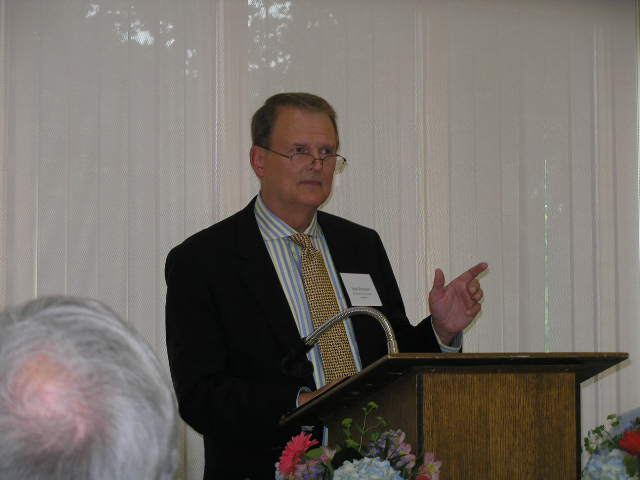
Suitably, Mr. Freeman focused on WFB's talent for making friends: Stream, download (27 sec). That talent was not a contrivance, though, as Freeman illustrated through a humorous anecdote relating Buckley's ostensibly confidential comments about him to the FBI: Stream, download (1 min, 35 sec).
Expanding the portraiture, Portsmouth Abbey Oblate Director Dom Damian Kearney related his experiences with Bill Buckley, first when they were both students at Yale (among the strictly limited 10% of students who were Catholic) and later when Mr. Buckley sent his son Christopher to Kearney's school, where the monk once caught the young man thumbing through an issue of Playboy, featuring an article by his father: Stream, download (59 sec).
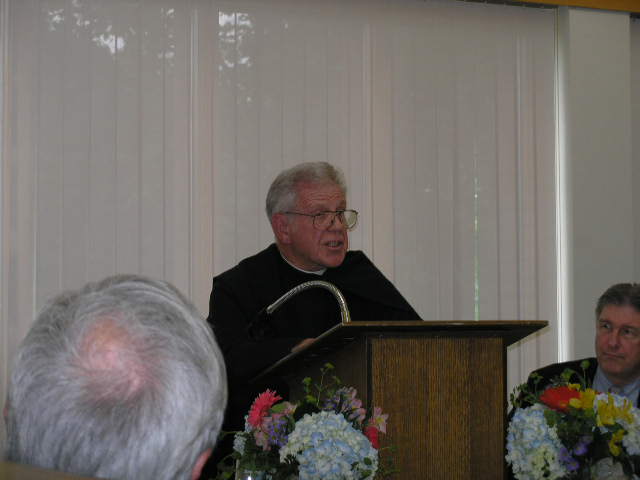
James MacGuire was a friend of Christopher's in those days, and remains such, now, so he had several personal anecdotes about the Buckley family, as well, when he took the microphone (which had been reduced to a mere turn of phrase by the failure of the actual microphone's battery).

MacGuire's central mission, though, was to read some excerpts from Christopher Buckley's book Losing Mum and Pup, and he summed up Christopher's tenuous relationship with his father's faith thus: Stream, download (1 min, 8 sec).
The final speaker of the whole shebang was Clark Judge, Managing Director of the White House Writers Group, who brought the conversation back toward the academic and strove to describe the essence of William F. Buckley, Jr.'s accomplishment: Stream, download (46 sec).

June 21, 2009
The Professor and Friend
In summarizing the first three speakers at the Portsmouth Institute's WFB conference, I observed their different styles. Among subsequent speakers, I'd say that, truly, E.J. Dionne and K.J. Lopez spoke much as columnists. They offered facts and quotations, giving their own opinions, and building overall arguments. None who've read their work would be very surprised at, essentially, their style of reading of their work.
Roger Kimball's presentation was that of a compelling university lecture. It's difficult to articulate the difference, but one can hear it in reviewing the speeches. The best that I can do is to say that the lecturer's first objective is to edify, while the columnist's is to state an argument. Perhaps another way to think of it is to see the lecturer as reading a chapter from a book; it's still the presentation of an argument, but it's a longer form argument, stretching beyond the bounds of an individual chapter.
Lee Edwards, of The Heritage Foundation, joins Mr. Kimball in that category.
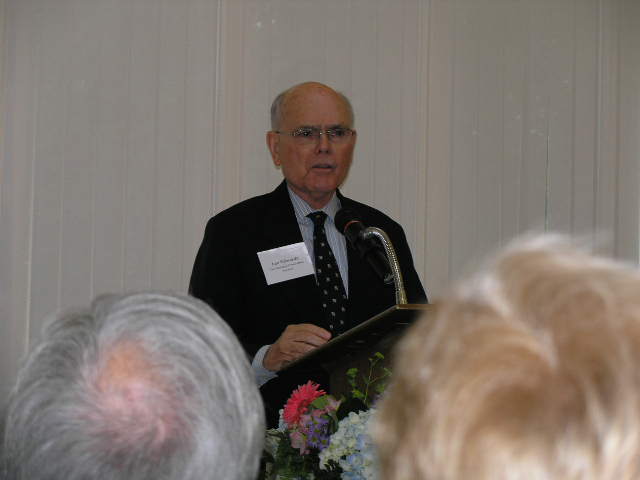
The perspective of the personal acquaintance was particularly valuable in Mr. Edwards's talk — which was, after all, billed in the program as "The William F. Buckley, Jr., I Knew." It is, therefore, an obvious act to relay some personal anecdotes:
- Young Bill and Trish Buckley's adventure to secretly baptize house guests in order to save their souls: Stream, download (1 min, 3 sec).
- In the line of Bill Buckley investing in the human capital of young conservatives, an anecdote involving Mr. Edwards's wife and her hanging-up-the-phone disbelief that the celebrity would call her dorm: Stream, download (2 min, 28 sec)
- Summing up much of what had been said of Buckley's charitable nature and self-contradictions (that are not really contradictions at all, in the end): Stream, download (2 min, 22 sec).
Additionally, during the Q&A period, Mr. Edwards offered an abstract-type summary of his essay, "The End of Conservatism?" in which he describes five essential elements required for a movement, stream, download (1 min, 54 sec):
- A philosophy
- An infrastructure/constituency
- A financial base
- Media facility
- Charismatic and principled leaders
Members of the budding Rhode Island reform movement could benefit greatly by heeding Mr. Edwards's advice.
The Liberal's Tempered Perspective
The first thing to note about Washington Post columnist E.J. Dionne's after-dinner speech at the Portsmouth Institute's conference on William F. Buckley's conservatism is his mention of something that struck me for the duration of the event: namely, that religious life does not preclude real life, much less intellectual life. Stream, download (52 sec). Experience with the monastery and admiration for the monks, Dionne said, saved him "from a sometimes popular and always foolish prejudice against men and women of faith."
That perspective brings into relief the difficulty of Dionne's task at the conference, as the lone liberal speaker in the program as well as an alumnus of the school, a personal friend to many in the audience, and an ideological dissenter handed a microphone at what was, after all, a multiday tribute to WFB. Still, I would have preferred his going a good bit further in challenging his audience, because the debate that he might have sparked would have exposed a more comprehensive picture of what Buckley actually accomplished.
Dionne described, for example, what he takes to be "the many contradictions of contemporary conservatism," and the messiness and continual threat of collapse that such composition implies: stream, download (47 sec). Missed in his convenient observation (for a liberal) is, first, that reality itself is messy and seemingly self-contradictory and, second, that Western civilization itself is more a brilliantly contrived pile of loose stones than a solid monolith. He speaks of conservative fusionism as an idea that "never fully cohered" without apparently seeing that an ideology that would accurately address the world as it stands must necessarily involve an organic process of adjusting to infinite semblances of incoherence in the universe and human nature.
Of a piece is Dionne's characterization of Buckley's conservative counterculturalism as a paradox: stream, download (46 sec). Dionne describes Buckley's work as a reaction to the stultifying conformity of the '50s, but he seems not to understand that the objection to "middle of the road qua middle of the road" is that making moderation a goal is not only incoherent, but points to emptiness.
WFB's accomplishment, in this regard, is that he manifested the age's aesthetic preference for rebels but pointed it toward an intellectual structure concerned, at its soul, with a higher order, compared with the deliberate (and selectively beneficial) chaos underlying the prescriptions of radicals.
June 7, 2009
After a Difficult Violent Roundtable, Part 2
A second conversation in which sufficient articulation proved difficult on Friday night's all–Anchor Rising Violent Roundtable on the Matt Allen Show related to Matt's statement that the Catholic Church is in some respects an anti-American institution. Having such a strong statement catch one off guard doesn't make measured extemporaneous response an easy accomplishment, but upon reflection, I'd suggest that Matt is backing into a perilous political philosophy.
The Roman Catholic Church — any church, for that matter — should not be an "American" institution. The U.S.A. exists as an entity and as an idea; to the extent that an authentically American church were not redundant, it would be dangerous. A religion with policy conclusions in lock-step with the practice of the American idea would necessarily lend theological import to a quintessentially secular project. It would be a fundamental establishment of religion, marrying Church and State.
There is not only great value in, but essential need for cultural institutions completely separate from the reigning polity — with a source and structure of authority that is distinct from the nation's governmental strategy. Where members of the hierarchy are wrong in prudential matters, Catholics should discuss (even debate) the issues and argue for the Church's proper role, but all should realize that the Church's interests are not the same as the country's. Sometimes one will be wrong, or the human beings who guide it will step beyond their appropriate boundaries; sometimes the other will be the culprit; but that's reason to accept them as mutual ballast.
In an objective analysis, Matt's imputation of anti-Americanism on the part of the Church based on the public policies for which some of its representatives advocate is identical to the impulse of those within the hierarchy who wish overzealously to leverage the government's powers of taxation. Both sides judge and prescribe as if the two pillars of society ought to be more of a continuous support, in which the visibility of light is indicative of fatal cracks, not expected separation.
Let's not dilute anti-Americanism. I don't believe it is Matt's point of view that the Roman Catholic Church takes as its goal the downfall or diminution of the United States as a secular construct. The institutional Church has watched governments rise and fall throughout its history, and there are multiple bold lines between supporting policies that are arguably detrimental to the civic body and calling for the downfall of a Great Satan. An instructive distinction exists between President Ronald Reagan's characterization of the Soviet Union as an "evil empire" and Pope John Paul II's view of communism as "a medicine more dangerous than the disease itself" that became "a powerful threat and challenge to the entire world."
Both the United States of America and the Roman Catholic Church are centrally concerned with liberty. For one, it's liberty from oppression by people; for the other, it's liberty from oppression by sin and evil. Those concerned with either in particular should pay close attention to the other, but nobody should expect their requirements always to be the same, just as nobody should drive the two apart because one — accurately or erroneously — points in a different direction from time to time.
The project of post-Enlightenment conservatism (as we understand it today) is to layer balances and restraints against human nature, and theologically, the impulse to declare opposition amounts to a Church of Me, in which the individual pushes away a perspective that ought to be given credence. Here, the philosophical thread leads to a final point of contention on Friday night — namely, conservative wariness of populism — which I'll address after I've trimmed some hedges and made my way through the Sunday paper.
June 6, 2009
After a Difficult Violent Roundtable, Part 1
Last night's Violent Roundtable on the Matt Allen Show was the most difficult public appearance/talk show that I've done yet. Probably because Matt correctly assessed that an hour of harmony wouldn't have been very interesting, his questions touched on a number of weighty subjects on which expressing comprehensive thoughts on the spot is not easy.
For instance, take Matt's reference to Rep. John Loughlin's suggestion that the government get out of the marriage business, and permit everybody civil unions, because "marriage is a religious concept." That attempt at compromise (I'd call it a cop-out) is simply based on a false premise. Marriage is not a religious concept; it transcends religion, not only in the sense that all religions throughout history have recognized its opposite-sex nature, as I mentioned last night, but also in the sense that it resides at the intersection of multiple social strata: religion (yes), but also family, heritage, government, property, history, and so on, all of which find relevance in the biological fact of a man and a woman's ability to become one in the person of a child.
Religion's role in marriage is to lend the mysticism that makes the relationship profound, and therefore worthy of lifelong vows. Ancestry roots children in their society. Property gives motivation for productivity and economic prudence, particularly with a long-term view of generations. And government's role is to protect the community that it governs, in this context, by protecting the familial structure on which all of Western society's progress has been founded.
Consequently, government has even more objective, secular interest in encouraging stable marriages — that is, permanent unions between intimate men and women — than it does in encouraging the additional social good of consistent mutual care, which is ultimately what civil unions would recognize. Even the requirement of intimacy would be impossible for the government to require or assume, opening the door for civil unions between anybody and anybody (or anybodies).
For government to reduce all mutual care relationships to a level field, relying on religious groups to define their profundity, it would create a necessary equivalence between them. By declining to adhere to a consistent definition understood across the aforementioned strata, the government referee would be declaring the concept of marriage available for redefinition and throwing it to cultural forces that include not only religious organizations, but also pop-culture industries. If nothing else, the social noise would end the marital institution's utility.
Matt's suggestion — fantastic in principle — that we should refuse to acknowledge the government's authority as lexicographer skirts an assessment of what is actually happening. Drawn forward by well financed and highly motivated special interests and prodded by a complicit media industry, the government has been forcing a new definition of marriage into the culture. That being the case, following Matt's political philosophy would actually require the people to demand that the government explicitly affirm the definition of marriage under which their culture has operated throughout history until such time as it is understood by all to have changed.
In other words, the trajectory of the change currently involves the government's redefinition in order to manipulate the culture. Those playing defense on the traditionalist side are not the ones ceding authority to the political class, nor is there equivalence between our attempts to hold the government in place and the attempts of radicals to drag it into the cultural fight.
The initial question that sparked our discussion, on the radio, was whether the government should be granting heretofore marital rights and privileges piecemeal, one by one, to same-sex couples. The topic shifted a bit by the time it got to me, but my answer would have been that such an approach is precisely the appropriate one. Formed back when people actually believed that same-sex marriage was sufficiently inconceivable that a constitutional amendment was not necessary, my view has long been that the governments at various levels should affirm the traditional definition of marriage and do so in such a way as to enable state-level legislation easing the difficulties that those with other relationship types face. Require that legislation to define new relationships and their privileges without reference to marriage (i.e., no "all rights and privileges of marriage" language), thus requiring our society to come to consensus about the justification, purpose, and meaning of each change.
Cultural forces will vie to define the new unions, and it would be appropriate for those on the same-sex marriage side to refer to themselves as married, if they so choose, as well as to strive for the broader society's similar understanding of their relationships. Over time, the culture may come to see no significant difference between civil unions and marriage, or perhaps the distinctions between mutual-care relationships and procreative marriages will become more prominent. All the debate, however, and experimentation would be performed outside of the core institution of marriage and without the government's being used as a lever to roll the cultural boulder.
April 3, 2009
Anchor Rising's Top 10 Right-of-Center Rhode Islanders: 2, 1
It isn't until one attempts to score people's influence and power that it becomes clear what separates the tiers — and what an opportunity and responsibility having the spotlight can be. By virtue of their offices, our top 2 are well ahead of the rest of the pack, and unless conservatives (or otherwise right-of-center players) begin claiming new positions — or creating them — it's difficult to imagine much change.
 Roman Catholic Bishop Thomas Tobin is unique on this list in that he's much stronger in social conservatism than in economic, largely because we adjusted for his position on immigration in the latter category. Still, one can hardly deny that he belongs on the list, and once that's admitted, the rest is simple admission of reality. The bishop is frequently mentioned in the news — most substantially in a week-long Projo spread a short while ago — and both his influence and direct decision authority span parishes, schools, religious organizations, charities, and even the diocese's own newspaper.
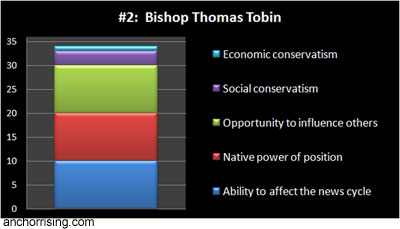
 As much as some of our fellow frustrated RI conservatives may wish to deny the obvious, Governor Don Carcieri clearly sets the top-end conservative benchmark in the state. Rail against his style, strategy, and effectiveness, if you must, but the governor is undeniably a right-wing stalwart in the social and economic positions that he states, and his influence and direct power are unmatched among the state's conservatives. That he leads our navy blue state sometimes seems to be a quirk of modern history, and with the political field as it currently appears, we aren't likely to repeat the miracle when his term is up.
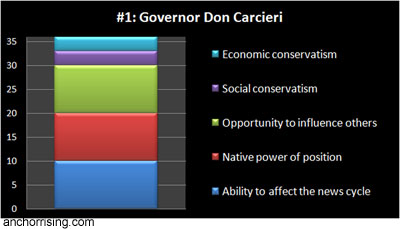
April 2, 2009
Anchor Rising's Top 10 Right-of-Center Rhode Islanders: 4, 3
Our ranking continues with a battle of the media, in a sense, the old media and the... well... young adult media. Among the interesting factors that are likely to affect this list by its next iteration will be trends in how people consume their news and commentary. For the time being, though, that folded paper thing is still a powerhouse.
 Say what you will about the Providence Journal, it remains the standard for the news that's fit to print in the state. The local papers may be more of a must-read affair for those within their markets, but when it comes to Rhode Island and its capital, the Projo sets the record. And Edward Achorn has a strong voice in setting the tone of its opinion pages. We're not entirely sure about the full duties and responsibilities of the Deputy Editorial-Pages Editor, but Mr. Achorn contributes under his own name, as a member of the editorial board, and as a player in determining what other writers appear on the two-page spread. And of course, the "all the right enemies" thing applies once again. I mean, the unions actually dispatch people to disrupt his talks.
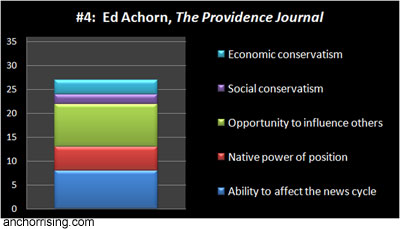
 Whether he's describing the shared Battle of the Unplowed Roads, making politicians on both sides of the aisle squirm, or standing up for those of us who refuse to join the iPhone cult, Dan Yorke sets the topic for Rhode Island's drive home. With his vast audience, political connections, and considered opinions directly conveyed, Dan is a force in the Ocean State, and the good news is that — be strategic differences what they may — he's on our side (for the most part).
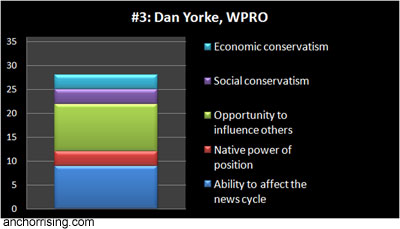
A Brief Chat with Number 10
Andrew stopped by the studio to take our Wednesday spot on the Matt Allen show and to discuss our top 10 list as well as the political philosophy and action that the state of Rhode Island requires. Stream by clicking here, or download it.
April 1, 2009
Anchor Rising's Top 10 Right-of-Center Rhode Islanders: 7, 6, 5
This batch of right-of-center Rhode Islanders stands as evidence that disaggregating subjectivity can have unpredictable results. If we had been satisfied to wing our list without settling on criteria, one the following three members of the top 10 would have been lower, one would have been higher, and one probably wouldn't have made the list at all.
To those who object to any of the following placements, we can only shrug and make that favorite claim of Rhode Island officials: Our hands were tied by the process.
 As a low-key worker behind the scenes (usually), Bill seems to be almost too much one of us to be some big deal conservative figure. But if you factor in his ability to generate news interest (by argument and by controversy), his local and national networking, his municipal office, and the investigative mission of his Ocean State Policy Research Institute, the points add up.
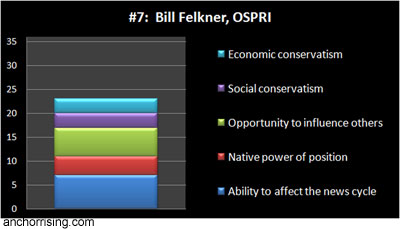
 Had we compiled this list just a couple of weeks ago, Mr. Laffey would have certainly broken the top 5, and we are hopeful that circumstances and decisions will lead to turnaround rather than drift. For now, despite an announcement that he will not seek the governorship as expected, and despite rumors that he's headed out of state, it remains undeniable that Laffey has an open line into the news cycle and still counts many Rhode Islanders among his dedicated supporters.

 To include Democrats or not to include Democrats? Well, if we're being honest (and if we acknowledge the state in which we operate), we have to admit that the political center line does cross through Democrat territory. The reality is that Mr. Caprio has been a news-generating machine, lately; he holds a reasonably powerful, high-profile office in the state; and he's been opening up channels across media as well as across the political spectrum. As for his conservatism, it's true that he looks likely to take the "personally opposed, politically ambivalent" cop-out on social issues, but for a Democrat, that's a marker of moderation. Economically, we're comfortable giving the treasurer the benefit of the doubt that he's well to the right of his fellow Ds.
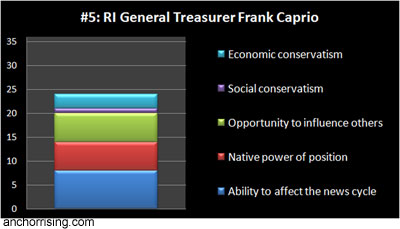
ADDENDUM:
To make the title of the list more accurate, we've changed it from Top 10 Conservative Rhode Islanders to Top 10 Right-of-Center Rhode Islanders. Sometimes a shift in emphasis emerges between concept and publication without the resulting changes' being as thorough as they should be; such was the case here.
March 31, 2009
Anchor Rising's Top 10 Right-of-Center Rhode Islanders: 10, 9, 8
Last week, we began a conversation about how one would gauge the top 10 conservative Rhode Islanders. To be sure, the conversation didn't stay on topic very long, but it did spark some discussion among the contributors. Once we defined criteria and a scoring system, we felt capable of providing a veneer of objectivity to our guesswork. Such rankings are inherently subjective and often based more on impressions than quantifiable metrics, but in an attempt at control, we rated each person on a ten point scale in each of the following three categories:
- Ability to affect the news cycle: In the ideological game, the message makes the messenger, so affecting the public discussion is a critical power. Some folks are go-to quotables for news stories; others can effectively create news from press releases; others can drive their opinions into the news even though their names never appear there.
- Native power of position: Since we're measuring "power" in a general sense, it's important to tease out different forms thereof. An influential media personality may reach thousands, but his or her ability to make decisions that change people's lives is indirect. Prominent executives top this category, with average legislators in the middle of the pack.
- Opportunity to influence others: It's one thing to provide quotes and stories to others (who may or may not report them accurately); it's another to have a personal audience or following. Conveyance of one's positions to other people and persuasion of them to act, or at least think, differently is the form of power generally called "influence."
Especially given the prominence of moderates in Rhode Island's right-of-center coalition, we thought it reasonable to work the person's degree of conservatism into the formula. Therefore, candidates could earn another six points — three on social issues and three on economic — with one point being at least moderation/ambivalence and three being a full fledged conservatism. Consequently, the highest possible score was 36.
We realize that opinions vary on what matters and how the criteria apply to each person on the list, and this being our first attempt at such an inquiry, we welcome comments or even corrections.
 Starting off the top 10 is 630AM/99.7FM WPRO's evening host Matt Allen. Yes, he's the new host on the schedule; yes, he's on late. But Matt's got the top show on the radio waves during his slot, and we run into his listeners often. His power derives almost entirely from his microphone and his ability to make a thing news simply by discussing it. On the ideological scorecard, his libertarian streak softens his social conservatism, but Matt's well within the inner chambers of right's big tent.
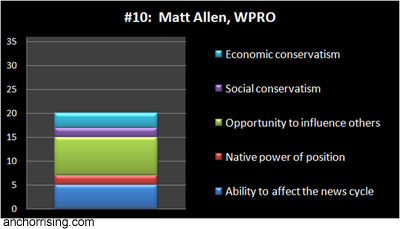
 Nobody would deny that the leader of a such a tiny band as the state House GOP is far from the top of the political hill, but certain powers and privileges accrue to the role. (Right?) More importantly, where there is discussion of budgetary matters, Mr. Watson is very often the agitated "opposing voice." When corruption and procedural leftism rear their heads in the General Assembly, he often leads the attack from the right (albeit, sometimes requiring prompting from folks farther up our list)... for what it's worth. Although, from what we hear, it's best that the leader remain mum on social issues, he's definitely a man of the right by Rhode Island standards.
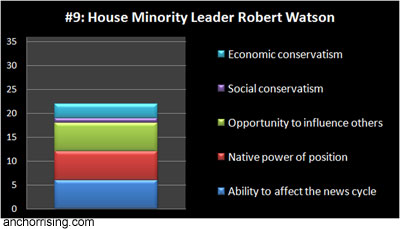
 You've heard the significance of having all the right enemies? Well, WPRO's morning host John DePetro drives those enemies crazy. We're not entirely sure why that is — assuming it's not the quick-take style of his show — but the size of his audience and local familiarity with his name (having snagged the "independent man" brand) are enough to land him on our list. He also carries the native Rhode Islander's advantage of having personal connections throughout the state.
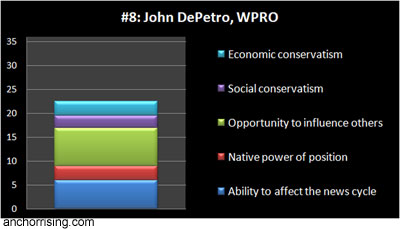
ADDENDUM:
To make the title of the list more accurate, we've changed it from Top 10 Conservative Rhode Islanders to Top 10 Right-of-Center Rhode Islanders. Sometimes a shift in emphasis emerges between concept and publication without the resulting changes' being as thorough as they should be; such was the case here.
March 26, 2009
A Not-So-Idle Question
Pondering something not at all self-referential, I got to wondering who might rank on a top 10 list of conservative Rhode Islanders. (Given the competition, let's define "conservative" as "right-of-center.") Some names and placements are obvious, but what would the breakdown be?
I suppose one would first have to settle on criteria. There are folks who, by the nature of their positions, have a certain amount of power. Others have influence of which the public is hardly aware. Still others are very visible, but their influence beyond their visibility is a question. How does one measure a legislator against a radio personality? A newspaper editor against an activist?
What do you think?
March 2, 2009
Hoping Against Hope for Presidential Wisdom
Curious about how conservative Obama fans are getting along, I checked in with the man whose leg the messiah made tingle with knowledge, David Brooks. Here is a guy who reallly, really wants to believe:
If ever this kind of domestic revolution were possible, this is the time and these are the people to do it. The crisis demands a large response. The people around Obama are smart and sober. Their plans are bold but seem supple and chastened by a realistic sensibility.Yet they set off my Burkean alarm bells. I fear that in trying to do everything at once, they will do nothing well. I fear that we have a group of people who haven't even learned to use their new phone system trying to redesign half the U.S. economy. I fear they are going to try to undertake the biggest administrative challenge in American history while refusing to hire the people who can help the most: agency veterans who are registered lobbyists. ...
It'll be interesting to see who's right. But I can't even root for my own vindication. The costs are too high. I have to go to the keyboard each morning hoping Barack Obama is going to prove me wrong.
What'll be interesting is how Brooks and others gauge Obama's success. "If Obama is mostly successful," he writes, "then the epistemological skepticism natural to conservatives will have been discredited." Such judgments have a way of being obscured by the turmoil of government and society.
After the budget speech, for example, Brooks sought to blame political innocence, not a fundamental intellectual misconception, for Obama's willingness to embrace a destructive half-plan for America's future:
The bigger problem is health care. This is an issue where everybody wants benefits they don't pay for, where perverse incentives have created an expensive system that doesn't deliver results. This is an area where aggressive presidential leadership is mandatory.Yet in no other area does the administration cede so much authority. The administration has over-learned the lessons of the Clinton-care fiasco. They're not going to send up a detailed 1,400-page program. Fine. But they're not pushing a plan at all.
Instead, replicating the model that did such harm to the stimulus package, they are merely outlining eight general principles and then sending the matter up to Capitol Hill. They vow to have a series of "conversations" and then presumably at some point some group of committee chairmen will write a bill or a bunch of bills. ...
Even though the budget is not all one would have hoped, I'd trust the folks in the Obama administration to craft a decent health care plan before I'd trust the Congressional Old Bulls. Obama blew a mighty trumpet Tuesday night, but after you blow the trumpet, you actually have to charge.
Perhaps that trust is rooted in a swindle, and the Obama team is ceding authority because it is more concerned with appearances than actions. That is the great flaw of big government philosophy: It moves forward on the assumption that a plan could be created... by somebody... and then fumbles for anything that would maintain the illusion, because no concrete proposal will actually work. The upshot is that the powerful manipulate the new well of money and influence while the general public suffers.
March 1, 2009
While on the Topic of Pining (a Little Revivification)
If you've got ten minutes, it might do your patriotic spirit good to watch a couple snips of speeches from opposite ends of Ronald Reagan's political career:
- The first I came across while perusing Prof. Jacobson's blog: "Those who would trade our freedom for the soup kitchen of the welfare state have told us they have a utopian solution of peace without victory; they call their policy 'accommodation,' and they say that if we'll only avoid any direct confrontation with the enemy, he'll forget his evil ways and learn to love us."
- The second is presented on Ocean State Republican as an answer to Obama's supporters: "All great change in America begins at the dinner table, so tonight in the kitchen, I hope the talking begins. And children, if your parents haven't been teaching you what it means to be an American, let 'em know and nail 'em on it. That would be a very American thing to do."
It's tempting to bemoan that "they don't make 'em like Reagan anymore," but they do. We just have to find them — and support them.

The Top Issue at CPAC
... and the margin by which it surpassed other issues surprised me. From ABC's The Note:
CPAC's straw poll got underway on Thursday at the Omni Shoreham Hotel in Washington, D.C., and was conducted through Friday afternoon.As conference attendees would walk into the hotel's main ballroom, they were invited to fill out a questionnaire.
* * *
The conservative activists participating in CPAC's straw poll are primarily concerned with limiting the scope of government. Seventy-four percent of straw poll participants said they are most concerned about limiting the size of government, 15 percent said they are primarily concerned with promoting traditional values and 10 percent said they are primarily concerned with security regardless of the cost.
I'd have thought social issues/"traditional values" would have gotten top billing.
As for the winner of the CPAC presidential straw poll, frankly, I wish he were president now. It's a good guess that Mitt Romney would not be contemplating, for example, the nationalization of our banks or the dismantling of contract law and the slide in real estate values that will certainly follow - just the opposite of the effect sought - because banks will both constrict lending and charge more to lend. Ah, the road to hell ...
Check out Fox News for extensive coverage of CPAC, which wraps up today.
February 22, 2009
On Reports of Conservatism's Death
Don't count Jay Nordlinger among those who believe American conservatism is in crisis. He unnecessarily elides conservatism and Republicanism, but his point is well taken:
Consider the 2008 presidential election. It was almost a perfect storm for Republicans. John McCain was a very, very poor candidate. He could barely make a case for himself. Now, I voted for him with gusto, and wish he had been elected. I’d like to go back to that same polling place and vote for him again. I wish he were in the Oval Office right now. But he had a very hard time making a case for himself, particularly in the three presidential debates.His running mate, Sarah Palin, was perfectly and disgustingly vilified. The Left, broadly defined, has a lot to answer for in this regard.
McCain-Palin had 100 percent negative media coverage (or 99.9—depends on how precise you wish to be). Barack Obama had 100 percent positive coverage. The rooting was open and appalling.
And he was a very, very good candidate—a good campaigner, a good speaker, a good debater, a good pol.
Plus, the incumbent Republican president had historically low approval ratings. And the nation was weary of a fairly long and difficult war. And, in September, the financial system collapsed.
AND AND AND: McCain-Palin got 46 percent of the vote. Think of that.
As I've said before, I believe that, culturally, conservatism has been on a gradual incline over the past couple of decades, but that President Bush, in the aftermath of September 11, cashed in too rapidly on its political gains. And now, as Nordlinger puts it: "The patient may not be at death’s door; he may be simply resting."
The movement must take stock of itself. It must shuffle out some old baggage and usher in some new faces. The country, the party, the movement — they've all taken some major hits this decade. Various cultural illnesses have graduated to more critical organs. Some philosophical principles have been dirtied by their poor exercise (as with the free market). Others are asserting their essential truth behind the ostensible successes of the other side (consider the demeanor and structure of the first family). In any process of growth, however, there are periods of apparent, but superficial, stagnation.
Western Conservatism must refortify, though, and quickly, because in the very near future, it's going to have to dispel the hopelessness that creeping socialism will engender and arrest Islamic militantism in its tracks.
February 2, 2009
A Home Overseas?
Conservatives sometimes lament that, unlike liberals, they lack for countries to which to move — or at least to threaten to move — when they lose elections. Judging purely from its president's attitude, it looks like the Czech Republic might be headed in the right direction:
When it comes to the climate, "there are competing theories. I'm very sorry that some people, like Al Gore, are not ready to listen to the competing theories. I do listen to them."Klaus has published a book called "Blue Planet in Green Shackles: What Is Endangered: Climate or Freedom?" Klaus told us that the answer is freedom — freedom is endangered — adding, "I imagine National Review would understand what I mean." I replied, "Actually, there are differing views about global warming at National Review."
Another journalist present said, "What freedom do you mean? What freedom is endangered?" Klaus pointed to her and said, "Yours, mine, [turning to the World Economic Forum representative] the moderator's. The freedom of publications like National Review."
A different journalist, with high-pitched indignation, said, "Are you saying that Al Gore is threatening freedom?" Klaus answered, "More or less. Environmentalism and the global-warming alarmism are challenging our freedom; Al Gore is an important person in this movement."
January 8, 2009
R.I.P. Father Richard John Neuhaus
Founder of First Things and one of this country's preeminent theologians, Father Richard Jon Neuhaus has passed away. From the National Catholic Reporter.
From the early 1970s forward, Neuhaus was a key architect of two alliances with profound consequences for American politics, both of which overcame histories of mutual antagonism: one between conservative Catholics and Protestant Evangelicals, and the other between free market neo-conservatives and “faith and values” social conservatives.In 2005, Time magazine took the unusual step of including the Catholic Neuhaus on a list of America’s 25 most influential Evangelicals, noting that in a 2004 session with journalists from religious publications, President George W. Bush cited Neuhaus more often than any other living authority.
“Father Richard,” the president said then, “helps me articulate these [religious] things.”
To Catholic insiders, however, it was Neuhaus’ writing rather than his political activism that made him a celebrity. From the pages of First Things, the unapologetically high-brow journal he founded in 1990, Neuhaus kept up a steady stream of commentary on matters both sacred and secular.
In broad strokes, Neuhaus was an unabashed supporter of the papacies of John Paul II and Benedict XVI, and his commentary was prized in Rome. John Paul, for example, named Neuhaus as a delegate to the 1997 Synod for America. Yet he was no lapdog for ecclesiastical authority; he lamented the Vatican’s opposition to the Iraq war in 2003, and early in Benedict’s papacy Neuhaus voiced “palpable uneasiness” that the new pontiff was not clamping down on what Neuhaus saw as dissent from church teaching.
Over the years, even people who disagreed with Neuhaus’ politics or theology would devour his monthly essay in First Things, titled “The Public Square,” for sheer literary pleasure. His combination of epigrammatic formulae and occasionally biting satire often reminded fans of English-language Catholic luminaries of earlier eras, such as G.K. Chesterton or Cardinal John Henry Newman.
December 31, 2008

Recognizing Socialism Before Everyone Else Was
Remember, when you read stories over the next few months that begin like this Washington Times story does…
Republican Party officials say they will try next month to pass a resolution accusing President Bush and congressional Republican leaders of embracing "socialism," underscoring deep dissension within the party at the end of Mr. Bush's administration.…that Anchor Rising commenters were calling President Bush a socialist, long before it was cool to do so; here's Tom W from June of 2007…
George W has been a disaster for the Republican Party, and he's getting worse with each passing year.As we head into 2009, Anchor Rising hopes to continue to be the place where you can get next year's news now!He's also been a disaster for conservatives, for the unwashed masses think he is one, all the while he's been governing like an "evangelical socialist" (I wish I'd thought of that description, it is soooo apt).
The resolution is being spearheaded by Republican National Committee Vice-Chairman James Bopp, a name that may be familiar to Rhode Islanders as the lawyer who represented the Republican party in their 2002 campaign finance/First Amendment case in front of the Board of Elecitons, and who helped write the Carcieri administration's legal brief arguing that Rhode Island can grant same-sex divorces without recognizing same-sex marriage.
December 1, 2008
Strangely Controversial
It's strange that this, from Rod Dreher's argument for the centrality of religious social conservatives to the Republican Party, should have the air of something controversial:
Times change. Today, the greatest threats to conservative interests come not from the Soviet Union or high taxes, but from too much individual freedom. Look around you: Americans have been poor stewards of our economic liberty, owing to cultural values that celebrate unfettered materialism. Our families and communities have fragmented, in part because we have embraced an ethic of extreme individualism. Climate change and a peak in oil production threaten our future because we have been irresponsible caretakers of the natural world and its resources. At best, the religious right stood ineffectively against these trends. At worst, we preached them, mistaking consumerism for conservatism.All political problems, traditional conservatism teaches, are ultimately religious problems because they result from disordered souls. In the era now dawning, Americans will learn again to live within limits — and together. Religious conservatives are philosophically positioned to lead the way, but we can't do it by pouring new wine into old skins.
The piece that modern sensibilities tend not to infer is the specification that the excess of individual freedom oughtn't be curbed by government fiat. Some people overreach, of course, but the mainline of social conservatism holds that it is government's role to foster a sociopolitical environment in which sociocultural institutions can function to rein in behavior in an atmosphere respectful of free will and compromise. Even with clear atrocities such as abortion, social conservatives tend to advocate for federalist solutions. There's a reason that they and libertarians have managed to hold their alliance for so long: there's a significant ideological, and personal, overlap.
Dreher goes on to make a point that's entirely in keeping with my general philosophy of political rhetoric:
We're going to have to learn to think and talk in terms — and not overtly religious ones — of building up civil society and its mediating institutions. David Cameron has revived the Conservative Party's fortunes in Great Britain by following this model. His is a heavily secular approach for his heavily secular nation. Fortunately, American religious conservatives have more of a cultural base to build on.
St. Paul insisted that we can know God by His creation, and it follows that moral ills ultimately manifest in social wounds that we all sense to be wrong. That is where dialogue must start, and it is where civil-sphere argumentation must stay; once the social point is made, those who've been converted that far will either find the rest of the way for themselves or they won't. Attempting to force a particular destination on them ensures the latter outcome.
November 21, 2008
This Right, That Right, Who's Right?
So, John Henke warns social-religious conservatives of electoral apocalypse should they excise libertarians:
Social conservatives have to realize that they need the fiscally conservative, socially moderate/tolerant voters if they want to be a part of a winning coalition. The limited government message won revolutionary victories for Republicans in 1980 and 1994; it is the only viable organizing principle for the current Republican coalition.
And Ramesh Ponnuru takes the opposing view:
His point that social conservatives need economic conservatives is well taken. But the reverse is also true, and indeed more true. So, in the bit you quote, he suggests that it was limited government that won the day in 1994, with social conservatives along for the ride. It would oversimplify matters, but be much closer to the truth, to suggest that "God, gays, and guns" powered Republican successes that year—and the "revolution" sputtered out as soon as Republicans touched Medicare.
There's a group being lost in the back and forth, and I think it's probably the largest of the three, or at least a sort of right-wing swing vote: social-religious-economic conservatives. We who fall in that category believe in limited government and low taxes, but with the consequence that the government and religion must have a working relationship, as it were, and that laws can and should have a moral component. We also believe, however, that too expansive and invasive a government will ultimately crush the values that we seek to instill in the American people.
We are wary of socially conservative big-government types, but repelled by the libertinism that underlies the libertarian movement. Come election time, we weigh the extremity of both strains in each individual candidate and would suggest that the winning conservative strategy would be to develop and promote a consistent political philosophy that balances the two right wings and doesn't cede one-half of our agenda to the socially and economically liberal left.
November 18, 2008
The GOP: What To Emphasize, What to De-emphasize
This l.t.e. (no longer on line), forwarded by a friend, appeared in the Wall Street Journal yesterday. It succintly outlines the discussion this evening between WPRO's Matt Allen and National GOP Committeeman (State Representative) Joe Trillo as well as currently among Republicans everywhere.
My own slightly tangential reaction to this letter is: what hijacking? While their continued presence in the Republican party platform is one of the big subjects of the discussion, the pro life/school choice/marriage planks in the Republican party platform did not suddenly appear this year.
Mainstream Republicans and right-leaning independents want to back a party that leads on the issues of spending discipline, government reform, protection of individual liberties and a strong defense. If the Christian right is allowed to continue its hijacking of the GOP, the party will stand simply for pro-life, school choice and antigay marriage. All three are important issues and will keep the evangelical Republicans in line. But the Republican Party must return to its roots to avoid more of the same thumping it experienced on November 4.Scott Ullem, Chicago.
Prescriptions for the Other Side
Those all-powerful radio hosts are to blame for the Republicans' misfortunes, according to Steven Stark. If that's the case, perhaps liberals' difficulty succeeding in the medium was a function of strategy. More seriously, I'd point out that Stark has picked two moments in history and asserted a trend, even though Republicans' fortunes have been more of an arc since the late '80s than a downward slide.
But let's allow that some percentage of the electorate has been driven away from the Republican Party out of aversion to heated, audio-only rhetoric. I'd argue that the perception is a generated one. Even the characterization of "the relentless stream of invective from the right side of the dial" is an arguable description, especially in comparison with the viciousness of the Left, in the multiple media that it controls. And it hardly explains why the affable President Bush is so unpopular.
To be sure, Bush's big-government results are far from the conservative ideal. Some might go so far as to accuse the president of trying to be the populist that Stark is gratified to see in Mike Huckabee. At least in the realm of political theory, conservatives are justified in complaining that their philosophy is inaccurately tarred by association with Mr. Bush.
And there's the edge of the paper covering Stark's argument: President Bush was vilified as a conservative, and conservative media stars are portrayed as beyond-the-pale invective slingers, even when their rhetoric is no more heated or divisive than many a successful liberal. If Mike Huckabee had emerged victorious from the Republican primaries, we'd have spent the last six months hearing what a fire-breather he is.
The lesson for conservatives, in short, is not that it needs to present nice, conciliatory policies, or to take mollifying the skittish middle as a priority. To be sure, I'm a fan of calmness and good humor, but I'd suggest that the liberals who are currently deigning to review the faults of the right are not really complaining about style, but about content, and the only way to remedy that is to change our very nature and to turn a blind eye to reality.
October 22, 2008
Me-Too "Conservatives"
Tony Blankley provides some historical and practical context for the rash of conservative commentators who have become enamored with Obama based on his "temperment". He calls them "me-too Conservatives." He also forecasts what will happen post-election:
I suspect that the conservative movement we start rebuilding on the ashes of Nov. 4 (even if McCain wins) will have little use for overwritten, over-delicate commentary. The new movement will be plain-spoken and socially networked up from the Interneted streets, suburbs and small towns of America. It certainly will not listen very attentively to those conservatives who idolatrize Obama and collaborate in heralding his arrival....As I did at the beginning of and throughout the Buckley/Goldwater/Reagan/Gingrich conservative movement, I will try to lend my hand. I certainly will do what I can to make it a big-tent conservative movement.Me too.
October 16, 2008
Looking into the Wilderness
Markos Moulitsas (Daily Kos himself) recently wrote (h/t) that he wants to "break the conservative movement's backs and crush their spirits." He wants to "destroy their most beloved leaders" and silence "some of their most cherished voices." Further, he writes, with the 2008 election, the liberal/progressive/Democratic movement "[has] been blessed with an opportunity to help that process along." The neo-religious terminology is indicative of how "Kos" and many of his ideological allies view politics: "spirits", "beloved leaders", "cherished voices", "blessed with an opportunity".
I suppose that's the difference between the role that politics plays in the daily lives of leftist, partisan ideologues and traditional conservatives like me. My psychological well-being is not tied to whether or not Obama becomes the next President of the United States. I don't first look to politicians and government for answers. My optimism won't be undone by the success or failure of a particular politician or political party. And my faith resides in a higher power, not in the workings of fallible men. In short, I don't invest in the political careers of strangers as a way towards personal fulfillment.
Now I'm not naive and I know that there will be many conservatives emotionally devastated by an Obama presidency and a Democratic super-majority in Congress. I suppose they will be the proof to Moulitsas' theorem. But most conservatives won't "turtle" simply because a shiny new, liberal administration is in Washington, D.C. Remember, conservatives generally don't exactly view a potential McCain presidency as a new high-water mark for conservatism. No, the writing has been on the wall for a few months now, and conservatives are well prepared.
While I've chosen to side with the Maverick over the Messiah--my least worst of the two--I fully expect to disagree with whomever is elected President in 2008, if only by differing degrees. As such, I've made my serious philosophical differences with Barack Obama known. But my critique is not based on hatred or dislike for a man I don't know. Instead, it is based on my disagreement with his stated policies and his apparent worldview. Questioning his judgment based on past associations isn't a personal attack. Doubting the sincerity of a smooth orator with a sparse track record is not hate speech.
Yet, after years of GOP leadership, the American people seem ready to hand the keys of government over to the Democratic party and the cipher at the top of the ticket. It doesn't look like any minds are going to be changed this far along. So we will soon be witness to the Democrats' grand plans. They are sure they have all of the answers and are smart enough and good enough to see them through. They don't have much time to pay attention to the proponents of the past. Progress, after all, has won.
And no doubt they will take great pleasure in denigrating the conservative ideas they purport to have failed. Well, I suppose they will have earned their day in the sun.
But any potential success will depend less on the theory behind the policies implemented than on the practical effect those policies have on the lives of every day Americans. And the role that contingency plays--Will the economy continue to stagnate? Will we be attacked again?--and the concomitant reaction--Will Obama's policies hurt or help...or matter? Will a huminatarian peace-keeping mission turn into a war?--shouldn't be overlooked. The American people are not as patient as they used to be and will blame the President and Congress whether deserved or not. Lest we forget, way back in 2004 there was a so-called permanent Republican majority. It lasted all of 2 years. Voters could very well experience buyers' remorse in 2010 or 2012 as they did in 2006. The times change. Quickly.
As a traditional conservative, I believe that our society and culture was built on and continues to require certain principles that have proven successful over time. Though political winds may shift, bedrock principles aren't so easily changed. They have allowed us to prosper as individuals, as families, as communities and as a nation. They must be constantly defended and, where appropriate, modified, if slowly (to paraphrase Edmund Burke), to meet the new challenges of the time. And they endure, even if unheeded, no matter the ephemeral presence that occupies the Oval Office. After all, if conservative principles can survive long years in the wilderness of Canada (and Europe, for that matter), they can certainly survive an election cycle or two here in the U.S.A.
So, regardless of who is "running the country," I'll still continue to devote most of my energy to--and derive the majority of my happiness from--my family and friends and neighbors. And I'll continue to espouse and defend and debate over the principles upon which, I believe, offer us all the best chance for success. And, hopefully, I'll do it all with a smile and a chuckle in-waiting. It's only politics, after all.
August 6, 2008

Our Loss of Memory
Jonah Goldberg writes about Forgetting the Evils of Communism: The amnesia bites a little deeper:
Alexander Solzhenitsyn is dead. Peter Rodman is dead. And memory is dying with them.Over the weekend, Solzhenitsyn, the 89-year-old literary titan, and Rodman, the American foreign-policy intellectual, passed away...
What I admired most in both men was their memory. They remembered important things, specifically the evil of Communism. And, perhaps nearly as important, they remembered who recognized that evil and who did not.
Rodman, for example, was an architect of the Reagan Doctrine in places such as Angola and Afghanistan. One of his books, More Precious Than Peace: The Cold War and the Struggle for the Third World, was the quintessential defense of thwarting the Soviets in ugly spots of the globe where Americans were understandably reluctant to spend blood or treasure.
In Berlin on July 24, Barack Obama’s history of the Cold War sounded cheerier. There was a lot of unity and "standing as one," and we dropped some candy on Berlin, and now we need to be unified like we were then.
But unity was hardly the defining feature of the Cold War. There were supposed allies reluctant to help and official enemies who were eager to do their share. There were Russians — like Solzhenitsyn — who bravely told the world about Soviet barbarity. Here at home, there were a great many Americans, including intellectual heirs to the "useful idiots" Lenin relied on, who rolled their eyes at self-styled "cold warriors" such as Rodman. And from Vietnam through the SANE/Freeze movement, liberal resolve and unity were aimed most passionately against America’s policies — not the Soviet Union’s...
But it’s worth remembering how evil Communist governments really were. Stalin murdered more people than Hitler...The Black Book of Communism, a scholarly accounting of communism’s crimes, counts about 94 million murdered by the supposed champions of the common man (20 million for the Soviets alone), and some say that number is too low...
In 1974, when the New Yorker reviewed Solzhenitsyn’s The Gulag Archipelago, George Steiner wrote: "To infer that the Soviet Terror is as hideous as Hitlerism is not only a brutal oversimplification but a moral indecency." When Ronald Reagan denounced the "evil empire" — because it was evil and it was an empire — he too was accused of absurd oversimplification.
The real brutal oversimplification is the treacle we hear from Obama, that victory in the Cold War was some Hallmark-movie lesson in global hand-holding. The reality is that it was a long slog, and throughout, the champions of "unity" wanted to capitulate to this evil, and the champions of freedom were rewarded with ridicule.
"This is the moment," Obama proclaimed, "when every nation in Europe must have the chance to choose its own tomorrow free from the shadows of yesterday." Rodman and Solzhenitsyn understood that such talk was dangerously naive. People free from the "shadows of yesterday" forget things they swore never to forget.
Solzhenitsyn and Rodman are gone now, and a generation that learned such hard lessons is leaving us too quickly. The amnesia bites a little deeper.
August 3, 2008
Grand New Party
Fred Siegel reviewed Grand New Party: How Republicans Can Win the Working Class and Save the American Dream, by Ross Douthat and Reihan Salam in a recent issue of National Review. Here's the basic thesis, according to Siegel:
The timely thesis of Grand New Party is that the party that captures “the non-college-educated voters who make up roughly half of the electorate” will dominate politics for the foreseeable future, as has been the case ever since the New Deal...Siegel agrees with their forecast that the U.S. may be turning into a "stratified society" where the upper middle class--thanks to "[t]he combination of intermarriage among professionals and a higher divorce rate among the less educated"--is at the top of "a Europe-like class structure, in which the upper middle class (particularly in the tech and financial-services industries) lives segregated from ordinary Americans." Siegel believes "illegal immigration, and the flow of servants it provides...has, in a sense, reconciled upper-middle-class feminism with the family." Two-professionals can work while the kids are minded while the illegal servants put the meals on the same table paid under which they are paid.[The authors] show quite convincingly that neither party is able to speak effectively to these voters. Democrats respond to their economic anxieties, but mistakenly dismiss their cultural concerns as merely a Republican contrivance, and offer to assuage their concerns by making them clients of an ever-expanding state. Douthat and Salam demonstrate further that “the so-called social issues,” from abortion, marriage, and religion to the death penalty and immigration, “aren’t just red herrings,” as liberals insist. Rather, they speak to the realities of working-class life, in which a failed marriage or crime or low-wage competition can put a family on the skids: “Working-class social conservatism . . . wasn’t just the residue of ancestral prejudices, it was and is a rational response to lives absent the security provided by wealth and degrees.”
Church and family as conventionally understood — and not government — are the bulwarks of the social solidarity essential for a stable and successful lower-middle-class life. But if liberal Democrats, some occasional rhetoric aside, are allergic to the social issues, business Republicans seem insensible to the perils produced by a global glut of low-wage labor that includes illegal immigration here at home. If Republicans refuse to recognize “that the white working class wants, and needs, more from public policy than simply to be left alone,” they will, the authors insist, be cast into the political wilderness.
Creating strong families seems to be the ultimate cure for these ills. While Siegel is sympathetic to the goal, the means is less convincing.
The book offers a long list of reasonable proposals, ranging from expanded health-care-insurance pools to enhanced child tax credits and modernized highway signals (to reduce commuting time), that are designed to help create stronger, more secure families. The litany of solutions, which includes many of the proposals floating around the think-tank world, are not nearly as compelling as the book’s underlying argument. Nowhere do the authors take up the sheer incapacity of government to design effectively, and administer, sophisticated programs.
July 12, 2008
RIP, Tony Snow
Tony Snow died today, at age 53, of cancer. We remember his family in our prayers as we pay tribute to the memory of a wonderful man.
Some tributes:
Cal Thomas
Byron York
Shannen Coffin
Kathryn Jean Lopez
Michelle Malkin
Fox News
Several selections from Snow's writings about Reagan, Parting Thoughts on the Ultimate Sacrifice, and Message to GOPers.
Finally, Snow wrote a poignant and powerful article last year entitled Cancer's Unexpected Blessings: When you enter the Valley of the Shadow of Death, things change where he discussed his cancer:
Blessings arrive in unexpected packages—in my case, cancer.Those of us with potentially fatal diseases—and there are millions in America today—find ourselves in the odd position of coping with our mortality while trying to fathom God's will. Although it would be the height of presumption to declare with confidence What It All Means, Scripture provides powerful hints and consolations.
The first is that we shouldn't spend too much time trying to answer the why questions: Why me? Why must people suffer? Why can't someone else get sick? We can't answer such things, and the questions themselves often are designed more to express our anguish than to solicit an answer.
I don't know why I have cancer, and I don't much care. It is what it is—a plain and indisputable fact. Yet even while staring into a mirror darkly, great and stunning truths begin to take shape. Our maladies define a central feature of our existence: We are fallen. We are imperfect. Our bodies give out.
But despite this—because of it—God offers the possibility of salvation and grace. We don't know how the narrative of our lives will end, but we get to choose how to use the interval between now and the moment we meet our Creator face-to-face.
Second, we need to get past the anxiety. The mere thought of dying can send adrenaline flooding through your system. A dizzy, unfocused panic seizes you. Your heart thumps; your head swims. You think of nothingness and swoon. You fear partings; you worry about the impact on family and friends. You fidget and get nowhere.
To regain footing, remember that we were born not into death, but into life—and that the journey continues after we have finished our days on this earth. We accept this on faith, but that faith is nourished by a conviction that stirs even within many nonbelieving hearts—an intuition that the gift of life, once given, cannot be taken away. Those who have been stricken enjoy the special privilege of being able to fight with their might, main, and faith to live—fully, richly, exuberantly—no matter how their days may be numbered.
Third, we can open our eyes and hearts. God relishes surprise. We want lives of simple, predictable ease—smooth, even trails as far as the eye can see—but God likes to go off-road. He provokes us with twists and turns. He places us in predicaments that seem to defy our endurance and comprehension—and yet don't. By his love and grace, we persevere. The challenges that make our hearts leap and stomachs churn invariably strengthen our faith and grant measures of wisdom and joy we would not experience otherwise.
'You Have Been Called'
Picture yourself in a hospital bed. The fog of anesthesia has begun to wear away. A doctor stands at your feet; a loved one holds your hand at the side. "It's cancer," the healer announces.
The natural reaction is to turn to God and ask him to serve as a cosmic Santa. "Dear God, make it all go away. Make everything simpler." But another voice whispers: "You have been called." Your quandary has drawn you closer to God, closer to those you love, closer to the issues that matter—and has dragged into insignificance the banal concerns that occupy our "normal time."...
The moment you enter the Valley of the Shadow of Death, things change. You discover that Christianity is not something doughy, passive, pious, and soft. Faith may be the substance of things hoped for, the evidence of things not seen. But it also draws you into a world shorn of fearful caution. The life of belief teems with thrills, boldness, danger, shocks, reversals, triumphs, and epiphanies. Think of Paul, traipsing though the known world and contemplating trips to what must have seemed the antipodes (Spain), shaking the dust from his sandals, worrying not about the morrow, but only about the moment.
There's nothing wilder than a life of humble virtue—for it is through selflessness and service that God wrings from our bodies and spirits the most we ever could give, the most we ever could offer, and the most we ever could do.
Finally, we can let love change everything. When Jesus was faced with the prospect of crucifixion, he grieved not for himself, but for us. He cried for Jerusalem before entering the holy city. From the Cross, he took on the cumulative burden of human sin and weakness, and begged for forgiveness on our behalf.
We get repeated chances to learn that life is not about us—that we acquire purpose and satisfaction by sharing in God's love for others. Sickness gets us partway there. It reminds us of our limitations and dependence. But it also gives us a chance to serve the healthy. A minister friend of mine observes that people suffering grave afflictions often acquire the faith of two people, while loved ones accept the burden of two people's worries and fears.
Learning How to Live
Most of us have watched friends as they drifted toward God's arms not with resignation, but with peace and hope. In so doing, they have taught us not how to die, but how to live. They have emulated Christ by transmitting the power and authority of love...
[Snow's best friend, dying of cancer several years ago] gift was to remind everyone around him that even though God doesn't promise us tomorrow, he does promise us eternity—filled with life and love we cannot comprehend—and that one can in the throes of sickness point the rest of us toward timeless truths that will help us weather future storms.
Through such trials, God bids us to choose: Do we believe, or do we not? Will we be bold enough to love, daring enough to serve, humble enough to submit, and strong enough to acknowledge our limitations? Can we surrender our concern in things that don't matter so that we might devote our remaining days to things that do?
When our faith flags, he throws reminders in our way. Think of the prayer warriors in our midst. They change things, and those of us who have been on the receiving end of their petitions and intercessions know it.
It is hard to describe, but there are times when suddenly the hairs on the back of your neck stand up, and you feel a surge of the Spirit. Somehow you just know: Others have chosen, when talking to the Author of all creation, to lift us up—to speak of us!
This is love of a very special order. But so is the ability to sit back and appreciate the wonder of every created thing. The mere thought of death somehow makes every blessing vivid, every happiness more luminous and intense. We may not know how our contest with sickness will end, but we have felt the ineluctable touch of God.
What is man that Thou art mindful of him? We don't know much, but we know this: No matter where we are, no matter what we do, no matter how bleak or frightening our prospects, each and every one of us, each and every day, lies in the same safe and impregnable place—in the hollow of God's hand.
RIP, Tony Snow.
ADDENDUM:
Snow's 2007 commencement address at Catholic University
Bill Kristol
...I’ll remember Tony Snow more for his character than his career. I’ll especially remember the calm courage and cheerful optimism he displayed in his last three years, in the face of his fatal illness.For quite a while now, optimism has had a bad reputation in intellectual circles. The fashionable books of my youth — and they are good books — were darkly foreboding ones like Aldous Huxley’s "Brave New World" and George Orwell’s "1984." Young conservatives of the era were much taken by Whittaker Chambers’s gloomy memoir, "Witness." We who read Albert Camus — and if you had any pretensions to being a non-Marxist intellectual, you read Camus — loved the melancholy close of his essay "The Myth of Sisyphus": "One must imagine Sisyphus happy."
The basic attitude one derived from these works was that pessimism is deeper than optimism, and existential angst more profound than cheerful confidence. This attitude remains powerful, perhaps dominant, among many thoughtful people today — perhaps especially among conservatives, reacting against a facile liberal belief in progress.
Tony Snow was a conservative. But he didn’t have a prejudice in favor of melancholy. His deep Christian faith combined with his natural exuberance to give him an upbeat world view. Watching him, and so admiring his remarkable strength of character in the last phase of his life, I came to wonder: Could it be that a stance of faith-grounded optimism is in fact superior to one of worldly pessimism or sophisticated fatalism?
Tony was one of the nicest guys you’d ever meet — kind, helpful and cheerful. But underlying these seemingly natural qualities was a kind of choice: the choice of gratitude. Tony thought we should be grateful for what life has given us, not bitter or anxious about what it hasn’t.
So he once wrote that "If you think Independence Day is America’s defining holiday, think again. Thanksgiving deserves that title, hands-down." He believed that gratitude, not self-assertion, was the fundamental human truth, and that a recognition of this was one of the things that made America great...
...Tony was a fascinating type. He was, literally, the opposite of a paranoid. He was a “pro-noid.” He assumed people liked him. It is a rare quality for any person. It is almost unheard-of in Washington. Tony lived a wonderful life in large measure because he believed the universe was on his side, and it was. Until it wasn’t...
...From the start I could see that Tony was blessed not just with brains and great looks — he had a far rarer virtue: God gave him the most superior temperament I've ever seen in a man of his prominence. Unfailingly gracious, sweet, and genuine, he was always a pleasure to be around. We kept in touch over the years and when he was hit by cancer, the entire world saw that what had at first seemed like just niceness was something far more, something approaching greatness. Constantly dismissive of his woes and worries, steadfast in his faith in a loving God, he bore his affliction with a most surpassing grace...
...He had a uniquely jovial demeanor; he got along with people of all political persuasions; he treated everyone with respect; he was deeply knowledgeable in all matters with which he would deal and a quick study as to the limited others; he was a fierce advocate for positions he believed in -- and most of those aligned nicely with this administration's; and his verbal agility was unparalleled. Even in fierce debate, he was always of good cheer.But in my opinion, Tony's greatest attributes were his genuineness and authenticity, his impeccable character, his abundant decency as a human being, his likability, his work ethic and, most of all, his profoundly held life priorities, beginning with his paramount and unshakable commitments to God and family.
Many have already spoken of Tony's consuming love for his wife and children and his passion for God. I am but another firsthand witness to his "walking the walk" and, like so many others, greatly admired him for it.
People tend to say very nice things about people who pass away -- and that is as it should be; it's the right thing to do. But be assured in Tony's case, all the eulogies you are hearing about and reading are heartfelt and utterly without reservation. Tony was the real article -- he and the life he led were examples to which we should all aspire...
...He was an amazing man who gave the impression he had all the time in the world for everyone he met. Which, of course, was the one thing he didn't have...
...the quality that most struck me then about Tony, whom I hadn’t met before, was not his energy and enthusiasm (which were wonderful—"a breath of fresh air" is quite right) but his deep and intensely cheerful curiosity.In his first week in the job [as White House press secretary], I made the mistake of sending Tony a half page of “talking points” about an issue I was charged with that was likely to come up that day. This was how his predecessor had preferred to get information from the policy staff. I quickly got a call from Snow saying that was all very nice, but why don’t we talk in some detail instead about what had happened, the background, the people involved, the history, the parts reporters may not know about that ought to shape our response...it was also one of the most peculiar telephone conversations I’ve ever had. We didn’t know each other when he called, and by the end of that fifteen or twenty minute conversation, he not only knew all about the issue in question, he knew all about me, my family, and my life, and I knew more about him than I do about some people I’ve known for years. Needless to say, in that afternoon’s briefing, when the subject did come up, Tony batted the question out of the park, putting things much better than I had on the phone.
...it became clear that he wanted to learn everything he could not only so that he could speak with some depth and authority to the press...but also because he himself was moved by a love of the little details and the big stories. This was an important part of his infectious enthusiasm. His love of life and his amazement at our country had to do with an appreciation for how the little pieces added up, and what extraordinary things happen here every day. His deep reserve of principle, love, and faith was never far from the surface, and he drew on it easily and often, even as the surface was always bubbling with excitement, confidence, and optimism...
Bob Beckel and Cal Thomas on Bill O'Reilly
Mark Hemingway
Kathryn Jean Lopez here and here on Snow's interview with David Gregory, which is here; Lopez concludes with these words:
Live life until you can no longer. "Every moment's a blessing." Tony's moments with us are up, but don't let that be the takeaway from his life, that he died; we all die. Focus on how we can live — as you can see, it can make people take notice, and that's a good thing when it's for the right reasons.
May 2, 2008
International Conservatives Continue Winning Streak
While many pundits still expect the U.S. to make a leftward move in November, it's interesting to note that political ground continues to be gained by the right in some important Western European countries. The latest example being the local elections in Great Britain:
Winning the London mayoral contest is expected to cap an historic electoral win for the Conservatives with David Cameron’s party on course for more than 44 per cent of the national vote. Labour is now expected to finish with as little as 24 per cent, humiliatingly pushed into third place by the Liberal Democrats on 25 per cent.This follows wins by the more conservative parties (hey, we're being relative here) in Germany, France and Italy (off the top of my head), though Spain is still leaning left.Prime Minister Gordon Brown admitted it had been a "bad" and "disappointing" night for the Labour Party in the local elections...The size of the Conservative majority is comparable to Labour’s local election win under Tony Blair in 1995. sparking speculation that Mr Cameron could be swept into power with a sizeable majority if repeated in a general election.
March 29, 2008
A Further Thought
But let's not lose sight of a principle that looms pretty large in conservative philosophy: that social pressure is often the appropriate means of guiding individuals toward behavior that is healthy for society. This concept puts conservatives at the obvious political disadvantage of giving liberals cover to declare that they judge nothing but judgement and untruth (which is a lie), while conservatives must have the courage of their convictions and step forward in the face of error, even when doing so is difficult and involves skirting tricky lines and making one's self a target (which, by the way, arguably reinforces the healthy social pressure on the pressurer).
Popular interpretation of Jesus' admonition about being the first to cast stones has, I think, treated the stones as too broad a metaphor. In specific, they were instruments of execution. To treat them as representative of mere disapproval ignores the fact that Jesus' instruction to the woman was to go forth and sin no more, which required that she knew what was sinful, which required that her culture informed her.
Will it hurt a child, one day, to read judgemental language on the Internet regarding his parents and the circumstances of his childhood? Probably. But much more profound was the harm to the child done by those who determined the circumstances. Worse is the harm to victims of the legitimization of irresponsible behavior.
March 19, 2008
Reflections by Bill Buckley and Pope Benedict XVI on our Judeo-Christian/Western Civilization tradition: "...how deep we fall...there is always hope...the one who has hope lives differently..."
William Kristol writes:
...Bill was a complicated man. In him, admirable but disparate qualities coexisted easily. Bill was at once remarkably ecumenical — and knowledgeably discriminating. He had a taste for profound reflection about man and God — and for fierce polemicizing against socialists and appeasers. He had a real joie de vivre — but also, perhaps like any thoughtful person, a streak of melancholy. He appreciated the intellectual arguments for pessimism, but he never yielded to the mortal sin of despair...
Peter Robinson writes:
..."We deem it the central revelation of Western experience," William F. Buckley wrote in 1960, "that man cannot ineradicably stain himself, for the wells of regeneration are infinitely deep....Even out of the depths of despair, we take heart in the knowledge that it cannot matter how deep we fall, for there is always hope."
(And, as an example of hope, read the rest of Robinson's post about Gorbachev.)
A more scholarly discussion of hope and its connection to faith can be found in Pope Benedict XVI's second encyclical, Saved in Hope, which includes these words:
...According to the Christian faith, "redemption" - salvation - is not simply a given. Redemption is offered to us in the sense that we have been given hope, trustworthy hope, by virtue of which we can face our present...The Gospel is not merely a communication of things that can be known - it is one that makes things happen and is life-changing. The dark door of time, of the future, has been thrown open. The one who has hope lives differently; the one who hopes has been granted the gift of a new life...
February 27, 2008
William F. Buckley, Jr.
John Podhoretz offered these words about WFB:
He was the model of the modern American intellectual. He published a small magazine of ideas whose influence and centrality to the country in which he lived vastly outdistanced publications with 100 times its readership. He wrote a newspaper column for a half-century, twice or three times a week, at which he grew so expert that he could dash one off in the time it took his driver to navigate the length of the Bruckner Expressway, and with a quality of prose that made other newspaper scribes seem as simple-minded as the anonymous authors of Dick and Jane. He ran for office once, a fool’s errand that led to the publication of one of the best books ever written about politics, The Unmaking of a Mayor. He was one of the first writer-thinkers to find a home on television with his show Firing Line, and his wit made him a superb talk-show guest. For all these reasons, he transcended his roots and became a pop-culture icon, the only writer to have appeared as a caricatured figure in a Disney movie (when the genie in Aladdin, voiced by Robin Williams, converts himself into Buckley, complete with his patented lean-back in a chair, as he details the “three-wish” rule). From the first to the last, however, he had an intellectually transcendent purpose from which he never deviated: The explication of, defense of, and advancement of, traditional mores and traditional beliefs, and a concomitant commitment to the notion that social experiments are very dangerous things indeed. He was, ever and always, a serious man in an increasingly unserious time.
RIP.
R.I.P. William F. Buckley Jr.
William F. Buckley, Jr., part of the bedrock foundation--some would say the cornerstone--of the modern American conservative movement died this morning. From the National Review's Kathryn Jean Lopez:
I’m devastated to report that our dear friend, mentor, leader, and founder William F. Buckley Jr., died this morning in his study in Stamford, Connecticut.He died while at work; if he had been given a choice on how to depart this world, I suspect that would have been exactly it. At home, still devoted to the war of ideas.
As you might expect, we’ll have much more to say here and in NR in the coming days and weeks and months. For now: Thank you, Bill. God bless you, now with your dear Pat. Our deepest condolences to Christopher and the rest of the Buckley family. And our fervent prayer that we continue to do WFB’s life’s work justice.
January 21, 2008
Summarizing a Conservative World View
Mona Charen describes John Hood's definition as "the best one paragraph summation of what it means to be a conservative I've seen in a long, long time."
The conservative movement constitutes an alliance of those who accept unchangeable facts rather than trying to wish fantasy into reality, remake human nature, or avoid economic tradeoffs. Traditionalists embrace timeless morals, even when they deny one immediate gratification. Libertarians embrace the sovereignty of consumer demand and the sometimes-disorienting effects of technological change, even when the result isn't to one's personal liking. And hawks embrace the reality that America lives in a dangerous neighborhood, one full of bullies, pirates, and fanatics who respond to gestures of good will with contempt, larceny, and brutality.
December 1, 2007
How I Came to Believe in God, and Why I Shouldn't Try to Be Steve Laffey
To a completely unrelated post, Theracapulas (who has commented under a variety of names over the past six months) explains the problem with Anchor Rising and the RIGOP:
As to why someone like you would say that you agree with a socialist like that URI professor is flat out perplexing. Dan Yorke didn't say that only wealthy people should have children. He said only people who could afford children should have them. She then said that was riddiculous. She's a socialist.The point behind all this is that you're simply not a fighter, and that's why this blog is so uninspiring. Have you ever posted anything about how we need to move to a voucher system in rhode island? No, you'd rather dance around stupid points with Pat Crowley, and confuse everyone in the process. But that's just one example.
You're passive. That's the problem with the RI. GOP, but it's not just you. Gio Cicione is passive. Governor Carcieri is passive. And the members of the legislature besides Trillo, they're downright laughable. State Senator Ed Bates anyone? lol
The party needs fighters like former Cranston Mayor Stephen Laffey and Joe Trillo. We don't needs people like you who dance around issues and go into way too much stupid detail as opposed to making clear, straight forward points.
Putting aside Thera's odd definition of passivity — which somehow includes a man with my schedule, not to mention a businessman who ran for and won the governor's seat and (albeit a little late) laid off hundreds of state workers — I guess the place to start, in my response, is with my conversion to Catholicism. Here's the shortened version of that story:
About eight years ago, I began to feel that the atheism to which I'd stumbled during problematic teen years wasn't adequate to make sense of the world as I was experiencing it. Yet, I'd accepted so many principles, and had learned to have emotional affinity for such a segment of society, that I felt awkward trying to believe in God. My approach to the first stages of conversion was twofold: I attacked the intellectual precepts that I now know to have been faulty by reading opposing argumentation, and I began noticing acceptance of God within the culture to which I'd acclimated. The latter strategy sounds (and is) a little silly, from a certain point of view, but having been a teenage rock/pop junky, for instance, finding religious references in Cat Stevens, Bach, Bob Dylan, and Beethoven and realizing that George Harrison wasn't nuts to be the believing Beatle helped me to develop the emotional configuration of a man in whose culture believing in God is actually a possibility. Just so, conversion requires not only the appearance of intellectual necessity, but also emotional impetus and a spectrum of tiered affinity (from Dylan to Harrison and ultimately to explicitly Christian musicians).
The relevance is that Rhode Island needs to be converted to conservative ideas. As much emotional impetus as the threat of utter collapse may provide, and as much as conservative prescriptions may be obvious necessities, for the state to be saved, its culture and its people must change in ways that touch upon identity.
As it happens, I agree that Rhode Island needs fighters — people to slap the citizens awake and to kick the agents of somnambulism out of the room. That's the central reason that I was so reluctant to support Steve Laffey's bid to take his political career out of the state. But I'm not he; I tried on the taking-no-guff hat long ago and wound up miserable and hurtful. I won't by any means be the last man in the room to throw a punch, but in some folks, belligerence isn't a tool, but a beast. In some folks, it's a comedian. I'm of the former sort, and I've learned that I'm more effective (and happier, to be sure) channeling my fight to other fronts of the war.
The Dan Yorke exchange that Theracapulas misconstrues is an example of the role that, it's fair to say, Anchor Rising in general seeks to fill. Kathleen Gorman said, "You think only wealthy people should have children?" Dan Yorke said, "Yes! Now we're getting somewhere! Only people who can afford it should do it."
Now, we on the right understand (or assume) that Yorke isn't condemning hardworking young families that make the gamble, with reasonable odds, that their professional efforts will pay off with sufficient rapidity to support a growing family. But those approaching the conversation from another direction — the significant number of Rhode Islanders whom we must convert — are susceptible to Gorman's spin/delusion that such families are of a kind with those who procreate without a thought to raising their children and look to the government for indefinite assistance. Note that it was her spun version of Yorke's position that she called "crazy," not (as Thera respins it) Yorke's toned down explanation.
"If all people waited until they had enough money to support their children," asserted Gorman, "there would be no children in the world." As a thirtysomething in my particular circumstances, I can't do otherwise than agree with the statement, isolated of itself. I take it to be my role, therefore, to seek to explain why the statement, isolated of itself, does not require agreement with Gorman's social program. In doing so, I'm also offering counsel to the fighters on my side as to how they might tweak their message for maximum persuasive effect.
How well somebody undertaking such a role actually performs it is always a legitimate area of critique, and I'll cup my meager talents in my palms and plea that I can only do as well as I can do, while always striving to do better. If my writing confuses, I can only apologize and note that I'm merely a humble carpenter. If it's the role itself, however, that you dislike, then I'll suggest that perhaps you aren't my audience. It would certainly be more entertaining for me to crash and burn, frothing with righteousness, but I doubt it would be more effective in the long run.
And if Theracapulas believes that he can create a more inspiring blog, I encourage him to start his own. Heck, I encourage him to come out of the shadows with a real name, begin submitting Engaged Citizen posts, and perhaps to become a contributor to Anchor Rising.
ADDENDUM:
I'm not sure why Thera's so sure that I've never advocated school vouchers; I've done so every time it's remotely relevant to the point that I'm making. Of course, I'm more apt to describe what it is I'm actually advocating — parental school choice, as a matter of principle and practicality — than to plaster my posts with the "voucher" buzzword. The word "voucher" has already been raised as a net for ideological volleys, and at any rate, I'd like to leave open the possibility that a more feasible approach to school choice doesn't involve a voucher system.
November 27, 2007
Sometimes, We Just Have to Agree to Agree
In the comments section of a recent post mentioning his book Rescuing Providence, after thanking Anchor Rising for the plug, Providence firefighter Michael Morse wrote…
I can't say I agree with a lot of your views, but they are always interesting and thought provoking.However, upon reading sections from his most recent Projo op-ed, like this one…
Our society once prided itself on rugged individualism, fairness and the ability to take care of ourselves, and our own. The tide has turned. People now expect to be taken care of.…or this one…
Taxpayers pay for a service and deserve to get their money’s worth. It is a sad day when a proud, effective force must be diminished to cater to a growing population that takes government services for granted, and treats emergency vehicles as their private taxi service.…I have to say that I can't see much disagreement at the level of basic philosophical views!
November 21, 2007
The Entitlement Mindset of Rich and Poor
A relevant thought for the day from Claremont's Richard Reeb:
Entitlements ought to be understood only as goods or honors that we have earned, not something we think that we, or someone else, ought to have. That necessarily and unavoidably entails taking from one person or group and giving to another. The impolite word for that is theft. It impoverishes the victim and corrupts the beneficiary...But maybe the foxes watching the Rhode Island hen house have finally out-foxed themselves.There is no point in being charitable toward what is truly not a charitable, but rather a greedy and a covetous, impulse, this political game called income redistribution. People who advocate it call themselves liberals (or progressives since liberalism got a bad name in the 1980s), but liberal people don’t demonstrate any moral virtue by forcibly taking someone else’s money instead of donating their own.
...the words of the Declaration of Independence clarify the matter: one is entitled only (though this is no small thing) to life, liberty and the pursuit of happiness, meaning that all must respect, and the government that we establish should secure, the free exercise of those rights.
The pursuit of happiness is not merely following one’s passions or inclinations but making the decisions and forming the habits which sustain one’s life, enhance one’s liberty and attain one’s happiness. None of this is easy, nor can it be, but it is easy to understand: one works to enrich oneself and not a king, aristocrat, dictator or bureaucrat, not to mention citizens who choose not to work and expect you to support them.
The entitlement mentality is so strong and pervasive that both the well off and the poor have fallen prey to it. In this democratic country, it has become a political creed that there is a permanent "underclass" that deserves to be supported. But no less a force are the wealthy farmers, businessmen and bureaucrats whose subsidies, write offs and sinecures fill their pockets and distort the marketplace.
Decent people are rightly critical of what they call "crazy" government programs that waste billions of taxpayers’ dollars. But the recipients of those giveaways are not crazy by any means, except perhaps crazy like a fox.
November 19, 2007
Time for a Social Welfare Paradigm Shift
Last week, in light of our half-a-billion dollar budget deficit, I linked to a piece by William Voegeli in which he explained that conservatives, while they can accept the necessity of a welfare state, must continue to try to apply the throttle to the always-growing amount of money we spend on government social welfare programs.
Right now, the state's taxpayers are paying some of the highest levels in the country and are faced with a half-billion dollar deficit. Cutting state jobs is only part of the solution. Our relatively generous social welfare programs have to be cut. The Governor is going to try to shorten the length of payment by cutting the time people can spend on welfare from 60 to 30 months as well as changing the level of income (% of the poverty level) at which various subsidies (health care, day care) kick in. He also may try to institute a family cap for welfare recipients. None of this will be popular, but it is necessary.
A lot of money is going to pay for the mistakes being made by other people. There is little left to give. Dan Yorke has been calling for the state to stop subsidizing the lifestyles of those who continue to make bad choices while continuing to take care of those in need due to circumstances beyond their control (his "baby mama" plan). Over the weekend, it became apparent that Governor Carcieri (link is to video) is thinking along these lines. Basically, he's going to try to change state's social welfare operating philosophy.
Part of this is reflected in his request of churches and charities--and communities as a whole--to do more to reach out to those in need. As the Governor explains, the solutions lay beyond simply giving more money: he's not asking others to take up the financial slack in the face of state government cuts. Instead, he recognizes that the state government has given plenty of money in the past and the effect has been, in many cases, to do nothing more than enable the same bad behavior over and over. Communities--and the organizations and churches within those communities--can better and more effectively serve as moral touchstones than can government bureaucracies. Individuals are held more accountable by the other members of their "little platoon" than by a faceless, nameless bureaucrat, after all.
We've tried it the big government, high-tax way for at least 30 years now. It's time to change the way we unfurl our state's safety net. That means setting stricter time limits on how long the helping hand will be extended as well as raising our--the Rhode Island community's--expectations of all of its citizens. It's time to ennoble the independent spirit within people rather than to continue to enable a helpless dependence. Yes, instead of giving them the fish, let's teach them how to fish for themselves, and more quickly. Isn't that truly the more moral path?
October 18, 2007
It's Almost as If There's a Moral Underpinning
Every now and then, patterns emerge from my scattershot reading habits. Here's Jeff Jacoby on public education in America:
Americans differ on same-sex marriage and evolution, on the importance of sports and the value of phonics, on the right to bear arms and the reverence due the Confederate flag. Some parents are committed secularists; others are devout believers. Some place great emphasis on math and science; others stress history and foreign languages. Americans hold disparate opinions on everything from the truth of the Bible to the meaning of the First Amendment, from the usefulness of rote memorization to the significance of music and art. With parents so often in loud disagreement, why should children be locked into a one-size-fits-all, government-knows-best model of education? ...But we should be concerned. Not just because the quality of government schooling is so often poor or its costs so high. Not just because public schools are constantly roiled by political storms. Not just because schools backed by the power of the state are not accountable to parents and can ride roughshod over their concerns. And not just because the public-school monopoly, like most monopolies, resists change, innovation, and excellence.
All of that is true, but a more fundamental truth is this: In a society founded on political and economic liberty, government schools have no place. Free men and women do not entrust to the state the molding of their children's minds and character.
A similar thread, it seems to me, runs through this snippet of Peter Robinson's interview with Milton Friedman:
ROBINSON: Here’s the argument some economists make against a tax cut. Again, quoting Robert Solow: "Tax reduction, especially income tax reduction, fattens the disposable income of households. Most of it flows into consumption; only a small fraction is saved. The choice between debt reduction and tax reduction as ways of disposing of a budget surplus is mainly a choice between adding to investment and adding to consumption, between provision for the future and enjoyment today." So, according to this argument, you cut taxes and all you’re going to do is enable the American people to go on a brief, giddy spree.FRIEDMAN: It will enable the American people to do what the American people want to do, not what Bob Solow thinks they ought to do.
ROBINSON: But you’re making a moral argument, not an economic argument.
FRIEDMAN: Yes, that’s a moral argument, absolutely. Are there any other arguments? Fundamentally doesn’t it all come down to moral arguments? What’s an amoral argument?
I'm tempted to ask why the same people who believe that it is wrong "to impose my view" — as John Edwards put it in his own expression of asininity — believe that they can impose personal budgets. The answer's too easy, though: They're just fine with the government's imposing views and budgets, and out of some delusion, they're persuaded that they'll be able to grab the reins.
October 10, 2007
Consensus Cascade: Fear the "Experts"
The New York Times piece, "Diet and Fat: A Severe Case of Mistaken Consensus" explains how a scientific "consensus" came into being that a low-fat diet was best (despite evidence to the contrary) (via Dale Light). How'd it happen?
We like to think that people improve their judgment by putting their minds together, and sometimes they do. The studio audience at “Who Wants to Be a Millionaire” usually votes for the right answer. But suppose, instead of the audience members voting silently in unison, they voted out loud one after another. And suppose the first person gets it wrong.Hm. Sound familiar? As Dale Light notes:If the second person isn’t sure of the answer, he’s liable to go along with the first person’s guess. By then, even if the third person suspects another answer is right, she’s more liable to go along just because she assumes the first two together know more than she does. Thus begins an “informational cascade” as one person after another assumes that the rest can’t all be wrong.
Because of this effect, groups are surprisingly prone to reach mistaken conclusions even when most of the people started out knowing better, according to the economists Sushil Bikhchandani, David Hirshleifer and Ivo Welch. If, say, 60 percent of a group’s members have been given information pointing them to the right answer (while the rest have information pointing to the wrong answer), there is still about a one-in-three chance that the group will cascade to a mistaken consensus.
Cascades are especially common in medicine as doctors take their cues from others, leading them to overdiagnose some faddish ailments (called bandwagon diseases) and overprescribe certain treatments (like the tonsillectomies once popular for children). Unable to keep up with the volume of research, doctors look for guidance from an expert — or at least someone who sounds confident.
We should remember that "science" is conducted by human beings with all the weakness and fallibility that entails, and that credentialed "experts" are often disastrously wrong. With that in mind we should recognize that expert opinion is a weak and shifting base on which to construct public policy.While this is true in the hard sciences, it is especially true in the social sciences, which are less empirical no matter what anyone says. Usually the prescription written to solve a societal ill is more test run than cure. The reality is that it usually takes years, decades or even centuries for good ideas to percolate and solidify into something that works.
October 9, 2007
What Kind of Conservative are you?
Fred Hutchinson has a quick summary of the 5 kinds (are there more?) of conservatism and their historical roots. Offered without comment and merely to pique your intellectual curiosity.
August 11, 2007
Post-Modern Conservatives
Over at Spinning Clio (two mentions in a week!), I've posted about the Post-Modernism of Russell Kirk. I know, I know...but if your interest is pique, please take look.
August 8, 2007
Calvin Coolidge, Movie Star
Believe it or not, there has never been a movie made about Calvin Coolidge.
[Cue laughtrack.]
OK, that is ENTIRELY believable. Over at Spinning Clio I post about a new documentary that looks at the presidency of "Cool Cal" and attempts to revise some of the impressions we have about him. In short, it is proof that "historical revisionism" is far more than the liberal shibboleth that so many assume. (OK, done preaching). So, if you're so inclined, check it out. (We've also mentioned him around here from time to time).
In the meantime, here are a couple Coolidge timeless quotes that show that conservatives could learn a lot from our 30th President.
"We do not need more material development, we need more spiritual development. We do not need more intellectual power, we need more moral power. We do not need more knowledge, we need more character. We do not need more government, we need more culture. We do not need more law, we need more religion. We do not need more of the things that are seen, we need more of the things that are unseen. It is on that side of life that it is desirable to put the emphasis at the present time. If that side be strengthened, the other side will take care of itself."
"Real reform does not begin with a law, it ends with a law. The attempt to dragoon the body when the need is to convince the soul will end only in revolt... It is time to supplement the appeal to law, which is limited, with an appeal to the spirit of the people, which is unlimited." "We live in an age of science and of abounding accumulation of material things. The things of the spirit come first. Unless we cling to that, all our material prosperity, overwhelming though it may appear, will turn to a barren sceptre in our grasp... Man has a spiritual nature. Touch it, and it must respond as the magnet responds to the pole."
June 4, 2007
Kirk's (Russell, not Captain) Ten Conservative Principles
Apropos of nothing--er--except conservatism, here's a conservative lesson for the day. Why, you may ask? Well, every once in a while we need to be reminded, don't we? So, please open your primer to Russel Kirk's Ten Conservative Principles. (Regarding the post title, maybe I should try to come up with Captain Kirk's own list...or not).
First, Mr. Kirk's explanation of "conservatism."
Being neither a religion nor an ideology, the body of opinion termed conservatism possesses no Holy Writ and no Das Kapital to provide dogmata. So far as it is possible to determine what conservatives believe, the first principles of the conservative persuasion are derived from what leading conservative writers and public men have professed during the past two centuries....Here is Kirk's list (follow the link for lengthier explanations):The attitude we call conservatism is sustained by a body of sentiments, rather than by a system of ideological dogmata. It is almost true that a conservative may be defined as a person who thinks himself such. The conservative movement or body of opinion can accommodate a considerable diversity of views on a good many subjects, there being no Test Act or Thirty-Nine Articles of the conservative creed.
In essence, the conservative person is simply one who finds the permanent things more pleasing than Chaos and Old Night. (Yet conservatives know, with Burke, that healthy “change is the means of our preservation.”) A people’s historic continuity of experience, says the conservative, offers a guide to policy far better than the abstract designs of coffee-house philosophers. But of course there is more to the conservative persuasion than this general attitude.
...In fine, the diversity of ways in which conservative views may find expression is itself proof that conservatism is no fixed ideology. What particular principles conservatives emphasize during any given time will vary with the circumstances and necessities of that era. The following ten articles of belief reflect the emphases of conservatives in America nowadays {circa .
May 29, 2007
A Conservative Primer
Peter Berkowitz, a senior fellow at Stanford University's Hoover Institution, offers a primer on American conservatism. The intro:
The left prides itself on, and frequently boasts of, its superior appreciation of the complexity and depth of moral and political life. But political debate in America today tells a different story.Berkowitz mentions Kirk's The Conservative Mind, Hayek's The Road to Serfdom and Strauss's Natural Right and History. Anyone looking to understand the foundation upon which the modern conservative movement is built should start there. According to Berkowitz, that includes a few college professors:On a variety of issues that currently divide the nation, those to the left of center seem to be converging, their ranks increasingly untroubled by debate or dissent, except on daily tactics and long-term strategy. Meanwhile, those to the right of center are engaged in an intense intra-party struggle to balance competing principles and goods.
One source of the divisions evident today is the tension in modern conservatism between its commitment to individual liberty, and its lively appreciation of the need to preserve the beliefs, practices, associations and institutions that form citizens capable of preserving liberty. The conservative reflex to resist change must often be overcome, because prudent change is necessary to defend liberty. Yet the tension within often compels conservatives to wrestle with the consequences of change more fully than progressives--for whom change itself is often seen as good, and change that contributes to the equalization of social conditions as a very important good.
The varieties of conservatism are poorly understood today not only because of the bitterness of current political battles but also because the books that have played a key role in forming the several schools go largely untaught at our universities and largely unread by our professors. Indeed, perhaps one cause of the polarization that afflicts our political and intellectual class is the failure of our universities to teach, and in many cases to note the existence of, the conservative dimensions of American political thought.
UPDATE: In the comments, Andrew asked when, exactly, did Strauss enter the picture....I tried to answer, but Jonah Goldberg does better:
Peter Lawler asks whether it's really true that Kirk, Strauss and Hayek constitute conservatism's Big Three. That's a toughie and I think the folks with the most interesting answer to that question would be Hayek, Strauss and Kirk themselves. Isn't influence a more diffuse phenomenon? Lots more folks were probably directly influenced by, say, Tom Sowell, George Will and William F. Buckley than those Big Three, but Sowell, Will & Buckley were in turn deeply affected by them. Maybe the best way to think of Berkowitz's Big Three best represent three major themes in modern conservatism: Order (Kirk), Rights (Strauss) and Liberty (Hayek). Another interesting question might be: is that it? Or should Berkowitz have offered a Big Four or Five?
May 16, 2007
Sowell on the Difference in First Principles, or Assumptions
If no one has even one percent of the knowledge currently available, not counting the vast amounts of knowledge yet to be discovered, the imposition from the top of the notions favored by elites convinced of their own superior knowledge and virtue is a formula for disaster...what the political left, even in democratic countries, share is the notion that knowledgeable and virtuous people like themselves have both a right and a duty to use the power of government to impose their superior knowledge and virtue on others....
If no one has even one percent of all the knowledge in a society, then it is crucial that the other 99 percent of knowledge -- scattered in tiny and individually unimpressive amounts among the population at large -- be allowed the freedom to be used in working out mutual accommodations among the people themselves.
These innumerable mutual interactions are what bring the other 99 percent of knowledge into play -- and generate new knowledge.
That is why free markets, judicial restraint, and reliance on decisions and traditions growing out of the experiences of the many -- rather than the groupthink of the elite few -- are so important.
April 26, 2007
RE: Wingfield's Letter
I share Justin's concern that some of what has gone on may not be "out of deliberate strategy" and instead may be for the sake of "the sheer self-gratifying joy of subversion and recognition." It is this line between publicity-for-its-own-sake and polemic that is sometimes hard to toe. (Ann Coulter comes to mind). So, perhaps I was a bit too hard on Wingfield, but there is certainly a place for using free speech--including tough language--to shake up the campus conventional wisdom. Keeping in mind that most College Republicans are essentially apprentices in field of polemics, some line-crossing is to be expected.
If nothing else, Wingfield's resignation--which, by the way, is largely symbolic as he's graduating in a couple weeks by which time his replacement will have been elected--has brought to the fore a debate that is going on in the wider world of conservative and Republican politics. It's encapsulated well in this post from National Review's Jonah Goldberg in which one of his emailers observes:
The vast right wing conspiracy at some point seems to have decided that we'll command, if not dominate, the following:Young and motivated College Republicans are the GOPs counterpart to the liberal foot soldiers of MoveOn. Wingfield is correct to caution them about stepping over the line. But we also have to realize that there is a difference between the language used in discussions held at a suburban, backyard barbecue and the jawing that goes on at a kegger.- Think tanks
- Talk radio
- BlogsThis strategy seems to depend on persuading opinion leaders of the merits of our case, preferably using 10,000+ words to do so. The opinion leaders then hold court at family barbecues, dazzling friends and family with facts and logic and slowly converting them to our side.
That's a perfectly legitimate approach, but it has three problems that make it less than sufficient as a marketing strategy: (1) political junkies aren't necessarily opinion leaders; (2) the arguments are usually too complex to be easily distilled into something that could lead to opinion leadership; and, (3) it assumes that people's views are shaped by facts and logic, when things like the aforementioned group identity are at least as important among many people.
In other words, we need counterparts to MoveOn and its ilk that can succinctly and persuasively communicate meaningful information to largely disinterested voters, and do so using the tools and tones appropriate for our target audiences.
Wingfield's Letter
Inasmuch as it is difficult to discuss a document that is not readily available to the public, herewith is Ethan Wingfield's letter of resignation as Chairman of the College Republican Federation of Rhode Island (printed with permission):
To all,I write this evening to announce my resignation as Chairman of the College Republican Federation of Rhode Island, effective at midnight, tonight. The petty in-fighting in this organization, led by arrogant and immature personalities, is beyond belief. Labeling vitriol, arrogance, and dogmatism as "getting work done" is quickly developing a dominant culture within this organization with which I will not associate. Over the past year, I have worked to change the organization into one that will invite interest among its members, command respect from the community, and promote dignified discourse on the college communities throughout this state. However, others involved in the organization have not contributed the maturity, hard work, and political will necessary to accomplish this much-needed transformation. Sadly, this is the second year in a row that a chairman has attempted to accomplish this, and also the second year in a row that culminated in the resignation of the chairman under similar circumstances.
Under my leadership, CRs from Brown, PC, and RWU logged hundreds of hours working on campaigns leading up to the November elections. We launched a comprehensive website. The Federation held a successful fundraiser, hosted by prominent Providence Republicans, drawing donors from all over the state. The Roger Williams University chapter has been reestablished and is among the strongest in the state, after only two semesters of activity. College Republican involvement and activity is at an all-time high in this state. I am proud of the work I have done, but fear for the future of this organization.
Edmund Burke, the Irish statesman, is esteemed by many to be the father of modern conservatism. In his book, "Reflections on the Revolution of France," Burke wrote, "But what is liberty without wisdom, and without virtue? It is the greatest of all possible evils; for it is folly, vice, and madness, without tuition or restraint."
As I leave this post, College Republicans around this state have created multiple controversies by exercising our liberty of free speech. We are conservatives, not liberals. Use wisdom, and be virtuous when you exercise free speech. Do not use your liberty to incite your campus against you: the purpose of this organization is to grow and support the Republican party, and that end will only be accomplished when our message is one that appeals to the ordinary sensibilities of every individual. Seek rapport with your campus so that you can win their hearts and minds.
As you seek rapport with your community, work tirelessly to put the culture and mission of this organization back on the right track. Seek guidance from the state party and esteemed Republicans throughout the state. Be sure to include and encourage; maintain a relentlessly positive message to leaders and members. If this does not happen, then the Federation will become irrelevant to the strong chapters in this state, and useless to the chapters that are weak.
All my best,
Ethan
Observing, first of all, that the usages of "our liberty of free speech" that Wingfield finds objectionable appear to be associated in his mind with a more characteristic trend among his peers, I have to admit frankly that I — manifestly not a Chafee Republican — share his concern, more broadly among conservatives, that "vitriol, arrogance, and dogmatism" are finding free rein under the excuse of "getting work done."
Perhaps I differ from Wingfield in that I think using "liberty to incite your campus against you" is a valid strategy (metaphorically, for most of us, of course). However, I am less and less confident that it is being done out of deliberate strategy, as opposed to the sheer self-gratifying joy of subversion and recognition.
April 16, 2007
On the Passing of the "Mother of the Conservative Movement"
Last night I learned that Pat Buckley, wife of conservative giant William F. Buckley, Jr., had passed away. By all accounts, she was a truly remarkable woman.
March 31, 2007

What is Conservatism?
The posts by Justin and Marc on Conservative Political Methods logically lead to the fundamental question: what, exactly, is "conservatism?" The problem here is the word itself: "conservatism" is concerned with "conserving," but conserving what?
Many years ago, the Nobel Prize Laureate (Economics) and dean of the "Austrian School" of economics, Friedrich von Hayek, wrote an essay entitled "Why I am not a Conservative." Many readers were puzzled because the Austrian School was always described as conservative. Hayek preferred the term "liberal" (as do I), but unfortunately for truth in packaging, that term was hijacked, at least in the United States, in the early twentieth century by social democrats. That meant in practice that conservatives could be portrayed as defenders of the (bad) old ways, who stood in the way of (good) progress.
The meaninglessness of the term "conservative" is best captured by the case of the Soviet Union. As Gorbachev moved to liberalize the USSR, the US press began to call the hard-line Stalinists who opposed him "conservatives." So Ronald Reagan was conservative and so were the hardline communists. What utter nonsense.
"Libertarian" doesn't solve the problem because it divorces action from principle.
I wish we could recover the word "liberal" from those who hijacked it. After all, it traditionally referred to those who were committed to "liberty." That's what I believe is worth conserving. Since the word is probably beyond saving, I now describe myself as a "Declaration of Independence" conservative. That's the best I can do. I want to conserve the principles of the American Founding.
But this doesn't please everyone who calls themselves conservatives. Right now over at "No Left Turns," the blog of the Ashbrook Center, there's a nasty row going on. The spark was a "podcast" of Harry Jaffa discussing the Lincoln-Douglas Debates. Defenders of the Old South denounced him as a neo-con "nutjob" and called Lincoln a left-wing tyrant comparable to Stalin, Hitler and Mao.
Well I am a son of the South who was raised in a Lost Cause household. I once believed that the South represented the essence of liberty, but one can only believe this by ignoring the institution of slavery, which constituted the basis of Southern society. My epiphany on road to Damascus occurred when I read the speech by Alexander Stephens, vice president of the Confederacy, that he delivered in Savannah on March 21,1861. He never once mentions "states' rights" the term always invoked by defenders of the Old South, but he does spend a grat deal of time talking about African slavery, which is says is the natural result of the inferiority of the African race, and the "cornerstone' of the new Confederate Constitution.
The Old South is not what we should be defending. Until there is some fundamental agreement on principles, "conservatism" will continue to lack real meaning.
March 30, 2007
Re: Conservative Political Methods
Justin jumped in ahead of me on this one (hey, it happens with us non-coordinating bloggers). Here's a little more background. NY Times columnist David Brooks ($ required) started it off, and Andrew Sullivan, Ross Douthat and Jonah Goldberg have all weighed in thus far. The acute argument being had is between Sullivan and Douthat/Brooks. Brooks (and Douthat through his defense of the former) is advocating for a more populist/conservative Republicanism while Sullivan--who believes Brooks has sold-out to the Bush "christianist" neo-whatever--is arguing for smaller government and "liberty vs. power" / "security before liberty" conservatism. It's higher-level, political theory stuff and a good read (if you can get over Sullivan's Bush-paranoia hyperbole).
As Justin points out, it's Goldberg's observation that is probably most interesting and important, especially for Anchor Rising readers. It helps to explain why we Anchor Rising contributors--to differing degrees--identify ourselves more as conservatives than Republicans (if I may presume to speak for the others). It also explains why I suspect some RI Republicans may get frustrated with us from time to time. We genuinely believe that conservative ideas and solutions are better and are less inclined to forsake our ideals for short-term solutions. That isn't to say that we don't compromise, just that we are predisposed not to.
Brooks has apparently taken his cue from libertarian Tyler Cowen. Cowen believes that, while libertarian economic theory has largely triumphed--inflation and taxes are down since the 70s and economic freedom has been spreading worldwide--libertarians have to acknowledge that they have an epistemological problem:
Libertarian ideas...have...brought much bigger government. The more wealth we have, the more government we can afford. Furthermore, the better government operates, the more government people will demand. That is the fundamental paradox of libertarianism.If less government is better and more efficient, if it does the job better, then it becomes more attractive to the average citizen. Cowen thinks libertarianism needs to become more "pragmatic" to deal with this problem by not rejecting big-government out of hand--it's what the consumers want!--and this is essentially what Brooks is saying, too.
Both Cowen and Brooks believe that the old "liberty vs. power" paradigm--in which power is equated to large, intrusive government--is outdated. From this, you can see them working toward a new justification for embracing old-fashioned, big government populism--though with conservative trappings. Brooks says as much:
Normal, nonideological people are less concerned about the threat to their freedom from an overweening state than from the threats posed by these amorphous yet pervasive phenomena [Islamic extremism, failed states, global competition, global warming, nuclear proliferation, a skills-based economy, economic and social segmentation]. The 'liberty vs. power' paradigm is less germane. It's been replaced in the public consciousness with a 'security leads to freedom' paradigm. People with a secure base are more free to take risks and explore the possibilities of their world.Thus, according to this line of thinking, this new "security leads to freedom" paradigm makes a benevolent and big state necessary. As Sullivan points out, conservatism has always been concerned with the "security leads to freedom" paradigm, too. That's why conservatives generally support law and order and military spending. But that's not the type of security Brooks is referring to. No, he's talking more societal safety net stuff. Translation: so-called big government conservatism.
Which leads to a question. Where will we be as a nation if both conservatives and libertarian's join liberals and progressives in espousing their own bigger-is-better-and-we-know-best big-government programs? There really isn't any sort of conservative or libertarian tradition in that approach. But Brooks and Cowen seem to be sublimating their political principles for the sake of being politically attractive to the masses, so they're trying to redefine "conservatism" and "libertarianism" to appeal to more people. It's sort of ideology-by-poll. That's not to say that Republicans shouldn't go ahead an try to re-define themselves. I say, "have at it." But don't call it "conservative" (nor, I suspect, libertarian).
As Goldberg points out:
Where is it written that conservatives have to have new popular ideas? If we can't make our existing ideas popular, is it really so terrible that conservatism become unpopular? Or does conservatism have to become a de facto political party of its own, constantly churning out new ideas that will get swing voters to call themselves "conservatives" not by converting them to conservatism, but by converting conservatism into some rightwing progressive agenda?Finally, its my contention that, despite what Brooks and Cowen believe, the "liberty vs. power" formulation is still appropriate and instructive. It has helped to describe events in the 1770s, 1830s, the 1930s/40s and the 1960s/70s. If there is one constant, it's that it's easier to grow government than to shrink it (and we know this all too well, don't we fellow Rhode Islanders?). With that growth, the government--often imperceptibly--grabs more power over the lives of everyday people. At the time, it may seem benign, even noble, but eventually it transforms into something more arbitrary and, yes, even heartless. Bigger isn't better and it's frighteningly impersonal. It's an old but apt joke: do you want all of the compassion found in the DMV making decisions about your Healthcare?...By all means conservatism needs to change because reality changes. But conservatives are the last people in the world who should be terrified at the idea that our ideas are momentarily unpopular...
In other words, just because government may be more efficient now (debatable), doesn't mean it will always be so (hardly). If we are faced with the paradox that shrinking government has ultimately led to growing government again and that this is all very "pragmatic", then we will find ourselves--eventually--back where we were in the 1970s. In fact, as we Rhode Islanders know, some of us have never left. It may take longer, it may take shorter, but we'll get there.
It is up to conservatives (and libertarians) to remember their history and stand athwart it and yell "Stop!" Lean and efficient government can provide for the security of US citizens without having to penetrate so thoroughly into their daily lives. Large government is an abstraction that should be feared and watched. That is one of the missions with which conservatives and libertarians should concern themselves, regardless of which political party may oppose them.
Conservative Political Methods
I'm with Jonah Goldberg on this one:
Ross writes that both Sullivan and Brooks "are aware that conservatism needs to be for something more than just supply-side economics." (Let's leave aside that "supply-side economics" is a term that should be laid to rest, having done its job over a quarter of a century ago). Sitting still, just beneath the surface, in this thought is the idea that conservatives need to have popular ideas, winning ideas, clever ideas in order to win the battle of ideas. ...The conservative movement is not primarily nor even really secondarily about winning elections. Conservatives are about winning arguments or, if you prefer, winning hearts and minds. The Republican Party can be a useful tool in this regard, but it's an unwieldy and ultimately unreliable one. Personally, I think the GOP and conservatism have become too intertwined. This is good when it makes the GOP more conservative, but it's bad when it makes conservatism more like a political party.
Conservatives' political activism ought to entail finding truth and persuading others that they are correct. Yes, the politics of politics must be considered, but being right is the necessary foundation and overriding consideration.
March 26, 2007
Buy Local, or Buy Cheap?
This snippet from the ProJo's Robert Whitcomb got me thinking:
This past Sunday’s Boston Herald detailed, in a story by Phil Restuccia, a growing movement of consumers and local businesspeople called Local First. This national group has organized 17,000 businesses around the country into 50 groups promoting their services directly to local shoppers, appealing to geographic loyalty and a sense of community. It’s kind of the “Small Is Beautiful” movement redux, or a cousin of the New Urbanism.As the sole breadwinner of a family of four, I certainly have some "free-market" proclivities (ie; cheap=good!). Nonetheless, I also have always felt a certain--responsibility?--to frequent local, mom-and-pop or small businesses when I can.Founded by Massachusetts health-club owner Laury Hammel, the movement wants to strengthen community ties by keeping locally owned businesses in, well, business and in so doing to strengthen frayed community ties in anomie-ridden America.
The movement has gained considerable traction, but given Americans’ obsession with the low prices offered by national store chains whose stuff is made by cheap labor abroad, and the comfort factor for many consumers of national brands, you have to wonder how far this movement can go — as attractive as it is to affluent and urbane people in the Northeast. {Links added by me--MAC}
But I wonder what a conservative economic theory would hold as being more, well, conservative. I think it safe to say that, generally speaking, if the quality of the product is the same, that a larger business--like the big box retailers--can offer the same product at a cheaper price. But is it--should it be--all about price?
In the short term, it's hard to argue against paying the cheaper price. But what about long term consequences? Should we promote buying local, even if it's more expensive, because it helps out our own micro (Rhode Island) and micro-micro (town or city) economy? I would think that buying local will help local business (wow, how insightful, huh?), the local economy and, yes, even local tax revenues. I suppose this is a micro-economic version of the argument for "Buying American."
I realize this is theoretical and that most people will go for the lowest price, but what do other conservatives think? In other words, quality of product being equal, does it make fiscally conservative sense to prioritize buying local?
March 20, 2007
Harold Ford at Brown
Former Tennessee Congressman Harold Ford, Jr. (D) spoke at Brown last night. The ProJo (Scott McKay) reports:
Democrats from New England and other deep blue regions of the country must understand that their party cannot succeed in the South and West without acknowledging that many voters consider the party too far left on social and economic issues, said Harold Ford Jr., the former Tennessee congressman who is president of the Democratic Leadership Council, the coalition of centrist Democrats.Ford also opposed the Bush Administration on the Iraq War and is in favor of splitting Iraq into separate Kurd, Sunni and Shia autonomous regions. Yet, mostly because of his views on social issues, he's considered a DINO (Democrat in Name Only) because he's simply not liberal enough for the majority of his party.Ford, who lost a closely contested Senate race last year and is considered one of the leaders of a young generation of Democrats, told a Brown University audience yesterday that “there really is a perception that Democrats don’t understand mainstream values in the country.”
“Democrats have got to overcome this perception” to be more competitive in the South, the West and border states, Ford said.
...Yesterday, Ford talked about the need for students to get involved in politics and public policy and explained stances that would make it difficult for him to win a Democratic primary in New England, but resonate with more conservative Southerners.
Ford said he is opposed to gay marriage, gun control and supports school vouchers and charter schools alternatives to failing public schools.
“I love vouchers,” said Ford. “I like guns, I think people ought to be able to hunt.”
As is often the case with political figures whose roots are in the South or the black community, Ford spoke easily of his Christian faith, recounting how church attendance was required in his youth and describing Jesus Christ as his savior.
That being said, even if he is regarded by local progressives as a DINO, I wonder if he would win if he ran in Rhode Island? Given the alternatives this past election season, I certainly would have voted him over either of our two Senate candidates in '06!
Imagine the sort of rhetorical twists and turns that would have been displayed had it been a Ford v. Chafee election. Would it have been a case of any (D) is better than any (R)--or vice versa? Or would ideology--stripped of its traditional partisan alignments--have come front and center? It certainly would have been interesting. Maybe someday.
March 11, 2007
Disappointing Rogers
The ProJo reports:
With written pleas for cash to help put “hard-charging, fearless, battle-tested Republican veterans in the U.S. Congress,” they raised more than $415,000 in the 2005-06 election cycle.So, $9,000 for candidates. And none of them were in Rhode Island!Two percent of that money went to federal candidates: a total of $9,000 in two years.
In that same time period, Rogers and Winthrop paid themselves $144,000 from their fund, mostly in “political consulting” fees...
The Special Operations Fund spent more than $300,000 in the last cycle on the mechanics of raising money, including: $111,000 on postage; $76,000 on printing and production; $19,000 on payroll taxes and fees; $6,700 on acquiring donor lists.
All the money went to Republicans running for Congress, including Representatives J.D. Hayworth of Arizona and Rob Simmons of Connecticut. The fund gave $250 in September 2005 to U.S. Senate candidate John Spencer, the Republican challenger to Sen. Hillary Clinton, D-N.Y. Winthrop worked for Spencer on that campaign.As a guy who supported Rogers in the past, I find this all very disappointing. While I realize that there are complicated campaign finance issues that apply, is it still too much to ask for someone of Rogers stature to have focused his energy on local candidates?In 2006, the fund made six political contributions totaling $6,250. By far the largest was $5,000 on March 17 to Don Stenberg, a Republican running for U.S. Senate in Nebraska. He did not win his party’s nomination.
In all, the PAC contributed a total of $3,000 to nine U.S. House candidates and $6,000 to five U.S. Senate candidates in the last cycle.
March 6, 2007
Starve the Budget Beast
To no one's surprise, the various "advocates" who have taken up permanent residence at the State House pleaded with lawmakers to accept their solution to the budget shortfall: either raise taxes or stop any scheduled tax cuts:
Freeze the so-called “tax-cut-for-the- rich” in its tracks before state government loses tens of millions of dollars.Ahhh yes, nothing like pulling the good ol' class warfare card. Unfortunately, it seems like--this time at least--the House rules have changed and that trump card has been devalued:Halt the phaseout of the capital gains tax before the state loses millions more.
And then extend the state’s sales tax to “luxury items,” such as airplanes; boat moorings; fitness, golf and country-club memberships; medical and legal services and any single article of food or clothing that costs more than $150. And slap a new tax on land speculators who make big money buying and quickly reselling real estate at inflated prices.
But the notion of raising taxes to plug a projected $354-million revenue-spending gap this year and next drew a cool reception from key Democratic lawmakers interviewed after yesterday’s news conference — and outright opposition from Republican Carcieri.The "advocates" are all about short-term thinking. They want "their" money--including an already-spent annual increase, of course--and they want it now, to heck with the long-term repercussions. For their part, it appears as if some State House Democrats are finally looking beyond meeting the short-term needs of one of their valuable constituencies. For his part, the Governor would not budge:House Majority Leader Gordon D. Fox was non-committal, saying: “I recognize the need for long-term planning regarding budgetary matters. However, I will refrain from commenting on the specific proposals that were raised today because they all have to be viewed in the context of the overall state budget.”
House Finance Chairman Steven M. Costantino said he would consider proposals for reining in the state’s expensive historic tax-credit program, but would not look favorably on any proposal to halt the long-promised capital gains tax phase-out or revoke the new opportunity lawmakers gave the state’s wealthiest taxpayers last year to reduce their income taxes by paying an alternative flat tax...
The tax cut was not linked — as its predecessors had been — to the creation of a specific number of new jobs. But it was pitched to lawmakers — and enthusiastically embraced by House Democratic leaders — as a way to both keep and bring “major decision-makers” to Rhode Island who would produce jobs.
Given how concerned the legislature remains about jobs, Costantino, D-Providence, said he would be “afraid to touch that right now.”
A statement issued late yesterday by [the Governor's] office said: “Fundamentally, Governor Carcieri believes we must cut spending so we can cut taxes. By contrast, this group’s only answer is to increase Rhode Island taxes so we can also continue to increase state spending. Unfortunately, the ‘Coalition to Raise Your Taxes’ continues to cling to the mistaken belief that we can tax and spend our way to good fiscal health.”According to the story, written by the ProJo's Katherine Gregg, the coalition "also proposed lifting the newly lowered cap on how much the cities and towns can raise their own taxes each year." But, as Gregg pointed out, "That too promised to be a hard sell." Indeed:“Like every Rhode Island family,” spokesman Jeff Neal said, “state government must begin to live within its means. A family cannot increase its spending by 8 or 9 percent each year if their household income is only going up by 4 or 5 percent. Similarly, state government cannot continue to increase spending by 8 or 9 percent a year if our underlying revenues are only growing by 4 or 5 percent a year.”
The state is firmly committed to enforcing the new 5.25-percent tax levy cap, but also acknowledges that some details have not been worked out. Senate Majority Leader M. Teresa Paiva Weed, one of the key sponsors of the tax cap, which passed last summer, called the tax relief act a work in progress and stressed that the state is committed to helping municipalities work through all their questions.Perhaps the General Assembly has finally realized that they have to rein in the spending. One way to do this is by implementing laws that force they and others to do so. The property tax ceiling will be felt on the municipal level, for sure, and there seem to be some valid concerns regarding the acute issue of education spending. But, that aside, the limit on how much property taxes can increase will help limit the growth of local government. But it will take more than just starving these budgetary bear cubs. Rhode Island needs to starve the she-bear, too. Hopefully, the legislature agrees: it's time to starve the Beast. To do so, they need to follow the advice of McGee-Cienki and get "to the root of why taxes have continued to go up." Here's a hint: payroll.Despite that assurance, many local officials were left shaking their heads yesterday. They cited the burden of the new levy cap and said they think it was implemented too quickly and without addressing state aid to education and other key factors that affect municipal spending.
“Were my questions answered? No,” said Suzanne McGee-Cienki, chairwoman of the East Greenwich School Committee. “I applaud the state effort to try to control property taxes, which have increased so significantly, but I question as to whether they’ve really gotten to the root of why taxes have continued to go up, and I also don’t think that they studied all the implications the cap will have on school departments and communities.”
March 2, 2007
At CPAC, Focus Shifts to Congress
This week is the annual meeting of the Conservative Political Action Committee (CPAC) in Washington, D.C. (Andrew went last year). It appears that these active conservatives, disgruntled with the current crop of Presidential candidates, are turning their eyes towards Congress:
Conservative leaders, who are gathering in Washington today for the first Conservative Political Action Conference meeting since the Republican Party's electoral defeat last year, acknowledged in interviews that it will be difficult to reclaim control of Congress. But faced with a pack of GOP presidential contenders with spotty conservative credentials, the party's fiscal and social conservatives say they are making a special effort to reclaim power on Capitol Hill to hold the next White House in line.Norquist's point about national Republicans being president-centric is also applicable here in Rhode Island. The RIGOP, if nothing else, has been a governor-centric party. Perhaps, with new leadership, this will change."For years, the party was completely president-centric, and put all their efforts into keeping the presidency," said Grover Norquist , president of Americans for Tax Reform. "But going into 2008, it's going to be equally important to pick up the House and Senate. Now, people recognize you can govern from either body," not just the White House, Norquist said.
Paul Weyrich , president of the Free Congress Foundation, said the party's top-tier presidential candidates -- including Arizona Senator John McCain, former New York mayor Rudolph Giuliani , and former Massachusetts governor Mitt Romney -- are too liberal for many conservatives.
"If we can't play a role in the presidential [election] , then at least let's elect some senators and congressmen. Maybe we can play a role in Congress," Weyrich said.
Bill Lauderback , executive vice president of the American Conservative Union, agreed: "2008 is not just about the White House. It's about maintaining conservative principles within the public policy debate," he said.
February 17, 2007
The Morality of Capitalism
Well, sometimes the self-generated posting just doesn't come easily, which describes my state over the last few days. So, that's when we bloggers revert to the excerpt-other-people's-writing-and-compile-and-synthesize tactic. (Well, it's better than nothing).
I recently read this piece from Richard Karlgaard on Forbe's web site in which he wrote:
Money (profit) is a tool. It is capital. Without capital there is no capitalism. Innovation starves. Prosperity weakens. Societies stagnate. God-given gifts wither. This is especially true for humanity's wonderfully zany outliers: artists, inventors, entrepreneurs. They need capitalism more than anyone.Money is good, therefore, because capitalism is good. It delivers the goods, literally, and better--broadly and individually--than does any other system...
Bill Ziff, a successful magazine capitalist who died last year, spoke for most of us: "[Capitalism] is not in itself sufficient to create values. It depends on what human and religious values we, ourselves, bring to our affairs. Insofar as those values fail, we would all descend toward a lawless, inhumane, cutthroat society that will no longer harbor our civilization."
Continue reading "The Morality of Capitalism"
February 2, 2007
Panic on the Right?
Here’s Republican pollster Frank Luntz, as quoted by syndicated columnist Robert Novak (via Townhall, h/t Instapundit)…
"The Republican message machine is a skeleton of its former self," Luntz told me. "These people have no idea how the American people react to them."Luntz sees a disconnect between Republicans and voters that projects a grim future for the party. That contradicts what House and Senate Republicans are saying to each other in closed party conferences. While Luntz views 2006 election defeats as ominous portents, the party's congressional leaders see only transitory setbacks and now dwell on bashing Democrats....
"The Republican Party that lost those historic elections was a tired, cranky shell of the articulate reformist, forward-thinking movement that was swept into office in 1994 on a wave of positive change," Luntz wrote. He went on to say that the Republicans of 2006 "were an ethical morass, more interested in protecting their jobs than protecting the people they served. The 1994 Republicans came to 'revolutionize' Washington. Washington won."
And here’s former Clinton political consultant Dick Morris as quoted by the Washington Examiner (h/t Drudge)…
No matter what happens, the situation in Iraq will “assure that the GOP gets massacred in 2008 congressional elections.” In 2010, the Republicans will take back the Congress — “Hillary will give Republicans the same gift she gave them in 1994” — and they’ll win the presidency in 2012, but thanks to demographic shifts favoring Democrats (namely the rising Hispanic and African-American populations), “that will be the last Republican president we’ll ever see.”Before the 2006 elections, you could find Republican strategists talking about how demography was going to guarantee a Republican majority into the future, since more babies are born in red states than in blue ones. Now, we’re seeing a wave of contrary predictions, ala Dick Morris, forecasting that Republicans are doomed to become nothing more than a regional party. That’s quite a switch in prognostication, more than should be discernable from the results of a single election. Either someone was wrong before, or someone is wrong now (or I suppose, everyone has been and continues to be wrong, all of the time!)
One thing seems pretty clear to me at this stage; Morris’ prediction stands a much better chance of coming true, if the National Republican Party continues its current strategy of totally writing off blue states in the northeast without a fight.
So who do you think is over-reacting, and who’s taking the long view?
Panic on the Right?
Here’s Republican pollster Frank Luntz, as quoted by syndicated columnist Robert Novak (via Townhall, h/t Instapundit)…
"The Republican message machine is a skeleton of its former self," Luntz told me. "These people have no idea how the American people react to them."Luntz sees a disconnect between Republicans and voters that projects a grim future for the party. That contradicts what House and Senate Republicans are saying to each other in closed party conferences. While Luntz views 2006 election defeats as ominous portents, the party's congressional leaders see only transitory setbacks and now dwell on bashing Democrats....
"The Republican Party that lost those historic elections was a tired, cranky shell of the articulate reformist, forward-thinking movement that was swept into office in 1994 on a wave of positive change," Luntz wrote. He went on to say that the Republicans of 2006 "were an ethical morass, more interested in protecting their jobs than protecting the people they served. The 1994 Republicans came to 'revolutionize' Washington. Washington won."
And here’s former Clinton political consultant Dick Morris as quoted by the Washington Examiner (h/t Drudge)…
No matter what happens, the situation in Iraq will “assure that the GOP gets massacred in 2008 congressional elections.” In 2010, the Republicans will take back the Congress — “Hillary will give Republicans the same gift she gave them in 1994” — and they’ll win the presidency in 2012, but thanks to demographic shifts favoring Democrats (namely the rising Hispanic and African-American populations), “that will be the last Republican president we’ll ever see.”Before the 2006 elections, you could find Republican strategists talking about how demography was going to guarantee a Republican majority into the future, since more babies are born in red states than in blue ones. Now, we’re seeing a wave of contrary predictions, ala Dick Morris, forecasting that Republicans are doomed to become nothing more than a regional party. That’s quite a switch in prognostication, more than should be discernable from the results of a single election. Either someone was wrong before, or someone is wrong now (or I suppose, everyone has been and continues to be wrong, all of the time!)
One thing seems pretty clear to me at this stage; Morris’ prediction stands a much better chance of coming true, if the National Republican Party continues its current strategy of totally writing off blue states in the northeast without a fight.
So who do you think is over-reacting, and who’s taking the long view?
February 1, 2007
Of Patriots, Pole Stars and Polemics
It was clear to me that in his piece on "Civic Conservatism" that Fonte was emphasizing civic conservatism (or American Patriotism or American Nationalism) as a "glue" that both holds the various types of conservatism together and can serve as an appealing ideological template with which to sway many independent or (ironically) non-ideological voters. As my post demonstrated, I agreed with this formulation for what it was. (His response to my post--which I didn't see until Justin posted it--concerning how there should be an emphasis on American culture over that of the "other" is fine because I assumed that prioritization, even if I didn't spell it out).
Justin's critique of Fonte and his subsequent clarification can stand on its own. Now, to be honest, I initially took Justin's use of the word "nationalism" to mean that of the European variety, but concluded that my initial reaction was due to my recent experience as a MA History student (in which one is continually exposed to the history and historiography of the what's, how's and why's of the European brand of nationalism). Eventually, knowing Justin, I figured out that he was talking about the sort of American Nationalism that Fonte later described and equated with American Patriotism in his emailed response to Justin.
It never ceases to amaze me how one word and the assumptions made on how it is being used can lead to so much confusion among those who would otherwise agree. Thus, I can see how Fonte apparently made the same assumption about Justin's use of "nationalism" as I initially did. But an argument over "nationalism" and "patriotism" wasn't really Justin's main point, anyway, as Justin has since explained. (But it is something I'd like to focus on for a bit. See the extended entry--below--for my digression).
Back to the point. Patriotism is fundamentally an emotional response, which is why it "stir[s] the blood." Ultimately, Justin agreed with this (though he called it nationalism), but wanted to stress that the real "oomph" behind the conservative movement needs to be more than a reliance on emotion-based patriotism. A patriot also must understand why he feels the way he does when he sees the flag and hears the National Anthem. Conservatives understand that we aren't patriotic "just because..." Rather, we are patriotic because we have learned and are continually reminded of the particular American philosophy, culture, and history that comprise and enable our shared American ideals. Indeed, behind the emotion is a whole lot of reason.
As Fonte wrote:
In terms of contemporary policy, civic conservatism emphasizes the following principles: the equality of American citizenship; the learning of America’s history and values, properly understood; the imperative of assimilating immigrants patriotically into the American way of life (what we proudly used to call Americanization); and the indivisibility of American sovereignty.I agree that those general principles would be palatable to a variety of Americans. Yet, "civic conservatism" is really only the skin of the body conservative. The meat and bones are the conservative philosophy and the conservative interpretation of American culture and history.
Many Americans agree viscerally with the tenets of Fonte's "civic conservatism," but they can't explain why. Most American's are good people who don't want to hurt or "impose their values" on others. Because of this, self-doubt about why they hold the values they do can creep in if they are confronted with unfounded and unpleasant charges of racism or bigotry. And such charges would surely be hurled their way if they say they support "Americanization" and "the equality of American citizenship." Unable to defend their position, they will revert to their inherent "niceness" and go along to get along.
Average folks need to know that what the believe to be true and good really is. They need to know the "why." Otherwise they'll be shamed into abandoning the ideals and mores that they feel in their bones to be true. That is why it is incumbent on conservatives to explain that philosophy and history have shown that "Americanization" and "the equality of American citizenship" are beneficial to society and are meant to help all of its people. Simply saying "just because" isn't enough.
In the end, while I recognize the value of Fonte's "civic conservatism," I agree with Justin that conservatives shouldn't rely too much on it's appeal for it's own sake. Weightier essays in support of the agreed upon bullet points need to be at the ready so that a firmer traction can be established in the uphill battle against philosophical, cultural and historical naivete.
Continue reading "Of Patriots, Pole Stars and Polemics"
My Apparent Problem with the Pole Stars of American History
Somewhere in the hazy period Tuesday between leaving work early at lunch time and leaving Hasbro Children's Hospital around 8:00 p.m., I read John Fonte's emailed response to Anchor Rising's commentary on his recent piece about "civic conservatism." For most of the remainder of that day, the part of my brain not preoccupied with other things thought that Mr. Fonte must surely be right that I had let slip thoughts in which I don't actually believe or of which I had been blissfully unaware. Now that I've reread my comments and his, I'm not entirely sure how I transformed into a sneering anti-patriot in his eyes. He writes:
On Marc Comtois comments.I pretty much agree with everything he wrote. I would only emphasize that the ethnic-based or "other" group culture that Americans possess should be subordinate to the overall American civic culture and to political loyalty to the United States.
On Justin Katz comments.
First, I don't suggest that "my conservatism is the conservatism." What I do suggest is that "civic" conservatism is deeply rooted in American conservatism and can be a unifying force. In a National Review cover story on June 2, 2003 I called this civic conservatism--"patriotic conservatism"--and described this tendency as glue that unites most (not all) conservatives. I am not describing a universal conservatism, I am talking about an American conservatism. Without American patriotism and an American nation there is no American conservatism that makes sense. Mr. Katz apparently has a problem with George Washington's Farewell Address ("to concentrate one's affections"). Also, he apparently has a problem with traditional American patriotism, given his sneering reference to "nationalism." Well American nationalism has traditionally meant support for the heritage of Washington and the Founding Fathers, of Daniel Webster, Abraham Lincoln, Calvin Coolidge and Ronald Reagan. Those who attempt to distinguish between American "patriotism" and American "nationalism" (which has never been blood and soil based, but philosophical, cultural, and historical)---play the game of an anti-patriotic impulse. An American conservatism that is devoid of Washington and Lincoln, is not an "American" conservatism that is recognizable to most Americans.
I apparently misread the degree to which Fonte believes that civic conservatism is somehow more fundamental than other conservatisms, and for that I apologize. In his paragraph:
True, most conservatives are fusionists, supporting limited government, traditional values, and strong national defense. But what stirs the blood?
I guess I mistook the "stirs the blood" phrase as applying to "most conservatives," not just the handful who are more exclusively civic conservatives. Be that as it may, while I agree with George Washington's prioritization, with respect to patriotic feelings, of the American nation over "local discriminations," I disagree with the prioritization — implicit in Fonte's categorical coinage — of the civic over the social, economic, and philosophical. If American patriotism centers around the "philosophical, cultural, and historical," not the geographical, then conservatism ought to stir the blood based on those ideas.
I used the term "nationalism" not to invoke the bogeyman of Europe's bloody, sectarian history, but to give an objective category to Fonte's policy suggestions. If they are to be the policies under the "Civic" heading in American Conservatism's platform, wonderful, but if they are to be conservatives' leading edge, then I doubt that hearts and minds will be forthcoming. I support completely, for example, "the patriotic assimilation of immigrants without apology," but I wonder how a person, let alone a movement, that is stirred less by culture than by national patriotism can argue with any force for a particular culture that those immigrants ought to be assimilated to.
January 30, 2007
Newt Gingrich on Conservatism and on Iraq
The first speaker at the NRI Conservative Summit this past weekend was former Speaker of the House Newt Gingrich. The former Speaker offered a challenging take on the state of conservatism…
Former Speaker of the House Newt Gingrich: Always talk personally first, historically second, and politically last. This is the number one problem with the consultant class. The get up every morning and read Hotline, and then they go to Drudge, and then they talk politics all day, and then because they have no idea what the average American thinks or does, they try to write a clever attack commercial because they haven’t got anything positive to say. That is fundamentally wrong.
What people want to know first is what are you going to do for me? This does not mean that you have to be for liberal bureaucracies. Freedom is one of things I am going to do for you. The right to have a work ethic and keep most of what you earn is something I want to do you for. The right to have larger take-home pay is something I want to do for you.
This is a fight over policies. Do you want policies that strengthen bureaucracies, or policies that strengthen entrepaneurs? Do you want policies that strengthen Washington, or policies that strengthen families? Do you want more choices for the cabinet secretary or more choices for the secretary back home? It’s very straightforward. It’s a policy fight.
People want to know, first of all, how are you going to make my life better? And at $3.00 a gallon for gas, they began to go maybe this Republican Congress isn’t working. When health prices rise up unendingly, in most cases faster than take home pay, they go maybe this isn’t working. When they see the Detroit School system graduate 21% of incoming freshmen on time and cheat 4 out of 5 children, they say on a practical level maybe this isn’t working. When they learn that an African-American male who drops out of school has a 73% unemployment in his 20s and a 60% likelihood and going to jail, at a personal level, it’s not working.
We don’t know how to talk that way, because we, frankly, came out of an ideological movement that was then transformed by a Hollywood actor who had been FDR Democrat. And so we sort of loved Ronald Reagan, but we didn’t study him.
This is not about ideology. Ideology is a process of thought designed to produce better results. The question is what are the results. And why aren’t we and the liberal Detroit arguing on the side of parents and their children against the machine that’s destroying them?
Totally different model. So just practice every day. What are you going say that’s personal first, historical second, and political last…
…and was strong and direct on the subject of the Iraq war, and the unacceptability of defeat…
NG: I had said as early as the fall of 2003 we had the wrong policy and had gone off a cliff. That did not mean I thought we should withdraw. It meant I thought we should get the right policy. We are at the edge of maybe getting the right policy with General Petraeus.
But Iraq is a mess. We have to start with that understanding. I never defend the mess in Iraq. What I do say is this. Everybody who believes that defeat is an easy alternative needs to explain the consequences of defeat.
We have tried weakness once before under Jimmy Carter. We had a 444 day hostage crisis in Iran. We had the American embassy burned in Pakistan. We had the American ambassador killed in Afghanistan. We had the Soviets invade Afghanistan and have proxy forces in Cuba, Mozambique, Angola, Grenada, Nicaragua and El Salvador. We had the Soviets financing over a million person demonstration in Europe. People forget how much anti-Americanism there was when Ronald Reagan was defending freedom and defeating the Soviet Union.
So we’ve tried weakness. We’ve tried weakness at home with liberalism. It got us 13% inflation and 22% interest rates. Some of you are old enough to remember when you had to know the last number of your car-tag to know which days you we allowed to sit in line to buy gasoline. Remember how the Carter administration and liberals had totally messed up. It’s perfectly appropriate for [Speaker of the House Nancy] Pelosi to appoint [Congressman Edward] Markey to head an energy committee because he represents precisely the values that destroyed the energy system last time. So we’ve done all this.
The debate has to be over Iraq in context. Tell me about the North Korean bomb. Tell me about Iran’s nuclear weapons program. Tell me about the public statements about defeating America from Chavez and Ahmadinejad. Now, in that context, tell me why you think a policy of weakness and defeat is a clever next step. And that doesn’t mean that we are in an easy place. I think we are in as hard a place as Lincoln was in 1862, I think we are in as hard a place as Franklin Delano Roosevelt was in 1942, and I think we had better figure out how to win, because sooner or later we are going to have to beat these people.
The Baker-Hamilton commission exactly reversed what we need to do. [Prime Minister Yitzhak] Rabin understood that the key to making peace with the Arabs was to be able to stop the Iranians. Baker-Hamilton said why don’t we invite the Iranians in to help us out with the Arabs. That is like saying if only Adolph Hitler had been friendly, Munich wouldn’t have been nearly as bad.
I think this is a serious moment in American history, and I think at some point in time we will run a real risk of losing 2 or 3 cities to nuclear weapons, and I think it’s a lot better to act now, before we lose a city, then to wake up an appoint a new 9/11 commission saying “gee, why didn’t we know”.
And how’s this for a bit of rabble-rousing…
NG: One of the things that would tempt me this fall would be the prospect of 7 or 10 or 12 dialogues next fall, with Hillary, because I don’t believe the left could survive an open, honest dialogue about the difference in values of the two systems.
January 29, 2007
Re: Another Brand is Proposed
Marc notes the latest in modified conservatism, put forward by the Hudson Institute's John Fonte (director of the institute's Center for American Common Culture). The piece strikes me — to be honest — as the latest parry in the somewhat ridiculous battle over conservatism that the Republicans' ineptitude has ussured in — the latest attempt to declare, "my conservatism is the conservatism!" Fonte asks, "what stirs the blood?" And his answer is, essentially, nationalism.
Well, to each his own, I suppose, but I think Fonte greatly overestimates the degree to which the field of self-identifying conservatives is united in the prioritization of "American national cohesion." To me, conservatism represents a broad philosophy, describing a temperament and a strategy for deriving core beliefs. If that all boils down to my country's "right to concentrate [my] affections," then my first reaction is to assume that I've been played.
I will credit Fonte with creating a reasonable statement of principles under which conservatives of various stripes could unify. However, if in his construction he hopes to stack the deck in favor of his own colors, then I'd suggest that it is as doomed as any explicit and intellectual attempt to offer a universal conservatism that sublimates more precise — and therefore less encompassing — definitions.
The Dim Future for the Term Compassionate Conservatism Shouldn’t Doom its Underlying Idea
Marc's previous post on "civic conservatism" prompts me to give my report on the national-state of another conservative brand, "compassionate conservatism". It's finished as a political label, but it's rooted in better ideas than you might think.
At the NRI Conservative Summit, Professor Marvin Olasky, the individual probably most responsible for bringing the term “compassionate conservative” into mainstream public discourse, expressed disappointment with President Bush’s version of compassionately conservative social welfare policy. His complaint was that President Bush has invoked the term “compassionate conservatism” without implementing the underlying ideas on the scale that is necessary.
According to Professor Olasky, compassionate conservatism should involve a radical simplification (my term) in the way that government delivers social welfare benefits to its citizens. He named two specific examples: a) an expanded child tax-credit and b) vouchers that public aid-recipients could use to seek help from social service providers of their choice -- faith-based providers included. In contrast, President Bush’s big domestic initiatives, like No-Child-Left-Behind and Medicare part-D, have been attempts to reform and expand existing bureaucracies. Dare I say that on the homefront, President Bush has governed more as a “Rockefeller Republican” who believes that big bureaucracy works, if you just find the right set of managers, and not really as a “compassionate conservative” who believes that something is irretrievably lost when personal efforts to help one another are replaced with government regimentation?
Of course, many mainstream conservatives bristle at the suggestion that “compassionate” can ever be a proper qualifier for conservative, wary that the implication that there is something compassion-neutral about conservatism does more perceptual harm than the modifier heals. This unpopularity with conservatives, combined with compassionate conservatism’s association in the mind of the general public with President Bush and his in-the-thirties approval ratings has already settled the taxonomical argument -- “Compassionate Coservatism” as a defining paradigm is not going to catch on. This most emphatically does not mean that the merits of Professor Olasky’s ideas about the role of government in providing social services and individual opportunity should be dismissed.
Another Brand is Proposed: Civic Conservatives
I am a civic conservative, a “civ-con.”I think a lot of Americans long for a day when we're just, ya know, Americans and everyone can embrace a shared national culture and heritage. And by the way, that doesn't mean there isn't room for other group-based cultures, etc., it just means that those with a cultural heritage from other countries or groups should also embrace American culture as their own. An important and basic requisite for maintaining a strong nation is that it's people identify with a shared national culture and heritage. In short, that they "buy into it." If people continue to view America as only a place to make a buck and disregard the civic obligations that go with the financial (and civic) benefits, then America may indeed go the way of Rome.At the level of highest principle civic conservatism emphasizes the Unum in E Pluribus Unum and puts American national cohesion over any group interest. The intellectual origins of civic conservatism can be traced to George Washington’s Farewell Address.
Citizens by birth or choice, of a common country, that country has a right to concentrate your affections. The name American, which belongs to you, in your national capacity, must always exalt the just pride of Patriotism, more than any appellation derived from local discriminations.As Washington scholar Matthew Spalding of the Heritage Foundation puts it: “Above all, the Farewell Address directs the American regime toward Union, or unity, rather than diversity. America must be something more than a league of states or regions, a collection of various groups and interests.”In terms of contemporary policy, civic conservatism emphasizes the following principles: the equality of American citizenship; the learning of America’s history and values, properly understood; the imperative of assimilating immigrants patriotically into the American way of life (what we proudly used to call Americanization); and the indivisibility of American sovereignty.
The leaders of a serious civic conservatism would not simply rely upon “feel-good” personal stories or platitudes about “common values” and “living the American dream” as substitutes for policy. Instead, they would directly challenge the anti-assimilationist agenda of the past thirty years with the ultimate objective of “roll-back,” to borrow from the successful Jim Burnham-Bill Buckley-Ronald Reagan Cold War strategy. Like the old evil empire, the multicultural-“diversity”-PC machine is based on lies and riddled with “internal contradictions.” It, too, might crumble when confronted with real resistance...
Among the broad population, many so-called Reagan Democrats, as well as most average Republican voters, possess instinctive civ-con tendencies....Civic conservative issues are strongly supported by the general public, although often resisted by elites and special interests. They are an untapped source of strength for an articulate candidate who would internalize them and make them his own.
Mitt Romney on Social Issues
I know. I’m not supposed to be posting anything on the 2008 Presidential campaign before June. However, I’m adding a codicil to my New Year’s resolution: I can make an exception when able to present primary-source material about a Presidential candidate (or someone with a Presidential exploratory committee) that adds to a discussion area already active here at Anchor Rising.
At the National Review Institute’s (direct quote from NRO-Editor-at-Large Jonah Goldberg: "Whatever that is") Conservative Summit held this past weekend in Washington D.C., Presidential Candidate and former Massachusetts Governor Mitt Romney gave a substantive address on his philosophy concerning the major issues in American politics -- limited and fiscally conservative government, healthcare, foreign policy, and social and life issues. Here's what Governor Romney had to say about gay marriage, abortion and stem-cell research...
Governor Mitt Romney: When I ran [for Governor of Massachusetts], there were a couple of social issues that were part of that debate. You probably know what some of them were.
One was gay marriage. I opposed then and do now oppose gay marriage and civil unions.
One was related to abortion. My opponent was in favor of lowering the age where a young woman could get an abortion without parental consent from 18 to 16…I, of course, opposed changing the law in that regard.
Another issue was the death penalty, I was for, [my opponent] was against.
Another was English immersion. For a long time, our state had bilingual education, where the schools or the parents get to choose what language their child is taught in. I said that’s just not right. If kids want to be successful in America, they have to learn the language of America. We fought for that, and by the way, I won that one, my opponent did not.
Now, as you know, after I got elected, Massachusetts became sort of the center stage for a number of very important social issues, one of them being gay marriage. I am proud of the fact that I and my team did everything within our power and within the law to stand up for traditional marriage. This is not, in my view and the view of my team, a matter of adult rights. We respect the rights of gay citizens to live as they wish and to have tolerance and respect and not be discriminated against. I feel that very deeply. At the same time, we believe that marriage is not primarily about adults. In a society, marriage is primarily about the development and nurturing of children. A child’s development, I believe, is enhanced by access to a mom and a dad. I believe in every child’s right to a mom and a dad.
Now, there’s one key social issue where I did not run as a social conservative, at least one. That was with regards to abortion. I said I would protect a woman’s right to choose an abortion. I’ve changed my view on that, as you probably know.
Let me tell you the history about that. Some years ago, when I was at the Olympics, I met a guy named Mark Lewis. He was head of our marketing there. He told me that he was a finalist for a Rhodes scholarship. I don’t know how far he got. His final interview was with a German interviewer and the interviewer said to him “Mr. Lewis, who is one of your political heroes?” and he said Ronald Reagan. The German had the predictable response -- *GASP*. He said how in the world can you square that statement with what Churchill said, which is that “a young person who is not a liberal has no heart?” Mark responded by repeating the last portion of that Churchillian comment, that “an older person who was not a conservative had no brain” and adding “I, Herr Doctor, simply matured early”.
On abortion, I wasn’t always a Ronald Reagan conservative. Neither was Ronald Regan, by the way. But like him, I learned with experience.
In my case, the point where that experience came most to bear was with regards to learning about stem-cell research. Let me tell you, there are so many different ways of getting stem cells. I was delving into that because my legislature was proposing new legislation that re-defined when life began. I think it’s interesting that the legislature thinks it has the capacity to make that determination. Our state had always said that life began at conception, but they were going to re-define when life began, so I spent some time learning (with, by the way, a number of people in this room who helped) about all of the different types and sources of stem-cells, not only adult stem cells and umbilical stem cells and stem cells from existing lines, but also surplus embryos from in-vitro fertilization. I supported all of those.
But for me, there was a bright-line when you started creating new life for the purposes of destruction and experimentation. That was somatic-cell nuclear transfer (or cloning) and also what’s known as embryo farming. At one point, I was sitting down with the head of the stem-cell research department at Harvard and the provost of Harvard University, and they were explaining these techniques to me. I imagined in my mind this embryo farming. Embryo farming is taking donor sperm and donor eggs and putting them together in the laboratory and creating a new embryo. If that’s not creating new life, then I don’t know what is. I imagined row after row after row of racks of these, created either by the cloning process or the farming process. At that point, one of the two gentleman said, “Governor, there’s really not a moral issue at stake here, because we destroy the embryos at 14 days”. I have to tell you, that comment and that perspective hit me very hard. As he left the room with his colleague, I turned to Beth Myers, my chief of staff, and said I want to make it real clear: we have so cheapened the value and sanctity of human life in our society that someone can think there’s not a moral issue because we kill embryos at 14 days.
Shortly thereafter, I announced I was firmly pro-life.
Now, you don’t have to take my word for it, by the way. The nice thing about being able to watch governors is you don’t have to look just at what they say, you can look at what they’ve done. Over my term, I had 4 or 5 different measures that came to my desk [concerning life issues] and on every single one I came down on the side of respecting human life. That didn’t make me real popular in the state. Remember, in Massachusetts, Ted Kennedy is considered a moderate….
In the next few days, I’ll have more from Mitt Romney on other issues, excerpts from Newt Gingrich and Jeb Bush on the meaning and future direction of conservatism and from Tony Snow on the Iraq Surge and the President’s new healthcare proposal, plus a whole lot of insights and opinions that I heard discussed at the conference that will bring you up-to-date on the state of conservatism…
January 25, 2007
Summing Up Differing Approaches to Poverty
Nathan Smith at TCS daily offers this contrast between how President Bush and Sen. Jim Webb view the poverty question:
President Bush has proposed an array of policies that confront different aspects of real deprivation as experienced by the poor here and abroad: bad education, lack of legal status and fear of deportation, lack of health care and disease. Of course, also critical to poverty alleviation is the ongoing success of the US economy, which, as the president mentioned, has created 7.2 million jobs since the beginning of the current expansion. Jobs are both the best way out of poverty and, as presidential aspirant John Edwards has said, a source of "dignity and self-respect." By calling for a balanced budget in five years, without raising taxes, President Bush made a bid to preserve a business climate in which prosperity will continue.In short, it's the rhetoric of class warfare and "envy" (Webb) versus the rhetoric of "altruism" (Bush). Read the whole thing for a further explanation.While the president is interested in dealing with specific aspects of poverty and deprivation, he is not interested in the position of poor people relative to others. Senator Webb is. "When I graduated from college," remarks Senator Webb, "the average corporate CEO made 20 times what the average worker did; today, it¹s nearly 400 times." Or again, "Wages and salaries for our workers are at all-time lows as a percentage of national wealth." In each case, the statistic he cites is a ratio: the average worker's wages compared to those of the CEO; wages and salaries compared to national wealth. That the average worker is much wealthier in absolute terms than he was thirty years ago does not seem to interest Webb much: what matters is that his relative wealth has decreased.
January 22, 2007
Answering Klaus on The Meaning of Conservatism
Using this site’s readers as a surrogate for conservatives, commenter "Klaus" put forth this question about the meaning of conservatism…
My understanding is that the denizens of this site generally advocate low taxes, little or no gov't regulation of industry/commerce, and are opposed to any sense of redistribution of wealth.The answer is that the statement is not accurate. Most conservatives would agree that low taxes and a government that does not involve itself in redistributing wealth are ideal, but there will always be areas where some regulation is necessary. The difference between a centrist conservative and a centrist liberal is that the conservative wants to give markets the benefit of the doubt wherever possible, while the liberal says that some things are “too important” to be left to markets, e.g. educating children, even if there is no evidence that strict government regulation of individual behavior, e.g. a geographic monopoly school system, does any good. To use another example, can you point to one mainstream conservative (or even one non-kooky libertarian) who advocates dismantling the SEC or repealing child labor laws?Is that a fair and accurate statement?
In general, conservatives don’t believe that high taxes are a good thing in and of themselves; they believe that taxes should be collected to pay for the few things that government needs to focus on. The liberal view, on the other hand, rests on the assumption that given infinite resources, government will do infinite good. That is a much more ideological view of the world than the more pragmatic conservative view, which holds that power over others should be decentralized wherever possible, so that no small oligarchy can really mess things up for lots and lots of people.
The question back to Klaus is does he believe that there should be any limits on the power of government?
Finally, in posing his questions, Klaus opened with…
I would like to ask one question. If you can give me a satisfactory answer, I will never darken your doorstep again. How's that for incentive?Even though I (and other AR commenters in the original post) have answered Klaus' question and helped set him straight, we really haven’t done it out of a desire to drive him away. Unlike progressives, conservatives do not expect a final ending to policy debates, where a cadre of enlightened expert bureaucrats will determine the perfect formula for running everyone’s lives. Conservatives expect that a dialog reflecting the rich diversity of human experience will always be necessary for determining the truth.
January 15, 2007
Remembering Dr. King
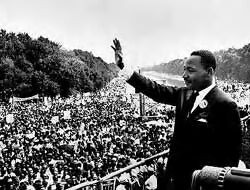
In remembrance of Dr. Martin Luther King, Jr., take some time to read his "I Have a Dream" speech. Also, there are quite a few pieces extolling the inherent conservatism (and Republicanism) of Dr. King. For instance, the Heritage Foundation held a lecture in 1993 concerning "The Conservative Virtues of Dr. Martin Luther King" and posted a piece about "Martin Luther King's Conservative Legacy" last year. Then there is a new piece by Francis Rice explaining "Why Martin Luther King Was Republican." Finally, Andrew Busch responds to some criticism he received on an earlier piece he had written on Dr. King and Conservatism.
I suppose it could appear as if I'm overly-politicizing here. Yet, my intention is to present the conservative viewpoint on Dr. King in hopes of showing that he did indeed speak to--and for--all Americans.
January 4, 2007
Phillipe and Jorge and the Conservatives, Part 2
Two more comments about the Phillipe and Jorge column from this week’s Providence Phoenix.
1. In commenting on conservatism in general, Phillipe and Jorge do express strong approval of market-based ideas…
When will we acknowledge that the free market system is not a panacea, but an excellent path with limits? Those shortcomings include health-care, education, mass transit, and environmental safety (although environmental sanity can become profitable in certain respects).Most conservatives would agree with the “excellent path with limits” sentiment (it’s generally libertarians who want to reduce limitations on capitalism to a bare minimum, despite the consequences).
But with regards to their specific counterexamples, how exactly do P&J reach the conclusion that education represents a market failure? A better case can be made for the opposite; higher education is run on a much more free-market basis than primary or secondary education. Does anyone seriously suggest that higher education would improve if we replaced the existing colleges and universities with the geographic monopoly system we use for K-12?
2. P&J also express less than approval, but definite sympathy, for a certain strain of conservative thought…
Many of the thoughts recently expressed about Gerald R. Ford’s presidency remind your superior correspondents of just how dangerously far to the right this country has veered. We’re not talking about the small government/fiscally prudent right that we can understand and respect, even if we frequently disagree with it. This is the totalitarian right of Bush and the neo-cons.Now, P&J’s characterization of limited government conservatism suggests that its opposite would entail support for big government and fiscal imprudence, correct? But that’s probably too simple…
…or is it? Here is Rhode Island’s newest United States Senator, Sheldon Whitehouse, as described in John Mulligan's article from today’s Projo…
On the Budget Committee, [Senator Sheldon Whitehouse] said he expects to see tension between the principle of “paying as you go” and the need for more spending on social programs. He took a wait and see stance on how to resolve that dilemma.So Senator Whitehouse has decided there is a need for more spending, even though it won’t fit within the current budget and he knows that the country is running deficits.
Isn't this an obvious case of wanting to combine fiscal imprudence with big government?
December 18, 2006
Children of "Murphy Browns" Paying the Price
Dan Quayle was taken to task many years ago for his "Murphy Brown" speech, in which he said:
Ultimately however, marriage is a moral issue that requires cultural consensus, and the use of social sanctions. Bearing babies irresponsibly is, simply, wrong. Failing to support children one has fathered is wrong. We must be unequivocal about this.As Quayle said, we social conservative are often pooh-poohed as moralizing busy-bodies. But there's a reason why we care about such things as promoting traditional families. No matter that we can all point to specific, acute examples of imperfect "traditional" families--and there is no "perfect" family--conservatives believe that the basis for a sound family is having a parent of either sex. Dan Quayle voiced those beliefs 14 years ago and since then, many people--both liberal and conservative--have conceded that Quayle was right:It doesn't help matters when prime time TV has Murphy Brown - a character who supposedly epitomizes today's intelligent, highly paid, professional woman - mocking the importance of fathers, by bearing a child alone, and calling it just another "lifestyle choice."
I know it is not fashionable to talk about moral values, but we need to do it. Even though our cultural leaders in Hollywood; network TV, the national newspapers routinely jeer at them, I think that most of us in , this room know that some things are good, and other things are wrong...It's time to talk again about family, hard work, integrity and personal responsibility. We cannot be embarrassed out of our belief that two parents, married to each other, are better in most cases for children than one.
Ten years later, most anyone involved in child development agrees that two parents are preferable. He beamed while pointing out a recent New York Times headline that read "The Controversial Truth: Two-Parent Families Are Better."Now, all of this expert opinion is fine and dandy, but a new set of voices is making themselves heard. The kids who have lived through the experience. Katrina Clark was one of those kids:In 1992, discussing illegitimacy was taboo. Most politicians had steered clear of the subject since 1965, when a then-obscure assistant secretary of labor by the name of Daniel Patrick Moynihan released a report linking poverty among black children to the prevalence of out-of-wedlock births. The report was denounced, and Moynihan was labeled a racist.
During the 1990s, the climate changed.
Due to a push by conservatives -- and some liberals -- and to a growing body of research, the subject of illegitimacy became legitimate.
Press coverage of the topic grew. And, as welfare reform emerged as a major policy priority in Congress, Democrats and Republicans agreed that the government needed to take concrete steps to reduce out-of-wedlock births. A 1993 Atlantic magazine cover story was titled "Dan Quayle Was Right." And later that year, Clinton declared, "I believe the country would be a lot better off if children were born to married couples."
"We finally removed the gag," says Robert Rector, a senior research fellow at the conservative Heritage Foundation. Rector has helped draft many family-formation provisions of Republican welfare reform bills in Congress. In the 1996 federal welfare reform law, Congress approved federal funding for sexual-abstinence programs and a bonus to states that reduce their ratios of out-of-wedlock births
When she was 32, my mother -- single, and worried that she might never marry and have a family -- allowed a doctor wearing rubber gloves to inject a syringe of sperm from an unknown man into her uterus so that she could have a baby. I am the result: a donor-conceived child.Continue reading "Children of "Murphy Browns" Paying the Price"And for a while, I was pretty angry about it.
I was angry at the idea that where donor conception is concerned, everyone focuses on the "parents" -- the adults who can make choices about their own lives. The recipient gets sympathy for wanting to have a child. The donor gets a guarantee of anonymity and absolution from any responsibility for the offspring of his "donation." As long as these adults are happy, then donor conception is a success, right?
Not so. The children born of these transactions are people, too. Those of us in the first documented generation of donor babies -- conceived in the late 1980s and early '90s, when sperm banks became more common and donor insemination began to flourish -- are coming of age, and we have something to say.
I'm here to tell you that emotionally, many of us are not keeping up. We didn't ask to be born into this situation, with its limitations and confusion. It's hypocritical of parents and medical professionals to assume that biological roots won't matter to the "products" of the cryobanks' service, when the longing for a biological relationship is what brings customers to the banks in the first place.
We offspring are recognizing the right that was stripped from us at birth -- the right to know who both our parents are. {Emphasis mine.}
December 6, 2006
Froma Harrop Gets Fiscal Conservatism Right
Without enough people noticing, liberals have mostly succeeded in redefining the term fiscal conservatism from its original meaning of "we must be extremely cautious about spending public funds" to something along the lines of "we must raise taxes high enough to pay for unlimited government spending". Froma Harrop deserves credit for not falling for the switch. In today's Projo, Ms. Harrop reminds people that a real fiscal conservatism begins with controlling the spending side of the equation...
Anger over Washington's spending orgy was especially strong around Denver, Philadelphia and other formerly Republican suburbs. They went blue in the last election, but their voters haven't signed on any dotted lines with the Democratic Party. If Republicans run Schwarzneggerian candidates who promise both stem-cell research and spending discipline, they could win those districts back.Last week, we saw Ms. Harrop embracing free market principles for half of a column; this week she is touting controlling spending as half of a program for Republican success. Can an entire column on the sensibility of free markets and smaller government be far behind!?
December 1, 2006
Appealing to the Parenting Class
Yuval Levin has written a piece that is getting some attention around the web. In it, he identifies what he calls the "parenting class" as being the new group to whom politicians will need to appeal:
The worry of middle- and lower-middle-class families arises from a genuine tension between the two things they most eagerly strive to do: build families and build wealth. That tension, and the disquiet it causes, is especially acute for parents. Indeed, Americans in the middle class and what used to be called the working class would be better conceived of today as the parenting class. Their concerns and aspirations are no longer focused on their standing in the workplace, as they were when our political vocabulary was coming of age, but on balancing the pursuits of family and prosperity.He has his own ideas as to how conservatives can address the concerns of this group. It's well worth the read.The members of the parenting class do not live on the edge of poverty. But they are anxious about their ability to meet their high aims, like affording a decent college for their children, getting the most from their health care dollar, and (in our increasingly older society) meeting the needs of their aging parents.
This is the anxiety of a successful capitalist economy filled with individuals who want to lead good lives. It is an anxiety produced by the kind of society conservatives seek to promote. It therefore calls for a response from the right, from those who share the aspiration to balance families and free markets...this aspirational anxiety should be the focus of a conservative domestic policy agenda, and the lens through which conservatives understand their challenge in the coming years.
Give Locally, it's More Effective
I posted a couple weeks ago about Arthur Brooks' findings that conservatives are more charitable than liberals. Last night, John Stossel (via Karen Woods) looked into whether or not we are "Cheap in America" and found that it was a myth. Working off of this, Woods draws a couple conclusions:
Bureaucracies, government ones and even big charity ones (national or international), just don’t do as good a job as private, local donors and charities; and (2) Americans are truly more generous than any other people on the planet--no matter their means. Rich and poor alike give generously...Woods continues on, but the short and sweet of it is that it's a more effective use of your money and time if you give to local charities.So one point is clear, defensible, and should motivate that worthy end-of-year giving: Charity does it better. Private donations are more substantial and yield more positive effects on the givers and receivers than any government effort. Volunteerism, direct involvement with those in need, is extremely powerful and productive.
There’s a second, equally critical point, interestingly not in the sites of the “more government money to fight world poverty” campaigns: effective giving. Give to organizations that transform people’s lives and communities.
November 30, 2006
Bleeding the (Blue)blood out of the New England GOP
First, the New York Times focuses the soft-filter lense on the now dwindling ranks of GOP moderates in New England and :
It was a species as endemic to New England as craggy seascapes and creamy clam chowder: the moderate Yankee Republican.Then they let the moderates explain that they're the real conservatives:Dignified in demeanor, independent in ideology and frequently blue in blood, they were politicians in the mold of Roosevelt and Rockefeller: socially tolerant, environmentally enthusiastic, people who liked government to keep its wallet close to its vest and its hands out of social issues like abortion and, in recent years, same-sex marriage...
Walter Peterson, a former New Hampshire governor and lifelong Republican, this year became the co-chairman of Republicans for John Lynch, the incumbent Democratic governor.I'm afraid that Mr. Peterson is the one "bastardizing" the meaning of the word. His apparent complaint that today's conservatives "dislike [people] from other religious viewpoints” stands out as the primary difference in his functional description of "what it means to be a Republican" and that of most contemporary conservatives. Together with the linkage of "live and let live" with "moderate" and "tolerant"--such a neat little trick--the comment reveals that the real axe he and other moderates have to grind is that they look down their blue-veined noses at people who actually have a religious viewpoint. In short, live and let live unless you're a right wing, religious nut. Very tolerant of them.“What the people want is basically to feel like the candidates of a political party are working for the people, not just following some niche issues,” Mr. Peterson said. “The old traditional Republican Party was conservative on small government, efficient government; believed in supporting people to give them a chance at life but not having people on the dole; wanted a balanced budget; and on social issues they were moderate, tolerant, live and let live. They didn’t dislike somebody from other religious viewpoints.”
He continued, “That was the old-fashioned conservative, but the word conservative today has been bastardized.”
As a practical, pragmatic and political matter, the various New England GOPs need to have a much bigger tent than their counterparts in, say, the south. Yet, they also have to recognize that the conservatives who are (seemingly) at the lower, rank-and-file level of the party are tired of being ignored. We're smart enough to realize that compromises have to be made. Maybe it's time that the bluebloods realize that, too.
Finally, the Times offers Senator Chafee as Exhibit "A":
I’m caught between the state party, which I’m very comfortable in, and the national party, which I’m not,” said Mr. Chafee, adding that he was considering the merits of “sticking it out and hoping the pendulum swings back.”Sheesh, Senator. "Sticking it out"? Could he be any more complacent? If he really wants to hold elective office again, he has to be proactive, seize the bull by the horns and start working now. A good place to start would be to put his time and money where his rhetoric is and help build the RI GOP. Don't start waiting. Start doing. (And remember to be tolerant and open-minded, K?)
November 24, 2006
Tradition
Jonah Goldberg writes about the importance of tradition:
Traditional rules of conduct emerge over time through a process of trial and error. To pick an extreme example, the Shakers banned sex and - surprise! - America is not overrun with Shakers today. Successful societies learn from their mistakes in time to make adjustments. Those adjustments become best practices that in turn become customs, and eventually, those customs become traditions. Those traditions are passed along from generation to generation, usually without us knowing all the reasons why they became traditions in the first place.Goldberg continues by using Madonna--"a pioneer of slattern chic"--and showing how her apparent post-motherhood epiphany towards a more traditional morality does little good for the generation who grew up taking her message of "slattern chic" to heart.Obviously, some of these traditions are outdated and silly. Others are vital. Even leftists and libertarians who display ritualized contempt for tradition understand that we do some things today because we've learned from the mistakes of our forefathers. If everything is open to revision, then slavery is still a viable option. Fundamentally, this isn't a point about political conservatism so much as civilization itself. Cultures have roots - a point we're learning the hard way in Iraq, where there is no liberal democratic tradition and we are trying to create one from scratch.
Goldberg isn't blaming Madonna personally for the decline and fall of Western Civilization. However, he is pointing out that she is but one of many who were pushed to the front of the cultural vanguard and--like it or not--served as an example of what it meant to be cool. Perhaps she wasn't the first, but Madonna's example provided the template for a generation of young female pop singers--Britney Spears and Christina Aguilera come to mind--who defined becoming "independent" as becoming slutty. Predictably, both Spears and Aguilera have toned it down as they've matured. They and we have learned--again--that hedonism doesn't equal happiness: it's just too bad that no one ever seems to listen the first time.
But I suppose that ignoring the moralizing of the older and wiser is human nature. Every generation goes through their "Rebel Without a Cause" phase, but most grow out of it--having kids and assuming adult responsibilities has a way of doing that. What doesn't seem to change is that there are always those who will take advantage of the innate rebelliousness of youth in an attempt to push cultural change. They are locked in a cycle of change for it's own sake--more libertine anarchy than liberal progressivism it often seems--whether it's ultimately better for society or not.
Conservatives don't believe that change is bad, but we do believe that it should be undertaken gradually. Most importantly, conservatives believe that if the results of "change" aren't looking so hot, the solution isn't to press for further change in the vain hope that we'll somehow get it right this time, really, we promise. Instead, the smartest option is to go back to what worked before. Sometimes Mom and Dad and Grandma and Grandpa really do know what they're talking about, after all.
November 20, 2006
Conservatives Back Ideology with Cash
{N.B. Cross-posted at Spinning Clio--MAC}
Historian Ralph Luker points to a new book by Syracuse University professor Arthur C. Brooks called Who Really Cares: The Surprising Truth About Compassionate Conservatism. According to this story:
When it comes to helping the needy, Brooks writes: "For too long, liberals have been claiming they are the most virtuous members of American society. Although they usually give less to charity, they have nevertheless lambasted conservatives for their callousness in the face of social injustice."Brooks seems very reluctant to embrace his findings. I would bet it's because he isn't too keen on the idea of the political hammer it could become for social (religious) conservatives. I also think he'll get his wish of having other academics putting his findings through rigorous analysis! Finally, Ralph poses a good question: "do people on the left actually say: 'I gave at the IRS.'?"...The book's basic findings are that conservatives who practice religion, live in traditional nuclear families and reject the notion that the government should engage in income redistribution are the most generous Americans, by any measure.
Conversely, secular liberals who believe fervently in government entitlement programs give far less to charity. They want everyone's tax dollars to support charitable causes and are reluctant to write checks to those causes, even when governments don't provide them with enough money...
"These are not the sort of conclusions I ever thought I would reach when I started looking at charitable giving in graduate school, 10 years ago," he writes in the introduction. "I have to admit I probably would have hated what I have to say in this book."
Still, he says it forcefully, pointing out that liberals give less than conservatives in every way imaginable, including volunteer hours and donated blood.
...Harvey Mansfield, professor of government at Harvard University and 2004 recipient of the National Humanities Medal, does not know Brooks personally but has read the book.
"His main finding is quite startling, that the people who talk the most about caring actually fork over the least," he said. "But beyond this finding I thought his analysis was extremely good, especially for an economist. He thinks very well about the reason for this and reflects about politics and morals in a way most economists do their best to avoid."
November 10, 2006
Rebuilding the RI GOP Part I: Forming a Political Philosophy
I think an important distinction needs to be made in this discussion about re-invigorating the Rhode Island Republican Party by "defining conservatism.' The attempt to excise the social aspects from the holistic definition of conservatism--essentially smaller government and traditional morality--indicates that it's not conservatism that is being defined so much as Rhode Island Republicanism. The strong on defense, small-government, low taxes, but mum-on-morality positioning sounds similar to Giuliani-style Republicanism to me. This is probably a pragmatic approach for a Northeastern state's Republican party to take, but let's not treat social conservatism as some sort of pariah.
Social conservatives realize that they can only be a part of the coalition that makes up the RIGOP. However, they also deserve to be treated with respect. Statements by RIGOP "moderates"--as when Sen. Chafee called them "radical right wingers"--don't help matters. Justin has explained--much more eloquently than I could--that socially conservative beliefs are sincerely held and are "above" politics. Nonetheless, in the political sphere, moderates and libertarians within the RI GOP can expect social conservatives to compromise to achieve certain political goals. But "Compromise Avenue" isn't a one-way street.
I think that Justin has correctly delineated the three groups that will make up the future RI GOP: conservatives, libertarians and moderates. Now, I have a pretty good idea where the average conservative is going to stand on most issues (small government, low taxes, traditional morality). I also think I have a good handle on what the average libertarian believes (small government, low taxes and "stay out of my bedroom"). I can't say the same about moderates. For now, I'll take my cue from Senator Chafee, a self-described moderate Republican, who stated yesterday that a he "care[d] about fiscal responsibility, environmental stewardship, aversion to foreign entanglements, personal liberties. This is the Republican Party that I represent."
It's obvious that there is some common ground to be found and I think that we can agree with the fiscal/small government policy that Jon Scott outlined:
1. I believe in low taxesI agree that these can form the central pillar on which the RI GOP should try to rebuild. Yet, these are only goals: there is still disagreement on how to achieve them. For instance, I believe that most conservatives and libertarians would prioritize tax cuts, while most moderates prefer budget balancing before tax-cutting. I don't think it's a major stumbling block, though, and a coherent fiscal policy could be established that would be germane to future RIGOP candidates for both state and national offices.
2. I believe in small government
3. I believe in a strong national defense (to include secure borders).
Foreign policy questions are usually reserved for candidates for national offices. (This year was different: until now, I hadn't realized that the Governor had so much to do with the Iraq War). Standing for a strong national defense seems to be a no-brainer, but there is some difference of opinion just amongst conservatives as to what that means. Stay at home more--�essentially a defensive posture--or project power (ie; get them over there before they come here)? And what to make of the moderate position staked out by Senator Chafee that we should have an "aversion to foreign entanglements�" It sounds very Founding Father-ish, but I think that even many moderates would agree that this is not a practical approach in today's troubling world.
I don't think that there is much disagreement over the concept of strengthening our borders, but there are differing viewpoints over how to address the fundamental reason for why we need to do so, namely illegal immigration.
Senator Chafee mentioned environmental stewardship and this is an area in which the GOP, both nationally and at the state level, has allowed their political opponents to negatively define them. In our jam-packed state, fighting for open space, keeping the bay clean by improving city sewage systems, etc. are worthwhile and popular causes to embrace. Addressing environmental concerns go directly to quality of life issues and even have an economic development component. A sound environmental policy can explain how the RI GOP is just as "green" as most Rhode Islanders. It's our water and air, too.
These are all part of an overriding philosophy of government that the RI GOP should then tailor to our specific political environment. That doesn't mean sacrificing principles, but it does mean recognizing which issues should be emphasized. And the one issue that overrides all other is the business-as-usual approach in State Government.
Corruption is part of the problem, but lack of accountability and legislating behind closed doors (ie; open-government issues) are also viable areas for the RI GOP to address. It hasn't been for a lack of trying, though. Rhode Islanders seem to recognize that something is wrong with their state government, but they continue to enable the same Democrat leaders who perpetuate the problem by re-electing their own particular Democrat to the legislature. As it has been observed before, most Rhode Islanders simply think "my guy is OK" and it's the "other guys" who are the bad actors. Changing that attitude is the job that the RI GOP needs to undertake before it will ever make meaningful political progress in this state.
Trying to determine what it means to be a Rhode Island Republican is a worthwhile exercise. But unless the RI GOP can find attractive candidates to espouse these viable alternatives, the policy prescriptions concocted by us armchair philosophers and policy-wonks will be all for naught. Finding a coherent RIGOP philosophy is but one part of the problem. And it's the easy part. The RIGOP must realize that a party built for longevity is built from the bottom up, not the top down. The tough part will be finding and funding the right folks to run against the Democrat monopoly across the entire political spectrum. But more on that later.
November 9, 2006
Let's Get One Thing Straight: Core Beliefs
An emergent strain of thought that ought to be quashed appears in the comments to my most recent post. Writes Greg:
Maybe it's time for Republicans to return to their roots? Let's go back to the start, decide what we believe in, and build a whole new platform.Do we really need to be anti-gay? How does that really help us? ...
Are we really on the right side of the cloning debate? Are we saving babies or just stifling technological growth?
How can we properly frame the debate on social programs so that we can all come to an understanding and a middle ground?
Most of these things aren't hard if we put politics aside and start talking to each other like people that want to SOLVE problems.
Writes congressional candidate Jon Scott:
...we need to put aside our differences and come to some sort of agreement on flashpoint issues that divide the Party and pull us away from forward progress. That was one of the central tenets of my campaign.In his comments, Hayden wrote: “The party needs to recruit some moderate, smart, energetic young people to make them relevant” and I couldn’t agree more as long as those recruits agree that taxes should be low, government should be small, and the US should have a strong national defense.
Some on this board will bristle at that sentiment because their definition of conservative is somewhat different. The problem is that those three principles are our core beliefs as a Party and we have abandoned them for social conservatism. It is fine to be socially conservative but we cannot be so at the expense of our core beliefs and that is what has happened in Washington.
The place to begin is with Greg's suggestion that we can "SOLVE problems" if only we'd put politics aside. The essential and unmitigable reality is that he has the democratic process exactly backwards. It is politics that enables us to resolve more fundamental differences — to "solve problems" as a civic grouping without devolving into violence. In other words, if we put politics aside, we aren't digging down to shared core beliefs, but rather, we are exposing our core beliefs as incompatible.
For example: If you want me to buy that the greater good is served by backing down the path toward evil (just a little, just this once, promise) to grant medical scientists the right to federal funds in order to clone and kill embryos, I say no sale. If you want me to compromise the crucial institution of marriage to gain the votes of people too spineless or indifferent to stand up to emotional blackmail, I say no deal. If you want me to accept that mothers can "initiate the demise" of their children as long as an inch of the newly formed bodies have not yet tasted air, I say, so help me God, no.
These are "core beliefs." These are principles. You put politics aside, and this is what you get.
Low taxes and small government are preferences that must serve more substantive beliefs. For some — to give the liberal cliché its due — those more substantive beliefs are greed and selfishness. For others, they are liberty and independence. For still others, they are means toward the development of moral maturity. The political system is what enables us to work together, despite fundamental differences, to implement our shared governmental preferences. With those preferences in place, we act in other arenas (most notably, the social sphere) in order to turn them toward our ends.
I wouldn't be surprised if a significant portion of modern lowercase-L libertarians would allow all that I've written thus far — whether out of agreement or for the sake of argument. The friction appears when we acknowledge — or put forward for acknowledgment — the fact that libertarianism is negated not by social conservatives, but by liberals. What do we do when, as is currently the case, social conservatives must put aside their preferences for the sake of defending their core beliefs against liberals? How ought libertarians and the representatives of our shared Republican coalition respond when social conservatives feel it necessary — as with abortion, embryonic stem-cell research, and same-sex marriage — to assert their core beliefs beyond the social sphere, into the civic sphere?
What I would advise is sufficiently obvious that I won't be so forward as to make you read something that goes without saying. I will express, however, my analytical understanding that a political party will not win majority support based on civic preferences alone. Of itself, the statement "you should support small government" lacks a "because."
Most definitely, Republicans must decide what they believe in. Personally, I think social conservatives provide a supremely rich supply of compelling "becauses," if only libertarians and "moderates" would trace conservatives' reasoning back from our points of agreement. If the first two groups come to agree that the third group is correct on this or that issue, then we will jointly be able to articulate our platform in broader terms. If disagreement remains, then we will jointly be able to articulate why inclusion of arguable parts of our platform allows broader advancement.
But if Republicans' conclusion is that it is not politically expedient to support that which I actually do believe, on higher planes than politics and government mechanisms, then they cannot count me among their number.
November 8, 2006
"[T]he total failure of big government Republicanism"
I may have intimated it previously, but let me be clear: yesterday was a failure for Republicans, not for Conservatives. But Conservative Oklahoma Senator Tom Coburn adds an important qualifier (via Instapundit):
Although this election represents a short-term setback for Republicans, it could be an important turning point for the Republican Party and, more importantly, the country. Every incumbent was reminded that the American people, not party establishments, hold the reins of government... Many factors contributed to these election results. The American people obviously are concerned about the conduct of the war in Iraq... The overriding theme of this election, however, is that voters are more interested in changing the culture in Washington than changing course in Washington, D.C. This election was not a rejection of conservative principles per se, but a rejection of corrupt, complacent and incompetent government....Among the Republicans who lost their re-election bids a surprising number were political moderates who advocated a more activist government. Several Republican members of the appropriations committees, which have been on a spending binge, also were not re-elected. On the other hand, the two Republican senators who pulled off the most impressive victories were unapologetic conservatives, Jon Kyl (R-AZ) and John Ensign (R-NV). It is also notable that the Democrats who won or who ran competitive races sounded more like Ronald Reagan than Lyndon Johnson.
This election does not show that voters have abandoned their belief in limited government; it shows that the Republican Party has abandoned them. In fact, these results represent the total failure of big government Republicanism.
Continue reading ""[T]he total failure of big government Republicanism""
November 6, 2006
Memo to Conservatives: Next Time You Have to Share a Ride With a Liberal, Volunteer to Use Your Own Car
David Jaffe of Kmareka provides a rare moment of insight into the eternal debate between liberals and consevatives: An America without conservatism is like a SUV without brakes...
In the sedan (or SUV) that is America, liberals are the gas pedal, and conservatives are the brakes. One group seeks forward progress, while the other seeks to halt or even reverse direction.Except that Mr. Jaffe then goes on to argue that brakes (i.e. conservatism) are inherently bad things…
The irony of Bush’s words is that, rather than masking, they expose the inherent intolerance and meanness of the conservative cause.Then, after butchering the analogy about as thoroughly as is possible, he has the audacity to talk about conservatives being the stupid ones! At least most conservatives I know prefer cars with brakes over cars without them.
(NOTE: The spelling of "brakes" has been corrected from "breaks" in the original version of this post)
October 12, 2006
Theocrats, Moral Relativism & The Myth of Religious Tolerance, Part VI: The Alleged Theocracy Threat - Valid or a Tool to Limit the Public Debate?
The previous posting in this series ended with these words:
A discussion about the meaning of "reason" becomes important as reason offers a tool to enable a pluralistic society to have substantive discourse about what belongs in our public square.
A previous posting entitled Respectful Competition: A Basic Requirement for a Healthy Democracy clarified the meaning of a vibrant discourse in our society:
A healthy democracy does not require blurring political differences. But it must find a way to express those differences forcefully without anathematizing people who hold different views.
As a first step toward discussing the meaning and significance of reason, this posting asks whether the current propensity for some to use the theocracy label in our public debate amounts to anathematizing religious people in an attempt to stifle one side of the debate in our public square.
Jonah Goldberg made these comments this week in Liberal Paranoia:
...Ross Douthat surveys the scare literature demonizing "Christianists," "theocons" and "Christocrats" - people who were under the impression that they were actually law-abiding, tax-paying, patriotic American citizens who happen to subscribe to the Christian faith. Little did they know they're actually all about rounding up infidels and torching the Constitution...
Ross Douhat is the associate editor at the Atlantic Monthly and he has written a book review entitled Theocracy, Theocracy, Theocracy which includes these arguments:
This is a paranoid moment in American politics...Perhaps the strangest of these strange stories, though, is the notion that twenty-first-century America is slouching toward theocracy. This is an old paranoia...
To understand what, precisely, the anti-theocrats think has gone so wrong, it’s necessary to understand what they mean by the term theocracy. This is no easy task...the clout of institutional religion is at low ebb in American politics...
...as National Review’s Ramesh Ponnuru put it, in an essay written amid the "values voter" hysteria of 2004:
It may be instructive to think about the wish list of Christian-conservative organizations involved in politics...Nearly every one of these policies—and all of the most conservative ones—would merely turn the clock back to the late 1950s. That may be a very bad idea, but the America of the 1950s was not a theocracy....But if you’re committed to the notion that religious conservatives represent an existential threat to democratic government, you need a broader definition of theocracy to convey your sense of impending doom...
All you need are politicians who invoke religion and apply Christian principles to public policy.
If that’s all it takes to make a theocracy, then these writers are correct: Contemporary America is run by theocrats. Of course, by that measure, so was the America of every previous era. The United States has always been at once a secular republic and a religious nation, reflexively libertarian and fiercely pious, and this tension has been working itself out in our politics for more than two hundred years...But there’s no way to give an account of American history without grappling with this tension...
Yet this is a history that the anti-theocrats seem determined to reject...
...this strict-separationist interpretation of world history frees the anti-theocrats from the messy business of actually arguing with their opponents...
A Christian is...allowed to mix religion and politics in support of sweeping social reforms— but only if those reforms are safely identified with the political Left, and with the interests of the Democratic party...
Sometimes it’s argued that what sets the contemporary Christian Right apart from previous iterations of politically active religion isn't its Christianity per se but its unwillingness to couch argument in terms that nonbelievers can accept—to use "public reason," in the Rawlsian phrase, to make a political case that doesn’t rely on Bible-thumping. As a prudential matter, the case for public reason makes a great deal of sense. But one searches American history in vain—from abolitionist polemics down to Martin Luther King’s Scripture-saturated speeches—for any evidence of this supposedly ironclad rule being rigorously applied, or applied at all.
And besides, religious conservatives do, frequently and loudly, make arguments for their positions on non-theological grounds...
What all these observers point out, and what the anti-theocrats ignore, is that the religious polarization of American politics runs in both directions. The Republican party has become more religious because the Democrats became self-consciously secular...
So the rise of the Religious Right, and the growing "religion gap"...aren’t new things in American history but a reaction to a new thing: to an old political party newly dependent on a bloc of voters who reject the role that religion has traditionally played in American political life. The hysteria over theocracy, in turn, represents an attempt to rewrite the history of the United States to suit these voters' prejudices, by setting a year zero somewhere around 1970 and casting everything that’s happened since as a battle between progress and atavism, reason and fundamentalism, the Enlightenment and the medieval dark.
The tragedy is that so many religious people have gone along with this revisionism...
There is no single Christian politics, and no movement can claim to have arrived at the perfect marriage of religious faith and political action. Christianity is too otherworldly for that, and the world too fallen. But this doesn't free believers from the obligation to strive in political affairs, as they strive in all things, to do what God would have them do. And the moments when God’s will is inscrutable, or glimpsed only through a glass, darkly, are the moments when good-faith arguments between believers ought to bear the greatest fruit...
In today's America, these arguments are constantly taking place...But they are increasingly drowned out by cries of "theocracy, theocracy, theocracy" and by a zeal, among ostensibly religious intellectuals, to read their fellow believers out of public life and sell their birthright for the blessing of the New York Times.
More excerpts from the article are contained in the Extended Entry below.
In another posting, Rediscovering Civility and Purpose in America's Public Discourse, a quote from T.S. Eliot defines the connection to and importance of religion in our public discussions:
As political philosophy derives its sanctions from ethics, and ethics from the truth of religion, it is only by returning to the eternal source of truth that we can hope for any social organization which will not, to its ultimate destruction, ignore some essential aspect of reality. The term "democracy"...does not contain enough positive content to stand alone against the forces that you dislike - it can easily be transformed by them. If you will not have God, you will pay your respects to Hitler and Stalin.
Reason, therefore, offers us - as members of a pluralistic society - the opportunity to discuss the connections between political philosophy, ethics and religion as we seek to better understand our American and Western Civilization heritages and apply their teachings to our habits as citizens of this great country.
Earlier postings in this series can be found here:
Part I: The Difference Between Religious Freedom and Religious Tolerance
Part II: Are We Hostile Toward or Encouraging Religious Belief?
Part III: Consequences of Excluding Religion from the Public Square
Part IV: Moral Recovery via Rediscovering the Meaning of Words
Part V: Recovering the Meaning and Implications of Religious Freedom
October 4, 2006
Theocrats, Moral Relativism & the Myth of Religious Tolerance, Part V: Recovering the Meaning and Implications of Religious Freedom
The previous posting in this series noted how moral relativism leads to words losing their meaning, thereby impoverishing the public discourse and making genuine consensus on important issues difficult, if not impossible. It also suggested that moral recovery was possible by calling for it with direct language.
As a first step toward eliminating that lack of meaning, the same posting identified four crucial questions and addressed the first question about whether moral truths exist and belong in the public square.
The second question noted that there is a lack of agreement on the meaning of religious freedom and reason.
It is impossible to have a reasoned public discourse over the proper role of religion in the public square if we do not share a common understanding about the meaning of religious freedom. The impact of no common ground means the public discourse often descends into an ahistorical mumbo-jumbo from secular left fundamentalists warning about the alleged threat from theocrats. The left's actions have the effect of stripping the public square of religious practices or habits as attempts are made to block religious or religion-inspired people and practices from playing any role whatsoever in the public square. These behaviors have created a backlash and new assertiveness from the religious right in recent times.
The purpose of this posting is to offer a broad definition of religious freedom, which can be found in the Extended Entry below, and reflect on some of its implications for all of us.
After reading the thoughts below on the meaning of religious freedom, several striking thoughts arise from the document:
First, it provides greater insight into the higher purpose that is at the heart of why religious freedom is so important: With the personal responsibility and free will that arise from the dignity of man is the moral obligation and sense of duty to pursue truth and abide by it as it becomes known. That provides a challenge to each of us: Do we accept as our personal duty, the obligation to pursue truth and abide by it as we achieve new understandings? (Note: Commitment to that course of action does not require a particular religious belief. It does require a dedication to being men and women of virtue.)
Second, there are profound implications that follow once that pursuit is engaged: Frequently our public discourse is an unpleasant mixture of some people questioning whether there is any truth at all while others are presenting beliefs as if they have already reached truth in its final form. It is these people - called fundamentalists of the left and right, respectively - who often dominate the public debate to our society's detriment. In contrast, the alternative view expressed below suggests the practice of religious freedom is a process with milestones achieved along the way - but not an end. That concept is completely ignored by secular left fundamentalists who prefer to rely on the use of scare tactics that equate any religious belief with religious fanaticism in order to achieve a near ban on religious expression in the public square. Yet an ongoing process also implies a lack of final closure in understanding truth, which should result in a greater spirit of humility accompanying the ongoing pursuit by religious people.
These conclusions lead us back to another point from the previous posting: The dominant struggle in our society today is over the meaning of freedom, in this case understanding the implications of religious freedom in our society. Once we have this freedom, how do we pursue truth and talk constructively to each other about it given that we live in a pluralistic society made up of people with differing religious beliefs?
Let's assume most people share a common goal of living together successfully and with meaning in a civil society. For that to happen, we have to be able to talk to each other, to have a substantive discourse. But it cannot be based upon the requirements that the existence of moral truths be denied, that religious beliefs be excluded from the public square, or that everyone be required to hold similar religious beliefs.
George Weigel put this issue in perspective when he wrote about Pope John Paul II:
Building the free society certainly involves getting the institutions right; beyond that, however, freedom's future depends on men and women of virtue, capable of knowing, and choosing, the genuinely good.That is why John Paul relentlessly preached genuine tolerance: not the tolerance of indifference, as if differences over the good didn't matter, but the real tolerance of differences engaged, explored, and debated within the bond of a profound respect for the humanity of the other...
John Paul II was teaching a crucial lesson about the future of freedom: Universal empathy comes through, not around, particular convictions...
It is in this context that a discussion about the meaning of "reason" becomes important as reason offers a tool to enable a pluralistic society to have substantive discourse about what belongs in our public square. That discussion of reason shall be the topic of the next posting in this series.
Earlier postings in this series can be found here:
Part I: The Difference Between Religious Freedom and Religious Tolerance
Part II: Are We Hostile Toward or Encouraging Religious Belief?
Part III: Consequences of Excluding Religion from the Public Square
Part IV: Moral Recovery via Rediscovering the Meaning of Words
September 24, 2006
Theocrats, Moral Relativism & the Myth of Religious Tolerance, Part IV: Moral Recovery via Rediscovering the Meaning of Words
The comments sections of
Part I: The Difference Between Religious Freedom and Religious Tolerance
Part II: Are We Hostile Toward or Encouraging Religious Belief?
Part III: Consequences of Excluding Religion from the Public Square
of this Theocrats, Moral Relativism & the Myth of Religious Tolerance series, plus Justin's Favoring the Non-Participatory posting, offer up many statements which present a largely incoherent vision for how our society will develop, share, and sustain a set of core values necessary for it to exist in a cohesive manner.
Distilled to their essence, the comments highlighted four major issues:
1. Do moral truths (discovered via either faith or reason) exist and belong in the public square - and how should they affect our public life?2. How do we define reason and religious freedom?
3. What does religious freedom - as defined in the 1st Amendment - mean and how has jurisprudence and societal practices changed our interpretation of religious freedom over the years?
4. What role and importance did the Founding Fathers assign to religion in our society and why?
This posting focuses on the first part of question #1 and subsequent postings in this series will address the remaining issues.
To provide a context before tackling question #1, here are some of the statements from the comments sections:
At no time do I want to interfere with your right or anyone else's right to practice [religion] as you choose...It is impossible for the state to speak on religion without giving the impression that one has been preferred. As you increase "liberty" for one, you decrease it for others. The Founders wanted balance for all...The Government does not have the right to allow one advocacy over another even if we can't figure out what the other is...We can never figure out what "all" advocacy is...Since the "all" universe cannot be determined, the only way to keep balance is the "no" universe...The Government cannot allow the advocacy of religion on public grounds because it limits the freedoms of others to express their religious views when they are not advocated. The non-advocated position has been de-established by the Government�How do you know with certainty that every religion has been asked to participate? You assume so because as a mainstream sect, you were. However, the guy who worships Kelly Clarkson as a demi-goddess was not...he was left out, his religion is valid, and therefore demeaned...Since everyone will not choose to participate...you cannot allow some belief system to obtain an advantage because they choose to participate. Therefore, no one gets to participate.
There are two striking features to these comments: First, they avoid any discussion of substantive issues such as freedom, justice, rights, and moral common sense. Instead, they devolve into ideas emphasizing how our government should restrict the freedom of citizens to express their beliefs in any public forum.
And when we equate the suggested religion of Kelly-Clarkson-as-a-demi-goddess with either the Jewish or Christian tradition, have not we just endorsed an unserious moral relativism which denies there are any moral truths discoverable by faith or reason? If there are no moral truths, have not then words like freedom and justice lost all meaning?
Reflections on Pope John Paul II's role in the demise of Communism - as highlighted in an article in the extended entry below - offers some guidance about where to begin:
Language, then, and the restoration of its relationship with reality were critical to the Communist collapse. This was no small feat since, for many in the West, words had lost their meaning. A recovery of meaning was essential before a real challenge could be presented...You cannot use "evil" as an adjective until you know it as a noun...the new struggle [today] is over the meaning of freedom...In Veritatis Splendor, the pope warned of "the risk of an alliance between democracy and ethical relativism, which would remove any sure moral reference point from political and social life, and on a deeper level make the acknowledgment of truth impossible." If truth is impossible, so are the "self-evident truths" upon which free government depends. Then, one can understand everything in terms of power and its manipulation...[John Paul II] raised the hope that moral recovery is possible by calling for it.
That loss of meaning means we - at least implicitly - deny the existence of moral truths and, by default, fail to address the societal consequences of the moral relativism now dominating the public square, as described by these words from Pope Benedict XVI:
No great, inspiring culture of the future can be built upon the moral principle of relativism. For at its bottom such a culture holds that nothing is better than anything else, and that all things are in themselves equally meaningless...The culture of relativism invites its own destruction...by its own internal incoherence...
Yet, acknowledging the existence of moral truths is part of both our American and Western Civilization heritages. As Lee Harris writes, our heritage is a rich one:
Christian Europe, after all, was a fusion of diverse elements: the Hebrew tradition, the experience of the early Christian community, the Roman genius for law, order, and hierarchy, the Germanic barbarians' love of freedom, among many others. In this cultural amalgam, Greek philosophy certain played a role. St. Clement argued that Greek philosophy had been given by God to mankind as a second source of truth, comparable to the Hebrew revelation. Benedict argues that the "inner rapprochement between Biblical faith and Greek philosophical inquiry was an event of decisive importance not only from the standpoint of the history of religions, but also from that of world history."
Our heritage not only acknowledges the existence of moral truths but argues that these truths can be discovered by either faith or reason - thereby confirming what has been true for centuries: This public conversation about the role of moral truths in the public square does not require everyone to hold identical religious beliefs. It does require us to be morally serious and to firmly place moral relativism in the dustbin of history.
Moral truths belong in the public square to avoid the societal consequences of moral relativism. Only with a belief in moral truths can words become meaningful again and enable us to begin a public conversation about principles such as freedom and - from there - to discuss proper ways to introduce their meaning back into the public square.
As a first step toward the recovery of meaning, let's next ask ourselves whether we truly understand the meaning of freedom - including religious freedom - and reason as we explore how best to live our American experiment in ordered liberty.
Continue reading "Theocrats, Moral Relativism & the Myth of Religious Tolerance, Part IV: Moral Recovery via Rediscovering the Meaning of Words"September 14, 2006
Theocrats, Moral Relativism & the Myth of Religious Tolerance, Part III: Consequences of Excluding Religion From the Public Square
Part I in this series discussed how there is an important distinction between "tolerance" and "freedom." Justin, in a subsequent email to me, described it this way:
Tolerance asserts authority; freedom implies autonomy, perhaps even precedence.
Part II in this series noted how both the role of religion in the public square of our society has been steadily marginalized and Americans largely do not know their history well enough to understand how much has changed just in our lifetime.
This Part III posting describes some of the consequences when religion is excluded from the public square in America.
Richard John Neuhaus wrote these words in 1984:
Politics and religion are different enterprises...But they are constantly coupling and getting quite mixed up with one another. There is nothing new about this. What is relatively new is the naked public square. The naked public square is the result of political doctrine and practice that would exclude religion and religiously grounded values from the conduct of public business...When religion in any traditional or recognizable form is excluded from the public square, it does not mean that the public square is in fact naked...
The truly naked public square is at best a transitional phenomenon. It is a vacuum begging to be filled. When the democratically affirmed institutions that generate and transmit values are excluded, the vacuum will be filled by the agent left in control of the public square, the state. In this manner, a perverse notion of the disestablishment of religion leads to the establishment of the state as church...
Our problems, then, stem in large part from the philosophical and legal effort to isolate and exclude the religious dimension of culture...only the state can..."lay claim to compulsive authority."...of all the institutions in societies, only religion can invoke against the state a transcendent authority and have its invocation seconded by "the people" to whom a democratic state is presumably accountable. For the state to be secured from such challenge, religion must be redefined as a private, emphatically not public, phenomenon. In addition, because truly value-less existence is impossible for persons or societies, the state must displace religion as the generator and bearer of values...
[T]he notion of the secular state can become the prelude to totalitarianism. That is, once religion is reduced to nothing more than privatized conscience, the public square has only two actors in it - the state and the individual. Religion as a mediating structure...is no longer available as a countervailing force to the ambitions of the state...
If law and polity are divorced from moral judgment...all things are permitted and...all things will be done...When in our public life no legal prohibition can be articulated with the force of transcendent authority, then there are no rules rooted in ultimacies that can protect the poor, the powerless and the marginal...
Politics is an inescapably moral enterprise. Those who participate in it are...moral actors. The word "moral" here...means only that the questions engaged [in politics] are questions that have to do with what is right or wrong, good or evil. Whatever moral dignity politics may possess depends upon its being a process of contention and compromise among moral actors, not simply a process of accomodation among individuals in pursuit of their interests. The conflict in American public life today, then, is not a conflict between morality and secularism. It is a conflict of moralities in which one moral system calls itself secular and insists that the other do likewise as the price of admission to the public arena. That insistence is in fact a demand that the other side capitulate...
Therein lies the great debate and the great struggle in America and throughout Western Civilization.
Do we believe in reason and the ability to distinguish between right and wrong?Do we believe in and teach the uniqueness of our Western Civilization tradition?
Has the relativism of multiculturalism dumbed it all down to where there are no standards of excellence and no truth discoverable by some combination of reason and faith?
Or, as William Voegli said:
Justice, rights, moral common sense - either these are things we can have intelligent conversations about or they aren't...
September 10, 2006
Theocrats, Moral Relativism & the Myth of Religious Tolerance, Part II: Are We Hostile Toward or Encouraging Religious Belief?
In a comment to the Part I posting, Joe Mahn writes:
...From my simple perspective and I think in the context of the actual events of the time religious freedom meant that no State in the Union under the Constitution could force, by law, any citizen to participate in, confess, or otherwise practice any particular State sanctioned or preferred religion. It would also forbid the creation of a State religion with attendant threats of incarceration or imposition of any punishment upon said citizens.The objective of these freedoms was to allow citizens to believe what they wanted with no interference from the State as well as guarantee that States not mandate one religion, or sect within a religion, over another.
From that point going forward governments across the land, from municipal to federal, acknowledged God, His laws, and many other events and rituals of the Christian faith with little or no dissent. That all changed in the late 1940's when the US Supreme Court violated the Constitution by interfering in the rights of the sovereign states and prohibiting the free exercise of religion.
It's been all downhill from there....
Let's give a specific example of how much things have changed in our understanding of the relationship between the State and religion over the last 50 years: Supreme Court Justice William O. Douglas was know as a very liberal justice of the court. Yet, in Zorach v. Clauson, a 1952 case, he wrote for the Court with these words:
New York City has a program which permits its public schools to release students during the school day so that they may leave the school buildings and school grounds and go to religious centers for religious instruction or devotional exercises. A student is released on written request of his parents. Those not released stay in the classrooms. The churches make weekly reports to the schools, sending a list of children who have been released from public school but who have not reported for religious instruction...It takes obtuse reasoning to inject any issue of the "free exercise" of religion into the present case. No one is forced to go to the religious classroom, and no religious exercise or instruction is brought to the classrooms of the public schools. A student need not take religious instruction. He is left to his own desires as to the manner or time of his religious devotions, if any...
Moreover...we do not see how New York by this type of "released time" program has made a law respecting an establishment of religion within the meaning of the First Amendment...
And so far as interference with the "free exercise" of religion and an "establishment" of religion are concerned, the separation must be complete and unequivocal. The First Amendment within the scope of its coverage permits no exception; the prohibition is absolute. The First Amendment, however, does not say that, in every and all respects there shall be a separation of Church and State. Rather, it studiously defines the manner, the specific ways, in which there shall be no concert or union or dependency one on the other. That is the common sense of the matter. Otherwise the state and religion would be aliens to each other -- hostile, suspicious, and even unfriendly. Churches could not be required to pay even property taxes. Municipalities would not be permitted to render police or fire protection to religious groups. Policemen who helped parishioners into their places of worship would violate the Constitution. Prayers in our legislative halls; the appeals to the Almighty in the messages of the Chief Executive; the proclamations making Thanksgiving Day a holiday; "so help me God" in our courtroom oaths -- these and all other references to the Almighty that run through our laws, our public rituals, our ceremonies would be flouting the First Amendment. A fastidious atheist or agnostic could even object to the supplication with which the Court opens each session: "God save the United States and this Honorable Court."
We would have to press the concept of separation of Church and State to these extremes to condemn the present law on constitutional grounds. The nullification of this law would have wide and profound effects. A Catholic student applies to his teacher for permission to leave the school during hours on a Holy Day of Obligation to attend a mass. A Jewish student asks his teacher for permission to be excused for Yom Kippur. A Protestant wants the afternoon off for a family baptismal ceremony. In each case, the teacher requires parental consent in writing. In each case, the teacher, in order to make sure the student is not a truant, goes further and requires a report from the priest, the rabbi, or the minister. The teacher, in other words, cooperates in a religious program to the extent of making it possible for her students to participate in it. Whether she does it occasionally for a few students, regularly for one, or pursuant to a systematized program designed to further the religious needs of all the students does not alter the character of the act.
We are a religious people whose institutions presuppose a Supreme Being. We guarantee the freedom to worship as one chooses. We make room for as wide a variety of beliefs and creeds as the spiritual needs of man deem necessary. We sponsor an attitude on the part of government that shows no partiality to any one group and that lets each flourish according to the zeal of its adherents and the appeal of its dogma. When the state encourages religious instruction or cooperates with religious authorities by adjusting the schedule of public events to sectarian needs, it follows the best of our traditions. For it then respects the religious nature of our people and accommodates the public service to their spiritual needs. To hold that it may not would be to find in the Constitution a requirement that the government show a callous indifference to religious groups. That would be preferring those who believe in no religion over those who do believe. Government may not finance religious groups nor undertake religious instruction nor blend secular and sectarian education nor use secular institutions to force one or some religion on any person. But we find no constitutional requirement which makes it necessary for government to be hostile to religion and to throw its weight against efforts to widen the effective scope of religious influence...
But we cannot expand it to cover the present released time program unless separation of Church and State means that public institutions can make no adjustments of their schedules to accommodate the religious needs of the people. We cannot read into the Bill of Rights such a philosophy of hostility to religion.
How things change. Today, we hear examples of how a Christian student club cannot even meet after school on school property - while a gay & lesbian student club can. The issue for many of us is not the latter club's ability to meet. Rather, it is the exclusion of the former club's ability to meet.
Unfortunately, in yet another tribute to our lack of knowledge of American history, enough time has passed with these current practices being the norm so that most American's think it was never otherwise.
September 9, 2006
Theocrats, Moral Relativism & the Myth of Religious Tolerance, Part I: The Difference Between Religious Freedom & Religious Tolerance
Do we believe in reason and the ability to distinguish between right and wrong? Do we believe in and teach the uniqueness of our Western Civilization tradition? Or, has the relativism of multiculturalism dumbed it all down to where there are no standards of excellence or truth discoverable by some combination of reason or faith?
In Having it Both Ways on "Values", William Voegli writes:
...The more practical problem with the fact-value distinction is that no one, including those who espouse it, actually believes it. No one is really "value-neutral" with respect to his own values, or regards them as values, arbitrary preferences that one just happens to be saddled with...The problem with relativism is its insistence that all moral impulses are created equal - that there are no reasons to choose the standards of the wise and good over those of the deranged and cruel. A world organized according to that principle would be anarchic, uninhabitable. As Leo Strauss wrote, the attempt to "regard nihilism as a minor inconvenience" is untenable.
The problem with relativists is that they always dismiss other people's beliefs, but spare their own moral preferences from their doctrine's scoffing...
Justice, rights, moral common sense - either these are things we can have intelligent discussions about or they aren't...
In The Myth of Relgious Tolerance, Thomas Williams writes:
The vehement, sometimes acrimonious debates that accompanied the drafting of the Vatican II declaration on religious freedom, Dignitatis Humanae, yielded an exceptionally precise and carefully worded document. Noteworthy in the 5,700-word declaration is the absence of even a single reference to religious "tolerance" or "toleration."Continue reading "Theocrats, Moral Relativism & the Myth of Religious Tolerance, Part I: The Difference Between Religious Freedom & Religious Tolerance"The choice of religious "freedom" or "liberty" as the proper category for discussion and the exclusion of "tolerance" flies in the face of the societal trend to deal with church-state issues in terms of religious tolerance...
Why Tolerance Isn't Enough
Religion is a good to be embraced and defended - not an evil to be put up with. No one speaks of tolerating chocolate pudding or a spring walk in the park. By speaking of religious "tolerance," we make religion an unfortunate fact to be borne - like noisy neighbors and crowded buses - not a blessing to be celebrated.
Our modern ideas of religious tolerance sprang from the European Enlightenment. A central tenet of this movement was the notion of progress, understood as the overcoming of the ignorance of superstition and religion to usher in the age of reason and science...
Since religion was the primary cause of conflict and war, the argument went, peace could only be achieved through a lessening of people's passion for religion and commitment to specific doctrines...
The language of tolerance was first proposed to describe the attitude that confessional states, such as Anglican England and Catholic France, should adopt toward Christians of other persuasions (though no mention was made of tolerance for non-Christian faiths). The assumption was that the state had recognized a certain confession as "true" and put up with other practices and beliefs as a concession to those in error. This led, however, to the employment of tolerance language toward religion. The philosophes would downplay or even ridicule religion in the firm belief that it would soon disappear altogether. Thus, separation of church and state becomes separation of public life and religious belief. Religion was excluded from public conversation and relegated strictly to the intimacy of home and chapel. Religious tolerance is a myth, but a myth imposed by an anti-religious intellectual elite.
September 4, 2006

"Who You Gonna Call?" The Little Platoons
The convenient cliche propagated by many people is that those who truly care about the needy will be supportive of new or expanded government programs. Those who oppose this approach of throwing endlessly increasing sums of money at social programs are commonly labeled as heartless and lacking in compassion. That is not only a false label but it shows a lack of knowledge about American history as well as a lack of understanding about how the incentives created by many large government programs are fundamentally flawed.
There are two sets of answers to the challenge about how best to care for the less fortunate in our society. The first is the empirical data that shows many/most large social programs, like those generated by the Great Society, just don't work. The recent public debate about welfare reform, as it celebrated its 10-year anniversary, has driven this point home in spades. The second is to study our past and apply lessons from its successes to meeting social needs in today's world.
Let's review both answers, beginning with the second answer.
When we study the past, Alexis de Tocqueville's words in Democracy in America are a good place to start:
Americans of all ages, all stations of life, and all types of disposition are forever forming associations. There are not only commercial and industrial associations in which all take part, but others of a thousand different types - religious, moral, serious, futile, very general and very limited, immensely large and very minute. Americans combine to give fetes, found seminaries, build churches, distribute books, and send missionaries to antipodes. Hospitals, prisons, and schools take shape that way. Finally, if they want to proclaim a truth or propagate some feeling by the encouragement of a great example, they form an association. In every case, at the head of any new undertaking, where in France you would find the government or in England some territorial magnate, in the United States you are sure to find an association.
Or at least we used to think more that way...
In his November 2004 letter in Acton Notes, Rev. Robert Sirico contrasted the two alternative world views:
When people say "call the authorities," they generally mean governmental officials - usually, the police. It is just a colloquialism, but do we understand the implication? The suggestion is that government and its many agents trump all other authority in our lives - or, even, that they have supremacy in society. That is far from true.Day to day, public officials do not have the greatest impact on our lives. At home, parents set ground rules. In school, teachers raise expectations. At work, we may be managed by virtue of a labor contract. In our neighborhood, we agree to observe the rules of the housing covenant.
Our civic associations and choices of faith also imply the desire to conform behavior to the wishes of the group at large...
Robert Nisbet warned decades ago that as civil authority gains power, private and voluntary authority will be less influential in our lives. This process results in tension between citizens and the state, and we know who will win that struggle. We need intermediating institutions of authority to enforce order and give coherence to our disparate wishes.
The free society is not properly characterized as one of individuals. It is, instead, made up of free men and women who choose to involve themselves in a wide range of structures of influence. If we care about freedom, the government should be the authority of last resort...
Senator Santorum and British MP Iain Duncan Smith have outlined an alternative vision to the large government program approach in Let's Deploy the 'Little Platoons': A conservative vision of social justice:
For all the differences between the United States and Europe, we share a common challenge: how to improve the social well-being of our citizens without a massive growth in the size and intrusiveness of government. We're convinced that conservatism--properly understood--offers the surest road to social justice.In many conservative circles, "social justice" is synonymous with socialism or radical individualism. No wonder: For decades, the political left has used it as a Trojan horse for its big-state agenda. Yet the wreckage of their policies is obvious...
Conservatives on both sides of the Atlantic and beyond are charting a new vision of social justice. It recognizes that the problems caused or aggravated by the growth in government cannot be corrected by a crude reduction in its size. Policy must also deliberately foster the growth of what Edmund Burke called "the little platoons" of civil society: families, neighborhood associations, private enterprises, charities and churches. These are the real source of economic growth and social vitality.
The social justice agenda we endorse is grounded in social conservatism. That means helping the poor discover the dignity of work, rather than making them wards of the state. It means locking up violent criminals, but offering nonviolent offenders lots of help to become responsible citizens. It endorses a policy of "zero tolerance" toward drug use and sexual trafficking, yet insists that those struggling with all manner of addictions can start their lives afresh.
In America, this vision emerged a decade ago with bold conservative initiatives aimed at empowering individuals and grassroots groups helping the nation's neediest, such as the Community Renewal Act and other antipoverty initiatives. Today's CARE Act is part of the same tradition...
...These efforts seek to empower individuals and families, not bureaucracies, and unleash the creativity and generosity of neighbor helping neighbor...
Addressing these social problems that have worsened over many decades will take years. "The most important of all revolutions," Burke wrote, is "a revolution in sentiments, manners and moral opinions." Yet we believe that social-justice conservatism can produce societies that are more humane than anything liberalism could accomplish. As we build a conservative alternative--a vision informed both by idealism and realism--we have evidence, experience and common sense on our side.
Further thoughts on this subject can be found in What is Social Justice? and Rediscovering Civil Society, Part I: Mediating Structures and the Dilemmas of the Welfare State. In the first posting link, Michael Novak writes on why volunatry associations are so important:
We must rule out any use of "social justice" that does not attach to the habits (that is, virtues) of individuals. Social justice is a virtue, an attribute of individuals, or it is a fraud. And if Tocqueville is right that "the principle of association is the first law of democracy," then social justice is the first virtue of democracy, for it is the habit of putting the principle of association into daily practice. Neglect of it, Hayek wrote, has moral consequences:It is one of the greatest weaknesses of our time that we lack the patience and faith to build up voluntary organizations for purposes which we value highly, and immediately ask the government to bring about by coercion (or with means raised by coercion) anything that appears as desirable to large numbers. Yet nothing can have a more deadening effect on real participation by the citizens than if government, instead of merely providing the essential framework of spontaneous growth, becomes monolithic and takes charge of the provision for all needs, which can be provided for only by the common effort of many.
Returning to the first issue highlighted at the beginning of this posting, we must ask why the large government programs typically fail. It can be explained by comparing the differences between the incentives created by coerced charity versus voluntary charity:
Coerced "charity" via government taxation has several corrosive effects:First, it incentivizes citizens to relinquish all personal responsibility to care for or get involved in supporting the needy in their community. After all, "the government" is responsible for doing that.Second, it assumes that a distant bureaucrat can better judge how to structure the policy designed to meet the true needs of our neighbor whom he has never met. This is the knowledge/information problem raised over the years by both Hayek and Sowell.
Third, the problem in the second example also leads to higher economic costs due to more ineffective programs, continued propagation of such poor policies, and the ability for the programs to be affected by remote sources of power whose self-interest can often be anything but truly helping the needy neighbor.
Fourth, it also harms the recipient of the charity, because appreciation will soon be replaced with a feeling of entitlement.
On the other hand, voluntary charity draws people in through the formation of associations who are willingly bound by the same altruistic purpose. Such voluntary associations end up developing a refined sense of moral responsibility at the individual and group levels. And by teaching people to care and receive the joy and satisfaction that only comes from giving personally, people are touched in emotionally and spiritually powerful ways - and will be more likely to continue to reach out to others.
"Who You Gonna Call?" The Little Platoons
The convenient cliche propagated by many people is that those who truly care about the needy will be supportive of new or expanded government programs. Those who oppose this approach of throwing endlessly increasing sums of money at social programs are commonly labeled as heartless and lacking in compassion. That is not only a false label but it shows a lack of knowledge about American history as well as a lack of understanding about how the incentives created by many large government programs are fundamentally flawed.
There are two sets of answers to the challenge about how best to care for the less fortunate in our society. The first is the empirical data that shows many/most large social programs, like those generated by the Great Society, just don't work. The recent public debate about welfare reform, as it celebrated its 10-year anniversary, has driven this point home in spades. The second is to study our past and apply lessons from its successes to meeting social needs in today's world.
Let's review both answers, beginning with the second answer.
When we study the past, Alexis de Tocqueville's words in Democracy in America are a good place to start:
Americans of all ages, all stations of life, and all types of disposition are forever forming associations. There are not only commercial and industrial associations in which all take part, but others of a thousand different types - religious, moral, serious, futile, very general and very limited, immensely large and very minute. Americans combine to give fetes, found seminaries, build churches, distribute books, and send missionaries to antipodes. Hospitals, prisons, and schools take shape that way. Finally, if they want to proclaim a truth or propagate some feeling by the encouragement of a great example, they form an association. In every case, at the head of any new undertaking, where in France you would find the government or in England some territorial magnate, in the United States you are sure to find an association.
Or at least we used to think more that way...
In his November 2004 letter in Acton Notes, Rev. Robert Sirico contrasted the two alternative world views:
When people say "call the authorities," they generally mean governmental officials - usually, the police. It is just a colloquialism, but do we understand the implication? The suggestion is that government and its many agents trump all other authority in our lives - or, even, that they have supremacy in society. That is far from true.Day to day, public officials do not have the greatest impact on our lives. At home, parents set ground rules. In school, teachers raise expectations. At work, we may be managed by virtue of a labor contract. In our neighborhood, we agree to observe the rules of the housing covenant.
Our civic associations and choices of faith also imply the desire to conform behavior to the wishes of the group at large...
Robert Nisbet warned decades ago that as civil authority gains power, private and voluntary authority will be less influential in our lives. This process results in tension between citizens and the state, and we know who will win that struggle. We need intermediating institutions of authority to enforce order and give coherence to our disparate wishes.
The free society is not properly characterized as one of individuals. It is, instead, made up of free men and women who choose to involve themselves in a wide range of structures of influence. If we care about freedom, the government should be the authority of last resort...
Senator Santorum and British MP Iain Duncan Smith have outlined an alternative vision to the large government program approach in Let's Deploy the 'Little Platoons': A conservative vision of social justice:
For all the differences between the United States and Europe, we share a common challenge: how to improve the social well-being of our citizens without a massive growth in the size and intrusiveness of government. We're convinced that conservatism--properly understood--offers the surest road to social justice.In many conservative circles, "social justice" is synonymous with socialism or radical individualism. No wonder: For decades, the political left has used it as a Trojan horse for its big-state agenda. Yet the wreckage of their policies is obvious...
Conservatives on both sides of the Atlantic and beyond are charting a new vision of social justice. It recognizes that the problems caused or aggravated by the growth in government cannot be corrected by a crude reduction in its size. Policy must also deliberately foster the growth of what Edmund Burke called "the little platoons" of civil society: families, neighborhood associations, private enterprises, charities and churches. These are the real source of economic growth and social vitality.
The social justice agenda we endorse is grounded in social conservatism. That means helping the poor discover the dignity of work, rather than making them wards of the state. It means locking up violent criminals, but offering nonviolent offenders lots of help to become responsible citizens. It endorses a policy of "zero tolerance" toward drug use and sexual trafficking, yet insists that those struggling with all manner of addictions can start their lives afresh.
In America, this vision emerged a decade ago with bold conservative initiatives aimed at empowering individuals and grassroots groups helping the nation's neediest, such as the Community Renewal Act and other antipoverty initiatives. Today's CARE Act is part of the same tradition...
...These efforts seek to empower individuals and families, not bureaucracies, and unleash the creativity and generosity of neighbor helping neighbor...
Addressing these social problems that have worsened over many decades will take years. "The most important of all revolutions," Burke wrote, is "a revolution in sentiments, manners and moral opinions." Yet we believe that social-justice conservatism can produce societies that are more humane than anything liberalism could accomplish. As we build a conservative alternative--a vision informed both by idealism and realism--we have evidence, experience and common sense on our side.
Further thoughts on this subject can be found in What is Social Justice? and Rediscovering Civil Society, Part I: Mediating Structures and the Dilemmas of the Welfare State. In the first posting link, Michael Novak writes on why volunatry associations are so important:
We must rule out any use of "social justice" that does not attach to the habits (that is, virtues) of individuals. Social justice is a virtue, an attribute of individuals, or it is a fraud. And if Tocqueville is right that "the principle of association is the first law of democracy," then social justice is the first virtue of democracy, for it is the habit of putting the principle of association into daily practice. Neglect of it, Hayek wrote, has moral consequences:It is one of the greatest weaknesses of our time that we lack the patience and faith to build up voluntary organizations for purposes which we value highly, and immediately ask the government to bring about by coercion (or with means raised by coercion) anything that appears as desirable to large numbers. Yet nothing can have a more deadening effect on real participation by the citizens than if government, instead of merely providing the essential framework of spontaneous growth, becomes monolithic and takes charge of the provision for all needs, which can be provided for only by the common effort of many.
Returning to the first issue highlighted at the beginning of this posting, we must ask why the large government programs typically fail. It can be explained by comparing the differences between the incentives created by coerced charity versus voluntary charity:
Coerced "charity" via government taxation has several corrosive effects:First, it incentivizes citizens to relinquish all personal responsibility to care for or get involved in supporting the needy in their community. After all, "the government" is responsible for doing that.Second, it assumes that a distant bureaucrat can better judge how to structure the policy designed to meet the true needs of our neighbor whom he has never met. This is the knowledge/information problem raised over the years by both Hayek and Sowell.
Third, the problem in the second example also leads to higher economic costs due to more ineffective programs, continued propagation of such poor policies, and the ability for the programs to be affected by remote sources of power whose self-interest can often be anything but truly helping the needy neighbor.
Fourth, it also harms the recipient of the charity, because appreciation will soon be replaced with a feeling of entitlement.
On the other hand, voluntary charity draws people in through the formation of associations who are willingly bound by the same altruistic purpose. Such voluntary associations end up developing a refined sense of moral responsibility at the individual and group levels. And by teaching people to care and receive the joy and satisfaction that only comes from giving personally, people are touched in emotionally and spiritually powerful ways - and will be more likely to continue to reach out to others.
August 3, 2006
The Limits of Compassionate Conservatism: A Problem of Message and Messenger
A professor by the name of Andrew E. Busch had an article in Tuesday’s OpinionJournal ostensibly about the failure of “compassionate conservatism”. But the article is as much about the Bush administration’s lack of effort in promoting its ideas as it is about the ideas themselves…
Mr. Bush has neglected the critical task--carried out by Barry Goldwater, Ronald Reagan, and Newt Gingrich--of advancing a public argument that connects his otherwise disparate policy decisions to a broader philosophical framework. He has failed to articulate the philosophical argument for limited government that once defined the Republican Party. At the same time he has failed to win broad acceptance for his alternative, so-called compassionate conservatism. To a large extent, he has abandoned the systematic promotion of public philosophy altogether.Professor Busch also captures a sense of how the failure to articulate a domestic governing philosophy can lead to more pragmatic failures…
Compassionate conservatism has systematically pushed Mr. Bush toward deals in which he has gotten neither enough good policy nor enough political payoff to justify what he has had to surrender.For those with a legitimate interest is the nature of conservatism, Professor Busch's article is a worthwhile read.
July 26, 2006
The Other Coast on Hangin’ With the Conservatives in Rhode Island
A resident of the other coast has posted his impressions of the National Federation of Republican Assemblies' Northeast Conservative Conference held at the Crowne Plaza in Warwick this past weekend. Two Rhode Island speakers made a strong impression on Steve Frank, a contributor to the California Conservative blog. One was Steve Laffey...
I met the Mayor of Cranston, Steve Laffey. He is running a strong race against Senator Lincoln Chafee–the deciding vote in favor of McCain-Feingold. Laffey, is very articulate, an MBA from Harvard and a successful businessman in the finance field. He is solid on the issue, believes we need to secure the borders first, cut taxes, in order to increase revenues and the assets you have already paid taxes on should go to your children and family, not to the government. This is going to be a winner, on September 12 and in the November election.…and the other was Dave Talan…
But, if you want to hear about a tragedy, listen to what happened in Providence, Rhode Island! Several years ago, they created 4 charter schools, each has become among the top rated schools in the city. So what did the unions do? They got the City Council (sic) to put a moratorium on the creation of any new charter schools….On the east side of Providence, one area has 2200 kids eligible to be in K-12. But, the Republican candidate for Mayor, Dave Talan, noted that only 60 of them actually go to public schools. This is a rich area, so the families get the best education they can buy. Of course, almost no kids on the south side go to private schools, this is the minority area of the city. Private schools which rate academically higher that the public schools in the area, cost on the average of $4,000 per student per year. Public schools cost $12,000. In a district of 36,000 students, over 8,000 have left for either private schools or charter schools–more would leave if they could afford it.
July 24, 2006
Conservatives Invade Rhode Island for the Weekend
This past weekend, over one hundred members of Republican Assemblies from around the nation gathered at the Crowne Plaza in Warwick for the National Federation of Republican Assemblies (NFRA) Northeast Conservative Conference and National Board of Directors Meeting. The hosting organization was the Rhode Island Republican Assembly.
Here’s a general description of the event and of the Republican Assemblies – both locally and nationally -- from Raymond McKay, President of the Rhode Island Republican Assembly…
The event this weekend was to promote the Conservative movement in the northeast and also to promote the Rhode Island Republican Assembly here in Rhode Island.In addition to conducting their organizational business, the Republican Assemblies presented a series of speakers and discussions…The long term goals are to grow the Assembly and to help the GOP become more true to itself and to its roots and to the Ronald Reagan Republicans that made the party great in the eighties. We’ve lost sight of our core principles and the party can’t challenge Democrats if it isn’t true to its own core principles, because if everyone is seeing the same message, and the only difference is that candidates are wearing different suits, then why should the general public care?
- As mentioned in the previous post, Senator Tom Coburn of Oklahoma gave the luncheon keynote where he discussed stem cells, the War on Terror, healthcare, and the philosophy of governance in general.
- Attorney Rebecca O’Dell Townsend delivered the opening keynote, a discussion of how the modern concentration of power in the judiciary is both ahistorical and undermines the protections provided by the separation of powers. Ms. Townsend presented some fascinating examples, like how the contemporary practice of using foreign law in judicial decision making is expressly cited as evidence of tyranny in the Declaration of Independence…
[The King] has combined with others to subject us to a jurisdiction foreign to our constitution, and unacknowledged by our laws; giving his Assent to their Acts of pretended Legislation.
- NFRA President Richard Engle spent some time discussing faith as a legitimate and integral part of politics.
- NFRA Executive Vice-President Rod Martin gave a stirring speech about why conservatives shouldn't abandon President Bush or the Republican party in the 2006 mid-term elections. In a nutshell, Mr. Martin’s message was a) liberals never stop fighting to expand the power of government, so conservatives can’t afford to take any election cycle off and b) the most important organ of government has become the Supreme Court, so it is important to work towards keeping the President and Senate and Republican hands. Mr. Martin also discussed how President Bush is conservative in some areas where he rarely gets credit, like pursuing missile defense and vigorously defending the idea that the 2nd amendment protects individual gun ownership.
- Suzette Kelo told the story of the seizure of her home and how it led to the Supreme Court ruling that the government has the right to seize property for economic development.
- Phil Kiver, author of a book titled 182 Days in Iraq, discussed his experiences as a military journalist in Iraq, including some firsthand evidence of weapons of mass destruction he observed.
- A number of breakout-lecture sessions were held, dedicated to subjects like an analysis of Hamdan v. Rumsfeld, illegal immigration reform, eminent domain reform, the benefits of the flat-tax, creating a culture of life, and strategies for conservative activism.
- Several regional candidates made their pitches -- Greg Parke running for Senate in Vermont, Mark Shepard running Congress in Vermont, Ken Chase running for Senate in Massachusetts, Rick Barton and Chuck Morse (no relation) running for Congress in Massachusetts. Oh, and some guy named Steve Laffey talked about for running for Senate in Rhode Island.
- Other local candidates who made speaking appearances were Jon Scott and Ed Leather, Reginald Centracchio and Kerry King, Sue Stenhouse, Dave Talan, Scott Avedisian, and Alan Fung
- Jim Haldeman described how he felt compelled during his service in Iraq to step outside the safety of the American compound at Fallujah (in violation of a general order) and offer his personal condolences to an Iraqi General who had witnessed the death of a friend after a tragic misunderstanding, and how the ripples of basic, human acts like that, even in the worst of circumstances, do as much to build peaceful and prosperous societies as does anything else.
The best answer that I’ve heard to that is from our District of Columbia Republican Assembly President Grover Norquist. Grover describes our coalition as the leave-us-alone coalition. There are a group of entities out there who are trying “get from”. What the conservative coalition is and what the Republican Assembly is is the leave-us-alone coalition. Leave our families alone, the traditional family is fine. Leave our money alone, I can spend it better than the government can.Over the course of the week, I’ll post some more material from the conference, including some more discussion of issues by Senator Coburn and the story of Kelo v. New London, as told by Suzette Kelo.Government is here for a certain set of very specific and limited purposes. Protect my life, protect my liberty, protect my property. And protect everybody else’s life, liberty and property. When government is not doing that, then it is acting tyrannical, according to our Declaration of Independence. Government can do those three things. It’s not government’s place to do anything else beyond that, even good things. Not every good thing should be done by government.
That resonates. Just like it resonated with the colonists when they signed off on that Declaration of Independence, it resonates now.
June 14, 2006
"Are You Conservative?"
Arnold Kling has a few questions regarding whether or not "you" are conservative. Here they are:
1. Do you believe that bringing children into the world is a very serious responsibility for the parents?Follow the link for Kling's answers to each question. However, here's Kling's central thesis, which gives you a hint at the sort of answers he has to each question:2. Do you believe that the flaws and imperfections of human beings are reflected in government?
3. Do you believe that it is better to try to accumulate wealth for retirement or to rely on a pension?
4. Do you believe that your health is your responsibility?
5. Do you believe that education is more important than public schools?
6. Do you believe that the world would be better off if more countries were like America, or not?
What is distinctive about liberals is their belief that they are the only people who can exercise freedom with responsibility. They believe that a paternalistic government can make better decisions for those who not in the elite.Kling doesn't just take the liberal, "elitist" mindset to task, either. The paternalistic attitude as exhibited by the Bush administration in such matters as No Child Left Behind or Medicare Drug program also fosters government growth. We need look no further than the fraud, waste and abuse that ocurred under the mantle of Hurricane Katrina "aid" for further proof.
The short answer to the question, "Are you conservative?" is dictated by whether or not you believe in an expansive or conservative use of government to "solve" people's problems.
March 22, 2006
My Father Always Told Me That When the Other Side Has Nothing On You, They Make Up a Study to Say You're Crazy
Maybe it's because I'm a whiny conservative, but I can't tell if this posting from RI Future is for real or a parody...
Well, this is obvious. Whiny children, claims a new study, tend to grow up conservative while confident, resilient, self-reliant kids mostly grow up to be liberals. It’s clear that Liberalism is a higher state of mind. Liberals want to challenge where society has been and push the further evolution of our society. Conservatives accept the status quo and seek to “conserve” what already exists. I want progress. I’m a liberal.What do you think?
By the way, since liberals apparently want change, I'm looking forward to RI Future's support on replacing the 1930s era Social Security structure with something suitable for the present day, school choice reform, health-savings accounts, and replacing the United Nations with an institution that actually works.
February 21, 2006
Recentering Conservatism Around Virtue
I've mentioned the "Crunchy Con" idea before, and now it's chief proponent--Rod Dreher--has a book out on it and NRO is hosting a forum in which various conservatives will discuss and debate the book. I suspect that many will focus on the seeming incongruity (or stereotype-defying) idea of granola-eating, eco-conscious, art-loving conservatives, but the main focus should be on Dreher's central thesis, which he summarizes:
Crunchy Cons main premise is that something has gone wrong with the conservative movement in this country. We have become too fixated on materialism and consumerism, at the expense of the family and, in turn, the moral character of society. As E. F. Schumacher said, "the essence of civilization is not in a multiplication of wants but in the purification of human character." The book calls for a reinterpretation of and return to the kind of traditionalist conservatism espoused by Russell Kirk and others, a conservatism that put culture and cultural renewal — as distinct from economics — at the heart of the conservative mission.Dreher's thesis exposes a tension between "traditional" conservatives and "libertarian" conservatives. Touchstone's David Mills further highlights the difference:
...a traditionalist conservative or any other Christian might not think some version of libertarian economics superior to the alternatives. But he doesn't begin with a primary allegiance to "freedom" — an infinitely elastic idea — rather than virtue as a social good. He begins with virtue and all it represents and makes his economic decisions by its principles and on most matters, on which traditionalist principle does not direct one to any particular policy, prudentially. He might well advocate what the libertarian would consider "statist restraint."It will be interesting to track the forthcoming debate. (By the way, Justin saw this one coming about a year ago).
February 17, 2006
Conflating Conservative with Republican
Jonah Goldberg offers a reminder that Republicans and conservative is not the same thing.
Republicans and conservatives aren't the same thing. This distinction seems lost on lots of people, including cable television bark-show bookers and partisan Democrats and Republicans alike. To a principled conservative, it is bad news when the Democrats lurch to the left, even if it makes the Democrats less likely to win elections. Why? Because when the Democrats move left, so do the Republicans.This is a point that Chafee supporting commenters (such as those commenting on this post) are either missing or understand well-enough to try to redefine "real" conservatism as whatever reflects Sen. Chafee's policy positions.In American politics, when one party moves left or right, the political center of gravity moves that way too. Bill Clinton, whatever his flaws, moved his party to the right. His triangulation infuriated Republicans because it is always vexing when someone steals your lunch. Democrats despise Bush's compassionate conservatism for similar reasons. A Republican president promising to "leave no child behind" annoys Democrats as much as Clinton's denouncing of Sista Soulja irked Republicans. When the Bush presidency is over, it will be more obvious in hindsight how much he moved the GOP to the left — by making the nanny state bipartisan.
It all boils down to what matters to you most. As a conservative, the extent I root for the GOP depends entirely on how successful it is in moving the political climate of the country toward fiscal restraint, limited government, and cultural decency. Single-issue voters understand this point best: Pro-lifers would dearly love to break the GOP monopoly on opposing abortion, just as abortion-rights supporters dream of the day when both parties are pro-choice. Many conservatives, including yours truly, would have agonized over a choice between a reliably pro-war Democrat and George W. Bush in 2004, particularly if judicial appointments weren't so important.
February 11, 2006
Other Impressions of CPAC
WASHINGTON D.C. – I’m getting ready to fly back to Rhode Island, hopefully ahead of the snowstorm…
Mary Katharine Ham’s posts (here and here) on Hugh Hewitt’s website provide a good jumping off point for finding other reporting and impressions of CPAC.
Congressman Mike Pence on United Nations Reform
WASHINGTON D.C. – Mike Pence is one of the authors and the primary sponsors of the “tough” version of United Nations reform currently under consideration by Congress. During a question-and-answer session with Congressman Pence, I had the chance to ask him if he believes that United Nations reform will pass this year.
Congressman Pence thinks that there will be United Nations reform this year, partially through legislation, and partially through the tenacious efforts of John Bolton. Pence characterized the House UN reform bill as setting a timeline for reforms that the United Nations has already embraced on issues like accounting, transparency, and human rights.
Congressman Pence believes that the US must use the power of the purse to implement UN reform with teeth and that his bill does that. He hasn’t seen the latest iteration of the Senate bill, but the Congressman believes that the House and Senate will come together to pass a tough reform bill.
According to Congressman Pence, the UN has “consistently been an utter failure in its core mission, which was to bring the free nations of the world together to confront tyranny in a collective way” evidenced most dramatically by the unwillingness of the UN to follow through on sixteen separate resolutions throughout the 1990s; "it wasn’t that diplomacy failed, it wasn’t that America failed, it was the United Nations that failed".
Congressman Pence believes that if these reforms are not achieved, then the US needs to "seriously consider putting our heads together with the other nations of the earth that are committed to freedom and consider a new forum for the twenty-first century" – a forum that won’t spend "an enormous amount of time trying to tie down this great nation".
Meet Greg Parke, Candidate for U.S. Senate in Vermont
WASHINGTON D.C. -- Greg Parke is running as a Republican for Senate seat being vacated by Jim Jeffords in Vermont. He is running in a contested Republican primary where the winner will likely face Socialist Bernie Sanders in the general election. Always interested in talking to New England conservatives, I took the opportunity to ask Mr. Parke a few questions.
I asked Mr. Parke why he believes (as we at Anchor Rising do) that there is a bigger audience for conservatism in New England than most of the nation realizes.
Mr. Parke answered by using the example of the 2000 elections for state office in Vermont. There was a 34 seat turnover in the Vermont House of Representatives and Republicans almost won control of the Senate after Howard Dean and the state legislature passed civil unions. Unfortunately, the Republican party leadership squandered their mandate by not taking social issues seriously and, as a result, they lost seats in 2002 and 2004, losing their majority in the House and dropping from 14 to 6 (out of 30) seats in the Senate.
According to Mr. Parke, in race after race, you could find Democrats who lost their seats to Republicans in 2000, but won them back while receiving about the same vote totals they had received in the elections they had lost, because the conservative base didn’t turn out to vote, because they felt abandoned by the party. Mr. Parke used the words “discouraged, disgruntled” to describe the attitude of conservative voters towards the Republican Party leadership.
I then asked Mr. Parke what issues he is running on in his campaign for the United States Senate.
Mr. Parke, a former fighter pilot, diplomat, and Middle Eastern policy analyst with the Pentagon, replied that defense is a natural issue for him and, more importantly, that Bernie Sanders is very weak and out-of-synch with Vermonters on defense issues. According to Mr. Parke, Congressman Sanders’ voting record on defense is not good; he has voted against body armor and improved medical benefits for the troops, has a poor record on veterans’ issues and, in the 1990s, when the Clinton administration wanted to cut the intelligence budget, Congressman Sanders wanted even bigger cuts than the administration wanted.
Mr. Parke believes Vermonters take defense issues very seriously and that they understand that the Senate is lot different from the House; he has heard many people tell him that they voted for Mr. Sanders for the house, but don't feel that Mr. Sanders is appropriate for the Senate.
February 10, 2006
Bill Frist on Lincoln Chafee (and Running for President)
WASHINGTON D.C. -- Senate Republican Majority leader Bill Frist stopped by Blogger’s Alley this afternoon to answer a few questions. It was not I who asked the first question about Senator Chafee…
Q: Why should Republicans support Senator Chafee in his re-election after he would not even vote for President Bush in the last election?
Senator Bill Frist: Senator Chafee is a colleague. He is a Republican. It is a big tent, the Republican party. He is a principled man and a man of integrity. Senator Chafee being a Republican means that we, in part, are in majority control of the United States Senate and that our leadership is Republican in terms of the majority leader, the whip, the conference director and the policy chairman.
Q: Are there any issues you’d like to see Senator Chafee evolve on?
BF: I need all Republicans to recognize that we need to tighten our belts like all other Americans are doing and have to do. We need to cut out the wasteful Washington spending. It is something we are committed to do and something that we will do. I would ask that all Republicans, including Senator Chafee, help me voice that entitlement reform has got to be brought back out to our agenda, because young people today are going to pay a heavy price. Their future is being mortgaged on our entitlement programs. It doesn’t mean cut them, but slow the growth, and if we do that, we can guarantee a future of prosperity for all Americans.
Q: Are you running for President?
BF: I will fulfill my commitment on term limits. It’s rare for politicians to do what they say, I know, but after 12 years I’m going back to Nashville to live in the house I grew up in with same values that my family instilled in me, and then I’ll decide whether or not I’m going to go back to heart surgery or be a medical missionary…
(dramatic pause)
…or do something else in public service.
Best Non-Inflammatory Ann Coulter Line
WASHINGTON D.C. -- "Conservatives are the ones who favor the real constitution and not the director's cut favored by the Democrats".
Coulter's message boils down to warning Republicans that it would be folly for them to abandon their principles and run a pro-choice Republican because they believe it's the only way to beat Hilary Clinton.
Condi for Prez!
WASHINGTON D.C. -- I had a quick opportunity to talk to Jessie Jane Duff, who is leading the movement to draft Condoleezza Rice to run for President of the United States. I asked if she believed that Dr. Rice could win in Rhode Island. She answered that Dr. Rice could defeat any Democrat.
I asked if Dr. Rice could beat Rudy Guiliani in a primary in Rhode Island. Ms. Duff answered that it would be a piece of cake, but that Mr. Guiliani would be a fine vice-presidential nominee.
The Future of the United Nations
WASHINGTON D.C. -- The debate I atteneded on whether the U.S. should either reform or just withdraw from the UN was disappointing. Jeff Gayner of "Americans for Sovereignty" made the usual (and compelling) arguments for full US withdrawal -- the UN is corrupt, the UN tries to impose rules that go beyond what our government would allow itself to do, the UN takes hypocrisy to new heights by putting countries like Sudan on the human rights commission etc. He said the UN should be replaced with a comunity of democracies (he didn't use that exact phrase, but that was the general idea) and went as far as to endorse Congressman Ron Paul's bill that has the US withdrawing from the UN and telling the UN to move their offices somewhere else.
Unfortunately, the person representing the other position in the debate, Jon Utley of "Conservatives for Peace", made very superficial arguments in defense of the UN -- the UN gives the US legitimacy and legality -- without elaborating or offering that any reform was needed at all. He tried to explain that the oil-for-food corruption was the fault of the Clinton administration for want to keep sanctions in place against Iraq.
Tell me, are there UNiks out there that the UN itself must absolutely be saved, or would a brand new organization, without the UN's historical baggage, be sufficient?
Vice-President Cheney Talks About the Future, Part 4
WASHINGTON D.C. -- 4. The Vice-President was unapologetic about the NSA warrantless surveillance program. And he was very clear on one factual point. Only calls where one end was outside of the United States were monitored. This, I believe, is the substantive fact that will make this a non-issue.
The fourth amendment bars "unreasonable searches and seizures". A different standard of reasonableness -- in the law and in people's minds -- applies to what crosses national borders than to what stays within the borders. A reasonable search of person who is crossing the border from Mexico or Canada would not be considered a reasonable search of someone traveling between Warwick and East Greenwich. The same distinction can be applied to electronic communication.
If the Democrats stick with their "the war in Iraq was a mistake" line, but aggressively push the idea that warrantless surveillance of parties outside of the United States should be forbidden, then they are arguing that the United States shouldn't be active in promoting the rights of average people trapped under totalitarian governments trying to go about normal lives, but should actively apply the protections of the American Constitution to non-citizens outside of the United who may be plotting terrorists acts.
Isn't this an example of the famed Democratic incoherence on foreign policy?
Vice-President Cheney Talks About the Future, Part 3
WASHINGTON D.C. -- 3. The good news is that energy policy occupied a prominent place in the Vice-President's remarks. The bad news is that the supposition from earlier in the week seemed to be borne out; solar and wind were not presented as significant alternatives.
The components of energy policy mentioned by Vice-President Cheney were expanding refining capacity, increasing production from domestic oil sources (including ANWR) and certain alternative forms of energy -- hydrogen fuel cells, clean coal and -- brace yourself, Bountyhunter, and take heart, John_b -- ethanol.
Vice-President Cheney Talks About the Future, Part 2
WASHINGTON D.C. – 2. Vice-President Cheney pointed out what economic and revenue-collection data from the past few years have made obvious, cutting tax rates does not imply cutting tax revenues. If you create a tax-environment that encourages growth, you can collect more revenue than by trying to take a bigger chunk out of a stagnant environment. And there is a plan to take this argument beyond the realm of rhetoric; the administration plans to create new division in the Treasury Department to conduct more dynamic analyses of tax-policy.
I sense lots of blogging about the exciting differences between different dynamic revenue models coming in the near future!
Vice-President Cheney Talks About the Future, Part 1
WASHINGTON D.C. -- Vice-President Richard Cheney delivered his address at CPAC last night. The Vice-President’s remarks made clear what conservative beliefs are on a number of big issues and how they will mesh with Republican electoral strategy heading into the 2006 elections -- and beyond. The next few posts (time-wise, which means scroll up, not down) will explain the details…
1. Social Security reform is not dead. It has just been moved to the long-term list of goals rather than the short-term list.
I draw this inference from a single line in the Vice-President’s speech. At the very beginning speech, before he discussed tax-cuts, energy policy, or the War on Terror, he very conspicuously thanked “Students for Saving Social Security” for participating in the conference. This was the only issue group attending the conference (and there are a lot of them here) that he acknowledged directly.
Conservatives are beginning a drive to explain to the young’uns that Social Security can’t be there for them in the future its current form and to get them active in thinking about what the alternatives are. This may not pay any electoral dividends immediately, but unless the Democrats come up with a better plan than pay-more-to receive-less, Social Security could become an effective Republican issue far into the future.
February 9, 2006
Lunch with Stephen Schwartz
WASHINGTON D.C. -- Thanks to Rocco DiPippo and Michael Calderon, I had the opportunity to have lunch with Stephen Schwartz, Executive Director of the Center for Islamic Pluralism and a regular contributor to the Weekly Standard.
Mr. Schwartz, an expert on the history of Islam, can make a convincing case that the idea of an absolute prohibition on images of the Prophet in Islamic law is a myth. He believes that our media and political elites need to learn more details of Muslim beliefs and traditions so that they won’t readily support policies favored only by fringe groups with odd interpretations of their own history who seek to expand their power at the expense of everyone else.
Mr. Schwartz will make these arguments in rich historical detail in an upcoming Weekly Standard article.
Free Market Think Tank in RI?
WASHINGTON D.C. – Did you know that Rhode Island is one of only seven states in the U.S. without a free-market think tank? If anyone is interested in starting one (Tom Coyne, call your office), the State Policy Network would like to help you get started.
Tonya Barr from SPN said that the most important part of starting a think tank is finding people who are interested in starting one.
What’s the Difference Between an Agreement and a Treaty?
WASHINGTON D.C. -- Congressman Tom Tancredo, talking on a panel about immigration issues, made the following point that I had had been previously unaware of. Why are “free trade agreements” agreements and not treaties?
Tancredo’s answer is that if they were treaties, they would require 2/3 approval of the Senate to be ratified, and thus would never pass.
Is this another example of George Will’s creeping expansion of government power when it serves government interests?
George Will: Rhode Island is a Potential Hotbed of Conservatism
WASHINGTON D.C – Well, that’s not precisely what he said. However, George F. Will laid out six ideas in his opening lecture at CPAC that he believes should define conservatism into the future…
- Win elections to secure the Federal judiciary.
- Prevent a growing dependency on government that creates perverse incentives.
- Stop the lawless attack on American success, e.g. Maryland imposing taxes on Walmart to fund a state healhcare program.
- Battle the politics of condescension. Trust the American people to be able to choose their own schools, their health care through health-savings accounts, their own retirement plans, etc.
- Remember that conservatives will not always control the executive branch of government; don't support unreasonable expansions of government power. Will pointedly used the example that the Congressional authorization to use force in Afghanistan did not change surveillance law regading warrants.
- In foreign policy, conservative skepticism about government should extend to a skepticism about our ability to remake turbulent societies
Points 2, 3, and 4, in particular, are very relevant to the future of Rhode Island. If these ideas are immediately rejected, where else will alternatives to policies of higher taxes and more spending on ineffective programs be found?
February 6, 2006
The Coercive Role of Government
D. W. MacKenzie wrote in the October 2002 issue of The Freeman: Ideas on Liberty, the monthly publication of the Foundation for Economic Education, about the coercive role of government:
I am government...Coercion is both my vocation and my avocation; it is in my very nature to compel others to do that which they otherwise would not do. My nature should then be of great concern to you as I impinge on your liberty. My nature affects your life profoundly. Indeed, there is little in your life that escapes my grasp. I am also a mystery to many. Some see me as benevolent, though I murdered 119 million people in the twentieth century. Some see me as omniscient, though I face an insurmountable knowledge problem in trying to comprehend the society I seek to control. Some see me as an absolute necessity, though people have lived in societies without me. But those whom I use seldom recognize any of this. These naive convictions grant me an unwarranted place in society. These misconceptions have imposed great hardships on ordinary people, though they have served an elite of rulers well...
I benefit few at the expense of the many. Small groups organize easily, and large ones do not. Hence if I serve any interests other than those of actual rulers, I serve narrow interests. I grant monopoly privileges to influential industrialists and trade associations. I do this with tariffs and import restrictions that hobble foreign competitors. I do this with regulations that place burdens on new businesses. I do this with licensing laws that restrict access to professions. Of course, these interests pay me to get what they want. Sometimes they pay me simply to leave them alone.
My form is difficult to comprehend as well. I am vast and complex. No one can fathom me in all my complexity. I comprise a gargantuan array of agencies, statutes and regulations, and discretionary policies. No one would have the time or the intellectual capacity to know me fully even if he were to try. There is little point in trying anyway. One person can do nothing to me. No significant election has ever turned on a single vote, so voters have no obvious incentive to learn about me...
I am responsible for all the worst unnatural tragedies and unnecessary burdens that mankind has endured. Yet it seems that no one knows how to stop me. How can this be? My true nature is not easy to discern. When tragedy strikes, I am called into action. If I raise taxes to fund the effort to deal with crises, all can see my costs clearly. If I instead expand my authority to conscript resources, I hide my true costs, thus causing many to overestimate the net benefit of my actions. This instills unduly favorable beliefs about me in many minds.
...There have been successful efforts to restrain me for extended periods of time...In such places, people have prospered. But I have often succeeded in making strong comebacks. Some seek to limit my power with constitutional rules. However, there are strong reasons to doubt the efficacy of these rules. Persons who have power to enforce constitutional rules also have the power to flout them.
Why then do I ever fail?...There must be an answer, because I do sometimes falter...my failures are relatively uncommon. As difficult as the issues here are, they are vitally important to you because the continued success of free societies hinges on them. What is more important to you than that?
And here is why America's Founding was different, even though we have lost our way in recent decades.
February 1, 2006
Move Over Senator
Thinking aloud over at The Corner, Ramesh Ponnuru asks, "What do conservatives gain if Chafee wins?" But first he makes a case for conservative retribution against Sen. Chafee:
The more I think about it, the more important it seems to me that Steve Laffey beat him in the Rhode Island Senate primary.As some of you may have realized, I've basically come to that conclusion myself, though not from any desire for retributive action against Senator Chafee.None of the Republicans who voted against Bork in 1987, and none of the Democrats who voted against Thomas in 1991, paid any price. (It was the pro-Thomas senators who suffered: Democrat Alan Dixon lost a primary to Carol Moseley-Braun, and Arlen Specter had a tough general election.) If Chafee loses, it will make it harder for Snowe and Collins to vote against a qualified conservative in the next Supreme Court fight.
What do conservatives gain if Chafee wins? The hope that he would vote to keep Senate Republicans in the majority if it came down to him. We don't know that he would vote that way; and it's not clear that nominal control of the Senate matters all that much. Even if Laffey went on to lose the general election, taking out Chafee looks like a good move to me.
In a response to a critique of my post regarding where Sen. Chafee has differed from conservatives, I explained why I have decided that it's time to send Sen. Chafee on his way. I think it's proper for me to summarize my reasoning in a "regular" post so readers (and my fellow Anchor Rising contributors) can see where I stand on the Laffey/Chafee race.
Anchor Rising is a conservative blog, not a Republican blog. I am a registered Republican, but I'm a conservative first. I am more concerned with growing the conservative movement within the state than I am with keeping a liberal Republican in national office merely for the false promise of "goodies" for my state.
It is a political reality that the home for conservatives is the GOP. Unfortunately, Sen. Chafee--the face of the RIGOP at the national level--has shown time and again that he is most comfortable being a liberal Republican. In fact, it's as if he revels in the attention he accrues for being a Republican wildcard. His position as the only Republican in our congressional delegation has given both he and his supporters considerable power--both direct and indirect--within the State GOP, especially at the top of the state GOP hierarchy.
Additionally, though there are many leaders within the RIGOP who are more conservative than Sen. Chafee (such as Governor Carcieri), these leaders have chosen to be "pragmatists" and "grin and bear it" as Sen. Chafee routinely votes against the interests of his President and the interests of the majority of the Party he calls "home." They are understandably reluctant to break Ronald Reagan's 11th Commandment ("Never speak ill of another Republican"; the same cannot be said for the NRSC), especially in a state with such a small GOP contingent. But the willingness of the RIGOP to accept whatever Senator Chafee does for the sake of having a seat at the national GOP's table is starving their own conservative base.
The Alito confirmation vote is the most recent and stark example of how much Sen. Chafee differs from even his fellow liberal/moderate Republicans like Maine Senator Olympia Snowe. He was the only Republican to vote against confirmation of Justice Alito, a nominee of a President of his own party. Yes, the GOP is a "big tent" party--but Sen. Chafee usually isn't in the tent when the Main Event is in the center ring!
Eventually, the RI GOP--whether from the "bottom up" or the "top down"--has to make a decision: Continue being satisfied with the status quo and the shenanigans of our "independent" Senator, or send the sort of message that is long overdue. Currently, Mayor Steven Laffey is the vehicle through which conservative members of the RIGOP can best make such a statement. Mayor Laffey isn't a "perfect" conservative (if such a thing exists), but he is undeniably more conservative than Sen. Chafee. At the least, he will support President Bush on the big issues like the War in Iraq. I am not condoning some sort of ideological purity within the RIGOP, nor am I naive enough to believe such a thing is achievable. All I desire is that the RIGOP begin to reflect the predominant ideals of the majority of its members, from the top on down.
Regardless of whether or not Sen. Chafee has a better chance than Mayor Laffey of winning the general election is not as important as how the nomination of each effects the structure of the RIGOP. If--as Tip O'Neill said, "All politics is local"--then it's time for RIGOP to concern ourselves with our own backyard. Party building requires its members to be inspired, something that has been sorely lacking within the GOP. Inspiration requires leadership, but it also requires that the members "buy-in" to a message in which the truly believe. Even if Mayor Laffey should win the primary, but lose the general election, few can doubt that his views are more in line with the majority of the RIGOP.
Many say that RI is a "liberal" state, and that having a liberal Republican is the best that we can do. That is both pessimistic and defeatist. Conservatives have to realize that there is no law stating hat RI will always be "liberal." We are not consigned to some permanent fate. We have the ability to change Rhode Island, but only through optimism and hard work will we be successful.
After 1964, Barry Goldwater was considered a fringe candidate who had led the nascent national conservative movement to a fiery death. In 1980, Ronald Reagan proved them wrong. In between 1964 and 1980, Reagan and others led a grassroots movement that spread the conservative message throughout the nation. Unfortunately, with the exception of a brief period during the 1980s, that message has been forgotten in Rhode Island. It is past time that Rhode Island conservatives rectify that situation. The first step is to change the attitude and direction of the RIGOP. So long as we continue to derive inspiration from our conservative ideals and values--and don't accept vague promises of maintaining our little slice of the political pie--we can be confident in our attempt to fundamentally change the Rhode Island Republican Party. Change has to start somewhere and sometime: Why not here, why not now?
January 30, 2006
Grass-Roots Nature of Conservatism
Phyllis Schlafly--writing in opposition to the President's proposed guest worker program--explains that such an idea is antithetical to the ideals held by the grassroots of the conservative movement. As she explains, conservatives don't like taking "marching orders":
The conservative movement that elected Ronald Reagan twice, George Bush I once, and George Bush II twice, is essentially a movement of grass-rooters who don’t like to take orders from the top and who revolt when they believe they are betrayed or bossed by those they elected. That’s why the grass roots abandoned the first George Bush when he reneged on his “no new taxes, read my lips” promise.Setting the specific "intra-party divisions" aside, I think Schlafly's larger point that grassroots conservatives don't like being told what to do by party "bosses" is being proven out here in the Ocean State.The tough political tactics used by union bosses and Democratic machine bosses simply don’t sit well with conservative Republicans.
Resentment against the Bush Administration is still festering about the combination of threats and bribes that pushed through close votes in Congress to pass the costly Medicare prescription drug bill in 2003 and CAFTA (Central American Free Trade Agreement) in 2004.
Maybe the intra-party divisions between fiscal vs. Big Government conservatives that lay behind the former battle, and between pro vs. anti-free-traders in the latter battle, were evenly balanced enough that the Bush Administration alienated only a handful of Republicans. But in demanding guest worker amnesty, the Bush Administration is taking the unpopular side of a party division that is at least 80-20.
January 19, 2006
Walter Williams: Attacking Lobbyists is Wrong Battle
Walter Williams, once again, cuts through all the political posturing about the rationale for lobbying reforms in his latest editorial:
...Whatever actions Congress might take in the matter of lobbying are going to be just as disappointing in ending influence-peddling as their Bipartisan Campaign Reform Act of 2002, known as the McCain-Feingold bill. Before we allow ourselves to be bamboozled by our political leaders, we might do our own analysis to determine whether the problem is money in politics or something more fundamental.Let's start this analysis with a question. Why do corporations, unions and other interest groups fork over millions of dollars to the campaign coffers of politicians? Is it because these groups are extraordinarily civic-minded Americans who have a deep interest in congressmen doing their jobs of upholding and defending the U.S. Constitution?...Anyone answering in the affirmative...probably also believes that storks deliver babies and there really is an Easter Bunny and Santa Claus.
A much better explanation for the millions going to the campaign coffers of Washington politicians lies in the awesome growth of government control over business, property, employment and other areas of our lives. Having such power, Washington politicians are in the position to grant favors. The greater their power to grant favors, the greater the value of being able to influence Congress, and there's no better influence than money.
The generic favor sought is to get Congress, under one ruse or another, to grant a privilege or right to one group of Americans that will be denied another group of Americans. A variant of this privilege is to get Congress to do something that would be criminal if done privately.
Here's just one among possibly thousands of examples. If Archer Daniels Midland (ADM) used goons and violence to stop people from buying sugar from Caribbean producers so that sugar prices would rise, making it easier for ADM to sell more of its corn syrup sweetener, they'd wind up in jail. If they line the coffers of congressmen, they can buy the same result without risking imprisonment. Congress simply does the dirty work for them by enacting sugar import quotas and tariffs...
...A tweak here and a tweak there in the tax code can mean millions of dollars.
...Campaign finance and lobby reform will only change the method of influence-peddling. If Congress did only what's specifically enumerated in our Constitution, influence-peddling would be a non-issue simply because the Constitution contains no authority for Congress to grant favors and special privileges. Nearly two decades ago, during dinner with the late Nobel Laureate Friedrich Hayek, I asked him if he had the power to write one law that would get government out of our lives, what would that law be? Professor Hayek replied he'd write a law that read: Whatever Congress does for one American it must do for all Americans. He elaborated: If Congress makes payments to one American for not raising pigs, every American not raising pigs should also receive payments. Obviously, were there to be such a law, there would be reduced capacity for privilege-granting by Congress and less influence-peddling.
Whatever Congress does for one American it must do for all Americans: A simple, but powerful, policy spoken by one of the greatest economists. Now ponder how that would change Washington's game of pork.
January 18, 2006
Goldwater: A government that is big enough to give you all you want is big enough to take it all away
George Will has written an editorial entitled For the House GOP, A Belated Evolution in which he makes the following comments:
…And now among House Republicans there are Darwinian stirrings, prompted by concerns about survival.In Washington, such concerns often are confused with and substitute for moral epiphanies…
The national pastime is no longer baseball, it is rent-seeking -- bending public power for private advantage. There are two reasons why rent-seeking has become so lurid, but those reasons for today's dystopian politics are reasons why most suggested cures seem utopian.
The first reason is big government -- the regulatory state. This year Washington will disperse $2.6 trillion, which is a small portion of Washington's economic consequences, considering the costs and benefits distributed by incessant fiddling with the tax code, and by government's regulatory fidgets.
Second, House Republicans, after 40 years in the minority, have, since 1994, wallowed in the pleasures of power. They have practiced DeLayism, or "K Street conservatism." This involves exuberantly serving rent-seekers, who hire K Street lobbyists as helpers. For House Republicans the aim of the game is to build political support. But Republicans shed their conservatism in the process of securing their seats in the service, they say, of conservatism.
Liberals practice "K Street liberalism" with an easy conscience because they believe government should do as much as possible for as many interests as possible. But "K Street conservatism" compounds unseemliness with hypocrisy. Until the Bush administration, with its incontinent spending, unleashed an especially conscienceless Republican control of both political branches, conservatives pretended to believe in limited government. The past five years, during which the number of registered lobbyists more than doubled, have proved that, for some Republicans, conservative virtue was merely the absence of opportunity for vice.
The way to reduce rent-seeking is to reduce the government's role in the allocation of wealth and opportunity. People serious about reducing the role of money in politics should be serious about reducing the role of politics in distributing money. But those most eager to do the former -- liberals, generally -- are the least eager to do the latter.
A surgical reform would be congressional term limits, which would end careerism, thereby changing the incentives for entering politics and for becoming, when in office, an enabler of rent-seekers in exchange for their help in retaining office forever. The movement for limits -- a Madisonian reform to alter the dynamic of interestedness that inevitably animates politics -- was surging until four months after Republicans took control of the House. In May 1995 the Supreme Court ruled 5 to 4 that congressional terms could not be limited by states' statutes. Hence a constitutional amendment is necessary. Hence Congress must initiate limits on itself. That will never happen.
…a few institutional reforms milder than term limits might be useful. But none will be more than marginally important, absent the philosophical renewal of conservatism…
Roy Blunt of Missouri, the man who was selected, not elected, to replace DeLay, is a champion of earmarks as a form of constituent service…A salient fact: In 15 years in the House, Boehner has never put an earmark in an appropriations or transportation bill.
Since Will wrote his editorial, Congressman John Shadegg of Arizona has announced his candidacy for the Majority Leader role in the House. Here are some excerpts from his Wall Street Journal editorial entitled The Spirit of 1994: Republicans need to look again to the examples of Goldwater and Reagan:
Ten years ago, the American people put Republicans in control of the House of Representatives for the first time in more than 40 years. It was a historic achievement, made possible because we stood for the principles the American people believed in: smaller government, returning power to the states, lower taxes, greater individual freedom and--above all--reform.Some Republican leaders in the House seem to have lost sight of those principles, though the American people still believe in them...
Republicans promised the American people two things in 1994. First, we promised to rein in the size and scope of the federal government. Second, we promised to clean up Washington. In recent years, we have fallen short on both counts. Total federal spending has grown by 33% since 1995, in inflation-adjusted dollars. Worse, we have permitted some of the same backroom practices that flourished in the old Democrat-controlled House...The recent scandals involving Duke Cunningham and Jack Abramoff have highlighted the problem, but this is not just a case of a few bad apples. The system itself needs structural reforms.
This has been clear for some time. I did not discover reform as an issue--like Saul on the road to Damascus--when I entered the majority leader race. It has been an integral part of my record, not at one time a decade ago, but constantly, year in and year out since 1994. Yesterday John Boehner wrote on this page about a proposal to reform the earmark process offered by Rep. Jeff Flake. While Mr. Boehner is suddenly talking about this idea, I was one of the first co-sponsors when it was introduced last spring.
We need sunshine in the earmark process, and an end to secret, backroom deals. According to Citizens Against Government Waste, the total number of earmarks in 2005 was nearly 14,000--compared with only 1,439 in 1995. Earmarked money is often spent without the oversight and consideration in the regular appropriations process, so waste, abuse or even fraud is more likely...
Every year Congress adopts a budget, and every year we exceed it. Cheats and dodges--supplemental spending without offsets, "off budget" spending--hide this expenditure, but it is added to our national debt, a legacy of irresponsibility to burden future generations. We are still using a budget process that dates from 1974, when Democrats ruled the House and the government was a fraction of its current size. We need reforms in our budget rules to force Congress to stay within the budget it adopts...
I grew up watching the example of Barry Goldwater, who worked closely with my father. He taught me that "a government that is big enough to give you all you want is big enough to take it all away." That philosophy guided me when I ran for Congress in 1994. I was thrilled to be part of the Revolutionary Class of '94, and the sense of hope and mission of the early days after the American people elected a Republican majority in the House is still with me...
...The party of Ronald Reagan exists not to expand government, but to protect the American people from government's excesses. President Reagan once said, "If you're afraid of the future, then get out of the way, stand aside. The people of this country are ready to move again."...
While a well-intentioned man of principle and the best person for the Majority Leader job, Congressman Shadegg's reform ideas don't deal vigorously enough with the core structural problem raised by George Will. The structural problem is influenced by how money flows into politics in the first place (see here) and why there are no incentives for politicians and bureaucrats to make any changes to that status quo (see here).
Why does all of this matter? Because, as is noted in a posting highlighted below:
...Big government means there are plenty of spoils to divide among the many powerful pigs at the public trough.Continue reading "Goldwater: A government that is big enough to give you all you want is big enough to take it all away"The next time your Senator or Congressman tries to impress you with the spoils he or she is bringing home to your district, take a step back and remember that the true price you are paying for any suggested benefit must also include the pro-rata cost of feeding every other pig across America who eats from the public trough.
Most importantly, what is often forgotten is that the spoils they are so eager to divide up represent a meaningful portion of the incomes of American working families and retirees - who are usually unrepresented at the table when these spoils are given away.
We must never forget that all families pay quite a price for these giveaways: It means less of their own hard-earned incomes is available to be spent on their own tangible needs, on things such as food, clothing, medical care, education, etc.
And that is why big government means less freedom for American working families and retirees.
December 29, 2005
Boldly Going Where Few Conservatives Have Gone Before…
…to the pages of the Providence Phoenix.
In response to Ian Donnis’ Phoenix article on Rhode Island’s young Democrats and young Republicans, Justin expressed some disappointment over how quickly young Republican leaders reject any association with a robust conservatism.
In a letter to the editor in this week’s Phoenix (scroll down to the 2nd letter on the page), I attempt to explain to Rhode Island’s Republicans why their “fiscally moderate, socially conservative” “fiscally conservative, socially moderate” message is not nearly as popular as they believe it to be.
UPDATE:
The fabulously named AuH20Republican suggests, correctly, that my last sentence above paints all RI Republicans with too broad a brush. I should have said that I am attempting to explain to Rhode Island’s Republican party establishment why their “fiscally conservative, socially moderate” message is not nearly as popular as they believe it to be.
UPDATE 2:
Or maybe AuH20Republican was pointing out an even stupider mistake on my part (see the strike-through above). I think I'm ready for the new year.
Is Jeffrey Hart Equating Conservatism with Realism? (And Why He's Wrong if He Is)
Here's a little more on why I think Jeffrey Hart's use of the term "Wilsonian" to describe George W. Bush's foreign policy obfuscates, rather than clarifies, the debate over the nature of a conservative foreign policy. Hart states that...
George W. Bush has firmly situated himself in [the Wilsonian] tradition, as in his 2003 pronouncement, "The human heart desires the same good things everywhere on earth." Welcome to Iraq. Whereas realism counsels great prudence in complex cultural situations, Wilsonianism rushes optimistically ahead.If Jeffrey Hart is claiming that realism is the true conservative path, then it is he, and not George Bush, who is the conservative iconoclast. Hart is certainly aware of "realism" has a very specific meaning when applied to foreign policy. If realism is conservatism, then uber-realists Richard Nixon and Henry Kissinger should be counted amongst the great conservative leaders.
Students of conservatism should feel free to correct me if I'm wrong here, but I know of very few conservatives who trace the lineage of conservatism through Nixon/Kissinger. Nixon, in fact, is generally considered a major example of the non-conservative Republicanism that troubles Hart so.
At this point you might rightfully ask if it matters how conservative foreign policy is labeled, as long as people understand the ideas being discussed. But that is precisely the point. Because Hart chose to criticize W's foreign policy for being "Wilsonian" instead of being "idealistic", I cannot tell if Hart believes that there is any role for ideals in foreign policy. The praise of "realism" implies that he believes that foreign policy should be ideals-free. The fact that Hart chose to criticize a specific version of an ideals-based foreign policy, instead of idealism in general, implies the opposite.
ADDITIONAL INFORMATION:
Here is the link to Marc's detailed summary of the many facets of the Hart debate.
December 27, 2005
The Non-Wilsonian Roots of Republican Foreign Policy
In today’s OpinionJournal, Jeffrey Hart attempts to sum up the state of contemporary conservatism...
The Conservative Mind is a work in progress. Its deviations and lunges to ideology and utopianism have been self-corrected by prudence, reserved judgment as an operative principle, a healthy practical skepticism and the requirement of historical knowledge as a guide to prudent policy. Without a deep knowledge of history, policy analysis is feckless.Jonah Goldberg and Ramesh Ponnuru at National Review Online, two gentlemen very familiar with the history and principles of conservatism, have serious reservations about the views expressed by Mr. Hart towards life and cultural issues.
I have a reservation of my own. Mr. Hart believes that Republicans have turned away from conservatism to pursue what he calls a “hard Wilsonian” foreign policy. Hard Wilsonianism is the term often used (improperly, in my opinion) to describe the belief that the US should aggressively promote its ideals in its foreign policy, by force of arms if necessary.
This definition -- consistent with Mr. Hart’s essay -- too broadly construes the meaning and the dangers of Wilsonianism. Wilsonians want to do more than just promote (classically) liberal, democratic ideals in the conduct of foreign policy. They want to promote those ideals using specific means -- by endowing supra-national institutions with a legitimate right to coerce sovereign governments into behaving in a particular way.
This doesn’t really describe the foreign policy of George W. Bush.
No version of “Wilsonianism” would have allowed the toppling of Saddam Hussein’s government of without UN, or some kind of formal, supra-national permission. You might argue that the foreign policy of George W. Bush is overly idealistic (I would disagree), but calling it "Wilsonian" stretches the definition of "Wilsonian" beyond any useful meaning.
UPDATE:
Marc has compiled many reactions to Jeffrey's Hart's essay over at Spinning Clio.
December 23, 2005
Steve Laffey, Health Savings Accounts, and Conservatism, Part 1
The attention given to the vote on ANWR earlier this week stepped on bit of news relating to Steve Laffey in another significant policy area…
Laffey Introduces First HSA Plan in New England for Municipal Employees.HSA’s have potential to be the reform that fixes the healthcare mess in this country.Last night, Cranston’s City Council voted to ratify the tentative agreement negotiated between Mayor Laffey and Local 251, the Teamsters – comprised of 162 City employees. Most notable in the agreement is the introduction of Health Savings Accounts (HSA’s) as an option for the municipal employees.
Here’s how they work. An employer makes regular (tax-free) contributions to an HSA. The employee spends from the HSA’s for routine medical expenses, preventative check-ups, vaccinations, etc. The employee also purchases high-deductible catastrophic medical insurance (which is cheaper than comprehensive insurance) in case of a major medical emergency. The idea is to return insurance to being insurance -- many people pooling their money to help a few who need major assistance when an emergency strikes.
We’ll talk more about healthcare policy specifics in the coming year, but for now, I want to use this issue to emphasize Justin’s point from a few days ago – that the why of policymaking in many ways, is as important as the what and the how. The official announcement of HSA program from the Laffey campaign site is strong on the fiscal responsibility and the economic libertarian angles. These are both good arguments, but to fully understand the importance of HSA’s you need to go one step further…
Steve Laffey, Health Savings Accounts, and Conservatism, Part 2
Healthcare reform is necessary in this country not just because of the current system’s fiscal insanity. It's necessary because our present healthcare delivery system disrupts a fundamental connection in society – the relationship between healer and patient. While our leaders and the public in general weren’t paying nearly enough attention, laws were put into place that allowed insurance companies and government bureaucracies to insert themselves far too agressively between doctors and patients.
The bureaucratization of healthcare has consequences that reach beyond budgetary effects. The bureaucratization of healthcare contributes to a general feeling of insecurity in American society. Will I be able to go to my doctor tomorrow, if some bureaucrat decides to change the rules? Even if a doctor wants to treat me, will the insurance company allow him to? If some intermediary makes an improper decision, is there any chance of reversing it?
When individuals start feeling that too much of their lives have come under the control of distant, unaccountable actors -- and there's nothing more important to controlling your life than maintaining your health -- they despair about their ability to help themselves. And to help them where they feel they can't help themselves, people start demanding that government seize more power to try to fix things. But as government accumulates more power, it becomes inevitably less accountable, eventually becoming just another meddling intermediary.
HSA’s, which allow people to begin to seek medical treatment without obtaining permission from some remote third party partially motivated by something other than a desire to heal, help eliminate this insecurity. In doing so, they break the cycle driving society towards a mechanistic regime of government-controlled medical decision making.
By endorsing HSA’s Steve Laffey has presented a policy consistent with a humanistic conservatism that is cognizant of the fact that what good government does comes from building upon -- not replacing -- the relationships between and the innovation of individuals. Laffey's energy policy is based on the same idea. My hope is that we will to continue to see this theme as the Mayor presents his policy proposals in other areas and that Mayor Laffey himself, eventually, will spend some time directly explaining its importance.
December 5, 2005
National Republicans Believe Chafee can Win Rhode Island Without Republican Votes
Originally, we thought that Steve Laffey was the only RI Republican disliked by the National Republican Senatorial Committee. Now, it turns out that the national party is abandoning all Republicans in Rhode Island (with the exception of Lincoln Chafee).
The Democratic Senatorial Campaign Committee website is reporting (with an attribution to a C-SPAN2 discussion on December 1) that Brian Nick, spokesman for the National Republican Senatorial Committee, has stated that Senator Lincoln Chafee needs no support from Republican voters to win a Senate campaign in Rhode Island…
Nick: “Senator Chafee doesn’t need Republicans to vote for him.”Guy Cecil [Political Director of the Democratic Senatorial Campaign Committee]: “Well, he’ll need a few Republicans to get through the Primary, won’t he?”
Nick: “No.”
November 11, 2005
How Deep is their Conservatism?
To build on Justin's latest post, I'd point you to John Hinderaker's post in which he boils down what has happened to the Republicans over the last year and asks why they appear so weak-kneed:
So what has happened in the past twelve months to terrify so many of our Republican office-holders? Two hurricanes struck, and some observers accused a federal agency of responding too slowly to one of them. Tom DeLay was indicted, in what was basically a bad joke, by an absurdly partisan and utterly discredited Texas Democrat DA. An aide to the Vice President has been accused of lying to a grand jury about telling the truth to the press about a mountebank Democrat's lies about the administration. And the President's poll ratings--more or less irrelevant, given that he can't run for office again--have dropped into a range occupied, at one time or another, by every President from Lyndon Johnson to the present.Too many elected Republicans--caught in the Beltway echo chamber and desirous of making everyone (the media) happy--seem to believe that they are in a weaker position than they actually are. They seem to have forgotton that they control both Houses and the Presidency. They are sacrificing their conservative principles because they believe that backing off of same will give them some sort of relief. But it won't and they should know better. Instead, it makes them appear weak and able to be bullied. But their actions do more than betray a lack of faith in their purported conservative principles. They also indicate that, in fact, there may be quite a few more rhetorical than ideological conservatives in the Republican party.These are pathetic reasons for our representatives in Congress to be in a Chicken Little mode. The Republicans are rapidly snatching defeat from the jaws of victory, and it's hard to say who is more to blame--the Congressional Republicans, some of whom are afraid of their own shadows, or the White House, which, in studiously refraining from responding to the most outrageously unfair and blatantly partisan attacks launched against an American administration in 145 years, seems intent on a weird kind of martyrdom.
It's no wonder that Republicans across the country increasingly regard their elected representatives as gutless wonders. There is no objective reason why 2006 should be a disaster for the party, but it will be if our representative don't stick together and show the voters that the Republican party still stands for security, common sense and limited government. That's still a winning combination, but only if our representatives vote for it.
October 30, 2005
A Conservative View of American Politics Today
Upon the withdrawal of Harriet Meirs nomination to the Supreme Court, Senate Minority Leader Harry Reid (D-Nevada) said: "The radical right wing of the Republican Party killed the Harriet Miers nomination. Apparently, Ms. Miers did not satisfy those who want to pack the Supreme Court with rigid ideologues."
Well, once again, Senator Reid doesn't know what he is talking about.
Rather, here is a more accurate "reid" of the conservative view of American politics today.
An editorial by Rod Dreher offers these comments:
...American conservatism is in crisis at the moment because the bizarre Harriet Miers nomination imposed a surreality check on the right, forcing us to consider just how much nonsense we had gone along with for the sake of party discipline.Where to start? With the Lyndon Johnson-level spending? The signing of the McCain-Feingold campaign-finance bill, which candidate Bush had denounced as unconstitutional? The race-preferences sellout in the University of Michigan cases?
There was also the cynical use of the federal marriage amendment, which the administration dropped after turning out the social-conservative vote in 2004. And grass-roots conservatives cite the president's intent to liberalize immigration policy with Mexico.
Then there is the Iraq quagmire, which, even if initially a worthy cause, has become a rolling disaster.
On top of this came the Katrina debacle, which further damaged conservatism's claim to competent governance.
Conservatives, consciously or not, looked the other way for far too long, mostly because we felt it important to back the president in wartime and because nothing was more important to the various tribes of Red State Nation than recapturing the Supreme Court. For the first time in a generation, a conservative Republican president and a Republican majority in the Senate made that dream a real possibility.
Whatever else Bush might fumble, we trusted him to get that right.
Instead, he gave us a crony pick of no special talents or discernible vision, except for love of Our Lord and George W. Bush, and support for racial preferences. This is what we drank the Rovian Kool-Aid for? The Miers selection was no isolated incident, but the tipping point in a series of betrayals...
A Washington Times article added these comments:
...The choice of Miss Miers was significant because, conservatives critics agreed, it caused some on the right to go public for the first time with their criticism of Mr. Bush, blaming him directly for a major decision he made instead of blaming it on White House advisers, administration aides or renegade Republicans in Congress."Withdrawing Miers put a Band-Aid on the rift," says George Conway III, a New York lawyer who is beginning to emerge as one of the new generation of conservative-activist leaders. "That rift now is healed and will be reopened only if he makes the same mistake twice -- then the Band-Aid will come right off."
"Miers was the proverbial straw that broke the camel's back among conservatives," says Mr. Conway, who worked behind the scenes against President Clinton during the Paula Jones and Monica Lewinsky scandals.
He says some nationally prominent conservative leaders have privately dissented from most or, in some cases, all of the president's initiatives on a range of fronts. "It's a long, long list."
He says it includes expanding the federal government's role in education and the welfare state through Medicare drug benefits, encroachment on personal freedoms in the name of fighting terrorism, the decision to go to war with Iraq and what they see as mismanaging the war, not opposing the McCain-Feingold campaign-finance regulations, promoting a guest-worker program for illegal aliens and not fighting the principle of enforced diversity in the University of Michigan racial-preferences cases...
Many anti-Miers conservatives disagree on the desirability and purpose of a nomination fight.
"I think it is a bogus claim people in the press make when they say what the right wants is a fight about ideology," Mr. Conway says. "No. What we want is a good justice nominee but not a fight for the sake of having a fight. If it takes a fight to get a good justice, fine."Horace Cooper, a former Bush Labor Department official who is now a constitutional law professor at George Mason University, supported the Miers nomination, and he now says a Senate confirmation fight could be useful.
"We need a certifiably conservative judge as Bush's choice so that the fight in the Senate provides that 'teaching moment' when we can explain to the nation what we mean by conservative and constitutionalist."...
Wanting a strong candidate for the Supreme Court, an "A" player and not an unqualified crony. Wanting a teaching moment, a moment to stand on principles carefully and rationally articulated to the American public. Being willing even to lose in the short run in order to take that principled stand. Acting based on the knowledge that, in politics, there is a need to stay on offense - even after a defeat - because there will always be future opportunities to win the battle. This is conservatism at its principled best.
Contrast that principled approach with the way the Democrats are handling the hot topic of special counsel Fitzgerald's investigation, as noted in this excerpt from a New York Times' editorial by David Brooks:
Special Prosecutor Patrick Fitzgerald did not find evidence to prove that there was a "broad conspiracy to out a covert agent for political gain. He did not find evidence of wide-ranging criminal behavior. He did not even indict the media's ordained villain, Karl Rove," writes David Brooks in Sunday's NY Times."Leading Democratic politicians filled the air with grand conspiracy theories that would be at home in the John Birch Society."
"Why are these people so compulsively overheated?.. Why do they have to slather on wild, unsupported charges that do little more than make them look unhinged?
Brooks quotes from an essay written 40 years ago by Richard Hofstadter called "The Paranoid Style in American Politics."
Hofstadter argued that sometimes people who are dispossessed, who feel their country has been taken away from them and their kind, develop an angry, suspicious and conspiratorial frame of mind. It is never enough to believe their opponents have committed honest mistakes or have legitimate purposes; they insist on believing in malicious conspiracies.
"The paranoid spokesman," Hofstadter wrote, "sees the fate of conspiracy in apocalyptic terms -- he traffics in the birth and death of whole worlds, whole political orders, whole systems of human values. He is always manning the barricades of civilization." Because his opponents are so evil, the conspiracy monger is never content with anything but their total destruction."
Brooks summarizes: "So some Democrats were not content with Libby's indictment, but had to stretch, distort and exaggerate. The tragic thing is that at the exact moment when the Republican Party is staggering under the weight of its own mistakes, the Democratic Party's loudest voices are in the grip of passions that render them untrustworthy."
As this previous posting noted, the left is trying to frame this judiciary debate on false terms:
Implicit in the public debate about the upcoming Supreme Court nomination is the assumption by many on the left that any nominee by President Bush is going to be an activist from the right who will seek to undo the aggressive legislating done by the Court in recent years with an equally aggressive counter response. Such a belief reduces the debate to nothing more than a raw power struggle between competing interests. And it completely misses the real point of the judicial activism debate...Those of us who believe in an original intent approach to judicial behavior believe that legislatures are the place where democratic processes should play out in order to build a public consensus on important policy matters. It takes time and it frequently seems like a messy, inefficient process. But, consider the horrible alternative we now live with: When the Supreme Court legislates on policy matters, it immediately stops any public debate before there has been sufficient time to develop a public consensus. As a result, their action immediately yields a polarization on the topic which, as the abortion issue has shown, makes reasoned debate and building a public consensus practically impossible. We have become a more divided society due to judges legislating from the bench.
Nothing would be more valuable for the American public than to see a very public debate between a principled conservatism and a paranoid, unhinged left.
Continue reading "A Conservative View of American Politics Today"October 27, 2005
Conservative Ideals Triumph In Miers Nomination
By now, most have heard that Harriet Miers has withdrawn herself from consideration for the Supreme Court (go here or here for more). While conservatives are relieved and are patting themselves on the back, there are many Republican party loyalists who are accusing them of being "extreme" conservatives and of ultimately undermining the President.
Despite what some have charged, this was not about insider/outsider, elite/non-elite, or anything else. It was about ideological conservatives holding the President to a higher standard. Simply put, with the confirmation of John Roberts as Chief Justice fresh in their minds, conservatives had expected President Bush to nominate another intellectual conservative to the Supreme Court. They had thought the days of Republican Presidents nominating "stealth" candidates who can "get along" were over. The nomination of Harriet Miers was a shocking disappointment and one that conservatives simply refused to accept.
Finally, this episode has illustrated that there is a difference between ideological loyalty and party loyalty, after all. In practicing and promoting the latter, the President and his supporters alienated those who prioritize ideals over political expediency. (This could serve as a lesson here in Rhode Island). As NRO's Jonah Goldberg wrote:
Party discipline matters because parties are supposed to stand for something. It's not clear what, if anything, Miers stood for. If hard feelings are the problem, imagine how much harder they would have been had she stuck it out? Besides, Party discipline is a two way street. It is smart for conservatives to be loyal to the President when the President is loyal to conservatives.
Yes, there is a little bitterness towards conservatives being expressed by party loyalists, but that will pass. Now it's up to the President to take his mulligan and drive the ball down the right side of the fairway. Then both groups, conservative ideologues and party loyalists, can unite behind him against the all-out assault that can be expected from the liberal establishment.
October 25, 2005
When Ideology and Politics Collide
David Sirota is the co-chairperson of the liberal Progressive Legislative Action Network and has written about what he dubs "Partisan War Syndrome" and how it is negatively affecting the political prospects of the left. In short, Sirota writes about how partisanship and political opportunism--the anything to get Bush syndrome, as it were--has eclipsed ideological steadfastness in the Democrat party, which is weaker for it. In his conclusion, he explains the importance of ideology over what some would call "pragmatic" politics:
Make no mistake about it - we cannot expect political parties to resist Partisan War Syndrome. In fact, we can expect parties to actively spread it. Just like corporations exist only to make money, political parties exist solely to win elections, no matter how opportunistic and partisan they have to be.We err if we dismiss his insight simply because he is liberal (Sun Tzu anyone?). It seems to me that there are some obvious parallels between Sirota's characterization of the national Democrats and our own Rhode Island GOP in the context of the current Senate campaign. That being said, conservatives in Rhode Island face the prospect of choosing the more conservative (or less liberal) of two candidates who appear to be moderate within the context of the national GOP.But while it may be acceptable for politicians and parties to exhibit cynical, conniving, convictionless behavior, it is quite alarming for the supposed idealistic "ideological" foot soldiers supporting them to operate in the same way. The former has elections to think about. But the latter is supposed to be about broader movements that are larger than just the next November. And without the latter, the best-run, best-funded party in the world will always emanate a self-defeating image of standing for nothing.
This, in part, explains why the Democratic Party emanates such an image today: It is not only the spineless politicians in Washington who have no compass, but also a large and vocal swath of the base that lacks ideological cohesion as well. The politicians are, in a sense, just a public representation of that deeply-rooted lack of conviction. Put another way, looking at the typical evasive, jellyfish-like Democratic politician on the nightly news is like putting a mirror up to a growing swath of the grassroots left itself.
Why should this be troubling to the average progressive? First, it is both soulless and aimless. Partisanship is not ideology, and movements are not political parties - they are bigger than political parties, and shape those parties accordingly through pressure. As much as paid party hacks would argue otherwise, the most significant movements in American history did not emanate from the innards of the Democratic or Republican Party headquarters, and they did not come from groups of activists who put labels before substance: They spawned from millions of people committed to grassroots movements organized around ideas - movements which pushed both parties' establishments to deal with given issues. Without those movements transcending exclusively partisan concerns, American history would be a one-page tale of status quo.
Second, even for those concerned more about electoral victories than ideology, this Partisan War Syndrome that subverts ideological movements ultimately hurts electoral prospects. Today's Republican Party, for instance, could not win without the corresponding conservative ideological movement that gets that party its committed donors, fervent foot soldiers and loyal activists. That base certainly operates as an arm of the GOP's party infrastructure - but few doubt it is fueled less by hollow partisanship, and more by their grassroots' commitment to social, economic and religious conservatism.
One issue that has been discussed frequently hereabouts, is whether supporting the apparently more conservative candidate (Laffey) on the micro (Rhode Island) level will ultimately help or hurt the conservative movement on the macro (national) level. Will pragmatic politics waged and won on the local level--ie; the safe approach of re-electing the aggravatingly moderate incumbent Chafee--really safeguard the conservative ideological movement nationally, or can conservative ideology be fought for and won on both levels by electing the "insurgent" Laffey?
The former path is a circle and will lead to where RI Republicans are now: with a perception that Rhode Island is full of "go-along Republicans" who pick the safe route because it offers a safer play for keeping the U.S. Senate in Republican (ie; more conservative) hands. So while it may not do much to further the conservative cause within Rhode Island, it will vouchsafe conservatism nationally. Choosing the other path will align the RI Republican base with an ideologically closer candidate, though he may be less likely to win in a statewide election. Many believe such an outcome will lead to a Republican loss in the general election and a Senate turned over to the Democrats (ie; more liberal).
While the big "IF" is whether the more conservative Laffey can translate statewide or not, a less-voiced question is: will Laffey's campaign for a national political office translate into an upswing of conservative representation at the state or local level? In other words, will he have "coattails" within RI? Past elections have indicated that Sen. Chafee doesn't. Should conservatives be more or less concerned with the the national or local political scene? What has support for the national conservative movement garnered RI conservatives? Instead of looking for a top-down solution, is the solution really to be had from the bottom up?
October 21, 2005
Conservatives Aren't "Whig"-ing Out
If you find yourself stuck inside while the rain falls this weekend, and you feel like reading a historical critique of an attempt to link modern conservatism to that of the short-lived Whigs of the antebellum era, then head over to Spinning Clio, settle in (perhaps with some coffee!) and have a read.
August 23, 2005
Religious Without Being Morally Serious Vs. Morally Serious Without Being Religious
The Wall Street Journal's Best of the Web nails this story about Pat Robertson:
Since we've defended the "religious right," we suppose we'd better say a word about Pat Robertson's latest foolishness, as reported by the Associated Press:Religious broadcaster Pat Robertson called on Monday for the assassination of Venezuelan President Hugo Chavez, calling him a "terrific danger" to the United States. . . .
"You know, I don't know about this doctrine of assassination, but if he thinks we're trying to assassinate him, I think that we really ought to go ahead and do it," Robertson said. "It's a whole lot cheaper than starting a war . . . and I don't think any oil shipments will stop." . . .
"We have the ability to take him out, and I think the time has come that we exercise that ability," Robertson said.
"We don't need another $200 billion war to get rid of one, you know, strong-arm dictator," he continued. "It's a whole lot easier to have some of the covert operatives do the job and then get it over with."
We agree that Chavez is a menace, but give us a break. Religious conservatives argue (to take an example) that embryonic stem-cell research is wrong because the sanctity of nascent life is absolute and thus outweighs any possible benefits. But Robertson is willing to countenance assassination because it is "easier" and "cheaper" than other ways of bringing about a desired outcome? It goes to show that one can be religious without being morally serious.
Mr. Robertson is indeed lacking in moral seriousness. Shame on him for talking so loosely and inappropriately.
On the other hand, James Taranto's editorial referenced above and entitled Why I'm Rooting for the Religious Right: Secular liberals show open contempt for traditionalists is a morally serious communication and worthy of further highlighting:
I am not a Christian, or even a religious believer, and my opinions on social issues are decidedly middle-of-the-road. So why do I find myself rooting for the "religious right"? I suppose it is because I am put off by self-righteousness, closed-mindedness, and contempt for democracy and pluralism--all of which characterize the opposition to the religious right.One can disagree with religious conservatives on abortion, gay rights, school prayer, creationism and any number of other issues, and still recognize that they have good reason to feel disfranchised. This isn't the same as the oft-heard complaint of "anti-Christian bigotry," which is at best imprecise, since American Christians are all over the map politically. But those who hold traditionalist views have been shut out of the democratic process by a series of court decisions that, based on constitutional reasoning ranging from plausible to ludicrous, declared the preferred policies of the secular left the law of the land.
For the most part, the religious right has responded in good civic-minded fashion: by organizing, becoming politically active, and supporting like-minded candidates. This has required exquisite discipline and patience, since changing court-imposed policies entails first changing the courts, a process that can take decades...
In the past three elections, the religious right has helped to elect a conservative Republican president and a bigger, and increasingly conservative, Republican Senate majority. This should make it possible to move the courts in a conservative direction. But Senate Democrats, taking their cue from liberal interest groups, have responded by subverting the democratic process, using the filibuster to impose an unprecedented supermajority requirement on the confirmation of judges.
That's what prompted Christian conservatives to organize "Justice Sunday," last month's antifilibuster rally, at a church in Kentucky. After following long-established rules for at least a quarter-century, they can hardly be faulted for objecting when their opponents answer their success by effectively changing those rules.
This procedural high-handedness is of a piece with the arrogant attitude the secular left takes toward the religious right. Last week a Boston Globe columnist wrote that what he called "right-wing crackpots--excuse me, 'people of faith' " were promoting "knuckle-dragging judges." This contempt expresses itself in more refined ways as well, such as the idea that social conservatism is a form of "working class" false consciousness. Thomas Frank advanced this argument in last year's bestseller, "What's the Matter With Kansas?"
Liberal politicians have picked up the theme...
...It's not that [liberal Senator Feingold] sees the issues as unimportant, but that he does not respect the views of those who disagree. His views are thoughtful and enlightened; theirs are, as Mr. Frank describes them, a mindless "backlash."
This attitude is politically self-defeating, for voters know when politicians are insulting their intelligence...Many voters who aren't pro-life absolutists have misgivings about abortion on demand and about the death of Terri Schiavo. By refusing to acknowledge the possibility of thoughtful disagreement or ambivalence, Mr. Dean is giving these moderates an excellent reason to vote Republican.
Curiously, while secular liberals underestimate the intellectual seriousness of the religious right, they also overestimate its uniformity and ambition. The hysterical talk about an incipient "theocracy"--as if that is what America was before 1963, when the Supreme Court banned prayer in public schools--is either utterly cynical or staggeringly naive.
Last week an article in The Nation, a left-wing weekly, described the motley collection of religious figures who gathered for Justice Sunday. A black minister stood next to a preacher with a six-degrees-of-separation connection to the Ku Klux Klan. A Catholic shared the stage with a Baptist theologian who had described Roman Catholicism as "a false church."
These folks may not be your cup of tea, but this was a highly ecumenical group, united on some issues of morality and politics but deeply divided on matters of faith. The thought that they could ever agree enough to impose a theocracy is laughable.
And the religious right includes not only Christians of various stripes but also Orthodox Jews and even conservative Muslims. Far from the sectarian movement its foes portray, it is in truth a manifestation of the religious pluralism that makes America great. Therein lies its strength.
August 15, 2005
Shahid�s Strawman No. 3
Sunday's Projo ran a detailed, 10-point essay accusing "the right wing" (abbreviated in the article as RW) of hypocrisy. My initial impression is that not a single one of the ten points has any serious merit to it.
The Senescent Man has some thoughts on point #2.
RightRI takes on point #7.
Here are my thoughts on point #8.
And here's what I think of one of the ugliest points, point #3...
For decades, one rock in the RW shoe has been its opponents' name calling; racist, bigot and homophobe are crutches that liberals use to dismiss RW arguments as emotion-based. This drives the RW people nuts, because they think themselves the logical, sensible end of the spectrum. Yet they themselves keep the charge of anti-Semitism as the first arrow in their quiver against any opposition to Israeli policy. Other opponents are simply Bush haters or America haters.In mid-2002, after Afghanistan but before Iraq, the RW was unhappy that Colin Powell was willing to meet with Yassir Arafat before Arafat had committed to move against terrorism. To the best of my knowledge, this policy difference did not lead anyone to call Colin Powell an anti-semite. Howard Dean created a minor furor during the 2004 Presidential campaign when he said that it was not America's place to take sides in the Israel-Palestine conflict. No one in the RW accused Dean of equivocating because of anti-semitism. Certain Congresspeople, like Cynthia McKinney or Jim Moran have been accused of anti-semitism, because of specific things they or their supporters said. But other Congresspeople who have similar voting records to Mckinney and Moran according to the U.S Campaign to End the Israeli Occupation, like Nick Rahall, John Dingell, Jim McDermott, or Barbara Lee, have not been accused of anti-semitism because of positions they take.
The idea that anti-Semitism "is the first arrow in their quiver against any opposition to Israeli policy" shows either blatant ignorance or callous disregard for the truth.
Shahid’s Strawman No. 8
Sunday’s Projo ran a detailed, 10-point essay accusing “the right wing” (abbreviated in the article as RW) of hypocrisy. My initial impression is that not a single one of the ten points has any serious merit to it. I’ll start with point #8.
In Haiti, Bosnia and Kosovo, the Clinton administration called our troop involvement morally imperative. RW leaders opposed all three involvements as devoid of "vital national interest." Now we have the embarrassing spectacle of months passing with our troops able to locate every gold bar in Iraq but no weapons that were supposedly bursting from every closet. Now the moral justification is enough.First, notable “RW Leaders” did support intervention in Yugoslavia. William Kristol (aka the leader of the neoconservative cabal) supported intervention as vital to the national interest. John McCain and Chuck Hagel introduced a bill into Congress allowing the President wide latitude to use ground troops is Kosovo. Jesse Helms, then chairman of the Senate foreign relations committee (and you can’t get any more RW than Jesse Helms without falling into Pat Buchanan territory) thought that the United States had enough of a national interest in Yugoslavia to sponsor legislation authorizing 100 million dollars in US aid aimed at removing Slobodan Milosevic from power and establishing a democratic regime in his place.
Second, no RWer that I know of has advanced a purely “moral” justification, i.e. a justification devoid of national interest, for intervention in Iraq. President Bush has placed Iraq into a larger strategic framework: topple the most odious regime in a part of the world where democracy is seriously lacking, and it might help to liberalize the entire region. A more liberal Middle East is less likely to serve as an incubator of trans-national instability. Because you do not agree with the strategy does not mean that it does not exist. President Clinton had a hard time gaining support for his interventions because they were not part of any analogous strategic framework.
One down, nine to go…
July 11, 2005
"It Is Liberalism That Is Now Bookless And Dying"
Charles Kesler has published an editorial entitled Bookless in America, where he says:
Half a century ago, in liberalism's heyday, American conservatism seemed a contradiction in terms. Men of genuine and liberal learning (was there any other kind?) assured one another that the United States is, was, and ever would be a liberal society. They defined liberalism in an easy-going, open-ended way, connecting the New Deal to the American Revolution by a more-or-less straight line, defined less by philosophy than by temperament: the readiness to change, to experiment, to reinvent—both the government and the self.In various ways, Louis Hartz, Lionel Trilling, Arthur Schlesinger, Jr., and others drove this lesson home...Conservatism was at best liberalism’s shadow...American conservatism was inarticulate—"bookless," John Kenneth Galbraith once remarked acidulously—because it had nothing to say either about or to America.
With his usual acuity, Galbraith’s pronouncement came in the midst of the century’s greatest outpouring of conservative books. The 1950s and 1960s saw the publication of classic works by (to name a few) Friedrich Hayek, Milton Friedman, Russell Kirk, Richard Weaver, Robert Nisbet, Eric Voegelin, Leo Strauss, Harry V. Jaffa, Edward C. Banfield, Whittaker Chambers, and William F. Buckley, Jr. Subsequent decades added luster, with James Buchanan, Thomas Sowell, Charles Murray, James Q. Wilson, Allan Bloom, Walter Berns, Irving Kristol, Norman Podhoretz, and others joining the fray.
So, who’s bookless now? The publisher of The New Republic, no less, admitted recently: "It is liberalism that is now bookless and dying."
"Who is a truly influential liberal mind in our culture?" Martin Peretz asked. "Whose ideas challenge and whose ideals inspire?... There’s no one, really. What’s left is the laundry list: the catalogue of programs…that Republicans aren’t funding, and the blogs, with their daily panic dose about how the Bush administration is ruining the country."
In fact, the exhaustion of liberal ideas started long ago: modern liberalism peaked intellectually in the first half of the last century. By the century’s end, so many progressive ideas had been written into law, with such mixed results, that liberals remain bewildered and even to a degree disillusioned by their own successes, not to mention their multiplying electoral defeats. Their glory days seem behind them. If "the era of big government is over," after all, where do liberals go from here?
Think twice before gloating, however. After victory in the Cold War and the death of many of conservatism’s founding fathers (especially Ronald Reagan), one senses on the Right not only a generational shift but also a growing distraction or inattentiveness, as though the campfires are burning down.
The two developments are related, in part...
This decline is visible in conservatism at large, too. It is one thing (a blessing, I can tell you) to grow up reading and watching Bill Buckley; another to grow up reading and watching Bill O’Reilly...
Nonetheless, the danger of taking our precepts for granted—of forgetting the thinkers and arguments that made possible the epic confrontation with liberalism—grows greater as American conservatism moves farther away from its own founding age. We need to recur to first principles if we are not to lose sight of our purposes.
But then one of the spiritual advantages of conservatism is the confidence that all is never completely lost…or won. There is no such thing as saving civilization, once and for all. It is a never-ending challenge. Though the finest books may fade and be forgotten, truth endures, awaiting rediscovery. Most liberals, by contrast, believe fervently in mankind’s evolution, in every sense of the term. Once shake their faith that history is necessarily on their side, and they are left unmanned—and bookless.
Therein lies the structural deficiency of liberalism and an appropriate word of caution for conservatives.
July 3, 2005
Relinking Constitutional Law & Jurisprudence to the Constitution
William Kristol, in an article entitled Reversing the Bork Defeat, makes this observation:
On October 23, 1987--a day that lives in conservative infamy--Robert Bork's nomination to the Supreme Court was rejected by a Democratic Senate. Now, 18 years later, George W. Bush has the chance to reverse this defeat, and to begin to fulfill what has always been one of the core themes of modern American conservatism: the relinking of constitutional law and constitutional jurisprudence to the Constitution.The restoration of constitutional government has been the one area in which modern conservatism has had the least success. From Ronald Reagan to George W. Bush, conservative economic policies have been (more or less) pursued, and, when pursued, have been vindicated. From Ronald Reagan to George W. Bush, conservative foreign policies based on American strength and American principles have been--when pursued--remarkably successful. One might even say that, in both economics and foreign policy, the degree of conservative success has been far greater than anyone would have imagined in 1980.
But in the area of constitutionalism, conservative goals have been thwarted, and the key moment of failure, from which conservative constitutionalism has never recovered, was the Bork defeat in 1987. For the last 18 years constitutional jurisprudence has continued to drift away from a sound constitutionalism based on the written Constitution and a proper deference to popular self-government in many areas of public life. Bork's defeat was both a cause and a symbol of this continued downward drift...
May 13, 2005
The "Hypocrisy" of Conservative Individuals Doesn't Negate Their Ideals
Travis Rowley has an excellent piece in today's ProJo explaining that Conservative "hypocrisy" as evidenced by the moral failures of some prominent conservatives does not render the moral ideals themselves invalid. Yet, that is what liberals are essentially implying when they cry "hypocrisy" when a conservative suffers a moral stumble.
If a Sunday Preacher challenges his congregation to uphold a higher morality and speaks of the wickedness of pedophilia, murder, and thievery, but then is discovered to have committed such acts himself, who among us would then defend those acts and let them become our societal norm? Nobody would, but such reasoning saturated Joel Connelly's [recent] column...Connelly. . . took issue with the stunning observation that, yes, values-pushing conservatives also do wrong. Gasp! So shocked was Connelly that he has become "deeply suspicious of proper places and public piety."
No column could have better exposed liberals' craving for right-wing hypocrisy, their utter incomprehension of traditional thought, and their shameless assaults on the character of their political foes. When your adversaries are winning the minds of a moral majority, one option you have is to destroy their integrity. If you can't discredit the thought, discredit the source. This is entirely consistent with the left's political heritage, and Connelly wasted no time staying true to leftist form. His column ripped through the personal lives of former House Speaker Newt Gingrich (R.-Ga.), former Rep. Robert Bauman (R.-Md.), Rep. Dan Burton (R.-Ind.), Rep. Henry Hyde (R.-Ill.), a Catholic bishop, and numerous citizens in the pious town of Spokane. . . . However accurate Connelly's accusations are of those mentioned above, they serve no substantive point in the domain of argument, and perfectly exhibit the left's failure to understand why conservatives hold the moral high ground.
The subtitle of Crowley's piece really does say it all: "Right's hypocrisy isn't the left's virtue." For more, Continue reading "The "Hypocrisy" of Conservative Individuals Doesn't Negate Their Ideals"
April 23, 2005
Discussing Justice, Rights & Moral Common Sense
Our country deserves a rigorous public debate about some serious and highly important issues raised in several recent postings entitled Pope Benedict XVI: Offering Faith as an Antidote to Relativism and Rediscovering Civility and Purpose in America's Public Discourse. This posting offers some additional perspectives on these issues.
Andrew Busch adds his thoughts:
There has been a great deal of discussion over the past three weeks about the implications for the Catholic Church of the death of Pope John Paul II and the selection of a new Pope, as Cardinal Ratzinger became Pope Benedict XVI...Continue reading "Discussing Justice, Rights & Moral Common Sense"First, for all of their public obsession with "diversity," "multiculturalism," and "tolerance," the liberals who populate (and indeed dominate) the mainstream media have little use for tolerance or diversity when it comes to cultural values...
The message was clear: Diversity is fine, as long as it does not interfere with imposing a moral (or perhaps amoral) conformity on the human race by badgering into submission any remaining resistance to the nihilism that now passes for sophistication in elite circles...
Second, the whole episode exposed the great moral dilemma of modern liberalism, the reason it seems unable to produce heroic figures. Liberals love heroic men, but they dislike it intensely when those men confidently possess a strong moral compass. That is to say, they want most of all to have men of conviction who nevertheless have no convictions...Diversity without disagreement, heroism without convictions. This is the jumble that remains of post-modernist liberalism in America, and for three weeks in April, it was on full public display.
March 31, 2005
Rediscovering Civility and Purpose in America's Public Discourse
Hugh Hewitt writes:
The Terri Schiavo tragedy has been seized on by long-time critics of the "religious right" to launch attack after attack on the legitimacy of political action on the basis of religious belief. This attack has ignored the inconvenient participation in the debate--on the side of resuming water and nutrition for Terri Schiavo--of the spectacularly not-the-religious-rightness of Tom Harkin, Nat Hentoff, Jesse Jackson, and a coalition of disability advocacy groups.The attack has also been hysterical...
All of these charges--from the most incoherent to the most measured--arrive without definition as to what "the religious right" is, and without argument as to why the agenda of this ill-defined group is less legitimate than the pro-gay marriage, pro-cloning, pro-partial-birth abortion, pro-euthanasia agenda of other political actors...Every political conflict is a choice between competing moral codes...
...But a strain of thought is developing that the political objectives of people of faith have second-class status when compared to those of, say, religiously secular elites. Of course, not only would such a position have surprised all of the Founding Fathers, it would have shocked Lincoln and Reagan, too.
The speed with which issues that excite the passions of people of faith have arrived at the center of American politics is not surprising given the forced march that the courts have put those issues on. It was not the "religious right" that pushed gay marriage...ordered Terri Schiavo's feeding tube removed... forced the United States Supreme Court to repeatedly issue rulings on areas of law that would have been better left to legislatures.
These and other developments have indeed mobilized new activists across the country, many of who see a vast disparity between what they believe ought to be public policy and what is becoming that policy by judicial fiat. They have every right to participate in politics, and they can be expected to refuse to support elected officials who ignore their concerns.
Attempts to silence them, marginalize them, or to encourage others to do so are not arguments against their positions, but admissions that those positions represent majorities that cannot be refused a place at the law-making table.
Five important issues arise out of Hewitt's editorial and are the focus of this posting: (i) the under-discussed but domineering presence of liberal fundamentalism, a competing moral code in American society; (ii) how judicial activism destroys the fabric of our politics; (iii) the connection between religious values and the American Founding; (iv) the long-term consequences for America of a radically secular religion; and, (v) how we discover civility and purpose in America's public discourse.
Continue reading "Rediscovering Civility and Purpose in America's Public Discourse"
Limited Government to Protect Equal Rights
When Mac Owens first signed on as a contributor to Anchor Rising, he sent me a speech that he had given on February 23, 2002, at the North Kingston Town Committee's Annual Lincoln Dinner. The current collection of issues, both nationally and in Rhode Island, makes it particularly appropriate for posting now. (I'm told, by the way, that Lincoln Chafee, in attendance, blushed when Owens suggested that Republicans should aspire to be more than merely pale imitations of the Democrats.)
Tonight, your main speaker will talk to you about the upcoming elections of 2002. These off year elections are certainly important and worthy of discussion. But at the same time, it is occasionally useful to return to our origins, "to recur to first principles." That is what I wish to do with the time allotted me. What are the principles of the Republican Party? What do Republicans believe in? What differentiates Republicans from Democrats?
Although some here tonight may disagree, let me offer a suggestion as to what these differences are. The modern Democratic Party was founded by FDR. Its central idea is that government's job is to adjudicate the distribution of resources among competing claimants. Democrats increasingly view the United States, not as a community of individuals, but as an array of groups whose demands must be met. But since government produces nothing on its own, certain favored groups prosper at the expense of others. The modern Democratic Party invokes the language of rights, but what Democrats really mean by the term are privileges or claims to resources that are granted by government. They certainly don't mean by rights what the Founders meant when they used the term.
On the other hand, the Republican Party was founded on the basis of principles invoked by Abraham Lincoln. He himself recurred to the principles of the American Founding, specifically the Declaration of Independence, so we can say that the principles of the Republican Party are the principles of the nation. In essence these principles hold that the only purpose of government is to protect the equal natural rights of individual citizens. These rights inhere in individuals, not groups, and are antecedent to the creation of government. They are the rights invoked by the Declaration of Independence — life, liberty, and the pursuit of happiness — not happiness, but the pursuit of happiness.
Continue reading "Limited Government to Protect Equal Rights"March 14, 2005
Moving Rhode Island to the Right
Figures I'd find out about this at the last minute and that it's on a day when I'm busy and under the weather, but any of you who are healthy and free might be interested to know that Dinesh D'Souza will be speaking at Brown tonight at 8:00 p.m. in the Salomon Center for Teaching on The College Green (Salomon 101).
January 18, 2005
Labels as a First Step Toward Finding Deeper Meaning
I received the December 2004 issue of The Proposition, a publication of the Claremont Institute. As a graduate of Harvey Mudd College, one of the Claremont Colleges, who also satisfied the requirements for a political science major at Claremont McKenna College, I found one of the quotes in the issue to be an interesting perspective on a world that simply adores putting labels on most everything:
The idea that government should be limited in its powers and that we should be a moral, self-governing people was commonsense wisdom for America's Founders, and it remains so for Americans who love freedom and constitutional government. The problem today is that many people simply don't understand these principles. From liberal intellectual elites, to most of the media, to those government "experts" who exert increasing control over our lives, the most influential people and institutions are trying to turn America into something other than the free country it has always been.In conservative politics these days there is much talk of "Neo-Conservatives" and "Paleo-Conservatives" and "Libertarians." Because of our 25 years of hard work...there is talk now of what it means to be a "Claremont Conservative." When asked what this means, we explain that a Claremont Conservative is someone who believes in the principles of the Declaration of Independence - that all men are created equal, and that government exists to defend our natural rights to life, liberty, and the pursuit of happiness. A Claremont Conservative agrees with Alexander Hamilton that citizens are capable of governing themselves through "reflection and choice," and that we do not need bureaucratic experts telling us how to raise our children or run our businesses. A Claremont Conservative thinks the opinions of American citizens are as important, if not more, than the opinions of bureaucrats.
You can see the various projects of the Claremont Institute at their website and discover several of my personal favorites: "A User's Guide to the Declaration of Independence" website, the "Rediscovering George Washington" website, and the "Vindicating the Founders" website.
America would benefit greatly if all citizens developed a deeper understanding of the principles on which the founding of our great nation was built. Happy reading!
ADDENDUM:
There is a wonderful posting at Power Line about the Claremont Institute and the Claremont Review of Books. I also heartily endorse Marc's comments about the latter publication; it is a must read for anyone serious about politics.
January 11, 2005
Campus Conservatism...Growing?
These are unexpected arguments to hear from conservatives, since they usually deny that disproportionate statistics can be taken as proof of discrimination. When it comes to employment discrimination or affirmative action, conservatives will blithely insist that the absence of minorities (in a work force or student body) simply means that there were too few "qualified applicants." And don't bother talking to them about a "glass ceiling" or "mommy track" that impedes women's careers. That's not discrimination, they say, it's "self-selection."In fact, according to Lubet, conservatives are engaging in a bit of self-selection of their own by not selecting a career in academia.
Conservatives abandon these arguments, however, when it comes to their own prospects in academe. Then the relative scarcity of Republican professors is widely asserted as proof of willful prejudice.
Perhaps fewer conservatives than liberals are willing to endure the many years of poverty-stricken graduate study necessary to qualify for a faculty position. Perhaps conservatives are smarter than liberals, and recognize that graduate school is a poor investment, given the scant job opportunities that await new Ph.D.s. Or perhaps studious conservatives are more attracted to the greater financial rewards of industry and commerce.I would say that he is correct, but would emphasize that, in his attempt to hoist conservatives on their own petards, he has managed to skewer the assumptions held by himself and his fellow liberals concerning affirmative action, hasn't he? However, be that as it may, it is this classically liberal elitist bit that both illustrates and confirms the attitudes of so many liberal academics:
It is completely reasonable for conservatives to flock to jobs that reward competition, aggression, self-interest and victory. So it should not be surprising that liberals gravitate to professions -- such as academics, journalism, social work and the arts -- that emphasize inquiry, objectivity and the free exchange of ideas. After all, teachers at all levels -- from nursery school to graduate school -- tend to be Democrats.So you see, conservatives simply don't care about anyone but themselves. It is too bad that those virtues that Lubet ascribes to liberals, "inquiry, objectivity and the free exchange of ideas," are too-often quashed, either aggressively or passively (or passive-aggressively?) within so many ivy-covered walls. To be fair, Lubet recognizes that the stifling of debate is not good for his profession, but to me he comes across as only luke-warm to the idea. It is also predictable how he attempts to assign a negative connotation to "competition" and "victory" by lumping them in with "aggression" and "self-interest," the latter two having lost any sense of the "positive" in today's English language.
Besides the more organized conservative movements, there are indications that change may be affected "from the bottom up." A new book, God on the Quad: How Religious Colleges and the Missionary Generation Are Changing America by Naomi Schaefer Riley (who was recently interviewed by National Review), surveys the state of conservatism, particularly of the religious sort, in our colleges. Riley cleverly tags the current batch of conservative college students with the label "Generation M" (M is for Missionary) and states that they
participate in the typical model of college behavior. They don't spend their college years experimenting with sex or drugs. They marry early and plan ahead for family life. They oppose sex outside of marriage, as well as homosexual relationships. Most dress modestly and don't drink, use drugs, or smoke. While they would disagree among themselves about what it means to be a religious person, they all assume that trying to live by a set of rules, generally laid down in scripture, is the prerequisite for a healthy, productive, and moral life.Riley focused on traditionally religious institutions, including many that have purposely set themselves up to be "conservative" academic institutions. While the graduates of these schools, at least as portrayed by Riley, appear to be proactive in wanting to take the conservative message to the "un-enlightened" (ie, that's their "mission") in the blue states, the same willingness to engage liberals can't be said for many of the academic bastions from which the "Gen-Mers" come.
For conservatives a more heartening picture is provided by a recent piece in City Journal by Brian C. Anderson. Surveying more "traditional" universities, Anderson details how a more secular conservatism is spreading, even into the halls of the Ivy League.
The number of College Republicans, for instance, has almost tripled, from 400 or so campus chapters six years ago, to 1,148 today, with 120,000-plus members (compared with the College Democrats’ 900 or so chapters and 100,000 members). And College Republicans are thriving even on elite campuses. “We’ve doubled in size over the last few years, to more than 400 students,” reports Evan Baehr, the square-jawed future pol heading the Princeton chapter. The number of College Republicans at Penn has also rocketed upward, says chapter president Stephanie Steward, from 25 or so members a couple of years ago to 700 members today. Same story at Harvard. These young Republican activists, trudging into battleground states this fall in get-out-the vote efforts, helped George W. Bush win.Anderson notes how today's college conservative is not much different from his liberal counterpart: both tend to like the same music, the same movies, and the same pop-culture. In short, politics is the only discernable difference, specifically, the War on Terror. Other dividing lines are affirmative action policy and "family values," with conservative students against abortion and for more women having kids within a traditional family: in short, the Ozzie and Harriet ideal. However, according to Anderson, most young conservatives agree wtih their liberal peers, rather than their ideological elders, that gay marriage is acceptable. (Perhaps when Generation M, at least the secular version, begins to marry, this attitude may change).
Students have become conservative for a variety of reasons. Some have reflexively come to reject the demonization of the Western Culture with which they identify and from which they sprang. Others reject the liberal ideology that has been proven wrong on communism and various other subjects, especially when said ideology is being "rammed down" their throats. Finally, some simply enjoy being a campus rebel. Thus, we are left with a bitter irony for liberals. The liberal professoriat of today's colleges, those who comprised the very 60's counter-culture that challenged and eventually took over the academy, is now itself being challenged by a conservative counter-culture. In essence, liberals have become "the man." How funny is that.
December 26, 2004
Interview with Michael Medved
The January-February 2005 issue of The American Enterprise magazine contains an interview with Michael Medved, whose background is summarized at the beginning of the interview:
Michael Medved was voted "most radical" in his Los Angeles high school class, then graduated from Yale and attended Yale Law School, where he knew Bill and Hillary Clinton. He was an anti-war protester and backer of Eugene McCarthy, after which he worked for Robert Kennedy's Presidential campaign. He was at the Ambassador Hotel when Kennedy was shot. Medved also took part in George McGovern's 1972 Presidential run, and while living in Berkeley, California worked briefly for the re-election of Congressman Ron Dellums, described as the "angriest black radical in Congress." Medved eventually became a film critic, and for 12 years co-hosted the popular PBS movie review show "Sneak Previews."
The interview is good reading. Here are several interesting comments:
One of my "aha" moments in my 20's was recognizing that all the things I wanted in my life - stability, love, community, friendship, sense of purpose - all of those things were vastly more accessible within a religious context...What we did go through in the 1960's and '70's was the revolt of the elites. Traditionally, elites defined duty, honor, good behavior, and the like for the rest of the population. Today that has been reversed. Today, if you're seeking strong concepts of duty, honor, discipline, and the kind of character that makes you a military leader, for instance, you're more likely to find that in a family named Gonzalez than a family named Winthrop...
[TAE: You write that "I refused to give up on thinking of myself as a liberal because I didn't want to stop seeing myself as a good person." How have liberals done such a good job of associating themselves with virtue?] By emphasizing good intentions while ignoring bad results...
"Liberal" became a dirty word in America not because of Republican ad campaigns, but because anybody with eyes could eventually see that liberalism just doesn't work...
Contemporary liberalism is based on the idea that the world is coming to an end. You can't embrace liberalism if you are optimistic about the world in which you live, or grateful, or cheerful. Liberalism today is based on gloom.
This is not a gloomy or failing country. Yet the Left believes we need to radically remake everything from our family structure to our economic system, because we're in the midst of a national epidemic of greed, and evil, and all-around badness. This whining has never been less appropriate for any people in the history of the planet than it is for Americans of the twentieth century.
Our Declaration of Independence
This posting relates to a previous posting on the American Founding and also relates to Liberal Fundamentalism and The Naked Public Square Revisited, Parts I, II, and III.
Thanks to Power Line for referring to a 1926 speech by Calvin Coolidge on the 150th anniversary of the Declaration of Independence. If you ever have any doubt that certain apostles of liberal fundamentalism are actively attempting to rewrite our country's history, read the entire speech. In the meantime, here are some powerful excerpts:
There is something beyond the establishment of a new nation, great as that event would be, in the Declaration of Independence which has ever since caused it to be regarded as one of the great charters that not only was to liberate America but was everywhere to ennoble humanity.It was not because it proposed to establish a new nation, but because it was proposed to establish a nation on new principles, that July 4, 1776, has come to be regarded as one of the greatest days in history...
...Three very definite propositions were set out in [the Declaration's] preamble regarding the nature of mankind and therefore of government. These were the doctrine that all men are created equal, that they are endowed with certain inalienable rights, and that therefore the source of the just powers of government must be derived from the consent of the governed...
While these principles were not altogether new in political action, and were very far from new in political speculation, they had never been assembled before and declared in such a combination...
It was the fact that our Declaration of Independence containing these immortal truths was the political action of a duly authorized and constituted representative public body in its sovereign capacity, supported by the force of general opinion and by the armies of Washington already in the field, which makes it the most important civil document in the world...
...when we come to a contemplation of the immediate conception of the principles of human relationship which went into the Declaration of Independence we are not required to extend our search beyond our own shores. They are found in the texts, the sermons, and the writings of the early colonial clergy who were earnestly undertaking to instruct their congregations in the great mystery of how to live...
In its main features the Declaration of Independence is a great spiritual document. It is a declaration not of material but of spiritual conceptions. Equality, liberty, popular sovereignity, the rights of man - these are not elements which we can see and touch. They are ideals. They have their source and their roots in religious convictions...Unless the faith of the American people in these religious convictions is to endure, the principles of our Declaration will perish...
About the Declaration there is a finality that is exceedingly restful. It is often asserted that the world has made a great deal of progress since 1776..that we may therefore very well discard their conclusions for something more modern. But that reasoning can not be applied to this great charter. If all men are created equal, that is final. If they are endowed with inalienable rights, that is final. If governments derive their just powers from the consent of the governed, that is final...If anyone wishes to deny their truth or their soundness, the only direction in which he can proceed historically is not forward, but backward toward the time when there was no equality, no rights of the individual, no rule of the people...
In all the essentials we have achieved an equality which was never possessed by any other people...The rights of the individual are held sacred and protected by constitutional guarantees, which even the government itself is bound not to violate. If there is any one thing among us that is established beyond question, it is self-government -- the right of the people to rule. If there is any failure in respect to any of these principles, it is because there is a failure on the part of individuals to observe them. We hold that the duly authorized expression of the will of the people has a divine sanction...The ultimate sanction of law rests on the righteous authority of the Almighty...
...We live in an age of science and of abounding accumulation of material things. These did not create our Declaration. Our Declaration created them. The things of the spirit come first. Unless we cling to that, all of our material prosperity, overwhelming though it may appear, will turn to a barren sceptre in our grasp. If we are to maintain the great heritage which has been bequeathed us, we must be like-minded as the fathers who created it...We must cultivate the reverence which they had for the things that are holy. We must follow the spiritual and moral leadership which they showed...
The speech connects to an excerpt from another Power Line posting:
Knowledge of American history holds the key to much of the current discussion of political issues, such as the ongoing liberal attack on Christian belief and on arguments premised on belief in God...Absent knowledge of American history, one would never know that the United States is founded on the basis of a creed, rather than on tribal or blood lines, in which God plays a prominent part. Absent knowledge of history generally, one would never know that this fact makes America unique.What is the American creed?...The American creed is expressed with inspired concision in the words of the Declaration of Independence...
But does the Declaration have any legal status such that these words can be truly deemed to state the American creed? It does, although virtually no one seems to know it. In 1878 Congress enacted a revised version of the United States Code that included a new first section entitled "The Organic Laws of the United States."
The Code is Congress's official compilation of federal law; the organic laws of the United States are America's founding laws. First and foremost of the four organic laws of the United States is the Declaration of Independence...
Professor Jaffa [of the Claremont Institute] teaches us that the Declaration contains four distinct references to God: He is the author of the "laws of...God"; the "Creator" who "endowed" us with our inalienable rights; "the Supreme Judge of the world"; and "Divine Providence." Americans declared their independence, "appealing to the Supreme Judge of the world for the rectitude of our intentions."
The Declaration states the American creed, the creed that recognizes the source (Nature and Nature's God) of our rights.
December 20, 2004
Independently Moderate
"It's naive to assume there would be one collection of views widely held by everyone," he said. "I'm amazed at all this hand-wringing over the level of discourse and partisanship. It leads me to believe nobody has read any history. The level of divisiveness now is really quite mild when it's compared with numerous periods in our history."Indeed, our history is replete with political brawls that would appear unseemly to those with more milder political sensibilities. The accusation Thomas Jefferson had a liaison with a slave was first brought up during his presidential campaign. Andrew Jackson was accused of bigamy because his wife had never technically divorced from her first husband before marrying Ol' Hickory. Of course, the greatest period of political divisiveness was the period leading up to the Civil War. How soon we forget. However, according to Democrat Louisville Mayor Jerry Abramson, "It may not actually be worse but TV can make it feel worse." He has a point.
In this instantaneous mass media age, most any story can be picked up by television, radio or the internet and spread worldwide within a matter of minutes. As such, upon first hearing an initial report of some event, it is human nature to take a position on that event, usually based upon an ideological worldview. It is also human nature that, once we have formed an opinion, we change our minds only when the evidence arrayed against our original position is well nigh overwhelming. We Americans like to stick to our guns. As such, our unprecedented near-instantaneous access to mountains of information has increased and amplified the ideological polarization in our country. However, despite the heated rhetoric generated by those on the poles, there is a mass of people, the majority in fact, who are in the political "cool middle" and are not caught up in the ideology wars. They are the self-described "moderates," voters who ostensibly desire nothing more than "bipartisanship." They are the same people who claim to be political "independents" often stating, not disingenuously, that they "like to look at both sides and make up their own mind." If this is indeed so, it is incumbent upon the ideologues, positively defined, to plea their cases to this mass of undecideds every election cycle.
In the 2004 Presidential election, Rhode Island voters who described themselves as political "independents" accounted for 26% of the vote, and split 48/49 for Bush/Kerry. (source). (Registered Republicans and Democrats were evenly divided at 37% and split 93/6 and 11/89, respectively for Bush/Kerry). This would seem to indicate that neither Republican nor Democrats were able to persuade a statistically significant majority of Independents. However, more useful statistics are found in the ideological breakdown of the Rhode Island electorate (source). In Democrat-dominated Rhode Island, only 21% of voters identify themselves as Liberal, while 34% identify themselves as Conservative. (It is safe to assume that mose Liberals are Democrats and most Conservatives are Republicans, though I'm sure there is some party/ideology cross-pollinization). Putting these two polar groups aside, leaves the largest voting group in Rhode Island, those who call themselves "Moderate." In Rhode Island, they comprise 45% of the electorate and broke 54/45 for Kerry.
Generally speaking, it is accepted that a moderate is liberal on social issues, conservative on fiscal, and all over the map on international issues, though they usually are enamored with the hazy concept of "diplomacy" (witness our own Senator Lincoln Chafee). It is also a safe assumption that most moderates are also those who most often call for bipartisanship. According to Senator McConnell, now that Republicans dominate Washington, the definition of bipartisanship is about to change:
For decades... "bipartisan" meant only a "center-left" coalition of Democrats and a smattering of Republicans. "The key now...will be whether there are a group of Democrats willing to join with most Republicans in a coalition of the center-right."In Rhode Island, we have Republican Senator Lincoln Chafee, who is properly viewed by his Republican counterparts as essentially a moderate Democrat. In this, I suspect Senator Chafee reflects the ideological make-up of his own constituency: Moderates who can be described as "center-left." For most, Senator Chafee and his late father John Chafee are probably the only Republicans for whom they've ever voted. As such, I don't foresee such a change as predicted by McConnell in Rhode Island. Indeed, the field of Rhode Island moderates may not be the most fertile for planting conservative ideas. I do believe that there are moderates who are really conservatives, they just don't think of themselves as such. It is much more pleasant to view oneself as a "moderate" person, after all.
In reality, many, if not most, Rhode Island Democrats and Independents are traditional FDR/JFK Democrats who simply can't bring themselves to vote Republican. Unfortunately, this means they vote in a way disconnected from their own beliefs, as they assign their traditional Democrat ideals onto today's Democrats who are far more liberal than they. We few conservatives in Rhode Island are trying to convince the average Rhode Islander that their traditional beliefs are, for the most part, not reflective of those held by the 21st century Democrat party. It is a difficult task, especially when they still believe the notion that Republicans, and conservatives by extension, are intolerant, beholden to the wealthy, and don't care about "the little guy." Despite this pre-existing condition, however, there is evidence that conservative arguments may be taking hold.
According to the same exit polls cited above, as a percent of the electorate, those describing themselves as Conservatives rose 3% from the Presidential election of 2000, and those describing themselves as Moderate rose 1%. Self-described Liberals remained unchanged. My guess is that the 1% rise in Moderates is directly attributable to Liberals re-defining themselves as Moderates. As for the 3% rise in Conservatives, perhaps minds are being changed. It could be that the Independent Man atop our State House, to whom so many Rhode Islanders point a representative of their own views, may be glancing to his right. Perhaps, just perhaps, he sees the Anchor beginning to Rise on the Rhode Island ship of state. Perhaps there is "Hope" after all.
December 14, 2004
Liberal Fundamentalism, Revisited
Consider these quotes about the recently concluded election:
"Election results reflect a decision of the right wing to cultivate and exploit ignorance in the citizenry...Ignorance and blood lust have a long tradition...especially in red states...They know no boundaries or rules. [Bush and Cheney] are predatory and resentful, amoral, avaricious, and arrogant." Jane Smiley"I am saddened by what I feel is the obtuseness and shortsightedness of a good part of the country - the heartland." Article
"Where else do we find fundamentalist zeal, a rage at secularity, religious intolerance, fear of and hatred for modernity?" Garry Wills
"...used that religious energy to promote divisions and intolerance at home and abroad..." Thomas Friedman
"W's presidency rushes backward, stifling possibilities, stirring intolerance, confusing church with state, blowing off the world, replacing science with religion, and facts with faith. We're entering another dark ages...a scary, paranoid, regressive reality." Maureen Dowd
These are just some examples of the heated and frequently over-the-top rhetoric by the left.
That ugliness and resulting polarization led me to dig out one of the most powerful editorials I have read in my adult life – and it speaks directly to the so-called Red versus Blue state phenomenon. Here are some excerpts:
We have been following the extensive theological commentary in the press on the subject of politics and religion in the current presidential campaign. It might not otherwise have occurred to us that so many editorialists and columnists harbored so many deep, pent-up opinions on religious worship, voluntary school prayer or Christian fundamentalism.What we have been looking for but have so far missed in this great awakening of religious writing is a short sermon on the subject of liberal fundamentalism...we would like to offer a few thoughts on what has been far and away the most messianic religion in America the past two decades - liberal politics.
American liberalism has traditionally derived much of its energy from a volatile mixture of emotion and moral superiority. The liberal belief that one's policies would on balance accomplish something indisputably good generally made opposing arguments about shortcomings, costs or unintended consequences unpersuasive...
In retrospect, it's clear that the moral clarity of the early civil-rights movement was a political epiphany for many white liberals...many active liberals carried along their newly found moral certitude and quasi-religious fervor into nearly every major public policy issue that has come along in the past 15 years. The result has been liberal fundamentalism.
...Not surprisingly, this evangelical liberalism produced a response. Conservative groups - both secular and religious - were created, and they quite obviously made the political success of their adversaries more difficult. Liberals don't like that. So now, suddenly, we find all these politicians and columnists who are afraid someone might want to impose a particular point of view on them...
If some liberals are now afraid that certain Christian fundamentalists will reintroduce new forms of intolerance and excessive religious zeal into American political life, perhaps we should concede the possibility that they know what they're talking about. But they might also meditate on the current election and why there has been an apparent rightward shift in political sentiment in the U.S. It could be that a great many voters have taken a good look at the fundamentalists on the religious right and the fundamentalists on the political left and made up their minds about which poses the greater threat to their own private and public values.
Interesting perspective, isn’t it? Doesn’t it strike you as if the editorial was written on November 3, 2004, the day after the election? But, no, it wasn’t written last month or even this year. Rather, the Wall Street Journal published that editorial entitled "Liberal Fundamentalism" on September 13, 1984.
Unfortunately, liberal fundamentalism continues to actively strip naked the traditional public square and replace it with a secular absolutism. Another editorial discussed recent actions against the Boy Scouts and Catholic Charities by noting:
What's going on here is an effort by liberal activists and their judiciary enablers to turn one set of personal mores into a public orthodoxy from which there can be no dissent, even if that means trampling the First Amendment. Any voluntary association that doesn't comply - the same little platoons once considered the bedrock of American freedom - will be driven from the public square. Meet the new face of intolerance.
This ideological intolerance is not the historical face of America. It does not reflect the principles of the Declaration of Independence. And it is not the practices of most Americans today, including many principled liberals and conservatives.
But still the question remains: Where will we go from here as a country? No one should doubt that this is a battle for the future of our country and it requires active engagement by all of us. History from recent decades shows that the apostles of liberal fundamentalism are unrelenting in their self-righteousness and intolerance of any opposing world view. We are fighting what Thomas Sowell has labeled the "vision of the [self-] anointed."
As we do battle with this determined foe, I would offer you three quotes for reflection and encouragement.
The first quote reminds us of the natural law principles articulated by our Founders and why that leads to a crucial belief in limited government:
...natural law jurisprudence represents the greatest threat to the liberal desire to replace limited, constitutional government with a regulatory-welfare state of unlimited powers....the principle that our rights come not from government but from a "Creator" and "the laws of nature and of nature's God," as our Declaration of Independence says, and that the purpose and power of government should therefore be limited to protecting our natural, God-given rights.
The left understands that if it is to succeed, these principles of constitutional government must be jettisoned, or at least redefined...the founders' natural-law defense of constitutional government is fatal to liberalism's goal...
...Woodrow Wilson, for example, insisted that unlike the physical universe, the political universe contains no immutable principles or laws. 'Government...is a living thing...'
From a liberal view, liberty cannot be a natural right, protected by a government of limited powers, because there are no natural rights...Instead, 'the state...is the creator of liberty.'
...The liberal critique of the Constitution has been repeated so long and with such intensity that it has become orthodoxy in our law schools, courtrooms and legislative halls...
The size, scope and purposes of our government are no longer anchored in and limited by our Constitution...The American people need to be reminded of the source of their rights and persuaded that limited government is good; that the principles of the Constitution - which are the natural-law principles of the Declaration of Independence - are timeless, not time-bound; that without those principles, the noble ends set forth in the Constitution's preamble can never be achieved.
The second quote comes from Thomas Jefferson, as mentioned in Chapter 6 of Richard John Neuhaus' book, The Naked Public Square:
...Jefferson, however, had no illusions that democracy had resolved the religious question by establishing "the separation of church and state." Consider, for example, his well-known reflection on the immorality of slavery:And can the liberties of a nation be thought secure when we have removed their only firm basis, a conviction in the minds of the people that these liberties are the gift of God?...In short, Jefferson understood that that no constitution or written law is strong enough to defend rights under attack. Their "only firm basis" is in their being perceived as transcendent gift.
The final quote comes from George Washington's 1796 Farewell Address as his Presidency was ending. It speaks to the importance of religion and morality:
Of all the dispositions and habits which lead to political prosperity, religion and morality are indispensable supports. In vain would that man claim the tribute of patriotism who should labor to subvert these great pillars of human happiness - these firmest props of the duties of men and citizens. The mere politician, equally with the pious man, ought to respect and to cherish them...Let it simply be asked, Where is the security for property, for reputation, for life, if the sense of religious obligation desert the oaths which are the instruments of investigation in courts of justice? And let us with caution indulge the supposition that morality can be maintained without religion. Whatever may be conceded to the influence of refined education on minds of peculiar structure, reason and experience both forbid us to expect that national morality can prevail in exclusion of religious principle.
The very nature of public debate on a controversial issue in a democracy is "messy" and that messiness makes the debate appear inefficient or even ineffective. But that is because it takes time to build a consensus among citizens across our great country. For the survival of our country, we must find that consensus over time by helping people rediscover the importance of limited government and how both morality and religion are crucial building blocks.
I believe we will achieve such an outcome by appealing to Americans across the political spectrum who hold a deep-seated belief in the right of individual Americans to live a life of principled freedom among their family, friends, church and community – without interference from fundamentalists of any persuasion.
December 3, 2004
Honoring The Land We Love
With the election over, we once again turn our attention to the future. That includes preparing for a new group of government officials to take office.
Therefore it seems timely to reflect on the principles of the American Founding, as we hope these principles will guide both our lawmakers and us.
It is a common practice for some people to focus on America’s past or current failings. Some even go so far as to claim The American Project is a failure or illegitimate because of these imperfections.
Contrast that world view with the words of Dr. Martin Luther King, Jr., leader of one of the great moral endeavors of our lifetime. We all agree that slavery was a failing in the early years of the Republic. We further agree that unequal treatment under the law in a post-slavery world was another failing. Yet, when faced with the latter challenge, Dr. King successfully led a change effort by appealing to higher principles.
Consider this excerpt from his 1963 "I Have A Dream" speech:
I still have a dream. It is a dream deeply rooted in the American dream. I have a dream that one day this nation will rise up and live out the true meaning of its creed: We hold these truths to be self-evident that all men are created equal. I have a dream that one day on the red hills of Georgia the sons of former slaves and the sons of former slave owners will be able to sit down together at the table of brotherhood….I have a dream that my four little children will one day live in a nation where they will not be judged by the color of their skin but by the content of their character.
We are touched because those powerful words appeal to timeless moral principles that are grounded in both our Declaration of Independence and the great moral traditions that precede our Founding.
Roger Pilon wrote the following in a 2002 Cato Institute booklet containing the Declaration of Independence and Constitution:
Appealing to all mankind, the Declaration's seminal passage opens with perhaps the most important line in the document: "We hold these Truths to be self-evident." Grounded in reason, "self-evident" truths invoke the long tradition of natural law, which holds that there is a "higher law" of right and wrong from which to derive human law and against which to criticize that law at any time. It is not political will, then, but moral reasoning, accessible to all, that is the foundation of our political system.But if reason is the foundation of the Founders' vision – the method by which we justify our political order – liberty is its aim. Thus, cardinal moral truths are these:
…that all Men are created equal, that they are endowed by their Creator with certain unalienable Rights, that among these are Life, Liberty, and the Pursuit of Happiness – That to secure these Rights, Governments are instituted among Men, deriving their just Powers from the Consent of the Governed.We are all created equal, as defined by our natural rights; thus, no one has rights superior to those of anyone else. Moreover, we are born with those rights, we do not get them from government – indeed, whatever rights or powers government has come from us, from "the Consent of the Governed." And our rights to life, liberty, and the pursuit of happiness imply the right to live our lives as we wish – to pursue happiness as we think best, by our own lights – provided only that we respect the equal rights of others to do the same. Drawing by implication upon the common law tradition of liberty, property, and contract – its principles rooted in "right reason" – the Founders thus outlined the moral foundations of a free society.
Dr. Pilon concluded his essay by writing:
In the end, however, no constitution can be self-enforcing. Government officials must respect their oaths to uphold the Constitution; and we the people must be vigilant in seeing that they do. The Founders drafted an extraordinarily thoughtful plan of government, but it is up to us, to each generation, to preserve and protect it for ourselves and for future generations. For the Constitution will live only if it is alive in the hearts and minds of the American people. That, perhaps, is the most enduring lesson of our experiment in ordered liberty.
A love for life and liberty with the freedom to pursue happiness, while seeking a deeper understanding of the moral underpinnings of natural law. In this time of great challenges and conflict, may all of us live up to that vision authored by our Founders as we strive to be engaged citizens who are vigilant stewards of freedom and opportunity for all Americans.
December 1, 2004
Something to ponder
The highest good of liberal society is neither simply freedom nor simply equality but the blend of the two as freedom and equality. The balance one seeks is “as much freedom as is consistent with equality,” where equality is understood to be the mutual recognition of freedom.It seems that it is this quest for balance in which all of us are a part. Some tend more toward freedom while others to equality. It is the task of us all to find that point at which it is the best of both worlds.
November 24, 2004
Thanksgiving and Separation of Church and State
'Congress shall make no law respecting an establishment of religion or prohibiting the free exercise thereof.' This guarantee has been widely, almost willfully, misunderstood in recent years, and interpreted as meaning that the federal government is forbidden by the Constitution to countenance or subsidize even indirectly the practice of religion. That would have astonished and angered the Founding Fathers. What the guarantee means is that Congress may not set up a state religion on the lines of the Church of England, ‘as by law established.’ It was an anti-establishment clause. The second half of the guarantee means that Congress may not interfere with the practice of any religion, and it could be argued that recent interpretations of the First Amendment run directly contrary to the plain and obvious meaning of this guarantee, and that for a court to forbid people to hold prayers in public schools is a flagrant breach of the Constitution. In effect, the First Amendment forbade Congress to favor one church, or religious sect, over another. It certainly did not inhibit Congress from identifying itself with the religious impulse as such or from authorizing religious practices where all could agree on their desirability. The House of Representatives passed the First Amendment on September 24, 1789. The next day it passed, by a two-to-one majority, a resolution calling for a day of national prayer and thanksgiving [emphasis mine].To be sure, many of the founders were not what we today would consider conventional Christians (rather, they were deists), but most recognized the importance of organized religion in society. (For more on the deism of the Founders, refer to p.141-44 of Johnson's History).
It is worth pausing a second to look at the details of this gesture, which may be regarded as the House’s opinion of how the First Amendment should be understood. The resolution reads: ‘We acknowledge with grateful hearts the many signal favors of Almighty God, especially by affording them an opportunity peacefully to establish a constitutional government for their safety and happiness.’ President Washington was then asked to designate the day of prayer and thanksgiving, thus inaugurating a public holiday, Thanksgiving, which Americans still universally enjoy. He replied: ‘It is the duty of all nations to acknowledge the providence of 144 Almighty God, to obey His will, to be grateful for His mercy, to implore His protection and favor ... That great and glorious Being who is the beneficent author of all the good that was, that is, or that ever will be, that we may then unite in rendering unto Him our sincere and humble thanks for His kind care and protection of the people.’
There were, to be sure, powerful non- or even anti-religious forces at work among Americans at this time, as a result of the teachings of Hume, Voltaire, Rousseau, and, above all, Tom Paine. Paine did not see himself as anti-religious, needless to say. He professed his faith in ‘One god and no more.’ This was ‘the religion of humanity.’ The doctrine he formulated in The Age of Reason (1794-5) was ‘My country is the world and my religion is to do good.” This work was widely read at the time, in many of the colleges, alongside Jefferson’s translation of Volney’s skeptical Ruines ou Meditations sur les revolutions des empires (1791), and similar works by Elihu Palmer, John Fitch, John Fellows, and Ethan Allen. The Age of Reason was even read by some farmers, artisans, and shopkeepers, as well as students. As one Massachusetts lawyer observed, it was ‘highly thought of by many who knew neither what the age they lived in, nor reason, was.’ With characteristic hyperbole and venom, John Adams wrote of Paine: ‘I do not know whether any man in the world has had more influence on its inhabitants or affairs for the last thirty years than Tom Paine. There can be no severer satire on the age. For such a mongrel between pig and puppy, begotten by a wild boar on a bitch wolf, never before in any age of the world was suffered by the poltroonery of mankind, to run through such a career of mischief. Call it then The Age of Paine.’
As it happened, by the time Adams wrote this (1805), Paine’s day was done. His ‘age’ had been the 1780s and the early 1790s. Then the reaction set in. When Paine returned to America in 1802 after his disastrous experiences in Revolutionary France, he noticed the difference. The religious tide was returning fast. People found him an irritating, repetitive figure from the past, a bore. Even Jefferson, once his friend, now president, gave him the brush-off. And Jefferson, as president, gave his final gloss on the First Amendment to a Presbyterian clergyman, who asked him why, unlike Washington and Adams (and later Madison), he did not issue a Thanksgiving proclamation. Religion, said Jefferson, was a matter for the states: ‘I consider the government of the United States as interdicted from intermeddling with religious institutions, their doctrines, disciplines, or exercises. This results from the provision that no law shall be made respecting the establishment of religion, or the free exercise thereof, but also from that which reserves to the states the powers not delegated to the United States. Certainly no power over religious discipline has been delegated to the general government. It must thus rest with the states as far as it can be in any human authority.’ The wall of separation between church and state, then, if it existed at all, was not between government and the public, but between the federal government and the states. And the states, after the First Amendment, continued to make religious provision when they thought fit, as they always had done. [Paul Johnson, A History of the American People, p. 144-45]
With that, I wish you all a Happy Thanksgiving. (I may be around some time this weekend, but I have a tour of southern New England scheduled, so free time, much less blogging time, will be at a premium).
ADDENDUM: I'd also recommend Ken Masugi's piece, which touches on the same theme and points to the Thanksgiving Proclamations of Presidents George Washington and Abraham Lincoln.
November 12, 2004
Overstating Morality's Election Day Impact
Krauthammer first notes how the Democrats have seemingly converted the Angry White Males of 1994 (who voted Newt Gingrich and the Republican Congress into power) into the "Bigoted Christian Redneck" of 2004. He then deconstructs the exit polling that has provided the basis for the apparent importance of moral issues in the 2004 Presidential Election.
Whence comes this fable? With President Bush increasing his share of the vote among Hispanics, Jews, women (especially married women), Catholics, seniors and even African Americans, on what does this victory-of-the-homophobic-evangelical voter rest?Krauthammer then uses his broader categories, does the simple math and shows that War/Terror and Economic issues still held the preeminent place in the voters' minds on election day, much as they did in all of the polls leading up to the election. In essence, the election hinged on the voters prioritization of War/Terror and the Economy. As Freedman had earlier pointed out, there wasn't a "morality gap" so much as a "terrorism gap." Krauthammer's argument is convincing and well-reasoned, though he doesn't mention the role of the 4 million evangelicals who sat out the 2000 election and undoubtedly helped push President Bush to the popular vote lead this election. He does address the specific issue of gay marriage:
Its origins lie in a single question in the Election Day exit poll. The urban myth grew around the fact that "moral values" ranked highest in the answer to Question J: "Which ONE issue mattered most in deciding how you voted for president?"
It is a thin reed upon which to base a General Theory of the '04 Election. In fact, it is no reed at all. The way the question was set up, moral values were sure to be ranked disproportionately high. Why? Because it was a multiple-choice question, and moral values cover a group of issues, while all the other choices were individual issues. Chop up the alternatives finely enough, and moral values are sure to get a bare plurality over the others.
Look at the choices:
• Education, 4 percent.
• Taxes, 5 percent.
• Health Care, 8 percent.
• Iraq, 15 percent.
• Terrorism, 19 percent.
• Economy and Jobs, 20 percent.
• Moral Values, 22 percent.
"Moral values" encompass abortion, gay marriage, Hollywood's influence, the general coarsening of the culture and, for some, the morality of preemptive war. The way to logically pit this class of issues against the others would be to pit it against other classes: "war issues" or "foreign policy issues" (Iraq plus terrorism) and "economic issues" (jobs, taxes, health care, etc).
Ah, yes. But the fallback is then to attribute Bush's victory to the gay marriage referendums that pushed Bush over the top, particularly in Ohio.I would argue that, even if the numbers were to support a "great anti-gay surge" that, in fact, it wasn't anti-gay so much as anti-judicial activism (See: Massachusetts Supreme Court). Nonetheless, the demonization of their opponents is an oft-used salve for the liberal ego. As Krauthammer writes, "They need their moral superiority like oxygen, and they cannot have it cut off by mere facts. Once again they angrily claim the moral high ground, while standing in the ruins of yet another humiliating electoral defeat." Except, of course, in Rhode Island, where the simple of appendage of "(D)" to one's name seems to be enough to guarantee political victory.
This is more nonsense. George Bush increased his vote in 2004 over 2000 by an average of 3.1 percent nationwide. In Ohio the increase was 1 percent -- less than a third of the national average. In the 11 states in which the gay marriage referendums were held, Bush increased his vote by less than he did in the 39 states that did not have the referendum. The great anti-gay surge was pure fiction.
November 10, 2004
Bi-Partisan Conservatism
In my previous post on Karl Rove, I alluded to the difference between the political calculation of a party seeking to build itself by widening its appeal and conservatives seeking to maintain their ideals, regardless of whether or not they garnered widespread political appeal. Goldberg illustrates the dichotomy thus:
By all accounts, Bush and Karl Rove want to seal the Republican party as the majority for a generation. I'm all for it, but that doesn't mean I'll like everything the White House does to achieve this. The No Child Left Behind Act was a deliberate attempt to steal education from Democrats as an issue. It was somewhat successful, but that doesn't mean conservatives should suddenly cheer federal meddling in local education. The expansion of Medicare to cover prescription drugs was a fiscal train wreck.Keeping this in mind, while I may sound like a Republican cheerleader at times, I will also try to point out the good, conservative things that Democrat politicians accomplish, too. Therefore, I point you to the success that Democrat Providence Mayor David Cicilline has had in negotiating a more reasonable contract for the city's municipal workers.
The White House has many excellent ideas � tax reform, overhauling Social Security, etc. � that conservatives should get behind. But if the goal is to make the Republican party the majority party by making it the more "reasonable" big-government party, I suspect you won't find it so easy to confuse conservatives and Republicans in the near future.
The three-year contract gives some 900 city workers pay raises of 7.5 percent over three years. More important, the workers -- who on Oct. 6 strongly endorsed the contract -- agreed to pay for 10 percent of their health coverage, as did the pensioners. Perhaps above all, the contract increases the flexibility of departmental managers by eliminating a no-layoff clause and by reducing the red tape involved in reassigning workers.There is more work to be done with the firefighter and police unions, but Mayor Cicilline has shown that he is willing to fight for the taxpayers. For this I congratulate him.

 About Community Crier

 About Engaged Citizen