Click here for the new Anchor Rising & Ocean State Current page

The Soul That Needs Searching for the True Liberals, by Justin Katz
Political Thought
12:31 PM, 12/26/12
Blue States to Get Higher Taxes They Voted For, by Marc Comtois
Blue v. Red
11:00 AM, 12/ 6/12
Things We Read Today (22), Tuesday, by Justin Katz
Under the Government's Wing
5:03 PM, 10/ 2/12
U.S. Grant and the Left-Right Lines, by Justin Katz
Blue v. Red
11:35 AM, 09/29/12
Things We Read Today (19), Tuesday, by Justin Katz
Mainstream Media
12:02 AM, 09/26/12
President Obama's Early Inklings of the Dependency Portal, by Justin Katz
Under the Government's Wing
3:40 PM, 09/25/12
Things We Read Today, 8, by Justin Katz
Political Thought
7:11 PM, 09/11/12
Things We Read Today, 2, by Justin Katz
Political Thought
5:37 PM, 09/ 4/12
Hopkins Center Milton Party (and Thoughts on the Fuel of Capitalism), by Justin Katz
Political Thought
9:38 AM, 08/ 1/12
Credit for Building, Blame for Dividing, by Justin Katz
Political Thought
11:17 AM, 07/19/12
December 26, 2012

The Soul That Needs Searching for the True Liberals
This week between Christmas and New Year’s Day is an apt one for thinking on a grand scale — of the where-we’ve-been-and-where-we-must-go variety. Essays in that vein fill the tabs on my open browser window, and as is often the case, most of them come from the center-right’s great aggregator and one-line editorialist Glenn Reynolds.
Three that seem particularly closely related are by men whose first names very narrowly miss being one of life’s quotidian, cosmic coincidences: Roger Kimball, Roger L. Simon, and Robert Kaplan.
Mr. Kimball sets the table, writing about the shirked responsibility of our cultural institutions “to act as ambassadors linking the wisdom of the past with the requirements of the present in such a way that we could build responsibly for the future." As Thomas Sowell writes, in another of my open tabs, “The more I study the history of intellectuals, the more they seem like a wrecking crew, dismantling civilization bit by bit — replacing what works with what sounds good.”
If we separate out that huge number of people who consider themselves to be “liberals,” but who, going about their lives, aren’t deeply involved in intellectual definition of what liberalism requires them to believe, we are left with the collection of “progressives.” “Progress,” a dictionary may remind us, assumes a value judgment of which direction is forward, and the intellectuals of the political Left are only too happy to supply the answer.
December 6, 2012

Blue States to Get Higher Taxes They Voted For
With their enthusiastic backing of President Obama and the Democratic Party on Election Day, the bluest parts of America may have embraced a program utterly at odds with their economic self-interest....Any move to raise taxes on the rich — defined as households making over $250,000 annually — strikes directly at the economies of these states, which depend heavily on the earnings of high-income professionals, entrepreneurs and technical workers....The top 10 states with the largest percentage of “rich” households under the Obama formula include true blue bastions Washington, D.C., which has the highest concentration of big earners, Connecticut, New Jersey, Maryland, Massachusetts, New York, California and Hawaii. The only historic “swing state” in the top six is Virginia, due largely to the presence of the affluent suburbs of the capital.Jim Geraghty proposes taking it all a bit further....Big metro areas supported Obama, particularly their core cities, by margins as high as four to one. Besides New York, the metro areas with the highest percentage of high-earning households include such lockstep blue cities as San Francisco, Washington, San Jose, Atlanta and Los Angeles.
...Of course, one can argue that these changes follow the precepts of social justice: Rich people and rich regions should pay more. Yet being “rich” means different things in different places, due to vast differences in costs of living. The cost of living in New York and Los Angeles, for example, is so high that the adjusted value of salaries rank in the bottom fifth in the nation. In other words, a couple with two children with a $150,000 income in Austin or Raleigh may be, in terms of housing and personal consumption, far “richer” than one making twice that in New York or Los Angeles.
From this, the GOP could conceivably propose a “tax Blue America” plan:Matthew Yglesias agrees with at least part of Geraghty's plan:* Keep the tax rate on capital gains the same.
* Raise income taxes on the top income bracket for 2013, those making $398,350 and up (single filers, married joint filers, or head of household).
* Means-test, or eliminate entirely, the mortgage-interest deduction (which benefits taxpayers in areas with the highest real-estate values and mortgages — i.e., Hawaii, D.C., New York, California, and Connecticut).
* Means-test or eliminate entirely the federal deduction of state and local taxes, which is disproportionately utilized by those in high-tax blue states: “In 2005, taxpayers in California and New York together made up 20 percent of those claiming the deduction and accounted for 30 percent of its value. Itemizers in New York, New Jersey, Connecticut, and California claimed on average over $12,000 per household.”
...Geraghty is right that the state and local tax deduction primarily benefits residents of blue states since blue states have high taxes, and so does the mortgage interest tax deduction because blue states have expensive houses.Hey, they asked for it.I think this is a fine idea, but I'm especially enthusiastic about the mortgage part. Suppose homeowners in expensive coastal cities couldn't deduct their mortgage interest, what would happen? Well, what would happen is that prices would fall. But nothing more dramatic than that. All the deduction does is encourage further bidding up of the price. In a normal market, that bidding up of the price might lead to additional construction. But the main reason those blue metro areas have such expensive houses is that zoning doesn't allow demand to be matched with supply. No matter how expensive Georgetown or Harvard Square or Park Avenue gets they're not demolishing the existing structures and replacing them with much larger ones. So you'd get some extra tax revenue this way with no real change in the amount of underlying economic activity.
October 2, 2012
Things We Read Today (22), Tuesday
Economic development options, from all-government to government-dominated; the heartless-to-caring axis in politics; Southern New Englanders' "independence"; solidarity between Romney and his garbage man; the media coup d'etat.
September 29, 2012
U.S. Grant and the Left-Right Lines
Two lines of debate in the battle of Left versus Right cross frequently.
One is the question of whether history has an inexorable pull toward which it progresses, making it possible for there to be a "right side" of history that one can predict beforehand for a given issue. The other is whether one's side on the issues of the day offers a direct parallel to the sides that one would have taken having born at another period in history.
September 26, 2012
Things We Read Today (19), Tuesday
Believing the political worst of priests; spinning bad SAT results; the skill of being trainable; the strange market valuation in Unionland.
September 25, 2012
President Obama's Early Inklings of the Dependency Portal
In the battle of hidden video and archived recordings that is sure to characterize political campaigns during the digital age, audio emerged from a 1998 presentation by then-state-senator Barack Obama at Loyola University in Illinois. The statement that made headlines (at least on the center-right side of the media) was now-President Obama's belief in economic "redistribution" through the government.
Those who've been following the development, in the Ocean State, of what the Rhode Island Center for Freedom and Prosperity is calling a "dependency portal" may be more concerned about the context. Throughout the roughly twenty minutes prior to a question-and-answer period, Obama's talk exposes early indications of precisely the model of which the Center has been warning.
September 11, 2012
Things We Read Today, 8
Today: September 11, global change, evolution, economics, 17th amendment, gold standard, and a boughten electorate... all to a purpose.
September 4, 2012
Things We Read Today, 2
Today's quick(ish) hits touch on:
- Partisanship as evidenced by Bill Maher, Rachel Maddow, and Nick Gillespie.
- The libertarian-conservative divide and this year's election.
- Ed Fitzpatrick's one-way love of fact checking.
- The dependency nation as an existential threat.
August 1, 2012
Hopkins Center Milton Party (and Thoughts on the Fuel of Capitalism)
The Stephen Hopkins Center for Civil Rights' panel discussion on the event of Milton Friedman's hundredth birthday offset "liberaltarian" Brown professor John Tomasi with June Speakman, a Roger Williams professor more inclined to agree with the prefix of the coinage. The panel would have benefited from the inclusion of an unabridged conservative who agreed with its root.
The most interesting idea placed on the Nick-a-Nees table was Tomasi's hypothesis that free markets can correspond with social justice if we think of the latter concept "in new ways." The people who developed social justice, he says, just "happened to be all from the left."
A conservative panelist might have suggested that there's no "happened to be" about it — that the very concept was designed to supplant the competing idea of charity and free association. Justice is the province of the police and the justice system, and "social justice" inherently suggests that those who hold the political levers can judge and impose their view of a just society on others against their will.
Watch video of the event and continue reading on the Ocean State Current...
July 19, 2012
Credit for Building, Blame for Dividing
President Obama's teleprompter style has been the subject of substantial (often mocking) critical commentary, and with some justification, as this nearly parodic 2010 video from a Virginia classroom proves:
Given recent political events, one can sympathize with the desire of public officials to avoid extemporaneous speech. In a world in which one's every public utterance can be recorded, scrutinized, and exploited, one can't rely on an audience's capacity to get your drift and give you the benefit of the doubt. And it's all to easy to blurt out a sentence such as the now infamous, "If you've got a business, you didn't build that."
Predictably, in the realm of commentary, the debate has moved to the meta matter of whether commentators are deliberately misconstruing the President's meaning. On Slate, Dave Weigel charitably infers "a missing sentence or clause" that Obama neglected to utter because he was "rambling." On Reason, Tim Cavanaugh rejoins that "at some point it helps to look at that thing above the subtext, which is generally known as 'the text.'"
June 22, 2012

Libby, Libby, Libby Is Using Labels, Labels, Labels
I tried this earlier over Twitter but the 140 character limit doesn't really lend itself to good debate. Mr. Plain over at RIFuture tweeted about Libby Kimzey's article on the need for more diversity at the State House. Ms. Kimzey has announced that she is running for a seat in the General Assembly this year.
First, the part I agree with. We do need diversity, but we need more diversity of opinions. We need diversity with regard to following the more powerful members of the Assembly. We need people who will say no to the horse-swapping and arm-twisting that goes on. We need diversity among people to stand up for what's the right thing to do, even if some high-powered lobbyist tells them otherwise. I'm not advocating for more people in the Assembly to be conservative, though that would be nice, I'm just looking for more divergent thinkers and more people who aren't there just go along and get along.
So here's where that article falls apart.
You can’t fix problems you don’t see, and so I want my General Assembly to have eyes in as many places as possible, and I do believe that requires diversity in all factors, from gender, race and age, to class, employment history, and experiences with poverty.No, no, no. I agree that you can't fix problems you're unaware of, but I disagree that it means we necessarily need more people of different gender, race or age. Intelligent people can see problems that don't affect them and can see arguments from all angles. I don't care if we elected 100% 95 year old green women, if they were all smart and wanted to do what's best for Rhode Island. Just because someone is of a certain gender or race or age doesn't necessarily make them better suited for the Assembly. That sounds a lot like profiling, and I thought people who come from the progressive camp, like Ms. Kimzey, are against profiling, no? So why is it ok to profile people when it suits the argument?
Then there's this:
So, if you’re a cashier, or a waitress or a salesperson, it’s time you gave some thought to running for office. Your community needs you. The stakes are too high to sit on the sidelines.What? Why? Is that all we care about? Cashiers and waitresses? How about smart people, Libby? Yes, cashiers and waitstaffers can be smart, but that's not a quality you wrote that you're looking for.
Again, I'm glad any time anyone is willing to give up their own time and energy to make a run for public office. However, I think when asking people to run, we should seek out those most qualified and those who would do the best job in the office, and not just those who we can use to check off some boxes.
I'd say good luck to Ms. Kimzey in her run for office but if this is the type of logic and reasoning she'd use in the State House, I think i'll pass.
PS. In case you're too young to get the reference in the title: http://www.youtube.com/watch?v=_fivBoHfgEs
March 21, 2012

Rhode Island: The Ultimate Microcosm of Walter Russell Mead's America
Walter Russell Mead of the American Interest has a long (but very readable) essay on the future of the American social and political systems. He is discussing the nation as a whole, but anyone who follows the news in Rhode Island with any regularity will recognize that we are on the leading edge of nearly every, if not every, trend that he describes. Here are a few excerpts that could have come from an RI-specific article...
The incompetence, mediocrity, high cost structure and all-around dysfunctional nature of backward blue staffing and management patterns in large public school systems increasingly appall Democrats as well as Republicans.In spite of the problems, Mead harbors a bi-partisan optimism for America's future...The teachers unions are fighting a bitter rearguard action, and by no means have they lost their influence in Democratic Party politics and state and local governments, but across the country the unions are often fighting Democrats rather than Republicans as Democratic elected officials work to do something about the state of our schools...Ultimately even most Democratic officeholders in deep blue cities can’t keep raising taxes to please teachers while parents fume about poor educational results. Something has to give, and increasingly, that something is the traditional school system as charter schools and other forms of innovation push ahead....
Generous pensions were fine as long as you didn’t have to make much of a tradeoff between paying pensions and covering current expenses. But after years of evasion and deceit, the bills are coming due. The underfunding of state and local pensions isn’t just showing up as shadowy future deficits projected ten and twenty years down the road; it is showing up as actual costs that have to be paid out of current revenues right now. Do you pay off the geezers and fire the cops, or do you keep the cops on the beat and stiff the retirees?
Democrats will have to streamline government, trim fat, stop featherbedding and generally remake state and local government into something leaner and meaner because they have no choice...As bloggers are wont to say from time-to-time, read the whole thing.Republicans and anti-blue statists will want to fix this because bad government is big government and takes a terrible toll on the economy (cumbersome procedures, bad decisions, a large and expensive staff). But smart proponents of a strong federal government will also want to change this status quo because the state as presently constituted is simply not able to take on all the missions they would like to see addressed.
Just as we once saw competing Republican and Democratic versions of Progressive politics, so going forward we will see competing Republican and Democratic versions of post-blue politics. I can’t predict how these partisan battles will come out, but it seems likely that through it all, the government will be remade and the bureaucratic administrative state that has dominated American life since the New Deal will transform.
November 30, 2011
Bullies, Allowed and Not Allowed
It's a substantially different issue from the banalization of Christmas trees, in a number of ways, but I think there's something of the same mentality as emerged from Morgan Hill, CA, here summarized by Glenn Garvin:
... When a federal judge in San Francisco ruled earlier this month that school administrators in a California town had the right to kick out kids for wearing American flag T-shirts because they were offending Mexican-American students, the silence among First Amendment activists and the media was deafening....
At Morgan Hill's Live Oak High School, scores of the many Mexican-American students wore the red, green and white colors of the Mexican flag. But five kids came in American-flag T-shirts. As the five sat at a table outside during a morning break in classes, assistant principal Miguel Rodriguez summoned them into the school office.
The Mexican-American students were angry about the American flags, Rodriguez warned the five, and they had to either turn their T-shirts inside-out or go home for the day. "They said we were starting a fight, we were fuel to the fire," sophomore Matt Dariano told the Gilroy Dispatch.
As Garvin suggests, this turns the First Amendment on its head — applying the weight of the law to suppress the speech of the targets of threats, and taking the side of bullies who would silence others. The common thread between this mentality and that which renames Christmas trees but not menorahs is a tendency to treat groups of people as if they've got some sort of unified racial conscience.
A parent naturally places stronger restrictions on an older sibling's treatment of a younger sibling than the other way around, because the older sibling ought to know better, because he or she can do more harm, and because we want to inculcate a sense of obligation to protect those who are not as strong. One gets just such an impression from debates handling government's involvement in cultural disputes — as if to say that Christians need to be adult enough to keep their faith unstated or that white students can live without their patriotic t-shirts so as to get along with their immigrant peers.
But group dynamics aren't equivalent to the interaction of individuals in this way, and a truly representative and objective government must consider its citizens in their capacity as individuals. Of course, this is a path that diverged along political lines long ago, and so touches on a great number of hot-button issues.
November 22, 2011
The Horse Looked Desirable; That's Why It Was Deadly
In a post illustrating why he's risen so quickly to the status of "must read" and why it's so crucial to have intellectually curious people making their full-time livings investigating state-level politics and government, Ted Nesi responds to my incredulity at everybody's willingness to accept the pension reform narrative. This is the most important paragraph of Ted's post:
All of them had different opinions on the best approach to shore up a significantly underfunded pension system like Rhode Island's. But I never talked to anyone who dismissed the changes enacted here — the nation's highest public-sector retirement age; a years-long COLA freeze; a limited reamortization; a hybrid plan for most workers — as fig leaves. These are significant, consequential policy changes. And with big increases in pension contributions looming next year, is that really any surprise?
Much of the difference between Ted and me can be traversed with the reminder that I didn't use the image of fig leaves, but of a Trojan horse. A Trojan horse is dangerous, in the first instance, because on its surface it's desirable enough to lure defenders to bring it within the city walls. A hybrid plan, later retirement, COLA suspensions, changes in the formulas for calculating base pensions... these are all desirable reforms, but the "how much" and "what else" are what matters.
Even by the admission of enthusiastic supporters of the bill, the actual reforms covered less than half of the total liability problem. If one considers that reamortization cost nearly two billion dollars, it's reasonable to suggest that the amount of the problem only shrunk about a sixth or seventh. If one expects the 7.5% assumed return to prove much too optimistic, then this reform will look like a bare minimum to get by in the present.
And then comes the invading army hiding in the belly of the reforms, which Ted neglects to cite in his response: The Retirement Board (7 of 15 members labor appointed) will now dictate legislation for future changes that address the other 5/8, 6/7, 17/18, or whatever of the liability that remains to be solved.. The 5.5% privatization tax and any other post facto concessions from the legislature (such as binding arbitration) are additional legions. Meanwhile, the unions will endeavor to scale back the hit that they've taken, on one front through the courts, and on a second front by whittling in the legislature. (Take note that the NEARI president has "fix this law" first on his agenda for the next session.)
As to whether a reform more to my liking — the main criterion of which would be actually solving the problem — would have passed, I don't know. If it had not come this year, it would have come next, or the one after, and it would have been more likely to come without all of the deadly catches. As I've suggested before, a step in the right direction isn't worth taking if it leads into a fatal trap. I'm increasingly confident that this reform, beyond making the larger pension problem more difficult to solve in the future will wind up thwarting a number of other reforms having nothing to do with pensions and without which Rhode Island will continue to slide toward insolvency.
The Reason Behind Pension Credulity
In his Sunday Providence Journal column, Ed Fitzpatrick reviews the passage of pension reform, and I have to say that he contributes to my surreal feeling of different realities based on different narratives:
Keep in mind that this isn't Texas: This happened in Rhode Island, a deep-blue state where unions are considered a legendary force at the State HouseKeep in mind that this happened under Governor Chafee, the Republican-turned-independent who ran with union backing and is seen by some as being just to the left of Bernie Sanders, the Vermont senator who describes himself as a democratic socialist.
Keep in mind that this happened thanks to Gina M. Raimondo, a Democrat who had a top Laborers' union official on her transition team. It happened thanks to a General Assembly dominated by Democrats; thanks to Gordon D. Fox, D-Providence, who became House speaker amid concerns that he'd be too liberal; and thanks to Senate President M. Teresa Paiva Weed, D-Newport, who has union officials on her leadership team.
Yet, in the end, it wasn't even close.
Wouldn't it be reasonable — no, obvious, obligatory — at least to wonder out loud whether there might be something more going on here than the advertisements and political speeches proclaim? I mean, not only does Paiva Weed have union officials on her leadership team, but they voted for the bill. Senate Majority Leader Dominick Ruggerio (D, North Providence, Providence), who exchanges nepotism jobs with his fellow high-paid union leaders, voted for this pension reform bill. Why does it feel like Anchor Rising is the only outlet in Rhode Island concerned that maybe, just maybe, there are some major catches built into this reform — perhaps so dramatic that the actual "reforms" were boards on a Trojan horse?
I think Fitzpatrick gives a piece of the answer when he subsequently writes:
In short, it was not like Wisconsin, where Republican Gov. Scott Walker engaged in a bitter battle with public employees, [Raimondo] said.
Others in the media have talked about how reform never would have happened with a Republican executive slate. I can't help but wonder — as big government chokes on its weight and proves unable to repair itself nationwide, as the collapse of entitlement programs approaches inexorably, as treasured Democrat-left solutions to economic downturns prove ineffectual and (surprise!) prone to corruption, and as the great beacon of hope, President Obama, disappoints on a historic scale — if pension reform didn't tap a deep need to believe that sitting down and negotiating in order to reach a result that benefits everybody is actually possible, provided a few technocratic figures show the resolve and leadership of demigods.
The Wisconsin comparison is telling for two reasons: First, Rhode Island's pension reform is simply not sufficient to solve the problem, and apparently, it was soft enough to gain support even within the ranks of union leaders, leading one to believe that the payoff, for entrenched powers, will ultimately be greater than the surface sacrifices. Walker's reform efforts were much more substantial and struck much more clearly at the heart of Wisconsin's problems.
Second, a large part of Governor Walker's difficulties can be explained by the act of several Democrats in fleeing the state and short-circuiting the legislative process. I don't believe that Rhode Island Democrats are any less friendly to labor than Wisconsin Democrats, nor do I believe that they are any less capable of dramatic tactics to thwart reforms that they do not like. Rather, I'd suggest that the absence of anything but a few public performances and aggressive letters (leaked or otherwise) is evidence that the reform fell well short of where it should be.
Yes, the unions will sue, in part to prevent legislators in other states from getting the wrong idea about what happened in Rhode Island. Yes, they'll make lots of noise about voting legislators out, mostly as a negotiation tactic to push their agenda through the next session of the General Assembly. But the snarl doesn't reach their eyes. What we've seen in Rhode Island wasn't the objective process of lawmaking as it should work; it was the variation of political theater performed when the powerful backers are ultimately getting what they want. Look to Wisconsin for the variation that one can expect when they aren't.
But for the time being, it appears that the performance has been enough to reinforce belief that a blue vision for government can work. Sadly, even some who ought to know better have fallen for it, too.
October 18, 2011
A Protest the Media Can Love
After a decade of blogging, the hunt for mainstream media bias gives me about the same thrill as finding three-leaf clovers. Even so, the Providence Journal's front page declaration in its Sunday edition took me back a bit:
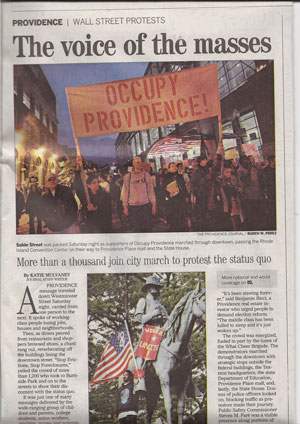
"The voice of the masses"? Since Sunday, multiple polls have emerged suggesting that it just ain't so. From The Hill:
The movement appears to have struck a chord with progressive voters, but it does not seem to represent the feelings of the wider public.The Hill poll found that only one in three likely voters blames Wall Street for the country's financial troubles, whereas more than half — 56 percent — blame Washington.
And again from USA Today/Gallup:
When asked whom they blame more for the poor economy, 64% of Americans name the federal government and 30% say big financial.78% say Wall Street bears a great deal or a fair amount of blame for the economy; 87% say the same about Washington.
We've been hearing a lot about the supposed ideological overlap between the Occupy movement and the Tea Party, but actual poll results from "the masses" seem to trend more toward the latter than the former when the question moves toward whom to blame and (more importantly) where to focus efforts for change. Indeed, describing his own poll-based research, Douglas Schoen describes the Occupiers as follows:
Our research shows clearly that the movement doesn't represent unemployed America and is not ideologically diverse. Rather, it comprises an unrepresentative segment of the electorate that believes in radical redistribution of wealth, civil disobedience and, in some instances, violence. Half (52%) have participated in a political movement before, virtually all (98%) say they would support civil disobedience to achieve their goals, and nearly one-third (31%) would support violence to advance their agenda.
But all of these results were released after the Providence Journal decided what narrative to append to the Occupy Providence event, so perhaps the size of the crowd put the group in the Projo's "masses" category. Of course, recalling that the Projo estimated the initial Tea Party rally at twice the size, one would expect objective news reports to apply the same narrative, right? Well, no:
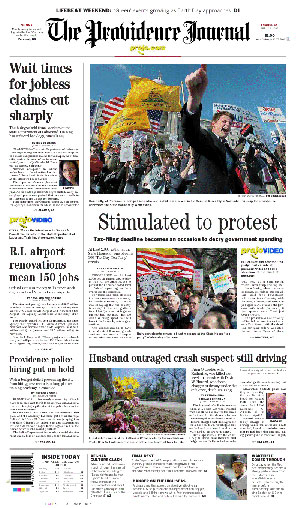
And of course, in the case of Occupy Providence, the "masses" were assisted by a free front page advertisement in the state's paper of record on the morning of the event:
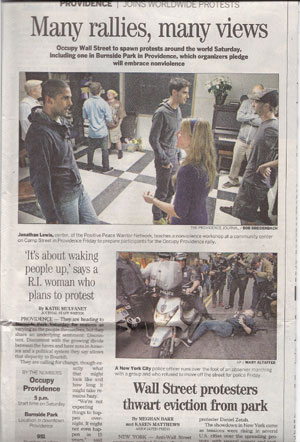
Surely, to achieve even greater attendance, the Tea Party must have had a similar courtesy. Umm...
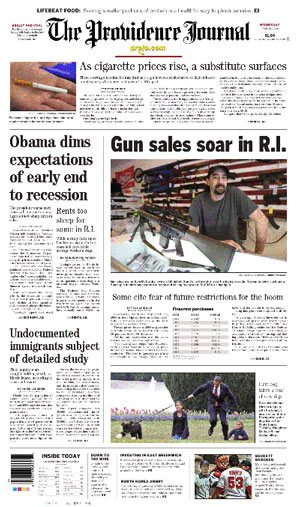
The kid in me would like nothing more than to head down to the Providence Journal newsroom to test out the echo.
September 15, 2011
Oh Froma
I never really paid much attention previously to people's opinions of Froma Harrop and her columns. That is in part because I've seen her criticized from both sides of the political spectrum, so how bad can she really be? Well, her column on Wednesday in the Providence Journal sure seemed to make her biases evident.
Let's start with the opening sentence:
"If the 2012 election were held today, Republicans could very well have their heads handed to them."
I don't quite understand this one. I looked up the Generic Congressional Vote polling on realclearpolitics.com and I see a dead heat. The polls just generically ask people, who would you vote for, the Democrat or the Republican. The answer comes out a perfect split tie at 41.3% each. I'm not sure how that is getting your "head handed to you".
Next, if we need any other election results to be an indication, then look no further than New York's Ninth Congressional district where Rep-elect Bob Turner is the first Republican to win that seat since 1920. During that campaign, even the popular Democrat and former NYC mayor Ed Koch came out in support of the Republican to specifically "send a message" to President Obama that his policies are unacceptable. Even the president's own popularity polls are often an indication of which party will be victorious in the upcoming election. Obama's disapproval rating currently leads his approval rating by 7 points. I'm not sure where Harrop gets this "head handed to them" idea.
Then, one of her very next sentences:
"Their debt-ceiling hijinks were no doubt immensely amusing to the Tea Party fringe"
Debt-ceiling hijinks? Maybe she's unaware that the country is having some financial issues right now and there wasn't that much attention being paid to fixing the issue. Just keep borrowing and borrowing without fixing the structural problem? No, something needed to be done and rather than making a five minute speech that only the Speaker and any homebound CSPAN viewer at 2 in the afternoon would see, they decided to stand up and do what they could to fix the problem. And look what's happening now, there is some focus on fixing the deficits and runaway spending. That doesn't sound like hijinks, that sounds like being responsible and doing the job you were elected to do.
"We’ve reached the part of the Western where the townsfolk, long intimidated by a gang of bullies, suddenly find their courage and fight back. A snowballing of suppressed rage bodes ill for the Grand Old Party."
I agree with the first part. I am tired of the same old Washington, the same old lies, the same old business as usual. However, I think her second sentence has the wrong target. I think the suppressed rage may bode ill for many incumbents.
However, with her belief that the bully is the GOP and the Tea Party, who is this "we" that she speaks of? Clearly she's speaking from a Democrat's point of view and trying to project her single opinion on others. I don't see that happening. This is like a conservative columnist claiming in early 2007 that the Democrats were being too whiny and would end up the big losers in the mid-term elections. We know how that turned out.
"[The Tea Party's] circus act helped push a U.S. debt downgrade"
But what effectively originally it? Obama and the Congress' mismanagement of the financial situations, bailouts and stimulus borrowing. The ratings agency even admitted that part of the reason for the downgrade was that the spending cuts did not go far enough. How far would the downgrade have gone if there were no cuts?
And there's also Harrop with her revisionist history:
"It was against that sour public mood that Bob Dole, the Kansas Republican, ran against Bill Clinton in 1996. He lost."
Yes, Dole lost in 1996 as did Walter Mondale in 1984. Both candidates were running against extremely popular presidents in a time when America was very prosperous and going well. When America is chugging along well, why would you want to change the president? Conversely, when America is moving like we are now, is exactly the time to change both the President and Congress.
September 5, 2011
Flipping Rhode Island Red...Or At Least a Shade of Purple
I have a friend who is a Pittsburg Pirates fan and I'm constantly shaking my head at the lack of effort that franchise makes to become a championship contender. The reason for this is the Pirates play in the National League Central division, which with its six teams is actually one of the weakest in baseball and often sends its champion to the postseason with the fewest wins of all playoff teams. In 2006, the St. Louis Cardinals went to the post-season and won the World Series after only winning 83 regular season games. That's only two wins better than having equal wins and losses. Pretty mediocre.
So what's my point here? As easy as it is for a team to get to baseball's post season from the National League Central, I think it could be just as easy for the Republicans to make major gains in Rhode Island for relatively short money. Rhode Island has just as many Senate seats as any other state and currently, the House is very close on its makeup and we have a sitting Congressman who has to be more nervous than a long-tailed cat in a rocking chair factory.
I say short money because Rhode Island only has one media market and one statewide newspaper where the Republican National Committee could spend on advertising and touting the benefits of the fiscally conservative candidates. Start advertising with the three television media outlets (channels 12 and 64 seem to function as one) especially during the all important national news and Wheel of Fortune hour. Start dispelling rumors and misstatements by certain elected officials and start getting out a positive message.
I have walked door to door with multiple candidates over the last eight years and one thing I find when we talk to people is while Rhode Island is viewed as one of the bluest states in the country, many people do actually have fairly conservative opinions, especially on the fiscal side. People try to tell me that Rhode Island is a Democratic state, but actually, it's not. It is an "Unaffiliated" state. The greatest percentage of voters are listed as Unaffiliated. They don't align themselves with either party and many of them will tell you that they often have a split ballot and will vote for who they think is the best candidate.
If the RNC were to come in and focus on the fiscal conservatism of its candidates and sway these on-the-fence-unaffiliateds, great inroads could be made toward moving Rhode Island's seats in Washington to the other side of the aisle and at least turn our deep blue to some shade of purple.
August 5, 2011
The Assumptions Underlying Harrop's Insanity
One would think that members of an editorial staff would offer each other the service of gently warning their coworkers when they near the deep end. Or perhaps Froma Harrop is firmly convinced of the approaching death of newspapers and is effectively auditioning for a part in the far-left blind heat machine.
Granted, her tirade against the Tea Party movement, Republicans, and even President Obama has the incongruent quality of being both inane to the point of offense and unoriginal. It's one thing for a writer with a well-paying publicly visible job to rant like an overly righteous undergrad; it's quite another if she does so with an undergrad's lack of originality, and a column that Jeff Jacoby published in the Boston Globe the same day that Harrop's diatribe ran illustrates that we'd already heard it all. Here's Harrop's version:
Make no mistake: The Tea Party Republicans have engaged in economic terrorism against the U.S. — threatening to blow up the economy if they don't get what they want. And like the al-Qaida bombers, what they want is delusional: the dream of restoring some fantasy caliphate in which no one pays taxes, while the country is magically protected from foreign attack and the elderly get government-paid hip replacements.Americans are not supposed to negotiate with terrorists, but that's what Obama has been doing. Obama should have grabbed the bully pulpit early on, bellowing that everything can be discussed but not America's honor, which requires making good on its debt obligations. Lines about "we're all at fault" and "Republicans should compromise" are beyond pathetic on a subject that should be beyond discussion.
Oh, please, Mr. Obama, follow Harrop's advice! Better yet, Democrats, please do not hesitate to find a candidate who promises her a taste of the red meat that she knows to be just beyond the rabid foam that coats her lips.
For the sake of finding some way of salvaging intellectual discussion from Harrop's ravings, though, pause for a moment to consider what she must believe to be true in order to come to her conclusions:
In the last half century, Congress has raised the debt ceiling 49 times under Republican presidents and 29 times under Democrats. The votes were cast without drama because the idea of this country defaulting on its debts was unthinkable. This last-minute deal notwithstanding, the dangerous precedent whereby America's promise to pay what it owes can be brought into political play has been set. ...Republicans are ultimately going to take the rap over this debt-ceiling outrage. The full faith and credit of the United States is not a matter over which reasonable people may disagree, and the larger public knows that in its heart.
Two assumptions must be met for this to be logically consistent, and I don't think the "larger public" shares those assumptions. They're certainly arguable enough that a rational person would restrain her rhetoric when standing upon them to speak (or snarl, as the case is).
First, she assumes that the debt ceiling ought to be little more than a mile marker on the highway — passed with scarcely a notice and signifying nothing of substantial concern. To the contrary, I suspect the average attention-paying American would think it reasonable for the debt ceiling to be, at the very least, a mechanism for generating real political heat whenever elected representatives pass it. This is a "real success" of the Republicans' debt-ceiling maneuvers (albeit inadequate to current challenges), as Charles Krauthammer states:
... because of the Boehner rule — which he invented on his own out of whole cloth in that speech he gave at the New York Economic Club a few months ago in which he said a dollar of debt ceiling increase has to be matched by a dollar of spending cuts (which, Jay Carney is right, there's no logical connection, but now there is a political indelible connection) — every time the debt ceiling will come up, there's going to be a debate in the country. This is a real success.
Second, Harrop assumes that every expenditure of government is akin to an immutable debt resting on the "full faith and credit of the United States." Real cuts to government spending may be difficult, but they can be accomplished without a financial default. One wonders whether the reason that the Fromarian ilk has rattled off its hinges is that they fear a society inclined to reconsider — and force their elected representatives to reconsider — whether government can in fact do everything.
Put differently, they fear a civic process in which it is no longer adequate to force a policy into law — by legislation, by executive order, by bureaucratic regulation, or by judicial decree — but rather, in which paying for that policy and its enforcement must be justified every year.
July 29, 2011
A Frothing Projo Editorial and a Much Needed Policy Reversal
"House GOP vs. America" — that's quite a headline for an unsigned editorial about the debt ceiling battle. The text below it is the sort of summary of economic assumptions and narrow conclusions about specific issues that is therefore impossible to address without revisiting every particular issue and arguing line by line.
For example, writes the editorial board:
That House Republicans, dominated by Tea Party zealots, still refuse to support raising the debt ceiling after having been offered a deal to cut $3 of spending for every $1 of new tax revenues shows a frightening willingness to wreak havoc with the American economy.
For that one, Jerry Pournelle has already provided the points that I would make:
... What's called a cut is in fact merely a small decrease in the rate of increase, so that "cut" means spending more money. There will be a $1.1 Trillion cut spread over ten years, with a Commission of 12, 6 Republicans and 6 Democrats, to propose more cuts. If 7 of them can agree on a "cut" — which may be an actual cut but is more likely to be a reduction in the rate of increase — then both Houses of Congress have to approve the "cut". This may amount to $2 Trillion spread over ten years, or $200 billion a year.The government will continue to borrow $100 billion a month. That amount will go up as the deficit rises. We will then be told that gollies, we did everything we could, but it's not working, we have to have more revenue or we are in default, give us more money. When we point out that they promised cuts and didn’t deliver, we will be told that, well, yeah, but look at that guy with the private jet over there! Tax him, tax him! Look, that company made obscene profits last year! Tax them, tax them!
But so it goes, with the Projo's style mirroring a mouth-breathing lefty blogger rather than a respectable publication. From the above-quoted title and the term "Tea Party zealots" to putting "conservatives" in quotation marks to a declaration that it is "nonsensical" to say that letting tax cuts expire, thus increasing the amount that people pay in taxes, is... umm... raising taxes. You know, because the average American family, when plotting out its budget projections for the next decade, has already taken into account the expected increase. Right?
You do account for projected tax policy when you budget for the next decade, don't you?
The key paragraph of the editorial is this one (emphasis in original):
[The Bush years were] years of the partly unfunded Iraq and Afghanistan wars, TARP and other bailouts and the (totally unfunded) Medicare drug benefit, among other things. New policies during Bush years, including the above-mentioned tax cuts, cost $5 trillion. New costs in the Obama administration, including the economic stimulus, totaled only $1.4 trillion.
Although the editors don't bother citing a source for their data, it appears to come from this New York Times chart, which derives from the left-wing Center on Budget and Policy Priorities. Having sifted through CBPP data reports in the past, I'd suggest that we're not looking at an objective fact, but (again) at a series of assumptions and narrow conclusions that are eminently arguable. In other words, by the time you get to a chart that broad, use of the numbers ought to be heavily qualified.
Even this idea of "new costs" illustrates the point. As the Iraq war wound down, President Obama ramped up activities in Afghanistan, yet the chart does not include any such costs. The Projo insists that letting tax cuts expire is not a "new" policy, but the chart does not appear to treat the extension of those cuts in 2010 to be an Obama-era cost.
Next consider that the Bush total is entirely actual results, while most of the Obama total entails projections. How is it possible that "health reform and entitlement changes" can possibly represent an increase of only $152 billion from 2009 to 2017? Be sure to check back on that one in 2020. And be sure to note that roughly $2 trillion of the total "new policies" derives from the failed stimulus spending of which liberals, including at least some of the Projo editors, wanted more. These are the people making righteous declarations about others' hypocrisy?
Another choice bit of the editorial has to do with taxation in general:
Meanwhile, the Republican refusal to let some of the Bush tax cuts expire or to close tax loopholes is nothing short of delusional. Federal tax collections as a percentage of the economy are the lowest they’ve been in over six decades!
While that's pretty much true, collections and percentage of GDP aren't as clearly relevant as the editors imply. As the first chart here shows, since 1960, the federal tax percentage of GDP has consistently been between 15% and 20% — despite changes in tax policy and despite economic booms and recessions. Those of us who've been in the working world for at least 10 years will likely recognize that the two big recent dips in this data point corresponded with two economic contractions.
Indeed, it's interesting to note that tax collections as a percentage of GDP actually increased after the maligned Bush tax cuts. (The Reagan tax cuts show a similar, though more gradual, trend.)
In the context of the debt ceiling two additional points ought to be remembered. First, government expenditures as a percentage of GDP have never been higher. Second, the "tax cuts for the rich" that President Obama insists be part of any debt ceiling deal (which gives him at least as much blame for the Projo's "budget Armageddon" as Republicans) amount to about 15% of the Bush tax cut total — which is a point that the CBPP and Projo alike are not particularly careful about making.
I'll agree with the Projo editors on one thing: "It's time for Republicans to take ownership of their failed policies of the last 10 years and reverse them." Government spending is out of control and must be reined in. Whether it results from policies implemented during the presidency of Obama, Bush, or FDR the size of government must be reduced. If anything, the House Republicans are not being stringent enough.
May 25, 2011
The Social Structure of Socialists
Glenn Reynolds highlights an article in the New York Post that hits some familiar notes:
For more than 15 years, New York state has led the country in domestic outmigration: For every American who comes here, roughly two depart for other states. This outmigration slowed briefly following the onset of the Great Recession. But a recent Marist poll suggests that the rate is likely to increase: 36 percent of New Yorkers under 30 plan to leave over the next five years. Why are all these people fleeing?For one thing, according to a recent survey in Chief Executive, our state has the second-worst business climate in the country. (Only California ranks lower.) People go where the jobs are, so when a state repels businesses, it repels residents, too.
Taxes, mandates, regulations... it's the same old story with a plain dramatic conflict: difficulty building the better life to which Americans historically aspire. Reynolds puts it perfectly:
Have you noticed that wherever what Walter Russell Mead calls the "blue state model" is applied, you get a crust of really rich people, jobs for some folks who service them, and then not much employment or opportunity for younger people?
Perhaps it comes down to basic philosophy. To those who advocate for blue-state policies, it is the natural order of things that some are suited to high position and those who are not must be cared for as subjects. Anybody who wishes to move from the low group to the higher without following the strict guidelines for acculturation by which one imitates and reinforces his betters must be a suspicious, greedy character.
Thus college becomes a route to learn the habits of thought and affectations that give weight to elite biases. Thus highly paid union organizers stand as the representatives of the uninitiated in the ruling class. Thus professional advocates work toward a growing class of permanently dependent wards of the state. And thus develops the attraction of regions that allow greater freedom and more independence.
May 23, 2011
Grading by Ideology
An interesting tidbit from over the weekend is that college professors appear to grade differently based on political affiliation:
We study grading outcomes associated with professors in an elite university in the United States who were identified -- using voter registration records from the county where the university is located -- as either Republicans or Democrats. The evidence suggests that student grades are linked to the political orientation of professors: relative to their Democratic colleagues, Republican professors are associated with a less egalitarian distribution of grades and with lower grades awarded to Black students relative to Whites.
As you can see by the included chart, Republican-given grades track more closely with what one might expect: lower grades correlating with lower SAT scores and higher with higher. And I'd certainly be willing to believe that Democrats (presumed, in the study, to be liberal) are more apt to boost underachievers and resent overachievers, whom they attempt to humble.
Still, one major consideration that does not appear to have been taken into account (at least as apparent in a quick scan of the research document) is the type of courses involved. Humanities departments, to my experience, have a deeply entrenched and rigid screening process that surely keeps Republicans and (especially) conservatives out, so those Republicans whom one can find on faculty lists are likely to be teaching less mushy, more objective subjects .
Another explanation, apart from the urge to redistribute, could involve Republicans' status as a small minority. Whatever is cause and whatever is effect, professors who feel as if they exist behind enemy lines, as it were, might have a different outlook on testing and grading, making them more likely, I'd wager, to prioritize proven achievement in a competitive atmosphere.
May 20, 2011
Fun with Froma
Longtime readers know that I've never been much of a Froma Harrop fan. People who know her assure me that she's reasonable, but she starts from (what one might call) the flawed premises of the ruling class. Still, when she focused on Rhode Island, at least she articulated a distinct perspective on matters of local concern; now that she's syndicated, she seems in direct competition with other national liberal pundits who are frustrating to read.
Every now and then, though, it's fun to dip into a column and spot the aforementioned premises, as is the case with last month's "The GOP's Third World vision for the United States":
Government programs are sustainable only if you sustain them. That's done primarily through taxes. Years of tax-cutting have helped drive federal tax revenues to a 60-year bottom relative to the gross domestic product.
Of course, as an economy grows — considering that few government programs necessarily scale directly with the prosperity of the nation (indeed, many should go in the opposite direction) — one would expect government to shrink on a relative basis. If we a priori set government as a proportion of the economy, then we'll ever be looking for programs on which to spend the unneeded money, which actually jibes pretty well with political trends of the past half century.
The interesting point, though, is that one could construct an explanation for that "60-year bottom" so as to credit tax cuts with economic growth. Harrop goes on, and I can't help but interject, here and there:
If low taxes are the key to economic growth, as Republicans assert, then why aren’t we doing better? [Because taxes at all levels of government are still too high, because regulations stifle the economy as well as taxes, and because the economy is cyclical without regard to the government.] What explains the phenomenal growth of the 1950s, when the top marginal rate hit 91 percent? [The Baby Boom and the release of pent up demand and production capacity after World War II.] Or the years following the Democrats' 1993 tax hike on high incomes, when the economy boomed, the budget ran a surplus and the rich did better than ever? [Conditions formed in the '80s and the development of new technologies, notably the Internet.] And what explains the mediocre job growth in 2001-2008, as two big tax cuts went into effect? [The dot-com bust and the shift of capital toward investment in speculative real estate, rather than productive enterprise, as a result of government policies making such speculation seem unreasonably safe.] Then came the crash, fueled by deregulation. [And Harropian liberals credit Obama's stimulus for preventing worse, even as they fail to mention the same possibility when it comes to Bush's tax cuts.]
Of course, my rejoinders are arguably as simplistic as Harrop's assertions, but I'm writing as a hobby on a blog, while she's making a healthy living as a professional opinionista. More importantly, her baseline philosophy initiates an error that affects all that she piles upon it:
Public benefits are what divide a rich-country way of life from the threadbare alternative. Let's assume that Americans want the blessings of the former.
To the extent that such a statement is true, it's circumstantial. The European model is pretty much the only "rich-country way of life" by which Americans can measure themselves, and just because Europe does things a certain way doesn't mean that the Continent is providing an objective example of what civilization ought to be.
Acknowledging that leads to the question of what the objective of a civic system ought to be, at which one must consider the longevity with which that "rich-country way of life" can be sustained. On that count, I'd suggest that we'd be much better off pursuing an alternative method of distributing our national prosperity that doesn't measure success by the amount of public benefits (either relative to the economy or in absolute terms), but in the well-being of the individuals who make up the citizenry.
April 1, 2011
Anatomy of a Controversy
With over 250 comments, it'd take quite a bit of catching up, and the horrible policy of letting readers delete a comment when enough of them flag it as "inappropriate" makes the conversation difficult to follow, because comments (including Gordon's) suddenly disappear, but the response thread to this story on the Tiverton-LittleCompton Patch is a fascinating glimpse at the boiling of a controversy.
The story itself is about Tiverton High School student Cynda Martin's founding of a gay-straight alliance (GSA) group. There was no controversy in the group's founding, no push-back from the school, and the subject is a mildly more-topical variation of the local feel-good story. The controversy began when Budget Committee Member Joe Sousa and State Representative Dan Gordon expressed the opinion that schools should focus on academics, with the latter writing:
And this is why if I have anything to say about it, Tiverton will lose school funding to local charter schools. It doesn't matter if gay or straight, if sexual meet-up groups are being promoted in our schools rather than improving test scores, that school is failing. Is it really more important for our children to get 'sexed-up', than learning advanced math?
As I was quick to point out in the comments, what's reasonable in that paragraph is inartfully put and, in my view, errs in the approach to charters, which might very well emphasize such groups and the motivation for which ought to be to improve public schools, not defund them. What's not reasonable in the comment stems from a misunderstanding of the nature of such student groups and an apparent disconnect from the current state of acceptance of homosexuality in terms that aren't explicitly sexual, but amorous.
The indignant comments began to steamroll, with parents, students, and school faculty chiming in, especially when WRNI picked up the story as "Lawmaker wants to ban gay student group from Tiverton High School," RI Future tugged on the thread, and Gordon went on John DePetro's show. His fellow Tiverton rep. Jay Edwards eagerly condemned his comments, and the state Democrat Party got in on the action. Then Gordon made matters worse by returning to the comment section, where he wound up arguing about grammar with high school students.
Amidst a flurry of posts from students during the school day, yesterday, Tiverton tech teacher Edward Davis took the opportunity to decry a focus on test scores:
The popular trend is to say, "We are falling behind other countries, we need to get our scores up!" But research shows concentrating on test scores is not the solution. Harvard Graduate School of Education's recent study, "Pathways to Prosperity", looked into why our education system, that once led the world, has fallen behind. According to the report, most of the countries that have passed us up have developed career pathways that emphasize technical education and preperation for the workforce.
And not surprisingly, commenters — including Davis, but many anonymous — have dragged the local taxpayer group, Tiverton Citizens for Change (TCC), into it, because obviously one cannot limit taxation without having an anti-gay agenda... or something.
If you want a glimpse of the seams of personal politics, this controversy shows them. It really is fascinating, not to mention a case study for new politicians.
ADDENDUM:
Although I thought it worth noting that teachers and students have been participating in online discussions during school hours, I don't think there's anything inherently objectionable about it. Given the state of technology, it's entirely feasible that everybody can post on the Internet during truly free time. (That kids might be better off socializing in person or doing something active is a different question.) And even were class time being used for that purpose, online discourse and politics are certainly legitimate areas of concern in some classes.
January 13, 2011
Party Games in "Non-Partisan" Tiverton
Back in 2007, I argued against non-partisan elections in Tiverton. Those who disagreed took a very community-oriented view:
ARGUING AGAINST asking Tiverton voters whether they'd like to return to partisan elections after one cycle of nonpartisanism, Charter Review Commission member Frank "Richard" Joslin made two points that have the ring of Rhode Islandry: First, that residents who actually vote (or get involved) know who belongs to what party, and second, that Joslin's fellow members of the Tiverton Democratic Committee are so ideologically diverse as to make party labels of negligible value. At the previous meeting, Commissioner Frank Marshall had asserted that everybody elected to local office is there simply to work hard and do right by the town.Thus do Rhode Islanders like to believe about themselves. Everybody who cares knows, so inside information is by definition public, and everybody votes for the person, not the party, because the individuals are so independent and well intentioned.
That's all well and good, and to large extent true. But party isn't nothing; otherwise, there would cease to be a Tiverton Democratic Committee.
I raise the debate now because it came to light in the comments of my liveblog from Monday night's Town Council meeting that the lone Republican in Tiverton's delegation to the State House, Dan Gordon, was not informed that his peers would be briefing the local governing body. In fact, the same thing happened at the last regular School Committee meeting.
There are certainly legitimate reasons that the relevant clerks for the municipal government and the school department did not contact the only non-incumbent elected representative that Tiverton has sent to the General Assembly for this session. His contact information might not have been readily at hand or accurate. And the Democrat senators and representative might have merely forgotten to mention the meetings, even after the Republican's absence at the School Committee meeting.
It is conspicuous, though, that Rep. Jay Edwards is a member of the Democrat committee... as is Town Clerk Nancy Mello... as are three of the five School Committee members... as is, I believe, the Democrat candidate whom Gordon defeated in the last election. As Joslin once said, everybody knows who belongs to what party, especially those who continue to operate as members thereof.
October 9, 2010
Green and Blue v. Red
An op-ed in the New York Post, by Sen. James Inhofe (R, OK) points to a couple of topics worth discussion:
One insidious force keeping unemployment high is regulatory uncertainty: Companies that could hire (or re-hire), don't — because they're worried about what new restrictions will be coming down from Washington.Congress bears much of the blame — especially for the new "financial reform" law, which leaves so many details to be filled in later. But a major contributor to businesses' worries is the Obama Environmental Protection Agency, which is issuing a daily barrage of rules and regulations threatening jobs in American industry.
So concludes "EPA's Anti-Industrial Policy: Threatening Jobs and America's Manufacturing Base" — a new report from the minority staff of the Senate Committee on Environment and Public Works (on which I serve as ranking member).
Inhofe goes on to describe three of the four "most egregiously anti-business proposals" of the EPA, on which the report focuses:
- New rules for industrial boilers
- Unnaturally lowered ozone levels
- The claim that the agency has the authority to regulate carbon dioxide
The fourth proposal addressed in the full report (PDF) has to do with regulation of Portland Cement plants. Notably, all of the proposals have had the effect of putting Republicans and private-sector unions on the same side of advocacy — because both sides have reason to fear policies that could cost the economy almost a million jobs, many of them industrial.
But the Republicans don't have entirely clean hands on a broader view. Return your thoughts to Inhofe's lament over regulatory uncertainty. Such uncertainty is surely an inevitable consequence of our deeply divided political sphere. Indeed, the only thing that has been certain, over the past two decades, has been that government authority would grow and expand, but with a modicum of respect for free market principles that has driven the economy of the United States. Republicans of the current generations have failed to pull government in the other direction — with many, including President Bush, apparently quite comfortable with its expansion. That consistent trend enabled companies (particularly large companies) to adjust and plan for their own benefit, and smaller businesses and individuals could predict what rules would persist and which were prone to adjustment.
What President Obama and the Congressional Democrats have illustrated is that the balance cannot hold. Eventually, government's size and power becomes such that expansion requires it to rewrite rules by which other social powerhouses thrive. That's the line being crossed. Businesses operate by the larger principle (crass as it is) of profit, which makes it unlikely that a new corporate executive regime will change policies based on whim. When they do, the fact that companies are replaceable means that the gap they leave will be filled; another company will spot the poorly managed competitor's dash to the cliff and maneuver to fill its abandoned space. There is no secondary government.
Government, by its nature, is subject to the whims of those who hold its reins. Especially when public offices become the domain of independently wealthy politicians, they become prone to ideological excess, and ideology defines its own larger principles, making their decisions much less predictable. The nation's deep political divide matters most of all because the size of government grants unwieldy power to the side that happens to be winning for the moment.
October 8, 2010
The Goal Is to Silence, Not to Oppose
The opposition went to the immigration law enforcement rally, last Friday, dressed humorously to distract from their underlying intent, which is to prevent the public from hearing or understanding an argument with which they disagree:
Suddenly, demonstrators in polyester clown suits filed through security and entered the State House rotunda, carrying signs that said, "Clown Power," and "Clowntocracy."At that point, the "Clowns for Immigration Law Enforcement" outnumbered Palumbo-bill supporters, whose critical mass never exceeded 50.
The clowns mocked the speakers with whoops and applause: "Peter Palumbo! Clown in Chief!" "Peter Palumbo! Clown in Chief!" "When I say 'Clown!' You say 'Power!'"
It's not surprising that, in the middle of a work day, it's easier to raise a crowd opposed to enforcing immigration law than supportive of it. More to the point, the intention here — as with protestors at the recent rally hosted by the National Organization for Marriage, in Providence — is to make it more difficult for a public conversation to be had.
Take away the "clown," and all they're shouting is "power."
October 3, 2010
Only One Side Counts
I've been meaning to note Bob Kerr's continued function as the elder statesman who says what the younger folks must strive to keep to themselves at the Providence Journal. Here's the crux of his Wednesday column:
You might remember protest. It's an honored American tradition. It's how this whole thing got started. People speak out and other people are moved to think about things they hadn't thought about before. ...This is not the golden age of protest. Despite the brutal cost of two misguided wars and an economy knocked cruelly out of balance, it is difficult to move people to take their feelings out in public.
It might be fear, it might be indifference, it might be the desire to stay comfy and cozy at any cost.
His purpose, the reader quickly finds, is less to make grand statements about protest culture than to promote a particular protest with which he's sympathetic. But in his entire column, he offers not one sentence, one phrase, one carefully sharpened jab about the Tea Party movement that has been redefining politics in the United States. In the left's strained and rigid lexicon, shining ideals like Protest can never be applied to people with whom they disagree.
When the Kerrs of the old guard raise "question authority" to the highest of principles, they conveniently neglect to consider that, as they slipped into their social positions and reached middle age, they themselves became authorities who must be questioned. And so, not only are many deliberate in their refusal to answer, but some try with all their might not to hear the inquiry.
September 29, 2010
The Straight Line Crosses Political Groupings
Timothy Sandefur's edifying review of the shift in legal thought on the Supreme Court during the era of President Franklin Roosevelt's progressive revolution points, among other things, to the way in which political groupings do not draw straight lines across history, such that a conservative or progressive today would have agreed with their supposed forerunners:
For a legislature to exert power in this way — for the personal benefit of the lawmaker or his allies — would be to act arbitrarily; to exert its mere will. But the due-process-of-law clause allows states to act only pursuant to law — that is, general rules serving the public good. In 1874, less than a decade after the Fourteenth Amendment added a new "due process of law" clause to the Constitution, the Court held that states could not take property from some citizens to benefit others because such legislation was not "law," but "a decree under legislative forms." Legislation restricting freedom only to enrich a particular faction, or lacking any basis other than legislative say-so, abridges liberty without due process of law.Progressive-era lawyers recognized that this legal doctrine was among the most serious obstacles to redistributive legislation. They therefore formulated a theory that the due-process clause required only fair procedures, and that the constitutional prohibition on legislative arbitrariness — which they derisively labeled "substantive due process" — had been concocted by "activist" judges who merely enforced their individual political views from the bench. The judges of a previous generation would have been stunned by this accusation, but by the 1930s, it had become common in the legal academy and among younger lawyers. The clash between the two interpretations of the due-process clause would form one of the central dramas of the New Deal decade.
As it happens, I agree with the progressives, as described in the above. Within the boundaries of the Constitution, states ought to be able to be given maximal leash, with residents never deprived of the right to work to change policies or to leave, and the expectation that state governments that choose poorly will watch productive residents leave and take the health of the local society with them. The problem is that federalism turned out to be an argument of convenience for factions outside of the judicial majority.
The insight of the progressives in the text that I've just quoted was that there exist rules laid out in the law concocted by people in a system of self government and that the people could therefore change them. Experiment. In terms of government, there isn't some abstract, pure Law to which legislatures and jurists must hew, because that abstraction turns out to be suspiciously similar to the opinions of the ruling class. But once they gained the majority, the progressives set about undermining the rules that made possible the very notion of due process:
... the Constitution explicitly bars states from "impairing the obligation of contracts," a prohibition adopted in response to uprisings like the 1786 Shays's Rebellion, in which farmers mobbed foreclosure sales, closed courts, and demanded "debtor stay laws" like that enacted in Minnesota. Laws limiting lenders' ability to recover from defaulting borrowers dry up credit and stifle economic expansion, which is why James Madison described them as "wicked" and "contrary to the first principles of the social compact." Even law professor William Prosser, who helped Minnesota legislators write the law, confessed in 1934 that the contracts clause "was inserted in the Constitution for the purpose of preventing precisely [this] type of legislation."When a bank foreclosed on the Blaisdell family's boarding house, they sought to extend the redemption period. The judge refused, finding the law unconstitutional, but the Blaisdells appealed, and the Supreme Court upheld the law in a 5–4 decision. Admitting it could not be reconciled with the Constitution, Chief Justice Charles Evans Hughes nevertheless held that the law was justified by the economic "emergency." It was "no answer," he claimed, "to insist that what the provision of the Constitution meant to the vision of that day it must mean to the vision of our time." To say "that the great clauses of the Constitution must be confined to the interpretation which the framers, with the conditions and outlook of their time, would have placed upon them" simply "carrie[d] its own refutation."
With legislatures thus freed to to do anything, provided it coincided with the ideologies and opinions of a majority of Supreme Court justices, the deterioration of the American experiment began in earnest. In our day, the federal government has stepped up its own involvement — from minimum wages to, now, healthcare — making real due process — the ability to organize and work for change in response to unjust laws — that much more difficult, and the decision of our rulers that much more arbitrary.
September 14, 2010
So That Nobody Hasn't Been Warned
Just in time for election season, I've finally managed to read Travis Rowley's The Rhode Island Republican. For good reason, the largest portion of the forty-page pamphlet addresses unions, specifically public-sector unions, primarily in context of the "Cloward-Piven Strategy":
In 1966, two Columbia University political scientists, Richard Andrew Cloward and Frances Fox Piven, penned an article in the Nation magazine titled, "The Weight of the Poor: A Strategy to End Poverty." The purpose of the article was to inform Marxist radicals of the most prolific method for hastening a socialist revolution. What became known as the Cloward-Piven Strategy instructed anti-capitalists to overload welfare bureaucracies with impossible obligations, thereby causing civil unrest and economic collapse. The political turmoil, it was predicted, would lead to the rejection of capitalism and the embrace of the quick fixes promised by redistributive policies.
That certainly rings familiar during the era of the Obamanation.
For most of us who pay regular attention, Travis's project was to collect examples that have tended to blend together into a sense of "normal" over the years, and we do well to seek reminders of the mentality that we face (and that must be stopped at the ballot box). Here's one telling passage, involving the move in Providence to force businesses to retain employees after a sale or merger:
[Rhode Island Hospitality Association President Dale] Venturini pointed out that "from July 2008 to July 2009, city revenue from the 1 percent hotel tax has dropped nearly 11 percent," and informed the Council that the "city hotel industry has been battered by the drastic reduction in corporate travel for conventions." Executive Director of the Convention Center Authority James McCarvill said that the legislation would "make it harder for the Authority to negotiate new contracts for food vendors at The Dunk and for management of the Convention Center."But it matters little to dictatorial Democrats what business professionals have to say. And when McCarvill questioned the Council's authority to have their hands so deeply involved in business affairs, Councilman Solomon "maintained that the city [was] within its jurisdiction since the hotels and convention center buildings currently recieve, or did receive, public money, including city tax breaks."
Let it be known, once you accept any form of tax leniency from the government, Democrats consider you their property, and grant themselves unlimited license to mingle in your private affairs. Now ask yourself, Have I ever claimed a tax deduction?
It's quite the reasoning. Government will confiscate the wealth of private individuals and businesses not just for the operation of necessary functions, like public safety and infrastructure, but for the purpose of shaping society. And when they don't confiscate that wealth, officials see that not so much as money not taken, but as money given.
Of course, to the Left, morality — as conceived and interpreted by the Left — is its own justification for government action, even when it makes no sense, as this insight from Travis notes:
... Howard Dean will have nothing of the free exercise of charity, which is the danger to his liberal logic. If people already have a sense of community, then why would Dean feel compelled to control it? If "communitarianism" is people's "natural tendency," why would an elected agency be required in order to provide it? Why is the practice of taking-and-giving necessary in a world chock full of good-hearted communitarians [as Dean argued as justification for blending capitalism and socialism]?"
Well, because liberals want charity to go to the people whom they prefer for causes of which they approve. A cause that has the effect of creating dependents and decreasing the disincentive to procreate recklessly? That's for them. A charity that reinforces Christian faith? Not so much.
The one concern that I have with The Rhode Island Republican is that I'm not sure whom Travis considers to be his audience. While the reminders to the likes of Anchor Rising readers are worth the short time to read the booklet and a rallying cry to conservative activists is always worth heeding, the people who really require to be informed are those who haven't already spotted the threads that Travis follows. They are apt to be suspicious of the frequent focus on some narrow figures on the Rhode Island Left, like Patrick Crowley, and pushed toward the apathy that meets partisan squabbles by unnecessary heat and name calling. (For example, Travis declares National Education Association [NEA] Rhode Island Executive Director Bob Walsh to be a "dingbat" early in the text.)
That said, Travis does provide a foundation from which his readers can go on to do the work of persuading their neighbors that their votes, this year, shouldn't be a simple matter of habit, because that approach has proven to be unhealthy to us all.
July 28, 2010
Teaching While Catholic
There may be more to the story, but it appears that University of Illinois Adjunct Associate Professor of Religious Studies Kenneth Howell has lost his job for the offense of teaching Catholic thought as if it might be worth considering as something more than a curious human error.
Kenneth Howell was told after the spring semester ended that he would no longer be teaching in the UI's Department of Religion. The decision came after a student complained about a discussion of homosexuality in the class in which Howell taught that the Catholic Church believes homosexual acts are morally wrong. ...One of his lectures in the introductory class on Catholicism focuses on the application of natural law theory to a social issue. In early May, Howell wrote a lengthy e-mail to his students, in preparation for an exam, in which he discusses how the theory of utilitarianism and natural law theory would judge the morality of homosexual acts.
That 1,500-word email clearly stays on the explanatory side of the line from advocacy, getting into trouble mainly at the end, at which point, Howell makes the mistake of suggesting that Catholic teachings are not small-minded gobbledygook, but the rational conclusions of long consideration and must be responded to with the same:
Natural Moral Theory says that if we are to have healthy sexual lives, we must return to a connection between procreation and sex. Why? Because that is what is REAL. It is based on human sexual anatomy and physiology. Human sexuality is inherently unitive and procreative. If we encourage sexual relations that violate this basic meaning, we will end up denying something essential about our humanity, about our feminine and masculine nature.I know this doesn't answer all the questions in many of your minds. All I ask as your teacher is that you approach these questions as a thinking adult. That implies questioning what you have heard around you. Unless you have done extensive research into homosexuality and are cognizant of the history of moral thought, you are not ready to make judgments about moral truth in this matter. All I encourage is to make informed decisions. As a final note, a perceptive reader will have noticed that none of what I have said here or in class depends upon religion. Catholics don't arrive at their moral conclusions based on their religion. They do so based on a thorough understanding of natural reality.
This was too much for a student who had "a friend" in Professor Howell's class, who made it clear in his email to the head of the religion department, Robert McKim, copied to LGBT activists and a journalist, that he finds it offensive to be told that knowledge and learning should precede judgment:
Anyways, my friend informed me that things got especially provocative when discussing homosexuality. He sent me the following e-mail, which I believe you will agree is downright absurd once you read it.I am in no way a gay rights activist, but allowing this hate speech at a public university is entirely unacceptable. It sickens me to know that hard-working Illinoisans are funding the salary of a man who does nothing but try to indoctrinate students and perpetuate stereotypes. Once again, this is a public university and should thus have no religious affiliation. Teaching a student about the tenets of a religion is one thing. Declaring that homosexual acts violate the natural laws of man is another. The courses at this institution should be geared to contribute to the public discourse and promote independent thought; not limit one's worldview and ostracize people of a certain sexual orientation.
In actuality, Howell's position was funded by "the Institute of Catholic Thought, part of St. John's Catholic Newman Center on campus and the Catholic Diocese of Peoria," but even if that were not the case, Howell's firing — if based on this complaint, or even a string of such complaints — is evidence of a profound anti-intellectualism that conservatives believe pervades American higher education. Whether "homosexual acts violate the natural laws of man" is a matter of debate, and if it is the case that Catholic philosophy's centuries of development have arrived at such erroneous conclusions that undergraduate students who aren't even studying them can declare them "downright absurd," then that debate ought to be handily won.
Instead, "inclusivity" has trumped intellect:
In another e-mail, Ann Mester, associate dean for the College of Liberal Arts and Sciences, wrote that she believes "the e-mails sent by Dr. Howell violate university standards of inclusivity, which would then entitle us to have him discontinue his teaching arrangement with us."
A frightening phrase, that: "entitle us to have him discontinue his teaching arrangement with us." Beware your students, believing Christians. You may find yourself privileged to allow passive-voiced administrators to avoid uncomfortable ideas.
July 25, 2010
Liberty Isn't Their Concern
Somehow the headline "Voicing their views" feels a bit discordant over an article that includes this detail:
Speakers from the New Jersey-based National Organization for Marriage seemed startled as they were encircled by counter-protesters who yelled, sang and waved the rainbow flag associated with the gay-pride movement. Then, as some 170 protesters — most wearing red T-shirts — rattled plastic bottles filled with coins as a distraction, the group's president pointed to their tactics as yet another example of why same-sex marriage should not be legalized.
Two days earlier, the same-sex marriage advocacy group Marriage Equality RI had held its own rally, got its free publicity, and if there was any counter-protesting on the scene, it wasn't so overt as to be noticed by reporter Randal Edgar. But allowing the opposition that much courtesy is apparently a step too far for SSM activists. For them, those who disagree must be silenced — driven from the public square.
I'd ballpark the likelihood that legalized SSM will satisfy that aggression at zero percent. The next movement to be drowned out and intimidated will be that seeking permission for traditionalists to hold to their views of marriage in their private capacity — in the way they conduct their businesses, associate in groups, and offer their charity.
Not to make too much of a theme of it, but once again, one can observe that the urge to be on "the right side of history" is easily manipulable to put well-intentioned citizens in league with those who would oppress others because they've woven a translucent cloak of victimhood from conflicts of the past. That force that we've personified as Evil is perfectly happy to switch from oppressing homosexuals to leveraging homosexuals to oppress traditionalists and knock down the social structures that enabled our society to advance to its current state.
(Indeed, a traditionalist, myself, I'm inclined to see that as the intention all along.)
July 23, 2010
Patinkin Back to His Comfort Zone
Having chided Mark Patinkin for his colum lampooning Republicans (poorly), I think it only fair to note that he's offered an attempt at some fair-play turnabout. It would be fascinating, I think, for a literature class to devote some discussion time to the differences in sentence structure and related attributes as a means of discerning Patinkin's actual position behind the authorial screen.
Note the general presentation of the Republican piece:
I wondered why we’re trying 9/11 terrorists in federal court instead of a military court.And why my state doesn’t have capital punishment.
I decided next time someone asks me for a handout, I’ll tell them to get a job. Which is actually compassionate conservatism. It helps no one to promote a culture of dependency. ...
Though I care about the environment, I decided I’m now against mandatory carbon emissions controls. Let the free market work it out.
I got cranky about activist judges banning the Pledge of Allegiance.
And so on. There's clearly an element of "wondering" about policies, an element of hyperbole, and assertions of principle, rather than argument. Contrast the Democrat piece; he does some character lampooning (which, unsurprisingly for multiple reasons, I find to be more accurately done), but then goes on to the socio-political opinions:
I wrote my congressman urging more money for social programs, since I believe it's government's obligation to help the needy.As for those who say this leads to a culture of dependency among the poor — no, that’s society's fault.
I'm a die-hard union supporter, and as for those who say organized labor makes America uncompetitive, let's not forget the sweatshops of the 1920s and '30s, and thanks to unions, we don't have those anymore.
I felt good about myself for supporting health care for all, whatever the cost, as well as gay marriage, gun control and abortion. And affirmative action, too, because America is still a racist society.
The statements are significantly more demonstrative, are less hyperbolic, and, especially with the union point, begin to take up actual argumentation. That last is quite differently presented than this, from the Republican parody:
As for getting God out of education the last decade or so — how's that working out for us?
Note the lack of a concrete example of the writer's argument; he offers, instead, an open-ended question indicative of an assumed prejudice, rather than considered conclusion. It's reasonable to explain the difference by his own sympathies, which is why I suggested, with the Republican column, that Patinkin suffered from a lack of familiarity with his subject.
July 12, 2010
Patinkin Should Put a Face on the Cliché
It's difficult to imagine what Mark Patinkin was thinking as he conceived, wrote, and submitted his recent column mocking Republicans — or rather, why he didn't think first. Like any group, there's surely plenty to mock about the GOP and its members, but the sheer absence of cleverness and accuracy, in this piece, suggests that Patinkin lacked even the interest to discern enough truth to make mockery fun. In fact, his rattling off of clichés is so out of date that he actually included this:
Suddenly, I felt guilt over having owned a German car in the past and having a Toyota in the family today. My next car will be Detroit iron.
Is Patinkin so out of touch with his subjects that he hasn't heard conservatives calling GM "Government Motors" and promising to buy other makes? By the above quotation, he shows not only that he isn't familiar with the ideology that he's presuming to summarize, but he doesn't understand the people. For the most part, he equates "Republicans" with "blueblood elites" — although even brief consideration of our Congressional delegation ought to lead the writer to suspect that he's dabbling too superficially in more complicated waters.
So I hereby challenge Mr. Patinkin (pass the word along, if you happen to speak with him) to attend some gatherings of actual Republicans. Something hosted by the Rhode Island Republican Assembly (RIRA) would be a good start.
No doubt, many of Patinkin's expectations about ideology and partisanship will be confirmed, but on a personal level, he might be surprised that some of his friends in the media and the Democrat Party much more closely resemble the picture that he draws.
June 9, 2010
Formerly Admirable, Now a Bad Example on the Way to Obviation
Bringing his military eye to the topic, Theodore Gatchel provides an astute summary of the Obama movement in government:
Two competing schools of thought have developed. One holds that the government's role should be one of educating people about the risks so that they can make informed decisions. The other school holds that the issues are too complex for most people to comprehend, thereby requiring the government to make the decisions for them.President Obama is clearly in the latter camp, which fits nicely with his promise to fundamentally change America. In this case it means transforming the country from one in which people who take risks are admired and rewarded to one in which risk taking is regarded as harmful to the common good.
To be sure, it's possible to go too far lauding unnecessary or ill-considered risks (or those that involve others without consent), but the freedom and opportunity of turning from security en route to improvement as the individual defines it has been essential to the American character — and should remain so.
April 19, 2010
What Is Government For?
At last, a comment from Stuart worth further exploration:
...the point is that governments were created to use our - yours and mine - pooled resources to create BETTER things than we could have created by our lonesome selves. In fact, good systems of government like that of the USA are the biggest friend of capitalism because they create the conditions and mitigate some of the risks where capitalism can flourish.
Well, some might argue that "governments were created" to give the dominant person or faction a means of making everybody else accede to his or their demands, but I'll allow that society's concept evolved, building up to a recreation of the concept of government. What's interesting about the above paragraph, though, is that each sentence describes a different concept of government: The first is left-wing, treating the government as a collective bee-hive, in which the members are all parts of a social organism. The second sentence presents a more right-wing positioning of government, as a mechanism to enhance the individual capacity of the governed.
It should surprise nobody that I think the first concept to be deeply flawed, not the least because it makes the typical progressive error of conflating government with the very concept of organization. All varieties of groups form in order to accomplish things beyond the ability of the individual, whether they are religious, economic, social, cultural, or governmental. Each type of organization will have different sources and applications of authority, depending on which aspect of society it inhabits, and "government" is sort of the final layer. And it should be a very thin layer, inasmuch as we leave to government the authority to use force — both of imprisonment and violence — whereas we insist that the other groups remain voluntary.
The difficulty that left-wingers face, within this model, is that too few people are willing to submit to their will voluntarily, so they wish to move more and more of their policy preferences into the category of organization that uses force. In other words, through all of our evolution, progressives wish to bring the notion of government back to being a mechanism by which the dominant faction imposes its desires on everybody else.
The Center Is Relative, I Suppose
With a few notable exceptions (ahem), Ian Donnis checked in with some right-leaning Rhode Island groups as we move into election season. It's interesting to note that the two voices for the other side were not people known for their roles as explicit leftists, but as union leaders, with this bold comment:
Robert Walsh is executive director of the National Education Association in Rhode Island and another prominent Democratic activist. He says unions and liberal Democrats don't deserve the blame for Rhode Island's woes."You want to give us the keys to the kingdom for a while, we'll show you what good progressive taxation and business development policies can do to turn the state around," Walsh says. "We're, I suppose, a useful target for the people on the other side of the political spectrum, but the gravity in the legislature's clearly in the center."
This chart, to which I linked during the Scott Brown campaign, comes to mind. It shows that RI's Democrats are relatively in the center among Democrats across the country, but that our Republicans are the most liberal around. Which means that the General Assembly is just plain liberal.
April 13, 2010
Jabbing from Old Media to New
Newport Daily News columnist Joe Baker used his space, yesterday, to respond to my post last week about his spreading of sunshine for the Democrats. Actually, he appears to have been more interested in addressing Anchor Rising commenter Tim:
"The Newport Daily News did the world a favor when they decided to strictly limit their online product and made Joe 'Pravda' Baker inaccessible to the greater population," wrote someone identified only as "Tim."Tim obviously did his homework. I began writing my column in 1991. Pravda, a newspaper espousing the Communist party line in Russia, went under in 1991. A coincidence? I think not.
Tim goes on: "Baker is an embarrassing party line hack for the Democrats."
Again, Tim shows an astounding ability to get right to the point. His apparent theory is that I have a political philosophy different from his, which — and I am going to go out on a limb here — is more Republican-leaning than Democratic. (Would that make him "an embarrassing party line hack" for Republicans?) In my 20 years of writing this column, I have tried never to sink to the depths of name calling. But can I ignore the wisdom of astute observers and philosophers like "Tim" any longer?
With regard to my points, Baker responds to the lesser. He disputes my recollection that economists were predicting that the recovery would have begun before this year, and inasmuch as searches for that sort of rolling information — who predicted what when — tend to be more time consuming than my schedule will allow, I'll declare it a wash. Suffice to say that my memory of this long recession entails a continuing series of adjusted predictions from economists continually pushing expectations back, especially with regard to employment.
On healthcare, which constituted the great bulk of my post, he takes up only a point that I said to "put aside": "As Katz himself says, much of the bill's provisions will be delayed, which I think strengthens my argument that people will not feel the pain predicted by opponents — if it does materialize — for quite some time."
Well, Baker's cheering of Obama's policies didn't contain that "if" or note that the Democrats have rigged the policies to explode after a few election seasons. He just said, "as the reality of the program sinks in and nobody sees the dire consequences predicted by its opponents," anger would fade. And he still hasn't shared with his readers my more significant points that companies have already revised predicted profits down to the tune of billions of dollars, based on the legislation, and that hospitals expect to be bled by the legislation, as well.
Unfortunately, Baker also conspicuously avoided mentioning the name of the blog, much less the URL at which my arguments could be found. Perhaps that sort of citation is just a new media thing.
April 7, 2010
UPDATE: Do You Know This Guy?
Apparently, my hypothesis was incorrect. The owner of the controversial sign checked in to explain that he was not a left-wing saboteur:
Justin, the picture is old news, you should pay attention a bit more, as all has been clarified about the sign. However, I do appreciate you keeping the subject alive as to continue to shed more bad light on my ineffective, failure of a congressman, Mr. Langevin. In an effort to help to educate you, I will enclose some links for your reading enjoyment. It may interest you to note that my ineffective, failure of a congressman, Mr. Langevin, has never sponsored or passed any legislation to assist the disabled. He continues to ignore gross violations of the ADA code as it relates to handicap accessibility. He has voted in every sense to continue to raise taxes, expand the public debt, bailout the criminal banks, he has voted in his career 99.93% along party lines (fact courtesy of Open Secrets.org). He is known as a "follower" in that he has never passed ANY legislation. His staff's salaries have almost doubled since 2004, he had a known criminal on his payroll in 2007, (hmmmm, a congressman with a known criminal on the payroll, not very welled versed in security is he??)Link.What else, oh yeah, He voted against reducing SS tax on senior citizens, but voted to give himself a $5300.00 COLA. I could go on and on, but someday, you too, when you learn to do research, will have facts like these and others at your finger tips. I do find it interesting that he owns 4 homes registered under the business name Future Realty Management Co. that his mother operates for him. Looks like he's doing pretty pretty pretty pretty good for HIMSELF !!!! As he continues to take steps to push our country closer to socialism.
One last point ,this one you should take the rubbish out of your ears so that you can hear it loud and clear. I REPRESENT NO GROUP OTHER THAN MYSELF AS A LAW ABIDING TAX PAYING CITIZEN!! GOT THAT?? Good.
Now go read a fairy tale about how good your president is, and how wonderful Marxism has worked in the past, and rest your head calmly while soldiers die so that you can spew your illiterate garbage.
Regards
Rob
By "clarified," he's referring to an appearance on the Helen Glover Show in which he apologized for the distraction and to insist that he represents only himself. So it's the secondary hypothesis: that a loosely affiliated grassroots movement will have people who make statements in a way that others find distasteful. And then the left-wing saboteurs jump in.
Now that that's cleared up, I'll get back to my Marxist reading list and reorganizing my personal Obama shrine.
April 5, 2010
Do You Know This Guy?
So, I'm testing a hypothesis, here. Given the fact that he had two identical "Langevin's Vote Cripple$ America" signs, that they were much more cleanly done than the typical homemade Tea Party sign, and that he made a deliberate effort to get the sign behind speakers at the 10th Amendment rally, I'm going with the theory that this guy was deliberately trying to tar the RI Tea Party's image. Anybody recognize him?
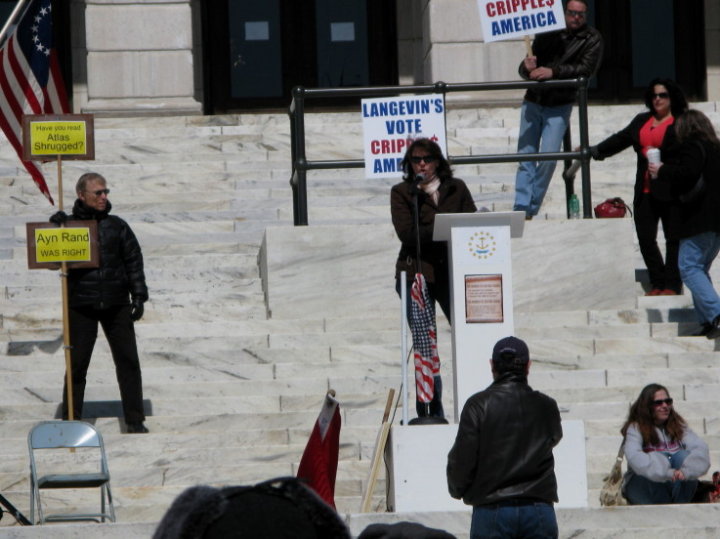
April 3, 2010
A Newly Aware America Confronting Old Tricks
Andrew Breitbart pulls together some of the threads related to the post-healthcare-vote anti-Tea Party redirection, concluding:
Who is calling the shots here? Is it the White House, by way of Chicago? Or is it Nancy Pelosi and Harry Reid? The press refused to tell you the truth about this president. It refused to tell you of his proud adherence to the teachings of the original Chicago "community organizer" Saul Alinsky. We have now entered the first full-fledged Alinsky presidency. The only way to beat Alinsky is with Alinsky. The Democrats and President Obama will not give up this tack. Do you think the GOP will win the day in November and in 2012 if its strategy is to apologize for every manufactured "right wing fringe" outrage?
I disagree about "the only way to beat Alinsky." I think it's honesty. That's why it's significant that he's becoming an increasingly understood figure. Fighting Alinsky with Alinsky would mean deception and manipulation, which many whom I've observed on the political right are not well suited to do effectively. Bright lights and proper conduct are the appropriate and most effective responses. Two notes on this front, one national and one local.
First, consider this small story, slipped into the inner pages of the Saturday paper:
David Brian Stone [leader of the recently FBI-stung militia group] never got too far in his plans. His influence didn't appear to extend much beyond a close circle of family and friends, and associates say other militias refused to come to his defense during raids late last month. ...Members of a group in Hutaree's own backyard — the Lenawee Volunteer Michigan Militia — not only refused to assist one of Stone's sons who fled the FBI after a raid on Saturday night, but they actually turned to authorities to help track down Joshua Stone.
I lack the time and interest to dig into the details and merits of the FBI investigation and raid, but the timing and the huge national splash certainly gives the impression that somebody is constructing a narrative stretching from the Tea Party movement, through the Republican Party, to the most fringe characters of the right.
Which brings us to a local item on which I've been meaning to comment:
Some people wore tri-cornered hats and waved yellow flags that proclaimed "Don't Tread On Me." Others brandished signs with more current messages aimed at Rhode Island's congressional delegation, such as "Abort the D.C. Thugs," with photos of Senators Jack Reed and Sheldon Whitehouse and Representatives Patrick Kennedy and James Langevin, and "LANGEVIN'S VOTE CRIPPLE$ AMERICA."
The "Abort the D.C. Thugs" sign lies at about the edge of what one expects at these rallies, but the one about Langevin, specifically, crosses the line. Indeed, it's so beyond the appropriate that one wonders why reporter Mike Stanton, or his on-scene surrogate, didn't attempt to procure the sign-wielder's name and extract further comment. Perhaps the journalists' caught a whiff of the reek of setup around the sign.
Anybody have a picture of that sign — especially of the person holding it?
March 31, 2010
The Process of Forcing Popular Will on the People
The March issue of First Things was an anniversary issue reprinting various pieces from past iterations, and a 1994 article by Russell Hittinger reconsidering the state of the political battlefield prior to the Supreme Court's Roe v. Wade decision sheds some light on the process of progressives implementation of policies with which the American people have their doubts (to put it mildly), first with contraceptives:
Garrow makes it clear that the "reproductive rights" movement won its victories in the federal courts, not in the legislatures. Interestingly, in the first Supreme Court case dealing with contraception, Poe v. Ullman (1961), Justice Felix Frankfurter was so astonished by the conservative legislative history that he asked, at oral argument, whether some "outside authoritarian power" had coerced the Connecticut legislature. Even after the Court struck down the Connecticut statute in1965, other states adamantly retained various kinds of anti-contraceptive statutes. The Supreme Court ripped these out of the states, one by one, until they finally managed to invalidate New York's law against the sale of contraceptives to minors in 1977. Even in the middle of the sexual revolution, states did not willingly relinquish their authority to exercise moral police powers in this matter.
Then with abortion and euthanasia:
For the historical record, it should be remembered that on the eve of the federally compelled abortion "right" the citizens of Michigan voted overwhelmingly against it; and let the historical record show that twenty-one years later, on the eve of a federally mandated "right" to physician-assisted euthanasia, the citizens of Washington voted it down. The idea that the federal courts have merely facilitated the social and political agenda of the people is a myth. The idea that the issues of abortion, euthanasia, and homosexuality are politically unmanageable, and must therefore be reserved for sub-political "cultural" discourse, is a myth. Regrettably, the pundits continue to overlook the most obvious and historically consistent datum: namely, the abrogation of the people's legislative judgment by federal courts. Before we condemn the people for their moral decline and insensitivity, the judicial violation of the political order must be fully considered.
We're seeing a repeat of the process with same-sex marriage. The left initiates a forceful push for its policies across the country, and voters mostly reject the ideas. But the extent to which advocates repeat their call (especially given their permeation of media industries) keeps the issue alive, with the frequency of mentions giving judges a false cover of popular support. Their declarations of "inevitability" are only accurate to the extent that we continue to allow them to take away our right to self governance.
March 24, 2010
Looking for an Accurate Name
Although I can already hear the howls of rage and scorn (especially from those farthest to the political left), I have to say that I kind of like this suggestion of Dennis Prager's:
3. Democrats should be referred to as Social Democrats.This is not meant to be cute, let alone a slur. But calling Democrats Social Democrats is an effective way of reminding Americans that there is no longer any difference between what is now known as the Democratic party and the Social Democratic parties of Europe. When the Democratic party returns to its roots as a liberal, not left-wing, party, we will happily resume calling the party by its original name. However, since no Democrat can cite a significant difference between the Democratic party and the SD parties, there is no good reason not to use the more accurate nomenclature.
March 22, 2010
The Fly Trap's Lure
This thought, from a review of a posthumous book by Jean-Francois Revel by David Pryce-Jones (subscription required), strikes me as particularly timely, today:
A couple of years after Furet's book, six equally reputable scholars published The Black Book of Communism, detailing how the experiment of Communism had cost about a hundred million helpless people their lives. It fascinated and appalled Revel that this book, in contrast to Furet's, was not well received but criticized as unnecessary, "visceral" again, somehow too much. Revel's conclusion from this strange example of double standards was that freedom is too demanding for some people and they will hanker after Communism even though it has irrefutably demonstrated its moral, political, and economic bankruptcy. The Left, in short, still refuses to treat centralization, a command economy, and equality of social outcomes as the impediments to freedom that they are.
Freedom naturally entails a certain degree of risk, and there will always be those who prey on fear of that risk to gain power for themselves or desire, for charitable reasons, to prevent it in the first place. Humanity is so constituted, however, as to long for freedom, and using the force of government to restrain it in broad, comprehensive strokes will inevitably have consequences far greater than an individual's choices possibly can.
March 3, 2010
Colleges Are Liberal Havens, Even When They're Catholic
It's interesting to see the political shifts of Catholic college students assessed on a scale of agreement with Catholic doctrine:
On pro-life issues, the results indicated a "mixed pattern," it said. A majority of Catholic students leave college disagreeing that abortion should be legal but they number fewer than those who entered with that opinion, it said. Overall 56 percent said they disagreed "strongly" or "somewhat" that "abortion should be legal." ...Like Catholic students at most public colleges, they moved toward agreeing with the church's position on the need to reduce the number of large and small weapons and its view that federal military spending should not be increased.
On the death penalty, 49 percent of Catholic students on Catholic campuses agreed "strongly" or "somewhat" with the church's opposition to the death penalty and were more likely than Catholic students at public colleges to agree with the church's social justice teaching on the need to reduce suffering in the world and "improve the human condition."
In brief, college moves kids to the left. Since the Church crosses the center line of Western politics, the students move toward the Church in some instances and away from it in others.
February 13, 2010
The Creators and Protectors of Civilization
Cassy Fiano is right to lambaste the callousness and selfishness of Courtney Cook, who took to the pages of Salon to explain how ideal a circumstance is presented to the military wife to initiate a separation and divorce from the deployed father of her children.
By her own telling, Cook took to Marxism and cowardly men while brooding about herself as her husband risked his life for their country, and her solipsism developed to the extent of this scene, which Fiano highlights:
Last July my son, the baby that was born to television coverage of Operation Desert Storm, said goodbye to his high school friends, shaved his head and enrolled in the United States Naval Academy. I am deeply proud of him, but it was my ex-husband who stood with my son on Induction Day. I could not bear to be there, could not watch the child of my body step away from the safe, civilian world I'd tried to so desperately to create for myself and him.
However "deeply proud" Cook may be of the son who's a "that," not a "who," and whom she could not support in her pride, she should heed the lesson of his choice. He understands, one suspects, that the safety of the civilian world was not of his mother's making, but of his father's.
February 4, 2010
From Zinn to Town Politics
I've got writing forthcoming on the matter locally, but for now, I'll remark that, somehow, I'm continually surprised by the extent to which people think we can run the world as if it were as we want it to be, not as it is. There's a point, in such discussions, at which we run off a reductive cliff; obviously, any understanding of the world will begin with basic assumptions. What I'm talking about is a tendency to ignore actual experience as a factor in subsequent decisions. One example: Play nice with unions, get burned, abused, and scammed, and return to the bargaining table the subsequent year striving for harmonious negotiations.
There seems to me something similar in the phenomenon of Howard Zinn, and Roger Kimball touches on it in an excellent postmortem take-down of his work:
To his credit — well, it's not really to his credit, since he offers the admission only to disarm criticism, but Zinn is entirely candid about the ideological nature of his opus. All history, he says, involves a choice of perspectives. Maybe so. Are we therefore to assume all perspectives are equally valuable? Zinn employs this relativist's sleight of hand in order to promulgate his preferred species of intolerance, which appeals to latitudinarian sensitivities only because it is an intolerance fabricated in opposition to the established order. If "all history is ideological" (it isn’t really), then why not make your choice based on what appeals to your political sympathies, truth be damned? That's the takeaway of Zinn's admission, and it's all he offers to explain his decision, which he details at the beginning of his book ...In other words, what Zinn offers us is not a corrective, but a distortion. It is as if someone said to you, "Would you like to see Versailles?" and then took you on a tour of a broken shed on the outskirts of the palace grounds. "You see, pretty shabby, isn't it?"
Kimball also points out that certain of Zinn's claims simply aren't true. But truth isn't the point for the historian's fans; Truth is, and therefore, the evidence must be subservient.
January 29, 2010
Pick Your Authoritarian
Commenting to my "That Anti-Republican Feeling," Dan writes:
Most people in this country self-identify as fiscally conservative and socially liberal. When people have to constantly choose between what they consider two evils (the socially authoritarian R's or the economically authoritarian D's), they either become utterly confused and vote for familiarity like this caller, or they become discouraged and stop participating in the system altogether, both of which support the corrupt status quo.
This false dichotomy is precisely one of the methods of cultural leverage that I was suggesting keeps voters feeling as if a vote for Republicans is a vote for evil. If the Democrats are too enthusiastic about the size of government (measured along a sliding scale of ever-greater intrusion), well, they're just wrong, but well intentioned. People who are just wrong can be persuaded. But if the Republicans are too enthusiastic about controlling personal behavior (measured along a sliding scale of ever-greater liberty), well, they must be animated by animus and are therefore beyond reason.
On the first analysis, these two "authoritarianisms" aren't comparable. Elected officials who advocate for smaller government are advocating their own limitation. To be sure, actual Republicans often fall far short of the ideals that the party espouses, but generally speaking, their social policies are defensive and aimed at preserving aspects of society and culture, not aggressive, and aimed at expanding their reach.
On the second analysis, the two categories aren't distinct. Sure, Democrats are happy to open the door for sexual dysfunction and permit the womb to be a killing field, but on matters of personal association and other liberties, such as those of religion and speech, they're not so sanguine. Moreover, their libertinism is married to their affection for government assistance. As I noted, the caller to Dan Yorke who began this conversation cited opposition to the welfare state as an example of his fiscal conservatism, but the welfare state is rooted in support for political policies and cultural trends that undermine self control.
Phrased from the opposite perspective, to the extent that Republicans are "authoritarian" on social issues, the purpose is to nudge society toward practices that ultimately enable greater liberty and alleviate the urge to use the government as a backstop. We can argue the specifics of implementation, of course. My view is that the federal government's role should not go much beyond maintaining the integrity of the states and the ability of individuals to affect state and local policy.
The point is that, to some extent, the choice that Dan describes really is an either/or that fiscally conservative social liberals strive not to address; a higher level of behavioral control must be maintained in order for a smaller government to be socially sustainable. More accurately, though, it's a choice between a nanny state that is actually authoritarian and a political philosophy in support of cultural developments that regulate some individual desires so as to enable a more profound freedom.
January 26, 2010
That Anti-Republican Feeling
An interesting call to the Dan Yorke Show as I was nearing home on my commute. The caller started out complaining about the corrupt, one-party political system in Rhode Island and then suggested that he simply couldn't vote for Republicans because, while he's fiscally conservative, he's socially liberal. He included opposition to the welfare state in his fiscal conservatism (erroneously, in my opinion). So, when Dan asked about social issues, he came up with abortion and same-sex marriage.
Dan got the caller to agree that abortion is a national issue, not a state issue, and asked (paraphrasing), "You're not putting same-sex marriage above the economic collapse of the state, are you?"
At that point, the caller switched to, "Well, Republicans can't govern." He said they're typically a rubber stamp. Assuming we're able to tease out the Rhode Island context, the caller thereby illustrated two of the attitudes that have helped to doom this state.
The first is the need for saviors, whether in the form of a person or a party. Having such a small minority is not going to be conducive to expert performance from Republicans. They do what they can, no doubt, but sometimes the going along thing can seem like a fair trade for some small pittance of success. To turn things around, one must vote Republicans into office so that (1) what they do carries the minimal weight of, well, mattering, and (2) people who might be reluctant to spend valuable time on a futile effort will increasingly see public office as worthwhile.
The second attitude, under which the first arguably falls, has been bred by decades of manipulation in movies, art, education, media, magazines, and so on that voting Republican is just a bad thing to do. Special interests have gotten a lot of return on that particular investment. The impression of too many Rhode Islanders that good people have to vote for Democrats has certainly helped unions and the welfare industry, and we're seeing the consequences, nationally, when the Democrats cash that chip in.
"Social issues," in other words, can be cover for intellectual laziness and moral cowardice. It's nice and vague and allows the voter to give in to the fully flourished seed of propaganda... without having to hurt the brain trying to dig up a plausible reason.
January 25, 2010
Identifying the Stealth
The Providence Journal ran this story on the front page, Saturday, with the headline "Stealth GOP effort helped Brown win." The first paragraphs surely give comfort to those who continue to prefer that the upset not be proof of real grassroots unrest and voter discontent with the Democrats' policies:
The stunning Republican come-from-behind victory in Massachusetts' special U.S. Senate election wasn't entirely a shock to Sen. John Cornyn, the chairman of the National Republican Senatorial Committee.The Texas senator had led a stealth Republican operation in the Bay State since December that quietly funneled top staffers, $1 million in cash and campaign knowhow to backstop Republican candidate Scott Brown.
But what constitutes stealth ought to be a question. Here, the Republicans just didn't advertise their financial support of a candidate in a critical (if long-odds) race. Further along in the article, reporter Maria Recio looks to give the other side's interpretation:
State Democrats dispute that they were in the dark about the national Republicans being in the state.
And what Democrat does Recio present as comparable to a Republican in elected office who sits on a committee to elect more Republicans?
"We were very much aware that this was a national election," said Tim Sullivan, the legislative and communications director for the Massachusetts AFL-CIO. "Contrary to popular belief, our side was running a campaign. When it came down to the race being a race, everyone got mobilized."
Perhaps the acronym needs an addition: D-AFL-CIO. Indeed, on the very same interior page as the above quotation is Randal Edgar's application to Rhode Island of the recent U.S. Supreme Court ruling on campaign finance legislation. The lead reads:
Campaign finance ruling could lead to more spending on ads by corporations and unions.
But three-quarters of the way through the story, one comes upon this:
"It allows too much special interests and lobbying," said Edward Eberle, a professor at the Roger Williams University School of Law. "And I think it makes whoever is up for reelection beholden to the special-interest groups."Also critical were William Lynch, chairman of the state’s Democratic Party, and George Nee, president of the AFL-CIO of Rhode Island.
I'm not sure how much more beholden Democrats could be to their major interest group when journalists treat party activists and interest group activists as interchangeable. One suspects that the unionists oppose loosened campaign finance rules because they're already so thoroughly interwoven with a political movement — and political party — that the slight leveling of the playing field that comes with allowing corporations to spend more money independently is far more of a threat than being able to spend their own money more overtly is a benefit.
January 16, 2010
Successfully Avoiding Divorce Requires Marriage
I've been meaning to point out a problem with Lefteris Pavlides's objection to a recent report that Rhode Island is among the unhappiest states in the country. Declares Pavlides:
Year after year the so-called "happy" states are on the top of broken homes and children in single families. For my money whole, two-parent families have a better chance at true happiness. The states with the highest divorce rates also have the lowest taxes, which means they have the lowest services for those suffering and the worst educational opportunities for their children. These not very children-friendly places can not be very happy.
His evidence for this claim is that the supposedly most happy states have higher divorce rates than the unhappy states. It's been a while since I dug into these numbers deeply, but I'm sure my 2004 discovery holds: Divorce rates are calculated per 1,000 of the population, not of marriages, and the states with the highest divorce rates per 1,000 residents also have much higher marriage rates per 1,000 residents.
If I were inclined to provocation, I'd suggest that married Northeasterners should hold on to their spouses for dear life... miserable people might find it difficult to find gold twice.
December 30, 2009
Whitehouse We Have Heard on High
It's a curious standard, that which Edward Fitzpatrick applies to Senator Sheldon Whitehouse's objectionable remarks on the Senate floor:
No doubt, those lines gave voice to the Democratic anger and frustration that mounts every time Sarah Palin posts more nonsense on Facebook. ...Perhaps it's good for Rhode Island to have a fiery, outspoken senator to go with the understated Sen. Jack Reed. Perhaps there is some political utility to such speeches. If Palin is going to be using her Twitter account to perpetuate the "death panel" idea (PolitiFact's "Lie of the Year"), maybe Democrats need to do more to fire back.
Fitzpatrick appears to conclude that, based on the math of the vote, Whitehouse could have afforded to take the high ground, in this case, but think of the interaction that he's describing and at least partially justifying: A woman who is at most an open-ended candidate, but currently just another political commentator, puts content on social networking Web sites, and a man elected to represent the people of Rhode Island fires back in an official, scripted speech from the floor of the national legislature. One shudders to think what other government institutions the Democrats will consider utilizing to "fire back" at citizens who express unhelpful objections on the Internet.
Also curious is Fitzpatrick's position in light of his column — back before the "summer of death panels and socialists" as he quotes Dana Milbank — praising Whitehouse for being "aggressive." That was in reference to Whitehouse's comparison of the Bush administration to the historical horrors that he now applies more broadly, to everybody who opposes his party's takeover of American healthcare.
I'd suggest that the high road was left back when President Transparency and Compromise took office and began showing his partisan closed curtains, not the least by releasing reports casting conservative beliefs as reason for suspicion of terrorism, and when Democrats like Sheldon Whitehouse pounded the metaphorical table about the need for a "truth commission."
ADDENDUM:
A side-note: Fitzpatrick cites the Obama-as-Hitler signage of Lyndon LaRouche supporters among the affronts to which Whitehouse is understandably reacting without mentioning that LaRouche is a Democrat. That information might be relevant to his narrative.
December 22, 2009
The Targets of Strident Progressivism
One further observation of interest with respect to Sen. Whitehouse's stridency is the target of his claims: However much he actually believes that Republicans are obstructing process and feeding off fear, he's surely comfortable assuming that he's safe from personal attack and that the nation is safe from the actual atrocities of which he warns. (Although, we're dangerously close to an attempt to derive coherent sense from his speech.)
Moving to other issues than healthcare, though, I'm sure Mark Steyn's suggestion would return to applicability:
Recently, the writer Barbara Kay testified to the House of Commons in Ottawa about a Jewish teacher at a francophone school in Ontario. Around 2002 she began to encounter explicitly anti-Semitic speech from Muslim students: "Does someone smell a Jew? It stinks here." "You are not human, you are a Jew." Had Anglo-Saxon skinheads essayed such jests, Oliver Kamm's warriors of secular pluralism would have crushed them like bugs. But when the teacher went to the principal, and the school board, and the local "hate-crimes unit," they all looked the other way and advised her that it would be easier if she retired. Sixty out of 75 French teachers at the school opted to leave: A couple were Jewish, a few more practicing Catholics, and most of the rest were the liberal secularists on whom Oliver Kamm's defense of the West rests. The francophone children withdrew, too. And now the principal and most of the students and faculty are Muslim.Maybe it would have wound up like that anyway. But having nothing to stand in your way except liberal progressives certainly accelerated the process. And as it went at one schoolhouse, so will it go on the broader horizon: If you believe in everything, you're unlikely to stand for something.
December 12, 2009
That Which You Cannot Believe
Frankly, I believe a newspaper should have the right to take this sort of action, but I think it sufficiently outrageous that advertisers and readers should react negatively:
Larry Grard, 58, of Winslow covered the November election for Maine Today, the vote in which Maine citizens rejected homosexual "marriage." Subsequently, he received a press release at work from a homosexual activist which read: "We will not allow the lies and hate – the foundation on which our opponents build their campaign --- to break our spirits." Being a devout Catholic, Grard was offended by the release's blanket reference to opponents of same-sex marriage.
So, using his private email accounte, Grard wrote back:
Who are the hateful, venom-spewing ones? Hint: Not the yes on 1 crowd. You hateful people have been spreading nothing but vitriol since this campaign began. Good riddance!
Subsequently, the long-time employee and his cooking-columnist wife lost their jobs with the paper. Message sent, I guess.
December 6, 2009
Anti-Intellectual Radicals
I've been meaning to offer kudos for this excellent letter by David Carlin, who is, somewhat surprisingly, a sociology and philosophy professor at CCRI:
The question of whether or not anti-SSM people are motivated by bigotry is an empirical question, and I submit (as would Dr. Harrop, I believe) that if their motives were empirically examined, it would be discovered that they are not so motivated. But those associated with the gay movement are rarely interested in this empirical question. Instead — behaving in a purely propagandistic and thoroughly unscientific manner — they simply classify anybody opposed to their agenda as "bigoted" and "homophobic." Thus no amount of empirical evidence to the contrary will persuade them to withdraw their accusations.One of my great objections to the gay movement is its profound anti-intellectualism — that is, its absolute refusal to keep its mind open to empirical evidence that might contradict its propaganda.
That's from the November 22 Providence Journal. I wonder whether the professor's had any threats against his job, or the like.
November 28, 2009
And Then There's Open Season on the Right
Further to Robert Wright's specious left-wing argument that we shouldn't battle terrorist organizations abroad because it might set off a few loons at home, take a moment to ponder this revelation:
A Kentucky census worker found naked, bound with duct tape and hanging from a tree with "fed" scrawled on his chest killed himself but staged his death to make it look like a homicide, authorities said Tuesday.
The lack of incidents notwithstanding, the American left and the mainstream media have made it such a forceful cliché that white, Christian, male conservatives are a violent horde stalking our nation that it's become the context for this sort of insurance fraud. You know, I don't think I've ever read a single opinion piece questioning the appropriateness of jumping to conclusions about and maligning right-wingers because of random incidents and statements on the grounds that it might drive us to a further sense of isolation and tendency toward violence.
Perhaps that's because the folks inclined toward such worries when it comes to other groups know that their worldview is a house of imaginary cards.
November 16, 2009
Vlog #10: An Individual Constitution
Wherein I respond to an op-ed by Rep. David Segal (D, Providence) suggesting that the grassroots tea party movement that so opposes the current establishment in Rhode Island would have naturally been inclined to support the old establishment back in the 1800s:
November 14, 2009
Did Somebody Mention Propaganda?
Curious to note that today marks the third time in four days that the Providence Journal has run the governor-as-bigot story on the front page. And unless I've missed it, the paper's reporters have yet to indicate that they've any interest in disrupting that there is nobody in Rhode Island whose views fall within any proximity to the governor's stance. Indeed, for today's article, Steve Peoples sought comment from Marriage Equality Rhode Island, but didn't apparently bother to call the National Organization for Marriage Rhode Island.
We'll see whether the newspaper's advocacy carries over to the big Sunday edition.
November 13, 2009
Never a Compelling Argument
I'm left with the depressing conclusion that Brian Hull actually believes this:
To finish up, Whitehouse spoke about the apparent disconnect from reality that is exhibited by the Republican Party, whether it be about health care reform, or the climate bill, or same-sex marriage. Their strategy is to foment fear and worry by relying on propaganda and appeals to emotion, rather than reason, common sense, or reality.
The evidence for a fair play turnabout is too voluminous to make any choices. You want to talk propaganda related to gay rights? Shall we catalog the invariably positive presentation of gays in popular culture alongside the dark stupidity attributed to traditionalists? Or how about emotionalism? Look no further than Bob Kerr, today:
This is a governor denying homosexuals dignity in death, denying them the very human right to bring love and grief together in a final tribute. It's cruel, heartless and despicable — not to mention predictable.
Agree or disagree (in any degree), it's clear that Kerr is appealing, here, to emotion, not reason. Or how about fear mongering? Well, turn to the letters section:
I am despondent over the direction of this country. The Tea Party protesters, while by no means the majority, will terrify the ignorant, which in turn will intimidate our elected officials.We are turning into Nazi Germany.
Clearly, neither side has the market cornered on reckless rhetoric and bad argumentation, but that's the point: Whitehouse and Hull either believe or are cynically perpetuating a Mickey Mouse view of political reality: If only we could ignore those bad people, then goodness would shine through! Whatever you do, don't be lured into believing that they might actually have honorable intentions and make a point or two worth considering.
It's an understandable tendency, to be sure, but inasmuch as Whitehouse is a U.S. Senator and Hull is sitting in a quasi-significant seat in Rhode Island's political scene, it threatens to continue to define civic discourse.
October 30, 2009
Who's Keener on Current Events?
The pro-Republican results of the Pew Research Poll, "What Does the Public Know?," (h/t) has led to some "rah rah" chatter on the right side of the blogosphere, partly inspired because the MSM isn't covering the results the same as they did previous polls showing opposite results. True enough, self-identified Republicans performed better than Democrats. Here's the snapshot:

What I'd like to point out, though, is that INDEPENDENTS also did better on most questions than DEMOCRATS. I wonder if this is a reflection of the Democrats recent political success. Have a portion of the Democratic voting electorate "checked out" from current events in the belief that "their guys/gals" will handle it? Does this reflect a hangover effect amongst the younger-skewing Democratic co-hort? More:
Overall, Americans ages 50 and older answered an average of 5.8 questions correctly, while those younger than age 30 answered an average of just four questions. College graduates got the highest scores among all of the groups analyzed (7.1 correct answers), while those with some college education averaged 5.3 correct answers and those with a high school education or less got 4.2 right.So, reading these results (warning: potential non-PC content!!!) it looks like that, on average, the most knowledgeable person is a 50+ year old Republican or independent man with a college education. The least knowledgeable is an under-30, Democratic woman with a high school education (or less). That is, generally speaking, of course!!!Republicans and independents each averaged 5.7 correct answers, compared with five correct among Democrats. Men correctly answered an average of 5.9 of the 12 items; women answered an average of 4.7.
October 21, 2009
Conservatives Are Dead Before They're Born
Jonah Goldberg has a good buck-up-young-conservative-soldier essay in a recent National Review (subscription required) in which he makes the observation that media liberals are suspiciously likely to predict that any emerging conservative movements will never get off the ground and then that their doom soon awaits, when they do. This line is particularly valuable as a spark for contemplation:
When liberals chalk up the tea-party protests and the like as racism, it is a slur, but it's also a wonderful sign that they won't even consider thinking seriously about their opposition.
Never forget to take that lack of consideration — that rank underestimation — into account when devising political strategy.
October 15, 2009
Irresistible Entry into the Left-Right Thumb Wrestle
Alright, so it's low-hanging fruit, but the letter to the editor reply of Nicholas Kondon (Hope Valley) to a prior letter by Evelyn Zifcak (North Smithfield) simply begs a response. Wrote Ms. Zifcak:
Tea parties get a bad rap, especially the Washington, D.C., march where 1 million folks from all over the country exercised their God-given and constitutional right to assemble and protest peacefully. Thank heaven that right is still alive and well!
To which Mr. Kondon rebuffs:
To begin with, can anyone provide us with the word of God that gives us the right to assemble and protest? Would we find that in the Old or New Testament? I’m sure it's there; God seems always to provide citations for the right wing.
Hmmm. I'm pretty sure the founding documents of our nation — not the Bible — offer the philosophical acknowledgment of our God-given rights as something prior to and superseding the state. The Declaration of Independence relates God, people, and the government thus:
We hold these truths to be self-evident, that all men are created equal, that they are endowed by their Creator with certain unalienable Rights, that among these are Life, Liberty and the pursuit of Happiness. — That to secure these rights, Governments are instituted among Men, deriving their just powers from the consent of the governed...
God grants rights, and the government secures them. Toward enumerating some of the more important or vulnerable of these rights, the U.S. Congress collected, and the United States adopted, a Bill of Rights, the first one of which includes the following language:
the right of the people peaceably to assemble
Kondon goes on:
With a casual wave of her hand, Ms Zifcak says some placards, only a few, "were in poor taste." In my lexicon, poor taste does not include comparing this president, or any president, to Hitler, or advocating his death.
One wonders what he thinks of the pictures to be found here of anti-Bush rallies. Perhaps he'll hold them to be something other than "poor taste," but whether he'd call them outrageous or well justified, I have my suspicions.
September 18, 2009
Yes, a Little State Can Learn from a Big State
Wouldn't it be refreshing if this sort of thing were written about our small Northeastern state?
[Texas] Republicans did not take the bait [to raise taxes]. Governor [Rick] Perry told the legislature to not even bother sending him a bill with a tax increase, because he would not sign it. Instead, he submitted a budget in which every spending line was a zero — an act of political theater, to be sure, but an effective one. Republicans ran a classic good-cop/bad-cop routine on the bureaucracy, with Perry taking a hard line against tax increases and Rep. Talmadge Heflin, at that time the new Republican chairman of the Appropriations Committee, meeting with the heads of the state's 35 largest agencies and asking them to start from zero. The agency chiefs were told that they had to keep spending at less than 87.5 percent of the previous year's level, draconian cuts by the standards of most state governments, but they were given maximum flexibility in achieving those goals.
Particulars can vary; ultimately the philosophy is what's important:
"There are certain truths that have to be agreed to," Perry says. "One is that economies grow when they are free from over-taxation, over-regulation, over-litigation, and they have a skilled work force. Government isn't difficult in theory — don't spend all the money, keep taxes low, have a fair and predictable regulatory climate, keep frivolous lawsuits to a minimum, and fund an accountable education system so that you have a skilled work force available. Then get the hell out of the way and let the private sector do what the private sector does best. It's simple in theory, but it's difficult to accomplish. In Texas, we've implemented that theory, and it's produced an economy that has no match in America."
That description looks like the photo negative of Rhode Island.
September 13, 2009
Psychopaths and Public Debate
The horrible story of senseless killings in Owosso, Michigan, clarifies social dynamics that were the subject of debate after the murder of abortionist George Tiller:
Harlan Drake or "Hale" as he is known to friends is now charged with 2 counts of 1st Degree Premeditated Murder for the killings of James “Jim” Pouillon and Mike Fouss. Police say that Harlan Drake has told detectives that he had a list of 3 people in his head that he wanted to kill.Two of the people on his "list" have died as a result but the third, James Howe, was not attacked. Since he has admitted to a third person on his hit list, it is resulting in a charge of unlawful intent with a firearm. There is no motive behind Mr. Howe or Mr. Fuoss, who owned the Fouss Gravel Company. There is only one known connection between Mike Fouss and Harlan Drake, his mother used to work for Mr. Fouss.
As to the reason for the killing of pro-life activist Jim Pouillon, Harlan Drake has told police that he was “offended” by Pouillon’s anti-abortion messages.
The bottom-line, substantive fact is that Drake is a psychopath who decided to kill three people for random, personal reasons. A consideration on the periphery of that fact is that the nation in which Drake lived is in the midst of a decades' long dispute about abortion in which those on the pro-abortion side often argue that the protests by those on the pro-life side are so egregious that their First Amendment rights ought to be denied. After George Tiller's death, they also tarred the entire pro-life movement as culpable.
But those who advocate for abortion laws are not responsible for the murder of Jim Pouillon. The possibility that psychopaths might follow threads of the argument is an inevitable price of a free and open society and does not negate the rights or stain the morality of those who engage in the debate, much less those on one particular side or the other.
September 10, 2009
An Inexorable Pull of Echo Chamber Snark?
Putting down his column about the race for attorney general of Rhode Island, I thought about what an improvement the Providence Journal's Ed Fitzpatrick is over his predecessor. And then he had to go and write a bit of got-a-laugh-at-the-cocktail-party received wisdom like his reaction to the story of parents opting their children out of the President's speech to school children. His general position is hardly indefensible, and for the most part, I agree with him, but there's a big ol' blob of the goo that dribbles out from a bias of which mainstream media types remain amazingly unaware:
After listening to right-wing talk show hosts, Web sites and Republican Party officials, I wouldn't be a bit surprised if Mr. Obama tells my first grader how to use condoms and exchange needles. I think Florida GOP Chairman Jim Greer spoke for all of us when he said he was "appalled that taxpayer dollars are being used to spread President Obama's socialist ideology."
A state party chairman is now a representative of an army of right-leaning Americans? Clearly, Fitzpatrick didn't (and doesn't) actually spend much time reviewing the content of radio talk shows and conservative Web sites, because there is no way he would have failed to be cognizant of the fact that complaints arose most especially from the classroom discussion suggestions. And if he had encountered such points, he would surely have used his prominent space in the state's major newspaper to explore more intricate themes, rather than riff on that unwashed class of right-wing "others."
Instead, because he hadn't bothered to investigate the other side, he proved himself of a kind with Bob Kerr, who used his similarly prominent space toward almost the same ends, with a very minor variation in hue.
September 6, 2009
Liberté ou Égalité
It is, unfortunately, behind a subscriber wall, but John O'Sullivan's recent article about types of revolutions (taking recent unrest in Iran as a starting point) is excellent fodder for Sunday afternoon pondering, while mowing the lawn or whatever you have to do today.
In essence, O'Sullivan follows a speech by Italian President Fancesco Cossiga in the '90s reviewing five revolutions that grouped into liberal (what modern politics would characterize as "conservative") and anti-liberal (leftist, progressive). O'Sullivan writes that "the aesthetics of revolution have been captured by the Left, including the fascist Left, so that we often fail to recognize a revolution carried out on other principles." On the liberal (conservative) side fall England's Glorious Revolution of 1688 and the American Revolution of 1776, expanding liberty and transforming government into a body of representatives.
That is emphatically not true of either the French Revolution of 1789 or the Bolshevik Revolution of 1917. As Cossiga pointed out, these revolutions were anti-liberal revolutions hostile to the liberties, both real and procedural, central to 1776 and 1688. That is less clear in the case of 1789, because the early French revolutionaries thought they were introducing into France the same reforms they had admired in England and America. But as several scholars have observed, most recently Portuguese professor Joao Espada in his essay "Edmund Burke and the Anglo-American Tradition of Liberty," very different conceptions of liberty underlay their reforms. Whereas the Anglo-Americans saw liberty as a system of government that allowed people to pursue different ways of life, their Continental imitators saw it as a particular way of life that, if necessary, might have to be imposed on those mistakenly enslaved to tradition, religion, inequality, or whatever. Eradicating tradition, religion, inequality, or anything else to which people are strongly attached, however, requires abolishing their freedom, usually bloodily. Hence the revolution of 1789 became more plainly anti-liberal and more violent as it ground relentlessly on.
September 1, 2009
The Thing About Taxation
Oswald Krell is at it, again — proving, this time, that beating a strawman for long enough begins to resemble a pillow fight against one's self:
Low tax states are more violent, have higher rates of teen pregnancy, somewhat higher poverty rates, and lower median incomes.Do low taxes cause these problems? No. Correlation is not causation.
Rather, to me, what is emerging is the description of an attitude. Low-tax proponents favor "Stand on your own" rhetoric, which is really a coded term for letting the rich shirk their civic obligations. The result is that the bulk of the population is noticibly worse off in low-tax states: more violence, more teen pregnancy, more poverty, lower incomes.
Now, explain to me: why this is an attractive paradigm?
I repeat: The argument for taxes in Rhode Island isn't that low rates are the decisive factor in a given region's economy, and adding social data doesn't change the fact that people and businesses do take the cost of government into consideration.when they plot their financial lives. The question that Rhode Island's progressives are so studiously striving to ignore is that taxation must be judged based on a given state's circumstances, and Rhode Island is overburdened with them, as with other manifestations of big government like mandates and regulations. "We will let you operate your business as you see fit and to keep more of what you earn" need not be innuendo for gun violence and teen pregnancy.
Lower taxes and lightened regulations would encourage economic activity and improve the earning potential of all residents, which I'm reasonably certain would correlate positively with improved social markers in the state, as well. (Krell doesn't provide his sources, so I'll simply offer the hypothesis that Rhode Island fares poorly, by such measures, compared with similar states.)
That's a suggestion that RIFuture-owner Brian Hull should consider, as well:
The recession effect is having a profound impact on the state's economy, but the long-term financing of the state would be better served if the General Assembly would make the "tough choices" and restructure the tax code, shifting the burden away from the vast majority of Rhode Islanders who have seen their incomes shrink and are struggling to make ends meet.
For perspective, don't lose sight of the fact that, in the name of improving the economy, Hull wants both to raise taxes and to shift them toward a particular group. Apart from being manifestly unjust, such a strategy would be economically devastating. What, pray tell, would Hull like to change about this picture:
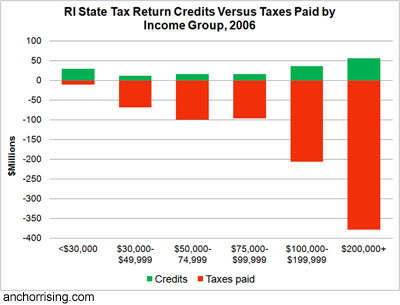
Me, I'd like to see less red across the board.
Zigging Left When They Should Zag Right
Not being sufficiently well versed in Japanese politics, I won't enter the discussion about just how "conservative" the country's Liberal Democratic Party has been, but the expressed plans of the more-liberal Democratic Party that just won control don't bode promisingly:
Fed up with the [LDP], voters turned overwhelmingly to the opposition Democratic Party of Japan, which ran a populist-leaning platform with plans for cash handouts to families with children and expanding the social safety net.
Somehow, Chris Powell's dark hopes for Connecticut seem related:
Since the poor and troubled long have been only a pretext for the government class, and since this long has been the caliber of Connecticut's political life, that's the way it will continue to be.Maybe at some point the human suffering, the social disintegration and the disintegration of the cities, and the many policy failures will prompt enough citizens to ask their governor and legislators how this can be amid the comfort of the government class, how this can be after billions in appropriations over decades in the name of alleviating poverty and other problems that have only worsened, and why nothing grows in Connecticut anymore except government itself. But that point is not yet.
August 31, 2009
A Warm Anchor Rising Critique Welcome to Brian Hull
We'd like to welcome, of course, Brian Hull to the RI blogscene in his new role as proprietor of RIFuture. I, for one, am hopeful for a return to the collegiality of the Matt Jerzyk years and am determined not to be the cause should that prove unworkable.
That said, what better method of offering a cyber handshake and slap on the back could there be than highlighting our fundamental differences? And they must be fundamental, because this argument seems flatly erroneous to me:
There is a real big problem with the [state government] shutdown days, over and above the forced pay cut of 4.6% that the employees will have to absorb. We already have a weak economy, and to essentially take another $17.3 million out of it won't make things any better. Consumer spending makes up the bulk of GDP, nationally and in the state. Add the multiplier effect and every dollar spent generates a dollar plus in economic activity. By stripping out $17.3 million from the local economy of Rhode Island, we're going to depress the economy by much more than $17.3 million. This is not a good thing.
Yet:
We're in a recession, and while the recession might be getting better, there is no indication that employment will bounce back anytime soon. This will mean a suppressed economic situation in RI potentially for years to come. The unfortunate reality is that we need to raise revenues. And that means higher taxes.
We could certainly dip into the argument over whether state workers or taxpayers would use money in a more economically productive fashion. Even if we ignore the fact that it costs the government money to collect taxes, but nothing not to collect them, and even if we accept that new taxes would skew toward the higher end of the economic spectrum (which I assume would be Brian's preference), I'd argue that the business owners and wealthy residents thus implicated would be apt to spend additional money in a way that maximizes the multiplier effect.
The more direct point, though, is that Brian's appeal to the need to leave money in the economy ought to suggest a different form of government cut than to the labor force. Instead, he merely argues for redistribution.
He doesn't even advocate for easing restrictions, regulations, and mandates on businesses and productive individuals as a way of increasing economic activity and, thus, government revenue. One gets the impression, from his post, that "taxpayer dollars" exist in some sort of pool outside of the economy that folks won't "be happy about paying" to the government, but that they otherwise won't use.
August 23, 2009
Bob Kerr's Condescension
Sometimes Bob Kerr is really difficult to take, and I'm beginning to put my finger on the reason. In his Friday column, he characterized Rep. Barney Frank's quip that conversation with a particular town hall participant would be like "trying to have a conversation with a dining room table" and query as to her planet of origin as "a small, witty and welcome comeback." From Frank and Kerr's perspective the response was justified, but it takes a smarmy condescension objectively to declare that a powerful man telling a young lady among the public that she's like a table was merely small and witty.
The statement recalls another instance, just after the election, when Kerr described this bumper sticker as "clever and funny and not mean-spirited": "Joe the Plumber, Meet Barack the President." Not mean-spirited because Kerr says it to be so. And now, with anxious Americans crowding town hall meetings and unable to keep the cool tone of a LaRouche supporter making Nazi comparisons, Kerr opines:
So maybe, just maybe, a big bunch of us will look at how close we are coming to a total breakdown in the way we are supposed to conduct our public business. We might even be embarrassed and disturbed at how a calculated sideshow of irrational raving has threatened to keep us from learning the things we need to know. We might want to try reasonable debate again.
Does Kerr allocate some of the blame to an administration that, as one of its first acts, released a report broadly citing conservatives as potential terrorists, thus signaling how it perceived opposing views? No. Does he urge restraint from a Democrat Congress that's been passing expensive, power-grabbing legislation like rectal gas, in such a way as to diminish the opportunity for the American people to have their opinions considered? Nope. Does he take to task members of the mainstream media — ostensibly objective reporters — who openly mock citizens who disagree with the liberal line? Yeah, right. Does he sympathize that a ravenous government and the various strata of elites who unquestioningly support it are scaring a large number of the hoi polloi? Not on your life.
How fortuitous that the same issue of the Providence Journal should print an op-ed by James Haught drawing our attention away from the current administration to call President Bush "a religious crackpot, an ex-drunk of small intellect who 'got saved.'" Should we expect critiques from Kerr of the visceral hatred from his co-leftists?
I suspect not. The opinions of the likes of Kerr is clear: We, the smart people, are now in power, and the rest of you should just shut up and listen.
August 19, 2009

Gut Feeling Confirmed: ACORN Disavows Langevin Event E-Mail
Following up on Justin's unease, I conveyed the e-mail in question to the Rhode Island office of ACORN. They responded quickly with the following statement.
An e-mail from Rhode Island Young Republicans that supposedly included an e-mail message from ACORN to our members is entirely a hoax and a fabrication. We have seen this pattern across the country, where right wing and Republican elements are attempting to stoke up their base using these entirely fabricated lies about ACORN. Around the country ACORN is engaged in the fight for quality, affordable health care, and believe it is every American's right and privilege to voice their opinion and attend town hall meetings. But for the record:a) ACORN has never had a plan to attend Congressman Langevin's Town Hall meeting; and
b) The e-mail that was supposedly from ACORN to our members is a total fabrication.
Let us pause here to note the inherently non-solid, often non-verifiable nature of electronic mail. The Young Republicans may well have received and then passed along the e-mail in good faith. (I've e-mailed them to ask the source of the e-mail, though, upon reflection, that might have been a silly question.) ACORN has denied sending the e-mail. Still a mystery, however, is its author and originator, who may be
- a friend of ACORN,- a friend of the Young Republicans or
- an uninvolved third party trying to create mischief.
August 18, 2009
Just a Gut Feeling
By now, you've probably seen somebody or other mentioning this:
As you are aware in our prior email, we need your presence at Congressman James Langevin's Town Hall Meeting at the Warwick police Station 99 Veterans Memorial Drive, Warwick, Rhode Island. We are planning on arriving early at 1:30PM to fill the hall before the radical right protestors arrive. A box lunch will be provided for those on the bus. We will meet at headquarters for those wishing to join us on the bus. Thank you!The Acorn Team
Something about it just doesn't resonate right, for me. I suppose poor grammar mightn't be a stretch in an authentic email from ACORN, but the fact that the signature doesn't all-cap the group's name is odd. The fact that the announcement gives the address of the destination, but not the address of "headquarters" is peculiar, too, for a leading organizational group on the dark side.
It could be legitimate, of course, and even if it is not, those who've been spreading it around aren't necessarily aware of its fraudulence. But a whole collection of groups have posted or forwarded the email, and I believe it's been mentioned on talk radio, as well. If tomorrow comes and there's no gang of ACORN members wiping crumbs off their chins, a number of folks are going to have unnecessarily lost some credibility for future announcements.
August 17, 2009
The Casual Assumption of Correctitude
There are surely practitioners of the stratagem on both political wings, and it's the sort of ploy into which one can slip from time to time, but it seems to me that it is much more characteristic of liberals to weave rhetorical comforters that allow them to slip opinions through as objective fact. This, from Jamison Foser of the liberal Media Matters, is a fine sample. After 75% of a conspicuously benign essay on the need for substantive discussion of the healthcare legislation, this paragraph rolls across the table:
When you see people yelling, "Keep your government hands off my Medicare," that's a clear sign that the public needs some solid facts. How many people do you think know that health-care reform with a strong public option would cost taxpayers less than a plan without such an option? I bet that a distressingly large number of members of Congress don't know that, and that very, very few voters do.
Thus, wrapped in a blanket of mutually agreeable observations about a heated debate, Foser slips through the talking point that really ought to be the object of his argument — because it's a point that actually requires argument. Given the organization for which he writes, promulgating the assertion about costs probably is the objective of the piece, even though it's offered in a tone of "for example."
Ponder, for a moment, the not-so-fine distinction between error and misinformation. On the surface, here, Media Matters is requesting bias; in actuality, the group is endeavoring to insert it.
August 13, 2009
An Old Tale in a New Context
Bill Sammon recalls a day, back in 2002:
When Bush visited Portland, Ore., for a fundraiser, protesters stalked his motorcade, assailed his limousine and stoned a car containing his advisers. Chanting "Bush is a terrorist!", the demonstrators bullied passers-by, including gay softball players and a wheelchair-bound grandfather with multiple sclerosis.One protester even brandished a sign that seemed to advocate Bush's assassination. The man held a large photo of Bush that had been doctored to show a gun barrel pressed against his temple.
Oddly, as Sammon points out, the media that is so keen to make readers, viewers, and listeners aware of the anger of those who oppose (if I may reuse the phrase) the Democrats' federal powergrab in a porcine "healthcare reform" costume was uninterested in Bush's riotous reception. This, of course, is merely one example of history repeating itself with a different accent. When President Obama derides "scare tactics," I can't help but recall this:
That, for those who weren't blogging seven years ago, is a screenshot from an online advertisement put out by the Democratic National Committee. Scare tactics were institutional, back in the day.
While routing around in my old archives, I came across this quotation from FBI profiler Gregg McCrary, conveyed to Washington Post readers that same month:
"White males belong to a long-advantaged group that is now having to share power and control. But I think it has less to do with race than social class."
The context was the search for the Washington sniper. You might recall that, of the various possible profiles, the one about which we heard most frequently was of the angry white supremacist Christian militia variation. You might also recall that the snipers turned out to be black, which fact didn't seem to matter to some aspects of the coverage:

The interesting parallel, though, comes in this paragraph from Harold Meyerson, which arrived in my morning paper the other day:
When future historians look back at this passage in our nation's history, I suspect they'll conclude that this Obama-isn't-American nuttiness refracted the insecurities and, in some cases, the hatred that a portion of conservative white America felt about having a black president and about the transformation of what many thought of as their white nation into a genuinely multiracial republic. But whatever the reasons, a mobilized minority is making a very plausible play to thwart a demobilized majority.
Unsurprisingly, Meyerson's reflections spring from the healthcare townhalls. "What's particularly curious about these two protests," he writes, "is that they took place on very liberal turf — Philadelphia and Austin — yet the local liberals and people of color seemed absent." Bused-in angry white mobs, you might say. In contrast to the bused-in friendly multicultural mob with which Obama set the scene for his own townhall appearance thereby disproving the "demobilized majority" thesis.
The lesson, it would seem, is that angry whites are the villains whether they're the majority, the minority, the origin of a particular policy, the opposition, guilty, or innocent. What ought to be as clear blue as whitey's eyes, at this point, is that racial division has long been serving a leftist agenda, and whether there is a new, emerging majority or a left-wing minority has been deftly pulling together the strings of power, the tone has colored opposing voices not merely as wrong, but as hateful and illegitimate participants.
Those who present such a view as part of a political strategy manipulate the insecurities of the public. And although it's a too easy psychological analysis to make, one does wonder whether those whom the manipulators thus persuade are, themselves, uncomfortable with a multicultural society, giving themselves moral credit for resisting the impulse and believing those who disagree on unrelated political matters to be succumbing to it.
(Links compiled from various sources, but conspicuously from Instapundit both then and now.)
August 11, 2009
Unions Sowing Fear in the Streets
As a follow-up on the subject of organized labor stoking civil violence, it turns out that one of the Service Employees International Union (SEIU) members who crossed into physical violence in St. Louis wasn't just a overexcited layman:
Elston K. McCowan is a former organizer - now the Public Service Director of SEIU Local 2000 - and board member of the Walbridge Community Education Center, and is a Baptist minister, has been a community organizer for more than 23 years, and now, he is running for Mayor of the City of St. Louis under the Green Party.
As Clarice Feldman observes, McCowan "is the union"; he's one of the guys who "issues the cards."
Join that with an SEIU memo in Connecticut that explicitly instructs supporters to "drown out" those who oppose the healthcare power grab. The line between "being heard" and "making not heard" is not so subtle. The former is an expression of democratic process. The latter indicates an intention to bully the opposition into simply staying home in the interest of their own safety.
In Michigan, a man who confronted Rep. John Dingell (D., Michigan) about the availability of resources, under Obamacare, for his son's cerebral palsy subsequently received a visit in the middle of the night. Welcome to hope and change.
August 10, 2009
The Origin of Civic Violence
It does more than prove the group's extremely low opinion of its audience's awareness and intelligence that a propaganda video from the Service Employees International Union (SEIU) ends with the scene just after a half-dozen of its members, with racial slurs on their lips, had beaten up somebody protesting Congress's intentions with healthcare. Just after the incident, an overweight man with a cane, and wearing an SEIU t-shirt, walks toward the dissipating scuffle; the video strongly implies that the violence originated with the conservative activists and victimized peaceful union demonstrators. After the fade to black, we hear, "You just attacked that guy," and the video's producers are content to let the viewer infer the opposite of the truth.
The larger point that this audacity proves is that the people behind organized labor have little concern for truth and will rush to rewrite history in the most brazen fashion. So let's recall the time line:
- Per established strategy, the Obama administration and Congressional Democrats declared an urgency to pass healthcare-overhaul legislation before legislators' knees could be weakened by expected constituent opposition, or perhaps by simply reading and understanding the bill that they were being asked to transform into law.
- Many of those constituents set out to have their voices heard before the Democrats' urgency crossed the line to a done deal. Not surprisingly, when they had an elected representative's attention, their passion came through.
- Union thugs tipped one such event beyond the border into violence, although it should be noted that there's no indication that the conservative activists fought back with more force than necessary to stop an attack.
- Now, union leaders wish to foster a sense of victimhood and impending threat among their supporters.
And now the face of Rhode Island union thuggery, Patrick Crowley, stops only a few breaths from declaring, "Get the brass knuckles, boys":
This is nothing.And if this scares the people who support health care, or voted for Obama, or a good liberals/progressives, my question to you is: what are you going to do about it?
Are you going to send an email? Maybe call the RNC to complain?
Or are you going to do something more? Do you really think an email is going to stop people like this?
His latest update to the post shouts, "NOW WHAT ARE YOU PREPARED TO DO?"
And thus do leftist organizers usher in the fascism that motivates their lesser activities. Conservative citizens of the United States of America have showed no desire to step beyond letting their representatives know in no uncertain terms that they want the legislative process to work in their favor. Unions and progressives, by contrast, are itching for an excuse to roll over the objects of their hatred in a steamroller of fists and jackboots.
The most disgusting part is the complicity of school teachers, via their union, in promoting people who promote violence. It was the National Education Association of Rhode Island, after all, that lent Crowley an air of credibility.
Luckily, sunshine frightens a troll, so if anybody asks members of the right, "What are you prepared to do?," we can stand firm on principle. "Pull them into the light," we can say. Just keep talking (and taping). When the truth is on your side, it isn't a stretch to suggest that email is going to stop people like this.
August 7, 2009
The First Murmurs of Political Ugliness
John Loughlin, the presumed Republican candidate for Patrick Kennedy's seat in Congress, has issued a press release stating that "the Congressman has a basic obligation to share his in-depth knowledge" about healthcare legislation at three to five town-hall-style meetings. As a matter of an elected representative's responsibility, Loughlin is absolutely correct, but constituents might have cause to worry that the ordeal of such meetings might send Patrick back into preventive rehab. The "debate" is getting ugly.
After a few instances of citizens' displaying their passion about the Democrats' federal powergrab in a porcine "healthcare reform" costume, party figures have been striving to prove that nobody does divisiveness as well as they do:
Democrats and the White House are claiming that the sometimes rowdy protests that have disrupted Democratic lawmakers' meetings and health care events around the country are largely orchestrated from afar by insurers, lobbyists, Republican Party activists and others.
Jonah Goldberg goes into further detail about the Democrats' attacks on American citizens. Peggy Noonan took up the topic for the must-read piece to which Marc linked earlier. Noonan highlights the looks of shock that have been characteristic of the Democrats who've been experiencing Americans' frustration. "They had no idea how people were feeling," she writes, and she ends on a note of concern that their leaders and allies see more need for forehead-to-forehead response than for the much-invoked empathy:
Absent [President Obama calling for a pause in the debate], and let's assume that won't happen, the health-care protesters have to make sure they don’t get too hot, or get out of hand. They haven’t so far, they’ve been burly and full of debate, with plenty of booing. This is democracy’s great barbaric yawp. But every day the meetings seem just a little angrier, and people who are afraid—who have been made afraid, and left to be afraid—can get swept up. As this column is written, there comes word that John Sweeney of the AFL-CIO has announced he’ll be sending in union members to the meetings to counter health care’s critics.
If, like me, you've come across news of a beating that apparent members of the Service Employees International Union (SEIU) delivered to a grassroots activist in Missouri, and watched the video of the aftermath, Noonan's final chord is chilling.
To be sure, meeting constituent unrest with union thuggery is probably not what White House Deputy Chief of Staff Jim Messina meant when he told Senate Democrats, "If you get hit, we will punch back twice as hard," but the imagery is telling. And dangerous. Citizen ire is going to turn into bloodsport politics, in part because ostensible leaders prefer to battle than to listen.
Here Are Yer Angry Mobs!!!
Dana Loesch has some pictures of the "angry mobs" showing up at the Health Care Town Halls (you know, where there is supposed to be an open discussion, yada yada yada). Here's an example:

Scary!
The leftosphere and the liberal commentariat charged that the town hall meetings weren’t authentic, the crowds were ginned up by insurance companies, lobbyists and the Republican National Committee. But you can’t get people to leave their homes and go to a meeting with a congressman (of all people) unless they are engaged to the point of passion. And what tends to agitate people most is the idea of loss—loss of money hard earned, loss of autonomy, loss of the few things that work in a great sweeping away of those that don’t.People are not automatons. They show up only if they care.
What the town-hall meetings represent is a feeling of rebellion, an uprising against change they do not believe in. And the Democratic response has been stunningly crude and aggressive. It has been to attack. Nancy Pelosi, the speaker of the United States House of Representatives, accused the people at the meetings of “carrying swastikas and symbols like that.” (Apparently one protester held a hand-lettered sign with a “no” slash over a swastika.) But they are not Nazis, they’re Americans. Some of them looked like they’d actually spent some time fighting Nazis.
July 29, 2009
Tolerance!
Remind me, again, who the intolerant bigots are?
The police are investigating an assault Tuesday on Bald Hill Road.The weapon of choice: soda, salsa, eggs ...
"Your basic garden variety of food condiments," Capt. Robert Nelson said Wednesday.
It started as the four men stood at the median on Bald Hill Road and East Avenue around 2:40 p.m. protesting against same-sex marriage.
The location, Nelson noted, afforded them a roomy median and prime visibility.
They caught the attention of a group of women in one of the cars.
The women, who apparently objected to their message, flung a soda bottle at the men and vowed to return.
And back they were, about 15 minutes later, hurling at the men a mélange of food ingredients and drinks and a full repertoire of profanities, Nelson said.
One of the women swashed a protester with pepper spray.
No one was hurt and no arrests have been made, Nelson said
Note the jocular tone Maria Armental applies to her reportage and, in the game that is becoming all too frequently appropriate, imagine how the story would be presented if the men had been protesting for same-sex marriage.
July 22, 2009
"Blue State Meltdown"
Joel Klotkin's "The Blue-State Meltdown and the Collapse of the Chicago Model" contrasts the political power held by blue-state liberals:
On the surface this should be the moment the Blue Man basks in glory. The most urbane president since John Kennedy sits in the White House. A San Francisco liberal runs the House of Representatives while the key committees are controlled by representatives of Boston, Manhattan, Beverly Hills, and the Bay Area—bastions of the gentry.With current economic and demographic realities:Despite his famous no-blue-states-no-red-states-just-the-United-States statement, more than 90 percent of the top 300 administration officials come from states carried last year by President Obama. The inner cabinet—the key officials—hail almost entirely from a handful of cities, starting with Chicago but also including New York, Los Angeles, and the San Francisco area.
This administration shares all the basic prejudices of the Blue Man including his instinctive distaste for “sprawl,” cars, and factories. In contrast, policy is tilting to favor all the basic blue-state economic food groups—public employees, university researchers, Silicon Valley, Hollywood, Wall Street, and the major urban land interests.
Yet despite all this, the blue states appear to be continuing their decades-long meltdown. “Hope” may still sell among media pundits and café society, but the bad economy, increasingly now Obama’s, is causing serious pain to millions of ordinary people who happen to live in the left-leaning part of America.He also explains why blue-states, like Rhode Island, may have a hard time turning around because of a deep-seated "political economy" based on "the relentless expansion of public sector employment and political power."For example, while state and local budget crises have extended to some red states, the most severe fiscal and economic basket cases largely are concentrated in places such as New York, New Jersey, Illinois, Pennsylvania, Michigan, Oregon, and, perhaps most vividly of all, California. The last three have among the highest unemployment rates in the country; all the aforementioned are deeply in debt and have been forced to impose employee cutbacks and higher taxes almost certain to blunt a strong recovery.
The East Coast–dominated media, of course, wants to claim that we have reached “the twilight” of Sunbelt growth. This observation seems a bit premature. Instead, traditional red-state strongholds such as the Dakotas, Idaho, Texas, Utah, and North Carolina, dominated the list of fastest-growing regions recently compiled for Forbes by my colleagues at www.newgeography.com.
Although traditional progressives such as Franklin D. Roosevelt, Harry Truman, Fiorello La Guardia, and Pat Brown built up government employment, they never contemplated the growth of public employee unions that have emerged so powerfully since the 1960s.I'm not sure if Klotkin is implying that public sector workers aren't part of the "regular" middle class, but I would certainly include them. And in Rhode Island they just may be its "essence" by virtue of the number of Rhode Islanders who work in the public sector or are related to someone who does. That would help explain the resistance to change exhibited at the polling place year after year.Public sector employees initially played a positive role, assuring that the basic infrastructure—schools, roads, subways, sewers, water, and other basic sinews of society and the economy—functioned properly. But as much of the private economy moved out of places such as New York, Illinois, and, more recently, California, public sector employment began to grow as an end to itself.
Some blue-state theorists, columnist Harold Meyerson among them, have identified this new, highly unionized public sector workforce not so much an adjunct to the middle class but its essence. This has become very much the reality in many core blue regions—particularly big cities like New York, Chicago, and Detroit—as the private-sector middle class has drifted to the suburbs or out to the red states.
July 12, 2009
Ignorance Is Antithetical to Freedom
Keith Stokes adds some welcome historical perspective to the manufactured controversy about the last word in the state's official name — Rhode Island and Providence Plantations:
The historic use of the word plantation does not simply refer to early farms or settlements. It was specifically crafted and applied by our founding settlers as a means to express their newly achieved experience of religious liberty and expression.The word as part of our official state name was also influenced by the sermons and writings of one of New England's most prominent 17th Century clergyman: the Rev. John Cotton. Cotton was a Puritan and religious scholar who greatly influenced early Rhode Island Colony founders Roger Williams, John Clarke and Ann Hutchinson. His sermons included references to "A plantation of them into the promised land," contemplating the search for religious freedom of the Puritans and the real possibility of finding it in the new world. ...
This section of the charter refers to the Plantations name alongside the naming of our first settlement Providence, as the recognition that God (and through his divine providence) had guided these settlers in search of religious self-determination to form this new colony. It is imperative that all Rhode Islanders recognize that the name Plantations as part of Rhode Island's founding history means much more than simply a farm or settlement. The name is at the very heart of the formation of a colony that established the belief and practice of liberty of conscience and separation of church and state.
That is a history worth knowing, highlighting the ideals of our founding but rooted in the contextual biases of the times. It's a full picture, and none alive have any reason to be ashamed or unduly proud of it.
In seeking to reify the sins of the past in order to capitalize on them in the present, those wielding the eraser would spread smudges across our past, obscuring it. "Plantations" would signify only the objectionable connotation, implying inaccuracies about Rhode Island's history. Replacing the full history with a sparse sketch makes individuals susceptible to the invidious superimpositions by which manipulators turn ignorance to their advantage.
July 7, 2009
Because I Know Who'll Chuckle and Who'll Fume
David Kahane lets us in on a little secret:
I don't know why I'm telling you this, but maybe now you're beginning to understand the high-stakes game we're playing here. This ain't John McCain's logrolling senatorial club any more. This is a deadly serious attempt to realize the vision of the 1960s and to fundamentally transform the United States of America. This is the fusion of Communist dogma, high ideals, gangster tactics, and a stunning amount of self-loathing. For the first time in history, the patrician class is deliberately selling its own country down the river just to prove a point: that, yes, we can! This country stinks and we won't be happy until we’ve forced you to admit it.In other words, stop thinking of the Democratic Party as merely a political party, because it's much more than that. We're not just the party of slavery, segregation, secularism, and sedition. Not just the party of Aaron Burr, Boss Tweed, Richard J. Croker, Bull Connor, Chris Dodd, Richard Daley, Bill Ayers, the Reverend Jeremiah Wright, and Emperor Barack Hussein Obama II. Not just the party of Kendall "Agent 202" Myers, the State Department official recruited as a Cuban spy along with his wife during the Carter administration. Rather, think of the Democratic Party as what it really is: a criminal organization masquerading as a political party.
July 6, 2009
A Chilling Thought
I've yet to trace the history sufficiently to form a strong opinion about the Robert McNamara, although I do generally distasteful to snarl at the dead on the occasion of death. The remarkable chill, though, emanates from the comments to the post at that link, beginning with the following unobjectionable suggestion from Lee Rosten:
I suspect he will now face the real judge of his life's achievements and it will not be pretty.
To that, FritzieZivic retorts:
Nothing will happen to R.McN. He's dead. That's it. His dirty work is his legacy and that is the end of the story.Forget about at least that member of the 'Best and the Brightest' club getting his just desserts 'on the other side.'
With the final chill coming with Charles Drago's "near-total agreement" (emphasis in original):
What awaits McNamara, his masters, and their accessories on the "other side" is not our proper concern.God's work is our own -- right here, right now.
Think about that. Drago has made punishment on a par with eternal damnation a temporal project for humanity. What punishment couldn't be excused on those grounds, should the powerful deem one to be secularly evil?
It's nothing new to see the unholy alliance of such theists and atheists point in the direction of human beings as deserving of the responsibilities and powers rightly left to the Deity, but seeing it plied in the service of retribution is a frightening display that I hope has little currency in the population at large.
June 30, 2009
The Seemless Drift to Gomorrah
Sometimes, it seems as if the Left and Right agree on much more than their adherents perceive, the difference being mainly semantic... and concerning whether the sociological item on the table is positive or negative. Of course, in most contexts, that either/or judgment is the core determinant of whether we would characterize two parties as "in agreement," but it would surely serve the end of clarity if we could develop a social vocabulary that enabled us to trace agreement on cause and consequence even when we disagree vehemently on the desirability of the latter.
Take the thread that can be made to unravel beginning with Megan Andelloux's letter of objection to the Donna Hughes op-ed that I mentioned the other day:
Let me introduce myself: I’m the [sexologist and] nationally certified sex-educator and derogatorily labeled “tattooed lady” mentioned by Donna Hughes in her June 24 opinion piece. It seems that the professor of women’s studies at the University of Rhode Island was so put off by my appearance that she called into question my credentials. Putting quotation marks around my profession was insulting. And yes, I am a contributor to the sex-workers magazine $pread. Is it so shocking that sex workers can read?
Here's where we pause for a moment either to marvel that we're being asked to take seriously a magazine called $pread or to huff at the judgmentalism of those who don't appreciate the campy wordplay appropriate to a quirky profession. My reaction was the former, of course, and I'm further inclined to propose sympathy with academics who can't resist putting quotation marks around a line of work that entails publication in such a "periodical."
Still, we'd do better all around by practicing a healthy humor over undo seriousness concerning titles. Odd that I, arch conservative, should be the one thus to chastise, but as far as I'm concerned, quotations are implied around any and every title and credential; we print the punctuation merely as an expression of personal opinion about a particular one. Being a "professional" ultimately indicates little more than the ability to collect money for a particular service. Credentials and degrees mean specifically that hoops have been jumped, and the fact that they are available means primarily that somebody has found profit in offering them.
This is not to say that there isn't value to credentials and degrees; if a person is in the market for a sexologist (or, for that matter, an astrologer), it would be prudent to seek one who is recognized by the structural consensus of the field. It is also not to say that degree programs and certifications of longer pedigree aren't subject to the same yardstick; they profit mainly from better phrasing and a more sophisticated marketing campaign, and I'm as apt to pfft bubbles into my milk over any given university's catalog of degree offerings as over certain documentation available exclusively online.
Let it be acknowledged, though, that those of a radical bent have strong motivation to assert the legitimacy, even banality, of their officialnesses — initially because they don't have a track record of respectability, but also because their object (whether conscious or instinctual) is the incremental implementation of a culture toward which a majority of their countrymen would decline to set sail were it in the travelogue. The radical, progressive agenda proclaims the mildness of each turn of the rudder, suggesting that circumstances just favor the port to the immediate west. When the evening tides change the weather, the radicals cajole that a nearby island promises a safer harbor, and they announce their ever-foreseeable destination only after they've won control of the helm at midnight.
Sexology elides quickly to $pread, which explicitly validates prostitution, which is lashed to a culture of drugs, perversion, and abuse. The difficulty in communication is that the folks who inhabit points along that progression see nothing wrong with it and, where malevolent symptoms are undeniable, will blame stigma and society's blurred vision of the "real" problems beneath. To outsiders inspecting the strange world, its advocates raise people, like Andelloux, who appear admirably well adjusted except for the fetishes and kinks (although they'd argue against my "except").
Megan's Web site, for example, is conspicuously harmless, exuding softness. She doesn't appear dangerous, nor does she appear unhappy. See, naught can be wrong with a life led smiling. Personal unhappiness, however, is not the only — not even the most important — consequence of committing one's self to her worldview. That actuality comes into view with Ms. Andelloux's list of professional memberships, which includes both NARAL and Planned Parenthood. Once again, some will applaud that association, but we others see in it the most dire consequence of sexual "liberation."
The most dire in a parade of consequences. There's a whole lot of societal deconstruction to be observed in the life of this girl next door:
Derek Andelloux is an ex-football player, and he is built like one. He is blonde and blue-eyed with high cheekbones, and, like all blondes, Megan says, he smells like candy. He is husky, and Dutch-looking, and enjoys chopping wood. And after a few years of dating, he wanted to propose to Megan.She gave him a hundred different reasons why marriage was antiquated and sexist. She pointed out that her gay friends couldn't get married. She didn't want to lose her identity, to be introduced as Derek's wife, to be seen as a ball and chain instead of a sexual being. But she did want to spend the rest of her life with Derek.
The couple agreed to have a commitment ceremony instead, and after exchanging rings in front of 135 friends and relatives in September 2004, they merged their last names — he went from being Derek Mailloux to Derek Andelloux, and she added the French suffix to the first two syllables of "Anderson."
The life of this particular sexologist strives for sterility and is scornful of the institution by which Western society has so successfully managed relationships in which intended sterility is notoriously difficult to achieve. Conveniently, her "life partner's" Daily Kos diary describes him as a "future abortion provider."
Some will decry it as inflammatory to observe the fortuity of their relationship: Her life's work is to encourage a cast of mind with consequent behavior that tends to result in the creation of inconvenient human life, and his will be the termination of that life. I'd describe that as a cross-marketing package designed in Hell. They, likely not believing in Hell, would see their ideologies as mutually — and benignly — reinforcing and as reflective of their complementary affinities. Given her declared disinterest in becoming a parent, would it be offensive of me to wonder whether the couple mightn't find intimacy in the shared experience of eliminating their own accidental offspring? If so, why? It's an honest question.
With this image of suburban domesticity in a world in which prostitution is just another trade, cultural corruption is only mildly visible on the surface but applies its inevitably destructive subversion. It puts a whimsical, pastel face on a set of cannibalizing priorities. The legions of less-advantaged souls who cannot afford the Andellouxs' packaging will suffer tangible harm by the destruction of a culture from which they've benefited hugely, but in which radicals see only obstacles to the fulfillment of their desires.
Now consider Megan's behavior with her extended family:
Though Andelloux does not plan on having children of her own, she loves the sassiness and angst of teenagers. She often picks her niece Becky up in a town outside of Worcester, Massachusetts, and takes her out to dinner or shopping for shoes. Although Becky's parents, Andelloux's sister Amy and her husband Michael Zakarian, don't approve of her attempts to educate their children, Andelloux finds ways to spend time with her niece and her nephew, Tommy.Would it be judgmental to characterize the subversion of others' attempts to guide their own children as the polar opposite of respect? And if respect for differences and tolerance for the social enclaves that others build for themselves — most concretely, under their own roofs — is not the hallmark of a social movement that lists the Kink-Aware Professionals group alongside the ACLU, doesn't the cry of "live and let live" take on a vicious insincerity?
Would it be hyperbolic of me to suggest that such as these are blithe to their deconstruction of our society? It could not be, because rephrasing the suggestion in sunnier terms, they'd likely agree.
June 21, 2009
The Liberal's Tempered Perspective
The first thing to note about Washington Post columnist E.J. Dionne's after-dinner speech at the Portsmouth Institute's conference on William F. Buckley's conservatism is his mention of something that struck me for the duration of the event: namely, that religious life does not preclude real life, much less intellectual life. Stream, download (52 sec). Experience with the monastery and admiration for the monks, Dionne said, saved him "from a sometimes popular and always foolish prejudice against men and women of faith."
That perspective brings into relief the difficulty of Dionne's task at the conference, as the lone liberal speaker in the program as well as an alumnus of the school, a personal friend to many in the audience, and an ideological dissenter handed a microphone at what was, after all, a multiday tribute to WFB. Still, I would have preferred his going a good bit further in challenging his audience, because the debate that he might have sparked would have exposed a more comprehensive picture of what Buckley actually accomplished.
Dionne described, for example, what he takes to be "the many contradictions of contemporary conservatism," and the messiness and continual threat of collapse that such composition implies: stream, download (47 sec). Missed in his convenient observation (for a liberal) is, first, that reality itself is messy and seemingly self-contradictory and, second, that Western civilization itself is more a brilliantly contrived pile of loose stones than a solid monolith. He speaks of conservative fusionism as an idea that "never fully cohered" without apparently seeing that an ideology that would accurately address the world as it stands must necessarily involve an organic process of adjusting to infinite semblances of incoherence in the universe and human nature.
Of a piece is Dionne's characterization of Buckley's conservative counterculturalism as a paradox: stream, download (46 sec). Dionne describes Buckley's work as a reaction to the stultifying conformity of the '50s, but he seems not to understand that the objection to "middle of the road qua middle of the road" is that making moderation a goal is not only incoherent, but points to emptiness.
WFB's accomplishment, in this regard, is that he manifested the age's aesthetic preference for rebels but pointed it toward an intellectual structure concerned, at its soul, with a higher order, compared with the deliberate (and selectively beneficial) chaos underlying the prescriptions of radicals.
June 11, 2009
Left Moves Right Past Truth to Slander
Somehow the Washington Post, via the mouth of U.S. News and World Report's Alex Kingsbury manages to pull pro-lifers and free-marketers under the same umbrella as Islamic radicals as a means of retroactively absolving Homeland Security Secretary Janet Napolitano of the need for embarrassment over her department's politically motivated report warning of pending right-wing terrorism:
In the past two weeks, the country has seen the bombing of a Starbucks coffee shop in New York City, the arrest of four men for allegedly plotting to blow up synagogues and shoot down planes, the shooting of two soldiers at an Army recruitment center in Arkansas, the assassination of a doctor inside a Kansas church, and the shooting at the Holocaust Museum.... Although these are not all cases of right-wing extremism, each is an example of domestic terrorism.
That's right. A report that warned that newly returned veterans might be a stalking ground for recruitment by conservative villains is said to be vindicated in part by the murder of a military recruiter by a jihadi. Could a notion be more worthy of scorn?
Andy McCarthy does a fine job with the response that is unfortunately necessary in the face of such rhetoric. Paring the list of supposed evidence down to the fifty-something killer of an abortionist and the octogenarian white supremacist who attacked the Holocaust Museum, McCarthy explains:
The DHS report was noxious because it smeared conservatives as bigots and claimed, in the absence of any evidence that "rightwing extremists may be gaining new recruits" — including from returning military veterans — in preparation for a spate of terrorism. (Who's the new recruit? The 88-year-old Nazi?) It insinuated that traditional conservative policy positions (pro-federalism, pro-life, pro-Second Amendment, anti-illegal-immigration) were drivers of extremism. And it contended — in contravention of standard law-enforcement guidelines and federal law — that federal and state agencies should undertake pro-active investigations on the basis of constitutionally protected beliefs and activities.
June 9, 2009
Nothing Like Inactivism
Thomas Sowell puts his finger on something that many conservatives see as a frustrating and dangerous exercise in fantasy:
We have, for example, been doing nothing to stop Iran from getting nuclear bombs, but it has been elaborate, multifaceted, and complexly nuanced nothing.Had there been no United Nations, it would have been obvious to all and sundry that we were doing nothing — and that could have had dire political consequences at election time.
However, thanks to the United Nations, there is a place where political leaders can go to do nothing, with a flurry of highly visible activity — and the media will cover it in detail, with a straight face, so that people will think that something is actually being done.
There may be televised statements and counter-statements — passionate debate among people wearing exotic apparel from different nations, all in an impressive, photogenic setting. U.N. resolutions may be voted upon and published to the world. It can be some of the best nothing that money can buy.
On first look, Sowell's criticism of this nothingness would seem to conflict with the "inactivism" championed by Jonah Goldberg, but it doesn't:
These readers also note that I am in favor of an activist foreign policy when it comes to Iraq — and a few other places as well — and they accuse me of hypocrisy. It's a fair point as far as it goes in that I've never made a distinction between foreign and domestic policy when it comes to inactivism. But there is an important distinction here. In a decent, democratic, society individuals and associations of individuals can be trusted to regulate themselves and each other with minimal governmental — especially minimal federal — interference. Businesses solve their own problems without Washington, property owners protect their own property, communities devise ways to protect their citizens. Etc.
What inactivism comes down to is not taking action via government, because other social strata will take action and are better qualified to identify what action to take. On the international scene, however, dealing with other nations is explicitly the role of government.
To some degree, those on the other side of the aisle take the reverse approach: Taking action via government because they do not wish to let those other strata do what they do. But I've little doubt that they'd take the same approach to international affairs if given the chance. The difference is that liberals like to manipulate those who try to play by the rules, and the intractable rule-breakers who therefore get a pass are more prominent at the nation-state level.
June 2, 2009
Battles over Language
It's difficult not to see a deliberate stratagem behind the left's reaction to the "S" word, as Jonah Goldberg describes in USA Today:
Washington Post columnists Jim Hoagland (a centrist), E.J. Dionne (a liberal) and Harold Meyerson (very, very liberal) have all suggested that Obama intentionally or otherwise is putting us on the path to "social democracy." Left-wing blogger and Democratic activist Matthew Yglesias last fall hoped that the financial crisis offered a "real opportunity" for "massive socialism." Polling done by Rasmussen — and touted by Meyerson — shows that while Republicans favor "capitalism" over "socialism" by 11 to 1, Democrats favor capitalism by a mere 39% to 30%. So, again: Is it really crazy to think that there is a constituency for some flavor of socialism in the Democratic Party?When the question is aimed at them like an accusation, liberals roll their eyes at such "paranoia." They say Obama is merely reviving "New Deal economics" to "save" or "reform" capitalism. But liberals themselves have long seen this approach as the best way to incrementally bring about a European-style, social democratic welfare state. As Arthur Schlesinger Jr. (Robert's father) wrote in 1947, "There seems no inherent obstacle to the gradual advance of socialism in the United States through a series of New Deals."
The label of "socialist" doesn't play well across the United States, so as the administration inches toward applicable policies, the interference machine will kick into gear. I say call it what you will: Pravda uses "Marxism"; Golberg suggests "corporatism" (a marker of fascism). We could go with "statism," or perhaps we should coin "Obamaism" (although that sounds more like a trademark pattern of speech).
Just as with "liberalism," "Leftism," "progressivism," and so on, the stink of the concept will come through whatever perfumed linguistics are applied.
May 31, 2009
How the Moderate Enables the Liberal
David Brooks's recent column on judicial empathy is a wonderful example of the method by which moderates enable liberals. He begins with a strawman that in no way bears scrutiny:
The American legal system is based on a useful falsehood. It's based on the falsehood that this is a nation of laws, not men; that in rendering decisions, disembodied, objective judges are able to put aside emotion and unruly passion and issue opinions on the basis of pure reason.
Oddly, his very next sentence is, "Most people know this is untrue." If that's the case, perhaps Mr. Brooks should reconsider the accuracy of declaring the entire system's "basis." At the very least, some red flags ought to go up: It isn't accurate as a statement of our nation's founding, or else the Founders wouldn't have bothered interweaving the judiciary with the system of checks and balances. It isn't accurate as a statement about complaints against "judicial activism," which is made comprehensible by the fact that those who do the complaining don't promote the development of a system (one can imagine software) that takes the judgment out of judging.
By packing straw within reasonable-man's clothing, however, Brooks attempts to smuggle through an issue about which there would be some argument: that ours is a "nation of laws." His mechanism, here, is to present a definition of that phrase and to declare it false, while the substantive debate is over what the phrase means. I'd suggest the definition that our laws — not our personal histories, pedigrees, or credentials — set up the boundaries within which we should, as is unavoidable, rely on our human intellectual messiness. For his part, Brooks indulges in the falsehood that such plausible and necessary ideals are not ideals, but strict rules that may easily be proven to be impossible.
Thus, when he puts forward a perfectly banal observation about the process of decision making, he gives it the embellishing air of deconstructing a philosophical pillar of Truth (which, by the way, "most people know is untrue.")
The decision-making process gets even murkier once the judge has absorbed the disparate facts of a case. When noodling over some issue — whether it's a legal case, an essay, a math problem or a marketing strategy — people go foraging about for a unifying solution. This is not a hyper-rational, orderly process of the sort a computer might undertake. It's a meandering, largely unconscious process of trial and error.The mind tries on different solutions to see if they fit. Ideas and insights bubble up from some hidden layer of intuitions and heuristics. Sometimes you feel yourself getting closer to a conclusion, and sometimes you feel yourself getting farther away. The emotions serve as guidance signals, like from a GPS, as you feel your way toward a solution.
Then — often while you're in the shower or after a night's sleep — the answer comes to you. You experience a fantastic rush of pleasure that feels like a million tiny magnets suddenly clicking into alignment.
Notice the transition of Brooks's subject from "the judge" to "you." He's shooting for a moment of recognition in the reader — an "oh yeah, I've felt that." At the other end of the transition, the author slips in what is likely subconscious legerdemain: "The crucial question in evaluating a potential Supreme Court justice, therefore, is not whether she relies on empathy or emotion, but how she does so." He's made us sympathetic to the process and now applies it to his specific topic so as to slip right past the significance of evidence that's already on the table, such as Sonia Sotomayor's view of legal indefiniteness, her use of the language of identity politics, and President Obama's view that "one of the roles of the courts is to protect people who don't have a voice."
Brooks's column, in short, skirts the relevant questions. He states that "Sotomayor will be a good justice if she can empathize with the many types of people and actions involved in a case," but he doesn't engage in the debate over whether that looks likely to be the case. He restates the "crucial question" in such a way as to brush aside previous attempts at an answer.He ends the piece by hearkening back to wise conservatives of yore, with the implication being that those participating in the particular current debate on the potential Supreme Court justice are drifting from those roots.
It makes a cartoon of conservatives to presuppose that we don't understand the limits of our humanity. If anything, conservatives focus on them and, as Brooks ought to know, construct our philosophies of governance around acknowledging them. In the case of the judiciary, we raise up the principle of objectivity — the rule of law — and encourage a system whereby the sides nominate judges who will strive to achieve that ideal, with some missing the mark to the left and some missing it to the right.
In the hands of "moderates," such strategies skew by virtue of their presentation. Aesthetically, modern "centrists" lean toward liberalism and so will tend to construct their obvious, nice-sounding abstractions in such a way as to elide the left's extremism while making the right's mainstream seem dogged and extreme. The end result is an expression of the truism that perfect balance and compromise is not realistic, which ultimately cedes to the liberal argument that factors outside of our shared system — be it legal, political, or social — ought to predominate.
May 21, 2009
Grassroots Against the Socialist Revolution
Former CIA official Herbert Meyer has an excellent article about the Left's strategy and methods for radically transforming the United States of America, touching on some broad themes in current events:
At the core of democracy is the rule of law, and we have already lost it. The liberals lecture us incessantly that everything is "relative," but that's not true; some things are absolutes. You cannot claim to be faithful to your spouse because you never cheat on her -- except when you're in London on business. And you cannot claim to have the rule of law if the government can set aside the rule of law when it decides that "special circumstances" have arisen that warrant illegality. When the President and his aides handed ownership of Chrysler Corp. to the United Auto Workers union, they tried to avoid sending that beleaguered company into bankruptcy by muscling its bondholders into accepting less money for their assets than the law entitled them to collect. These contracts, and the law under which they were signed, were mere obstacles to a thuggish President bent on paying off his political supporters.It's going to get much worse, fast. President Obama has told us time and again that among his criteria for choosing Federal judges will be "empathy." Empathy is a wonderful quality in any human being, but a judge's job is to rule according to the law. Once our courts are presided over by judges who will reach verdicts based on how they feel about an issue -- such as abortion or the right of citizens to bear arms -- the law will be whatever the judges wish it to be; the rule of law will become an empty phrase rather than the architecture of our civilization.
We have lost our free-market economy as quickly as we have lost the rule of law. Money is to an economy what blood is to a body; life and death resides within the organ that controls its flow. The government already owns our country's leading banks, which means the government now controls our economy. (And in all fairness to President Obama, it was the Bush administration that started us down this ghastly road.) One indicator of the Obama administration's real objective: When some banks that had taken federal money attempted to repay their loans, the Treasury Department refused to accept repayment and step aside. This shows the government's goal isn't to prop up the banks, but rather to control them.
Here, too, things are going to get much worse, fast. The government now owns General Motors Corp., is reaching for control of insurance companies, and has launched plans to take over our country's healthcare industry. It even wants authority to set the salaries of executives in industries that, at least for now, aren't being subsidized or underwritten by the government.
Put all this together, and what we have in our country today isn't a democracy and it isn't a free-market economy. Reader, what we have now is a revolution.
And his solution should resonated especially well among Rhode Islanders:
We need to launch a counter-offensive, so to speak, and the place to start is at the local level. Working with our county and state political parties when we can -- or working around them when we must -- our objective will be to elect as many people as we can to public office who understand what a democracy is and how the free market works. This will include city council members, county commissioners, school board members, judges, sheriffs and even members of the local parks commission. With the strength and political momentum their elections will provide, we can surge to the state level and then -- before it's too late -- take back the power in Washington DC.
Although centralization of resources and legislation has been a creeping corrosive for quite some time, power is still pretty widely distributed in the American system of governance. Most of us do not wish to wield even local power, but as Meyer goes on to suggest, the alternative to engaging with our intact civic system will be much more burdensome — perhaps even "horrific."
May 8, 2009
Overheard on the Jobsite
Multi-job-site days always disrupt my posting routine, but I was rewarded with an encouraging exchange at my second stop. Two glass guys from the cape were installing a shower door as I put trim around the large vanity mirror. When they broke out the hammer drill to put screw anchors in the marble around the shower:
Me:You guys sure are loud.
Glass guy 1: Hey, you gotta break some eggs to make an omelet.
Me: Are you communists, too?
Glass guy 2:No, but we're all socialists now, apparently. You gotta spread the wealth around.
Me: Change you can believe in, because you've seen it before.
Glass guy 1: Hey, did you hear what the interest payments are going to be on all this borrowing?...
Glass guy 1: And you know how much that photo shoot from the plane in New York cost? ...
I work among non-union blue collar guys, of course, but it's still surprising (and pleasant!) to have such conversations.
I had my MP3 player on shuffle. If only it had happened to play that children's choir Obama campaign song...
May 6, 2009
Denouncing Nuts... of Two Kinds
For the record, I have no trouble denouncing these people — a denunciation in which I include both the subject of the linked post and those who associate with its poster. By suggesting that I might "think like" the "God hates fags" lunatics, Crowley illustrates his profound lack of reading comprehension skills and vicious disregard for the truth.
I don't believe that God hates, period, and I have a deep sympathy for homosexuals who wish to live as closely to heretofore heterosexual norms as possible. I've written before that I can envision a route to inclusion of their relationships in the institution of marriage in the long term and have lamented that the zeitgeist and subculture of the same-sex marriage movement make that possibility virtually nil.
Fringe groups like the Westboro Baptist Church and Phelps family get their theology so wrong as to further the cause of evil in the world, both by their own offensive acts and the degree to which they justify the errors of those whom they oppose.
April 24, 2009
Crowley's Strategy: Repeat the Lie
I remain reluctant to relinquish the innocence that leads to my being surprised that such people as Pat Crowley exist outside of Charles Dickens novels and the bureaucracies of totalitarian madhouse societies.
Last April, I informed readers of the Providence Journal opinion pages that, "according to tax returns filed in 2005 and 2006 (based on income from 2004 and 2005), Rhode Island lost, on a net basis, 8,296 taxpayers, with an aggregate adjusted gross income totaling $485 million, over those two years (IRS migration data)." The statement derived from some research that I'd posted here in February, and on which I later expanded here and here.
One recent evening, somebody working with the Greater Providence Chamber of Commerce emailed me to inquire after my source, which I provided, and subsequently forwarded to me an "E-Brief" conveying the data (PDF). RI Representative David Segal (D., Providence, East Providence) got wind of the release and posted about it on RI Future.
Then Crowley got in the game, teasing a post in which he would get to the bottom of the Chamber's claim. Wrote Pat: "Needless to say, this has made the policy wonk in me very excited. Why? A number is verifiable. Or at least it should be." In the comments, Tom Sgouros chipped in to correctly identify the data source (IRS migration) and to concede, at least, that "there's no doubt that it's troubling information."
When Pat finally put the post up, it was incorrect in its core accusation:
In order to make their claim, the Chamber needs to make a leap of faith – that the migrants were only in one direction and that they were all taxpayers. This is pure speculation: for example, with higher education being one of our major industries, a graduating class is going to have a lot of comings and going; and the Chamber only accounts for the goings.
And went on to cite trends in the number of IRS tax filers in Rhode Island. Unable to keep my fingers out of the fishbowl any longer, I explained that "tax years 2005 and 2006 saw migration TO Rhode Island of 43,774, with an aggregate AGI of $2,037,577,000, but migration FROM Rhode Island of 52,070, with an aggregate AGI of $2,522,327,000." (I also explained why the filer data wasn't directly applicable.) It was a quick I-should-already-be-in-bed comment, and I pretty much copied and pasted from the Excel file that I built from the IRS data last year. If only for rhetorical reasons, I should have been more explicit that the data is based on counties, not states, so both the inflow and outflow numbers include people who moved within Rhode Island, because Tom Sgouros correctly specified:
For 05-06, the IRS data I have says that 17,395 2006 returns were from people who moved from here to elsewhere, and that 12,968 people moved from elsewhere to here.
I should note, here, that the Chamber of Commerce's language is insufficiently specific that the data accounts for two years of migration. Adding the second year to Tom's number, we get the following for net losses of taxpayers and AGIs over the two years:
| Justin's taxpayers | Tom's taxpayers | |
|---|---|---|
| Inflow | 43,774 | 26,128 |
| Outflow | 52,070 | 34,424 |
| Net outflow | 8,296 | 8,296 |
Unless you're employed by the National Education Association of Rhode Island, you'll likely notice that the two totals are exactly the same, because the in-state migrants cancel themselves out. The same is true for AGI.
But rather than admit the obvious and attempt, as Sgouros did, to move the debate onto ground that is actually, well, debatable, Crowley dug in, saying that I've been "caught in a lie" and "exposed" and updating the post to accuse the Projo of fraud for a related editorial. Exposed I've been: of a desire to review numbers with those who dispute my conclusions and to clarify where we're looking at different things.
Given his slight change of status when he became the owner of RI Future, I'd been attempting some level of interblog comity, but it's so clear that Pat is of the do anything/say anything school of propaganda that it's difficult not to suggest that anybody who aligns themselves with him thereby damages their own credibility.
April 18, 2009
American Hate Groups Exposed!
There may really be reason for concern about terrorism among domestic hate groups:
After Tancredo entered the room, protesters kept him from speaking by shouting insults and holding a sign declaring “no dialogue with hate” in front of his face. Tancredo waited calmly while protestors held the sign and chanted…After protestors exited the hallway, Tancredo spoke for about two minutes before a protestor outside the building banged on a window, shattering the glass.
Tancredo was escorted out of the room by police after he deemed the situation too volatile, Young said.
Protesters proceeded to chant “We shut him down; no racists in our town” and “Yes, racists, we will fight, we know where you sleep at night!”
They'll know much more detail than that once the Department of Homeland Security is done gathering information on people who hold those threatening conservative beliefs.
See, That's the Difference Between a Popular Movement and an Establishment Structure
National Education Association of Rhode Island Executive Director Bob Walsh expresses puzzlement over Colleen Conley's being allowed to be the spokesperson for the RI Tea Party:
on Buddy's show on Ch. 6 on Sunday - he went fairly easy on her after she could not answer basic questions about the size of RI's budget or where she was proposing to cut it. She was also on the second segment of Newsmakers. ...Do you think if my side was having an event of this scale that we'd let one of out own appear on Buddy's show, or any show, that unprepared?
I'll confess that, on any given day in the recent past, I'd have been stumped by the question, "How large is Rhode Island's budget?" What I would cut is a different matter, but the notion that somebody could be prepared to that degree on such short notice likely strikes the reformist ear funny in a way that brings out two significant points. (Note that I'm putting aside the consideration that the Tea Party's focus was national.)
The first point is that the exact total budget number, of itself, isn't but so important from either an intellectual or rhetorical standpoint. Removed from context, it's meaningless. What's $7 billion (ish)? In order to assess whether that's too much, it is more significant to know that Rhode Island consistently ranks highly on matters of taxation, that its social programs are generous, that its public-sector unions are disproportionately well compensated compared with the private sector, and above all, that the budget deficit has been stepping up every year on a march toward a billion dollars of shortfall and that legislators won't take the steps necessary to turn it around.
The second, more critical, point is that the right-of-center reform movement in Rhode Island and across the country does not consist of folks who earn their living by reciting political arguments by which they stand to gain in their careers. Ask Ms. Conley a question about stationery, and she'll likely produce a more satisfactory answer. Ask me the standard rough opening for a three-foot door, and I'll ask you whether it's a six-six or six-eight and whether we're framing off finish or rough.
It would be more comparable, however, to ask me how many months worth of work I know my current employer to have or Colleen the size of the local market for custom illustrated cards, because the state budget is part of the public-sector total from which it is Mr. Walsh's job to extract amounts for his union's members. Personally, I've got too many numbers running through my head on a given day to have the capacity to recite the subsegment totals of RI government spending. We newly active citizens must rely on such strategies as generalizing the specifics that we read, hear, or see in the news into "too much," "too restrictive," "too generous."
This new dynamic — this increasingly engaged population — may be something for which Bob Walsh and his "side" aren't prepared. They won't be able to pull us into mutually canceling disputes over numbers, because we'll have to look them up, at which point we'll be able to explain how they're spinning them. And if they argue that we don't know what we're talking about — which they're already doing — well, that's more of a felt thing, from the audience's point of view, and not having memorized talking points is not a disadvantage if the speaker seems to have grasped the underlying issue and compensates for missing esoteria with good faith and honesty.
Buddy would likely stump Bob if he asked about the header size of his front entryway, but that wouldn't disqualify Mr. Walsh from suggesting that he'd like to be able to lock the door.
April 17, 2009
The CNN Reporter Just Couldn't Stand the Opposing Views
In the seven years or so since Fox News came on the scene in a real big way, the back and forth about which station is conservative and which is liberal has become redundant, and it's rare that examples are interesting, but an email from Our Country Deserves Better PAC highlights a telling scene.
Here is CNN's Susan Roesgen hectoring participants in a tea party crowd in Chicago. A sign likening President Obama to Hitler was the catalyst, but she then goes on to argue heatedly with a man whose statement had more to do with government principles than political rhetoric. Of course, during the previous president's term, she apparently thought it a splashy of levity that somebody in a Bush-Hitler-Satan mask made an appearance at a rally involving Catholic school girls.
My favorite part is in the first video, when she argues against the statement that President Lincoln believed in freedom from oppressive taxation by referencing the large amount of stimulus money recently apportioned for Lincoln's home state.
Targeting People with Dark Skin So As Not to Be Racist
Sometimes, one reads statements that leave the impression that the center line of American politics is a portal from one reality — with its own intellectual and moral standards — and another. Among the (predictable) criticisms being directed toward the Providence tea party is that the vast majority of those in attendance were light skinned, and in response to a comment by Real Deal Hope, on RI Future, that it was "an issue driven rally" with an open attendance opportunity, Matt Jerzyk offers the following:
While the event was an "open invitation," the event organizers did go around the state and speak at events, groups and businesses to drive up attendance. Anyone who has ever tried to organize an event knows that turnout is driven by specific outreach. Since my criticism apparently wasn't clear enough, let me give you a specific example. Did the event organizers go to Rhode Island's largest middle-class African-American church and ask for 5 minutes to speak about their event? Or the largest middle-class Colombian group in Central Falls or middle-class Cape Verdean group in East Providence? More to my point exactly, did they go on WBRU or PODER just like they went on every other radio station or did they sit down for an interview with UNIVISION or Providence en Espanol or the Providence American?
I could be wrong about this, but as far as I know, during the few weeks in which they organized the event, the RI Tea Party folks didn't "go around the state" speaking to groups, but made media appearances. They also didn't, I don't believe, go on WHJY, Cat Country, or "every other radio station" that doesn't have a news focus. If they did either of those things, I didn't hear about it.
That's ancillary to the point, which is the astonishing racial reductivism of Matt's suggestion. We on the right — particularly of the issue-driven, grassroots segment — target our message based on exhibited interests. When time is limited, we'll approach audiences that have exhibited receptivity to similar ideas and seek to work through media of general interest for the region. The assumption is that people exhibit their interests in accord with their individual beliefs and understanding, not on the basis of their skin or heritage.
To the left, tint is primary. In order to ensure that pictures of a crowd have color, they'll approach racially populated churches about government fiscal policy. They'll research ethnic enclaves in order to check off a hit-list of identity groups. By "racial inclusiveness," they clearly intend to divide and allocate people according to their race and then get representatives in a group photograph to promote their ideological cause. They mean to herd people into categories in order to more easily direct and manipulate them.
Matt may be correct that the hard-sell leftist effort to promote identity politics makes such a strategy politically savvy, in the current context, but I don't find it especially moral. And if I had skin of a darker hue, I'd be much more self-conscious about my physical appearance at a liberal rally than a conservative one, and I'd resent the effort to make me feel that I couldn't attend an event concerned with taxation without considering whether my fellow taxpayers were palpably conscious of my race.
As I walked around that crowd on Wednesday, I saw people. Contrary to the spin, some of them had darker skin than others, but I was paying more attention to signs and t-shirts.
A Disappointing Revelation of Character?
I have to say that I'm disappointed at this quotation from Tom Sgouros in a Providence Business News article:
The burden of state and local taxes has shifted from upper-income to middle-income Americans over the last two decades, "so people have a right to be angry, because the vast number of people are paying more and getting less than ever before," Sgouros said. "But their response to it is short-sighted and dumb."He said the demonstrators are "ignorant, because they choose not to learn about the issues they claim to speak about — and they’re afraid if they do learn about it, they will lose the purity of their opinions."
When I first began having exchanges with him, I would have said that Tom was above this sort of blunt insult and categorical psychoanalysis. Leaving open, as always, the possibility that context and editing might have affected his actual meaning somewhat, I find myself wondering whether increasing success is leading Mr. Sgouros to play to his audience or frustration that his success hasn't been greater has made him mean.
April 16, 2009
Don't Let Them Convince You That It Was Something That It Wasn't
This is a topic that I intend to consider from a couple of angles for some posts tomorrow, but it's worth making the general suggestion that attempts by various folks to define yesterday's tea party in Providence as something that it wasn't, or in a light that doesn't really apply, suggests that they just don't understand what's going on among right-of-center grassroots movements and the right side of the blogosphere. It could be that a basic difference in priorities, interests, and style precludes their understanding.
Consider the professional/mainstream media inclination to highlight a partisan aspect to the rallies — actually, to embellish for the purpose of highlighting it. Last night, as I waited in studio to go on the air with Matt Allen, WPRO reporter Steve Klamkin opened the door to discuss the tea party and was adamant that it was a "Republican event." The response that I gave on air to Matt was that the correlation is only a detracting factor — making it truly a "partisan" event — if the motivation for attendance was partisan regardless of the message. This was the opposite.
But this morning, Mr. Klamkin's report highlighted one speaker: Representative Joe Trillo, who said a few extemporaneous words after signing a no-tax pledge. Consider that: A reporter who wishes to see the event as a partisan event made a point of portraying it that way — not only picking a speaker who is known to be Republican, for one reason or another, but singling out one who is, by the nature of his office, a Republican figure.
The Providence Journal did something similar by using a picture of Republican candidate Dan Reilly for its front-page story of the event. It certainly isn't a denigration of either Mr. Reilly or Rep. Trillo to suggest that a picture of Colleen Conley, Bill Felkner, or Helen Glover would have been more appropriate as the signature image.
More than half of the other speakers are not explicitly partisan and would have conveyed a better sense of what the bubbling unrest is about: It's about people forming a popular movement, and that should be a much more frightening prospect to entrenched powers than the inevitable fact that politicians will find their way to microphones.
Providence, RI, Tax Day Tea Party Speech
This is one of those times in history when a society must make a decision. Social commentators of the near future will say one of two things about us: If we fail to be heard, then these tea parties, these expressions of outrage across the nation, are the final lunge of a fading culture, riddled with the errors of an unenlightened past. Or, if we can rein in our government, these demonstrations represent the reawakening of the American spirit, reasserting the principles of the United States.
Our country is defined by its principles. There is no picture of the typical American. We aren't a race. We aren't a religion. We aren't a tribe or a sect or a straight line of lineage. The typical American is a person in motion. With a swagger. Sometimes a smirk. Often a smile. But always, there's a set jaw and a confident stride toward the future — toward growth and improvement and a better life for all who'll but seek it.
Future historians will either tell the tale of a nation that tipped the scales toward the final decline of Western civilization, or they will celebrate the character of a people who saved the world once again. Because it was right, and because it was who they were. Who we are.
We are called, most critically, not to stand against an external enemy — although that exists — but against a corruption of spirit. There is a cancer running through our culture that wants ease instead of opportunity, that takes a life of stability to be a higher goal than a life of achievement. Powerful interests will punish those who strive and excel because they want to be the ones providing everybody else's comfort — defining everybody else's well-being.
We here today do not savor work, but freedom. If we aren't free to err and struggle, we aren't free to succeed. If we aren't free to build organizations and businesses and lives according to our beliefs and our goals, and based on our own experiences, then we just aren't free. There is no stability without risk, and freedom is the only defense against stagnation.
The forces of stagnation have waged a decades-long campaign to advance their cause incrementally. Little by little. While they hold sway in the halls of power they inject their principles of big government and nanny-state dictation into the body politic, and then, when the poison reveals itself in painful consequences, they recede into the shadows and await their next chance.
When a welfare and social policy regime results in a desperate underclass, these forces point to a bogeyman of bigotry. Conveniently, it's always to be found among their political opposition. When quasi-governmental lenders back unsecure investments and build an edifice of financial straw, would-be magicians of the political sphere spread our great-grandchildren's earnings around in order to establish the principle that government knows best how to run all things, large and small. They connive to foster dependency. They know that an antidote never fully overcomes addiction.
They take, and they tax. They regulate, and they assert authority. They preach their own superiority. And every year, they control a little bit more of our lives, telling a distracted citizenry that they are all that stands between our families and utter collapse and that only their guidance can protect us from our prejudices. They push the fallacy that an increasingly complicated society requires centralized oversight and central planning, when the polar opposite is true. Well, I'm sorry, Senators Reed and Whitehouse, Congressmen Langevin and Kennedy, but no matter how eloquent and genuinely intelligent our new president may be, even if he's the brightest bulb in that dim capital, his thinking is fundamentally flawed. It is dangerous. Oppressive.
If we cannot put a stop to the lapse in our national ideals currently seeping into Washington — very similar to the illness that has ravaged Rhode Island — we will cease to be the United States of America. If we cannot say to the president and his followers, "you lied — you sold us a break, a period of cooperation," if we cannot say that and make the schemers in our government stop pasting a radical pastiche where they promised the even lines of a new realism, then they will have no fear. They will march right into our lives. They will know that the nice image of helping our old country to cross the road to a time of undefined hope and dubious change is suitable propaganda to cover their power grab.
I suspect that most of you here today now understand that there was never any intention to compromise. Those who rule our nation — and who would rule the "global community" — have an idea of compromise that is merely to mouth some pleasing words about listening and then to do whatever they want, take whatever they want. And that is why we must be uncompromising in our message. Enough is enough. That is the statement that the people of these United States have to make. That we have to make here today. And that we must continue to make as we turn our country back toward the right direction in the months and years to come.
April 15, 2009
A Society Lacking Confidence Will Wither.
Ed Achorn's column, yesterday, is more relevant to today's demonstration than may seem at first to be the case:
What's at the center of [Brown's Columbus Day] debate, and others like it, is whether we believe in our civilization anymore. Growing numbers of people seem to be losing faith in it.To my mind, Columbus Day was never really about the man himself, or the historic events of 1492 and their immediate aftermath. It was about what he symbolized: courage, intelligence, endurance, a willingness to risk everything seeking new worlds. Columbus Day was a celebration of Western Civilization and, ultimately, the most magnificent country that arose in the New World, the United States of America.
The disparagement of Columbus, much like the disparagement of the Founders so popular in recent years, seems designed to break down the faith of young people, and in time most Americans, that this really is an exceptional place, a country that has achieved unique things in world history because of one thing: freedom.
A lack of belief in ourselves has much to do with America's current economic predicament. As we've drifted from a desire for opportunity to a demand for ease and stability, we've created the structure that enabled the "too big to fail" label and the concomitant greed. Furthermore, it is a loss of ideals that is leading us down the wrong path toward recovery.
More than anything, we must reclaim our confidence in the society that our founders intended to build.
April 7, 2009
Insight Across Rhode Island
Stephen DiGianfilippo of East Greenwich ponders whom the stimulus actually stimulates:
Like most members of Congress, I, too, lacked the time to actually read the 1,000-plus pages of the so-called "stimulus package." From what I understand from media coverage, however, it provides funds for things like Food Stamps and "free" health care; "tax cuts" for people who don’t pay income taxes (i.e., disguised welfare checks); environmental studies; automakers (which, ironically, are themselves largely victims of other special interests); governmental unions, and various projects that benefit private-sector unions.Besides a measly check worth about $8 per week, however, the average American isn't being stimulated at all. In fact, he may now have a better chance of losing his private-sector job instead.
He goes on to note the hundreds of millions that labor unions invested in the purchase of Democrat votes, which leads into some thoughts on RI teacher union antics from Warwick's Joseph Weaver:
What is especially discouraging is that in a state that considers itself liberal, so much power is wielded by one of its most reactionary forces, the teachers unions.Charter schools, school vouchers, mayors' schools, school consolidation — all progressive, enlightened steps designed to give parents and students a choice in their education opportunities and put the focus on the child — are constantly attacked and thwarted by teachers unions, which make it clear that they come first. The first question asked when change is proposed is not "Will the child come out better" but "Will the union come out better." If the answer to the latter is no, consider the issue dead.
Hey, I'll accept the notion of school choice and vouchers as "progressive"... if only because of whom it would annoy.
Sex Is Not All
It's a tragicomic truism that members of the cultural movement, with roots in the "Sexual Revolution," that presses for the acceptance of ever more licentious behavior, that peppers popular culture with lewd images and innuendo, and that leverages carnal lust as an enticement toward the trap of its radical worldview often accuse those who stand against them in defense of our society of being obsessed with sex. Here, in the words of commenter Pragmatist:
And why not just admit that this criticism of the president is really about sex Justin? We all know that religious conservatives, above all else, are obsessed with sex: the consequences of straight sex and existence of gay sex. Religious concerns about the environment, war, torture, income inequality seldom pop up on the conseravtive radar. But sex? Well then, hold the presses!
It doesn't take much capacity for objectivity to observe that none of the other issues that Pragmatist lists find anywhere near the concerted advocacy of sex when it comes to promoting sin qua sin, from the religious point of view. Nobody advocates lessons in safe-torture to grammar school children. (Abstinence is unrealistic, after all!) Nobody proposes that war should be a matter of individual choice made as free of consequences as possible.
Moreover, those not quite so blinkered by hostility to the expression of traditional views will likely comprehend that, for religious conservatives, chief among the "consequences of straight sex" is the creation of human life, and therein lies the motivation for determination. Note, for evidence, that the conservative radar is also well tuned to the overtures of scientists to transform human life into a utility. Progressives appear to believe that conservatives see protection of embryos and objection to cloning as front-guard barriers against the fundamental normalization of abortion, which (the story holds) we oppose because cannot keep our minds off the activity that creates a being to be aborted in the first place. The failure to see the true consistent core of this belief system is strongly suggestive of a desperate need to maintain the feeling of moral imprimatur for the commission of evil.
But what of torture? Isn't that an evil act? Yes, of course, and I've yet to hear a religious conservative argue for torture of an anything-to-extract-information degree, and general agreement that torture is unacceptable contributes to the skewed public perception. Because we all agree that our government should not be lopping off fingers one joint at a time, the discussion quickly moves to determination of the line. Truth be told, I've had discussions with other religious conservatives in which I voiced my difficulty seeing mild sleep deprivation and droning music, even stress positions, as torture; that doesn't indicate that conservatism is a philosophy in which torture isn't an issue, but that some of us believe that interrogations of unlawful combatants can be a bit more strenuous than a questionnaire. It's also relevant that the conversation would be a non-starter were the principle under scrutiny the permissibility of performing "enhanced interrogation" on innocent civilians.
What of income inequality? Isn't greed one of the seven deadlies? Aren't we called to serve our brothers and sisters? Yes, of course, but we on the right believe that opportunity is the more effective means of assisting the poor and that coercively redistributive power in the hands of a government body is a recipe for even more damaging outcomes.
Indeed, cycling through the issues that he mentions, one thought recurs with each: Pragmatist really hasn't followed internal debates among conservatives. What emerges from such a study is that there are basic principles held to be irreducible and a broad, fluid field of prudential lines.
At the core of them all, of course, is life, and among the most thoroughly agreed upon conclusions among religious righties is that a society that encourages (not forces) healthy personal choices endows its people with the most powerful possible protectant against a corruption that deadens the instinct for justice across the board. The most sure sources of instruction for discerning social necessities are the traditions that enabled the moral and corporeal advancement of our culture over millennia in the first place.
March 29, 2009
The Left's Congenital Racism
Overwhelming obligations and only mild interest have limited the attention that I've paid to the JournoList controversy with which readers of the national conservative blogosphere will surely be familiar. Now that the discussion has transitioned into one of the semantics of racism, however, a brief comment is irresistible.
By way of background, New Republic publisher Marty Peretz is currently under fire for referring to the "congenital corruption" of Latin American countries. His detractors declare the phrase to be racist — imputing corruption to Latinos, I suppose. Having become entangled in the spat, Jonah Goldberg posted the following email earlier today:
The people who think that "congenital corruption" is racist are just showing their own ignorance of the meaning of the word. It has two meanings, 1)from birth, 2) essential nature. Describing Latin American countries as congenitally corrupt is absolutely accurate and has nothing to do with race. Corruption in those countries is systematic and endemic (essential nature) and that state has existed since those countries' independence (from birth). While many assume that a congenital birth defect means a genetic disorder, the term congenital includes both hereditary and environmentally caused disorders.Peretz' critics are dangerously close to "niggardly" territory.
As accurate as such semantic analysis may be, I don't think it quite captures the underlying error of thought, which ultimately exposes the congenital racism of liberals. In short, they believe race and ethnicity to be much more determinative than do conservatives. One cannot, in their view, declare the political tendencies of a region to be hopelessly and pervasively corrupt at their very core (i.e., congenital) without its being a statement of genetic qualities of the people who inhabit the region. One hears a similar ring in declarations that democracy will never work in the Middle East; it's not put forward as a statement of cultural habit, but of personal capacity.
It's this same racist impulse that raises cultural sensitivity to the status of a high ideal. An observation of foolishness in another's culture is cast as an attack on their innate intelligence, because they are assumed to be capable of intellectual disassociation from those practices. Standing firmly astride one's own culture (as with crucifixes in the classrooms of a Catholic university) is said to be an affront to non-sectarian students, because the uninitiated are presumed not to have the maturity to tolerate pluralism.
March 2, 2009
Hoping Against Hope for Presidential Wisdom
Curious about how conservative Obama fans are getting along, I checked in with the man whose leg the messiah made tingle with knowledge, David Brooks. Here is a guy who reallly, really wants to believe:
If ever this kind of domestic revolution were possible, this is the time and these are the people to do it. The crisis demands a large response. The people around Obama are smart and sober. Their plans are bold but seem supple and chastened by a realistic sensibility.Yet they set off my Burkean alarm bells. I fear that in trying to do everything at once, they will do nothing well. I fear that we have a group of people who haven't even learned to use their new phone system trying to redesign half the U.S. economy. I fear they are going to try to undertake the biggest administrative challenge in American history while refusing to hire the people who can help the most: agency veterans who are registered lobbyists. ...
It'll be interesting to see who's right. But I can't even root for my own vindication. The costs are too high. I have to go to the keyboard each morning hoping Barack Obama is going to prove me wrong.
What'll be interesting is how Brooks and others gauge Obama's success. "If Obama is mostly successful," he writes, "then the epistemological skepticism natural to conservatives will have been discredited." Such judgments have a way of being obscured by the turmoil of government and society.
After the budget speech, for example, Brooks sought to blame political innocence, not a fundamental intellectual misconception, for Obama's willingness to embrace a destructive half-plan for America's future:
The bigger problem is health care. This is an issue where everybody wants benefits they don't pay for, where perverse incentives have created an expensive system that doesn't deliver results. This is an area where aggressive presidential leadership is mandatory.Yet in no other area does the administration cede so much authority. The administration has over-learned the lessons of the Clinton-care fiasco. They're not going to send up a detailed 1,400-page program. Fine. But they're not pushing a plan at all.
Instead, replicating the model that did such harm to the stimulus package, they are merely outlining eight general principles and then sending the matter up to Capitol Hill. They vow to have a series of "conversations" and then presumably at some point some group of committee chairmen will write a bill or a bunch of bills. ...
Even though the budget is not all one would have hoped, I'd trust the folks in the Obama administration to craft a decent health care plan before I'd trust the Congressional Old Bulls. Obama blew a mighty trumpet Tuesday night, but after you blow the trumpet, you actually have to charge.
Perhaps that trust is rooted in a swindle, and the Obama team is ceding authority because it is more concerned with appearances than actions. That is the great flaw of big government philosophy: It moves forward on the assumption that a plan could be created... by somebody... and then fumbles for anything that would maintain the illusion, because no concrete proposal will actually work. The upshot is that the powerful manipulate the new well of money and influence while the general public suffers.
February 25, 2009
Dispelling Myths About Bipartisanship
Can we now be clear about what it fundamentally means to strive for "bipartisan" action?
Reed said economists "on both sides of the political divide" concluded "this stimulus was necessary, that we had to stop the job losses, we had to get people back into the marketplace, that there was a very real fear of even worse job losses." He said the package represents "a rather rapid response to the most significant problem facing the country, which I think speaks volumes of the president's leadership and his ability to get difficult things done."But he cautioned that more must be done, such as "additional efforts to increase lending by the banking community."
While campaigning, Obama decried partisanship, and once in office, he tried to gain support for the stimulus package from Republicans in Congress. But the package passed without a single vote from House Republicans, and it received support from just three Republican senators — Maine's Susan Collins and Olympia Snowe and Pennsylvania's Arlen Specter, whom conservatives deride as RINOs (Republicans In Name Only).
In response to Republican criticism of the stimulus package, Reed questioned the GOP's claim to fiscal conservatism, noting the national debt rose sharply during President Bush’s administration. "I think after presiding over the economic policies that led us to so much of this," he said, "their standing to be critical is really diminished. But I think what they did is they adopted a political posture, not one based on a pragmatic analysis of the markets and what had to be done."
So should Obama keep striving for bipartisanship?
Brown University political science Prof. James Morone had an op/ed piece in The New York Times on Tuesday, saying that while Obama seems eager "to restore a culture of cooperation in Washington," it's not going to be easy because "that golden bipartisan era never existed."
"Great presidents do manage to push past partisanship — not by reaching out to the other party, but by overwhelming it with a new vision," Morone wrote. "Franklin Roosevelt did not offer a hand to the defeated Hooverites." Rather, FDR's success stemmed from "the collective, social-gospel vision he articulated from the start."
"Bipartisan" is a desirable marker of actions that are so clear and popular that even the necessary political tension that should exist in a healthy society does not apply to them (at least fully). If the weighty and complicated matters of our day sail along with the winds of a bipartisan spirit, it means that our government is not functioning properly.
February 23, 2009

Travis Rowley: No Country for Black Individualism
The Coen Brothers' 2007 film No Country For Old Men revolves around the tale of several young men engaged in a violent race for a satchel of cash. Tommy Lee Jones plays an aging sheriff investigating the depressing trail of bloodshed, markings that inform the old man that the customs and morals that guided his generation have decayed even faster than he has. Jones ends up as a depiction of the anguish experienced by people left without a country they can call home.
Democrats remain on their quest to offer similar anguish to African Americans, as liberals now embark on their fifth decade aimed at stripping these reliable party constituents of American nationalism.
Liberal mouthpieces have long emphasized a shameful American history, one marked by slavery and segregation. And they insist that, even today, a majority of Americans hold contempt for dark-skinned people. "Something is clearly wrong when the government's most effective affirmative-action program is the preference people of color receive when entering not college, but the criminal-justice system," proclaims one prominent progressive text titled A Covenant With Black America — which goes on to say that there is "a multi-headed, multi-tentacled monster out there devouring blacks who live in certain neighborhoods."
Such rhetoric has caused many African Americans to experience feelings of anti-Americanism and national detachment. Blacks now see mirages of racism everywhere, albeit disguised by "code words" and "institutional racism." The outrage last year over Barack Obama being referred to as "articulate" provided a powerful example of this paranoia.
Anger and hatred typically accompany blacks' racial anxiety. Before the start of a game last year the NBA's Josh Howard said to a live camera, "The Star-Spangled Banner is going on. I don't celebrate this [expletive]. I'm black." Denver Nuggets guard Mahmoud Abdul-Rauf refused to even stand for the National Anthem, stating that the American flag was a "symbol of oppression" and that the United States has a long "history of tyranny."
In Democratic circles, this is known as "patriotism."
These are not so much black sentiments, as much as they are liberal. But many blacks now subscribe to the anti-American wing of contemporary liberalism.
Last year Michelle Obama said that America was "just downright mean" and admitted, "For the first time in my adult lifetime, I am really proud of my country." And any Google search of Jeremiah Wright provides a score of videos showing Barack Obama's longtime pastor condemning America for practicing "state terrorism" and for "inventing the HIV virus as a means of genocide against people of color." We find Wright referring to the United States as the "US of KKK A" and thundering, "Not God bless America. Goddam America!"
His all-black congregation cheers.
To be without a home is to live with pain. But this has been the Democratic scheme for decades — to promote government intrusion by convincing minorities that most Americans, especially Republicans, reject them. Republicans are racist, and against affirmative action. Democrats care, and will give you stuff.
The misinformation campaign has succeeded. Many black Americans now view racial solidarity as more important than black individualism. Each year a handful of notorious black leaders convene an event called the State of the Black Union, calling all "brothers" to recognize the uniformed plight that all African Americans endure.
Liberals stripped blacks of their country, so they concocted a new one — the Black Union.
Because racial camaraderie has resulted in more than 90% of blacks predictably voting for Democrats, the advice to be more "inclusive" is often delivered to the GOP: Replicate the way in which Democrats pander to minorities in order to attract blacks to the Republican Party.
But safeguarding the feelings of minorities by adhering to liberals' politically correct pap is precisely the cause of blacks' adoption of big-government, anti-American liberalism. Do Republicans really want to be associated with such a philosophy?
The advice is backwards. Blacks are the ones to make concessions. They must abandon their liberalism before the party of conservatism can consider their membership. A simple matter of principle.
Yet, in order to convince Republicans to alter their strategy, Los Angeles-based writer Chaise Nunnally recently referenced in the Projo the Don Imus controversy, in which Imus referred to the Rutgers women's basketball team as "nappy-headed hoes." Even though Nunnally found the opinions expressed by conservatives involved in the debate "legitimate and defensible," he thought "they also struck the wrong note in communicating with the black community on a racially sensitive topic."
Nunnally's counsel was to be more racially symbolic, recommending Republicans find "a more race-sensitive tack to woo black voters." Join the left in their truth-stifling political correctness in order to trick blacks into voting for you.
That's how much liberals respect minorities.
Republicans would be better off listening to black conservative columnist Thomas Sowell, who recently reminded his readers, "Most Americans' principles are closer to those of the Republicans than to those of the Democrats ... [Republicans] won big when they stood for something and told the people what that something was ... Ronald Reagan was the classic example. But another example would be the stunning Republican victories in the 1994 Congressional elections ... Articulating the message of Newt Gingrich's 'contract for America' was a key to that historic victory."
Republicans win when they underline conservatism, not when they dilute their principles by pandering to special interests. They should leave such prostitution to the Democrats.
For black Americans addicted to Democrats' coddling sense of self-pity and collectivism, they will find no such slavery within the Republican Party. Only when blacks finally recognize the big-government whip held in Democratic hands, can the Party of Lincoln help them regain their independence, sustain their dignity, strengthen their families, and recapture their country.
Travis Rowley is the Chairman of the RI Young Republicans, and author of Out of Ivy: How a Liberal Ivy Created a Committed Conservative.
February 16, 2009
Exporting the Culture of Death
For his latest column, Bishop Tobin imagined the interview he would conduct with President Obama:
TOBIN: But the use of tax dollars to pay for abortions is very controversial. It's a divisive policy. It violates the conscience of millions of Americans who respect life and oppose abortion. Isn't that completely contrary to your goal of fostering unity in the nation?OBAMA: Bishop Tobin, let's be clear. I said in my inauguration speech that with all the problems our nation is facing we have to overcome narrow ideological positions and move beyond childish behaviors.
TOBIN: But, Mr. President, providing tax money to support abortion — isn't that in itself an ideological position?
OBAMA: No, not in my view.
TOBIN: But do you consider the heartfelt convictions of pro-lifers to be "childish behaviors?"
OBAMA: Well, not exactly, but let's move on . . .
TOBIN: Is it safe to assume that you consider the use of tax dollars to pay for abortions overseas to be good foreign policy?
OBAMA: I believe that people overseas should have the same rights we Americans have — the right to kill their children and use abortion as a form of birth control.
TOBIN: But shouldn't we be using foreign aid for more positive reasons — for example, to provide food, clothing, shelter and medicine to impoverished children?
OBAMA: Bishop, obviously you're missing the point. If you control the population and eliminate the children, you don't have to worry about giving them food, clothing, shelter and medicine now do you?
Nicholas Eberstadt the question of whether such a response would be accurate:
Population alarmists and their allies in the U.N. are deluding themselves when they claim government intervention can reduce fertility rates and "stabilize" population. Their mantra is that education, high literacy and cheap birth control lead to lower birth rates.Health, literacy and voluntary contraception are meritorious objectives in their own right, irrespective of any influence on population growth. But it is misleading to assert that they predictably reduce birth rates.
Take literacy. The adult-literacy rate in 2006 was about a third higher in Malawi than Morocco (54 percent vs. 40 percent), yet fertility levels in Malawi were double. Family-planning campaigns are similarly unpredictable. For instance, in 1974 Mexico started a vigorous campaign to cut population growth and got fertility levels down by 56 percent but Brazil's fertility level fell by 54 percent with no campaign at all, in the same quarter century. These are not cherry-picked examples. There is simply no way of knowing in advance the impact of family-planning programs on birth rates.
It turns out that the single best international predictor of fertility levels is the number of children that women say they would like. ...
Yes, culture is the determinant of such behavior, and it has been the argument of we on the Right that the normalization of abortion and extensive promotion of contraceptives tilts the culture the wrong way. To Leftists, however, there is no culture but their culture, and whether they arrive at their policies based on their beliefs or hope to promote their beliefs through their policies is moot — indeed, irrelevant.
February 14, 2009
But Whose Truth Must We Tell?
Now here's an interesting, disturbing idea:
Undoubtedly you've heard the calls for a return of the Fairness Doctrine. Listen, I am so sick and tired of "fair and balanced" as the next person yet I believe in separation of press and state.Hmmm. What to do...what to do?
I got it!
How about reversing the court decision that actually states the media is not legally required to tell the viewer the truth!
As Northeastern conservatives are particularly well trained to understand, based on experience walking deep in the heart of bizarro country and often (for those of us who've gone through a political conversion of some degree) a memorable period of discovering that everything you thought you knew about the world was wrong, the concept of "telling the truth" is not immune to spin and relativity. For effectiveness and accuracy, no legal policy will ever match habits of discerning credibility and applying common sense. Indeed, a government stamp can numb the drive to exercise those two knacks.
January 31, 2009
More Tax Aversion from the Tax-and-Spend Left
I'm sure Tom Daschle had every intention of filing three years of amended tax returns (one for every year since he was bumped from public office, I believe) whether or not he'd been presented with the opportunity of joining the Obama administration:
Thomas A. Daschle recently filed amended tax returns for 2005, 2006 and 2007 reporting $128,203 in additional tax and $11,964 in interest. The adjustments resulted from additional income for consulting services and the use of a car service, and reductions in charitable contribution deductions. Senator Daschle filed the amended returns voluntarily after Barack Obama announced his intention to nominate the senator to be the Secretary of Health and Human Services. The Presidential Transition Team identified the charitable contribution issue and Senator Daschle self-identified the income adjustments.
If not, citizens of the United States of America — even those who support the current president — might have reason to question whether Mr. Daschle possesses the ethical fortitude to hold appointed office.
January 25, 2009
Up Being Down as a Political Philosophy
The way in which individuals construct an understanding of their societies is what makes it fatal to paint them all with the bold colors of their affiliations: People will be particularly amenable to certain explanations for events around them — whether they've been pushed toward prescribed priorities via social clichés, have an economic interest in a particular construction, or some combination — and will act accordingly. Their culpability is not diminished by that fact, but it does have implications for any strategy intended to change their minds (or at least persuade them to loosen their grip on something precious that they're strangling).
I bring this up in an exercise to deepen my empathy for those whose behavior I so deplore and whose practices I find so detrimental to the state. Imagine yourself, for instance, in the place of somebody who's a few steps closer to the left of political center and/or whose very livelihood is dramatically reliant upon the strength of organized public-sector unions. From such a position, Pat Crowley's response to a description of the forces involved in East Providence by Travis Rowley might just succeed in its certain end of pushing you a little farther away from cold reality (emphasis added):
But, like I said before, there is a certain class of folks in Rhode island that are upset that their standing as overlords is being challenged. They're not upset about class warfare, they're upset that the under classes are starting to fight back in the war they have been waging against workers and poor people for generations. Rowley's pieces, now published more frequently in The Journal, expose the glass jaw of the right wing. The joining in common cause of disgraced Education Partnership refugees, so-called Taxpayer groups with out of state memberships (watch this video), and anti-immigrant bullies in common cause against teachers and unions is called Astroturfing. The reason why they are doing it: Rowley's first line: "UNIONS, the engine of the Rhode Island left..."
In this bizarre world, a young go-getting member of the state's almost non-existent opposition party is the emblem of a class of "overlords," struggling to maintain the oppression of a category of citizens whose average household income is actually well above the average for the state. Crowley even provides a link to a conspiratorial definition for "astroturfing":
The use of paid shills to create the impression of a popular movement, through means like letters to newspapers from soi-disant 'concerned citizens', paid opinion pieces, and the formation of grass-roots lobbying groups that are actually funded by a PR group (AstroTurf is fake grass; hence the term).
In your empathetic mode, doesn't it all begin to make sense? Put aside your first-hand knowledge that the local reform groups are really just citizens who've had enough and imagine that this small group of vocal people who wish to make changes to your enviable employment package are actually a front group for powerful interests attempting to keep the lid on society's populist potential. Only you, the middle-class union worker, remain as a shining emblem of The Possible for your fellow workers. (And besides, who wants to work into their 60s?)
Under those circumstances, you too might find yourself telling a financially struggling carpenter why you and your even-better-paid spouse (with the family business and a rental property) absolutely deserve an increase in remuneration even as the state's economy collapses. You might even be inclined to listen to the flashy union executive as he explains to you that screaming and intimidating elected municipal officials is all just part of the negotiation game — absolutely essential to the prevention of backsliding into indentured servitude.
If the so-called "taxpayers" aren't villains, then the whole worldview into which you've molded your career deserves some scrutiny. And if Crowley's audience begins to question whether there's actually a chance — a hint worth considering — that they've somehow become the bad guys in the story, his own lucrative position as an operative for an immensely powerful union organization (that actually does fund astroturfers) comes under threat.
January 12, 2009
Behold the Fruits of "Academic Freedom"
Ever have an educator explain to you that it is important to hear all sides of an argument and to engage the opposition in dialogue? Well, for many humanities professors, that may be a lesson preached more than practiced:
Anyone who needed evidence that the culture wars are far from over could find it here at the annual gathering of the Modern Language Association last week. As the response to David Horowitz's appearance on an MLA panel showed all too plainly, the culture wars haven't ended; they've just reached an ugly stalemate. ...... In fact, Mr. Horowitz's appearance at the MLA meeting, he said, is the first time that he has defended his views in person before a scholarly group. ...
But members of the audience weren't having any of it. They wanted to challenge the panel about one thing: why Mr. Horowitz was there in the first place.
"Are you now proud that you are the only organization to invite Horowitz to speak?" an angry Barbara Foley of Rutgers University at Newark asked. "Did you do your homework" about Mr. Horowitz's blog, FrontPagemag.com? she continued, to audience applause. Grover Furr of Montclair State University and a self-described "victim" of Mr. Horowitz's book The Professors: The 101 Most Dangerous Academics in America, said he objected to Mr. Horowitz's being invited "not because of his views but because he is a liar." Another audience member complained that out of thousands of MLA members, the organization had picked "two FrontPage columnists" for the panel. ...
At one point, a member of the audience could be seen giving Mr. Horowitz the finger. Brian Kennelly of California Polytechnic State University at San Luis Obispo, who presided over the event, wrote on The Chronicle's Web site that he observed an audience member repeatedly mouthing an obscenity to Mr. Horowitz — behavior he called "troublesome" and "repugnant."
It's telling, and not very surprising, that a roomful of academics required the supervision of security guards. I wonder if they had their Tasers at the ready.
ADDENDUM:
It was Rhode Island's own Rocco DiPippo, by the way, who blew the whistle on Professor Furr. I suspect Grover would think twice before directing his spittle toward Rocco in person.
January 5, 2009
Who You Calling Angry!!!
I was disappointed to come across this musing from Providence Journal Opinion Page Editor Bob Whitcomb (via RI Future):
Why do right-wing radio talk-show hosts like Rush Limbaugh do so well and liberal ones not so well? Consider that Colin McEnroe, a rude liberal, has just been fired by WTIC in Hartford and that national liberal talk-show hosts have had a tough time hanging on to their jobs.And why do letters to the editor even in liberal states like Rhode Island and Connecticut feature so many right-wingers complaining about high taxes, overspending and allegedly corrupt legislators and so on even as the general electorate elects liberal Democrats by wide margins?
Simple. It's because the conservatives tend to be angrier than liberals and anger is a powerful energizer and seller. Radio stations, all too many of which are owned by a few few national companies, know that they need intensity of listenership above all to sell advertising time. Hiring a right-wing host is a good strategy for selling advertising time.
It's similar to why newspapers devote so much space to sports: Followers of teams are committed readers.
That is not to say that many liberals aren't infuriated, too. Consider the sometimes almost psychotic hatred of G.W. Bush. But, all in all, right wingers tend to be angrier, longer.
There are, no doubt, talk radio hosts who are strikingly angry, but I still have trouble counting Rush Limbaugh among them. The proverbial heavy breathing on Limbaugh is more guffaw than growl; the most strenuous tone is typically stunned amusement at liberals' insanity. The same is true on most talk radio shows. The missing factor in the usual liberal assessment of their heat is the length of the programs, generally with unscripted conversation throughout. Show me the person who can discuss current events with strangers for three hours per day — often reaching down to core ideology — without occasionally raising his voice, and I'll show you a man without beliefs.
If anger plays a role in the disparity in talk radio success between conservatives and liberals, the key isn't the depth or longevity of emotion, but the different modes of expressing it — experiencing it. It's the distinction between a heated rollick that sometimes approaches the push too hard and a passive-aggressive seething. There's a viciousness to liberal anger — made painfully prominent in that "almost psychotic hatred of G.W. Bush" — a wipe-them-out-make-them-irrelevant belittling. Right wing anger is, in its way, more masculine; it pounds on the front door, bloodies the lip, and leaves as if the point's been made. That sort of anger, because visible in advance, can be talked down, soothed, whereas the other sort of anger slides the knife in and out with mute certainty.
But I wonder if even that much explanation is necessary. It might be more productive to chart ideological leanings demographically and align media by occupation. NPR's major non-music shows align with commutes. The king of conservative talk radio covers the after-lunch span of the work day. Perhaps the critical factor is the political norm among those who can talk — and listen to talk — while they work.
The thread is continuous across these various points, weaving a picture of masculine sparring, most often of a good-natured tone, among men whose hands are occupied more than their minds at work. Of course there are broad exceptions (pun intended or not), but it is the vast average of a group that will spell success for a daily show.
As for Whitcomb's association of talk radio with letters to the editor, well, I imagine Bob designates the political inclinations of writers based on the topics that they raise. Letters don't come, like mine, marked with a "conservative" stamp. Therefore, I'd expect letters complaining about "high taxes, overspending and allegedly corrupt legislators" to be especially common in liberal states, in which at least the first two qualities are a matter of principle.
January 2, 2009
The Look of "Balance" in the New Year
It isn't my intention, with this post, to gripe about not being included on a list in which we'd be in awkward company, but I do think it worthwhile to point out that Crowley's "Rhode Island Blog Round Up" probably gives a better sense of the truth than declarations by a man who considers them cheap indeed:
... if the blog is going to continue to be a success, people who still need to be convinced will have to be welcomed into the conversation.... While the Projo has layers of editorial review, local TV has too little time for in depth discussions, and talk radio is more bluster than brains, RIFUTURE is a place for people of all political stripes to take their message directly to the people.
In true lefty fashion, Crowley can be expected simply to move the boundaries of which political stripes are fit for civilized discussion.
December 29, 2008
Corporations Are Only People When Barney Wants to Give Them Something
I just came across this bit of economic philosophy from Congressman Barney Frank (D - MA), on 60 Minutes, that contradicts the standard liberal construct (emphasis added):
STAHL: But there was never any doubt that Frank himself didn't want the car companies to go under. What about the idea that, in capitalism, if a company doesn't cut it, they die? It's over.FRANK: And that's what Herbert Hoover said. And Franklin Roosevelt said no.
STAHL: That's what Darwin said.
FRANK: Yes, it's true. And Darwin was a very good biologist. I don't think he was much of an economist.
STAHL: What we're now faced is with all the taxpayers having to prop up companies that made terrible decisions consistently.
FRANK: No, we're not propping up companies. That's your mistake. We're propping up individuals. The world doesn't consist of companies. The world are people, the country is people. And yes, it is possible to argue that the government should stay out of-
STAHL: But then — but then you're talking about welfare.
FRANK: Yeah, I'm for welfare. You're not? Are you for letting people starve?
One could quip that it apparently takes union membership to make the individual employee worthy of props... so to speak. Suffice to say that the likes of Frank have been all too willing to look beyond the individuals whom companies support when they've decried "corporate welfare" and demanded that corporations be taxed as if they're people.
December 28, 2008
On Love and Confidence
Perhaps it's his lack of children that enables liberal columnist Joel Stein so succinctly to enunciate one of the more damaging failures of philosophy in modern culture:
True love is the blind belief that your child is the smartest, cutest, most charming person in the world, one you would gladly die for.
The ineluctable consequence of a belief that "true love" entails certainty in its object's perfection is the conclusion that one does not love that object when flaws inevitably emerge. Can it be doubted that this is a common pathology in our era? Irresponsible fathers leave their children because they prove difficult. Wives leave their husbands because they can't maintain that alluring blend of mystery and security. And Joel Stein is only "in 'like' with [his] country" because its people are flawed.
That said, I'll acknowledge that love "because it's mine" — what Stein calls "tribalism" — is intellectually unsatisfying and, indeed, stinks of self deception. One should no more love based on happenstance than one should hate based on coincidence. The lingering "what if" of those bases for such strong emotions can fester and corrupt.
No, love — whether of child, spouse, or country — must be a matter of spark and decision. The spark is of inspiration — the comprehension of something in the other that rests in the palms like a precious gem — and the decision is to commit to intertwinement — even when beauty fades and quirks begin to rankle, even when the child rebels and the nation falls into the hands of a political enemy, even when the gem no longer gleams from beneath layers of muck. The failure of such love is less evidence that the object is not worthy of being loved than an indication that the erstwhile lover is incapable of loving.
Thus it is that Stein pats himself on the back for his intellectual complexity, even as he exhibits simplicity of self-comprehension:
... I still think conservatives love America for the same tribalistic reasons people love whatever groups they belong to. These are the people who are sure Christianity is the only right religion, that America is the best country, that the Republicans have the only good candidates, that gays have cooties.I wish I felt such certainty. Sure, it makes life less interesting and nuanced, and absolute conviction can lead to dangerous extremism, but I suspect it makes people happier. I'll never experience the joy of Hannity-level patriotism. I'm the type who always wonders if some other idea or place or system is better and I'm missing out.
Although his claim is of a native circumspection, Stein is apparently very certain that it is false to claim Christianity as "the only right religion" and that it is simplistic to rank America as "the best country" (leave the two lapses into partisan rhetoric aside). It is difficult to take Stein at his word, therefore, that he "wonders" whether something better exists; there aren't really any mystery countries out there, after all. His reader can infer with confidence, from Stein's writing and his identified ideology, that he already knows what idea and system would be better and will love the place that most closely approximates his utopia.
Joel is not wrong that he cannot love his country as others do, because a requirement of love's commitment is acceptance, to the point of a willingness to change rather than impose. After the spark and the decision comes growth, of the sort that lattice enables in vines.
Stein ends his column with a statement of recognition that he cannot love his country as he professes to love his wife. Presumably he's made a deliberate attempt not to "always wonder" whether he isn't missing out on someone better. If I were to advise the lady, though, I'd suggest that she see if she can't bring her hubby around to a less abashed patriotism, perhaps beginning with a flag lapel pin as a St. Valentine's Day gift.
December 22, 2008
A Gift to the RI Right
I don't know what makes Ian think think this news would "irritate" us: "Crowley to succeed Jerzyk at RI's Future." There's even more reason for optimism in the fact that the RI Left doesn't understand what a gift to Ocean State conservatives this is.
November 16, 2008
Life as We Know It, or More Incitement to Riot
And now for an opportunity for Northeastern conservatives to nod in a knowing fashion:
... just before the election, [14-year-old Illinois student] Catherine consulted with her history teacher, then bravely wore a unique T-shirt to school and recorded the comments of teachers and students in her journal. The T-shirt bore the simple yet quite subversive words drawn with a red marker:"McCain Girl."
"I was just really curious how they'd react to something that different, because a lot of people at my school wore Obama shirts and they are big Obama supporters," Catherine told us. "I just really wanted to see what their reaction would be."
Immediately, Catherine learned she was stupid for wearing a shirt with Republican John McCain's name. Not merely stupid. Very stupid.
"People were upset. But they started saying things, calling me very stupid, telling me my shirt was stupid and I shouldn't be wearing it," Catherine said.
Then it got worse.
"One person told me to go die. It was a lot of dying. A lot of comments about how I should be killed," Catherine said, of the tolerance in Oak Park.
But students weren't the only ones surprised that she wore a shirt supporting McCain.
"In one class, I had one teacher say she will not judge me for my choice, but that she was surprised that I supported McCain," Catherine said. ...
One student suggested that she be put up on a cross for her political beliefs.
"He said, 'You should be crucifixed.' It was kind of funny because, I was like, don't you mean 'crucified?' " Catherine said.
Other entries in her notebook involved suggestions by classmates that she be "burned with her shirt on" for "being a filthy-rich Republican."
Of course, there were moments with which we visible blue-state right-wingers are all too familiar:
Only a few times did anyone say anything remotely positive about her McCain shirt. One girl pulled her aside in a corner, out of earshot of other students, and whispered, "I really like your shirt."
The next day, Catherine wore a blue-ink "Obama Girl" shirt, and the reaction was unsurprisingly different. Personally, I think the experiment would have been more telling if she'd wore the shirts in reverse order. Odds are that her Obama shirt would have gone largely without remark — support for that candidate being the default for conformity.
November 15, 2008
A Tyrannical Mindset
Of course, we can't tar a social movement with the acts of a few, but at some point, the volume of incidents bespeaks a mindset. One assaulted immigrant may not suffice. One elderly woman mobbed and forced to watch as her cross is stomped may still fall short. I wonder, though, how many vandalized churches must be added to the list for concerns to be acknowledged as reasonable:
Another church building belonging to The Church of Jesus Christ of Latter-day Saints has been vandalized. This incident in Sandy is the seventh in a string of vandalisms targeting the Church's chapels.Churches in Weber and Davis counties were also hit by vandals over the weekend, raising concerns about a possible hate crime. In those incidents, vandals shattered doors and windows.
Or perhaps a blacklist exceeds the threshold. (Am I alone in having viewed campaign finance laws as a protection against corrupt government, not as an opportunity to harass opponents' supporters?)
As I said, a mindset begins to emerge, and it tends to be expressed violently in failure and oppressively in success. Where possible, radical change will be forced upon society by way of judicial legislation; where the people block that route, civil society may be threatened. It's written in the emotional foundation of the cause; if religious or secular traditionalism "is hate," then its practitioners don't deserve a place at the table.
When traditionalists prevail, violent backlash against them is ignored, excused, or mitigated through equivalence. And when the radicals prevail, the movement's first principles dictate that policy treat the opposition as having secondary rights.
November 14, 2008
The Armies of Tolerance
Clearly, this 67-year-old woman was inciting the peaceful crowd to violence.
Too bad the police weren't there to arrest her! (Video of the aftermath, and the original incident from a different angle here.)
November 1, 2008
What "Moderate" Means...
... would seem to be precisely what skeptics thought it meant when Ken Block launched his party of that name about a year ago — namely, susceptible to pressure and manipulation. At the time, Block wrote an Engaged Citizen post in which he declared:
All ridiculous culture war issues aside, the time is right now for those who believe that what ails Rhode Island can and should be fixed. There are many disparate groups which have overlapping goals, and the need is critical right now to ignore ideological differences, pool resources and advocate together for specific changes that should be palatable to all. My strong suggestion is to push all out on separation of powers, disallowing one time payouts to be used to balance the budget and disallowing the settling of ethics charges by paying off the Ethics Commission. These ideas have popular appeal and immediate relevance.
The Web site of the Moderate Party of Rhode Island proclaims that the "hot button social topics of our times (abortion, illegal immigration, etc) necessarily must take a legislative back seat while our economy is repaired and the erosion of the tax base reversed." And yet, in an email announcement just released, Block explains that it withdrew its endorsement of Republican David Anderson because some statements that he made in a private email "do not reflect the brand or style of politics that the Moderate Party of RI believes should be practiced."
Well that didn't take long! A local political operative — whose profession and public standing depend on Rhode Island's continuation down its spiral — declares as racism concern about the affirmative action mentality — which is clearly within the realm of "hot button social topics" — and the Moderate Party rushes for distance. That doesn't instill confidence in the organization's dependability when the fight is truly engaged for the soul and well-being of our state.
In a response that Block emailed me when I inquired about the matter before he'd sent out his statement, Ken used the passive voice to avoid acknowledging his apparent alignment with the crowd whose smears he had rewarded with action:
It is unfortunate for David that his private email has gone public in this way. He is a very bright person who has worked hard on his campaign, and who agreed with many of the central tenets that underpin the Moderate Party of RI.
As many have argued, moderation and centrism ought not be taken for a surfeit of principle. The six Republicans whom Block still endorses could give a small indication of their seriousness about building a principled organization to rival the RI establishment by withdrawing their Moderate affiliation.
October 30, 2008
Admitting What Must Be Done
Even just a hint that Governor Carcieri likes the notion of eliminating the income tax, almost as a philosophical matter, is enough to induce the fury of Johnathan Berard (emphasis added):
As a taxpayer, I'm mad because the state decided to go more than $33 million dollars over budget, but as a student, I'm absolutely furious that the solution to make up some of that loss is to take funding from state schools, necessitating tuition increases. This makes some of us losers on both ends! Part of the reason students like me go to schools like URI, RIC, and CCRI is because of the affordability of the education provided. Now, because of these rate hikes, current students and their families, who have already received their financial aid award packets for the year, are forced to come up with even more money to fund their educations. This is especially tough on families on already restrictive budgets who now have to somehow cough up hundreds or thousands of extra dollars to continue their or their loved one's education. Unfortunately, unlike the executive branch of their state government, when Rhode Island families go over their budgets, they have no one to take funding away from in order to make up for the shortfall.
Following Berard's reasoning in principle ought to lead one to small-government conclusions. Take his thought another step: When citizens face a shortage of income, because they lack jobs, they can't just turn to wealthier neighbors and take the money from them. Instead, they tighten their belts and focus on improving their circumstances for the future.
There are two explanations on the table for the current state of our state's budget. The first, presumably Berard's, is that Rhode Island has been allowing its wealthier citizens to keep too much of their money. The second, the correct option, is that the government is spending money on things that it oughtn't be spending money on — from extravagant worker benefits to an imbalanced welfare industry. Reluctance to admit the second conclusion leads Berard to miss his rhetorical mark in two significant ways.
The first relates to his mistaken inference that the governor would intend to make up the full loss of revenue from the eliminated income tax through sales tax, "assuming that taxpayers will just spend their extra money on retail purchases":
Rhode Island is in a recession, has the highest unemployment rate in the country, and we rank 18th in home foreclosures. Besides that, a great majority of residents' retirement savings are in question due to the volatility on Wall Street and the instability of financial markets. What makes the Governor think that we'd choose to spend that extra income on a new car, iPod, or plasma TV, rather than paying our mortgages, purchasing groceries for our families, or saving for our retirements? Or paying our tuitions?
Note the implication that Rhode Islanders can't pay for mortgages, groceries, retirements, or tuitions as things stand. How then is it moral to take money from their paychecks? No, a shift in the state's method of taxation wouldn't likely be a wash as a matter of revenue, but more of its citizens would have more money in their pockets in order to support their families, save, and invest, whether by investing we mean purchasing stocks, investing in real estate (i.e., a home), or investing in their own educations. If, financially, they need to avoid taxes, they can do so by eliminating consumption.
The second assumes that the working and middle classes won't act out of self interest (ironically, because it is clearly in Berard's self interest to push this line):
What if, instead of gambling that business will take root in Rhode Island by abolishing taxes, Rhode Island instead decides to provide initiatives for and incentives to the students in its higher education system who aspire to help grow the statewide economy? What if, instead of allowing the lower and middle classes to bear a larger percentage of the tax burden, Rhode Island instead provided a way for those same people to increase their level of education, which induces economic growth? Instead of helping to better the lives of Rhode Islanders, though, the actions of the Carcieri administration have simply served as hindrance to our advancement, both financially and educationally.
So, it is a gamble to attract businesses by allowing them (and their employees) to keep more of the money that they make here in Rhode Island, but it is somehow not a gamble to hand cash to students in the hopes that they'll leap from the graduation stage to slay the state's economic demons with their diplomas. That's worse than a gamble; it's unrealistic. Newly credentialed citizens generally lack the resources, the experience, and the tolerance for risk to build businesses from the ground up. Graduates will go where the jobs are, and the jobs are currently more likely to be found anywhere in the United States other than Rhode Island. Any coins that the government plunks into the educational slots, in other words, just fall out the back of the machines.
The difficult reality that many of those who've read Berard's commentary on RI Future are ideologically disposed to deny is that a state so desperately in need of economic expansion must shave off all expenditures that do not serve that single-minded objective. That means paying less to keep the government operating. That means paying less for the education that its towns provide. That means regretfully admitting that those in need of assistance have to look elsewhere.
Because their constituencies rely on it, those on the left emphasize the health of the politcal entity, of the government. At this moment in history, Rhode Island needs to focus on the well-being of its people.
October 26, 2008
On the Happiness of Conservatives
Something has seemed tellingly erroneous about liberals' declarations of conservatives' desperateness and their premature schadenfreude related to the presumed outcome of the election. Liberals misapprehend something very basic in the conservative philosophy, which, although it varies in form and degree across the right-wing spectrum, is partly definitive. Those perplexed by the partisan or ideological happiness gap are missing the same something:
This year, when things seem so rosy for Democrats, the joy gulch yawns wider than ever. The fraction of very happy Republicans has never been so much larger than the very happy Democrats.What's the Republicans' secret to feeling groovy?
"They have more money," Paul Taylor, director of the Pew Social & Demographic Trends project, writes in the new report. "They have more friends. They are more religious. They are healthier. They are more likely to be married. They like their communities better. They like their jobs more. They are more satisfied with their family life. They like the weather better." ...
Brooks says a lot hinges on the answer to this question: Do you believe that hard work and perseverance can overcome disadvantages? Conservatives are more likely to say yes.
Pew found that Democrats are more likely to say that success in life is mostly determined by outside forces. Republicans lean toward thinking that success is determined by one's own efforts.
The hypothesis: Those who think they can control their destinies are happier.
The notion of controlling one's destiny begins to go off the mark, because core to conservatism is a material realism. As Peter Robinson describes in a summary of an interview with Thomas Sowell:
He prefers an older way of looking at American politics--a much older way. In his classic 1987 work, A Conflict of Visions, Sowell identifies two competing worldviews, or visions, that have underlain the Western political tradition for centuries.Sowell calls one worldview the "constrained vision." It sees human nature as flawed or fallen, seeking to make the best of the possibilities that exist within that constraint. The competing worldview, which Sowell terms the "unconstrained vision," instead sees human nature as capable of continual improvement.
You can trace the constrained vision back to Aristotle; the unconstrained vision to Plato. But the neatest illustration of the two visions occurred during the great upheavals of the 18th century, the American and French revolutions.
The American Revolution embodied the constrained vision. "In the United States," Sowell says, "it was assumed from the outset that what you needed to do above all was minimize [the damage that could be done by] the flaws in human nature." The founders did so by composing a constitution of checks and balances. More than two centuries later, their work remains in place.
The French Revolution, by contrast, embodied the unconstrained vision. "In France," Sowell says, "the idea was that if you put the right people in charge--if you had a political Messiah--then problems would just go away." The result? The Terror, Napoleon and so many decades of instability that France finally sorted itself out only when Charles de Gaulle declared the Fifth Republic.
What role have the two visions played in the campaign? Sen. John McCain, who is trailing, has by and large embraced the constrained vision; Sen. Barack Obama, who is leading, the unconstrained vision. Asked if Obama represents the purest expression of the unconstrained vision since Franklin Roosevelt, Sowell, himself an African-American, replies: "No. Since the beginning of American politics. This man [Obama] has been a left ideologue for 20 years."
In the constrained vision, in contemporary politics, there's no such thing as perfectibility, so its implication for mood is to be happy anyway — to do our best. The unconstrained vision, ever chasing impossible structure insists that our work is not done, and it doesn't take much objectivity to see that our work can never be done. The Right sees the world's ebbs and flows and seeks meaning that isn't essentially linked to floods; the Left creates a narrative of progress, ever tangibly near, too often thwarted. One worldview casts setbacks as ultimately temporary and opponents as misguided; to the other, humanity is an ugly crowd that must be led, and saved by any means necessary from those who would repress it.
On a personal note, I can testify that I spent most of my adulthood thus far never long surpassing the positive threshold of any happiness index, and the idea that things beyond my personal control were precisely the things most in need of change has only recently receded. Now, I'd have to pause before telling a pollster whether I'm "very happy" or only "pretty happy." (I'd definitely be in the top group if I could manage to get my finances at least into break-even territory.) Oh, there are various forces that keep us all from achieving everything we desire, and sometimes they manifest in ugliness among our brethren, but our victory is not necessarily their defeat. Indeed, they cannot be defeated in a worldly sense, only ignored.
Not surprisingly, my improved mood in recent years has correlated most closely with my increasingly confident religiosity. My health has remained constant, and if anything, my sense of personal wealth has decreased. The foundation of true happiness may be a sense of progress and chance of success, and then contentment, but progress is never consistent, and success is never assured. What I find conservatism to provide is the promise that, when it comes to life's important answers, we are our ancestors' peers, not an improved iteration of them. What I find Christianity to provide is an understanding that progress needn't be toward worldly goals and a willingness to redefine the measurement of success.
October 18, 2008
Ah, the Years to Come
The forces of tolerance strike again:
While the Democrat-leaning media continues to scare undecided voters with bedtime stories about some mythical angry McCain supporter whom nobody has seen, here is a real district attorney's complaint documenting an unprovoked assault by an enraged Democrat against a McCain volunteer in midtown Manhattan: "Defendant grabbed the sign [informant] was holding, broke the wood stick that was attached to it, and then struck informant in informant's face thereby causing informant to sustain redness, swelling, and bruising to informant’s face and further causing informant to sustain substantial pain." ...I followed him down the stairs to the subway until I could get the police and I said, "You're not going to get away with it." And as soon as he saw the police he immediately went calm. He still had the stick in his hand, and you could see the injury on my face, and he admitted it. He was arrested. He actually said, "I don’t know why I did this. It's just those signs, and this election, it has me so upset."
And again:
In a violent display of intolerance, an opponent of Proposition 8 attacked and seriously injured a man who was volunteering on Sunday for the initiative to define marriage as between and a man and a woman.Prop. 8 supporter, Jose Nunez, 37, was brutally assaulted while waiting to distribute yard signs to other supporters of the initiative after church services at the St. Stanislaus Parish in Modesto.
The assailant grabbed about 75 signs and yelled at Nunez accusingly, "What do you have against gays!" Although Nunez replied that he had nothing against gays, he was attacked anyway. The assailant punched Nunez in the left eye and ran off with the signs.
Nunez, his eye dripping with blood, walked into a building on church grounds where a fellow parishioner called 911. Police and paramedics responded to the scene.
An Obama supporter attacks a woman; a same-sex marriage supporter attacks an immigrant. Stoked to a frenzy with messianic visions and black-and-white certitude of good and evil along political lines, the Left can hardly be expected to calm itself should it grab the levers of power.
October 17, 2008
The Mainstreaming of Taibbi
Whenever Matt Taibbi's name appears on my computer screen, I pause for a moment to regret that the mainstream has apparently been moving toward him. The first time it happened was in February 2003, when Projo blogger Sheila Lennon gushed over his raw freshness. At the time, I wondered whether it wasn't a bit unseemly for a professional journalist to be so enamored of such a street-sputterer, spewing such epithets as "corpulent Oreo," to describe a black Republican.
Nowadays, Taibbi is apparently a writer for Rolling Stone and being afforded the opportunity to ply his shtick against the likes of Byron York. Here's a sample, following up on York's tempered suggestion that Fannie Mae and Freddie Mac were one key component of the financial meltdown:
I'm saying that you're talking about individual homeowners defaulting. But these massive companies aren't going under because of individual homeowner defaults. They're going under because of the myriad derivatives trades that go on in connection with each piece of debt, whether it be a homeowner loan or a corporate bond. I'm still waiting to hear what your idea is of how these trades work. I'm guessing you've never even heard of them.I mean really. You honestly think a company like AIG tanks because a bunch of minorities couldn't pay off their mortgages?
The game works — if you're impressed with the same sort of argumentative tactics that the clever kids deployed in high school — because the speaker feigns ignorance (or backs it up with an actual, blithe lack of knowledge) in order to tap dance around arguments that are necessarily subtle. Yes, the various derivatives and swaps constituted a house of cards that, yes, ultimately relied upon the viability of risky mortgages, but yes, what made those mortgages and derivatives attractive to enough investors to make their failure catastrophic was the belief that Fannie and Freddie would mitigate the risk.
Of course, if one's goal is to show off for peers by "proving" an opponent's racism, well, sober assessment of blame really isn't helpful.
September 19, 2008
No Time to Update the Script
Is it me, or is the news editor of the Providence Phoenix increasingly giving the impression of a strident partisan? To be sure, no doubt previously existed as to Ian's political leanings, but something in this election season seems to be drawing him further across the tightrope spanning the ideological gulf, toward his ticker-tape-talking-point friends. Perhaps I've been too keen to see balance, heretofore, but this post puts a head on the snake (so to speak):
Yet the CRFRI's implication that non-Republicans are to blame for the state of the fight against terrorism seems a bit odd, doesn't it?A few questions:
Who botched the hunt for Osama bin Laden?
Who allowed the Taliban to come back into power in Afghanistan?Who has waged an extremely costly and unnecessary war that has failed in its stated goal of transforming the Middle East?
Whose own government says this war has made worse the fight against terrorism?
And who is reportedly ramping up the search for Osama since there's a presidential election in November?
Putting aside my observation that, beyond its name, the College Republican Federation of Rhode Island stated nothing in the materials that Donnis cites to implicate non-Republicans in a way that exonerates various members of the party, what does seem a bit odd to me is that Donnis begins his questioning with reference a "botched" hunt for OBL and ends it faulting the administration's renewed focus on him now that its days in office are coming to a close. It's also worth noting that Donnis's link related to the OBL question is to an article from spring 2002, since which time precious little has been heard from the terrorist mastermind.
Donnis doesn't provide a link for his second question, but I'd submit that this article answers it with "Iran":
Iran's Revolutionary Guards have been arming Taliban groups in western Afghanistan for the past year, an independent journalist has told Adnkronos International (AKI).
Question #3 points to a curious — perhaps telling — ambiguity in liberals' thinking: The linked opinion piece addresses the Global War on Terror, with Iraq being merely a stage in that broader war; is Donnis's position that fighting terrorists is "unnecessary"? And apart from that request for clarification, I wonder if Ian would provide his view of a reasonable time frame in which to "transform" an entire region. Should routing terrorists and transforming a broad-based ideo-political culture be roughly equivalent, in time span, to earning a Master's degree? Or is it a project more in the mold of changing a state school's image from "party school" to respected institution?
Chronology is certainly relevant to Donnis's next question, not the least because his supporting link harks back to the pre-surge days of September 2006. Apparently, presidential races are to be run during whatever period serves the liberal candidate best, regardless of whether it happens to be the present.
September 4, 2008
How Unlike a Normal Young Man Is David Segal?
Oh to have the financial liberty that David Segal makes evident through his priorities (emphasis added):
I can think of nothing that would attract young people to Rhode Island, and keep them around, at a higher rate than expanded transit, and expanded health care -- two services that have suffered the most, under the austerity measures that have been pushed by Chamber of Commerce, the Governor, and far too many characters in the Assembly.
From personal experience, as well as acquaintanceship with various "young people" throughout my thirty-three years, I'd hazard to suggest that those of us who are not full-time part-time legislators are more likely to be attracted to and remain in a place with employment opportunities aplenty than a tax hell with a unionized fleet of public designated drivers. And depending where one draws the line for "young people," I suspect that there isn't an age demographic with less reason to worry about healthcare coverage.
Me, I remained in Rhode Island owing to the gravity of a large traditional family, but inasmuch as Mr. Segal is more ideologue than practical provincialist, I don't imagine he'll be advocating for traditional family values as an economic foundation.
August 14, 2008
Last Night's Performance
PROEM:
The streaming link wasn't working all day, so having fixed it, I've moved the post back up to the top of the blog. Sorry for the muddleheadedness.
Listen as I stun Matt Allen with my confession that I voted for Sheldon Whitehouse, explain our Engaged Citizen, and summarize Bill Felkner's post using that feature — all with the halt-sprint rhythm of one who's spent years typing his thoughts more often than speaking them. Stream by clicking here or download it.
August 12, 2008
Cold War Divisions to Return?
Not to scuttle all that harmony over dreams of a "working waterfront," but something's too eerie about this not to highlight it:
Launching an invasion while the world news is focused on the Olympics is pretty savy... and a grand first step towards a renewed, major US/Russia confrontation.
Yes, quite a clever fellow, that Putin, with his savvy first step toward the reascension of a leftist counterweight to that otherwise irredeemably vain, shallow, superstitious, greedy U.S. of A. Guess we should all take our usual sides on the escalation of global tensions.
(I'm curious from where Matt took the map. Note that South Ossetia and North Ossetia are the same color — as if to visually imply that Georgia is attempting to break apart a country.)
August 7, 2008
The Pseudo-Intellectuals' Candidate
Has anybody else gotten the sense that the Obamanation has the interesting effect of highlighting how extensively the zany intellectual clichés from the academic Left are ingrained in the liberal/Democrat movement? Consider Victor Davis Hanson's post aptly titled "Postmodern Architecture":
What was stunning about the NY Times' Bob Herbert's charge that the McCain campaign, in its satire on Obama's messianic sense of self, had deliberately inserted clips of the phallic Leaning Tower of Pisa and Washington Monument to drive home a racist trope about black men and white women was not just his embarrassing ignorance of architecture, or his infantile pop-Freudianism, or even his preemptory efforts to tie all criticism of Obama to racism and thereby stifle dissent. It was the sheer arrogance in the manner in which he persisted in his false points: "An image right there... of the Leaning Tower of Pisa and ... the Washington Monument.... You tell me why those two phallic symbols are placed there...".
Anybody who's sat through a college literature course no doubt recognizes Herbert's over-reliance on Freudian symbolism. (E.g., "His use of the word 'thrust' during the sword-fight scene emphasizes the phallic nature of the sword and raises the question of the white man's primal fear of being sexually compromised by the African American.")
Here's another example:
I think that the writer thought it smart to use the word "biracial" instead of "black" to feed on white male fear of black men taking white women.I also think that the writer also thought it was brilliant to use the phrase "tiger by the tail" which is very close to the children's rhyme "tiger by the toe" which was originally the not so childish "n***** by the toe".
The blogger goes on, in the comments, to highlight the ostensibly racist letter writer's use of the word "lust," but a more rewarding deep reading can be performed without ripping the word from its succulent context:
Every scientific analysis of news coverage has noted the vastly dissimilar treatment of the two candidates. The media lust to be a part of "making history" by helping elect a biracial candidate. So, in the process, everything from ethics to integrity is chucked over the side. We're gonna make history. But, oh, at what cost?
We can well imagine the orgasmic euphoria with which the headline "Obama Wins!" would be written, and some of us may already harbor the foreboding fear of the governance that may follow it, but when it comes to fantasies, I'd suggest that the dark ones of the White Male are not nearly as significant a factor as the titillated craving for the expiation of guilt by means of submission to the Other from those who see in every tower a phallus and therein an expression of power.
July 22, 2008
Waiting for the Lightning Flash
Personal stress and strain is always a factor, but I've had a vague sense that dialog is becoming more difficult and the tone of political/ideological debate is becoming more vicious of late. The disclaimer, here, is that I remain deliberately naive; heck, I've been surprised to gather first-hand experience of the extent to which the day-to-day activities of my industry are governed by dishonesty.
An all-too-predictable post by an unsurprising Rhode Island blogger about a certain columnist using his regular space to explore something on his mind other than politics and the comments to that post solidify the impression. (Normally I'd link to the thing regardless, but either you've already seen it, will come across it and recognize it, or really would derive no value from reading it.)
Yeah, I know, bring on the comments about my companionship with vitriol. Accuse me of hypocrisy with respect to honesty. Rant all you want. And in doing so, confirm that, to the extent that national politics bear on the mood, this season will end with a surge of either bitter vexation or haughty triumphalism. (This video is what seems always to come to mind in such circumstances, especially after minute 2:00.)
July 12, 2008
Progressive Culture Shock
Believe it or not, I'm not a big fan of class warfare. I'm a blue-collar capitalist, after all. I break my back merely to get by, but I'm deeply suspicious of plans to grant the government authority to redistribute income away from those who are more likely to have their backs massaged than strained.
Still, when a behind-the-scenes architect of the progressive Economic Death and Dismemberment Act laments that working stiffs aren't helping to make his commute to work via public transportation more pleasant, it's a bit much to take:
Last week, I was a little startled to get a phone call from my daughter, who is 14. She plays the viola, you see, and is traveling with her high-school orchestra in Europe for ten days this summer, and I'm the kind of 20th-century guy who is surprised by phone calls from Germany.But it was a happy call, and she reported to me that they were in Berlin, and told me about the Checkpoint Charlie museum (giving me the opportunity to reflect that the Berlin wall, which seemed eternal to me once, came down three years before she was born), and the Fernsehturm, a giant TV tower with a rotating platform from which to view the city. But she also reported that the trains and buses were cool, too. She was thrilled that she and her friends could get wherever they wanted to go -- by themselves. We had a 3-minute call, and probably half of it was about the feeling of independence and how much fun the trains were to use. ...
The problem [in Rhode Island] is that the system is stuck: endlessly starved of resources by a legislature and Governor who don't ever ride the bus themselves and don't see its value. The result: overcrowded and unpleasant riding conditions, schedules so sparse they barely work at all, and unreliable service to boot. The truth is that RIPTA is barely adequate as public transit, and the proof is in the number of cars parked at RIPTA's Elmwood Avenue garage each day -- even the drivers and managers who get a free ride don't take it.
My question for Tom Sgouros: If my wife and I don't have the global mobility that his teenage daughter enjoys, why should we subsidize her vehicular independence back home? If we haven't been able to afford to take a whole week off in two years or to take those sorts of vacations that involve, you know, hotels and stuff for about a decade (since our honeymoon), perhaps it isn't merely the elitism of the governor and the GA that limits the distribution of public finances.
If Mr. Sgouros wishes to transfer more of the state government's current spending toward public transportation and infrastructure, he'll earn my support. But he'll have to explain to his union and other public-dime friends and employers that their largess must be the source of the funds. The rest of us are tapped, and those who need to carry van-loads of tools (rather than laptops and leather briefcases) to work don't derive quite the same cost-benefit analysis.
And if public transportation is such a great deal, by the way, why can't its managers charge enough of a fare to make ends meet without tax dollars? Their doing so might deprive a viola or two of international airfare, but at least Dad wouldn't have to ride to the office on the backs of the proles.
June 21, 2008
The Sweet Simplicity of Progressivism
If only progressives' plans were always this straightforward:
Statewide Wifi available everywhere to everyone... for free .And let the cable/telephone companies bid on the right to be the State's sole provider. How would it be paid for? The company winning the bid to provide the service will maintain sole rights to sell advertising space on the statewide network.
So, we take a centralized power with tax and police powers and invest it with the authority to determine the single corporate provider of Internet services in the state, and that provider wouldn't charge a penny because it would reap its rewards by selling advertising targeting its monopolized captive audience. No chance of corruption and ossification there!
Where would the ads appear, again?
June 15, 2008
It's Settled, Then
Peter Schweizer offers a very interesting read on studies finding that conservatives are happier, friendlier, more charitable, and more likely to hug their children, while liberals are... ahem... otherwise:
Much of the desire to distribute wealth and higher taxation is motivated by envy - the desire to take more from someone else - and bitterness.The culprit here is not those on the Left who embrace progressive ideas but the ideas themselves.
As John Maynard Keynes reminds us: 'The ideas of economists and political philosophers, both when they are right and wrong, are more powerful than commonly understood. Indeed the world is ruled by little else.' Or, as the American theorist Richard Weaver once declared: 'Ideas have consequences.'
And it seems that today modern progressive ideas can often bring out the worst in people.
This finding resonates with especial strength for those who've sensed its counterintuitive truth:
Most surprising of all is reputable research showing those on the Left are more interested in money than Right-wingers.Both the World Values Survey and the General Social Survey reveal Left-wingers are more likely to rate 'high income' as an important factor in choosing a job, more likely to say 'after good health, money is the most important thing', and agree with the statement 'there are no right or wrong ways to make money'.
Does anybody know the html for the "evil smile" tag?
June 12, 2008
Economic Savvy When It Really Matters
Yes, it does seem that leftward politicos do seem to have a better grasp economics when they are directly affected by a policy:
Feinstein, head of the Senate Committee on Rules and Administration, was forced to deal with reality. "It's cratering," the Washington Post quoted Feinstein as saying [referring to the government-run Senate dining services]. "Candidly, I don’t think the taxpayers should be subsidizing something that doesn't need to be. There are parts of government that can be run like a business and should be run like businesses."Yes, yes, go on, Dianne. Run with that thought. Explore it, as the therapists say.
Perhaps you might meditate on the District of Columbia's public school system, which spends roughly $14,000 a pupil in exchange for one of the worst educations in the country. Every year, one of the greatest mysteries in the nation's capital is whether textbooks have been delivered to the right kids, or even to the right schools. It can take until Christmas to get it all worked out. FedEx Corp., meanwhile, can tell you where any of its millions of packages are in more than 100 countries, right now. (Why not just FedEx the textbooks to the kids?)
Or you might ponder the hilarious example of New York's OTB. For most of the last 40 years, these state-run betting parlors have actually lost money. Apparently, the house always wins — except when Uncle Sam is the bookie.
Look wherever you like, it's not as if there's a shortage of examples. And more are on the way.
Jonah Goldberg means the examples are on the way by means of Barack Obama, should he win.
May 26, 2008
Palatable Decline
It's a small thing, to be sure, but a comment that Ian Donnis made to his own recent post on economic development in Rhode Island points to an increasingly sore spot:
... hopefully the effort to promote "green jobs," which I've written about previously in the Phoenix, will also yield dividends.
It is not my intention to single out Ian — who is among the more reasonable of his ideological species — but here's a radical thought: How about we just try to create jobs, in general? Isn't the horrible state of our state such that we'd be well advised to avoid burdening its economic health with adjectives?
With the fad of "green jobs," echoed in Ian's reference to the Greenhouse Compact from the '80s, it seems that those on the left are less concerned with job creation than making the ideological most of an opportunity to promise any economic development at all — in this case, to leverage the thirst for work in order to promote the Kool Aid of environmentalism. The reason, it seems clear to me, even if it isn't of conscious origin for Leftists, is that they are opposed to taking those steps that would promote a generally business-friendly environment, so they cast their hopes on "inventing" or (more often) "reinventing" the market to suit their preferences.
They do not want to tell the unionists that the state can no longer afford to pay more for their work than it's worth, in market terms, neither do they wish to admit to civic dependents that, well, sorry, but the state of Rhode Island really isn't in the best position to sustain them, just now. So, to make the necessary investments — and allow the necessary reality of "high-paying jobs" — palatable, they insert that immunizing adjective: "green." They allow themselves to believe that, with just the right mix of incentives, a government-driven industry will materialize that provides high-paying union jobs, while filling the government's coffers with redistributable revenue, all with the ecological boon of saving Mother Nature from the ravages of mankind's selfishness.
I hate to go all capitalist populist on y'all, but it seems to me that anybody who's currently struggling to stay working in a state and at a time of shrinking employment probably doesn't care much for any green but the hue of cash. High paying, low paying, most of them probably agree with me that the time to embark upon "a strategic repositioning of the local economy," in Ian's words, is when things are going well. Not when people are watching as the local economy drains their lives of everything that they've worked so hard to build.
May 1, 2008
Engaged Citizens and In-Group Activists
As commenter Will noted in response to Marc's post, Matt Jerzyk thought it worth pointing out something that surely we all noticed (indeed, on which we three mused when the photographer told us that he'd be shooting the RI Future gang the following night): that the Phoenix photos buck left/right stereotypes. In that quality, however, they do no more than express reality.
Ian elides a significant difference, I think, in his statement that we who founded AR "were motivated by a similar desire [to Jerzyk's] to provide a broader and more consequential forum for [our] ideas and philosophy." Here's RI Future's nutshell catalyst:
Matt Jerzyk launched his Rhode Island's Future blog in January 2005 because, after having worked locally in community- and union-organizing, "I saw first-hand how difficult it was to penetrate the media cabal with progressive stories of hope and change."
Here's what I told Ian:
At some point in late 2003 Andrew emailed me with the suggestion of a group blog. Around that time, he was writing periodically for TechCentralStation, and I was doing the same with National Review Online. The idea lost steam at that time, but a year later, an increasing sense that things were seriously awry in our state led us to take another look at the notion.
On one side, a local activist and unionist sees blogging as a way to sell "progressive stories." On the other side, a few opinion scribblers think there are important points to be made about local matters. Piecing together one blog is a law-school student; piecing together the other is a carpenter.
It would push real life a bit far toward fiction to make too much of this point, but the stereotype that the Left has found useful in a rebellious age is undermined by more than sweaters versus suit jackets.
(N.B. — For the record, I do not wish, with this post, to scuttle our little burst of comity, even if the Phoenix did give RI Future a color table-of-contents picture in the print edition. Bitter? I'm praying and polishing my gun even as I type.)
April 23, 2008
Don't Pie Me, Bro!
New York Times columnist Thomas Friedman joins the list of pundits to face the confectionary firing squad:
Friedman ducked, and was left with only minor streams of the sugary green goo on his black pants and turtleneck.He stood in bewilderment and mild disgust as the young man and woman bolted from the stage and out the side door, throwing a handful of fliers into the air to relay the message they apparently were not going to deliver personally.
"Thomas Friedman deserves a pie in the face...," the flier said, "because of his sickeningly cheery applaud for free market capitalism's conquest of the planet, for telling the world that the free market and techno fixes can save us from climate change. From carbon trading to biofuels, these distractions are dangerous in and of themselves, while encouraging inaction with respect to the true problems at hand..."
RIFuture found the video on YouTube. It only took Friedman about 40 seconds to recover enough to begin making light of the attack. Me, I think speakers not towing the radical-left line on university campuses should begin carrying Tasers. Now there's a YouTube video that I'd like to see.
April 14, 2008
Poison in the Blogosphere and an Ailing Canary in Rhode Island
Every couple of years, it seems, a student from Brown will contact me for comment in an article about blogging for the Brown Daily Herald. It's traditionally been a unifying topic: although we've got different emphases, we Rhode Island bloggers will all agree about the value and opportunities that the medium offers, not the least because it sets the stage for open public discussion of important matters.
This time around, the reporter's final question, yesterday, was whether I had any response to Pat Crowley's assertion to her that we at Anchor Rising are fascists.
What a shame the Rhode Island Left has allowed that guy such a visible place in the local public discourse. More's the shame that nobody on their side will denounce him. And the biggest shame of all is that he comes to us courtesy of our state's teachers.
April 7, 2008
The Line Starts on the Left
I have to admit that I've been unfair to National Education Association Rhode Island Assistant Director Patrick Crowley. From time to time I've wondered whether I've played some small role in reducing his undeserved credibility, but now I see that my efforts toward that goal are hardly measurable in comparison to his own.
I'm sure all of those ostensibly reasonable folks on the Rhode Island left who've chided me for unfair and unproductive dialog (most often not of my authorship) are preparing their statements of dismay even as I type. Mr. Walsh? Mr. Sgouros? Mr. Schmeling?
Remember, folks, this man has a significant role in our public education system.
March 29, 2008
A Further Thought
But let's not lose sight of a principle that looms pretty large in conservative philosophy: that social pressure is often the appropriate means of guiding individuals toward behavior that is healthy for society. This concept puts conservatives at the obvious political disadvantage of giving liberals cover to declare that they judge nothing but judgement and untruth (which is a lie), while conservatives must have the courage of their convictions and step forward in the face of error, even when doing so is difficult and involves skirting tricky lines and making one's self a target (which, by the way, arguably reinforces the healthy social pressure on the pressurer).
Popular interpretation of Jesus' admonition about being the first to cast stones has, I think, treated the stones as too broad a metaphor. In specific, they were instruments of execution. To treat them as representative of mere disapproval ignores the fact that Jesus' instruction to the woman was to go forth and sin no more, which required that she knew what was sinful, which required that her culture informed her.
Will it hurt a child, one day, to read judgemental language on the Internet regarding his parents and the circumstances of his childhood? Probably. But much more profound was the harm to the child done by those who determined the circumstances. Worse is the harm to victims of the legitimization of irresponsible behavior.
March 28, 2008
The Damage of Cheap Political Points
Providence Journal photographer Kathy Borchers (and her editor) lobbed a softball out there to accompany Steve Peoples's predictable coverage of the other night's State House events (PDF), and Matt Jerzyk hammered it into the ground:
In one corner we have MEN IN SUITS who are longtime advocates for lowering taxes on the richest millionaires and corporate tycoons at the expense of health care and child care!In the other corner we have WOMEN & CHILDREN who desperately want to save a program that helps poor kids have equal opportunities for early childhood development.
What's irksome about such unimaginative political gamesmanship is how oblivious the speakers generally are of the consequences of their own rhetoric. To adopt the metaphor, disadvantaged children would be much better off if their own fathers were, themselves, to become "MEN IN SUITS" — responsible, hard-working citizens. (And it isn't at all unlikely that some of the pictured women are married to "MEN IN SUITS," thus enabling their participation in a midday rally.) Jerzyk has contributed to the hackneyed cliché vilifying such men, who are never portrayed with the dignity of standing up for the survival of their businesses (and the families, both their own and employees', thereby supported), but always as scraping with greedy fingers at the world's good deeds. Their efforts to decrease public handouts are never treated as if there's any counterbalance from their efforts to increase general prosperity such that others can earn what is not given.
The aggregate image thereby created provides a powerful rationalization for those eager to chase their natural libidicism down the path that leads away from their familial responsibilities. No less are women given license not to join the forces of supposed commercial evil or to encourage men toward it. Sadly, righteous leftward purity can often come at the taxpayer's expense.
When one considers that Jerzyk titled his post not "Men v. Women & Kids," but "Daddy v. Mommy & the Kids," his boilerplate propagandizing moves from troublesome to despicable. Hesitance to question whether progressive family-destructive efforts are deliberate begins to evaporate when the professional (MEN IN SUITS) advocates drive such wedges into the culture.
March 24, 2008
Another Winter of Discontent
Perchance I wasn't alone among readers of Saturday's Projo opinion pages in recalling Mac's piece on NRO back in 2004:
In fact, the entire Winter Soldiers Investigation was a lie. It was inspired by Mark Lane's 1970 book entitled Conversations with Americans, which claimed to recount atrocity stories by Vietnam veterans. This book was panned by James Reston Jr. and Neil Sheehan, not exactly known as supporters of the Vietnam War. Sheehan in particular demonstrated that many of Lane's "eye witnesses" either had never served in Vietnam or had not done so in the capacity they claimed.Nonetheless, Sen. Mark Hatfield inserted the transcript of the Winter Soldier testimonies into the Congressional Record and asked the Commandant of the Marine Corps to investigate the war crimes allegedly committed by Marines. When the Naval Investigative Service attempted to interview the so-called witnesses, most refused to cooperate, even after assurances that they would not be questioned about atrocities they may have committed personally. Those that did cooperate never provided details of actual crimes to investigators. The NIS also discovered that some of the most grisly testimony was given by fake witnesses who had appropriated the names of real Vietnam veterans. Guenter Lewy tells the entire study in his book, America in Vietnam.
What brought that to mind, of course, was an op-ed by a couple of Brown professors:
LAST WEEKEND, we joined hundreds of young veterans of the wars in Iraq and Afghanistan gathered near Washington, D.C., for the Winter Soldier Hearings: Iraq and Afghanistan. In a packed conference auditorium, under the glare of lights and the cameras of the BBC and other international and national media, former and active-duty troops brought the day-to-day reality of the war home to hundreds of people attending this historic event. They gave eyewitness accounts of what they saw and did with their units during the invasion and war whose fifth anniversary is upon us, as well as in the now six-year-old occupation of Afghanistan.
After decades of pining, the American Left is now full-boar reviving the '60s era, although they haven't gone quite so far as accusing our boys in the military of regular gang rapes of civilians. Still, those offering testimony do provide a veritable banquet for anybody drooling to undermine America's efforts overseas:
The veterans told of:• U.S. troops raiding home after home after home in which no insurgent activity or evidence was found, terrorizing the families inside.
• U.S. troops kicking, butt stroking and clothes-lining Iraqi prisoners of war, whom they were told to always call “detainees” so that Geneva Conventions did not apply.
• U.S. troops spraying machine-gun fire into homes after hearing a single shot from somewhere in a village.
• U.S. troops throwing urine-filled bottles and feces-packed food at people walking along the side of the road.
• U.S. troops shooting farmers working in their fields at night (to take advantage of the erratic electricity to run their irrigation systems) simply because they were out after a U.S.-mandated curfew.
• U.S. troops commanded not to stop for pedestrians, and instead to run over anyone or anything in the road as their convoys roar down highways;
• U.S. troops commanded to destroy boxes containing entire archives of birth certificates of the people of Fallujah, after a U.S. scorched-earth campaign in that city in 2004.
... they emphatically declared in their testimony that crimes against the people of Iraq at the hands of the U.S. armed forces were not isolated incidents of pent-up resentment or a matter of a few bad apples spoiling an otherwise healthy barrel.
The acts were habitual, repeated and officially promoted or condoned.
The authors/anthropology professors, Catherine Lutz and Matthew Gutmann, suggest that we American citizens must "demand more honest media coverage of the war." Odd, then, that they cite Iraqi survey data from 2007, instead of the just-released, and much improved (from American's perspective) 2008 iteration (PDF). Funny that, with the 2007 data apparently before them, they refer generally to an "overwhelming majority of Iraqis [who] want the U.S. to leave the country, and to do so immediately," even though that 47% of respondents were outnumbered by the combined 53% who answered with some form of "remain until..." (a total that is now 63%).
That observation leads to others that bring into question the objectivity of the survey itself, which is annually sponsored by international media organizations. New this year was a question about credit and blame for improvements or lack thereof in security. Those who answered that security had improved were given the following parties on which to lavish credit:
- Iraqi Army (13%)
- Iraqi Police (18%)
- Muqtada Al-Sadr (5%)
- Awakening Councils (8%)
- Iraqi Government (26%)
- Other (30%)
While those who'd stated that things had worsened could allocate blame to the following:
- US forces operations (20%)
- Militias (13%)
- Al Qaeda (9%)
- Neighboring countries (6%)
- Politicians/political groups (11%)
- Iraqi Government (9%)
- Parties and their militias (18%)
- Other (18%)
What a respondent answered if he blamed al Qaeda militias affiliated with political groups and sponsored by neighboring countries is anybody's guess, but clearly only a small minority of the minority (26%) who said that the security situation had become worse blame the United States.
And on and on the thread of tweaks goes, leaving one in little doubt as to how a neo cultural revolution can be built upon air... and some fond memories.
March 13, 2008
Knotting Some Public/Private Threads
One can hear, in the expected quarters, the admonition that Eliot Spitzer's $80,000 whoring habit is a private matter. I wonder how many who'd make that argument also see David Richardson's travails in Providence — where he recently requested proof of the citizenship status of an Hispanic customer to his store — as private.
I imagine that a sizable number of them would insist that Richardson's act, as a manifestation of racism, was a blight on our society and has repercussions beyond the individuals involved. But then, I'd say the same of adultery and prostitution.
Perhaps they'd take the tack that his business transactions are a public matter. But then a prostitute's business transactions would be the same, and a marriage is even more explicitly so.
The circumstances are different, of course, one involving an elected official and the other a store owner, but I don't see anywhere to draw a line between the two that makes one act private and the other public.
March 12, 2008
The Northeast Conservative Gripe
The bout of grousing that Eliot Spitzer's solicitous troubles inspired from John Derbyshire sounds all too familiar. Here are the final paragraphs, which hit the page like a fist on the desk:
All the TV talking heads are telling me, with their sternest let-him-who-is-without-sin faces on, that it would be wrong, wrong to poke fun at Spitzer, to kick him when he's down, to press for his resignation. We should reserve judgment, they tell me. We should think about his family, they tell me. It's a victimless crime, after all, they tell me.Well, I and my family have been living for 15 months in the state this guy presides over. We've been paying the taxes and premiums, seething in the traffic jams, watching the U-Hauls heading west, dealing with surly, feather-bedded state employees. What I say to the talking heads is: The hell with all that. And what I say to Eliot Spitzer is what Oliver Cromwell said to the Rump Parliament: "Depart, I say; and let us have done with you. In the name of God, go!"
March 9, 2008
Correcting a Misconception About We Right Wingahs
Come an idle Saturday night ("idle" being a very relative adjective in my case), our referral logs led me to a September post by URI professor Michael Vocino, in which Professor V. voices some misconceptions about Anchor Rising, specifically, and conservatives in general. The minor one, first:
If you go to the spokespeople for the RI Right Wing at Anchor Rising, you can see that the fight against education and social services for middle and lower class RIslanders is in full swing.
I'm pretty sure that by law (or bylaw, as the case may be) left wingers must refer to us as the "self-proclaimed spokespeople for the RI Right Wing." We lost the "broadly proclaimed spokespeople" title the other night when Matt Allen beat Andrew in the thumb-wrestling competition at our local VRWC meeting. I am, however, plotting a route of reclamation that depends upon the title's passing from Matt to Bill Felkner to Will Ricci, whom I believe Monique will be able to defeat in a game of Connect Four come August. I'll keep y'all posted as to our progress.
More seriously, Vocino probably isn't alone in having this incorrect impression (emphasis added):
Unfortunately the pundits at Anchor Rising fail to make the obvious connection that RI Republicans are out of touch with the people of RI AND that could be the reason they can't elect anyone and the reason even those Republicans elected are jumping ship.RIslanders WANT a state-supplied health care system, they want a state-supplied education system, they want all those services that are their right to expect from their governments, EVEN IF IT MEANS higher taxes.
Some would make the case that Rhode Islanders are more conservative in certain respects than their Democrat leanings lead us to believe. My own assessment is that such conservatism as exists in Rhode Island is too often roped into the Democrat coalition via patronage and unionism. A strong argument could also be made that the RI Republicans are (although less so, these days) "out of touch" with RI conservatives, which compounds the problems at the voting booth.
Be that as it may, it simply isn't true that we AR pundits lack understanding of Rhode Islanders' actual leanings. When it comes to such things as Vocino's preferred socialism, however, we believe that Rhode Islanders who back such an approach are wrong, and that they will learn of their error only through painful experience with its consequences. We see the junkies' dependency, and we argue against it. Unless those with affection for the status quo begin to peel away from the coalition, they are going to suffer from a collapse in which they, themselves, are complicit.
Which concept (complicity) brings us back to Vocino, and his closing question:
What kind of system or man wants to make a profit out of lending money to others who want to go on to college?
Well, it's certainly a question worth contemplating professor.
Facing Reality on RI Poverty
The point's a little bit of a tangent from poverty advocates' request for more workers to make food stamps easier to claim and disperse (which always raises questions about the responsibility of the government to promote its handouts), but this closing quotation illuminates one of the indistinct areas in which liberals and conservatives move toward different solutions:
"The governor is not facing reality. We have a major hunger problem in Rhode Island" and the state is not serving enough people, [Henry Shelton, director of the George A. Wiley Center,] said.
Liberals look at increasing numbers of "hungry" Rhode Islanders and say "make it not so," meaning "give them food." This being an endemic problem, not a temporary crisis in food production, one must also offer suggestions for solving the underlying issue of poverty, and the liberal solution is, again, "make it not so," meaning "give them money," whether that directive takes the form of direct welfare payments, supplemental resources to increase the ease of working or the earnings that may be treated as discretionary income, government jobs, union organization to muscle for jobs, or legislated minimum wages and benefits.
The problem is that, eventually, the society finds itself saying "make it not so" to an avalanche in progress. Dependency becomes a habit, rather than an uncomfortable temporary necessity. Those inclined toward it will migrate in search of it. Those overburdened in its provision will migrate away. Meanwhile, the system's demands drive away businesses and generally drag the society down. The question avoided via imperative at the beginning was "what's the best way to make it not so given our circumstances," and that question quickly transforms into "how can we continue to afford this?"
Rhode Island no longer has the resources to deal with the increasing demand. That is the reality that we must face, and denying it will only increase the amount of need. Those who do the work of angels for the poor certainly have admirable priorities, but at least in degree, those priorities are shared by too few of their fellow citizens. Keep requiring, by government fiat, that average citizens contribute more than they believe reasonable, and they'll continue to leave, even as those whom the policies benefit continue to arrive.
The conservative would suggest that Rhode Island should fortify itself first. As aesthetically unpleasing and morally uncomfortable as it may be, we must get our house in order before we invite others in. That will mean giving the needy incentive to seek out states with the resources to address their needs. It will mean making the state an attractive place to live and do business for those who already have some advantages and wish to build more. Then let those in need return for the opportunity to climb, not to tread water.
I do not believe, as I may be accused of believing, that success proves value. Rather, I believe that people, as a matter of human nature, will work much more assiduously toward their own success than toward the subsidization of others' subsistence, and that they are therefore more advisably treated as an engine than a pool.
Thus, presented the prison of poverty and disadvantage, the liberal seeks to adorn the cell with such things as will make it more tolerable until freedom arrives, while the conservative wishes merely to open the door and make the society outside more apparently worth joining.
March 5, 2008
Terrorism on the Political Spectrum
There go those fascist terrorists again:
Three seven-figure dream homes went up in flames early yesterday in a Seattle suburb, apparently set by eco-terrorists who left a sign mocking the builders' claims that the 4,000-plus-square-foot houses were environmentally friendly.The sign - a sheet marked with spray paint - bore the initials ELF, for Earth Liberation Front, a loose collection of radical environmentalists that has claimed responsibility for dozens of attacks since the 1990s.
(Yes, my opening line can be taken as evidence that I'm currently reading Jonah Goldberg's Liberal Fascism.)
February 1, 2008
Ward: "Whether Walsh likes it or not, the party is coming to an end."
Both Justin and I mentioned NEA President Bob Walsh's rather intemperate anti-business comments last week:
"We are never going to compete with folks, with employers who are so ridiculous they do not provide retirement security plans for their employees....If they don’t, they are terrible people and they shouldn’t be allowed to exist and that’s always going to be the union position on those issues.” ~ Bob WalshTom Ward, publisher of the Valley Breeze (h/t Dan Yorke), is similarly unimpressed.
If Walsh's comments are a true reflection of what small business and honest taxpayers are up against, we should all sell our businesses to others and leave. Really. Obviously, Walsh wouldn't mind if we left - or died. Saturday's story centered around Rhode Island's overly generous pension system, showing how our state pays far more to retirees than other New England states. How, for instance, a 55-year-old Rhode Island retiree with 30 years of service, having earned $57,000 per year at retirement, would receive $37,620 per year - with annual raises for life - in his retirement. The same Vermont retiree would receive $24,966. Over the normal lifetime of the two retirees, the Rhode Islander would be paid almost $1 million more than his counterpart in Vermont.Ward also gives an example on par with the example I gave regarding former Providence Administrator John Simmons' pending pension.Walsh doesn't like the reform talk, and seems to harbor some lingering bitterness over the state pension reforms put in place a few years ago that already save taxpayers millions each year....
Let me explain something to you, Mr. Walsh. You only have money for the rich pensions because you and your friends in the General Assembly have been given the power to confiscate our money. You don't earn anything. You don't create any wealth. You just take what you need, and when you come up short - like now - you just try to take more. In polite company, it's called "taxation," but you and I know it's just greed.
I and my hard-working employees, on the other hand, have to go out and earn our customers' money every day. And our customers have to go out and earn their customers money every day. When we fail, we go out of business. No pension. No safety net. We don't get to confiscate anybody's money to keep our sorry boat afloat. You can - and do.
All across Rhode Island, business is suffering today. We are the wealth creators, working long hours and risking it all to run a business against all the obstacles you and your friends place in our way. If we eventually succumb to the state's jack-booted thuggery, we stop filling your wallets. Get it? We don't succeed with you. We succeed despite you.
And despite having our state leaders picking our pockets with new fees and taxes at every turn, many of us provide the 401 (k) pension plans we can afford for our employees. For that, you call us "terrible people." What a disgraceful comment, Mr. Walsh.
A few years ago, Macera was Woonsocket's assistant superintendent, earning on average $103,000 per year for her final three years of service in that post. Three years ago, she was promoted to superintendent. Upon her promotion, she called for the elimination of the assistant superintendent's post, asking the School Committee to fold those duties into her own and asking for a much larger compensation. The School Committee agreed, and in the past three years, Macera earned $152,900 in year 1, $162,900 in year 2, and now earns $172,900 this year.In Rhode Island, a pensioner like Macera, with more than 35 years service, receives 80 percent of their highest three years' pay.
Union leaders like Walsh keep complaining that we just don't understand; that pensioners have to pay into the system. In fact, he's correct and Macera and others pay 9.5 percent of their pay into the pension system.
Was it a good investment for her? You decide.
Had Macera retired as assistant superintendent three years ago with a top three-year average pay of $103,000, she would have a pension of $82,400 per year.
Instead, she took the promotion and worked for a new three-year average wage of about $163,000. Her annual pension now? $130,320. For those of you without a nearby calculator, that's $2,506 per week. Oh yeah, she gets a 3 percent raise (about $75 per week) every year, too.
If you do the math, you'll learn that as superintendent Macera paid an extra $17,100 into the state pension system in her final three years. Her return? An extra $48,000 per year in her pension. She'll have all her money back in four months. Should she live 20 years she'll take away more than one million extra dollars for her $17,000 investment.
January 26, 2008
The Business of Business Is... Healthcare?
As disappointing as it is that Ian Donnis would write approvingly of something spat onto the public square by the NEA's Patrick Crowley, it's more disappointing that he seems to agree:
Pat Crowley has a strong post up at RI's Future, pointing to a state report to indicate how Rhode Island taxpayers are paying more than $5 million (plus about $6M from the feds) to pay for health insurance for workers at some of the state's biggest and more profitable corporations
Yeah, it's a nice bit of spin disguised as presumption for those who share the view of Crowley's boss, Bob Walsh, that employers who don't provide public-union-like benefits to employees "are terrible people [who] shouldn’t be allowed to exist." In that view, many employers provide health insurance (often with a you-pay-for-it caveat) to their workers, so it must be considered a moral obligation. That obligation being presumed to be universally acknowledged, the progressives acquire the suspicion that, somewhere along the hierarchy, the companies let themselves off the hook with an assuagement of guilt that the public will pick up the slack. Hence the bizarre characterization of the process as "corporate welfare."
The obvious question, in response to the moralists' insinuations is what we should do about the problem, and one can imagine their answer being to make the employers provide health coverage. That would be the logical reaction to our discovery of such injurious behavior.
So what would be the consequence of government dictation of minimum benefits for employees? Will employers just throw up their hands — "fellas, they got us" — and take the financial blow? No. They'll attempt to make up the expense elsewhere. Perhaps they'll attempt to levy a sort of third-party tax on customers, passing on the cost of government mandates to them. Perhaps they'll lower salaries or lay people off. And if the cost of doing business in Rhode Island becomes too high, if customers will not accept increased costs, or if employees cannot be attracted with lower salaries (but higher benefits), then the businesses will close down or leave.
I wonder, were that to happen, whether progressives would then declare the various public costs of supporting the unemployed to be corporate welfare "going to" (Crowley's words) the companies that no longer employ the money's actual recipients.
The truly disheartening realization is that Donnis, whom I take to be somewhat representative of honorable and well-intentioned progressives in the state, apparently fails to make the connection between this very approach to issues facing the public and the state's problems, which he readily acknowledges:
While I'd like to claim credit for coining the subject line in this post ["Rhode Island and Sisyphus Plantations"], that honor goes to URI professor of economics Len Lardaro, who uses it to describe the Ocean State's seemingly perpetual budget problems. ...Lardaro believes that voter dissatisfaction will bring a number of new lawmakers, Democrats and Republicans, into office this year, and that that will have a salutary effect.
We'll have to wait to see if the professor is right. In the interim, state officials will have to keep rolling budget deficits up the proverbial hill.
Everybody understands (if they don't have a financial or ideological reason not to) that Rhode Island needs to improve its business environment. But that term doesn't just include tax rates. It isn't limited to infrastructure, roads, location, schools, real estate costs, and so on. It also involves the likelihood that a region's culture will lead it to push the government past its bounds in regulating corporations. There's a reason that only two insurance companies operate in Rhode Island. There's a reason healthcare expenses are so high. And there is a multiplicity of reasons that businesses choose not to operate in our state, making it difficult for Rhode Islanders to find work, let alone jobs with stellar benefits.
January 13, 2008
Not a One on the Island
I managed to restrain myself and hold on to a Christmas gift card to Barnes & Noble until Wednesday in order to put it toward the purchase of Jonah Goldberg's new book. (As readers know, I was otherwise occupied on Tuesday evening, which is when the book was officially released.) Liberal Fascism was nowhere to be found in the Middletown store; I even walked around and looked in possible places of giggly liberal concealment — historical fiction, fantasy, comedy. Having no success, I inquired at the customer service desk, and the woman behind the counter informed me that the store had not received a single copy.
Did I order one? Well, no. If I have to do that, why would I care to do so at a corporate storefront rather than choose either a small shop or an online source to which I'd prefer that my money went?
January 10, 2008
Imbalanced, On Balance
Alex Merchant got a picture and story in the Providence Journal for convincing the faculty at St. George's School in Middletown — of whom "most... consider themselves liberal" — to let him and other members of the Young Liberals organization skip class to drive up to New Hampshire and volunteer with the Obama campaign. Wouldn't it have been an amazing learning experience for the faculty to run with the idea and bring up some conservative students to work with a Republican campaign?
Ah, well. With no images to compensate from the high school level, herewith some RI College Republicans on the road for Mitt Romney:
Perhaps the College Republicans should offer outreach for younger kids.
ADDENDUM:
Sarah Highland's posted a write-up of the College Republicans' trip. (She's the one on the right, by the way.)
December 18, 2007
Conservatives Develop Liberals' Havens
From time to time, we'll discuss among ourselves a theory that certain shifts in states' political character are the results of liberals' fleeing from regions that they've ruined to regions in which conservative policies have (ahem) done precisely what one would expect them to do. As Froma Harrop recently discovered, New Hampshire is exhibit A:
The question again: Do recent elections here reflect temporary choler at the Republican leadership or a more fundamental shift? The changing demographics don't bode well for the Grand Old Party."There used to be places that would vote Republican no matter how bad a year it was," Scala said. "Nowadays, those reserves are really depleted."
Many of the old-time Yankees — the "genealogical Republicans" — are dying off. They are being replaced by fairly liberal retirees from other states. New Hampshire has long attracted blue-collar Republicans, angry over taxes, from Massachusetts. But they are now being outnumbered by an influx of more educated, politically progressive workers to the state's booming high-tech industries.
The trick, I guess, is to figure out what region conservatives will pick for improvement next. Sadly, I doubt that they'll consider Rhode Island to be ripe, which is unfortunate: the state would make for a fantastic proof of concept field.
December 6, 2007

Romney Speech: The Public Square Cannot Be Naked
The Corner provides excerpts from Mitt Romney's speech today, which suggest it will focus on the broader strategic question of what role religion should play in the American public square instead of the granularity of Mormon theology:
There are some who may feel that religion is not a matter to be seriously considered in the context of the weighty threats that face us. If so, they are at odds with the nation's founders, for they, when our nation faced its greatest peril, sought the blessings of the Creator. And further, they discovered the essential connection between the survival of a free land and the protection of religious freedom. In John Adam's words: 'We have no government armed with power capable of contending with human passions unbridled by morality and religion... Our constitution was made for a moral and religious people.Freedom requires religion just as religion requires freedom. Freedom opens the windows of the soul so that man can discover his most profound beliefs and commune with God. Freedom and religion endure together, or perish alone…
When I place my hand on the Bible and take the oath of office, that oath becomes my highest promise to God. If I am fortunate to become your president, I will serve no one religion, no one group, no one cause, and no one interest. A President must serve only the common cause of the people of the United States…
There are some who would have a presidential candidate describe and explain his church's distinctive doctrines. To do so would enable the very religious test the founders prohibited in the constitution. No candidate should become the spokesman for his faith. For if he becomes President he will need the prayers of the people of all faiths…
It is important to recognize that while differences in theology exist between the churches in America, we share a common creed of moral convictions. And where the affairs of our nation are concerned, it's usually a sound rule to focus on the latter – on the great moral principles that urge us all on a common course. Whether it was the cause of abolition, or civil rights, or the right to life itself, no movement of conscience can succeed in America that cannot speak to the convictions of religious people.
We separate church and state affairs in this country, and for good reason. No religion should dictate to the state nor should the state interfere with the free practice of religion. But in recent years, the notion of the separation of church and state has been taken by some well beyond its original meaning. They seek to remove from the public domain any acknowledgment of God. Religion is seen as merely a private affair with no place in public life. It is as if they are intent on establishing a new religion in America – the religion of secularism. They are wrong.
The founders proscribed the establishment of a state religion, but they did not countenance the elimination of religion from the public square. We are a nation 'Under God' and in God, we do indeed trust.
We should acknowledge the Creator as did the founders – in ceremony and word. He should remain on our currency, in our pledge, in the teaching of our history, and during the holiday season, nativity scenes and menorahs should be welcome in our public places. Our greatness would not long endure without judges who respect the foundation of faith upon which our constitution rests. I will take care to separate the affairs of government from any religion, but I will not separate us from 'the God who gave us liberty…
These American values, this great moral heritage, is shared and lived in my religion as it is in yours. I was taught in my home to honor God and love my neighbor. I saw my father march with Martin Luther King. I saw my parents provide compassionate care to others, in personal ways to people nearby, and in just as consequential ways in leading national volunteer movements…
My faith is grounded on these truths. You can witness them in Ann and my marriage and in our family. We are a long way from perfect and we have surely stumbled along the way, but our aspirations, our values, are the self -same as those from the other faiths that stand upon this common foundation. And these convictions will indeed inform my presidency...
The diversity of our cultural expression, and the vibrancy of our religious dialogue, has kept America in the forefront of civilized nations even as others regard religious freedom as something to be destroyed.
In such a world, we can be deeply thankful that we live in a land where reason and religion are friends and allies in the cause of liberty, joined against the evils and dangers of the day. And you can be certain of this: Any believer in religious freedom, any person who has knelt in prayer to the Almighty, has a friend and ally in me. And so it is for hundreds of millions of our countrymen: we do not insist on a single strain of religion - rather, we welcome our nation's symphony of faith.
The Mormon tradition has some serious theological differences with Catholic and Protestant traditions. Yet, there are also theological differences which exist between Roman Catholicism and Protestant traditions, Catholicism and the Eastern Orthodox traditions, Pentecostal and main line Protestant traditions, Evangelical and main line Protestant traditions, Christianity and Judaism, as well as Orthodox, Conservative and Reformed traditions of Judaism. We can argue about theological particulars but I haven't found that to be interesting since college days when we debated all sorts of topics. And even then, those debates were often inconclusive or unproductive.
But the issue regarding what is the proper role of religion in the American public square - including how it informs the way we live together as a nation, a community, and a family - is a most important debate. That debate requires a certain moral seriousness, which can exist across differing religious traditions. It further requires us to take a serious look again at the principles of our Founding, which affirm that we are born with our rights which come from the Creator and "the laws of nature of and of nature's God," not the government. And, as the Founders stated, morality cannot be sustained without religious influence.
It is a debate which has not been conducted openly and honestly in recent times, as noted in the earlier Anchor Rising posts highlighted in the Extended Entry below.
If Romney's speech reignites a public debate on what should fill our public square, he has then made an important contribution to our civic discourse.
ADDENDUM:
The text of Romney's speech is here. The video is here.
Here are some of the subsequent commentaries -
Kathryn Jean Lopez
Mona Charen
Byron York
Byron York
Kate O'Beirne
Ramesh Ponnuru
Jonah Goldberg
Mark Levin
Captain's Quarter
South Carolina Republican Party leadership
Power Line
Examiner editorial
Lee Harris
Ed Cone
John Podhoretz
Fox News Special Report with Brit Hume
Evangelical leaders on Hannity & Colmes
Wall Street Journal
Boston Globe
Peggy Noonan
John Dickerson
Michael Gerson
Pat Buchanan
David Kuo
Rich Lowry
Charles Krauthammer
David Kusnet
Kathleen Parker
Jay Cost
E.J. Dionne
David Brooks
Dick Morris
Eleanor Clift
Liz Mair
Jonah Goldberg
Jason Lee Steorts
National Review editors
An NRO symposium
Kathryn Jean Lopez
Bill Bennett
David Frum
The Anchoress
Jimmy Akin
International Herald Tribune
Steve Chapman
Robert Robb
Terry Eastland
Richard John Neuhaus
Along with the American Founders, Romney strongly affirms the role of religion at the creation and through the history of this constitutional order...Continue reading "Romney Speech: The Public Square Cannot Be Naked"...Those familiar with the discussion of these questions might say that the entirety of Romney’s address is an exercise in "civil religion." That is closer to the truth of the matter. Civil religion is not another religion but is a mix of convictions about transcendent truths that are held in common and refracted through the particular religious traditions to which Americans adhere...
...His understanding that the naked public square is not neutral toward religion but is a project of the quasi-religion of secularism is entirely on target. His sharp contrast between America and a secularistic Europe, on the one hand, and jihadist fanaticism, on the other, is well stated.
It is too much to say, as he did, that Americans "share a common creed of moral convictions." It is not a creed, just as America is not a church, but there is an undeniably Judeo-Christian moral ambiance within which we engage and dispute how we ought to order our life together. And, however much we may argue over particulars, Mr. Romney is surely right in saying that "no movement of conscience can succeed in America that cannot speak to the convictions of religious people."...
...He was making a bid for the support of people who find themselves on one side of a culture war that they did not declare. If you wonder who did declare the war, you need go no further than the facing page of the Times on the same day, with its typically strident editorial attacking Mr. Romney and his argument about religion in American public life...
...I believe Mr. Romney has rendered a significant service in advancing the understanding of religion and public life in the American experiment...
November 29, 2007
Rhode Island's Charitable Giving
The discussion about the northeast's charitable giving continues. Rhode Island, in particular, has traditionally done poorly in the Catalogue for Philanthropy's "Generosity index", which uses "average adjusted gross income (AAGI) to the rank of each state's average itemized charitable deductions". Rhode Island ranked 47th in the Generosity Index compiled from 2005 data.
The Catalogue for Philanthropy's methodology, however, has been criticized for failing to take into account regional differences in the value of a dollar and, in response, The Boston Foundation compiled an analysis of charitable giving in November 2005 that included state-level cost-of-living and tax-burden adjustments to income. Though the Boston foundation refused to rank the states, this is how I characterized the findings of their study…
The Boston Foundation's charitable giving metric places Rhode Island in the middle of the pack. States most similar to Rhode Island are Alabama, Alaska, Florida, Mississippi, Louisiana, Arizona and Montana.Well, according to the Providence Business News, the Catalogue for Philanthropy has come back with a methodology of their own for insulating their results from cost-of-living concerns. In their most recent survey, the Catalogue looked only at charitable giving from earners guaranteed to have lots of disposable income no matter where they live, specifically, earners who reported an income of $200,000 or more. ($200,000 was also chosen, I suspect, as it coincides with the top range reported by IRS in its breakdown of number-of-tax returns by income level).
Guess who's dead last in charitable giving effort coming from the $200,000+ tax bracket…
Wyoming residents with incomes of $200,000 or more per year gave the most to charity in 2005, followed by residents of Oklahoma, South Dakota, Arkansas and Utah, the nonprofit Catalogue for Philanthropy said in its 11th annual report. Their peers in Rhode Island gave the least, followed by New Jersey, Alaska, Hawaii and West Virginia….Are our stingy upper-income residents making the rest of Rhode Island look bad? And perhaps more importantly, given that the numbers in the PBN story suggest about $80,000,000 missing from charitable programs (about $6,500-per-earner to bring Rhode Island up to level of other states, times about 12,000 tax returns of $200,000 or more, according to IRS figures), although there is no guarantee that all of this money would be going to local charities, doesn't this suggest that there is something to Governor's Carcieri's call for local charities to do more, not in terms of charities exerting greater effort, but in terms of local donors stepping up to give the charities more to work with?"Over the past 11 years nationwide, in the over-$200,000 income bracket, income increased 17.9 percent and charitable giving increased 24.6 percent. In Rhode Island, that income bracket increased by 6 percent, while its charitable giving increased 7 percent.", [said Martin Cohn, a spokesman for the Catalogue for Philanthropy].
October 28, 2007
An Unworldly Association of Statistics
These are curious statistics to compare:
To put the roughly one-third who believe in ghosts and UFOs in perspective, it's about the same as, in recent AP-Ipsos polls, the 36 percent who said they are baseball fans; the 37 percent who said the U.S. made the right decision to invade Iraq; and the 31 percent who approve of the job President Bush is doing.
Ah the rubes! Well, not really:
A smaller but still substantial 23 percent say they have actually seen a ghost or believe they have been in one's presence, with the most likely candidates for such visits including single people, Catholics and those who never attend religious services. By 31 percent to 18 percent, more liberals than conservatives report seeing a specter.
I suppose that might explain dead people voting...
The Left Comes 'Round Right?
Perhaps owing to a natural affinity for arguments that put the United States in a stumbling-behemoth light, retired ABC leftist, Bristol photographer, and occasional Providence Journal op-ed contributor Jerry Landay makes some points with which I agree:
... Breakdown, [social scientist Leopold Kohr] stated [in the 1950s], is the product of social organs that implode when they grow too vast. They need immense and ever-greater amounts of input — wealth, tax revenues, resources — to sustain and nourish their infrastructures. A point is reached when these demands became too great.Healthy institutions depend on the free flow of communications, top to bottom and back. Ultimately, with too many layers of bureaucracy increasing separation, communications break down. The gap grows between people and their governments, along with the rupture of essential feedback loops that organizations depend on to deal swiftly with acute needs. Human misery and social upheavals spread, external relations worsen, and wars grow exponentially as a result.
Perhaps Mr. Landay will join me in advocating for a return of governance rights to the states and advocating against the creeping movement toward international government. The problem isn't really layers of bureaucracy or government, per se, but the fact that power increasingly resides at the most remote levels.
In the interest of political harmony, I urge conservatives to resist the urge to explain to folks who begin to come around to conclusions such as Landay's that decreasing size and increasing localization of authority would necessarily result in regions that enforce a social regime completely at odds with their own beliefs. They might decide that being "too big — too much — too many — too late" isn't such a bad thing when its result is the enforcement thereof.
September 21, 2007
Just a Quick Shake of the Head
Reading Pat Crowley's reaction in the comments section of my previous post, I find myself shaking my head at the inability of a certain type to comprehend that some people take an honest interest in the world around them and pursue and present knowledge with the intention of finding the truth.
I meant it when I said that everybody involved in the latest round of the Tiverton teacher contract spat may be better informed than me, and I mean it when I say that I'm interested in the counterarguments to that which I've found. I've no direct personal investment in this fight — except, of course, as a taxpayer and a parent in Tiverton — and I'm not colluding with anybody to affect negotiations.
I'm not even especially invested in my argument. If it turns out that Pat is correct on the law (which would seem to require that subsequent case law had gutted the legislated language, although I could be wrong about that, too), I'll admit it and move on to argue that the law is perverse and that Mr. Rearick was right to challenge it.
September 17, 2007
"Shame!"
Mark Steyn solves the problem of our lack of general consensus about what to shout at speakers who deserve remonstration:
This year I marked the anniversary of September 11th by driving through Massachusetts. It wasn't exactly planned that way, just the way things panned out. So, heading toward Boston, I tuned to Bay State radio colossus Howie Carr and heard him reading out portions from the official address to the 9/11 commemoration ceremony by Deval Patrick, who is apparently the governor of Massachusetts. 9/11, said Governor Patrick, "was a mean and nasty and bitter attack on the United States.""Mean and nasty"? He sounds like an over-sensitive waiter complaining that John Kerry's sent back the aubergine coulis again. But evidently that's what passes for tough talk in Massachusetts these days — the shot heard around the world and so forth. Anyway, Governor Patrick didn't want to leave the crowd with all that macho cowboy rhetoric ringing in their ears, so he moved on to the nub of his speech: 9/11, he continued, "was also a failure of human beings to understand each other, to learn to love each other."
I was laughing so much I lost control of the wheel and the guy in the next lane had to swerve rather dramatically. He flipped me the Universal Symbol of Human Understanding. I certainly understood him, though I'm not sure I could learn to love him. Anyway I drove on to Boston and pondered the governor's remarks. He had made them, after all, before an audience of 9/11 families: Six years ago, two of the four planes took off from Logan Airport, and so citizens of Massachusetts ranked very high among the toll of victims. Whether or not any of the family members present last Tuesday were offended by Governor Patrick, no-one cried "Shame!" or walked out on the ceremony. Americans are generally respectful of their political eminences, no matter how little they deserve it.
Let's all agree on "Shame!" as the voice from the crowd when the crowd is too polite (or deluded) to take the microphone away.
August 29, 2007
Another Take on Blue States
Speaking of blue states, in his forthcoming book The Bluest State: How Democrats Created the Massachusetts Blueprint for American Political Disaster, Boston political analyst Jon Keller offers this short diagnosis of the problems with national-scale liberalism, all too evident in the state politics of our neighbor to the north (via Adam Reilly of the Boston Phoenix)…
Democrats have limped through a generation of tenuous grasp on national political power in part because they’ve been infected with the Massachusetts viruses I’ve described: addiction to tax revenues and a raging edifice complex couched in disrespect for wage earners; phony identity politics without real results for women and minorities; reflexive anti-Americanism in foreign affairs; vain indulgence in obnoxious political correctness; self-serving featherbedding; NIMBYism; authoritarian distortion of the balance of governmental power, all simmered in a broth of hypocritical paternalism.Any of that sound familiar to Rhode Island residents?
August 8, 2007
Counteracting "Progressives"
As it happens, I agree with Jonah Goldberg's response to conservatives who are concerned about the reemergence of the term "progressive" as a trick to maneuver opponents into the rhetorical position of "against progress":
Re: the need for conservatives to come up with their own label. No thanks. Sure, I'd like to have "liberal" back — at least to describe traditional libertarians — but I would oppose tooth and nail the idea of casting aside the word conservative simply to market it better. That's the logic of "compassionate conservatism," Kempism, and other schools of thought which hold that conservatism needs to adopt liberal assumptions in order to be "relevant." The fact that conservatives are willing to stick by their ideas and label is a sign and source of conservative strength, not weakness. Coming up with some "progressive" sounding label for conservatives merely concedes an argument we need not concede. Conservatism didn't need the adjective "compassionate" and it doesn't need any other clever repackaging. It is what it is. If we need to embrace some new reforms that's fine. Conservatives understand that times change. But just call them conservative reforms. Or just call them reforms conservatives can get behind.
Nonetheless, while I wouldn't have the Right pursue a deliberate strategy of name-changing (market tested, as it were), I do think it might be helpful to consolidate a rejoinder to the "against progress" slander into a comparative term. The first step is to articulate the problem with marching under the banner of Progress — namely, that it offers no qualifiers addressing toward what, by what means, or with what protections progress ought to be pursued. As anybody who has spent time debating progressives will have observed, they've a peculiar certainty that their current views define the future and a frightening faith that it can be dictated with only token efforts to preserve the uncapturable treasures of our tradition.
So what, if not opposite, would be opposed to Progress and progressives? It sounds a tad clunky, but the word to which I keep returning in my search through dictionaries and thesauri is Maturity, which would make us, I suppose, maturists.
July 3, 2007
What's in a Catch Phrase?
Kiersten Marek offers a rare opportunity to highlight — in productive, conversational terms — what liberals and conservatives see differently in one of the topics over which they wrangle:
I know some at Anchorrising.com and the head of the Rhode Island Republican party, Giovanni Cicione, complain of the strong poverty advocacy lobby in the state, but when I read statistics like those above, it seems to me that our poverty advocacy lobby is not strong enough.
The statistics to which she refers are the various room and board payments to foster households in the Southern New England states, among which Rhode Island's are substantially lower than the others. I'm not inclined to argue against increasing in-the-field payments; rather, the phrase that draws my attention is "strong poverty advocacy lobby."
Like many who share my general ideology, I'm suspicious of these catch phrases not only because they're grammatically vulgar (as if somebody's advocating poverty), but also because the linguistic contortions just give the impression that they're disguising emphases. I don't think, for example, that many people on my side of the aisle are opposed to strong advocacy on behalf of those in need. (Otherwise, I'd find my church a much less hospitable place.) The complaint is that having a "strong poverty advocacy lobby" doesn't mean that the worthy cause is being advocated with particular strength or effectiveness; it means that the lobby wields strength on its own behalf.
If advocacy on behalf of the poor were strong, it wouldn't rely so heavily on those who stand to benefit financially from increasing budgets, but would treat service providers as another group that must be lobbied for the benefit of those who receive services. As Marc, especially, has been pointing out, lately, the funds are there, and I'd suggest to Kiersten that the goal of lobbying shouldn't be a bottomless pit of taxpayer resources, but accountability and effectiveness of the entire system, from the tax collector through to low-rung state employees.
April 11, 2007
Re: The Confluence of Homosexuality and Abortion
Contra Ian Donnis, you can make this stuff up:
Mohler began by summarizing some recent research into sexual orientation, and advising his Christian readership that they should brace for the possibility that a biological basis for homosexuality may be proven.Mohler wrote that such proof would not alter the Bible's condemnation of homosexuality, but said the discovery would be ''of great pastoral significance, allowing for a greater understanding of why certain persons struggle with these particular sexual temptations.''
He also referred to a recent article in the pop-culture magazine Radar, which explored the possibility that sexual orientation could be detected in unborn babies and raised the question of whether parents _ even liberals who support gay rights _ might be open to trying future prenatal techniques that would reverse homosexuality.
Indeed, anybody who took the initiative to find out what conservative Christians actually believe, argue, and proclaim wouldn't have to make anything up; it would be more accurate to say that they could predict it as a matter of straightforward analysis. As Rev. Joseph Fessio, provost of Ave Maria University and editor of Ignatius Press, explains:
''Same-sex activity is considered disordered,'' Fessio said. ''If there are ways of detecting diseases or disorders of children in the womb, and a way of treating them that respected the dignity of the child and mother, it would be a wonderful advancement of science.''
For those with disorders of a different sort, I'll put it simply: we right-wing fanatics simply believe that unborn children are in fact human beings, worthy, at the very least, of a right not to be killed. It is not the womb that is inviolable, but the individual, and to the extent that a treatment is legitimate for those outside of the womb, it is equally so within it. I'm not saying that some magnificently speculative procedure to treat a condition that may or may not originate in the womb is legitimate, let alone desirable, but if one is not surprised that an Evangelical would support medical treatment for homosexuality, then it betrays ignorance to level accusations of hypocrisy in this case.
Unfortunately, another thing that needn't be made up because it is so predictable is the utter inanity of liberal reactions, of which Mary Ann Sorrentino's is a fine example. In keeping with the apparent bigotry by which all conservative Christians are merely mind-melded drones — or "hordes of so-called Christians," if you prefer — Sorrentino evinces the above mentioned ignorance:
Mohler belongs to the same faction that has opposed pre-birth medical tampering in the past. Gender selection, in vitro fertilizations, even some pre-birth surgical procedures have all been deemed wrongful interference in divine territory. Now that these people see a way to diddle with the sexuality of the unborn, however, many of them are all over that possibility.
For the most part, the only "medical tampering" that raises substantial opposition from this so-called faction is that which involves death as its objective. That, indeed, is the primary objection to in vitro fertilization: that it requires the creation of embryos who will not be brought to term. Similarly, gender selection has largely been an issue — a real one, actually in practice, as opposed to the speculative brave-new-world version — because the "selection" takes the form of culling. As for "some pre-birth surgical procedures," I'm not sure what Sorrentino is talking about, much less who specifically objected to them, but her vagueness is typical.
Then, as if adhering closely to the guidelines of some rhetorical propaganda instruction manual, Sorrentino follows ignorance with laughable plying of emotional strings — describing a Hollywood movie that features a gay-therapy version of Clockwork Orange treatment and wondering darkly, "Is this the kind of thing that 'people of God' really support?" (I love the quotation marks around "people of God," as if she cannot even bring herself to countenance the sincerity of believers, even as she attempts to manipulate their good will.) This stratagem could only be followed with a faith-based elevation of homosexuality's existential essentialness beyond even genetics:
If Mohler is allowed to have his way, and society begins to tamper with the sexual preferences of about-to-be citizens still floating in the womb, the probable result will be a generation of would-be heterosexuals who eventually revert to their preferences for same-gender lovers.
Well, I suppose that, in an argument that brushes past two layers of speculative outcomes and transforms a villain's out-loud thinking into an assertion of "a way," it isn't out of place to declare the probability that all will be for naught. Similarly, it is not out of place for the author of such manifestly empty-headed rhetoric to read the minds of people with differing opinions and know — just know — that they are all about hate.
December 19, 2006
Autoesteemism in the Classroom
In a comment to my post on sex education, Rhody points to another of those differences of understanding between conservatives and liberals that seem nigh impossible to resolve:
I think the best way to discourage sex before marriage is building kids' self-esteem and letting them know they don't have to give it up to feel good about themselves. And the same lesson can be applied to gay teens, too.But "self-esteem" seems to be considered just as dirty a word in many conservative circles as "masturbation."
I'd say that "self-esteem" — that is, self-esteem trapped in quotation marks, as a buzzword — is rightly a dirty word among conservatives, because it indicates a mushy make-adults-feel-good dictum that the metaphorical fat kid in the class should never feel badly about himself. A more conservative approach toward a similar end would be for teachers, and other adults concerned about a particular student, to put forward the additional effort to help the child achieve such things as make him deserving of self-esteem. The difference is between banning competition so that nobody can lose and acknowledging that the possibility of loss is what gives value to success. Failure is never absolute, only context-specific, spurring the loser to find ways in which to succeed, perhaps by choosing other areas of competition.
But back to sex.
We're at an enigmatic time in cultural history, indeed, if the (I daresay) antiquated notion that young girls are consenting to sex in order, simply, to prove that they are desirable to males can coexist with a conviction that any sexual orientation is tangibly equivalent to any other (as for the purposes of defining marriage). If there is no substantive differentiation to be made between male-female sexual relationships and, say, male-male sexual relationships, then there is no justification for Rhody's sexist imagery when he muses that it might be better if "sexual excess went into towels instead of teenage girls." The construction exhibits an undeniably phallocentric understanding of who is ceding and who is claiming power.
It can no longer be taken for granted that girls, much less boys, believe that they are giving something up when they consent to premarital — even prematriculational — sex. The non-contingent "self-esteem" in the liberal arsenal does not apply, because liberals are defining sex as something natural and ordinary for both genders to pursue and perform, without requiring any substantial proof of worthiness on the part of potential partners (e.g., marital commitment).
For conservatives, in contrast, human worth is intrinsic, but self-esteem is contingent upon our assent to a higher behavioral norm than that expressed, for example, by the safe-sex-education assumption that abstinence is unrealistic. In religious terms, we are all of equal worth in the eyes of God, but the value that we perceive ourselves to have to Him is contingent upon our willingness to place our relationship with Him (especially through self-improvement) above our biological urges.
It isn't that children have something so valuable that we must puff up their self-esteem in order to enable them to hold on to it. Rather, by insisting that they not participate in the objectification inherent in teenage sexual desire, that they treat sex as something more than the mutual gratification of human objects, we teach them that they can achieve a state of being that justifies their holding themselves in high regard.
November 5, 2006
Avoiding the Hypocrisy of Chastity
One is justifiably reluctant to declare Michael Novak flat wrong on matters of religion and culture, but I'm compelled to do just that in response to his writing:
Being a liberal means having a right to do anything that you want sexually anywhere, anytime, and with anybody. Thus, there is no way for liberals to be hypocritical about sex. Except by being chaste.
To avoid such hypocrisy, all liberals need do is either fetishize chastity or make an orientation of it, as with asexuality. Thus, the avoidance of or disinclination toward sex becomes, itself, a sexual state of being. Whereas in Christian thought, both sex and chastity, when rightly ordered, are spiritual acts.
The reason these aren't merely two sides of a coin — and people inevitably will judge for themselves the significance of this difference — is that conservatives are skeptical of attempts to broaden the preferences, whims, and even lusts that are seen as rightly ordered toward God, while liberals are content to incorporate all of life into sexuality. And that brings me back to the intellectually safer ground of agreeing with Mr. Novak, who also writes that "the center of liberal values has migrated to sex and gender."
Voting for Delusion
I was so perplexed by Froma Harrop's column about the Democrat Party's 50-State Strategy that I thought for a moment that I'd missed something that would be, politically, on the order of magnitude of the Earth's poles moving to the equator:
Imagine Democrats in Washington who don't all sound like Henry Waxman, Charlie Rangel or Ted Kennedy. That's about to happen, as party Chairman Howard Dean's 50-state strategy bears fruit. The plan involves running strong candidates on Republican turf and letting them speak the native tongue. Some worry that a socially varied Democratic Party would lead to chaos. California liberals would clash with Colorado libertarians, who would spar with Bible Belt Carolinians.Doesn't have to happen. A more diverse Democratic delegation could avoid geo-cultural warfare by sending many socially contentious issues back to the states, where they belong. Then Democrats in Washington could concentrate on their lunch-pail issues, above all, economic justice.
The "some worry" phrase makes it sound as if there's a debate currently ongoing over a revolutionary plan by the Man Who Said "Aaarrgghh," so I thought I'd see what this 50-State Strategy might entail. Well, according to the official Democrat Web page, the 50-State Strategy is essentially an organizational, get-out-the-vote kind of thing, not a grand statement of principle. Indeed, nowhere on the Web site was I able to find a single indication that the Democrats have any intention of changing their platform or political approach, let alone so much as a hint that Roe v. Wade might be on the Democrats' internal negotiation table.
In other words, Harrop's appeal to Democrat federalism is wishful thinking to the point of delusion and, therefore, could be wished for either party... or both. Personally, I do wish for both parties to incorporate stronger federalist principles in their platforms. It would be folly, however, to suggest that any particular strategy from either party is likely to further that end — much less make it "about to happen."
If only Harrop had provided citations for the discussion that led her to indulge in daydreams, perhaps readers could figure out who is playing whom. As it is, one gets the impression that Harrop is merely exploiting a promise of federalism to badmouth President Bush for the anti-federalist sins of which both parties are perhaps unsalvageably guilty.
ADDENDUM:
As a footnote, I'd like to mention that Harrop's apparent understanding of the mechanisms of society in a federalist framework makes it a much less appealing notion than it ought to be:
But when the New Jersey Supreme Court ruled that its state constitution guarantees same-sex couples the legal benefits of marriage, President Bush immediately stuck his nose in. At a campaign stop in Indiana, he denounced New Jersey's "activist" judges. Whether these state judges are activist or not should be the concern of New Jerseyans and no one else.
Unless we are to be a balkanized nation without its own character, what happens in each state ought to concern us all, and public statements are perhaps the most undeniably appropriate means of exerting influence across state borders. The question federalism seeks to answer is who gets the final say for each area and at what level of government.
October 22, 2006
Deriving Quality in Life
In response to my reaction to Froma Harrop's column on population growth, reader Barry comments:
As a math teacher who often has to explain exponential growth, I appreciate Froma Harrop's explanation of the perils of population growth, even though it makes both conservatives and liberals uneasy. The US population has more than doubled since I was born, and it is growing at a rate that will double again in about 70 years unless something changes. We have already seen the warning signs with 300 million people: loss of open space, ugliness spreading, congestion, depletion of some resources that make us more dependent on foreign sources, and more. What will things be like if the US reaches 600 million, well within the lifetime of those born now? Wishful thinking will not make the mathematics go away. It is clearly in our self interest to slow the growth of human population, and we can do this now without coercion just by making family planning available to all the world's couples who seek this but do not have the information or resources to use it.
Far be it from me to argue the mechanics of exponential growth with a math teacher, but it mightn't be as imprudent to wonder whether the principle actually has the political implications that accompany his calculations. My thoughts keep coming back to Social Security. If our population growth is so out of control, why is this federal pyramid scheme lurching toward insolvency?
According to U.S. Census historical data (PDF), the population of the United States was 76 million in 1900, 150.7 million in 1950, and 281.4 million in 2000. In 2050, the bureau projects (PDF), it will be 419.9 million. A few quick calculations show that the rate of population growth is slowing — from 98% during 1900–1950 to 49% during 2000–2050. Granted, the latter period will require a dramatically larger number of actual people to achieve that dramatically lower growth rate, but I question the wisdom of intentionally retarding a trend that is decreasing on its own.
Back to Social Security: According to that Census projection, 21% of 2050's 420 million people will be over the age of 65 (compared with 12% in 2000). The fewer the new citizens arriving (in one way or another) before that date, the higher that percentage will be. How will that affect our elusive quality of life? On its FAQ page, the Negative Population Growth organization to which Harrop approvingly refers simply, if humorously, punts on the matter of Social Security:
There is no denying that Social Security's viability requires some tough decisions. But adding scores of millions of new workers would at best postpone, not solve, the Social Security problem–and at an enormous cost in resource depletion and environmental damage. Rather, we should see the aging of America as an opportunity to begin transitioning to sustainability.
What a marvelously noncommittal phrase, "transitioning to sustainability"! When it comes to quality of life, it appears that the choice may be between lessening traffic on the way to work or managing ever to retire. Or maybe we just have to give the failed organizing principle of socialism another try.
Reading through the FAQ, one discovers markers of the underlying ideology behind the impulse to control the population of the United States, nicely consolidated in the essay on Darwinism with which it answers the plain question of "What is NPG's view of abortion?":
All successful species, [Darwin] said, have the ability to bear more young than their environment can support. This enables species to recover from food-short periods and it enables the best adapted to expand and fill new environmental niches when the opportunity presents. ...That excess fecundity is central to the population dynamics of living creatures. ... The Darwinian controls, imposed in part by our destruction of the ecosystem, will stop the growth.
Seen in that light, family planning is perhaps the most fundamental advance in the human condition. ... Family planning is not just something that we are entitled to practice for our own purposes. It is something that the Earth itself badly needs, to escape the damage of continued human population growth. It is essential to the preservation of ecological balance in the face of a species grown far too successful. ...
Such foresight is good in theory, but it may not be sufficient in practice. The common good is probably the last thing on people's minds when they are making love, and abortion may be necessary, for the good of the woman and of society, when contraception is not practiced. In the United States, there is one induced abortion for every three live births. ...
The very idea of family planning is not very old, and the idea of tying it to social ends is a new one in human experience. We are far from knowing how to do it. Until we have learned, abortion plays a role as the final resort for women who don't want children or can't raise them. And Roe vs. Wade provides the legal framework to reconcile it with other societal goals.
I've elided many statements that would lead to worthwhile discussions, but the blending of Darwinism with environmentalism and a suspicion of human fertility, leading to a conclusion about the necessity of abortion, points to a defining belief: that humankind can, and should, micromanage itself toward an ideal set by an intellectual elite.
On the problem of Europe and Japan's having "too few working people to support the elderly," for example, the group suggests that "a reversal of population growth... offers those countries the opportunity to decide what population size is best for them." Simple as that. "If they decide a larger size is better suited for them, they can raise their fertility back to replacement level or increase immigration." Never mind that generations may have to suffer through such adjustments; never mind whether people (or which people) will reproduce on command; never mind that the immigrant solution can change a nation's culture irreparably.
What begins with Harrop's simple suggestion that "300 million is too many Americans" turns out, with very little research or thought required, to be quite a bit more complicated. Harrop and NPG may respectively dismiss concerns about our economic health as merely a desire for "100 million new customers" that "benefits business interests," but one cannot leave economic well-being out of discussions of quality of life. One also cannot ignore the dangers of the civilized world's leading by example on this count; the population of the Muslim Middle East, it's worth noting, grew 300% during the latter half of the last century.
The essential dividing line of the modern world may be between those who believe that quality of life derives from experience of it, as created, and those who believe that we can fine-tune our society to achieve a self-determined self-interest. The line isn't exactly between theists and secularists, but it's close. And it must be a cold realization for those in the latter group that their own prophet Darwin might point out that Nature selects for fertility and therefore for worldviews that celebrate it.
It doesn't take much discernment to name the cosmic force that achieves its ends by disrupting nature and corrupting faith. It doesn't take much consideration to realize that even well-intentioned social engineering can go horribly awry. And it doesn't take much imagination to envision the frightening strategies that may replace population-growth scare tactics when the fecund fail or decline to get with the program.
October 4, 2006
Libertarian Dissonance: Who?s Right, the Daily Kos or the Wall Street Journal, and Does It Matter?
This week, "Kos" (Markos Moulitsas), uber-blogger of the left-blogosphere, argued in a Cato Institute's monthly electronic journal that the Democratic party is the natural home for voters who believe in individual liberty...
It was my fealty to the notion of personal liberty that made me a Republican when I came of age in the 1980s. It is my continued fealty to personal liberty that makes me a Democrat today.Of course, Kos is wrong. Consider some of the America's biggest domestic challenges, and the potential solutions that maximize personal liberty...The case against the libertarian Republican is so easy to make that I almost feel compelled to stipulate it and move on.
- Improving the Quality of Education: Public School choice, charters, and vouchers
- Retirement Security: Inidividual retirement accounts
- Healthcare: Health-Savings Accounts, Decoupling health insurance from the workplace
- Political Participation: Repeal campaign finance limits on free speech.
As many commenters to the original article have noted, the centerpiece of Kos' "libertarianism" is increased government regulation of private business, which is not libertarian at all, with some paeans to issues like flag-burning added on. (Combining attitudes on flag burning with campaign finance reform is as enlightening an illustration of mainstream Democratic thinking on individual liberty as there is: the government should leave individuals free to engage in symbolic, isolated acts, but as soon as individuals want to take actions that might influence the larger society, then it's regulate-to-the-max!)
However, Kos' attempt to redefine a political phiosophy as its opposite is not the point. He freely admits he is an activist, not an intellectual. The more interesting point is that as an activist, if he thinks libertarians are worth courting, he must believe there's substantial voting bloc of them out there.
However, a Wall Street Journal editorial that appeared the day after Kos' article hinted (unintentionally) at the opposite. The Journal suggests that the Republican leaders don't believe that there are enough voters in the electorate who believe in individual freedom to make liberty-maximizing solutions to domestic problems political winners...
Social Security reform was never going to be easy, and Mr. Bush's war-driven decline in job approval meant he couldn't move any Democrats. But that still doesn't excuse such prominent Republicans as Tom Davis (Virginia) and Roy Blunt (Missouri) for resisting their President's reform effort behind the scenes. So frightened were they that they never even brought the subject up for a vote.Add to the Journal's despair the fact that President Bush allowed the No-Child-Left-Behind act to be turned from a potentially-meaningful school choice plan ito an increased layer of centralized regulation and that he signed of campaign finance reform act of 2002, and it's hard to make the case that the Republicans have done their part in advancing an agenda of individual liberty.Perhaps the most puzzling abdication was the GOP failure to do anything at all on health care. The window for saving private health care from government encroachment is closing, and both business and workers are feeling the pinch from rising costs. Yet Republicans failed to make health-care savings accounts more attractive, failed to let business associations offer their own health plans, and failed even to bring to a vote Arizona Congressman John Shadegg's bill to avoid costly state mandates by letting health insurance be marketed across state boundaries.
Accepting that the WSJ and the KOS are reliable windows into their respective sides? political thought, it seems that an agenda of individual liberty doesn't have a home in either political party right now. America has one party (the Democrats) so committed to an agenda of centralizing government power, it has talked itself into believing that government regulation is freedom! We have the other side (the Republicans) that doesn't believe that many Americans really support individual liberty, and has resigned itself to the inevitable adoption of a collectivist agenda. How will liberty prevail in this environment?
October 3, 2006
The Trust of Children
Via a predictably political RI Future post, I came across this even more predictably political DailyKos post:
You do not abuse the trust of children. If you find out about the possible abuse of children, you have a duty to stop it. A duty. An imperative. An oath. All those words that men say, and seldom, apparently, mean.Because sexual abuse ruins lives forever. What happened to Foley came full circle, from molested victim to predator himself. And now new children are involved, and new lives have been affected, forever.
That is why you do not abuse the trust of children. That is why it was so very important, when the red flags were raised, from 2001 onwards, from 2003 onwards, from 2005 onwards; you have a duty to do more than the most minimally possible nothing.
Perhaps it's my scandal fatigue again that hears tones of disgustingly cynical political posturing in Kos's post, but it's rich, nonetheless, to hear preaching about abusing the trust of children from the representatives of the party of easy divorce and easier abortion.
June 13, 2006
The Tides of Values
PROEM:
I wrote the following piece for publication in the closing months of 2004. As these things happen, it was never published, but never actually rejected. In the intervening months, I've periodically looked for it online — as if I'd posted it somewhere — so it seemed prudent to go ahead and do so now.
Whether or not "moral values" were the decisive factor in this year's election, pervasive acceptance that they are the opposition's domain seems to have stung some liberals deeply. The Democrats have long been marketed as the party for good deeds done by proxy. As University of Connecticut professor emeritus William D'Antonio phrased it, in his Boston Globe defense of "Massachusetts liberals," "The money they have invested in their future is known more popularly as taxes."
The moral heft that some public-dime philanthropists attribute to taxation has granted the flow of federal funds a central place in the dark fantasies into which such people have recently retreated in their wounded vanity. They are discovering the great flaw of a strategy that makes a social-investment advisor out of a republican democracy.
The blue states, those that voted for John Kerry, contribute more to the federal coffers, but that money disproportionately ends up in the red states, those that voted for George Bush. As long as the priorities of the former group defined the national agenda, however, this relationship hasn't attracted much attention. Perhaps those liberals who noticed it thought the political leverage garnered through dependency was part of their investment.
But with the decisive reelection of a hated regime, coastal Democrats fear that the "segment of the country that pays for the federal government is now being governed by the people who don't pay for the federal government." The partisan who decried that state of affaires on The McLaughlin Group, Lawrence O'Donnell, believes that its continuation will generate "a serious discussion of secession over the next 20 years."
Unfortunately for the budding rebels of the coasts, some of the evidence doesn't quite fit their complaint. For example, it's true that dense populations tend to vote in the Democrats' favor; hence the idea that the blue/red gap means that the tax dollars of wealthy urbanites are being funneled to rustic fundamentalists. On the local county level, however, population correlates with federal expenditures. Consequently, expenditures also correlate with party affiliation. In fact, the distribution of those dollars appears to be the better predictor of Democrats' success.
Consider New Jersey, to which the Tax Foundation attributes the "'blessing' of being the [top] state that gives far more than it receives." Using 2003 data, the average Kerry county in New Jersey has 181% the population of the average Bush county, but it receives 211% the federal largesse, according to the Census Bureau. In a state that receives back only 57¢ per federal tax dollar collected, each resident of Kerry territory accounts for $5,917 in federal expenditures, while each resident of Bush country accounts for $5,086.
Suspicions of a similar situation in Illinois led the aptly named blogger Sensible Mom to hypothesize that red counties "are contributing more to and demanding less of the federal government than the blue counties." And as it turns out, in her state, Kerry-voting counties include 53% of citizens but claim 60% of distributed federal dollars. That disparate distribution of the 73¢ that the state gets back per tax dollar translates into $6,011 for each blue county resident, compared with $4,526 for each red county resident.
Even in Mississippi, where Kerry counties are home to only 32% of the population, they claim 39% of federal expenditures. Per person, the blue sections of this red state take $8,082 from the national tax pool, while the red sections take only $6,675. As for New Mexico, which is opposite New Jersey on the Tax Foundation's list, the $1.99 that the feds return for each tax dollar accumulates to $9,517 per Kerry county citizen and $8,773 per Bush county citizen. In this case, the difference would be much greater if it weren't for almost $2 billion in non-defense procurement dollars pouring into Los Alamos county, which President Bush won with 52% of the vote.
The dramatic skew in Los Alamos raises an intriguing question: who actually gets the money? Lawrence O'Donnell claimed that "ninety percent of the red states are welfare client states of the federal government." But the Los Alamos National Laboratory and its $2.2 billion budget (FY04) are managed by the University of California, the public higher education system of the nearest blue state.
Alternately, consider the locally focused federal charity of Section 8 housing. The nation's two richest states, Connecticut and New Jersey, receive $126 and $106 per capita for Section 8, respectively. The nation's two poorest states, Mississippi and Arkansas, receive $54 and $53 per capita. For the navy blue states of Rhode Island and Massachusetts, the numbers are $178 and $200. Obviously, housing is more expensive in the coastal states, but again: who gets the money? The needy may manage to put roofs over their heads — in homes that don't necessarily vary qualitatively no matter the area's political color. However, the cash goes into the bank accounts and investment portfolios of landlords and property owners.
Number-crunching aside, blue-state conservatives have reason to suspect that the tides of money aren't their liberal neighbors' most significant concern. Just as there are blue hands out for federal dollars in red states, there are voters in the blue states who aren't interested in outsourcing good deeds and the provision of hope to politicians and bureaucrats. His second time on the presidential ballot, W. increased his percentage of votes in 48 states, after all. In fact, Karl Rove has noted that the Bush vote in Rhode Island increased at more than twice the national rate.
Potential secessionists might be surprised how many loyalists are in their midst. (Indeed, the more they rant, the more there will be.) Beneath the confusion of liberals' clamorous dominance on their home turf, it might actually be the case that the people who really pay for the federal government are at last being governed by sympathizers from that distant land in which "moral values" are not merely a catch phrase to be spun.
ADDENDUM:
Reader AuH2ORepublican corrected me regarding the number of states in which Bush increased his vote (see comments section). Honestly, I don't recall my source for that statistic, but I've modified the text.
January 3, 2006
Projo Editorial Board to Most of America: We Are Better than You Are
The Projo welcomes Rhode Islanders back to the first work-day of the new year with a bit of regional jingoism that is equal parts inaccurate and ugly. The gist of a Tuesday unsigned editorial is that New England and the Pacific Northwest are so superior to the rest of the country, they need not care what the rest of the country thinks...
If you think of the United States as the upper half of a human body, New England and the Pacific Northwest are its shoulders. And in an economic sense, they are....Now, if you're going to insult most of the country that you live in, you should have a few facts to back up the points you make, but this editorial doesn't present the supporting facts -- because they don't exist.Politicians in the South and the heartland often forget this. They sometimes denigrate the northern East and West coasts as cul-de-sacs: picturesque places of little import. They are so wrong.
America's two shoulders need not worry about what others think of them. New England and the Pacific Northwest have the best social indicators [and] the country's upper corners are where much of the money is made.
The unsigned editorial asserts that...
[New England and the Pacific Northwest] both maintain socially liberal traditions of helping the less-well-off, while staying out of people's bedrooms,but there is no credible consensus that New England is a special place when it comes to helping the "less-well-off". The Boston Foundation recently conducted a study of state-by-state charitable giving adjusted for local cost-of-living and tax burdens. (In large measure, the study is a response to the Generosity Index, published by the Catalogue for Philanthropy, which consistently ranks New England states near the bottom in charitable giving). Though the Boston Foundation resists the concept of "ranking" states, a few state-level and regional-level conclusions are obvious.
Connecticut is the only New England state to make the Boston Foundation's top group of charitable givers in the most recent data (from 2002). Massachusetts also does well in the study, but not quite as well as the Southern states of Georgia, North Carolina, and South Carolina. Vermont and New Hampshire rate near the bottom of the study. It's pretty clear that a superior New England tradition of "helping the less well off" with charitable giving does not exist.
The Boston Foundation's charitable giving metric places Rhode Island in the middle of the pack. States most similar to Rhode Island are Alabama, Alaska, Florida, Mississippi, Louisiana, Arizona and Montana. When it comes to charity, RI has a lot more in common with the Deep South than it does with the rest of southern New England.
The editorial makes a second important assertion of questionable basis in reality...
The Northeast and the Northwest are both economic powerhouses, burdened with paying for much of the country's spending.Again, there are basic facts available which counter this assertion. According to statistics compiled by the Tax Foundation, 3 of the 6 New England states -- Massachusetts, Connecticut, and New Hampshire -- are "donor" states that pay out more in Federal income taxes than they receive. The other 3 -- Maine, Vermont, and, yes, Rhode Island -- are "beneficiary" states that receive more in Federal taxes than they pay. There is no pattern of New England superiority in matters of fiscal responsibility, and Rhode Islanders, in particular, are not paying for Sun Belt spending. Rhode Island gets all of its Federal taxes back, and then some.
Having twice taken a sloppy approach towards the facts, the editorial then delves into the realm of sloppy philosophizing...
[T]ax cuts engineered by the Sunbelt politicians will, ironically, leave more money up north for local use. After all, the country's upper corners are where much of the money is made.There is nothing "ironic" about the fact that Federal tax cuts allow people to keep their money closer to home. The core of the argument for reducing both the Federal tax burden and Federal spending is that money is spent most effectively when it is spent by the people closest to problems and not by remote bureaucrats. Now that the liberal bloc of Projo editorial writers bloc has come to realize this, will they be consistent and advocate that Federal spending be cut so that more money can stay closer to home?
December 30, 2005
Why Liberalism is Confused
Ross Douthat, guestblogging over at AndrewSullivan.com, provides a fresh (at least to me) perspective on the fundamental problem with contemporary liberalism...
The original aim of the liberal philosophers was to remove the "high" questions, the important-but-unresolvable questions - what is virtue? is Jesus Christ the Son of God? where do we go when we die? etc. - from the political realm, where they had caused so much trouble, and into the private and personal sphere. Politics henceforth would focus on lower matters, and be more peacable because of it. The difficulty, of course, is that over time liberalism lost sight of the fact that the high questions are high, and the low questions low, and came to believe that because everyone could agree, say, that you should respect your neighbor's property and avoid killing your enemy whenever possible, these were the most important questions facing humanity, and nobody - not even essayists and intellectuals - should sweat the other, harder-to-answer stuff. In early liberalism, governments weren't supposed to take positions on Christ's divinity, because the question was too important to be adjudicated by the state; in late liberalism, writers for the Times Book Review aren't supposed to take positions on Christ's divinity, because the question isn't important enough to worry over.
December 29, 2005
Boldly Going Where Few Conservatives Have Gone Before…
…to the pages of the Providence Phoenix.
In response to Ian Donnis’ Phoenix article on Rhode Island’s young Democrats and young Republicans, Justin expressed some disappointment over how quickly young Republican leaders reject any association with a robust conservatism.
In a letter to the editor in this week’s Phoenix (scroll down to the 2nd letter on the page), I attempt to explain to Rhode Island’s Republicans why their “fiscally moderate, socially conservative” “fiscally conservative, socially moderate” message is not nearly as popular as they believe it to be.
UPDATE:
The fabulously named AuH20Republican suggests, correctly, that my last sentence above paints all RI Republicans with too broad a brush. I should have said that I am attempting to explain to Rhode Island’s Republican party establishment why their “fiscally conservative, socially moderate” message is not nearly as popular as they believe it to be.
UPDATE 2:
Or maybe AuH20Republican was pointing out an even stupider mistake on my part (see the strike-through above). I think I'm ready for the new year.
November 25, 2005
The Prick of Liberal Conceit
The Providence Journal's Bob Kerr slipped a curious few paragraphs in the midst of a 600-word piece of derision:
Brown students are not enjoying their unintended celebrity. But then they haven't exactly covered themselves in glory on the social front lately.For a while now, neighbors of the university have been complaining that student parties have spilled over in sometimes loud and ugly ways. There is apparently no guarantee that with high tuition comes an increased sense of social responsibility. At Saturday's event, some students had to leave in ambulances due to assorted excesses. High tuition also doesn't guarantee a sense of personal limits.
So Brown officials have decided to take a long overdue look at campus party policy. There could be changes.
And now, thanks to Fox News and its own roving party animal, thousands of people across the country know that at some parties at Brown University in Providence, students have sex.
Readers might infer that Brown's "long overdue look" was already underway before Bill O'Reilly gave Fox News viewers around the world a peek into the Ivy League weekend. They might therefore conclude, as Kerr does, that O'Reilly's report was "a sneaky, pointless piece of work." But that would, at the very least, assume more than the ProJo's own coverage ("Drunken revel at Brown prompts review of school policy") should allow. The party and O'Reilly's revelation thereof appear to have been a single event, from the perspective of Brown's policy makers.
What's curious is that, from the rest of his piece, one might wonder whether Kerr truly believes that Brown's policies — or its social life — need any investigation at all. His focus is not "the seedy social underbelly of a prestigious university," but the ostensible voyeurism of conservatives — whom he casts as superficially desiring reassurance "that they live lives Bill O'Reilly would approve of." But — given the longevity (and banality) of Kerr's proffered storyline — why the heat? Why the hackish interjections of "Gawwwwlleeee!!!" and "Shazzzam!!!"? Assuming that Kerr was not at that particular party, why does the stench of embarrassment puff out from behind his ire?
Perhaps what so upsets Kerr is not Fox's voyeurism, but rather its motivation, as he fancies, to "look inside the kinds of places where liberals surely lurk and do liberal things with their clothes off." In like spirit to Kerr's characterization, Anne Hersh, a Providence resident who is pushing Brown to tone down the partying in her neighborhood, suggests that the university find a way to "maintain your liberal image and curriculum, but still encourage your students to be respectful of the community at large."
It would seem beyond liberals' purview to insist — or to institute policies to ensure — that Brown students conduct themselves in a manner befitting the Ivy League. Who are they to define such a thing? In Bob Kerr's world, it is less judgmental to shriek at conservatives for noticing what liberalism apparently signifies.
October 25, 2005
Pacing Around a Disturbing Theme
My latest FactIs column, "The Premises of the Culture of Death," ponders a theme upon which I can't quite land my finger. Something about things not meaning what they mean in pulsing cultural conversation that lacks substance.
This, by the way, is my final FactIs column. I'm very grateful to the folks who produce the 'zine for giving me the opportunity, and for doing so with such consistent courtesy and encouragement. But timing is as it is, and the need to prepare my house (and household) to accommodate another child in the spring — as well as the need to support that house (and household) — will leave me unable to devote sufficient time to a regular, polished, deadlined column.
January 25, 2005
January 20, 2005
Inaugural Schadenfreude
What can one do but marvel that Providence Journal page B.01 columnist Bob Kerr would commit this to print:
It's a day to be silly. We're not just inaugurating a president; we're inaugurating a whole new way of life in which the entire country becomes its own reality show. People watch us from other places, waiting for the next pileup, the next collision, the next national obsession with a criminal lowlife. We seldom disappoint our worldwide audience. ...We'll be living a cartoon tomorrow. Let's act appropriately.
I'll try to get some friends together for an informal seminar on what books, if any, might show up on the shelves of the George W. Bush Presidential Library when it's built sometime in 2010 over a prairie dog hole in west Texas. The Little Engine That Could? A Golfer's Life? The Pet Goat?
What can one do but offer a shake of the head, a hearty laugh, and a suggestion that the liberal media has been living in a cartoon for as long as anyone can remember. (The laugh, by the way, is at the spectacle of the last denizens refusing to see Toontown in live-action.)
ADDENDUM:
And yes, I want credit for resisting the obvious Democrat-related quips about a "national obsession with a criminal lowlife."
January 19, 2005
Respectful Competition: A Basic Requirement for a Healthy Democracy
A previous posting highlighted how the coarsening of our public debate in America has resulted from the use of extreme language that only seeks to intimidate, not to persuade.
Subsequently, there was the usual talk after the election about how the conservative winners should "moderate" their views, a code word suggesting that capitulating on key principles to liberals who lost the election was the only proper course of action. What a bunch of silly nonsense!
Politics, like business, is a competitive, contact sport. No one in their right mind believes that businesses become successful by not seeking a competitive advantage. Nor does anyone in their right mind believe that businesses become successful by appealing only to the most narrow customer base. Finally, no sensible person believes that corporate monopolies have any incentive to maintain the highest level of excellence that is a natural result of living in a competitive world.
Why should the competition for the best political principles and public policy initiatives be any different?
The losers in the 2004 election did not articulate a viable, competitive alternative vision for where America should go in the future. The best thing that could happen to our country right now would be for them to stop calling people names and start thinking outside the box. After doing that, they should come back into the public debate with innovative thinking that offers a truly competitive alternative to the winners of 2004.
Two current examples drive home what happens when there is a lack of competition in the political arena: Rhode Island politics and the spending habits of the U.S. Congress. The Rhode Island legislature is 85% Democrat, which means the minority party cannot, by itself, stop legislation. That means the majority party has no need to build a majority coalition outside its own ranks and no need to build a broader consensus. The citizens of Rhode Island are worse off because the lopsided majority means there is no competition for the best policy ideas and no way to stop officials from acting against the best interests of the citizens whom they were elected to serve. There would be the same problem if the state legislature was 85% controlled by Republicans; the pork-laden excessive spending by the Republican-controlled U.S. Congress reinforces that conclusion.
To sum it all up, I offer you a quote from William Voegeli, who wrote:
The inevitable post-election blather about unity fails to make the crucial distinction. A healthy democracy does not require blurring political differences. But it must find a way to express those differences forcefully without anathematizing people who hold different views.
ADDENDUM:
Michael Barone wrote an interesting commentary on March 14, 2005 in which he suggests that the Democrats are out of gas. If true, there is a vacuum waiting to be filled by some new, creative leaders.
January 14, 2005
Cutting the Safety-Net Industry
The latest salvo in the long-running local discussion of the relationship between social workers and socialism comes from Richard Hill of Narragansett:
Schools of social work offer little to no education on how to run a business. Thus, some social workers have no concept of how to succeed without getting a check from the government. It would help the public if some of these social-work schools ended their profiling of 50 percent of the country, and taught some basic concepts of self-support to social workers.
Course number 205 could be titled "Accepting Your Capitalist Society." (Come to think of it, I could use a few pointers on self-support, myself.)
January 11, 2005
Campus Conservatism...Growing?
These are unexpected arguments to hear from conservatives, since they usually deny that disproportionate statistics can be taken as proof of discrimination. When it comes to employment discrimination or affirmative action, conservatives will blithely insist that the absence of minorities (in a work force or student body) simply means that there were too few "qualified applicants." And don't bother talking to them about a "glass ceiling" or "mommy track" that impedes women's careers. That's not discrimination, they say, it's "self-selection."In fact, according to Lubet, conservatives are engaging in a bit of self-selection of their own by not selecting a career in academia.
Conservatives abandon these arguments, however, when it comes to their own prospects in academe. Then the relative scarcity of Republican professors is widely asserted as proof of willful prejudice.
Perhaps fewer conservatives than liberals are willing to endure the many years of poverty-stricken graduate study necessary to qualify for a faculty position. Perhaps conservatives are smarter than liberals, and recognize that graduate school is a poor investment, given the scant job opportunities that await new Ph.D.s. Or perhaps studious conservatives are more attracted to the greater financial rewards of industry and commerce.I would say that he is correct, but would emphasize that, in his attempt to hoist conservatives on their own petards, he has managed to skewer the assumptions held by himself and his fellow liberals concerning affirmative action, hasn't he? However, be that as it may, it is this classically liberal elitist bit that both illustrates and confirms the attitudes of so many liberal academics:
It is completely reasonable for conservatives to flock to jobs that reward competition, aggression, self-interest and victory. So it should not be surprising that liberals gravitate to professions -- such as academics, journalism, social work and the arts -- that emphasize inquiry, objectivity and the free exchange of ideas. After all, teachers at all levels -- from nursery school to graduate school -- tend to be Democrats.So you see, conservatives simply don't care about anyone but themselves. It is too bad that those virtues that Lubet ascribes to liberals, "inquiry, objectivity and the free exchange of ideas," are too-often quashed, either aggressively or passively (or passive-aggressively?) within so many ivy-covered walls. To be fair, Lubet recognizes that the stifling of debate is not good for his profession, but to me he comes across as only luke-warm to the idea. It is also predictable how he attempts to assign a negative connotation to "competition" and "victory" by lumping them in with "aggression" and "self-interest," the latter two having lost any sense of the "positive" in today's English language.
Besides the more organized conservative movements, there are indications that change may be affected "from the bottom up." A new book, God on the Quad: How Religious Colleges and the Missionary Generation Are Changing America by Naomi Schaefer Riley (who was recently interviewed by National Review), surveys the state of conservatism, particularly of the religious sort, in our colleges. Riley cleverly tags the current batch of conservative college students with the label "Generation M" (M is for Missionary) and states that they
participate in the typical model of college behavior. They don't spend their college years experimenting with sex or drugs. They marry early and plan ahead for family life. They oppose sex outside of marriage, as well as homosexual relationships. Most dress modestly and don't drink, use drugs, or smoke. While they would disagree among themselves about what it means to be a religious person, they all assume that trying to live by a set of rules, generally laid down in scripture, is the prerequisite for a healthy, productive, and moral life.Riley focused on traditionally religious institutions, including many that have purposely set themselves up to be "conservative" academic institutions. While the graduates of these schools, at least as portrayed by Riley, appear to be proactive in wanting to take the conservative message to the "un-enlightened" (ie, that's their "mission") in the blue states, the same willingness to engage liberals can't be said for many of the academic bastions from which the "Gen-Mers" come.
For conservatives a more heartening picture is provided by a recent piece in City Journal by Brian C. Anderson. Surveying more "traditional" universities, Anderson details how a more secular conservatism is spreading, even into the halls of the Ivy League.
The number of College Republicans, for instance, has almost tripled, from 400 or so campus chapters six years ago, to 1,148 today, with 120,000-plus members (compared with the College Democrats’ 900 or so chapters and 100,000 members). And College Republicans are thriving even on elite campuses. “We’ve doubled in size over the last few years, to more than 400 students,” reports Evan Baehr, the square-jawed future pol heading the Princeton chapter. The number of College Republicans at Penn has also rocketed upward, says chapter president Stephanie Steward, from 25 or so members a couple of years ago to 700 members today. Same story at Harvard. These young Republican activists, trudging into battleground states this fall in get-out-the vote efforts, helped George W. Bush win.Anderson notes how today's college conservative is not much different from his liberal counterpart: both tend to like the same music, the same movies, and the same pop-culture. In short, politics is the only discernable difference, specifically, the War on Terror. Other dividing lines are affirmative action policy and "family values," with conservative students against abortion and for more women having kids within a traditional family: in short, the Ozzie and Harriet ideal. However, according to Anderson, most young conservatives agree wtih their liberal peers, rather than their ideological elders, that gay marriage is acceptable. (Perhaps when Generation M, at least the secular version, begins to marry, this attitude may change).
Students have become conservative for a variety of reasons. Some have reflexively come to reject the demonization of the Western Culture with which they identify and from which they sprang. Others reject the liberal ideology that has been proven wrong on communism and various other subjects, especially when said ideology is being "rammed down" their throats. Finally, some simply enjoy being a campus rebel. Thus, we are left with a bitter irony for liberals. The liberal professoriat of today's colleges, those who comprised the very 60's counter-culture that challenged and eventually took over the academy, is now itself being challenged by a conservative counter-culture. In essence, liberals have become "the man." How funny is that.
January 10, 2005
It's a Mad, Mad World — Eh, Liberals?
Questions of schadenfreude's sinfulness aside, I have to thank Northeast Dilemma for pointing on New England Republican to an uplifting column by Katha Pollitt. I daresay that, with this paragraph, Pollitt opens wide the thickets that hide the secret path to a sunnier political perspective:
Sometimes I think America is becoming another place, unrecognizable. David Harvey, the great geographer, tells the story of a friend who returned to the United States last spring after seven years away and could not believe the transformation. "It was as if everyone had been sprinkled with idiot dust!" Some kind of mysterious national dumb-down would explain the ease with which the Republicans have managed to get so many people agitated about the nonexistent Social Security crisis -- at 82 percent ranked way above poverty and homelessness (71 percent) and racial justice (47 percent) in a list of urgent issues in a recent poll -- or about gay marriage, whose threat to heterosexual unions nobody so far has been able to articulate. Mass mental deterioration would explain, too, how so many Americans still believe the discredited premises of the Iraq War -- Saddam Hussein had WMD, was Osama's best friend, was behind 9/11. But even as a joke it doesn't explain the way we have come to accept as normal, or at least plausible, things that would have shocked us to our core only a little while ago. Michelle Malkin, a far-right absurdity, writes a book defending the internment of the Japanese in World War II, and before you know it Daniel Pipes, Middle East scholar and frequent op-ed commentator, is citing Malkin to support his proposals for racial profiling of Muslims. And he's got lots of company -- in a recent poll almost half of respondents agreed that the civil liberties of Muslims should be curtailed. Pipes's proposals in turn seem mild compared with the plans being floated by the Pentagon and the CIA for lifetime detention of terrorist suspects -- without charges, without lawyers, in a network of secret prisons around the globe. Kafkaesque doesn't begin to describe it -- at least Joseph K. had an attorney and the prisoner of "In the Penal Colony" got a sentence.
The thought-lite handling of the first few issues that she names may frustrate with their expected irksomeness and pretension, but by the end of the ramble, a light-hearted conservative will surely smile in appreciation of how dramatically liberals' world must seem to be falling apart. How crazy America must seem to those who've built an entire worldview on the denial of key organizing principles.
It's alright to be wrong, of course, but it's critically telling that Pollitt doesn't pause even for a moment — between blaming first Americans' stupidity and then their fear — to wonder whether she's the one who's missing something. Having not read her work more than incidentally, I won't speculate as to her intelligence, but there's a yellow powdery substance scattered between the lines of this particular column, and I think she gives it the proper name: "fear dust."
ADDENDUM:
For the sheer irony of it, I think somebody ought to submit the above paragraph from Pollitt to Andrew Sullivan for his Malkin Award.
January 6, 2005
Stepping Out to Charge Back In
Congrats to Will Ricci, of the NFRA of RI, for being named editor of the Rhode Island HQ pages of GOPUSA. The more conservatives in this state can reach beyond its borders, the better our chances of forcing change.
Will's got some blog-like posts of news from around Rhode Island, and he's in the process of updating the various local links. Be sure to express your opinion on his online poll asking about support for Chafee's reelection. (My response shouldn't be a surprise.)
January 4, 2005
And Never Shall They Meet
I share Bil Herron's consternation at not making the cut for the latest local-media dip into the blogosphere. Unfortunately, neither Anchor Rising nor Dust in the Light nor The Ocean State Blogger has Bil's obvious reasons to blame. No, in our case, it's not a lack of effort; it's just us — the price of being counterculturalists.
The only three blogs that Jen Senecal mentioned in her Providence Monthly piece were Providence Journal blogger Sheila Lennon (of course), woneffe ("a mix of urbanism, politics, and gay issues in and around Rhode Island, along with some wonderful photographs"), and The PRESSblog ("a source for marketing news, ideas, and ad reviews, all focused on the Rhode Island marketing scene"). With the exception of PRESSblog, which appears to be politically neutral, the common theme of all the others (including those to which woneffe links to "spread the wealth") is easy to spot.
Oh well. I suppose it's best, when working for change, not to be too cozy with the keepers of the status quo. Being a good sport, though, I will offer one bit of advice to the folks at Providence Monthly. If you're going to make some of your content available online, putting up the piece about things that are... online might be a good idea. I'm sure the folks at PRESSblog would agree.
January 2, 2005
The State of Literary Capitalism
On Friday, I went to Barnes & Noble in Middletown to see if the store had one or both of the magazines in which my work currently appears. I couldn't find any copies of Newport Life, and the two copies of National Review on the rack were two-issues old. Well, I just called to ask whether the new one had come in yet, and the associate with whom I spoke said he hadn't seen it. With the holidays and all, he told me, magazines don't receive a high priority.
He was very helpful, so I didn't get the impression that I was dealing with one of those retail clerks whom Jay Nordlinger calls "little suppressors" (after the bookstore chain The Little Professor; see the email at the end of this Impromptus for the archetype). Nonetheless, the young man on the phone implied that he, personally, would have seen any new issues, and yet I had to tell him what section to look in. (At least, that's how I took his question, "Have you ever been here before?")
More suspiciously, as he perused the shelves, he asked, "Do you mean ISR?"
"No, what's that?"
"The International Socialist Review."
This same store was the one at which I bought Andrew Sullivan's Virtually Normal some months ago while researching my NR piece. And oddly enough, the clerk who helped me that time looked none too comfortable standing at my side and scanning the hodgepodge of material — from erotic fiction to social science tomes — in the Gay & Lesbian section. (Silly theocon that I am, I had wasted my time searching the Politics & Government and Social Sciences sections.)
December 26, 2004

The Meaning of "Tolerance"
Each of two recent articles on the troubles in the Netherlands contained interesting quotes on the long-term impact of multiculturism. There is a warning for America in these words as they highlight the ongoing confusion over the meaning of "tolerance."
A quote in the first article said:
...tolerance became a pretext for not addressing problems...
A quote in the second article said:
We have been so tolerant of others' culture and religion, we are losing our own...Europe is losing itself...One day we will wake up, and it will be too late...
I looked up the definition of the word "tolerance" and it said:
sympathy or indulgence for beliefs or practices differing from or conflicting with one's own...the allowable deviation from a standard...
The definition of tolerance clearly states there are pre-existing standards, without which the very concept of tolerance has no significance. But multiculturism has led us into a world of relativism where there are no standards. And that means there is no way to define allowable deviations.
In a free and democratic society, we owe it to ourselves to openly debate what will be the appropriate standards and the allowable deviations from them that we will tolerate in our American society.
I hope we can conduct that debate in a context that keeps sight of the standards given to us through our Founding in the Declaration of Independence, the lessons learned over the entire history of America, and the natural law principles that have guided Western Civilization for centuries.
We owe it to our children and the future of America not to let the relativism of multiculturism result in any further dumbing down of our society based on the misguided thinking and ahistorical practices of the last forty years or so.
ADDENDUM:
Power Line has highlighted Mark Steyn's new comments on the "tolerance" debate with some updated stories, one of which is a tall tale. However, one of them is quite true and involves a now well-publicized story from our own state of Rhode Island, which Justin has written on here.
Our Declaration of Independence
This posting relates to a previous posting on the American Founding and also relates to Liberal Fundamentalism and The Naked Public Square Revisited, Parts I, II, and III.
Thanks to Power Line for referring to a 1926 speech by Calvin Coolidge on the 150th anniversary of the Declaration of Independence. If you ever have any doubt that certain apostles of liberal fundamentalism are actively attempting to rewrite our country's history, read the entire speech. In the meantime, here are some powerful excerpts:
There is something beyond the establishment of a new nation, great as that event would be, in the Declaration of Independence which has ever since caused it to be regarded as one of the great charters that not only was to liberate America but was everywhere to ennoble humanity.It was not because it proposed to establish a new nation, but because it was proposed to establish a nation on new principles, that July 4, 1776, has come to be regarded as one of the greatest days in history...
...Three very definite propositions were set out in [the Declaration's] preamble regarding the nature of mankind and therefore of government. These were the doctrine that all men are created equal, that they are endowed with certain inalienable rights, and that therefore the source of the just powers of government must be derived from the consent of the governed...
While these principles were not altogether new in political action, and were very far from new in political speculation, they had never been assembled before and declared in such a combination...
It was the fact that our Declaration of Independence containing these immortal truths was the political action of a duly authorized and constituted representative public body in its sovereign capacity, supported by the force of general opinion and by the armies of Washington already in the field, which makes it the most important civil document in the world...
...when we come to a contemplation of the immediate conception of the principles of human relationship which went into the Declaration of Independence we are not required to extend our search beyond our own shores. They are found in the texts, the sermons, and the writings of the early colonial clergy who were earnestly undertaking to instruct their congregations in the great mystery of how to live...
In its main features the Declaration of Independence is a great spiritual document. It is a declaration not of material but of spiritual conceptions. Equality, liberty, popular sovereignity, the rights of man - these are not elements which we can see and touch. They are ideals. They have their source and their roots in religious convictions...Unless the faith of the American people in these religious convictions is to endure, the principles of our Declaration will perish...
About the Declaration there is a finality that is exceedingly restful. It is often asserted that the world has made a great deal of progress since 1776..that we may therefore very well discard their conclusions for something more modern. But that reasoning can not be applied to this great charter. If all men are created equal, that is final. If they are endowed with inalienable rights, that is final. If governments derive their just powers from the consent of the governed, that is final...If anyone wishes to deny their truth or their soundness, the only direction in which he can proceed historically is not forward, but backward toward the time when there was no equality, no rights of the individual, no rule of the people...
In all the essentials we have achieved an equality which was never possessed by any other people...The rights of the individual are held sacred and protected by constitutional guarantees, which even the government itself is bound not to violate. If there is any one thing among us that is established beyond question, it is self-government -- the right of the people to rule. If there is any failure in respect to any of these principles, it is because there is a failure on the part of individuals to observe them. We hold that the duly authorized expression of the will of the people has a divine sanction...The ultimate sanction of law rests on the righteous authority of the Almighty...
...We live in an age of science and of abounding accumulation of material things. These did not create our Declaration. Our Declaration created them. The things of the spirit come first. Unless we cling to that, all of our material prosperity, overwhelming though it may appear, will turn to a barren sceptre in our grasp. If we are to maintain the great heritage which has been bequeathed us, we must be like-minded as the fathers who created it...We must cultivate the reverence which they had for the things that are holy. We must follow the spiritual and moral leadership which they showed...
The speech connects to an excerpt from another Power Line posting:
Knowledge of American history holds the key to much of the current discussion of political issues, such as the ongoing liberal attack on Christian belief and on arguments premised on belief in God...Absent knowledge of American history, one would never know that the United States is founded on the basis of a creed, rather than on tribal or blood lines, in which God plays a prominent part. Absent knowledge of history generally, one would never know that this fact makes America unique.What is the American creed?...The American creed is expressed with inspired concision in the words of the Declaration of Independence...
But does the Declaration have any legal status such that these words can be truly deemed to state the American creed? It does, although virtually no one seems to know it. In 1878 Congress enacted a revised version of the United States Code that included a new first section entitled "The Organic Laws of the United States."
The Code is Congress's official compilation of federal law; the organic laws of the United States are America's founding laws. First and foremost of the four organic laws of the United States is the Declaration of Independence...
Professor Jaffa [of the Claremont Institute] teaches us that the Declaration contains four distinct references to God: He is the author of the "laws of...God"; the "Creator" who "endowed" us with our inalienable rights; "the Supreme Judge of the world"; and "Divine Providence." Americans declared their independence, "appealing to the Supreme Judge of the world for the rectitude of our intentions."
The Declaration states the American creed, the creed that recognizes the source (Nature and Nature's God) of our rights.
December 21, 2004
The Naked Public Square Revisited, Part III
After pulling together the two previous postings of The Naked Public Square Revisited, Parts I & II, I returned home this weekend to find the December 27 issue of National Review with its cover article entitled "Secularism & Its Discontents." In the article, Ramesh Ponnuru offers some further insights into the debate about the public square.
Ponnuru reiterates how inappropriate name-calling has become the norm:
...most liberals, including religious ones, do find Christian conservatism dangerous in a way that makes it similar in principle, if not in virulence, to the Taliban...The idea that Christian conservatives and Islamofascists can be reasonably or fairly compared in this fashion is such a common-place that people who propound it often do not seem to think that they are saying anything provocative...
Putting things into perspective, Ponnuru notes:
My point...is to note that introducing nearly every one of these policies [of the religious Right] would merely turn the clock back to the late 1950's. That may be a very bad idea, but the America of the 1950's was not a theocracy.America at the time of its Founding was, by contemporary standards, including contemporary conservative standards, shockingly illiberal...
At the same time, Ponnuru offers the following appropriate suggestion to religious conservatives:
To the extent that religious conservatives are jumping from policy disagreements to accusations of bigotry against some persons - and this does happen - they ought to stop. And while there is no constitutional requirement that people make political arguments in terms that can be understood by fellow citizens with different religious views, it is a reasonable request.
He then turns his attention to how liberals often twist the relationship between faith and reason in this debate:
The way liberals typically deploy the distinction between faith and reason in public-policy argument could also stand some interrogation. There are good reasons to think that it involves real unfairness to religious conservatives, or at least to their views.Liberals tend to assume, without reflection, that the rational view of an issue is the one that most non-religious people take. The idea that a religious tradition could strengthen people's reason - could help them reach rationally sound conclusions they might not otherwise reach - rarely occurs to them...liberalism's general tendency is to identify reason with irreligion.
When you have read the likes of Thomas Aquinas and St. Augustine, it is hard not to find this reaction just plain annoying - not to mention just plain ignorant.
Ponnuru states the core problem in a way complementary to how Neuhaus did in the previous posting:
Liberalism's hymns to reason always end up truncating reason. They are pleas for open debate designed to rule things out of debate...Let us imagine a conservative who says that abortion should be illegal because it kills human beings. His liberal friend responds that this sort of theological talk is inadmissable in a democracy because it violates the rules of open debate. We can see that this liberal has misrepresented his friend's views and shut down the discussion - all in the name of reasoned argument. Yet that conversation happens all the time in our politics, and somehow we don't see it.If I'm right about liberalism's instinctive reflexes, then contemporary liberalism has forfeited the creed's ancient claim to promote civil peace...But if liberal secularism amounts to the unwitting imposition of the views of an irreligious minority on a religious majority, then it hardly seems likely to foster social harmony. Nor has it.
Finally, Ponnuru offers a sobering thought on what this all means during a time when Americans face a dedicated and evil external foe:
Liberalism's confusions about church and state matter more now that we are in a war with actual theocrats, murderous ones. It is one thing to fight a war for religious freedom, pluralism, and modernity. It is another to fight a war for those things as liberals understand them...
December 18, 2004
The Naked Public Square Revisited, Part II
This posting is the second part of a discussion that began with an earlier posting and is related to two previous postings about liberal fundamentalism and the American Founding.
Richard John Neuhaus wrote a book entitled The Naked Public Square: Religion & Democracy in America. First published in 1984, it addressed societal trends and the philosophical issues underlying the religion/democracy debate in America. Here are some excerpts where he describes the problem:
Politics and religion are different enterprises...But they are constantly coupling and getting quite mixed up with one another. There is nothing new about this. What is relatively new is the naked public square. The naked public square is the result of political doctrine and practice that would exclude religion and religiously grounded values from the conduct of public business...When religion in any traditional or recognizable form is excluded from the public square, it does not mean that the public square is in fact naked...
The truly naked public square is at best a transitional phenomenon. It is a vacuum begging to be filled. When the democratically affirmed institutions that generate and transmit values are excluded, the vacuum will be filled by the agent left in control of the public square, the state. In this manner, a perverse notion of the disestablishment of religion leads to the establishment of the state as church...
Our problems, then, stem in large part from the philosophical and legal effort to isolate and exclude the religious dimension of culture...only the state can..."lay claim to compulsive authority."...of all the institutions in societies, only religion can invoke against the state a transcendent authority and have its invocation seconded by "the people" to whom a democratic state is presumably accountable. For the state to be secured from such challenge, religion must be redefined as a private, emphatically not public, phenomenon. In addition, because truly value-less existence is impossible for persons or societies, the state must displace religion as the generator and bearer of values...
[T]he notion of the secular state can become the prelude to totalitarianism. That is, once religion is reduced to nothing more than privatized conscience, the public square has only two actors in it - the state and the individual. Religion as a mediating structure...is no longer available as a countervailing force to the ambitions of the state...
If law and polity are divorced from moral judgment...all things are permitted and...all things will be done...When in our public life no legal prohibition can be articulated with the force of transcendent authority, then there are no rules rooted in ultimacies that can protect the poor, the powerless and the marginal...
Politics is an inescapably moral enterprise. Those who participate in it are...moral actors. The word "moral" here...means only that the questions engaged [in politics] are questions that have to do with what is right or wrong, good or evil. Whatever moral dignity politics may possess depends upon its being a process of contention and compromise among moral actors, not simply a process of accomodation among individuals in pursuit of their interests. The conflict in American public life today, then, is not a conflict between morality and secularism. It is a conflict of moralities in which one moral system calls itself secular and insists that the other do likewise as the price of admission to the public arena. That insistence is in fact a demand that the other side capitulate...
The founding fathers of the American experiment declared certain truths to be self-evident and moved on from that premise. It is a measure of our decline into what may be the new dark ages that today we are compelled to produce evidence for the self-evident.
It is sobering to consider how rapid the decline in America has been, happening during our lifetime. For example, contrast today's status quo with this 1952 opinion by William O. Douglas who, as a not particularly religious man, wrote the following in a U.S. Supreme Court case entitled Zorach v. Clauson:
We are a religious people whose institutions presuppose a Supreme Being. We guarantee the freedom to worship as one chooses. We make room for a variety of beliefs and creeds as the spiritual needs of man deem necessary. We sponsor an attitude on the part of government that shows no partiality to any one group and lets each flourish according to the zeal of its adherents and the appeal of its dogma. When the state encourages religious instruction or cooperates with religious authorities by adjusting the schedule of public events to sectarian needs, it follows in the best of our traditions. For it then respects the religious nature of our people and accomodates the public service to their spiritual needs. To hold that it may not would be to find in the Constitution a requirement that the government show a callous indifference to religious groups. That would be preferring those who believe in no religion over those who do believe.
Finally, here are some additional thoughts from Neuhaus where he offers some guidance on how to understand and fix the problem:
One enters the public square, then, not as an anonymous citizen but as a person shaped by "other sources" that are neither defined by nor subservient to the public square. The public square is not a secular and morally sterilized space but a space for conversation, contention, and compromise among moral actors...compromise is an exercise of moral responsibility by persons who accept responsibility for sustaining the exercise that is called democracy...One enters the democratic arena, then, as a moral actor. This must be insisted upon against those who view compromise as the antithesis of moral behavior. It must also be insisted upon against those who claim that moral judgment must be set aside before entering the public square...In this [latter] view, the assertion that a moral claim is an intrusion...an "imposition" upon a presumably value-free process. Morally serious people, however, cannot divide themselves so neatly...We do not have here an instance of moral judgment versus value-free secular reason. We have rather an instance of moralities in conflict. The notion of moralities in conflict is utterly essential to remedying the problems posed by the naked public square. Those who want to bring religiously based value to bear in public discourse have an obligation to "translate" those values into terms that are as accessible as possible to those who do not share the same religious grounding. They also have the obligation, however, to expose the myth of value-neutrality...
Neuhaus is now a Roman Catholic priest, a man known for publicly stating his deeply held religious beliefs. Yet, it is instructive to note how, through the use of reason that reaches out to all Americans, he carefully describes the issues we face here. In that way, he is being true to the principles of our Founding.
Americans who believe in liberty and self-government need to take responsibility for changing the course of our country's debate on this important issue. We need to approach this issue with greater clarity.
As we prepare for another new year, it is a worthy endeavor to contemplate how each of us can make our own individual contribution in 2005 to helping the land we love.
December 17, 2004
The Naked Public Square Revisited, Part I
This Christmas holiday season has reignited the public debate about the proper roles for church and state.
Why are so many Americans upset about what is going on? Consider the following:
Christmas has been sanitized in schools and public squares, in malls and parades..."Those who think that the censoring of Christmas is a blue-state phenomenon need to consider what happened today in the Wichita [Kansas] Eagle," said William Donahue of the New York-based Catholic League for Religious and Civil Rights.
The Kansas newspaper ran a correction, he said, for mistakenly referring to a "Christmas Tree" rather than a "Community Tree" at the Wichita Winterfest celebration.
"It's time practicing Christians demanded to know from these speech-code fascists precisely who it is they think they are protecting [by] dropping the dreaded 'C-word'," Mr. Donahue said yesterday...
"People are tired of efforts to sanitize religious expression. This policy against even instrumental Christmas music in schools violates common sense and is neither necessary nor constitutional," Mr. Scott [of the Alliance Defense Fund] added...
Denver, for example, refused to allow a Christian church float in the city's holiday parade, because "direct religious themes" were not allowed. Homosexual American Indians, Chinese lion dancers and German folk dancers, however, were welcome...
School districts in Florida and New Jersey have banned Christmas carols altogether, and an "all-inclusive" holiday song program at a Chicago-area elementary school included Jewish and Jamaican songs, but no Christmas carols.
Meanwhile, a Kirkland, Wash., high-school principal nixed a production of "A Christmas Carol" because of Tiny Tim's prayer, "God bless us everyone," while neighboring libraries banned Christmas trees...
"Our Founding Fathers didn't intend to take religion out of the state. They took state out of religion," [said] Jim Finnegan.
We have seen similar issues arise in Cranston.
Unfortunately, however, the problem is much deeper and not limited to the Christmas season. As an article entitled "Declaration of Independence Banned" noted:
In the city of Cupertino, California, a fifth grade public school teacher at Stevens Creek School, Stephen Williams, has been prohibited by the principal from distributing the Declaration of Independence among other documents from the American Founding. Why? Because they mention God.
Things have truly gotten out of hand when American children are forbidden from reading our own Declaration of Independence. And, it shows how far certain people will go to enforce the new religion of secular intolerance. (See the Liberal Fundamentalism, Revisited posting for additional perspective on this intolerance.)
The same author continued:
Carried to its logical conclusion, the position staked out by modern courts would prevent not only any mention of God in the classroom, but would render teaching the natural rights principles of constitutional government unconstitutional......there is a concerted effort to drive God out of our schools and out of our public square...to remove constitutional limitations on government power, and, at the same time, replace moral, free, self-sufficient citizens with needy, subservient citizens dependent on government. Removing God from the American mind advances both goals.
Understanding that sound government and a free, moral society rest upon a belief in the "laws of nature and of nature's God," California passed a law in 1997 requiring public schools to teach the Declaration of Independence and other documents from the Founding period...
As my friend, John Eastman, said in the same article:
"Unfortunately, our courts have abandoned the original meaning of the religion clauses of the First Amendment, and what we are witnessing today is the logical consequence of a half-century of misguided jurisprudence."
This view of the world has serious implications for the American principle of self-government. Here are some further thoughts from an article entitled "Belief in God Underlies Self Government":
America's founders devised the world's most excellent constitution, but they never imagined that their handiwork would survive without the proper understanding of its foundations and purposes…The ultimate cause of our political order, and the reason for its existence, is set forth with surpassing eloquence in the Declaration's Preamble:
"We hold these truths to be self evident-that all men are created equal; that they are endowed by their Creator with certain inalienable rights; that among these are the rights to life, liberty and the pursuit of happiness. That to secure these rights, governments are instituted among men, deriving their just powers from the consent of the governed."This is the most revolutionary political doctrine in the history of the world...
But the radical nature of the Declaration consists not only in its revolutionary character but in its reliance on the authority of a divine Creator. The Declaration teaches that the authority of the people is prior to government, but that the rights of the people are the gift of God. Neither man nor government is the author of liberty. That honor belongs only to God...
It is true that America's founders were scrupulously neutral between the numerous religious sects that existed in their time. But it is not true that they were hostile to the God worshipped by all of them...
What is especially sinister about the relentless campaign to remove all public references to God is that it calls the nation's foundations needlessly into question. If there is no God, then there is no human freedom and there is no government by consent of the governed...
Thomas Jefferson wrote in his Notes on the State of Virginia,
"[C]an the liberties of a nation be thought secure when we have removed their only firm basis, a conviction in the minds of the people that these liberties are the gift of God?"
I will post shortly some excerpts from a powerful book which directly tackles this important issue of religion and democracy in America.
December 14, 2004
Liberal Fundamentalism, Revisited
Consider these quotes about the recently concluded election:
"Election results reflect a decision of the right wing to cultivate and exploit ignorance in the citizenry...Ignorance and blood lust have a long tradition...especially in red states...They know no boundaries or rules. [Bush and Cheney] are predatory and resentful, amoral, avaricious, and arrogant." Jane Smiley"I am saddened by what I feel is the obtuseness and shortsightedness of a good part of the country - the heartland." Article
"Where else do we find fundamentalist zeal, a rage at secularity, religious intolerance, fear of and hatred for modernity?" Garry Wills
"...used that religious energy to promote divisions and intolerance at home and abroad..." Thomas Friedman
"W's presidency rushes backward, stifling possibilities, stirring intolerance, confusing church with state, blowing off the world, replacing science with religion, and facts with faith. We're entering another dark ages...a scary, paranoid, regressive reality." Maureen Dowd
These are just some examples of the heated and frequently over-the-top rhetoric by the left.
That ugliness and resulting polarization led me to dig out one of the most powerful editorials I have read in my adult life - and it speaks directly to the so-called Red versus Blue state phenomenon. Here are some excerpts:
We have been following the extensive theological commentary in the press on the subject of politics and religion in the current presidential campaign. It might not otherwise have occurred to us that so many editorialists and columnists harbored so many deep, pent-up opinions on religious worship, voluntary school prayer or Christian fundamentalism.What we have been looking for but have so far missed in this great awakening of religious writing is a short sermon on the subject of liberal fundamentalism...we would like to offer a few thoughts on what has been far and away the most messianic religion in America the past two decades - liberal politics.
American liberalism has traditionally derived much of its energy from a volatile mixture of emotion and moral superiority. The liberal belief that one's policies would on balance accomplish something indisputably good generally made opposing arguments about shortcomings, costs or unintended consequences unpersuasive...
In retrospect, it's clear that the moral clarity of the early civil-rights movement was a political epiphany for many white liberals...many active liberals carried along their newly found moral certitude and quasi-religious fervor into nearly every major public policy issue that has come along in the past 15 years. The result has been liberal fundamentalism.
...Not surprisingly, this evangelical liberalism produced a response. Conservative groups - both secular and religious - were created, and they quite obviously made the political success of their adversaries more difficult. Liberals don't like that. So now, suddenly, we find all these politicians and columnists who are afraid someone might want to impose a particular point of view on them...
If some liberals are now afraid that certain Christian fundamentalists will reintroduce new forms of intolerance and excessive religious zeal into American political life, perhaps we should concede the possibility that they know what they're talking about. But they might also meditate on the current election and why there has been an apparent rightward shift in political sentiment in the U.S. It could be that a great many voters have taken a good look at the fundamentalists on the religious right and the fundamentalists on the political left and made up their minds about which poses the greater threat to their own private and public values.
Interesting perspective, isn't it? Doesn't it strike you as if the editorial was written on November 3, 2004, the day after the election? But, no, it wasn't written last month or even this year. Rather, the Wall Street Journal published that editorial entitled "Liberal Fundamentalism" on September 13, 1984.
Unfortunately, liberal fundamentalism continues to actively strip naked the traditional public square and replace it with a secular absolutism. Another editorial discussed recent actions against the Boy Scouts and Catholic Charities by noting:
What's going on here is an effort by liberal activists and their judiciary enablers to turn one set of personal mores into a public orthodoxy from which there can be no dissent, even if that means trampling the First Amendment. Any voluntary association that doesn't comply - the same little platoons once considered the bedrock of American freedom - will be driven from the public square. Meet the new face of intolerance.
This ideological intolerance is not the historical face of America. It does not reflect the principles of the Declaration of Independence. And it is not the practices of most Americans today, including many principled liberals and conservatives.
But still the question remains: Where will we go from here as a country? No one should doubt that this is a battle for the future of our country and it requires active engagement by all of us. History from recent decades shows that the apostles of liberal fundamentalism are unrelenting in their self-righteousness and intolerance of any opposing world view. We are fighting what Thomas Sowell has labeled the "vision of the [self-] anointed."
As we do battle with this determined foe, I would offer you three quotes for reflection and encouragement.
The first quote reminds us of the natural law principles articulated by our Founders and why that leads to a crucial belief in limited government:
...natural law jurisprudence represents the greatest threat to the liberal desire to replace limited, constitutional government with a regulatory-welfare state of unlimited powers....the principle that our rights come not from government but from a "Creator" and "the laws of nature and of nature's God," as our Declaration of Independence says, and that the purpose and power of government should therefore be limited to protecting our natural, God-given rights.
The left understands that if it is to succeed, these principles of constitutional government must be jettisoned, or at least redefined...the founders' natural-law defense of constitutional government is fatal to liberalism's goal...
...Woodrow Wilson, for example, insisted that unlike the physical universe, the political universe contains no immutable principles or laws. 'Government...is a living thing...'
From a liberal view, liberty cannot be a natural right, protected by a government of limited powers, because there are no natural rights...Instead, 'the state...is the creator of liberty.'
...The liberal critique of the Constitution has been repeated so long and with such intensity that it has become orthodoxy in our law schools, courtrooms and legislative halls...
The size, scope and purposes of our government are no longer anchored in and limited by our Constitution...The American people need to be reminded of the source of their rights and persuaded that limited government is good; that the principles of the Constitution - which are the natural-law principles of the Declaration of Independence - are timeless, not time-bound; that without those principles, the noble ends set forth in the Constitution's preamble can never be achieved.
The second quote comes from Thomas Jefferson, as mentioned in Chapter 6 of Richard John Neuhaus' book, The Naked Public Square:
...Jefferson, however, had no illusions that democracy had resolved the religious question by establishing "the separation of church and state." Consider, for example, his well-known reflection on the immorality of slavery:And can the liberties of a nation be thought secure when we have removed their only firm basis, a conviction in the minds of the people that these liberties are the gift of God?...In short, Jefferson understood that that no constitution or written law is strong enough to defend rights under attack. Their "only firm basis" is in their being perceived as transcendent gift.
The final quote comes from George Washington's 1796 Farewell Address as his Presidency was ending. It speaks to the importance of religion and morality:
Of all the dispositions and habits which lead to political prosperity, religion and morality are indispensable supports. In vain would that man claim the tribute of patriotism who should labor to subvert these great pillars of human happiness - these firmest props of the duties of men and citizens. The mere politician, equally with the pious man, ought to respect and to cherish them...Let it simply be asked, Where is the security for property, for reputation, for life, if the sense of religious obligation desert the oaths which are the instruments of investigation in courts of justice? And let us with caution indulge the supposition that morality can be maintained without religion. Whatever may be conceded to the influence of refined education on minds of peculiar structure, reason and experience both forbid us to expect that national morality can prevail in exclusion of religious principle.
The very nature of public debate on a controversial issue in a democracy is "messy" and that messiness makes the debate appear inefficient or even ineffective. But that is because it takes time to build a consensus among citizens across our great country. For the survival of our country, we must find that consensus over time by helping people rediscover the importance of limited government and how both morality and religion are crucial building blocks.
I believe we will achieve such an outcome by appealing to Americans across the political spectrum who hold a deep-seated belief in the right of individual Americans to live a life of principled freedom among their family, friends, church and community - without interference from fundamentalists of any persuasion.
Liberal Fundamentalism, Revisited
Consider these quotes about the recently concluded election:
"Election results reflect a decision of the right wing to cultivate and exploit ignorance in the citizenry...Ignorance and blood lust have a long tradition...especially in red states...They know no boundaries or rules. [Bush and Cheney] are predatory and resentful, amoral, avaricious, and arrogant." Jane Smiley"I am saddened by what I feel is the obtuseness and shortsightedness of a good part of the country - the heartland." Article
"Where else do we find fundamentalist zeal, a rage at secularity, religious intolerance, fear of and hatred for modernity?" Garry Wills
"...used that religious energy to promote divisions and intolerance at home and abroad..." Thomas Friedman
"W's presidency rushes backward, stifling possibilities, stirring intolerance, confusing church with state, blowing off the world, replacing science with religion, and facts with faith. We're entering another dark ages...a scary, paranoid, regressive reality." Maureen Dowd
These are just some examples of the heated and frequently over-the-top rhetoric by the left.
That ugliness and resulting polarization led me to dig out one of the most powerful editorials I have read in my adult life – and it speaks directly to the so-called Red versus Blue state phenomenon. Here are some excerpts:
We have been following the extensive theological commentary in the press on the subject of politics and religion in the current presidential campaign. It might not otherwise have occurred to us that so many editorialists and columnists harbored so many deep, pent-up opinions on religious worship, voluntary school prayer or Christian fundamentalism.What we have been looking for but have so far missed in this great awakening of religious writing is a short sermon on the subject of liberal fundamentalism...we would like to offer a few thoughts on what has been far and away the most messianic religion in America the past two decades - liberal politics.
American liberalism has traditionally derived much of its energy from a volatile mixture of emotion and moral superiority. The liberal belief that one's policies would on balance accomplish something indisputably good generally made opposing arguments about shortcomings, costs or unintended consequences unpersuasive...
In retrospect, it's clear that the moral clarity of the early civil-rights movement was a political epiphany for many white liberals...many active liberals carried along their newly found moral certitude and quasi-religious fervor into nearly every major public policy issue that has come along in the past 15 years. The result has been liberal fundamentalism.
...Not surprisingly, this evangelical liberalism produced a response. Conservative groups - both secular and religious - were created, and they quite obviously made the political success of their adversaries more difficult. Liberals don't like that. So now, suddenly, we find all these politicians and columnists who are afraid someone might want to impose a particular point of view on them...
If some liberals are now afraid that certain Christian fundamentalists will reintroduce new forms of intolerance and excessive religious zeal into American political life, perhaps we should concede the possibility that they know what they're talking about. But they might also meditate on the current election and why there has been an apparent rightward shift in political sentiment in the U.S. It could be that a great many voters have taken a good look at the fundamentalists on the religious right and the fundamentalists on the political left and made up their minds about which poses the greater threat to their own private and public values.
Interesting perspective, isn’t it? Doesn’t it strike you as if the editorial was written on November 3, 2004, the day after the election? But, no, it wasn’t written last month or even this year. Rather, the Wall Street Journal published that editorial entitled "Liberal Fundamentalism" on September 13, 1984.
Unfortunately, liberal fundamentalism continues to actively strip naked the traditional public square and replace it with a secular absolutism. Another editorial discussed recent actions against the Boy Scouts and Catholic Charities by noting:
What's going on here is an effort by liberal activists and their judiciary enablers to turn one set of personal mores into a public orthodoxy from which there can be no dissent, even if that means trampling the First Amendment. Any voluntary association that doesn't comply - the same little platoons once considered the bedrock of American freedom - will be driven from the public square. Meet the new face of intolerance.
This ideological intolerance is not the historical face of America. It does not reflect the principles of the Declaration of Independence. And it is not the practices of most Americans today, including many principled liberals and conservatives.
But still the question remains: Where will we go from here as a country? No one should doubt that this is a battle for the future of our country and it requires active engagement by all of us. History from recent decades shows that the apostles of liberal fundamentalism are unrelenting in their self-righteousness and intolerance of any opposing world view. We are fighting what Thomas Sowell has labeled the "vision of the [self-] anointed."
As we do battle with this determined foe, I would offer you three quotes for reflection and encouragement.
The first quote reminds us of the natural law principles articulated by our Founders and why that leads to a crucial belief in limited government:
...natural law jurisprudence represents the greatest threat to the liberal desire to replace limited, constitutional government with a regulatory-welfare state of unlimited powers....the principle that our rights come not from government but from a "Creator" and "the laws of nature and of nature's God," as our Declaration of Independence says, and that the purpose and power of government should therefore be limited to protecting our natural, God-given rights.
The left understands that if it is to succeed, these principles of constitutional government must be jettisoned, or at least redefined...the founders' natural-law defense of constitutional government is fatal to liberalism's goal...
...Woodrow Wilson, for example, insisted that unlike the physical universe, the political universe contains no immutable principles or laws. 'Government...is a living thing...'
From a liberal view, liberty cannot be a natural right, protected by a government of limited powers, because there are no natural rights...Instead, 'the state...is the creator of liberty.'
...The liberal critique of the Constitution has been repeated so long and with such intensity that it has become orthodoxy in our law schools, courtrooms and legislative halls...
The size, scope and purposes of our government are no longer anchored in and limited by our Constitution...The American people need to be reminded of the source of their rights and persuaded that limited government is good; that the principles of the Constitution - which are the natural-law principles of the Declaration of Independence - are timeless, not time-bound; that without those principles, the noble ends set forth in the Constitution's preamble can never be achieved.
The second quote comes from Thomas Jefferson, as mentioned in Chapter 6 of Richard John Neuhaus' book, The Naked Public Square:
...Jefferson, however, had no illusions that democracy had resolved the religious question by establishing "the separation of church and state." Consider, for example, his well-known reflection on the immorality of slavery:And can the liberties of a nation be thought secure when we have removed their only firm basis, a conviction in the minds of the people that these liberties are the gift of God?...In short, Jefferson understood that that no constitution or written law is strong enough to defend rights under attack. Their "only firm basis" is in their being perceived as transcendent gift.
The final quote comes from George Washington's 1796 Farewell Address as his Presidency was ending. It speaks to the importance of religion and morality:
Of all the dispositions and habits which lead to political prosperity, religion and morality are indispensable supports. In vain would that man claim the tribute of patriotism who should labor to subvert these great pillars of human happiness - these firmest props of the duties of men and citizens. The mere politician, equally with the pious man, ought to respect and to cherish them...Let it simply be asked, Where is the security for property, for reputation, for life, if the sense of religious obligation desert the oaths which are the instruments of investigation in courts of justice? And let us with caution indulge the supposition that morality can be maintained without religion. Whatever may be conceded to the influence of refined education on minds of peculiar structure, reason and experience both forbid us to expect that national morality can prevail in exclusion of religious principle.
The very nature of public debate on a controversial issue in a democracy is "messy" and that messiness makes the debate appear inefficient or even ineffective. But that is because it takes time to build a consensus among citizens across our great country. For the survival of our country, we must find that consensus over time by helping people rediscover the importance of limited government and how both morality and religion are crucial building blocks.
I believe we will achieve such an outcome by appealing to Americans across the political spectrum who hold a deep-seated belief in the right of individual Americans to live a life of principled freedom among their family, friends, church and community – without interference from fundamentalists of any persuasion.
Like Christians from the Catacombs
While leading the way to the Christmas tree that my family had tagged a month before, I was amused by the searching look from the young man with the saw when he alluded to some volunteer work that he'd recently done with Rock the Vote and I said nothing. The other day, a solicitor for a charity called and, in attempting to find a way around my "just can't this year," started making jokes about how President Bush will be inaugurated but wasn't "reelected."
Spending time with a new acquaintance, today, I smiled inwardly at our Dance of the Issues, whereby two people gradually unveil their views on particular topics — the more closely bounded, the better — in lieu of the kind of shorthand that suffices when one is confident of holding the majority opinion. Go to church? Yes. Michael Moore? Fool. Iraq? Media bias. Second Amendment? "Bear" means "carry."
These various anecdotes bring to mind a recent Ben Stein piece:
The man at the Christmas tree tent in Malibu kept winking at me and nodding when no one else was looking. I smiled and kept looking at the trees. (In Malibu, we Jews have Christmas trees.) Finally, he motioned to me to come over to is table. He cupped his hand over his mouth and took my hand. "We won," he said. "We won." ...This is the way it is here. We meet in smoky places. We give the high sign, we nod knowingly. We are like members of the Maquis in Occupied France. Or early Christians emerging from the catacombs in Caligula's Rome. We are the GOP in Hollywood, and on the West Side of L.A. The culture here is so dominantly left-wing, PC, vegan, hate-America that many of us feel we have to behave as if we were underground.
My experiences here in Rhode Island aren't to the level of Stein's, but then again, I'm not a public figure.
(Via Blog from the Core)
December 3, 2004
Honoring The Land We Love
With the election over, we once again turn our attention to the future. That includes preparing for a new group of government officials to take office.
Therefore it seems timely to reflect on the principles of the American Founding, as we hope these principles will guide both our lawmakers and us.
It is a common practice for some people to focus on America’s past or current failings. Some even go so far as to claim The American Project is a failure or illegitimate because of these imperfections.
Contrast that world view with the words of Dr. Martin Luther King, Jr., leader of one of the great moral endeavors of our lifetime. We all agree that slavery was a failing in the early years of the Republic. We further agree that unequal treatment under the law in a post-slavery world was another failing. Yet, when faced with the latter challenge, Dr. King successfully led a change effort by appealing to higher principles.
Consider this excerpt from his 1963 "I Have A Dream" speech:
I still have a dream. It is a dream deeply rooted in the American dream. I have a dream that one day this nation will rise up and live out the true meaning of its creed: We hold these truths to be self-evident that all men are created equal. I have a dream that one day on the red hills of Georgia the sons of former slaves and the sons of former slave owners will be able to sit down together at the table of brotherhood….I have a dream that my four little children will one day live in a nation where they will not be judged by the color of their skin but by the content of their character.
We are touched because those powerful words appeal to timeless moral principles that are grounded in both our Declaration of Independence and the great moral traditions that precede our Founding.
Roger Pilon wrote the following in a 2002 Cato Institute booklet containing the Declaration of Independence and Constitution:
Appealing to all mankind, the Declaration's seminal passage opens with perhaps the most important line in the document: "We hold these Truths to be self-evident." Grounded in reason, "self-evident" truths invoke the long tradition of natural law, which holds that there is a "higher law" of right and wrong from which to derive human law and against which to criticize that law at any time. It is not political will, then, but moral reasoning, accessible to all, that is the foundation of our political system.But if reason is the foundation of the Founders' vision – the method by which we justify our political order – liberty is its aim. Thus, cardinal moral truths are these:
…that all Men are created equal, that they are endowed by their Creator with certain unalienable Rights, that among these are Life, Liberty, and the Pursuit of Happiness – That to secure these Rights, Governments are instituted among Men, deriving their just Powers from the Consent of the Governed.We are all created equal, as defined by our natural rights; thus, no one has rights superior to those of anyone else. Moreover, we are born with those rights, we do not get them from government – indeed, whatever rights or powers government has come from us, from "the Consent of the Governed." And our rights to life, liberty, and the pursuit of happiness imply the right to live our lives as we wish – to pursue happiness as we think best, by our own lights – provided only that we respect the equal rights of others to do the same. Drawing by implication upon the common law tradition of liberty, property, and contract – its principles rooted in "right reason" – the Founders thus outlined the moral foundations of a free society.
Dr. Pilon concluded his essay by writing:
In the end, however, no constitution can be self-enforcing. Government officials must respect their oaths to uphold the Constitution; and we the people must be vigilant in seeing that they do. The Founders drafted an extraordinarily thoughtful plan of government, but it is up to us, to each generation, to preserve and protect it for ourselves and for future generations. For the Constitution will live only if it is alive in the hearts and minds of the American people. That, perhaps, is the most enduring lesson of our experiment in ordered liberty.
A love for life and liberty with the freedom to pursue happiness, while seeking a deeper understanding of the moral underpinnings of natural law. In this time of great challenges and conflict, may all of us live up to that vision authored by our Founders as we strive to be engaged citizens who are vigilant stewards of freedom and opportunity for all Americans.
December 2, 2004
The Safety Net Industry
It might surprise North Providence social worker Don Jackson and his ilk that I take seriously my duty to follow President Kennedy's famous imploration and ask what I can do for my country, and for all of humanity. It might surprise the entire field of professional social workers to hear that I don't believe myself to be unique in that attribute among conservatives. Writes Mr. Jackson:
The great conservative wave that swept into this country with the presidency of Ronald Reagan changed the sensibility of the populace from "Ask not what your country can do for you. . . ." to "He who has the most toys wins." One is not going to acquire many "toys" with a degree in the low-paid world of social work. So the field tends to attract us liberals.
One wonders how Mr. Jackson's explanation from economics handles conservatives' disproportionate enlistment in the armed services. Or what about conservatives who pursue religious missionary work? Or punditry?
Truth be told, I find it a peculiar notion that those who would state as plain fact that there "aren't enough 'do-gooders' and charities to make a dent in the social problems in this country (much less the world) without aid from the government" deserve the moral inheritance of "ask not what your country can do for you." For the desert to be just, socialist social workers would have to be correct in their apparent belief that their vocation is above all others in the good that it has accomplished. As much as they may do, and as much of a blessing as they may be to individuals in need, that just isn't the case.
Jackson believes that "without broad social change and government intervention, poverty, illiteracy, discrimination, etc., will continue to increase," but that's more an article of faith than a fact-driven assessment, in terms of both trends and solutions. According to the National Center for Education Statistics, the illiteracy rate dropped from 20% of the population in 1870 to 0.6% in 1979. Poor people, in our times, enjoy capabilities and services that even emperors of old could only dream of. Of course, arguments could be made that government intervention played a role in such advances, but did its influence equal that of technological advancement or that of economic freedom? Has federal affirmative action done more to diminish discrimination than, say, television?
We all face decisions about how best to spend our time, and while there's much to admire in those for whom the answer is social work, others may be better suited elsewhere. I wish I were able to become more individually involved in charitable work, but family and financial demands give me a limited opening; are those hours better spent ladling soup or advocating for cultural change that I really do (believe it or not) think will benefit everybody?
In the article that sparked Jackson's letter to the editor, Rhode Island College social work professor Jim Ryczek is reported as believing "that a comprehensive welfare state is the optimal form of government." Somehow Prof. Ryczek doesn't find that view in conflict with social workers' commitment "to helping poor and oppressed communities become empowered to make positive changes." In its history, socialism has done quite a bit to the poor and oppressed; empowering them hasn't been a prominent feature.
For all my protestation, though, social workers with graduate degrees and their professors may be correct that their field isn't for conservatives. A certain mindset is required for choosing that route rather than maximally furthering the country's economy professionally, while working for change and charity personally. It also requires a certain approach to problems, which conservatives may be too inclined to address at their source, rather than through a safety net.
November 18, 2004
Two TV Nations
One of the election lessons for Democrats is that while the Left doesn't understand the Right, the Right can't help but understand the Left, because the Left is in charge of pop culture. Urban blue staters can go their entire lives happily innocent of the world of church socials and duck hunting and Boy Scout meetings, but small-town red staters are exposed to big-city blue-state values every time they turn on the TV.Sieppe has given four examples of relatively conservative (or at least, definitely not liberal) television shows: Blue Collar TV, American Dreams, King of the Hill, and The Simpsons. The only one of the four that I have not seen is American Dreams, though I watch none of them regularly. As with most shows, the episodes are sometimes uneven, but the very fact that none seem to tow the Conventional Wisdom/Politically Correct line add to their appeal. I suspect as Hollywood realizes that there is money to be made by producing fare that would be appealing to the "Red-Staters" (Passion of the Christ comes immediately to mind) we will see more entertainment about and for "regular" America. I just wonder if the main characters created for such entertainment will be portrayed as genuine people (Red-State Everyman, if you will) or if the entertainment industry will simply rehash the same old "redneck" stereotypes.
November 17, 2004
The Red in the Blue
Having been struggling for an interesting way to frame this, I was much relieved to read Marc's recent post about demographics and Republican states' receiving more government aid while (ostensibly) voting against Big Government. Blogger Sensible Mom has explored the data in a bit more depth (the bracketed comment is hers):
But let's focus on the election map by county. Those states with large cities, Illinois, New York and California, benefit from the corporate taxes payed by the businesses in those cities. In addition, in many of the blue states, there are large areas of red. Take a look at Illinois and California. One of the collar counties of Chicago, DuPage County, is wealthy. I would like to see the average tax bill per household in DuPage compared to the average in the city of Chicago [I'm going to try to find this data]. I bet it is higher in DuPage. ...Next I looked at Illinois by county. I picked one blue county, Cook (includes Chicago), and three red counties, Lake, DuPage and Will. The US Census Bureau publishes the Consolidated Federal Funds Report by county. When that information is divided by the population in each county it shows that the blue counties receive considerably more federal funds on average than the red counties.
Of course, Illinois might be different than, say, Massachusetts, but some of the considerations are significant. First, we can't forget the disproportion of corporate taxes when assessing how much the Blue States "give." Second, it is apparently (and logically) the case that some Blue States concentrate the money that the feds give back to them in a limited number of Democrat-controlled areas.
So here's the (intentionally biased) question: Do the Republican poor vote principle while the Democrat poor vote self-interest? I don't have the time, right now, to dig into this as deeply as the turf appears to allow, but at initial glance, it would seem that living amid the Coastal Elite has a deleterious effect on one's character.
(Via Lane Core)
A Strategy... Just in Case
Mackubin Thomas Owens, a professor at the War College in Newport, has done a little preliminary strategic brainstorming in the event that the Blue States try to secede:
To begin with, where would the blue-state secessionists get the military force they would need to vindicate their action? After all, to paraphrase Thomas Hobbes, principles, no matter how noble, are mere wind without the sword. Most U.S. servicemen come from the red states, or from the red counties of the blue states. The blue states have made it next to impossible for their citizens to own firearms, so they can't count on "a people, numerous and armed" to vindicate their secession.
Although I imagine Blue State liberals, in their secession fantasies, imagine themselves being set free by their legions of lawyers, Owens's piece is certainly worth a read for the laugh. A Red v. Blue war would be a bit like when the littlest brother gets really, really mad at the biggest.
November 12, 2004
Overstating Morality's Election Day Impact
Krauthammer first notes how the Democrats have seemingly converted the Angry White Males of 1994 (who voted Newt Gingrich and the Republican Congress into power) into the "Bigoted Christian Redneck" of 2004. He then deconstructs the exit polling that has provided the basis for the apparent importance of moral issues in the 2004 Presidential Election.
Whence comes this fable? With President Bush increasing his share of the vote among Hispanics, Jews, women (especially married women), Catholics, seniors and even African Americans, on what does this victory-of-the-homophobic-evangelical voter rest?Krauthammer then uses his broader categories, does the simple math and shows that War/Terror and Economic issues still held the preeminent place in the voters' minds on election day, much as they did in all of the polls leading up to the election. In essence, the election hinged on the voters prioritization of War/Terror and the Economy. As Freedman had earlier pointed out, there wasn't a "morality gap" so much as a "terrorism gap." Krauthammer's argument is convincing and well-reasoned, though he doesn't mention the role of the 4 million evangelicals who sat out the 2000 election and undoubtedly helped push President Bush to the popular vote lead this election. He does address the specific issue of gay marriage:
Its origins lie in a single question in the Election Day exit poll. The urban myth grew around the fact that "moral values" ranked highest in the answer to Question J: "Which ONE issue mattered most in deciding how you voted for president?"
It is a thin reed upon which to base a General Theory of the '04 Election. In fact, it is no reed at all. The way the question was set up, moral values were sure to be ranked disproportionately high. Why? Because it was a multiple-choice question, and moral values cover a group of issues, while all the other choices were individual issues. Chop up the alternatives finely enough, and moral values are sure to get a bare plurality over the others.
Look at the choices:
• Education, 4 percent.
• Taxes, 5 percent.
• Health Care, 8 percent.
• Iraq, 15 percent.
• Terrorism, 19 percent.
• Economy and Jobs, 20 percent.
• Moral Values, 22 percent.
"Moral values" encompass abortion, gay marriage, Hollywood's influence, the general coarsening of the culture and, for some, the morality of preemptive war. The way to logically pit this class of issues against the others would be to pit it against other classes: "war issues" or "foreign policy issues" (Iraq plus terrorism) and "economic issues" (jobs, taxes, health care, etc).
Ah, yes. But the fallback is then to attribute Bush's victory to the gay marriage referendums that pushed Bush over the top, particularly in Ohio.I would argue that, even if the numbers were to support a "great anti-gay surge" that, in fact, it wasn't anti-gay so much as anti-judicial activism (See: Massachusetts Supreme Court). Nonetheless, the demonization of their opponents is an oft-used salve for the liberal ego. As Krauthammer writes, "They need their moral superiority like oxygen, and they cannot have it cut off by mere facts. Once again they angrily claim the moral high ground, while standing in the ruins of yet another humiliating electoral defeat." Except, of course, in Rhode Island, where the simple of appendage of "(D)" to one's name seems to be enough to guarantee political victory.
This is more nonsense. George Bush increased his vote in 2004 over 2000 by an average of 3.1 percent nationwide. In Ohio the increase was 1 percent -- less than a third of the national average. In the 11 states in which the gay marriage referendums were held, Bush increased his vote by less than he did in the 39 states that did not have the referendum. The great anti-gay surge was pure fiction.
November 11, 2004
Double Checking the Chastener
While I'm proud to see him touting New England's Roman Catholics as a pivotal demographic, University of Connecticut and Catholic University professor William D'Antonio was a bit bold in his comments last week in the Boston Globe:
For all the Bible Belt talk about family values, it is the people from Kerry's home state, along with their neighbors in the Northeast corridor, who live these values. Indeed, it is the "blue" states, led led by Massachusetts and Connecticut, that have been willing to invest more money over time to foster the reality of what it means to leave no children behind. And they have been among the nation's leaders in promoting a living wage as their goal in public employment. The money they have invested in their future is known more popularly as taxes; these so-called liberal people see that money is their investment to help insure a compassionate, humane society. Family values are much more likely to be found in the states mistakenly called out-of-the-mainstream liberal. By their behavior you can know them as the true conservatives. They are showing how to conserve family life through the way they live their family values.
Oh yes, Massachusetts and Connecticut leave no children behind — except the 27.1% and 26.2% that they respectively left behind in abortion clinics in 2000. Rhode Island outdid them both, at 30.9%.
As for "conserving family life," one wonders what that might mean to the 42.4% (MA) and 43.2% (RI) of households with members over 65 that are actually households of one — older folks living by themselves. For context, the average for the Southern states that D'Antonio lists in the following paragraph is 38.8% of households, and for the Northeast, 41.3%:
The Associated Press, using data supplied by the US Census Bureau, found that the highest divorce rates are to be found in the Bible Belt. The AP report stated that "the divorce rates in these conservative states are roughly 50 percent above the national average of 4.2 per thousand people." The 10 Southern states with some of the highest divorce rates were Alabama, Arkansas, Arizona, Florida, Georgia, Mississippi, North Carolina, Oklahoma, South Carolina, and Texas. By comparison nine states in the Northeast were among those with the lowest divorce rates: Connecticut, Massachusetts, Maine, New Hampshire, New Jersey, New York, Pennsylvania, Rhode Island, and Vermont.
Those are odd states to group for D'Antonio's purposes. New Hampshire's 2001 divorce rate (PDF) was only lower than those of four of the ten Southern states, and Oklahoma and South Carolina would only be average among the Northeastern states. Nonetheless, he is correct to note that Massachusetts had the lowest number of divorces per 1,000 inhabitants in 2001, at 2.4. Leaving out the flukish Nevada, Arkansas was at the other end, with 6.6 divorces per 1,000 inhabitants.
Of course, that year, Arkansas also had one of the highest marriage rates, at 14.8, compared with Massachusetts' 6.4, which was the sixth lowest. That means that Arkansas gained 8.2 marriages per 1,000 inhabitants, while Massachusetts gained only 4.0. (For Rhode Island, the calculation is 8.6 marriages minus 3.3 divorces equals a 5.3 gain.) Little wonder that the 2000 Census found that 54.3% of Arkansas's households were married-couple families, while only 49% of Massachusetts' and 48.2% of Rhode Island's were.
Michael Triplett, who (via Marriage Debate Blog) led me to D'Antonio's editorial, concludes that "liberalism, tolerance, and permissiveness [don't] appear to lead to high divorce rates." I'd suggest that D'Antonio's bout of what Tom Sylvester calls "increasingly trite, self-congratulatory" analysis doesn't quite justify declaration of those three qualities' success.
In 1990, Rhode Island, Massachusetts, and Connecticut topped the list of states when viewed according to Catholics' proportion of the population (63.1%, 49.2%, and 41.8%, respectively). Not surprisingly, I'm willing to agree with D'Antonio that New England Catholics represent a net plus for "family values" statistics. (Stanley Kurtz also highlights the Roman Catholic factor in Massachusetts.) That being the case, one wonders what New England's numbers might look like if church-going religious citizens were removed from the tally, leaving secular liberals without recourse to their good behavior when the notion of values becomes politically important.

 About Community Crier